The irrationality of the nuclear industry economics – hundreds of $billions in tax-payer subsidies
*Subsidies at inception, reducing capital costs and operating costs.
*Accounting rules allowing companies to write down capital costs after cost overruns, cancellations and plant abandonments, reducing capital-recovery requirements,
*Recovery of “stranded costs” (costs to a utility’s assets because of new regulations or a deregulated market) passed on to rate payers.
 Nuclear Energy Dangerous to Your Wallet, Not Only the Environment, CounterPunch, by PETE DOLACK , 1 JAN 16 The ongoing environmental disaster at Fukushima is a grim enough reminder of the dangers of nuclear power, but nuclear does not make sense economically, either. The entire industry would not exist without massive government subsidies.
Quite an insult: Subsidies prop up an industry that points a dagger at the heart of the communities where ever it operates. The building of nuclear power plants drastically slowed after the disasters at Three Mile Island and Chernobyl, so it is at a minimum reckless that the latest attempt to resuscitate nuclear power pushes forward heedless of Fukushima’s discharge of radioactive materials into the air, soil and ocean.
There are no definitive statistics on the amount of subsidies enjoyed by nuclear power providers — in part because there so many different types of subsidies — but it amounts to a figure, whether we calculate in dollars, euros or pounds, in the hundreds of billions. Quite a result for an industry whose boosters, at its dawn a half-century ago, declared that it would provide energy “too cheap to meter.”
Taxpayers are not finished footing the bill for the industry, however. There is the matter of disposing radioactive waste (often borne by governments rather than energy companies) and fresh subsidies being granted for new nuclear power plants. None of this is unprecedented — government handouts have the been the industry’s rule from its inception. Continue reading
Nuclear industry discounts the massive tax-payer future costs of radioactive wastes
Nuclear Energy Dangerous to Your Wallet, Not Only the Environment, CounterPunch, by PETE DOLACK , 1 JAN 16 “………There would at least be a small silver lining in this dark picture if the electricity produced were cheap. But that’s not the case. From the mid-1970s to the mid-1990s, the cost of producing electricity from nuclear power in France tripled and in the United States the cost increased fivefold, according to the Vermont Law School paper [page 46].
 Then there are the costs of nuclear that are not imposed by any other energy source: What to do with all the radioactive waste? Regardless of who ultimately shoulders these costs, the environmental dangers will last for tens of thousands of years. In the United States, there is the fiasco of the Yucca Mountain nuclear waste dump in Nevada. The U.S. government has collected $35 billion from energy companies to finance the dump, which is the subject of fierce local opposition and appears to have no chance of being built.
Presumably, the energy companies have passed on these costs to their consumers but nonetheless are demanding the government take the radioactive waste they are storing at their plants or compensate them. As part of this deal, the U.S. government made itself legally responsible for finding a permanent nuclear-waste storage facility.
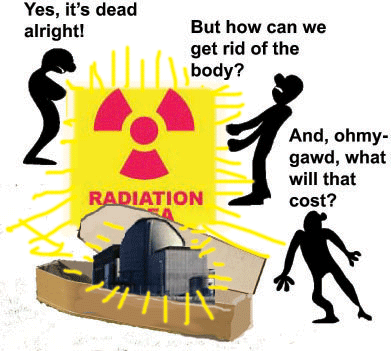
And, eventually, plants come to the end of their lives and must be decommissioned, another big expense that energy companies would like to be borne by someone else. The Heinrich Böll Stiftung studysays:
“[T]here is a significant mismatch between the interests of commercial concerns and society in general. Huge costs that will only be incurred far in the future have little weight in commercial decisions because such costs are “discounted.” This means that waste disposal costs and decommissioning costs, which are at present no more than ill-supported guesses, are of little interest to commercial companies. From a moral point of view, the current generation should be extremely wary of leaving such an uncertain, expensive, and potentially dangerous legacy to a future generation to deal with when there are no ways of reliably ensuring that the current generation can bequeath the funds to deal with them, much less bear the physical risk. Similarly, the accident risk also plays no part in decision-making because the companies are absolved of this risk by international treaties that shift the risk to taxpayers.” [page 17]
The British government, for instance, currently foots more than three-quarters of the bill for radioactive waste management and decommissioning, and for nuclear legacy sites. A report prepared for Parliament estimates that total public liability to date just for this program is around £50 billion, with tens of billions more to come……….http://www.counterpunch.org/2016/01/01/nuclear-energy-dangerous-to-your-wallet-not-only-the-environment/
Pro Nuclear Spin: denial of radiation effects, of Fukushima harm
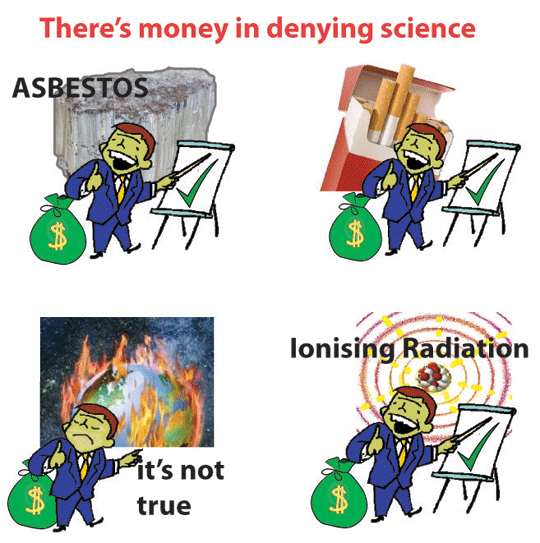
Denial in the face of evidence has certainly been an effective tool to frustrate worldwide efforts to address Climate Change. Why not attempt the same public relations makeover on radiation?
This new, bold initiative appears to be coming in a two-pronged attack: the first is reviving an already disproved theory that radiation may be ‘good for you’: hormesis.
The second is changing the world’s perception of the Fukushima Daiichi triple meltdown that released and deposited massive amounts of radioactivity in many areas of Japan.
The potential ramifications for public health are huge.
Demystifying Nuclear Power: Problem: In a post-Fukushima-triple-meltdown world, do the numbers work for atomic power? Fairewinds,November 17, 2015 by Sue Prent
With a giant blot still reading over the page of its public safety record, the multi-national, multi-billion dollar atomic power industry faces the stark economic reality that without even more of the regulatory and financial support that it has long enjoyed, it cannot successfully compete financially with sustainable methods electrical generation.
Moreover, these preferential government regulations and incredible financial subsidies from countries around the world are more concerned with maintaining a nuclear energy fleet that in the US has long been tied-up with Defense Department interests, and throughout the world has also been an assured method of access to nuclear weapons.
During the early days of atomic reactors, decommissioning, clean-up and long-term radioactive waste storage were not even acknowledged or planned for, and now they crowd onto center stage as aged and leaking plants line up to speedily shutdown and abandon their overflowing nuclear waste cesspools. In the US, people living near the plants and state governments without regulatory authority over this federal process are stunned to discover the financial burden of underfunded decommissioning funds and inadequate decommissioning procedures that will leave the public facing corporate waste abandonment.
That’s right, here’s the hook: if it weren’t for the scientific consensus view that radiation is harmful, and more radiation is even more harmful, nuclear plants might be a whole lot cheaper to operate.
Talk about your “inconvenient truth!”
Recent developments suggest that the atomic power industry, with cooperation from the US Nuclear Regulatory Commission (NRC), may have come up with a crafty way to make the financial numbers work once again: rehabilitate radiation. Continue reading
Weakening of nuclear radiation standards would certainly suit Nuclear Medicine Industry

 Demystifying Nuclear Power: Problem: In a post-Fukushima-triple-meltdown world, do the numbers work for atomic power? Fairewinds,November 17, 2015 by Sue Prent “…..Nuclear medicine interests share some of the existential angst experienced by their atomic energy sector colleagues. So it is not surprising that Carol Marcus Ph.D., M.D. is a professor of Nuclear Medicine at U.C.L.A is one of the petitioners to the NRC to demand that it relax radiation illness standards. Nuclear medicine is where expansion of the development and application of new radiology treatments and specialized equipment represent a huge corporate industrial growth opportunity.
Ms. Marcus and her colleagues have a special interest in countering many medical evaluations and admonitions that are routinely raised by doctors and hospitals around the world about the over-use of radiation for diagnosis and treatment.
Adoption of the hormesis theory of benign radiation would really help the nuclear medicine industry as much as it will help the atomic reactor power industry. In fact, Dr. Marcus’ petition to the NRC seems to equate the fact that radiation can be useful in diagnosis and treatment of cancer with evidence that low-dose radiation is indeed beneficial, in spite of years of data proving that is not true, including the lengthy German study.
To that, one must counter that the benefits brought to cancer treatment by radiation have a very specific tissue-destroying capacity rather than any positive health function. There is no scientifically corroborated benefit for even an extremely low-dose of radiation. Rather than providing any actual proof for her hypothesis, the balance of Dr. Marcus’ petition seems to be filled with complaints detailing how existing radiation protection guidelines hamstring her profession.
The second petition to end LNT, submitted by Certified Health Physicist Mark L. Miller relies heavily on language identical to that of Dr. Marcus, suggesting a collaborative relationship.
The third petition was submitted by a group lead by one of the principle voices supporting the hormesis theory, Mohan Doss Ph.D. His cosigner’s predictably represent atomic corporate interests that have heavily financially invested in the success and expansion of atomic industries.
According to the Fox Chase Cancer Center website, Mr. Doss, who is an MCCPM (Member of the Canadian College of Physicists in Medicine) radiology practice includes
Mr. Doss, who has found a well-spring of opportunity in the convenient meme of hormesis, is quoted along with the other two petitioners in a New York Times article that uses the number of deaths from suicide and accident that have occurred among evacuees from Fukushima evacuation zone as a rallying call……… http://www.fairewinds.org/nuclear-energy-education/demystifying-nuclear-power-problem-in-a-post-fukushima-triple-meltdown-world-do-the-numbers-work-for-atomic-power
Scientists used X ray images to prove the ecosystem damage from ionising radiation

 The X-Ray Images That Showed Midcentury Scientists How Radiation Affects an Ecosystem http://www.slate.com/blogs/the_vault/2015/12/28/how_midcentury_ecologists_used_x_ray_radioautographs_to_see_how_radiation.html By Laura J. Martin In June 1947, biologists from the University of Washington collected a wrasse from the waters around Bikini Atoll, squished it against a photographic plate, and took an x-ray. The resulting image shocked them. Almost an entire year had passed since the United States had detonated “Able” and “Baker,” two fission bombs, at the atoll. The scientists involved in the Bikini Scientific Resurvey were certain that the expansive Pacific Ocean would have quickly diluted and dispersed any radioactive products from the 1946 detonations.
And yet here, in dazzling white, was radiation revealed. Bikini Atoll’s biota had absorbed the products of the explosions. More curious, still: the radioactivity was not distributed evenly across a fish’s body. It seemed to be concentrated in the digestive system.
The U.S. Atomic Energy Commission was the main funder of ecological research in the United States from World War II until the 1970s. Between 1946 and 1962, the United States exploded 105 atomic and nuclear weapons in these inhabited Pacific atolls, changing their ecology, as well as the science of ecology itself. During this time the Commission continued to contract ecologists from the University of Washington and other institutions to return to the proving grounds.
The first studies done by the University of Washington Radiation Ecology laboratory—assembled by the Manhattan Project under strict confidentiality in 1943—had reflected the Manhattan Project’s belief that the major hazard of atomic technology was prolonged exposure to external sources of highly penetrative gamma radiation. The biologists burned specimens to ash and then passed those ashes through a Geiger counter. But during the Bikini Scientific Resurvey, they decided to employ a relatively new and more efficient method, “radioautography,” based on the assumption that a radioactive sample placed against photographic film would produce a brighter or darker image, depending on how much radiation reacted with the film.
Over the next two decades, such radioautographs led to the emergence of the idea that radiation is “biomagnified” as it moves up the food chain. This concept wouldprove essential to convincing legislators to ban DDT and restrict other pollutants. Interconnections among species—the objects of abstract flow charts in the 1930s —became brilliantly visible.
A number of other photos from the Pacific Surveys can be viewed at the University of Washington’s Digital Collection at this link.
Laura J. Martin is an environmental historian. She is a Ziff Environmental Fellow at the Harvard University Center for the Environment and a postdoc in the Department of the History of Science. Visit her website or find her on Twitter.
USA: Your town’s radiation levels this week

 Fukushima Update: “Your Radiation This Week, BEFORE IT’S NEWS, Dec 19 to Dec 26, 2015″ By Bob Nichols
Normal Radiation is 5 to 20 CPM. 50 CPM is an alert level.
RADIATION CPM* • TIMES NORMAL BACKGROUND LEVEL • CITY, STATE • TYPE (
Baby Pulse Spikes Rad Monitors in US: ..……
The facts: Fukushima today
The herculean cleanup of Fukushima Prefecture involves 105 cities, towns, and villages. Unlike Chernobyl where authorities declared a 1,000 square mile no-habitation zone and resettlement of 350,000 people, thus allowing radiation to dissipate over decades-to-centuries, Japan is attempting to remake Fukushima back into its old self. But, radioactive material collected in millions of black bags is a vexing problem for the ages.
Adding to the lingering problem of transporting and storing radioactive waste, over time, the bags will likely deteriorate and need to be replaced with fresh bags. It is an endless cycle.
Handling radioactive waste in Japan may become generational employment, similar to how second and third generation workers eventually completed the grand cathedrals of Europe, like Notre Dame de Paris with a cornerstone laid in 1163 resulting in major construction completed circa 1250.
 Fukushima Today, Dissident Voice by Robert Hunziker / December 29th, 2015 Throughout the world, the name Fukushima has become synonymous with nuclear disaster and running for the hills. Yet, Fukushima may be one of the least understood disasters in modern times, as nobody knows how to fix either the problem nor the true dimension of the damage. Thus, Fukushima is in uncharted territory, a total nuclear meltdown that dances to its own rhythm. Similar to an overly concerned parent, TEPCO merely monitors but makes big mistakes along the way.
Over time, bits and pieces of information about Fukushima Prefecture come to surface. For example, Arkadiusz Podniesinski, the noted documentary photographer of Chernobyl, recently visited Fukushima. His photos and commentary depict a scenario of ruination and anxiety, a sense of hopelessness for the future.
Ominously, the broken down Fukushima Daiichi Nuclear Power Plant looms in the background of everybody’s life, like the seemingly indestructible iconic image of destruction itself, Godzilla with its signature “atomic breath.”
Podniesinski’s commentary clearly identifies the blame for the nuclear accident, namely:………
Within Fukushima, Orange Zones are designated as less contaminated but still uninhabitable because radiation levels run 20-50 mSv/y, but decontamination work is underway. Residents are allowed to visit homes for short duration only during the daytime. However, as it happens, very few people are seen. Most of the former residents do not want to go back and the wooden houses in many of the towns and villages are severely dilapidated.
The lowest radiation areas are designated the Green Zone (< 20 mSv/y), where decontamination work is complete and evacuation orders are to be lifted.
Enormous black sealed bags filled with radioactive soil and all kinds of sizzling waste are stacked across the countryside, as approximately 20,000 workers thoroughly cleanse soil, rooftops, streets, and gutters. House-by-house, workers scrub rooftops and walls by hand.
The radioactive-contained black bags are trucked outside of towns to the far outskirts where thousands upon thousands upon thousands of big black bags are stacked. An aerial view of these temporary storage sites appears like gigantic quilts of rectangular shapes neatly, geometrically spread across the landscape for as far as the eye can see. The government claims the radioactive-contained black bags will be gone from the countryside within 30 years, but where to?………
The herculean cleanup of Fukushima Prefecture involves 105 cities, towns, and villages. Unlike Chernobyl where authorities declared a 1,000 square mile no-habitation zone and resettlement of 350,000 people, thus allowing radiation to dissipate over decades-to-centuries, Japan is attempting to remake Fukushima back into its old self. But, radioactive material collected in millions of black bags is a vexing problem for the ages.
In that regard, Japanese authorities have commissioned construction of a massive landfill just outside of the Fukushima Daiichi Power Plant, expected to contain 16-to-22 million bags of debris, enough to fill 15 baseball stadiums. Unfortunately, bags filled with radioactivity are more than a mere headache; they are more like a severe migraine. A truck can carry 6-8 of the huge bags at a time, and with so many, it could take decades to move the material. Adding to the lingering problem of transporting and storing radioactive waste, over time, the bags will likely deteriorate and need to be replaced with fresh bags. It is an endless cycle.
Handling radioactive waste in Japan may become generational employment, similar to how second and third generation workers eventually completed the grand cathedrals of Europe, like Notre Dame de Paris with a cornerstone laid in 1163 resulting in major construction completed circa 1250. http://dissidentvoice.org/2015/12/fukushima-today/
“Radiation Sensors in Major U.S. Cities Turned Off By EPA
BEFORE IT’S NEWS, Dec 19 to Dec 26, 2015″ By Bob Nichols”………“Radiation Sensors in Major U.S. Cities Turned Off By EPA”: Billings, Montana on Oct 16, 2015 was reading a Combined Beta and Gamma Rad of 1,227 Beta and 703 Gamma for a Combined reading of 1,930CPM. The Beta Rad unit stopped publicly reporting, then four (4) days later on Oct 20, 2015 at 12:37:25 the unit came to life again. It’s… ahh, personality had changed, though. The new Beta and Gamma reading was 926 Beta and 401 Gamma. The new Combined radiation number on Oct 20 was 1,227 CPM Combined. The Combined reading was 603 CPM less than it was 4 days before. There was no Note or Comment on the missing four days. It was a 4 Day Rad Gap and an unexplained disappearance of 603CPM. The disappearing CPM was comprised of 302 CPM Gamma and 301 CPM Beta. In the next 4 Hours the Combined CPM eroded another 550 CPM for a total CPM Loss of 1,153 CPM. Billings, Montana today is barely in the List of cities above 1000 CPM. Billings is now 23rd on the list and reads 1,101 CPM. The missing Radiation remains “Unaccounted For.” Presumably it [the radiation] did not go to the Moon; therefore, it is on Earth somewhere now. (So, they apparently tried to “rig” the system and failed, so instead turned it all off. Just my hunch… – CP)USA’s new Protective Action Guidelines (PAG) designed to protect the nuclear industry
New Protection Action Guidelines Will Leave You Chilled to the Bone, Nuclear World, Marti LeRoux 26 Dec 15, “………..On April 15th, 2013 a request for public comment regarding the new Protective Action Guidelines or PAGs was published in the Federal Register while at the same time, the EPA made the new PAGs effective immediately. Obviously, the request for public comment was just a dog and pony show designed to give the illusion of presenting the new PAGs in a public forum.
The new PAGs released under the Obama administration puts our health at risk due to its utter lack of concern regarding skyrocketing cancer rates, genetic mutations, miscarriages, infertility and other radiation induced health issues that will manifest as a direct result of these new PAGs. (Ironically, the majority of these health issues can easily be blamed on the victim’s poor eating habits, radiophobia, “genetic predisposition” and a host of other things, but it’s doubtful the word “nuclear radiation” will never be uttered.)
The vague and misleading language deliberately engineered to leave you vulnerable and unprotected will also leave you chilled to the bone once you comprehend the full impact of just how inept the new PAGs are. The root problem lies in the unconcealed fact that these new PAGs “allow massive radiation exposures without any protective actions being recommended to limit them.”
To add insult to injury, the new PAGs bury the new changes in footnotes. These changes are not included in the document itself, only citations referencing other reports. Not one word is mentioned as to how the new PAGs compare to previously established protections in the Safe Drinking Water Act (SDWA).
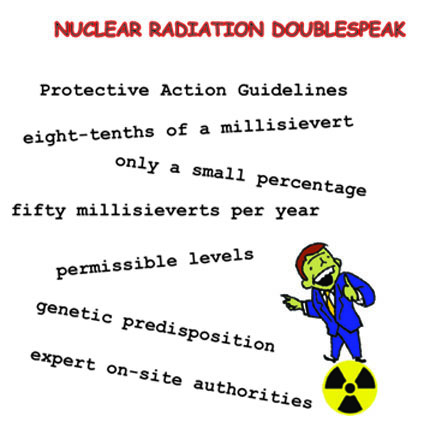
According to the Public Employees for Environmental Responsibility (PEER), the new Protective Action Guides would disturbingly raise allowed levels of radiation in food, water, air, and the environment. PEER is a national organization of local, state, and federal employees who were justifiably alarmed over internal EPA emails regarding new PAG standards. PEER claims these new PAGs will cause a “nearly 1000-fold increase for exposure to strontium-90, a 3000 to 100,000-fold hike for exposure to iodine-131; and an almost 25,000 rise for exposure to radioactive nickel-63″ in drinking water.
The EPA is turning its back on its responsibility, as previous limitations assured that we would not be exposed to “more than 5 rem over 50 years.”
These new PAGs may be the final nail in the coffin if they are not immediately repealed and the older, more responsible PAGs are reestablished.
Suspiciously, since 2011 (coincidentally the same year Fukushima started spewing its unrelenting radioactive poison all over the world) the EPA has been planning on raising limits. These planning sessions took place behind closed doors due to a loophole, since PAGs are considered “guidance” and therefore do not require public input as proposed new regulations would. However, the problem arises as these new “permissible levels” are treated as if they carry the same weight as a regulation would. It’s scary business indeed, as internal documents obtained by PEER under the Freedom of Information Act (FOIA) show evidence that the new “permissible levels” would allow a single glass of drinking water to contain, “the equivalent of a lifetime’s permissible exposure.”
These new PAGs are hard to swallow, as they grant “on-site authorities” a great degree of latitude in ignoring previously established limits. They also leave the EPA unaccountable. What is most concerning, is that the term “on-site authorities” is very vague and misleading. I believe it is our duty to question who qualifies as an “on-site authority.” The first thing that pops into my mind is some corporate flunky with a clip board and a checklist or a lab coat clad EPA employee well versed in all the loopholes contained within the new PAGs. Anyway you slice it, these new PAGs spell disaster for the US population as a whole. http://www.nuclearworld.net/pag/
Christmas joy for the weapons makers, especially in USA
 US foreign arms deals up by nearly $13 billion December 27, 2015 Nicholas Fandos The United States controls just over 50 per cent of the world’s weapons markets, Read more: http://www.theage.com.au/world/us-foreign-arms-deals-up-by-nearly-13-billion-20151226-glv3sx.html#ixzz3vU4qe9zF Nicholas Fandos, 27 Dedc 15 . Washington: Foreign arms sales by the United States jumped by almost $US10 billion ($13 billion) in 2014, about 35 per cent, even as the global weapons market remained flat and competition among suppliers increased, a new congressional study has found.
American weapons receipts rose to $US36.2 billion in 2014 from $US26.7 billion the year before, bolstered by multibillion-dollar agreements with Qatar, Saudi Arabia and South Korea. Those deals and others ensured that the United States remained the single largest provider of arms around the world last year, controlling just over 50 per cent of the market.
Russia followed the US as the top weapons supplier, completing $US10.2 billion in sales, compared with $US10.3 billion in 2013. Sweden was third, with roughly $US5.5 billion in sales, followed by France with $US4.4 billion and China with $US2.2 billion.
South Korea, a key US ally, was the world’s top weapons buyer in 2014, completing $US7.8 billion in contracts. It has faced continued tensions with neighbouring North Korea in recent years over the North’s nuclear weapons program and other provocations. The bulk of South Korea’s purchases were made with the United States, worth more than $US7 billion, and included transport helicopters and related support, as well as advanced unmanned aerial surveillance vehicles.
Brazil, another developing nation building its military force, was third with $US6.5 billion worth of purchase agreements, primarily for Swedish aircraft.
The report to Congress found that total global arms sales rose slightly in 2014 to $US71.8 billion, from $US70.1 billion in 2013. Despite that increase, the report concluded that “the international arms market is not likely growing over all” because of “the weakened state of the global economy”.
It was the second successive year that global sales remained steady, suggesting that the market has begun to level off after several years of extreme fluctuation.
Read more:
ENE News summarises the most shocking points in India’s scandalous nuclear history
 “Nuclear Nightmare”: Children with mutations “on almost every street” — Deformed heads, lopsided bodies, “toad skin”, eyelids turned inside out — School built using radioactive waste “part of community outreach project” — Nuclear Expert: “Exceptionally worrying, no one should’ve been living anywhere near” (VIDEO)http://enenews.com/nuclear-nightmare-village-birth-defects-deformed-heads-lopsided-bodies-toad-skin-eyelids-turned-inside-school-built-radioactive-waste-children-mutations-almost-every-street-video?utm_source=feedburner&utm_medium=email&utm_campaign=Feed%3A+ENENews+%28Energy+News%29Excerpts from report on Huffington Post, Dec 14, 2015 (emphasis added):
- How India’s Nuclear Industry Created A River Of Death…
- Researchers found that the Subarnarekha river and areas around Jadugoda, India, werepoisoned from the emissions of a nearby secret nuclear factory…
- [T]he Center for Public Integrity has reviewed hundreds of pages of personal testimony and clinical reports in the case that present a disturbing scenario…
- Doctors and health workers, as well as international radiation experts, say that nuclear chiefs have repeatedly suppressed or rebuffed their warnings… The case files include epidemiological and medical surveys warning of a high incidence of infertility, birth defects and congenital illnesses…
- [Dipak Ghosh, a respected Indian physicist and dean of the Faculty of Science at Jadavpur University, with his] team collected samples from the river and from adjacent wells, seven years ago, he was alarmed by the results… “It was potentially catastrophic,” Ghosh said in a recent interview. Millions of people along the waterway were potentially exposed…
- Many said their children were born with partially formed skulls, blood disorders,missing eyes or toes, fused fingers or brittle limbs…
- Analyzing a representative sample of people between 4 and 60 years old living within a mile and a half of the third tailing dam, the researchers hired by [Uranium Corporation of India Limited] concluded that the residents were “affected by radiation.”… symptoms included swollen joints, spleens and livers, and coughing up blood. The UCIL report also described “osteoporosis, defective limbs, and habitual abortion,” as well as many complaints of “missed menstrual cycle” and a cluster of cancer cases…
- [A]n American diplomat [warned that] “lax safety measures … are exposing local tribal communities to radiation contamination.” In a confidential cable to Washington, Henry V. Jardine, a career foreign service officer and former Army captain, expressed blunt dismay… In a new cable on June 6, 2008… Jardine told Washington that still another epidemiological study had concluded “indigenous groups … living close to the mines reportedly suffer high-rates of cancer, physical deformities, blindness, brain damage and other ailments.” UCIL “refuses to acknowledge these issues,” he noted. Jardine wrapped up: “Post contacts, citing independent research, say that it is difficult to point out any reason other than radiation…”
- Surendra Gadekar, a nuclear physicist, began taking soil, water and air samples… Their study was published in 2004… It found radiation levels inside the villages around the tailing ponds were almost 60 times the U.S. Nuclear Regulatory Commission “safe level.”… [They] also documented the existence in neighboring populations of children withmalformed torsos and deformed heads and the wrong number of fingers, as well as a cluster of cases where infants’ bodies grew at different rates, giving them alopsided gait. Some had hyperkeratosis, a condition known as “toad skin”…
- In late 2000, [Hiroaki Koide, a nuclear engineer who teaches at the Research Reactor Institute at Kyoto University] took soil and water samples… “These figures wereexceptionally worrying,” Koide said. “No one should have been living anywhere near“… Koide confirmed that uranium rock and finely ground mine tailings had been used as ballast for road leveling and house building and to construct a local school and clinic… [A] senior UCIL official… confirmed these construction projects using irradiated materials had gone ahead as “part of a community outreach project.”
Toronto Star, Sep 15, 2014: India’s nuclear nightmare: The village of birth defects… Neither Alowati nor Duniya can walk, nor can they hold anything; their limbs dangle lifelessly… Their knees and elbows are rubbed raw from crawling… They need help to bathe and use the toilet. Children with birth deformities like Alowati and Duniya live on almost every street in Jadugora… When people began to notice that young women were having miscarriages, witches and spirits were blamed… But people had lesions, children were born with deformities, hair loss was common. Cows couldn’t give birth, hens laid fewer eggs, fish had skin diseases… [L]ocal media reports… included shocking pictures of children who were sick or deformed… A 2007 report by the Indian Doctors for Peace and Development, a non-profit, found a far greater incidence of congenital deformity, sterility and cancer… Mohammad is 13 but looks 7. Like Alowati and Duniya, he drags himself forward with his elbows… A few huts away [a child’s] eyelids are turned inside out…
Vulnerability of India’s nuclear materials to theft
India’s nuclear explosive materials are vulnerable to theft, U.S. officials and experts say. But Washington has chosen not to press for tougher security while its trade with India is booming, Center For Public Integrity, By Adrian Levy R. Jeffrey Smith 17 Dec 15 “…….. officials here and outside India depict as serious shortcomings in the country’s nuclear guard force, tasked with defending one of the world’s largest stockpiles of fissile material and nuclear explosives.
An estimated 90 to 110 Indian nuclear bombs are stored in six or so government-run sites patrolled by the same security force, according to the Stockholm International Peace Research Institute, an independent think tank, and Indian officials. Within the next two decades, as many as 57 reactors could also be operating under the force’s protection, as well as four plants where spent nuclear fuel is dissolved in chemicals to separate out plutonium to make new fuel or be used in nuclear bombs.
The sites are spread out over vast distances: from the stony foothills of the Himalayas in the north down to the red earth of the tropical south. Shuttling hundreds of miles in between will be occasional convoys of lightly-protected trucks laden with explosive and fissile materials — including plutonium and enriched uranium — that could be used in civilian and military reactors or to spark a nuclear blast.
The Kalpakkam shooting as a result alarmed Indian and Western officials who question whether this country — which is surrounded by unstable neighbors and has a history of civil tumult — has taken adequate precautions to safeguard its sensitive facilities and keep the building blocks of a devastating nuclear bomb from being stolen by insiders with grievances, ill motives, or in the worst case, connections to terrorists.
Although experts say they regard the issue as urgent, Washington is not pressing India for quick reforms. The Obama administration is instead trying to avoid any dispute that might interrupt a planned expansion of U.S. military sales to Delhi, several senior U.S. officials said in interviews.
The experts’ concerns are based in part on a series of documented nuclear security lapses in the past two decades, in addition to the shooting:
- Several kilograms of what authorities described as semi-processed uranium were stolen by a criminal gang, allegedly with Pakistani links, from a state mine in Meghalya, in northeastern India, in 1994. Four years later, a federal politician was arrested near the West Bengal border with 100 kilograms of uranium from India’s Jadugoda mining complex that he was allegedly attempting to sell to Pakistani sympathizers associated with the same gang. A police dossier seen by the Center states that ten more people connected with smuggling were arrested two years after this, in operations that recovered 57 pounds of stolen uranium.
- In 2008, another criminal gang was caught attempting to smuggle low-grade uranium, capable of being used in a primitive radiation-dispersal device, from one of India’s state-owned mines across the border to Nepal. The same year another group was caught moving an illicit stock of uranium over the border to Bangladesh, the gang having been assisted by the son of an employee at India’s Atomic Minerals Division, which supervises uranium mining and processing.
- In 2009, a nuclear reactor employee in southwest India deliberately poisoned dozens of his colleagues with a radioactive isotope, taking advantage of numerous gaps in plant security, according to an internal government report seen by the Center.
- And in 2013, leftist guerillas in northeast India illegally obtained uranium ore from a government-run milling complex in northeast India and strapped it to high explosives to make a crude bomb before being caught by police, according to an inspector involved in the case. Continue reading
Fukushima Prefecture’s problem of disposal of radioactive trash
Behind the Scenes / Waste disposal site a dilemma for Fukushima, Japan Times 21 Dec 15 By Yuki Inamura and Keita Aimoto / Yomiuri Shimbun Staff Writes
On Dec. 4, the Fukushima prefectural government notified the national government that it would accept a proposal to dispose of the radioactive designated waste [definition below page] stored in the prefecture, where a catastrophic accident struck Tokyo Electric Power Co.’s Fukushima No. 1 nuclear power plant due to the 2011 earthquake. The Fukushima prefectural government’s recent decision signifies a step forward in efforts to rehabilitate the nuclear disaster-hit prefecture. However, the latest move poses a dilemma: In some neighboring prefectures that are home to a large amount of such designated waste, there are persistent calls for their waste to be concentrated in Fukushima Prefecture.

The government’s proposal would entail the use of the Fukushima Eco-tech Clean Center, an existing private-sector disposal plant in the town of Tomioka, to bury a portion of the designated waste stored in the prefecture. The waste subject to this disposal will consist of garbage and other waste material whose radiation levels stand at 100,000 becquerels or less per kilogram.
Two years ago, the national government formally presented the proposal to the Fukushima prefectural government. This coincided with the national government’s move to unveil another plan aimed at building an interim storage facility in the prefecture. This facility would be used to store, for extended periods, garbage whose radioactive levels exceed 100,000 becquerels per kilogram as well as a massive amount of contaminated soil. There has been a constant increase in the amount of contaminated soil as a result of ongoing decontamination work. The interim storage facility is currently being built. Continue reading
Excavation planned – removal of NUMEC nuclear waste dump in Parks Township
NUMEC nuclear waste dump in Parks Township will be excavated http://triblive.com/neighborhoods/yourallekiskivalley/yourallekiskivalleymore/9678472-74/nuclear-corps-materials#axzz3v71kOvgB
According to the U.S. Nuclear Regulatory Commission, Special Nuclear Material is only “mildly radioactive” but can include fissile material — uranium-233, uranium-235 and plutonium-239 — that, in concentrated form, can be the primary ingredients of nuclear explosives.
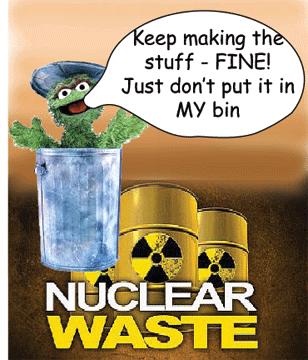 By Mary Ann Thomas, Dec. 22, 2015 After finding more complex radioactive contamination than expected in 2011 at the nuclear waste dump in Parks Township, the Army Corps of Engineers announced Tuesday it will stay the course for a $350 million project to dig up and remove 36,000 tons of waste.
The Corps shut down the cleanup four years ago after unearthing more highly radioactive nuclear materials that required special handling, escalating cleanup costs.
The defunct Nuclear Materials and Equipment Corp. and successors, the Atlantic Richfield Co. and Babcock & Wilcox disposed of uranium, plutonium and other hazardous materials at the 44-acre, Armstrong county, site from 1960 until the early 1970s. With plants in Parks and Apollo, those companies produced fuel for Navy nuclear reactors, nuclear power plants and other government entities.
The Corps will release its request for proposals from contractors and likely name a new cleanup company in 2017. The contractor will develop new plans and start digging again in 2018. The waste will then be shipped out of state.
The project is expected to finish between 2026 and 2028 : http://triblive.com/neighborhoods/yourallekiskivalley/yourallekiskivalleymore/9678472-74/nuclear-corps-materials#ixzz3v728qWVp
World’s largest nuclear fusion reactor launched by Germany
 Germany launches world’s largest nuclear fusion reactor The rocky road to nuclear fusion power, DW, 18 Dec 15 Innovative designs using modern superconductors are supposed to bring us nuclear fusion power plants soon – some optimists say. Fusion experts predict, however, that a practical application will take many more decades. Nuclear fusion is considered a potential energy source of the future. It’s clean nuclear energy. But what is it, exactly and why is it so difficult to generate? Let’s start with the difference between classical nuclear fission and nuclear fusion.
Nuclear fission means that radioactive isotopes, like uranium or plutonium are being split up and turned into other highly radioactive isotopes that then have to be deposited or reprocessed.
Nuclear fusion means that two isotopes of hydrogen – called deuterium and tritium – merge together – they “fuse.” And that leaves behind only non-poisonous helium and one single neutron, but no nuclear waste.
Huge amounts of energy caught in a plasma
Nuclear fusion takes place in the sun for example – or in a hydrogen bomb – and that’s the big challenge for engineers – how do you control the high energy fusion process in a power plant?
That’s what scientists have been working on since the 1960s. One model-fusion-reactor called Wendelstein 7-X has just started operating in the northern German town of Greifswald. It is not designed to generate a nuclear fusion reaction yet – so far it’s just a specific reactor design that’s being tested.
What all fusion reactors have in common is a ring-shaped form. The idea behind it is to take powerful electromagnets and create a strong electromagnetic field, which is shaped somewhat like an inflated bicycle tube.
That electromagnetic field must be so dense that when it is being heated by a microwave oven to about one million degrees centigrade, a plasma will emerge in the very center of the ring. And that plasma can then be ignited to start the nuclear fusion process.
Research reactors show what’s possible
In Europe, two prominent fusion experiments are under way. One is Wendelstein 7-X, which just generated its first helium plasma last week – albeit without actually going into nuclear fusion. The other one is ITER – a huge experimental project in southern France, which is still under construction and won’t be ready to run before 2023.
ITER is supposed to do real nuclear fusion – but only for short periods of time, certainly not for any longer than 60 minutes. And ITER is just one of many steps towards turning the idea of nuclear fusion into a practical application.
Are smaller, alternative designs feasible?………
Hot, hot, hot
The heat is also problematic. In the core of the nuclear-fusion plasma, the temperature would be around 150 million centigrade. This extreme heat stays put – right there in the center of the plasma. But even around it, it still gets seriously hot – 500 to 700 degrees at the breeding blanket – which is the inner layer of the metal tube that contains the plasma and which will serve to “breed” the tritium that is needed for the fusion reaction.
Even more problematic is the so called “power-exhaust.” That is the part of the system, where the used-up fuel from the fusion process is being extracted – mostly helium. The first metal components hit by hot gases are called the “diverter.” It can get hotter than 2,000 degrees centigrade.
The engineers are trying to use the metal tungsten, used in old-fashioned light bulbs – to withstand such temperatures. They have a melting point of around 3,000 degrees. But there are limits.
“In the case of ITER we can do it, because the heat is not there constantly. Only one to three percent of the time, ITER will eventually be running.” Hesch says. “But that is not an option for a power plant, which has to run 24/7. And if someone pretends to build a smaller reactor with the same power as ITER, I can definitely say – there is no solution for that diverter-problem.”
Several decades to build a real power plant
Nonetheless Hesch is optimistic that the development of nuclear fusion power reactors will go ahead – but not quite as fast as some of the industry optimists predict.
“With ITER we want to show that fusion can actually deliver more energy than we have to put into it to heat the plasma. The next step would be to build an entirely new fusion demonstrator power plant, which will actually generate electricity.”
The engineers are already working on the designs now. They will have to learn lessons from ITER, which is scheduled to start operating in 2023. Taking the necessary time for design, planning and construction into account, it looks very unlikely the first nuclear-fusion power plant will be up and running much before the middle of the century. http://www.dw.com/en/the-rocky-road-to-nuclear-fusion-power/a-18927630
1 This Month



26 September – International Day for the Total Elimination of Nuclear Weapons


PLEASE OPPOSE HR 8255 AND S.3639 – bills would accelerate satellite deployment, with no environmental review or safeguards – https://ncstd5li.quorum.us/campaign/169331/
To see nuclear-related stories in greater depth and intensity – go to https://nuclearinformation.wordpress.com
-
Archives
- September 2026 (245)
- August 2026 (330)
- July 2026 (355)
- June 2026 (287)
- May 2026 (306)
- April 2026 (356)
- March 2026 (251)
- February 2026 (267)
- January 2026 (308)
- December 2025 (358)
- November 2025 (359)
- October 2025 (375)
-
Categories
- 1
- 1 NUCLEAR ISSUES
- business and costs
- climate change
- culture and arts
- ENERGY
- environment
- health
- history
- indigenous issues
- Legal
- marketing of nuclear
- media
- opposition to nuclear
- PERSONAL STORIES
- politics
- politics international
- Religion and ethics
- safety
- secrets,lies and civil liberties
- spinbuster
- technology
- Uranium
- wastes
- weapons and war
- Women
- 2 WORLD
- ACTION
- AFRICA
- Atrocities
- AUSTRALIA
- Christina's notes
- Christina's themes
- culture and arts
- Events
- Fuk 2022
- Fuk 2023
- Fukushima 2017
- Fukushima 2018
- fukushima 2019
- Fukushima 2020
- Fukushima 2021
- general
- global warming
- Humour (God we need it)
- Nuclear
- RARE EARTHS
- Reference
- resources – print
- Resources -audiovicual
- Weekly Newsletter
- World
- World Nuclear
- YouTube
-
RSS
Entries RSS
Comments RSS
 nuclear-news