The Thorium Nuclear Dream – a critical assessment
 Thorium: new and improved nuclear energy? https://wiseinternational.org/nuclear-energy/thorium-new-and-improved-nuclear-energy
There is quite some – sometimes tiresome – rhetoric of thorium enthusiasts. Let’s call them thor-bores. Their arguments have little merit but they refuse to go away.
Here are some facts:
- There is no “thorium reactor.” There is a proposal to use thorium as a fuel in various reactor designs including light-water reactors–as well as fast breeder reactors.
- You still need uranium – or even plutonium – in a reactor using thorium. Thorium is not a fissile material and cannot either start or sustain a chain reaction. Therefore, a reactor using thorium would also need either enriched uranium or plutonium to initiate the chain reaction and sustain it until enough of the thorium has converted to fissile uranium (U-233) to sustain it.
- Using plutonium sets up proliferation risks. To make a “thorium reactor” work, one must (a) mix the thorium with plutonium that has been stripped of the highly radioactive fission products; (b) use the mixed-oxide thorium-plutonium fuel in a reactor, whereby the plutonium atoms fission and produce power while the thorium atoms absorb neutrons and are turned into uranium-233 (a man-made isotope of uranium that has never existed in nature); (c) strip the fission products from the uranium-233 and mix THAT with thorium in order to continue the “cycle”. In this phase, the U-233 atoms fission and produce power while the thorium atoms absorb neutrons and generate MORE uranium-233. And so the cycle continues, generating more and more fission product wastes.
- Uranium-233 is also excellent weapons-grade material. Unlike any other type of uranium fuel, uranium-233 is 100 percent enriched from the outset and thus is an excellent weapons-grade material and as effective as plutonium-239 for making nuclear bombs. This makes it very proliferation-prone and a tempting target for theft by criminal and terrorist organizations and for use by national governments in creating nuclear weapons.
- Proliferation risks are not negated by thorium mixed with U-238. It has been claimed that thorium fuel cycles with reprocessing would be much less of a proliferation risk because the thorium can be mixed with uranium-238. In fact, fissile uranium-233 must first be mixed with non-fissile uranium-238. If the U-238 content is high enough, it is claimed that the mixture cannot be used to make bombs with out uranium enrichment. However, while more U-238 does dilute the U-233, it also results in the production of more plutonium-239, so the proliferation problem remains.
- Thorium would trigger a resumption of reprocessing in the US. In most proposed thorium fuel cycles, reprocessing is required to separate out the U-233 for use in fresh fuel. Reprocessing chemically separates plutonium and uranium and creates a large amount of so-called low-level but still highly radioactive liquid, gaseous and solid wastes.
- Using thorium does not eliminate the problem of long-lived radioactive waste. Fission of thorium creates long-lived fission products including technetium-99 (half-life of over 200,000 years). Without reprocessing, thorium-232 is itself extremely long-lived (half-life of 14 billion years) and its decay products will build up over time in irradiated fuel. Therefore, in addition to all the fission products produced, the irradiated fuel is also quite radiotoxic. Wastes that pose long-term hazards are also produced at the “front end” of the thorium fuel cycle during mining, just as with the uranium fuel cycle.
- Attempts to develop “thorium reactors” have failed for decades. No commercial “thoriumreactor” exists anywhere in the world. India has been attempting, without success, to develop a thorium breeder fuel cycle for decades. Other countries including the US and Russia have researched the development of thorium fuel for more than half a century without overcoming technical complications.
- Fabricating “thorium fuel” is dangerous to health. The process involves the production of U-232 which is extremely radioactive and very dangerous in small quantities. The inhalation of a unit of radioactivity of thorium-232 or thorium-228 produces a far higher dose than the inhalation of uranium containing the same amount of radioactivity. A single particle in the lung would exceed legal radiation standards for the general public.
- Fabricating “thorium fuel” is expensive. The thorium fuel cycle would be more expensive than the uranium fuel cycle. Using a traditional light-water (once-through) reactor, thorium fuel would need both uranium enrichment (or plutonium separation) and thorium target rod production. Using a breeder reactor makes costly reprocessing necessary.
Widespread and lingering medical effects of the Chernobyl nuclear disaster
 The Medical Implications of the 1986 Chernobyl Nuclear Disaster http://www.globalresearch.ca/the-medical-implications-of-the-1986-chernobyl-nuclear-disaster/5521671 Thirty Years Ago, April 1986 By Helen Caldicott Global Research, April 25, 2016 The following text by renowned scientist
and physician Dr. Helen Caldicott on the impacts of the 1986 Chernobyl will be followed in a subsequent article by an analysis of the medical implications of the Fukushima disaster
 The only on-site medical and epidemiological data gathered after Chernobyl was released in a report published by the New York Academy of Medicine in 2009 titled “Chernobyl – Consequences of the Catastrophe for People and the Environment,” which was gleaned from over 5000 papers published largely in Russian and translated into English.
These studies were gathered mainly from populations residing in the heavily irradiated zones in the Ukraine, Belarus and European Russia. However the Russian government classified all the relevant medical data for 3 years.
The Chernobyl 1986 catastrophe has turned into a new medical experiment conducted on millions of innocent people, much like the populations of Hiroshima and Nagasaki.
Because, the International Atomic Energy Agency, the United Nations Security Committee on the Effects of Atomic Radiation and the World Health Organisation never collected data from real patients, instead to their discredit they estimated the number of potential diseases that they derived only from calculations of radioactive releases and extrapolated doses.
Hence it is vitally important to scientifically and epidemiologically document the many illnesses which arose after the accident so that the medical profession can learn from these shocking accidents. These papers presented in the Chernobyl report by the NY Academy of Sciences attempt to do so. Some people say that they are not adequately peer reviewed so they should be ignored, however they are the only on-the-ground documentations of the many illnesses afflicting the irradiated populations
In essence 28 years after the accident, 50% of thirteen European countries are still contaminated by a variety of long-lived radioactive elements and the medical effects are severe in some areas. Before Chernobyl, 80% of the children in Belarus were healthy and now only 20% remain in good health.
Millions of people initially were exposed to very high radiation doses from short-lived radioactive elements so the initial radiation doses were thousands of times higher than doses received 3 years later.
Types of radioactive elements Continue reading
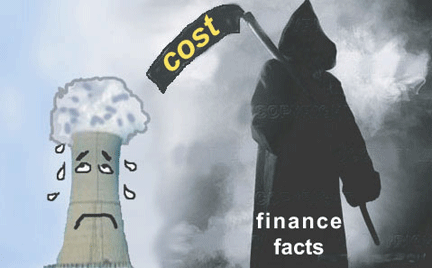
Central bankers, financial facts, bringing an end to the nuclear power era?
Central Bankers Stimulate Nuclear End That Evaded Activists http://www.bloomberg.com/news/articles/2016-04-25/central-bankers-stimulate-end-for-nuclear-that-evaded-activists Jonathan Tirone April 26, 2016 —
-
Interest rates near record lows cut funds for decommissioning
-
Industry faces $1 trillion of liabilities from retiring plants
-
Central banks may accomplish what a generation of anti-nuclear activists have failed to do: Force operators to finally decommission almost 150 reactors now sitting in limbo across the globe.

The plants have been shut down, either because they’re too expensive to run or because of concerns about their safety or age. They can’t send electricity to the grid, and they’ll need the special funds saved over decades for formal decommissioning and clean-up of radioactive waste.
In the past, many operators delayed decommissioning to allow growth in the clean-up funds. As the global economy weakened, however, and central banks kept interest rates low, the principal in some of those funds shrank. Last year in the U.S., seven of the 10 biggest funds lost money, falling to $43.7 billion, a drop of 1.1 percent. Now, with projected costs rising, industry advocates say owners are more likely to opt for full decommissioning before the funds decline further.
- “One can’t rely as much on fund growth as in the past,” said Patrick Joseph O’Sullivan, a decommissioning specialist with the International Atomic Energy Agency. “It’s actually pushing utilities to think about bringing forward all this work because they’re not able to rely anymore on assuming high returns on investments.”
- The change in emphasis comes 30 years after the April 26, 1986 explosion at the Chernobyl reactor spread radioactive fallout across Europe. That event, followed 25 years later by meltdown at the Fukushima plant in Japan, undercut nuclear as a power generator as low-cost options like natural gas and renewable energies became increasingly available.A 2005 report by the IAEA forecast costs to shut a 1,000 megawatt reactor would range from 150 million euros ($169 million) to 750 million euros. In the U.S., the country with the most decommissioning experience, actual costs have ranged from $307 million to $819 million, according to the Nuclear Energy Agency.
Twenty-four U.S. decommissioning projects with site-specific estimates will require average clean-up funds of about $750 million per reactor, the U.S. Nuclear Regulatory Commission reported. Those costs jive with an estimate by Exelon Corp., which operates reactors at 15 U.S. nuclear power plants.
- Exelon estimates it will take $1 billion to decommission its 2-unit plant in Zion, Illinois. It told shareholders in February that “sustained low market prices or depressed demand” could accelerate “asset retirement obligation expense related to future decommissioning activities.” Exelon’s clean-up fund fell 2 percent to $10.3 billion last year.Utilities operating in Germany including EON SE, RWE AG and Vattenfall SE have set aside funds deemed “acceptable” by regulators to cover 47.5 billion euros of estimated costs to decommission the country’s 17 reactors. Shares of those utilities jumped in February after reports that the German government would kick in an additional 17.7 billion euros to help store the radioactive waste.
“Understanding of these costs is fundamental for the development of estimates based on realistic decommissioning plans,” the Paris-based Nuclear Energy Agency said last month in a 260-page report prepared for regulators and utilities. “More and more questions are raised over the adequacy of the necessary infrastructure and human resources, as well as the ability and mechanisms to finance the costs.”
There are 438 nuclear reactors in operation worldwide and less than 4 percent of the power reactors built have been fully decommissioned. Fewer still have figured out how to store waste for the thousands of years it will remain dangerous.
- “For us, the trend toward early dismantling has important advantages,” said the IAEA’s O’Sullivan. “It will contribute to better burden sharing between current and future generations.”About $200 billion will be spent worldwide in the next 20 years on decommissioning the world’s aging fleet of reactors, Thomas LaGuardia, an American nuclear engineer who is helping the IAEA to establish decommissioning guidelines, said in an interview. Nuclear operators that haven’t saved sufficient decommissioning funds may opt to put plants in safe storage until their accounts bulk up, he said.
- Project management and environmental remediation companies in the U.S. and Europe could see their markets grow as utilities draw down decommissioning funds to shut aging reactors, Swedish radiation safety analyst Simon Carroll said in an interview.“One person’s cost is another man’s income,” he said.
Sweden’s decommissioning fund fell 0.5 percent last year, Carroll said in an e-mail. The country reported on Tuesday that returns on it’s 59.3 billion krona ($7.3 billion) Nuclear Waste Fund also dropped 0.5 percent in 2015.
Wildlife continues to suffer seriously from radiation at Chernobyl and Fukushima
Our studies provide new fundamental insights about consequences of chronic, multigenerational exposure to low-dose ionizing radiation. Most importantly, we have found that individual organisms are injured by radiation in a variety of ways. The cumulative effects of these injuries result in lower population sizes and reduced biodiversity in high-radiation areas.
Broad impacts at Chernobyl
 Radiation exposure has caused genetic damage and increased mutation rates in many organisms in the Chernobyl region. So far, we have found little convincing evidence that many organisms there are evolving to become more resistant to radiation.
Organisms’ evolutionary history may play a large role in determining how vulnerable they are to radiation. In our studies, species that have historically shown high mutation rates, such as the barn swallow (Hirundo rustica), the icterine warbler (Hippolais icterina) and the Eurasian blackcap (Sylvia atricapilla), are among the most likely to show population declinesin Chernobyl. Our hypothesis is that species differ in their ability to repair DNA, and this affects both DNA substitution rates and susceptibility to radiation from Chernobyl.
Much like human survivors of the Hiroshima and Nagasaki atomic bombs, birds and mammals at Chernobyl have cataracts in their eyes andsmaller brains. These are direct consequences of exposure to ionizing radiation in air, water and food. Like some cancer patients undergoing radiation therapy, many of the birds have malformed sperm. In the most radioactive areas, up to 40 percent of male birds are completely sterile, with no sperm or just a few dead sperm in their reproductive tracts during the breeding season.
Tumors, presumably cancerous, are obvious on some birds in high-radiation areas. So are developmental abnormalities in some plants and insects.
Given overwhelming evidence of genetic damage and injury to individuals, it is not surprising that populations of many organisms in highly contaminated areas have shrunk. In Chernobyl, all major groups of animals that we surveyed were less abundant in more radioactive areas. This includes birds, butterflies, dragonflies, bees, grasshoppers, spiders and large and small mammals.
Not every species shows the same pattern of decline. Many species, including wolves, show no effects of radiation on their population density. A few species of birds appear to be more abundant in more radioactive areas. In both cases, higher numbers may reflect the fact that there are fewer competitors or predators for these species in highly radioactive areas.
Moreover, vast areas of the Chernobyl Exclusion Zone are not presently heavily contaminated, and appear to provide a refuge for many species. One report published in 2015 described game animals such as wild boar and elk as thriving in the Chernobyl ecosystem. But nearly all documented consequences of radiation in Chernobyl and Fukushima have found that individual organisms exposed to radiation suffer serious harm.
There may be exceptions. For example, substances called antioxidants can defend against the damage to DNA, proteins and lipids caused by ionizing radiation. The levels of antioxidants that individuals have available in their bodies may play an important role in reducing the damage caused by radiation. There is evidence that some birds may have adapted to radiation by changing the way they use antioxidants in their bodies.
Parallels at Fukushima
Recently we have tested the validity of our Chernobyl studies by repeating them in Fukushima, Japan. The 2011 power loss and core meltdown at three nuclear reactors there released about one-tenth as much radioactive material as the Chernobyl disaster.
Overall, we have found similar patterns of declines in abundance and diversity of birds, although some species are more sensitive to radiation than others. We have also found declines in some insects, such as butterflies, which may reflect the accumulation of harmful mutationsover multiple generations.
Our most recent studies at Fukushima have benefited from more sophisticated analyses of radiation doses received by animals. In our most recent paper, we teamed up with radioecologists to reconstruct the doses received by about 7,000 birds. The parallels we have found between Chernobyl and Fukushima provide strong evidence that radiation is the underlying cause of the effects we have observed in both locations.
Some members of the radiation regulatory community have been slow to acknowledge how nuclear accidents have harmed wildlife. For example, the U.N.-sponsored Chernobyl Forum instigated the notion that the accident has had a positive impact on living organisms in the exclusion zone because of the lack of human activities. A more recent report of the United Nations Scientific Committee on the Effects of Atomic Radiation predicts minimal consequences for the biota animal and plant life of the Fukushima region.
Unfortunately these official assessments were largely based on predictions from theoretical models, not on direct empirical observations of the plants and animals living in these regions. Based on our research, and that of others, it is now known that animals living under the full range of stresses in nature are far more sensitive to the effects of radiation than previously believed. Although field studies sometimes lack the controlled settings needed for precise scientific experimentation, they make up for this with a more realistic description of natural processes.
Our emphasis on documenting radiation effects under “natural” conditions using wild organisms has provided many discoveries that will help us to prepare for the next nuclear accident or act of nuclear terrorism. This information is absolutely needed if we are to protect the environment not just for man, but also for the living organisms and ecosystem services that sustain all life on this planet……https://theconversation.com/at-chernobyl-and-fukushima-radioactivity-has-seriously-harmed-wildlife-57030
Germany wrestles with the dilemma of disposing of dead nuclear reactors and thier toxic wastes
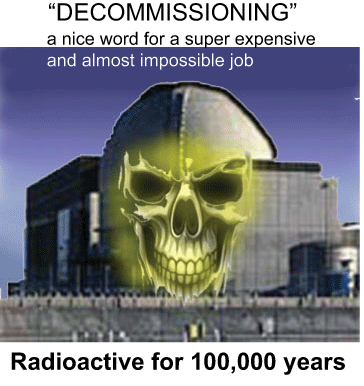 Nuclear reactor sites: Dismantle or fence off? http://www.dw.com/en/nuclear-reactor-sites-dismantle-or-fence-off/a-19111969, 26 Apr 16, Three decades after the Chernobyl disaster, Germany is preparing to go nuclear-free. Industry plans to dismantle and dispose of radioactive waste. But some green campaigners say it’s safer to leave reactor sites as-is.
Thirty years ago, the Chernobyl disaster released radioactivity that spread across much of the northern hemisphere into the atmosphere. It also spurred social movements around the world to demand an end to nuclear power.
In Germany, that end is finally in sight ,as the country prepares to go nuclear-free by 2022. But the task of safely decommissioning and dismantling nuclear power stations promises to be expensive and controversial, and will take many years.
Debate rages over how to dispose of highly radioactive spent fuel rods from commercial nuclear power stations. But there is less awareness around how the dissolving industry and its regulators must also decide what to do with disused reactor sites.
Masses of equipment and a variety of buildings at the sites were exposed to nuclear fission reaction products for years, and have become slightly or moderately radioactive as a result. Therein lies the crux of the disposal problem.
Big money, long time
The consultancy ADL has estimated it will take about two decades to fully dismantle Germany’s 17 nuclear reactor sites, and cost at least 18 billion euros – not including the cost of subsequent radioactive waste disposal.
Why will it take so long and cost so much? DW posed this question to E.ON, Germany’s largest electricity utility and owner of 11 nuclear power stations – most of them already shut down.
An E.ON spokesperson said dismantling of reactor sites must take place in stages. First, spent uranium fuel rods must be transported off-site, to interim storage elsewhere. This can’t happen until four or five years after a reactor is shut down, because the fuel rods’ radioactivity first needs to decrease sufficiently for their safe handling to become possible.
Dismantling equipment is then expected to take 10 to 15 years. Final demolition of remaining buildings and site remediation will take another two to three years after all radioactive materials have been removed from the former reactor site.
Radioactive waste materials can be treated by a variety of means – compression, desiccation, enclosure in cement, or burning to ash – to reduce total volume prior to packing, shipping, and final disposal in an approved secure long-term storage site, E.ON said.
Put it in a deep, dry hole
Schacht Konrad, a disused iron-ore mine shaft near the German town of Salzgitter, is under consideration as the national site for the final disposal of low- to medium-grade radioactive materials.
The mine was chosen because it is particularly dry inside – reducing the risk of radioactive materials dissolving and entering into the groundwater. It’s meant to take in around 90 percent (by volume) of all the radioactive rubble from decontaminated nuclear sites in Germany – but only the mildly radioactive stuff.
German law specifies a threshold of very low radioactivity below which materials are deemed safe. Materials that fall below the threshold can legally be disposed of through the regular waste disposal system. But some anti-nuclear campaigners insist there’s no safe threshold, however low.
In contrast to low-level, mildly radioactive waste from former reactor sites, highly radioactive waste – including spent fuel rods – will be left in cooling ponds on closed-down reactor sites for some decades. Ultimately, they’ll be disposed of in one or more special high-security repositories. The location of those repositories is highly contentious, and has not yet been settled.
Leave them where they’re standing?
While the government and nuclear industry are keen to get on with dismantling and removing reactors soon after they’re shut down, Jörg Schmid and Henrik Paulitz of the German division of the International Physicians for the Prevention of Nuclear War (IPPNW) think perhaps they shouldn’t be dismantled at all.
“Dismantling nuclear reactors is expensive and poses health dangers,” according to an IPPNW report in German published in January of this year.
In the report, Schmid and Paulitz say that serious consideration should be given to the option of securely fencing off old nuclear reactor sites and allowing low-level radioactivity from contaminated buildings and equipment to recede over decades.
The IPPNW’s preferred solution would see heavily contaminated elements such as spent fuel rods be removed immediately, while the less-contaminated buildings and equipment would be left in situ indefinitely.
This would avoid dispersing the radioactive material more widely, and minimize risk to human populations, the study’s authors argue.
E.ON told DW that fencing off sites was neither more nor less safe than dismantling them – but argued that dismantling is a better solution in terms of the labor market consequences.
“IPPNW’s option would mean that 300 to 400 people who work at a nuclear site would abruptly lose their jobs,” the spokesperson said.
But Paulitz countered: “The nuclear industry must answer the question: is the proposed dismantling of the reactor sites a necessary measure, or is it just a new multi-billion-euro industry?”
Radioactive steel in children’s bedrooms?
About 99 percent of the total mass of material at a former nuclear site is radioactive at such a low level that it is deemed safe – so the material is no longer covered by nuclear safety regulations and can be released into the environment, according to IPPNW’s Schmid, who is a medical doctor.
But Schmid said that what matters is total radiation exposure over time. If very large amounts of very weakly radioactive material are dispersed through the environment, for example by being reintroduced into material supply chains, that represents a significant amount of broadcast radiation exposure over time.
Dismantling nuclear power plants, Paulitz said, leads to a problem: “The great majority of the site’s materials won’t be classified as nuclear waste, and will instead be disposed of in ordinary household waste streams, or even recycled into normal supply chains.”
“From a health and safety perspective, we see this as irresponsible.” Paulitz said, as weakly radioactive steel taken from a dismantled nuclear site could end up built into a radiator in a child’s bedroom, for example.
Danger of Chernobyl nuclear reactor wreck will remain for thousands of years
Ruined Chernobyl nuclear plant will remain a threat for 3,000 years @mattschodcnews BY MATTHEW SCHOFIELD mschofield@mcclatchydc.com , Miami Herald, 24 Apr 16,
- 30 years since Chernobyl may seem like a long time, but it’s really just the start
- Below reactor’s ruins is a 2,000-ton radioactive mass that can’t be removed
- How do you protect a site for as long a time as Western civilization has existed?
….It will be 30 years ago on 26 April that Pripyat and the nearby Chernobyl nuclear plant became synonymous with nuclear disaster, that the word Chernobyl came to mean more than just a little village in rural Ukraine, and this place became more than just another spot in the shadowy Soviet Union.
Even 30 years later – 25 years after the country that built it ceased to exist – the full damage of that day is still argued.
Death toll estimates run from hundreds to millions. The area near the reactor is both a teeming wildlife refuge and an irradiated ghost-scape. Much of eastern and central Europe continues to deal with fallout aftermath. The infamous Reactor Number 4 remains a problem that is neither solved nor solvable………..
All told, about 4,000 people would eventually die from the accident, according to a report by the World Health Organization and the International Atomic Energy Agency.
Others say those numbers are wildly low. Alexey Yablokov, a former environment adviser to Russian President Boris Yeltsin, estimated the global death toll to be 1.44 million. Other reports placed the cancer death totals at 30,000 to 60,000. Belarusian physicist Georgiy Lepin, a vice president of the association of liquidators of Chernobyl, the men brought in to fight the fire and clean up, estimated that within a few years, 13,000 rescue workers had died and another 70,000 were left unfit for work. The official number of disabled Chernobyl rescue workers today in Ukraine is 106,000.
A United Nations study says that “5 million people currently live in areas of Belarus, Russia and Ukraine that are contaminated with radionuclides due to the accident; about 100,000 of them live in areas classified in the past by government authorities as areas of ‘strict control.’ ”……….
What they figured out was the worst nuclear-energy disaster in human history, far worse than the explosion at Kyshtym nuclear complex in 1957 in what was then the Soviet Union, which released 70 tons of radioactive material into the air, or the 1957 fire at the Windscale Nuclear Reactor in northwestern England, which forced a ban on milk sales for a month, or the Three Mile Island disaster in Pennsylvania on March 29, 1979, where a cooling malfunction led to a partial meltdown.
All of central and eastern Europe was at risk. Even today, in Bavaria in southern Germany, wildlife officials warn hunters not to eat the meat of wild boars, which continue to show high levels of radiation contamination……..http://www.miamiherald.com/news/nation-world/world/article73405857.html
Global nuclear salesmen still not happy with India’s Nuclear Liability Law
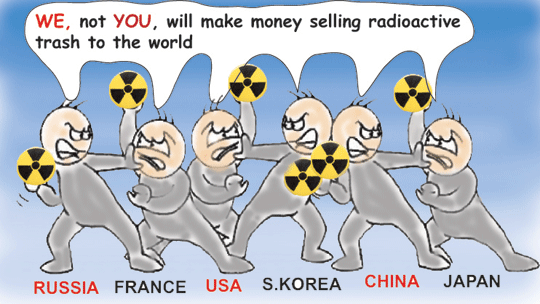 Concern Over India’s Nuclear Liability Law Still Remains: French Firm EDF http://www.ndtv.com/india-news/concern-over-indias-nuclear-liability-law-still-remains-french-firm-edf-1398896
The fresh techno-commercial proposal will also take into account India’s concern over high per unit tariff, French government officials said.
“The French feel that there is a lot of ambiguity in Clause 46 and there is fear in the minds of suppliers. We have raised this issue both with NPCIL and the Department of Atomic Energy,” said a French official.
Last month, Nuclear Power Corporation of India Limited (NPCIL) had signed an agreement for building six European Pressurised Reactors (EPR) as against the earlier proposal of two such reactors.
The delay in the project, which was first signed in 2008, and concern over India’s liability law came in the wake of nuclear firms Areva and EDF merging their reactor businesses into a joint venture controlled by EDF, as part of a broad restructuring last year.
In 2014, the US too had raised similar concerns about Clause 46 in particular.
In April last year, Areva had also signed an agreement with NPCIL to expedite the programme.
“Things are unclear over how much insurance cover does supplier have to take. There is still a lot of ambiguity in this,” the French official said.
The French government officials said the liability issue is still “manageable” but pricing still remains a major hurdle.
While the cost of the electricity generated by Kudankulam Nuclear Power Project (KKNPP) Units I and II hovers between Rs. 3 to 3.50 per unit, for JNPP, it is expected to be Rs. 9.14 per unit. India is not ready to go beyond Rs. 6.50 per unit.
The intractable thousands of years problem of Chernobyl’s radioactive debris
 Ruined Chernobyl nuclear plant will remain a threat for 3,000 years @mattschodcnews BY MATTHEW SCHOFIELD mschofield@mcclatchydc.com , Miami Herald, 24 Apr 16,
 “…………When the steam burst through the roof of Reactor Number 4 in 1986, it took with it 5 percent of the enriched uranium. That means 10 tons vanished. It also means 95 percent, or 190 tons, remained. They’re still there.
After the blasted reactor partially collapsed into the nuclear material, it created a radioactive blob of uranium, concrete, steel and assorted junk weighing about 2,000 tons. Ideally, Ukraine would remove the material. Sergiy Parashyn grabs a pen and paper as he talks about the problems with that.
“We do not know how to do this,” he explains. “We do not have the technology to do this. It must be something new.”……
“One problem is that the material is decaying and is brittle, and when we cut it up to transport it to disposal bins, it will very likely fill the air with radioactive dust,” he explains. So the tractor has to be able to operate in a radioactive environment, it has to be able to control and eliminate any dust and it has to operate in an area that will not be at all safe for humans. “Maybe something like this would work, maybe it wouldn’t. We don’t know. That’s a problem.”
It’s a problem because while 5 percent of the radioactive material caused problems that continue 30 years later and will continue to cause problems for eons to come, the other 95 percent of the material could represent about 20 times the problems.
For instance, if mistakes are made and the brittle material is released into the atmosphere, they’re back to square one. If the material gets into the Pripyat River, it will flow into the Dnieper River. The Dnieper River is the water source for Kiev. The Dnieper is the primary water source for much of Ukraine.
This is why Ukrainian officials are counting on what they call a sarcophagus to contain the site, a massive structure that looks like a Quonset hut being assembled behind a wall that is intended to deflect radiation from the decaying plant from workers.
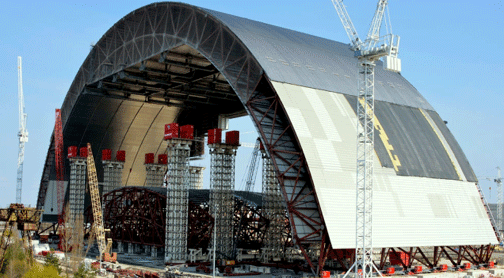
When finished, it will be rolled across the crumbling concrete of the surrounding ground to cover and further seal the dangerous reactor. The work is expected to be completed in 2018, though that is just a guess. It’s expected to last 100 years. It’s not nearly long enough.
Reactor Number 4 today is essentially an unplanned nuclear-waste dump. To serve in that role requires it to last for 3,000 years. That means the area surrounding Chernobyl will be safe to inhabit by people again in the year 4986.
How likely is that? To get an idea of what it means to contain and control a deadly and potentially devastating radioactive pile in Ukraine for 3,000 years, consider what the world looked like 3,000 years ago:……
Detlef Appel, a geologist who runs PanGeo, a Hamburg, Germany, company that consults on such nuclear storage issues, notes that 3,000 years probably isn’t long enough. He suggests that truly safe radioactive waste storage needs to extend a million years into the future. Think back to when man’s earliest relative began to walk the Earth.
“We can trust human endeavor, perhaps, for a few hundred years, though that is doubtful,” he said. “Storage implies a way to retrieve the materials. It requires trained personnel, maintenance, updating and security. Clearly, nothing man made is more than temporary, and therefore it isn’t adequate.”
Even the continents will have moved in a million years.
Tetiana Verbytska, an energy policy expert at the National Ecological Center of Ukraine, worries that people are far too easygoing about Chernobyl. Among government officials right now, mindful of the 30-year anniversary, there is a movement to shrink the radius of the highly contaminated no man’s land from 18 miles to 6.
“The move to reduce the highly contaminated zone has nothing to do with science and everything to do with public relations,” she says. “In Ukraine, each April we make wonderful speeches about our commitment to dealing with this problem, and the rest of each year we hope the problem will just go away.”
There are other reasons to worry. Ukraine is creaking under a civil war against insurgents backed by Russia and scraping by with an economy that in the decades since the collapse of the Soviet Union has been looted by a series of oligarchs. It doesn’t have the money to fund an educational system that can be expected to create legions of top scientists and engineers.
Officials speak very proudly of the new sarcophagus roof that is being put into place. But the finish date on that has been repeatedly backed up, and there’s no guarantee that its 2018 date won’t be moved again.
A variety of disasters could still strike. The site’s existing covering, built in haste after the accident, could collapse, shattering the brittle mix of radioactive materials below and sending nuclear dust into the atmosphere to mix with rain. There could be an earthquake. The entire site is fragile.
Olga Kosharna, the lead scientist at the Ukrainian Department of Energy and Nuclear Safety in Kiev who oversaw safety at Chernobyl in the 1990s, recalls walking the roof above the shattered reactor and being horrified to find holes that had been burned through the concrete.
The shoes she wore that day were highly contaminated and had to be destroyed.
Alexandre Polack, a spokesman for the European Union, notes in an email that the date to begin removing radioactive material from the site is still 20 to 30 years away. “The current shelter covering destroyed Reactor 4 was reinforced in recent years and seems stable,” he writes. “However it was built in haste after the accident and never intended as a long-term solution.”
Verbytska emphasizes that the mass of uranium debris inside Reactor Number 4 is now a mess that goes beyond human ability to clean up. Others dismiss the situation as a problem, but one that technology can fix.
“We don’t have the technology to fix the problem,” she says. “We don’t have the process to develop the technology to fix the problem, and we don’t have the money to support the process to develop the technology to fix the problem. The solutions for our Chernobyl problems are very much ‘seal it for now.’ We will have smart children and smart grandchildren who in 100 years or so will figure out what to do.”
After the disaster, radiation burned off the tops of the trees. Soviet officials ordered the trees cut down and buried deep. But they failed to properly encase the buried wood. As a new forest grew unchecked above the radioactive remains of the old forest, the new wood was also highly radioactive. The whole thing will have to be dug up and encased and buried again, properly. http://www.miamiherald.com/news/nation-world/world/article73405857.html
How ionising radiation affects our bodies

The high-energy radiation given off by radioactive decay can take the form of very high speed particles (electrons in the case of beta radiation; two protons and two neutrons in alpha radiation) or waves (gamma or X-rays).
Regardless of the form it takes, all nuclear radiation has enough energy to strip electrons off atoms and molecules that it interacts with, earning it the name ionising radiation.
It is this electron-stripping (ionising) property that does the damage to our cells and tissues.
As well as generating heat, the removal of electrons can break chemical bonds. When that happens in a molecule of DNA it can cause mutations, which can lead to cancer down the track. And ionising a protein can mess with its shape and function — not something you want in the molecules that coordinate most of the chemistry in our cells.
Those effects are compounded when water molecules (H2O) in our bodies are ionised into the high energy free radicals OH– and H+, which can go on to attack other nearby molecules and cells.
Our bodies are full of water, and almost all cells have DNA, but some cells and tissues are more susceptible to damage from nuclear radiation than others.
Which cells in the body are most affected by radiation?The cells and organs that are most affected by nuclear radiation are the ones that are actively reproducing, because the DNA is more exposed when the cell is in the process of dividing.
Blood cells have the highest turnover rate in our bodies, so the tissue where they are produced — the rapidly dividing cells of the bone marrow — is the most susceptible to radiation damage.
The damage to bone marrow in high doses — and complete destruction of it in very high doses — impairs our immune system by not replacing our white blood cells.
Long-term exposure to lower doses can lead to cancerous DNA mutations in the marrow, which can lead to the blood cancer leukaemia in people exposed through work or location………
Developing foetuses are, of course, incredibly susceptible to radiation, ……
Exposure to external radiation is one thing, but ingesting radioactive particles takes the damage to another level.
Inhaling or swallowing radioactive material delivers the source of radiation directly to your cells, increasing the risk of cancer developing in the tissues where they accumulate.
Radioactive iodine (iodine-131) blown into the atmosphere by the 1986 Chernobyl explosion caused a large number of cases of thyroid cancer in people who drank contaminated milk. (Having been released in the clouds of radioactive material following the explosion, the iodine — a by-product of nuclear fission reactions — landed on fields where it was swallowed by cows).
Iodine is essential for the normal function of the thyroid gland, and with its knack for attracting iodine the gland gets a concentrated dose of iodine-131 when contaminated milk is drunk. Thankfully, thyroid cancer is treatable by removal of the gland, although a lifetime of hormone supplements follows. With a half-life of just eight days, the level of radioactive iodine fell off quickly after the accident, so the risk of exposure dropped within weeks of the disaster.
Not so with the radioactive isotope of caesium-137, which has a half-life of 30 years. Caesium is very soluble in water, so when it enters our bloodstream via contaminated food or water it ends up spreading throughout our bodies, and concentrating in muscle tissue in particular. Our bodies eventually turn over these tissues, but it takes three months to reduce the amount of caesium in our muscles by half, so the long-term exposure to beta and gamma radiation increases the chances of cancer developing in those tissues.
With a half-life of 29 years, strontium-90 joins caesium-137 as a long-lasting source of harmful radiation after nuclear accidents.
Strontium is chemically very similar to calcium, so if you ingest food contaminated with radioactive strontium isotopes like strontium-90, it ends up wherever calcium normally would — primarily in the bones.
In adults, strontium accumulates mainly on the surface of bones, but in children it can be incorporated into the growing bone itself. The beta radiation given off as the radioactive atoms decay into more stable forms can damage the bone marrow and lead to bone cancer. http://www.abc.net.au/news/2016-04-22/what-nuclear-radiation-does-to-your-body/7346324
Blowing away the dishonest spin of the nuclear lobby against renewable energy
 Renewable energy versus nuclear: dispelling the myths http://www.theecologist.org/News/news_analysis/2987577/renewable_energy_versus_nuclear_dispelling_the_myths.html Mark Diesendorf 19th April 2016
Don’t believe the spurious claims of nuclear shills constantly doing down renewables, writes Mark Diesendorf. Clean, safe renewable energy technologies have the potential to supply 100% of the world’s electricity needs – but the first hurdle is to refute the deliberately misleading myths designed to promote the politically powerful but ultimately doomed nuclear industry.
Nuclear energy and renewable energy (RE) are the principal competitors for low-carbon electricity in many countries.
As RE technologies have grown in volume and investment, and become much cheaper, nuclear proponents and deniers of climate science have become deniers of RE.
The strategies and tactics of RE deniers are very similar to those of climate science deniers.
To create uncertainty about the ability of RE to power an industrial society, they bombard decision-makers and the media with negative myths about RE and positive myths about nuclear energy, attempting to turn these myths into conventional wisdom.
In responding to the climate crisis, few countries have the economic resources to expand investment substantially in both nuclear and RE. This is demonstrated in 2016 by the UK government, which is offering huge long-term subsidies to nuclear while severely cutting existing short-term subsidies to RE.
This article, a sequel to one busting the myth that we need base-load power stations such as nuclear or coal, examines critically some of the other myths about nuclear energy and RE. It offers a resource for those who wish to question these myths. The myths discussed here have been drawn from comments by nuclear proponents and RE opponents in the media, articles, blogs and on-line comments.
Myth 1: Base-load power stations are necessary to supply base-load demand. Continue reading
Chernobyl’s nuclear nightmare – a timeline
Chernobyl: Timeline of a nuclear nightmare http://www.wtsp.com/news/nation-now/chernobyl-timeline-of-a-nuclear-nightmare/138536883 Kim Hjelmgaard and USA TODAY , April 17, 2016

Timeline of a disaster
February 1986:
Ukraine’s Minister of Power and Electrification Vitali Sklyarov tells Soviet Life magazine that the odds of a meltdown at Chernobyl’s nuclear power plant are “one in 10,000 years.”
April 25, 1986:
The plant’s operators prepare to conduct a special test to see how an emergency water cooling system would fare in the event of a complete loss of power.
April 26, 1986:
The test begins at 1:23.04 a.m.
Fifty-six seconds later, pressure builds in the reactor No. 4 in the form of steam. This causes an explosion that lifts a 1,000-ton lid that covers volatile fuel elements. Radiation is immediately released into the air.
As oxygen pours into the reactor, a graphite fire begins. A chemical reaction causes a second explosion, and burning debris lands on the roof of reactor No. 3.
Meanwhile, the engineer responsible for the night shift, Alexander Akinhov, does not yet think the reactor’s core is damaged. “The reactor is OK, we have no problems,” he says. Akinhov subsequently dies from radiation illness.
Thirty separate fires develop. An alarm goes off at a local fire station.
At 1.45 a.m. firefighters arrive. They know nothing about radiation and aren’t wearing any protective clothing. Driver Grigory Khmel later recalls: “We saw graphite lying everywhere. I kicked a bit of it. Another fireman picked up a piece and said ‘hot.’ Neither of us had any idea of radiation. My colleagues Kolya, Pravik and others all went up the ladder of the reactor. I never saw them again.”
At 3:12 a.m. an alarm goes off at an army base deep in the Soviet Union. The general in charge decides to send troops. They arrive in Ukraine’s capital of Kiev at 2 p.m.
At 5 a.m. reactor No. 3 is shut down. Reactors No. 1 and 2 are stopped about 24 hours later.
April 27, 1986:
As more emergency response teams arrive, evacuations begin in a radius of 6 miles around the plant. April 28, 1986:
The Soviet Union publicly admits for the first time that an accident happened but gives few details.
An alarm goes off at a Swedish nuclear plant after the soles of shoes worn by a nuclear safety engineer there test positive for radioactivity. The radiation is traced to Chernobyl.
May 1, 1986:
May Day parades to celebrate workers go ahead as planned in Kiev and Belarus’ capital Minsk despite huge amounts of radiation continuing to be released. Wind, and radioactive clouds, blow back toward Kiev after initially drifting northwest toward Europe. Authorities believe that by holding these celebrations they will prevent panic.
May 14, 1986:
Soviet leader Mikhail Gorbachev talks about the accident live on television. He subsequently mobilizes hundreds of thousands of people, including military reservists from all parts of the Soviet Union, to help in the cleanup.
They become known as “liquidators.” Many will become ill and die from radiation-related diseases.
Gorbachev, in a 2006 memoir, says Chernobyl “was perhaps the real cause of the collapse of the Soviet Union.”
A bleak picture of the climate effects of “just a small” nuclear war
Nuclear Famine, Independent Australia 17 April 2016, Daryl Williams discusses a recent scientific report in which the devastating global impacts of a small nuclear conflict, including “nuclear famine”, are outlined.
THE COLD WAR is over, the Berlin Wall has fallen, nuclear warhead numbers have declined significantly — so the threat of nuclear catastrophe has passed, right?
Well, sadly no.
In fact, things may be more dangerous today than at the height of the Cold War.
Computer simulations of the indirect climate effects of even a “small” regional nuclear exchange indicate that the whole world would still be imperiled.
A recent 16-page scientific paper, ‘Multidecadal global cooling and unprecedented ozone loss following a ‘regional nuclear conflict‘, by Mills, Toon, Lee-Taylor and Robock, outlines the horrific unexpected consequences. Once you boil down the “science-speak” it paints a bleak picture – via an “Earth system model” which includes atmospheric chemistry, ocean dynamics and interactive sea ice and land components – which we should do everything we can to avoid.

It deserves far more attention than it has received and its findings should be informing our foreign, defence and emergency management policies. In summary, the scenario it simulates is as follows:
Firestorms in India and Pakistan from a “small” regional conflict and nuclear exchange would inject 5 Tg (or one million tonnes) of black carbon (smoke, soot, dust) into the stratosphere which spreads globally.
The black carbon heats the stratosphere (by up to an amazing 80 degrees C) and cools the lower atmosphere and surface (by 1.1 degrees C in the first four years, down to 1.6 degrees in the fifth year, slowly rising to 0.25 to 0.5 degrees 20 years later). The colder surface temperatures reduce precipitation by 6% globally for the first five years and still by 4.5% one decade on.
Oh, and hundreds of millions of Indians and Pakistanis would be incinerated to death … but let’s concentrate on the long-term climate repercussions.
The heating of the stratosphere caused by the black carbon produces a dramatic loss of ozone (30% to 45% at mid-latitudes for the first five years, 50 to 60% at northern high latitudes) giving ‘a global ozone loss on a scale never observed‘.
It is the combination of dramatic extended drops in surface temperatures termed ‘the coldest average surface temperatures in the last 1000 years’ and precipitation with a dramatic increase in UV radiation.
That spells big trouble for Earth in the form of
‘widespread damage to human health, agriculture, terrestrial and aquatic ecosystems.’
That is,
‘…combined cooling and enhanced UV would put significant pressures on global food supplies and could trigger global nuclear famine.’
As well, ‘… the average growing season is reduced by up to 40 days throughout the world’s agricultural zones over these five years’. The increased UV-B radiation would reduce plant height, shoot mass and foliage area, damage DNA and significantly increase insect losses. A 16% loss of ozone could reduce phytoplankton levels in the ocean by 15%, resulting in a loss of seven million tons of fish per year……..
Regional extremes can be worse. Large areas of continental landmasses would experience significantly greater cooling than average:
Winters (JJA) in southern Africa and South America would be up to 2.5 degrees C cooler on average for 5 years … [and] … most of North America, Asia, Europe and the Middle East would experience winters (DJF) that are 2.5 to 6 degrees C cooler … and summers (JJA) 1 to 4 degrees C cooler.
Which is worse than any volcanic winter in the last 1000 years. There would be significant regional drying over the Asian Monsoon region, including the Middle East, the Indian subcontinent and Southeast Asia, as well as the Amazon, the American South-East and Western Australia — which would be 20% to 60% drier.
All from a “minor” nuclear exchange between India and Pakistan……..https://independentaustralia.net/environment/environment-display/nuclear-famine,8893
Facts on Fukushima today
164,865: Fukushima residents who fled their homes after the disaster.
97,320: Number who still haven’t returned.
49: Municipalities in Fukushima that have completed decontamination work.
45: Number that have not.
30: Percent of electricity generated by nuclear power before the disaster.
1.7: Percent of electricity generated by nuclear power after the disaster.
3: Reactors currently online, out of 43 now workable.
54: Reactors with safety permits before the disaster.
53: Percent of the 1,017 Japanese in a March 5-6 Mainichi Shimbun newspaper survey who opposed restarting nuclear power plants.
30: Percent who supported restarts. The remaining 17 percent were undecided.
760,000: Metric tons of contaminated water currently stored at the Fukushima nuclear plant.
1,000: Tanks at the plant storing radioactive water after treatment.
7,000: Workers decommissioning the Fukushima plant.
26,000: Laborers on decontamination work offsite.
200: Becquerels of radioactive cesium per cubic meter (264 gallons) in seawater immediately off the plant in 2015.
50 million: Becquerels of cesium per cubic meter in the same water in 2011.
7,400: Maximum number of becquerels of cesium per cubic meter allowed in drinking water by the U.S. Environmental Protection Agency. ……………http://www.fukushimawatch.com/2016-04-14-harsh-reality-every-statistic-you-need-to-know-about-the-incredible-damage-of-the-fukushima-nuclear-disaster-since-2011.html
Rt.com outlines the 8 most dangerous nuclear plants near earthquake fault lines
 Disasters waiting to happen: 8 most dangerous nuclear plants near earthquake fault lines, Rt.com [excellent pictures] 5 Apr, 2016
“ ……….dozens of potential atomic bombs operate along seismic fault lines. Here are eight of the most deadly, including one that may never be built because of Fukushima.
Koeberg nuclear power plant, Capetown Koeberg is the only nuclear power plant on the continent of Africa and just 8km from the Milnerton fault, which crosses Table Bay. While the largest earthquake to hit the city came more than 200 years ago, the Milnerton fault has the potential to hit at least 6.5 on the Richter scale. Energy company Eskom have insisted the plant is built to “ensure that no radiation escapes under any conceivable circumstances, from an earthquake to a jumbo jet collision.”
Diablo Canyon Power Plant, California Situated along by the shores of the Pacific Ocean – and four active fault lines, this plant has come under scrutiny since Fukushima. Diablo Canyon’s two reactors lie in an earthquake red zone with the Hosgri fault, the Los Osos fault, the San Luis Bay fault, and the Shoreline fault all nearby – and the major San Andreas fault 80km away…..
Indian Point, New York The Empire State’s Indian Point is considered by many to be the next Fukushima.Not only has the plant been plagued with operational problems, but it is situated almost on top of the Rampano fault line.A study by Columbia University in 2008 suggested the New York area was at greater risk of high-magnitude earthquakes than first thought, with the discovery of a new potential disaster area, the Stamfrod-Peekskill line. A spill of radioactive water at the plant in January led environmentalists to call for its closure, with the Riverkeeper group declaring that the site, which runs reactors from the 1970s, “isn’t safe anyone.”
Jaitapur Nuclear Power Project, India The French company Areva NP are proposing to build one of the largest nuclear plants in the world in India, capable of producing 9900 MW of power. Greenpeace is among those opposing the six reactor plant, questioning the safety of its pressurized water cooling system and the shaky ground on which it might be built. Like Fukushima Daiichi, Jaitapur would be operate along by the sea. Critics say the 16 fault lines on the west coast pose a serious threat to safety. However, India’s Atomic Energy Regulatory Board are satisfied that there are no faults within5km.
Columbia Generating Station, Washington state The last nuclear power plant remaining in the Pacific Northwest, the Columbia Generating Station (CGS) could be a potential disaster because of its Fukushima-like boiling water reactor.It’s located near the Columbia river along the Cascadia subduction zone, acknowledged by the Washington State Department as capable of producing “some of the largest and most damaging earthquakes in the world.” A 2013 Seattle Times report quoted a geologist working with the Physicians for Social Responsibility as saying the plant had not undergone structural upgrades since its opening in 1984. A March 2015 risk assessment stated that seismic damage to the site “is low for CGS.”
Arkansas Nuclear One, Arkansas A study of the US Geological Survey hazard map suggests the Arkansas state nuclear plant could be at risk from the New Madrid zone, one of North America’s most active areas for earthquakes. A quake in 1811 was thought to be 8.0 on the Richter scale and reportedly rang bells over a thousand miles away in Boston. The US government warns the damage to the area is likely to be 20 times larger than a “big one” in California due to the “less fractured nature” of the rock.
Sendai Nuclear Power Station, Japan…….Sendai and other Japanese power plants need to withstand their precarious position near the tectonic plate zone called the Japan Trench. Because of plate movements in this area, the Pacific country is hit by an estimated 1,500 earthquakes per year.
Akkuyu Nuclear Plant, Turkey The US$20-billion Akkuyu Nuclear Power Plant in Turkey slated to go up along the Mediterranean coast is a joint project with Rosatom. Foundations for the four reactor facility were laid in April last year despite opposition to its location, which is approximately 25km from the Ecemis fault line. The Republic of Cyprus expressed its concern with the plans when Energy Minister Antonis Paschalides questioned the decision to construct it in “a seismically active area.” https://www.rt.com/news/339763-disaster-nuclear-earthquake-japan/
Nuclear industry up to their old tricks, spruiking “new nuclear”
But thorium can’t fuel a reactor by itself: rather, a uranium- or plutonium-fueled reactor can convert thorium-232 into fissionable (and plutonium-like, highly bomb-usable) uranium-233. Thorium’s proliferation [8], waste, safety, and cost problems differ only in detail from uranium’s: e.g., thorium ore makes less mill waste, but highly radioactive U-232 makes fabricating or reprocessing U-233 fuel hard and costly.

‘New’ nuclear reactors? Same old story, Ecologist, Amory Lovins 12th April 2016 The nuclear industry is forever reinventing itself with one brilliant ‘new’ idea after another, Amory Lovins wrote in this classic 2009 essay. But whether it’s touting the wonders of future SMRs, IFRs or LFTRs, the reality never changes: the reactors they are building right now are over time, over budget and beset by serious, entirely unforeseen technical problems….. Continue reading
1 This Month



26 September – International Day for the Total Elimination of Nuclear Weapons


PLEASE OPPOSE HR 8255 AND S.3639 – bills would accelerate satellite deployment, with no environmental review or safeguards – https://ncstd5li.quorum.us/campaign/169331/
To see nuclear-related stories in greater depth and intensity – go to https://nuclearinformation.wordpress.com
-
Archives
- September 2026 (233)
- August 2026 (330)
- July 2026 (355)
- June 2026 (287)
- May 2026 (306)
- April 2026 (356)
- March 2026 (251)
- February 2026 (267)
- January 2026 (308)
- December 2025 (358)
- November 2025 (359)
- October 2025 (375)
-
Categories
- 1
- 1 NUCLEAR ISSUES
- business and costs
- climate change
- culture and arts
- ENERGY
- environment
- health
- history
- indigenous issues
- Legal
- marketing of nuclear
- media
- opposition to nuclear
- PERSONAL STORIES
- politics
- politics international
- Religion and ethics
- safety
- secrets,lies and civil liberties
- spinbuster
- technology
- Uranium
- wastes
- weapons and war
- Women
- 2 WORLD
- ACTION
- AFRICA
- Atrocities
- AUSTRALIA
- Christina's notes
- Christina's themes
- culture and arts
- Events
- Fuk 2022
- Fuk 2023
- Fukushima 2017
- Fukushima 2018
- fukushima 2019
- Fukushima 2020
- Fukushima 2021
- general
- global warming
- Humour (God we need it)
- Nuclear
- RARE EARTHS
- Reference
- resources – print
- Resources -audiovicual
- Weekly Newsletter
- World
- World Nuclear
- YouTube
-
RSS
Entries RSS
Comments RSS
 nuclear-news