The media ignored the fiasco of AREVA’s nuclear waste storage facility at Chernobyl
 Areva’s Incredible Fiasco in Chernobyl http://journaldelenergie.com/nucleaire/arevas-incredible-fiasco-in-chernobyl/
Le 17 février 2016 par Martin Leers INVESTIGATION. The EPR reactor is not Areva’s first failure in the field of nuclear engineering. The French nuclear company was involved in another disgraceful fiasco in Chernobyl, which the press has not wasted any time exposing.
In the heart of the exclusion zone, just 2.5 kilometers from the ruins of Chernobyl’s reactor no. 4, lies a strange pile of concrete boxes, and two horizontal beams with multiple oval holes drilled into them extending for hundreds of meters. This unusual assemblage is called ISF2, which stands for “Interim Spent Fuel Storage Facility 2”. It is a nuclear waste storage facility, which Ukraine commissioned Areva to build. The French nuclear group made a major design error in the facility, which has rendered it inoperable. This facility, considered by the international community to be as vital to the nuclear safety of Chernobyl as the giant arch over the damaged reactor, is still not functioning to this day, largely because of Areva’s initial errors.
After the explosion of Chernobyl’s reactor no. 4, 29 years ago, the nuclear power plant, which housed three additional units, continued to operate for more than 14 years.[1] The dismantling of these three reactors and the management of their nuclear waste is the other major project for Chernobyl’s nuclear safety, concurrent with the giant arch meant to cover the “sarcophagus” of the ruined reactor.
Areva pledged to produce a « turnkey » installation where spent nuclear fuel from Chernobyl’s reactors no. 1, 2 and 3 would be stored for at least 100 years
In 1999, Areva’s branch devoted to nuclear reactors and engineering (Areva NP then Framatome) signed a contract with the Ukrainian government corporation Energoatom to build ISF2, a center for dry cask storage where the spent nuclear fuel from Chernobyl’s reactors no. 1, 2 and 3 would be stored for at least 100 years. This marked a first for storing fuel from Soviet-designed RBMK nuclear reactors.[2] Areva pledged to produce a « turnkey facility » by the Summer of 2005 and began construction in the Spring of 2000. This storage facility was financed mainly by 16 donor countries from a fund reserved for “urgent nuclear safety improvements” managed by the European Bank for Reconstruction and Development (EBRD), which also contributed to it. The European Union (EU) and nine EU member countries have been major contributors to this fund, which is separate from the fund earmarked for financing works on the containment of reactor no. 4. Continue reading
The alarming hidden costs of nuclear power stations
 The scary hidden cost of building a nuclear power station, http://www.rdm.co.za/business/2016/06/13/the-scary-hidden-cost-of-building-a-nuclear-power-station
Even assuming that SA can find the funds, we would do well to take into account the non-negotiable costs of decommissioning and waste management BRENDA MARTIN
13 JUNE 2016 Consider decommissioning costs before committing to new nuclear power investment
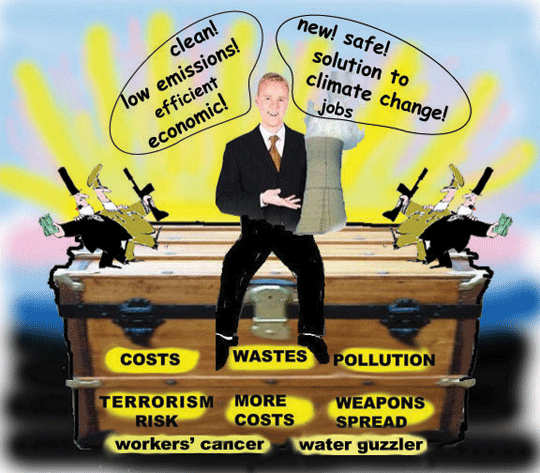
As South Africa prepares to invest in new nuclear power, we may do well to consider the other end of such investment: decommissioning. In the north of Germany, the Greifswald nuclear power plant (also known as Lubmin) has been undergoing the process of decommissioning since 1990. Before its closure, with a total planned capacity of 8 x 400MW plant built, but with only 5 reactors fuelled, Lubmin was to be the largest nuclear power station in East Germany prior to reunification. The reactors were of the VVER-440/V-230 type, or so-called second generation of Soviet-design. When it is concluded, the full process of decommissioning at Lubmin will have taken 30 years from first shutdown. In 1990 the company responsible for decommisioning this 8 x 400MW nuclear power plant, Energiewerke Nord, estimated a cost of half a billion DM per unit. Later this estimate was adjusted to 3.2 billion/unit. Today 4.1 billion/unit is a conservative final estimate (Energiewerke Nord, 2016).
More recently, early in 2012, following the Fukushima disaster in March 2011, the German government announced the immediate withdrawal of the operating licenses of eight German nuclear power plants and revived its plans to phase out nuclear power — by 2022. As this process unfolds, it will be possible to move beyond speculation, to actual data on costs, process and skills required for decommissioning.
What is involved in decommissioning a nuclear power plant?
Nuclear decommissioning is the process whereby a nuclear power plant site as a whole is dismantled to the point that it no longer requires measures for radiation protection to be applied. It is both an administrative and a technical process, including clean-up of all radioactive materials and then progressive demolition of the plant. Once a facility is fully decommissioned it should present no danger of radiation exposure. After a facility has been completely decommissioned, it is released from regulatory control and the plant licensee is no longer responsible for its safety.
The costs of decommissioning are spread over the lifetime of a facility and given that most nuclear power plants operate for over 40 years, funds need to be saved in a decommissioning fund to ensure that future costs are provided for.
What are the current estimates for nuclear power plant decommissioning?
This year, on April 28, an independent commission appointed by the German government (Kommission zur Überprüfung des Kernenergieausstiegs, KFK) presented its recommendations to the Ministry of Economics and Energy. The commission recommended that reactor owners — EnBW, EOn, RWE and Vattenfall — pay an initial sum of €23.3-billion ($26.4-billion) over the next few years, into a state-owned fund set up to cover the costs of decommissioning of the plants and managing radioactive waste. This sum includes a “risk premium” of around 35% to close the gap between provisions and actual costs.
According to the ministry, there will be approximately 10 500 tonnes of used fuel from 23 nuclear power plants, which will need to be stored in about 1 100 containers. A further 300 containers of high- and intermediate-level waste are also expected from the reprocessing of used fuel, as well as 500 containers of used fuel from research and demonstration reactors. In addition, some 600 000 cubic meters of low- and intermediate-level waste will need to be disposed of, including waste from industry, medicine and research.
Just before KFK started its work in October 2015, a study conducted by German audit firm Warth & Klein Grant Thornton for the Ministry of Economics and Energy had estimated the following costs for decommissioning 23 nuclear power plants, in 2014 money i.e. the cost if plants were to be decommissioned in 2014:
- Closure and decommissioning: €19.7-billion
- Containers, transport: €9.9-billon
- Intermediate storage: €5.8-billion
- Final low heat waste storage: €3.75-billion
- Final high active waste storage: €8.3-billion
i.e. a total of €47.5-billion.
However, decommissioning of all of Germany’s 23 nuclear power plants will not be undertaken at the same time. Most costs will be incurred in the future. Annexure 9 of the Warth & Klein Grant Thornton report provides an estimate of likely decommissioning costs when taking into account projected interest rate and inflation scenarios, as well as various likely nuclear-specific cost increases. Their conclusion? Total costs of decommissioning all nuclear power plants in Germany could reach up to €77.4-billion.
Given these emerging figures, even assuming that SA can find the necessary funds needed for new nuclear power investment, we would do well to take into account the increasingly known, non-negotiable related costs of decommissioning and waste management — of both old and new nuclear-related investment.
The American President’s Nuclear Codes
 Nuclear codes: A president’s awesome power By Mark Hertling June 10, 2016 CNN The military aides who carry it call it “the football.” The more accurate name is the “president’s emergency response satchel.” But no matter what it is called, the contents of this small metal briefcase contained within a black leather satchel is always within a few feet of the president of the United States.

List of worldwide nuclear stations headed for closing soon
 Illinois Power Plant Closings Reveal Worldwide Nuclear Issues, Clean Technica June 9th, 2016 by Sandy Dechert “………..International Nuclear Power
The World Nuclear Association……… enumerates 89 reactors scheduled to close by the end of 2025. Among the planned closures:
Armenia 1 in 2026
Belgium 2 by 2015, 5 more by 2025.
Canada 4 by 2015, 10 by 2025, 5 more by 2040.
Finland 3 by 2040
Germany 9 by 2025
Hungary 2 by 2025, 2 more by 2040
Mexico 2 by 2040
Netherlands 1 by 2025
Pakistan 1 by 2025, 1 more by 2040
Russia 1 by 2015, 23 by 2025, 4 more by 2040
Slovakia 2 by 2025
South Africa 2 by 2025
South Korea 1 by 2025, 1 more by 2040
Spain (7 reactors whose licenses run out before 2025, no decisions yet)
Sweden 2 by 2025, 5 more by 2040
Switzerland 34 by 2025, 2 more by 2040
Ukraine 2 by 2015, 10 more by 2025, 3 more by 2040
United Kingdom 1 by 2015, 6 more by 2025, 2 more by 2040
These numbers do not include the Japanese reactors shut down for safety checks following Fukushima, a third of France’s 58 nuclear reactors, and 7 Spanish reactors whose licenses are expiring without a close/refurbish decision by national regulators. Interestingly, the Philippines is converting a nuclear reactor to natural gas.
Worldwide, more than 60 reactors are under construction in 15 countries. However, other developments may threaten what some perceive as an international “nuclear renaissance”:
- One Indian reactor has been… under construction for 12 years with no hook-up date in sight;
- In Taiwan, two reactor units under construction for 15 years were halted this past April due to political opposition;
- At least 50 of the units listed as “under construction” have encountered construction delays — delays lasting from several months to several years;
- In China, ground zero for the so-called nuclear renaissance, 21 of the 28 units under construction are experiencing delays lasting between several months and more than two years; and
- Of the 17 remaining projects, a few have come online but many have yet to reach a targeted start-up date, and may or may not face delays or cancellations in the future.
………. the future of nuclear power still definitely lies in the “partly cloudy” range. https://cleantechnica.com/2016/06/09/illinois-power-plant-closings-reveal-worldwide-nuclear-issues/
Probability of a big nuclear accident within the next 10 years
The Chances of Another Chernobyl Before 2050? 50%, Say Safety Specialists
And there’s a 50:50 chance of a Three Mile Island-scale disaster in the next 10 years, according to the largest statistical analysis of nuclear accidents ever undertaken. MIT Technology Review April 17, 2015 Given that most countries with nuclear power intend to keep their reactors running and that many new reactors are planned, an important goal is to better understand the nature of risk in the nuclear industry. What, for example, is the likelihood of another Chernobyl in the next few years?
Today, we get an answer thanks to the work of Spencer Wheatley and Didier Sornette at ETH Zurich in Switzerland and Benjamin Sovacool at Aarhus University in Denmark. These guys have compiled the most comprehensive list of nuclear accidents ever created and used it to calculate the likelihood of other accidents in future.
Their worrying conclusion is that the chances are 50:50 that a major nuclear disaster will occur somewhere in the world before 2050. “There is a 50 per cent chance that a Chernobyl event (or larger) occurs in the next 27 years,” they conclude.

The nuclear industry has long been criticised for its over-confident attitude to risk. But truly independent analyses are few and far between, partly because much of the data on accidents is compiled by the nuclear industry itself, which is reluctant to share it.
The International Atomic Energy Agency rates accidents using a system called the International Nuclear Event Scale, which is related to the amount of radiation released. However, the Agency does not publish a historical database of these accidents, probably because it has a dual role of both regulating the nuclear industry and promoting it.
So it has fallen to others to compile lists of accidents, the most comprehensive of which contains details of 102 events. (By comparison there are 72 events that have a rating on the International Nuclear Event Scale.)
Wheatley and co have significantly increased this number. They refrain from using the data from the International Atomic Energy Agency and compile their own list instead……..
The resulting list ranks 174 accidents between 1946 and 2014 and includes their date, location, the monetary cost in U.S. dollars, and the rating where available on the International Nuclear Event Scale and on another well-known scale called the Nuclear Accident Magnitude Scale.
The top five accidents ranked by monetary cost are the Fukushima accident in March 2011, the Chernobyl explosion in April 1986, a fire at the Tsuruga nuclear plant in December 1995, a fire at Rocky Flats nuclear weapons plant in September 1957 and an incident in March 1955 at Sellafield, then known as Windscale, two years before the infamous fire at the facility. Indeed, Sellafield appears five times in the list of the top 15 of most expensive nuclear accidents.
The new database contains 75 percent more entries than the most comprehensive list up until now. And this extra data significantly improves the kind of statistical analysis that can be done.
Wheatley and co take full advantage of this. They say for a start that the new database reveals just how poor the International Nuclear Event Scale actually is. For that to be consistent, the Fukushima disaster would need to be rated at 10 or 11, rather than at the current maximum level of 7, they say…….
These kinds of large unexpected events are known as dragon king events and particularly difficult to analyse because they follow this different distribution, have unforeseen causes, and are few in number.
Nevertheless, Wheatley and co say their data suggests that the nuclear industry remains vulnerable dragon king events. “There is a 50% chance that a Fukushima event (or larger) occurs in the next 50 years,” they say……
The team calculate that a Chernobyl-scale event, the most severe in terms of radiation release, is as likely as not in the next 27 years. And they say a Three Mile Island event in the next 10 years has a probability of 50 percent……
Wheatley and co’s work suggests that a Chernobyl-scale accident is worryingly likely to occur within the working lifetime of the reactors now being built. And when that happens, a once obscure place will enter the lexicon as a synonym for catastrophe, just like Chernobyl, Windscale and Fukushima.
These risks will have to be carefully weighed against the advantages. The question for engineers, policy makers and the general public alike is whether that risk is worth taking, given what’s at stake.
Ref: arxiv.org/abs/1504.02380 : Of Disasters and Dragon Kings: A Statistical Analysis of Nuclear Power Incidents & Accidents https://www.technologyreview.com/s/536886/the-chances-of-another-chernobyl-before-2050-50-say-safety-specialists/
Michael Mariotte exposes pro nuclear “environmentalists” Hansen and Shellenberger
 How low can they go? Hansen, Shellenberger now shilling for Exelon Green World, Michael Mariotte
April 6, 2016 “…….Enter the pro-nuke “environmentalists.”
Specifically, renowned climate scientist Dr. James Hansen and industry-oriented Michael Shellenberger of the Breakthrough Institute, came to Illinois this week to weigh in on the Exelon bailout debate. And no, they didn’t support renewables or other clean energy technologies. They didn’t question whether the nation’s largest electric utility really needs to gouge Illinoisans for another $300 million to keep aging, money-losing reactors open. Their message was pretty simple: in an open letter to Illinois legislators they, and several dozen others (most of whom are long-standing nuclear advocates) urged them to “do everything in your power to keep all of Illinois’s nuclear power plants running for their full lifetimes.”
Sometimes Dr. Hansen just makes you wonder if he isn’t undertaking some bizarre experiment to see how far he can undermine his own credibility before it all blows up in his face.
Back in November 2013 he and three colleagues wrote an open letter to us nuclear opponents urging us to reconsider nuclear power. It’s worth going back and reading some of that letter.
“As climate and energy scientists concerned with global climate change, we are writing to urge you to advocate the development and deployment of safer nuclear energy systems,” the letter began. It added, “We call on your organization to support the development and deployment of safer nuclear power systems as a practical means of addressing the climate change problem.” And: “We understand that today’s nuclear plants are far from perfect. Fortunately, passive safety systems and other advances can make new plants much safer.”
Note the emphasis: Hansen is clearly talking about “safer” nuclear reactors. To be precise, he was seeking environmentalist support for development and deployment of Generation IV reactors. Which, to date, do not exist.
NIRS and Civil Society Institute organized a response, signed by 300+ organizations, to Hansen’s letter explaining our continued opposition to nuclear power as a climate response and calling for a public debate on the issue. We never received a reply.
Now jump ahead to December 2015, just four months ago. Shortly before the Paris COP 21 climate talks, Hansen et. al. issued a new missive: “Nuclear power, particularly next-generation nuclear power with a closed fuel cycle (where spent fuel is reprocessed), is uniquely scalable, and environmentally advantageous. Over the past 50 years, nuclear power stations – by offsetting fossil fuel combustion – have avoided the emission of an estimated 60bn tonnes of carbon dioxide. Nuclear energy can power whole civilizations, and produce waste streams that are trivial compared to the waste produced by fossil fuel combustion. There are technical means to dispose of this small amount of waste safely. However, nuclear does pose unique safety and proliferation concerns that must be addressed with strong and binding international standards and safeguards. Most importantly for climate, nuclear produces no CO2 during power generation.”
While there is much to dispute in this paragraph, again note the emphasis on safety and “next-generation nuclear power” and continued acknowledgement of nuclear’s “unique safety and proliferation concerns.”
Fukushima-clone Quad Cities, which began operation in 1972, and Clinton, which began operation in 1987, clearly do not fall under the “safer” or “next-generation” nuclear memes. By endorsing not only their continued operation, but their continued operation enabled by forcing the people of Illinois to further line Exelon’s pockets, Hansen has made a mockery of his earlier safety concerns and exposed himself as no different than any other Exelon-paid-for Nuclear Matters spokesperson.
But it gets worse, because by allying himself with the Breakthrough Institute’s Shellenberger, Hansen has gone a step even further, a step right over the credibility cliff. Because asMidwest Energy News reported, “Shellenberger described next-generation technology as farther away from viability than he had previously hoped, and urged more focus on the nation’s existing reactors.
“How much safer could they be?” he said. “If you have nuclear plants that don’t hurt anyone, keep running them.”
In other words, Shellenberger dismisses Hansen’s support of Generation IV reactors in one phrase and argues in essence that because Fukushima hasn’t happened yet at Quad Cities, well, hell, it never will; keep them running… But Fukushima did, in fact, happen. And there were supposed to have been lessons learned from that disaster. One of those is to be highly skeptical of GE Mark I nuclear reactor designs that are essentially identical to Fukushima, and that have been highly controversial even since their inception in the 1960s.
Thus, Hansen and Shellenberger (and the rest of the letter’s signers, most of whom probably know little about the actual situation in Illinois) are now dismissing any pretense of caring about nuclear safety. For what? To enable Exelon, the largest electric utility in the nation, to gouge Illinoisans for another $300 million to keep open three aging, uneconomic and unsafe nuclear reactors, because of their low carbon emissions.
Seriously, do Hansen and Shellenberger really intend to argue that the world’s climate depends on whether three midwestern nuclear reactors stay open or not? Especially when, to the extent their power needs to be replaced at all it will not be replaced by coal (check out the growing list of coal bankruptcies, there won’t be any new coal plants in Illinois) but to some limited and temporary extent by gas and over the longer and larger term by clean energy. Genuinely clean energy. The kind that doesn’t routinely spew out toxic radiation into the air and water nor create lethal radioactive waste that–their protestations to the contrary–there is not yet, and may not be for centuries, a scientifically-responsible and publicly-acceptable storage solution.
And why have they even entered this debate at all? Shellenberger has gone so far as to establish a new organization called Environmental Progress Illinois to “protect and grow solar, wind and nuclear energy.” He claims that the group hasn’t taken a position on state legislative proposals yet, but expressed support for the concept of having nuclear power treated like renewables in a new “clean energy portfolio standard.” Which happens to be Exelon’s proposal.
Shellenberger, for the record, says his new group takes no money from the energy industry.
And why is Hansen jumping into this battle? This is not the Keystone pipeline. Closing three reactors–or 30 reactors over the next few years for that matter–is not “game over” for climate, not when those reactors can be replaced by clean energy technologies, as both EPA and EIA analyses project they will be.
Arguing for environmentalists to consider Generation IV reactor technology was one thing. For many reasons, we rejected that approach and explained in detail why we did so, but at least it was a fair challenge. But actively working to prevent the shutdown of three reactors of 1960s nuclear technology under the pretense that it would matter for the climate is a leap too far. I hate to say it, but it is a leap so far that it brings into question Hansen’s credibility on the far more important issues of his climate science generally. I have long trusted Hansen on climate issues; now, I am nervous about that. If he can be so wrong in Illinois, and so far removed from his own previous statements on nuclear safety, and seems willing to sell himself to the nation’s largest, and quite possibly greediest, electric utility, well, how can I trust his other work?
I have been telling myself–and others– as Hansen’s pro-nuclear statements have become more and more strident and outlandish over the past few years that, well, Hansen is a climate expert, not an energy expert, and there is a big difference between the two. That’s still true, of course. But I’m having my doubts. Could some of his climate statements–that I’m not expert enough to evaluate the way I am expert enough to evaluate his nuclear statements–be as far removed from reality as his Illinois positions? Fortunately, there are a lot of other climate experts out there. I’ll start listening more closely to them. And there are lots of real energy experts out there, but I already know them and I’ll continue to listen to them. As for Hansen, I probably won’t listen to him anymore on either subject.
As for Illinois, closing Clinton and Quad Cities would not only save its citizens money and reduce the daily risk these dangerous reactors pose, it would help usher in substantial new clean energy investment, something the state desperately could use. That would be the kind of win-win situation–for the state and the climate, if not for Exelon–that the legislature hopefully will recognize. https://safeenergy.org/2016/04/06/how-low-can-they-go/
Obama’s Hiroshima Visit Is a Reminder that Atomic Bombs Weren’t What Won the War
 The World Post, Gar Alperovitz Author, Political Economist, Historian05/24/2016 U.S.
  President Barack Obama’s forthcoming visit to Hiroshima offers an opportunity to reconsider some of the myths surrounding the historic decision to use the atomic bomb. Such reconsideration also helps focus attention on how we can avoid any future use of weapons that are now thousands of times more powerful than the ones used in 1945.
A good place to start is with an unusual and little-noticed display at The National Museum of the United States Navy in Washington. A plaque explaining an exhibit devoted to the atomic bombings declares: “The vast destruction wreaked by the bombings of Hiroshima and Nagasaki and the loss of 135,000 people made little impact on the Japanese military. However, the Soviet invasion of Manchuria on 9 August — fulfilling a promise made at the Yalta Conference in February — changed their minds.”
Though the surprising statement runs contrary to the accepted claim that the atomic bombs ended World War II, it is faithful to the historical record of how and why Japan surrendered. The Japanese cabinet — and especially the Japanese army leaders — were not, in fact, jolted into surrender by the bombings. Japan had been willing to sacrifice city after city to American conventional bombing in the months leading up to Hiroshima — most dramatically in the March 9 firebombing of Tokyo, an attack that cost an estimated 100,000 lives.
What Japan’s military leaders were focused on was the Red Army, which was poised to take on the best of Japan’s remaining army in Manchuria. The historical record also makes clear that American leaders fully understood this. Indeed, before the atomic bomb was successfully tested, U.S. leaders desperately sought assurances that the Red Army would attack Japan after Germany was defeated. The president was strongly advised that when this happened, Japan was likely to surrender with the sole proviso that Japan be allowed to keep its emperor in some figurehead role.
Nor was this deemed a major problem. The U.S. military had long planned to keep the emperor in such a role to help control Japan during the postwar occupation. Once the atomic bomb was successfully tested, however, assurances for the emperor that were included in the 1945 Proclamation Defining Terms for Japanese Surrender were eliminated, making it certain Japan would continue to fight. As the Navy museum plaque also accurately explains: “Truman’s political advisors overrode the views of the military leaders and foreign policy makers, insisting that Americans would not accept leniency towards the emperor.”
Although it goes on to suggest this was done for political, not military reasons, there are unresolved questions about this judgment. ……
early postwar critics pointed out that there is considerable evidence that diplomatic reasons concerning the Soviet Union — not military reasons concerning Japan — may have been important. For instance, after a group of nuclear scientists met with Truman’s chief adviser on the atomic bomb, U.S. Secretary of State James Byrnes, onereported that, “Mr. Byrnes did not argue that it was necessary to use the bomb against the cities of Japan in order to win the war … Mr. Byrnes’ … view [was] that our possessing and demonstrating the bomb would make Russia more manageable.”……..
Gar Alperovitz is the author of two major studies of the atomic bombings: “Atomic Diplomacy: Hiroshima and Potsdam“ and “The Decision to Use the Atomic Bomb,” where references to the key documentary sources in this piece can also be found. http://www.huffingtonpost.com/gar-alperovitz/obama-hiroshima-bomb_b_10067434.html
The USA Pentagon’s budget labyrinth for a planned $1 trillion splurge
 The Pentagon’s War on Accountability: Slush Funds, Smoke and Mirrors, and Funny Money Equal Weapons Systems Galore By William D. Hartung, Tom Dispatch, Reader Supported News, 24 May 16 Slush Funds Galore
“………If smokescreens and evasive maneuvers aren’t enough to hide the Pentagon’s actual priorities from the taxpaying public, there’s always secrecy. The Secrecy Project at the Federation of American Scientists recently put the size of the intelligence portion of the national security state’s “black budget“ — its secret spending on everything from spying to developing high-tech weaponry — at more than $70 billion. That figure includes a wide variety of activities carried out through the CIA, the NSA, and other members of the intelligence community, but $16.8 billion of it was requested directly by the Department of Defense. And that $70 billion is just the tip of the iceberg when it comes to secret spending programs, since billions more in secret financing for the development and acquisition of new weapons systems has been squirreled away elsewhere.
The largest recent project to have its total costs shrouded in secrecy is the B-21, the Air Force’s new nuclear bomber. Air Force officials claim that they need to keep the cost secret lest potential enemies “connect the dots” and learn too much about the plane’s key characteristics. In a letter to Senator McCain, an advocate of making the cost of the plane public, Ronald Walden of the Air Force’s Rapid Capabilities Office claimed that there was “a strong correlation between the cost of an air vehicle and its total weight.” This, he suggested, might make it “decisively easier” for potential opponents to guess its range and payload.
If such assessments sound ludicrous, it’s because they are. As the histories of other major Pentagon acquisition programs have shown, the price of a system tells you just that — its price — and nothing more. Otherwise, with its classic cost overruns, the F-35 would have a range beyond compare, possibly to Mars and back. Of course, the real rationale for keeping the full cost estimate for the B-21 secret is to avoid bad publicity. Budget analyst Todd Harrison of the Center for Strategic and International Studies suggests that it’s an attempt to avoid “sticker shock” for a program that he estimates could cost more than $100 billion to develop and purchase.
The bomber, in turn, is just part of a planned $1 trillion splurge over the next three decades on a new generation of bombers, ballistic missile submarines, and ground-based nuclear missiles, part of an updating of the vast U.S. nuclear arsenal. And keep this in mind: that trillion dollars is simply an initial estimate before the usual Pentagon cost overruns even begin to come into play. Financially, the nuclear plan is going to hit taxpayer wallets particularly hard in the mid-2020s when a number of wildly expensive non-nuclear systems like the F-35 combat aircraft will also be hitting peak production.
Under the circumstances, it doesn’t take a genius to know that there’s only one way to avoid the budgetary equivalent of a 30-car pile up: increase the Pentagon’s already ample finances yet again. Principal Deputy Undersecretary of Defense Brian McKeon was referring to the costs of building new nuclear delivery vehicles when he said that the administration was “wondering how the heck we’re going to pay for it, and probably thanking our lucky stars we won’t be here to answer the question.” Of course, the rest of us will be stuck holding the bag when all those programs cloaked in secrecy suddenly come out of hiding and the bills come fully due.
At this point, you may not be shocked to learn that, in response to McKeon’s uncomfortable question, the Pentagon has come up with yet another budgetary gimmick. It’s known as the “National Sea-Based Deterrence Fund,” or as Taxpayers for Common Sense more accurately labels it, “the Navy’s submarine slush fund.” The idea — a longstanding darling of the submarine lobby (and yes, Virginia, there is a submarine lobby in Washington) — is to set up a separate slush fund outside the Navy’s normal shipbuilding budget. That’s where the money for the new ballistic missile submarine program, currently slated to cost $139 billion for 12 subs, would go.
Establishing such a new slush fund would, in turn, finesse any direct budgetary competition between the submarine program and the new surface ships the Navy also wants, and so avoid a political battle that might end up substantially reducing the number of vessels the Navy is hoping to buy over the next 30 years. Naturally, the money for the submarine fund will have to come from somewhere, either one of the other military services or that operations and maintenance budget so regularly raided to help pay for expensive weapons programs.
Not to be outmaneuvered, Air Force Secretary Deborah Lee James has now asked Congress to set up a “strategic deterrence fund” to pay for its two newest nuclear delivery vehicles, the planned bomber and a long-range nuclear-armed ballistic missile. In theory, this would take pressure off other major Air Force projects like the F-35, but as with the submarine fund, it only adds up if a future president and a future Congress can be persuaded to jack up the Pentagon budget to make room for these and other weapons systems.
In the end, however the specifics work out, any “fund” for such weaponry will be just another case of smoke and mirrors, a way of kicking the nuclear funding crisis down the road in hopes of fatter budgets to come. Why make choices now when the Pentagon and the military services can bet on blackmailing a future Trump or Clinton administration and a future Congress into ponying up the extra billions of dollars needed to make their latest ill-conceived plans add up?
If your head is spinning after this brief tour of the Pentagon’s budget labyrinth, it should be. That’s just what the Pentagon wants its painfully complicated budget practices to do: leave Congress, any administration, and the public too confused and exhausted to actually hold it accountable for how our tax dollars are being spent. So far, they’re getting away with it.
William D. Hartung, a TomDispatch regular, is the director of the Arms and Security Project at the Center for International Policy and a senior adviser to the Security Assistance Monitor. He is the author of, among other books, Prophets of War: Lockheed Martin and the Making of the Military-Industrial Complex.
Follow TomDispatch on Twitter and join us on Facebook. Check out the newest Dispatch Book, Nick Turse’s Next Time They’ll Come to Count the Dead, and Tom Engelhardt’s latest book, Shadow Government: Surveillance, Secret Wars, and a Global Security State in a Single-Superpower World. http://readersupportednews.org/opinion2/277-75/37052-the-pentagons-war-on-accountability-slush-funds-smoke-and-mirrors-and-funny-money-equal-weapons-systems-galore
Weaponising the planet – the Pentagon’s secret “war budget”

 The Pentagon’s War on Accountability: Slush Funds, Smoke and Mirrors, and Funny Money Equal Weapons Systems Galore By William D. Hartung, Tom Dispatch, Reader Supported News, 24 May 16 How to Arm the Planet
“……..In recent years, keeping tabs on how the Pentagon spends its money has grown even more difficult thanks to the “war budget” — known in Pentagonese as the Overseas Contingency Operations (OCO) account — which has become a nearly bottomless pit for items that have nothing to do with fighting wars. The use of the OCO as a slush fund began in earnest in the early years of the Bush administration’s war in Iraq and has continued ever since. It’s hard to put a precise number on how much money has been slipped into that budget or taken out of it to pay for pet projects of every sort in the last decade-plus, but the total is certainly more than $100 billion and counting.
The Pentagon’s routine use of the war budget as a way to fund whatever it wants has set an example for a Congress that’s seldom seen a military project it wasn’t eager to pay for. Only recently, for instance, the House Armed Services Committee chair, Texas Republican Congressman Mac Thornberry, proposed taking $18 billion from the war budget to cover items like an extra 11 F-35 combat aircraft and 14 F-18 fighter-bombers that the Pentagon hadn’t even asked for.
This was great news for Lockheed Martin, which needs a shot in the arm for its troubled F-35 program, already slated to be the most expensive weapons system in history, and for Boeing, which has been lobbying aggressively to keep its F-18 production line open in the face of declining orders from the Navy. But it’s bad news for the troops because, as the Project on Government Oversight has demonstrated, the money used to pay for the unneeded planes will come at the expense of training and maintenance funds.
This is, by the way, the height of hypocrisy at a time when the House Armed Services Committee is routinely sending out hysterical missives about the country’s supposed lack of military readiness. The money to adequately train military personnel and keep their equipment running is, in fact, there. Members of Congress like Thornberry would just have to stop raiding the operations budget to pay for big ticket weapons systems, while turning a blind eye to wasteful spending in other parts of the Pentagon budget.
Thornberry’s gambit may not carry the day, since both President Obama and Senate Armed Services Committee chair John McCain oppose it. But as long as a separate war budget exists, the temptation to stuff it with unnecessary programs will persist as well.
Of course, that war budget is just part of the problem. The Pentagon has so many budding programs tucked away in so many different lines of its budget that even its officials have a hard time keeping track of what’s actually going on. As for the rest of us, we’re essentially in the dark.
Consider, for instance, the proliferation of military aid programs. The Security Assistance Monitor, a nonprofit that tracks such programs, has identified more than two dozen of them worth about $10 billion annually. Combine them with similar programs tucked away in the State Department’s budget, and the U.S. is contributing to the arming and training of security forces in 180 countries. (To put that mind-boggling total in perspective, there are at most 196 countries on the planet.) Who could possibly keep track of such programs, no less what effect they may be having on the countries and militaries involved, or on the complex politics of, and conflicts in, various regions?
Best suggestion: don’t even think about it (which is exactly what the Pentagon and the military-industrial complex want you to do). And no need for Congress to do so either. After all, as Lora Lumpe and Jeremy Ravinsky of the Open Society Foundations noted earlier this year, the Pentagon is the only government agency providing foreign assistance that does not even have to submit to Congress an annual budget justification for what it does. As a result, they write, “the public does not know how much the DoD is spending in a given country and why……….”http://readersupportednews.org/opinion2/277-75/37052-the-pentagons-war-on-accountability-slush-funds-smoke-and-mirrors-and-funny-money-equal-weapons-systems-galore
Pentagon successfully keeps extent of military spending secret from the American public
The Pentagon’s War on Accountability: Slush Funds, Smoke and Mirrors, and Funny Money Equal Weapons Systems Galore By William D. Hartung, Tom Dispatch, Reader Supported News, 24 May 16 “……..Now you see it, now you don’t. Think of it as the Department of Defense’s version of the street con game, three-card monte, or maybe simply as the Pentagon shuffle. In any case, the Pentagon’s budget is as close to a work of art as you’re likely to find in the U.S. government — if, that is, by work of art you mean scam.
The United States is on track to spend more than $600 billion on the military this year — more, that is, than was spent at the height of President Ronald Reagan’s Cold War military buildup, and more than the military budgets of at least the next seven nations in the world combined. And keep in mind that that’s just a partial total. As an analysis by the Straus Military Reform Project has shown, if we count related activities like homeland security, veterans’ affairs, nuclear warhead production at the Department of Energy, military aid to other countries, and interest on the military-related national debt, that figure reaches a cool $1 trillion.
The more that’s spent on “defense,” however, the less the Pentagon wants us to know about how those mountains of money are actually being used. As the only major federal agency that can’t pass an audit, the Department of Defense (DoD) is the poster child for irresponsible budgeting.
It’s not just that its books don’t add up, however. The DoD is taking active measures to disguise how it is spending the hundreds of billions of taxpayer dollars it receives every year — from using the separate “war budget” as a slush fund to pay for pet projects that have nothing to do with fighting wars to keeping the cost of its new nuclear bomber a secret. Add in dozens of other secret projects hidden in the department’s budget and the Pentagon’s poorly documented military aid programs, and it’s clear that the DoD believes it has something to hide.
Don’t for a moment imagine that the Pentagon’s growing list of secret programs and evasive budgetary maneuvers is accidental or simply a matter of sloppy bookkeeping. Much of it is remarkably purposeful. By keeping us in the dark about how it spends our money, the Pentagon has made it virtually impossible for anyone to hold it accountable for just about anything. An entrenched bureaucracy is determined not to provide information that might be used to bring its sprawling budget — and so the institution itself — under control. That’s why budgetary deception has become such a standard operating procedure at the Department of Defense.
The audit problem is a case in point. The Pentagon along with all other major federal agencies was first required to make its books auditable in the Chief Financial Officers Act of 1990. More than 25 years later, there is no evidence to suggest that the Pentagon will ever be able to pass an audit. In fact, the one limited instance in which success seemed to be within reach — an audit of a portion of the books of a single service, the Marine Corps — turned out, upon closer inspection, to be a case study in bureaucratic resistance.
In April 2014, when it appeared that the Corps had come back with a clean audit, Secretary of Defense Chuck Hagel was so elated that he held a special ceremony in the “Hall of Heroes” at the Pentagon. “It might seem a bit unusual to be in the Hall of Heroes to honor a bookkeeping accomplishment,” he acknowledged, “but damn, this is an accomplishment.”
In March 2015, however, that “accomplishment” vanished into thin air. The Pentagon’s Office of Inspector General (OIG), which had overseen the work of Grant Thornton, the private firm that conducted the audit, denied that it had been successful (allegedly in response to “new information”). In fact, in late 2013, as Reuters reported, auditors at the OIG had argued for months against green-lighting Grant Thornton’s work, believing that it was full of obvious holes. They were, however, overruled by the deputy inspector general for auditing, who had what Reuters described as a “longstanding professional relationship” with the Grant Thornton executive supervising the audit.
The Pentagon and the firm deny that there was any conflict of interest, but the bottom line is clear enough: there was far more interest in promoting the idea that the Marine Corps could pass an audit than in seeing it actually do so, even if inconvenient facts had to be swept under the rug. This sort of behavior is hardly surprising once you consider all the benefits from an undisturbed status quo that accrue to Pentagon bureaucrats and cash-hungry contractors.
Without a reliable paper trail, there is no systematic way to track waste, fraud, and abuse in Pentagon contracting, or even to figure out how many contractors the Pentagon employs, though a conservative estimate puts the number at well over 600,000. The result is easy money with minimal accountability………http://readersupportednews.org/opinion2/277-75/37052-the-pentagons-war-on-accountability-slush-funds-smoke-and-mirrors-and-funny-money-equal-weapons-systems-galore
Timing is all important, for iodine tablets to be effective against ionising radiation
North Rhine-Westphalia prepares for Belgium nuclear accident with iodine tablets, DW, 2q4 May 16“…….In the case of a nuclear disaster, timing is paramount in the administration of iodine tablets. The medication works by supplying the thyroid gland with a concentrated amount of “healthy” iodine. In theory, this should prevent the gland from absorbing any radioactive iodine released into the air in a nuclear accident.
Taken too early, however, “healthy” iodine will already have been partially or even completely broken down. Taken too late, the radioactive iodine will have already been absorbed by the thyroid – potentially increasing the risk of thyroid cancer.
The only nuclear accident to date, which called for the use of iodine tablets was the 1986 Chernobyl disaster. In Poland, some 10.5 million children and 7 million adults were successfully administered the “healthy” iodine, with later examinations reaping only positive results. In Belarus, however, where no iodine tablets were administered, thyroid cancer in children – which is usually extremely rare – was reported 100 times higher than normal. http://www.dw.com/en/north-rhine-westphalia-prepares-for-belgium-nuclear-accident-with-iodine-tablets/a-19279950
USA’s nuclear power plants have experienced 10 perilous near misses
 10 Near Misses at U.S. Nuclear Power Plants Considered Precursors to a Meltdown https://ecowatch.com/2016/05/24/near-misses-nuclear-plants/ Greenpeace | May 24, 2016 Following the 30th anniversary of the Chernobyl nuclear disaster, Greenpeace USA released a new report Tuesday on the 166 near misses at U.S. nuclear power plants over the past decade. Of the incidents identified in Nuclear Near Misses: A Decade of Accident Precursors at U.S. Nuclear Plants, 10 are considered by the Nuclear Regulatory Commission (NRC) to be important precursors to a meltdown.
“Contrary to NRC commissioners’ claims, there is nothing safe about the nuclear reactors in the United States,” Greenpeace Nuclear Policy Analyst Jim Riccio said. “Thirty years after Chernobyl and five years after Fukushima, it is clear that these kinds of disasters could absolutely happen here. It is time for the NRC to listen to the whistleblowers within its own ranks and address these longstanding issues and vulnerabilities.”
In addition to the 163 accident precursors or near misses documented by the NRC, Greenpeace identified three significant near misses that NRC risk analysts failed to review under the agency’s Accident Sequence Precursor Program (ASP): the triple meltdown threat to Duke Energy’s Oconee Nuclear Station west of Greenville, South Carolina. According to NRC’s risk analysts, if nearby Jocassee Dam had failed, all three of the nuclear reactors at Oconee were certain to meltdown.
The report identified the following incidents as the top 10 near misses at nuclear plants between 2004-2014:
1. Browns Ferry 1 in Athens, Alabama: Residual heat removal loop unavailable; valve failure.
2. Wolf Creek in Burlington, Kansas: Multiple switchyard faults, reactor trip and loss of offsite power.
3. Robinson in Hartsville, South Carolina: Fire causes partial loss of offsite power & reactor coolant pump seal cooling challenges.
4. Fort Calhoun in Fort Calhoun, Nebraska: Fire in safety-related 480 volt electrical breaker due to deficient design control. 8 other breakers susceptible.
5. River Bend in St. Francisville, Louisiana. Loss of normal service water, circulating water and feedwater caused by electrical fault.
6. Oconee 1 in Seneca, South Carolina: Failure of Jocassee Dam would result in a meltdown.
7. Oconee 2 in Seneca, South Carolina: Failure of Jocassee Dam would result in a meltdown.
8. Oconee 3 in Seneca, South Carolina: Failure of Jocassee Dam would result in a meltdown.
9. North Anna 1 in Mineral, Virginia: Dual loss of offsite power caused by earthquake AFW pump out of service & failure of Unit 2 EDG.
10. Byron 2 in Byron, Illinois: Transformer & breaker failures cause Loss of Off Site Power, reactor trip and de-energizing of safety buses.
“If the NRC can’t even accurately track near meltdowns why should the public have any confidence that they can prevent them? It’s time to retire these dangerous nuclear plants and end the nuclear era once and for all,” Riccio concluded.
NBC4 is revealing LA’s Nuclear Secret – investigative journalism spells it out
LA’S NUCLEAR SECRET http://data.nbcstations.com/national/KNBC/la-nuclear-secret/
You really need to go to the link above and read the original article. It makes it easy for you to follow up aspects and find details
Years of mishandling dangerous radioactive materials and chemicals has also left a toxic legacy for generations of people living near the Santa Susana Field Laboratory. BY JOEL GROVER AND MATTHEW GLASSER
Tucked away in the hills above the San Fernando and Simi valleys was a 2,800-acre laboratory with a mission that was a mystery to the thousands of people who lived in its shadow. In a place called Area IV of the Santa Susana Field Laboratory (SSFL), there was a secret collaboration between the U.S. government and private companies to test the limits of nuclear power.
For decades, scientists and staff at SSFL experimented with new types of nuclear reactors, advanced rocket systems and futuristic weapons. While this research helped launch Americans into space and provided a better understanding of nuclear power, years of mishandling dangerous radioactive materials and chemicals has also left a toxic legacy for generations of people living near the site. The scientists are now gone, but acres and acres of radioactive and chemical contamination remains right above the neighborhoods of thousands.
The NBC4 I-Team spent a year investigating the story of the Santa Susana Field Lab. Our work involved interviews with whistleblowers, an intense review of more than 15,000 pages of government, academic and corporate documents, and interviews with dozens of community members, experts and public officials. We now know these families have been living in the shadow of one of the nation’s worst nuclear disasters in history and for the first time, NBC4 is revealing LA’s Nuclear Secret. Continue reading
Uranium industry finally acknowledging its dire situation
Uranium on the rocks http://onlineopinion.com.au/view.asp?article=18236&page=0

| By Jim Green , 17 May 2016 Indicative of the uranium industry’s worldwide malaise, mining giant Cameco recently announced the suspension of production at Rabbit Lake and reduced production at McArthur River/Key Lake in Canada. Cameco is also curtailing production at its two U.S. uranium mines. About 500 jobs will be lost at Rabbit Lake and 85 at the U.S. mines. A Cameco statement said that “with today’s oversupplied market and uncertainty as to how long these market conditions will persist, we need to focus our resources on our lowest cost assets and maintain a strong balance sheet.”Christopher Ecclestone, mining strategist at Hallgarten & Company, offered this glum assessment of the uranium market: “The long-held theory during the prolonged mining sector slump was that Uranium as an energy metal could potentially break away irrespective of the rest of the metals space. How true they were, but not in the way they intended, for just as the mining space has broken out of its swoon the Uranium price has not only been left behind but has gone into reverse. This is truly dismaying for the trigger for a uranium rebound was supposed to be the Japanese nuclear restart and yet it has had zero effect and indeed maybe has somehow (though the logic escapes us) resulted in a lower price.”Ecclestone adds that uranium has “made fools and liars of many in recent years, including ourselves” and that “uranium bulls know how Moses felt when he was destined to wander forty years in the desert and never get to see the Promised Land.” He states that uranium exploration “is for the birds” because “the market won’t fund it and investors won’t give credit for whatever you find”.
The Minerals Council of Australia launched a pro-uranium social media campaign last month. The twitter hashtag #untappedpotential was soon trending but – as an AAP piece noted – contributors were overwhelmingly critical. No doubt the Minerals Council anticipated the negative publicity but what it didn’t anticipate is the uranium price falling to an 11-year low. Mining.com noted in an April 20 article that the current low price hasn’t been seen since May 2005. The current price, under US26/lb, is well under half the price just before the 2011 Fukushima disaster, and under one-fifth of the 2007 peak of a bubble. Mining.com quotes a Haywood Securities research note which points out that the spot uranium price “saw three years of back-to-back double-digit percentage losses from 2011-13, but none worse than what we’ve seen thus far in 2016, and at no point since Fukushima, did the average weekly spot price dip below $28 a pound.” Haywood Securities notes that an over-supplied market continues to inflate global inventories. Mining.comnotes that five years after the Fukushima disaster, only two of Japan’s nuclear reactors are back online (and yet another permanent reactor closure was announced on May 15), and that in other developed markets nuclear power is also in retreat. The last reactor start-up in the U.S. was 20 years ago. The French Parliament legislated last year to reduce the country’s reliance on nuclear power by one-third. Germany is phasing out nuclear power, as are several other countries. The European Commission recently released a report predicting that the EU’s nuclear power retreat ‒ down 14% over the past decade ‒ will continue. China is a growth market but has amassed a “staggering” stockpile of yellowcake according to Macquarie Bank. India’s nuclear power program is in a “deep freeze” according to the Hindustan Times (unfortunately the same cannot be said about its nuclear weapons program), while India’s energy minister Piyush Goyal said on April 20 that India is not in a “tearing hurry” to expand nuclear power since there are unresolved questions about cost, safety and liability waivers sought by foreign companies. A decision on two planned reactors in the UK could be announced in the near future and the cost – A$48 billion for the two reactors – goes a long way to explaining nuclear power’s worldwide stagnation. If the project proceeds, the industry will be hoping it doesn’t go three times over budget and lag 5-9 years behind schedule, as reactor projects in France and Finland have. Even if all of Japan’s 42 reactors are included in the count, the number of power reactors operating worldwide is the same now as it was a decade ago. And there is little likelihood that nuclear power will break out of its long stagnation in the foreseeable future, with the ageing of the global reactor fleet a growing problem for the industry. As former World Nuclear Association executive Steve Kidd noted earlier this year: “The future is likely to repeat the experience of 2015 when 10 new reactors came into operation worldwide but 8 shut down. So as things stand, the industry is essentially running to stand still.” Australia’s uranium industry is also struggling just to stand still. The industry accounts for just 0.2 percent of national export revenue and less than 0.01 percent of all jobs in Australia. Those underwhelming figures are likely to become even less whelming with the end of mining and the winding down of processing at the Ranger mine in the NT. |
The options for decommissioning a nuclear plant
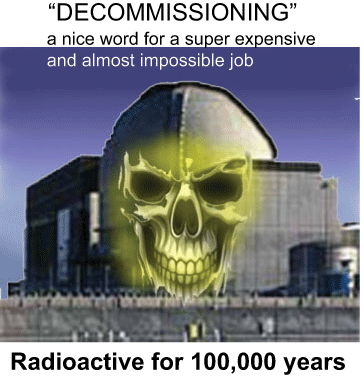 US nuclear industry’s plan thanks to NRC: let taxpayers carry the can for closed power plants, Ecologist Linda Pentz Gunter13th May 2016 “…….There are currently three decommissioning options when a reactor closes. They are known by apparent acronyms that are really just capitalized slogans, masking the flaws behind all three.
DECON refers to prompt dismantlement. This sounds promising for all sides, dispensing with the whole decommissioning process and its attendant costs, headaches and liabilities in about 10 years.
In principle DECON is supported by environmental and anti-nuclear groups, but with one giant caveat: the radioactive waste that remains on site after decommissioning of the reactor, must be adequately safeguarded.
Under the current regulatory scheme, the NRC allows the licensee to offload the irradiated nuclear fuel from the spent fuel storage pools into dry storage casks. These are not adequately protected from security threats. Nor is there any contingency to re-contain nuclear waste should it begin leaking from one of these casks.
Current casks designs are qualified for on-site nuclear waste storage for only 20 years and re-certified for four additional cycles. Some of these cask designs have already experienced degradation of protective seals and concrete shielding after less than a decade of use.
Of greatest concern, the casks are situated outside, closely congregated, on open tarmacs raising security concerns for their vulnerability to attack.
Consequently, the anti-nuclear and environmental groups that support DECON insist on the implementation of enhanced security called ‘Hardened On-Site Storage’, or HOSS to minimize these risks.
Rather than storing dozens of vulnerable dry-casks right next to each other in the open air, HOSS better secures the nuclear waste in above-ground individualized casks. These casks are fortified within modules of concentric capped silos of concrete and steel surrounded by earthen mounds.
The HOSS canisters would be dispersed over a wider area than traditional cask storage and would be better positioned to withstand a range and combination of weapons, explosives, and attacks, including anti-tank missiles, aircraft impacts, and car bombs.
Currently, reactor owners are not permitted to spend decommissioning funds on nuclear waste management as part of the DECON process. Nor do utilities want to go to the added expense of HOSS, which is not currently being considered by federal agencies, despite hundreds of petitioning groups and thousands of signatories to make HOSS a nuclear security priority at operating reactors as well as decommissioned sites.
A small number of reactors across the world have already used DECON (but without HOSS.) According to the Paris-based Organization of Economic Cooperation and Development, of the nearly 150 nuclear power reactors that have ceased operation worldwide to date, only 16 units have completed the ‘DECON’ decommissioning process with 10 of those units in the United States taking on average 10 years to complete.
What ‘SAFSTOR’ really means: ‘mothball’ and walk away
The second option, euphemistically-named SAFSTOR, or ‘safe store’, allows owners to take up to 60 years from the day the reactor closes to complete decommissioning. This would effectively enable owners to delay the start of decommissioning for 50 years, leaving the reactor and fuel pools mothballed until then and the local communities at risk.
Unsurprisingly, this is the option that is increasingly favored by reactor owners, who are petitioning the NRC for across-the-board cost cutting under SAFSTOR, regardless of the specific conditions of the individual reactor sites.
Entergy Vice President, Michael Twomey, even told Vermont state legislators in reference to the decommissioning of its Vermont Yankee nuclear reactor, that if the process is not complete in 60 years the company is fully within its rights to simply walk away, and if challenged, would litigate. Vermont Yankee closed on December 29, 2014.
The third option is ENTOMB. Without any regulatory guidance or legal framework, it allows utilities to essentially avoid decommissioning altogether. It is the option when no other options exist, as is the case at Chernobyl.
The exploded Chernobyl containment was eventually shrouded in a giant concrete sarcophagus at great expense and resulting in radiological exposure to hundreds of thousands of laborers. That structure is now being encased with a new, high-tech “Arch”, again at vast expense. However, for regular decommissioning activities, ENTOMB should be viewed as a last resort and not as a strategy for escaping liability.
Waste management is nuclear power’s most painful Achilles’ heel
The waste management aspect of the decommissioning process remains the industry’s most painful Achilles’ heel. Despite successfully suing the Department of Energy for failure to remove the waste, as promised, to a final repository site, utilities are seeking to avoid using those funds for waste management.
Instead, utilities are seeking to siphon off decommissioning trust funds to build and manage the necessary on-site Independent Spent Fuel Storage Installation (ISFSI) to house irradiated fuel from a closed reactor. An ISFSI is not currently considered part of a legitimate decommissioning process covered by the trust fund.
The delays wrought by such wrangling means that irradiated fuel sits in densely packed storage pools inside the reactor – and in the case of the 30 remaining GE Mark I and II reactors in the US, on the roof. (The GE designs are the same as those that melted down and exploded at Fukushima.)
The fuel pools are over-packed because of inadequate existing on-site storage facilities. But delays in offloading them, even while the reactor is still running, never mind when it closes, represent one of the greatest risks to public health, safety and security. A catastrophic fire, aircraft impact or other disaster that released vast amounts of radioactive fallout from the high-density storage pools could contaminate entire regions potentially indefinitely.
“The four ongoing disasters at Fukushima Daiichi have clearly shown the vulnerability of nuclear power plants that have spent nuclear fuel stored in these overcrowded and unprotected spent fuel pools”, Gundersen wrote in his comments to the NRC.
Fuel pools at closed US nuclear plants are a Fukushima waiting to happen
This is the principle reason to oppose SAFSTOR, safety experts say. Not only will the fuel remain in the pools, and in poorly protected waste casks, but protections and safety measures will be reduced. This is already exemplified in Vermont where the NRC has allowed Entergy to dismantle its emergency plan around Vermont Yankee and reduce inspections on the ventilation system near the spent fuel pool.
As Gundersen points out, the Vermont Yankee fuel pool still “contains more highly radioactive waste than was held in any of the fuel pools at Fukushima Daiichi.”
With a Fukushima-scale disaster is a real possibility even at closed reactors, critics are urging the NRC not to rubber stamp exemption requests. In the event of a nuclear catastrophe, evacuations downwind and downstream cannot be assumed to go well if emergency preparedness was discontinued months, years, or even decades earlier.
Even plans for site cleanup and decontamination are inadequate and have been watered down by the NRC itself. Site release criteria currently mandate clearing away surface soil down to three feet. But strontium-90 has been found far deeper on the Vermont Yankee site already. The NRC limit would open the way for strontium and potentially other isotopes resting deeper than three feet to migrate down into groundwater and potentially later to drinking water.
Instead, there should be more thorough post-decommissioning environmental analyses of where and how much residual radioactivity has been left behind in soil and water before power companies are allowed to walk away from accountability and liability.
To do decommissioning right, Gundersen argues that the state ratepayers should control decommissioning funds not the utility, because it is their money.
And, he says, decommissioning should be undertaken in such a way that operators “assure that those plants are promptly and safely decommissioned without unwarranted radiological contamination of the environment and extended cleanup and mitigation costs passed on to ratepayers or taxpayers.”
Linda Pentz Gunter is the international specialist at Beyond Nuclear, a Takoma Park, MD environmental advocacy group. http://www.theecologist.org/News/news_analysis/2987679/us_nuclear_industrys_plan_thanks_to_nrc_let_taxpayers_carry_the_can_for_closed_power_plants.html
1 This Month



26 September – International Day for the Total Elimination of Nuclear Weapons


PLEASE OPPOSE HR 8255 AND S.3639 – bills would accelerate satellite deployment, with no environmental review or safeguards – https://ncstd5li.quorum.us/campaign/169331/
To see nuclear-related stories in greater depth and intensity – go to https://nuclearinformation.wordpress.com
-
Archives
- September 2026 (233)
- August 2026 (330)
- July 2026 (355)
- June 2026 (287)
- May 2026 (306)
- April 2026 (356)
- March 2026 (251)
- February 2026 (267)
- January 2026 (308)
- December 2025 (358)
- November 2025 (359)
- October 2025 (375)
-
Categories
- 1
- 1 NUCLEAR ISSUES
- business and costs
- climate change
- culture and arts
- ENERGY
- environment
- health
- history
- indigenous issues
- Legal
- marketing of nuclear
- media
- opposition to nuclear
- PERSONAL STORIES
- politics
- politics international
- Religion and ethics
- safety
- secrets,lies and civil liberties
- spinbuster
- technology
- Uranium
- wastes
- weapons and war
- Women
- 2 WORLD
- ACTION
- AFRICA
- Atrocities
- AUSTRALIA
- Christina's notes
- Christina's themes
- culture and arts
- Events
- Fuk 2022
- Fuk 2023
- Fukushima 2017
- Fukushima 2018
- fukushima 2019
- Fukushima 2020
- Fukushima 2021
- general
- global warming
- Humour (God we need it)
- Nuclear
- RARE EARTHS
- Reference
- resources – print
- Resources -audiovicual
- Weekly Newsletter
- World
- World Nuclear
- YouTube
-
RSS
Entries RSS
Comments RSS
 nuclear-news