UK govt again to try “astronomically expensive” plutonium reprocessing nuclear reactors
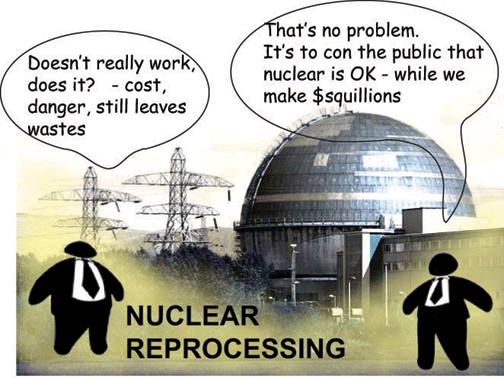 Westminster relaunches plutonium reactors despite ‘disastrous’ experience, The National, 26 April, 20 By Rob Edwards This article was brought to you by The Ferret.
THE UK Government is trying to resurrect plutonium-powered reactors despite abandoning a multi-billion bid to make them work in Scotland.
Documents released by the UK Office for Nuclear Regulation (ONR) under freedom of information law reveal that fast reactors, which can burn and breed plutonium, are among “advanced nuclear technologies” being backed by UK ministers.
Two experimental fast reactors were built and tested at a cost of £4 billion over four decades at Dounreay in Caithness. But the programme was closed in 1994 as uneconomic after a series of accidents and leaks.
Now ONR has been funded by the Department for Business, Energy and Industrial Strategy (BEIS) in London to boost its capacity to regulate new designs of fast reactors, along with other advanced nuclear technologies.
Campaigners have condemned the moves to rehabilitate plutonium as a nuclear fuel as “astronomically expensive”, “disastrous” and “mind-boggling”. They point out that it can be made into nuclear bombs and is highly toxic – and the UK has 140 tonnes of it…….
ONR released 23 documents about advanced nuclear technologies in response to a freedom of information request by Dr David Lowry, a London-based research fellow at the US Institute for Resource and Security Studies. They include redacted minutes and notes of meetings from 2019 discussing fast reactors, and are being published by The Ferret.
One note of a meeting in November 2019 shows that ONR attempted to access a huge database on fast reactors maintained by the UK Government’s National Nuclear Laboratory (NNL) in Warrington, Cheshire…..
Two companies have so far won funding under this heading to help develop fast reactors that can burn plutonium. The US power company, Westinghouse, is proposing lead-cooled fast reactors, while another US company called Advanced Reactor Concepts wants to build sodium-cooled fast reactors.
In November 2019 BEIS also announced an £18 million grant to a consortium led by reactor manufacturer, Rolls Royce, to develop a “small modular reactor designed and manufactured in the UK capable of producing cost effective electricity”.
According to Dr Lowry, fast reactors would require building a plutonium fuel fabrication plant. Such plants are “astronomically expensive” and have proved “technical and financial disasters” in the past, he said.
“Any such fabrication plant would be an inevitable target for terrorists wanting to create spectacular iconic disruption of such a high profile plutonium plant, with devastating human health and environmental hazards.”
Lowry was originally told by ONR that it held no documents on advanced nuclear technologies. As well as redacting the 23 documents that have now been released, the nuclear safety regulator is withholding a further 13 documents as commercially confidential – a claim that Lowry dismissed as “fatuous nonsense”.
THE veteran nuclear critic and respected author, Walt Patterson, argued that no fast reactor programme in the world had worked since the 1950s. Even if it did, it would take “centuries” to burn the UK’s 140 tonne plutonium stockpile, and create more radioactive waste with nowhere to go, he said.
“Extraordinary – they never learn do they? I remain perpetually gobsmacked at the lobbying power of the nuclear obsessives,” he told The Ferret. “The mind continue to boggle.”
The Edinburgh-based nuclear consultant, Pete Roche, suggested that renewable energy was the cheapest and most sustainable solution to climate change. “The UK Government seems to be planning some kind of low carbon dystopia with nuclear reactors getting smaller, some of which at least will be fuelled by plutonium,” he said.
“The idea of weapons-useable plutonium fuel being transported on our roads should send shivers down the spine of security experts and emergency planners.”
Another nuclear expert and critic, Dr Ian Fairlie, described BEIS’s renewed interest in fast reactors as problematic. “Experience with them over many years in the US, Russia, France and the UK has shown them to be disastrous and a waste of taxpayers’ money,” he said.
This is not the view taken by the UK Nuclear Industry Association, which brings together nuclear companies. It wants to see the UK’s plutonium being used in reactors rather than disposed of as waste……
“The Scottish Government remains opposed to new nuclear power plants in Scotland,” a spokesperson told The Ferret. “The Scottish Government believes our long term energy needs can be met without the need for new nuclear capacity.”
The UK Department for Business, Energy and Industrial Strategy did not respond to repeated requests to comment. https://www.thenational.scot/news/18405852.westminster-relaunches-plutonium-reactors-despite-disastrous-experience/
The end of reprocessing spent nuclear fuel has left an expensive UK plutonium stockpile with no peaceful use
 UK plutonium stockpile is a costly headache, https://climatenewsnetwork.net/uk-plutonium-stockpile-is-a-costly-headache/ April 23rd, 2020, by Paul Brown, The end of reprocessing spent nuclear fuel has left an expensive UK plutonium stockpile with no peaceful use UK plutonium stockpile is a costly headache, https://climatenewsnetwork.net/uk-plutonium-stockpile-is-a-costly-headache/ April 23rd, 2020, by Paul Brown, The end of reprocessing spent nuclear fuel has left an expensive UK plutonium stockpile with no peaceful use
LONDON, 23 April, 2020 − For 70 years Britain has been dissolving spent nuclear fuel in acid, separating the plutonium and uranium it contains and stockpiling the plutonium in the hope of finding some peaceful use for it, to no avail: all it has to show today is a UK plutonium stockpile. To comply with its international obligations not to discharge any more liquid radioactive waste into the Irish Sea, the United Kingdom government agreed more than 20 years ago under the Ospar Convention on the protection of the north-east Atlantic to shut its nuclear fuel reprocessing works at Sellafield in northwestern England at the end of this year. As well as 139 tonnes of plutonium, which has to be both carefully stored to prevent a nuclear chain reaction and protected by armed guards as well, to avoid terrorist attack, there are thousands of tonnes of depleted uranium at Sellafield. The reprocessing plant shut down prematurely as a result of a Covid-19 outbreak among its employees, and most of the 11,500 workers there have been sent home, leaving a skeleton staff to keep the site safe. Whether the plant will be restarted after the epidemic is unknown. Fewer than half Sellafield’s workers are involved in reprocessing. Most are engaged in cleaning up after decades of nuclear energy generation and related experiments. There are 200 buildings at the massive site, many of them disused. It costs British taxpayers around £2.3 billion (US$2.8bn) a year to run Sellafield and keep it safe. Solution needed soon While the British government has been reluctant to make any decision on what to do about its stockpiled plutonium and uranium, the Bulletin of the Atomic Scientists has expressed alarm about the danger it poses. “The United Kingdom has to find a solution for its plutonium stockpile, and quickly,” its report says. The scientists point out that there is enough plutonium to make hundreds of thousands of nuclear weapons, and that it is a permanent proliferation risk. The annual cost of £73m to keep the plutonium safe is dwarfed by the much larger cost of trying to make safe the whole site with its thousands of tonnes of nuclear waste. The Bulletin reports that the original reason for the reprocessing works was to produce plutonium for nuclear weapons. The UK supplied the US at times, as well as producing its own weapons. A 2014 agreement between the British and US governments gives an outline of the nuclear links which then existed between them.
For decades there were also plans to use plutonium in fast breeder reactors and to blend it with uranium to make Mixed Oxide Fuel (MOX) . This was a time when governments believed that the world’s supply of uranium would run out and that re-using it with plutonium would be a way of generating large amounts of electricity, as a way to avoid burning fossil fuels and as part of the solution to climate change. MOX was one possible fuel. Using recycled plutonium in fast breeder reactors was another possibility. And a third option was new-style reactors that burned plutonium, theoretically possible but never built. But uranium did not run out, and MOX did not prove economic. It and the new reactors proved so technically difficult they were abandoned. Despite these setbacks, successive British governments have continued reprocessing, always refusing to class plutonium as a waste, while still exploring ways of using it in some kind of new reactor. This is likely to remain the official position even after reprocessing ends in December. The UK’s Nuclear Decommissioning Authority, the agency that runs Sellafield, faced by this indecision, continues to store the plutonium behind three barbed-wire barricades, guarded by the only armed civilian police force in the country. Here to stay? One of the tricky political problems is that 23 tonnes of the plutonium is owned by Japan, which sent its spent fuel to be reprocessed at Sellafield but is unable to use the recycled material, which cannot be returned to Japan in its current state because of nuclear proliferation concerns. Despite these setbacks, successive British governments have continued reprocessing, always refusing to class plutonium as a waste, while still exploring ways of using it in some kind of new reactor. This is likely to remain the official position even after reprocessing ends in December. The UK’s Nuclear Decommissioning Authority, the agency that runs Sellafield, faced by this indecision, continues to store the plutonium behind three barbed-wire barricades, guarded by the only armed civilian police force in the country. Here to stay? One of the tricky political problems is that 23 tonnes of the plutonium is owned by Japan, which sent its spent fuel to be reprocessed at Sellafield but is unable to use the recycled material, which cannot be returned to Japan in its current state because of nuclear proliferation concerns. |
|
A warning to Idaho residents on the danger of Hanford’s nuclear wastes

A study released by the National Cancer Institute in 1997 showed that 25 states had citizens exposed to high levels of radiation due to nuclear testing.
“When there is an earthquake in that area, the radiation fallout will be equal to Chernobyl,” Brodesser said in her lecture. “When, not if.”
They know what they’ve done’: America’s nuclear past threatens Idaho’s future https://www.idahopress.com/news/local/they-know-what-theyve-done-americas-nuclear-past-threatens-idahos-future/article_a02826ba-b62f-5964-9b08-09dbe300d596.html, By ASHLEY MILLER amiller@idahopress.com MERIDIAN — In a time before social distancing, the lecture hall of the Idaho College of Osteopathic Medicine was packed. Students, staff, politicians and community members sat intermixed in the seats, elbow to elbow.
But Kaaren Brodesser stood alone.
Before she started her lecture on March 10, she was introduced simply as an advocate. More than that, she is a witness, part of a small group of people fighting for the rights of Idahoans whose lives changed on July 16, 1945, when the U.S. conducted the first-ever nuclear test, setting off a series of events the world is still struggling to fully understand.
These are downwinders, and they are dying.
‘THEY KNOW WHAT THEY’VE DONE’
In the 1950s and ’60s, the bulk of America’s nuclear testing was done in a 680-square-mile piece of desert about 65 miles outside of Las Vegas. The Nevada Test Site was ground zero for America’s Cold War preparations, testing the effects and power of the nuclear bombs designed by the military. From 1951 to 1958, around 100 aboveground nuclear tests were conducted on the site. The site was chosen for its relative isolation from any densely populated cities; however, in the end, distance was not the solution it first seemed.
The term “downwinders” refers to anyone who lived in communities exposed to nuclear radiation during the end of World War II and the peak of the Cold War (roughly the late 1940s to 1980). During the construction and testing of nuclear weapons, wind patterns directed the fallout far beyond the safety perimeters of the sites, spreading radiation hundreds and even thousands of miles away.
In the book “Atomic Farmgirl,” author Teri Hein details her life growing up downwind of Hanford, Washington, where the bulk of America’s plutonium was produced for many decades. She explains the fallout like this: When Mount Saint Helens erupted in 1980, ash drifted far past the state lines of Washington. The wind carried and then settled the debris into neighboring states. Nuclear radiation fallout can be thought of in the same way. The testing locations in Nevada and the production plants in Hanford are the eruption. The radiation then drifted into Idaho, Montana, Wyoming and beyond.
The radiation was in the air and, more importantly, in the crops and livestock of these communities. According to the National Cancer Institute, a significant portion of the Intermountain West was exposed to high doses of radiation from the tests, specifically the radioisotope Iodine-131. Iodine-131 is processed in the thyroid, the gland in your neck that regulates hormones. This is why children seemed to be the hardest hit from the fallout: their thyroid is still developing and isn’t strong enough to process the high dosage of Iodine.
NCI’s list of medical issues tied to downwinders is long, ranging from multiple sclerosis to various forms of cancer that slowly eat away at your life. That’s something that Emmett resident Tona Henderson knows only too much about. Continue reading
Opening the lid on Russia’s super-secretive nuclear industry

“Our country will receive waste from foreign nuclear power plants built by Rosatom from time to time” https://realnoevremya.com/articles/4406-vladimir-slivyak-on-import-of-radioactive-waste-to-russia By  Matvey Antropov, 14.04.2020
Environmentalist Vladimir Slivyak on the industry that “always kept its affairs secret”
On March 19 and April 6 of this year, German eco-activists protested against the export of new shipments of radioactive waste to Russia, “cynically undertaken in the midst of the pandemic to safely avoid protests.” Realnoe Vremya spoke with Vladimir Slivyak, co-chairman of the Russian environmental group Ecozaschita!, author of the book From Hiroshima to Fukushima, about how nuclear waste is imported to Russia, how open information is about Rosatom’s activities, and whether a nuclear power plant will be built in Tatarstan.
“We will know that certain wastes are imported to Russia after their transportation or arrival”
Vladimir, let’s first determine what is considered to be radioactive waste.
There are different points of view on this issue. There is a view of the nuclear industry, which is the position of the state, and there is a view of environmentalists, which, of course, is fundamentally different. The first is that if you plan to use radioactive waste (RW) further, then they are not considered waste. Environmentalists believe that any action with radioactive materials leaves waste (by-products). This can be work at nuclear power plants, in places where uranium is extracted and enriched — there are a lot of such places. In general, the discussion about what is considered waste in Russia has been going on for many years.
It should also be noted that when it comes to importing nuclear waste to Russia, it is most often waste from uranium enrichment — depleted uranium hexafluoride UF6 or spent fuel from nuclear power plants.
How many tonnes of radioactive waste are imported to Russia and who is their main exporter?
There is a contract, under which from 2019 to 2022, 12,000 tonnes of depleted uranium hexafluoride should be imported to our country from the plant in Gronau (North Rhine —Westphalia), owned by Urenco. Approximately 6,000 tonnes have already been imported. Of course, we don’t know about all the contracts. From 2016 to at least 2019, Russia received depleted uranium hexafluoride from the British plant in Capenhurst of the same company Urenco. It is unknown exactly how much it was imported.
The nuclear industry has always kept its business secret and still does. All the words that they want to be open and engage with the public are conversations in favour of the poor. Of course, all the information in Rosatom is classified. We will know that certain wastes are imported to Russia after their transportation or arrival to Russia. We have colleagues abroad who monitor the movement of nuclear waste. So we will only find out about this through our own channels of civil cooperation of activists. Reports from representatives of the nuclear industry are very rare in the media, so it is quite difficult for us to navigate. But the data on the movement of uranium hexafluoride from the plant in Gronau are accurate — they were obtained by a member of the Bundestag from the official response of the German government.
It should also be noted that Rosatom builds nuclear power plants in different countries of the world. Last year, we conducted the first independent study in Russia to find out where Rosatom operates, where nuclear power plants are actually being built, and where only the appearance of construction is being created. We have a corresponding report on our website. Usually, the priority option when signing an agreement on the construction of a nuclear power plant involves the return of spent nuclear fuel to Russia, of course, for a lot of money. In other words, our country will receive waste from foreign nuclear power plants built by Rosatom from time to time. Ecologists consider them to be one of the most dangerous among the nuclear waste.
“They say that this is not waste but valuable raw materials. At the same time, a million tonnes of ‘raw materials’ lie idle for decades”
As far as I know, the import of nuclear waste in Russia was not always allowed, right?
Yes, in the ’90s, spent nuclear fuel from nuclear power plants could not be transported. And then it was considered waste. There was also a complete ban on the import of other raw materials. The nuclear industry (then ministry of atomic energy) came out of the situation in the following way: referring to long-concluded agreements that need to be fulfilled, the ministry for atomic energy asked to make an exception for them. And the government agreed with these arguments.
And in 2001, a bill was passed allowing the import of spent fuel from foreign nuclear power plants and removing it from the category of waste (because it can be used further). Although the essence of the question on this topic is as follows: during the production of electricity at nuclear power plants, nuclear waste occurs. Whether you use them in the future or not -it’s still waste. Besides, not all spent fuel is used in any way in industry.
Our legislation has done everything for Rosatom’s comfortable operation. If the latter has indicated somewhere that it plans to use the waste in some way in the future, this means that it ceases to be radioactive waste. But this is absurd.
Rosatom is committed to disposing of all depleted uranium hexafluoride available in Russia by 2080. Here is a quote on this topic from Novaya Gazeta: “But against the background of the international outcry, Rosatom announced the launch of a programme for the management of DUHF, in which uranium “tails” are called raw materials for nuclear power of the future, a source of hydrogen fluoride and fluorine. One of the goals of the programme is the complete elimination of DUHF reserves at all Russian landfills by 2080. “Our activities can be designated with the Recycling sign,” said the acting CEO of Techsnabexport (Rosatom’s subsidiary) Yury Ulyanin.”
Does anyone believe that Rosatom will be able to recycle millions of tonnes of UF6 by 2080? In Russia, any documents that speak of such a distant time are perceived as absurd. At the moment, more than one million tonnes of depleted uranium hexafluoride are stored at enterprises and in places where radioactive waste is stored in Russia. A very small part has been converted to a different form that is more convenient for storage, but this is not even disposal or recycling.
Now, when the issue of importing UF6 from Germany has been raised, Rosatom insists that it is not waste but insanely valuable and necessary raw materials. But at the same time, they have a million tonnes of this raw material without any use for decades
“We were brought and showed absolutely nothing”
Under what conditions are nuclear waste stored? How safe is it?
For example, waste from Germany is being transported to a landfill in the closed city of Novouralsk in Sverdlovsk Oblast. No one is allowed in this city to see what kind of radioactive waste is stored there. There are satellite photos that show that the containers are under the open sky. In some photos in Google Maps or Google Earth, one can see that some containers are subject to corrosion.
This information is also available from government agencies, but it is from the second half of the 2000s. Since then, publication of information on nuclear waste had been restricted. In the 2000s, Rostekhnadzor made reports on dangerous types of industry in Russia, in which the risks were described in detail. It said that a significant number of containers are subject to corrosion and there is a threat of their depressurization.
Now Rosatom says that everything is fine, take our word for it. Word — because an ordinary person can not get to the places where any radioactive waste is transported. For the most part, these are closed cities with access control. Even if someone is allowed on them as an exception, they only show a small piece of territory. You can’t freely study containers, you don’t decide what they show you.
I had a single experience of visiting a closed city in the 2000s. Then there was a fire at one of the enterprises of the uranium industry in the city of Lesnoy, Sverdlovsk Oblast. We distributed information about the fire through our channels, and a representative of Rosatom told us something like this: “Let’s take you to that company, and you will see for yourself that the information about the fire is not true.” My colleague and I were brought and showed absolutely nothing. We were taken to the house of culture, where the employees of this enterprise were sitting, and they began to express something to us. We asked: “Will you show us anything?” They told us they wouldn’t show us anything, and sent us back.
Apart from satellite images, there is no other open information on radioactive waste in closed cities.
Where and how are other types of radioactive waste stored in Russia? Are there any radiation leak?
If we take spent nuclear fuel from a nuclear power plant, then after removing it from the reactor, it is stored in pools, where it lies in the water for several years and cools down. Spent fuel can be stored dry for a long time in containers on special sites.
By default, we should assume that in theory, radiation leakage is always possible, and therefore we need to achieve the most reliable barrier between RW and the environment. Once radiation enters the environment, you can no longer control it. The rain or wind blows, and the radioactive trace spreads further and further. The only chance to contain radiation is to organize very well the places where radioactive substances are stored.
A person cannot imagine all the combinations of extreme circumstances that can lead to the depressurization of a container with radioactive substances or to the destruction of a storage facility. Accidents happen because people can’t calculate everything. Each accident is an example of some new combination of circumstances that we could not have predicted.
The nuclear industry remains the most classified in Russia. They try never to talk about any problems or accidents, and this is contrary to the interests of public safety. From the latest news, we can recall how last year the media reported about a suspected radiation leak in Novouralsk. We haven’t really found out what happened there.
America’s eternal nuclear waste problem
After burning at 550 degrees Fahrenheit for several years, the fuel in the cores of nuclear reactors (uranium, in most cases) will experience diminishing returns of energy output. The 700-pound, 14.5’-tall uranium fuel assemblies must be replaced, but what to do with the street lamp-sized chunk of (very) heavy metal that will leak radiation for the next 100,000 years?
For nearly 40 years, federal officials have grappled with the question of nuclear waste disposal. There’s no easy answer.
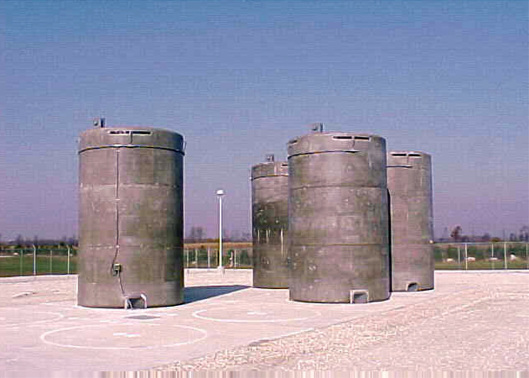
All the uranium ever burned and extracted from reactors at Exelon’s Nine Mile Point and James A. FitzPatrick nuclear facilities remains at the sites, within sight of the Lake Ontario shoreline in Scriba. After several years in a cooling pool adjacent to the reactor itself, the depleted uranium is entombed in steel and concrete silos (known as dry cask storage) at a separate part of the plants’ campuses.
Dry cask storage is “designed to contain radiation, manage heat and prevent nuclear fission. They must resist earthquakes, projectiles, tornadoes, floods, temperature extremes and other scenarios,” according to the Nuclear Regulatory Commission (NRC), which oversees all nuclear plants in the United States. While licensed on a 20-year basis and in most cases built to be effective for more than 100 years, dry cask installations are nevertheless not designed to last forever — unlike the radiation emanating from the uranium.
There’s a lot of science involved in using uranium to power our homes and businesses, but the solution to its waste problem is undeniably a political one.
The federal Nuclear Waste Policy Act of 1982 mandated the Department of Energy to find a solution to the problem of how to collect, transport and store American nuclear waste in a central location. Four decades later, the spent uranium from FitzPatrick and Nine Mile Point’s reactors still sits in Scriba, enjoying its lakeside view.
In 1987, Yucca Mountain, Nevada, was selected from a pool of eight potential sites to host the nation’s geological repository for high-level nuclear waste.

According to the NRC, the Yucca Mountain facility would look basically as follows:
1. Canisters of waste, sealed in special casks, are shipped to the site by truck or train.
2. Shipping casks are removed, and the inner tubes with the waste are placed in steel, multilayered storage containers.
3. An automated system sends storage containers underground to the tunnels.
4. Containers are stored along the tunnels, on their sides.
Unsurprisingly, this was not a universally popular decision with the people of Nye County, Nevada, where Yucca Mountain is located.
NRC documents describe the scenes at the first public hearings in Nye County about the project in 1999 and 2000, after more than a decade of geological studies and environmental impact research.
“The citizens expressed concern about why they felt they couldn’t trust the government and were afraid of being lied to,” read one section of a report prepared by the Center for Nuclear Waste Regulatory Analyses.
In addition to the scientific challenges of building a facility capable of withstanding one million years of natural disasters (an actual court-ordered requirement), the NRC found they had to deal with unexpected human hurdles
“At one of the meetings a local politician attended the meeting with his own television reporter and used the meeting as a venue for grandstanding,” the report said. “His comments off camera to the NRC staff were very complimentary, but on camera he took a much harsher stance.”
U.S. Sen. Kirsten Gillibrand, D-NY, has indicated that while she believes a federal repository is the best solution to spent uranium storage, she would not demand the construction of one without the consent of its local communities.
“Senator Gillibrand believes we must find a permanent solution for spent fuel storage and the Department of Energy should work with the states and with Congress to find an acceptable site,” said Gillibrand spokesperson Miriam Cash. “There should be a federal repository for permanently storing civilian nuclear waste and communities in New York should not have to be required to store it on-site for decades.”
Funds for the Yucca Mountain licensing review process finally ran out in 2011 and no meaningful progress has been made since that point, according to federal nuclear officials.
Secretary of Energy Stephen Chu, a member of President Barack Obama’s administration, dubbed Yucca Mountain “off the table” in 2009, but clearly, the table still has room to accommodate its return.
Yucca Mountain sits in the middle of the Nevada desert roughly 100 miles northwest of Las Vegas. Since the site’s selection in 1987 as the national spent fuel repository from a pool of eight other locations, the Department of Energy has run into roadblocks from local and environmental interests and, perhaps most importantly, opposition from Nevada Democrat Harry Reid. Reid represented Nevada in the U.S. Senate for 30 years beginning in 1987 and deftly wielded his influence, including as Senate majority leader, to stifle Yucca Mountain progress until his 2017 retirement. That was the same year President Donald Trump’s first executive budget contained funds to restart the research into a feasible transition from individual reactor site dry cask storage to a national repository system.
Executive budgets are not law, however, and while Trump’s public support for more than $100 million in funding symbolized yet another component in his industry-friendly administration’s larger platform, Congress has yet to approve any of the dollars.
“The political debate rages on,” Rod McCullum of the Nuclear Energy Institute, an industry advocacy group based in Washington, D.C., told The Palladium-Times in a recent interview. “The scientific and technical basis is as strong as ever, but the political will to move forward is as weak as ever.”
Any meaningful change in funding for the Yucca Mountain licensing review would would need to come from Congress, but in a legislative body where in the best of times progress is measured in subatomic increments, the current health crisis has brought all non-COVID-19 discussion to an indefinate halt.
In a statement on the topic of dry cask storage versus a federal repository, U.S. Rep. Anthony Brindisi, D-Utica, expressed support for a “bipartisan solution that identifies and funds a permanent storage solution” and removing the spent uranium from its sites. Brindisi is also a co-sponsor on H.R. 2314, the Nuclear Powers America Act, which provides investment tax credits for nuclear power plants.
The course reversal (and back again) by the federal government isn’t helping matters. As recently as 2018, legislation was proposed funding Yucca Mountain’s review process. For many, the term “nuclear waste” evokes images of leaking barrels of glowing, toxic goo; the boring truth is that spent fuel’s true danger lies more in the quantity than its lack-of-quality. As long as nuclear plants continue to operate in the United States, they will continue to produce waste uranium that must be carefully stored on site in dry cask facilities.
Yucca Mountain’s license application is for a term of 10,000 years. It is unclear if that is a long enough span of time for officials to come to a final decision.
Seth Wallace is the managing editor of The Palladium-Times and a nuclear energy policy enthusiast.
Microbes in nuclear fuel ponds slow down the decommissioning process
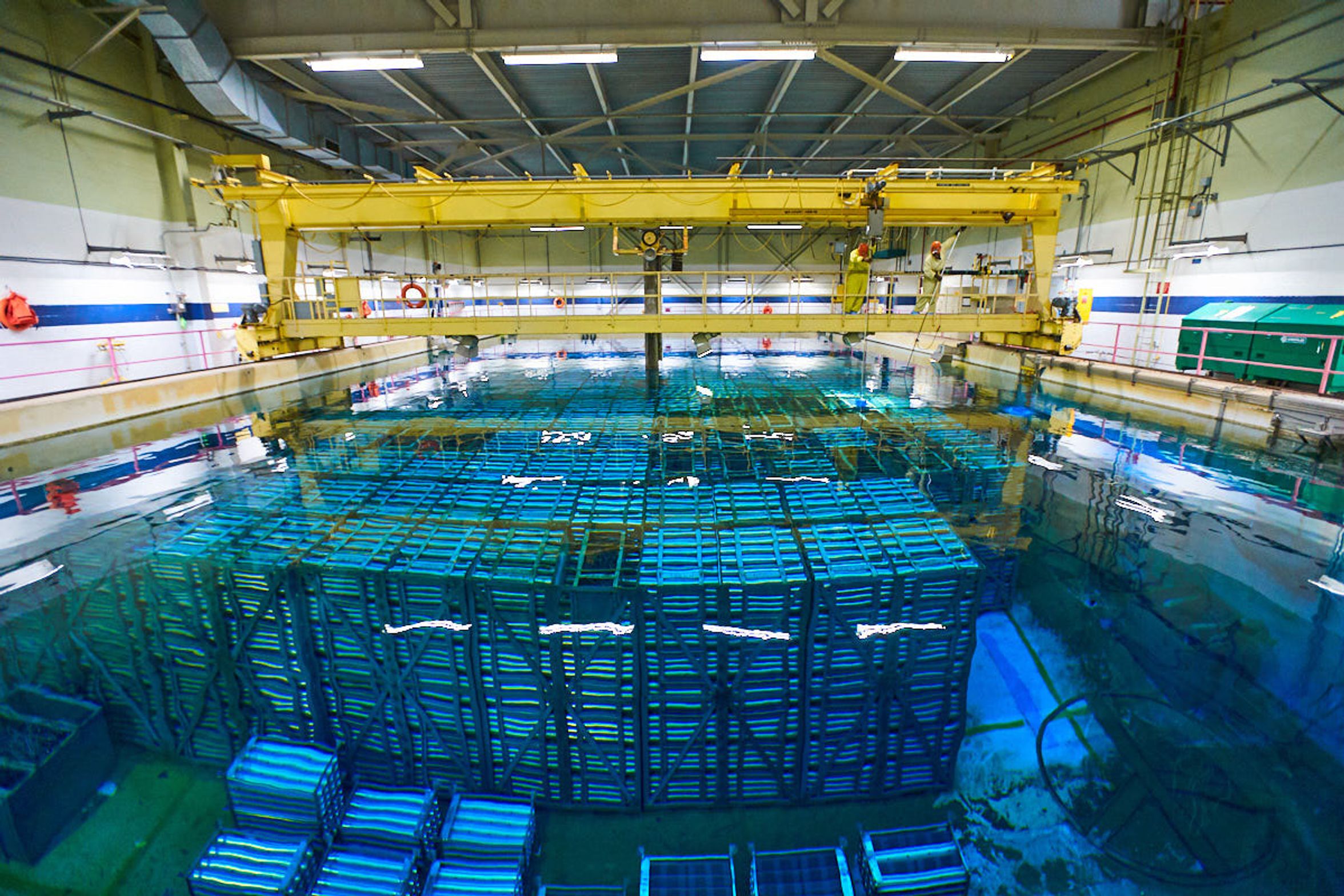 Manchester University 8th April 2020,Two new research papers from The University of Manchester, working with colleagues at Sellafield Limited and the National Nuclear Laboratory show that microbes can actively colonise some of the most intensively radioactive waste storage sites in Europe. When nuclear facilities such as
Sellafield were designed and built more than 50 years ago, it was sensible to assume that the conditions in the pond would prevent microbial life from taking hold, but now new research shows that this is not the case. The growth of microbial life in nuclear facilities can cause uncertainty or problems. Understanding how microbial life can inhabit environments such as
fuel storage ponds is vital to progress nuclear decommissioning work such as at Sellafield. Microbes are a group of organisms that, including bacteria and algae, are known to inhabit a wide range of habitats on Earth. Improvements in detection technology in recent years has allowed microorganisms to be detected in environments previously thought to be inhospitable to life. It is now becoming clear that some microorganisms are capable of withstanding surprisingly high doses of radiation, at levels significantly greater than seen in natural environments. Power Technology 8th April 2020, University of Manchester researchers have discovered microbial life can
Geomicromicrobiologists studied microbes that can cause summer blooms in
nuclear fuel storage ponds, slowing down the decommissioning process of retired nuclear plants. Summer blooms reduce visibility and disrupt fuel retrieval. University of Manchester microbiology professor Jonathan Lloyd
said: “Our research focused on Sellafield’s First Generation Magnox Storage Pond (FGMSP), which is a legacy pond that has both significant levels of radioactivity in conjunction with a highly alkaline pH (11.4), equivalent to domestic bleach. “The ultimate aim of this work was to identify the microbes that can tolerate such an inhospitable environment, understand how they tolerate high radiation levels, and help site operators control their growth. “The growth of the microorganisms in the FGMSP inhibits the operations in the pond, which is currently a priority for decommissioning. “ |
|
|
Finally, they might investigate America’s most fatal nuclear submarine disaster
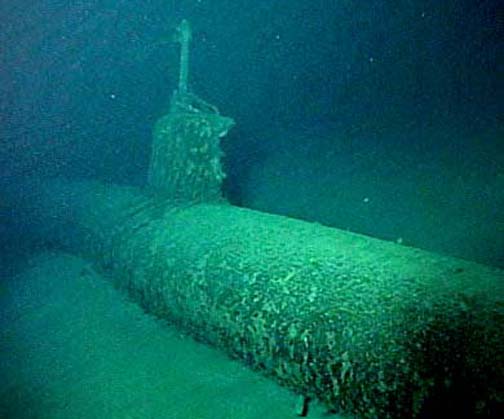
CTY Pisces – Photos of a Japanese midget submarine that was sunk off Pearl Harbor on the day of the attack. There’s a hole at the base of the conning tower where an artillery shell penetrated the hull, sinking the sub and killing the crew. Photos courtesy of Terry Kerby, Hawaii Undersea Research Laboratory. August 2003.
 seven-years-later-americas-worst-nuclear-submarine-disaster, By Robert Eatinger, Friday, April 10, 2020, Fifty-seven years ago today, America suffered its first, and in terms of fatalities its worst, loss of a nuclear-powered submarine. Yet, much of the information about that disaster and the Navy’s subsequent investigation has remained outside of public view. That may change this year.
In February this year, Judge Trevor N. McFadden of the U.S. District Court for the District of Columbia ordered the Navy to review 300 pages of documents a month starting April 30 and by the end of every month thereafter, and to begin rolling productions of documents starting on or before May 15 and every month thereafter.
University boffins discuss the eternal problem of nuclear wastes
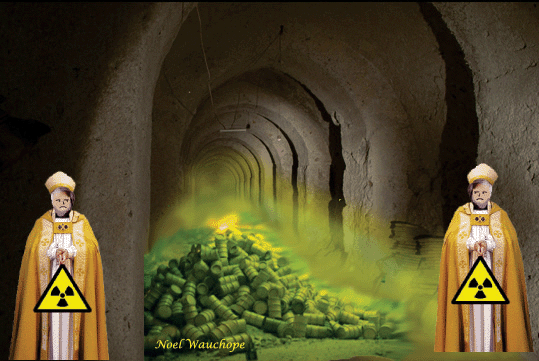
 Amazing – still none of these scientists suggests stopping making this radioactive trash!
The problem of nuclear waste, The Naked Scientists, 07 April 2020 Interview with Claire Corkhill, University of Sheffield
Part of the show The Rise of Radioactivity
Chris – So what you’re saying is, if we’ve got say something that looks like glass, because it’s spitting out all these energetic particles of radiation all the time, it’s slowly going to shatter the glass. It’s almost like shaking the glass very, very hard for hundreds of thousands of years; it’s eventually going to fall to pieces and it will no longer be any good at retaining and constraining the radioactive products inside.
Adam – How do we design something in the future so that this stuff stays where it is, and isn’t archeologist bait, and they suddenly dig up a radioactive cube of glass?
Fukushima Daiichi nuclear power plant’s deadly hazard – highly radioactive sandbags
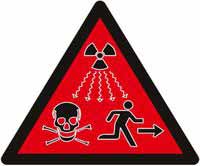 Nuclear sandbags too hot to handle, https://www.theaustralian.com.au/world/the-times/nuclear-sandbags-too-hot-to-handle/news-story/87b811443cb8e2881f55e17108872880 By RICHARD LLOYD PARRY, THE TIMES. APRIL 1, 2020
- Japanese engineers trying to dismantle the melted reactors at the Fukushima Daiichi nuclear power plant face a new hazard — radioactive sandbags so deadly that standing next to them for a few minutes could be fatal.
The sandbags were intended to make life easier for the teams dealing with the aftermath of the nuclear disaster in 2011 when three reactors melted after a tsunami destroyed their cooling systems. Twenty-six tonnes of the bags were placed in basements beneath two of the reactors to absorb radioactivity from waste water.
They were stuffed with zeolite, minerals that can absorb caesium. Nine years after the disaster, the submerged sandbags have sucked up so much radiation that they now represent a deadly danger themselves.
Samples of zeolite removed from the bags contain caesium, producing huge amounts of radiation, while the sandbags are giving off up to four sieverts of radiation an hour. Fifteen minutes of exposure to this could cause haemorrhaging. After an hour, half of those exposed would eventually die as a result. The maximum lifetime recommended dose of radiation for humans is less than half a sievert.
Tokyo Electric Power Co (Tepco), which operates the plant, had intended to remove the contaminated water by the end of 2020. The complication caused by the sand means it will take three years longer, the latest delay to the decommissioning.
Tepco managers have admitted that the technology needed to finish the job does not exist and they do not have a full idea of how it will be achieved. Their stated goal of decommissioning by 2051 may be impossible, they said.
One of the biggest problems is the 170 tonnes of irradiated water coming out of the plant every day, much of it natural ground water that flows through the earth towards the sea, picking up radiation on the way. Tepco pumps it out and stores it in huge storage tanks, filtered of some, but not all, of its contaminants — 1.17 million tonnes so far. In two years, the storage space will run out.
The government wants to pour the water away, insisting that the diluting effect of the Pacific will render the radiation harmless, but it is opposed by North and South Korea and the local fishing industry, whose reputation has been ruined by the disaster.
Plutonium contamination at Rocky Flats
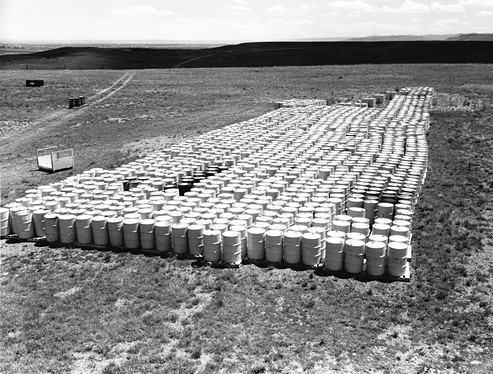 How Colorado’s nuclear past is affecting its future, Colorado Springs INDY, GONE FISSION, by Heidi Beedle 25 Mar 20, IT WAS FEB. 25 AND BROOMFIELD City Council was done. It unanimously voted last month to withdraw from the Jefferson Parkway Public Highway Authority (JPPHA), a proposed north-south toll road that would ostensibly help mitigate traffic congestion in the Northwest Metro Denver area. The route would have taken the road through the eastern edge of the Rocky Flats Wildlife Refuge, just south of the Boulder County line, bordering Arvada and Broomfield. The council vote was influenced by preliminary soil samples taken by the JPPHA in July 2019, specifically one sample that showed plutonium levels more than five times higher than the acceptable standard (the rest of the samples taken at that time were within acceptable standards). Before its current existence as a wildlife refuge, Rocky Flats was the site of a nuclear weapons plant, which has caused concern about plutonium contamination in the area. Forty-eight subsequent samples taken by the U.S. Fish and Wildlife Service, which manages the refuge, showed levels well below cleanup standards of 50 picocuries per gram.
The city council vote is the latest installment in the ongoing conflict between concerned residents and public officials, and Rocky Flats and Colorado Department of Public Health and Environment (CDPHE). For decades, residents and at least two directors of Jefferson County Public Health, have claimed that plutonium released from the plant is responsible for the high rate of cancers in the area. These claims have been consistently disputed by CDPHE and the Department of Energy (DOE). ……..
Johnson was concerned about the instances of cancers in Jefferson County and questioned the official measurements of plutonium in the soils around Rocky Flats, finding in his own testing that plutonium levels in the soil were 44 times higher than reported by the Department of Public Health. Johnson grew increasingly concerned about an increase in cancer deaths in Jefferson County, and in a paper published in 1981, noted that a rise in certain kinds of cancers Johnson was seeing in Jefferson County, such as leukemia, “supports the hypothesis that exposure of general populations to small concentrations of plutonium and other radionuclides may have an effect on cancer incidence.” Johnson noted that “plutonium concentrations in the air at the Rocky Flats plant are consistently the highest (1970-1977) in the US DOE monitoring network,” based on his studies of the DOE’s own data. He also asserted that the DOE’s measurements were likely an underestimation.
Almost 40 years later, and the current head of the Jefferson County Public Health Department, Dr. Mark Johnson (no relation) has come to the same conclusion. In 2018 he spoke outagainst opening the wildlife refuge to the public, and he thinks the recent discovery of plutonium near the proposed parkway site should give people reason to reconsider. “
“There are clear studies that have shown there is an increased risk or rate of plutonium in the dirt there,” agrees Mark Johnson. “I have concerns already about the digging around with the subdivisions and the commercial enterprises that have gone into that area that were basically kicking up a lot of stuff — and we don’t know what is there.”
Carl Johnson was fired in 1981 for his persistent, outspoken criticism of the plant, but won a subsequent whistleblower lawsuit. Partly due to Johnson’s criticism, the FBI and the EPA began looking into operations at the Rocky Flats Plant starting in 1987. The investigation was aided by Jim Stone, an employee at the plant who also became a whistleblower over what he saw as grave safety violations……..
THOUGH EXHAUSTIVE DOCUMENTATION of waste sites and deposits exists, questions remain as to the effectiveness of the now-completed cleanup. Jon Lipsky, a former FBI agent who led the raid on Rocky Flats in 1989, criticized the decision to open the refuge to the public in 2016, and has claimed there is still work to be done. Originally, the DOE estimated it would take 65 years and $37 billion to clean up the site. It was completed in 2005 for $7 billion.
During the process, there were still surprises to be found. ……..
The questions of the lasting effects from the operations at Rocky Flats may never be answered to the satisfaction of residents like Hansen, who are dealing with serious health issues. Jeff Gipe, the artist behind the Cold War Horse memorial that was erected in 2015, is currently working on a documentary about the plant, Half-Life of Memory, which may draw more attention to the issue.
President Donald Trump, who has a good shot at re-election, has reduced the effectiveness of agencies like the EPA while also advocating for an increase in nuclear arms development.
In 2019, the federal government proposed a new plutonium pit production facility near Aiken, South Carolina. But that is presumably not our problem. https://www.csindy.com/coloradosprings/how-colorados-nuclear-past-is-affecting-its-future/Content?oid=21526239
A new low-cost solar technology for environmental cooling
A new low-cost solar technology for environmental cooling https://www.eurekalert.org/pub_releases/2020-03/pdt-anl032320.php POLITECNICO DI TORINO Space cooling and heating is a common need in most inhabited areas. In Europe, the energy consumed for air conditioning is rising, and the situation could get worse in the near future due to the temperature increase in different regions worldwide. The increasing cooling need in buildings especially during the summer season is satisfied by the popular air conditioners, which often make use of refrigerants with high environmental impact and also lead to high electricity consumption. So, how can we reduce the energy demand for building cooling?
A new study comes from a research group based at the Politecnico di Torino (SMaLL) and the National Institute of Metrological Research (INRiM), who has proposed a device capable of generating a cooling load without the use of electricity: the research has been published in Science Advances*. Like more traditional cooling devices, this new technology also exploits the evaporation of a liquid. However, the key idea proposed by the Turin researchers is to use simple water and common salt instead of chemicals that are potentially harmful for the environment. The environmental impact of the new device is also reduced because it is based on passive phenomena, i.e. spontaneous processes such as capillarity or evaporation, instead of on pumps and compressors that require energy and maintenance.
“Cooling by water evaporation has always been known. As an example, Nature makes use of sweat evaporation from the skin to cool down our body. However, this strategy is effective as long as air is not saturated with water vapour. Our idea was to come up with a low-cost technology capable to maximize the cooling effect regardless of the external water vapour conditions. Instead of being exposed to air, pure water is in contact with an impermeable membrane that keeps separated from a highly concentrated salty solution. The membrane can be imagined as a porous sieve with pore size in the order of one millionth of a meter. Owing to its water-repellent properties, our membrane liquid water does not pass through the membrane, whereas its vapour does. In this way, the fresh and salt water do not mix, while a constant water vapour flux occurs from one end of the membrane to the other. As a result, pure water gets cooled, with this effect being further amplified thanks to the presence of different evaporation stages. Clearly, the salty water concentration will constantly decrease and the cooling effect will diminish over time; however, the difference in salinity between the two solutions can be continuously – and sustainably – restored using solar energy, as also demonstrated in another recent study from our group**”, explains Matteo Alberghini, PhD student of the Energy Department of the Politecnico di Torino and first author of the research.
The interesting feature of the suggested device consists in its modular design made of cooling units, a few centimetres thick each, that can be stacked in series to increase the cooling effect in series, as happens with common batteries. In this way it is possible to finely tune the cooling power according to individual needs, possibly reaching cooling capacity comparable to those typically necessary for domestic use. Furthermore, water and salt do not need pumps or other auxiliaries to be transported within the device. On the contrary, it “moves” spontaneously thanks to capillary effects of some components which, like in kitchen paper, are capable of absorbing and transporting water also against gravity.
“Other technologies for passive cooling are also being tested in various labs and research centres worldwide, such as those based on infrared heat dissipation into the outer space – also known as radiative passive cooling. Those approaches, although promising and suitable for some applications, also present major limitations: the principle on which they are based may be ineffective in tropical climates and in general on very humid days, when, however, the need for conditioning would still be high; moreover, there is a theoretical limit for the maximum cooling power. Our passive prototype, based instead on evaporative cooling between two aqueous solutions with different salinities, could overcome this limit, creating a useful effect independent of external humidity. Moreover, we could obtain an even higher cooling capacity in the future by increasing the concentration of the saline solution or by resorting to a more sophisticated modular design of the device” commented the researchers.
Also due to the simplicity of the device assembly and the required materials, a rather low production cost can be envisioned, in the order of a few euros for each cooling stage. As such, the device could be ideal for installations in rural areas, where the possible lack of well-trained technicians can make operation and maintenance of traditional cooling systems difficult. Interesting applications can also be envisioned in regions with large availability in water with high saline concentration, such as coastal regions in the vicinity of large desalination plants or nearby salt marshes and salt mines.
As of now, the technology is not yet ready for an immediate commercial exploitation, and further developments (also subject to future funding or industrial partnerships) are necessary. In perspective, this technology could be used in combination with existing and more traditional cooling systems for effectively implementing energy saving strategies.
[*] Matteo Alberghini, Matteo Morciano, Matteo Fasano, Fabio Bertiglia, Vito Fernicola, Pietro Asinari, Eliodoro Chiavazzo. Multistage and passive cooling process driven by salinity difference, SCIENCE ADVANCES (2020), URL: https://advances.sciencemag.org/content/6/11/eaax5015
[**] Eliodoro Chiavazzo, Matteo Morciano, Francesca Viglino, Matteo Fasano, Pietro Asinari, Passive solar high-yield seawater desalination by modular and low-cost distillation, NATURE SUSTAINABILITY (2018), URL: https://www.nature.com/articles/s41893-018-0186-x
Meet the Climate Science Deniers Who Downplayed COVID-19 Risks

|
Meet the Climate Science Deniers Who Downplayed COVID-19 The very next day, the American Council on Science and Health (ACSH) published an article titled, “Coronavirus in the U.S.: How Bad Will It Be?” “Is coronavirus worse than the flu?” it began. “No, not even close.” “It already has spread from person-to-person in the U.S., but it probably won’t go far,” ACSH added. “And the American healthcare system is excellent at dealing with this sort of problem.” ACSH is one of several organizations promoting climate science denial that are now spreading misinformation on the coronavirus, with potentially deadly consequences. American Council on Science and Health?The ACSH presents itself to the public as a proponent of “peer-reviewed mainstream science,” in the words of the organization’s mission. Their experts have frequently been quoted in mainstream newspapers and magazines, and they pen columns criticizing journalists who write critically about companies like Monsanto. The group has received funding from oil giants including ExxonMobil, as well as from the agribusiness, chemical and tobacco industries to name a few. When it comes to climate change, ACSH has published a steady stream of articles downplaying climate science and criticizing efforts to slow carbon emissions — even in the face of a mountain of peer-reviewed research on the climate crisis. ACSH slammed the medical journal The Lancet as “an ideologically driven outlet with a very clear political agenda where being sensationalist and culturally woke trumps evidence and reasonability” (after the Lancet published an article titled “The carbon footprint”). The purported “pro-science” advocacy group has labeled Greta Thunberg’s activism “doomsday prophesying.” It has (falsely) suggested that climate change is less of a concern because “more people die in winter than in summer” (they don’t). And that’s all just in the past nine months. The ACSH’s stance against climate action dates back to at least 1997. When it comes to coronavirus, now a global pandemic, ACSH’s authors rushed to judgment. They assured readers that there was little to worry about, and put some of the same faulty thinking that underlies their stance on climate change on display. ACSH isn’t alone. Other organizations that have also engaged in climate science denial made similar missteps on COVID-19, including prominent organizations that fanned the flames of conspiracy theories or confidently promoted complacency when circumstances required rapid action. To be clear: No one should be faulted for failing to foresee precisely how severe of a problem COVID-19 would prove to be. None of us has a crystal ball and few, if any, expected this situation to unfold in this particular way. But these organizations published positions that not only wound up being laden with false reassurances, but they did so based on claims that they made confidently at the time that now appear to have been false or misleading. Defending Conspiracy Theorists Continue reading |
Ozone-depleting chemicals appearing again in the atmosphere
 The Global Victory Over Ozone-Killing Chemicals Is Coming Undone https://www.bloomberg.com/news/articles/2020-03-20/the-virus-is-teaching-everyone-what-runaway-growth-really-means The Global Victory Over Ozone-Killing Chemicals Is Coming Undone https://www.bloomberg.com/news/articles/2020-03-20/the-virus-is-teaching-everyone-what-runaway-growth-really-means
Mysterious emissions have been slowing the atmosphere’s healing. Scientists think they’ve finally discovered the source. By Eric Roston, March 18, 2020, Ozone-destroying chemicals once thought to be successfully banished are now making their way into the air again, slowing down our atmosphere’s recovery after those same chemicals effectively ripped a hole in it in the mid-20th century. Slowing things down still further: scientists haven’t been able to figure out where the chemicals are coming from.Before the rapidly changing global climate seized our collective attention, destruction of the Earth’s protective ozone shield became an environmental cause célèbre. Chemists in the 1970s predicted the damage to the atmosphere that could be done by chlorofluorocarbons, which were common in everything from aerosol hairspray to refrigerators. (They won the Nobel Prize in 1995.) The 1987 Montreal Protocol phasing out CFCs was eventually signed by 197 countries—every country in the United Nations, plus entities like the European Union and the Holy See—making it one of the pinnacles of global environmental diplomacy.
Then something funny started to happen. In 2012, two years after the treaty mandated all CFC production should cease, unexpected blips in atmospheric levels of a key chemical, CFC-11, started to appear. They’ve been attributed in part to unauthorized production of the chemicals in China—but that still wasn’t enough to make sense of the concentrations scientists were seeing. Now a team led by scientists at the Massachusetts Institute of Technology have a possible answer. Their research, published Tuesday in the journal Nature Communications, shows that equipment and materials manufactured legally before the phase-out still hold enormous volumes of CFCs. As these products decay, the chemicals leak out. . Emissions from these previously underestimated “banks” of CFC chemicals are enough to slow ozone recovery by about six years if they’re not disposed of, according to the researchers.
CFCs—and their eventual replacements, hydrofluorocarbons—also trap heat. While there’s far less of them in the atmosphere than there is of carbon dioxide, they’re much more potent. The chemicals being released have the warming potential of 9 billion metric tons CO₂, or roughly 30% more than the European Union has pledged to eliminate by 2030.
Given how prevalent CFCs once were, properly disposing of them would be a huge, disruptive challenge. It would mean dismantling buildings with CFC-based foam insulation, replacing old refrigerators and air conditioners, and either destroying or burying the whole lot to lock the CFCs out of the atmosphere. “While 100% destruction of the banks is unrealistic,” the authors write, “certainly some material can be recovered and destroyed.”
|
|
Nuclear Power Plants: Tritium is a lot more hazardous than they say

tests for statistical significance have been misused in epidemiological studies on cancers near nuclear facilities. These in the past have often concluded that such effects do not occur or they downplayed any effects which did occur. In fact, copious evidence exists throughout the world – over 60 studies – of raised cancer levels near NPPs.
Most (>75%) of these studies found cancer increases but because they were small, their findings were often dismissed as not statistically significant. In other words, they were chucked in the bin marked “not significant” without further consideration.
The Hazards of Tritium, Dr Ian Fairlie, March 13, 2020
Summary
Nuclear facilities emit very large amounts of tritium, 3H, the radioactive isotope of hydrogen. Much evidence from cell/animal studies and radiation biology theory indicates that tritium is more hazardous than gamma rays and most X-rays. However the International Commission on Radiological Protection (ICRP) continues to underestimate tritium’s hazard by recommending a radiation weighting factor (wR) of unity for tritium’s beta particle emissions. Tritium’s exceptionally high molecular exchange rate with hydrogen atoms on adjacent molecules makes it extremely mobile in the environment. This plus the fact that the most common form of tritium is water, ie radioactive water, means that, when tritium is emitted from nuclear facilities, it rapidly contaminates all biota in adjacent areas. Tritium binds with organic matter to form organically bound tritium (OBT) with long residence times in tissues and organs making it more radiotoxic than tritiated water (HTO). Epidemiology studies indicate increases in cancers and congenital malformations near nuclear facilities. It is recommended that nuclear operators and scientists should be properly informed about tritium’s hazards; that tritium’s safety factors should be strengthened; and that a hazard scheme for common radionuclides be established. Continue reading
Dr Ian Fairlea on Epidemiological Evidence of Cancer Risks
 The Hazards of Tritium,https://www.ianfairlie.org/news/the-hazards-of-tritium/ , Dr Ian Fairlie, March 13, 2020 “……….Epidemiological Evidence of Risks Because of methodological limitations, epidemiology studies are a blunt tool for discovering whether adverse effects result from radiation exposures. These limitations include:
- under-ascertainment, …
- strict data requirements….
- confounding factors: the true causes of morbidity or mortality can be uncertain due to confounding factors such as socio-economic status and competing causes of death.
- bias: ……
- poor signal to noise…..
- uncertain doses:……
- wide confidence intervals……
The Abuse of Statistical Significance Tests
1 This Month

26 September – International Day for the Total Elimination of Nuclear Weapons


PLEASE OPPOSE HR 8255 AND S.3639 – bills would accelerate satellite deployment, with no environmental review or safeguards – https://ncstd5li.quorum.us/campaign/169331/
To see nuclear-related stories in greater depth and intensity – go to https://nuclearinformation.wordpress.com
-
Archives
- September 2026 (206)
- August 2026 (330)
- July 2026 (355)
- June 2026 (287)
- May 2026 (306)
- April 2026 (356)
- March 2026 (251)
- February 2026 (267)
- January 2026 (308)
- December 2025 (358)
- November 2025 (359)
- October 2025 (375)
-
Categories
- 1
- 1 NUCLEAR ISSUES
- business and costs
- climate change
- culture and arts
- ENERGY
- environment
- health
- history
- indigenous issues
- Legal
- marketing of nuclear
- media
- opposition to nuclear
- PERSONAL STORIES
- politics
- politics international
- Religion and ethics
- safety
- secrets,lies and civil liberties
- spinbuster
- technology
- Uranium
- wastes
- weapons and war
- Women
- 2 WORLD
- ACTION
- AFRICA
- Atrocities
- AUSTRALIA
- Christina's notes
- Christina's themes
- culture and arts
- Events
- Fuk 2022
- Fuk 2023
- Fukushima 2017
- Fukushima 2018
- fukushima 2019
- Fukushima 2020
- Fukushima 2021
- general
- global warming
- Humour (God we need it)
- Nuclear
- RARE EARTHS
- Reference
- resources – print
- Resources -audiovicual
- Weekly Newsletter
- World
- World Nuclear
- YouTube
-
RSS
Entries RSS
Comments RSS
 nuclear-news