South Pole warming at triple the global average

A record-breaking cold for a spell then made way for even warmer temperature anomalies from the early 2000s. For the 1989-2018 period, the mercury rose an average of 0.6 degrees per decade, or three times the global warming rate, the researchers found.
The report on the flipping of temperature trends at the most southerly point comes as abnormal warmth continues to bake the planet’s other polar extreme. The Russian town of Verkhoyansk last week reported 38 degrees, the warmest reading ever recorded within the Arctic Circle.
For Antarctica, the recent accelerated warming is estimated to be about two-thirds the result of natural variability with the role of rising greenhouse gases contributing about one-third, said Kyle Clem, a post-doctoral research fellow at New Zealand’s Victoria University.
The rapid warming “lies within the upper bounds of natural variability”, Dr Clem said. “It’s extremely rare and it appears very likely that humans played a role.”
The research shows “there’s no place on earth that’s immune to global warming”, he said. “There’s nowhere to hide – not even up on the Antarctic Plateau.”
Sitting at 2835 metres above sea level – or 600 metres higher than Mt Kosciuszko – on a rocky continent, the South Pole is exposed to different weather processes than its polar opposite. By contrast, the North Pole rests on shifting sea ice with the seabed more than four kilometres below.
Dr Clem, along with other researchers from the US and the UK, found changing circulation patterns in the Pacific and Southern Ocean determine which parts of Antarctica warm or cool.
For instance, the western tropical Pacific has periods when is warmer or cooler than usual.
The warmer period – known as the negative phase of the so-called Interdecadal Pacific Oscillation – set in about 2000. During this phase, there is more storm activity in the tropics which in turn spawns more high- and low-pressure systems that send heat far into the high latitudes.
The circumpolar westerly winds, which have been strengthening and contracting polewards under climate change – also play a role in amplifying the transfer of warmth into Antarctica.
When those two patterns align, as they have in recent decades, the South Pole warms but some parts, such as western Antarctica warm at a slow pace or even cool, as the frigid air shifts around.
Michael Mann, Director of the Earth System Science Centre at the University of Pennsylvania, said the study provided “a very detailed and useful analysis” of the forces at play in the far south.
If anything, though, the researchers’ use of model simulations to reach conclusions about regional trends probably understates the role of human-caused climate change.
“In short, what the authors attribute to natural internal cycles might just be a shift in atmospheric circulation that is actually due to human-caused climate change but isn’t accurately captured in the average over models,” Professor Mann said, in an email that included those italics.
The recent polar extremes – including eastern Siberian temperatures above 40 degrees – were important because “what happens in the poles doesn’t stay in the poles”, the prominent climate scientist said.
Changes at the South Pole itself were not as critical as the warming of the Southern Ocean, which is leading to the collapse of the West Antarctic ice shelves and the destabilisation of the interior ice sheet.
“This was not well predicted by climate models, meaning we are further along when it comes to the destabilisation of ice sheets and the commitment to rising sea levels than we expected to be at this point,” Professor Mann said.
Siberia’s alarming prolonged heat wave
Climate crisis: alarm at record-breaking heatwave in  Siberia https://www.theguardian.com/environment/2020/jun/17/climate-crisis-alarm-at-record-breaking-heatwave-in-siberia
Thu 18 Jun 2020 A prolonged heatwave in Siberia is “undoubtedly alarming”, climate scientists have said. The freak temperatures have been linked to wildfires, a huge oil spill and a plague of tree-eating moths.
On a global scale, the Siberian heat is helping push the world towards its hottest year on record in 2020, despite a temporary dip in carbon emissions owing to the coronavirus pandemic.
Temperatures in the polar regions are rising fastest because ocean currents carry heat towards the poles and reflective ice and snow is melting away.
Russian towns in the Arctic circle have recorded extraordinary temperatures, with Nizhnyaya Pesha hitting 30C on 9 June and Khatanga, which usually has daytime temperatures of around 0C at this time of year, hitting 25C on 22 May. The previous record was 12C.
In May, surface temperatures in parts of Siberia were up to 10C above average, according to the EU’s Copernicus Climate Change Service (C3S). Martin Stendel, of the Danish Meteorological Institute, said the abnormal May temperatures seen in north-west Siberia would be likely to happen just once in 100,000 years without human-caused global heating.
Freja Vamborg, a senior scientist at C3S, said: “It is undoubtedly an alarming sign, but not only May was unusually warm in Siberia. The whole of winter and spring had repeated periods of higher-than-average surface air temperatures.
“Although the planet as a whole is warming, this isn’t happening evenly. Western Siberia stands out as a region that shows more of a warming trend with higher variations in temperature. So to some extent large temperature anomalies are not unexpected. However, what is unusual is how long the warmer-than-average anomalies have persisted for.”
Marina Makarova, the chief meteorologist at Russia’s Rosgidromet weather service, said: “This winter was the hottest in Siberia since records began 130 years ago. Average temperatures were up to 6C higher than the seasonal norms.”
Robert Rohde, the lead scientist at the Berkeley Earth project, said Russia as a whole had experienced record high temperatures in 2020, with the average from January to May 5.3C above the 1951-1980 average. “[This is a] new record by a massive 1.9C,” he said.
In December, Russia’s president, Vladimir Putin, commented on the unusual heat: “Some of our cities were built north of the Arctic Circle, on the permafrost. If it begins to thaw, you can imagine what consequences it would have. It’s very serious.”
Thawing permafrost was at least partly to blame for a spill of diesel fuel in Siberia this month that led Putin to declare a state of emergency. The supports of the storage tank suddenly sank, according to its operators; green groups said ageing and poorly maintained infrastructure was also to blame.
Wildfires have raged across hundreds of thousands of hectares of Siberia’s forests. Farmers often light fires in the spring to clear vegetation, and a combination of high temperatures and strong winds has caused some fires to burn out of control.
Swarms of the Siberian silk moth, whose larvae eat at conifer trees, have grown rapidly in the rising temperatures. “In all my long career, I’ve never seen moths so huge and growing so quickly,” Vladimir Soldatov, a moth expert, told AFP.
He warned of “tragic consequences” for forests, with the larvae stripping trees of their needles and making them more susceptible to fires.
Radioactive cloud over Europe in 2017 came from a civilian nuclear reactor

|
Radioactive cloud over Europe had civilian background https://www.eurekalert.org/pub_releases/2020-06/uom-rco061220.phpIsotope measurements on air filters: researchers investigated undeclared nuclear release / Study in “Nature Communications” 14 June 20
UNIVERSITY OF MÜNSTER A mysterious cloud containing radioactive ruthenium-106, which moved across Europe in autumn 2017, is still bothering Europe’s radiation protection entities. Although the activity concentrations were innocuous, they reached up to 100 times the levels of what had been detected over Europe in the aftermath of the Fukushima accident. Since no government has assumed responsibility so far, a military background could not be ruled out. Researchers at the Leibniz University Hannover and the University of Münster (both Germany) now found out that the cloud did not originate from military sources – but rather from civilian nuclear activities. Hence, the release of ruthenium from a reprocessing plant for nuclear fuels is the most conclusive scenario for explaining the incident in autumn 2017. The study has been published in the journal Nature Communications.
Background: It is impossible to make a clear distinction between civilian and military sources solely based on measurements of radioactive isotopes of ruthenium. For the first time, researchers from the Institute of Radioecology and Radiation Protection at Leibniz University of Hannover and the Institute of Planetology at Münster University succeeded in quantifying stable ruthenium isotopes in air filters that were released with the radioactive ruthenium. Within the scope of the study, the team left conventional scientific paths: “We usually measure ruthenium isotopes to study the formation history of Earth”, says Prof. Thorsten Kleine from the University of Münster, adding that the methods originally developed to address research questions in planetology were instrumental in solving this mystery. The fact that the airborne ruthenium stemming from nuclear activities occurred in minuscule amounts and were diluted with natural stable ruthenium presented a significant challenge. Through the clean chemical separation of ruthenium fractions from air filters and subsequent high-precision measurements via mass spectrometry, the researchers determined the ratio of stable ruthenium from the nuclear source. The ruthenium isotopic ratios found in the filter are consistent with the signature of a civilian source, in particular the signature of spent nuclear fuel from a nuclear power plant. A military background (such as the production of weapons-grade plutonium) can be ruled out. Furthermore, high-precision measurements enabled the researchers to draw further conclusions. “The isotope signature discovered in the air filter exhibits no similarities with nuclear fuels of conventional Western pressurised or boiling water reactors. Instead, it is consistent with the isotope signature of a specific type of Russian pressurised water reactors – the VVER series. Worldwide, approximately 20 reactors of this type of VVER are currently operational”, specifies Professor Georg Steinhauser from Leibniz University Hannover. Original publication: T. Hopp et al. (2020): Non-natural ruthenium isotope ratios of the undeclared 2017 atmospheric release consistent with civilian nuclear activities. Nature Communications; DOI: 10.1038/s41467-020-16316-3 |
|
Trump wants a nuclear test – adding to the sickness of the world
Trump apparently wants a nuclear test. It could be bad for your health. https://thebulletin.org/2020/06/trump-apparently-wants-a-nuclear-test-it-could-be-bad-for-your-health/#Sara Z. Kutchesfahani
June 5, 2020 In recent weeks, the Trump administration reportedly discussed the possibility of doing something the United States has not done since 1992: resuming explosive testing of nuclear weapons. Since the creation of the nuclear bomb, at least eight nations have detonated 2,056 nuclear test explosions at test sites around the world. Ten years ago, Japanese artist Isao Hashimoto created an informative but scary time-lapse map depicting all of these explosions. In it, each nation gets a flashing dot on the map whenever it detonates a nuclear weapon, with a running tally kept on the top and bottom bars of the screen.
While the story begins in 1945 with the first ever nuclear weapon test (code-named Trinity), the real action comes in 1962, when there were 178 tests globally, more than in any other year. Not only is the rapid rate alarming, but where they happened—mainly on the lands of indigenous people—is also shocking.
A US resumption of nuclear tests would send a bad signal to other countries and prompt them to test and create their own nuclear weapons. Moreover, innocent bystanders could be exposed to the radioactive fallout from a nuclear explosion. Tens of thousands of people have been afflicted by leukemia, thyroid cancer, miscarriages, and severe birth defects as a result of past nuclear testing in the United States alone.
Half of the 2,056 nuclear tests were conducted by one country alone: the United States. Yes, that’s right: the total number of US-conducted tests stands at 1,030, which is more than the number of tests done by the other seven nuclear testing countries combined. Most of the explosions took place at the height of the Cold War in a series of tit-for-tat exchanges between the United States and the Soviet Union.
Even before the banner year of 1962, nuclear testing was already out of control. In 1954, the United States carried out Castle Bravo, the most powerful US nuclear weapon test (and its first thermonuclear weapon, also known as an H-bomb). The 1961 Soviet Tsar Bomba (“King of Bombs”) detonation, though, remains the most powerful human-made explosion in history. Tsar Bomba created an explosion equivalent to 50 megatons of TNT. Let’s pause for a moment for a mathematical intermission to put this yield into perspective.
1 ton = 1,000 kilograms, or 2,200 pounds of explosives
1 kiloton = 1,000 tons, or about 2,200,000 pounds
1 megaton = 1,000,000 tons, or about 2,200,000,000 pounds
The biggest conventional bomb in the US arsenal = 11 tons of TNT
Little Boy (Hiroshima) = 16 kilotons of TNT
Fat Man (Nagasaki) = 20 kilotons of TNT
Castle Bravo = 15 megatons of TNT (roughly 1,000 times more powerful than the Little Boy bomb)
Tsar Bomba = 50 megatons of TNT (roughly 10 times the total explosive power unleashed in all of World War Two, including both the Little Boy and Fat Man bombs that destroyed Hiroshima and Nagasaki)
Each and every above-ground nuclear explosion spread radioactive materials throughout the atmosphere. Once the Partial Nuclear Test Ban Treaty took effect in 1963, many of the tests moved underground, but those still sometimes leaked radioactive materials into the atmosphere. The overall effect was the contamination of the air and soil where people live and work—some of which is still around today.
While testing continued throughout the Cold War, it came to a gradual halt by 1992, such that by 1993, negotiations for a Comprehensive Nuclear Test Ban Treaty began. The Comprehensive Test Ban Treaty is an international treaty banning all nuclear explosions for both civilian and military purposes, in all environments, but it has yet to enter into force. Although the United States has not ratified the treaty, it and all other nuclear weapon states (apart from North Korea), have honored the test ban. Perhaps maybe until now.
Why should the average person care about all this? Well, because there was and is an enormous human cost of nuclear weapons testing. If you go back and watch the Hashimoto video, you’ll notice none of the 1,030 US tests were conducted anywhere near Washington, DC. Likewise, none of the Soviet, French, or British tests were carried out around Moscow, Paris, or London. Instead, the explosions took place mainly on the lands of indigenous people, such as in the Marshall Islands, or in some cases, in the country’s own backyard, such as in New Mexico, Colorado, and Nevada.
Nuclear testing ignores the voices of those who are tangibly affected by it. The human cost of nuclear weapons testing, from environmental contamination to the exploitation of powerless communities, has largely been overlooked. When the United Sates opened a nuclear testing site near Las Vegas, the people who lived downwind of the test site were assured that only a safe level of radiation could reach them. Yet, sheep started getting sick. They had burns on their faces and lips and blisters on their bodies. Ewes miscarried. Many lambs were born deformed or too weak to nurse. Around 20,000 sheep in total—a quarter of the herds in southern Utah and Nevada—died.
If that was the effect on sheep, imagine the effect on humans. Cancers associated with radiation exposure (including leukemia and thyroid cancer) were all too common. Women suffered from miscarriages. Those who didn’t miscarry gave birth to babies with severe birth defects, some of which were so severe that the infants didn’t look human. In 1990, US Congress created the Radiation Exposure Compensation Act to help rectify these injustices. To date, over 36,000 people have claimed benefits from the fund, giving a sense of the scale of the harm. But this is a lower limit. An independent study has estimated that radiation from testing caused more than 340,000 excess American deaths between 1951 and 1973.
The harms are not just a thing of the past: Utah “downwinders” are still suffering and dying as a result of health effects from nuclear tests conducted upwind in Nevada decades ago. One such downwinder is Mary Dickson, who has seen friends and family die of cancer, and has even had her own battles with it. In 2007, she wrote Exposed—an unpublished screenplay based on a true story about her sister, a fellow downwinder, and her deteriorating health due to the effects of the above-ground nuclear tests.
I’ve had the privilege of reading Exposed, and it is superb. Dickson pieces together the historical nuclear nuggets in such a compelling way that it not only deserves a thorough and careful read, but also a viewing, with tissues at hand. It is extremely powerful and personal, so much that anyone reading or watching it would be outraged by the Trump administration’s latest proclamations to resume nuclear testing. (The Players Club in New York had planned to stage a reading of the play in May 2020 on the sidelines of the Nuclear Non-Proliferation Treaty Review Conference, but unfortunately these plans were put on hold due to the coronavirus pandemic.) One of the most dramatic lines of the play reads, “The hardest thing is not the dying. It’s that the dead are so easily forgotten. We’re fighting for all of them. So their lives will serve as a warning. So it won’t happen again.”
Anti–nuclear resistance in Russia: problems, protests, reprisals

Produced by RSEU’s program “Against nuclear and radioaсtive threats”
Report “Anti–nuclear resistance in Russia: problems, protests, reprisals” Produced by RSEU’s program “Against nuclear and radioaсtive threats”
Editor and translator: Vitaly Servetnik
English editor: Anna WhiteCover
illustration: Anastasia Semenova
Layout: Sergey Fedulov
Saitnt Petersburg 2020
Nuclear energy: failures and lies…….5
Expired reactors……………………………6
Decommissioning problems…………..7
Uranium mining protest………………..8
The Mayak plant: Rosatom’s dirty face………10
Struggle against nuclear repository……………11
A road through a radioactive graveyard……..14
Conclusion: nuclear power is a problem, not a solution….14
Nuclear energy: failures and lies
4 https://7×7–journal.ru/articles/2019/08/09/admin-istraciya–severodvinska–udalila–s–oficialnogo–saj-ta–reliz–o–skachke–radiacii–v–gorode–posle–vzry-va–pri–ispytanii–reaktivnoj–ustanovki–baza–soobshi-la–o–shesti–postradavshih–ot–oblucheniya
8 https://www.tol.org/client/article/23174-nucle-ar-strength-kola.html
9 https://barentsobserver.com/en/sections/nature/ kola-reactor-3-runs-overtime (Eng.)
10 https://barentsobserver.com/en/nature/ ice-cold-swimming-nuclear-protest (Eng.)
11 http://pim.org.ru/old/2005–04–28–answer–mur-manproc.pdf (Rus.)
12 https://profile.ru/society/ekolog–znachit–vrag–13271/
13 https://kec.org.ru/organisation/histrory/
14 http://rusecounion.ru/eng/nuclearstatusre-port2019 (Eng.)
15 http://rusecounion.ru/eng/node/2994 (Eng.),http://rusecounion.ru/eng/node/2991 (Eng.)
16 https://www.rbc.ru/spb_sz/29/12/2018/ 5c2633749a7947f8833fc99817 http://decommission.ru/2019/06/14/laes_sos-nobyl/
18 http://decommission.ru/2017/12/21/yad-news_1_201217/
19 http://rusecounion.ru/eng/node/2993 (Eng.)
20 http://rusecounion.ru/eng/node/2992 (Eng.)
21 http://greenworld.org.ru/?q=human_right_21111622 https://shtab.navalny.com/hq/kurgan/3687/
23 https://novayagazeta.ru/arti-cles/2019/11/08/82647–strana–uraniya
24 https://youtu.be/irqY75jSnA8
25 https://vk.com/wall–141292704_3351
26 https://45.ru/text/gorod/53533571/
27 https://ovdinfo.org/express–news/2020/04/15/v–kurgane–fsb–vozbudilo–ugolovnoe–delo–protiv–ekoaktivistki
28 http://chng.it/xHgMmwkPq5
29 http://rusecounion.ru/ru/no–uf6
30 http://activatica.org/blogs/view/id/8619/title/ pochemu–nuzhno–ostanovit–uranovyy poezd
31 https://www.zaks.ru/new/archive/view/195957
32 http://rusecounion.ru/ru/decomatom_19320
33 https://66.ru/news/society/226814/
34 https://greenpeace.ru/blogs/2019/12/17/peter-burg–ne–hochet–radioaktivnyh–podarkov/
35 https://foeasiapacific.org/2019/07/01/ russia-must-stop-criminal-persecu-tion-of-ecodefense-director-alexandra-koroly-ova-repeal-the-foreign-agent-law-and-promote-envi-ronmental-justice/ (Eng.)
36 https://ecodefense.ru/2019/12/30/alexandra–koroleva–political–refuge/
37 http://rusecounion.ru/ru/decom_mayak_2018
38 http://nuclear.tatar.mtss.ru/fa230907.htm
39 http://chel–portal.ru/enc/dvizhenie_za_yader-nuyu_bezopasnost
40 http://hudoc.echr.coe.int/eng?i=001-103084(Eng.), http://hudoc.echr.coe.int/eng?i=001-158136(Eng.)
41 https://www.vesti.ru/doc.html?id=949087
42 https://theins.ru/confession/81445
43 https://www.kommersant.ru/doc/941081
44 https://www.rbc.ru/poli-tics/18/03/2015/550812909a79475f79d367cc
45 https://novayagazeta.ru/ news/2016/12/13/127413–sud–v–chelyabinske–likvid-iroval–priznannyy–inostrannyym–agentom–fond–za–prirodu
46 https://za–prirodu.ru/page/ekspansija–neve-zhestva
47 http://babr24.com/kras/?IDE=198678
48 http://www.change.org/mogilnik
49 https://youtu.be/WTKfCnXt58Q?t=1729
50 https://meduza.io/news/2016/08/25/krasnoyarsk-ogo–aktivista–obvinili–v–razzhiganii–nenavisti–k–at-omschikam
51 http://greenworld.org.ru/sites/default/greenfiles/ Mariasov_doklad_int.pdf
52 https://vk.com/@pitsunova–filkina–gramota–ros-rao
53 https://news.sarbc.ru/main/2019/07/25/235566.html
54 https://regnum.ru/news/polit/2867802.html
55 http://chng.it/5RsJDQfkxq
56 https://ovdinfo.org/express–news/2020/03/11/ kirovskie–vlasti–ne–soglasovali–miting–ni–na–odnoy–iz–31–ploshchadok–no
57 http://rusecounion.ru/ru/horda_msk
58 https://youtu.be/R9_9phYaWBE
59 https://youtu.be/bMKfYD1SLdc
60 https://youtu.be/l5K8agywCNw
61 https://youtu.be/iXOyT0qPUi0
62 http://activatica.org/blogs/view/id/9759/title/ na–sklon–v–moskvoreche–vernulsya–simvol–obo-rony–sob
Activists, despite government oppression, campaign for decommissioning of Russia’s aging nuclear reactors
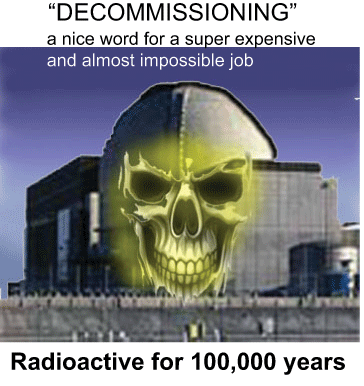 Anti–nuclear resistance in Russia: problems, protests, reprisals [Full Report 2020] Report “Anti–nuclear resistance in Russia: problems, protests, reprisals” Produced by RSEU’s program “Against nuclear and radioaсtive threats”
“………..For many years, Murmansk regional environmental groups have opposed the ageing Kola NPP reactor’s lifetime extension. They have participated in public hearings, have organised many demonstrations (8-9-10), appealed to and received support from the prosecutor’s office(11), but this was all ignored by Rosatom. Activists also called on the governor to shut down the old NPP, but environmental organisations were shutdown instead. One such organisation is Kola Environmental Center (KEC) – listed as a Foreign Agent in 2017– and was subject to two trials and fined 150,000 rubles (12). KEC was forced to close down as a legal entity in2018, but has continued its environmental work as a public movement(13). Another organisation in the region –Nature and Youth – made the decision to close down in order to avoid prosecution, but continues its work as an unregistered initiative
• In 2018, after 45 years of operation, the first power unit of the Leningrad NPP was finally shut down.The second one scheduled for shutdown is in 2020, the third in 2025 and the fourth in 2026. However,decommissioning projects have not yet been clearly developed for the reactors.
• The public organisation, Green World, has worked for many years in Sosnovy Bor, Leningrad Region, a city dominated by the nuclear industry and closed to outsiders. Since 1988, activists of the organisation have opposed dangerous nuclear projects in the Baltic Sea region(17) and have provided the public with independent information on the environmental situation. (18)
In its place, another organisation was opened – the Public Council of the South Coast of the Gulf of Finland. Activists have continued their work as before under this new name…….”
Green light for Rokkasho nuclear reprocessing plant, but is it viable?

@ú{´RÌgpÏÝjR¿ÄHêSAÂX§ZPºi¤¯ÊMÐ@©çj
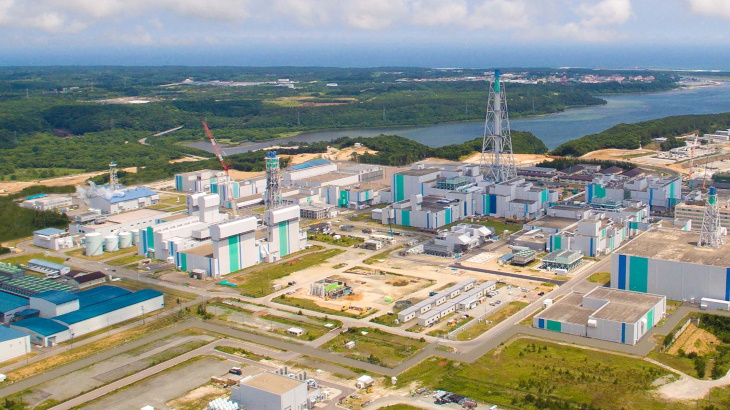
The NRA’s approval means the long-troubled and controversial plant has moved closer to going into operation. Here’s a look at the Rokkasho plant and the problems it has faced.
What is the Rokkasho reprocessing plant? The plant at Rokkasho is a 3.8 million square meter facility designed to reprocess spent nuclear fuel from the nation’s nuclear reactors.
Construction began in 1993. Once in operation, the plant’s maximum daily reprocessing capacity will be a cumulative total of 800 tons per year.
During reprocessing, uranium and plutonium are extracted, and the Rokkasho plant is expected to generate up to eight tons of plutonium annually. Both are then turned into a mixed uranium-plutonium oxide (MOX) fuel at a separate MOX fabrication plant, also located in Rokkasho, for use in commercial reactors. Construction on the MOX facility began in 2010 and it’s expected to be completed in 2022.
The Rokkasho reprocessing plant can store up to 3,000 tons of spent nuclear fuel from the nation’s power plants on-site. It’s nearly full however, with over 2,900 tons of high-level waste already waiting to be reprocessed.
Why has it taken until now for the Rokkasho plant to secure approval from the nuclear watchdog? Decades of technical problems and the new safety standards for nuclear power that went into effect after the 2011 triple meltdown at the power plant in Fukushima Prefecture have delayed Rokkasho’s completion date 24 times so far. It took six years for the plant to win approval under the post-3/11 safety standards.
There has also long been concern and unease over the entire project — and not just among traditional anti-nuclear activists — which the government has been forced to address. Japan is the only non-nuclear weapons state pursuing reprocessing. But as far back as the 1970s, as Japan was debating a nuclear reprocessing program, the United States became concerned about a plant producing plutonium that could be used for a nuclear weapons program.
The issue was raised at a Feb. 1, 1977, meeting between U.S. Vice President Walter Mondale and Prime Minister Takeo Fukuda.
“Reprocessing facilities which could produce weapons grade material are simply bomb factories,” noted a declassified U.S. State Department cable on the meeting. “We want to cooperate (with Japan) to keep the problem under control.”
…….. technical mishaps led to plans being made and then scrapped for many years, while arms control experts continued to worry that Japan could end up stockpiling plutonium that could lead to proliferation problems.
After the 2011 disaster, the NRA created tougher measures to minimize damage from natural disasters, forcing more construction and upgrades at the plant, leading to higher costs.
The Tokai plant halted operations in 2007. The decision to scrap it was made in 2014, as it was judged to be unable to meet the new safety standards. But little progress is being made, due to uncertainty over where to store all of the radioactive waste.
Safety concerns over the Rokkasho plant have remained, especially since 2017 when it was revealed that Japan Nuclear Fuel had not carried out mandatory safety standards for 14 years
By the time of the NRA announcement on May 13, the price tag for work at the Rokkasho plant had reached nearly ¥14 trillion.
What happens next? The NRA is soliciting public comment on its decision until June 12, but the Ministry of Economy, Trade, and Industry is expected to formally approve the decision. After that, the Aomori governor would be asked to give his approval, though that is not a legal requirement. The last bureaucratic hurdles would then have been cleared to start operations at the plant by the spring of 2022.
However, there are other issues that could force a delay to the start of reprocessing. Japan had originally envisioned MOX fuel powering between 16 and 18 of the nation’s 54 commercial reactors that were operating before 2011, in place of conventional uranium.
But only four reactors are using it out of the current total of nine officially in operation. MOX fuel is more expensive than conventional uranium fuel, raising questions about how much reprocessed fuel the facilities would need, or want…….
Japan finds itself caught between promises to the international community to reduce its plutonium stockpile through reprocessing at Rokkasho, and questions about whether MOX is still an economically, and politically, viable resource — given the expenses involved and the availability of other fossil fuel and renewable energy resources. https://www.japantimes.co.jp/news/2020/05/31/national/social-issues/aomoris-rokkasho-nuclear-plant-gets-green-light-hurdles-remain/#.XtQfrTozbIU
Time that Japan faced up to the folly of its nuclear fuel cycle dream
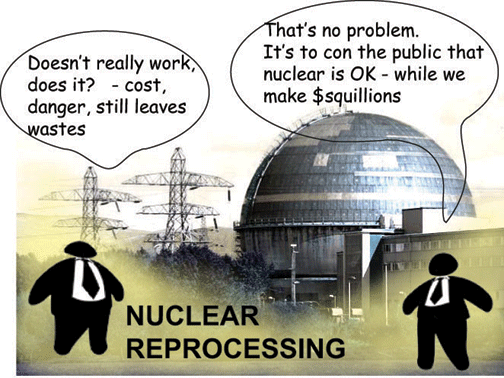
As the situation stands, plutonium will start to pile up with no prospects of it being consumed. Reducing the amount produced is also an issue that needs to be addressed.
The United States and Britain have already pulled out of a nuclear fuel cycle.
|
Editorial: Time to set a course away from Japan’s troubled nuclear fuel cycle https://mainichi.jp/english/articles/20200518/p2a/00m/0na/029000c, May 18, 2020 (Mainichi Japan) The Rokkasho Nuclear Fuel Reprocessing Facility being constructed in the northern Japan prefecture of Aomori has cleared a safety inspection by the Nuclear Regulation Authority (NRA). Spent fuel from Japan’s nuclear power plants will be reprocessed at this facility, which will play a key role in Japan’s “nuclear fuel cycle” policy. Under the policy, uranium and plutonium extracted from such fuel is to be processed for further use. Japan Nuclear Fuel Ltd., the operator of the reprocessing facility, aims to complete construction by autumn next year, but there are no immediate prospects of the facility going into operation. On top of this, due to changes in the circumstances surrounding nuclear power, the meaning of the facility’s existence is no longer clear. The first issue to consider is declining demand for the use of fuel to be reprocessed at the facility. Such fuel was originally destined to go mainly to the Monju fast-breeder reactor in the western Japan prefecture of Fukui, but a spate of problems with the sodium-cooled reactor led to a decision in 2016 to decommission it. There are no plans to construct a replacement facility. There were also plans to use reprocessed fuel at nuclear power stations to generate electricity, but there are only four reactors that can handle it, far fewer than the 16 to 18 originally planned. As the situation stands, plutonium will start to pile up with no prospects of it being consumed. Reducing the amount produced is also an issue that needs to be addressed. Japan already possesses more than 45 metric tons of surplus plutonium, and there are fears in international society that it could be converted for use in nuclear weapons. In 2018, the government pledged to reduce the amount. A realistic approach is not to reprocess the fuel in the first place. Forming the backdrop to Japan’s persistence with fuel reprocessing is the problem of how to handle the large amount of spent nuclear fuel being stored on the grounds of the reprocessing facility. If Japan gives up on its nuclear fuel cycle policy, then the spent fuel will be sent back to nuclear power plants across the country. But those facilities are already pressed for storage space, making it difficult for them to accept the spent fuel. The total cost of the reprocessing facility, including construction and maintenance costs, stands at 14 trillion yen. Some of the cost will be tacked onto electricity bills. There is a need to rethink the question of whether the public is receiving benefits commensurate with the huge investment into the facility. NRA Chairman Toyoshi Fuketa said he would check with the minister of economy, trade and industry whether operation of the reprocessing plant was in line with the nation’s energy policy. In the wake of the 2011 Great East Japan Earthquake and tsunami and the ensuing nuclear disaster, many countries across the world turned in the direction of abandoning nuclear power. There are sufficient uranium resources in the world, and the justification for reprocessing as “effective utilization of limited resources” has faded. The United States and Britain have already pulled out of a nuclear fuel cycle. Japan must avoid a situation in which it wastes time by sticking to a national policy and becomes laden with risks. The country should squarely face up to the fact that it is in a no-win situation, and search for an alternative to the nuclear fuel cycle policy. |
Nuclear fraud in Norway could affect nuclear safety in other countries
 Faked-data scandal might jeopardize safety at unknown number of nuclear power plantsAn investigation at Norway’s now-closed Halden research reactor reveals that results from a number of nuclear fuel experiments were tampered with in an effort that was “planned and well hidden,” according to the facility’s operator — a discovery that could have consequences for numerous nuclear power utilities around the world. Bellona, May 15, 2020 by Charles Digges Faked-data scandal might jeopardize safety at unknown number of nuclear power plantsAn investigation at Norway’s now-closed Halden research reactor reveals that results from a number of nuclear fuel experiments were tampered with in an effort that was “planned and well hidden,” according to the facility’s operator — a discovery that could have consequences for numerous nuclear power utilities around the world. Bellona, May 15, 2020 by Charles Digges
Many of Halden’s former customers are foreign governments and nuclear utilities that relied on Halden’s data to make decisions about how to fuel their own nuclear reactors. The purpose of research facilities like Halden is to simulate how various nuclear fuels behave under different circumstances, thus allowing nuclear power companies a greater margin of safety in their operations. While officials have not revealed which nuclear operators might have been impacted by the falsifications, the say the report casts doubt on seven fuel experiments that took place between 1990 and 2005. “What scares us is that companies around the world operating nuclear reactors may have relied on data from the Halden reactor,” says Frederic Hauge, Bellona’s president. “If data has been manipulated, security can be jeopardized, because the research is used to make decisions about how the reactors are operated.” The Halden reactor, which is one of four research reactors run in Norway, began operations in 1955 and was shuttered in 2018 after a long period of financial difficulties and technical problems. Kvamme Associates, an Oslo-based anti-corruption research group, led the investigation into the suspect data. The group provided its results to the Institute of Energy Technology, or IFE, Halden’s operator, earlier this week. According to investigators, the IFE’s suspicions about data manipulation arose last summer. The ensuing inquiry revealed fraud so serious that the IFE reported it to Norway’s economic crimes unit. The investigation report, which IFE released to Bellona this week, shows that a number of fuel tests were fabricated either because researchers failed to meet test requirements, or because they ran up against deadlines they were unable to meet. “We have found that data was changed,” IFE director Nils Morten Huseby, told Norway’s national broadcaster, NRK. “What was reported to customers is not what the tests actually showed. It can potentially be serious, but we need to know more about how the customers used the data.”……. Three other projects carried out at Halden are also under suspicion and are currently under review, NRK said. Bellona’s Hauge questioned the IFE’s oversight of the experiments in question, and called for a broader investigation into the institute’s management practices……… According to NRK, the Kvamme Associates report states that four international projects conducted at the Halden reactor were found to contain fabricated data. Independent experts found that two of the cases involved no security or safety risks, the broadcaster reported, while two other cases have not been fully evaluated. Three other projects carried out at Halden are also under suspicion and are currently under review, NRK said. ……The revelations come as a blow to the IFE, which until Halden’s closure had struggled with criticism that the reactor was too costly to the Norwegian public and had battled allegations that it was unsafe following a 2016 iodine leak. “The fact that IFE’s reputation as a research institution is at stake here is one thing,” said Hauge. “But that it may have affected the safety of an unknown number of nuclear power plants in an unknown number of countries – that’s very, very serious.”….. Bellona’s Hauge questioned the IFE’s oversight of the experiments in question, and called for a broader investigation into the institute’s management practices. https://bellona.org/news/nuclear-issues/2020-05-faked-data-scandal-might-jeopardize-safety-at-unknown-number-of-nuclear-power-plants |
|
Rokkasho nuclear reprocessing, a pointless effort , to postpone coping with plutonium trash

the project should not be kept alive through irresponsible collusion between the government and the power industry to avoid tackling this challenge.
Political leaders should make the tough decision as soon as possible to put the nation on a path toward a new energy future.
|
Japan should end its nonsensical effort to recycle nuclear fuel http://www.asahi.com/ajw/articles/13372798, May 14, 2020 Japanese nuclear regulators have endorsed the safety of a contentious plant to reprocess spent nuclear fuel.
The Nuclear Regulation Authority (NRA) on May 13 approved a draft report on the safety inspection of the reprocessing plant being built in Rokkasho, Aomori Prefecture, by Japan Nuclear Fuel Ltd. The report says the plant meets the new nuclear safety standards introduced after the 2011 Fukushima nuclear disaster. The NRA’s decision represents a big step forward toward bringing the long-delayed Rokkasho reprocessing plant online. Japan’s policy program to establish a nuclear fuel recycling system to recover plutonium from spent nuclear fuel to be reused in reactors, however, is already bankrupt beyond redemption. Operating the reprocessing plant simply does not make sense because of the many problems it entails with regard to nuclear proliferation, cost effectiveness, energy security and other important policy issues. Prime Minister Shinzo Abe’s administration should change its policy concerning nuclear fuel recycling. It would be irresponsible to maintain this unsustainable national policy aimlessly simply because of the NRA’s verdict that the plant meets the new safety standards. TROUBLE-PLAGUED PLANT Continue reading |
Rokkasho – Japan’s nuclear ‘pie in the sky’
 VOX POPULI: Government, nuclear industry badly in need of a reality check http://www.asahi.com/ajw/articles/13375632Vox Populi, Vox Dei is a daily column that runs on Page 1 of The Asahi Shimbun., May 15, 2020 In his 1991 book “Rokkashomura no Kiroku” (Record of Rokkasho village), journalist Satoshi Kamata documented the displacement of residents for a planned large development project in the northern village.
Kamata reproduced an essay written by an elementary school pupil, whose school was earmarked for closure because of the megaproject.
“I detest development more than I could ever say,” the youngster wrote.
The villagers were promised a rosy future, with rows of factories turning their rural community into a vibrant urban center. But none of that happened, and the school closed in 1984.
“All that talk about the factories was a lie,” the child lamented. “I truly hate being made to feel so sad and lonely.”
Instead of this development project that never materialized, the village of Rokkasho in Aomori Prefecture ended up hosting a facility for reprocessing spent nuclear fuel.
A series of delays held up the project for years, but the Nuclear Regulation Authority finally ruled the plant’s safety measures acceptable under its new standards on May 13.
The Rokkasho plant was meant to be the “nucleus” of the nation’s nuclear fuel recycling program of the future, with the purpose of minimizing nuclear waste by reusing spent fuel.
The reprocessed fuel was to be burned in fast-breeder reactors, but efforts to develop a viable fast-breeder reactor have gone nowhere. Attempts to use the reprocessed fuel in conventional nuclear reactors have also stalled.
The whole project has effectively become a proverbial pie in the sky.
But neither the government nor utilities would acknowledge this reality and review the project, apparently because they fear the issue of nuclear waste will become the focus of attention.
I wonder how long they are going to keep their heads in the sand without addressing the thorny problem of how to dispose of nuclear waste.
Here’s a riddle: What cannot be seen when your eyes are open, but can be seen when your eyes are closed? The answer is a dream.
Where the nuclear fuel recycling program is concerned, I imagine the nation’s nuclear community must be dreaming or hallucinating.
How much radioactive waste is stored on our planet?
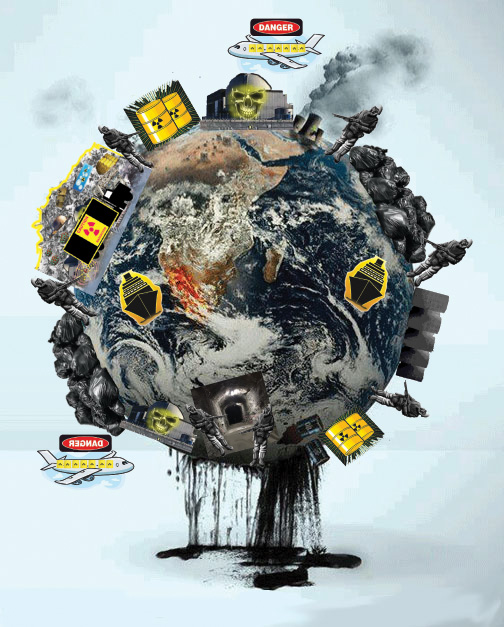 The black boxes of nuclear waste strategy https://wiseinternational.org/nuclear-monitor/882/black-boxes-nuclear-waste-strategy
How much radioactive waste is stored on our planet? According to the world’s first nuclear waste report, we don’t really know. We do know that nearly seven decades of civil and military reactor programmes have led to large stockpiles of waste, and that its volume is growing; we also know that our ignorance is vast, and there appears to be no responsible solution to the problem.
The systems delivering management strategies vary tremendously from one country to another, as do the range of authorities responsible for their management; so establishing volumes, risks and costs is no small task. When we add to this complexity national variations in both terminology and conceptual frameworks, a cross-country comparison becomes a Gordian knot. States don’t just differ in their classification systems ‒ they also follow different regulatory and safety procedures; the same applies to funding schemes, accounting measures, inventory reports and liability strategies. The European Commission is reportedly not able to make sense of the member state reports it receives, due to the extent of the anomalies. The commission has stated that it would consider taking measures to harmonize inventory reporting; it also expressed interest in finding ways to encourage states to secure appropriate financing options to pay for waste management.1 Nuclear Waste Directive implementation failures have led to the launch of infringement procedures against 25 out of 28 member states.2
While Russia offers practially no useful information about its nuclear waste inventory, the data from Belgium and the Netherlands are out of date, and the quality of Slovakia’s reports are so bad that they couldn’t be used for the WNWR report. Together with Euratom and national supervisory bodies, the Commission may wish to look into the codification of reporting methodologies in order to loosen the Gordian knot somewhat. The question of safety is ultimately a matter of implementation, and one of the functions of EU bodies is to indicate where implementation problems lie.
Criteria: the basis for informed decision-making
The World Nuclear Waste Report 2019 – Focus Europe (WNWR) offers criteria by which some of the evident lapses in reporting and departures from minimum obligations can be identified and remedied.3 Continue reading
‘Small Modular Nuclear Reactor’ entrepreneurs trying to revive dangerous ‘plutonium economy’ dream.

It seems that these two SMNR entrepreneurs in New Brunswick, along with other nuclear “players” worldwide, are trying to revitalize the “plutonium economy” — a nuclear industry dream from the distant past that many believed had been laid to rest because of the failure of plutonium-fuelled breeder reactors almost everywhere, including the US, France, Britain and Japan.
The phrase “plutonium economy” refers to a world in which plutonium is the primary nuclear fuel in the future rather than natural or slightly enriched uranium. Plutonium, a derivative of uranium that does not exist in nature but is created inside every nuclear reactor fuelled with uranium, would thereby become an article of commerce.
The proposed SMNR prototype from ARC Nuclear in Saint John is the ARC-100 reactor (100 megawatts of electricity). It is a liquid sodium-cooled SMNR, based on the 1964 EBR-2 reactor – the Experimental Breeder Reactor #2 in Idaho. Its predecessor, the EBR-1 breeder reactor, had a partial meltdown in 1955, and the Fermi-1 breeder reactor near Detroit, also modelled on the EBR-2, had a partial meltdown in 1966.
Admiral Hyman Rickover, who created the US fleet of nuclear-powered submarines, tried a liquid-sodium-cooled reactor only once, in a submarine called the Sea Wolf. He vowed that he would never do it again. In 1956 he told the US Atomic Energy Commission that liquid sodium-cooled reactors are “expensive to build, complex to operate, susceptible to prolonged shutdown as a result of even minor malfunctions, and difficult and time-consuming to repair.”
The ARC-100 is designed with the capability and explicit intention of reusing or recycling irradiated CANDU fuel. In the prototype phase, the proposal is to use irradiated fuel from NB Power’s Point Lepreau Nuclear Generating Station. Lepreau is a CANDU-6 nuclear reactor.
The other newly proposed NB SMNR prototype is the Moltex “Stable Salt Reactor” (SSR) — also a “fast reactor”, cooled by molten salt, that is likewise intended to re-use or recycle irradiated CANDU fuel, again from the Lepreau reactor in the prototype phase.
The “re-use” (or “recycling”) of “spent nuclear fuel”, also called “used nuclear fuel” or “irradiated nuclear fuel,” is industry code for plutonium extraction. The idea is to transition from uranium to plutonium as a nuclear fuel, because uranium supplies will not outlast dwindling oil supplies. Breeder reactors are designed to use plutonium as a fuel and create (“breed”) even more plutonium while doing so.
It is only possible to re-use or recycle existing used nuclear fuel by somehow accessing the unused “fissile material” in the used fuel. This material is mainly plutonium. Accessing this material involves a chemical procedure called “reprocessing” which was banned in the late 1970s by the Carter administration in the US and the first Pierre Elliot Trudeau administration in Canada. South Korea and Taiwan were likewise forbidden (with pressure from the US) to use this chemical extraction process.
Why did both the US and Canada ban this recycling scheme? Two reasons: 1) it is highly dangerous and polluting to “open up” the used nuclear fuel in order to extract the desired plutonium or U-233; and 2) extracting plutonium creates a civilian traffic in highly dangerous materials (plutonium and U-233) that can be used by governments or criminals or terrorists to make powerful nuclear weapons without the need for terribly sophisticated or readily detectable infrastructure.
Argonne Laboratories in the US, and the South Korean government, have been developing (for more than 10 years now) a new wrinkle on the reprocessing operation which they call “pyroprocessing.” This effort is an attempt to overcome the existing prohibitions on reprocessing and to restart the “plutonium economy.”
Both New Brunswick projects are claiming that their proposed nuclear reactor prototypes would be successful economically. To succeed, they must build and export the reactors by the hundreds in future.
On the contrary, however, the use of plutonium fuel is, and always has been, much more expensive than the use of uranium fuel. This is especially true now, when the price of uranium is exceedingly low and showing very little sign of recovering. In Saskatchewan, Cameco has shut down some of its richest uranium mines and has laid off more than a thousand workers, while reducing the pay of those still working by 25 percent. Under these conditions, it is impossible for plutonium-fuelled reactors to compete with uranium-fuelled reactors.
And to make matters worse for the industry, it is well known that even uranium-fuelled reactors cannot compete with the alternatives such as wind and solar or even natural-gas-fired generators. It is an open question why governments are using public funds to subsidize such uneconomical, dangerous and unsustainable nuclear technologies. It’s not their money after all – it’s ours!
Dr. Gordon Edwards, a scientist and nuclear consultant, is the President of the Canadian Coalition for Nuclear Responsibility. He can be reached at: ccnr@web.ca Note from the NB Media Co-op editors: Dr. Edwards visited New Brunswick in March for a series of public talks on the development of so-called Small Modular Nuclear Reactors. The story of his talk in Saint John can be accessed here. The video of the webinar presentation scheduled for Fredericton can be accessed here.
The Nuclear Non-Proliferation Treaty- its promise and its failure
 Now, nuclear disarmament is at a standstill, existing treaties have either been dismantled or at risk, development in underway of new types of nuclear weapons with new missions and lowered threshold of use, and threats of use of nuclear weapons have been sounded.
|
25 Years After the Indefinite Extension of The Nuclear Non-Proliferation Treaty: A Field of Broken Promises and Shattered Visions InDepth News, By Tariq Rauf 11 May 20, VIENNA (IDN) – “I long ago took to heart the words of Omar Bradley, spoken virtually a half century ago, when he observed, having seen the aftermath of the bombs on Hiroshima and Nagasaki, thus: ‘We live in an age of nuclear giants and ethical infants. We live in a world that has achieved brilliance without wisdom, power without conscience. We’ve unlocked the mysteries of the atom and forgotten the lessons of the Sermon on the Mount. We know more about war than we know about peace, more about killing than we know about living’.”
These remarks were made by General George Lee Butler, the last Commander of the United States Strategic Air Command (SAC) in a speech in Ottawa, Canada, on 11 March 1999. “Why a country that makes atomic bombs would ban fireworks”, asked a child at the United Nations kindergarten in New York. ………..Decision on the Indefinite Extension of the NPT The momentous decision to extend the NPT indefinitely was taken on Thursday, 11 May 1995, in the 17th plenary meeting of the review and extension conference starting at 12:10 PM New York time. The President of the 1995 NPT Review and Extension Conference (NPTREC), Ambassador Jayantha Dhanapala (Sri Lanka), began the meeting by saying that, “I apologize to all delegations for the delay in convening this meeting, but I assure them that it was for very good reasons. Consultations were taking place amongst delegations to ensure that our work should progress smoothly. We also commence a little after high noon to intensify the drama of the occasion”. Dhanapala informed the delegates that three proposals were on the table regarding options for the extension of the Treaty, these were: (1) a proposal by Mexico, calling for indefinite extension along with a number of procedural elements; (2) a proposal submitted by Canada on behalf of 103 States parties and subsequently sponsored by eight additional States parties, calling for the indefinite extension with no added elements; and (3) a proposal submitted by Indonesia and 10 States parties and subsequently sponsored by three additional States parties; calling for an extension for rolling fixed periods of twenty-five years with a review and extension conference at the end of each fixed period to conduct an effective and comprehensive review of the operation of the Treaty, and for the Treaty to be extended for the next fixed period of twenty-five years unless the majority of the parties to the Treaty decided otherwise at the review and extension conference………. The principles and objectives contained recommendations and actions covering all three pillars of the NPT: (1) nuclear disarmament; (2) nuclear-non-proliferation; and (3) peaceful uses of nuclear technologies. Continue reading |
Canada on verge of investing in plutonium
Gordon Edwards <ccnr@web.ca>\, 26 Apr 2020, It seems that the two SMNR (Small Modular  Nuclear Reactor) entrepreneurs in New Brunswick (Canada), along with other nuclear “players” worldwide, are trying to revitalize the “plutonium economy” — a nuclear industry dream from the distant past that many believed had been laid to rest because of the failure of plutonium-based breeder reactors almost everywhere – e.g. USA, France, Britain, Japan …
1 This Month

26 September – International Day for the Total Elimination of Nuclear Weapons


PLEASE OPPOSE HR 8255 AND S.3639 – bills would accelerate satellite deployment, with no environmental review or safeguards – https://ncstd5li.quorum.us/campaign/169331/
To see nuclear-related stories in greater depth and intensity – go to https://nuclearinformation.wordpress.com
-
Archives
- September 2026 (206)
- August 2026 (330)
- July 2026 (355)
- June 2026 (287)
- May 2026 (306)
- April 2026 (356)
- March 2026 (251)
- February 2026 (267)
- January 2026 (308)
- December 2025 (358)
- November 2025 (359)
- October 2025 (375)
-
Categories
- 1
- 1 NUCLEAR ISSUES
- business and costs
- climate change
- culture and arts
- ENERGY
- environment
- health
- history
- indigenous issues
- Legal
- marketing of nuclear
- media
- opposition to nuclear
- PERSONAL STORIES
- politics
- politics international
- Religion and ethics
- safety
- secrets,lies and civil liberties
- spinbuster
- technology
- Uranium
- wastes
- weapons and war
- Women
- 2 WORLD
- ACTION
- AFRICA
- Atrocities
- AUSTRALIA
- Christina's notes
- Christina's themes
- culture and arts
- Events
- Fuk 2022
- Fuk 2023
- Fukushima 2017
- Fukushima 2018
- fukushima 2019
- Fukushima 2020
- Fukushima 2021
- general
- global warming
- Humour (God we need it)
- Nuclear
- RARE EARTHS
- Reference
- resources – print
- Resources -audiovicual
- Weekly Newsletter
- World
- World Nuclear
- YouTube
-
RSS
Entries RSS
Comments RSS
 nuclear-news