Nuclear testing left a signature of radioactive carbon all around the world
Even after childhood, bomb radiocarbon chronicles the history of our body.
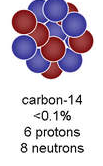 Your Inner H-Bomb Nuclear testing left a signature of radioactive carbon all around the world—in trees and sharks, in oceans and human bodies. Even as that signal disappears, it’s revealing new secrets to scientists. The Atlantic, Story by Carl Zimmer, 2 Mar 20,
 Rafter expected the level of radiocarbon to fluctuate. But he soon discovered that something else was happening: Month after month, the carbon dioxide in the atmosphere was getting more radioactive. He dunked barrels into the ocean, and he found that the amount of carbon 14 was rising in seawater as well. He could even measure extra carbon 14 in the young leaves growing on trees in New Zealand.
The Castle Bravo test and the ones that followed had to be the source. They were turning the atmosphere upside down. Instead of cosmic rays falling from space, they were sending neutrons up to the sky, creating a huge new supply of radiocarbon.
Other scientists began looking, and they saw the same pattern. In Texas, the carbon 14 levels in new tree rings were increasing each year. In Holland, the flesh of snails gained more as well. In New York, scientists examined the lungs of a fresh human cadaver, and found that extra carbon 14 lurked in its cells. A living volunteer donated blood and an exhalation of air. Bomb radiocarbon was in those, too.
Bomb radiocarbon did not pose a significant threat to human health—certainly not compared with other elements released by bombs, such as plutonium and uranium. But its accumulation was deeply unsettling nonetheless. When Linus Pauling accepted the 1962 Nobel Peace Prize for his campaigning against hydrogen bombs, he said that carbon 14 “deserves our special concern” because it “shows the extent to which the earth is being changed by the tests of nuclear weapons.”
The following year, the signing of the Partial Test Ban Treaty stopped aboveground nuclear explosions, and ended the supply of bomb radiocarbon. All told, those tests produced about 60,000 trillion trillion new atoms of carbon 14. It would take cosmic rays 250 years to make that much. In 1964, Rafter quickly saw the treaty’s effect: His trays of lye had less carbon 14 than they had the year before.
Only a tiny fraction of the carbon 14 was decaying into nitrogen. For the most part, the atmosphere’s radiocarbon levels were dropping because the atoms were rushing out of the air. This exodus of radiocarbon gave scientists an unprecedented chance to observe how nature works.
Today scientists are still learning from these man-made atoms. “I feel a little bit bad about it,” says Kristie Boering, an atmospheric chemist at UC Berkeley who has studied radiocarbon for more than 20 years. “It’s a huge tragedy, the fact that we set off all these bombs to begin with. And then we get all this interesting scientific information from it for all these decades. It’s hard to know exactly how to pitch that when we’re giving talks. You can’t get too excited about the bombs that we set off, right?”
Yet the fact remains that for atmospheric scientists like Boering, bomb radiocarbon has lit up the sky like a tracer dye. When nuclear triggermen such as John Clark set off their bombs, most of the resulting carbon 14 shot up into the stratosphere directly above the impact sites. Each spring, parcels of stratospheric air gently fell down into the troposphere below, carrying with them a fresh load of carbon 14. It took a few months for these parcels to settle on weather stations on the ground. Only by following bomb radiocarbon did scientists discover this perpetual avalanche.
Once carbon 14 fell out of the stratosphere, it kept moving. The troposphere is made up of four great rings of circulating air. Inside each ring, warm air rises and flows through the sky away from the equator. Eventually it cools and sinks back to the ground, flowing toward the equator again before rising once more. At first, bomb radiocarbon remained trapped in the Northern Hemisphere rings, above where the tests had taken place. It took many years to leak through their invisible walls and move toward the tropics. After that, the annual monsoons sweeping through southern Asia pushed bomb radiocarbon over the equator and into the Southern Hemisphere.
Eventually, some of the bomb radiocarbon fell all the way to the surface of the planet. Some of it was absorbed by trees and other plants, which then died and delivered some of that radiocarbon to the soil. Other radiocarbon atoms settled into the ocean, to be carried along by its currents.
Carbon 14 “is inextricably linked to our understanding of how the water moves,” says Steve Beaupre, an oceanographer at Stony Brook University, in New York…….
[a whole fascinating section here about research into marine life]
……. For forensic scientists who need to determine the age of skeletal remains, lenses aren’t much help. But teeth are. As children develop teeth, they incorporate carbon into the enamel. If people’s teeth have a very low level of radiocarbon, it means that they were born well before Castle Bravo. People born in the early 1960s have high levels of radiocarbon in their molars, which develop early, and lower levels in their wisdom teeth, which grow years later. By matching each tooth in a jaw to the bomb curve, forensic scientists can estimate the age of a skeleton to within one or two years.
Even after childhood, bomb radiocarbon chronicles the history of our body. When we build new cells, we make DNA strands out of the carbon in our food. Scientists have used bomb radiocarbon in people’s DNA to determine the age of their cells. In our brains, most of the cells form around the time we’re born. But many cells in our hearts and other organs are much younger………
Children who are just now going through teething pains will have only a little more bomb radiocarbon in their enamel than children born before Castle Bravo did. Over the past six decades, the land and ocean have removed much of what nuclear bombs put into the air. Heather Graven, a climate scientist at Imperial College London, is studying this decline. It helps her predict the future of the planet.
Graven and her colleagues build models of the world to study the climate. As we emit fossil fuels, the extra carbon dioxide traps heat. How much heat we’re facing in centuries to come depends in part on how much carbon dioxide the oceans and land can remove. Graven can use the rise and fall of bomb radiocarbon as a benchmark to test her models………..
If we keep burning fossil fuels at our accelerating rate, the planet will veer into climate chaos. And once more, radiocarbon will serve as a witness to our self-destructive actions. Unless we swiftly stop burning fossil fuels, we will push carbon 14 down far below the level it was at before the nuclear bombs began exploding.
To Graven, the coming radiocarbon crash is just as significant as the bomb spike has been. “We’re transitioning from a bomb signal to a fossil-fuel-dilution signal,” she said.
The author Jonathan Weiner once observed that we should think of burning fossil fuels as a disturbance on par with nuclear-weapon detonations. “It is a slow-motion explosion manufactured by every last man, woman and child on the planet,” he wrote. If we threw up our billions of tons of carbon into the air all at once, it would dwarf Castle Bravo. “A pillar of fire would seem to extend higher into the sky and farther into the future than the eye can see,” Weiner wrote.
Bomb radiocarbon showed us how nuclear weapons threatened the entire world. Today, everyone on Earth still carries that mark. Now our pulse of carbon 14 is turning into an inverted bomb spike, a new signal of the next great threat to human survival.
No comments yet.
-
Archives
- October 2026 (92)
- September 2026 (339)
- August 2026 (330)
- July 2026 (355)
- June 2026 (287)
- May 2026 (306)
- April 2026 (356)
- March 2026 (251)
- February 2026 (267)
- January 2026 (308)
- December 2025 (358)
- November 2025 (359)
-
Categories
- 1
- 1 NUCLEAR ISSUES
- business and costs
- climate change
- culture and arts
- ENERGY
- environment
- health
- history
- indigenous issues
- Legal
- marketing of nuclear
- media
- opposition to nuclear
- PERSONAL STORIES
- politics
- politics international
- Religion and ethics
- safety
- secrets,lies and civil liberties
- spinbuster
- technology
- Uranium
- wastes
- weapons and war
- Women
- 2 WORLD
- ACTION
- AFRICA
- Atrocities
- AUSTRALIA
- Christina's notes
- Christina's themes
- culture and arts
- Events
- Fuk 2022
- Fuk 2023
- Fukushima 2017
- Fukushima 2018
- fukushima 2019
- Fukushima 2020
- Fukushima 2021
- general
- global warming
- Humour (God we need it)
- Nuclear
- RARE EARTHS
- Reference
- resources – print
- Resources -audiovicual
- Weekly Newsletter
- World
- World Nuclear
- YouTube
-
RSS
Entries RSS
Comments RSS


Leave a Reply