Donald Trump the Worst President in the History of the United States

Anna Thurlow, 9 Jan 21, Donald Trump Has Been the Worst President in the History of the United StatesBy Eve ottenburg and Karl Grossman
“For those who concluded from the Covid-19 debacle that Trump simply wasn’t up to the job, it looks unlikely, to say the least, that his China legacy will be anything other than catastrophic. U.S. and Chinese economies are intertwined and, as we’ve already seen, decoupling hurts lots of Americans, starting with farmers. Trump’s executive order on December 28, prohibiting investments in firms reportedly controlled by the Chinese military does little besides ratchet up tensions. Hostilities between the two navies in the South China Sea could explode into regional war at any time. And how that war would be prevented from becoming nuclear is a very well-kept secret. But the geniuses in the Pentagon aren’t concerned. They believe in their new generation of small, “smart” nuclear weapons and “winnable” nuclear wars, as does Trump, the president who arguably has done more to promote nuclear war than perhaps any predecessor since mankind first split the atom.
Donald Trump has been the worst president in the history of the United States.”
Eve ottenburg
The attack by his supporters on the Capitol was a capstone of his presidency — lawless, an attack on democracy, a U.S. counterpart of the rise of Nazism in Germany in the 1930s.
It was a horror representative of his tenure.
Thank heavens and thanks to successful and hard political work, he will in days be out of office. And there must be criminal prosecutions on the state and local levels as well the federal level, which he’ll likely try to wrangle out of with a pardon.
There must be consequences to his horrendous term in office.
“An American Tragedy” was the title of a piece by David Remnick, editor of The New Yorker magazine, right after Election Day 2016. “The election of Donald Trump,” Remnick wrote, “is nothing less than a tragedy for the American republic, a tragedy for the Constitution, and a triumph for the forces, at home and abroad, of nativism, authoritarianism, misogyny, and racism.” There would be “miseries to come”– and there have been.
Remnick warned against an “attempt to normalize” the election of Trump. “Trump is vulgarity unbounded, a knowledge-free national leader”, “a twisted caricature of every rotten reflex of the radical right…a flim-flam man” with “disdain for democratic norms.”
The attack on the Capitol by the Trumpsters was an attempt at a coup to undo a presidential election in which a record number of voters came out to dump Trump and elect Joe Biden.
It was an act of insurrection incited by Trump.
As he tweeted to followers on December 20th — “Big protest in DC on January 6th. Be there, will be wild!”
Yes, and indeed it was wild.
And then, in a speech in front of The White House on Wednesday, addressing his backers who had arrived, said: “We’re going to walk down Pennsylvania Avenue…and we’re going to the Capitol.” He added: “You have to be strong.”
His call was preceded by his lawyer, Rudy Giuliani, proclaiming “let’s have trial by combat.”
Giuliani, who took an oath to be an attorney and adhere to rule of law, represented Trump in many courts in challenges to his election defeat with claims that judges found totally untrue–but Giuliani opted instead, in violation of that oath, for “trial by combat.”
Remnick warned about an “attempt to normalize” Trump, but so much of media have engaged in “both sides-ing” the situation, as Julie Hollar of Fairness and Accuracy in Reporting has written.
When a person tells an out-and-out lie, there is no journalistic obligation to “balance” a story with a falsehood
And Trump, The Washington Post report has recorded, has uttered more than 20,000 falsehoods in his term in office.
And then there have been the Trump disinformation machines led by Fox -about which Nazi propagandist Joseph Goebbels would smile.
But this is far more than a media problem.
Trump tapped into a vein of racism and other poisons in the United States.
He soon will be out of The White House but Trumpism, so horribly, will still be here.
“You have to summon an act of will, a certain energy and imagination, to replace truth with the authority of a con man like Trump,” George Packer wrote in the current issue of The Atlantic.
Trump’s “barrage of falsehoods — as many as 50 daily in the last fevered months of the 2020 campaign — complemented his unconcealed brutality,” writes Packer.
“Two events in Trump’s last year in office broke the spell of his sinister perversion of the truth,” he says: COVID-19 and a free election.
“The beginning of the end of Trump’s presidency arrived on March 11, 2020, when he addressed the nation for the first time on the subject of the pandemic and showed himself to be completely out of his depth. The virus was a fact that Trump couldn’t lie into oblivion or forge into a political weapon — it was too personal and frightening, too real. As hundreds of Americans died and the administration flailed between fantasy, partisan incitement, and criminal negligence, a crucial number of Americans realized that Trump’s lies could get someone they love killed,” says Packer.
He continues: “The second event came on November 3”– the election.
And that is what Trump and his followers who attacked the Capitol sought to undo. And, on the same day, Trump enablers in Congress were trying to undo it by having the votes of the Electoral College denied.
“The election didn’t end his lies — nothing will…But we learned that we still want democracy. This, too, is the legacy of Donald Trump,” Packer concluded.
Yes, most Americans still want democracy, but the history of authoritarian takeovers shows that a relatively small group of fanatics can beat the majority.
And we still are left with those toxic issues that Trump capitalized on.
Another component here is the enabling of Trump by all those Republicans.
Margaret Sullivan wrote a piece earlier this week in The Washington Post, headed “We must stop calling Trump’s enablers ‘conservative.’ They are the radical right.”
She wrote: “These days the true radicals are the enablers of President Trump’s ongoing attempted coup: the media bloviators on Fox News, One America and Newsmax who parrot his lies about election fraud; and the members of Congress who plan to object on Wednesday to what should be a pro forma step of approving the electoral college results, so that President-elect Joe Biden can take office peacefully on Jan. 20.
“But instead of being called what they are, these media and political figures get a mild label: conservative. Instead of calling out the truth, it normalizes; it softens the dangerous edges,” she continued. “It makes it seem, well, not so bad. Conservative, after all, describes politics devoted to free enterprise and traditional ideas. But that’s simply false. Sean Hannity is not conservative. Sen. Josh Hawley of Missouri and Sen. Tommy Tuberville of Alabama are not conservative. Nor are the other 10 (at last count) Senators who plan to object” to the Electoral College vote.
She notes Tim Alberta wrote on Politico that “‘There is nothing conservative about subverting democracy.’ He suggests ‘far right’ as an alternative descriptor. Not bad. But I’d take it a step further, because it’s important to be precise. I’d call them members of the radical right.
“Members of the radical right won’t like this, of course. They soak in the word ‘conservative” like a warm bath.”
“On Jan. 20, we can still presume Trump will be gone from the White House,” she writes. “But his enablers and the movement that fostered him, and that he built up, will remain. That’s troubling. We should take one small but symbolic step toward repairing the damage by using the right words to describe it. It would be a start.”
Journalist Carl Bernstein, of Watergate fame, says Trump “will be in our history books as a dark, dark stain unlike any president of the United States.” And he investigated Nixon.
An act of love — Beyond Nuclear International

Courts threaten freedom of Russian nature protector
An act of love — Beyond Nuclear International
Lyubov Kudryashova loves nature. Now she may be jailed for defending it
By Jack Cohen-Joppa
In Russian, her name means love. And it’s true. Lyubov Kudryashova loves the broad valley of Russia’s Tobol River, where it meanders out of Kazakhstan into the Kurgan Oblast. Her grandfather is buried there, she was born there, and she’s raised three sons there. As far as she knows, her ancestors have always lived there.
There, below the southern Urals, frigid continental winters give way to spring floods that inundate a landscape of oxbow lakes, wetlands, forests and fields. The waters sustain a large aquifer that Russia recognizes as a strategic reserve of fresh water.
“We, native people of the land, are against a barbaric attitude towards nature,” she says. “But our voices are too low.”
Which is why the passion of this campaigning environmentalist and entrepreneur has been met with fabricated charges of encouraging terrorism via the internet. She’s now on trial in a military court in Yekaterinburg, six hours away from her small town.
But Lyubov Kudryashova will not be spurned. “My ecological activity is going to continue. Well, I guess till the day the unjust court could takes away my freedom.”
In 2017, the government awarded an operating license for borehole leeching of uranium to Dalur, a uranium mining subsidiary of the Russian state nuclear agency Rosatom. The license to tap the Dobrovolnoye deposit around the village of Zverinogolovskoye condemned the very farmland Kudryashova’s father managed when she would accompany him as a child.
Dalur has two other leaky in-situ uranium projects in the Kurgan.
Many Tobol Valley residents feared environmental disaster when they learned that hundreds of exploratory wells would be drilled through the aquifer into the mineral deposit lying beneath it, without any public environmental review. Borehole leeching would eventually involve drilling thousands of wells and the injection of a million tons of sulfuric acid over 20-30 years, then withdrawing the dissolved minerals and chemically extracting the uranium.
Several times, activists tried to start a referendum and demand an independent environmental review, but met only refusals from the local officials.
Last fall, environmentalists surveyed some of Dalur’s other boreholes in Kurgan and documented much higher radiation levels than permitted. Despite the concerns, construction began on an in-situ leaching pilot plant and the huge clay-lined “mud pits” needed to receive the massive volume of toxic, acidified sludge produced in the process.
Beginning in 2017, Kudryashova was involved in the legal case against the Russian Federation over its refusal to conduct an environmental impact assessment before awarding the license to develop the mine.
That year, she also co-founded the Public Monitoring Fund for the Environmental Condition and the Population Welfare with the regional branch of the Communist Party of the Russian Federation. One month later, a judge of the Kurgan Regional Court issued an order giving the Russian Federal Security Service (FSB) authority to wiretap her telephone.
The Fund publishes information on the environmental impact of Dalur’s mining activity. Kudryashova writes, “Shortly after the completion of the case in the Supreme Court of the Russian Federation and the registration of the environmental fund, a hidden judgment of another court was rendered that allowed the FSB to begin wiretapping my phone and, I believe, begin to look for fictitious crimes in order to stop my work.
“I guess money is more important than the radioactive contamination of land,” she observed.
So it was that on January 29, 2019, armed men led by an FSB captain broke into her family’s home and spent the day searching it. That summer the FSB got a local court to involuntarily commit Kudryashova to the Kurgan District Psychiatric Hospital for most of the month of July. She was kept from speaking with family or others outside without permission of the agency.
Then in March 2020, the FSB charged Kudryashova with 12 counts of “public justification of terrorism using the Internet” based on a specious forensic analysis of posts on the social network VKontakte, which, according to Kudryashova, never belonged to her page. The actual source of those posts remains unknown because the protocol and the DVD-R capturing those posts show evidence of fabrication and forgery. And at the most recent session of her trial in late December, a CD-R the defense had presented to the court for evidence was found to have been erased by an FSB operative.
Prosecutors say she advocated for violent overthrow of the constitutional order by re-posting memes with such seditious phrases as, “The fate of Russia is determined by each of us, what you personally or I do, then Russia will. A correct position can only be revolutionary” and “If the nation is convinced that the ruling power in the state is directed not at the development of its cultural, economic and other needs, but, on the contrary, at trampling them, then it is not only the right, but also the duty of the nation to overthrow that power and establish one corresponding to the national interests of the people.”
Kudryashova writes, “Nonviolent ecological activism, in the understanding of the rulers of my country, is a crime. That’s why prisons are full of people who wanted to protect nature, but those who harmed it are free… Ecological crimes against present and future generations are not subject to the judgement of a military court.
“I’m 55 years old and my life is not as important as the preservation of nature. My duty and responsibility are to make a small contribution in a great cause — to stop violence against nature and people. The price of atomic energy is the life of future generations.”
Her trial is in the Central District Military Court of Yekaterinburg, where the next hearing is scheduled for 28-29 January, 2021. Agora International Human Rights Group and the Memorial civil rights society in Russia have provided an attorney and other support for Kudryashova.
Letters in support of Lyubov Kudryashova and seeking dismissal of the charges against her should be addressed to the chair of the court collegium examining the case, Judge Sergei Gladkih, st. Bazhova 85, Yekaterinburg, Russia 62005, or by email to opo.covs.svd@sudrf.ru. Refer to Case №: 2-42/2020, Lyubov Kudryashova.
Jack Cohen-Joppa is the co-editor of The Nuclear Resister, the co-founder of the eponymous organization and co-winner with Felice Cohen-Joppa of the 2020 Nuclear Free Future Award in the category of Education.
Human Rights and the UN Treaty on the Prohibition of Nuclear Weapons
|
Australia: The UN Treaty on the Prohibition of Nuclear Weapons: Corrs Human Rights Day event recap https://www.mondaq.com/australia/human-rights/1019602/the-un-treaty-on-the-prohibition-of-nuclear-weapons-corrs-human-rights-day-event-recap
23 December 2020 Corrs Chambers Westgarth On 10 December 2020, Corrs marked Human Rights Day with an ‘In Conversation’ event focused on the UN Treaty on the Prohibition of Nuclear Weapons (Treaty).
The event brought together leading experts in the field of nuclear disarmament and the humanitarian impacts of a nuclear event, including;
Discussion between the panellists focused on the significance of the Treaty and how it may shape future obligations of states and corporates in connection with nuclear weapons and nuclear disarmament. The Treaty currently has 51 parties and 86 signatories and is set to enter into force on 22 January 2021, cementing a categorical ban on nuclear weapons, 75 years after their first use. Australia has yet to ratify the Treaty. A number of themes that emerged from the conversation are explored below. Why is this conversation so critical?The panellists agreed that the prohibition of nuclear weapons is perhaps more urgent now than ever before. In early 2020, the Doomsday Clock – which symbolises the gravest existential dangers facing humankind – was moved to 100 seconds to midnight, indicating that humankind was closer to the apocalypse than ever in history. This movement was attributed to the increased threats of nuclear war and the continued global failure to address climate change. The adjustment was described as indicative of ‘the most dangerous situation that humanity has ever faced’. This is unsurprising. Today, there remain around 13,500 nuclear weapons in the hands of only a few states. Many are in a high operational readiness, and have the ability to be rapidly deployed. It is well understood that the use of even a fraction of these weapons would result in unimaginable loss of human life and have long-term effects on human health, the environment and global food supplies. The World Health Organisation (WHO) has consistently found that all the world’s health resources would not be effective in responding to even a singlenuclear attack. A paradigm shiftThe Treaty was born out of a shift in focus from the assumed defence and international security benefits of nuclear weapons to the catastrophic humanitarian consequences they would incur. The Red Cross, ICAN and members of civil society played a vital role in shaping that discussion. Dr Durham noted that this shift in momentum began when then President of the ICRC Jakob Kellenberger addressed the Geneva Diplomatic Corp in the lead up to the Non Proliferation Treaty Review Conference in 2010, declaring that the debate on nuclear weapons must be guided not by ‘military doctrine and power politics’, but by ‘human beings, . the fundamental rules of international humanitarian law, and . the collective future of humanity’. The humanitarian focus of the discourse continued its momentum with a series of conferences convened to consider the humanitarian impact of nuclear weapons in Norway (2013), Mexico (2014) and Austria (2014). Dr Durham and Dr Ruff reflected on their respective involvement in these conferences, observing how they provided a platform to discuss the humanitarian consequences of nuclear weapon use at the international level, significantly shifting the debate and bringing to bear increased urgency in the need to ban nuclear weapons. Legal significance and relationship with other treatiesWhen the Treaty enters into force, it will be the first international legal instrument which makes nuclear weapons illegal, prohibiting their development, testing, production, acquisition, stockpiling, use, deployment or threat of use. The Treaty will also prohibit the provision of assistance to any state in the conduct of prohibited activities. It is notable that, even with all their destructive power, nuclear weapons are the last form of weapons of mass destruction to be prohibited. The Treaty will only bind those states which have formally signed and ratified it, which means that non-parties (such as Australia) do not have any formal obligations under the Treaty. Other nuclear weapons treaties, including the nearly universal Treaty on the Non-Proliferation of Nuclear Weapons (NPT) which has been in force since 1970, will continue as a cornerstone in the international legal framework governing nuclear weapons. In this regard, Dr Durham observed that the NPT and the Treaty are complimentary rather than conflicting in their shared aspiration to eliminate nuclear weapons. Legal ramifications for the commercial sectorFor businesses, the Treaty will begin a process of stigmatisation of companies that are involved in the production of nuclear weapons. It may also render their operations unlawful. Tara Gutman observed that the impact of the Treaty’s prohibitions is already being felt, noting that:
In addition, state parties to the Treaty are expected to make the manufacture of nuclear weapons or their components unlawful under domestic laws in their territories. How these matters impact the commercial sector in the coming years will be interesting to follow. What’s next?The panellists reminded us that the entry into force of the Treaty is but a step on what has been a long path towards nuclear disarmament. Other nuclear weapons treaties, including the nearly universal Treaty on the Non-Proliferation of Nuclear Weapons (NPT) which has been in force since 1970, will continue as a cornerstone in the international legal framework governing nuclear weapons. In this regard, Dr Durham observed that the NPT and the Treaty are complimentary rather than conflicting in their shared aspiration to eliminate nuclear weapons. Legal ramifications for the commercial sectorFor businesses, the Treaty will begin a process of stigmatisation of companies that are involved in the production of nuclear weapons. It may also render their operations unlawful. Tara Gutman observed that the impact of the Treaty’s prohibitions is already being felt, noting that:
In addition, state parties to the Treaty are expected to make the manufacture of nuclear weapons or their components unlawful under domestic laws in their territories. How these matters impact the commercial sector in the coming years will be interesting to follow. What’s next?The panellists reminded us that the entry into force of the Treaty is but a step on what has been a long path towards nuclear disarmament. |
|
Dr Helen Caldicott as mentor for anti-nuclear activists
 My Six Mentors, “………Helen Caldicott, MD, by Mary Olson, Gender and Radiation Impact Project, 1 January 20121
Helen Caldicott deserves a much greater place in our histories of the Cold War and ending the USA / USSR arms race than she generally gets. This is, perhaps, because she is powerful and a woman. A pediatrician, who in the 1970’s would not tolerate the radioactive fallout she and her patients were suffering from nuclear weapons tests in Australia, Helen and her family came to the USA. She and another physician named Ira Helfand revived what had been a local Boston organization of physicians and created a Nobel Prize winning organization called Physicians for Social Responsibility (PSR), which later participated in the creation of another Nobel Prize winning group, the International Physicians for the Prevention of Nuclear War (IPPNW). These two along with hundreds of other organizations committed to peace and nuclear disarmament formed the International Campaign for the Abolition of Nuclear Weapons (ICAN) which has helped to create the new Treaty on the Prohibition of Nuclear Weapons (see http://icanw.org/the-treaty ) and also won the Nobel Prize (2017).
Helen herself is a powerful communicator and will move audiences at a level that can change the course of someone’s life and work. She followed her own destiny to winning meetings with Mikhail Gorbachev, President of the Soviet Union, where she educated him about Nuclear Winter and the fact that nuclear is not a war that anyone can win. She also met with President Reagan in the era and diagnosing early-stage dementia… Her ability to bring the reality of the world to these men, and reality of these men to the world set her aside, in a class by herself—and was an enormous contribution to us all.
I first met Helen in the body of her Cold War block-buster book “Nuclear Madness.” I was in the midst of an existential crisis that could have become an even bigger health crisis. After college I needed a job (not yet a career) because I was broke, broken up from my first “true” love, and far from home. I got a job as a research assistant in a lab at a prestigious medical school; it was 1984.
Within 2 weeks, I was inadvertently contaminated with radioactivity (without my knowledge) by carelessness of a lab-mate. The radioactive material, Phosphorus-32 is used in research to trace biochemical activity in living organisms. This type of radioactivity is not deeply penetrating, so there was some reason not to panic, however the I was exposed continuously for over a week, and I also found radioactivity at home– my toothbrush was “hot”—so I had also had some level of internal exposure. I was terrified. The lab used concentrations of the tracer thousands of times higher than is typical.
The institution told me there was no danger, but because I was upset, they helped me transfer to a different job. No accident report was filed, and in the midst of transition, my radiation detection badge was never processed. It is not possible to know the dimensions of my exposure—I began having symptoms that were not normal for me. Many people, including some family members told me I was imagining things. No one in my circle understood how terrified I was.
I was fortunate that Helen had already written “Nuclear Madness”—the first edition came out in 1978, just before the March 1979 Three Mile Island nuclear meltdown in Harrisburg PA—an event that propelled the book into multiple printings including a Bantam Paperback edition that I found. It turned out that 7 years later I helped Helen to revise and update the same text for the 1994 WW Norton edition. It was Helen’s deep commitment to truth, to speaking and writing that truth, to empowering people to take action for good. Helen’s words accurately described radiation and its potential for harm, and in my panic about the unknown, this calmed me.
Every other authority I had encountered was trying to tell me there was no problem—when I knew they had no right to dismiss what had happened to me. I am quite certain that had I remained alone with my fear, despair, and confusion my panic would have resulted in behaviors that would have compounded any harm bodily from that radioactive contamination. Reading Helen’s work let me know there was at least one woman walking the Earth who did know what I was going through… it made it possible for me to choose recovery and walk away from a legal battle that would have forced me to maintain, hold and prove a myself a victim. Instead, following in Helen’s wake, I chose Peaceful Warrior. Thank you Helen! : ……….. https://www.genderandradiation.org/blog/2020/12/31/my-six-mentors
Mary Olson pays tribute to Rosalie Bertell, the great explainer of radiation impacts on health.
My Six Mentors, by Mary Olson, Gender and Radiation Impact Project, 1 January 20121
 “……………. Rosalie Bertell, PhD
It was Rosalie who most let me know that I am able to contribute original work towards the day that People, to decide not to split atoms any more. Human beings began splitting atoms in Chicago, in 1942. Rosalie, a PhD in mathematics and member of the Order of Gray Nuns, knew more than anyone else I have worked with, that all of it—every last nuclear license, and radioactive emission, all the waste and all the bombs and all the money congress gives to nuclear activities are choices. People made, and continue to make these decisions…and we can change our mind.
Rosalie studied radiation impacts and was committed to service on behalf of future generations. She won the Right Livelihood award for her work with communities impacted by nuclear industry. Often called the “alternative Peace Prize” – she was one of the first women to be honored. As a laureate, she was encouraged to find and mentor students. Rosalie hoped that I, and my coworker Diane D’Arrigo would go to graduate school and she could be our mentor. We decided since we were already in our 50’s to simply study with her, informally. We traveled, 5 or 6 times to the Mother House where she resided and she generously met with us in the last two years of her life. She was always small in stature, but at that point her back was bent and she barely came up to my chest, but still had the intensity of a wolverine!
It was Rosalie Bertell who helped me tackle one of the biggest challenges I have faced. After a public talk on radioactive waste policy that I gave during this time, a woman asked me if radiation was more harmful to women, to her, compared to a man. Even though I had studied and known many of the top independent radiation researchers, including Bertell, I had never heard that biological sex could be a factor for harm—other than in reproduction (pregnancy)—but that is more about the embryo and fetus than the woman. I told her that I was sorry, I did not know and would get back to her. In fact, I forgot.
Two years later, when nuclear reactors exploded in Japan at a site called Fukushima Daiichi, I remembered that question and knew it urgently needed an answer. I was unaware that Dr Arjun Makhijani and a team had written on sex differences in radiation harm in 2006 (see www.ieer.org ) and also did not turn that up as I searched for any information on differences between males and females. My findings, five years later are an independent confirmation of the IEER work.
Since I found nothing on a basic google dive, I called Rosalie, who was at that point nearing the end of her life, to ask if she had studied biological sex. She had not, and the one report she pointed me to was out of print. It was my second call, a week later, that prompted her to tell me that I would have to look at the data myself.
I had no idea that the National Academy of Science (NAS) had published tables with 60 years of data on cancers and cancer deaths among the survivors of Hiroshima and Nagasaki. Rosalie told me to find out for myself. I was shocked. I had stopped any formal study of math in the 6th grade…she was a mathematician—I asked her to do it, and she reminded me that she was dying. I protested again. It was her next words that pushed me. Rosalie said, “The data is divided by males and females so you can look at this question—and if there is a difference, it will be a simple pattern. It is good you do not have more math because if there is a difference, you will find it and not make it more complicated than it is.” She said to get a few pencils, a sharpener, an eraser and lots of paper, and go to it. I did.
The result was my first paper on the topic, “Atomic Radiation is More Harmful to Women,” (October 2011) published to the web in time for Rosalie to congratulate me. Three years later the paper was the basis for my invitation to speak at the global Vienna Conference on the Humanitarian Consequences of Nuclear Weapons. Three years later as the new Treaty on the Prohibition of Nuclear Weapons was in the work, I founded the Gender and Radiation Impact Project. Rosalie is the one who put rocket fuel in my determination to help. If the world decides to base radiation protection on Refence Little Girl—make every regulation in terms of protecting females who are infants—five years old, future generations have a chance. Rosalie is the one who modeled for me that it is possible to reach for the best possible outcome, and, indeed, we have an obligation to do so………..…… https://www.genderandradiation.org/blog/2020/12/31/my-six-mentors
Non violent anti-nuclear action – the Clamshell Alliance model for success
Know Your Nonviolent History: In 1976 Clamshell Alliance Launches Mass Demonstrations https://www.riverasun.com/know-your-nonviolent-history-in-1976-clamshell-alliance-launches-mass-demonstrations/August 18, 2016, by Rivera Sun On August 1st, 1976, the first nonviolent mass demonstration of the Clamshell Alliance took place at the proposed site of the Seabrook Nuclear Energy Facility in New Hampshire. The Clamshell Alliance was a group of anti-nuclear activists who worked to stop nuclear power plant construction at a time when President Nixon’s “Project Independence” had proposed the construction of over 1,000 nuclear power plants throughout the nation. Although the Clamshell Alliance was only partially successful in halting the Seabrook facility, their mass mobilizations deterred the plans for other plants and changed the landscape of nuclear energy forever. If not for the Clamshell Alliance, it is possible that we would be living in the nuclear nightmare of President Nixon’s vision of a thousand plants by the year 2000.
|
The Clamshell Alliance used a model of affinity groups of 6-20 people, and a spokes council system that functioned on consensus decision-making by all members. In July 1976, the Clamshell Alliance adopted a Declaration of Nuclear Resistance and by August 1st had mobilized their first protest of 200-600 people. Later in August, a second protest and civil disobedience action occupied the Seabrook construction site for 75 minutes, singing songs and planting trees. Nearly all of the 200 participants were arrested. In April of 1977, the Clamshell Alliance mobilized 2,000 people for a demonstration. 1,400 participants were arrested, most refusing to post bail. They were held in jails and National Guard armories for up to two weeks. The activists used this time for training and networking, and subsequently, the detention of the activists was seen as a blunder on the part of Governor Meldrim Thomson. In 1978, the Clamshell Alliance successfully organized another series of mass demonstrations and arrests. From June 23-26th, the alliance accepted an agreement to legally protest on the site for three days. Some sources claim this protest was one of the largest on-site protests in the history of the anti-nuclear movement, citing over 20,000 participants and very few arrests. On March 29th, 1979, the meltdown of the Three Mile Island reactor in Harrisburg, Pennsylvania, propelled the dangers of nuclear power to the forefront of national concern. In collaboration with other groups, a huge anti-nuclear energy rally was organized in Washington, D.C. on May 6, 1979. Between 50,000 and 120,000 people gathered to protest nuclear power and demand safe alternatives. These demonstrations played a major role in slowing and stopping the rush toward nuclear energy. Although Unit 1 of Seabrook Power Plant went online in 1990, Unit 2 was cancelled altogether. The project cost seven times the original billion-dollar estimate and was completed 14 years later than anticipated. In that time, hundreds of other proposals were dropped, due to the high social and fiscal costs encountered by the Seabrook Power Plant. For decades after the inception of the Clamshell Alliance and other similar groups, no new nuclear power facilities were proposed or constructed. The Clamshell Alliance left a lasting legacy in its organizing structure, movement practices, consensus model, and strategies for change. These are all tools and resources that can be used by current movements for change. This article is from Rivera Sun’s book of nonviolent histories that have made our world. Click here for more information. |
|
Hanford’s dangerous collection of nuclear waste sites, including 177 underground leaky tanks
Washington’s new nuclear waste lead takes on Hanford’s aging tanks, OPB, By Anna King (Northwest News Network), Dec. 30, 2020.
David Bowen is charged with holding the U.S. Department of Energy accountable for its cleanup of a site that once produced plutonium for nuclear weapons.
At the Hanford site in southeastern Washington, along the Columbia River, millions of gallons of radioactive sludge are cradled in aging underground tanks.
Nearly 2,000 capsules filled with cesium and strontium rest unquietly in an old, glowing-blue pool of water. Two reactors along the Columbia still need to be sealed up and cocooned.
And those are just some of the bigger waste sites out of hundreds at the 580-square-mile cleanup site.
177 underground tanks filled with radioactive waste It’s a lot to ponder and a steep learning curve for freshly hired David Bowen. …..He started his new job Dec. 16 as the Nuclear Waste Program lead for Washington’s Department of Ecology in Richland.
he’ll hold the U.S. Department of Energy accountable for its cleanup at the site using the Tri-Party Agreement. That’s a 1989 document struck between Ecology, the federal Department of Energy and the U.S. Environmental Protection Agency.
Hanford houses leftovers from World War II and the Cold War, when it was the nation’s factory for plutonium. Trenches, pits and buildings are all contaminated with loads of chemicals and radioactive waste generated at breakneck speed.
The stickiest problem: 177 tanks — some of them leakers — filled with radioactive waste.
“Some of [the underground tanks] are 50-plus years old,” Bowen said. “And they weren’t designed to last this long. There are still fluids in them, millions of gallons, in sludge, et cetera. So, there’s the opportunity for that to escape and get into the Columbia River — or the groundwater is high.”
A massive waste treatment plant is being built in the desert at Hanford to treat that tank waste. But the cleanup timeline has been pushed back several times since the 1980s. It could be pushed back more because of the pandemic.
……. Aging infrastructure, aging expertsHanford is much like a complex small city: thousands of commuting workers, miles of highways and intertwining roads.
Then there are all the stakeholders: multiple tribes, Seattle-based Hanford watchdog groups, salmon and Columbia River advocates and multiple government agencies. Losing Hanford experts to retirement or attrition to other agencies is a big problem — and a growing one. Some key Ecology experts have recently been lured away to federal posts or to work as Hanford contractors. And many have already retired. Bowen said he’s well aware he needs to work fast……… https://www.opb.org/article/2020/12/29/washington-nuclear-waste-program-manager-hanford/
The insanity of nuclear power in space
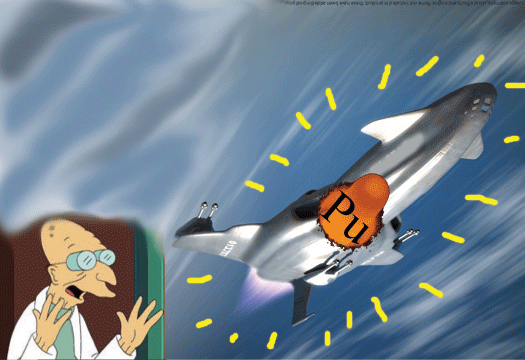
 The Big Push for Nukes in Space, https://www.counterpunch.org/2020/12/15/the-big-push-for-nukes-in-space/?fbclid=IwAR1rGf0qomJlTKuhqCOsTTl3EkKOQzxf2QxOJ-3n0MnxGWNLvybgxXPovTU BY KARL GROSSMAN.– 15 Dec 20, Last week a SpaceX rocket exploded in a fireball at the SpaceX site in Texas. “Fortunately,” reported Lester Holt on NBC TV’s Nightly News, “no one was aboard.”
But what if nuclear materials had been aboard?
The nuclear space issue is one I got into 35 years ago when I learned—from reading a U.S. Department of Energy newsletter—about two space shuttles, one the Challenger which was to be launched the following year with 24.2 pounds of plutonium aboard.
The plutonium the shuttles were to carry aloft in 1986 was to be used as fuel in radioisotope thermoelectric generators—RTGs—that were to provide a small amount of electric power for instruments on space probes to be released from the shuttles once the shuttles achieved orbit.
The plutonium-fueled RTGs had nothing to do with propulsion.
I used the U.S. Freedom of Information Act to ask what would be the consequences of an accident on launch, in the lower or upper atmosphere—and what about the dispersal of deadly plutonium. A few years earlier, I wrote Cover Up: What You Are Not Supposed to Know About Nuclear Power, so I was well familiar with plutonium, considered the most lethal radioactive substance.
For 10 months there was a stonewall of challenges to my FOIA request by DOE and NASA. Finally, I got the information, heavily redacted, with the claim that the likelihood of a shuttle accident releasing plutonium was “small.”
Said one document: “The risk would be small due to the high reliability inherent in the design of the Space Shuttle.” NASA put the odds of a catastrophic shuttle accident at one-in-100,000.
Then, on January 28, 1986 the Challenger blew up.
It was on its next mission—in May 1986—that it was slated to have a plutonium-fueled RTG aboard.
From a pay phone in an appliance store –amid scores of TV sets with that horrible video of the Challenger exploding—I called The Nation magazine and asked the folks there whether they knew that the next launch of the Challenger was to be a nuclear mission. They didn’t.
They had me write an editorial that appeared on The Nation’s front page titled “The Lethal Shuttle.” It began, “Far more than seven people could have died if the explosion that destroyed Challenger had occurred during the next launch…”
And I got deeper and deeper into the nukes-in-space issue—authoring two books, one The Wrong Stuff, presenting three TV documentaries, writing many hundreds of newspaper and magazine articles and speaking widely on the issue.
NASA, incidentally, later in 1986, drastically increased the odds of a catastrophic shuttle accident to one-in-76. It turned out the one-in-100,000 estimate was based on dubious guessing.
I found that accidents involving the use of nuclear power in space is not a sky-is-falling threat. In the then 26 U.S. space nuclear shots, there had been three accident, the worst in 1964 involving a satellite powered by a SNAP 9-A radioisotope thermoelectric generator fueled with plutonium.
The satellite failed to achieve orbit, broke up in the atmosphere as it came crashing back down to Earth, its plutonium dispersing as dust extensively on Earth. Dr. John Gofman, an M.D. and Ph.D., professor of medical physics at the University of California at Berkeley, formerly associate director of Lawrence Livermore National Laboratory, author of Poisoned Power and involved in early studies of plutonium, long pointed to the SNAP 9-A accident as causing an increase in lung cancer on Earth.
Today the use of nuclear in space is being pushed harder than ever.
“US Eyes Building Nuclear Power Plants for Moon and Mars,” declared the headline this July of an Associated Press dispatch. “US Eyes Building Nuclear Power Plants for Moon and Mars”.
As Linda Pentz Gunter, editor at Beyond Nuclear International, recently wrote here on CounterPunch, “Yet undeterred by immorality and expense, and apparently without the slightest concern for the radioactive dirt pile these reactors will produce, NASA and the Department of Energy are eagerly soliciting proposals.” https://www.counterpunch.org/2020/10/21/nukes-on-the-moon/
In July, too, the White House National Space Council issued a strategy for space exploration that includes “nuclear propulsion methods.” “US Ramps Up Planning for Space Nuclear Technology”
General Atomics Electromagnetic Systems has come out with a design for a nuclear propulsion reactor for trips to Mars.
Nuclear propulsion, its promoters are saying, would get astronauts to Mars quicker.
Shouted the headline in Popular Mechanics last month: “The Thermal Nuclear Engine That Could Get Us to Mars in Just 3 Months.”
And Elon Musk, founder and CEO of Space X, has been touting the detonation of nuclear bombs on Mars to, he says, “transform it into an Earth-like planet.” https://www.independent.co.uk/life-style/gadgets-and-tech/news/elon-musk-mars-nuke-humans-live-mirrors-spacex-a9072631.html
As Business Insider explains, Musk “has championed the idea of launching nuclear weapons just over Mars’ poles since 2015. He believes it will help warm the planet and make it more hospitable for human life.”
As space.com says: “The explosions would vaporize a fair chunk of Mars’ ice caps, liberating enough water vapor and carbon dioxide—both potent greenhouse gases—to warm up the planet substantially, the idea goes.” https://www.space.com/elon-musk-nuke-mars-terraforming.html
It’s been projected that it would take more than 10,000 nuclear bombs to carry out the Musk plan.
The nuclear bomb explosions would also would render Mars radioactive.
The nuclear bombs would be carried to Mars on the fleet of 1,000 Starships that Musk wants to build—like the one that blew up this week.
SpaceX is selling T-shirts emblazoned with the words “Nuke Mars.”
Beyond the this completely insane plan to ruin Mars, as on Earth, solar energy can provide all the power needed for would-be settlements on Mars and the Moon. Continue reading
How the marketing of American weapons determines U.S. foreign policy on China

Key Pentagon Official Turned China Policy Over to Arms Industry & Taiwan Supporters October 28, 2020, The triumph of corporate and foreign interests over one of the most consequential decisions regarding China is likely to bedevil U.S. foreign policy for  years to come, writes Gareth Porter. https://consortiumnews.com/2020/10/28/key-pentagon-official-turned-china-policy-over-to-arms-industry-taiwan-supporters/ By Gareth Porter
The Grayzone
When the United States finalized a set of seven arms sales packages to Taiwan in August, including 66 upgraded F-16 fighter planes and longer-range air-to-ground missiles that could hit sensitive targets on mainland China, it shifted U.S. policy sharply toward a much more aggressive stance on the geo-strategic island at the heart of military tensions between the United States and China.
Branded “Fortress Taiwan” by the Pentagon, the ambitious arms deal was engineered by Randall Schriver, a veteran pro-Taiwan activist and anti-China hardliner whose think tank had been financed by America’s biggest arms contractors and by the Taiwan government itself.
Since assuming the post of assistant secretary of defense for Asian and Pacific security affairs in early 2018, Schriver has focused primarily on granting his major arms company patrons the vaunted arms deals they had sought for years.
The arms sales Schriver has overseen represent the most dangerous U.S. escalation against China in years. The weapons systems will give Taiwan the capability to strike Chinese military and civilian targets far inland, thus emboldening those determined to push for independence from China.
Although no U.S. administration has committed to defending Taiwan since Washington normalized relations with China, the Pentagon is developing the weapons systems and military strategy it would need for a full-scale war. If a conflict breaks out, Taiwan is likely to be at its center.
Returning Favors
Schriver is a longtime advocate of massive, highly provocative arms sales to Taiwan who has advanced the demand that the territory be treated more like a sovereign, independent state. His lobbying has been propelled by financial support from major arms contractors and Taiwan through two institutional bases: a consulting business and a “think tank” that also led the charge for arms sales to U.S. allies in East Asia.
The first of these outfits was a consulting firm called Armitage International, which Schriver founded in 2005 with Richard Armitage, a senior Pentagon and State Department official in the Reagan and George W. Bush administrations.
Schriver had served as Armitage’s chief of staff in the State Department and then as deputy sssistant secretary of state for East Asian and Pacific affairs. (Armitage, a lifelong Republican, recently released a video endorsement of Joseph Biden for president).
As a partner in Armitage International, Schriver was paid consulting fees by two major arms contractors — Boeing and Raytheon — both of which hoped to obtain arms sales to Taiwan and other East Asian allies to compensate for declining profits from Pentagon contracts.
Schriver started a second national-security venture in 2008 as president and CEO of a new lobbying front called The Project 2049 Institute, where Armitage served as chairman of the board. The name of the new institution referred to the date by which some anti-China hawks believed China intended to achieve global domination.
From its inception, The Project 2049 Institute focused primarily on U.S. military cooperation with Northeast Asian allies — and Taiwan in particular — with an emphasis on selling them more and better U.S. arms.
Schriver, known as the Taiwan government’s main ally in Washington, became the key interlocutor for major U.S. arms makers looking to cash in potential markets in Taiwan. He was able to solicit financial support for the institute from Lockheed Martin, General Atomics, BAE and Raytheon, according to Project 2049’s internet site, which provides no figures on the amounts given by each prior to 2017.
Equally important, however, is The Project 2049 Institute’s heavy dependence on grants from the government of Taiwan. The most recent annual report of the institute shows that more than a third of its funding in 2017 came either directly from the Taiwan government or a quasi-official organization representing its national security institutions.
Project 2049 received a total of $280,000 from the Taiwan Ministry of Defense and Taiwan’s unofficial diplomatic office in Washington (TECRO) as well as $60,000 from the “Prospect Foundation,” whose officers are all former top national-security officials of Taiwan. In 2017, another $252,000 in support for Schriver’s institute came from the State Department, at a time when it was taking an especially aggressive public anti-China line.
By creating a non-profit “think tank,” Schriver and Armitage had found a way to skirt rules aimed at minimizing conflicts of interest in the executive branch.
The Executive Order 13770 issued by President Donald Trump in early 2017 that was supposed to tighten restrictions on conflicts of interest barred Schriver from participation for a period of two years “in any particular matter that is directly and substantially related to my former employer or former clients….”
However, the financial support for Project 2049 from Boeing, Lockheed-Martin, General Atomics, Northrop Grumman and Raytheon, and from Taiwanese official and quasi-official bodies were considered as outside that prohibition, because they were not technically “clients.”
Big Wins for Supporters
Brought into the Pentagon at the beginning 2018 to push China policy toward a more confrontational stance, Schriver spent 2018 and the first half of 2019 moving proposals for several major arms sales to Taiwan — including the new F-16s and the air-to-ground missiles capable of hitting sensitive targets in China — through inter-agency consultations.
He secured White House approval for the arms packages and Congress was informally notified in August 2019, however, Congress was not notified of the decision until August 2020. That was because Trump was engaged in serious trade negotiations with China and wanted to avoid unnecessary provocation to Beijing.
Lockheed Martin was the biggest corporate winner in the huge and expensive suite of arms sales to Taiwan. It reaped the largest single package of the series: a 10-year, $8 billion deal for which it was the “principal contractor” to provide 66 of its own F-16 fighters to Taiwan, along with the accompanying engines, radars and other electronic warfare equipment.
The seven major arms sales packages included big wins for other corporate supporters as well: Boeing’s AGM-84E Standoff Land Attack Missile (SLAM), which could be fired by the F-16s and hit sensitive military and even economic targets in China’s Nanjing region, and sea-surveillance drones from General Atomics.
In February 2020, shortly after Schriver left the Pentagon, the Taiwanese President Tsai Ing-wen received the lobbyist in her office in Taipei and publicly thanked him for having “facilitated the sale of F-16V fighter jets to Taiwan and attached great importance to the role and status of Taiwan in the Indo-Pacific region.” It was an extraordinary expression of a foreign government’s gratitude for a U.S. official’s service to its interests.
Having delivered the goods for the big military contractors and the Taiwan government, Schriver returned to The Project 2049 Institute, replacing Armitage as chairman of the board.
Neocon Vision
The arms sales to Taiwan represented a signal victory for those who still hoping to reverse the official U.S. acceptance the People’s Republic of China as the legitimate government of all of China.
Ever since the 1982 U.S.-China Joint Communique, in which the United States vowed that it had “no intention of interfering in China’s internal affairs or pursuing a policy of “two China’s” or “one China, one Taiwan,” anti-China hardliners who opposed that concession have insisted on making the 1979 Taiwan Relations Act, which called for the United States to sell Taiwan such arms “as may be necessary to enable Taiwan to maintain a sufficient self-defense capability” as keystone of U.S. Taiwan policy.
The neoconservative Project for a New American Century (PNAC) led by William Kristol and Robert Kagan wanted to go even further; it pushed for the United States to restore its early Cold War commitment to defend Taiwan from any Chinese military assault.
Thus a 1999 PNAC statement called on the United States to “declare unambiguously that it will come to Taiwan’s defense in the event of an attack or a blockade against Taiwan, including against the offshore islands of Matsu and Kinmen.”
After leaving the World Bank in 2008 amidst a scandal involving his girlfriend, Paul Wolfowitz – the author of that 1999 statement on East Asia – turned his attention to protecting Taiwan.
Despite the absence of any business interest he was known to have in Taiwan, Wolfowitz was chairman of the board of the U.S.-Taiwan Business Council from 2008 to 2018. The Project 2049 Institute was a key member of the council, along with all the major arms companies hoping to make sales to Taiwan.
During the first days of Wolfowitz’s chairmanship, the U.S.-China Business Council published a lengthy study warning of a deteriorating air power balance between China and Taiwan. The study was obviously written under the auspices of one or more of the major arms companies who were members, but it was attributed only to “the Council’s membership” and to “several outside experts” whom it did not name.
The study criticized both the George W. Bush and Obama administrations for refusing to provide the latest F-16 models to Taiwan, warning that U.S. forces would be forced to defend the island directly if the jets were not immediately supplied. It also called for providing Taiwan with land-attack cruise missiles capable of hitting some of the most sensitive military and civilian targets in the Nanjing province that lay opposite Taiwan.
The delicacy of the political-diplomatic situation regarding Taiwan’s status, and the reality of China’s ability to reunify the country if it chooses to do so has deterred every administration since George H.W. Bush sold 150 F-16 fighter jets to Taiwan. That was, until Shriver’s provocative “Fortress Taiwan” sale went through.
The triumph of corporate and foreign interests in determining one of the most consequential U.S. decisions regarding China is likely to bedevil U.S. policy for years to come. At a moment when the Pentagon is pushing a rearmament program based mainly on preparation for war with China, an influential former official backed by arms industry and Taiwanese money has helped set the stage for a potentially catastrophic confrontation.
Gareth Porter is an independent investigative journalist who has covered national security policy since 2005 and was the recipient of Gellhorn Prize for Journalism in 2012. His most recent book is The CIA Insider’s Guide to the Iran Crisis, co-authored with John Kiriakou, just published in February.
This article is from The Grayzone
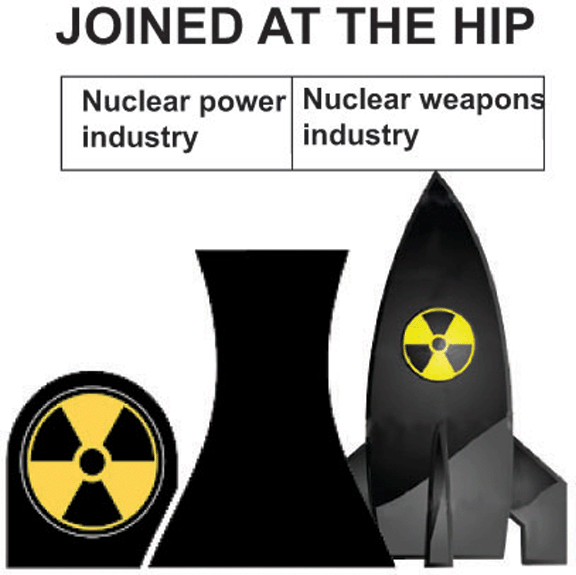
Small Nuclear Reactors – the Big New Way – to get the public to fund the nuclear weapons industry
so-called “small nuclear reactors”
Downing Street told the Financial Times, which it faithfully reported, that it was “considering” £2 billion of taxpayers’ money to support “small nuclear reactors”
They are not small
The first thing to know about these beasts is that they are not small. 440MW? The plant at Wylfa (Anglesey, north Wales) was 460MW (it’s closed now). 440MW is bigger than all the Magnox type reactors except Wylfa and comparable to an Advanced Gas-cooled Reactor.
Only if military needs are driving this decision is it explicable.
”Clearly, the military need to maintain both reactor construction and operation skills and access to fissile materials will remain. I can well see the temptation for Defence Ministers to try to transfer this cost to civilian budgets,”
Any nation’s defence budget in this day and age cannot afford a new generation of nuclear weapons. So it needs to pass the costs onto the energy sector.
How the UK’s secret defence policy is driving energy policy – with the public kept in the dark. https://www.thefifthestate.com.au/energy-lead/how-the-uks-secret-defence-policy-is-driving-energy-policy-with-the-public-kept-in-the-dark/ BY DAVID THORPE / 13 OCTOBER 2020
The UK government has for 15 years persistently backed the need for new nuclear power. Given its many problems, most informed observers can’t understand why. The answer lies in its commitment to being a nuclear military force. Continue reading
Untrue: claims that the nuclear bombing of Hiroshima and Nagasaki ended World War 2
 Did the Atomic Bomb End the Pacific War?
The use of the atomic weapon must be seen as a continuation and a start: the nuclear continuation of the conventional terror bombing of Japanese civilians, and the start of a new “cold war.” Portside, August 2, 2020 Paul Ham
Many historians and most lay people still
believe the atomic destruction of Hiroshima and Nagasaki ended the Pacific War.
They claim with varying intensity that the Japanese regime surrendered unconditionally in response to the nuclear attack; that the bomb saved a million or more Amercian servicemen; that Hiroshima and Nagasaki were chosen chiefly for their value as military targets; and that the use of the weapon was, according to a post-war propaganda campaign aimed at soothing American consciences, ‘our least abhorrent choice’.
The trouble is, not one of these claims is true.
That such denial of the facts has been allowed to persist for 75 years, that so many people believe this ‘revisionist’ line – revisionist because it was concocted after the war as a post-facto justification for the bomb – demonstrates the power of a government-sponsored rewrite of history over the minds of academics, journalists, citizens and presidents.
The uranium bomb dropped on Hiroshima, code-named ‘Little Boy’, landed on the city center, exploding above the main hospital and wiping out dozens of schools, killing 75,000 people, including tens of thousands of school children.
‘Fat Man’, the plutonium bomb used on Nagasaki, incinerated the largest Catholic community in Japan, obliterating the country’s biggest cathedral along with a residential district packed with schools and hospitals. Its missed its original target, the city center.
Zealous apologists for the bomb will have started picking holes: Hiroshima held troops? Yes, a few enfeebled battalions. Hiroshima had military factories? Most were on the outskirts of town, well clear of the bomb. Continue reading
SOUTH KOREA’S CORRUPT AND DANGEROUS NUCLEAR INDUSTRY
 “During the eighteen months from the beginning of 2012 to mid- 2013, major corruption incidents occurred in the nuclear power industry in every country currently seeking to export nuclear reactors: the United States, Canada, Japan, South Korea, Russia, France, and China….. “In the Korean case, systemic nuclear industry corruption was found
Supplementary Submission to the Victorian Parliament’s Standing Committee on Environment and Planning
Inquiry into Nuclear Prohibition Friends of the Earth Australia www.nuclear.foe.org.au
June 2020 – Extract
SOUTH KOREA’S CORRUPT AND DANGEROUS NUCLEAR INDUSTRY
South Korea’s reactor project in the UAE is years behind schedule: the start-up of the first reactor has not yet occurred despite initially being scheduled for 2017. The project has been promoted as a US$20 billion (A$29 billion) contract but costs have undoubtedly increased. The World Nuclear Industry Status Report gives a figure of €24.4 billion (A$40 billion).[1]
[1] https://www.worldnuclearreport.org/The-World-Nuclear-Industry-Status-Report-2017-HTML.html
[2] KBS, 8 May 2020, ‘S. Korea Unveils Energy Plan to Reduce Coal-powered, Nuclear Power Plants’, http://world.kbs.co.kr/service/news_view.htm
The following articles discuss:
- The endemic corruption in South Korea’s nuclear industry.
- The business model which sacrifices safety in order to improve economics (the CEO of French nuclear utility Areva likened Korea’s AP1400 reactor design to ‘a car without airbags and safety belts.'[1])
- The level of state-sponsored skullduggery associated with South Korea’s nuclear industry is almost beyond belief, even extending to a secret military side-agreement to the UAE reactor contract which was agreed without the knowledge or agreement of South Korea’s parliament
Nuclear corruption and the partial reform of South Korea’s nuclear mafia
Jim Green, Nuclear Monitor #887, 17 June 2020, https://wiseinternational.org/nuclear-monitor/887/nuclear-monitor-887-17-june-2020
The corrupt behavior of Japan’s ‘nuclear village’ ‒ and the very existence of the nuclear village ‒ were root causes of the March 2011 Fukushima disaster and a string of earlier accidents.1 In the aftermath of the Fukushima disaster, academic Richard Tanter identified a worldwide pattern of nuclear corruption:2
“During the eighteen months from the beginning of 2012 to mid- 2013, major corruption incidents occurred in the nuclear power industry in every country currently seeking to export nuclear reactors: the United States, Canada, Japan, South Korea, Russia, France, and China. A number of other countries that operate or plan to have nuclear power plants also had major corruption cases, including Lithuania, Bulgaria, and Pakistan; moreover, serious allegations of corruption were raised in Egypt, India, Jordan, Nigeria, Slovakia, South Africa, and Taiwan.
“In the Korean case, systemic nuclear industry corruption was found; in Canada, deep corporate corruption within the largest nuclear engineering corporation was one matter, and bribery of nuclear technology consuming countries’ senior ministers was another. In Russia, the issue was persistent, deep seated, and widespread corruption in state-owned and private nuclear industry companies, with profound implications for the safety of Russian nuclear industry exports.
South Korea is slowly phasing out its nuclear power industry. In the late 2000s, it was anticipated that South Korea’s nuclear capacity would rise from 18 gigawatts (GW) to 43 GW by 2030. The current plan is to reduce the number of reactors from a peak of 26 in 2024 to 17 reactors (approx. 17 GW) in 2034.[2] Thus the ambitions have been more than halved. In recent years the South Korean government has shut down the Kori-1 and Wolsong-1 reactors, and suspended or cancelled plans for six further reactors.
“Two cases in nuclear technology importing countries, Lithuania and Bulgaria, revealed large-scale bribery involving government, the nuclear industry, and foreign (US and Russian) companies.
“Post-Soviet bloc geostrategic energy interests are central to both stories. The profound influence of organized crime in national energy policy, and on a transnational basis, is revealed in the Bulgarian and Russian cases. Suspicions are widespread and allegations common in the cases of India, Taiwan, and Bangladesh, but confirmed evidence remains weak.”
Since Tanter’s 2013 article, more information has surfaced regarding corruption in Russia’s nuclear industry3-4 and Russia’s nuclear dealings with India.5-7 The corruption associated with the abandoned Westinghouse nuclear power project in South Carolina is gradually coming to light.8 Corruption has been uncovered in the nuclear programs of South Africa9-15, Brazil16, Ukraine17 and, no doubt, elsewhere.
The International Atomic Energy Agency (IAEA) noted in its 2015 Nuclear Technology Review that counterfeit, fraudulent and suspect items (CFSIs) “are becoming an increasing concern for operating organizations and regulators”18 And again in 2019, an IAEA report noted that CFSIs “are of increasing concern in the nuclear industry and generally throughout the industrial and commercial supply chains.”19 The 2019 report noted that CFSIs “can pose immediate and potential threats to worker safety, facility performance, the public and the environment, and they can negatively impact facility costs.”
“Post-Soviet bloc geostrategic energy interests are central to both stories. The profound influence of organized crime in national energy policy, and on a transnational basis, is revealed in the Bulgarian and Russian cases. Suspicions are widespread and allegations common in the cases of India, Taiwan, and Bangladesh, but confirmed evidence remains weak.”
“The sequence of events that led to the station blackout began on 4 February 2012 when the management carried out a planned shutdown of the reactor for refuelling. On 9 February, the plant suffered a loss of power due to human error during a test of the main generator. After this, one of the two emergency diesel generators failed to start. The other generator was undergoing maintenance. In addition, the connection to one of the offsite auxiliary transformers failed to work as it had not been properly set up after maintenance; and the other offsite transformer was just entering maintenance. This caused a station blackout lasting 11 minutes 43 seconds. Cooling was lost for 11 minutes. The plant manager only reported the event to the Nuclear Safety and Security Commission on 12 March, more than one month later. … The plant manager justified the decision not to report the blackout on the risk of loss of public confidence and of credibility of the plant with the management of the operating company.”
Not long after, a much broader pattern of corruption began to come to light:
“Investigations of 101 companies revealed a wide range of illegal activities including bribery, overpaying, preferential treatment and favouritism, limiting competition in bidding, accepting parts with fraudulent or even no certificate, and collusion by parties in the falsification of testing reports.”
An investigation by the Korea Institute for Nuclear Safety showed that 2,114 test reports had been falsified by material suppliers and equipment manufacturers; that a further 62 equipment qualification documents (environmental and seismic qualification) were falsified between 1996 and 2012; and that a further 3,408 test reports and 53 qualification reports could not be verified or were unclear.22,23 Over 7,000 reactor parts were replaced in the aftermath of the scandal.23
Andrews-Speed details the corruption that probably had the greatest consequences for reactor safety:22
[1] Nucleonics Week (2010) : No core catcher, double containment for UAE reactors, South Koreans say, April 22, 2010.
“A very special case of systematic counterfeiting came to light in May 2013 when it was revealed that safety-grade control cable installed in four reactors had been falsely certified. The supplier of the cable was a Korean company, JS Cable. In 2004, KHNP decided for the first time to purchase cable from a domestic rather than foreign supplier. JS Cable submitted a bid to KEPCO E&C, despite not having the capability to make cable to the required specifications. KHNP awarded the contract to JS Cable with the first delivery due in 2017, on the condition that the cable met the required standards.
An investigation by the Korea Institute for Nuclear Safety showed that 2,114 test reports had been falsified by material suppliers and equipment manufacturers; that a further 62 equipment qualification documents (environmental and seismic qualification) were falsified between 1996 and 2012; and that a further 3,408 test reports and 53 qualification reports could not be verified or were unclear.22,23 Over 7,000 reactor parts were replaced in the aftermath of the scandal.23
“JS Cable chose Saehan TEP to test the cable, but this firm lacked the capacity to undertake the required loss of coolant testing. So Saehan TEP outsourced the process to the Canadian testing firm, RCM Technologies (RCMT). RCMT tested six samples, but only one passed. JS Cable sent six further samples. Only two passed, but these two samples were illegitimate as they had not been exposed to radiation before testing. In response, KHNP instructed KEPCO E&C to make the test results acceptable. So KEPCO E&C, Saehan TEP and JS cable agreed together to modify the test reports from RCMT to show that all the samples met the required standards.”
The corruption also affected South Korea’s reactor construction project in the UAE. Hyundai Heavy Industries employees offered bribes to KHNP officials in charge of the supply of parts for reactors to be exported to the UAE.24 And ‒ incredibly ‒ the reactor contract was underpinned by a secret military side-agreement, signed without the knowledge or approval of South Korea’s National Assembly, and containing a clause that does not require approval from the National Assembly to engage in conflict, should there be a request for military assistance from the UAE.25-28 The pact includes a clause that would obligate South Korea to intervene militarily to protect the UAE in the event of a crisis, in addition to the deployment of South Korean special forces and the ongoing supply of military equipment.25
Structural problems
Andrews-Speed describes the interlinking elements of South Korea’s ‘nuclear mafia’ involving nuclear power companies, research centers, regulators, government, and educational institutions. He notes that the country’s nuclear industry possesses some special features that make it particularly prone to corruption, relating to the structure and governance of the industry, and its close links with the government.
Both KHNP and KEPCO E&C are monopolists in their fields, and both suffer from poor corporate governance and weak internal management:22
“The poor corporate governance has its roots in the way in which the Ministry of Trade, Industry and Energy is directly involved in the management of KEPCO and its subsidiaries and in the political nature of appointments of many board members and senior managers. The weak internal management was particularly pertinent to safety because, before it was amended in 2014, the Act on Nuclear Safety and Security did not address the safety standards of parts and equipment. Thus, the selling of sub-standard components was not illegal and the task of supply chain oversight was left to KHNP to manage.”
Improvements and lingering problems
Andrews-Speed notes that the Kori-1 blackout and the systemic supply-chain corruption led to efforts to curb corruption. These included revisions to the Nuclear Safety Act giving greater powers to the newly created Nuclear Safety and Security Commission; placing new reporting obligations on all actors in the nuclear supply chain; and broader legislation and regulations governing public procurement, the conduct of public officials and corruption.
But it is doubtful whether these reforms are sufficient:22
“The principal obstacles to progress relate to power and structure. The Nuclear Safety and Security Commission lacks the authority of nuclear regulators in some other countries for a number of reasons
First, after 2013 the status of the Commission Chair was reduced from Ministerial to Vice-Ministerial level and their reporting line was changed from the President to the Prime Minister. The reason for this change of status related more to the career mobility of civil servants than to the governance of nuclear safety. Nevertheless, the consequences for the authority of the Commission have been significant. It cannot now issue any regulations without the approval of the Ministry of Justice and other Ministries. This results in delay and occasional suppression of new regulations. In addition, it has been alleged that the Nuclear Safety and Security Commission redacts and sanitizes the safety reports of the Korea Institute Nuclear Safety. The consequences of this practice on safety are exacerbated by the ability of ministries, politicians and KEPCO subsidiaries to block the tough enforcement of safety standards.
“Second, the National Assembly provides little oversight of the Commission. Instead, authority lies solely with the government. Finally, the term of the Commission Chair is just three years which is shorter than that of the nation’s president which is five years. This contrasts with the situation in the USA, for example, where the Chair of the Nuclear Regulatory Commission is appointed for a five-year term, one year longer than that of the US President. As a result, Korean Presidents have significant influence over the nuclear regulator given their remit to appoint all nine members of the Commission. Taken together, these three factors enhance the power of the executive over the Nuclear Safety and Security Commission.
“The structural weaknesses within Korea’s nuclear industry are multiple. The Ministries of Finance and Strategy and of Trade, Industry and Energy exert excessive influence over state-owned enterprises, including KHNP and KEPCO E&C. These two corporations not only have strong monopolistic positions but KHNP combines the roles of constructor, owner and operator of nuclear power plants. In addition, KHNP exerts undue influence over KEPCO E&C. This strong triangular relationship between government and two monopolists persists today and forms the core of Korea’s ‘nuclear mafia’. Only radical structural and governance reform can address this fundamental weakness.
“Further compounding factors include: the corporate culture of KEPCO and its subsidiaries that emphasizes the need for conformity; the weak culture of accountability that arises in part from the absence of a strong law providing for punitive damages; and the general standard of personal and corporate ethics in Korea.”
One indication of ongoing problems ‒ and efforts to resolve them ‒ was the awarding of ‘prize money’ to 14 whistleblowers in 2019 for reporting violations of nuclear or radiation safety laws to the Nuclear Safety and Security Committee.29
There were another six arrests related to nuclear corruption in 2018 ‒ an outcome that only scratched the surface of the problems according to a whistleblower.30
A recent example of violations of safety regulations occurred at the Hanbit-1 reactor on 10 May 2019. The reactor’s thermal output exceeded safety limits but was kept running for nearly 12 hours when it should have been shut down manually at once.31 In addition, the control rods were operated by a person who does not hold a Reactor Operator’s license.32
References: Continue reading
Ohio a clear example of corporate power and dark money shaping public policy

What happened in Ohio is a clear example of corporate power combined with the growth of “dark money” organizations following the 2010 Citizens United Supreme Court decision to shape public policy decisions. The reasons why FirstEnergy engaged in such activities are not hard to guess. Any entity that invests so heavily in these dark money organizations, media strategies, lobbyists, and political contributions will be expecting a sizeable return on its investments. And indeed, it has been rewarded handsomely. The irony is that an industry that acknowledges that it is not economically competitive is spending massively on lobbying. It is the ratepayers and taxpayers who bear the cost of these twisted priorities.
 A dirty battle for a nuclear bailout in Ohio https://thebulletin.org/2020/04/a-dirty-battle-for-a-nuclear-bailout-in-ohio/# By Shakiba Fadaie, M. V. Ramana,
  April 21, 2020 Last July, Ohio’s governor signed House Bill 6 (HB6) to provide FirstEnergy (now Energy Harbor), a large electric utility, with subsidies of nearly $150 million per year to keep its Perry and Davis-Besse nuclear power plants operating. Ohio is only the fifth US state to offer such subsidies; other states include New York, Illinois, New Jersey, and Connecticut. Although the subsidies are justified by some as necessary for climate mitigation, in the latter four states, electricity generation from natural gas, which results in greenhouse gas emissions, has increased since 2017, when these subsidy programs started kicking in. Moreover, in Ohio, subsidies are also being extended to coal power plants, providing the clearest illustration that what underlies the push for subsidies to nuclear plants is not a result of a real commitment to climate mitigation but a way to use climate concerns to bolster the profits of some energy corporations.
The enormous lobbying effort that won the subsidies used dark money–backed organizations that spent millions of dollars to sway voters and politicians. But it didn’t stop with the bill being signed into law—the lobbying also thwarted the ability of citizens to put the proposal to a democratic vote through a referendum, including by funding television advertisements that falsely claimed that China was “intertwining themselves financially in our energy infrastructure” and threatening “national security,” implying that not going through with the nuclear bailout would somehow lead to Chinese control of Ohio’s power grid. As confronting climate change gets in the way of corporate profits, such dirty battles are sure to emerge more often.
Electricity economics. It has been known since the late 1970s that the cost of constructing nuclear plants in the United States is very high, but the cost gap between nuclear electricity and other alternatives has increased dramatically in the last decade. In its most recent estimate, the Wall Street firm Lazard estimated that a new nuclear plant will generate electricity at an average cost of $155 per megawatt hour, nearly four times the corresponding estimates of around $40 per megawatt hour each for new wind and solar energy plants. The average cost for natural gas plants is $56 per megawatt hour.
The gap will only grow larger. While the costs of nuclear power have been increasing, the costs of wind and solar power have declined by around 70 to 90 percent in the last decade. Even solar projects that offer some amount of storage to meet demand when the sun no longer shines are becoming cheaper. Last year, the city of Los Angeles signed such a contract at $33 per megawatt hour. So new nuclear power plants are simply not competitive in the US electricity market.
But what about already operating nuclear plants, those that don’t have to worry about borrowing money for construction or repaying the money they have already borrowed? Herein lies the real cost problem for electric utilities that own nuclear plants. For each megawatt hour of electricity generated in 2019, the average nuclear power plant in the United States spent $30.42 on fuel, repairs and maintenance, and wages; some spent much more. Those costs are comparable to the overall generation costs (including the cost of construction) of solar and wind power listed above.
Renewable energy plants, of course, cost very little to operate since they don’t need any fuel. Thus, already existing renewable plants will remain far cheaper than nuclear plants. With natural gas plants, the comparison with nuclear plants depends on the cost of natural gas; thanks to fracking, for the last many years, natural gas plants have also lowered their operational costs to way below that of nuclear reactors.
The net result is that nuclear electricity is no longer competitive, and that is a problem for utilities that operate in states where electricity is traded on the market. (Other states, where a state regulator approves electricity projects, allow utilities to pass on the high costs of nuclear power to rate payers.) The number of nuclear plants this trend affects is quite large. In 2018, Bloomberg analysts estimated that “more than one quarter of all nuclear plants don’t make enough money to cover their operating costs.”
Political games. This state of affairs has led electric utilities in various states to try and get taxpayers and ratepayers to pay more to keep up their profits. Ohio’s FirstEnergy started early, in 2014, when it asked Ohio regulators to allow its distribution utilities to enter into agreements to purchase the outputs of its coal and nuclear plants at a set price that significantly exceeded wholesale electricity market prices. Ohio ratepayers would end up paying for electricity from these plants even if the distribution companies could have purchased electricity from other providers at cheaper prices. The proposal was approved in 2016, but the Federal Energy Regulatory Commission blocked the deal because it would have been unfair to consumers.
Since then, FirstEnergy has regularly tried to get subsidies in one form or another—until it succeeded in 2019 with HB6. In summary, that bill forces electricity consumers in Ohio to pay a surcharge on their monthly bills, and the resulting amounts go to subsidizing two nuclear power plants owned by FirstEnergy—Perry and Davis-Besse—and two coal-fired plants owned by Ohio Valley Electricity Corporation. The bill also weakens (and will eventually gut) Ohio’s requirements for a minimum amount of electricity to be provided by renewable sources and reduces its targets for improving energy efficiency.
There has been a recent history of growth of renewables in Ohio, albeit from a pitifully low base. According to the US Energy Information Administration, between 2011 and 2017, Ohio’s wind and solar production grew by factors of 7.6 and 4.3 respectively. The reasons for this growth presumably have to do with the economic factors mentioned earlier. Likewise, energy efficiency programs saved twice as much as was spent on implementing them, and were projected to save $4 billion over 10 years. An increase in renewable energy production combined with energy efficiency improvements was shown to be the most economical way to reduce Ohio’s emissions by over 30 percent between 2012 and 2030 as part of the 2014 proposed Clean Power Plan of the US Environmental Protection Agency.
What do those in favor of the bill say? The arguments being used by pro-nuclear groups can be categorized into two sets of claims: economic and environmental. The environmental argument is that nuclear power is a clean power source and a source of “clean air,” a claim made by, for example, Judd Gregg, former governor and senator from the state of New Hampshire and a member of the advocacy council of Nuclear Matters. The problem with that argument is two-fold. First, it does not explain why the bill would support the continued operation of old coal power plants. Second, it doesn’t fit well with the fact that renewables and energy efficiency are far cheaper sources of clean air, and this bill guts both of those.
The economic argument has to do with the fact that nuclear power plants are a source of employment among those communities living near the facilities. When they are shut down, those jobs would obviously disappear. Naturally, some labor unions, those with many members working in the nuclear industry, supported the bill. The International Brotherhood of Electrical Workers website, for example, proudly announced that its “activists have been hard at work, pressing representatives from both political parties to support this job-saving bill and urging all of their Buckeye State brothers and sisters to do the same,” with a union official going on to offer the tip: “No form letters or petitions, but one-on-one contact with the people that vote for them… It’s the personal touch that works.”
But, as with the environmental argument, the economic argument is dubious. The Perry and Davis-Besse nuclear power plants employ an estimated 700 workers each. Even generous estimates that include “additional jobs … that result from the overall economic boost associated with lower electricity prices and more in-state production” assert that the two plants create a combined 4,270 jobs. While these claims don’t square with the higher electricity costs that drive the need for subsidies, even these figures are just a fraction of the “over 81,000 workers” employed in the energy efficiency sector in the state.
More to the point, the number of jobs at these nuclear plants is very small when viewed in the context of the millions of dollars offered as subsidies to FirstEnergy, which, if invested in other energy resources, would create work for many more people. Per unit of electricity generated, nuclear power creates somewhere between one-half and one-sixth the number of jobs created by solar photovoltaic electricity. Because solar energy costs much less to install or generate, nuclear power employs even fewer on a per dollar basis.
The big fight. None of these arguments is exactly rocket science, and the fact that HB6 amounted to a corporate bailout was clear to many. Coalitions of Ohio companies, the state’s manufacturers’ association, environmental groups, and economists testified against the bill. A consumer group ran targeted radio advertisements pointing out how the bill was intended “to subsidize FirstEnergy’s failing investments.” All to no avail.
FirstEnergy’s lobbying power was overwhelming. Politicians were targeted directly and were offered campaign contributions. FirstEnergy and a political action committee they created contributed millions to political candidates and parties in Ohio. Although the details remain murky, much of the funding is documented by two main sources: state and federal campaign-finance filings and records from bankruptcy proceedings that FirstEnergy had entered into. Among the more egregious examples of this funding was the use of payroll deductions from FirstEnergy’s roughly 15,000 employees to raise and pay nearly a million dollars in political contributions between 2017 and 2019, most of it going to Republicans. The effort also included at least $9.5 million in television advertisements, much of which came from a dark money group. There is evidence, however, that FirstEnergy paid at least $1.9 million to this group.
Although Republicans received the majority of the financial contributions, Democrats were also recipients, and therefore support for (and opposition to) the bill was not strictly along party lines. On the Democratic side, those who supported the bill typically cited “a desire to retain union jobs at the endangered plants.” On the other side of the aisle, those Republicans who opposed it invoked problems with subsidies in general.
The raw political and economic power of the industry was on display even after the bill was passed. Having been defeated within the legislature, grassroots organizations such as Ohioans Against Corporate Bailouts and Ohio Consumers Power Alliance took to the streets and tried to collect signatures on a petition calling for a referendum question about HB6 to be included in the 2020 elections. It was a tough task, since those opposing the bailout had less than two months to gather over a quarter of a million valid signatures.
FirstEnergy tried to stop them with a two-pronged approach. The first was a legal trick. It went to the state’s supreme court and argued that the monthly charges on customers “should be considered tax increases, which cannot be challenged by a referendum.” But the court dismissed the case, saying there was “no ‘justiciable controversy’ for it to decide.” For the main part, though, the response from FirstEnergy and other beneficiaries was more of the same: dark money–backed organizations spending millions to undo the grassroots efforts by urging voters to refuse signing the petition.

Among these organizations was one called Ohioans for Energy Security, which sponsored television advertisements that falsely claimed that China is “intertwining themselves financially in our energy infrastructure,” threatening “national security,” and implying that not going through with the bailout campaign would lead to Chinese control of Ohio’s power grid. The watchdog organization Energy and Policy Institute quickly identified that some of the people featured in the TV advertisement were in fact FirstEnergy employees. In other words, there was reason to suspect that FirstEnergy was behind the advertisement. Ohioans for Energy Security also mailed thousands of letters to state residents with bold lettering behind a Chinese flag imploring, “Don’t give the Chinese government your personal information.” The hyperbolic allegations about China apparently are connected to natural gas-fired power plants in Ohio that were partially financed by a Chinese government-owned bank, although FirstEnergy has itself borrowed money from the same bank.
There were also accusations that the law’s supporters were trying to buy off circulators and take their petitions. Another front group, Protect Ohio Clean Energy Jobs, whose spokesperson was registered as a lobbyist for FirstEnergy Solutions, used “targeted ads on social media” to urge people who had already signed the referendum petition to withdraw their names.
The point of all these actions by FirstEnergy and its front or allied organizations was to dissuade voters from participating—and they succeeded. In October of last year, Ohioans Against Corporate Bailouts announced that it would not file the referendum petition, and HB6 went into effect.
Lessons. What happened in Ohio is a clear example of corporate power combined with the growth of “dark money” organizations following the 2010 Citizens United Supreme Court decision to shape public policy decisions. The reasons why FirstEnergy engaged in such activities are not hard to guess. Any entity that invests so heavily in these dark money organizations, media strategies, lobbyists, and political contributions will be expecting a sizeable return on its investments. And indeed, it has been rewarded handsomely. The irony is that an industry that acknowledges that it is not economically competitive is spending massively on lobbying. It is the ratepayers and taxpayers who bear the cost of these twisted priorities.
Although they have not been so egregious in their strategies and the energy and environmental policy outcomes have not been so detrimental, electricity utilities in New York, Illinois, New Jersey, and Connecticut have also pursued profits at a financial cost to customers. As in the case of Ohio, the concerned electricity utilities all have investments in fossil fueled plants as well, and they have a vested interest in maintaining those plants for as long as possible.
Adding up all the bailouts to utilities with nuclear plants in the five aforementioned states would result in roughly $15 billion going from consumers to these corporations over the next several years. Although such a sum might seem small when compared to the much larger bailouts that have been paid out in the aftermath of the economic crashes in 2008 and 2020, it is nevertheless a large amount of money within the electricity sector. More important, the funds go to maintaining the profits of large energy corporations, often under the guise of climate mitigation, but without delivering the real and rapid reductions of emissions that are urgently needed.
Climate change is a serious concern, and finding ways of rewarding electric utilities for maintaining the status quo is not the way to tackle it. Even worse, by diverting much-needed resources and investment away from renewables and related technologies, these subsidies undermine efforts to decarbonize the electricity sector and further entrench companies that invest in high-risk energy sources, be they nuclear or fossil-fueled.
The Mayak nuclear reprocessing plant: Rosatom’s dirty face- and the courageous opposition
 problems, protests, reprisals” Produced by RSEU’s program “Against nuclear and radioaсtive threats”
In the city of Krasnoyarsk, Rosatom plans to build a national repository for high–level radioactive waste. A site has been selected on the banks of Siberia’s largest river, the Yenisei, only 40 km from the city. Environmental activists consider this project, if implemented,to be a crime against future generations and violates numerous Russian laws. Activists are also concerned that waste from Ukraine,Hungary, Bulgaria (and in the future from Belarus, Turkey, Bangladesh, and other countries) could be transported there as well. (47)
1 This Month


PLEASE OPPOSE HR 8255 AND S.3639 – bills would accelerate satellite deployment, with no environmental review or safeguards – https://ncstd5li.quorum.us/campaign/169331/
To see nuclear-related stories in greater depth and intensity – go to https://nuclearinformation.wordpress.com
-
Archives
- September 2026 (194)
- August 2026 (330)
- July 2026 (355)
- June 2026 (287)
- May 2026 (306)
- April 2026 (356)
- March 2026 (251)
- February 2026 (267)
- January 2026 (308)
- December 2025 (358)
- November 2025 (359)
- October 2025 (375)
-
Categories
- 1
- 1 NUCLEAR ISSUES
- business and costs
- climate change
- culture and arts
- ENERGY
- environment
- health
- history
- indigenous issues
- Legal
- marketing of nuclear
- media
- opposition to nuclear
- PERSONAL STORIES
- politics
- politics international
- Religion and ethics
- safety
- secrets,lies and civil liberties
- spinbuster
- technology
- Uranium
- wastes
- weapons and war
- Women
- 2 WORLD
- ACTION
- AFRICA
- Atrocities
- AUSTRALIA
- Christina's notes
- Christina's themes
- culture and arts
- Events
- Fuk 2022
- Fuk 2023
- Fukushima 2017
- Fukushima 2018
- fukushima 2019
- Fukushima 2020
- Fukushima 2021
- general
- global warming
- Humour (God we need it)
- Nuclear
- RARE EARTHS
- Reference
- resources – print
- Resources -audiovicual
- Weekly Newsletter
- World
- World Nuclear
- YouTube
-
RSS
Entries RSS
Comments RSS
 nuclear-news