Counting the cost of cracking at EDF’s nuclear reactors in France

Nuclear Engineering, 11 Aug, 22,
The full extent of stress corrosion cracking at EDF’s reactors in France has still to be determined. Nonetheless, lower production as plants are re-examined has come at the worst possible time for the company.
On 15 December 2021 EDF announced that it would temporarily shut down two reactors at the Civaux site. The move came after inspections undertaken as part of as Civaux 1’s 10-yearly in-service inspection revealed defect indications close to welds in pipes that formed part of the of the safety injection system (SIS). This back-up circuit allows borated water to be injected into the reactor core in order to stop the nuclear reaction and to maintain the volume of water in the primary circuit in the event of a loss of primary coolant accident.
The discovery illustrated the mixed blessings of a ‘series’ approach to nuclear build, as EDF decided that it should also investigate and, if needed, address the same problem at other reactors in the N4 series, notably at Chooz, where there are four similar reactors. It began an outage at Chooz 2 on 16 December and at Chooz 1 on 18 December.
At that time EDF said the extended outage at Civaux and the closure at Chooz would cost it about 1TWh in lost generation to the end of 2021. But since then the company has found the problem to be more widespread.
ASN (Autorite´ de Su^rete´ Nucle´aire), France’s nuclear safety authority, said analysis on parts of the pipes removed from Civaux 1 had revealed the presence of cracking resulting from an unexpected stress corrosion phenomenon on the inner face of the piping, close to the weld bead. There was worse news for EDF. The ultrasonic inspection, which had been carried out during the plants’ regular 10-yearly outages, is mainly used to detect cracking caused by thermal fatigue. It is less effective at detecting stress corrosion cracking (SCC). That raised the fear that SCC had been present in reactors that had previously been examined by ultrasound and indications of SCC had wrongly been classified as spurious. The re-examination of Chooz B1 and B2 indicated this was indeed the case and there was SCC that needed to be addressed.
All five of the reactors in the initial group have had to undergo additional checks to determine which areas and systems are affected by the stress corrosion phenomenon.
To make matters worse still, checks at Penly 1, during its third 10-yearly outage, revealed indications on the same pipes, which laboratory analysis showed to be SCC, albeit at a smaller scale than at Civaux 1. Unlike the Chooz and Civaux reactors, Penly is not one of the 1450MWe N4 series but a 1300MWe reactor in an earlier French series.
As a result, EDF has returned to the checks previously conducted on all of its reactors to re-examine the results, searching for indications then thought to be spurious but now seen as potential indications of stress corrosion.
May update
In early May, speaking at an investor meeting after the company published results for the three months to the end of March, Regis Clement, EDF’s Deputy Head of Nuclear Generation, provided an update to investors.
He said inspections and examinations had confirmed stress corrosion in sections of piping at Civaux 1, Chooz 1 and Penly 1, where the affected parts will be removed and replaced. EDF had already begun investigations at Civaux 2 and Chooz 2 and now that has been extended to seven more units – Chinon 3, Cattenom 3, Bugey 3 and 4, Flamanville 1 and 2, and Golfech 1. Of these units, Clement said: “Indications have been found during ultrasound inspection process but we are not yet able to establish whether these are minor flaws in the composition of the steel, traces of thermal fatigue or stress corrosion.” Laboratory tests are under way.
In the end, EDF will inspect all its reactors. It expects that process to be completed by the end of 2023 and largely to be carried out during scheduled maintenance outages. Clement said, “At this time more or less 20% of the fleet is undergoing examination” and EDF expected to have a “high level of requirements” in controlling or remedying the problem.
The overall cost of assessing and remedying the problem cannot yet be fully assessed, ……………………….https://www.neimagazine.com/features/featurecounting-the-cost-of-cracking-9919744/
Inside Lockheed Martin’s Sweeping Recruitment on College Campuses

Our investigation found this unfettered recruiting access to be part of a deeper and growing enmeshment between universities and the defense industry.
at many college STEM programs around the country have become pipelines for weapons contractors.
if you’re an engineering student at Georgia Tech, Lockheed is omnipresent.
Reader Supported News, Indigo Olivier/In These Times 14 august 22
To a casual observer, the Black Hawk and Sikorsky S-76 helicopters may have seemed incongruous landing next to the student union on the University of Connecticut’s pastoral green campus, but this particular Thursday in September 2018 was Lockheed Martin Day, and the aircraft were the main attraction.
A small group of students stood nearby, signs in hand, protesting Lockheed’s presence and informing others about a recent massacre.
Weeks earlier, 40 children had been killed when a Saudi-led coalition air strike dropped a 500-pound bomb on a school bus in northern Yemen. A CNN investigation found that Lockheed — the world’s largest weapons manufacturer — had sold the precision-guided munition to Saudi Arabia a year prior in a $110 billion arms deal brokered under former President Donald Trump.
Back in Storrs, Conn., Lockheed, which has a longstanding partnership with UConn, appeared on campus to recruit with TED-style talks, flight simulations, technology demos and on-the-spot interviews. A few lucky students took a helicopter flight around campus.
UConn is among at least a dozen universities that participate in Lockheed Martin Day, part of a sweeping national effort to establish defense industry recruitment pipelines in college STEM (science, technology, engineering, and mathematics) programs. Dozens of campuses nationwide now have corporate partnerships with Lockheed and other weapons manufacturers.
Lockheed is the country’s single largest government contractor, producing Black Hawks, F-35 fighter jets, Javelin anti-tank systems and the Hellfire missiles found on Predator drones. With more than 114,000 employees, the company depends on a pool of highly skilled and highly specialized workers, complete with the ability to obtain proper security clearances when needed. In its most recent annual report, Lockheed tells investors, “We increasingly compete with commercial technology companies outside of the aerospace and defense industry for qualified technical, cyber and scientific positions as the number of qualified domestic engineers is decreasing and the number of cyber professionals is not keeping up with demand.”
Lockheed has hired more than 21,000 new employees since 2020 to replace retiring workers and keep up with turnover. Student pipelines are integral to the company’s talent acquisition strategy.
As tuition costs and student debt have skyrocketed, Lockheed has enticed students with scholarships, well paid internships and a student loan repayment program. When the pandemic made in-person recruitment more difficult, Lockheed expanded its virtual outreach — after one 2020 virtual hiring event, the company reported a 300% increase in offers and a 400% increase in job acceptances among the STEM scholarship program participants over the previous year.
And in a self-described effort to diversify its workforce and build an inclusive culture, Lockheed has also put new focus on financial support and recruitment at historically Black colleges and universities.
Lockheed’s recruitment efforts are intertwined with various types of “research partnerships.” Universities receive six- and seven-figure grants from Lockheed and other defense contractors — or even more massive sums from the Department of Defense — to work on basic and applied research, up to and including designs, prototypes and testing of weapons technology. A student might work on Lockheed-sponsored research as part of their course load, then intern over the summer at Lockheed, be officially recruited by Lockheed upon graduation and start working there immediately, with defense clearances already in place — sometimes continuing the same work. In 2020, Lockheed reported that more than 60% of graduating interns became full-time employees.
Lockheed is not alone among corporations or military contractors in its aggressive university outreach, but the expansive presence of private defense companies on campuses raises questions about the extent to which corporations — particularly those profiting from war — should influence student career trajectories. In April, student and community protesters at Tufts University shut down a General Dynamics recruiting event, then protested outside a Raytheon presentation later that month, chanting, “We see through your smoke and mirrors. You can’t have our engineers.”
Illah Nourbakhsh, an ethics professor at Carnegie Mellon University with a background in robotics, presents the question this way: “If you have a palette of possible futures for students, and you take some possible future, and you make it so shiny and exciting and amazing by pouring money on the marketing process of it that it overcomes any possible marketing done by alternatives that are more socially minded — do the kids have agency? Is it a fair, balanced field?
“Of course not.”
Lockheed did not respond by deadline to requests for comment on this article.
For more than a year, In These Times investigated the presence of Lockheed and other arms manufacturers on campuses, combing through company and university annual reports, IRS filings, LinkedIn profiles, budgets, legislative records and academic policies, as well as interviewing students and professors. Most students requested pseudonyms, indicated with asterisks*, so as not to adversely impact their career prospects. Several spoke positively of Lockheed.
“It’s probably what most engineers, especially in mechanical and aerospace who want to go into defense prospects, aspire to,” says Sam*, who graduated with a bachelor’s in aerospace engineering in December 2021. “They’re one of the biggest defense contractors in this country, so you have the opportunity to work on very state-of-the-art technology.”
Other students believe putting their skills to military use is unethical.
Alan*, a December 2021 graduate in electrical engineering at the University of West Florida who is currently job-hunting while living with his parents, says he’s not looking at defense contractors and is instead holding out for a position that allows him to leave the Earth better than he found it. “When it comes to engineering, we do have a responsibility,” he says. “Every tool can be a weapon. … I don’t really feel like I need to be putting my gifts to make more bombs.”
Located near the world’s largest Air Force base in the Florida panhandle, the University of West Florida regularly hosts recruiters from the defense industry, including Lockheed. Alan says companies like Lockheed set up tables in student buildings to recruit in the hallways.
“I just walked past those tables,” he says, “but sometimes they’ll call you over. It’s kind of like going to the mall, and people want you to try their soap. It’s kind of annoying, but I get that they always need new people.”
Our investigation found this unfettered recruiting access to be part of a deeper and growing enmeshment between universities and the defense industry.
Decades of state disinvestment in public higher education have converged with a growing emphasis on sponsored research, and in an era of ballooning student debt, the billions in annual defense spending prop up university budgets and subsidize student educations. The result is that many college STEM programs around the country have become pipelines for weapons contractors……………………………….
Cameron Davis, who graduated from Georgia Tech with a bachelor’s in computer engineering in 2021, says, “A lot of people that I talk to aren’t 100% comfortable working on defense contracts, working on things that are basically going to kill people.” But, he adds, the lucrative pay of defense contractors “drives a lot of your moral disagreements with defense away.”
In 2019 and 2021, Lockheed was the university’s largest alumni employer, and the company has been one of Georgia Tech’s most frequent job interviewers since at least 2002.
“Even in my field — which isn’t even as defense-adjacent as aerospace engineering or mechanical engineering — companies like Raytheon will have dedicated programs to recruit people,” says Davis. “I’ve been in line with other companies at a career fair and defense contractors literally walk up to me in line and be like, ‘Hey, do you want to talk about helicopters or something?’”
“The corporate presence at Georgia Tech is a little bit overwhelming at times,”……………………………………….
THE MILITARY’S STUDENT RESEARCHERS
Clifford Conner recalls his freshman year at Georgia Tech, in 1959, when the school was still segregated. He studied experimental psychology. When graduation approached, his professors — who also worked in the Lockheed Corporation’s Marietta office just north of Atlanta — said they could help him get a job at Lockheed. Conner accepted.
His work on the wing design of the C-5 Galaxy, then the largest military cargo plane in the world, took him to England, where he began reading a lot about the war in Vietnam. “I wasn’t under the spell of the American press,” Conner says. After a few years with Lockheed, he quit and joined the antiwar movement.
It took him another year to find a job at about a third of the salary he was making at Lockheed.
Conner went on to become a historian of science and a professor at the CUNY School of Professional Studies. His most recent book, The Tragedy of American Science: From Truman to Trump (2020), explores how the STEM fields have moved away from improving the human condition to advancing corporate and defense interests. He writes about the Bayh-Dole Act, which removed public-licensing restrictions in 1980 and “opened the floodgates to corporate investors seeking monopoly ownership of innovative technology.” The law allowed universities and nonprofits to file patents on projects funded with federal money, from weapons to pharmaceuticals. The rationale was to encourage commercial collaboration and underscore the idea that federally funded inventions should be used to support a free-market system.
“After the Bayh-Dole Act, the lines between corporate, university and government research were all blurred,” Conner tells In These Times.
Conner went on to become a historian of science and a professor at the CUNY School of Professional Studies. His most recent book, The Tragedy of American Science: From Truman to Trump (2020), explores how the STEM fields have moved away from improving the human condition to advancing corporate and defense interests. He writes about the Bayh-Dole Act, which removed public-licensing restrictions in 1980 and “opened the floodgates to corporate investors seeking monopoly ownership of innovative technology.” The law allowed universities and nonprofits to file patents on projects funded with federal money, from weapons to pharmaceuticals. The rationale was to encourage commercial collaboration and underscore the idea that federally funded inventions should be used to support a free-market system.
“After the Bayh-Dole Act, the lines between corporate, university and government research were all blurred,” Conner tells In These Times.
Georgia Tech’s applied research division, known as the Georgia Tech Research Institute (GTRI), now has four laboratories directly on Lockheed’s aeronautics campus in Marietta……………………………………
publicly available CVs, résumés and job listings for student researchers at GTRI explicitly detail work on weapons technology……………………………
Unlike Europe, the United States does not provide universities with general funding to support basic research, or “research for the sake of research.” A 2019 analysis by the American Association for the Advancement of Science, for example, notes, “on average, one-third of R…D in OECD countries” is funded by “government block grants used at the discretion of higher education institutions” — but the United States does not have the same mechanism.
U.S. appropriations to public higher education, meanwhile, have declined significantly in the past two decades, while the research environment has seen universities performing an ever-larger share of the nation’s technology research. The Defense Department has been the third-largest source of federal research and development funding to universities for decades (after the Department of Health and Human Services and the National Science Foundation).
But universities also seek out private-sector money to fund research directly, and the defense sector has been a willing donor.
In recent years, Lockheed has partnered with a network of more than 100 universities to advance hypersonics technology — weapons traveling so fast they’re undetectable by radar — and signed master research agreements for multi-year collaborations with Purdue, Texas A…M and Notre Dame in 2021.
While delivering technological innovations to defense companies, these partnerships also double as employment pipelines. The University of Colorado Boulder has collaborated on space systems with Lockheed for nearly two decades. In a statement on the university’s website, one Lockheed executive (and school alum) writes, “Lockheed Martin employs about 56,000 engineers and technicians, 35% of which could retire in the next few years. We must keep up a ‘talent pipeline’ to fill this pending gap: currently, our major source of talent is CU-Boulder.”
SADDLED WITH DEBT
Nearly half of the nation’s discretionary budget goes toward military spending; of that money, one-third to one-half goes to private contractors, according to a 2021 analysis by military researcher William Hartung for Brown University’s Costs of War Project.
Today, 46 million Americans hold student debt totaling $1.7 trillion, which is the projected lifetime cost to U.S. taxpayers of Lockheed’s F-35 fighter jet program — the most expensive weapon system ever built………….
Lockheed is among a growing number of companies that offer student loan assistance to its employees. The company’s Invest In Me program offers incoming graduates a $150 monthly cash bonus for five years and a student loan refinancing program. Every year, Lockheed awards $10,000 scholarships to 200 students that may be renewed up to three times for a potential $40,000. Lockheed also lists 61 universities participating in its STEM scholarship program, projected to invest a minimum of $30 million over five years as part of a larger $460 million education and innovation initiative using gains from Trump’s 2017 corporate tax cuts.
In a 2015 survey by American Student Assistance, 53% of respondents said student debt was either a “deciding factor” or had a “considerable impact” on their career choice.
“Pushing people into higher education has been our labor policy,” explains Astra Taylor, a writer, filmmaker and co-founder of the Debt Collective, a debtors’ union with roots in Occupy Wall Street. “You’re indebting yourself for the privilege of being hired, and it gives companies this economic power because then they can say, ‘We can help relieve some of the economic pain that you’ve incurred to make yourself appealing to us.’”
Raytheon, Northrop Grumman and Boeing all provide some form of student aid, such as scholarships and tuition reimbursement.
DIVERSIFYING WEAPONS MAKING
The private defense sector targets much of its financial support toward historically Black colleges and universities (HBCUs) and students from minority groups as part of stated efforts toward workforce diversity and promoting STEM jobs among a demographic that is critically underrepresented in STEM fields. Lockheed’s website and annual report note that minority groups are the “fastest-growing segment in the labor market” and that recruitment through “internships, early talent identification, outlying educational programs, co-ops, apprenticeships and pre-apprenticeships” is integral to building diverse employee pipelines.
This trend stirs up old controversies around military recruiting in communities of color.
The Army has long targeted minority-majority high schools and HBCUs with its Reserve Officers’ Training Corps programs and scholarships, to the extent that critics refer to it as a school-to-soldier pipeline. Without enlisting and the ensuing funding, many students wouldn’t receive a higher education. According to a 2016 report from the Brookings Institution, Black students hold an average of $7,400 more in student debt than their white counterparts upon graduating — a gap that widens to nearly $25,000 four years later. The Army leverages students’ predicaments to meet its recruiting goals.
Regardless, “the racial implications” of U.S. military actions “are hard to evade,” civil rights activist and Rep. John R. Conyers Jr. (D-Mich.) said at the outset of the Iraq War in 2003. “Would this be happening to [the Iraqis] if they were not nonwhite?” A Gallup poll at the time found 7 in 10 Black Americans opposed the war, while 8 in 10 white Americans favored it.
……………………………… Lockheed has started STEM education and recruiting initiatives at 20 minority serving institutions (MSIs), including 16 HBCUs. Of Lockheed’s 2021 scholarship recipients, 60% identified with a minority racial or ethnic group. In the 2020 to 2021 academic year, more than 40% of Lockheed’s early-career hires identified as people of color, with 450 coming from MSIs.
“Students who work in these spaces don’t know the gravity — are systematically made ignorant of the gravity — of participating in these systems,” says Myers……………………………………..
“You said that the CEO was an advocate for women and minorities,” a student organizer says during a recruitment presentation. “How does she maintain that role as head of a company that produces weapons which bomb and kill women and children in places like Palestine, Yemen, Libya and the Middle East?”
The recruiter responds: “I have no idea.”
MONEY TALKS
Ultimately, Lockheed’s deep reach into higher education reflects national priorities.
Since 9/11, the United States has spent $8 trillion on war. In 2020, for the first time, federal funding to Lockheed surpassed that of the U.S. Department of Education, the federal agency tasked with dispensing scholarships and Pell grants. Biden requested $813 billion in defense spending for fiscal year 2023, which includes the largest-ever allocation for research and development.
“Of course it’s the defense industries that have the ability to offer these favorable terms to people, because they’re also parasites on the public purse,” Astra Taylor says. “If these students weren’t worried about the cost of college, would they be as apt to take a job at a defense contractor versus doing something else in their community?”
Conner doesn’t fault students for taking jobs in the defense industry. “[They] realize that if they’re going to get a job when they graduate, it’s going to be at one of these places. And they can protest all they want, but they’ve got to be the spearpoint of a larger protest that involves the whole society.”
https://www.rsn.org/001/inside-lockheed-martins-sweeping-recruitment-on-college-campuses.html—
The shadows grow longer in Fukushima
By WANG XU in Tokyo | China Daily, 15 Aug 22,
As Tokyo tries to woo residents back, plans to dump toxic water pose more perils
For Setsuko Matsumoto, 71, there will be no return to her hometown in Fukushima prefecture-that is despite the determined efforts of the Japanese government to win her over to the idea that it is safe to do so. And that goes for the many like Matsumoto who cannot countenance how they can once again live in neighborhoods that were devastated by the earthquake and tsunami more than a decade ago.
Having run a hair salon for almost 30 years in Futaba, a town 4 kilometers from the crippled Fukushima Daiichi nuclear power plant, Matsumoto believes the place has no future. The government would have her believe otherwise. On Aug 30, it will lift the last of the restrictions imposed that have prevented former residents from living in the region permanently. It claims radiation levels arising from the nuclear accident in March 2011 are now low enough to be deemed safe.
“I don’t think that the town will be able to go on, even with the return of some elderly residents,” says Matsumoto.
Although 11 years have passed since the Fukushima plant’s cooling systems were severely damaged in the disaster, triggering the meltdown of three reactors and the release of large amounts of radiation, Matsumoto has her reasons for not moving back.
“Residing in Futaba is not an option for me,” she says. “The lack of shopping and medical care opportunities can’t be solved anytime soon and I don’t have a reason to relocate to a place with a worse living environment.”
Over the years, there have been sustained efforts-both from the top down and the bottom up-aimed at driving Fukushima’s reconstruction and revitalization. Seemingly limitless funds have been spent on that process, from the national government all the way down to township levels. These efforts are all bound up in the Japanese government’s economic and political ambitions to show the world that it has succeeded in managing the nuclear crisis.
Yet that strong desire to change Fukushima into something resembling its old form, or even something better, has encountered resistance from the likes of Matsumoto, who have lived with the effects of trauma for more than a decade.
As a result of the disaster, some 160,000 people like Matsumoto were evacuated from the Fukushima region. What the authorities had to contend with was a level-7 nuclear accident, the highest on the international scale of nuclear and radiological events. By the end of 2021, some 40,000 of them were still unable to return to their homes. But, with Futaba, the last of dozens of places ending their status as no-go zones, the government still faces a challenge in regaining the people’s trust.
In a survey conducted by Japan’s Reconstruction Agency and others, only 11.3 percent of respondents said they wanted to return to Futaba while more than 60 percent said they already decided not to return.
The town aims to attract 2,000 people back in the next five years but in a trial for overnight stays, beginning in January, has seen only 15 former residents have applied.
In a report in 2020, Miranda Schreurs, a professor and chair of environmental and climate policy at the Technical University of Munich, Germany, argues that the situation in Fukushima remains precarious because problems like the removal of radioactively contaminated waste, and issues such as incineration, still need to be addressed.
“It will still take many years to win back confidence and trust in the government’s messages that the region is safe,” Schreurs says in the report, adding that intergenerational equity is also an issue. The next generations will be left with the burden of completing the highly dangerous and complex decommissioning work at the Fukushima plant, she said.
The plans for Fukushima’s future also bump up against the government’s divisive decision to proceed with a plan to discharge the radioactive water from the plant into the Pacific Ocean. The water has been used to cool the highly radioactive, damaged reactor cores and would be sufficient to fill about 500 Olympic-sized swimming pools. Under Tokyo’s schedule, the ocean disposal will begin next spring.
Those plans present another blow to those former Fukushima residents who may be wanting to return to their old communities……………………………………………
In Japan, the condemnations of official policy, along with petitions calling for the reversal of the decision, have been constant since the ocean discharge plan was confirmed by the government in April last year.
Among the environmental groups denouncing the plan is FoE Japan. In a statement, it says the Japanese government and TEPCO had much earlier made written commitments on the matter, that “without the understanding of relevant personnel, no actions will be taken”. However, the government still decided to go ahead with the ocean discharge without seeking advice from the parties involved, the statement says.
Civil society groups in the most-affected prefectures submitted a petition to Japan’s Ministry of Economy, Trade and Industry and TEPCO in March. Reaffirming their opposition to the release of the contaminated water, they demanded that the government pursue other alternatives. Consumer groups and fisheries associations are at the forefront of this action.
The petition has collected some 180,000 signatures from residents in prefectures such as Fukushima, Iwate and Miyagi.
Under the government’s plan, the authorities will gradually discharge the still-contaminated water from next spring. Japan insists there are no alternatives to the ocean discharge. It says that by the end of 2022 there will be no space left at the site for storage. Moreover, after a treatment process known as the Advanced Liquid Processing System, or ALPS, the radioactive tritium-a radioactive isotope of hydrogen-will be the only radionuclide in the water and that it is harmless.
However, many environmental scientists and environmentalists are scathing in their condemnation of Japan’s narrative, saying it is misinformation aimed at creating a false impression that the consequences of the 2011 nuclear disaster are short-lived.
A report in 2020 by the environmental group Greenpeace says the narrative has been constructed to serve financial and political reasons.
“Long after the Yoshihide Suga (and Shinzo Abe) administrations are historical footnotes, the negative consequences of the Fukushima Daiichi meltdown will remain a present and constant threat most immediately to the people and environment of Fukushima, but also to the rest of Japan and internationally,” says the report, referring to Suga as the then prime minister whose government approved the disposal plan a year ago.
According to the Greenpeace report, there is no technical, engineering or legal barrier to securing storage space for ALPS-treated contaminated water. It is only a matter of political will and the decision is based on expediency-the cheapest option is ocean discharge.
“The discharge of wastewater from Fukushima is an act of contaminating the Pacific Ocean as well as the sea area of South Korea,” says Ahn Jae-hun, energy and climate change director at the Korea Federation for Environment Movement, an advocacy group in Seoul.
“Many people in South Korea believe that Japan’s discharge of the Fukushima wastewater is a wrong policy that threatens the safety of both the sea and humans.”
Shaun Burnie, a senior nuclear specialist with Greenpeace Germany, says the Fukushima contaminated water issue comes under the United Nations Convention on the Law of the Sea as it is a form of pollution to international waters.
There are strong grounds for individual countries to file a legal challenge against Japan’s plan, Burnie says. http://www.chinadaily.com.cn/a/202208/15/WS62f99f00a310fd2b29e7224e_1.html
The real death count for Hiroshima and Nagasaki was at least 210,000 – and more later.
The real death count for Hiroshima and nagasaki was 210,000 It was not 15,000 for Hiroshima and 74,000 for Nagasaki. That does not reflect birth defects, or other health effects we now know, are part of nuclear bomb fallout
The Atomic Bombings of Hiroshima and Nagasaki: A Summary of the Human Consequences, 1945-2018, and Lessons for Homo sapiens to End the Nuclear Weapon Age
Masao Tomonaga Pages 491-517 | Received 01 Sep 2019, Accepted 02 Oct 2019, Accepted author version posted online: 13 Nov 2019, Published online: 02 Dec 2019
ABSTRACT
Seventy-four years have passed since the atomic bombings of Hiroshima and Nagasaki. Approximately 210,000 victims died, and another 210,000 people survived. The damage to their health has continued, consisting of three phases of late effects: the appearance of leukemia, the first malignant disease, in 1949; an intermediate phase entailing the development of many types of cancer; and a final phase of lifelong cancers for hibakusha who experienced the bombing as a child, as well as a second wave of leukemia for elderly hibakusha and psychological damage such as depression and post-traumatic stress disorder. Thus, the human consequences of the atomic bombings have not ceased; many people are still dying of radiation-induced malignant diseases. Therefore, it is too early to finalize the total death toll. Hibakusha have faced a never-ending struggle to regenerate their lives and families under the fear of disease. As the only group of Homo sapiens experiencing real nuclear attacks, hibakusha have continued to engage in a lifelong movement to eliminate nuclear weapons. Political leaders, especially of nuclear-weapon states, must learn the wisdom of the hibakusha to save Homo sapiens from possible global extinction by nuclear war.
Introduction
The first nuclear weapon was detonated in New Mexico on 16 July 1945. That test explosion was soon followed by the wartime use of two atomic bombs on Hiroshima and Nagasaki on August 6 and 9, respectively. This opened the nuclear weapon age in the history of humanity. In the long history of wars and weapons, Homo sapiens had finally gained an ultimate weapon of mass destruction capable of obliterating itself……………………………….
Immediate Death and Early Lethal Consequences of the Bombings
Death-rate
Under the two gigantic mushroom clouds, approximately 280,000 citizens in Hiroshima and 240,000 in Nagasaki were suddenly thrown into chaos and agony. A total of approximately 140,000 in Hiroshima (Hiroshima 1971) and 73,000 in Nagasaki (Nagasaki, 1977) died instantaneously or within five months due to the combined effects of three components of physical energy generated by nuclear fissions: blast wind (pressure), radiant heat, and ionizing radiation. A total of more than 210,000 remaining victims, 140,000 in Hiroshima and 74,000 in Nagasaki, survived the first five months of death and agony and became hibakusha (Figure 1 on original).
A curve of death rates calculated in the aftermath by the surviving medical staff and students of Nagasaki Medical College showed almost 100% in residents living within a 500-meter radius of ground zero; 90% within 1,000 meters; 50% within1,500 meters; and 10% within 2,000 meters, making a clear concentric figure (Figure 2) (Shirabe 2006). Later the death-rate curve of Hiroshima was compared with Nagasaki’s, revealing that two curves were very similar, as if two scientific experiments were conducted. Among areas within 1,000 meters, the Nagasaki Medical School Hospital was exceptional – The death rate in the facility was as low as 43%. This is obviously because of the shielding effect of the thickest concrete walls of the hospital buildings.
Figure 2. [on original] Death rates by distance from ground zero in the first three months in areas of Nagasaki city.
The residents of both cities were mostly noncombatant civilians, including many women and children. Military combatants were only a minority. There were fewer adult males than females, and most of the males worked at military arsenals. Many young men went to war in the later stages of World War II. Young students were employed by military arsenals located close to ground zero; that increased the number of victims.
Citizens were suddenly thrown into firestorms at home, factories, and schools; on open roads or on ground; in automobiles and trams; and in city offices, hospitals, pharmacies, fire stations, and almost all city structures.
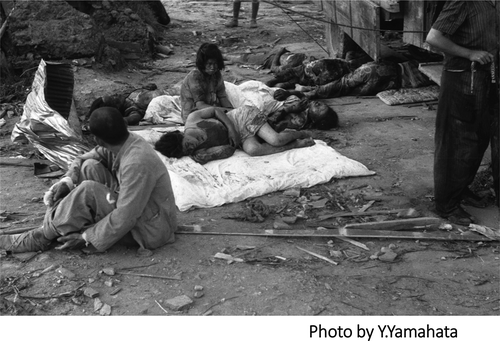
Many survivors spent the night on the road or the ground (Figure 3). Subsequently, many severely injured victims were forced to remain where they survived the first strike without being provided any meaningful medical treatment. Most of them died there.
Figure 3. The second morning after Nagasaki bombing.
……………………………….. In areas within 1 kilometer of ground zero, human bodies without any shielding, namely in open air on the roads and ground, were instantaneously squeezed by the blast wind (pressure) against walls, causing multiple fractures of skeletons and ruptures of the abdominal cavity causing escape of colons. Many people in open roads and grounds were carbonized by the direct effect of heat rays within 1.0 km from ground zero (Figure 7, Photo A). Many residential areas full of Japanese houses were crushed by the wind and burned out in which many victims were also burned to white bones (Figure 7, Photo B). The skin of people on open roads or grounds within 0.5–1.5 km were deeply flash-burned due to heavy heat rays. The skins were soon peeled off because of necrosis in the deep skin layer (For an example of a boy whose back was entirely burned, see Figure 8). With large areas of skin peeling off, people suffered severe pain and bleeding.
Figure 7. Body effects by heat rays and fire burn (1).
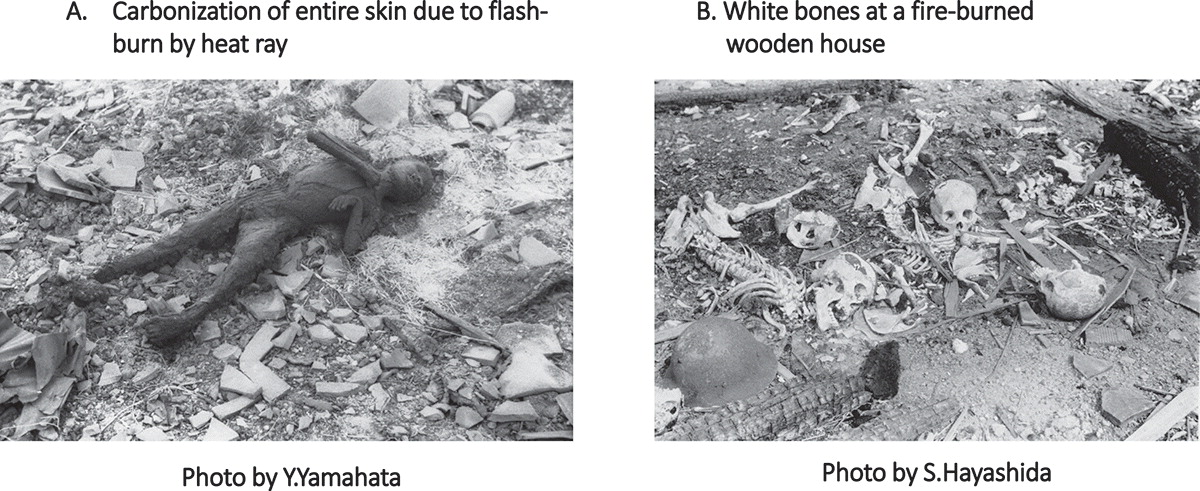
Figure 7. Body effects by heat rays and fire burn (1).

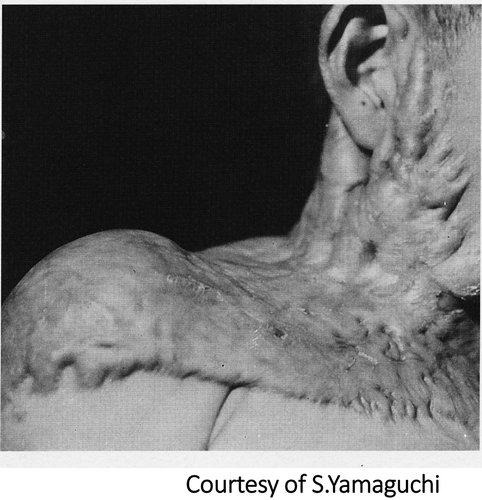
In three months after the bombing, these deep skin flash burns began to heal. However, with tissue being regenerated, keloid was quite often formed as shown in Figure 9. It was charcterized by marked thickening of the wounds, sometimes resembling cancerous proliferation of the skin.
Figure 9. Keloid formation after a severe flash burn by heat rays.
Thus many residential areas full of Japanese wooden houses were crushed and burned. The firestorms that continued over to next day finally flattened city areas within a 4 km radius. According to the saddest memory of some survivors, the blast wind tore off the heads of babies who were being carried on their mothers’ backs in the traditional Japanese way. Most of the mothers also died soon.
At the same time, the victims were irradiated by 100 grays (Gy)1 or more of combined gamma and neutron rays generated by nuclear fissions (Figure 6). Thus it could be possible to say that they were killed in three ways at once.
The people within 1 km of ground zero who finally survived were mostly those who were working inside a concrete building with thick walls or in a basement. Some other survivors were inside private air-raid shelters or military arsenals set in large shelters. Heat rays were effectively blocked by the walls, and radiation and blast were partially shielded before victims were exposed, thus allowing them to survive. But there were only a few hundred of these people. Many of those who survived at various proximal points were severely injured by debris and pieces of glass from damaged houses, heated and irradiated simultaneously. Many of them died within the first three months.
Struggle for Survival
Medical rescue teams perished and hospitals were all destroyed on the first day of the bombing. It therefore was impossible to find any meaningful medical aid. The situation was much severer in Hiroshima where over 90% of medical staffs, doctors, nurses, and pharmacists were dead. The Nagasaki Medical College Hospital, the largest and strongest concrete buildings in Nagasaki City, located 600 meters from ground zero, did provide fairly good shielding effects; the death rate was a relatively as low as 43%. Subsequently 900 lives in total – approximately half of the total number of professors, doctors, nurses and medical students were lost in the entire college facility including the hospital. Most of those who survived were severely injured by the blast wind and heat ray. The hospital had completely ceased to function. Within a few days, medical staffs and medical students who had survived opened first-aid stations around the margin of flattened areas.
n the late afternoon on the first day, several rescue trucks arrived carrying medical teams consisting of military doctors and nurses from Omura Navy Hospital, located 45 km north of Nagasaki City. They brought back approximately 700 severely injured victims, most of them severely burned, to the hospital and started treatment for burns and injuries consisting of bone fractures, cuts from pieces of glass, and embedding of debris and pieces of glass fragments deep in the skin. This number was very small compared to the total number of victims who suffered severe injuries, estimated to be approximately 30,000 in Nagasaki. A few hundred victims out of 700 were able to survive, thanks to intensive care at Omura Navy Hospital. They were indeed lucky people.
Several small rescue teams started their clinical activities within a few days. Some surgical operations were performed for those who had severe fractures due to the blast wind. There was no good treatment for severe skin burn, especially those cases with wide areas of skin burn. There were no stocks of drugs such as antibiotics and frozen blood plasma. Only oil and ointment were used. Even drip infusions of water and electrolytes such as salts and glucose (sugar) were not available in such small ambulatory facilities.
As a result of this lack of care, many survivors who were alive on the first and second days began to die due to severe bleeding from injuries such as severe fractures, dislocations, abdominal ruptures, thoracic punctures, and scalp and brain damage and also from dehydration and lack of adequate food supplies.
Initial Difficulty in Recognizing Radiation Effects
In the early days after the atomic bombings, many doctors had difficulty in identifying the symptoms of radiation-related ailments. There was no information about the nature of this new type of bomb. They did not even know that the bombs were nuclear and that radiation was dangerous to human beings. …………………………………………………………………………………….
Late Effects of Atomic Bombings: 1948–2018
About 270,000 victims of Hiroshima and Nagasaki finally recovered their health. They had to start their new daily life with a serious shortage of food and other necessities. After spending three years of recovery with relatively good health, hibakusha encountered the first malignant disease: leukemia. It is classified as the earliest occurring malignant disease due to atomic-bomb radiation because it was clearly distinguished from the disorders caused by ARS. Therefore, leukemia was the first malignant disease derived from cells injured by initial radiation exposure; the cells then transformed to malignant leukemia cells. This earliest delayed, or “late”, effect was followed by many kinds of cancer of various organs. Thus, the late effect spans an extremely long period.
First Malignant Disease Observed as the Earliest Late Effect of Atomic Bombings
Leukemias
In 1949, doctors in Hiroshima and Nagasaki began to recognize a gradual increase in the number of hibakusha patients, including children, suffering from leukemia. The excess annual rate of leukemia continued to rise until 1955 and then continued at an elevated level for more than 10 years (Figure 12) (Gunz and Henderson 1974). Acute and chronic types of leukemia both were observed.
These leukemias were later analyzed in detail when the first dosimetry system (DS65) became available. A clear radiation-dose dependency was revealed as a curve that elevated exponentially (called quadratic) from 100 millisieverts (mSv) at around 2.0 km from ground zero to more than 4 Gy at around 1.0 km (Figure 13 on original). Dose is thus inversely proportional to the square of the distance. Total leukemia incidence was four to five times higher than the control group of Nagasaki citizens not exposed to the bombing (Preston et al. 1996).
……………………………. People who were children under the age of 10 at the time of the bombings are now in their seventies. Some of them suffer from MDS. The increase in MDS among childhood survivors indicates that the massive irradiation of the whole body injured blood cells in bone marrow, and that these cells have survived more than 70 years in the bodies of hibakusha, and finally resulted in leukemia-inducing gene abnormality. MDS patients occasionally develop acute leukemia 3–5 years after the first diagnosis, and mostly die. Therefore, it can be said that atomic bomb is still killing some hibakusha even after more than a half century……………………..
Intermediate to Life-long Delayed Effects of Exposure to Atomic-bomb Radiation
Cancers
Around 1960, the incidence of solid cancers began to rise gradually. The elevated cancer incidence lasted for a long time (Ozasa 2016). It peaked around the year 2000 and remained at that level until now. The types of cancer that appeared include lung, breast, thyroid, stomach, colon, liver, skin, and bladder. ……………………………………….
In-utero Radiation Exposure
Microcephaly
In both Hiroshima and Nagasaki, many pregnant women were exposed to various doses of radiation. Miscarriages and malformation of newborn babies were frequently observed, but there were no good statistics showing radiation-dose effect. Some mothers who were in the early prenatal period at the time of the bombing sometimes bore babies who had a small head. The babies later became mentally disabled. There were 62 such babies recorded among 1,470 (Otake and Schull 1998). The larger the dose to the mother’s uterus was, the higher the incidence of microcephalic babies, suggesting high-dose radiation interrupted brain development. This is the most obvious phenomenon observed among fetuses exposed to radiation in utero.
Cancers
In-utero exposed babies were later found to have an increased risk of cancer development during their early adulthood. The follow-up study is now ongoing (Izumi et al. 2003)……………………………………………………………..
Summary of Hibakusha Life, 1945–2018
Can Homo Sapiens Gain the Ethical Wisdom to End the Nuclear Weapon Age and Survive?
The consequences of the atomic bombings linger on. First generation hibakusha population will cease to exist probably around 2045. If genetic transmission of radiation-related diseases to the second generation of hibakusha would be proved in the future, atomic bombs will continue to affect those descendants forever. The year 2045 will mark the 100th annniversary of the Hiroshima and Nagasaki nuclear bombings and of the nuclear weapon age. If we human beings fail to eradicate nuclear weapons before the first century ends, what should we do? This is the question that all hibakusha have posed in their 70-year struggle for survival all the time after bombings.
Summary of Hibakusha Life, 1945–2018
Can Homo Sapiens Gain the Ethical Wisdom to End the Nuclear Weapon Age and Survive?
The consequences of the atomic bombings linger on. First generation hibakusha population will cease to exist probably around 2045. If genetic transmission of radiation-related diseases to the second generation of hibakusha would be proved in the future, atomic bombs will continue to affect those descendants forever. The year 2045 will mark the 100th annniversary of the Hiroshima and Nagasaki nuclear bombings and of the nuclear weapon age. If we human beings fail to eradicate nuclear weapons before the first century ends, what should we do? This is the question that all hibakusha have posed in their 70-year struggle for survival all the time after bombings…………………………………………………………………………..more https://www.tandfonline.com/doi/full/10.1080/25751654.2019.1681226
Hisashi Ouchi Suffered an 83-day Death By Radiation Poisoning

https://science.howstuffworks.com/hisashi-ouchi.htm By: Patrick J. Kiger | Aug 8, 2022
On the morning of Sept. 30, 1999, at a nuclear fuel-processing plant in Tokaimura, Japan, 35-year-old Hisashi Ouchi and two other workers were purifying uranium oxide to make fuel rods for a research reactor.
As this account published a few months later in The Washington Post details, Ouchi was standing at a tank, holding a funnel, while a co-worker named Masato Shinohara poured a mixture of intermediate-enriched uranium oxide into it from a bucket.
Suddenly, they were startled by a flash of blue light, the first sign that something terrible was about to happen.
The workers, who had no previous experience in handling uranium with that level of enrichment, inadvertently had put too much of it in the tank, as this 2000 article in Bulletin of the Atomic Scientists details. As a result, they inadvertently triggered what’s known in the nuclear industry as a criticality accident — a release of radiation from an uncontrolled nuclear chain reaction.
Ouchi, who was closest to the nuclear reaction, received what probably was one of the biggest exposures to radiation in the history of nuclear accidents. He was about to suffer a horrifying fate that would become a cautionary lesson of the perils of the Atomic Age.
“The most obvious lesson is that when you’re working with [fissile] materials, criticality limits are there for a reason,” explains Edwin Lyman, a physicist and director of nuclear power safety for the Union of Concerned Scientists, and co-author, with his colleague Steven Dolley, of the article in Bulletin of the Atomic Scientists.
If safeguards aren’t carefully taught and followed, there’s potential for “a devastating type of accident,” Lyman says.
It wasn’t the first time it had happened. A 2000 U.S. Nuclear Regulatory Commission report noted that before Tokaimura, 21 previous criticality accidents had occurred between 1953 and 1997.
The two workers quickly left the room, according to The Post’s account. But even so, the damage already had been done. Ouchi, who was closest to the reaction, had received a massive dose of radiation. There have been various estimates of the exact amount, but a 2010 presentation by Masashi Kanamori of the Japan Atomic Energy Agency put the amount at 16 to 25 gray equivalents (GyEq), while Shinohara, who was about 18 inches (46 centimeters) away, received a lesser but still extremely harmful dose of about 6 to 9 GyEq and a third man, who was further away, was exposed to less radiation.
Internet articles frequently describe Ouchi as ‘the most radioactive man in history,’ or words to that effect, but nuclear expert Lyman stops a bit short of that assessment.
“The estimated doses for Ouchi were among the highest known, though I’m not sure if it’s the highest,” explains Lyman. “These typically occur in these kinds of criticality accidents.”
What Does a High Dose of Radiation Do To the Body?
The radiation dose in a criticality accident can be even worse than in a catastrophic accident at a nuclear power plant, such as the 1986 reactor explosion at Chernobyl in Ukraine, then a part of the Soviet Union, where the radiation was dispersed. (Even so, 28 people eventually died from radiation exposure.)
“These criticality accidents present the potential for delivery of a large amount of radiation in a short period of time, though a burst of neutrons and gamma rays,” Lyman says. “That one burst, if you’re close enough, you can sustain more than a lethal dose of radiation in seconds. So that’s the scary thing about it.”
High doses of radiation damage the body, rendering it unable to make new cells, so that the bone marrow, for example, stops making the red blood cells that carry oxygen and the white blood cells that fight infection, according to Lyman. “Your fate is predetermined, even though there will be a delay,” he says, “if you have a high enough dose of ionizing radiation that will kill cells, to the extent that your organs will not function.”
According to an October 1999 account in medical journal BMJ, the irradiated workers were taken to the National Institute of Radiological Sciences in Chiba, just east of Tokyo. There, it was determined that their lymphatic blood count had dropped to almost zero. Their symptoms included nausea, dehydration and diarrhea. Three days later, they were transferred to University of Tokyo Hospital, where doctors tried various measures in a desperate effort to save their lives.
Ouchi’s Condition Continued to Deteriorate
When Ouchi, a handsome, powerfully built, former high school rugby player who had a wife and young son, arrived at the hospital, he didn’t yet look like a victim of intense radiation exposure, according to “A Slow Death: 83 Days of Radiation Sickness,” a 2002 book by a team of journalists from Japan’s NHK-TV, later translated into English by Maho Harada. His face was slightly red and swollen and his eyes were bloodshot, but he didn’t have any blisters or burns, though he complained of pain in his ears and hand. The doctor who examined him even thought that it might be possible to save his life.
But within a day, Ouchi’s condition got worse. He began to require oxygen, and his abdomen swelled, according to the book. Things continued downhill after he arrived at the University of Tokyo hospital. Six days after the accident, a specialist who looked at images of the chromosomes in Ouchi’s bone marrow cells saw only scattered black dots, indicating that they were broken into pieces. Ouchi’s body wouldn’t be able to generate new cells. A week after the accident, Ouchi received a peripheral blood stem cell transplant, with his sister volunteering as a donor.
Nevertheless, Ouchi’s condition continued to deteriorate, according to the book. He began to complain of thirst, and when medical tape was removed from his chest, his skin started coming off with it. He began developing blisters. Tests showed that the radiation had killed the chromosomes that normally would enable his skin to regenerate, so that his epidermis, the outer layer that protected his body, gradually vanished. The pain became intense. He began experiencing breathing problems as well. Two weeks after the accident, he was no longer able to eat, and had to be fed intravenously. Two months into his ordeal, his heart stopped, though doctors were able to revive him.
On Dec. 21, at 11:21 p.m., Ouchi’s body finally gave out. According to Lyman’s and Dolley’s article, he died of multiple organ failure. Japan’s Prime Minister at the time, Keizo Obuchi, issued a statement expressing his condolences to the worker’s family and promised to improve nuclear safety measures, according to Japan Times.
Shinohara, Ouchi’s co-worker, died in April 2000 of multiple organ failure as well, according to The Guardian.
The Japanese government’s investigation concluded that the accident’s main causes included inadequate regulatory oversight, lack of an appropriate safety culture, and inadequate worker training and qualification, according to this April 2000 report by the U.S. Nuclear Regulatory Commission. Six officials from the company that operated the plant were charged with professional negligence and violating nuclear safety laws. In 2003, a court gave them suspended prison terms, and the company and at least one of the officials also were assessed fines, according to the Sydney Morning Herald.
Nuclear weapons will not bring peace or security, only dangers

We can honour the victims of Hiroshima and Nagasaki by supporting the prohibition treaty, says RAE STREET https://morningstaronline.co.uk/article/f/nuclear-weapons-will-not-bring-peace-or1 6 Aug, 22,
THIS is the month when we commemorate the fearful nuclear bombings of the people of Hiroshima and Nagasaki.
Alas, the myth is still put out that the bombs were dropped to end the second world war. That is not true.
By the time the bomb was ready for use, Japan was ready to surrender. As General Dwight D Eisenhower said, Japan was at that very moment seeking some way to surrender with minimum loss of face, and “it wasn’t necessary to hit them with that awful thing.”
Thus, the bomb on Hiroshima was dropped on August 6 before it was publicly stated that the Japanese had surrendered.
The Soviet Union entered the war in Asia on August 9. Later the same day, the US dropped a second bomb on Nagasaki.
We now know the horrors that nuclear bombs inflict. We have heard from the Hibaksha, the survivors. Now instead of heeding the survivors of those bombs, the Hibaksha, that nuclear weapons should be ended, governments across the world have developed more destructive nuclear bombs.
Britain, part of the US Trident submarine system, carries warheads on multiple missiles, with 15 times the power of the bomb used on Hiroshima.
Proponents of nuclear weapons, including the Nato military alliance, claim that they keep the peace and repeatedly talk of nuclear deterrents.
But the US has the largest nuclear arsenal in the world, and it did not stop the attack on the Twin Towers; nor did Trident stop terrorist attacks in Britain.
What is never mentioned is the death and destruction which has been brought about with the development of nuclear weapons, mainly on indigenous peoples.
This starts with the beginning of the cycle with uranium mining where native people in the US, in Canada, in Australia and the Congo, among others, have been forced into mining.
They and their families have suffered serious illness and even death. Above-ground testing has also brought suffering to native peoples.
After the French testing in the Pacific, mothers gave birth to “jellyfish” babies which died within a few hours. In the US above-ground testing meant that many of the “downwinders,” including the Western Shoshone, became seriously ill.
Although above-ground tests have now ended following the Comprehensive Test Ban Treaty, uranium mining has not ceased.
It continues except for Greenland where the Inuit, now in government, have banned uranium mining.
In 2022, with the war in Ukraine, we are now in more danger than ever before of a further use of nuclear weapons. If ever one of these highly destructive current bombs were exploded either by intent or accident, it would be a worldwide catastrophe.
There would be fires and radioactive fallout and fatal illnesses from acute radiation sickness, cancer and genetic damage which can be passed on to offspring.
At the same time, nuclear fireballs would send up enormous quantities of dust high into the atmosphere, blotting out the sun which would lead to nuclear winter.
And the contaminated ground would be unsuitable for food production leading to food shortages. In effect, if people had not died any other way, they would die of hunger.
Yet our current government not only supports the replacement of Trident but in the Integrated Defence Review increased the cap on Britain’s stockpile for 2025 from 180 to 260.
They even changed the scenario for nuclear use to “emerging technologies that could have a comparable impact,” possibly cyber-attacks but maybe some conventional weapons?
Starmer, once more making himself into a Tory by default, said via his shadow defence minister that Trident was “non-negotiable.”
Even the cost should have made him hesitate on this. It is estimated that the cost in public money — our money — will be £205 billion (and rising) to replace Trident.
And that when working people are struggling and across the world people starve; where we also urgently need funding for the transition from fossil fuels.
Nato too still holds a policy of first use of nuclear weapons and through the US, which has always dominated Nato policy, keeps “nuclear sharing,” weapons on the territory of five states: Belgium, Germany, Italy, the Netherlands and Turkey.
Without any public debate, we now know that nuclear bombs and nuclear capable aircraft are to be brought back to Lakenheath in Suffolk.
But the majority world wants nuclear disarmament. In January 2021, the UN-negotiated Treaty on the Prohibition of Nuclear Weapons came into force which now has 138 signatories — but not the Nato nuclear-armed states which were prevented by Nato.
Sixty-six states have now ratified the treaty. Our government and the Labour Party should be supporting the treaty because nuclear weapons will not bring peace or security, only dangers.
That way we would honour the memory of the victims of Hiroshima and Nagasaki. Our politicians should be looking at how to develop “common security,” putting funding and resources into dialogue and negotiation and respecting the security of everyone.
The lost nuclear bombs that no one can find

The exception to this progress is, of course, nuclear submarines – and even today, there are near-misses.
For Lewis, the fascination with lost nuclear weapons isn’t the potential risks they pose now – it’s what they represent: the fragility of our seemingly sophisticated systems for handling dangerous inventions safely.
“I think we have this fantasy that the people who handle nuclear weapons are somehow different than all the other people we know, make fewer mistakes, or that they’re somehow smarter. But the reality is that the organisations that we have to handle nuclear weapons are like every other human organisation. They make mistakes. They’re imperfect,” says Lewis.
planes carrying nuclear bombs no longer fly around on regular training exercises. “Airborne alerts ended for reasons that must be obvious to us,” he says. “In the end, the decision was made that it was too dangerous.”
The exception to this progress is, of course, nuclear submarines – and even today, there are near-misses.
BBC By Zaria Gorvett, 5th August 2022,
It was a mild winter’s morning at the height of the Cold War.
On January 17, 1966, at around 10:30am, a Spanish shrimp fisherman watched a misshapen white parcel fall from the sky… and silently glide towards the Alboran Sea. It had something hanging beneath it, though he couldn’t make out what it was. Then it slipped beneath the waves.
At the same time, in the nearby fishing village of Palomares, locals looked up at an identical sky and witnessed a very different scene – two giant fireballs, hurtling towards them. Within seconds, the sleepy rural idyll was shattered. Buildings shook. Shrapnel sliced towards the ground. Body parts fell to the earth.
A few weeks later, Philip Meyers received a message via a teleprinter – a device a bit like a fax that could send and receive primitive emails. At the time, he was working as a bomb disposal officer at the Naval Air Facility Sigonella, in eastern Sicily. He was told that there was a top secret emergency in Spain, and that he must report there within days.
However, the mission was not as covert as the military had hoped. “It was not a surprise to be called,” says Meyers. Even the public knew what was going on. When he attended a dinner party that evening and announced his mysterious trip, its intended confidentiality became something of a joke. “It was kind of embarrassing,” says Meyers. “It was supposed to be a secret but my friends were telling me why I was going.”
For weeks, newspapers around the globe had been reporting rumours of a terrible accident – two US military planes had collided in mid-air, scattering four B28 thermonuclear bombs across Palomares. Three were quickly recovered on land – but one had disappeared into the sparkling blue expanse to the south east, lost to the bottom of the nearby swathe of Mediterranean Sea. Now the hunt was on to find it – along with its 1.1 megatonne warhead, with the explosive power of 1,100,000 tonnes of TNT.
In fact, the Palomares incident is not the only time a nuclear weapon has been misplaced. There have been at least 32 so-called “broken arrow” accidents – those involving these catastrophically destructive, earth-flattening devices – since 1950. In many cases, the weapons were dropped by mistake or jettisoned during an emergency, then later recovered. But three US bombs have gone missing altogether – they’re still out there to this day, lurking in swamps, fields and oceans across the planet.
“We mostly know about the American cases,” says Jeffrey Lewis, director of the East Asia Non-proliferation Program at the James Martin Center for Non-proliferation Studies, California. He explains that the full list only emerged when a summary prepared by the US Department of Defense was declassified in the 1980s.
Many occurred during the Cold War, when the nation teetered on the precipice of Mutually Assured Destruction (MAD) with the Soviet Union – and consequently kept airplanes armed with nuclear weapons in the sky at all times from 1960 to 1968, in an operation known as Chrome Dome.
“We don’t know as much about other countries. We don’t really know anything about the United Kingdom or France, or Russia or China,” says Lewis. “So I don’t think we have anything like a full accounting.”
The Soviet Union’s nuclear past is particularly murky – it had amassed a stockpile of 45,000 nuclear weapons as of 1986. There are known cases where the country lost nuclear bombs that have never been retrieved, but unlike with the US incidents, they all occurred on submarines and their locations are known, if inaccessible.
One began on 8 April 1970, when a fire started spreading through the air conditioning system of a Soviet K-8 nuclear-powered submarine while it was diving in the Bay of Biscay – a treacherous stretch of water in the northeast Atlantic Ocean off the coasts of Spain and France, which is notorious for its violent storms and where many vessels have met their end. It had four nuclear torpedoes onboard, and when it promptly sank, it took its radioactive cargo with it.
However, these lost vessels didn’t always stay where they were. In 1974, a Soviet K-129 mysteriously sank in the Pacific Ocean, along with three nuclear missiles. The US soon found out, and decided to mount a secret attempt to retrieve this nuclear prize, “which was really a pretty crazy story in and of itself”, says Lewis.
The eccentric American billionaire Howard Hughes, famous for his broad spectrum of activity, including as a pilot and film director, pretended to become interested in deep sea mining. “But in fact, it wasn’t deep sea mining, it was an effort to build this giant claw that could go all the way down to the sea floor, grab the submarine, and bring it back up,” says Lewis. This was Project Azorian – and unfortunately it didn’t work. The submarine broke up as it was being lifted.
“And so those nuclear weapons would have fallen back to the sea floor,” says Lewis. The weapons remain there to this day, trapped in their rusting tomb. Some people think the weapons remain there to this day, trapped in their rusting tomb – though others believe they were eventually recovered.
Every now and then, there are reports that some of the US’ lost nuclear weapons have been found.
Back in 1998, a retired military officer and his partner were gripped with a sudden determination to discover a bomb dropped near Tybee Island, Georgia in 1958. They interviewed the pilot who had originally lost it, as well as those who had searched for the bomb all those decades ago – and narrowed down the search to Wassaw Sound, a nearby bay of the Atlantic Ocean. For years, the maverick duo scoured the area by boat, trailing a Geiger counter behind them to detect any tell-tale spikes in radiation.
And one day, there it was, in the exact spot the pilot had described – a patch with radiation 10 times the levels elsewhere. The government promptly dispatched a team to investigate. But alas, it was not the nuclear weapon. The anomaly was down to naturally occurring radiation from minerals in the seabed.
So for now, the US’ three lost hydrogen bombs – and, at the very least, a number of Soviet torpedoes – belong to the ocean, preserved as monuments to the risks of nuclear war, though they have largely been forgotten. Why haven’t we found all these rogue weapons yet? Is there a risk of them exploding? And will we ever get them back?
A shrouded object
When Meyers finally got to Palomares – the Spanish village where a B52 bomber came down in 1966 – the authorities were still looking for the missing nuclear bomb……………
Eventually, the parachute was pulling so hard on the line and hook that it simply snapped – sending the nuclear bomb slowly gliding back down towards the bottom. This time, it ended up even deeper than before.
………………… A month later they used a different kind of robotic submarine – a cable-controlled underwater vehicle – to grab the bomb by its parachute directly, and haul it up. It had shifted in its casing, so it couldn’t be disarmed the usual way, via a special port in the side – alarmingly, the officers instead had to cut into the nuclear weapon. “[It would have been] kind of nerve wracking to drill a hole in a hydrogen bomb,” says Meyers. “But they did it. They were prepared to do that.”
A swampy mystery
Unfortunately, the three lost bombs still out there today did not meet with such successful recovery efforts. …………………………………………………
Take the lost Tybee island bomb, which is still lying in silt somewhere in Wassaw Sound. ……………………………..
As it happens, having so many safety features is highly necessary – mostly because they don’t always work. In one case in 1961, a B-52 broke up while flying over Goldsboro, North Carolina, dropping two nuclear weapons to the ground. One was relatively undamaged after its parachute deployed successfully, but a later examination revealed that three out of four safeguards had failed.
In a declassified document from 1963, the then-US Secretary of Defence summed up the incident as a case where “by the slightest margin of chance, literally the failure of two wires to cross, a nuclear explosion was averted”.
The other nuclear bomb fell free to the ground, where it broke apart and ended up embedded in a field. Most parts were recovered, but one part containing uranium remains stuck under more than 50ft (15m) of mud. The US Air Force purchased the land around it to deter people from digging.
Some incidents are so baffling, they almost sound made up. Perhaps one of the most extraordinary occurred when a training exercise on the USS Ticonderoga went badly wrong in 1965. An A4E Skyhawk was being rolled to a plane elevator, while loaded with a B-43 nuclear bomb. It was a disaster in slow-motion – the crew on deck quickly realised that the plane was about to fall off, and waved for the pilot to apply the brakes. Tragically, he didn’t see them, and the young lieutenant, plane and weapon vanished into the Philippine Sea. They’re still there to this day, under 16,000 ft (4,900 m) of water near a Japanese island.
………………………….. A permanent loss
Lewis thinks it’s unlikely that we will ever find the three missing nuclear bombs. This is partly down to the same reasons they weren’t found in the first place.
…………………………………. In 1989, another Soviet nuclear submarine, the K-278 Komsomolets, sank in the Barents Sea off the coast of Norway. Like the K-8, it was also nuclear-powered, and it had been carrying two nuclear torpedoes at the time. For decades, its wreck has been lying under a mile (1.7km) of Arctic water.
But in 2019, scientists visited the vessel – and revealed that water samples taken from its ventilation pipe contained radiation levels up to 100,000 times higher than would normally be expected in sea water. …………
For Lewis, the fascination with lost nuclear weapons isn’t the potential risks they pose now – it’s what they represent: the fragility of our seemingly sophisticated systems for handling dangerous inventions safely.
“I think we have this fantasy that the people who handle nuclear weapons are somehow different than all the other people we know, make fewer mistakes, or that they’re somehow smarter. But the reality is that the organisations that we have to handle nuclear weapons are like every other human organisation. They make mistakes. They’re imperfect,” says Lewis.
Even at Palomares, where all the nuclear bombs that were dropped were eventually recovered, the land is still contaminated with radiation from two that detonated with conventional explosives. Some of the US military personnel who helped with the initial clean-up efforts – involving shovelling the surface of the soil into barrels – have since developed mysterious cancers which they believe are linked. In 2020, a number of survivors filed a class action suit against the Secretary of Veterans Affairs – though many of the claimants are currently in their late 70s and 80s.
Meanwhile, the local community has been campaigning for a more thorough clean-up for decades. Palomares has been dubbed “the most radioactive town in Europe“, and local environmentalists are currently protesting against a British company’s plans to build a holiday resort in the area.
Lewis is confident that losses of the kind that occurred during the Cold War are unlikely to happen again, mostly because operation Chrome Dome was ended in 1968, and planes carrying nuclear bombs no longer fly around on regular training exercises. “Airborne alerts ended for reasons that must be obvious to us,” he says. “In the end, the decision was made that it was too dangerous.”
The exception to this progress is, of course, nuclear submarines – and even today, there are near-misses. The US currently has 14 ballistic missile submarines (SSBNs) in operation, while France and the UK have four each.
To work as nuclear deterrents these submarines must remain undetected during operations at sea, and this means they can’t send any signals to the surface to find out where they are. Instead, they must navigate mostly by inertia – essentially, the crew rely on machines equipped with gyroscopes to calculate where the submarine is at any given time based on where it was last, what direction it was headed and how fast it was travelling. This potentially imprecise system has resulted in a number of incidents, including as recently as 2018 when a British SSBN almost bumped into a ferry.
The era of lost nuclear weapons might not be over just yet.
* Zaria Gorvett is a senior journalist for BBC Future and tweets @ZariaGorvett https://www.bbc.com/future/article/20220804-the-lost-nuclear-bombs-that-no-one-can-find
A clarification about China and Taiwan
Norman Realname, 5 Aug 22,

I’m grateful to a reader for providing this explanation.
I still think that it’s a pretty bad idea for USA and Australia to start a probable World War 3 over Taiwan.
The Republic of China (ROC) and the People’s Republic of China (PRC) are NOT synonyms and should not be used as such. The ROC has NO control over Hong Kong; it’s a semi-autonomous territory ruled by the PRC under the “one country, two systems” arrangement, as per treaty. Thus, grumbling about democratic subversion aside, there was no question of the PRC’s sovereignty over it.
The ROC, however, DOES have control over Taiwan, and the PRC does NOT. As to why this is the case, the most oversimplified answer is that the Chinese Civil War never fully ended and both governments claim to rule the territory of the other, but since the PRC has the de facto control of almost all of it, it’s recognized as the “real” China. The more complicated answer is that since democratization the ROC government no longer wants to rule the mainland and sees itself as a separate Taiwanese nation but is forbidden to relinquish its territorial claims (under threat of invasion) by the PRC who view Taiwan as integral Chinese territory and would interpret any movement away from them as secession (even though the PRC has never actually ruled over Taiwan).
The US and China differ over their interpretation of the situation. The PRC’s One China PRINCIPLE states that there is only one China, and Taiwan is a part of China. The US’s One China POLICY states that they *acknowledge* the PRC’s position on the matter, without actually saying whether or not they agree that Taiwan is part of China. In other words: the US generally agrees there is only one China, but they’re not sure (read: deliberately ambiguous) whether Taiwan is part of it.
Fundamentally, while the PRC has been successful in preventing international recognition of the ROC (Taiwan), they do not control the territory and cannot control the territory without:
1. The ROC (Taiwanese) government agreeing to hand over power peacefully to the PRC.
2. A full-scale military invasion of Taiwan aimed at the surrender and/or destruction of the ROC (Taiwanese) government.
To compare the situation to Hong Kong, – the crucial difference is the People’s Republic of China did not need to roll in their military to fight some theoretical Hong Kong military in order to be able to tell Hong Kong what to do.
Small nuclear reactors will bleed us dry and won’t solve climate change – unfounded promises

there is every reason to believe that if and when a NuScale SMR is built, its final cost too will vastly exceed current official estimates.
Unfounded promises — Beyond Nuclear International Small Modular Reactors epitomize culture that embraces exaggeration
By M.V. Ramana
In 2006, Elizabeth Holmes, founder of a Silicon Valley startup company called Theranos, was featured in Inc magazine’s annual list of 30 under 30 entrepreneurs. Her entrepreneurship involved blood, or more precisely, testing blood. Instead of the usual vials of blood, Holmes claimed to be able to obtain precise results about the health of patients using a very small sample of blood drawn from just a pinprick.
The promise was enticing and Holmes had a great run for a decade. She was supported by a bevy of celebrities and powerful individuals, including former U.S. secretaries of state Henry Kissinger and George Shultz, James Mattis, who later served as U.S. secretary of defense, and media mogul Rupert Murdoch. Not that any of them would be expected to know much about medical science or blood testing. But all that public endorsement helped. As did savvy marketing by Holmes. Theranos raised over $700 million from investors, and receive a market valuation of nearly $9 billion by 2014.
The downfall started the following year, when the Wall Street Journal exposed that Theranos was actually using standard blood tests behind the scenes because its technology did not really work. In January 2022, Holmes was found guilty of defrauding investors.
The second part of the Theranos story is an exception. In a culture which praises a strategy of routine exaggeration, encapsulated by the slogan “fake it till you make it”, it is rare for a tech CEO being found guilty of making false promises. But the first part of Theranos story—hype, advertisement, and belief in impossible promises—is very much the norm, and not just in the case of companies involved in the health care industry.
Small Modular Nuclear Reactors
Nuclear power offers a great example. In 2003, an important study produced by nuclear advocates at the Massachusetts Institute of Technology identified costs, safety, proliferation and waste as the four “unresolved problems” with nuclear power. Not surprisingly, then, companies trying to sell new reactor designs claim that their product will be cheaper, will produce less—or no—radioactive waste, be immune to accidents, and not contribute to nuclear proliferation. These tantalizing promises are the equivalent of testing blood with a pin prick.
And, as was the case with Theranos, many such companies have been backed up by wealthy investors and influential spokespeople, who have typically had as much to do with nuclear power as Kissinger had to with testing blood. Examples include Peter Thiel, the Silicon Valley investor; Stephen Harper, the former Prime Minister of Canada; and Richard Branson, the founder of the Virgin group. But just as the Theranos product did not do what Elizabeth Holmes and her backers were claiming, new nuclear reactor designs will not solve the multiple challenges faced by nuclear power.
One class of nuclear reactors that have been extensively promoted in this vein during the last decade are Small Modular Reactors (SMRs). The promotion has been productive for these companies, especially in Canada. Some of these companies have received large amounts of funding from the national and provincial governments. This includes Terrestrial Energy that received CAD 20 million and Moltex that received CAD 50.5 million, both from the Federal Government. The province of New Brunswick added to these by awarding CAD 5 million to Moltex and CAD 25 million in all to ARC-100.
All these companies have made various claims about the above mentioned problems. Moltex, for example, claims that its reactor design “reduces waste”, a claim also made by ARC-100. ARC-100 also claims to be inherently safe, while Terrestrial claims to be cost-competive. Both Terrestrial and ARC-100 claim to do well on proliferation resistance. In general, no design will admit to failing on any of these challenges.
Dealing with any of these challenges—safety enhancement, proliferation resistance, decreased generation of waste, and cost reduction—will have to be reflected in the technical design of the nuclear reactor. The problem is that each of these goals will drive the requirements on the reactor design in different, sometimes opposing, directions.
Economics
The hardest challenge is economics. Nuclear energy is an expensive way to generate electricity. In the 2021 edition of its annual cost report, Lazard, the Wall Street firm, estimated that the levelized cost of electricity from new nuclear plants will be between $131 and $204 per megawatt hour; in contrast, newly constructed utility-scale solar and wind plants produce electricity at somewhere between $26 and $50 per megawatt hour according to Lazard. The gap between nuclear power and renewables is large, and is growing larger. While nuclear costs have increased with time, the levelized cost of electricity for solar and wind have declined rapidly, and this is expected to continue over the coming decades.
Even operating costs for nuclear power plants are high and many reactors have been shut down because they are unprofitable. In 2018, NextEra, a large electric utility company in the United States, decided to shut down the Duane Arnold nuclear reactor, because it estimated that replacing nuclear with wind power will “save customers nearly $300 million in energy costs, on a net present value basis.”
The high cost of constructing and operating nuclear plants is a key driver of the decline of nuclear power around the world. In 1996, nuclear energy’s share of global commercial gross electricity generation peaked at 17.5 percent. By 2020, that had fallen to 10.1 percent, a 40 percent decline.
The high costs described above are for large nuclear power plants. SMRs, as the name suggests, produce relatively small amounts of electricity in comparison. Economically, this is a disadvantage. When the power output of the reactor decreases, it generates less revenue for the owning utility, but the cost of constructing the reactor is not proportionately smaller. SMRs will, therefore, cost more than large reactors for each unit (megawatt) of generation capacity. This makes electricity from small reactors more expensive. This is why most of the early small reactors built in the United States shut down early: they just couldn’t compete economically.
SMR proponents argue that the lost economies of scale will be compensated by savings through mass manufacture in factories and as these plants are built in large numbers costs will go down. But this claim is not very tenable. Historically, in the United States and France, the countries with the highest number of nuclear plants, costs went up, not down, with experience. Further, to achieve such savings, these reactors have to be manufactured by the hundreds, if not the thousands, even under very optimistic assumptions about rates of learning. Finally, even if SMRs were to become comparable in cost per unit capacity of large nuclear reactors, that would not be sufficient to make them economically competitive, because their electricity production cost would still be far higher than solar and wind energy.
…………………………………………. Cost escalations are already apparent in the case of the NuScale SMR, arguably the design that is most developed in the West. The estimated cost of the Utah Association of Municipal Power Systems project went from approximately $3 billion in 2014 to $6.1 billion in 2020—this is to build twelve units of the NuScale SMR that were to generate 600 megawatts of power. The cost was so high that NuScale had to change its offering to a smaller number of units that produce only 462 megawatts, but at a cost of $5.32 billion. In other words, the cost per kilowatt of generation capacity is around $11,500 (US dollars). That figure is around 80 percent more than the per kilowatt cost of the infamous Vogtle project at the time its construction started. Since that initial estimate of $14 billion for the two AP1000 reactors, the estimated cost of the much delayed project has escalated beyond $30 billion. As with the AP1000 reactors, there is every reason to believe that if and when a NuScale SMR is built, its final cost too will vastly exceed current official estimates. ……………
Timelines
The other promise made by SMR developers is how fast they can be deployed. GE-Hitachi, for example, claims that an SMR could be “complete as early as 2028” at the Darlington site. ARC-100 described an operational date of 2029 as an “aggressive but achievable target”.
Again, the historical record suggests otherwise. Consider NuScale. In 2008, the company projected that “a NuScale plant could be producing electricity by 2015-16”. As of 2022, the company projects 2029-30 as the date for start of generation. Russia’s KLT-40S, a reactor deployed on a barge, offers another example. When construction started in 2007, the reactor was projected to start operations in October 2010. It was actually commissioned a whole decade later, in May 2020.
The SMR designs being considered in Canada are even further off. In December 2021, Ontario Power Generation chose the BWRX-300 for the Darlington site. That design is based on GE-Hitachi’s Economical Simplified Boiling Water Reactor (ESBWR) design, which was submitted for licensing to the U.S. Nuclear Regulatory Commission in 2005. That ESBWR design was changed nine times; the NRC finally approved revision 10 from 2014. If the Canadian Nuclear Safety Commission does its due diligence, it might be 2030 or later before the BWRX-300 is even licensed for construction. That assumes that the BWRX-300 design remains unchanged. And, then, of course, there will be the inevitable delays (and cost escalations) during construction. ………….
Waste, Proliferation and Safety
Small reactors also cause all of the usual problems: the risk of severe accidents, the production of radioactive waste, and the potential for nuclear weapons proliferation. …………
…………… small modular reactor proposals often envision building multiple reactors at a site. The aim is to lower costs by taking advantage of common infrastructure elements. The configuration offered by NuScale, for example, has twelve reactor modules at each site, although it also offers four- and six-unit versions. With multiple reactors, the combined radioactive inventories might be comparable to that of a large reactor. Multiple reactors at a site increase the risk that an accident at one unit might either induce accidents at other reactors or make it harder to take preventive actions at others. This is especially the case if the underlying reason for the accident is a common one that affects all of the reactors, such as an earthquake. In the case of the accidents at Japan’s Fukushima Daiichi plant, explosions at one reactor damaged the spent fuel pool in a co-located reactor. Radiation leaks from one unit made it difficult for emergency workers to approach the other units. ……………………………
Claims by SMR proponents about not producing waste are not credible, especially if waste is understood not as one kind of material but a number of different streams. A recent paper in the Proceedings of the National Academy of Sciences examined three specific SMR designs and calculates that “relative to a gigawatt-scale PWR” these three will produce up to 5.5 times more spent fuel, 30 times more long-lived low and intermediate level waste, and 35 times more short-lived low and intermediate level waste. In other words, in comparison with large light water reactors, SMRs produce more, not less, waste per unit of electricity generated. As Paul Dorfman from the University of Sussex commented, “compared with existing conventional reactors, SMRs would increase the volume and complexity of the nuclear waste problem”.
Further, some of the SMR designs involve the use of materials that are corrosive and/or pyrophoric. Dealing with these forms is more complicated. For example, the ARC-100 design will use sodium that cannot be disposed of in geological repositories without extensive processing. Such processing has never been carried out at scale. The difference in chemical properties mean that the methods developed for dealing with waste from CANDU reactors will not work as such for these wastes.
Many SMR designs also make the problem of proliferation worse. Unlike the CANDU reactor design that uses natural uranium, many SMR designs use fuel forms that require either enriched uranium or plutonium. Either plutonium or uranium that is highly enriched in the uranium-235 isotope can be used to make nuclear weapons. Because uranium enrichment facilities can be reconfigured to alter enrichment levels, it is possible for a uranium enrichment facility designed to produce fuel for a reactor to be reconfigured to produce fuel for a bomb. All else being equal, nuclear reactor designs that require fuel with higher levels of uranium enrichment pose a greater proliferation risk—this is the reason for the international effort to convert highly enriched uranium fueled research reactors to low enriched uranium fuel or shutting them down.
Plutonium is created in all nuclear power plants that use uranium fuel, but it is produced alongside intensely radioactive fission products. Practically any mixture of plutonium isotopes could be used for making weapons. Using the plutonium either to fabricate nuclear fuel or to make nuclear weapons, require the “reprocessing” of the spent fuel. Canada has not reprocessed its power reactor spent fuel, but some SMR designs, such as the Moltex design, propose to “recycle” CANDU spent fuel. Last year, nine US nonproliferation experts wrote to Prime Minister Justin Trudeau expressing serious concerns “about the technology Moltex proposes to use.”
The proliferation problem is made worse by SMRs in many ways. ……………………..
Conclusion
The saga of Theranos should remind us to be skeptical of unfounded promises. Such promises are the fuel that drive the current interest in small modular nuclear reactors………
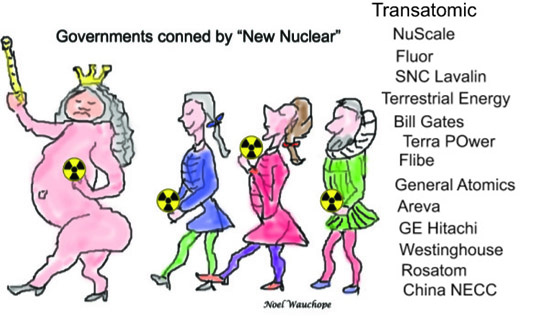
Rather than seeing the writing on the wall, unfortunately, government agencies are wasting money on funding small modular reactor proposals. Worse, they seek to justify such funding by repeating the tall claims made by promoters of these technologies…… https://beyondnuclearinternational.org/2022/07/31/unfounded-promises00
Westinghouse Nuclear Fuel Fabrication plant – a detailed history of troubles.

Dead fish near SC nuclear fuel site were an early warning. Then came the spills and accidents, The State, BY SAMMY FRETWELL, JULY 30, 2022
“……………………………………………………. 1980: State regulators learn of a fish kill near the Westinghouse wastewater plant. They found elevated levels of fluoride and ammonia-nitrogen in groundwater and surface water. It was later determined that the pollution came from the plant wastewater area. 1980: Twenty plant workers evacuated from Westinghouse after a small leak of uranium hexafluoride gas.
1982: Westinghouse unable to find 9.5 pounds of slightly enriched uranium, according to an NRC report. 1983: State regulators fine Westinghouse $6,000 for illegally shipping flammable material that caused a fire at Barnwell County’s low-level nuclear waste dump. 1988: Radioactivity found in monitoring wells is thought to have come from prior leaks of industrial wastewater. Low concentrations of Uranium 235, 234 and 238 found.
1989: EPA investigators find an array of pollutants in groundwater at the Westinghouse site, some higher than safe drinking water levels. Vinyl Chloride and TCE, both of which can cause cancer, were found to exceed the drinking water standard. 1989: Twenty five dead deer discovered at the Westinghouse property, some of them in an area where wastewater was being discharged near the Congaree River. The deer reportedly died from nitrate poisoning, but public records reviewed by The State do not show an exact cause. 1992: Trichloroethene (TCE), cis-1,2-dichloroethene (CIS 1,2 DCE) and tetrachloroethene (PCE), are detected at amounts above the federal maximum contaminant level for safe drinking water. The high levels were found near the plant’s oil house.
1993: NRC fines Westinghouse $18,750 after alleging that the company failed to perform a criticality safety analysis and failed to conduct safety tests. 1994: Radioactive leak exposes 55 workers to uranium hexafluoride and shuts down the Westinghouse plant. 1997: The plant loses two low-enriched fuel rods. The NRC says five violations of NRC requirements occurred. Safety was not compromised, but problems “are indicative of inadequate management attention.’’
1998: Company fined $13,750 after NRC notes the “loss of criticality control,’’ a problem that could have led to an accident. The agency says a problem had gone uncorrected. 2000: NRC hits Westinghouse with a violation notice because an operator “willfully violated criticality safety procedures when preparing to mix a batch of powder.’’ 2000: Uranyl nitrate spills at the Westinghouse plant, causing a cleanup. When the cleanup began, workers found the spill was worse than originally thought.
2001: NRC hits Westinghouse with a violation for transporting 3 cylinders of licensed material with elevated radiation levels. 2001: Westinghouse fails to follow criticality safety rules at a uranium recovery area dissolver elevator, violation notice says. Containers were not stacked far enough apart, reducing safety. Westinghouse didn’t do enough to fix the problem. 2001: NRC issues a violation notice to Westinghouse after raising concerns about criticality safety, including failing to keep uranium powder mixing hoods properly separated.
2001: NRC hits Westinghouse with violation after criticality safety controls failed to work on the ammonium diurnate process lines. 2002: NRC letter tells Westinghouse that its criticality safety control efforts need improvement. NRC Regional Administrator Luis Reyes says the last two safety reviews have urged improvement for criticality safety. Letter notes concern about nuclear transportation program. 2002: NRC notice of investigation says a contractor for Westinghouse falsified records about the receipt and processing of materials. That resulted in a small amount of nuclear material being improperly shipped to nuclear site in Tennessee. 2004: NRC again raises concerns about criticality safety, the practice of making sure a nuclear chain reaction does not occur. Efforts to improve compliance with procedures and “implement criticality safety controls were not fully effective,’’ letter from regional administrator Luis Reyes says.
2004: NRC letter hits Westinghouse with a $24,000 fine. The company failed to maintain criticality controls as required. Ash in the company’s incinerator exceeded concentration limits for uranium. The Level 2 violation is, at the time, the most serious ever noted at the plant. 2008: Broken pipe spills radioactive material into the soil in the same area as a later 2011 leak, but Westinghouse doesn’t tell state or federal regulators for years. 2008: The NRC sanctions Westinghouse for losing sixteen sample vials of uranium hexafluoride. The company didn’t properly document and control the transfer of the vials and failed to secure them from “unauthorized removal.’’ 2008: Westinghouse hit with a violation notice after a worker disabled an alarm and bypassed a safety significant interlock.
2009: Westinghouse fires a contract foreman after federal regulators found that he had falsified records. Westinghouse also was cited by the NRC. The foreman certified that employees were trained in safety procedures, when they had not completed training.
2009: Westinghouse loses 25 pounds of pellets that were to be used in making nuclear fuel rods. NRC downplays danger but says Westinghouse should have kept better track of the nuclear material.
2010: NRC levies $17,500 fine against Westinghouse after uranium-bearing wastewater spilled inside the plant.
2011: Uranium leaks into ground beneath the Westinghouse plant, but federal inspectors weren’t told about it for years. NRC officials said they only learned about the spill in 2017.
2012: Worker exposed to uranium-containing acid and whisked to a hospital by emergency medical crews. The worker was treated for pain and released.
2012: Westinghouse fails to follow through on a report to improve the facility so it could better withstand an earthquake, NRC says. Recommendations had been made nine years previously.
2015: Three workers are injured when steam erupted from a wash tank. The workers are taken to a Columbia area hospital for treatment and later sent to the burn center in Augusta, which specializes in treating severe burns.
2016: A buildup of uranium that could have led to a small burst of radiation forces Westinghouse to shut down part of the fuel plant and temporarily lay off 170 workers, about one-tenth of its work force at the plant. The uranium found in the scrubber area is nearly three times the legal limit.
2017: Westinghouse worker exposed to a solution toxic enough to cause chemical burns when the solution sprayed him. 2018: Uranium leaks into the ground through a hole in the Westinghouse plant floor. An acid solution had eaten into the floor. Soil was contaminated.
2018. The NRC says Westinghouse allowed workers to walk across a protecting liner for years, which likely weakened the liner and contributed to a hole in the floor that allowed uranium solution to leak out.
2019: Fire breaks out in a drum laden with mop heads, rags and other cleaning equipment.
2019: State and federal authorities report that water had leaked through a rusty shipping container and onto barrels of uranium-tainted trash. Contaminants then leaked into the soil below the shipping container floor.
2019: Westinghouse sends three workers to the hospital after they complained of an unusual taste in their mouths while doing maintenance on equipment that contains hydrofluoric acid.
2019: Two contaminated barrels are shipped from the Westinghouse plant to Washington State after workers in South Carolina failed to properly examine the containers for signs of radioactive contamination.
2020. The NRC issues violation against Westinghouse, this time after questions arose about nuclear safety. The issue centered on improper security of tamper seals, used to keep nuclear material from being stolen.
2020. NRC reports finding 13 pinhole leaks in a protective liner.
2020: South Carolina officials raise concerns about earthquakes at Westinghouse.
Sources: NRC records and news reports from The State. https://www.thestate.com/news/local/environment/article263945551.html
The Age of Women

Pearls and Irritations, By Julian Cribb, Jul 22, 2022
Leadership by wise women is indispensable if we are to escape the catastrophe that male leadership is presently building for humanity.
If humanity is to survive the vast and growing threats it faces, women must assume the leadership of government, business, religion and social institutions around the world. Female leadership is a required solution to the ten catastrophic risks which now confront the whole of our civilisation.
As a rule, women don’t start wars, mine coal or oil, destroy landscapes and forests, pollute air and oceans or poison their children – though they may benefit from those male actions. They tend to think more about the longer term than do men, and to consider the future needs of their children and grandchildren more fully. They tend to seek peaceful and constructive solutions to problems rather than warring over differences in values and beliefs, or over resources.
Since the time our species first differentiated its gender roles, over a million years ago, pragmatic male thought has largely driven our remarkable ascent, our great technological achievements up to the start of the present century. But men are also risk takers – and often ignore or make light of the risks created by the use, misuse or overuse of these technologies. Furthermore, in the hot, overcrowded, resource-depleted, poisoned world of the present and immediate future, competitive male attitudes are also our potential downfall, especially if they lead to wars and mass destruction.
In a world beset by catastrophic risks such as global ecological collapse, nuclear weapons, climate change, universal chemical poisoning, resource scarcity, food insecurity, overpopulation, pandemic disease, deadly new technologies and self-delusion, a fresh human perspective is needed – one which accentuates peaceful co-operation, caring, repair, healing and restoration. One which values food above weapons, health above chemicals, re-use and thrift above wastage, nature above profit, thought for the next generations above immediate self-gratification – and wisdom over mere intelligence or technical skill.
The most striking example of global female leadership is the decision by women everywhere to have far fewer babies. This has brought the birth rate down from 5 babies per woman in the mid-1960s to 2.4 babies in the early 2020s – and it is still falling, in every continent and in almost every country, albeit more slowly. Moreover many women have taken the decision to control their fertility without seeking male approval. They just did it. It is a responsibility the female of our species has undertaken because she instinctually understands the dangers and costs inherent in uncontrolled family and population growth. Women have, on their own initiative, tackled one of the thorniest and most controversial issues affecting the human future – and with demonstrable success. Unswayed by the selfish arguments of economics, nationalism, religion, paternalism or social pressure, they have willingly had fewer children in order that those whom they do bear may live better – or even live at all.
Women are also peacemakers. History offers few, if any, examples of wars of aggression waged by female leaders. Although perfectly capable of responding to military attack, female rulers from Elizabeth I, Maria Theresa and Catherine the Great to Golda Meir, Indira Ghandi and Margaret Thatcher defended their countries against attack by others or else ended wars which they had inherited from their male antecedents. Typically, they pursued their aims through diplomacy. All of the great wars of recent centuries, on the other hand, were started either by male monarchs, dictators or by male-dominated governments.
……….. Women are also peacemakers. History offers few, if any, examples of wars of aggression waged by female leaders. Although perfectly capable of responding to military attack, female rulers from Elizabeth I, Maria Theresa and Catherine the Great to Golda Meir, Indira Ghandi and Margaret Thatcher defended their countries against attack by others or else ended wars which they had inherited from their male antecedents. Typically, they pursued their aims through diplomacy. All of the great wars of recent centuries, on the other hand, were started either by male monarchs, dictators or by male-dominated governments.
In a world where conflict over declining resources of land, water, food, minerals, timber, fish and other vital necessities of life is increasingly probable, male leadership is far more likely to result in mass destruction and death than female leadership. Males in most societies are taught from youth to compete for what they want, and if competition doesn’t work, then to fight for it, often to the death. Sporting role models, gang behaviour, worship of military virtues and imposed patriarchal values cement the process. This masculine ideal is so firmly imprinted on society and on young males as to make questioning it tantamount to heresy – and most men fear to do so. Indeed, the dawning realisation that traditional male values are redundant in a world where humans can eliminate themselves has given rise to anxiety and confusion in many males over the likely loss of their ‘traditional’ roles of warrior and protector.
However, there is nothing compulsory about these traditional roles, ………………….. These stereotypes have endured centuries after the biological necessity for them has passed away. The preservation of these stone age roles in a 21st Century civilisation on the brink of catastrophe is an absurdity. Indeed, they will only hasten it.
Females learn or are taught to achieve their goals by other means, generally peaceful, diplomatic, negotiatory and co-operative. It follows that female leadership is better suited to the conditions of the C21st than it perhaps was to previous centuries – and male leadership less so. Thus, majority female rule can reduce the chances of civilisational collapse, or even human extinction, by war……………
It is noteworthy that women already tend to lead international organisations concerned with human health and wellbeing, with peace, with children and their future – whereas men tend to dominate organisations that pollute, manufacture poisons or weapons, plough up landscapes, pillage the oceans and destroy the climate. There are very few female leaders of the $7 trillion fossil fuels / petrochemicals sector, for example, and the male groupthink in that industry plainly values short-term profit above the safety and survival of humanity (including their own). This is classic male risk-taking behaviour ……….
Petrochemicals kill 12 million people every year and the toll is rising with climate change and the universal spread of poisons. In this case, a male-led industry prizes profit above human life on the largest scale ever to occur in history. But it is by no means unique. Other male-dominated sectors including agriculture, mining, forestry, corporate food and pharmaceuticals, electronics, advertising, armaments and the military, cause similar havoc among humanity, the natural world or both. For the sake of human survival, it is time their leadership underwent a radical repositioning in values, ethics and common sense.
The issue of whether women should lead humanity in the 21st century is thus not a question of gender equality or politics. It is not about ‘feminism’.
It is, quite simply, a foundational rule for human survival at the very time we face a major threat to our existence, arising from our own behaviours.
It is now a matter of choosing the kind of leadership which can best get us through the most dangerous era in all of human history.
Female thinking and leadership can protect a habitable planet and save humanity – or at least, some of it. And this means female thinking by enlightened men as well as by women. To influence global society towards more sustainable, healthy and peaceable solutions to our risks, we need many wise women in positions of power. This is indispensable, if we are escape the fate which male-led competition, aggression, overconsumption and pollution are building for us. https://johnmenadue.com/the-age-of-women-2/
British soldiers used as radiation guinea pigs in nuclear bomb tests in Australia
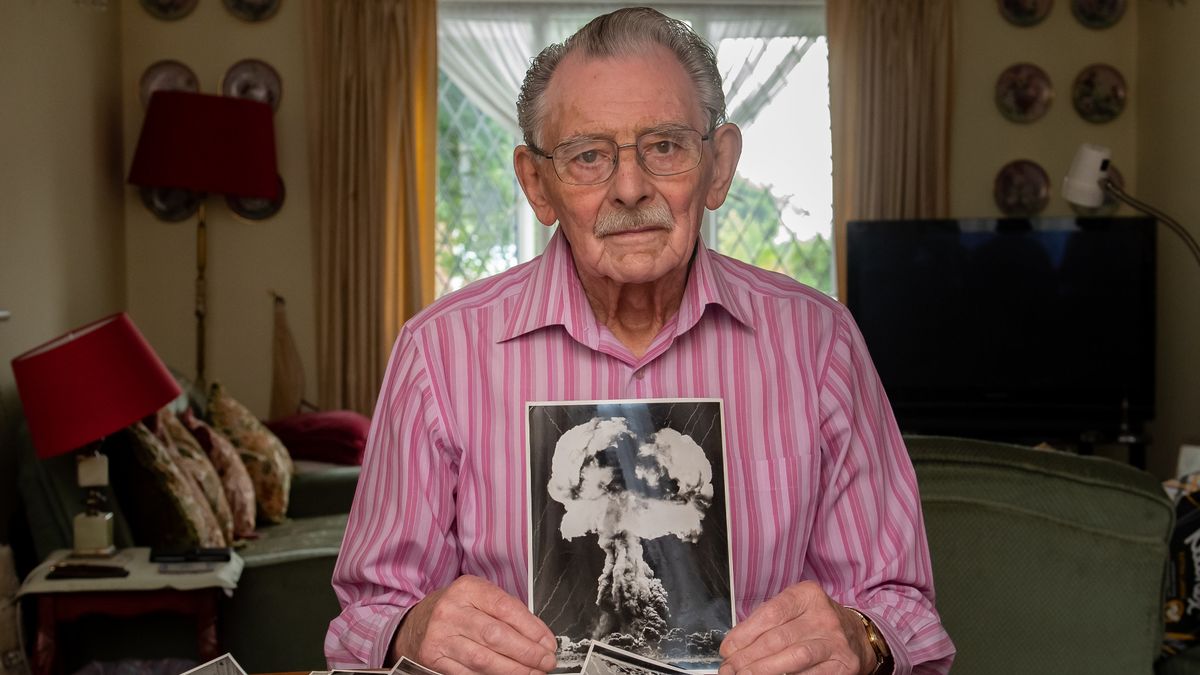
British veterans ‘ordered to march through smoking craters’ in nuclear bomb tests, Brian Tomlinson claims the state dumped him and his comrades, many of whom died from cancer after being used in a shocking human experiment,
https://www.mirror.co.uk/news/uk-news/british-veterans-ordered-march-through-27563987 Susie Boniface, Reporter, 24 Jul 2022,
A veteran of nuclear bomb tests has told how British servicemen were ordered to march through a smoking crater to find how radioactive it was.
Brian Tomlinson said he also had to dig out scientific instruments buried in the contaminated soil and revealed he was left with bleeding ulcers on his palms for two decades.
But he claims the state dumped him and his comrades, many of whom died from cancer in the years after they were used in a shocking human experiment in the Australian outback.
And Brian supports the Mirror’s campaign for a medal for heroes of the nuclear tests in the 50s.
“That place is still radioactive, it’s in the soil for a hell of a long time, so what chance does a human being have?” he said.
“A medal would get us a little bit of recognition for those who took part. It says you’re someone who’s been noticed and not discarded, which is how we’ve felt for so long.”
Last month, Boris Johnson became the first PM to meet veterans, and promised action before October’s 70th anniversary of the first test. His resignation threw it into doubt and campaigners are seeking reassurances from Rishi Sunak or Liz Truss that they will do the same.
Brian, now 85, was a sapper sent to Maralinga, South Australia, in 1957 to take part in Operation Antler, a series of three atomic bomb tests designed to help build the more powerful H-bomb.
His troop of Royal Engineers were blended with Australian soldiers, and 40 of them lived for a year inside the blast zone in canvas tents.
The main base, where scientists, top brass, and most troops stayed, was called Maralinga Village. Brian’s unit was 14 miles deeper into the testing grounds, at Roadside Camp. From there, it was just 9 miles to Ground Zero.
Brian, a 20-year-old corporal at the time, said: “Nobody told us what it was all about, or checked us for radiation, but every morning we went into the forward area.
We had pneumatic drills, and had to blast down through the soil. There was about 12 inches of earth, red dust, and below that was rock.”
For each of 3 blasts, the crew had to bury dozens of large steel containers 8ft square. Each had instruments inside to measure the explosion, with pipes protruding above ground level. Those closest to the bombs were sandbagged and concreted to protect them from the shockwave.
A few hours after each bomb, Brian and his crew – wearing only shorts, socks, boots and a hat – had to drive back in, remove the sandbags and concrete, and extract the instruments.
Scientists who went with them wore radiation suits and badges, but Brian said for the first two blasts he had neither.
He added: “After the third bomb, we were given little rubber boots, and a white overall, and a dose badge. We were told to walk through the crater. The mushroom cloud was still overhead. The wind had started to push it away. It was only a few hours after, not very long.”
The first two bombs, codenamed Tadje and Biak, were one kiloton and 6kts respectively.
But the third, Taranaki, was 25kts, as powerful as the weapon which destroyed Nagasaki in 1945.
Brian, of Yate, near Bristol, said: “As you approached the bomb site it was quite amazing, because it was like a bowling green. Everything was green and smooth. It was only when you were on it you realised the heat from the bomb had crystallised the earth underneath it. It was a crust of molten sand, like glass.
“The crater left there was huge. They told us to walk into that, down into the crater, and up the other side, and then check our meters to see how high the dose was.”
Brian said: “When it reached a certain point they told us to come out. It didn’t take long for it to reach that point. We weren’t told at the time what the dose was supposed to be. But it was just as bad as going through the centre of the bomb as soon as it had gone off.”
The first two bombs were detonated on top of 100ft-high towers built by the sappers, but desert sand was sucked into the fireball and fell to the ground as toxic fallout. The third bomb was tethered to barrage balloons 980ft up, supposedly minimising the risk.
But the size of the bomb, and perhaps the fact the same site was used for previous weapons tests, meant there was still fallout.
After they left the crater, Brian was taken to a decontamination area. The men’s clothes were stripped off and taken away, and the men were put through showers.
“We spent 5 or 6 minutes scrubbing away, then put ourselves in this meter, it was like standing on a weighing machine, and you push your hands through these bars to be tested. If a bell rang, you were still radioactive and had to go back in and scrub under your nails, everywhere, in your hair. I had to do it 3 times. They didn’t give us any more information.”
Documented safety measures at Maralinga included wire fences through which sand could easily be blown, and one wooden post barrier that Brian’s unit passed through each morning.
Brian was not checked for radiation while excavating amid the fallout, nor given long-term medical follow-ups. Six years later, he was medically discharged with a duodenal ulcer.
Radiation is known to cause problems with the lining of the gut, and earlier this year a government study reported nuclear test veterans were 20 per cent more likely than other servicemen to die from stomach cancer.
Brian said: “It wasn’t until later I started having skin problems. It would cover me from head to toes, rashes on my back, chest, legs, thighs. They used to come out on the palms of my hands.
“I’d get a little itchy blister in the centre of my palm, it would break and then spread over the fingers. I used to wear white cotton gloves to ease the pain and itching.
“The skin would go hard, then crack and bleed, and it would start all over again. I had that for 20 years, and no doctor could work out what it was.”
Today, cancer patients are warned radiotherapy using beta radiation can lead to radiodermatitis, which causes rashes, skin peeling, and ulceration. It is caused by the decay of isotopes, including plutonium and cobalt-60, both of which were in the Antler bombs.
Brian said: “I would have a constant itch, all over, and had to take cold showers just to stop the itching and have something of a normal life. I got depressed, to the point where I didn’t want to go and see the doctors because they just have me the same old medication and it never did me any good. Then one day, after 20 years, it just stopped, as suddenly as it came.”
Two decades after his discharge, Brian also had an operation to finally cure his ulcer. It involved cutting the vagus nerve, which controls digestion as well as carrying sensory information from the skin’s surface.
“I told all my consultants what was done to me out there in Maralinga, and asked if it was due to fallout. They all denied it,” said Brian. “Nobody’s ever done anything for us nuclear test veterans except withhold information from us.”
Campaigners have asked the Prime Minister for a medal and a service of national recognition at Westminster Abbey to mark the Plutonium Jubilee in 3 months’ time.
A spokesman for the MoD said it was grateful to veterans, and claimed they were well-monitored and protected. He added: “The Prime Minister met with veterans recently, and asked ministers to explore how their dedication can be recognised. We remain committed to considering any new evidence”
************************************************************************
For 40 years, the Mirror has campaigned for justice for the brave men who took part in Britain’s nuclear weapons tests.
The Ministry of Defence has fought back every step of the way.
We have told countless heartbreaking stories of grieving mums, children with deformities, men aged before their time and widows struggling to hold their families together, all while campaigning for recognition.
Two years ago we launched an appeal for a medal for the 1,500 survivors.
For the first time we were able to prove some were unwittingly used in experiments.
Our appeal was backed by then-Defence Secretary Gavin Williamson but his review foundered after he lost his job.
It had only six meetings in two years. They never asked to meet veterans. They never questioned the evidence.
Instead they asked for information from the MoD, which has a track record of denying what its own paperwork later proves.
And as our medal campaign gathered steam, civil servants simultaneously withdrew public documents from the National Archives.
Would anyone working in Whitehall today stay there, if 3 megatons of plutonium exploded south of the river?
The test veterans and their families will never stop fighting. The Mirror will never cease to demand they are heard.
Prime Minister, listen to them. Overturn this disgraceful decision.
The lingering horror of thorium radioactive poisoning in West Chicago

On the one hand, the story of West Chicago and thorium is one of triumph: a small town overcomes the odds and makes a big corporation clean up its radioactive waste. On the other hand, thorium still haunts some residents, especially those living with illness or deaths in the family that they suspect are related.
Are West Chicago’s Radiation Worries Over?, BELT Magazine, By Liuan Huska, 13 July 22,
Sandra Arzola was relaxing in her West Chicago home one weekend in 1995, when she heard a knock at the door. Recently married, she shared the gray duplex with her husband, mom and sister, and family members were constantly coming and going. But when Sandra answered the door that day, what she learned would change how she looked at her home and suburban community forever.
At the door was a woman representing Envirocon, an environmental cleanup company. There was thorium on the family’s property, the woman said, and if it was OK with them, workers were coming to remove it. It was the first time Sandra had heard of thorium “It took me by left field,” she said. “But [the representative] made it sound like everything was going to be fine.”
Unknowingly, the Arzolas had bought their way into what the Chicago Tribune in 1979 called “the radioactive capital of the Midwest.” Not long after they purchased the property, the U.S. Environmental Protection Agency designated it a Superfund site because of the hazardous waste in their yard.
The source of the danger was the old factory one block to the north of the Arzola home, which Jesse Arzola frequently went past while walking their dogs. From 1932 to 1973, the factory was the largest producer of rare earth and radioactive thorium compounds in the world. It started out producing lamps and later supplied thorium for the federal government’s atomic bomb development. But perhaps the factory’s most lasting legacy, at least in West Chicago, is the harmful radioactive waste that was dumped in ponds, piled at the factory and buried around homes and sidewalks across town.
Residents raised health concerns as early as the 1940s about the toxic material, but these were regularly dismissed by the factory, last owned by the Kerr-McGee Chemical Corporation. Comprehensive environmental protection rules weren’t put in place until the early 1970s, leaving the factory largely free to dispose of its nuclear waste for decades.
It has taken just as long for the company and government to clean up the radioactive waste. As of 2015, the radioactive sites under federal jurisdiction near the factory have been cleaned to EPA standards. There are no remaining health risks from the land, according to government officials.
But below the factory, the groundwater is still polluted with a range of toxins – particularly uranium – that exceed protection standards. The Illinois Emergency Management Agency, which has jurisdiction over the site, expects remediation to begin this fall. ……………………..
Prolonged or high levels of radiation exposure can damage genetic material in cells and cause cancer and other diseases later on, especially for children, who are more sensitive to radiation. Only two public health studies, published in the early 1990s, have been conducted in West Chicago. Both found elevated cancer rates in the 60185 zip code, which includes the neighborhood around the factory……………………………
The challenges facing West Chicago residents today began ninety years ago, when Charles R. Lindsay moved his lamp factory from Chicago to what was then an undeveloped little town with multiple rail connections. The factory, now officially known as the Rare Earths Facility, took monazite ore and used powerful acids to extract minerals to make gas lanterns, which burned thorium nitrate to emit an incandescent glow. During World War II, it also supplied thorium to the federal government to develop the atomic bombs that were later dropped on Nagasaki and Hiroshima, Japan.
During its four decades of operation, the Rare Earths Facility processed up to one hundred and forty-one thousand tons of monazite. The liquid waste from the extraction process was dumped into unlined ponds around the factory, seeping into the surrounding water table. Solid waste, a black, sand-like material known as thorium tailings, piled up on site. Old-timers share stories of sneaking into the factory grounds and playing on “Mount Thorium.” When the pile got too big, the waste was trucked down the road to a new pile in Reed Keppler Park.
Facing mounting piles of toxic waste, Lindsay came up with another solution: offer the waste to residents for landscaping. From the 1930s through the 1950s, radioactive thorium tailings were distributed across town, mixed with concrete to pour foundations, mixed with topsoil for gardens and spilled along roadways. The company continued to do this as the risks of radiation exposure became widely known starting in the late 1940s through its effects on Japanese atomic bomb survivors.
Soon after the factory moved to West Chicago, people started complaining. In 1941, nearby residents sued Lindsay Light for releasing airborne hydrofluoric acid that killed trees and shrubs nearby.
The federal government did not begin regulating nuclear materials until 1954. Starting in 1957 the company received repeated citations for safety violations, including failing to fence off radioactive storage areas, exposing workers to radiation levels above standards and improper waste disposal.
As the environmental movement gained steam through the 1960s, growing public pressure pushed Congress to create the Environmental Protection Agency and pass the Clean Air Act of 1970 and Clean Water Act of 1972. That resulted in sweeping new regulations – and obligations to the American public – for companies like Kerr-McGee, which had gotten used to operating with limited oversight…………………………….
The EPA denied the company’s request for an operating permit and the factory shuttered in 1973. It was cheaper to cease operations than follow the new rules. By 1980, Kerr-McGee had started the process of closing down the West Chicago facility for good. Pressure from residents and the city pushed the company to begin cleanup on 119 contaminated residential properties.
Still, Kerr-McGee had another plan that worried residents: to permanently store thirteen million cubic feet of radioactive waste at the factory site in a four-story, twenty-seven-acre, clay-covered cell. Concerned residents formed an organization, the Thorium Action Group, to fight the company’s proposal. This spawned more than a decade of legal battles between residents, the city of West Chicago, and state of Illinois — who wanted the thorium out of town — and the company and the federal Nuclear Regulatory Commission, who insisted the waste could safely be stored in this densely populated neighborhood of West Chicago…………………
Moving the thorium waste out of town would take over two decades to complete. In the meantime, there was still the problem of radioactive tailings embedded around the neighborhood…………………….
The Arzolas’ experience is far from rare. Realtors in West Chicago have operated with a “don’t ask, don’t tell” policy, said longtime realtor and former West Chicago resident Dan Czuba. Unlike for radon or lead, realtors never received directives from the state or any licensing board to disclose other harmful thorium byproducts. People have had to do their own homework and decide whether or not a home was a risk. “To this day,” Czuba said, “I still don’t know that there was an official statement of, ‘Thorium will hurt you.’”…………………………………..
Throughout the decades, various groups have tried to get the word out about thorium. The Thorium Action Group was active through the early 2000s. Once the EPA got involved and Kerr-McGee agreed to move the waste out, the group dissipated………
The lack of easily accessible information surrounding the contamination and cleanups has left some residents with the nagging worry that there may be other hidden pockets of radiation around town……….
One house to the west and across the railroad from the Arzolas, Erika Bartlett grew up playing along the tracks and under her yard’s sprawling old oak trees. When she was diagnosed with leukemia in 2012, at age thirty-four, a friend asked if there was anything she could have been exposed to.
“Wait a minute, I actually was,” Bartlett told her friend. She thought back to her high school years, when the oak trees, swingset and above-ground pool at her house were removed during the radiation remediation. Bartlett realized she had spent her childhood, starting from age four, in a neighborhood embedded with nuclear waste. She wondered how many others living near the factory had similar health problems. That started her on a yearslong personal investigation into the town’s thorium legacy.
Between 2012 and 2016, as Bartlett was undergoing cancer treatment, she knocked on doors in the neighborhoods around the factory, an area covering about one square mile. She found over 200 cases of cancers and other illnesses that could stem from radiation exposure, including birth defects, Hashimoto’s and aplastic anemia, the illness that killed the pioneering radioactivity researcher Marie Curie in 1934.
“When I first started, I didn’t think I’d find anything,” Bartlett said. “But block after block, it seemed like a bigger deal than I thought.”
The EPA estimated that, before the waste was removed, radiation levels in some residential neighborhoods in West Chicago increased lifetime cancer risks up to seventy times what is acceptable……
The only official health studies into the impacts on people living near the factory were conducted over three decades ago, by the Illinois Department of Public Health. Among residents in the 60185 zip code, studies in 1990 and 1991 found elevated rates of cancer, including melanomas and lung, colorectal and breast cancers. By grouping exposed and unexposed people together, however, researchers said more differences may have been masked……………………………………….
On the one hand, the story of West Chicago and thorium is one of triumph: a small town overcomes the odds and makes a big corporation clean up its radioactive waste. On the other hand, thorium still haunts some residents, especially those living with illness or deaths in the family that they suspect are related………………… https://beltmag.com/are-west-chicagos-radiation-worries-over/
Fukushima bosses ordered to pay billions for failing to prevent nuclear disaster
The Chemical Engineer, by Adam Duckett, 18 July 22,
FOUR former bosses of the Fukushima Daiichi nuclear plant have been ordered by a Tokyo court to pay ¥13trn yen (US$94bn) in damages for failing to prevent disaster at the site in 2011.
The lawsuit was filed by shareholders in 2012 and is the first to find former executives of utility company Tepco liable for compensation. Kyodo News reports that the presiding judge said the utility’s countermeasures for the tsunami “fundamentally lacked safety awareness and a sense of responsibility,” ruling that the executives failed to perform their duties.
A huge earthquake knocked out power supply to the plant and triggered a tsunami thought to measure as high as 15 m. This easily washed over the 5.5 m seawalls designed to protect the plant, flooding key infrastructure, including the backup diesel generators that had kicked in to power the cooling of the reactors. Without this power, the three units operating at the plant melted down, the reactor pressure vessels were breached, and radioactive material was released into the environment.
The trial focused on whether the management had taken appropriate decisions on how to manage the risk of tsunami after a Tepco unit estimated in 2008 that a tsunami measuring up to 15.7 m could strike the plant based on a Government analysis published in 2002, Kyodo News reports. The former executives’ lawyers argued that the assessment lacked reliability. The court disagreed and said the Government’s assessment obliged the company to take measures. It ruled that the decision not to act was “extremely irrational and unforgivable”.
The four executives found guilty include former Chairman Tsunehisa Katsumata, former President Masataka Shimizu, and former vice presidents Sakae Muto and Ichiro Takekuro. The sum they have been ordered to pay is well beyond their personal wealth, but they are expected to pay as much as their assets allow. A fifth defendant, former Managing Director Akio Komori, was found not liable for damages……………. more https://www.thechemicalengineer.com/news/fukushima-bosses-ordered-to-pay-billions-for-failing-to-prevent-nuclear-disaster/
Decadal trends in 137Cs concentrations in the bark and wood of trees contaminated by the Fukushima nuclear accident.
Abstract
Understanding the actual situation of radiocesium (137Cs) contamination of trees caused by the Fukushima nuclear accident is essential for predicting the future contamination of wood. Particularly important is determining whether the 137Cs dynamics within forests and trees have reached apparent steady state. We conducted a monitoring survey of four major tree species (Japanese cedar, Japanese cypress, konara oak, and Japanese red pine) at multiple sites. Using a dynamic linear model, we analyzed the temporal trends in 137Cs activity concentrations in the bark (whole), outer bark, inner bark, wood (whole), sapwood, and heartwood during the 2011–2020 period. The activity concentrations were decay-corrected to September 1, 2020, to exclude the decrease due to the radioactive decay. The 137Cs concentrations in the whole and outer bark samples showed an exponential decrease in most plots but a flat trend in one plot, where 137Cs root uptake is considered to be high. The 137Cs concentration ratio (CR) of inner bark/sapwood showed a flat trend but the CR of heartwood/sapwood increased in many plots, indicating that the 137Cs dynamics reached apparent steady state within one year in the biologically active parts (inner bark and sapwood) and after several to more than 10 years in the inactive part (heartwood). The 137Cs concentration in the whole wood showed an increasing trend in six plots. In four of these plots, the increasing trend shifted to a flat or decreasing trend. Overall, the results show that the 137Cs dynamics within forests and trees have reached apparent steady state in many plots, although the amount of 137Cs root uptake in some plots is possibly still increasing 10 years after the accident. Clarifying the mechanisms and key factors determining the amount of 137Cs root uptake will be crucial for predicting wood contamination.
Introduction
After the Fukushima Dai-ichi Nuclear Power Plant (FDNPP) accident in March of 2011, a wide area of forests in eastern Japan was contaminated with radionuclides. In particular, radiocesium (137Cs) has the potential to threaten the forestry and wood production in the contaminated area for many decades because it was released in large amounts (10 PBq)1 and has a relatively long half-life (30 years). Radiocesium levels for some wood uses are strictly regulated in Japan (e.g., 40 Bq kg−1 for firewood2 and 50 Bq kg−1 for mushroom bed logs3), meaning that multipurpose uses of wood from even moderately contaminated areas are restricted. Although a guidance level of radiocesium in construction wood has not been declared in Japan, the permissible levels in some European countries (370–740 Bq kg−1)4,5,6 suggest that logging should be precautionary within several tens of kilometers from the FDNPP, where the 137Cs activity concentration in wood potentially exceeds 1,000 Bq kg−1 [refs. 7,8]. To determine whether logging should proceed, the long-term variation in wood 137Cs concentration must be predicted as accurately as possible. Many simulation models successfully reproduce the temporal variations in the early phase after the FDNPP accident, but produce large uncertainties in long-term predictions9. To understand the 137Cs dynamics in forests and trees and hence refine the prediction models, it is essential to provide and analyze the observational data of 137Cs activity concentrations in tree stem parts.
Accident-derived 137Cs causes two types of tree contamination: direct contamination by 137Cs fallout shortly after the accident, and indirect contamination caused by surface uptake from directly contaminated foliage/bark10,11 and root uptake from contaminated soil12. The 137Cs concentration in bark that pre-exists the accident was affected by both 137Cs drop/wash off from bark surfaces and 137Cs uptake because the bark consists of a directly contaminated outer bark (rhytidome) and an indirectly contaminated inner bark (phloem). Given that the 137Cs content was 10 times higher in the outer bark than in the inner bark in 201213 and the 137Cs concentration in the whole bark decreased during the 2011–2016 period at many study sites8, the temporal variation in the whole bark 137Cs concentration during the early post-accident phase must be mainly contributed by drop/wash off of 137Cs on the outer bark surface.
In contrast, stem wood (xylem) covered by bark was contaminated only indirectly. Although 137Cs distribution in sapwood (outer part of stem wood; containing living cells) and heartwood (inner part of stem wood; containing no living cells) is non-uniform and species-specific8,13,14,15, the 137Cs concentration in whole wood depends on the amount of 137Cs uptake. Because the dissolvable 137Cs on the foliar/bark surface decreased significantly within 201116, the main route of 137Cs uptake since 2012 is likely root uptake rather than surface uptake. A monitoring survey during 2011–2016 showed that the temporal trend in the whole wood 137Cs concentration can be increasing, decreasing, or flat8, suggesting that 137Cs root uptake widely differs among sites and species.
Meanwhile, many simulation models have predicted an initial increase in the whole wood 137Cs concentration after the accident, followed by a gradual decline9. The initial increase is attributable to the increase in soil 137Cs inventory, and the following decline is mainly attributed to radioactive decay, dilution by wood biomass increment, and immobilization in the soil. Therefore, the trend shift from increasing to decreasing is a good indicator that shows the 137Cs dynamics within the forest have reached apparent steady state, which is characterized by slower changes in 137Cs concentration, bioavailability, and partitioning in the forest12,17,18. However, the timing of the trend shift predicted by the models have large uncertainty, varying from several years to a few decades from the accident9. Moreover, the trend shift has not been confirmed by observational data after the FDNPP accident. Although our monitoring survey cannot easily identify the key driving factors of the temporal trends, it can directly discern the trend shift from increasing to decreasing, and the timeframe of the increasing trend. The confirmation of the trend shift will accelerate the understanding of key factors of 137Cs root uptake, because important parameters such as transfer factor and CR are originally defined for a steady state condition18.
The present study aims to clarify the temporal trends of 137Cs concentrations in bark and wood of four major tree species (Japanese cedar, Japanese cypress, konara oak, and Japanese red pine) at multiple sites during the 10 years following the FDNPP accident. Detecting a trend shift from increasing to decreasing in the wood 137Cs concentration was especially important to infer whether the 137Cs dynamics within the forest have reached apparent steady state. We update Ohashi et al.8, who analyzed the monotonous increasing or decreasing trends during 2011–2016, with observational data of 2017–2020 and a more flexible time-series analysis using a dynamic linear model (DLM). The DLM is suitable for analyzing data including observational errors and autocorrelation, and has the advantage of being applicable to time-series data with missing years. For a more detailed understanding of bark contamination and the 137Cs dynamics in tree stems, we also newly provide data on the 137Cs concentrations in the outer and inner barks. The temporal trends in the 137Cs CRs of outer bark/inner bark, heartwood/sapwood, and inner bark/sapwood were analyzed to confirm whether the 137Cs dynamics within the trees have reached apparent steady state.
Materials and methods
Monitoring sites and species
The monitoring survey was conducted at five sites in Fukushima Prefecture (sites 1–4 and A1) and at one site in Ibaraki Prefecture (site 5), Japan (Fig. 1). Sites 1, 2, and A1 are located in Kawauchi Village, site 3 in Otama Village, site 4 in Tadami Town, and site 5 in Ishioka City. Monitoring at sites 1–5 was started in 2011 or 2012, and site A1 was additionally monitored since 2017. The tree species, age, mean diameter at breast height, initial deposition density of 137Cs, and sampling year of each sample at each site are listed in Table 1. The dominant tree species in the contaminated area, namely, Japanese cedar (Cryptomeria japonica [L.f.] D.Don), Japanese cypress (Chamaecyparis obtusa [Siebold et Zucc.] Endl.), konara oak (Quercus serrata Murray), and Japanese red pine (Pinus densiflora Siebold et Zucc.) were selected for monitoring. Japanese chestnut (Castanea crenata Siebold et Zucc.) was supplementally added in 2017. The cedar, cypress, and pine are evergreen coniferous species, and the oak and chestnut are deciduous broad-leaved species. Sites 1 and 3 each have three plots, and each plot contains a different monitoring species. Site A1 has one plot containing two different monitoring species, and the remaining sites each have one plot with one monitoring species, giving ten plots in total.


Sample collection and preparation
Bulk sampling of bark and wood disks was conducted by felling three trees per year at all sites during 2011–20168,25 and at sites 3–5 and A1 during 2017–2020. Partial sampling from six trees per year was conducted at sites 1 and 2 during 2017–2020 (from seven trees at site 2 in 2017) to sustain the monitoring trees. All the samples were obtained from the stems around breast height. During the partial sampling, bark pieces sized approximately 3 cm × 3 cm (axial length × tangential length) were collected from four directions of the tree stem using a chisel, and 12-mm-diameter wood cores were collected from two directions of the tree stem using an automatic increment borer (Smartborer, Seiwa Works, Tsukuba, Japan) equipped with a borer bit (10–101-1046, Haglöf Sweden, Långsele, Sweden). Such partial sampling increases the observational errors in the bark and wood 137Cs concentrations in individual trees26. To mitigate this error and maintain an accurate mean value of the 137Cs concentration, we increased the number of sampled trees from three to six. The sampling was conducted mainly in July–September of each year; the exceptions were site-5 samples in 2011 and 2012, which were collected irregularly during January–February of the following year. The collected bark pieces were separated into outer and inner barks, and the wood disks and cores were split into sapwood and heartwood. The outer and inner bark samples during 2012–2016 were obtained by partial sampling of barks sized approximately 10 cm × 10 cm from 2–3 directions on 2–3 trees per year.
The bulk samples of bark, sapwood, and heartwood were air-dried and then chipped into flakes using a cutting mill with a 6-mm mesh sieve (UPC-140, HORAI, Higashiosaka, Japan). The pieces of the outer and inner bark were chipped into approximately 5 mm × 5 mm pieces using pruning shears, and the cores of the sapwood and heartwood were chipped into semicircles of thickness 1–2 mm. Each sample was packed into a container for radioactivity measurements and its mass was measured after oven-drying at 75 °C for at least 48 h. Multiplying this mass by the conversion factor (0.98 for bark and 0.99 for wood)8 yielded the dry mass at 105 °C.
Radioactivity measurements
The radioactivity of 137Cs in the samples was determined by γ-ray spectrometry with a high-purity Ge semiconductor detector (GEM20, GEM40, or GWL-120, ORTEC, Oak Ridge, TN). For measurements, the bulk and partial samples were placed into Marinelli containers (2.0 L or 0.7 L) and cylindrical containers (100 mL or 5 mL), respectively. The peak efficiencies of the Marinelli containers, the 100-mL container, and the 5-mL container were calibrated using standard sources of MX033MR, MX033U8PP (Japan Radioisotope Association, Tokyo, Japan), and EG-ML (Eckert & Ziegler Isotope Products, Valencia, CA), respectively. For the measurement of the 5-mL container, a well-type Ge detector (GWL-120) was used under the empirical assumption that the difference in γ-ray self-absorption between the standard source and the samples is negligible27. The measurement was continued until the counting error became less than 5% (higher counting errors were allowed for small or weakly radioactive samples). The activity concentration of 137Cs in the bark (whole) collected by partial sampling was calculated as the mass-weighted mean of the concentrations in the outer and inner barks; meanwhile, the concentration in the wood (whole) was calculated as the cross-sectional-area-weighted mean of sapwood and heartwood concentrations. The activity concentrations were decay-corrected to September 1, 2020, to exclude the decrease due to the radioactive decay.
Discussion
Causes of temporal trends in bark 137Cs concentration
The 137Cs concentration in the whole bark decreased in many plots, clearly because the outer bark 137Cs concentration decreased. However, the whole bark 137Cs concentration showed a relatively small decrease or even a flat trend in some plots (site-2 cedar and site-1 cypress and oak). In the site-1 cypress plot, where the whole bark 137Cs concentration decreased relatively slowly, the inner bark 137Cs concentration notably increased. Similarly, although we lack early phase monitoring data in the site-2 cedar and site-1 oak plots, the inner bark 137Cs concentration in both plots is considered to have increased prior to monitoring because the sapwood 137Cs concentration increased in both plots and the CR of inner bark/sapwood was constant in all other plots. Therefore, the low-rate decrease or flat trend in the whole bark 137Cs concentration in some plots was probably caused by an increase in the inner bark 137Cs concentration, itself likely caused by high 137Cs root uptake (as discussed later).
The 137Cs concentration in the outer bark decreased in all four plots monitored since 2012 (site-1 and site-3 cedar, site-1 cypress, and site-3 pine), confirming the 137Cs drop/wash off from the bark surface. The constant (exponential) decrease in three of these plots indicates that the 137Cs drop/wash off was still continuing in 2020 but with smaller effect on the outer bark 137Cs concentration. In contrast, the decrease in the site-1 cypress plot seemed to slow down since around 2017. Furthermore, Kato et al.32 reported no decrease in 137Cs concentration in the outer bark of Japanese cedar during the 2012–2016 period. Such cases cannot be fitted by a simple decrease of the outer bark 137Cs concentration. As a longer-term perspective, in the outer bark of Norway spruces (Picea abies) affected by the Chernobyl nuclear accident, the biological half-life of 137Cs concentration was extended in areas with higher precipitation, suggesting that high root uptake of 137Cs hinders the decreasing trend33. The present study showed that 70–80% or more of the 137Cs deposited on the bark surface (outer bark) was removed by drop/wash off after 10 years from the accident and that the 137Cs CR of outer bark/inner bark became constant in some plots. These facts suggest that the longer-term variations in outer bark 137Cs concentration will be more influenced by 137Cs root uptake, although it is uncertain whether root uptake caused the slowing down of the decrease rate seen in the site-1 cypress plot. Further studies are needed to understand the 137Cs concentration in newly formed outer bark and to determine the 137Cs CR of outer bark/inner bark at steady state.
Causes of temporal trends in wood 137Cs concentration
The temporal trends of the 137Cs concentration in the whole wood basically corresponded to those in the sapwood. The exceptions were the site-3 and site-4 cedar plots, where the sapwood 137Cs concentration did not increase but the whole wood 137Cs concentration was raised by the notable increase in the heartwood 137Cs concentration. This behavior can be attributed to a species-specific characteristic of Japanese cedar, which facilitates Cs transfer from sapwood to heartwood8,15,34. The present study newly found that the increase in the 137Cs CR of heartwood/sapwood in the cedar plots became smaller or shifted to a flat trend around 2015–2016, indicating that 137Cs transfer between the sapwood and heartwood has reached apparent steady state at many sites 10 years after the accident. Therefore, after 2020, the whole wood 137Cs concentration in cedar is unlikely to increase without a concomitant increase in the sapwood 137Cs concentration.
The increasing trends in the 137Cs concentrations in whole wood and sapwood (site-2 cedar, site-1 cypress, and site-1 and site-3 oak plots) are seemingly caused by the yearly increase in 137Cs root uptake; however, the wood 137Cs concentration can also increase when the 137Cs root uptake is constant or even slightly decreases each year. This behavior can be shown in a simple simulation of the temporal variation in the wood 137Cs content (the amount of 137Cs in stem wood of a tree). If the 137Cs dynamics within a tree have reached steady state and the proportion of 137Cs allocated to stem wood become apparently constant, the wood 137Cs content in a given year can be considered to be determined by the amount of 137Cs root uptake and the amount of 137Cs emission via litterfall. The flat 137Cs CR trend of inner bark/sapwood during 2012–2020 (see Fig. 5) indicates that the 137Cs dynamics, at least those between the inner bark and sapwood, reached apparent steady state within 2011. Here we assume that (1) the annual amount of 137Cs root uptake is constant, (2) the proportion of 137Cs allocated to stem wood is apparently constant, and as assumed in many forest Cs dynamics models17,35,36,37, (3) a certain proportion of 137Cs in the stem wood is lost via litterfall each year. Under these conditions, the simulated amount of 137Cs emission balanced the amount of 137Cs root uptake after sufficient time, and the wood 137Cs content approached an asymptotic value calculated as [root uptake amount × allocation proportion × (1/emission proportion − 1)]. Note that the asymptotic value increases with increasing root uptake amount and decreasing emission proportion and does not depend on the amount of 137Cs foliar/bark surface uptake in the early post-accident phase. Nevertheless, the amount of 137Cs surface uptake in the early phase critically determines the trend of the wood 137Cs content. More specifically, the trend in the early phase will be increasing (decreasing) if the surface uptake is smaller (larger) than the asymptotic value. Finally, the temporal variation of the 137Cs concentration in wood is thought to be the sum of the dilution effect of the increasing wood biomass and the above-simulated variation in the wood 137Cs content. Therefore, in the early post-accident phase, the wood 137Cs concentration will increase when the wood 137Cs content increases at a higher rate than the wood biomass. As the wood 137Cs content approaches its asymptotic value (i.e., steady state), its increase rate slows and the dilution effect proportionally increases. Then, the wood 137Cs concentration shifts from an increasing trend to a decreasing trend. The trends of the 137Cs concentrations in whole wood and sapwood in the site-3 oak plot follow this basic temporal trend, which is similarly predicted by many simulation models9.
In other plots with the increasing trend (site-2 cedar and site-1 cypress and oak), the increase in the 137Cs concentrations in whole wood and sapwood became smaller or shifted to a flat trend around six years after the accident; however, it did not shift to a decreasing trend. This lack of any clear shift to a decreasing trend, which was similarly seen at sites with hydromorphic soils after the Chernobyl nuclear accident38,39, cannot be well explained by the above simulation. A core assumption of the simulation that the yearly amount of 137Cs root uptake is constant is probably violated in these plots, leading to underestimations of the root uptake amount. Although the inventory of exchangeable 137Cs in the organic soil layer has decreased yearly since the accident, that in the mineral soil layer at 0–5 cm depth has remained constant40. In addition, the downward migration of 137Cs has increased the 137Cs inventory in the mineral soil layer below 5-cm depth41,42. If the steady state 137Cs inventory of the root uptake source can be regarded as sufficient for trees, any increase in the 137Cs root uptake is likely explained by expansion of the root distribution and the increase in transpiration (water uptake) with tree growth. When the wood 137Cs content increases at a similar rate to the wood biomass, the increasing trend will not obviously shift to a decreasing trend. Therefore, assuming the 137Cs allocation and emission proportions in the mature trees do not change considerably with time, the amount of 137Cs root uptake is considered to be increasing yearly in these four plots.
In the remaining plots with the decreasing or flat trend (site-1 cedar, site-4 cedar without outliers, site-5 cypress, and site-3 pine), according to the above simulation, the amount of initial 137Cs surface uptake was larger than or similar to the asymptotic value, i.e. the amount of 137Cs root uptake is relatively small and/or the proportion of 137Cs emission via litterfall is relatively high. However, the amount of 137Cs root uptake in the plots with the flat trend is possibly increasing because the flat trend has not shifted to a decreasing trend. In these plots, although it is difficult to confirm apparent steady state of the soil–tree 137Cs cycling because of the lack of an initial increasing trend, the recent flat trends in the 137Cs CRs of heartwood/sapwood and inner bark/sapwood indicate that the 137Cs dynamics, at least within the trees, have reached apparent steady state.
Various factors were found to increase the 137Cs root uptake after the Chernobyl nuclear accident; for example, high soil water content, high soil organic and low clay content (i.e., low radiocesium interception potential [RIP]), low soil exchangeable K concentration, and high soil exchangeable NH4 concentration12,43. After the FDNPP accident, the 137Cs transfer from soil to Japanese cypress and konara oak was found to be negatively correlated with the soil exchangeable K concentration44,45 and the 137Cs mobility is reportedly high in soils with low RIP46. However, neither the soil exchangeable K and Cs concentrations nor the RIP have explained the different 137Cs aggregated transfer factors (defined as [137Cs activity concentration in a specified component/137Cs activity inventory in the soil]) of Japanese cedars at sites 1–446,47. Because the 137Cs dynamics within the forest and trees in many plots reached apparent steady state at 10 years after the FDNPP accident, the 137Cs aggregated transfer factor is now considered to be an informative indicator of the 137Cs root uptake. Therefore, a comprehensive analysis of the 137Cs aggregated transfer factor and the soil properties at more sites than in the present study will be important to understand key factors determining the amount of 137Cs root uptake by each tree species at each site.
Validity and limitation of the trend analyses
Although the application of the smooth local linear trend model failed in plots monitored for less than five years, it was deemed suitable for analyzing the decadal trend because it removes annual noises, which are probably caused by relatively large observational errors (including individual variability)26. Moreover, the algorithm that determines the trend and its shift between 2 and 4 delimiting years was apparently reasonable, because the detected trends well matched our intuition. However, when judging a trend, the algorithm simply assesses whether the true state values significantly differ between the delimiting years. Therefore, it cannot detect changes in the increase/decrease rate (i.e., whether an increasing/decreasing trend is approaching a flat trend). For example, the whole bark 137Cs concentration in the site-1 cypress plot was determined to decrease throughout the monitoring period. In fact, the decrease rate slowed around 2014 and the decreases were slight between 2014 and 2020 (see Fig. 2). Similarly, the sapwood 137Cs concentration in the site-1 cypress and oak plots was determined to increase throughout the monitoring period, but the increase rate has clearly slowed since around 2017. To more sensitively detect the shift from an increasing/decreasing trend to a flat trend, other algorithms are required. Nevertheless, this algorithm is acceptable for the chief aim of the present study; that is, to detect a trend shift from increasing to decreasing.
Conclusions
In many plots monitored at Fukushima and Ibaraki Prefectures, the 137Cs concentrations in the whole and outer bark decreased at almost the same yearly rate for 10 years after the FDNPP accident, indicating that the direct contamination of the outer bark was mostly but not completely removed during this period. Moreover, the 137Cs concentration in the whole bark decreased at relatively low rates or was stable in plots where the 137Cs root uptake was considered to be high. This fact suggests that indirect contamination through continuous root uptake can reach the same magnitude as direct contamination by the accident.
In all of our analyzed plots, the 137Cs CR of inner bark/sapwood has not changed since 2012, indicating that 137Cs transfer among the biologically active parts of the tree stem had already reached apparent steady state in 2011. In contrast, the 137Cs CR of heartwood/sapwood in six out of nine plots increased after the accident. In four of these plots, the 137Cs CR of heartwood/sapwood plateaued after 3–6 years; in the other two plots, the plateau was not reached even after 10 years. Therefore, saturation of 137Cs in heartwood (an inactive part of the tree stem) requires several years to more than one decade.
The 137Cs concentration in the whole wood showed an increasing trend in six out of nine plots. In four of these plots, the increasing trend shifted to a flat or decreasing trend, indicating that the 137Cs dynamics in many forests reached apparent steady state at 10 years after the accident. However, the lack of the clear shift to a decreasing trend indicates that the 137Cs root uptake is probably still increasing in some plots. Continuous monitoring surveys and further studies clarifying the complex mechanisms of 137Cs root uptake in forests are needed in order to refine the simulation models and improve their prediction accuracy.
1 This Month


Website of the Week

New book – https://www.amazon.com/dp/1923372157?utm_source=substack&utm_medium=email
Now until to February 10, 2026 Radioactive waste storage in France: the debate is finally open! How to participate?
-
Archives
- January 2026 (127)
- December 2025 (358)
- November 2025 (359)
- October 2025 (377)
- September 2025 (258)
- August 2025 (319)
- July 2025 (230)
- June 2025 (348)
- May 2025 (261)
- April 2025 (305)
- March 2025 (319)
- February 2025 (234)
-
Categories
- 1
- 1 NUCLEAR ISSUES
- business and costs
- climate change
- culture and arts
- ENERGY
- environment
- health
- history
- indigenous issues
- Legal
- marketing of nuclear
- media
- opposition to nuclear
- PERSONAL STORIES
- politics
- politics international
- Religion and ethics
- safety
- secrets,lies and civil liberties
- spinbuster
- technology
- Uranium
- wastes
- weapons and war
- Women
- 2 WORLD
- ACTION
- AFRICA
- Atrocities
- AUSTRALIA
- Christina's notes
- Christina's themes
- culture and arts
- Events
- Fuk 2022
- Fuk 2023
- Fukushima 2017
- Fukushima 2018
- fukushima 2019
- Fukushima 2020
- Fukushima 2021
- general
- global warming
- Humour (God we need it)
- Nuclear
- RARE EARTHS
- Reference
- resources – print
- Resources -audiovicual
- Weekly Newsletter
- World
- World Nuclear
- YouTube
-
RSS
Entries RSS
Comments RSS
 nuclear-news