On February 16, 2022, a full week before Putin sent combat troops into Ukraine, the Ukrainian Army began the heavy bombardment of the area (in east Ukraine) occupied by mainly ethnic Russians. Officials from the Observer Mission of the Organization for Security and Co-operation in Europe (OSCE) were located in the vicinity at the time and kept a record of the shelling as it took place. What the OSCE discovered was that the bombardment dramatically intensified as the week went on until it reached a peak on February 19, when a total of 2,026 artillery strikes were recorded. Keep in mind, the Ukrainian Army was, in fact, shelling civilian areas along the Line of Contact that were occupied by other Ukrainians.
We want to emphasize that the officials from the OSCE were operating in their professional capacity gathering first-hand evidence of shelling in the area. What their data shows is that Ukrainian Forces were bombing and killing their own people.This has all been documented and has not been challenged.
So, the question we must all ask ourselves is this: Is the bombardment and slaughter of one’s own people an ‘act of war’?
We think it is.And if we are right, then we must logically assume that the war began before the Russian invasion (which was launched a full week later) We must also assume that Russia’s alleged “unprovoked aggression” was not unprovoked at all but was the appropriate humanitarian response to the deliberate killing of civilians. In order to argue that the Russian invasion was ‘not provoked’, we would have to say that firing over 4,000 artillery shells into towns and neighborhoods where women and children live, is not a provocation? Who will defend that point of view?
No one, because it’s absurd. The killing of civilians in the Donbas was a clear provocation, a provocation that was aimed at goading Russia into a war. And –as we said earlier– the OSCE had monitors on the ground who provided full documentation of the shelling as it took place, which is as close to ironclad, eyewitness testimony as you’re going to get.
This, of course, is a major break with the “official narrative” which identifies Russia as the perpetrator of hostilities. But, as we’ve shown, that simply isn’t the case. The official narrative is wrong. Even so, it might not surprise you to know that most of the mainstream media completely omitted any coverage of the OSCE’s fact-finding activities in east Ukraine. The one exception to was Reuters that published a deliberately opaque account published on February 18 titled “Russia voices alarm over sharp increase of Donbass shelling”. Here’s an excerpt:
Russian Foreign Minister Sergei Lavrov voiced alarm on Friday over a sharp increase in shelling in eastern Ukraine and accused the OSCE special monitoring mission of glossing over what he said were Ukrainian violations of the peace process….
Washington and its allies have raised fears that the upsurge in violence in the Donbass could form part of a Russian pretext to invade Ukraine. Tensions are already high over a Russian military buildup to the north, east and south of Ukraine.
“We are very concerned by the reports of recent days – yesterday and the day before there was a sharp increase in shelling using weapons that are prohibited under the Minsk agreements,” Lavrov said, referring to peace accords aimed at ending the conflict. “So far we are seeing the special monitoring mission is doing its best to smooth over all questions that point to the blame of Ukraine’s armed forces,” he told a news conference.
Ukraine’s military on Friday denied violating the Minsk peace process and accused Moscow of waging an information war to say that Kyiv was shelling civilians, allegations it said were lies and designed to provoke it.” (Russia voices alarm over sharp increase of Donbass shelling, Reuters)
Notice the clever way that Reuters frames its coverage so that the claims of the Ukrainian military are given as much credibility as the claims of the Russian Foreign Minister. What Reuters fails to point out is that the OSCE’s report verifies Lavrov’s version of events while disproving the claims of the Ukrainians. It is the job of a journalist to make the distinction between fact and fiction but, once again, we see how agenda-driven news is not meant to inform but to mislead.
The point we are trying to make is simple: The war in Ukraine was not launched by a tyrannical Russian leader (Putin) bent on rebuilding the Soviet Empire. That narrative is a fraud that was cobbled together by neocon spin-meisters trying to build public support for a war with Russia. The facts I am presenting here can be identified on a map where the actual explosions took place and were then recorded by officials whose job was to fulfill that very task. Can you see the difference between the two? In one case, the storyline rests on speculation, conjecture and psychobabble; while in the other, the storyline is linked to actual events that took place on the ground and were catalogued by trained professionals in the field. In which version of events do you have more confidence?
Bottom line: Russia did not start the war in Ukraine. That is a fake narrative. The responsibility lies with the Ukrainian Army and their leaders in Kiev.
And here’s something else that is typically excluded in the media’s selective coverage. Before Putin sent his tanks across the border into Ukraine, he invoked United Nations Article 51 which provides a legal justification for military intervention. Of course, the United States has done this numerous times to provide a fig leaf of legitimacy to its numerous military interventions. But, in this case, you can see where the so-called Responsibility To Protect (R2P) could actually be justified, after all, by most estimates, the Ukrainian army has killed over 14,000 ethnic Russians since the US-backed coup 8 years ago. If ever there was a situation in which a defensive military operation could be justified, this was it. But that still doesn’t fully explain why Putin invoked UN Article 51. For that, we turn to former weapons inspector Scott Ritter, who explained it like this:
“Russian President Vladimir Putin, citing Article 51 as his authority, ordered what he called a “special military operation”…. under Article 51, there can be no doubt as to the legitimacy of Russia’s contention that the Russian-speaking population of the Donbass had been subjected to a brutal eight-year-long bombardment that had killed thousands of people.… Moreover, Russia claims to have documentary proof that the Ukrainian Army was preparing for a massive military incursion into the Donbass which was pre-empted by the Russian-led “special military operation.” [OSCE figures show an increase of government shelling of the area in the days before Russia moved in.]
..The bottom line is that Russia has set forth a cognizable claim under the doctrine of anticipatory collective self-defense, devised originally by the U.S. and NATO, as it applies to Article 51 which is predicated on fact, not fiction.
While it might be in vogue for people, organizations, and governments in the West to embrace the knee-jerk conclusion that Russia’s military intervention constitutes a wanton violation of the United Nations Charter and, as such, constitutes an illegal war of aggression, the uncomfortable truth is that, of all the claims made regarding the legality of pre-emption under Article 51 of the United Nations Charter, Russia’s justification for invading Ukraine is on solid legal ground.” (“Russia, Ukraine & the Law of War: Crime of Aggression”, Consortium News)
Here’s a bit more background from an article by foreign policy analyst Danial Kovalik:
“One must begin this discussion by accepting the fact that there was already a war happening in Ukraine for the eight years preceding the Russian military incursion in February 2022. And, this war by the government in Kiev… claimed the lives of around 14,000 people, many of them children, and displaced around 1.5 million more … The government in Kiev, and especially its neo-Nazi battalions, carried out attacks against these peoples … precisely because of their ethnicity. ..
While the UN Charter prohibits unilateral acts of war, it also provides, in Article 51, that “nothing in the present Charter shall impair the inherent right of individual or collective self-defense… ” And this right of self-defense has been interpreted to permit countries to respond, not only to actual armed attacks, but also to the threat of imminent attack.
In light of the above, it is my assessment.. that Russia had a right to act in its own self-defense by intervening in Ukraine, which had become a proxy of the US and NATO for an assault – not only on Russian ethnics within Ukraine – but also upon Russia itself.” (“Why Russia’s intervention in Ukraine is legal under international law”, RT)
So, has anyone in the western media reported on the fact that Putin invoked UN Article 51 before he launched the Special Military Operation?
No, they haven’t, because to do so, would be an admission that Putin’s military operation complies with international law. Instead, the media continues to spread the fiction that ‘Hitler-Putin is trying to rebuild the Soviet empire’, a claim for which there is not a scintilla of evidence. Keep in mind, Putin’s operation does not involve the toppling of a foreign government to install a Moscow-backed stooge, or the arming and training a foreign military that will be used as proxies to fight a geopolitical rival, or the stuffing a country with state-of-the-art weaponry to achieve his own narrow strategic objectives, or perpetrating terrorist acts of industrial sabotage (Nord-Stream 2) to prevent the economic integration of Asia and Europe. No, Putin hasn’t engaged in any of these things. But Washington certainly has, because Washington isn’t constrained by international law. In Washington’s eyes, international law is merely an inconvenience that is dismissively shrugged off whenever unilateral action is required. But Putin is not nearly as cavalier about such matters, in fact, he has a long history of playing by the rules because he believes the rules help to strengthen everyone’s security. And, he’s right; they do.
And that’s why he invoked Article 51 before he sent the troops to help the people in the Donbas. He felt he had a moral obligation to lend them his assistance but wanted his actions to comply with international law. We think he achieved both.
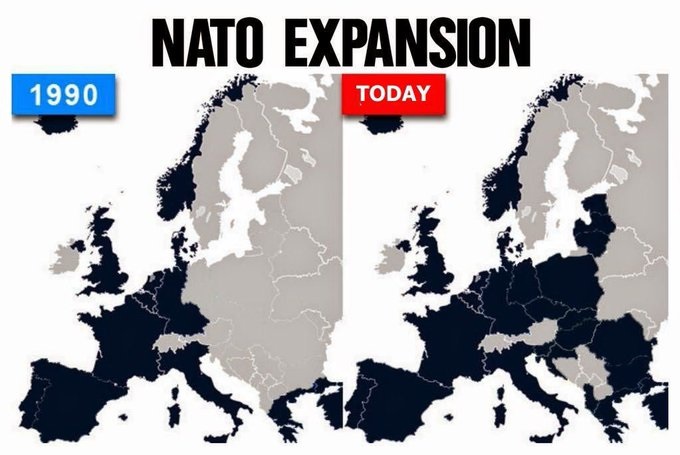
Here’s something else you will never see in the western media. You’ll never see the actual text of Putin’s security demands that were made a full 2 months before the war broke out. And, the reason you won’t see them, is because his demands were legitimate, reasonable and necessary. All Putin wanted was basic assurances that NATO was not planning to put its bases, armies and missile sites on Russia’s border. In other words, he was doing the same thing that all responsible leaders do to defend the safety and security of their own people.
Here are a few critical excerpts from the text of Putin’s proposal to the US and NATO: [on original]………………………….
It doesn’t take a genius to figure out what Putin was worried about. He was worried about NATO expansion and, in particular, the emergence of a hostile military alliance backed by Washington-groomed Nazis occupying territory on his western flank. Was that unreasonable of him? Should he have embraced these US-backed Russophobes and allowed them to place their missiles on his border? Would that have been the prudent thing to do?
So, what can we deduce from Putin’s list of demands?
First, we can deduce that he is not trying to reconstruct the Soviet empire as the MSM relentlessly insists. The list focuses exclusively on security-related demands, nothing else.
Second, it proves that the war could have easily been avoided had Zelensky simply maintained the status quo and formally announced that Ukraine would remain neutral. In fact, Zelensky actually agreed to neutrality in negotiations with Moscow in March, but Washington prevented the Ukrainian president from going through with the deal which means that the Biden administration is largely responsible for the ongoing conflict. (RT published an article today stating clearly that an agreement had been reached between Russia and Ukraine in March but the deal was intentionally scuttled by the US and UK. Washington wanted a war.)
Third, it shows that Putin is a reasonable leader whose demands should have been eagerly accepted. Was it unreasonable of Putin to ask that “The Parties shall refrain from deploying their armed forces and… military alliances.. in the areas where such deployment could be perceived by the other Party as a threat to its national security”? Was it unreasonable for him the ask that “The Parties shall eliminate all existing infrastructure for deployment of nuclear weapons outside their national territories”?
Where exactly are the “unreasonable demands” that Putin supposedly made?
There aren’t any. Putin made no demands that the US wouldn’t have made if ‘the shoe was on the other foot.’
Forth, it proves that the war is not a struggle for Ukrainian liberation or democracy. That’s hogwash. It is a war that is aimed at “weakening” Russia and eventually removing Putin from power. Those are the overriding goals. What that means is that Ukrainian soldiers are not dying for their country, they are dying for an elitist dream to expand NATO, crush Russia, encircle China, and extend US hegemony for another century. Ukraine is merely the battlefield on which the Great Power struggle is being fought.
There are number points we are trying to make in this article:
Who started the war? Answer– Ukraine started the war
Was the Russian invasion a violation of international law? Answer– No, the Russian invasion should be approved under United Nations Article 51
Could the war have been avoided if Ukraine declared neutrality and met Putin’s reasonable demands? Answer– Yes, the war could have been avoided
The last point deals with the Minsk Treaty and how the dishonesty of western leaders is going to effect the final settlement in Ukraine. I am convinced that neither Washington nor the NATO allies have any idea of how severely international relations have been decimated by the Minsk betrayal. In a world where legally binding agreements can be breezily discarded in the name of political expediency, the only way to settle disputes is through brute force. Did anyone in Germany, France or Washington think about this before they acted? (But, first, some background on Minsk.)
The aim of the Minsk agreement was to end the fighting between the Ukrainian army and ethnic Russians in the Donbas region of Ukraine. It was the responsibility of the four participants in the treaty– Germany, France, Russia and Ukraine– to ensure that both sides followed the terms of the deal. But in December, former German Chancellor Angela Merkel said in an interview with a German magazine, that there was never any intention of implementing the deal, instead, the plan was to use the time to make Ukraine stronger in order to prepare for a war with Russia. So, clearly, from the very beginning, the United States intended to provoke a war with Russia.
On September 5, 2014, Germany, France, Ukraine and Russia all signed Minsk, but the treaty failed and the fighting resumed. On February 12, 2015, Minsk 2 was signed, but that failed, as well. Please, watch this short segment on You Tube by Amit Sengupta who gives a brief rundown of Minsk and its implications: (I transcribed the piece myself and any mistakes are mine.) …………………. [Transcription on original]
There’s no way to overstate the importance of the Minsk betrayal or the impact it’s going to have on the final settlement in Ukraine. When trust is lost, nations can only ensure their security through brute force. What that means is that Russia must expand its perimeter as far as is necessary to ensure that it will remain beyond the enemy’s range of fire. (Putin, Lavrov and Medvedev have already indicated that they plan to do just that.) Second, the new perimeter must be permanently fortified with combat troops and lethal weaponry that are kept on hairtrigger alert. When treaties become vehicles for political opportunism, then nations must accept a permanent state of war. This is the world that Merkel, Hollande, Poroshenko and the US created by opting to use ‘the cornerstone of international relations’ (Treaties) to advance their own narrow warmongering objectives.
We just wonder if anyone in Washington realizes whet the fu** they’ve done?
Gathering this observation-based information is essential to counter an increasingly popular but flawed narrative that the only way to ensure our survival is to colonise other planets.
The best-case scenario for terraforming Mars leaves us with an atmosphere we are incapable of breathing
The scientific evidence is clear: the only celestial body that can support us is the one we evolved with. Here’s why
AEON, Arwen E Nicholson research fellow in physics and astronomy at the University of Exeter in the UK, Raphaëlle D Haywood senior lecturer in physics and astronomy at the University of Exeter in the UK. 3 Feb 23
At the start of the 22nd century, humanity left Earth for the stars. The enormous ecological and climatic devastation that had characterised the last 100 years had led to a world barren and inhospitable; we had used up Earth entirely. Rapid melting of ice caused the seas to rise, swallowing cities whole. Deforestation ravaged forests around the globe, causing widespread destruction and loss of life. All the while, we continued to burn the fossil fuels we knew to be poisoning us, and thus created a world no longer fit for our survival. And so we set our sights beyond Earth’s horizons to a new world, a place to begin again on a planet as yet untouched. But where are we going? What are our chances of finding the elusive planet B, an Earth-like world ready and waiting to welcome and shelter humanity from the chaos we created on the planet that brought us into being? We built powerful astronomical telescopes to search the skies for planets resembling our own, and very quickly found hundreds of Earth twins orbiting distant stars. Our home was not so unique after all. The universe is full of Earths!
This futuristic dream-like scenario is being sold to us as a real scientific possibility, with billionaires planning to move humanity to Mars in the near future. For decades, children have grown up with the daring movie adventures of intergalactic explorers and the untold habitable worlds they find. Many of the highest-grossing films are set on fictional planets, with paid advisors keeping the science ‘realistic’. At the same time, narratives of humans trying to survive on a post-apocalyptic Earth have also become mainstream.
Given all our technological advances, it’s tempting to believe we are approaching an age of interplanetary colonisation. But can we really leave Earth and all our worries behind? No. All these stories are missing what makes a planet habitable to us. What Earth-like means in astronomy textbooks and what it means to someone considering their survival prospects on a distant world are two vastly different things. We don’t just need a planet roughly the same size and temperature as Earth; we need a planet that spent billions of years evolving with us. We depend completely on the billions of other living organisms that make up Earth’s biosphere. Without them, we cannot survive. Astronomical observations and Earth’s geological record are clear: the only planet that can support us is the one we evolved with. There is no plan B. There is no planet B. Our future is here, and it doesn’t have to mean we’re doomed.
At the start of the 22nd century, humanity left Earth for the stars. The enormous ecological and climatic devastation that had characterised the last 100 years had led to a world barren and inhospitable; we had used up Earth entirely. Rapid melting of ice caused the seas to rise, swallowing cities whole. Deforestation ravaged forests around the globe, causing widespread destruction and loss of life. All the while, we continued to burn the fossil fuels we knew to be poisoning us, and thus created a world no longer fit for our survival. And so we set our sights beyond Earth’s horizons to a new world, a place to begin again on a planet as yet untouched. But where are we going? What are our chances of finding the elusive planet B, an Earth-like world ready and waiting to welcome and shelter humanity from the chaos we created on the planet that brought us into being? We built powerful astronomical telescopes to search the skies for planets resembling our own, and very quickly found hundreds of Earth twins orbiting distant stars. Our home was not so unique after all. The universe is full of Earths!
This futuristic dream-like scenario is being sold to us as a real scientific possibility, with billionaires planning to move humanity to Mars in the near future. For decades, children have grown up with the daring movie adventures of intergalactic explorers and the untold habitable worlds they find. Many of the highest-grossing films are set on fictional planets, with paid advisors keeping the science ‘realistic’. At the same time, narratives of humans trying to survive on a post-apocalyptic Earth have also become mainstream.
Given all our technological advances, it’s tempting to believe we are approaching an age of interplanetary colonisation. But can we really leave Earth and all our worries behind? No. All these stories are missing what makes a planet habitable to us. What Earth-like means in astronomy textbooks and what it means to someone considering their survival prospects on a distant world are two vastly different things. We don’t just need a planet roughly the same size and temperature as Earth; we need a planet that spent billions of years evolving with us. We depend completely on the billions of other living organisms that make up Earth’s biosphere. Without them, we cannot survive. Astronomical observations and Earth’s geological record are clear: the only planet that can support us is the one we evolved with. There is no plan B. There is no planet B. Our future is here, and it doesn’t have to mean we’re doomed.
Deep down, we know this from instinct: we are happiest when immersed in our natural environment. There are countless examples of the healing power of spending time in nature. Numerous articles speak of the benefits of ‘forest bathing’; spending time in the woods has been scientifically shown to reduce stress, anxiety and depression, and to improve sleep quality, thus nurturing both our physical and mental health. Our bodies instinctively know what we need: the thriving and unique biosphere that we have co-evolved with, that exists only here, on our home planet.
There is no planet B. These days, everyone is throwing around this catchy slogan. Most of us have seen it inscribed on an activist’s homemade placard, or heard it from a world leader. In 2014, the United Nations’ then secretary general Ban Ki-moon said: ‘There is no plan B because we do not have [a] planet B.’ The French president Emmanuel Macron echoed him in 2018 in his historical address to US Congress. There’s even a book named after it. The slogan gives strong impetus to address our planetary crisis. However, no one actually explains why there isn’t another planet we could live on, even though the evidence from Earth sciences and astronomy is clear. Gathering this observation-based information is essential to counter an increasingly popular but flawed narrative that the only way to ensure our survival is to colonise other planets.
The best-case scenario for terraforming Mars leaves us with an atmosphere we are incapable of breathing
The most common target of such speculative dreaming is our neighbour Mars. It is about half the size of Earth and receives about 40 per cent of the heat that we get from the Sun. From an astronomer’s perspective, Mars is Earth’s identical twin. And Mars has been in the news a lot lately, promoted as a possible outpost for humanity in the near future. While human-led missions to Mars seem likely in the coming decades, what are our prospects of long-term habitation on Mars? Present-day Mars is a cold, dry world with a very thin atmosphere and global dust storms that can last for weeks on end. Its average surface pressure is less than 1 per cent of Earth’s. Surviving without a pressure suit in such an environment is impossible. The dusty air mostly consists of carbon dioxide (CO2) and the surface temperature ranges from a balmy 30ºC (86ºF) in the summer, down to -140ºC (-220ºF) in the winter; these extreme temperature changes are due to the thin atmosphere on Mars.
Despite these clear challenges, proposals for terraforming Mars into a world suitable for long-term human habitation abound. Mars is further from the Sun than Earth, so it would require significantly more greenhouse gases to achieve a temperature similar to Earth’s. Thickening the atmosphere by releasing CO2 in the Martian surface is the most popular ‘solution’ to the thin atmosphere on Mars. However, every suggested method of releasing the carbon stored in Mars requires technology and resources far beyond what we are currently capable of. What’s more, a recent NASA study determined that there isn’t even enough CO2 on Mars to warm it sufficiently.
Even if we could find enough CO2, we would still be left with an atmosphere we couldn’t breathe. Earth’s atmosphere contains only 0.04 per cent CO2, and we cannot tolerate an atmosphere high in CO2. For an atmosphere with Earth’s atmospheric pressure, CO2 levels as high as 1 per cent can cause drowsiness in humans, and once we reach levels of 10 per cent CO2, we will suffocate even if there is abundant oxygen. The proposed absolute best-case scenario for terraforming Mars leaves us with an atmosphere we are incapable of breathing; and achieving it is well beyond our current technological and economic capabilities.
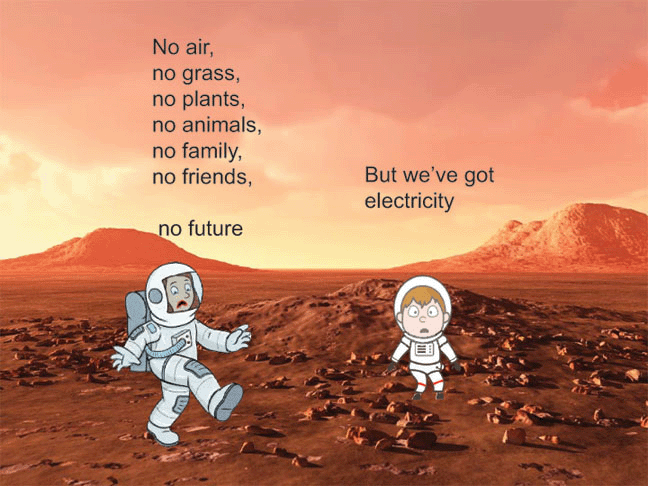
Instead of changing the atmosphere of Mars, a more realistic scenario might be to build habitat domes on its surface with internal conditions suitable for our survival. However, there would be a large pressure difference between the inside of the habitat and the outside atmosphere. Any breach in the habitat would rapidly lead to depressurisation as the breathable air escapes into the thin Martian atmosphere. Any humans living on Mars would have to be on constant high alert for any damage to their building structures, and suffocation would be a daily threat…………………………………………………………………………………………….
Living on a warming Earth presents many challenges. But these pale in comparison with the challenges of converting Mars, or any other planet, into a viable alternative. Scientists study Mars and other planets to better understand how Earth and life formed and evolved, and how they shape each other. We look to worlds beyond our horizons to better understand ourselves. In searching the Universe, we are not looking for an escape to our problems: Earth is our unique and only home in the cosmos. There is no planet B.https://aeon.co/essays/we-will-never-be-able-to-live-on-another-planet-heres-why
Covert Action Magazine, By Eva Bartlett, August 23, 2022 Excellent photographs
Ukraine continues to fire internationally-banned anti-personnel mines on civilian areas of Donetsk and other cities in the Donetsk People’s Republic (DPR), in violation of international law and of the mine ban convention Ukraine signed in 1999 and ratified in 2005.
Since July 27, Ukraine has been firing rockets containing cluster munitions filled with banned PFM-1 “Petal” (or “Butterfly”) anti-personnel mines all over Donetsk and surrounding areas. Each rocket contains over 300 of the mines. Already by August 3, the DPR’s Ministry of Emergency Situations noted that Ukraine had fired several thousand of the prohibited mines on Donetsk.
As of August 15, 44 civilians, including two children, have suffered gruesome injuries. Another mine victim died in hospital.
Younger children don’t know that the mines aren’t toys, and elderly often simply don’t see them, or likewise don’t understand the danger, as was the case with an elderly lady with dementia who, on August 8, lost a foot as a result of stepping on a mine while she was going to work in her garden plot.
Tiny but powerful, these insidious mines are designed not to kill but to tear off feet or hands. Their design allows them to float to the ground without exploding, where they easily blend in with most settings and generally lie dormant until stepped on or otherwise disturbed.
According to Konstantin Zhukov, Chief Medical Officer of Donetsk Ambulance Service, a weight of just 2 kg is enough to activate one of the mines. Sometimes, however, they explode spontaneously. An unspoken tragedy on top of the already tragic targeting of civilians is that dogs, cats, birds and other animals are also victims of these dirty mines.
In the grass, or surprisingly even on sidewalks and streets, it is very easy to overlook them or mistake them for a leaf. Even when I’ve seen such mines marked with warning signs or circled, it still took me quite a bit to actually see them.
In its relentless deploying of these mines, Ukraine has targeted all over Donetsk, as well as Makeevka to the east and Yasinovataya to the north. Ukraine has fired them elsewhere, including the hard-hit northern DPR city of Gorlovka, as well as regions in the Lugansk People’s Republic in previous months.
In fact, according to DPR authorities, Ukraine began using the mines in March, during battles for Mariupol, and in May was already firing them into DPR settlements. Also in early May, while in Rubiznhe in the Lugansk People’s Republic, I was warned that Ukraine had been littering nearby areas with the mines, something confirmed by locals when I went to nearby Sievierodonetsk on August 12.
Ukraine turns Donetsk into a minefield
I first saw the Ukrainian-fired mines on July 30, in Kirovskiy, western Donetsk, just days after Ukraine began showering the city with them.
Mine clearance sappers had isolated mines scattered in a field, to detonate after they had destroyed mines in the courtyard of an apartment complex. Amidst the tall grass, wild plants and garden plots, the mines would have been impossible for a non-sapper to spot, and very easy to disturb and lose a foot or hand in doing so.
Although I’d been assured that sappers had cleared the path, I still watched every step I took. And generally for the duration of my time in the DPR, I looked down while walking, watching for mines that could have been moved by wind or rain.
Behind a wall at one end of the apartment complex courtyard, sapper timer-detonated the eight mines they’d found scattered around the playground, lanes and walkways.
On a central Donetsk street the next morning, I saw a grouping of seven mines on a curbside, gathered either by sappers or some courageous local, with warnings to pedestrians and drivers of their presence.
They were so plentiful that marking them however possible was the only way to mitigate the immediate danger of someone randomly stepping or driving over them until they could be neutralized by the sappers……………………………………………………………
Media Claims Russia is Laying the Mines
As with most of its war crimes against the civilians of the Donbass, Ukraine and NATO media invert reality and claim Russia is the guilty party. They cry crocodile tears for the Donetsk children Ukraine has targeted, also disingenuously claiming the now-famous video of a DPR soldier detonating a mine by throwing a tire at it was a Ukrainian soldier demining Russian-fired mines.
The notion that Russia would explode mines over the city is not a reality-based idea. Most of the population are ethnic Russians, a significant number who now happily hold Russian citizenship. And further, it is Russian and DPR sappers putting themselves at risk to clear the streets, walks and fields of the mines.
In fact, a 21 year old DPR sapper lost a foot to such mine. Director of the Department of Fire and Rescue Forces of the Ministry of Emergency Situations of the Donetsk People’s Republic, Colonel Sergey Neka, told me of his injury: “After the cleansing of territories from explosive objects, returning back to the transport, a mine fell from the building, as a result of which it exploded under his feet and he lost his foot.”
In Makeevka, Igor Goncharov, the Chief Physician of the bombarded orphanage, spoke to me about his anger that Ukraine was targeting the property, insisting it had been deliberate, that since 2001 the orphanage was well-known to various international organizations, as well as Kiev, because, “It was the only one specialized in HIV.”
According to him, “American law allowed the adoption of HIV-positive children, so the United States was the only state that adopted HIV-infected children, so we were well known both within Ukraine and the Russian Federation and abroad. When they shoot, they know where they shoot,” he said of Ukraine.
“I think that this is not just inhumane, it is without morality, without conscience and without honour.”
I asked him to address Ukrainian and Western claims that it was Russia which deployed the mines, Russia which is shelling Donetsk and surrounding areas, knowing full well any average local resident could likewise easily debunk the claims.
“Even without being educated in military matters, it’s easy to localize the craters. Which way they are located indicates which side they were sent from. We know perfectly well where they shoot from. It’s all from Peski, Avdeevka, Nevelskoye. You can hear the crash and the whistle coming first. Ballistics can be defined. All the shelling comes from the Ukrainian side, it is unambiguous.”
Even without that logical thinking, let’s recall that Ukraine has been committing war crimes in the Donbass for over eight years, violating the Minsk Accords signed in 2014 and 2015. That Ukraine would use Petal mines from its enormous stockpile, after already shelling and sniping civilians, it not at all out of the question.
Ukrainian nationalists openly declare they view Russians as sub-human. School books teach this warped ideology. Videos show the extent of this mentality: teaching children not only to also hate Russians and see them as not humans, but also brainwashing them to believe killing Donbass residents is acceptable. The Ukrainian government itself funds Neo-Nazi-run indoctrination camps for youths.
The convention, “prohibits the use, stockpiling, production, and transfer of anti-personnel landmines (APLs).” Further, as outlined, Ukraine is, “in violation of Article 5 of the Mine Ban Treaty due to missing its 1 June 2016 clearance deadline without having requested and being granted an extension.”
The most likely risk scenario is a breach of spent fuel held in canisters or cooling ponds outside of the reactor core containment structure. This spent fuel is still highly radioactive and vulnerable to missiles, shells and rocket strikes which could spread radiation directly or start fires spreading radiation. An impact by an aircraft is also a significant risk due to the highly inflammable aircraft fuel onboard.
Scientists for Global Responsibility, Dr Philip Webber, 22 Jan 23
The Zaporizhzhia region in south eastern Ukraine houses the largest nuclear power station in Europe – the Zaporizhzhia NPP – one of the ten largest such plants in the world. It is currently in an intensely fought war zone. Dr Philip Webber, SGR, explains some of the risks of radiation releases that this poses, both nationally and internationally.
Article from Responsible Science journal, no.5; advance online publication: 15 December 2022
About the Zaporizhzhia site
The Zaporizhzhia nuclear plant [1] is part of a huge industrial complex some 8km square. It houses six large (1 gigawatt or GW) VVER-1000 Russian designed and built nuclear power reactors, [2] three thermal (coal- and gas-powered) power stations, and the purpose-built city of Enerhodar, which was built in 1970 to house 11,000 power plant workers and a total population of around 53,000. [3] Before the war, the nuclear plant supplied about 20% of Ukraine’s electricity – widely used for heating in large apartment blocks. The reactors’ containment structures [4] house the nuclear core and used or ‘spent’ nuclear fuel in cooling pools. After five years, this spent fuel is transferred to dry storage casks nearby, which are air-cooled. In addition, huge external cooling ponds – which are continuously sprayed with water – store many older used nuclear fuel rods. The three thermal plants were shut down in May 2022 having run out of fuel due to the Russian invasion.
The Zaporizhzhia power site is much larger than the biggest UK nuclear sites such as Sellafield or Hinkley Point – either of these would fit within just the area of the cooling ponds at Zaporizhzhia. The entire complex is situated on a flat promontory on the south-east bank of the Dnipro River which is 5km wide at that point. [5] The site is 50km south west of the city of Zaporizhzhia, also on the south bank of the Dnipro. Kherson is about 150km to the south west – but on the other bank of the river.
Under occupation
The reactor site has been occupied by Russian military forces since March 2022 – with Ukrainian forces in control of the opposite river bank. The original Ukrainian Energoatom plant operators are being forced to keep working there under conditions of extreme stress. These stresses include excessively long shifts, extreme concerns about family safety, and even the arrest of the plant chief. Various parts of the site have been hit by artillery shells and warheads from rocket-launched missiles over several months. Photographs show cratering and rocket tubes embedded in the ground. Both sides accuse the other of deliberately targeting and hitting the plant site. As a result of major safety concerns, the International Atomic Energy Agency (IAEA) has placed monitoring teams at the site and nearby, but sourcing reliable information remains extremely difficult. [6]
The local electricity grid is very extensive and extremely vulnerable. Before the war, several high voltage (HV) power lines extended east from the nuclear and thermal plants to what is now Russian-occupied Ukraine via extensive electricity sub-stations, whilst one large HV line connected directly across the Dnipro to the opposite bank – under the control of Ukraine – via Marhanets just 15km away. Artillery shells can easily be fired over 40km whilst rocket launchers can reach even further, so the entire area is within range of both Russian and Ukrainian forces. Perhaps unsurprisingly, the IAEA continue to report that connections to the electricity grid keep being destroyed by artillery shelling which are then intermittently repaired. Repairs are very difficult owing to a severe shortage of supplies such as power transformers, insulators, cabling and HV circuit breakers. So far, neither the containment buildings for the reactors, nor the spent fuel assemblies in canisters, nor the large cooling ponds appear to have been seriously breached, but there is no guarantee this will continue to be the case.
The plants remain in a highly contested conflict area. The IAEA and UN have called for the plants to be placed in a demilitarised safety zone. No such zone has yet been set up. It is perhaps worth saying that any such demilitarised zone would have to include the city of Enerhodar because of its intimate connection and proximity to the nuclear power plants and power lines that traverse the entire area. Creating such an exclusion zone at the centre of a high intensity war zone is extremely difficult and has been rarely achieved in other conflicts.
Emergency shutdown
It is extremely difficult to secure a reliable picture of what is actually going on at the Zaporizhzhia power generation site……………………………
What if the cooling fails?
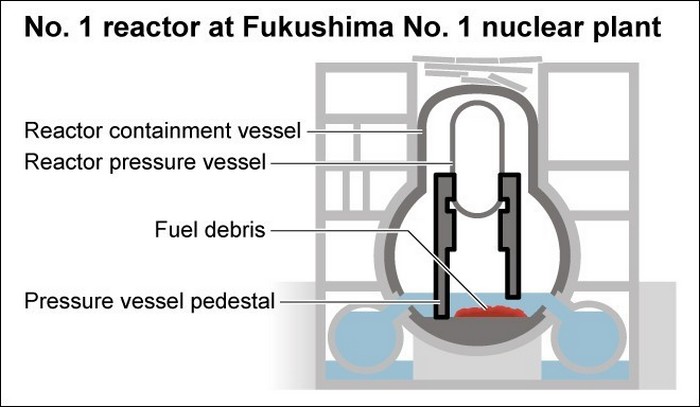
Any nuclear reactor, for safe operation, needs to be connected to an electricity supply to provide a reliable source of emergency core cooling power. Without such active cooling from pumped water, the reactor core will eventually overheat to dangerous levels. Outside the reactor cores, radioactive decay in spent fuel continues, releasing heat inside the reactor containment structure, the dry storage casks, and the external ponds. Any failures of, or threats to, electricity supplies create serious emergency situations. Because of this danger, each reactor has emergency diesel-fired electricity generators with around 10 days of fuel. [8] Ultimately, without active cooling powered by the grid, and once back-up diesel generators run out of fuel, core temperatures would rise uncontrollably. This would lead first to hydrogen gas release, then explosions, and ultimately, runaway core meltdowns breaching the core containment.
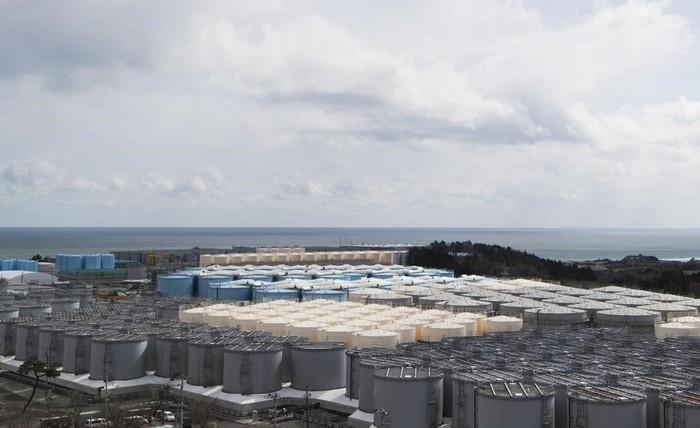
This is what happened at the Fukushima nuclear plant in Japan in 2011 [9] – when the cores in three reactors could not be cooled, large volumes of hydrogen gas were released into the containment structures, which then exploded, releasing highly radioactive materials into the environment – mainly as gases and vapours. After a few days, the reactor cores reached the melting points of the nuclear fuels and these highly radioactive molten materials burned down through the lower regions of the reactor vessels. This situation also has similarities with the 1986 Chernobyl disaster – the site of which is now part of Ukraine (and was occupied briefly by Russian troops early during the invasion).
In a reactor core of 1GW size, as those at Zaporizhzhia, if the cooling system breaks down, hydrogen explosions would occur after 8 to 12 hours. After about two days, the reactor core would become hot enough to burn through the base of the reactor vessel. [10]
Cooling for the reactor cores and spent fuel storage relies on several factors: a reliable supply of water; a reliable supply of power for the cooling pumps; working pumps; and staff to conduct any repairs and maintain the cooling systems. Without a reliable connection to the electricity grid, the only source of power for the pumps are, as mentioned, the back-up generators. With all of these factors now under threat, the risk of a reactor containment breach due to cooling failure is high. [11]
Other risks result from the ongoing conflict. Whilst an artillery shell or conventional cruise missile strike is unlikely to breach the reactor core containment directly, the threat is much greater to the integrity of over 3,000 spent fuel assemblies stored locally in concrete containers. Artillery, or a cruise missile could easily breach any of these containers releasing highly radioactive materials. This in turn could make part of the site – for example, cooling circuitry or fuel supplies – too dangerous to manage, which would lead to an even more serious core failure.
The possible effects of a nuclear disaster
There are a wide range of possible disaster scenarios.
Firstly, considering a meltdown of one or more reactor cores, the most comparable reactor accident so far has been the Fukushima plant radiation releases following the Great East Japan Earthquake and its subsequent tsunami in 2011. This led to an initial obligatory exclusion zone of 20km radius around the plant with 30km radius stay-at-home and no-fly zones and finally a larger zone extending 40km to the north west. Within a year, some people were permitted to return home within the 20km zone, whilst others with higher radiation levels were restricted for five years after the disaster, and a 30-year clean up period was envisaged. The Fukushima experience however does not give one high confidence that future nuclear disasters may be better managed……………………….
A further difficulty arising from the conflict is that emergency responses such as evacuation of population, distribution of iodine tablets or provision of emergency medical treatment would be very difficult to coordinate, especially as no one authority would be able to take charge of the situation………….
The most likely risk scenario is a breach of spent fuel held in canisters or cooling ponds outside of the reactor core containment structure. This spent fuel is still highly radioactive and vulnerable to missiles, shells and rocket strikes which could spread radiation directly or start fires spreading radiation. An impact by an aircraft is also a significant risk due to the highly inflammable aircraft fuel onboard.
What if a nuclear weapon were used?
The worst possible scenario is nuclear strike on a reactor. A direct strike by even the smallest nuclear warhead, for example, a 10 kilotonne (kT) ‘tactical’ nuclear warhead – smaller than that dropped on Hiroshima in World War II – would breach the core containment and spread the highly radioactive materials inside. A strike missing the core containment would spread the large amounts of spent fuel stored nearby. A 10kT nuclear blast and fireball would create a 1km radius zone of major destruction, a crater 25m deep and carry radioactive materials into a cloud of 8km altitude and 3km across depositing them underneath and downwind as fallout.
The reactor waste products contain long-lasting radioactive isotopes such as caesium and strontium which are readily absorbed into the body or into crops contaminating farmland. This would create a major radiation problem tens to hundreds of times worse and much longer-lasting than the nuclear weapon alone. [13]
At Zaporizhzhia, the large amounts of spent fuel storage make this risk even worse. Fallout would create a lethal radiation risk across the entire plant site and city of Enerhodar. …………………… a completely unmanageable evacuation requirement in peacetime let alone in the middle of an intense war. Depending on the dose rates, some areas may need to be avoided for years to decades………………………………….
Impacts in a war zone
Both the risk of a nuclear disaster and the consequences of it are multiplied in a war zone. In Ukraine, the population are already suffering intense pressure, strain and casualties due to direct impacts such as widespread Russian bombardment with artillery and missiles…………………………….
The only conclusion that can be drawn is that the existence of nuclear plants in any war zone creates a whole new range of risks and dangers ………………….. The other three Ukraine reactor sites are also at high risk due to damage to the electricity grid and have already been subject to emergency shutdown due to such damage…………..more https://www.sgr.org.uk/resources/nuclear-power-ukraine-what-would-happen-if-zaporizhzhia-was-hit
But as the conflict rages on, there have been accusations from some EU officials that the US is profiting from the war through weapons sales and gas prices.
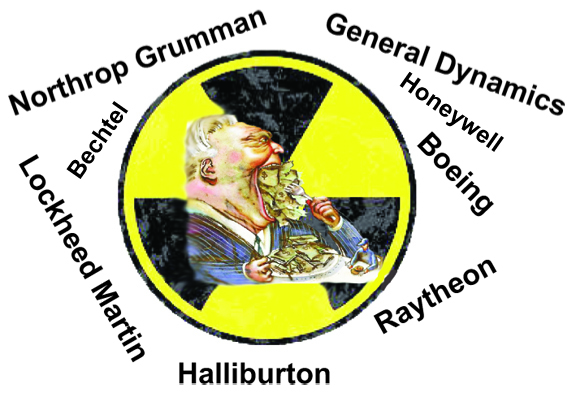
Meanwhile, analysts have warned of excessive spending and the US military-industrial complex (MIC) expanding beyond what is needed in response to Ukraine.
Defence budgets are also booming worldwide as countries replenish stocks sent to Ukraine and try to boost military capabilities in the face of mounting security threats.
Ultimately, the US defence contractors are set for a bonanza. ……..
What are the issues with the MIC?
The military-industrial complex is a term coined during the Cold War to describe the relationship between a government and defence industry contractors that lobby for increased military spending.
A country’s MIC has the potential to exert influence over government policy, especially if there are legislators who can benefit from the partnerships.
In the US, there is a wider vested interest in keeping the industry thriving, especially for local economies that are highly dependant on defence contractors for jobs.
Charles Miller, senior lecturer at the ANU’s school of politics and international relations, said about 800,000 jobs are directly tied to the sector.
“The local economy is highly dependent on defence contractors for its economic wellbeing,” Mr Miller told the ABC.
“And that’s not the Raytheons or the Boeings themselves, but what’s called the secondary contractors — that is, the people and the companies that make a living by servicing them.”
Former US president Dwight Eisenhower warned of the rise of the MIC and its threat to democracy in his 1961 farewell address.
“He viewed it as a huge problem,” Bill Hartung, a defence analyst at the US Quincy Institute for Responsible Statecraft, told the ABC.
“Although, he did say in the Cold War-era large military sales were necessary, but the question was how to control it, and what democratic guardrails could be put in place.”
Today, there doesn’t seem to be the same level of concern.
The MIC was already a “powerful force”, and in response to Ukraine the US has stripped away many safeguards to protect against waste and price gouging, Mr Hartung said.
He added that a lot of changes being discussed will last far beyond the war in Ukraine.
“The United States is kind of seizing this moment to try to get out a bunch of things that have been on their wish list for years, like committing to multi-year procurement of weapons,” Mr Hartung said.
“All of which will probably make it easier for those companies to rip off the government, because there will be less negotiation over prices and the inclination to just push things out the door.”………………………………….
Who are the biggest winners?
Since Russia’s full-scale invasion in February 2022, the US and its NATO allies have been throwing tens of billions of dollars worth of military aid Ukraine’s way.
They also produce some of the most in-demand and expensive weapons being sent to Ukraine.
The conflict has sent their stocks surging, with the share price of Northrop Grumman increasing 40 per cent by the end of 2022, while Lockheed Martin’s was up by 37 per cent.
In October, the Pentagon announced $US1.2 billion in contracts were underway to replenish US military stocks for weapons sent to the battlefield.
Production for Lockheed Martin’s popular Javelin anti-tank missiles — dubbed “Saint Javelin”, the protector of Ukraine — increased from 2,100 to nearly 4,000 per year.
While production for its High Mobility Artillery Rocket Systems (HIMARS) shot up from 60 to 96 units a year.
Soon after, Lockheed Martin won a $US7.8 billion contract modification for F-35 aircraft, and $US431 million to deliver new HIMARS and support services for the US Army and its foreign allies.
Last month, the US Senate passed a funding bill that included a record $US858 billion in annual defence spending — up from $US740 billion the previous year.
It was $US45 billion more than what was proposed by President Joe Biden.
The bill includes funding for Taiwan and Ukraine, allowing the Pentagon to buy massive amounts of high-priority munitions using multi-year contracts — both to help Kyiv fight Russia and to refill US stockpiles.
“It’s surprising how much it has gone up,” Mr Hartung said.
Hanna Homestead, a policy associate from the Center for International Policy (CIP) — a US-based group monitoring military spending and weapons — said contractors were already receiving a staggering amount.
“In 2020, Lockheed Martin got more money through federal contracts than the Department of State and USAID combined,” she told the ABC.
Allies like Japan have also announced historic surges in defence spending.
It includes around 250 billion yen ($3.16 billion) to buy Lockheed Martin fighter jets.
Japan’s major military reform plan will see it double defence spending to 2 per cent of GDP by 2027, using a spending target that follows the NATO standard.
Meanwhile, some NATO countries are pushing for a greater defence commitment in response to the Ukraine conflict, saying the benchmark of 2 per cent of GDP should be the bare minimum.
‘That’s just the way it is’
Many believe the US arms industry doesn’t have a great reputation.
“They continue to arm repressive regimes like Saudi Arabia, Egypt, the Philippines and Algeria that have horrific human rights records and have engaged in destabilising activities,” Mr Hartung said.
He also accused companies of “pure profiteering” when it came to Ukraine, saying they are buying back their own share market stocks to boost the prices at a time when they claim they need more money.
“[This] has nothing to do with making anyone safer,” Mr Hartung said.
“In general, the chaos of war makes profiteering easier.
The European Union’s chief diplomat Josep Borrell has accused the US of profiting from high gas prices, weapons and trade while its allies suffer.
However, Ms Homestead said it was still a small amount of companies getting the bulk of the benefits, which doesn’t necessarily trickle down.
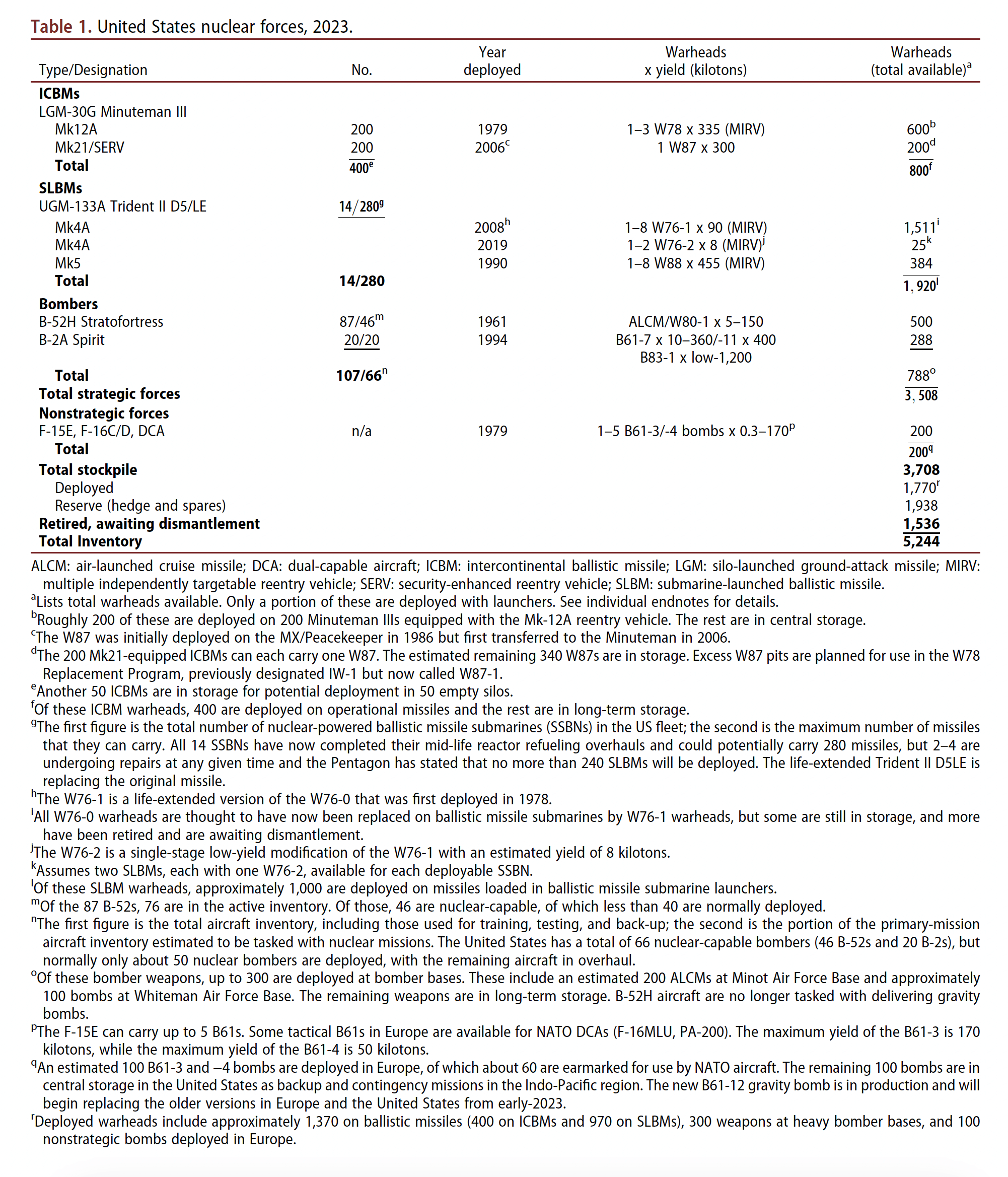
The United States is modernizing its nuclear bomber force by upgrading nuclear command-and-control capabilities on existing bombers, developing improved nuclear weapons (the B61-12 and the new AGM-181 Long-Range Standoff Weapon (LRSO), and designing a new heavy bomber (the B-21 Raider).
t the beginning of 2023, the US Department of Defense maintained an estimated stockpile of approximately 3,708 nuclear warheads for delivery by ballistic missiles and aircraft. Most of the warheads in the stockpile are not deployed but rather stored for potential upload onto missiles and aircraft as necessary. We estimate that approximately 1,770 warheads are currently deployed, of which roughly 1,370 strategic warheads are deployed on ballistic missiles and another 300 at strategic bomber bases in the United States. An additional 100 tactical bombs are deployed at air bases in Europe. The remaining warheads — approximately 1,938 — are in storage as a so-called hedge against technical or geopolitical surprises. Several hundred of those warheads are scheduled to be retired before 2030. (See Table 1. on original)
In addition to the warheads in the Department of Defense stockpile, approximately 1,536 retired — but still intact — warheads are stored under the custody of the Department of Energy and are awaiting dismantlement, giving a total US inventory of an estimated 5,244 warheads. Between 2010 and 2018, the US government publicly disclosed the size of the nuclear weapons stockpile; however, in 2019 and 2020, the Trump administration rejected requests from the Federation of American Scientists to declassify the latest stockpile numbers (Aftergood 2019; Kristensen 2019a, 2020d). In 2021, the Biden administration restored the United States’ previous transparency levels by declassifying both numbers for the entire history of the US nuclear arsenal until September 2020 — including the missing years of the Trump administration.
This effort revealed that the United States’ nuclear stockpile consisted of 3,750 warheads in September 2020 — only 72 warheads fewer than the last number made available in September 2017 before the Trump administration reduced the US government’s transparency efforts (US State Department 2021a). We estimate that the stockpile will continue to decline over the next decade-and-a-half as modernization programs consolidate the remaining warheads.
The Biden administration’s declassification also revealed that the pace of warhead dismantlement has slowed significantly in recent years. While the United States dismantled on average more than 1,000 warheads per year during the 1990s, in 2020 it dismantled only 184 warheads (US State Department 2021a). …………………
In the past, the Obama and Biden administrations often declassified the warhead stockpile and dismantlement numbers around the time of major arms control conferences. That did not happen in 2022, however, and the Biden administration has so far not acted on requests from the Federation of American Scientists to disclose the numbers for 2021 or 2022. A decision to no longer declassify these numbers would not only contradict the Biden administration’s own practice from 2020, but also represent a return to Trump-era levels of nuclear opacity. Such increased nuclear secrecy undermines US calls for Russia and China to increase transparency of their nuclear forces.
The US nuclear weapons are thought to be stored at an estimated 24 geographical locations in 11 US states and five European countries (Kristensen and Korda 2019, 124). The location with the most nuclear weapons by far is the large Kirtland Underground Munitions and Maintenance Storage Complex (KUMMSC) south of Albuquerque, New Mexico. Most of the weapons in this location are retired weapons awaiting dismantlement at the Pantex Plant in Texas. The state with the second-largest inventory is Washington, which is home to the Strategic Weapons Facility Pacific and the ballistic missile submarines at Naval Submarine Base Kitsap. The submarines operating from this base carry more deployed nuclear weapons than any other base in the United States.
Implementing the New START treaty
The United States appears to be in compliance with the New Strategic Arms Reduction Treaty (New START) limits. ………………………………
If New START expired without a follow-on treaty in place, both the United States and Russia could upload several hundred extra warheads onto their launchers. This means that the treaty has proven useful thus far in keeping a lid on both countries’ deployed strategic forces. Additionally, both countries would lose a critical node of transparency into each other’s nuclear forces. As of December 8, 2022, the United States and Russia had completed a combined 328 on-site inspections and exchanged 25,017 notifications (US State Department 2022b)……………………………….
The Nuclear Posture Review and nuclear modernization…………
Just like previous NPRs, the Biden administration’s NPR rejected policies of nuclear “no-first-use” or “sole purpose,” instead preferring to leave the option open for nuclear weapons to be used under “extreme circumstances to defend the vital interests of the United States or its allies and partners” (US Department of Defense 2022b, 9)…………………….
The most significant change between the Biden and Trump NPRs was the walking back of two Trump-era commitments — specifically, canceling the new sea-launched cruise missile and retiring the B83-1 gravity bomb……………………………………….
The complete nuclear modernization (and maintenance) program will continue well beyond 2039 and, based on the Congressional Budget Office’s estimate, will cost $1.2 trillion over the next three decades. Notably, although the estimate accounts for inflation (Congressional Budget Office 2017), other estimates forecast that the total cost will be closer to $1.7 trillion (Arms Control Association 2017). Whatever the actual price tag will be, it is likely to increase over time, resulting in increased competition with conventional modernization programs planned for the same period. …………
The National Nuclear Security Administration (NNSA) and the Department of Defense have also proposed developing several other new nuclear warheads, including the W93 navy warhead. The NNSA’s Stockpile Stewardship and Management Plan (SSMP) of December 2020 doubled the number of new nuclear warhead projects for the next 20 years compared to its 2019 plan (National Nuclear Security Administration (NNSA) 2020b).
Nuclear planning and nuclear exercises
In addition to the Nuclear Posture Review, the nuclear arsenal and the role it plays is shaped by plans and exercises that create the strike plans and practice how to carry them out…………….
OPLAN 8010–12 consists of “a family of plans” directed against four identified adversaries: Russia, China, North Korea, and Iran. Known as “Strategic Deterrence and Force Employment,” OPLAN 8010–12 first entered into effect in July 2012 in response to Operations Order Global Citadel signed by the defense secretary. ……………………
OPLAN 8010–12 is a whole-of-government plan that includes the full spectrum of national power to affect potential adversaries. ……………………………..
This year’s Global Thunder exercise was delayed but will probably happen in early-2023.
These exercises coincide with steadily increasing US bomber operations in Europe since Russia’s invasion of Ukraine in 2014 and again in 2022…………………………………………….
the mission of the Bomber Task Force is to move a fully combat-ready bomber force into the European theater. “It’s no longer just to go partner with our NATO allies or to go over and have a visible presence of American air power,” according to the commander of the 2nd Bomb Wing. “That’s part of it, but we are also there to drop weapons if called to do so” (Wrightsman 2019). These changes are evident in the types of increasingly provocative bombers operations over Europe, in some cases very close to the Russian border (Kristensen 2022a)……………………………..
The close integration of nuclear and conventional bombers into the same task force can have significant implications for crisis stability, misunderstandings, and the risk of nuclear escalation because it could result in misperceptions about what is being signaled and result in overreactions…………………………………
Land-based ballistic missiles
The US Air Force operates a force of 400 silo-based Minuteman III ICBMs split across three wings: the 90th Missile Wing at F. E. Warren Air Force Base in Colorado, Nebraska, and Wyoming; the 91st Missile Wing at Minot Air Force Base in North Dakota; and the 341st Missile Wing at Malmstrom Air Force Base in Montana………………………………
The Minuteman III missiles completed a multibillion-dollar, decade-long modernization program in 2015 to extend their service life until 2030. Although the United States did not officially deploy a new ICBM, the upgraded Minuteman III missiles “are basically new missiles except for the shell,” according to Air Force personnel (Pampe 2012)………………………………………………………………….
To produce the new W87-1 warhead in time to meet the Sentinel’s planned deployment schedule, the NNSA has set an extremely ambitious production rate of at least 80 plutonium pits per year by 2030.
In October 2019, Lockheed Martin was awarded a $138 million contract to integrate the Mk21 reentry vehicle into the Sentinel, beating out rivals Boeing, Raytheon, Northrop Grumman, and Orbital ATK (which Northrop Grumman now owns and has been renamed to Northrop Grumman Innovation Systems) (Lockheed Martin 2019
………………………………………………….. In May 2021, the US Congressional Budget Office estimated that the cost of acquiring and maintaining the Sentinel would total approximately $82 billion over the 2021–2030 period — approximately $20 billion more than the Congressional Budget Office had previously estimated for the 2019–2028 period (Congressional Budget Office 2021, 2019)……………………………………
Nuclear-powered ballistic missile submarines
The US Navy operates a fleet of 14 Ohio-class ballistic missile submarines (SSBNs), of which eight operate in the Pacific from their base near Bangor, Washington, and six operate in the Atlantic from their base at Kings Bay,…………………………………………………….
Design of the next generation of ballistic missile submarines, known as the Columbia-class, is well under way……………………………………
Strategic bombers
The US Air Force currently operates a fleet of 20 B-2A bombers (all of which are nuclear-capable) and 87 B-52H bombers (46 of which are nuclear-capable)……………………
Each B-2 can carry up to 16 nuclear bombs (the B61-7, B61-11, and B83-1 gravity bombs), and each B-52 H can carry up to 20 air-launched cruise missiles (the AGM-86B)……………………..
The United States is modernizing its nuclear bomber force by upgrading nuclear command-and-control capabilities on existing bombers, developing improved nuclear weapons (the B61-12 and the new AGM-181 Long-Range Standoff Weapon (LRSO), and designing a new heavy bomber (the B-21 Raider).
Upgrades to the nuclear command-and-control systems that the bombers use to plan and conduct nuclear strikes include the Global Aircrew Strategic Network Terminal. This is a new, high-altitude, electromagnetic pulse-hardened network of fixed and mobile nuclear command-and-control terminals………………
Another command-and-control upgrade involves a program known as Family of Advanced Beyond Line-of-Sight Terminals, which replaces existing terminals designed to communicate with the MILSTAR military satellite constellation operated by the US Space Force. …………………………………………….
The missile itself is expected to be entirely new, with significantly improved military capabilities compared with the air-launched cruise missile, including longer range, greater accuracy, and enhanced stealth (Young 2016). This violates the 2010 White House pledge (White House 2010) that the “United States will not … pursue … new capabilities for nuclear weapons,” though the 2018 NPR and 2022 NPR eliminated such constraints……………………..
Upgrades to the nuclear command-and-control systems that the bombers use to plan and conduct nuclear strikes include the Global Aircrew Strategic Network Terminal. This is a new, high-altitude, electromagnetic pulse-hardened network of fixed and mobile nuclear command-and-control terminals. ………..
Another command-and-control upgrade involves a program known as Family of Advanced Beyond Line-of-Sight Terminals, which replaces existing terminals designed to communicate with the MILSTAR military satellite constellation operated by the US Space Force. ……………….
The heavy bombers are also being upgraded with improved nuclear weapons. This effort includes development of the first guided, standoff nuclear gravity bomb, known as the B61-12, which is ultimately intended to replace all existing gravity bombs……………………………… The Air Force is also developing a new nuclear air-launched cruise missile known as the AGM-181 Long-Range Standoff Weapon (LRSO).
……………………………………………………… The conversion of the non-nuclear B-1 host bases to receive the nuclear B-21 bomber will increase the overall number of bomber bases with nuclear weapons storage facilities from two bases today (Minot AFB and Whiteman AFB) to five bases by the 2030s (Barksdale AFB will also regain nuclear storage capability) (Kristensen 2020c).
Nonstrategic nuclear weapons
The United States has only one type of nonstrategic nuclear weapon in its stockpile: the B61 gravity bomb……………………
The Belgian, Dutch, German, and Italian air forces are currently assigned an active nuclear strike role with US nuclear weapons……………………………….
NATO is working on a broad modernization of the nuclear posture in Europe that involves upgrading bombs, aircraft, and the weapons storage system (Kristensen 2022c)……………………………
NATO is life-extending the weapons storage security system, which involves upgrading command and control, as well as security, at the six active bases (Aviano, Büchel, Ghedi, Kleine Brogel, Incirlik, and Volkel) and one training base (Ramstein). ……………………… it appears that an air base in the United Kingdom — believed to be RAF Lakenheath — has been quietly added to the list of bases receiving nuclear weapon storage site upgrades (US Department of Defense 2022e). …………………………….. more https://thebulletin.org/premium/2023-01/nuclear-notebook-united-states-nuclear-weapons-2023/
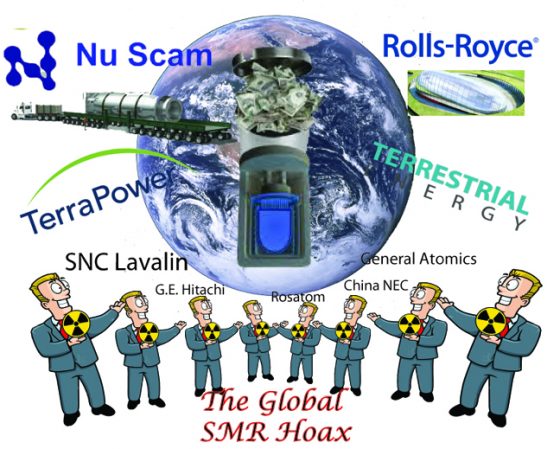
Towards the end of December 2022, Environment and Climate Change Minister Steven Guilbeault chose to ignore public concerns about small modular nuclear reactors (SMRs), rejecting a request to put a project through an additional federal impact assessment, favouring the nuclear industry and weakening oversight of an untested and risky technology.
When the revised Impact Assessment Act (IAA) became law in 2019, new nuclear reactors were exempted from assessment if they met certain conditions. Those pushing the exemption aimed to open the path to building new reactors. No surprise, then, that the conditions for exemption apply to almost all the SMR designs being considered for construction, even though Canada has no experience with them whatsoever.
The first SMR officially deemed exempt under the IAA is the ARC-100 sodium-cooled fast reactor proposed by NB Power for the Point Lepreau site on the Bay of Fundy in New Brunswick. Given the ecological sensitivity of the site and inherent problems with such reactors, the Coalition for Responsible Energy Development in New Brunswick (CRED-NB) formally requested Guilbeault to designate the project for a full impact assessment. The minister rejected the request on Dec. 22, claiming that a review by the Canadian Nuclear Safety Commission (CNSC) and the New Brunswick government would be adequate.
The federal impact assessment is the most rigorous form of public review available under law, seeking inputs from multiple stakeholders with different forms of expertise and outlooks. Ideally, the review panel would not be solely constituted by CNSC personnel and staff of the provincial government, a project funder. Indigenous nations and public interest groups had clearly stated their concerns to Guilbeault. Letters of support for CRED-NB’s request were submitted by the Wolastoq Grand Council, and Indigenous organizations representing the Peskotomuhkati Nation and the Mi’gmaq First Nations in New Brunswick, as well as more than 300 groups and individuals.
Why the public concern? Unlike the CANDU reactors operating in Ontario and New Brunswick, the ARC-100 design uses molten sodium instead of heavy water to transfer the intense heat produced by nuclear fission. Sodium reacts badly with air or water, burning or exploding upon such contact. Japan’s Monju demonstration reactor was shut down in 1995 within a few months of the reactor starting to generate power because of a sodium fire; it was reactivated in 2010 but was shut down again after another accident. The total price tag for this reactor and its cleanup is upwards of $10-billion.
Sodium also tends to leak out of pipes and vessels because of chemical interactions with the stainless steel in reactors. France’s Superphénix, the world’s largest sodium-cooled reactor, suffered numerous operational problems, including a major sodium leak. When put out of its misery in 1998, its load factor was under eight per cent, a fraction of the 80 to 90 per cent typical of commercial reactors.
Sodium-cooled reactors have also had numerous accidents, starting with the 1955 partial core meltdown of the EBR-1 in Idaho. A decade later, the Fermi-1 demonstration fast reactor near Detroit, Michigan suffered a similar but more devastating accident, leading to the book We Almost Lost Detroit and a song by Gil Scott Heron.
Sodium-cooled reactors have never been successfully commercialized despite numerous attempts over decades. Shut-down sodium-cooled reactors have proven difficult to decommission. In the U.S., the EBR-II reactor was shut down in 1994, but to date it has been unfeasible to extract the sodium metal from the highly radioactive spent fuel. The challenge is to dispose of this material without causing underground explosions due to a sodium-water reaction, as happened with the sodium-cooled Dounreay reactor in Scotland.
Radioactive particles are still being found on the Dounreay foreshore, more than four decades after the reactor waste exploded. A similar accident with the proposed ARC-100 reactor could result in widely spread radioactive contamination next to the Bay of Fundy.
These risks are all new to Canada. No sodium-cooled reactor has ever been built here. The Canadian Nuclear Safety Commission has never evaluated such reactors, one reason why the CNSC’s claim that its regulatory process provides sufficient oversight for SMR development rings hollow. What’s more, the CNSC’s active lobbying to speed up the regulatory process so SMRs could be more quickly brought to market suggests a fundamental conflict of interest by an “independent” regulator.
The ARC-100 project requires federal oversight and assessment. Its impacts on Indigenous rights as well as socio-economic factors and alternatives to the project will not be within the remit of either a CNSC review or a provincial assessment. The opportunities for an independent and official review of public concerns on these issues have now been significantly curtailed.
INTELLINEWS, By Professor Thane Gustafson in Washington January 8, 2023
As the Western nuclear industry flounders, Russia’s Rosatom is building nuclear power plants (NPPs) on time and under budget around the world, while selling uranium to the US……………….
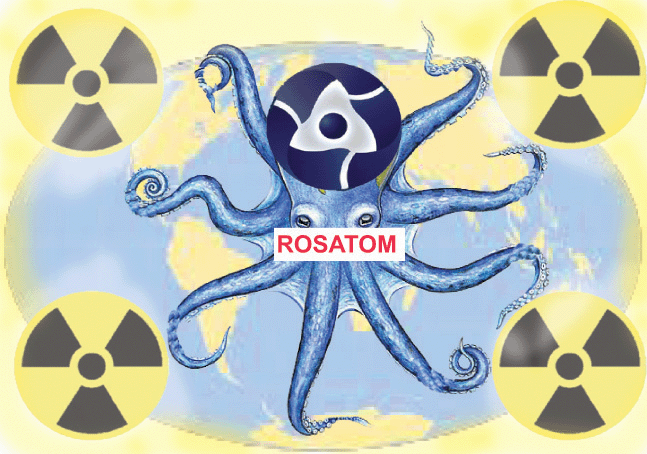
Russia’s nuclear industry is thriving, thanks mainly to its international business. According to Aleksey Likhachev, CEO of Rosatom, Russia’s nuclear monopoly, Russia is currently at work on 23 nuclear power units in a dozen different countries, including China, India, Belarus, Turkey, Hungary and Egypt. It sold $10bn worth of products abroad in 2022, a 15% increase on the year before, and its current foreign order book stands at over $200bn. Rosatom is actively courting new customers, mostly in the developing world; it offers a “full service” package that covers construction and operation, as well as the supply and reprocessing of nuclear fuel. The Russian government actively supports Rosatom with low-interest financing. In short, Russian nuclear power is on a roll.
But that is not all. In addition to building and operating new NPPs, Rosatom exports enriched uranium to numerous countries around the world, including the US and Europe. (In addition, Rosatom provides services to five EU counties that operate Russian-built NPPs.) Even though the revenues are not comparable (only about $1bn per year), the fuel exports are key politically. Because of this dependence, Russia’s nuclear industry is not under Western sanctions (as discussed further below), and it is not likely to be so any time soon. At this moment, Rosatom is able to operate without impediment, both at home and abroad; one of the few sectors in the Russian economy to be able to do so.
For both the US and Europe the implications are serious. First, they will continue to depend on Russian enriched uranium for several years more, potentially weakening their common front on sanctions. (Indeed, there have already been substantial disagreements among EU members over their policy toward Russian nuclear power.)
…… . Russia should continue to hold a commanding position in nuclear power for some time to come. …..
…. Putin named a politician, Sergei Kiriyenko, (above)to head the nuclear programme. Kiriyenko had had a mixed career up to that time – including a disastrous five-month stint as prime minister that coincided with Russia’s 1998 financial meltdown – but he turned out to be a talented manager. He regathered Rosatom’s wandering assets under one roof and after seeing off the oligarchs, he brought the industry’s unruly suppliers and contractors to heel. During the next eleven years he built Rosatom into a powerhouse. In 2016, Putin rewarded him with a secret medal and a top job, as Number 2 in the Kremlin’s Presidential Administration, where he is today.
The secrecy was no accident. When Rosatom was created in 2007, it inherited both the civilian NPPs and the military weapons assets. Kiriyenko made vigorous efforts to disentangle the military wing from the civilian, but the separation proved easier to achieve on paper than in reality. Today, the civilian and the military parts of Rosatom remain connected at the hip, as many parts of the nuclear supply chain, beginning with the mining of uranium, serve both military and civilian customers inside Russia.
But the military part was (and is) funded directly by the government, while the civilian part was supposed to be self-supporting. For Kiriyenko, this was a crucial difference. He had begun with ambitious plans for expanding nuclear power inside Russia, but he soon realised that there was little domestic demand for new NPPs in an electricity sector dominated by gas, and so Kiriyenko turned his sights on the foreign market. For this he needed to persuade the international community that Rosatom had become essentially a civilian business, in other words to fashion a new “commercial” image for the company. By and large he was successful, and Rosatom owes its present prosperity largely to the international business he built.
The impact of Western sanctions
Because of its important role as a supplier of uranium and nuclear fuels to NPPs around the world, including the US, Rosatom is not under Western sanctions. The US, in particular, relies on Russia for low-enrichment uranium for its own NPPs. Although efforts are under way to develop substitutes, for the present Rosatom is simply too valuable to sanction.
But even if sanctions were to be imposed, Rosatom’s operations would be largely unaffected by them. Internally, its supply chain, which as mentioned runs from uranium mining to power plant construction and operation, depends very little on the outside. ………….
Rosatom’s international business might be somewhat more vulnerable to sanctions, but so far there is little sign of it. Only one country, Finland, has pulled out of an ongoing project with Rosatom. ………………………….
Multiple challenges ahead
Yet quite apart from sanctions, Rosatom and Russian nuclear power may face multiple challenges ahead. One of them is technological progress. …………
Russia is the only country in the world to operate nuclear-powered icebreakers and floating NPPs, both of which are powered by small reactors. The Russian experience in designing and building small reactors goes back decades to the Soviet era, and there have been multiple generations of successively improved designs. Rosatom is working on deploying them not only on nuclear icebreakers and floating platforms, but also on land.
…………………….. The key to the future of SMRs, in the longer term, will likely be so-called “Generation IV” reactors, based on revolutionary designs that break entirely from the traditional light-water-reactor technology. But Generation IV is still an immature technology, and the race for leadership in G-IV is only now getting under way.
The more proximate threat to Rosatom’s leading position is Beijing. China has a vigorous nuclear programme, which is entirely independent of Russia…………………………………………
Finally, the ultimate challenges for Rosatom may be safety and reputational risk. Ever since the Chernobyl disaster in 1986, the Russian nuclear industry has had an excellent safety record. But the Russian invasion of Ukraine raises a serious new threat. There are four NPPs operating in Ukraine – ironically, all of them of Soviet manufacture. Russian [?] missiles have already landed close to one of them, the Zaporizhzhia plant, which is located close to the current battle line between Russian and Ukrainian forces. Just who is responsible for the safety of the plant is in dispute……………for Rosatom this plan is full of risks. If the plant were damaged and there were radioactive contamination, quite apart from the further suffering this would inflict on the Ukrainian people, for Rosatom the reputational damage would be extreme.
But Musk’s hot take on the Ukraine war should not be taken as proof of Musk’s anti establishment bona fides.
Far from being an establishment outsider, Elon Musk himself is a major figure in the military industrial complex, and represents the long tradition of Silicon Valley giants being thoroughly enmeshed in the military and intelligence wars.
Twitter’s “state-affiliated media” policy has an unwritten exemption for US government-funded and -controlled news media accounts. Twitter even boosts these accounts as “authoritative” sources for news during the Russian/Ukrainian war.
Elon Musk’s controlled release of the documents known as the “Twitter Files” has given us some insight into the inner workings of the social media platform. The batch of docs released on December 20 is arguably the most explosive, detailing Twitter’s deliberate shielding of US propaganda operations. After getting limited access to Twitter‘s internal systems, Lee Fang of the Intercept (12/20/22) detailed how Twitter staff “whitelisted” accounts run by US Central Command (CENTCOM), the unit of the US military that oversees the Middle East, as part of covert propaganda campaigns. In other words, Twitter protected accounts engaged in US psychological warfare operations, even though they clearly violated the platform’s terms of service.
But this is far from the whole story of Twitter’s assistance with US influence operations. A FAIR investigation reveals that dozens of large accounts that are part of US overt propaganda networks are given special treatment from the company, in blatant violation of Twitter’s own policies.
Through a lopsided “state-affiliated” media policy application, Twitter has actually gone against its own mission to provide “context” to users. More acutely, in Ukraine, Twitter actively promoted US funded media organizations as part of the “Topics” feature which ostensibly aggregated “authoritative” sources. The prominence of these outlets on the platform has strengthened their influence on the national media ecosystem, and has helped shape public perceptions of the entire war.
…………………………………………………………………………………………… Twitter rigorously enforces the rules for states the US considers to be hostile. Accounts for major state agencies in Russia, China and Iran are generally labeled as state entities. Media outlets from those countries are also targeted: PressTV from Iran, RT and Sputnik from Russia, and China Daily, Global Times, CGTN and China Xinhua News from China are all labeled “state-affiliated media.”
Twitter has taken extra measures against Russia after the invasion, adding explicit warnings on any post linking to “a Russian state-affiliated media website”:
…………….. Artificial exceptions
Twitter’s policy defines “state-affiliated media” as newsrooms where the state has “control over editorial content through financial resources, direct or indirect political pressures, and/or control over production and distribution.” But there are several major media accounts that seem to fit this description that have no such warning labels.
None of the major public media outlets in the US, Britain and Canada have received the label. In 2017, NPR received 4% of its funding from the US government. The BBC receives a large portion of its funding from the British Foreign and Commonwealth Office. The CBC receives $1.2 billion in funding from the Canadian government. Yet Twitter accounts for the BBC, CBC and NPR are all unlabeled on the platform……………………………..
National Endowment for Democracy
A look at the US’s soft power initiatives shows far more outlets that ought to fall under the “state affiliated” label. One such conduit for funding is the National Endowment for Democracy. The NED, created during the Reagan administration, pours $170 million a year into organizations dedicated to defending or installing regimes friendly to US policies.
ProPublica (11/24/10) described the NED as being “established by Congress, in effect, to take over the CIA’s covert propaganda efforts.” David Ignatius of the Washington Post (9/22/91) reported on the organization as a vehicle for “spyless coups,” as it was “doing in public what the CIA used to do in private.” The first NED president, Carl Gershman (MintPress, 9/9/19), admitted that the switch was largely a PR move to shroud the organization’s intentions: “It would be terrible for democratic groups around the world to be seen as subsidized by the CIA.”
NED operations in Ukraine deserve especially close scrutiny, given the organization’s role in the 2014 Maidan coup and the information war surrounding the Russian invasion. In 2013, Gershman described Ukraine as the “biggest prize” in the East/West rivalry (Washington Post, 9/26/13). Later that year, the NED united with other Western-backed influence networks to support the protest movements that later led to the removal of the president.
The history of the board is a who’s who of regime change advocates and imperial hawks. The current board includes Anne Applebaum, a popular anti-Russian staff writer at the Atlantic and frequent cable news commentator whose work epitomizes the New Cold War mentality, and Elliott Abrams, a major player in the Iran/Contra scandal who later played a key role in the Trump administration’s campaign to overthrow the Venezuelan government. Victoria Nuland, formerly the foreign policy advisor to Vice President Dick Cheney, is a key player in US foreign policy, and was even one of the US officials who was caught meddling behind the scenes to reshape the Ukrainian government in 2014. She served on the NED board in between her time in the State Department for the Obama and Biden administrations. Other former board members include Henry Kissinger, Paul Wolfowitz, Zbigniew Brzezinski and current CIA director William Burns.
After the war started, the NED removed all of its Ukraine projects from its website, though they are still available through the Internet Archive’s Wayback Machine. A look at 2021 projects shows extensive work funding media organizations throughout Ukraine with the ostensible goal of “promot[ing] government accountability” or “foster[ing] independent media.” Despite their overt funding from a well-documented US propaganda organ, none of these organizations’ Twitter accounts contain a “state-affiliated media” label. Even the NED’s own Twitter account does not reference its relationship to the US government.
This is highly relevant to the current war in Ukraine. CHESNO, ZN.UA, ZMiST and Ukrainian Toronto Television, Vox Ukraine are all part of the NED’s media network in Ukraine, yet their Twitter accounts have no state-affiliated label. Furthermore, some of the newsrooms in this network boast extensive ties to other US government organizations. European Pravda, the Ukraine Crisis Media Center and Hromadske—all founded during or shortly after the US-backed Maidan coup in 2014—boastexplicitpartnerships with NATO. Hromadske and the UCMC also tout partnerships with the US State Department, the US Embassy in Kyiv and the US Agency for International Development (USAID).
USAID plays a similar role to the NED. Under the protective cover of humanitarian aid and development projects, the agency serves as a conduit for US regime change operations and soft power influence peddling. Among other things, the organization has been a cover for “promoting democracy” in Nicaragua, and provided half a billion dollars to advance the coup attempt against Venezuela’s elected government.
Kyiv Post and Independent
The most popular recipient of NED funds has been the Kyiv Independent, a reconstitution of another NED-funded newsroom, the Kyiv Post. Though it claims to receive the majority of its funding through advertising and subscriptions, the Postwebsite lists the NED as “donors who sponsored content produced by the Kyiv Post journalists.”
When the Post was temporarily shuttered in a staff dispute in November 2021, many of the journalists formed the Kyiv Independent. They did this with a $200,000 grant from the Canadian government, as well as an emergency grant from the European Endowment for Democracy, an organization headquartered in Brussels that is both modeled after and funded by the NED.
After the outbreak of war, the Independent gained over 2 millionTwitter followers and attracted millions of dollars in donations. Staff from the Independent have flooded the US media ecosystem: Its reporters have had op-eds in top US newspapers like the New York Times (3/5/22) and the Washington Post (2/28/22). They often appear on US TV channels like CNN (3/21/22), CBS (12/21/22), Fox News (3/31/22) and MSNBC (4/10/22)…………………………………………..
Boosting US propaganda
Twitter’s policy effectively amounts to providing cover and reach for US propaganda organs. But this policy effect is far from the whole story. Through various mechanisms, Twitter actually boosts US-funded newsrooms and promotes them as trusted sources.
One such mechanism is the curated “Topics” feature. As part of its effort to “elevate reliable information,” Twitter recommends following its own curated feed for the Ukraine War. As of September 2022, Twitter said that this war feed for the Ukraine War had over 38.6 billion “impressions.” Scrolling through the feed shows many examples of the platform boosting US state-affiliated media, with few or no instances of coverage critical of the war effort. Despite their extensive ties to the US government, the Kyiv Independent and Kyiv Post are frequently offered as favored sources for information on the war.
The account has generated a list based on what they claim to be reliable sources on the conflict. The list currently has 55 members. Of these, at least 22 are either US-funded newsrooms, their affiliated journalists. Given the complexity of the funding channels, and the lack of information on some of these newsrooms’ websites, this number is likely an undercount:
New Voice of Ukraine (NED, State Department)
Euan MacDonald
Kyiv Post (NED)
Natalie Vikhrov
Kyiv Independent (NED)
Anastasiia Lapatina, Oleksiy Sorokin, Anna Myroniuk, Illia Ponomarenko
Zaborona (NED)…………………………….
Worldwide propaganda network
The US government currently funds other media organizations that function more blatantly as arms of the state, yet none have the “state-affiliated media” label on their Twitter accounts. These outlets are part of the media apparatus set up to promote the US point of view around the world during the Cold War. The New York Times (12/26/77) once described them as being part of a “worldwide propaganda network built by the CIA.”
The network, known as the “Propaganda Assets Inventory” within the agency, once encompassed around 500 individuals and organizations, ranging from operatives in major media like CBS,Associated Press and Reuters to smaller outlets under the “complete” “editorial control” of the CIA. Radio Free Asia, Voice of America and Radio Free Europe/Radio Liberty were at the vanguard of this propaganda operation. The Times reported in 1977 that the network resulted in a stream of US media stories that were “purposely misleading or downright false.”
The US government continues to directly operate several of these organizations. These outlets now fall under the auspices of the US Agency for Global Media (USAGM), a federal agency that received $810 million in 2022. That number marks a 27% increase from its 2021 budget, and is more than twice the amount RT received from Russia for its global operations in 2021 (RFE/RL, 8/25/21)…………………………………………………………………
Twitter, like otherSiliconValleybehemoths, has numerous links to the national security state. An investigation by Middle East Eye (9/30/19) revealed that one of Twitter’s top executives was also a member of one of the British military’s psychological warfare units, the 77th Brigade. Gordon MacMillan, who holds the top editorial position for the Middle East and North Africa at Twitter, joined the UK’s “information warfare” unit in 2015 while he was at Twitter. One UK general told MEE that the unit specialized in developing “the capability to compete in the war of narratives at the tactical level.” The story was met with near total silence in US and UK press (FAIR.org, 10/24/19), and MacMillan still works for Twitter.
Twitter also partners with the Australian Strategic Policy Institute, a hawkish think tank funded by the military industry and the US government, for its content moderation policies. In 2020, Twitter worked closely with the ASPI to remove over 170,000 low-follower accounts they alleged to be favorable to the Communist Party of China. More recently, Twitter and ASPI have announced a partnership ostensibly aimed at fighting disinformation and misinformation.
Twitter’s Strategic Response Team, in charge of making decisions about which content should be suppressed, was headed by Jeff Carlton, who previously worked for both the CIA and FBI. In fact, MintPress News (6/21/22) reported on the dozens of former FBI agents that have joined Twitter’s ranks over the years. Elon Musk’s controlled leak of internal communications, known as the “Twitter Files,” has renewed attention to the close relationship between the agency and the platform.
Though Twitter has previously denied directly “coordinat[ing] with other entities when making content moderation decisions,” recent reporting has revealed a deep level of integration between federal intelligence agencies, and Twitter’s content moderation policies. In part 6 of the “Twitter Files,” Matt Taibbi reported that the FBI has over 80 agents dedicated to flagging content on the platform and interfacing directly with Twitter leadership. Last year, emails leaked to the Intercept (10/31/22) showed how the Department of Homeland Security (DHS) and Twitter had an established process for content takedown requests from the agency related to election security.
The platform is clearly an important hub for pro-Ukrainian sentiment online, though not all of the activity is organic. In fact, one study (Declassified Australia, 11/3/22) released last year found a deluge of pro Ukrainian bots. Australian researchers studied a sample of over 5 million tweets about the war, and found that 90% of the total were pro-Ukrainian (identified using the #IStandWithUkraine hashtag or variations), and estimated that up to 80% of them were bots. Though researchers did not determine the precise origin of these accounts, it was obvious that they were sponsored by “pro-Ukrainian authorities.” The sheer volume of tweets undoubtedly helped shape online sentiment about the war.
It appears that Washington understands the importance of Twitter in shaping public sentiments. When Musk originally set his sights on buying the platform, the White House even considered opening a national security review of Musk’s business ventures, citing Musk’s “increasingly Russia-friendly stance.” These concerns were prompted by Musk’s plan to bar SpaceX’s StarLink system from being used in Ukraine, after a spat between Musk and a Ukrainian official. The concerns also came after Musk (10/3/22) tweeted out the outlines to a potential peace proposal between Russia and Ukraine. This proposal was met with scorn and shock among American elite circles, where escalation rather than peace is the dominant position (FAIR.org, 3/22/22).
Musk and the national security state
But Musk’s hot take on the Ukraine war should not be taken as proof of Musk’s anti establishment bona fides. Far from being an establishment outsider, Elon Musk himself is a major figure in the military industrial complex, and represents the long tradition of Silicon Valley giants being thoroughly enmeshed in the military and intelligence wars.
Musk’s rocket company, SpaceX, is a major military contractor, earning billions of dollars from the US national security state. It has received contracts to launch GPS technology into orbit to assist with the US drone war. The Pentagon has also contracted the company to build missile defense satellites. SpaceX has further won contracts from the Air Force, Space Defense Agency and National Reconnaissance Organization, and has launched spy satellites to be used by the CIA, NSA and other intelligence agencies (MintPress, 5/31/22).
In fact, SpaceX’s existence is largely owed to military and intelligence ties. One of its earliest backers of the company was the Pentagon’s Defense Advanced Research Projects Agency (DARPA), the same military research agency that gave us much of the technology that defines the modern internet age………………….
After the Russian invasion of Ukraine, Musk made headlines by offering to donate his Starlink technology to the Ukrainian government to keep the country online. Starlink, a satellite-based internet provider, was essential to Ukraine’s war effort after the Russian attack disabled much of its traditional military communications. It has enabled Ukrainians to quickly share battlefield intelligence, and connect with US support troops to perform “telemaintenance.”
Musk’s offer to “donate” the technology earned him a lot of positive press, but it was quietly revealed later that the US government had been paying SpaceX millions of dollars for the technology—despite what SpaceX officials had told the public. According to the Washington Post (4/8/22), the money was funneled through USAID, an organization that has long been a tool of US regime change efforts, and a front for covert intelligence operations………………………………………
The relationship between Musk and the security state is so strong that one official even told Bloomberg (10/20/22) that “the US government would also use Starlink in the event of telecommunications outage,” hinting at links to high-level national contingency planning.
Continuity of governance?
The conversation surrounding Twitter has centered around whether or not Elon Musk is a free-speech advocate, though little has focused on the implications of a military contractor having complete control over such an important platform. Though Musk may (or may not) be stepping down as CEO, the platform will remain his domain.
Many things have changed under Musk’s Twitter, but Twitter’s role as a megaphone for US government–funded media has not. It would take a large research study to understand precisely how much impact Twitter’s misapplication of its own policies has on the propagation. But even without this data, it is clear that the platform’s design serves to nudge users away from most media funded by Washington-unfriendly governments, and, in the case of the Ukraine War, push users toward media funded by the US government. Musk’s status as a military contractor only underscores that challenging US foreign policy objectives is unlikely to be a priority for the company. https://fair.org/home/under-musk-twitter-continues-to-promote-us-propaganda-networks/
Dec 19, 2022 What happens to the damaged reactors? The territories evacuated by 160 000 people? What are the new conditions for their return to the contaminated area since the lifting of the governmental aid procedures? Are lessons still being learned by our national operator for its own nuclear plants? We must not forget that a disaster is still unfolding in Japan and that EDF was supposed to upgrade its fleet on the basis of this feedback, which has still not been finalized.
Almost twelve years after the Fukushima disaster, Japan is still in the process of dismantling and ‘decontaminating’ the nuclear power plant, probably for the next thirty to forty years as well. In the very short term, the challenges are posed by the management of contaminated water.
All the contaminated water will be evacuated into the sea, by dilution over decades
Each intervention in the accident reactors brings out new elements
This has an impact on the schedule and the efficiency of the means used
At the same time, the Japanese government’s objective is to rehabilitate the contaminated areas at any cost
None of the French reactors is up to date with its safety level according to the post-Fukushima measures promulgated
Japan will resume its nuclear policy, time having done its work on memories
The great water cycle
Although Japanese politicians claim that they have finally mastered the monster, the colossal task of cleaning up the site is still far from being completed to allow for the ultimate dismantling, with the length of time competing with the endless financing.
After so many years of effort, from decontamination to the management of radioactive materials and maneuvers within the dismantled plant, the actions on site require more and more exceptional means, exclusive procedures, and unprecedented engineering feats (such as robotic probes), while the nuclear fuel inside continues to be cooled permanently by water (not without generating, to repeat, millions of liters of radioactive water).
But the hardest part is yet to come: containing the corium, an estimated 880 tons of molten radioactive waste created during this meltdown of the reactor cores, and managing the thousands of fuel rods. So much so that the complete cleanup and dismantling of the plant could take a generation or more for a total estimated cost of more than 200 billion dollars (according to an assessment published by the German insurer Munich Re, Japan is 150 billion euros), a low range since other estimates raise the bill between 470 and 660 billion dollars, which is not in contradiction with the costs of an accident projected by the IRSN in France.
The removal of this corium will remain the most essential unresolved issue for a long time. Without it, the contamination of this area will continue. In February 2022, the operator Tepco (Tokyo Electric Power Company Holdings Inc.) tried again to approach the molten fuel in the containment of a reactor after a few more or less unsuccessful attempts, the radioactivity of 2 sieverts/hour being the end of everything, including electronic robots. This withdrawal seems quite hypothetical, even the Chernobyl reactor has never been removed and remains contained in a sarcophagus.
(source: Fukushima blog and Japan’s Nuclear Safety Authority NRA)
Until that distant prospect arrives, the 1.37 million tons of water will have filled the maximum storage capacity. This water was used to cool the molten fuel in the reactor and then mixed with rainwater and groundwater. The treatment via an Advanced Liquid Processing System (ALPS) is touted as efficient, but does not remove tritium. Relative performance: Tepco has been repeatedly criticized for concealing and belatedly disclosing problems with filters designed to prevent particles from escaping into the air from the contaminated water treatment system: 24 of the 25 filters attached to the water treatment equipment were found to be damaged in 2021, an already known defect that resulted in no investigation of the cause of the problem and no preventive measures after the filters were replaced.
The management of this type of liquid waste is a problem shared by the Americans. On site, experts say that the tanks would present flooding and radiation hazards and would hamper the plant’s decontamination efforts. So much so that nuclear scientists, including members of the International Atomic Energy Agency (IAEA) and the Japanese Nuclear Regulatory Authority, have recommended controlled release of the water into the sea as the only scientifically and financially realistic option.
In the end, contaminated water would have to be released into the sea through an underwater tunnel about a kilometer offshore, after diluting it to bring the concentration of tritium well below the percentage allowed by regulation (the concentration would be below the maximum limit of tritium recommended by the World Health Organization for drinking water). Scientists say that the effects of long-term, low-dose exposure to tritium on the environment and humans are still unknown, but that tritium would affect humans more when consumed in fish. The health impact will therefore be monitored, which the government already assures us it is anticipating by analyzing 90,000 samples of treated water each year.
Assessment studies on the potential impact that the release of stored contaminated water into the ocean could have therefore seem insufficient. For tritium, in the form of tritiated water or bound to organic matter, in addition to its diverse behavior according to these configurations, is only part of the problem. Some data show great variability in the concentrations of contaminants between the thousand reservoirs, as well as differences in their relative quantities: some reservoirs that are poor in tritium are rich in strontium 90 and vice versa, suggesting a high variability in the concentrations of other radionuclides and a dilution rate that is not so constant. All the ignorance currently resides on the still unknown interactions of the long-lived radioactive isotopes contained in the contaminated water with the marine biology. It is in order to remove all questions that a complete and independent evaluation of the sixty or so radioisotopes is required by many organizations.
As it stands, with the support of the IAEA so that dilution meets expectations, depending on currents, flows …, the release of contaminated materials would take at least forty years. Opponents of such releases persist in proposing an alternative solution of storage in earthquake-resistant tanks in and around the Fukushima facility. For them, “given the 12.3-year half-life of tritium for radioactive decay, in 40 to 60 years, more than 90% of the tritium will have disappeared and the risks will be considerably reduced,” reducing the direct nuisance that could affect the marine environment and even the food chain.
Modelling of marine movements could lead the waste to Korea, then to China, and finally to the Federated States of Micronesia and Palau. As such, each of the impacted countries could bring an action against Japan before the International Tribunal for the Law of the Sea to demand an injunction or provisional measures under international law.
Faced with these unresolved health issues, China, South Korea, Taiwan, local fishing communities continue to oppose this management plan, but the work is far from being completed and the problem of storage remains. Just like the ice wall built into the floor of the power plant, the release of contaminated water requires huge new works: the underwater pipe starts at about 16 meters underground and is drilled at a rate of five to six meters per day.
Time is of the essence. The tanks should reach their maximum capacity by the fall of 2023 (the volume of radioactive water is growing at a rate of about 130 to 140 tons per day). But above all, it is necessary to act quickly because the area is likely to suffer another earthquake, a fear noted by all stakeholders. With the major concern of managing the uranium fuel rods stored in the reactors, the risks that radioactivity will be less contained increase with the years.In France, releases to the sea are not as much of a problem: the La Hague waste reprocessing site in France releases more than 11,000 terabecquerels per year, whereas here we are talking about 22 terabecquerels that would be released each year, which is much less than most of the power plants in the world. But we will come back to this atypical French case…
Giant Mikado
The operator Tepco has successfully removed more than 1500 fuel bundles from the reactor No. 4 of the plant since late 2014, but the hundreds still in place in the other three units must undergo the same type of sensitive operation. To do this, again and again, undertake in detail the clearing of rubble, the installation of shields, the dismantling of the roofs of buildings and the installation of platforms and special equipment to remove the rods… And ultimately decide where all the fuel and other solid radioactive debris will have to be stored or disposed of in the long term. A challenge.
The fuel is the biggest obstacle to dismantling. The solution could lie, according to some engineers, in the construction of a huge water-filled concrete tank around one of the damaged reactors and to carry out the dismantling work in an underwater manner. Objectives and benefits? To prevent radiation from proliferating in the environment and exposing workers (water is a radiation insulator, we use this technique in our cooling pools in France) and to maximize the space to operate the heavy dismantling equipment being made. An immersion solution made illusory for the moment: the steel structure enveloping the building before being filled with water is not feasible as long as radiation levels are so high in the reactor building, preventing access by human teams. In short, all this requires a multitude of refinements, the complexity of the reactors adding to the situations made difficult by the disaster.
Experience, which is exceptional in this field, is in any case lacking. What would guarantee the resistance of the concrete of the tanks over such long periods of time, under such hydraulic pressures? The stability of the soils supporting such structures? How can the concrete be made the least vulnerable possible to future earthquakes? How to replace them in the future?
All these difficulties begin to explain largely the delays of 30 to 40 to dismantle. The reactors are indeed severely damaged. And lethal radiation levels equivalent to melted nuclear fuel have been detected near one of the reactor covers, beyond simulations and well above previously assumed levels. Each of the reactors consists of three 150-ton covers, 12 meters in diameter and 60 centimeters thick: the radiation of 1.2 sieverts per hour is prohibitive, especially in this highly technical context. There is also no doubt that other hotspots will be revealed as investigations are carried out at the respective sites. The Nuclear Damage Compensation and Decommissioning Facilitation Corporation (NDF), created in 2014, has the very objective of trying to formulate strategic and technical plans in order to proceed with the dismantling of said reactors. Given the physical and radiological conditions, the technical and logistical high-wire act.
Also, each plan is revised as information is discovered, as investigations are conducted when they are operable. For example, the reinforcing bars of the pedestal, which are normally covered with concrete, are exposed inside Reactor No. 1. The concrete support foundation of a reactor whose core has melted has deteriorated so badly that rebar is now exposed.
The cylindrical base, whose wall is 1.2 meters thick, is 6 meters in diameter. It supports the 440-ton reactor pressure vessel. The reinforcing rods normally covered with concrete are now bare and the upper parts are covered with sediment that could be nuclear fuel debris. The concrete probably melted under the high temperature of the debris. The strength of the pedestal is a major concern, as any defect could prove critical in terms of earthquake resistance.
Nothing is simple. The management of human material appears less complex.
Bringing back to life, whatever it takes
In the mountains of eastern Fukushima Prefecture, one of the main traditional shiitake mushroom industries is now almost always shut down. The reason? Radioactive caesium exceeding the government’s maximum of 50 becquerels per kilogram, largely absorbed by the trees during their growth. More than ten years after the nuclear disaster, tests have revealed caesium levels between 100 and 540 becquerels per kilogram. While cesium C134 has a radioactive half-life of about two years and has almost disappeared by now, the half-life of cesium C137 is about 30 years and thus retains 30% of its radioactivity 50 years after the disaster, and 10% after a century.
As more than two thirds of Fukushima prefecture is covered by forests, nothing seems favorable in the short term to get rid of all or part of the deposited radioactivity, as forests are not part of the areas eligible for ‘decontamination’, unlike residential areas and their immediate surroundings.
On the side of the contaminated residential and agricultural areas, ‘decontamination’ measures have been undertaken. But soil erosion and the transfer of contaminants into waterways, frequent due to typhoons and other intense rain events, are causing the radioactive elements to return, moving them incessantly. Scientists are trying to track radioactive substances to better anticipate geographical fluctuations in doses, but nothing is simple: the phenomena of redistribution of the initial contamination deposits from the mountains to the inhabited low-lying areas are eternal.
The Ministry of the Environment is considering the reuse of decontaminated soils (official threshold of 8,000 becquerels per kilogram), with tests to be conducted. For now, a law requires the final disposal of contaminated soil outside Fukushima Prefecture by 2045, which represents about 14 million cubic meters (excluding areas where radiation levels remain high). This reuse would reduce the total volume before legal disposal.
More generally, Japan has for some years now opted for the strategy of holding radiological contamination as zero and/or harmless. This is illustrated by the representative example of the financial compensation given to farmers, designed so that the difference between pre- and post-accident sales is paid to them as compensation for “image damage”, verbatim.
Finally, in the midst of these piles of scrap metal and debris, it is necessary to make what can be made invisible. Concerning radioactive waste for example, it must be stored in time. On the west coast of the island of Hokkaidō, the villages of Suttsu and Kamoenai have been selected for a burial project. Stainless steel containers would be stored in a vitrified state. But consultation with the residents has not yet been carried out. This is not insignificant, because no less than 19,000 tons of waste are accumulating in the accidental, saturated power plants, and must find a place to rest for hundreds of years to come.
In this sparsely populated and isolated rural area, as in other designated sites, to help with acceptance, 15 million euros are being paid to each of the two municipalities to start the studies from 2020. 53 million are planned for the second phase, and much more in the final stages. This burial solution seems inevitable for Japan, as the waste cannot remain at the level of the surface power plants and is subject at all times to the earthquakes that are bound to occur over such long periods (strong earthquakes have struck off the prefecture in 2021 and 2022). The degrees of dangerousness thus allow the government to impose a default choice, for lack of anything better.
On December 6, 2022, the Director General of the IRSN met with the President of Fukushima University and with a manager of the Institute of Environmental Radioactivity (IER). What was the objective? To show the willingness of both parties to continue ongoing projects on the effects of radioactive contamination on biodiversity and environmental resilience.
But France will not have waited for the health results of a disaster to learn and commit itself to take into account any improvement likely to improve the nuclear safety of its reactors. No ?
Experience feedback
After a few reactor restarts that marked a major change in its nuclear energy policy (ten nuclear reactors from six plants out of a total of fifty-four were restarted by June 2022), the Japanese government is nonetheless planning to build new generation nuclear power plants to support its carbon emission reduction targets. (A memorandum of understanding was signed by the Japan Atomic Energy Agency, Mitsubishi Heavy Industries and Mitsubishi FBR Systems with the American start-up TerraPower to share data for the Natrium fast neutron reactor project; the American company NuScale Power presented its modular reactor technology). But above all, the government is considering extending the maximum service life of existing nuclear reactors beyond 60 years. Following the disaster, Japan had introduced stricter safety standards limiting the operation of nuclear reactors to 40 years, but there is now talk of modernizing the reactors with safety features presented as “the strictest in the world”, necessarily, to meet safety expectations. Their program is worthy of a major refurbishment (GK).
But in France, where are we with our supplementary safety assessments?
The steps taken after the Fukushima disaster to reassess the safety of French nuclear facilities were designed to integrate this feedback in ten years. More than ten years after the start of this process of carrying out complementary safety assessments (CSA), this integration remains limited and the program has been largely delayed in its implementation.
Apparently, ten years to learn all the lessons of this unthinkable accident was not enough. Fear of the probable occurrence of the impossible was not the best motivation to protect the French nuclear fleet from this type of catastrophic scenario, based solely on these new standards. Concerning in detail the reality of the 23 measures identified to be implemented (reinforcement of resistance to earthquake and flooding, automatic shutdown in the event of an earthquake, ultimate water top-up for the reactor and cooling pool, detection of corium in the reactor vessel, etc.), the observation is even distressing: not a single reactor in operation is completely up to standard.
According to NegaWatt’s calculations, at the current rate of progress and assuming that funding and skills are never lacking, it would take until 2040 for the post-Fukushima standards to be finally respected in all French reactors. And even then, some of the measures reported as being in place are not the most efficient and functional (we will come back to the Diesels d’ultime secours, the DUS of such a sensitive model).
Even for the ASN, the reception of the public in the context of post-accident management could appear more important than the effectiveness of the implementation of the measures urgently imposed.
Then, let us complete by confirming that France and Japan have a great and long common history which does not stop in nuclear matters. Among this history, let us recall that Japan lacks facilities to treat the waste from its own nuclear reactors and sends most of it abroad, especially to France. The previous transport of highly radioactive Mox (a mixture of highly toxic plutonium oxide and reprocessed uranium oxide) to Japan dates back to September 2021, not without risk even for the British company specialized in this field, a subsidiary of Orano. The final request for approval for the completion of the Rokkasho reprocessing plant, an important partnership and technology transfer project, is expected in December 2022, although the last shipments to Japan suffered from defective products from Orano’s Melox plant, a frequent occurrence because of a lack of good technical homogenization of the products.
No one is immortal
In the meantime, the ex-managers of the nuclear power plant have been sentenced to pay 95 billion euros for having caused the disaster of the entire eastern region of Japan. They were found guilty, above all, of not having sufficiently taken into account the risk of a tsunami at the Fukushima-Daiichi site, despite studies showing that waves of up to 15 meters could hit the reactor cores. Precisely the scenario that took place.
Worse, Tepco will be able to regret for a long time to have made plan the cliff which, naturally high of 35 meters, formed a natural dam against the ocean and the relatively frequent tsunamis in this seismic zone. This action was validated by the Japanese nuclear safety authorities, no less culpable, on the basis of the work of seismologists and according to economic considerations that once again prevailed (among other things, it was a question of minimizing the costs of cooling the reactors, which would have been operated with seawater pumps).
The world’s fourth largest public utility, familiar with scandals in the sector for half a century, Tepco must take charge of all the work of nuclear dismantling and treatment of contaminated water. With confidence. The final total estimates are constantly being revised upwards, from 11,000 billion to 21,500 billion yen, future budgets that are borrowed from financial institutions, among others, with the commitments to be repaid via the future revenues of the electricity companies. A whole financial package that will rely on which final payer?
Because Tepco’s financial situation and technical difficulties are deteriorating to such an extent that such forty-year timetable projections remain very hypothetical, and the intervention of the State as a last resort is becoming more and more obvious. For example, the Japanese government has stated that the repayment of more than $68 billion in government funding (interest-free loans, currently financed by government bonds) for cleanup and compensation for the Fukushima Daiichi nuclear power plant disaster, owed by Tepco, has been delayed. Tepco’s mandatory repayments have been reduced to $270 million per year from the previous $470 million per year. It is as much to say that the envisaged repayment periods are as spread out as the Japanese debt is abysmal.
Despite this chaotic long-term management, the Japanese government has stated that it is considering the construction of the next generation of nuclear power plants, given the international energy supply environment and Japan’s dependence on imported natural resources. Once the shock is over, business and realpolitik resume.
Marie Curie, known as the ‘mother of modern physics’, died from aplastic anaemia, a rare condition linked to high levels of exposure to her famed discoveries, the radioactive elements polonium and radium.
Curie, the first and only woman to win a Nobel Prize in two different fields (physics and chemistry), furthered the research of French physicist Henri Becquerel, who in 1896 discovered that the element uranium emits rays.
Alongside her French physicist husband, Pierre Curie, the brilliant scientific pair discovered a new radioactive element in 1898. The duo named the element polonium, after Poland, Marie’s native country.
Still, after more than 100 years, much of Curie’s personal effects including her clothes, furniture, cookbooks, and laboratory notes are still radioactive, author Bill Bryson writes in his book, A Short History of Nearly Everything.
Regarded as national and scientific treasures, Curie’s laboratory notebooks are stored in lead-lined boxes at France’s Bibliotheque National in Paris. Wellcome Library
While the library grants access to visitors to view Curie’s manuscripts, all guests are expected to sign a liability waiver and wear protective gear as the items are contaminated with radium 226, which has a half life of about 1,600 years, according to Christian Science Monitor.
Her body is also radioactive and was therefore placed in a coffin lined with nearly an inch of lead.
The Curie’s are buried in France’s Panthéon, a mausoleum in Paris which contains the remains of distinguished French citizens – like philosophers Rousseau and Voltaire.
When Jeni Knack moved to Simi Valley, California, in 2018, she had no idea that her family’s new home was within 5 miles of a former nuclear and rocket testing laboratory, perched atop a plateau and rife with contamination. Radioactive cesium-137, strontium-90, plutonium-239 and tritium, along with a mix of other toxic chemicals and heavy metals, are known to have been released at the industrial site through various spills, leaks, the use of open-air burn pits and a partial nuclear meltdown.
Once Knack learned about the Santa Susana Field Laboratory and the unusual number of childhood cancer cases in the surrounding community, she couldn’t ignore it. Her family now only drinks water from a 5-gallon (19-liter) jug delivered by Sparkletts water service. In August of 2021, she began sending her then 6-year-old daughter to kindergarten with two bottles of the water and instructions to not refill them at school, which is connected to the same Golden State Water Company that serves her home.
A federal report in 2007 acknowledged that two wells sourced by the water company were at risk of contamination from the site. “The EPA has said we’re at risk,” says Knack. And Golden State, she says, has at times used “possibly a very hefty portion of that well water.” To date, radioactivity above the natural level has not been detected in Golden State’s water.
Concerns across the country
All water contains some level of radiation; the amount and type can vary significantly. Production of nuclear weapons and energy from fissionable material is one potential source. Mining for uranium is another. Radioactive elements can be introduced into water via medical treatments, including radioactive iodine used to treat thyroid disorders. And it can be unearthed during oil and gas drilling, or any industrial activities that involve cracking into bedrock where radioactive elements naturally exist. What’s more, because of their natural presence, these elements can occasionally seep into aquifers even without being provoked.
The nonprofit Environmental Working Group (EWG, a partner in this reporting project) estimates that drinking water for more than 170 million Americans in all 50 states “contains radioactive elements at levels that may increase the risk of cancer.” In their analysis of public water system data collected between 2010 and 2015, EWG focused on six radioactive contaminants, including radium, radon and uranium. They found that California has more residents affected by radiation in their drinking water than anywhere else in the U.S. Yet the state is far from alone. About 80% of Texans are served by water utilities reporting detectable levels of radium. And concerns have echoed across the country — from abandoned uranium mines on Navajo Nation lands, to lingering nuclear waste from the Manhattan Project in Missouri, to contaminants leaching from phosphate mines in Florida.
While ingesting radioactive elements through drinking contaminated water is not the only route of human exposure, it is a major risk pathway, says Daniel Hirsch, a retired University of California, Santa Cruz, professor who has studied the Santa Susana Field Laboratory contamination. “One thing you don’t want to do is to mix radioactivity with water. It’s an easy mechanism to get it inside people,” he says. “When you drink water, you think you excrete it. But the body is made to extract things from what you ingest.”
Strontium-90, for example, is among elements that mimic calcium. So the body is apt to concentrate the contaminant in bones, raising the risk of leukemia. Pregnant women and young kids are especially vulnerable because greater amounts of radiation are deposited in rapidly growing tissue and bones. “This is why pregnant women are never x-rayed,” says Catherine Thomasson, an independent environmental policy consultant based in Portland, Oregon. Cesium can deposit in the pancreas, heart and other tissues, she notes. There, it may continue to emit radioactivity over time, causing disease and damage.
Scientists believe that no amount of radiation is safe. At high levels, the radiation produced by radioactive elements can trigger birth defects, impair development and cause cancer in almost any part of the body. And early life exposure means a long period of time for damage to develop.
Health advocates express concern that the government is not doing enough to protect the public from these and other risks associated with exposure to radioactive contamination in drinking water. The legal limits set by the U.S. Environmental Protection Agency (EPA) for several types of radioactive elements in community water systems have not been updated since 1976. Further, many elements are regulated as a group rather than individually, such as radium-226 plus radium-228. And water system operators, if they are required to monitor for radioactive elements, only need to do so infrequently — say, every six or nine years for certain contaminants.
Meanwhile, private wells generally remain unregulated with regard to the elements, which is particularly concerning because some nuclear power plants are located in rural areas where people depend on private wells. More than one out of every 10 Americans use private wells or tiny water systems that serve fewer than 15 residences.
The Santa Susana Field Laboratory was rural when it was first put to use about 70 years ago. Today, more than 700,000 people live within 10 miles (16 kilometers). Recent wildfires have exacerbated these residents’ concerns. The 2018 Woolsey fire started on the property and burned 80% of its 2,850 acres (1,153 hectares). Over the following three months, the levels of chemical and radioactive contamination running off the site exceeded state safety standards 57 times.
Hirsch highlights several potential avenues for drinking water contamination related to nuclear weapons or energy development. Wind can send contamination off site and deposit it into the soil, for example. Gravity can carry contaminants downhill. And rains can carry contamination via streams and rivers to infiltrate groundwater aquifers. While vegetation absorbs radioactive and chemical contaminants from the soil in which it grows, those pollutants are readily released into the environment during a fire.
While no tests have detected concerning levels of radioactivity in Golden State’s water, advocates and scientists argue that testing for radioactive elements remains inconsistent and incomplete across the country. Federal and state regulations do not require monitoring for all potential radioactive contaminants associated with the known industrial activity on the site. For some of the regulated contaminants, water companies need only test once every several years.
“This is not an isolated matter,” says Hirsch. “We’re sloppy with radioactive materials.”
“We need stricter regulations”
In 2018, around the same time that fires stirred up radioactive elements in and around the Santa Susana Field Laboratory, drinking water concerns arose just outside of Pittsburgh, Pennsylvania. Guy Kruppa, superintendent of the Belle Vernon Municipal Authority, had been noticing major die-offs of the bacteria in his sewage treatment plant. The bugs are critical for breaking down contaminants in the sewage before it is discharged into the Monongahela River. About 1 mile (1.6 kilometers) downstream is a drinking water plant.
Kruppa and his colleagues eventually linked the low bacteria numbers to leachate they accepted from the Westmoreland landfill. The landfill had begun taking waste from nearby fracking sites — material that included bacteria-killing salts and radioactive elements such as radium.
The Belle Vernon Municipal Authority subsequently got a court order to force the landfill to stop sending its leachate — the liquid stuff that flows off a landfill after it rains. “We sealed off the pipe,” Kruppa says.
Today, radiation is no longer discharging from his plant. Yet he remains concerned about where the leachate might now be going and, more broadly, about the weak regulation regarding radioactive waste that could end up in drinking water. The quarterly tests required of his sewage treatment plant, for example, do not include radium. “The old adage is, if you don’t test for it, you’re not going to find it,” adds Kruppa.
Concerns that radioactive elements from fracking could travel into community drinking water sources have been on the rise for at least a decade. A study led by Duke University researchers and published in 2013 found “potential environmental risks of radium bioaccumulation in localized areas of shale gas wastewater disposal.” Kruppa’s actions in 2018 drove widespread media attention to the issue.
In late July 2021, the state of Pennsylvania announced it would begin ordering landfills that accept waste from oil or gas drilling sites to test their leachate for certain radioactive materials associated with fracking. The state’s move was a “good step in the right direction,” says Amy Mall, a senior advocate with the nonprofit Natural Resources Defense Council, which published a report on radioactive waste from oil and gas production in July. “We do need more data. But we don’t think monitoring alone is adequate. We need stricter regulations as well.”
The EPA drinking water standard for radium-226 plus radium-228, the two most widespread isotopes of radium, is 5 picocuries per liter (0.26 gallon). The California Office of Environmental Hazard Assessment’s public health goal, set in 2006 and the basis of EWG’s study, is far more stringent: 0.05 picocuries per liter for radium-226 and just 0.019 picocuries per liter for radium-228. “There is a legal limit for some of these contaminants, like radium and uranium,” says Sydney Evans, a science analyst with EWG. “But, of course, that’s not necessarily what’s considered safe based on the latest research.”
“We don’t regulate for the most vulnerable,” says Arjun Makhijani, president of the nonprofit Institute for Energy and Environmental Research. He points to the first trimester in a pregnancy as among the riskiest windows of development.
The known toxicities of radioactive contaminants, as well as technology available to test for them, have evolved significantly since standards were established in the 1970s. “We have a rule limited by the technology available 40 years ago or more. It’s just a little crazy to me,” says Evans. Hirsch points to a series of reports from the National Academies of Sciences, Engineering, and Medicine on health risks from ionizing radiation. “They just keep finding that the same unit of exposure produces more cancers than had been presumed,” he says. The most recent version, published in 2006, found the risk of cancer due to radiation exposure for some elements to be about 35% higher per unit dose than the 1990 version.
The EPA has begun its fourth review of national primary drinking water regulations, in accordance with the Safe Drinking Water Act. The results are anticipated in 2023. While advocates hope for stricter standards, such changes would add to the difficulties many drinking water providers already face in finding the finances and technology necessary to meet those regulations.
Seeking solutions
The aquifer beneath Winona, Minnesota — which supplies drinking water to residents — naturally contains radium, resulting in challenges for the city water department to minimize levels of the radioactive element.
Tests of Winona’s drinking water have found levels of radium above federal standards. In response to results, in April 2021 city officials cautioned residents that low-dose exposure over many years can raise the risk of cancer. However, they did not advise people to avoid drinking the water.
The city is now looking to ramp up their use of a product called TonkaZorb, which has proven effective in removing radium at other drinking water plants, notes Brent Bunke, who served as the city’s water superintendent during the time of the testing. The product’s active ingredient is manganese, which binds to radium. The resulting clumps are easy to sift out by the sand filter. Local coverage aptly likened it to kitty litter. Bunke notes that the city also plans to replace the filter media in their aging sand filters. Of course, all these efforts are not cheap for the city. “It’s the cost of doing business,” says Bunke.
Winona is far from alone in their battle against ubiquitous radium. And they are unlikely to be the hardest hit. “Communities that are being impacted don’t necessarily have the means to fix it,” says Evans. “And it’s going to be a long-term, ongoing issue.” Over time, municipalities often have to drill deeper into the ground to find adequate water supply — where there tends to be even larger concentrations of radium.
Some are looking upstream for more equitable solutions. Stanford University researchers, for example, have identified a way to predict when and where uranium is released into groundwater aquifers. Dissolved calcium and alkalinity can boost water’s ability to pick up uranium, they found. Because this tends to happen in the top six feet of soil, drinking water managers can make sure that water bypasses that area as it seeps into or is pumped out of the ground.
The focus of this research has been on California’s Central Valley — an agricultural area rich in uranium. “When you start thinking about rural water systems, or you think about water that’s going to be used in agriculture, then your economic constraints become really, really great,” says Scott Fendorf, a professor of earth systems science at Stanford and coauthor on the study. “You can’t afford to do things like reverse osmosis” — a spendy form of filtration technology.
In general, radiation can be very difficult to remove from water. Reverse osmosis can be effective for uranium. Activated carbon can cut concentrations of radon and strontium. Yet standard home or water treatment plant filters are not necessarily going to remove all radioactive contaminants. Scientists and advocates underscore the need for further prevention strategies in the form of greater monitoring and stronger regulations. The push continues across the country, as the issue plagues nearly everywhere — an unfortunate truth that Knack now knows.
Why doesn’t her family simply move? “I’m not saying we won’t. I’m not saying we shouldn’t,” she says. “But I don’t even know where we’d go. It really looks like contaminated sites are not few, but all over the country.”
There is a widespread view that nuclear energy is necessary for decarbonizing the electricity sector in the United States. It is expressed not only by the nuclear industry, but also by scholars and policy-makers like former Energy Secretary Steven Chu, a Nobel Prize-winning physicist who recently said that the choices we have “…when the wind doesn’t blow and the sun doesn’t shine” are “fossil fuel or nuclear.” I disagree.
Wind and solar are much cheaper than new nuclear plants even when storage is added. The National Renewable Energy Laboratory estimated the cost of unsubsidized utility-scale solar plus battery storage in 2021 was $77 per megawatt-hour — about half the cost of new nuclear as estimated by the Wall Street firm Lazard. (An average New York State household uses a megawatt-hour in about seven weeks.)
Time is the scarcest resource of all for addressing the climate crisis. Nuclear has failed spectacularly on this count as well. Of the 34 new reactor projects announced for the “nuclear renaissance,” only two reactors being built in Georgia are set to come online — years late at more than double the initial cost estimate, a success rate of 6%. Even including the old Watts Bar 2 reactor (start of construction: 1973), which was completed in 2016 (well over budget), raises the success rate to just 9% — still much worse than the mediocre 50-50 record of the first round of nuclear construction in the U.S., when about half of the proposed reactors were ultimately built. The nuclear industry is marching fast — in the wrong direction.
The much-ballyhooed Small Modular Reactors are not going to save the day. NuScale, the most advanced in terms of certification, had announced in 2008 that its first reactor would be on line in 2015-2016; now the date is 2028 and costs have risen. In the same period, wind and solar generation have cumulatively generated electricity equal to more than the amount 300 NuScale SMRs would produce in 15 years. Nuclear is dismally slow, unequal to the climate challenge.
Simply saying that nuclear is “baseload power” is to recite an obsolete mantra. As David Olsen, a member of the Board of Governors of the California Independent System Operator, which runs that state’s electricity grid, has said: “‘Baseload’ refers to an old paradigm that has to go away.”
It is generally agreed that solar, wind and battery storage cannot address the entire decarbonization problem. They can do the job economically and reliably about 95% of the time. Much of the gap would be on winter nights with low wind when most buildings have electrified their heating and electric cars are plugged in. That’s where working with the rhythms of nature comes in.
Spring and autumn will be times of plentiful surplus wind and solar; that essentially free electricity could be used to make hydrogen to power light-duty fuel cells (such as those used in cars) to generate electricity on those cold winter nights. Surplus electricity can also be stored in the ground as cold or heat — artificial geothermal energy — for use during peak summer and winter hours.
Then there is V2G: vehicle-to-grid technology. When Hurricane Ian caused a blackout for millions in Florida, a Ford F-150 Lightning in “vehicle-to-home” mode saved the day for some. Plugged-in cars could have a dual purpose — as a load on the grid, or, for owners who sign up to profit, a supply resource for the grid, even as the charge for the commute next day is safeguarded.
We are also entering an era of smart appliances that can “talk” to the grid; it’s called “demand response.” The Federal Energy Regulatory Commission recognizes it as a resource equivalent to generation when many devices like cars or air conditioners are aggregated. People would get paid to sign up, and on those rare occasions when their heaters are lowered a degree or their clothes washing is postponed by a few hours, they would be paid again. No one would have to sign up; but signing up would make electricity cheaper. We know from experience there will be plenty of takers if the price is right.
All that is more than enough to take care of the 5% gap. No uranium mining, no nuclear waste, no plutonium produced just to keep the lights on.
We can create a renewable electricity system that is much more resilient to weather extremes and more reliable than what we have today. The thinking needs to change, as the Drake Landing Solar Community in Alberta, Canada, where it gets to negative 40 degrees Celsius in the winter, has shown. It provides over 90% of its heating by storing solar energy in the ground before the winter comes. Better than waiting for the nuclear Godot.
The below article is an excellent example of how even the New York Times has twisted the facts and manipulated public opinion in order to support a deeper agenda. This revealing story covers the bombing of Hiroshima back in 1945, yet the same deceptive techniques of distortion and manipulation continue to be used today to support the profit-making war machine.
The New York Times itself acknowledged government and media complicity in hiding the effects of the Atomic bomb in an Aug. 3, 2005 Reuters article they published titled “U.S. Suppressed Footage of Hiroshima for Decades.” Read this revealing article on the Times website on this webpage.
[Note: Since this message was originally posted in 2004, the New York Times removed the article at the above link. A web search shows that no other major media have this revealing story posted. Thankfully, you can still read a copy of this Reuters article on a foreign news website.]
Here’s a quote from this Reuters article, “In the weeks following the atomic attacks on Hiroshima and Nagasaki, U.S. authorities seized and suppressed film shot in the bombed cities by U.S. military crews and Japanese newsreel teams to prevent Americans from seeing the full extent of devastation wrought by the new weapons.” The below article goes into greater detail on the depth of deception. Please help to inform others by sharing this revealing news with your friends and colleagues and exploring the “What you can do” section below.
Hiroshima Cover-up: How the War Department’s Timesman Won a Pulitzer
by Amy Goodman and David Goodman, Aug. 10, 2004
At the dawn of the nuclear age, an independent Australian journalist named Wilfred Burchett traveled to Japan to cover the aftermath of the atomic bombing of Hiroshima. The only problem was that General Douglas MacArthur had declared southern Japan off-limits, barring the press. Over 200,000 people died in the atomic bombings of Hiroshima and Nagasaki, but no Western journalist witnessed the aftermath and told the story. The world’s media obediently crowded onto the USS Missouri off the coast of Japan to cover the surrender of the Japanese.
Wilfred Burchett decided to strike out on his own. He was determined to see for himself what this nuclear bomb had done, to understand what this vaunted new weapon was all about. So he boarded a train and traveled for thirty hours to the city of Hiroshima in defiance of General MacArthur’s orders.
Burchett emerged from the train into a nightmare world. The devastation that confronted him was unlike any he had ever seen during the war. The city of Hiroshima, with a population of 350,000, had been razed. Multistory buildings were reduced to charred posts. He saw people’s shadows seared into walls and sidewalks. He met people with their skin melting off. In the hospital, he saw patients with purple skin hemorrhages, gangrene, fever, and rapid hair loss. Burchett was among the first to witness and and describe radiation sickness.
Burchett sat down on a chunk of rubble with his Baby Hermes typewriter. His dispatch began: “In Hiroshima, thirty days after the first atomic bomb destroyed the city and shook the world, people are still dying, mysteriously and horribly – people who were uninjured in the cataclysm from an unknown something which I can only describe as the atomic plague.”
He continued, tapping out the words that still haunt to this day: “Hiroshima does not look like a bombed city. It looks as if a monster steamroller has passed over it and squashed it out of existence. I write these facts as dispassionately as I can in the hope that they will act as a warning to the world.”
Burchett’s article, headlined THE ATOMIC PLAGUE, was published on September 5, 1945, in the London Daily Express. The story caused a worldwide sensation. Burchett’s candid reaction to the horror shocked readers. “In this first testing ground of the atomic bomb I have seen the most terrible and frightening desolation in four years of war. It makes a blitzed Pacific island seem like an Eden. The damage is far greater than photographs can show. “When you arrive in Hiroshima you can look around for twenty-five and perhaps thirty square miles. You can see hardly a building. It gives you an empty feeling in the stomach to see such man-made destruction.”
Burchett’s searing independent reportage was a public relations fiasco for the U.S. military. General MacArthur had gone to pains to restrict journalists’ access to the bombed cities, and his military censors were sanitizing and even killing dispatches that described the horror. The official narrative of the atomic bombings downplayed civilian casualties and categorically dismissed reports of the deadly lingering effects of radiation.
Reporters whose dispatches [conflicted] with this version of events found themselves silenced: George Weller of the Chicago Daily News slipped into Nagasaki and wrote a 25,000-word story on the nightmare that he found there. Then he made a crucial error: He submitted the piece to military censors. His newspaper never even received his story. As Weller later summarized his experience with MacArthur’s censors, “They won.”
U.S. authorities responded in time-honored fashion to Burchett’s revelations: They attacked the messenger. General MacArthur ordered him expelled from Japan (the order was later rescinded), and his camera with photos of Hiroshima mysteriously vanished while he was in the hospital. U.S. officials accused Burchett of being influenced by Japanese propaganda. They scoffed at the notion of an atomic sickness. The U.S. military issued a press release right after the Hiroshima bombing that downplayed human casualties, instead emphasizing that the bombed area was the site of valuable industrial and military targets.
Four days after Burchett’s story splashed across front pages around the world, Major General Leslie R. Groves, director of the atomic bomb project, invited a select group of thirty reporters to New Mexico. Foremost among this group was William L. Laurence, the Pulitzer Prize-winning science reporter for The New York Times. Groves took the reporters to the site of the first atomic test. His intent was to demonstrate that no atomic radiation lingered at the site. Groves trusted Laurence to convey the military’s line; the general was not disappointed.
Laurence’s front-page story, U.S. ATOM BOMB SITE BELIES TOKYO TALES: TESTS ON NEW MEXICO RANGE CONFIRM THAT BLAST, AND NOT RADIATION, TOOK TOLL, ran on September 12, 1945, following a three-day delay to clear military censors. “This historic ground in New Mexico, scene of the first atomic explosion on earth and cradle of a new era in civilization, gave the most effective answer today to Japanese propaganda that radiations [sic] were responsible for deaths even after the day of the explosion, Aug. 6, and that persons entering Hiroshima had contracted mysterious maladies due to persistent radioactivity,” the article began. Laurence said unapologetically that the Army tour was intended “to give the lie to these claims.”
Laurence quoted General Groves: “The Japanese claim that people died from radiation. If this is true, the number was very small.” Laurence then went on to offer his own remarkable editorial on what happened: “The Japanese are still continuing their propaganda aimed at creating the impression that we won the war unfairly, and thus attempting to create sympathy for themselves and milder terms. Thus, at the beginning, the Japanese described ‘symptoms’ that did not ring true.”
But Laurence knew better. He had observed the first atomic bomb test on July 16, 1945, and he withheld what he knew about radioactive fallout across the southwestern desert that poisoned local residents and livestock. He kept mum about the spiking Geiger counters all around the test site.
William L. Laurence went on to write a series of ten articles for the Times that served as a glowing tribute to the ingenuity and technical achievements of the nuclear program. Throughout these and other reports, he downplayed and denied the human impact of the bombing. Laurence won the Pulitzer Prize for his reporting.
It turns out that William L. Laurence was not only receiving a salary from The New York Times. He was also on the payroll of the War Department. In March 1945, General Leslie Groves had held a secret meeting at The New York Times with Laurence to offer him a job writing press releases for the Manhattan Project, the U.S. program to develop atomic weapons. The intent, according to the Times, was “to explain the intricacies of the atomic bomb’s operating principles in laymen’s language.” Laurence also helped write statements on the bomb for President Truman and Secretary of War Henry Stimson.
Laurence eagerly accepted the offer, “his scientific curiosity and patriotic zeal perhaps blinding him to the notion that he was at the same time compromising his journalistic independence,” as essayist Harold Evans wrote in a history of war reporting. Evans recounted: “After the bombing, the brilliant but bullying Groves continually suppressed or distorted the effects of radiation. He dismissed reports of Japanese deaths as ‘hoax or propaganda.’ The Times’ Laurence weighed in, too, after Burchett’s reports, and parroted the government line.” Indeed, numerous press releases issued by the military after the Hiroshima bombing – which in the absence of eyewitness accounts were often reproduced verbatim by U.S. newspapers – were written by none other than Laurence.
“Mine has been the honor, unique in the history of journalism, of preparing the War Department’s official press release for worldwide distribution,” boasted Laurence in his memoirs, Dawn Over Zero. “No greater honor could have come to any newspaperman, or anyone else for that matter.”
“Atomic Bill” Laurence revered atomic weapons. He had been crusading for an American nuclear program in articles as far back as 1929. His dual status as government agent and reporter earned him an unprecedented level of access to American military officials – he even flew in the squadron of planes that dropped the atomic bomb on Nagasaki. His reports on the atomic bomb and its use had a hagiographic tone, laced with descriptions that conveyed almost religious awe.
In Laurence’s article about the bombing of Nagasaki (it was withheld by military censors until a month after the bombing), he described the detonation over Nagasaki that incinerated 100,000 people. Laurence waxed: “Awe-struck, we watched it shoot upward like a meteor coming from the earth instead of from outer space, becoming ever more alive as it climbed skyward through the white clouds. It was a living thing, a new species of being, born right before our incredulous eyes.”
Laurence later recounted his impressions of the atomic bomb: “Being close to it and watching it as it was being fashioned into a living thing, so exquisitely shaped that any sculptor would be proud to have created it, one . . . felt oneself in the presence of the supranatural.”
Laurence was good at keeping his master’s secrets – from suppressing the reports of deadly radioactivity in New Mexico to denying them in Japan. The Times was also good at keeping secrets, only revealing Laurence’s dual status as government spokesman and reporter on August 7, the day after the Hiroshima bombing – and four months after Laurence began working for the Pentagon. As Robert Jay Lifton and Greg Mitchell wrote in their excellent book Hiroshima in America: Fifty Years of Denial, “Here was the nation’s leading science reporter, severely compromised, not only unable but disinclined to reveal all he knew about the potential hazards of the most important scientific discovery of his time.”
Radiation: Now You See It, Now You Don’t
A curious twist to this story concerns another New York Times journalist who reported on Hiroshima; his name, believe it or not, was William Lawrence (his byline was W.H. Lawrence). He has long been confused with William L. Laurence. (Even Wilfred Burchett confuses the two men in his memoirs and his 1983 book, Shadows of Hiroshima.) Unlike the War Department’s Pulitzer Prize winner, W.H. Lawrence visited and reported on Hiroshima on the same day as Burchett. (William L. Laurence, after flying in the squadron of planes that bombed Nagasaki, was subsequently called back to the United States by the Times and did not visit the bombed cities.)
W.H. Lawrence’s original dispatch from Hiroshima was published on September 5, 1945. He reported matter-of-factly about the deadly effects of radiation, and wrote that Japanese doctors worried that “all who had been in Hiroshima that day would die as a result of the bomb’s lingering effects.” He described how “persons who had been only slightly injured on the day of the blast lost 86 percent of their white blood corpuscles, developed temperatures of 104 degrees Fahrenheit, their hair began to drop out, they lost their appetites, vomited blood and finally died.”
Oddly enough, W.H. Lawrence contradicted himself one week later in an article headlined NO RADIOACTIVITY IN HIROSHIMA RUIN. For this article, the Pentagon’s spin machine had swung into high gear in response to Burchett’s horrifying account of “atomic plague.” W.H. Lawrence reported that Brigadier General T. F. Farrell, chief of the War Department’s atomic bomb mission to Hiroshima, “denied categorically that [the bomb] produced a dangerous, lingering radioactivity.” Lawrence’s dispatch quotes only Farrell; the reporter never mentions his eyewitness account of people dying from radiation sickness that he wrote the previous week.
The conflicting accounts of Wilfred Burchett and William L. Laurence might be ancient history were it not for a modern twist. On October 23, 2003, The New York Times published an article about a controversy over a Pulitzer Prize awarded in 1932 to Times reporter Walter Duranty. A former correspondent in the Soviet Union, Duranty had denied the existence of a famine that had killed millions of Ukrainians in 1932 and 1933.
The Pulitzer Board had launched two inquiries to consider stripping Duranty of his prize. The Times “regretted the lapses” of its reporter and had published a signed editorial saying that Duranty’s work was “some of the worst reporting to appear in this newspaper.” Current Times executive editor Bill Keller decried Duranty’s “credulous, uncritical parroting of propaganda.”
On November 21, 2003, the Pulitzer Board decided against rescinding Duranty’s award, concluding that there was “no clear and convincing evidence of deliberate deception” in the articles that won the prize.
As an apologist for Joseph Stalin, Duranty is easy pickings. What about the “deliberate deception” of William L. Laurence in denying the lethal effects of radioactivity? And what of the fact that the Pulitzer Board knowingly awarded the top journalism prize to the Pentagon’s paid publicist, who denied the suffering of millions of Japanese? Do the Pulitzer Board and the Times approve of “uncritical parroting ” – as long as it is from the United States?
It is long overdue that the prize for Hiroshima’s apologist be stripped.
The original of the above article published on Aug. 10, 2004 is available here.
Important Note: A profound 22-minute video features interviews of a number of “atomic soldiers” who were ordered to watch the nuclear bomb blasts from as close as a mile away. They were sworn to secrecy under a penalty of a $10,000 fine (roughly $100,000 in today’s dollars) or 10 years in jail and instructed never to talk to their wives or their fellow soldiers about anything they saw or experienced. Don’t miss this incredible film, available on this webpage, that the U.S. government doesn’t want you to see.
Markku Lehtonen in The Bulletin of the Atomic Scientists covered this conference – “SMR & Advanced Reactor 2022” event in Atlanta – in a lengthy article.
The big players were there, among over 400 vendors, utility representatives, government officials, investors, and policy advocates, in “an atmosphere full of hope for yet another nuclear renaissance.
The writer details the claims and intentions of the SMR salesmen – in this “occasion for “team-building” and raising of spirits within the nuclear community.’, in relation to climate change and future energy needs, and briefly mentioning “security”, which is code for the nuclear weapons aspect.
It struck me that “team building” might be difficult, seeing that the industry representatives were from a whole heap of competing firms, with a whole heap of different small reactor designs, (and not all designs are even small, really)
This Bulletin article presents a measured discussion of the possibilities and the needs of the small nuclear reactors. The writer recognises that this gathering was really predominantly a showcase for the small nuclear wares, – the SMR salesmen “must promise, if not a radiant future, at least significant benefits to society. “
“Otherwise, investors, decision-makers, potential partners, and the public at large will not accept the inevitable costs and risks. Above all, promising is needed to convince governments to provide the support that has always been vital for the survival of the nuclear industry.”
He goes on to describe the discussions and concerns about regulation, needs for a skilled workforce, government support, economic viability. There were some contradictory claims about fast-breeder reactors.
Most interesting was the brief discussion on the political atmosphere, the role of governments, the question of over-regulation .
” A senior industry representative …. lamenting that the nuclear community has “allowed too much democracy to get in“
“The economic viability of the SMR promise will crucially depend on how much further down the road towards deglobalization, authoritarianism in its various guises, and further tweaking of the energy markets the Western societies are willing to go”
The Bulletin article concludes:
“Promises and counter-promises. For the SMR community that gathered in Atlanta, the conference was a moment of great hope and opportunity, not least thanks to the aggravating climate and energy security crises. But the road toward the fulfilment of the boldest SMR promises will be long, as is the list of the essential preconditions. To turn SMR promises into reality, the nuclear community will need no less than to achieve sufficient internal cohesion, attract investors, navigate through licensing processes, build up supply chains and factories for module manufacturing, win community acceptance on greenfield sites, demonstrate a workable solution to waste management, and reach a rate of deployment sufficient to trigger learning and generate economies of replication. Most fundamentally, governments would need to be persuaded to provide the many types of support SMRs require to deliver on their promises.
Promising of the kind seen at the conference is essential for the achievement of these objectives. The presentations and discussions in the corridors indeed ran the full gamut of promise-building, from the conviction of a dawning nuclear renaissance along the lines “this time, it will be different!” through the hope of SMRs as a solution to the net-zero and energy-security challenges, and all the way to specific affirmations hailing the virtues of individual SMR designs. The legitimacy and credibility of these claims were grounded in the convictions largely shared among the participants that renewables alone “just don’t cut it,” that the SMR supply chain is there, and that the nuclear industry has in the past shown its ability to rise to similar challenges.
Two questions appear as critical for the future of SMRs. First, despite the boost from the Ukraine crisis, it is uncertain whether SMR advocates can muster the political will and societal acceptance needed to turn SMRs into a commercial success. The economic viability of the SMR promise will crucially depend on how much further down the road towards deglobalization, authoritarianism in its various guises, and further tweaking of the energy markets the Western societies are willing to go. Although the heyday of neoliberalism is clearly behind us and government intervention is no longer the kind of swearword it was before the early 2000s, nothing guarantees that the nuclear euphoria following the Atoms for Peace program in the 1950s can be replicated. Moreover, the reliance of the SMR business case on complex global supply chains as well as on massive deployment and geographical dispersion of nuclear facilities creates its own geopolitical vulnerabilities and security problems.
Second, the experience from techno-scientific promising in a number of sectors has shown that to be socially robust, promises need constructive confrontation with counter-promises. In this regard, the Atlanta conference constituted somewhat of a missed opportunity. The absence of critical voices reflected a longstanding problem of the nuclear community recognized even by insiders—namely its unwillingness to embrace criticism and engage in constructive debate with sceptics. “Safe spaces” for internal debates within a like-minded community certainly have their place, yet in the current atmosphere of increasing hype, the SMR promise needs constructive controversy and mistrust more than ever.” https://thebulletin.org/2022/12/building-promises-of-small-modular-reactors-one-conference-at-a-time