Half of the world’s nuclear reactors will be closed down by 2030
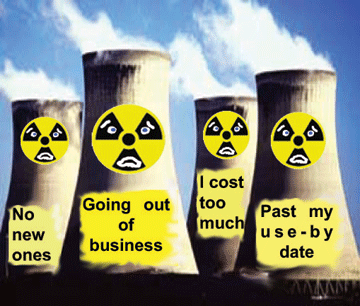 GlobalData’s report shows that more than 200 nuclear power stations across the world are expected to be closed by 2030, almost half of the number that are currently in operation.
Europe to Decommission Majority of Nuclear Power Stations by 2030 http://www.globaldata.com/PressReleaseDetails.aspx?PRID=174&Type=Industry&companyID=jpr Europe to Decommission Majority of Nuclear Power Stations by 2030 While US Bucks Global Trend 06 Jun 2012 Continue reading
USA devised Stuxnet computer worm to attack Iran’s nukes, says new book

 Obama ‘gave full backing to Stuxnet attack on Iran’ http://www.newscientist.com/blogs/onepercent/2012/06/obama-gave-full-backing-to-stu.html 1 June 2012 When George W Bush handed over the presidential reins to Barack Obama in 2008, he asked that the incoming man continue running what he regarded as two of his administration’s most promising security programs: the remotely-piloted drone war against Al Qaeda in Afghanistan – and the development of a cyberweapon nicknamed ‘the bug’, aimed at destroying Iran’s nascent nuclear capability.
Obama agreed – but we have now come to know that bug by another name: Stuxnet.
This revelation is at the heart of an apparently impeccably-sourced book due to be  published in the US on 5 June. In Confront and Conceal: Obama’s Secret Wars and Surprising Use of American Power, author David Sanger alleges that Stuxnet, which eventually wrecked hundreds of uranium centrifuges in Iran in 2010, was created by cyberweapons experts at the US National Security Agency in collaboration with ‘Unit 8200’, a cyber operation of Israeli intelligence. Continue reading
Distributed solar power for millions of the world’s poor
Barefoot Power’s products are brightening up the lives of those with limited or no access to grid power. Products range from single desk lamps to complete kits for use by homes, clinics and schools. With good links to microfinance organisations and exceptional customer care, Barefoot has sold more than 400,000 lanterns and lighting kits to two million rural poor in Africa,Asia Pacific, India and the Americas.
 Solar power pioneer wins global green energy award, PR Wire 1 June 12, A company specialising in providing affordable solar power products to remote rural communities has won a coveted Ashden Award for its work in Africa.
Barefoot Power was awarded some £20,000 in prize money at a prestigious ceremony in London this evening after joining other Award winners at a meeting with His Royal Highness the Prince of Wales at Clarence House in the morning.
The Ashden judges said: “With its astonishing sales figures, Barefoot is a fantastic example of a market-led solution to bringing renewable electricity to Africa’s rural poor. Through its network of micro-entrepreneurs it is overcoming the barriers of how to access remote communities and how to make solar power affordable.” Continue reading
USA’s Nuclear Regulatory Commission’s real role is to PROMOTE nuclear power
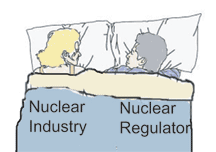
 Nuclear Rubberstamp Commission HUFFINGTON POST, Karl Grossman, 05/30/2012“… The resignation last week of the chairman of the U.S. Nuclear Regulatory Commission is another demonstration of the bankrupt basis of the NRC. Gregory Jaczko repeatedly called for the NRC to apply “lessons learned” from the Fukushima Daiichi nuclear plant disaster in Japan. And, for that, the nuclear industry — quite successfully — went after him fiercely.
The New York Times, in an editorial over the weekend , said that President Obama’s choice to replace Jaczko, Allison Macfarlane, “will need to be as independent and aggressive as Dr. Jaczko.”
That misses the institutional point.
The NRC was created in 1974 when Congress abolished the U.S. Atomic Energy Commission after deciding that the AEC’s dual missions of promoting and at the same time regulating nuclear power were deemed a conflict of interest. The AEC was replaced by the NRC, which was to regulate nuclear power, and a Department of Energy was later formed to advocate for it.
However, the same extreme pro-nuclear culture of the AEC continued on at the NRC. It has partnered with the DOE in promoting nuclear power.
Indeed, neither the AEC, in its more than 25 years, nor the NRC, in its nearly 30 years, ever denied an application for a construction or operating license for a nuclear power plant anywhere, anytime in the United States.
The NRC is a rubberstamp for the nuclear industry. “NRC stands for Nuclear Rubberstamp Commission,” says Kevin Kamps of the organization Beyond Nuclear. And it isn’t that Jaczko opposed nuclear power. “Greg is not anti-nuclear, but he’s pro-nuclear in a smart and considered way,” says Christopher Paine , director of the nuclear program at the Natural Resources Defense Council. Continue reading
Distributed solar energy, and distributed energy storage
In-Depth: Germany’s 22 GW Solar Energy Record Clean Technica, MAY 31, 2012 BY THOMAS“…….Millions of Batteries in Buildings — Utopian? …… it is very easy to show that it’s just a matter of time until the combination of energy storage for homes with rooftop solar energy and/or small-wind becomes viable and even profitable.
Today, there are still about 6.4 million oil tanks in homes and buildings all over Germany storing energy in the form heating oil. Installing such a tank costs several thousand Euros today. So, why shouldn’t independent power producers start putting up new forms of energy storage in the same numbers as soon as it makes economic sense?
How would 6 million home storage systems change the energy system? Well, 6 million 10 kW / 25 kWh would mean a distributed storage system with 60 GW maximum output/input and 150 GWh of capacity. That’s already enough storage for 10% of the current daily consumption, more than enough to power all German households through the night. It’s also coming a long way to fill the gap between renewable baseload power (hydro and biomass) and variable sources like wind and solar.
That 10-kW/25-kWh battery is not fiction by the way. It’s quite similar to the battery pack that powers the Nissan Leaf right now, Just one battery that will soon reach production volumes in the hundreds of thousands as factories in Japan, Europe, and the US crank up production by 2013.
It’s true that the $15,000 price tag for the battery is too high right now. But, since all kinds of competitors are investing in this market, economics of scale, innovation and optimization will certainly reduce the cost of such batteries in the coming years. In the case of multi-kWh batteries, this development is a lot more obvious than what happened with the price for solar cells just 7 years ago. The fall of prices surprised many analysts back then. Today, prices for solar cells are 70%-80% cheaper than what they were in 2007, putting the cost of solar systems well below $2 per Watt in Germany…. .. https://mail.google.com/mail/u/0/?shva=1#inbox/137a6ed1432cd545
USA’s Nuclear Regulatory Commission weakening the rules on nuclear safety
“successful implementation of existing mitigation measures can prevent reactor core damage or delay or reduce offsite releases of radioactive material.” Tell that to the people impacted by Chernobyl and Fukushima.
the NRC is holding a meeting with DOE and the industry’s Electric Power Research Institute on extending licenses to 80 years. Consider the reliability of an 80-year-old car….
 Nuclear Rubberstamp Commission HUFFINGTON POST, Karl Grossman, 05/30/2012“……..At the NRC in recent months a move has begun to negate what has been its benchmark analysis on the impacts of nuclear plant accidents. “Calculation Reactor Accident Consequences 2,” referred to as the CRAC-2 report. Issued in 1982, it projects the impacts from a meltdown with a breach of containment at every nuclear plant in the U.S. Continue reading
Confusion in estimating Fukushima radiation
TEPCO estimate sees more radiation than NISA’s, The Yomiuri Shimbun, 24 May 12 Tokyo Electric Power Co. has estimated the total amount of radioactive substances discharged from its Fukushima No. 1 nuclear power plant measured 760,000 terabecquerels, 1.6 times the estimate released by the Economy, Trade and Industry Ministry’s Nuclear and Industrial Safety Agency in February. Continue reading
Plutonium’s deadly history
 The Manhattan Project’s Fatal “Demon Core”, Physics Central, May 21, 2012 Sixty six years ago today, Louis Slotin saw a flash of blue light in the depths of Los Alamos National Laboratory. Seconds before, all that separated the young scientist from a lethal dose of radiation was a thin screwdriver.
The screwdriver supported a reflective covering that encased a sphere of plutonium, and if the reflector fell into place, a nuclear chain reaction would commence. When Slotin’s hand slipped, a lethal burst of radiation hit him, and he died nine days later. Continue reading
Majority of Americans want renewable energy, see USA politics as corrupt
the public has clearly picked up on the fact that corrupt politics is a key reason we don’t have more of that. 82% of Americans (69% of Republicans, 84% of Independents, and 95% of Democrats) agree with this statement: “The time is now for a new, grassroots-driven politics to realize a renewable energy future.
76% of Americans Want Clean Energy Instead of Nuclear, Natural Gas, & Coal Clean Technica MAY 15, 2012 BY ZACHARY SHAHAN Yet another recent poll showed that Americans really support clean energy, across political affiliations (though, there’s clearly more support on the left).
The ORC International survey, conducted for the nonprofit and nonpartisan Civil Society Institute (CSI), found that 76% of Americans (58% of Republicans, 83% of Independents, and 88% of Democrats) want to see ”a reduction in our reliance on nuclear power, natural gas and coal, and instead, launch a national initiative to boost renewable energy and energy efficiency.” (And who knows what the remaining 24% are smoking?) Continue reading
New devices to detect ionising radiation
Firms say new gear visually detects radiation hot spots, Japan Times, 18 May 12, A number of companies have started marketing equipment and devices that enable inspectors to visually detect radiation hot spots.
The devices are expected to be a great help to municipalities and construction companies engaged in decontamination work in areas affected by the nuclear crisis at Tokyo Electric Power Co.’s Fukushima No. 1 power plant.
Hitachi Consumer Electronics Co. has developed a camera that can detect gamma rays emitted by radioactive substances 10 or more meters away. The box-shaped device, which weighs 16.8 kg and measures 34 cm in all dimensions, is highly portable, the company says.
It detects three kinds of radioactive material — cesium-134, cesium-137 and iodine-131…..
http://www.japantimes.co.jp/text/nn20120518b1.html
Kent County Council opposes nuclear waste bunker plan
 Kent nuclear waste bunker proposal considered BBC News 16 May 12 A bunker used to store nuclear waste from all over the UK could be built in Kent, under a council’s plans. Shepway District Council is examining whether a nuclear disposal facility, where waste is buried underground, could be built at Romney Marsh. The authority said it could bring jobs to the area as Dungeness A and B power stations are phased out.

However, Kent County Council said it would use “every tool in the box” to oppose the scheme. The Romney Marsh Nuclear Research and Disposal Facility would be buried 200m (656ft) to 1,000m (3,280ft) below ground…..
Council leader’s ‘horror’ The leader of Kent County Council, Paul Carter, said his authority
opposed the plan and would push for a county-wide referendum if necessary. “We are totally opposed to initiating any process that even entertains the possibility of building a nuclear waste disposal site anywhere near or around Kent,” he said. “We will do everything possible to oppose this unviable proposal and will use every tool in the box to bring an end to this scheme…. http://www.bbc.co.uk/news/uk-england-kent-18086988
Challenge to Wyoming uranium mining project
Uranium Mining Environmental Consequences to Be Reviewed in Court, Switchboard, by Geoffrey Fettus, 14 May 12, For decades, uranium has been mined in ways that damage our waters and land, put our communities at risk, and cost taxpayers hundreds of millions of dollars in clean-up costs.
Now, for the first time in years, the environmental community has the chance to make its case before one of the crucial federal regulators on how we can do better. The stakes are high – especially for Western communities and their groundwater.
Last fall, NRDC and our Wyoming colleagues at the Powder River Basin Resources Council (PRBRC) challenged the proposed licensing of a planned uranium mine in Crook County, Wyoming. The mine would use a process known as “in-situ leach” mining. This method combines the mining and milling of uranium into a single step, by leaching uranium and other heavy metals off the surface of uranium-bearing rock in place.
Instead of actually digging up the uranium ore, in other words, this process extracts uranium by injecting water mixed with base solution into the rock formation in an underground aquifer, to dissolve the uranium from its host rock. The uranium-laden water flows into underground production wells and, from there, is pumped to the surface and piped to a centralized facility, which extracts the uranium.

We have written about the regulatory system and its numerous inadequacies . If you are really interested, I encourage you to read it. In brief, the Nuclear Regulatory Commission is the main licensing body for in-situ leach uranium mining. We are challenging that body’s decision to issue a license for the Wyoming mine. Continue reading
Finland’s plan for eternal storage of nuclear waste
there is the problem of time. HLW will remain dangerous for longer than civilization itself has existed. Future civilizations may not even have the ability to address the dangers—even if we could somehow warn them what they’re dealing with.

Meanwhile, the construction of new nuclear facilities continues apace, even in the U.S. Earlier this year, federal regulators granted licenses to construct two new plants in Georgia, the first such licenses in the U.S. since 1978. So our waste problem, and the world’s, will only get worse.
 Finland’s Crazy Plan to Make Nuclear Waste Disappear, Popular Mechanics, By Tim Heffernan 11 May 12, The U.S. plan to bury nuclear waste in Yucca Mountain may be dead, but in Finland, engineers are going ahead with a plan to build an enormous bunker to house the dangerous stuff. And they have a radical solution to keep future civilizations away—hide the nuclear waste somewhere so unremarkable and unpleasant that nobody would ever think to go there. Barring a disaster—or a miracle, depending on your viewpoint—the Finnish government later this year will begin the final licensing of the world’s first permanent storage facility for high-level nuclear waste. Continue reading
Archival test results of low level radiation do NOT show health benefits
 Reactor casualties 4 – The phony lost archive versus the real one. Paul Langley’s Nuclear History Blog, 11 May 12, In a recent issue of “Nature” claims are made of a “lost archive” of Cold War era animal tissue. The animals had been injected with radioactive isotopes in the USSR and the USA. 1,000s of animals were involved. Both nations’ governments wanted to know the effect of internalised substances which were radioactive. The claim in “Nature” involves the supposed recent “discovery” of these lost archives of tissue in both countries. Lo and behold, the quoted scientist claims that the tissue “proves” the health benefits of low dose radiation. Sound familiar?
Recycling plutonium more dangerous and costly than burying it
Experts urge Britain to bury plutonium rather than recycling
http://mainichi.jp/english/english/newsselect/news/20120510p2g00m0in010000c.html 10 May 12, WASHINGTON (Kyodo) — Four U.S. nuclear experts urged Britain to bury plutonium rather than recycling for fuel for nuclear reactors as it is more cost-effective, according to the British science journal Nature’s Thursday edition.
Citing an estimate in 2000 that recycling plutonium from spent fuel to make mixed oxide fuel adds $750 million each year to the cost of electric power generation in France, the four said, ”Britain should seriously evaluate the less costly and less risky method of direct
plutonium disposal, and take the opportunity to lead the world towards a better solution for reducing stockpiles.” Continue reading
1 This Month



26 September – International Day for the Total Elimination of Nuclear Weapons


PLEASE OPPOSE HR 8255 AND S.3639 – bills would accelerate satellite deployment, with no environmental review or safeguards – https://ncstd5li.quorum.us/campaign/169331/
To see nuclear-related stories in greater depth and intensity – go to https://nuclearinformation.wordpress.com
-
Archives
- September 2026 (269)
- August 2026 (330)
- July 2026 (355)
- June 2026 (287)
- May 2026 (306)
- April 2026 (356)
- March 2026 (251)
- February 2026 (267)
- January 2026 (308)
- December 2025 (358)
- November 2025 (359)
- October 2025 (375)
-
Categories
- 1
- 1 NUCLEAR ISSUES
- business and costs
- climate change
- culture and arts
- ENERGY
- environment
- health
- history
- indigenous issues
- Legal
- marketing of nuclear
- media
- opposition to nuclear
- PERSONAL STORIES
- politics
- politics international
- Religion and ethics
- safety
- secrets,lies and civil liberties
- spinbuster
- technology
- Uranium
- wastes
- weapons and war
- Women
- 2 WORLD
- ACTION
- AFRICA
- Atrocities
- AUSTRALIA
- Christina's notes
- Christina's themes
- culture and arts
- Events
- Fuk 2022
- Fuk 2023
- Fukushima 2017
- Fukushima 2018
- fukushima 2019
- Fukushima 2020
- Fukushima 2021
- general
- global warming
- Humour (God we need it)
- Nuclear
- RARE EARTHS
- Reference
- resources – print
- Resources -audiovicual
- Weekly Newsletter
- World
- World Nuclear
- YouTube
-
RSS
Entries RSS
Comments RSS

