Ionising radiation – the big cancer hazard for space travellers
Mission to Mars: The Radiation Problem. Smithsonian.com, 20 June 12, Would you go on a mission to Mars? The Dutch startup company Mars One is planning to establish the first Mars colony in 2023, starting with four individuals and adding more people every two years, funded by turning the whole endeavor into a reality TV show.
It’s just the latest plan to colonize the Red Planet, but I’m doubtful it will happen. There’s the expense, for sure, and the trials of trying to convince anyone to go on a one-way journey with just a few other strangers (what if you don’t get along? It’s not like you can leave). And then there’s the radiation problem.
Out in space, there are gamma rays from black holes, high-energy protons from the Sun, and cosmic rays from exploding stars. Earth’s atmosphere largely protects us from these types of radiation, but that wouldn’t help anyone traveling to Mars. They would be exposed to dangers that include neurological problems, loss of fertility and an increased risk of cancer….. A 2005 study found even more to worry about—the radiation would be high enough to cause cancer in 10 percent of men and 17 percent of women aged 25 to 34 if they were to go to Mars and back.
The easy solution would seem to be to shield the vessel that carries the humans to Mars, but no one has figured out how to do that. When the thin aluminum currently used to build spacecraft is hit with cosmic rays, it generates secondary radiation that is even more deadly. … http://blogs.smithsonianmag.com/science/2012/06/mission-to-mars-the-radiation-problem/
Global citizens’ monitoring of radiation data
Getting these devices out there — especially internationally — is a key to getting access to the world’s local radiation data.
The religious flag behind this project is the idea that this data should be accurate and open. Safecast uses open source and APIs and anyone can use the data to conduct research. For example a health researcher could use their radiation data to compare radiation levels against health information.
Local level radiation data is largely not available currently, or it’s owned by companies and not released.

 Using open source & grassroots to map the world’s radiation data http://gigaom.com/cleantech/using-open-source-grassroots-to-map-the-worlds-radiation-data/ By Katie Fehrenbacher Jun. 20, 2012, Mapping the world’s radiation and air pollution data, using one volunteer with one gadget at a time — that’s the goal of the Safecast project, which this week closed over $100,000 on Kickstarter to deliver a limited run of its open source geiger counters to interested buyers. “I don’t think it’s an unreasonable goal,” to create comprehensive maps of this data from all over the world, says Sean Bonner, co-founder of Safecast, in a phone interview shortly after his team’s project was funded.
Safecast originally focused on mapping radiation data just from Fukushima, Japan, in the wake of the nuclear disaster, and had a larger end goal to map the rest of Japan, too. But they realized that with enough eager volunteers in Japan, that mapping the entire country using geiger counters mounted on cars and held in the hands of regular citizens, was pretty doable. “It’s really only a matter of time before we’ve got all of Japan covered,” Continue reading
About the Flame computer virus
 Flame FAQ: All you need to know about the virus http://www.washingtonpost.com/blogs/blogpost/post/flame-faq-all-you-need-to-know-about-the-virus/2012/06/20/gJQAAlrTqV_blog.html By Benjamin Gottlieb
What is the Flame computer virus?
Flame is a sophisticated type of malware — short for malicious software — capable of infecting myriad computer networks for the purpose of gathering sensitive data. Once a network is infected by Flame, the virus can relay back massive amounts of information through a computer’s facilities. How does it work? Continue reading
Indian Point nuclear plant has three times the radioactivity of Fukushima’s spent fuel pools.
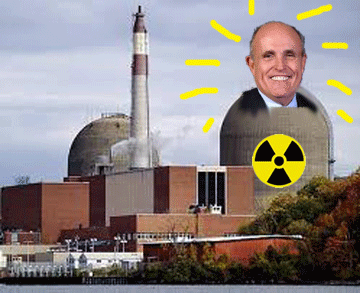 Wake Up and Smell the Radioactive Waste, OpEd News, 20 June 12, By Abby Luby“……Currently at Indian Point, 1,500 tons of high-level irradiated waste is stored in heavy steel and concrete casks on a tarmac a few hundred feet from the Hudson River. The Westchester-based plant produces about 30 tons of radioactive waste every 18 months, which is then crammed into two overcrowded, 40-foot deep spent fuel pools. Each pool holds about 1,000 tons of radioactive waste and has been leaking into the ground and river for years. However, the NRC has maintained that whatever leaches into the river is negligible, reiterating their catch phrase: “Dilution is the solution to pollution.”….
In a study by the Institute for Policy Studies, “Spent Nuclear Fuel Pools in the U.S.: Reducing the Deadly Risks of Storage,” Robert Alvarez, author and senior scholar for nuclear policy, said that Indian Point has three times the radioactivity of Fukushima’s spent fuel pools.
Indian Point is about 30 miles from Manhattan. A 1997 analysis, the Brookhaven National Laboratory [ http://pbadupws.nrc.gov/docs/ML0230/ML023040470.pdf – page 4] estimated a severe fire in a spent-fuel pool would release enough radioactive material to cause as many as 28,000 cancer deaths in a densely populated area and render 188 square miles uninhabitable.
In light of the Fukushima disaster and the potential for future leakage and catastrophic fires, the court ruled that the NRC’s analysis of the impacts of spent fuel storage was insufficient and is now requiring the agency to reassess the environmental impacts of the waste storage. Now it’s up to the NRC to heed the court and truly “protect the health and safety of the public.” http://www.opednews.com/articles/Wake-Up–Smell-the-Radioa-by-Abby-Luby-120614-180.html
Rosatom, Russia’s secretive, Mafia style, nuclear corporation
In 2002, a Russian scientist, well aware of covert activities by Russian authorities, declared to the Boston Globe that Rosatom is a “super-Mafia.” Secrecy is omnipotent within the governmental organization.

 Russia’s Dangerous Nuclear Legacy – Analysis Eurasia Review, By: Richard Rousseau June 18, 2012“……The post-Cold War world has an elusive international structure. Powerful global corporations, as well as international terrorist organizations, can frustrate a search for clarity and efficiency in fighting illicit activities in finance, economy, the organized crime, or smuggling of nuclear material.
In Russia, the main culprit is Rosatom. This relic of the Soviet system still operates largely
without independent oversight, especially since June 23, 2010, when President Dmitry Medvedev signed a decree that stated that Rostekhnadzor (the Federal Service for Ecological, Technological and Nuclear Supervision) would be henceforth under the direct control of
the government. Rosatom reports to no one in justifying how hundreds of millions of dollars are spent. Continue reading
Russia can’t afford new nuclear plants, and can’t afford to shut down old ones
The decommissioning of nuclear plants after exhausting their resources will put an enormous strain on Russian state budget. Largely for this reason, Rosatom is making every effort to prolong their operational life, knowing quite well that there will be economic shockwaves in the industry should nuclear units be closed.
Russia’s Dangerous Nuclear Legacy – Analysis Eurasia Review, By: Richard Rousseau June 18, 2012“…….The safety of nuclear reactors is primarily provided through the increased number of sophisticated security systems and physical barriers that limit or contain potential radiation leaks. These systems consist of a combination of natural and artificial barriers that work in tandem and complement each other in assuring the required
long-term isolation of the waste by preventing or limiting the movement of radioactive substances from the infrastructure of the repository to the biosphere.
However, in essence this has made nuclear plants increasingly more complex systems, which in turn drives up their construction and operation costs, while it is still impossible to achieve a 100 percent safety level. Continue reading
AREVA nuclear power company is in trouble
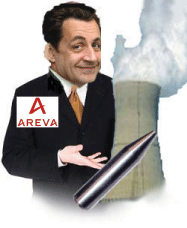 This renaissance is just a fairy tale, THE HINDU, 15 June 12, “…….In India, In Kalpakkam, , the Prototype Fast Breeder Reactor was slotted to contribute to the grid in March 2012. In 2005, Baldev Raj, Director of the Indira Gandhi Centre for Atomic Research, Kalpakkam, boasted that the 500 MW unit will be completed in 2010, 18 months before schedule.
Till date, there is no sign of this happening. The Kudankulam plant, which is now 23 years old since conception, lost only eight months due to protestors. In Jaitapur too, the government has more to worry about than local protestors.
Areva, the technology supplier, is in trouble. Last year, it announced losses of €1.6 billion, and the sacking of 1,200 workers in Germany. Last June, it decided to suspend production at a Virginia reactor component plant due to declining market prospects. Its expansion plans in France, the United Kingdom, and the U.S. may never materialise. Areva expected to sell 50 nuclear reactors this decade. It has not received a single order since 2007.
Now, with a socialist president at the helm in France, Areva’s future looks even more uncertain. French President François Hollande had promised voters a reduction in nuclear dependence from 75 to 50 per cent, and shutdown of an aging reactor in Fessenheim. Whether or not he carries through with these promises, it appears certain that no new
plants will be built or planned during his term.
Both conservative-led Germany and socialist France will make up the shortfall from the
nuclear phase-out, by investing in renewables for electricity and new jobs. In replacing nuclear with renewables, these nations are declaring that despite its carbon dividend, nuclear is too risky — financially, politically and environmentally — to pursue.
http://www.thehindu.com/opinion/op-ed/article3528968.ece

“Mentally ill”, “seditious” – govt labels for India’s anti nuclear protestors!
NIMHANS psychiatrists, to their shame, are striving to help people ”understand the  importance of the nuclear power plant.” They treat opposition to nuclear power as a disorder like schizophrenia, paranoia, or craving for victimhood.
 Demonising anti-nuclear protests, The Daily Star, Praful Bidwai, 15 June 12, So monumen-tally arrogant is India’s nuclear establishment that it brazenly brands its critics insane and in need of psychiatric treatment. It has asked the state-run National Institute of Mental Health and Neuro-Sciences (NIMHANS) to “counsel” the tens of thousands protesting against the Koodankulam nuclear power station in Tamil Nadu that it’s perfectly safe.
This marks a new offensive to impose nuclear power upon people who have resisted Koodankulam’s Russian-made reactors since 1988. After Fukushima, the presumption that fears about nuclear hazards are irrational betrays delusional insensitivity.
The police have filed 107 First Information Reports against an incredible 55,795 people in Koodankulam, charging 6,800 of them with ”sedition” and “waging war.” This sets a new record in harassment of popular protests anywhere. Leave alone sedition, there hasn’t been one violent incident during the seven-months-long Koodankulam protests. Continue reading
The “Nuclear Renaissance” – dead in the water
 This renaissance is just a fairy tale, THE HINDU, 15 June 12, NITYANAND JAYARAMAN”.….Germany and Switzerland have decided to phase out nuclear power,
despite their substantial dependence on it. Israel abandoned its year-old civilian nuclear programme after Fukushima. Belgium revived a pre-Fukushima decision to phase out nuclear power, using the Japanese disaster as a reminder. Italy and Kuwait gave up their nuclear debut by abandoning plans for 10 and four plants respectively. Mexico dropped plans for constructing 10 plants. All of Japan’s 54 reactors are now closed, and plans for 14 new reactors killed. Continue reading
Cyberweapons usher in the new arms race
Atomic scientists compare cyberwar to development of nuclear bomb Cyberbombs are the new atom bombs. Fox News, 15 June 12, The Bulletin of the Atomic Scientists warned Friday that the race to build and deploy cyberweapons — secret programs only recently discovered by security researchers, the extent of which is not yet fully known — closely resembles the race to build the first nuclear weapons.
“The parallels with the invention and first use of atomic bombs on Hiroshima and Nagasaki are eerie,” wrote Kennette Benedict  , the Bulletin’s executive director. The Bulletin of the Atomic Scientists was established in 1945 by scientists, engineers, and other experts who had created the atomic bomb as part of the Manhattan Project.
Its scientists also keep track of the doomsday clock, which warns of nuclear annihilation. Continue reading
Childhood leukaemia risk from very low exposure to ionising radiation

 Natural gamma rays linked to childhood leukaemia, University of Oxford, 12 June 12, A small but statistically significant link between risk of childhood leukaemia and the gamma rays we are all exposed to from our natural environment has been detected in a very large study led by Oxford University researchers.
Exposure to gamma rays from natural sources in the environment isn’t something that can readily be altered, but the study adds to our understanding of the small cancer risks associated with other low doses of radiation, such as from medical X-rays and CT scans. The findings demonstrate that there are small effects of radiation at very low doses.
Guidelines on exposure to low doses of radiation have largely been based on estimated risks from models using data from Japanese survivors of the atomic bombs, where radiation exposures were brief and very much higher. As a result, there have been some long-standing uncertainties about the extrapolation of these risks to low radiation doses.
The researchers conclude that the size of the increased risk of childhood leukaemia with natural gamma-ray exposure is consistent with these models and supports their continued use in radiation protection. The results of the study contradict the idea that there are no adverse radiation effects, or might even be beneficial effects, at these very low doses and dose rates. Continue reading
Comparing USA nuclear reactors with Fukushima reactors
nuclear reactors in the United States were built during the same time period as the Fukushima reactor, before 1980. These reactors were all built using the same 80-year-old technology, which is to say they’re all just as outdated as Fukushima and the materials and equipment used are all beginning to show the same signs of wear and tear.
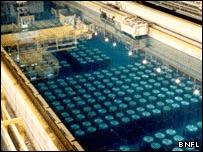 What makes this scenario even more alarming is that Gundersen says the reactors in the United States hold 4-5 times more nuclear waste than the Fukushima reactor.
Fukushima forum: Arnie Gundersen compares U.S. and Japanese nuclear reactors http://www.examiner.com/article/fukushima-forum-arnie-gundersen-compares-u-s-and-japanese-nuclear-reactors by Donna Anderson, 10 June 12 John B. Wells was at the helm for the Fukushima forum on the Saturday, June 9, 2012 edition of Coast to  Coast AM . The first guest was Arnie Gundersen who appeared on the show to share his expertise in the area of nuclear engineering and to make the American public more aware of the potential danger hiding in their own backyard.
Gundersen, who holds a master’s degree in nuclear engineering, has manged and coordinated design efforts for 70 nuclear reactors in the United States and has more than 40 years experience in nuclear power engineering. He’s currently working on the AP1000 nuclear power generator being built in South Carolina.
According to Gundersen the nuclear reactors in the United States were built during the same time period as the Fukushima reactor, before 1980. These reactors were all built using the same 80-year-old technology, which is to say they’re all just as outdated as Fukushima and the materials and equipment used are all beginning to show the same signs of wear and tear. Continue reading
Nuclear weapons industries control USA policy on military spending
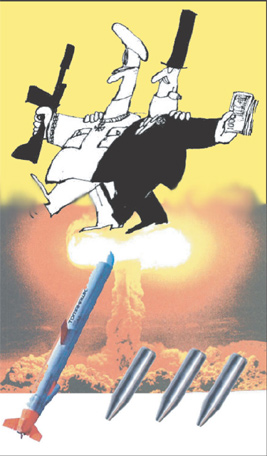 The Nuclear Weapons Industry’s Money Bombs, How millions in campaign cash and revolving-door lobbying have kept America’s atomic arsenal off the chopping block. — Mother Jones, By R. Jeffrey Smith, Center for Public
Integrity Jun. 6, 2012 Employees of private companies that produce the main pieces of the US nuclear arsenal have invested more than $18 million in the election campaigns of lawmakers that oversee related federal
spending, and the companies also employ more than 95 former members of Congress or Capitol Hill staff to lobby for government funding, according to a new report. Continue reading
Decommissioning nuclear reactors, expensive, but prudent, and cheaper than an accident
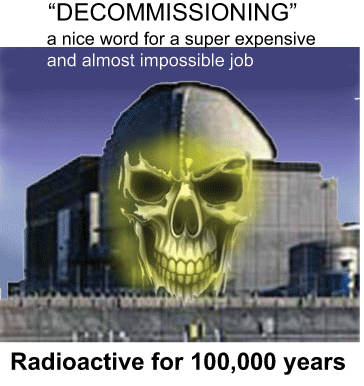 Europe’s approach is the prudent one…….America’s approach is to play russian roulette with 105 reactors that are already showing plenty of signs of serious wear and tear
 Europe’s challenge in decommissioning 150 nuclear reactors
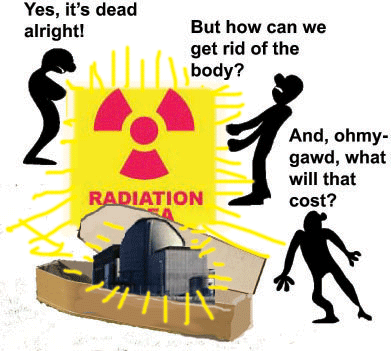 How hard is it to dismantle 150 nuclear reactors? Europe is about to find out http://www.washingtonpost.com/blogs/ezra-klein/post/how-hard-is-it-to-dismantle-150-nuclear-reactors-europes-about-to-find-out/2012/06/09/gJQA2EH0PV_blog.html
Brad Plumer, 06/09/2012 Last year, after the tsunami and reactor meltdown in Fukushima, Japan, many European nations decided to phase out their existing fleets of nuclear power plants. Germany and Belgium are aiming to end all atomic generation by 2030. Switzerland is shooting for 2035.
Not so easy to get rid of. Yet the mere act of shutting down those reactors is going to pose a huge challenge in the years ahead. Continue reading
1 This Month



26 September – International Day for the Total Elimination of Nuclear Weapons


PLEASE OPPOSE HR 8255 AND S.3639 – bills would accelerate satellite deployment, with no environmental review or safeguards – https://ncstd5li.quorum.us/campaign/169331/
To see nuclear-related stories in greater depth and intensity – go to https://nuclearinformation.wordpress.com
-
Archives
- September 2026 (269)
- August 2026 (330)
- July 2026 (355)
- June 2026 (287)
- May 2026 (306)
- April 2026 (356)
- March 2026 (251)
- February 2026 (267)
- January 2026 (308)
- December 2025 (358)
- November 2025 (359)
- October 2025 (375)
-
Categories
- 1
- 1 NUCLEAR ISSUES
- business and costs
- climate change
- culture and arts
- ENERGY
- environment
- health
- history
- indigenous issues
- Legal
- marketing of nuclear
- media
- opposition to nuclear
- PERSONAL STORIES
- politics
- politics international
- Religion and ethics
- safety
- secrets,lies and civil liberties
- spinbuster
- technology
- Uranium
- wastes
- weapons and war
- Women
- 2 WORLD
- ACTION
- AFRICA
- Atrocities
- AUSTRALIA
- Christina's notes
- Christina's themes
- culture and arts
- Events
- Fuk 2022
- Fuk 2023
- Fukushima 2017
- Fukushima 2018
- fukushima 2019
- Fukushima 2020
- Fukushima 2021
- general
- global warming
- Humour (God we need it)
- Nuclear
- RARE EARTHS
- Reference
- resources – print
- Resources -audiovicual
- Weekly Newsletter
- World
- World Nuclear
- YouTube
-
RSS
Entries RSS
Comments RSS

