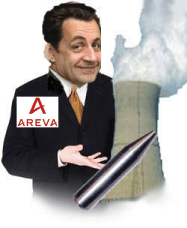
AREVA nuclear power company is in trouble
 This renaissance is just a fairy tale, THE HINDU, 15 June 12, “…….In India, In Kalpakkam, , the Prototype Fast Breeder Reactor was slotted to contribute to the grid in March 2012. In 2005, Baldev Raj, Director of the Indira Gandhi Centre for Atomic Research, Kalpakkam, boasted that the 500 MW unit will be completed in 2010, 18 months before schedule.
Till date, there is no sign of this happening. The Kudankulam plant, which is now 23 years old since conception, lost only eight months due to protestors. In Jaitapur too, the government has more to worry about than local protestors.
Areva, the technology supplier, is in trouble. Last year, it announced losses of €1.6 billion, and the sacking of 1,200 workers in Germany. Last June, it decided to suspend production at a Virginia reactor component plant due to declining market prospects. Its expansion plans in France, the United Kingdom, and the U.S. may never materialise. Areva expected to sell 50 nuclear reactors this decade. It has not received a single order since 2007.
Now, with a socialist president at the helm in France, Areva’s future looks even more uncertain. French President François Hollande had promised voters a reduction in nuclear dependence from 75 to 50 per cent, and shutdown of an aging reactor in Fessenheim. Whether or not he carries through with these promises, it appears certain that no new
plants will be built or planned during his term.
Both conservative-led Germany and socialist France will make up the shortfall from the
nuclear phase-out, by investing in renewables for electricity and new jobs. In replacing nuclear with renewables, these nations are declaring that despite its carbon dividend, nuclear is too risky — financially, politically and environmentally — to pursue.
http://www.thehindu.com/opinion/op-ed/article3528968.ece

“Mentally ill”, “seditious” – govt labels for India’s anti nuclear protestors!
NIMHANS psychiatrists, to their shame, are striving to help people ”understand the  importance of the nuclear power plant.” They treat opposition to nuclear power as a disorder like schizophrenia, paranoia, or craving for victimhood.
 Demonising anti-nuclear protests, The Daily Star, Praful Bidwai, 15 June 12, So monumen-tally arrogant is India’s nuclear establishment that it brazenly brands its critics insane and in need of psychiatric treatment. It has asked the state-run National Institute of Mental Health and Neuro-Sciences (NIMHANS) to “counsel” the tens of thousands protesting against the Koodankulam nuclear power station in Tamil Nadu that it’s perfectly safe.
This marks a new offensive to impose nuclear power upon people who have resisted Koodankulam’s Russian-made reactors since 1988. After Fukushima, the presumption that fears about nuclear hazards are irrational betrays delusional insensitivity.
The police have filed 107 First Information Reports against an incredible 55,795 people in Koodankulam, charging 6,800 of them with ”sedition” and “waging war.” This sets a new record in harassment of popular protests anywhere. Leave alone sedition, there hasn’t been one violent incident during the seven-months-long Koodankulam protests. Continue reading
The “Nuclear Renaissance” – dead in the water
 This renaissance is just a fairy tale, THE HINDU, 15 June 12, NITYANAND JAYARAMAN”.….Germany and Switzerland have decided to phase out nuclear power,
despite their substantial dependence on it. Israel abandoned its year-old civilian nuclear programme after Fukushima. Belgium revived a pre-Fukushima decision to phase out nuclear power, using the Japanese disaster as a reminder. Italy and Kuwait gave up their nuclear debut by abandoning plans for 10 and four plants respectively. Mexico dropped plans for constructing 10 plants. All of Japan’s 54 reactors are now closed, and plans for 14 new reactors killed. Continue reading
Cyberweapons usher in the new arms race
 Atomic scientists compare cyberwar to development of nuclear bomb Cyberbombs are the new atom bombs. Fox News, 15 June 12, The Bulletin of the Atomic Scientists warned Friday that the race to build and deploy cyberweapons — secret programs only recently discovered by security researchers, the extent of which is not yet fully known — closely resembles the race to build the first nuclear weapons.
“The parallels with the invention and first use of atomic bombs on Hiroshima and Nagasaki are eerie,” wrote Kennette Benedict  , the Bulletin’s executive director. The Bulletin of the Atomic Scientists was established in 1945 by scientists, engineers, and other experts who had created the atomic bomb as part of the Manhattan Project.
Its scientists also keep track of the doomsday clock, which warns of nuclear annihilation. Continue reading
Childhood leukaemia risk from very low exposure to ionising radiation

 Natural gamma rays linked to childhood leukaemia, University of Oxford, 12 June 12, A small but statistically significant link between risk of childhood leukaemia and the gamma rays we are all exposed to from our natural environment has been detected in a very large study led by Oxford University researchers.
Exposure to gamma rays from natural sources in the environment isn’t something that can readily be altered, but the study adds to our understanding of the small cancer risks associated with other low doses of radiation, such as from medical X-rays and CT scans. The findings demonstrate that there are small effects of radiation at very low doses.
Guidelines on exposure to low doses of radiation have largely been based on estimated risks from models using data from Japanese survivors of the atomic bombs, where radiation exposures were brief and very much higher. As a result, there have been some long-standing uncertainties about the extrapolation of these risks to low radiation doses.
The researchers conclude that the size of the increased risk of childhood leukaemia with natural gamma-ray exposure is consistent with these models and supports their continued use in radiation protection. The results of the study contradict the idea that there are no adverse radiation effects, or might even be beneficial effects, at these very low doses and dose rates. Continue reading
Comparing USA nuclear reactors with Fukushima reactors
nuclear reactors in the United States were built during the same time period as the Fukushima reactor, before 1980. These reactors were all built using the same 80-year-old technology, which is to say they’re all just as outdated as Fukushima and the materials and equipment used are all beginning to show the same signs of wear and tear.
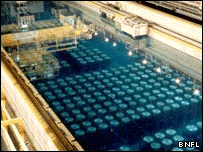 What makes this scenario even more alarming is that Gundersen says the reactors in the United States hold 4-5 times more nuclear waste than the Fukushima reactor.
Fukushima forum: Arnie Gundersen compares U.S. and Japanese nuclear reactors http://www.examiner.com/article/fukushima-forum-arnie-gundersen-compares-u-s-and-japanese-nuclear-reactors by Donna Anderson, 10 June 12 John B. Wells was at the helm for the Fukushima forum on the Saturday, June 9, 2012 edition of Coast to  Coast AM . The first guest was Arnie Gundersen who appeared on the show to share his expertise in the area of nuclear engineering and to make the American public more aware of the potential danger hiding in their own backyard.
Gundersen, who holds a master’s degree in nuclear engineering, has manged and coordinated design efforts for 70 nuclear reactors in the United States and has more than 40 years experience in nuclear power engineering. He’s currently working on the AP1000 nuclear power generator being built in South Carolina.
According to Gundersen the nuclear reactors in the United States were built during the same time period as the Fukushima reactor, before 1980. These reactors were all built using the same 80-year-old technology, which is to say they’re all just as outdated as Fukushima and the materials and equipment used are all beginning to show the same signs of wear and tear. Continue reading
Nuclear weapons industries control USA policy on military spending
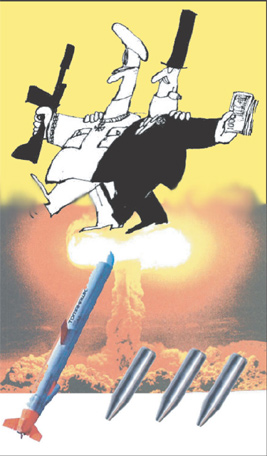 The Nuclear Weapons Industry’s Money Bombs, How millions in campaign cash and revolving-door lobbying have kept America’s atomic arsenal off the chopping block. — Mother Jones, By R. Jeffrey Smith, Center for Public
Integrity Jun. 6, 2012 Employees of private companies that produce the main pieces of the US nuclear arsenal have invested more than $18 million in the election campaigns of lawmakers that oversee related federal
spending, and the companies also employ more than 95 former members of Congress or Capitol Hill staff to lobby for government funding, according to a new report. Continue reading
Decommissioning nuclear reactors, expensive, but prudent, and cheaper than an accident
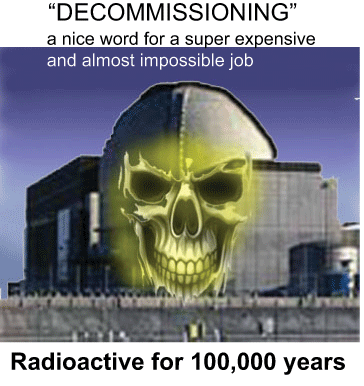 Europe’s approach is the prudent one…….America’s approach is to play russian roulette with 105 reactors that are already showing plenty of signs of serious wear and tear
 Europe’s challenge in decommissioning 150 nuclear reactors
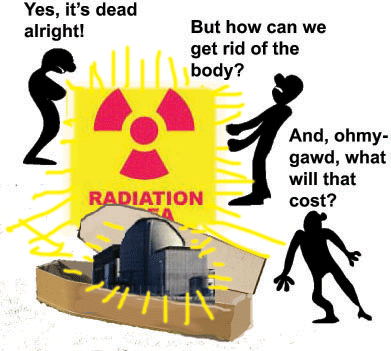 How hard is it to dismantle 150 nuclear reactors? Europe is about to find out http://www.washingtonpost.com/blogs/ezra-klein/post/how-hard-is-it-to-dismantle-150-nuclear-reactors-europes-about-to-find-out/2012/06/09/gJQA2EH0PV_blog.html
Brad Plumer, 06/09/2012 Last year, after the tsunami and reactor meltdown in Fukushima, Japan, many European nations decided to phase out their existing fleets of nuclear power plants. Germany and Belgium are aiming to end all atomic generation by 2030. Switzerland is shooting for 2035.
Not so easy to get rid of. Yet the mere act of shutting down those reactors is going to pose a huge challenge in the years ahead. Continue reading
Half of the world’s nuclear reactors will be closed down by 2030
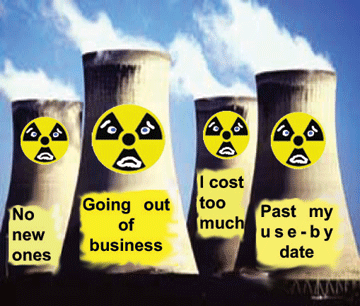 GlobalData’s report shows that more than 200 nuclear power stations across the world are expected to be closed by 2030, almost half of the number that are currently in operation.
Europe to Decommission Majority of Nuclear Power Stations by 2030 http://www.globaldata.com/PressReleaseDetails.aspx?PRID=174&Type=Industry&companyID=jpr Europe to Decommission Majority of Nuclear Power Stations by 2030 While US Bucks Global Trend 06 Jun 2012 Continue reading
USA devised Stuxnet computer worm to attack Iran’s nukes, says new book

 Obama ‘gave full backing to Stuxnet attack on Iran’ http://www.newscientist.com/blogs/onepercent/2012/06/obama-gave-full-backing-to-stu.html 1 June 2012 When George W Bush handed over the presidential reins to Barack Obama in 2008, he asked that the incoming man continue running what he regarded as two of his administration’s most promising security programs: the remotely-piloted drone war against Al Qaeda in Afghanistan – and the development of a cyberweapon nicknamed ‘the bug’, aimed at destroying Iran’s nascent nuclear capability.
Obama agreed – but we have now come to know that bug by another name: Stuxnet.
This revelation is at the heart of an apparently impeccably-sourced book due to be  published in the US on 5 June. In Confront and Conceal: Obama’s Secret Wars and Surprising Use of American Power, author David Sanger alleges that Stuxnet, which eventually wrecked hundreds of uranium centrifuges in Iran in 2010, was created by cyberweapons experts at the US National Security Agency in collaboration with ‘Unit 8200’, a cyber operation of Israeli intelligence. Continue reading
Distributed solar power for millions of the world’s poor
Barefoot Power’s products are brightening up the lives of those with limited or no access to grid power. Products range from single desk lamps to complete kits for use by homes, clinics and schools. With good links to microfinance organisations and exceptional customer care, Barefoot has sold more than 400,000 lanterns and lighting kits to two million rural poor in Africa,Asia Pacific, India and the Americas.
Solar power pioneer wins global green energy award, PR Wire 1 June 12, A company specialising in providing affordable solar power products to remote rural communities has won a coveted Ashden Award for its work in Africa.
Barefoot Power was awarded some £20,000 in prize money at a prestigious ceremony in London this evening after joining other Award winners at a meeting with His Royal Highness the Prince of Wales at Clarence House in the morning.
The Ashden judges said: “With its astonishing sales figures, Barefoot is a fantastic example of a market-led solution to bringing renewable electricity to Africa’s rural poor. Through its network of micro-entrepreneurs it is overcoming the barriers of how to access remote communities and how to make solar power affordable.” Continue reading
USA’s Nuclear Regulatory Commission’s real role is to PROMOTE nuclear power
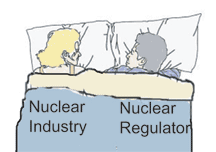
 Nuclear Rubberstamp Commission HUFFINGTON POST, Karl Grossman, 05/30/2012“… The resignation last week of the chairman of the U.S. Nuclear Regulatory Commission is another demonstration of the bankrupt basis of the NRC. Gregory Jaczko repeatedly called for the NRC to apply “lessons learned” from the Fukushima Daiichi nuclear plant disaster in Japan. And, for that, the nuclear industry — quite successfully — went after him fiercely.
The New York Times, in an editorial over the weekend , said that President Obama’s choice to replace Jaczko, Allison Macfarlane, “will need to be as independent and aggressive as Dr. Jaczko.”
That misses the institutional point.
The NRC was created in 1974 when Congress abolished the U.S. Atomic Energy Commission after deciding that the AEC’s dual missions of promoting and at the same time regulating nuclear power were deemed a conflict of interest. The AEC was replaced by the NRC, which was to regulate nuclear power, and a Department of Energy was later formed to advocate for it.
However, the same extreme pro-nuclear culture of the AEC continued on at the NRC. It has partnered with the DOE in promoting nuclear power.
Indeed, neither the AEC, in its more than 25 years, nor the NRC, in its nearly 30 years, ever denied an application for a construction or operating license for a nuclear power plant anywhere, anytime in the United States.
The NRC is a rubberstamp for the nuclear industry. “NRC stands for Nuclear Rubberstamp Commission,” says Kevin Kamps of the organization Beyond Nuclear. And it isn’t that Jaczko opposed nuclear power. “Greg is not anti-nuclear, but he’s pro-nuclear in a smart and considered way,” says Christopher Paine , director of the nuclear program at the Natural Resources Defense Council. Continue reading
Distributed solar energy, and distributed energy storage
In-Depth: Germany’s 22 GW Solar Energy Record Clean Technica, MAY 31, 2012 BY THOMAS“…….Millions of Batteries in Buildings — Utopian? …… it is very easy to show that it’s just a matter of time until the combination of energy storage for homes with rooftop solar energy and/or small-wind becomes viable and even profitable.
Today, there are still about 6.4 million oil tanks in homes and buildings all over Germany storing energy in the form heating oil. Installing such a tank costs several thousand Euros today. So, why shouldn’t independent power producers start putting up new forms of energy storage in the same numbers as soon as it makes economic sense?
How would 6 million home storage systems change the energy system? Well, 6 million 10 kW / 25 kWh would mean a distributed storage system with 60 GW maximum output/input and 150 GWh of capacity. That’s already enough storage for 10% of the current daily consumption, more than enough to power all German households through the night. It’s also coming a long way to fill the gap between renewable baseload power (hydro and biomass) and variable sources like wind and solar.
That 10-kW/25-kWh battery is not fiction by the way. It’s quite similar to the battery pack that powers the Nissan Leaf right now, Just one battery that will soon reach production volumes in the hundreds of thousands as factories in Japan, Europe, and the US crank up production by 2013.
It’s true that the $15,000 price tag for the battery is too high right now. But, since all kinds of competitors are investing in this market, economics of scale, innovation and optimization will certainly reduce the cost of such batteries in the coming years. In the case of multi-kWh batteries, this development is a lot more obvious than what happened with the price for solar cells just 7 years ago. The fall of prices surprised many analysts back then. Today, prices for solar cells are 70%-80% cheaper than what they were in 2007, putting the cost of solar systems well below $2 per Watt in Germany…. .. https://mail.google.com/mail/u/0/?shva=1#inbox/137a6ed1432cd545
USA’s Nuclear Regulatory Commission weakening the rules on nuclear safety
“successful implementation of existing mitigation measures can prevent reactor core damage or delay or reduce offsite releases of radioactive material.” Tell that to the people impacted by Chernobyl and Fukushima.
the NRC is holding a meeting with DOE and the industry’s Electric Power Research Institute on extending licenses to 80 years. Consider the reliability of an 80-year-old car….
Nuclear Rubberstamp Commission HUFFINGTON POST, Karl Grossman, 05/30/2012“……..At the NRC in recent months a move has begun to negate what has been its benchmark analysis on the impacts of nuclear plant accidents. “Calculation Reactor Accident Consequences 2,” referred to as the CRAC-2 report. Issued in 1982, it projects the impacts from a meltdown with a breach of containment at every nuclear plant in the U.S. Continue reading
1 This Month

4 May -West Suburban Peace Coalition to discuss Iran war at May Educational Forum
Monday, May 4, 7:00 – 8:00 PM Central Standard Time
Title: : How Trump’s Narrative Tries to Shape the Reality of the War on Iran.
Contact Walt Zlotow, zlotow@hotmail.com 630 442 3045 for further information
14 May – online event From Bombs to Data Centres: the Face of Nuclear Colonialism
To see nuclear-related stories in greater depth and intensity – go to https://nuclearinformation.wordpress.com
-
Archives
- May 2026 (37)
- April 2026 (356)
- March 2026 (251)
- February 2026 (268)
- January 2026 (308)
- December 2025 (358)
- November 2025 (359)
- October 2025 (376)
- September 2025 (257)
- August 2025 (319)
- July 2025 (230)
- June 2025 (348)
-
Categories
- 1
- 1 NUCLEAR ISSUES
- business and costs
- climate change
- culture and arts
- ENERGY
- environment
- health
- history
- indigenous issues
- Legal
- marketing of nuclear
- media
- opposition to nuclear
- PERSONAL STORIES
- politics
- politics international
- Religion and ethics
- safety
- secrets,lies and civil liberties
- spinbuster
- technology
- Uranium
- wastes
- weapons and war
- Women
- 2 WORLD
- ACTION
- AFRICA
- Atrocities
- AUSTRALIA
- Christina's notes
- Christina's themes
- culture and arts
- Events
- Fuk 2022
- Fuk 2023
- Fukushima 2017
- Fukushima 2018
- fukushima 2019
- Fukushima 2020
- Fukushima 2021
- general
- global warming
- Humour (God we need it)
- Nuclear
- RARE EARTHS
- Reference
- resources – print
- Resources -audiovicual
- Weekly Newsletter
- World
- World Nuclear
- YouTube
-
RSS
Entries RSS
Comments RSS
 nuclear-news