Nuclear industry fleeces taxpayers again – Small Modular Nuclear Reactors
Golden Fleece Award Goes to Department of Energy for Federal Spending on Small Modular Reactors http://www.taxpayer.net/library/article/golden-fleece-award-goes-to-department-of-energy-for-federal-spending-on-sm $100 Million in “Mini Nuke” Corporate Welfare Already Doled Out, Another Half Billion Dollars Or More in the Pipeline for Major Corporations that Could Pay for Own R&D, Licensing
WASHINGTON, D.C. – The federal government is in the process of wasting more than half a billion dollars to pay large, profitable companies for what should be their own expenses for research & development (R&D) and licensing related to “small modular reactors” (SMRs), which would be about a third of the size or less of today’s large nuclear reactors. In response, the nonpartisan group Taxpayers for Common Sense today handed out its latest “Golden Fleece Award” to the Department of Energy for the dollars being wasted on SMRs.

Titled “Taxpayer Subsidies for Small Modular Reactors,” a related TCS background report is available online here……
In making the Golden Fleece Award, Taxpayers for Common Sense highlighted the following issues: Continue reading
USA Federal Subsidies for Small Modular Reactors
Department Of Energy’s Small Modular Reactor Program
Savannah River Nuclear Development Site
Taxpayer Subsidies for Small Modular Reactors Taxpayers for Common Sense February 27, 2013 Download: Golden Fleece: Taxpayer Subsidies for Small Nuclear Reactors (pdf) “…..Federal Subsidies for Small Modular Reactors Federal support for SMRs is provided through a subsidy program for commercial nuclear power that can be traced back to the 1950s when federal subsidies for nuclear power reached astronomical levels. Not only did the government develop reactor and enrichment technology for the private sector, it also assumed legal responsibility for nuclear waste disposal, something never done for any other industry. In addition, the government issued multimillion-dollar development grants for many reactor technologies (most since abandoned) and distributed research reactors around the world. Continue reading
Hydraulic fracking causing radiation problem in water
 Report says drilling is creating radiation problems in Ohio Ohio,com.By BOB DOWNING June 14, 2013 The FreshWater Accountability Project Ohio (www.FWAPOH.com) today released a report on the presence and dangers of radiation present throughout the horizontal hydraulic fracturing (fracking) industry that is extracting minerals in Ohio.
The report, authored by Dr. Marvin Resnikoff, a longtime expert on radioactive waste management and since 1992, on radiation hazards from oil and gas drilling, details the serious problem associated with bringing up long-buried radium and other naturally-occurring hazards from thousands of feet underground.
The radiation is associated directly with the “hottest” areas of gas and oil productivity in deep shale layers and is an inevitable and burgeoning waste problem.
Resnikoff points out that much of the highly-radioactive solids such as rocks and soils pulled up during drilling, and contaminated muds and sands are cheaply disposed of in municipal landfills in Ohio, irrespective of actual radioactivity content, for 1/100th of the cost of disposal of comparable low-level radioactive waste from nuclear weapons and nuclear power generation in the nation’s three facilities for that purpose.
n Ohio, he stated, “It is evident that environmental concerns are trumped by the economics beneficial to the unconventional shale drilling industry.” Similarly, Dr. Resnikoff identified evidence that the Patriot water treatment facility in Warren, Ohio, which delivers pretreated water to the Warren public water treatment plant, is likely sending radium-laden water into the Mahoning River watershed. “On a daily basis, Patriot does not test for gamma emitting radionuclides and for radium-226,” he observed.
The expert also performed calculations showing that transport of radioactive liquid waste by tank truck greatly exceed federal thresholds which require specific tank design, minimum insurance under federal regulations of $5 million per shipment, and signage to be prominently located which identify the load as radioactive material.
The report notes that all three sets of federal regulations are being routinely violated which means State of Ohio regulations are clearly inadequate for this hazardous material, and possibly illegal…… http://www.ohio.com/blogs/drilling/ohio-utica-shale-1.291290/report-says-drilling-is-creating-radiation-problems-in-ohio-1.405891
Dangerously high global temperatures
Global Temperature Nearing Dangerous Levels, Says Study
http://au.ibtimes.com/articles/478736/20130614/climate-change-global-warming-carbon-emissions.htm#.UbzW_-dwo6I
Greenhouse gas emissions are dangerously rising at an alarming level. The abnormally fast growth rate could push the Earth beyond the safe limit in terms of average global temperature. The report is based on the study conducted by the International Energy Agency (IEA). Rising temperatures have profound effects on economic growth, agriculture, water and energy supply, and public health.

According to the IEA, carbon emissions increased by 1.4 per cent. This means an additional 31.6 gigatons of carbon dioxide were released into the air. The IEA is a research group organised by industrialised nations to monitor climate change. Continue reading
Safety and insurance problems for Small Modular Nuclear Reactors (SMRs)
Although significantly smaller than traditional reactors, SMRs will still require significant insurance in the event of an accident. New nuclear reactors are currently covered by the Price-Anderson Act for accidents valued at over $12.6 billion. Price-Anderson may fall dramatically short in the case of SMRs
Taxpayer Subsidies for Small Modular Reactors Taxpayers for Common Sense February 27, 2013 Download: Golden Fleece: Taxpayer Subsidies for Small Nuclear Reactors (pdf)
“……..Current Applicants Seeking Federal Subsidies
Five small modular reactor projects have applied for support from DOE to date, but none of the five different reactor designs have been licensed by the NRC. NRC and DOE aim to award the first design certification license by 2018 and final construction/operating license by the early 2020s. Currently, all five projects are in the pre-application phase with NRC working towards initial design certification.
All but one SMR project would develop an integral pressurized light water reactor (iPWR) while the other would develop a fast neutron reactor (FNR)…… Continue reading
Four types of radioactive isotopes emitted during a nuclear accident
 How Does Radiation Affect the Body? Big Think, by MICHIO KAKU APRIL 16, 2011, “……Four different types of radiation are emitted during a nuclear accident like the Fukushima meltdown: iodine, cesium, strontium, and potassium. Physicist Michio Kaku, spoke with Big Think this week about these different types of radiation and the effect each one has on the human body. Like Chernobyl, he said, the main problem has been radioactive iodine: “That’s why people have been taking potassium iodide pills—to flood the thyroid glands.” But potassium
iodide pills are not “radiation pills,” he added. They protect against just one byproduct—iodine 131—not against cesium, strontium, or the extremely dangerous plutonium.

Below are these four different radioactive isotopes, their half-lives, and the types of cancer with which they are most often associated. Continue reading
Nuclear Regulatory Commission will take safety allegations seriously
 Nuclear Energy Activist Toolkit #8: Allegations, Union of Concerned Scientists Dave Lochbaum, director, Nuclear Safety Project June 11, 2013 The NRC’s Allegations Program handles accusations that NRC’s requirements are being violated. The NRC receives allegations from workers at NRC-licensed facilities as well as from other sources. For example, workers sometimes seek to protect their identities (and their jobs) by voicing their concerns to media and groups like UCS. The NRC’s 250-word definition of allegation contains three footnotes containing 206 words of “clarification.” Ignoring that legal mumbo-jumbo, the NRC’s Allegations Program looks into reports that the agency’s requirements may have been violated.
The NRC can process allegations submitted anonymously, but would prefer to know the sources of allegations. The NRC seeks to ensure it correctly understands the allegations before dispatching inspectors to examine the issues. And sometimes the NRC re-contacts sources for additional information during the course of its investigations. The NRC also sends a letter summarizing the scope of its investigation and its findings to sources it knows.
With very few exceptions (such as when an allegation is made in a newspaper article or posted on a website), the NRC treats all sources confidentially even within the agency. For example, while the NRC’s allegations staff know the identity of a source, the NRC’s inspectors who investigate the allegations would not know this information…… Continue reading
UNSCEAR’s skewed message about Fukushima radiation
 Fukushima and the nuclear industry’s fight against fear, Independent Australia, 12 June 13, Now that the Fukushima meltdown has faded from public consciousness, says Noel Wauchope, the nuclear industry is trying to persuade the world there is nothing to fear from fission.“…… how come that the World Nuclear Association and the media can be so confident that the main task now is to overturn that unwarranted fear?
They are relying largely on phone interviews with some members of The United Nations Scientific Committee on the Effects of Atomic Radiation (UNSCEAR) ― notably UNSCEAR chair, Wolfgang Weiss. On 31 May, UNSCEAR released ‒ not an extensive official report ‒ but a brief preliminary report on Fukushima radiation and health ― the full report will be presented at the United Nations in October this year. The world press has been quoting this statement from this unofficial UNSCEAR press release
‘It is unlikely to be able to attribute any health effects in the future among the general public and the vast majority of workers.’ But the World Health Organisation’s comprehensive report (February 2013) concluded that an increased rate of breast cancer is to be expected in future years amongst women who were children when exposed to low level Fukushima radiation. It also predicted increased leukaemia amongst Fukushima clean-up workers.
If you dissect the UNSCEAR statement, you can see how very carefully it is worded so that it does not contradict the World Health Organisation. Continue reading
Demolishing San Onofre nuclear plant – 50 years and $billions in costs
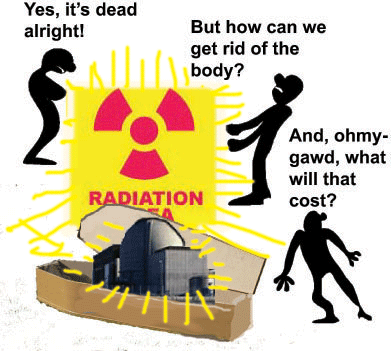 A long cooling-off period for San Onofre nuclear plant http://articles.latimes.com/2013/jun/08/local/la-me-san-onofre-nuclear-20130609 Tearing down San Onofre’s two nuclear reactors will be a technically complex job completed over decades. It’s likely Southern California Edison will first mothball the plant.|By Ralph Vartabedian, Los Angeles Times
Southern California Edison built San Onofre’s two nuclear reactors in about nine years, but tearing them down will be a technically complex, multibillion-dollar job completed over decades. It is likely that Edison first will mothball the plant, which under federal rules could keep its imposing imprint on the Orange-San Diego County coastline for another half-century.
When the plant does come down, it will be a massive job.
Tons of highly radioactive fuel now stored in pools will have to cool before the rods can be moved to concrete pads outdoors. Giant pipes that extend more than a mile into the ocean will have to come out. Pieces of the reactors will have to be cut with special saws and torches that reach 20 feet into the vessels’ cooling water. Continue reading
Patterns of Fukushima radiation in Northern hemisphere
 Study: Fukushima fuel burn-up spread over entire northern hemisphere’s middle latitudes — First time measured in southern hemisphere http://enenews.com/study-fukushima-fuel-burn-up-dispersed-over-entire-northern-hemispheres-middle-latitudes-first-time-also-measured-in-southern-hemisphere
Title: An overview of Fukushima radionuclides measured in the northern hemisphere
Source: Science of The Total Environment
Author: P. Thakura, S. Ballard, R. Nelson
Date: August 1, 2013
Abstract
The Great East Japan Earthquake and tsunami on March 11, 2011 resulted in the tragic accident at the Fukushima Nuclear Power Plant (NPP) and subsequently uncontrolled release of radioactive contaminants into the atmosphere. This review article attempts to compile and interpret data collected by various national and international monitoring networks in response to the Fukushima releases across the northern hemisphere. The majority of the releases occurred during the period March 12–22 with a maximum release phase from March 14–17, 2011. The radioactivity released was dominated by volatile fission products including isotopes of the noble gases (xenon and krypton), iodine, cesium, and tellurium. The radioactive gases and particles released in the accident were dispersed over the middle latitudes of the entire northern hemisphere and for the first time also measured in the southern Hemisphere. Isotopes of iodine and cesium were detected in air, water, milk and food samples collected across the entire northern hemisphere. Elevated levels of fission products were detected from March to May 2011 at many locations over the northern hemisphere.
This article focuses on the most prevalent cesium and iodine isotopes, but other secondary isotopes are also discussed. Spatial and temporal patterns and differences are contrasted. The activity ratios of 131I/137Cs and 134Cs/137Cs measured at several locations are evaluated to gain an insight into the fuel burn-up, the inventory of radionuclides in the reactor and the isotopic signature of the accident. It is important to note that all of the radiation levels detected outside of Japan have been very low and are well below any level of public and environmental hazard. Full study available here
USA’s secret 21 nuclear bombs in Netherlands
 Cold War nuclear bombs remain in the Netherlands : http://www.smh.com.au/world/cold-war-nuclear-bombs-remain-in-the-netherlands-20130611-2o15v.html#ixzz2Vz2EnXos June 11, 2013
BRUSSELS: Twenty-two American nuclear bombs remain housed in underground bunkers at a Dutch airbase, a Cold War legacy described as “pointless”.
Ruud Lubbers, Dutch prime minister from 1982 to 1994, broke a taboo of European politics by confirming the presence of the weapons at Volkel airbase.
“I would never have thought those silly things would still be there in 2013,” Mr Lubbers told De Tijd Vliegt, or Time Flies, a National Geographic television documentary. “They are an absolutely pointless part of a tradition in military thinking.” Continue reading
Why is World Health Organisation not releasing Iraq birth defects report?
 What’s delaying the WHO report on Iraqi birth defects http://www.aljazeera.com/indepth/opinion/2013/06/201365101540408281.html A 2012 World Health Organization study on congenital birth defects in Iraq has still not been released to the public. 06 Jun 2013 Mozhgan Savabieasfahani Dr Mozhgan Savabieasfahani, a native of Iran, is an environmental toxicologist based in Michigan. She is the author of over two dozen peer reviewed articles and the book, Pollution and Reproductive Damage (DVM 2009).

Iraq is poisoned. Thirty-five million Iraqis wake up every morning to a living nightmare of childhood cancers, adult cancers and birth defects. Familial cancers, cluster cancers and multiple cancers in the same individual have become frequent in Iraq.
Sterility, repeated miscarriages, stillbirths and severe birth defects – some never described in any medical books – are all around, in increasing numbers. Trapped in this hellish nightmare, millions of Iraqis struggle to survive, and they and they call for help.
At long last, public pressure and media attention to this public health catastrophe prompted a joint study by the World Health Organization (WHO) and the Iraqi Ministry of Health to determine the prevalence of birth defects in Iraq. This study began in May-June 2012 and was completed in early October 2012. Continue reading
Uranium mining continues to radioactively poison land and water in USA
Uranium Mine Pits Continue to Leak Radiation Today
Radiation and heavy metals from uranium mines continue to pollute the land, air and water today and very little action is being taken to stop it.
America’s “Secret Fukushima”: Uranium Mining is Poisoning the Bread Basket of the World By Margaret Flowers and Kevin Zeese Global Research, June 07, 2013 Truthout Early in the morning of July 16, 1979, a 20-foot section of the earthen dam blocking the waste pool for the Church Rock Uranium Mill caved in and released 95 million gallons of highly acidic fluid containing 1,100 tons of radioactive material. The fluid and waste flowed into the nearby Puerco River, traveling 80 miles downstream, leaving toxic puddles and backing up local sewers along the way.

Although this release of radiation, thought to be the largest in US history, occurred less than four months after the Three Mile Island partial nuclear meltdown that sent radioactive gases and iodine into the air, the Church Rock spill received little media attention. In contrast, the Three Mile Island accident made the headlines. And when the residents of Church Rock asked their governor to declare their community a disaster area so they could get recovery assistance, he refused. Continue reading
Heavy illness price paid by indigenous people in uranium mining
A few decades after uranium mining began in the Navajo Nation, increased numbers of cancer cases, lung cancer in particular, began to show up in the miners. A 2008 literature review in New Mexico found that the “Risk of lung cancer among male Navajo uranium miners was 28 times higher than in Navajo men who never mined, and two-thirds of all new lung cancer cases in Navajo men between 1969 and 1993 was attributable to a single exposure — underground uranium mining. Through 1990, death rates among Navajo uranium miners were 3.3 times greater than the U.S. average for lung cancer and 2.5 times greater for pneumoconioses and silicosis.”
 America’s “Secret Fukushima”: Uranium Mining is Poisoning the Bread Basket of the World By Margaret Flowers and Kevin Zeese Global Research, June 07, 2013 Truthout
“……..Thousands of open uranium mines excavated beginning in the 1950s continues to release radiation today. There have been inadequate measurements but the limited measures done show ongoing leaks larger than Fukushima. How did we get here?
It is estimated that 60 to 80 percent of uranium in the US is located on tribal land, particularly in the lands of the Navajo and Great Sioux Nations. After WWII, the United States Atomic Energy Commission (AEC) was created so that the US could obtain uranium for weapons production domestically. The AEC guaranteed that it would purchase all uranium that was mined. A uranium boom ensued. Private corporations jumped in and, in areas of South Dakota, individuals started mining for uranium on their private lands unaware of the dangers.
Private corporations set up thousands of underground and open pit uranium mines on tribal lands and hired local native Indians at low wages. Other than jobs, the uranium mines brought little benefit to these nations because the lands were given to non-Indian companies such as Kerr-McGee, Atlantic Richfield, Exxon and Mobil. Native Indians had little control over what took place. Continue reading
All of Tennessee Valley Authority.s nuclear power plants have notices of safety violations
All of TVA’s nuclear power plants operating under notices of safety violations http://enformable.com/2013/06/all-of-tvas-nuclear-power-plants-operating-under-notices-of-safety-violations/ Lucas W Hixson The Tennessee Valley Authority (TVA) is a federally owned corporation in the United States, which is already facing the threat of being sold as it carries some $25 billion in debt -just under the $30 million debt limit set by Congress, is facing increased oversight after having been found to having improperly assessed safety violations at two nuclear power plants. TVA owns and operates the Browns Ferry, Sequoyah, and Watts Barr nuclear power plants, all of which are operating under notices of safety violations. In 2011, the Browns Ferry nuclear power plant was issued a red finding due to the failure of a safety valve and TVA’s failure to recognize the problem.
This week, the Nuclear Regulatory Commission put the Sequoyah nuclear power plant and Watts Bar nuclear power plant on increased oversight after determining that TVA violated nuclear safety standards in how the utility analyzed and prepared its flood assessment risk at the two nuclear power plants, both of which are located on the Tennessee River.
In late April of this year, the NRC staff held a conference with TVA officials to discuss the risk significance of the issues with the flood protection area. After reviewing information presented by TVA and previous NRC inspections, the NRC staff concluded that the licensee had not met safety standards in multiple areas at both nuclear power plants. The NRC concluded that TVA did not adequately establish flooding protection for scenarios involving the failure of upstream dams and also had not taken necessary measures to prevent water from flooding the intake pumping station. Additionally, TVA was cited for an additional violation for not promptly notifying the NRC after discovering that the potential failure of upstream dams could result in an unanalyzed condition affecting plant safety.
In response to the violations, the Nuclear Regulatory Commission also increased its oversight at the nuclear power plants, an expense that TVA will have to pay for, putting all three nuclear facilities operated by TVA under increased oversight due to safety violations. The NRC did not choose to impose further civil penalties and fines on TVA beyond the expense of the additional inspections and oversight.
1 This Month



26 September – International Day for the Total Elimination of Nuclear Weapons


PLEASE OPPOSE HR 8255 AND S.3639 – bills would accelerate satellite deployment, with no environmental review or safeguards – https://ncstd5li.quorum.us/campaign/169331/
To see nuclear-related stories in greater depth and intensity – go to https://nuclearinformation.wordpress.com
-
Archives
- September 2026 (257)
- August 2026 (330)
- July 2026 (355)
- June 2026 (287)
- May 2026 (306)
- April 2026 (356)
- March 2026 (251)
- February 2026 (267)
- January 2026 (308)
- December 2025 (358)
- November 2025 (359)
- October 2025 (375)
-
Categories
- 1
- 1 NUCLEAR ISSUES
- business and costs
- climate change
- culture and arts
- ENERGY
- environment
- health
- history
- indigenous issues
- Legal
- marketing of nuclear
- media
- opposition to nuclear
- PERSONAL STORIES
- politics
- politics international
- Religion and ethics
- safety
- secrets,lies and civil liberties
- spinbuster
- technology
- Uranium
- wastes
- weapons and war
- Women
- 2 WORLD
- ACTION
- AFRICA
- Atrocities
- AUSTRALIA
- Christina's notes
- Christina's themes
- culture and arts
- Events
- Fuk 2022
- Fuk 2023
- Fukushima 2017
- Fukushima 2018
- fukushima 2019
- Fukushima 2020
- Fukushima 2021
- general
- global warming
- Humour (God we need it)
- Nuclear
- RARE EARTHS
- Reference
- resources – print
- Resources -audiovicual
- Weekly Newsletter
- World
- World Nuclear
- YouTube
-
RSS
Entries RSS
Comments RSS

