Biggest pile of plutonium in the world: Britain’s nightmare
 Britain has accumulated the biggest stockpile of civil
plutonium in the world, a target for terrorists and future bomb-makers. What was once thought to be a valued asset is now a costly liability. The Government faces a dilemma. Should it try to
turn the stuff into nuclear fuel at huge cost or write off the plutonium altogether? Previous attempts to deal with the problem went disastrously wrong, costing the taxpayer more than a billion pounds. Tonight File on 4 investigates what’s been called one of the most embarrassing failures in British industrial history. And now MP’s are worried taxpayers could be asked to pay up again. Continue reading
Britain’s quite horrible problem of stockpiled plutonium
UK’s plutonium stockpile dilemma http://www.bbc.co.uk/news/uk-21505271 By Rob Broom byFile on 4 June 2013, Britain has accumulated the biggest stockpile of civil plutonium in the world. What was once a valued asset is now viewed as a costly liability and a target for terrorists.
Previous attempts to deal with the stockpile have gone wrong and the government now faces a dilemma. Should it try to turn the stuff into nuclear fuel or write off the plutonium altogether?
Amid tight security at the Sellafield nuclear plant in Cumbria, is a store holding most of Britain’s stockpile of plutonium. Continue reading
It’s already happening: the effects of global warming
 The Effects of Global Warming by Marc Lallanilla , LiveScience Staff Writer 31 May 2013 “……. global warming is having a measurable effect on the planet right now.
Increase in average temperatures
One of the most immediate and obvious impacts of global warming is the increase in temperatures around the world. The average global temperature has increased by about 1.4 degrees Fahrenheit (0.8 degrees Celsius) over the past 100 years, according to the National Oceanic and Atmospheric Administration (NOAA).
Since recordkeeping began in 1895, the hottest year on record for the 48 contiguous U.S. states was 2012. Worldwide, 2012 was also the 10th-warmest year on record, according to NOAA. And nine of the warmest years on record have occurred since 2000. Continue reading
Travesty of justice – Bradley Manning on trial
 The United States should be in the dock, not Bradley Manning, The Independent, Owen Jones, 2 June 2013 The whistleblower has allowed us to scrutinise the hidden realities of US power “…..Today, American hero stands in the dock, damned for a relatively tiny ray of light he shone on the darker recesses of this elite. Over three years ago, US soldier Bradley Manning – even now just 25 years old – leaked 250,000 US diplomatic cables and half a million army reports. There has never been a bigger leak of classified material in the history of the United States.
His punishment has already been severe. According to Juan Méndez, the UN special rapporteur on torture, he has faced cruel, inhuman and degrading treatment. For months, he was deprived of human contact. He was stripped of his clothes, left without privacy, and forced to sleep without any darkness. In 2011, P J Crowley was forced to resign as the US state department’s official spokesman after slamming Manning’s treatment as “ridiculous and counterproductive and stupid”. Continue reading
USA’s Hanford nuclear radioactive wasteland
In all, since that very first leak in the 1950s, at least 69 tanks are known to have excreted more than 1 million gallons of waste – and possibly far more – into the soil.
Nuclear dump an environmental wasteland 3 New NZ, By Shannon Dininny, 3 June 13, A stainless steel tank the size of a basketball court lies buried in the sandy soil of southeastern Washington state, an aging remnant of US efforts to win World War II. The tank holds enough radioactive waste to fill an Olympic-sized swimming pool. And it is leaking.
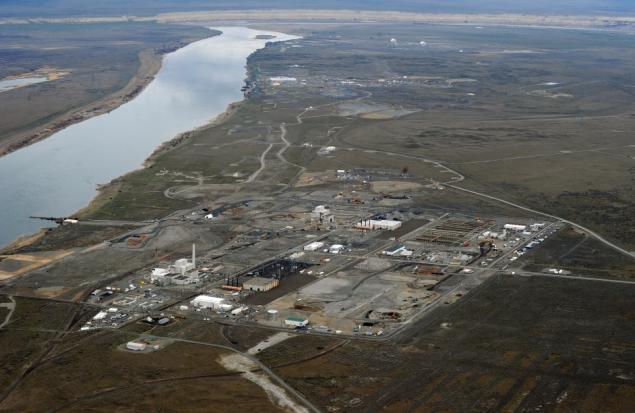
For 42 years, tank AY-102 has stored some of the deadliest material at one of the most environmentally contaminated places in the country: the Hanford Nuclear Reservation. Continue reading
Britain’s rather horrible plutonium and Mixed Oxide Fuel (MOX) dilemma
 “……….The Government wants to try and turn plutonium into a fuel which can be used
Numbers of nuclear warheads in various countries 2013
Think Tank: China Boosts Nuclear Arms Arsenal abc news, By MALIN RISING Associated PressSTOCKHOLM June 3, 2013 (AP)
20132012
Russia 8,50010,000
United States 7,7008,000
France 300300
China 250240
United Kingdom225225
Pakistan 100-12090-110
India 90-11080-100
Uranium and thorium distribution rules, from NRC
NRC Finalizes Rules on Using & Distributing Uranium & Thorium http://smnewsnet.com/archives/66243 2 June 13, The Nuclear Regulatory Commission is amending its regulations for products and materials containing unenriched uranium and thorium, also known as source material. The changes include new requirements for distributing source material and licensing its use.
Manufacturers and importers of products that can be used without a license—such as welding rods and gas lantern mantles that contain thorium, and decorative glassware containing uranium—will now need to apply to the NRC for specific licenses to distribute these products. Such licenses will impose new requirements for labeling, quality control, reporting and recordkeeping.
The new regulations also modify distribution, possession and use requirements for small quantities of source material that can be used or transferred without a specific license. Distributors of small quantities must now apply for specific licenses. For source material being processed or in a dispersible form, such as liquid or powder, the limit on the use or transfer at any one time without a license is decreasing from 15 to 3.3 pounds; the annual limit will drop from 150 to 15.4 pounds. Limits are not changing for anyone possessing source material in a solid, non-dispersible form (such as display samples of depleted uranium metal), removing uranium from drinking water, or determining the concentration of uranium and thorium in a material at a laboratory.
Finally, the new regulations expand the exemption from licensing for optical lenses containing thorium to include lenses and mirrors coated with or containing uranium or thorium. These products are typically used in lasers or other high-technology optical systems.
These new license requirements and possession limits are intended to ensure those who possess source material do so safely, and that the NRC has a better understanding of how much source material is being distributed annually.
Huge radiation health danger for astronauts going to Mars
Curiosity flew to Mars in a spacecraft that had shielding similar to what astronauts would have on the new crew vehicle being developed by NASA. The detector picked up an average of 1.8 millisieverts of radiation per day. A human being on the surface of the Earth receives only about 3 millisieverts of radiation in an entire year.
“The radiation environment in deep space is several hundred times more intense than it is on Earth, and that’s even inside a shielded spacecraft,”
“The radiation exposure on a trip to Mars would — barring a super-huge solar event — not be lethal. The concerns are mostly about cancer induction (a so-called ‘late effect’) and damage to the central nervous system,”

Space radiation would make Mars mission hazardous WP, By Joel Achenbach, May 30 Of all the hazards facing a human mission to Mars — something NASA and countless space buffs would love to see at some point — one of the hardest to solve is the radiation that saturates interplanetary space. New data, gathered by NASA’s Curiosity rover as it traveled to Mars, have confirmed that interplanetary space is a hostile medium and suggest that engineers need to find a way to speed up space travel significantly if they hope to reduce radiation exposure……
The effects of interplanetary radiation on the human body are not well understood. Until now, scientists had limited information about how much radiation penetrates a spacecraft during an interplanetary journey. But the Curiosity rover, which bristles with instruments, carried along a Radiation Assessment Detector, and it measured the incoming radiation during its 253-day trip to Mars, which began in November 2011. Continue reading
Two head CT scans double one’s risk of cancer from radiation
 the risk of having soft-tissue sarcoma will be doubled under an exposure equal to radiation from two CT head scans.
Low levels of medical radiation can cause cancer, HKU study warns http://www.scmp.com/news/hong-kong/article/1250953/low-levels-medical-radiation-can-cause-cancer-hku-study-warns Even low levels emitted by X-rays and CT scans can cause cancer, and people who often get whole-body checks are at risk, HKU study says, 01 June, 2013 Emily Tsang emily.tsang@scmp.com Worries have been raised about the overuse of radiation in medicine after a study shows that even low levels of radiation – such as those emitted by X-rays and CT scans – can cause cancer.
The risk of soft-tissue sarcoma is doubled if a person receives an amount of radiation equivalent to two CT head scans, University of Hong Kong researchers say. This means that people who join a growing
trend of getting frequent whole-body checks including X-rays and scans are putting themselves at risk, the researchers say, adding that authorities should also reconsider the risks of nuclear power.
“The study has highlighted that even low to moderate levels of exposure are enough to cause genetic mutation,” study leader Dino Samartzis said. Continue reading
Nevada population was exposed to nuclear bomb tests’ radioactive fallout
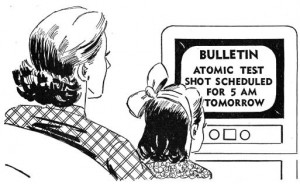 Add this little public service booklet, illustrated with the drawing at left and written by the Atomic Energy Commission to the people of Nevada:
“You are in a very real sense active participants in the Nation’s atomic test program. … Some of you have been inconvenienced by our test operations. At times some of you have been exposed to potential risk from flash, blast, or fall-out. You have accepted the inconvenience or the risk without fuss, without alarm, and without panic. Your cooperation has helped achieve an unusual record of safety.”
As though they were asked.
How Do We Know Nuclear Bombs Blow Down Forests? Because we built a forest in Nevada and blew it down. Slate, By Ann Finkbeiner May 31, 2013, “……. Once the United States had built the first atomic bomb in 1945, it then improved it by building the first hydrogen bomb in 1952. It then began working on building more portable bombs, and since the Soviet Union had done the same, the United States also wondered about the bombs’ effects. So in the early 1950s, the government set up models of all the things that bombs could blow up—houses, bridges, cars, pigs, sheep—and exploded bombs near them. The government did this for at least a decade and didn’t stop until it and the rest of the world banned above-ground testing. The tests, many of them at the Nevada Test Site, were called “shots,” and they had names.
The shot called Encore was on May 8, 1953, and among the many effects it tested was what a nuclear bomb would do to a forest. The Nevada Test Site wasn’t replete with forests, so the U.S. Forest Service brought 145 ponderosa pines from a nearby canyon and cemented them into holes lined up in tidy rows in an area called Frenchman Flat, 6,500 feet from ground zero. Then the Department of Defense air-dropped a 27-kiloton bomb that exploded 2,423 feet above the model forest. The heat set fire to the forest, then the blast wave blew down the trees and put out some fires and started others. Here’s the video. Continue reading
Nuclear weapons not an effective deterrent to cyber warfare
Is There A Place For Nuclear Deterrence in Cyberspace? Arms Control Now, May 30, 2013 by Tim Farnsworth In recent years, cyber attacks and the threats they pose have grown in sophistication, from low-level disruption and data theft—which are still a majority of cyber attacks—to high-level espionage and destruction.
Stuxnet, a piece of malware believed to be responsible for destroying approximately 1,000 centrifuges in Iran’s Natanz nuclear facility in late 2009 and early 2010, was a game-changer. For the first time, a computer virus was used to destroy a piece of physical infrastructure and the world took notice. The power of such a capability is clear today, but what happens once a wide range of counties and actors acquire equally sophisticated and powerful capabilities and there is no longer a technological gap between the United States, its allies, and the rest of the world?……..
the threat of using nuclear weapons to respond to cyber attacks by other states against U.S. critical infrastructure is not a realistic nor an effective response to cyber attack because:
- Cyber attacks lack the destructive and existential threat of nuclear weapons;
- A nuclear response to a cyber attack is not proportional;
- Threatening to respond with a nuclear weapons lacks credibility in adversaries’ eyes;
- Cyber deterrence in general is difficult to achieve; and
- The policy would provide a new rationale for nuclear proliferators…..
…………United States is already investing and should continue to invest in defensive capabilities to build-up the resiliency of its critical infrastructure networks to cyber attack. If critical networks are more difficult to compromise, then adversaries will be less likely to target them. And, the further global integration of information networks makes it less likely that states will seek to disrupt or attack other states’ cyber networks because the economic effects would be too great for both countries.
The U.S. should also engage further the international community to establish acceptable “rules of the road” for state behavior in cyberspace. And, it is important that current international law be recognized as a guide for developing these cyber rules and adjusted in order to make sense in the new and different technological environment. http://armscontrolnow.org/2013/05/30/is-there-a-place-for-nuclear-deterrence-in-cyberspace/
Several states, including the United States, have begun to discuss the establishment of cyberspace norms. The United Kingdom has hosted two international conferences on the subject. In September 2011 Russia and China proposed a code of conduct for cyber behavior. In 2011, the UN re-established the mandate for a group of governmental expertson developments in the field of telecommunications and international security. The United States and China recently discussed the possibility of opening a dialogue on the issue.
The adoption of a policy of using, or threatening to use, nuclear weapons in response to a major cyber attack by other states against U.S. critical infrastructure is not appropriate and is not an effective deterrent. Instead, the U.S. should continue to work with the international community to establish acceptable “rules of the road” that would hold states accountable and help impose some measure of restraint on all states’ cyber behavior.
More radiation exposure when contrast medium is used with CT scans
Radiation dose increased for every organ scanned at CT, particularly in the most vascularized tissues, wrote researchers from the University of Messina in Italy. Average doses rose by one-fifth for the liver, one-third for the spleen and pancreas, and almost three-fourths for the kidneys.
“The results are in agreement with our previous data, confirming an increase in organ radiation dose in contrast-enhanced CT compared with unenhanced CT,” wrote Dr. Ernesto Amato and colleagues (AJR, June 2013, Vol. 200:6, pp. 1288-1293)……
Investigators have also found an increase in the frequency of cellular abnormalities in patients who underwent contrast-enhanced radiographic examinations. But the actual increase in dose for any given scan — which depends on iodine uptake; the shape, volume, and position of the organ; and the emitted x-ray energy spectrum — remains unknown, the authors wrote…….
Confirming dose increases
The results were in line with the group’s previous phantom study, and they confirmed significant radiation dose increases in contrast-enhanced CT versus unenhanced CT, Amato and colleagues wrote. The data showed average dose increases of 19% for the liver, 71% for the kidneys, 33% for the spleen and pancreas, and 41% for the thyroid.
“The kidneys showed the maximum among the average dose [increases] (71%, resulting from an attenuation increment of 139 HU),” the authors wrote.”High renal enhancement is, in fact, due to both their high vascularization because they receive 20% to 25% of the cardiac output and the passage of iodine within the renal tubules. In particular, the level of contrast medium within renal tubules can be up to 50 to 100 times higher than that in the blood because of the mechanisms of tubular concentration and secretion.”
Thyroid tissue showed the second highest dose increase (41%) after contrast injection, based on an HU increase of 87%. Also, the dose increases in the thyroid depended on tissue density on unenhanced CT, the group noted. Denser thyroids showed a lower increase in attenuation and, consequently, lower increases in dose.
Because the liver and spleen are richly vascularized, Hounsfield units increased with contrast by 49 HU and 71 HU, respectively, and average dose increased by 19% and 33%……. http://www.auntminnie.com/index.aspx?sec=ser&sub=def&pag=dis&ItemID=103565
Astronauts going to Mars face a radiation cancer death sentence
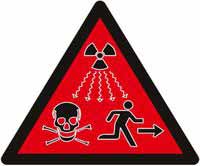 Radiation on trip to Mars near life limit HERALD SUN, AAP MAY 31, 2013 ASTRONAUTS who travel on future missions to Mars would likely be exposed to their lifetime limit of radiation during the trip, not to mention time spent on the Red Planet, scientists say.
The measurements were made aboard the Mars Science Laboratory, an unmanned NASA rover and mobile lab that set off for Mars in 2011 before landing 253 days later in August 2012, said the report in the US journal Science.
“In terms of accumulated dose, it’s like getting a whole-body CT scan once every five or six days,” said Cary Zeitlin, a principal scientist in Southwest Research Institute’s (SwRI) Space Science and Engineering Division.
“Radiation exposure at the level we measured is right at the edge, or possibly over the edge of what is considered acceptable in terms of career exposure limits defined by NASA and other space agencies.”
Zeitlin said more study is needed to determine the actual health risks — including the likelihood of developing cancer — associated with exposure to cosmic radiation before any human trip to Mars can take place.
The US space agency has said it is aiming for the first-ever astronaut mission to Mars some time in the 2030s…….. HTTP://WWW.HERALDSUN.COM.AU/NEWS/BREAKING-NEWS/RADIATION-ON-TRIP-TO-MARS-NEAR-LIFE-LIMIT/STORY-FNI0XQLL-1226654163809
USA government push for nuclear energy has ended in failure
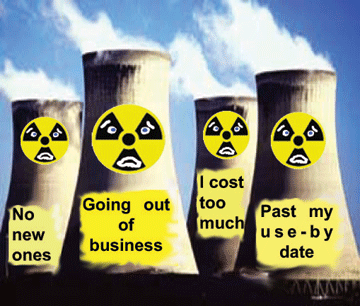 It was not supposed to be this way. In 2005 Congress approved subsidies to bolster the nuclear industry and encourage the construction of new plants. It extended a law limiting owner liability in case of accidents and, for the first few new reactors, offered $18 billion in loan guarantees, $2 billion in indemnification against cost overruns and $1 billion in tax breaks.
The NRC streamlined its licensing procedures, hoping to avoid the years of delays that inflated costs for earlier nuclear plants. (Southern ended up paying $8.7 billion for the existing reactors at Vogtle, a far cry from the $660m originally projected.)
None of this has worked as advertised.
Fracked off Thanks to cheap natural gas, America’s nuclear renaissance is on hold The Economist, Jun 1st 2013 | BURKE COUNTY, GEORGIA IT IS the sort of thing you would expect to see in China, not in the pine forests of rural Georgia. On the banks of the sluggish Savannah river towers one of the world’s biggest cranes. It is helping build two nuclear reactors, to add to the two already up and running at the Vogtle power plant. It testifies to the mammoth efforts that have been made in recent years to revive America’s nuclear industry—and to the disappointing results. Continue reading
1 This Month



26 September – International Day for the Total Elimination of Nuclear Weapons


PLEASE OPPOSE HR 8255 AND S.3639 – bills would accelerate satellite deployment, with no environmental review or safeguards – https://ncstd5li.quorum.us/campaign/169331/
To see nuclear-related stories in greater depth and intensity – go to https://nuclearinformation.wordpress.com
-
Archives
- September 2026 (257)
- August 2026 (330)
- July 2026 (355)
- June 2026 (287)
- May 2026 (306)
- April 2026 (356)
- March 2026 (251)
- February 2026 (267)
- January 2026 (308)
- December 2025 (358)
- November 2025 (359)
- October 2025 (375)
-
Categories
- 1
- 1 NUCLEAR ISSUES
- business and costs
- climate change
- culture and arts
- ENERGY
- environment
- health
- history
- indigenous issues
- Legal
- marketing of nuclear
- media
- opposition to nuclear
- PERSONAL STORIES
- politics
- politics international
- Religion and ethics
- safety
- secrets,lies and civil liberties
- spinbuster
- technology
- Uranium
- wastes
- weapons and war
- Women
- 2 WORLD
- ACTION
- AFRICA
- Atrocities
- AUSTRALIA
- Christina's notes
- Christina's themes
- culture and arts
- Events
- Fuk 2022
- Fuk 2023
- Fukushima 2017
- Fukushima 2018
- fukushima 2019
- Fukushima 2020
- Fukushima 2021
- general
- global warming
- Humour (God we need it)
- Nuclear
- RARE EARTHS
- Reference
- resources – print
- Resources -audiovicual
- Weekly Newsletter
- World
- World Nuclear
- YouTube
-
RSS
Entries RSS
Comments RSS

