Effects on the brain from nuclear radiation – reports from Hanford
 NBC stations reveal nuclear workers suffering severe brain damage, dementia — Toxic waste raining down from sky, wore baseball caps for protection — Brains being eaten away, teeth falling out — Workers raising safety issues framed using false evidence, fired — Gov’t not allowed in to investigate (VIDEO) http://enenews.com/nbc-stations-reveal-nuclear-workers-suffering-severe-brain-damage-dementia-toxic-waste-raining-down-from-sky-wore-baseball-caps-for-protection-brains-being-eaten-away-workers-raising-safety NBC Right Now,Apr. 30, 2014: Former Hanford Worker Sick from Nuclear Waste
- Jane Sander, reporter: A nuclear waste spill happened hours before at the tank farm.
- Lonnie Poteet, Hanford worker: I was already burning from my glove line to my t-shirt line and… starting to lose a little bit of vision in my right eye… Why didn’t they say something?
- Sander: Poteet describes living his life now as recluse… sharp pains in his head, they cause him to often twitch. He says medication prevents him from collapsing in pain due to severe nerve damage in his brain.
- Poteet: [More Hanford workers] are going to be exposed to the same situation… Nobody is going to do anything to stop it… As long as there’s profit… and they get their bonuses on a decent time, that’s all they care about… Most of the workers onsite right now are running scared. They will not bring up any safety concerns because as soon as you do, you’re going to be labeled and thrown off the site, just as fast as they can go. They’ll either create stuff that never happened, or they’ll find ways to get you.
NBC Right Now, June 5, 2014: Sick Former Hanford Worker Speaks Out
- Jane Sander, reporter: He sadly lives his life with a deadly disease…
- Lawrence Rouse, Hanford worker: I have toxic encephalopathy… it eats your brain away.
- Sander: Near the end of his almost 20 years at Hanford… he began to develop severe symptoms. Stuttering, memory loss, losing teeth…emotionally unstable…violent outbursts.
- Rouse: [My son] wrote this letter, this little poem, and said that his dad is gone… It would rain the chemicals on you from the stack. That’s why we wore the baseball caps.
- Sander: The Washington Dept. of Labor and DOE denied [compensation]… Since the [EEOICPA] program began in 2001, they’ve paid more than $1 billion in compensation and medical bills to [6,936 Hanford] workers…
- Rouse: DOE has always denied everything. And that’s not going to change.
- Sander: More Hanford workers continue to file claims for their illnesses.
- Watch the broadcast here
KING 5 Seattle (NBC), June 4, 2014: It’s an unprecedented series of workplace accidents in the state. Since mid-March the number Hanford workers seeking medical help after breathing in chemical vapors has risen to 34.
- Susannah Frame, reporter: Vapors causing serious illnesses at Hanford is not new… at the most contaminated workplace in the nation, OSHA can’t get past the gates to investigate.
- Diana Gegg, Hanford worker: It’s turned my life upside down.
- Frame: Brain damage, sudden tremors, vision loss, dementia – Illnesses the gov’t admits were caused by exposure… she can’t go out without a wheelchair, cook, or drive.
America’s MOX nuclear waste recycling boondoggle

they must stop making this radioactive trash
Failed Nuclear Weapons Recycling Program Could Put Us All in Danger io9, Mark Strauss, 7 June 14, Some government screw-ups are so epic that they require decades of effort. Such was the case for the recently cancelled plan to convert surplus weapons-grade plutonium into nuclear fuel. Not only did the U.S. waste $4 billion dollars, it increased the likelihood that terrorists could obtain bomb-making materials.
It sounded like a good idea at the beginning. Let’s turn megatons into megawatts!
In 2000, the United States and Russia signed the Plutonium Management and Disposition Agreement (PMDA). Each country pledged to dispose of at least 34 metric tons of plutonium from their nuclear weapons programs. U.S. nuclear weapons contain less than four kilograms of plutonium, so the combined total of 68 metric tons is enough for some 17,000 nuclear weapons. Disposing of this plutonium would make it more difficult to reverse U.S.-Russian nuclear weapons reductions and would prevent terrorists from gaining access to the material.
The United States settled on a plan to convert most of its surplus plutonium into fuel for nuclear reactors. A massive reprocessing plant would be built at the Savannah River Site in South Carolina, which, during the Cold War, had refined nuclear material for deployment in warheads. Now, the site would have a new mission: creating nuclear fuel from a mixture of plutonium and uranium oxide, otherwise known as mixed oxide fuel, or MOX. Although nuclear power plants in the U.S. use fuel made from low-enriched uranium (LEU), other countries had demonstrated that MOX was a viable alternative.
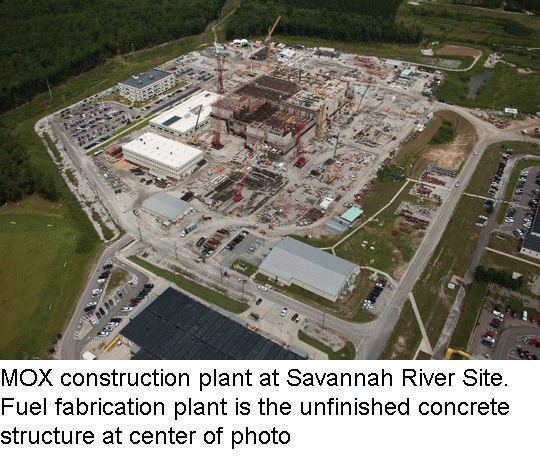
Instead, the final outcome was a mothballed facility and a still-increasing supply of surplus plutonium. Like I said, this isn’t your typical government boondoggle. It was twenty years in the making………. Continue reading
Management Problems in USA’s failed Nuclear Weapons Recycling Program
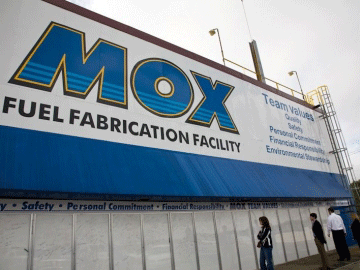 Failed Nuclear Weapons Recycling Program Could Put Us All in Danger io9, Mark Strauss, 7 June 14 “…….In 2004, the National Nuclear Security Administration estimated that the Savannah River MOX facility would cost $1.6 billion. Three years later, that estimate jumped to $4.9 billion. In 2012, the forecasted expenditure increased again, to $7.7 billion. By this time, $4 billion had already been spent and the project employed more than 1,800 construction workers, designers and engineers. Then, in April 2013, an internal review conducted by the Department of Energy revealed that the total lifetime operating cost of the facility—including construction, maintenance and disposal of all the plutonium—would be $24.2 billion.
TJust one example of the poor management that led to cost overruns: NNSA and its primary contractor underestimated the number of safety systems required to meet Nuclear Regulatory Commission (NRC) requirements, which further increased equipment installation costs. More specifically, they were unaware of the costs associated with building a facility that could withstand an earthquake. The source of their confusion? The MOX facility’s design is based on a similar facility in France, but the NRC regulatory requirements differ from those in France.
The Department of Energy was also at fault, because it approved the initial cost and schedule estimate, when the overall design of the MOX facility was only about 58% complete.
A report published two weeks ago by the Department’s Inspector General noted:
In a separate July 2006 memorandum to the NNSA Administrator, NNSA’s Associate Administrator for Infrastructure and Environment expressed his concern regarding the MOX Facility project. He expressed the belief that incomplete project planning could lead to an unintended “design-build-design” process similar to that experienced by other major Departmental projects including the Waste Treatment Plant and the Highly Enriched Uranium Materials Facility. The Waste Treatment Plant at the Hanford Site was given the approval to start construction when the design was only about 45 percent complete. Since then, total project costs for that facility have increased significantly and the project is considerably behind schedule. He pointed out that, similarly, a comprehensive design review had not been conducted on the complete MOX Facility project and that the project had high-risk potential for increasing downstream costs and schedule.
The White House did its part, as well. In 2010, President Obama announced a loan guarantee of $8.3 billion to help the Southern Company build two new nuclear reactors in Georgia. As a result, workers with nuclear engineering design and manufacturing experience were suddenly in very high demand. The MOX construction site had an employee turnover of 20% per year because, after workers completed additional training at the Savannah River Site, they quit to take higher paying jobs in Georgia. The U.S. government was subsidizing its own labor shortfall.
Finally, in March 2014, the White House announced that it would put the whole project on “cold standby”—essentially, preparing it for shutdown—while the administration evaluated “alternative plutonium disposition technologies to MOX that will achieve a safe and secure solution more quickly and cost effectively.”
Adding up the losses
MOX may be mothballed, but the problem of what to do with our surplus weapons-grade plutonium remains. And, despite cool relations between Washington and Moscow, the disposal agreement still stands.
The Department of Energy has established a Plutonium Disposition Working Group that will spend the next 12 to 18 months trying to come up with a plan. You can see an initial working paper here. The options are depressingly similar to the ones suggested by the National Academy of Sciences, 20 years ago.he sticker shock prompted the Department of Energy to note in its Fiscal Year 2014 budget request that, “This current plutonium disposition approach may be unaffordable…due to cost growth and fiscal pressure.”
Any lingering doubts that the MOX program was on its last legs were dispelled when the Government Accountability Office (GAO) published a report in February 2014. Even by GAO standards, the assessment was scathing.
One of the biggest mistakes, according to the GAO, was entrusting this project to the National Nuclear Security Administration, which is a semi-autonomous agency within the Department of Energy:
NNSA has not analyzed the underlying, or root, causes of the Plutonium Disposition program construction cost increases to help identify lessons learned and help address the agency’s difficulty in completing projects within cost and schedule, which has led to NNSA’s management of major projects remaining on GAO’s list of areas at high risk of fraud, waste, abuse, and mismanagement.
………Even if we got this facility up and working, nobody wants what it’s making. The companies that run commercial nuclear reactors have lost confidence in the program. They can’t be certain that it would provide a reliable, steady supply of fuel, or keep enough surplus fuel on hand in case it was needed. And why would commercial nuclear reactors purchase MOX when low-enriched uranium is cheaper, easier to transport and doesn’t present a security risk? Adding to the climate of skepticism: a MOX fuel irradiation test in a commercial reactor had to be prematurely terminated in 2008 because of unanticipated problems.
The loss to the United States can be measured in more than the $4 billion to build the facility and the hundreds of millions of dollars sent to Russia to subsidize their program. The greater loss is that the U.S. could have spent those funds to shore up other nonproliferation programs…….. http://io9.com/failed-nuclear-weapons-recycling-program-could-put-us-a-1586851270
Doom and gloom now permanent for the uranium industry
We are heading for a uranium crisis , Investor Intel, June 2, 2014 by Robin Bromby“……Welcome to the “perma-gloom” with spot uranium now at $28.25/lb. But it really does portend a very troubling situation. We could be on the brink of a real uranium crisis, one that could have serious ramifications down the road. This is because, on top of all the doubts about nuclear post-Fukushima and the slowness of Japan to get reactors back on line, uranium is caught up in the general malaise affecting the mining industry ……….the uranium price has fallen by 30% over the past year. If it keeps falling, and it well might, more and more companies will either go into hibernation mode or quit the sector all together ……..

A surer sign that all is not well can be evidenced from an ominous trend — exploration companies quitting the sector. Others are making cuts: Cameco closed its Cheyenne office, while BHP Billiton has deferred its expansion at the world’s biggest uranium deposit, Olympic Dam in South Australia. Australia’s Paladin Energy (ASX:PDN) has put one of its mines, Kayelekera in Malawi, on care and maintenance.
Back in 2007-8, after spot uranium hit $137/lb, this was the place to be. Suddenly every mining explorer was keen to be in the uranium hunt. At one stage, more than 260 companies listed on the Australian Securities claimed to have uranium projects (many of them in what the Canadian miners call “moose pasture”).
Now, it seems, those small number remaining can’t wait to get out. FYI Resources (ASX:FYI), which got into uranium after quitting the eye care business (it’s previous name was Freedom Eye) in 2009, is now concentrating on potash in Thailand. Uranex (ASX:UNX) is staying in Tanzania, but has put its uranium on the back-burner in order to pursue graphite.
But possibly the most startling change was reported today. Junior United Uranium (ASX:UUL) which has six projects in Western Australia [and A$3.41 million in the bank as at March 31] is getting out of uranium and into — wait for it — property development.You can’t exactly blame the directors. The shares are trading at a discount to the company assets (the market capitalisation being just A$2 million), all its projects are early-stage ones that will require considerable sums to explore and may not turn out to be viable, no one is investing in the sector, the uranium price is depressed as is the resource sector generally.
Just two weeks ago another uranium explorer working in Western Australia, Prime Minerals (ASX:PIM), signalled it was changing direction. It is merging with Cocoon Data Holdings which has data security software. The news lifted Prime’s stock from A0.9c to A2.2c.
Back in 2007, announcing you were getting into uranium could see your stock price double. Now announcing you’re switching focus away from uranium does the trick. This is not a good trend. http://investor
Questioning the economics of Small Modular Nuclear Reactors (SMRs)
Christian Science Monitor, Small-scale nuclear plants can be strung together and might save utilities on capital costs. But critics question the efficiency and operating costs of small-scale nuclear plants. By Ken Silverstein, June 1, 2014 The Obama administration wants to seed the United States with pint-size nuclear reactors, and this week it backed a new developer to do it. The US Department of Energy (DOE) said it would provide $217 million in matching funds over five years to NuScale, which builds small, ready-made reactors that can be strung together.
But NuScale only gets the federal funds if it can match them with money from private investors, who so far have been leery of the technology. In April, Babcock & Wilcox said it would scale back its DOE-backed plans to build modular reactors for the Tennessee Valley Authority because it failed to secure venture capital. Will NuScale do any better?
NuScale says its advantage is that 12 of its modular reactors can be combined to form a 540 megawatt unit. When one of the modules goes down, it could easily be maintained while the rest of the reactors continue to operate, so that whole facilities are not knocked off the grid. Each individual module could be refueled in relatively short order.
The cost of a 540 megawatt unit would be between $2.2 billion and $2.5 billion. That’s marginally less expensive per unit of output than a traditional nuclear plant. And at that price, utilities would not be taking the kind of financial risks they might otherwise have to if they built a $15 billion to $20 billion central nuclear facility.
As a first step, Oregon-based NuScale is opening a manufacturing plant in Charlotte, N.C., where it will hire 70 employees.
“This expansion … is critical to completing NuScale’s design and submitting our design certification application to the Nuclear Regulatory Commission,” writes Mike McGough, chief commercial officer of NuScale, in an e-mail. The company hopes to submit its design certification in the latter half of 2016. And it plans to begin signing commercial contracts by 2023.
That’s a long and arduous process – just as it is for a larger nuclear plant. Typically, investors don’t want to tie up their money for that long. The Department of Energy’s involvement is aimed at trying to create some legal and financial certainties so they can invest with more confidence. While NuScale says that its units are more affordable than larger centrally located nuclear facilities and that they can replace retiring coal plants, its critics say that the technology lacks efficiencies and cannot compete against combined-cycled natural gas facilities.
“I wish them luck but the economics don’t make sense,” says Mike Keller, president of Kansas-based Hybrid Power Technologies, in an interview regarding both NuScale and Babcock & Wilcox. He adds that the smaller units are inefficient, which means that they produce more nuclear waste than their larger nuclear cousins while they would generate power at three times the current cost of a combined cycle natural gas plant.
“Having a big chunk of money [from the government] does not equal commercial success,” adds Mr. Keller. “The US government should do more due diligence.”………http://www.csmonitor.com/Environment/Energy-Voices/2014/0601/Pint-size-nuclear-plants-get-a-boost-from-Obama-administration
Countering the misinformation promoting Thorium Nuclear Reactors

 Thorium Nuclear Information Resources http://kevinmeyerson.wordpress.com/2012/04/26/thorium-nuclear-information-resources/ There is a rash of misinformation on the net about the supposed merits of the ‘new’ nuclear energy source on the block, thorium. I am sure that in a perfect world where nobody lies, thorium would be the perfect answer to the world’s energy needs as is claimed. This is unfortunately not the case.
Apparently, every time there is a new nuclear catastrophe, the thorium ‘miracle’ is promoted again as the ‘savior’ for the world. The Fukushima nuclear radiation catastrophe was not unique and the thorium misinformation artists have come out in droves. It’s the nuclear industry’s defense mechanism – create a new ‘safety myth’ that regular people can latch onto.
In reality, the thorium nuclear fuel cycle has been under development since the very early days of the nuclear industry. India, for example, has spent decades trying to commercialize it, and has failed. The US, Russia, Germany, and many others tried and failed as well. At best, thorium based nuclear power generation may be commercialized in a few decades.
I doubt it.
Fortunately, there are a number of independent trustworthy and expert sources of information on the internet regarding thorium nuclear. Here they are: Continue reading
Another pesky NRC Chair who puts public safety above nuclear industry profits!
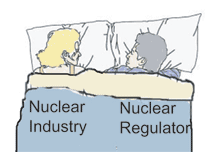 NRC rejects effort to move radwaste from pools; Macfarlane issues strong dissent Michael Mariotte, Green World, 30 May 14, The Nuclear Regulatory Commission has again sided with the nuclear power industry (where have you heard that one before?) and rejected efforts by environmental/clean energy groups and five U.S. Senators to move high-level radioactive waste out of overcrowded, dangerous and poorly-protected fuel pools as soon as it is cool enough to be placed in dry casks.
Not only did the NRC Commissioners take this unconscionable vote, they said this was their last word on the subject and they would refuse to ever again consider the issue.
 But the vote wasn’t unanimous: NRC Chair Allison Macfarlane, who has spent her career studying radioactive waste issues, issued a strong dissent to the decision, essentially arguing that the NRC staff hasn’t done its homework.
Which brings up an interesting subject we’ll talk about more below: what if the four Commissioners who voted for the industry on the waste issue–and nearly always vote for the industry–had been unsuccessful in their efforts in 2012 to oust then-chair Greg Jaczko, who almost certainly would have taken the same position as Macfarlane? We might then be looking at a Commission that could in a few months have had both Jaczko and Macfarlane as members, and perhaps at least one more Commissioner independent of the agency. That would be a very different situation than the industry-dominated and sympathetic Commission that has far too long run the NRC……….
In her dissent, Macfarlane castigated the staff for essentially shoddy research: “In my view, the staff has not adequately explored the issue of spent fuel management in the pool and as a result, I do not have adequate information on which to base a view on the need to require approaches that may lead to some form of expedited transfer of spent fuel from pools to dry casks.”
Macfarlane said she did not necessarily support a program to move the radioactive fuel to dry casks within five years, but primarily because the technical capacity to do so may not exist. And she complained that was the only option presented by the staff to the Commission:…….
In her nine-page dissent, the NRC chair also complained about the NRC staff’s failure unwillingness to fully engage the public in the agency’s radioactive waste discussions, writing, “I do not agree with the staff’s approach in engaging the public near the very end of the
current two-year regulatory review process, without the ability to fully provide input on key regulatory factors or review the draft regulatory analysis that was provided to the Commission. In accelerating this Tier 3 activity to align with the Waste Confidence environmental activities for public transparency, the staff may have ironically impeded the same public from fully vetting this issue in the safety and security arenas.”
Macfarlane concluded citing the precautionary principle:……….http://safeenergy.org/2014/05/29/nrc-rejects-effort-to-move-radwaste-from-pools/
The dismal history of USA’s failed thorium nuclear experiment
 Thorium: the wonder fuel that wasn’t http://thebulletin.org/thorium-wonder-fuel-wasnt7156 Robert Alvarez May 2014, “Thorium-Fueled Automobile Engine Needs Refueling Once a Century,” reads the headline of an October 2013 story in an online trade publication. This fantastic promise is just one part of a modern boomlet in enthusiasm about the energy potential of thorium, a radioactive element that is far more abundant than uranium. Thorium promoters consistently extol its supposed advantages over uranium. News outlets periodically foresee the possibility of “a cheaper, more efficient, and safer form of nuclear power that produces less nuclear waste than today’s uranium-based technology.”
Early thorium optimism. The energy potential of the element thorium was discovered in 1940 at the University of California at Berkeley, during the very early days of the US nuclear weapons program. Although thorium atoms do not split, researchers found that they will absorb neutrons when irradiated. After that a small fraction of the thorium then transmutes into a fissionable material—uranium 233—that does undergo fission and can therefore be used in a reactor or bomb.
By the early 1960’s, the US Atomic Energy Commission (AEC) had established a major thorium fuel research and development program, spurring utilities to build thorium-fueled reactors. Back then, the AEC was projecting that some 1,000 nuclear power reactors would dot the American landscape by the end of the 20th century, with a similar nuclear capacity abroad. As a result, the official reasoning held, world uranium supplies would be rapidly exhausted, and reactors that ran on the more-plentiful thorium would be needed.
With the strong endorsement of a congressionally created body, the Joint Committee on Atomic Energy, the United States began a major effort in the early 1960s to fund a two-track research and development effort for a new generation of reactors that would make any uranium shortage irrelevant by producing more fissile material fuel than they consumed.
The first track was development of plutonium-fueled “breeder” reactors, which held the promise of producing electricity and 30 percent more fuel than they consumed. This effort collapsed in the United States in the early 1980’s because of cost and proliferation concerns and technological problems. (The plutonium “fast” reactor program has been able to stay alive and still receives hefty sums as part of the Energy Department’s nuclear research and development portfolio.)
The second track—now largely forgotten—was based on thorium-fueled reactors. This option was attractive because thorium is far more abundant than uranium and holds the potential for producing an even larger amount of uranium 233 in reactors designed specifically for that purpose. In pursuing this track, the government produced a large amount of uranium 233, mainly at weapons production reactors. Approximately two tons of uranium 233 was produced, at an estimated total cost of $5.5 to $11 billion (2012 dollars), including associated cleanup costs.
The federal government established research and development projects to demonstrate the viability of uranium 233 breeder reactors in Minnesota, Tennessee, and Pennsylvania. By 1977, however, the government abandoned pursuit of the thorium fuel cycle in favor of plutonium-fueled breeders, leading to dissent in the ranks of the AEC. Alvin Weinberg, the long-time director of the Oak Ridge National Laboratory, was, in large part, fired because of his support of thorium over plutonium fuel.
By the late 1980’s, after several failed attempts to use it commercially, the US nuclear power industry also walked away from thorium. The first commercial nuclear plant to use thorium was Indian Point Unit I, a pressurized water reactor near New York City that began operation in 1962. Attempts to recover uranium 233 from its irradiated thorium fuel were described, however, as a “financial disaster.” The last serious attempt to use thorium in a commercial reactor was at the Fort St. Vrain plant in Colorado, which closed in 1989 after 10 years and hundreds of equipment failures, leaks, and fuel failures. There were four failed commercial thorium ventures; prior agreement makes the US government responsible for their wastes.
Where is the missing uranium 233? As it turned out, of course, the Atomic Energy Commission’s prediction of future nuclear capacity was off by an order of magnitude—the US nuclear fleet topped out at about 100, rather than 1,000 reactors—and the predicted uranium shortage never occurred. America’s experience with thorium fuels faded from public memory until 1996. Then, an Energy Department safety investigation found a national repository for uranium 233 in a building constructed in 1943 at the Oak Ridge National Laboratory. The repository was in dreadful condition; investigators reported an environmental release from a large fraction of the 1,100 containers “could be expected to occur within the next five years in that some of the packages are approaching 30 years of age and have not been regularly inspected.” TheEnergy Department later concluded that the building had “deteriorated beyond cost-effective repair. Significant annual costs would be incurred to satisfy current DOE storage standards, and to provide continued protection against potential nuclear criticality accidents or theft of the material.”
The neglect extended beyond the repository and storage containers; the government had also failed to keep proper track of its stores of uranium 233, officially classified as a Category I strategic special nuclear material that requires stringent security measures to prevent “an unauthorized opportunity to initiate or credibly threaten to initiate a nuclear dispersal or detonation.”
A 1996 audit by the Energy Department’s inspector general reported that the Oak Ridge National Laboratory, the Rocky Flats nuclear weapons facility, and the Idaho National Laboratory “had not performed all required physical inventories ... the longer complete physical inventories are delayed, the greater the risk that unauthorized movement of special nuclear materials could occur and go undetected.” The amounts of uranium 233 that the Oak Ridge and Idaho national labs have reported in their inventories has significantly varied. Based on a review of Energy Department data, there appears to be an inventory discrepancy; 96 kilograms or 6 percent of the U-233 produced is not accounted for. The Energy Department has yet to address this discrepancy, which difference is enough to fuel at least a dozen nuclear weapons.
Uranium 233 compares favorably to plutonium in terms of weaponization; a critical mass of that isotope of uranium—about 6 kilograms, in its metal form—is about the same weight as a plutonium critical mass. Unlike plutonium, however, uranium 233 does not need implosion engineering to be used in a bomb. In fact, the US government produced uranium 233 in small quantities for weapons, and weapons designers conducted several nuclear weapons tests between 1955 and 1968 using uranium 233. Interest was renewed in the mid-1960s, but uranium 233 never gained wide use as a weapons material in the US military because of its high cost, associated with the radiation protection required to protect personnel from uranium 232, a highly radioactive contaminant co-produced with uranium 233.
For a terrorist, however, uranium 233 is a tempting theft target; it does not require advanced shaping and implosion technology to be fashioned into a workable nuclear device. The Energy Department recognizes this characteristic and requires any amount of more than two kilograms of uranium 233 to be maintained under its most stringent safeguards, to prevent “onsite assembly of an improvised nuclear device.” As for the claim that radiation levels from uranium 232 make uranium 233 proliferation resistant, Oak Ridge researchers note that “if a diverter was motivated by foreign nationalistic purposes, personnel exposure would be of no concern since exposure … would not result in immediate death.”
The end of an unfortunate era. After its 1996 safety investigation at the Oak Ridge National Laboratory, the Energy Department spent millions to repackage about 450 kilograms of uranium 233 that is mixed with uranium 235 and sitting in the lab’s Building 3019, and to dispose of diluted uranium 233 fuel stored at the Idaho National Lab. The Energy Department’s nuclear weapons program managed to shift responsibility for the stockpile in Building 3019 from Oak Ridge to the Office of Nuclear Energy, which envisioned using the uranium 233 to make medical isotopes. This plan fell apart, and in 2005 Congress ordered the Energy Department to dispose of the uranium 233 stockpile as waste.
Since then, the Energy Department’s Office of Environmental Management has considered uranium 233 disposal to be an unfunded mandate, disconnected from other, higher-priority environmental cleanup compliance agreements. After several fits and starts, including a turnover of four project managers in less than two years, the Energy Department’s disposition project “had encountered a number of design delays, may exceed original cost estimates, and will likely not meet completion milestones,” the department’s inspector general reported in 2010. The cost of the project increased from $384 million to $473 million—or more than $1 million per kilogram for the disposal of uranium 233.
In an effort to reduce costs, the Energy Department developed a plan to ship nearly 75 percent of the fissile materials in Building 3019, as is, to a landfill at the Nevada Nuclear Security Site by the end of 2014. Because such disposal would violate the agency’s formal safeguards and radioactive waste disposal requirements, the Energy Department changed those rules, which it can do without public notification or comment. Never before has the agency or its predecessors taken steps to deliberately dump a large amount of highly concentrated fissile material in a landfill, an action that violates international standards and norms.
In June 2013, Nevada Gov. Brian Sandoval and members of the state’s congressional delegation announced their opposition to the landfill disposition plan. Energy Secretary Ernest Moniz visited with Sandoval but did not back down from the landfill plan. Even though the Oak Ridge material in its current form meets the legal definition for radioactive waste requiring geologic disposal, the Energy Department has taken the position that the sweeping authority granted to it under the Atomic Energy Act allows the department to dispose of the fissile material however it pleases, regardless of the state’s objection.
The United States has spent nearly $10 billion to discourage practices like landfill dumping of fissile materials in the former Soviet Union, only to have the Energy Department try it at home. Heedless of the discrepancy between overseas and domestic disposal policies, the department’s agenda—which focuses on saving money on guards who would be needed to secure the uranium 233—is placing the United States in an impossible position when it comes to criticizing the nuclear materials security of other countries. So ends America’s official experience with thorium, the wonder fuel.
Fukushima’s ice wall – massive cost, massive drain on electricity
Record high radiation in seawater off Fukushima plant, Japan Times, 17 May 14 “………..Tepco is struggling to reduce contamination at the poorly protected plant, which was damaged by the March 2011 earthquake and tsunami. Measures include plans to build a gigantic underground ice wall around the plant to keep the daily flow of groundwater from entering the cracked reactor buildings and mingling with the highly radioactive cooling water in their basements.
 The ice wall project is expected to cost ¥31.9 billion and will put a massive burden on the power grid when completed: It will need about 45.5 million kilowatt-hours of electricity to operate, equal to annual power consumption of 13,000 average households.
The project involves freezing the soil into barricades 30 meters deep and 2 meters thick for a distance of 1,500 meters around the buildings housing reactors 1 through 4.
The soil will be frozen by sinking pipes into the ground and running liquids through them at a temperature of minus 30 degrees.
On Friday, the Ministry of Economy, Trade and Industry and contractor Kajima Corp. demonstrated a miniature ice wall to reporters at the site.
“We can confirm the frozen soil’s effect in blocking water,” a ministry official said afterwards.
The department aims to begin construction next month. But the Nuclear Regulation Authority has not approved the plan, saying its backers have so far provided insufficient reassurances about public safety. International nuclear experts have also expressed concern about the effectiveness of the plan. http://www.japantimes.co.jp/news/2014/05/17/national/record-high-radiation-in-seawater-off-fukushima-plant/#.U3ptgdJdWik
Unfounded and irresponsible claims in favour of Small Modular Nuclear Reactors (SMRs)
 WHY SMALL MODULAR REACTORS ARE PART OF THE PROBLEM, NOT THE SOLUTION Mark Cooper, Ph.D. Senior Fellow for Economic Analysis Institute for Energy and the Environment Vermont Law School May 2014
“………..Unachievable assumptions about cost: Even industry executives and regulators believe the SMR technology will have costs that are substantially higher than the failed “nuclear renaissance” technology on a per unit of output. The higher costs result from
• lost economies of scale in containment structures, dedicated systems for control,
management and emergency response, and the cost of licensing and security,
• operating costs between one-fifth and one-quarter higher, and
• decommissioning costs between two and three times as high.
Irresponsible assumptions about a rush to market: To reduce the cost disadvantage and meet the urgent need for climate policy, advocates of SMR technology propose to deploy large numbers of reactors (50 or more), close to population centers, over a short period of time. This compressed RD&D schedule embodies a rush to market that does not make proper provision for early analysis, testing, and demonstration to provide an opportunity for experience-based design modifications. This is exactly the problem that arose in the 1970s, when utilities ordered 250 reactors and ended up cancelling more than half of them when the technology proved to be expensive and flawed.
Unrealistic assumptions about the scale of the sector: While each individual reactor would be smaller, the idea of creating an assembly line for SMR technology would require a massive financial commitment. If two designs and assembly lines are funded to ensure competition, by 2020 an optimistic cost scenario suggests a cost of more than $72 billion; a more realistic level would be over $90 billion. This massive commitment reinforces the traditional concern that nuclear power will crowd out the alternatives. Compared to U.S. Energy Information Administration (EIA) estimatesof U.S. spending on generation over the same period, these huge sums are equal to
• three-quarters of the total projected investment in electricity generation and
• substantially more than the total projected investment in renewables.
Radical changes in licensing and safety regulation: SMR technologies raise unique safety challenges including inspection of manufacturing and foreign plants, access to below ground facilities, integrated systems, waste management, retrieval of materials with potentially higher levels of radiation, flooding for below-ground facilities, and common designs that create potential “epidemic” failure. Yet ,SMR advocates want pre-approval and limited review of widely dispersed reactors located in close proximity to population centers and reductions in safety margins, including shrinking containment structures, limitations of staff for safety and security, consolidation of control to reduce redundancy, and much smaller evacuation zones. In the wake of global post-Fukushima
Calls for more rigorous safety regulation, policymakers and safety regulators are likely to look askance at proposals to dramatically relax safety oversight.
Unfounded claims of unique supply and demand advantages: Despite their high costs, advocates argue that smaller reactors are more attractive than large reactors because they are moreflexible, requiring smaller capital commitments and shorter construction times.
• By these same criteria, non-nuclear alternatives are far more attractive – smaller, less
costly, quicker to market, and already scalable.
• The alternatives also do not possess the security and proliferation risks and environmental problems that attach to nuclear power. …….. http://216.30.191.148/Cooper%20SMRs%20are%20Part%20of%20the%20Problem,%20Not%20the%20Solution%20FINAL2.pdf
Low levels of radioactive cesium produced insect deformities at Fukushima
New study reveals deaths and mutations ”increased sharply’ from exposure to Fukushima contamination, “especially at low doses” — ‘Small’ levels of cesium may be ‘significantly toxic’ — Smithsonian: “In other words, things don’t look good for the animals living around Fukushima” http://enenews.com/just-in-new-study-reveals-sharp-increase-in-deaths-and-mutations-from-exposure-to-fukushima-contamination-especially-at-low-doses-small-levels-of-cesium-may-be-significantly-toxic?utm_source=feedburner&utm_medium=email&utm_campaign=Feed%3A+ENENews+%28Energy+News%29
 Smithsonian Magazine, May 14, 2014: Even Tiny Amounts of Radioactive Food Made Caterpillars Become Abnormal Butterflies […] Researchers in Japan […] discovered, even a small amount of radiation is too much. […] The scientists collected plant material from around Fukushima and fed it to pale grass blue butterfly caterpillars. When the caterpillars turned into butterflies, they suffered from mutations and were more likely to die early [… even if they] had only eaten a small amount of artificial caesium […] In other words, things don’t look good for the animals living around Fukushima.
Nature — Scientific Reports (pdf), Published May 15, 2014: [We] examined possible relationships between the dose of ingested cesium per larva and the mortality and abnormality rates. Both the mortality and abnormality rates increased sharply, especially at low doses […] the mortality and abnormality rates increased sharply, especially at low doses. Additionally, there seemed to be no threshold level below which no biological response could be detected. […] the dose-response data suggests that the relatively small level of artificial cesium from the Fukushima Dai-ichi NPP may be significantly toxic to some individuals in butterfly populations […] the half lethal [i.e. LD50, amount that will kill 50% of a test subjects] dose [is 1.9 Bq per larva] and the half abnormal dose [is 0.76 Bq per larva] […] relatively small [levels] of artificial cesium from the Fukushima Dai-ichi NPP may be significantly toxic to some individuals in butterfly populations […] we assert that the half lethal and abnormal doses we obtained were quite high. […] it should be noted that we sampled contaminated leaves from Fukushima City, which many people inhabit as though nothing had happened […] Implications of the half lethal and abnormal doses we obtained in the present study will impact future discussions on the effects of radioactive exposure on other organisms, including humans. […] In conclusion, it is important to recognize the risk of internal radiation exposure due to ingested radioactive cesium, at least for the pale grass blue butterfly, and likely for certain other organisms living in the polluted area, possibly including humans. […]
Thorium nuclear fuel. They make out that it’s safe. But it’s not
Is the “Superfuel” Thorium Riskier Than We Thought? A new study in Nature says that using thorium as a nuclear fuel has a higher risk for proliferation into weapons than scientists had believed. Popular Mechanics 16 May 14, By Phil McKenna Imagine a cheap, plentiful source of energy that could provide safe, emissions-free power for hundreds of years without refueling and without any risk of nuclear proliferation. The fuel is thorium, and it has been trumpeted by proponents as a “superfuel” that eludes many of the pitfalls of today’s nuclear energy. But now, as a number of countries including China, India, and the United States explore the potential use of thorium for nuclear power, researchers say one of the biggest claims made about the fuel—its proliferation resistance—doesn’t add up.
But Ashley and his co-authors say a simple tweak in the thorium irradiation recipe can sidestep the radioactive isotope’s formation. If an element known as protactinium-233 is extracted from thorium early in the irradiation process, no uranium-232 will form. Instead, the separated protactinium-233 will decay into high purity uranium-233, which can be used in nuclear weapons.
“Eight kilograms of uranium-233 can be used for a nuclear weapon,” Ashley says. “The International Atomic Energy Agency views it the same as plutonium in terms of proliferation risk.” Creating weapons-grade uranium in this way would require someone to have access to a nuclear reactor during the irradiation of thorium fuel, so it’s not likely a terrorist group would be able to carry out the conversion. The bigger threat is that a country pursuing nuclear energy and nuclear weapons (say, Iran) could make both from thorium. “This technology could have a dual civilian and military use,” Ashley says. …..

Why Small Modular Nuclear Reactors are not viable, and no cure for climate change
WHY SMALL MODULAR REACTORS ARE PART OF THE PROBLEM, First, the viability of SMRs is dependent on the very economic processes that have eluded the industry in the past. The ability of the small modular reactor technology to reverse the cost trajectory of the industry is subject to considerable doubt. The empirical analysis of learning processes in the “Great Bandwagon Market” discussed in Section I and the failure of regulatory streamlining, advanced design and standardization in the “nuclear renaissance” certainly question the ability of the new technology to produce such a dramatic turnaround. As a result, even under the best of circumstances, the SMR technology will need massive subsidies in the early stages to get off the ground and take a significant amount of time to achieve the modest economic goal set for it.
Second, even if these economic processes work as hoped, nuclear power will still be more costly than many alternatives. Over the past two decades wind and solar have been experiencing the cost reducing processes of innovation, learning and economies of scale that nuclear advocate hoped would benefit the “Renaissance” technology and claim will affect the small modular technology. Nuclear cost curves are so far behind the other technologies that they will never catch up, even if the small modular technology performs as hoped.
Third, the extreme relaxation of safety margins and other changes in safety oversight is likely to receive a very skeptical response from policymakers. This is just the latest skirmish in a 50 year battle over safety. The push to deploy large numbers of reactors quickly with a new safety regime recalls the mistake of the early “Great Bandwagon Market.”
Fourth, the type of massive effort that would be necessary to drive nuclear costs down over the next couple of decades would be an extremely large bet on a highly risky technology that would foreclose alternatives that are much more attractive at present. Even if the technology could be deployed at scale at the currently projected costs, without undermining safety, it would be an unnecessarily expensive solution to the problem that would waste a great deal of time and resources, given past experience.
Finally, giving nuclear power a central role in climate change policy would not only drain away resources from the more promising alternatives, it would undermine the effort to create the physical and institutional infrastructure needed to support the emerging electricity systems based on renewables, distributed generation and intensive system and demand management.
The paper concludes that the prudent approach to resource acquisition is to build the institutional and physical infrastructure that achieves the maximum contribution from the more attractive resources available in the near and mid-term. With a clear path of more attractive resources, we do not have to engage in the hundred year debate today, although there is growing evidence that prospects for high penetration renewable scenarios for the long terms are quite good. The available and emerging alternatives can certainly carry the effort to meet the demand for electricity with low carbon resources a long way down the road, certainly long enough that the terrain of technologies available may be much broader before we have to settle for inferior options like nuclear power…
Dramatic rise in cancers, infant mortality near Diablo Canyon power plant
 Study: Nuclear Reactors Are Toxic to Surrounding Areas, Especially With Age 11 March 2014 By Candice Bernd, Truthout | Report A study released tlast week shows that public health in the communities surrounding California’s Diablo Canyon power plant in San Luis Obispo County declined dramatically after the plant was built. The findings also document the presence of Strontium-90 in baby teeth.
Is the baby tooth under your child’s pillow radioactive? It could be if you live relatively close to a nuclear power plant that has been operating normally and in accordance with federal regulations, according to a new study.
The study, released last week by the Santa Barbara-based think tank World Business Academy for its Safe Energy Project, found that public health indicators such as infant mortality rates and cancer incidence in surrounding areas rose dramatically after Pacific Gas and Electric’s (PG&E) two nuclear reactors at the Diablo Canyon power plant began operations in 1984 and 1985.
“This should be a concern for any nuclear reactor and its health risks, whether it’s been operating for a day or 30 or 40 years because these reactors create over 100 cancer-causing chemicals; much of it is stored as waste at the plant, but a portion of it is released into the environment and gets into human bodies through the food chain,” said Joseph Mangano, who authored the study. He is the executive director of the nonprofit Radiation and Public Health Project (RPHP).
The findings also document the presence of the radioactive isotope Strontium-90 in baby teeth, showing that the Strontium-90 levels in 50 baby teeth collected mostly from San Luis Obispo County, but also from Santa Barbara County, which is downwind from the Diablo Canyon plant, was 30.8 percent higher than the levels found in the 88 baby teeth from the rest of the state. Continue reading
Depleted uranium pollution of Hawaii by Pentagon’s dirty bombing
 The Pentagon’s Dirty Bombers: Depleted Uranium in the USA, Aletho News By David Lindorff – 10/26/2009 The Nuclear Regulator Commission is considering an application by the US Army for a permit to have depleted uranium at its Pohakuloa Training Area, a vast stretch of flat land in what’s called the “saddle” between the sacred mountains of Mauna Loa and Mauna Kea on Hawaii’s Big Island, and at the Schofield Barracks on the island of Oahu. In fact, what the Army is asking for is a permit to leave in place the DU left over from years of test firing of M101 mortar “spotting rounds,” that each contained close to half a pound of depleted uranium (DU). The Army, which originally denied that any DU weapons had been used at either location, now says that as many as 2000 rounds of M101 DU mortars might have been fired at Pohakuloa alone.
But that’s only a small part of the story.
The Army is actually seeking a master permit from the NRC to cover all the sites where it has fired DU weapons, including penetrator shells that, unlike the M101, are designed to hit targets and burn on impact, turning the DU in the warhead into a fine dust of uranium oxide. Hearings on this proposal were held in Hawaii on Aug. 26 and 27.
Uranium particles, whether pure uranium or in an oxidized form, are alpha emitters, and can be highly carcinogenic and mutagenic if ingested or inhaled, since they can lodge in one part of the body—the kidney or lung or gonad, for example—and then irradiate surrounding cells with large, destructive alpha particles (actually helium atoms), until some gene is compromised and a cell become malignant.
Among the sites identified by the NRC as being contaminated with DU are:
Ft. Hood, TX
Ft. Benning, GA
Ft. Campbell, KY
Ft. Knox, KY
Ft. Lewis, WA
Ft. Riley, KS
Aberdeen Proving Grounds, MD
Ft. Dix, NJ
Makua Military Reservation, HI
Other locations identified as having DU weapons contamination are:
China Lake Air Warfare Center, CA
Eglin AFB, Florida,
Nellis AFB, NV
Davis-Monthan AFB
Kirtland AFB, NM
White Sands Missile Range, NM
Ethan Allen Firing Range, VT
New Mexico Institute of Mining and Technology
An application for a 99-year permit to test DU weapons at the NM Inst. Of Mining and Technology claimed that that site’s test area was “so contaminated with DU… as to preclude any other use”!
DU weapons have also been used by the Navy at Vieques Island off Puerto Rico (the Navy claimed it was a “mistake.”)………. http://alethonews.wordpress.com/2014/05/09/the-pentagons-dirty-bombers-depleted-uranium-in-the-usa/
1 This Month



26 September – International Day for the Total Elimination of Nuclear Weapons


PLEASE OPPOSE HR 8255 AND S.3639 – bills would accelerate satellite deployment, with no environmental review or safeguards – https://ncstd5li.quorum.us/campaign/169331/
To see nuclear-related stories in greater depth and intensity – go to https://nuclearinformation.wordpress.com
-
Archives
- September 2026 (245)
- August 2026 (330)
- July 2026 (355)
- June 2026 (287)
- May 2026 (306)
- April 2026 (356)
- March 2026 (251)
- February 2026 (267)
- January 2026 (308)
- December 2025 (358)
- November 2025 (359)
- October 2025 (375)
-
Categories
- 1
- 1 NUCLEAR ISSUES
- business and costs
- climate change
- culture and arts
- ENERGY
- environment
- health
- history
- indigenous issues
- Legal
- marketing of nuclear
- media
- opposition to nuclear
- PERSONAL STORIES
- politics
- politics international
- Religion and ethics
- safety
- secrets,lies and civil liberties
- spinbuster
- technology
- Uranium
- wastes
- weapons and war
- Women
- 2 WORLD
- ACTION
- AFRICA
- Atrocities
- AUSTRALIA
- Christina's notes
- Christina's themes
- culture and arts
- Events
- Fuk 2022
- Fuk 2023
- Fukushima 2017
- Fukushima 2018
- fukushima 2019
- Fukushima 2020
- Fukushima 2021
- general
- global warming
- Humour (God we need it)
- Nuclear
- RARE EARTHS
- Reference
- resources – print
- Resources -audiovicual
- Weekly Newsletter
- World
- World Nuclear
- YouTube
-
RSS
Entries RSS
Comments RSS
 nuclear-news