Critical analysis of Fukushima report by the United Nations Scientific Committee on the Effects of Atomic Radiation
Fukushima: Bad and Getting Worse – Global Physicians Issue Scathing Critique of UN Report on Fukushima CounterPunch, by JOHN LaFORGE, 20 July 14
There is broad disagreement over the amounts and effects of radiation exposure due to the triple reactor meltdowns after the 2011 Great East-Japan Earthquake and tsunami. The International Physicians for the Prevention of Nuclear War (IPPNW) joined the controversy June 4, with a 27-page “Critical Analysis of the UNSCEAR Report ‘Levels and effects of radiation exposures due to the nuclear accident after the 2011 Great East-Japan Earthquake and tsunami.’”
IPPNW is the Nobel Peace Prize winning global federation of doctors working for “a healthier, safer and more peaceful world.” The group has adopted a highly critical view of nuclear power because as it says, “A world without nuclear weapons will only be possible if we also phase out nuclear energy.”
UNSCEAR, the United Nations Scientific Committee on the Effects of Atomic Radiation, published its deeply flawed report April 2. Its accompanying press release summed up its findings this way: “No discernible changes in future cancer rates and hereditary diseases are expected due to exposure to radiation as a result of the Fukushima nuclear accident.” The word “discernable” is a crucial disclaimer here.

Cancer, and the inexorable increase in cancer cases in Japan and around the world, is mostly caused by toxic pollution, including radiation exposure according to the National Cancer Institute.[1] But distinguishing a particular cancer case as having been caused by Fukushima rather than by other toxins, or combination of them, may be impossible – leading to UNSCEAR’s deceptive summation. As the IPPNW report says, “A cancer does not carry a label of origin…”
UNSCEAR’s use of the phrase “are expected” is also heavily nuanced. The increase in childhood leukemia cases near Germany’s operating nuclear reactors, compared to elsewhere, was not “expected,” but was proved in 1997. The findings, along with Chernobyl’s lingering consequences, led to the country’s federally mandated reactor phase-out. The plummeting of official childhood mortality rates around five US nuclear reactors after they were shut down was also “unexpected,” but shown by Joe Mangano and the Project on Radiation and Human Health.
The International Physicians’ analysis is severely critical of UNSCEAR’s current report which echoes its 2013 Fukushima review and press release that said, “It is unlikely to be able to attribute any health effects in the future among the general public and the vast majority of workers.”
“No justification for optimistic presumptions”
The IPPNW’s report says flatly, “Publications and current research give no justification for such apparently optimistic presumptions.” UNSCEAR, the physicians complain, “draws mainly on data from the nuclear industry’s publications rather than from independent sources and omits or misinterprets crucial aspects of radiation exposure”, and “does not reveal the true extent of the consequences” of the disaster. As a result, the doctors say the UN report is “over-optimistic and misleading.” The UN’s “systematic underestimations and questionable interpretations,” the physicians warn, “will be used by the nuclear industry to downplay the expected health effects of the catastrophe” and will likely but mistakenly be considered by public authorities as reliable and scientifically sound. Dozens of independent experts report that radiation attributable health effects are highly likely………. http://www.counterpunch.org/2014/07/18/fukushima-bad-and-getting-worse/
Nuclear power bad for climate: Climate Change bad for nuclear power
 How Nuclear Worsens Climate Change, Sierra Club, Dave Andrews May 28, 2014 The nuclear industry has been selling the world a story that nuclear power is a solution to climate change because it does not generate carbon dioxide (CO2), a major greenhouse gas. While this is true of the nuclear chain reaction itself, the front and back ends of nuclear power generate a large volume of CO2 and leave a trail of endlessly dangerous radioactivity along the way.
☢ Nuclear power has a big carbon footprint. At the front end of nuclear power, carbon energy is used for uranium mining, milling, processing, conversion, and enrichment, as well as for transportation, formulation of rods and construction of nuclear reactors (power plants). At the back end, there is the task of isolation of highly radioactive nuclear waste for millennia—a task which science has so far not been able to address. Large amounts of water are also used, first in mining and then in cooling the reactors.
All along the nuclear fuel chain, radioactive contamination of air, land and water occurs. Uranium mine and mill cleanup demands large amounts of fossil fuel. Each year 2,000 metric tons of high-level radioactive waste and twelve million cubic-feet of low-level radioactive waste are generated in the U.S. alone. None of this will magically disappear. Vast amounts of energy will be needed to isolate these dangerous wastes for generations to come.
☢ Nuclear power takes too long to deploy. Construction of the 1500 new reactors that the nuclear industry claims are needed to address global warming would mean opening a new reactor once every 2 weeks for the next 60 years. Reactors can take 10-15 years to build with an estimated cost of $12-15 billion each. In the past, cost and time needed for construction have each more than doubled from original estimates. We need to supply low-carbon energy sources NOW.
☢ Nuclear power is not suited for warming climates. Nuclear reactors need enormous amounts of cool water to continually remove heat from their cores. Reactors have been forced to close during heat waves due to warmth of sea, lake or river water — just when electricity is being used most. Low water levels during heat and drought have also forced reactors to shut down. In addition, cooling causes serious damage to aquatic life, killing millions of fish and untold numbers of macroinvertebrates, aquatic eggs and larvae.
☢ Six times as much carbon can be saved with efficiency or wind. Benjamin Sovacool from the Institute for Energy and Environment at Vermont Law School averaged the high and low estimates of carbon pollution from nuclear power. His study revealed that nuclear power’s carbon emissions are well below scrubbed coal-fired plants, natural gas-fired plants and oil. However, nuclear emits twice as much carbon as solar photovoltaic and six times as much as onshore wind farms. Energy efficiency and some of the other renewables also beat nuclear by sixfold or more.
☢ Nuclear power is not flexible. Nuclear is all-or-nothing power. A reactor can’t be geared to produce less power when electricity from renewables (like wind and solar) increases on the grid. This can make it challenging to increase renewables past a certain point. (continued on page 2)
When a reactor shuts down due to accident, planned upgrade or permanent closure, a large amount of power has to be found elsewhere. And nuclear plants are being closed, not opened — some because they no longer are making a profit. It’s important to develop renewablesNOW to be able to replace the electricity when utilities announce plans to close reactors.
☢ Nuclear subsidies rob research on renewables. Nuclear power has been subsidized throughout most of its fuel chain. In 2011 the Union of Concerned Scientists published Nuclear Power, Still Not Viable without Subsidies. This report shows that in some cases subsidies were greater than the value of the electricity produced. Subsidies are supposed to be for new innovations — not for propping up outdated technologies like fossil fuels and nuclear. Nuclear is also a dirty extractive industry – and like coal, oil and gas, nuclear depends on a limited supply of natural resources (uranium) in the ground.
☢ Cost of nuclear is going up, while cost of renewables is going down.Estimates for new reactors are, on average, four times higher than estimates from just eight years ago. Estimates for new reactors are invariably far less than the final cost, with the final cost often doubling. Sometimes, as in the cases of the Columbia Generating Station, Cherokee, and Perry, billions were spent while the reactors were never finished. Costs of renewables continue going down while their efficiency increases. ……. http://content.sierraclub.org/grassrootsnetwork/sites/content.sierraclub.org.activistnetwork/files/teams/documents/SierraNuclearClimate%20%284%29.pdf

United Nations Scientific Committee on the Effects of Atomic Radiation (UNSCEAR) has 10 major flaws
 Fukushima: Bad and Getting Worse – Global Physicians Issue Scathing Critique of UN Report on Fukushima CounterPunch, by JOHN LaFORGE, 20 July 14 Physicians find ten grave failures in UN report
The majority of the IPPNW’s report details 10 major errors, flaws or discrepancies in the UNSCEAR paper and explains study’s omissions, underestimates, inept comparisons, misinterpretations and unwarranted conclusions.
1. The total amount of radioactivity released by the disaster was underestimated by UNSCEAR and its estimate was based on disreputable sources of information. UNSCEAR ignored 3.5 years of nonstop emissions of radioactive materials “that continue unabated,” and only dealt with releases during the first weeks of the disaster. UNSCEAR relied on a study by the Japanese Atomic Energy Agency (JAEA) which, the IPPNW points out, “was severely criticized by the Fukushima Nuclear Accident Independent Investigation Commission … for its collusion with the nuclear industry.” The independent Norwegian Institute for Air Research’s estimate of cesium-137 released (available to UNSCEAR) was four times higher than the JAEA/UNSCEAR figure (37 PBq instead of 9 PBq). Even Tokyo Electric Power Co. itself estimated that iodine-131 releases were over four times higher than what JAEA/UNSCEAR) reported (500 PBq vs. 120 BPq). The UNSCEAR inexplicably chose to ignore large releases of strontium isotopes and 24 other radionuclides when estimating radiation doses to the public. (A PBq or petabecquerel is a quadrillion or 1015 Becquerels. Put another way, a PBq equals 27,000 curies, and one curie makes 37 billion atomic disintegrations per second.)
2. Internal radiation taken up with food and drink “significantly influences the total radiation dose an individual is exposed to,” the doctors note, and their critique warns pointedly, “UNSCEAR uses as its one and only source, the still unpublished database of the International Atomic Energy Association and the Food and Agriculture Organization. The IAEA was founded … to ‘accelerate and enlarge the contribution of atomic energy to peace, health and prosperity throughout the world.’ It therefore has a profound conflict of interest.” Food sample data from the IAEA should not be relied on, “as it discredits the assessment of internal radiation doses and makes the findings vulnerable to claims of manipulation.” As with its radiation release estimates, IAEA/UNSCEAR ignored the presence of strontium in food and water. Internal radiation dose estimates made by the Japanese Ministry for Science and Technology were 20, 40 and even 60 times higher than the highest numbers used in the IAEA/UNSCEAR reports.
3. To gauge radiation doses endured by over 24,000 workers on site at Fukushima, UNSCEAR relied solely on figures from Tokyo Electric Power Co., the severely compromised owners of the destroyed reactors. The IPPNW report dismisses all the conclusions drawn from Tepco, saying, “There is no meaningful control or oversight of the nuclear industry in Japan and data from Tepco has in the past frequently been found to be tampered with and falsified.” Continue reading
Some points of agreement on Fukushima between global physicians and UNSCEAR
Fukushima: Bad and Getting Worse – Global Physicians Issue Scathing Critique of UN Report on Fukushima CounterPunch, by JOHN LaFORGE, 20 July 14 “……..Points of agreement: Fukushima is worse than reported and worsening still
Before detailing the multiple inaccuracies in the UNSCEAR report, the doctors list four major points of agreement. First, UNSCEAR improved on the World Health Organization’s health assessment of the disaster’s on-going radioactive contamination. UNSCEAR also professionally “rejects the use of a threshold for radiation effects of 100 mSv [millisieverts], used by the International Atomic Energy Agency in the past.” Like most health physicists, both groups agree that there is no radiation dose so small that it can’t cause negative health effects. There are exposures allowed by governments, but none of them are safe.
Second, the UN and the physicians agree that areas of Japan that were not evacuated were seriously contaminated with iodine-132, iodine-131 and tellurium-132, the worst reported instance being Iwaki City which had 52 times the annual absorbed dose to infants’ thyroid than from natural background radiation. UNSCEAR also admitted that “people all over Japan” were affected by radioactive fallout (not just in Fukushima Prefecture) through contact with airborne or ingested radioactive materials. And while the UNSCEAR acknowledged that “contaminated rice, beef, seafood, milk, milk powder, green tea, vegetables, fruits and tap water were found all over mainland Japan”, it neglected “estimating doses for Tokyo … which also received a significant fallout both on March 15 and 21, 2011.”
Third, UNSCEAR agrees that the nuclear industry’s and the government’s estimates of the total radioactive contamination of the Pacific Ocean are “far too low.” Still, the IPPNW reports shows, UNSCEAR’s use of totally unreliable assumptions results in a grossly understated final estimate. For example, the UN report ignores all radioactive discharges to the ocean after April 30, 2011, even though roughly 300 tons of highly contaminated water has been pouring into the Pacific every day for 3-and-1/2 years, about 346,500 tons in the first 38 months.
Fourth, the Fukushima catastrophe is understood by both groups as an ongoing disaster, not the singular event portrayed by industry and commercial media. UNSCEAR even warns that ongoing radioactive pollution of the Pacific “may warrant further follow-up of exposures in the coming years,” and “further releases could not be excluded in the future,” from forests and fields during rainy and typhoon seasons –when winds spread long-lived radioactive particles – a and from waste management plans that now include incineration.
As the global doctors say, in their unhappy agreement with UNSCAR, “In the long run, this may lead to an increase in internal exposure in the general population through radioactive isotopes from ground water supplies and the food chain.”……” http://www.counterpunch.org/2014/07/18/fukushima-bad-and-getting-worse/
CT scan radiation cancer risk is reduced by Ohio hospital
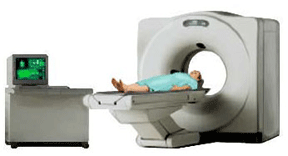
 Ohio hospital slashes CT radiation dose — and cancer risk By Brian Casey, AuntMinnie.com staff writer July 16, 2014 — By changing its scanning protocols, an Ohio hospital was able to cut by more than half the number of radiation-induced cancers that would have occurred following CT exams. The finding could alter the debate over the risks of medical radiation, according to a study in the July issue of the Journal of the American College of Radiology.
In the article, a team of researchers led by Michael Rayo, PhD, of Ohio State University described their project to implement new scanning protocols to reduce radiation dose. The group relied on commercially available tools accessible to most U.S. hospitals, such as iterative reconstruction, tube current modulation, and weight-based variable kV.
While taking into account an overall reduction in CT utilization that occurred during the same time period, the researchers calculated that their efforts would lead to a 63% reduction in cancers induced by the CT scans, based on widely accepted data. If the same scenario were repeated widely around the U.S., it could offer a way out of the morass that has engulfed radiology since the radiation dose controversy erupted in 2007 (JACR, July 2014, Vol. 11:7, pp. 703-708).
Rising volume and radiation dose
CT utilization grew steadily in the U.S. from 1998 through 2008, the authors noted. But in 2007, research studies began appearing that raised the specter that thousands of cancers could be caused by medical imaging exams, in particular CT studies. One study postulated that as many as 2% of all cancers in the U.S. could be caused by exposure to CT radiation, while another estimated that some 29,000 cancers could be caused annually by CT use.
The findings have spurred members of the radiology community to find ways to reduce exposure to medical radiation, with two main avenues being pursued: The first includes efforts such as Choosing Wisely, which reduces exposure by eliminating unnecessary imaging exams, while the second involves developing protocols to reduce the radiation dose used in appropriate exams.
Rayo and colleagues decided to study the topic to determine the impact on radiation dose at Ohio State University Wexner Medical Center, a tertiary-care facility in Columbus. They felt that previous research had not addressed the potential effects of dose reduction protocols and utilization declines on cancer risk reduction.
The researchers examined data for both Medicare and non-Medicare patients treated at the hospital on an inpatient basis in the calendar years 2008 to 2012. They examined reimbursement codes for CT scans of four regions: the abdomen and pelvis, head, sinus, and lumbar spine.
To assess the effectiveness of dose reduction strategies, they calculated the average dose-length product (DLP) in 2010 and 2012 (the hospital implemented its dose reduction program in 2011). The group used a sample of patients for each anatomical region and extrapolated the averages to all the patients scanned for that area at the hospital during the study periods.
Finally, the researchers calculated cancer incidence for both the preintervention and postintervention periods based on data from the Biological Effects of Ionizing Radiation (BEIR) VII report. They divided the estimates into three anatomical regions (estimates were not made for sinus CT due to a small sample size of patients).
They found that overall CT volume grew 21% from 2008 to 2010 and fell by 30% from 2010 to 2012, for a net decline of 15% over the study period. Other changes are shown in the table below. [table in original article]………
Finally, the researchers applied BEIR VII data to calculate how many fewer cancers might develop if all patients were scanned at the lower levels. This translated into an estimated decline of induced cancers from 10.1 cases in 2010 to 3.8 cases in 2012, and a drop in resulting mortalities from 5.1 individuals to 1.9 individuals……….http://www.auntminnie.com/index.aspx?sec=ser&sub=def&pag=dis&ItemID=107954
6 issues for America’s EPA on radiation safety limits
EPA Wants My Opinion? Well, Here It Is, Enformable Joieau Website Joy Thompson 18 July 14,
 The Environmental Protection Agency – the overseers of the suspiciously on-again/off-again RadNet monitoring system in the wake of the 2011 mass meltdown/blow-outs at Japan’s Fukushima Daiichi power station – has helpfully extended the public comment period on its proposed “update” to 40CFR.190, “Environmental Radiation Protection Standards for Nuclear Power Operations.”
Citizens now have until August 4th to submit their comments on exposure limits, dose calculations, new fuel cycle technologies and related topics.
Advance Notice of Proposed Rulemaking (ANPR).
The EPA is seeking public comment and information that they may or may not use for planned updates to the old rules for Environmental Radiation Protection issued in 1977, ostensibly to make them easier to understand and implement. Given how often the public is treated to professions of ignorance from the nuclear industry (such as, “we don’t know how to measure beta radiation levels!” when caught disseminating blatantly false data), this could be a good thing. The Nuclear Regulatory Commission [NRC] is responsible for implementing and enforcing the standards established by the EPA, and we have watched with some jaded dismay as NRC has steadily abdicated its responsibilities, entrusting them to the utilities it’s supposed to be regulating. Utilities now enjoy little to no oversight or auditing of their monitoring or records, and requirements for public notification and protection (like evacuation of nearby residents if releases reach certain levels) have been demonstrated pointless because they are routinely ignoredPerhaps if EPA can tweak its rules so that even the NRC can understand them, we could expect much better compliance all around……..
To help interested people who may be confused by the technical gobbledygook that frames the issues in the EPA’s documents, I am listing the issues here, offering an abbreviated look at EPA reasoning in presenting these issues for comment, and supplying my own responses to the questions EPA is posing to the public………
Issue 1: Consideration of a Risk Limit to protect individuals. Should the Agency express its limits for the purpose of this regulation in terms of radiation risk or radiation dose?
My Response to Issue 1:
Because both national and international radiation protection guidelines developed by non-governmental radiation experts such as the ICRP and the National Council on Radiation Protection and Measurements recommend that radiation exposure standards be established in terms of dose to members of the public, the EPA should continue to base its limits on effective dose to members of the public.
Issue 2: Updated Dose Methodology (dosimetry). How should the Agency update the radiation dosimetry methodology incorporated in the standard?
Current limits on exposures to the public during normal operation are 25mr [millirems] whole body, 75mr to the thyroid, and 25mr to any other organ, over a year’s time. There are no effective limits on accident releases, and anyone who followed the disaster at Fukushima in 2011 will understand why. If releases during an accident/event are calculated to deliver a set level of exposure [dose] to any member of the public over the duration of the event, the requirement for evacuation kicks in.
In the end, and given the past record of deception by the industry and its regulators concerning public exposures to radiation, it probably doesn’t matter which methodology is used to calculate and/or estimate doses to the public during a serious accident, so long as requirements for evacuation of the public when a certain set dose level is reached remain in place. That dose level should remain equivalent to the one(s) now in place.
My Response to Issue 2:
If using a more sophisticated method of calculating and estimating doses/harm to the public will make the task of radiation protection easier, there is no reason not to do so. If EPA decides to go to ICRP’s more recent methodology it should use the ICRP methodology that exists at present [60] and not the one ICRP might eventually quantify. Utilities should not be exempted from requirements for evacuation plans and notifications, nor should the allowable doses to the public be raised.
Issue 3: Radionuclide Release Limits. The Agency has established individual limits for release of specific radionuclides of concern. Based on a concept known as collective dose, these standards limit the total discharge of these radionuclides to the environment. The Agency is seeking input on: Should the Agency retain the radionuclide release limits in an updated rule and, if so, what should the Agency use as the basis for any release limits?
The original EPA release limits (Final Environmental Statement, 1976) were based on the assumption that spent fuel reprocessing would be the one area of the total fuel cycle that would release the most radionuclides to the environment. In 2014 we know from long experience with serious accidents, meltdowns and exploding reactor plants that the generation facilities themselves have proven to be the worst offenders. We do not reprocess commercial spent fuel in this country, and haven’t done so since the 1970s. The government reprocessing facilities that do exist are notoriously filthy, as are fabrication facilities working with plutonium to make MOX fuels. Still, in overall environmental contamination, power plants suffering nasty oopses are right up there for consideration. And power plants suffering nasty oopses are not subject to radionuclide release limits because there is no way to stop those releases.
Now, however, we are looking at decommissioning aged and aging nuclear facilities, doing something with the accumulated tonnage of spent fuel waste, and applying release limitations to any/all new technologies that will come with future nuclear energy development (if that happens). Nuclear pollution from these activities must also be considered.
My Response to Issue 3:
EPA should continue to use the existing standards of limiting environmental burden as a guide, calculate and apply equivalent radionuclide standards for individual facilities at any stage of the nuclear fuel cycle. This need not be based on estimated doses to the wider public or to individual members of the public. It does need to be recalculated as necessary whenever weapon/accident releases occur to release very large amounts of radionuclides to the biosphere, with an eye to maintaining a biosphere-wide environmental burden limit for all dangerous long-lived isotopes.
If such an effort ends up reducing the allowable radionuclide releases from any type of nuclear facility at any point along the fuel cycle to a level that cannot be reasonably applied, then those facilities should be closed and decommissioned. Humanity should not be asked to tolerate the nuclear pollution of our planet to the point where everyone’s health and longevity are materially compromised. If that means the end of the nuclear industry itself, then that’s what it means.
Issue 4: Water Resource Protection. How should a revised rule protect water resources?
Ground and surface water are necessary resources for organic life forms and entire ecosystems. EPA says it wishes to prevent water contamination rather than have to clean it up after it’s polluted. This is great. Existing standards don’t impose water-specific standards because nuclear plants do not release what they consider to be significant radionuclides to water sources during normal operation, and any such releases have had far less impact on public health than airborne releases. There are some fluid effluent limits for specific radionuclides.
As the industry’s facilities have aged, however, water pollution issues have come to the fore. Tritium contamination of groundwater, aquifers, rivers and lakes has become more problematic. Unfortunately, there are no technologies in existence that can effectively remove tritium from water. EPA wishes to establish off-site water standards commensurate with the Clean Water Act, which has specific limitations on concentration of carcinogens.
My Response to Issue 4:
The basis of any new EPA ground and/or surface water standards should be the limits specified in the Clean Water Act, diminished by the concentration of pollutants that may already be present in the water source. The dirtier the ground/surface water already is, the less any nuclear facility will be allowed to release. If the allowance goes to zero, the facility must be closed and decommissioned.
Issue 5: Spent Nuclear Fuel and High-Level Radioactive Waste Storage. How, if at all, should a revised rule explicitly address storage of spent nuclear fuel and high-level radioactive waste?……..
. The failure over the past 40 years to develop medium and long term spent fuel storage has turned operating nuclear plants into de facto storage facilities they were never designed to be. Government/industry agencies, commissions, industry think tanks and international bodies can recommend the development of medium and long term storage facilities all they like. Fact is if nobody’s building them, they flat don’t exist and recommendations accomplish exactly zip.
If it ever looks like such facilities may at long last come to be, then the EPA may have a regulatory role in limiting the amount of radioactive substances those facilities can be allowed to release in any form to the environment. …….
My Response to Issue 5:
The same limitations on releases to air and water from nuclear operations should be applied to on-site storage of spent fuel. There should also be a limitation on how much spent fuel can be stored in a single pool, as well as a time limit on how long it can stay there before being dry-casked. The industry should be forced to dry-cask all spent fuel in their pools that has been stored for 2 years or more. Any dry cask storage facilities on-site should have an area radiation limit to protect workers, and should not contribute at all to off-site radiation levels.
Issue 6: New Nuclear Technologies – What new technologies and practices have developed since 40CFR.190 was issued, and how should any revised rule address these advances and changes?……
My Response to Issue 6:
Reality is that there is no pressing need for the EPA to develop separate or differing limits for possible future nuclear technologies that are entirely unlikely to be deployed. If any of them ever are deployed, the existing (or revised) standards should be applicable to any new nuclear technologies. All applications involving nuclear fission should have to abide by the EPA protective regulations throughout the fuel cycle to limit harm to the general public, nuclear workers and the environment.
EPA should definitely develop and apply specific rules for MOX fuels as those are fabricated and used in power reactors. Plutonium is a dangerous radionuclide, as are other high energy alpha and beta emitters that occur during production, enrichment and fuel fabrication. Limits on levels and releases of these elements should be strict, and dutifully enforced.
Comments should be identified by Docket ID No. EPA-HQ-OAR-2013-0689. Comments may be submitted in the following ways:
• www.regulations.gov: follow the on-line instructions.
• Email: a-and-r-docket@epa.gov
• Fax: (202) 566-9744
• Mail: EPA Docket Center, Environmental Radiation Protection Standards for Nuclear Power Operations – Advance Notice of Proposed Rulemaking Docket, Docket ID No. EPA-HQ-OAR-2013-0689, 1200 Pennsylvania Ave. NW., Washington, DC 20460. Please include two copies.
• Hand Delivery: In person or by courier, deliver to: EPA Docket Center, EPA West, Room 3334, 1301 Constitution Ave. NW., Washington, DC 20004. During Docket’s normal hours of operation. Please include two copies. http://enformable.com/2014/07/epa-wants-opinion-well/
The foul legacy of mounting radioactive nuclear trash
The nuclear option still dogged by waste disposal problems http://www.independentaustralia.net/environment/environment-display/the-nuclear-option-still-dogged-by-waste-disposal-problems,6675 Climate News Network 16 July 2014 Nuclear power is seen as one of the possible solutions to climate change, but the recent closure of five U.S. power stations is forcing the industry to face up at last to the damaging legacy of how to deal with radioactive waste. Paul Brown fromClimate News Network reports.
LONG-TERM employment is hard to find these days, but one career that can be guaranteed to last a lifetime is dealing with nuclear waste.
The problem and how to solve it is becoming critical. Dozens of nuclear power stations in the U.S., Russia, Japan, and across Europe and Central Asia are nearing the end of their lives.
And when these stations close, the spent fuel has to be taken out, safely stored or disposed of, and then the pressure vessels and the mountains of concrete that make up the reactors have to be dismantled. This can take between 30 and 100 years, depending on the policies adopted.
In the rush to build stations in the last century, little thought was given to how to take them apart 40 years later. It was an age of optimism that science would always find a solution when one was needed, but the reality is that little effort was put into dealing with the waste problem. It is now coming back to haunt the industry.
Profitable business
Not that everyone sees it as a problem. A lot of companies view nuclear waste as a welcome and highly profitable business opportunity.
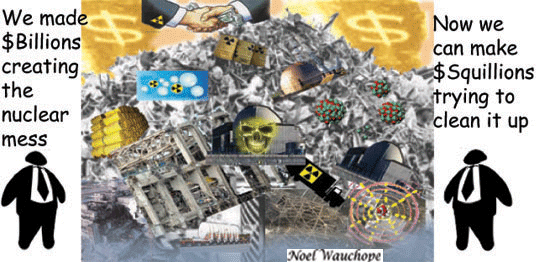
Either way, because of the dangers of radioactivity, it is not a problem that can be ignored. The sums of money that governments will have to find to deal with keeping the old stations safe are eye-wateringly large. They will run into many billions of dollars — an assured income for companies in the nuclear waste business, stretching to the end of this century and beyond.
The U.S. is a prime example of a country where the nuclear waste issue is becoming rapidly more urgent.
The problem has been brought to the fore in the U.S. because five stations have closed in the last two years. The Crystal River plant in Florida and San Onofre 1 and 2 in California have closed down because they were judged too costly to bring up to modern standards. Two more – Kewaunee in Wisconsin and the Vermont Yankee plant – could no longer compete on cost with the current price of natural gas and increased subsidies for renewables.
Nuclear Energy Insider, which keeps a forensic watch on the industry, predicts that several other nuclear power stations in the U.S. will also succumb to premature closure because they can no longer compete.
The dilemma for the industry is that the U.S. government has not solved the problem of what to do with the spent fuel and the highly radioactive nuclear waste that these stations have generated over the last 40 years. They have collected a levy – kept in a separate fund that now amounts to $31 billion – to pay for solving the problem, but still have not come up with a plan.
Legal action
Since it costs an estimated $10 million dollars a year to keep spent fuel safe at closed stations, electricity utilities saddled with these losses, and without any form of income, are taking legal action against the government.
The U.S. government has voted another $205 million to continue exploring the idea of sending the waste to the remote Yucca Mountain in Nevada — an idea fought over since 1987 and still no nearer solution. Even if this plan went through, the facility would not be built and accepting waste until 2048.
The big problem for the U.S., the utility companies and the consumers who will ultimately pay the bill is what to do in the meantime with the old stations, the spent fuel, and the sites. Much of the fuel will be moved from wet storage to easier-to-manage dry storage, but it will still be a costly process. What happens after that, and who will pay for it, is anyone’s guess.
The industry is having a Nuclear Decommissioning and Used Fuel Strategy Summit in October in Charlotte, North Carolina, to try to sort out some of these issues.
But America is not alone. The U.K. has already closed a dozen reactors. Most of the rest are due to be retired by 2024, but it is likely that the French company EDF, which owns the plants, will try to keep them open longer.
The bill for dealing with existing nuclear waste in Britain is constantly rising and currently stands at £74 billion, even without any other reactors being decommissioned.
The government is already spending £2 billion each year trying to clear up the legacy of past nuclear activities, but has as yet found no solution to dealing with the thousands of fuel rods still in permanent store at power stations.
As with the U.S., even if a solution is found, it would be at least 2050 before a facility to deal with this highly dangerous waste could be found. By that time, billions of pounds will have been expended just to keep the used fuel from igniting and causing a nuclear meltdown.
It is hard to know how the industry’s finances could stand such a drain on its resources without going bankrupt.
Similar problems are faced by Germany, which is already closing its industry permanently in favour of renewables, and France, with more than 50 ageing reactors.
Japan, still dealing with the aftermath of the Fukushima accident in 2011, is composed of crowded islands where few people will welcome a nuclear waste depository.
Many countries in the former Soviet bloc with ageing reactors look to Russia – which provided them – to solve their problems. But this may be a false hope, as Russia has an enormous unsolved waste problem of its own.
Dramatic rise
In all these countries, the issue of nuclear waste and what to do with it is a problem that has been put off – both by the industry and politicians – as an issue to be dealt with sometime in the future. But the problem is becoming more urgent as the costs and the volume of waste rises dramatically.
Unlike any other form of generation, even dirty coal plants, getting rid of nuclear stations is no simple matter. To cleanse a nuclear site so that it can be used for another industrial use is difficult. Radioactivity lasts for centuries, and all contamination has to be physically removed.
For many critics of the industry, the nuclear waste issue has always been a moral issue – as well as a financial one – that should not be left to future generations to solve. The industry itself has always relied on its continuous expansion, and developing science, to deal what it calls “back end costs” at some time in the distant future.
But as more stations close, and fewer new ones are planned to raise revenue, putting off the problem no longer seems an option, either for the industry or for the governments that ultimately will have to pick up the bill.
Freezing ducts very slowly built for Fukushima’s ice wall 90 built. 1460 more to go
TEPCO: 90 out of 1,550 freezing ducts built so far http://the-japan-news.com/news/article/0001411769 The Yomiuri Shimbun 10 July 14 Tokyo Electric Power Co. unveiled on Tuesday the construction site of the ice wall at the crippled Fukushima No. 1 nuclear power plant for the first time since work began last month.
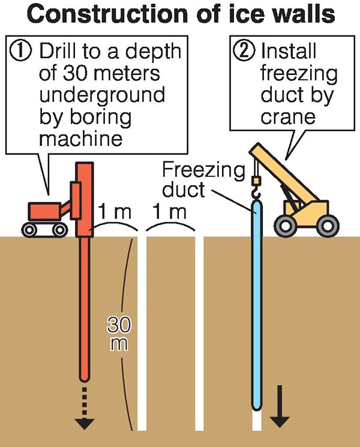
As a measure to halt the increase of contaminated water, the ice walls are aimed at freezing the ground around the Nos. 1 to 4 reactor buildings of the plant to block groundwater from flowing into reactor buildings and becoming contaminated.
Contaminated water at the nuclear plant currently amounts to about 500,000 tons. The government and TEPCO have been working on the construction in the hope of completing it early next fiscal year.
On Tuesday evening, about 30 workers drilled small holes about 30 meters deep around the No. 4 reactor building. Ducts to freeze underground soil are to be installed in the holes.
A total of 1,550 freezing ducts must be installed to surround the Nos. 1 to 4 reactor building area, measuring about 1.5 kilometers. However, TEPCO said only about 90 freezing ducts have been installed so far.
Due to heat exhaustion concerns during summer, workers at the construction site wear vests containing blue ice.
Meanwhile, the task of freezing tunnels filled with contaminated water using the same method involving the construction of an ice wall has been facing difficulties. The Nuclear Regulation Authority has therefore been calling on TEPCO to fundamentally revise construction plans.
Akira Ono, the chief of Fukushima No. 1 nuclear power plant, said: “We’ve already confirmed the effectiveness of ice walls through an on-site experiment. We will push ahead with the construction work forward as fast as we can.”
Internal radiation emitters causing cancers, birth deformities: depleted uranium’s legacy in Iraq
 Depleted Uranium And The Iraq War’s Legacy Of Cancer, Mint Press News, Depleted uranium was used in Iraq warzone weaponry, and now kids are playing in contaminated fields and the spent weapons are being sold as scrap metal. By Frederick Reese @FrederickReese | July 2, 2014 As instability in Iraq is forcing the United States to consider a third invasion of the Middle Eastern nation, the consequences of the first two invasions are coming into focus. For large sectors of the Iraqi population, American intervention has led to sharp spikes in the rates of congenital birth defects, premature births, miscarriages and leukemia cases.
According to Iraqi government statistics, the rate of cancer in the country has skyrocketed from 40 per 100,000 people prior to the First Gulf War in 1991, to 800 per 100,000 in 1995, to at least 1,600 per 100,000 in 2005.
The culprit behind all of these health issues is depleted uranium, a byproduct of uranium enrichment. With a mass fraction a third of what fissile uranium would have, depleted uranium emits less alpha radiation — up to 60 percent less than natural uranium, according to the U.S. Department of Defense. This “relative” safety offered a rationale for many nations — particularly, the U.S. — to put the waste material to use.
As depleted uranium is 1.67 times denser than lead, a depleted uranium projectile can be smaller than an equivalent lead projectile but produce similar results. This smaller size means a smaller diameter, less aerodynamic drag and a smaller area of impact, meaning that depleted uranium bullets can travel faster and inflict more pressure on impact, causing deeper penetration. Additionally, depleted uranium is incendiary and self-sharpening, making depleted uranium ideal for anti-tank ammunition. It is also used as armor plating for much of America’s tank fleet.
The problem with using depleted uranium, however, lies in the fact that depleted uranium is mostly de-energized. In practical terms, depleted uranium can have — at a minimum — 40 percent the radioactivity of natural uranium with a half-life that can be measured in millennia (between 703 million to 4.468 billion years). While the depleted uranium presents little to no risk to health via radiation due to its relatively weak radioactivity, direct internal contact with the heavy metal can have chemical toxicity effects on the nervous system, liver, heart and kidneys, with DNA mutations and RNA transcription errors being reported in the case of depleted uranium dust being absorbed in vitro.
While depleted uranium is not as toxic as other heavy metals, such as mercury or lead, pronounced toxicity is still possible through repeated or chronic exposure………http://www.mintpressnews.com/depleted-uranium-iraq-wars-legacy-cancer/193338/
Unanswered questions about OSMRs (Offshore Small Modular Reactors)
 Andrew Topf writes in Oil Price 06 July 2014“there are some unanswered questions. One is what would happen to the surrounding marine life should an uncontained nuclear meltdown occur at sea. Who can forget the Google Earth map depicting a yellow-green plume of radiation stretching half-way across the Pacific? While the authenticity of the map was later questioned, scientists have discovered trace amounts of radiation on the North American West Coast, a full three years after the event.
Another is the threat of terrorism. The MIT researchers claim that offshore nukes would be harder to attack, but on the other hand, they would also be tough to defend. Todd Woody, writing for The Atlantic, observed that defending these “nuclear islands” from terrorist assault, by ships and submarines, “would require some James Bond-like machinations,” including early detection systems, barriers to vital access points, and the use of automatic weaponry”
Anti Lynas Rare Earths protest in Malaysia: arrest and release of activists
Crikey Clarifier: what’s all the fuss about rare earths? http://www.crikey.com.au/2014/07/01/crikey-clarifier-whats-all-the-fuss-about-rare-earths/ by Crikey Intern Bondi resident Natalie Lowrey was suddenly released without charge on Friday night after five days’ detention in a Malaysian prison. Lowrey, who was born in New Zealand, was arrested last week in Kuantan, Malaysia, for protesting against the processing of rare earths by Australian minerals giant Lynas Corp. We delve into some of the issues surrounding the case.
What are rare earths?
Rare earths are chemical elements found in the earth’s crust that are vital to many modern technologies, including electronics such as speakers, computers, hybrid cars and wind turbines. Rare earths have unique magnetic, luminescent, and electrochemical properties that help technologies perform more efficiently. They are particularly valuable for use in smartphones, and are in high demand.
What is Lynas Corp, and what is it doing in Malaysia?
Lynas Corporation Ltd is an ASX 100 listed company based in Sydney, Australia. It is currently constructing the Lynas Advanced Materials Plant (LAMP), a rare earth processing plant at Gebeng, near Kuantan, Malaysia.
Lynas’ rare earth project has sparked protests in Australia and Malaysia over fears about possible negative health, environmental and economic impacts once the plant begins its operation, as it will produce radioactive material as a waste product. Although the rare earths are extracted in Western Australia, the potentially hazardous processing will take place in Malaysia.
Is there any evidence processing rare earths is dangerous?
Mitsubishi Chemicals Asian Rare Earths, a plant in Bukit Merah, Malaysia, was shut down in the 1992 after at least eight cases of leukaemia and a sudden surge in birth defects and miscarriages in the area. The plant was finally closed after an eight-year battle and is currently undergoing the largest clean-up in the rare earth industry at a cost of US$100 million. Cleaning up requires digging up the entire area of contamination and entombing it inside a mountain.
A spokesperson from Lynas told Crikey: “The Asian Rare Earth plant used the waste from tin mining as its raw material. Lynas raw material contains naturally low levels of thorium, which are 30-40 times lower than rare earth concentrates from tin mine tailings. By all international standards, the Lynas raw material is classified as safe, non-toxic and non-hazardous.”
But Dr David KL Quek, former president of the Malaysia Medical Association, has said:
“Thorium is an acknowledged waste product from the planned Lynas refinery of rare earth ores. Due to the various refining processes thorium will be enriched and concentrated to levels which could reach quantities that are difficult to contain or be safely sequestrated.
“Based on the preliminary Environmental Impact Agency report, thorium residues would lead to a sizeable radioactivity dose of some 62 Becquerel per gram. For 106 tonnes this would be an enormous quantity of radioactive residual thorium.”
Wastes from production will include radioactive thorium and uranium and their radioactive decay products such as radium and radon. Australian authorities have explicitly refused to allow the wastes to be shipped back to Australia for safe disposal.
Why Malaysia?
The Malaysian government has been more open to rare earths processing than the Australian government.
Phua Kai Lit, an associate professor of the Jeffery Cheah School of Medicine and Health Sciences at Monash University in Malaysia, told Crikey: “The Prime Minister, as well as the Chief Minister of the state of Pahang, are both strong supporters of the project. Similarly, political appointees such as the various ministers from ministries involved with the project echo the government’s line. The head of the main regulatory body, the Atomic Energy Licensing Board, also echoes the government’s line.
A spokesperson told Crikey Lynas plans to recycle the waste from the LAMP refining process into co-products such as plaster boards and cement. Two out of three of these products have been certified as non-radioactive by the Malaysian Atomic Energy Licensing Board.
The AELB is in charge of approving and monitoring radioactive industries and received an undisclosed sum by Lynas Corp in 2011. However the AELB denied the sum was a requirement.
They’e touting thorium nuclear energy, but it’s a weapons proliferation risk
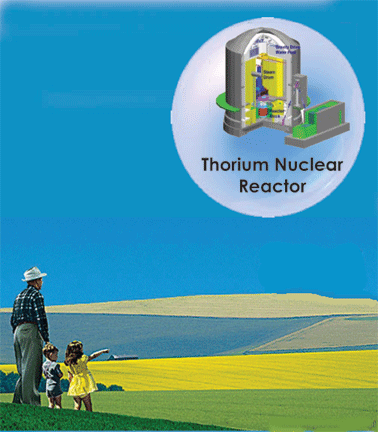 Thorium: Proliferation warnings on nuclear ‘wonder-fuel’ Phys Org, Thorium is being touted as an ideal fuel for a new generation of nuclear power plants, but in a piece in this week’s Nature, researchers suggest it may not be as benign as portrayed.
The element thorium, which many regard as a potential nuclear “wonder-fuel”, could be a greater proliferation threat than previously thought, scientists have warned.
Writing in a Comment piece in the new issue of the journal, Nature, nuclear energy specialists from four British universities suggest that, although thorium has been promoted as a superior fuel for future nuclear energy generation, it should not be regarded as inherently proliferation resistant. The piece highlights ways in which small quantities of uranium-233, a material useable in nuclear weapons, could be produced covertly from thorium, by chemically separating another isotope, protactinium-233, during its formation.
The chemical processes that are needed for protactinium separation could possibly be undertaken using standard lab equipment, potentially allowing it to happen in secret, and beyond the oversight of organisations such as the International Atomic Energy Agency (IAEA), the paper says.
The authors note that, from previous experiments to separate protactinium-233, it is feasible that just 1.6 tonnes of thorium metal would be enough to produce 8kg of uranium-233 which is the minimum amount required for a nuclear weapon. Using the process identified in their paper, they add that this could be done “in less than a year.”
……….”Small-scale chemical reprocessing of irradiated thorium can create an isotope of uranium – uranium-233 – that could be used in nuclear weapons. If nothing else, this raises a serious proliferation concern…….. Continue reading
Looks like Thorium Nuclear Energy has no future in USA
 G. Bothun · University of Oregon Researcj gaste ( apro nuke forum) 27 June 14
1) Currently the timescale to go from permit to actual turning ON line any nuclear power plant is about 15 years (I think currently there are only 2 recently (2012) approved plans coming on line in Georgia and that will take likely another 8–10 years) – meaning that this really isn’t a “bridge fuel” (especially compared to fracked natural gas – which is being rapidly depleted)
2) The whole US nuclear infrastructure is based on handling Uranium. Thorium has much more stringent handling requirements and I just don’t think the US will ramp up an infrastructure to deal with this. Its probably not even wise to do so as those investments are better made in renewable energy and/or carbon capture and storage projects (like the one in Michigan)
USA coastal communiities monitoring sea-borne Fukushima radiation plume
Fukushima radiation concerns coastal communities Tracy Loew, Statesman Journal 25 June 14, Talk in the Oregon coast town of Bandon often turns to the approaching plume of sea-borne radiation from Japan’s crippled Fukushima nuclear power plant.
“We’ve been worried about it and worried about it,” said Zac Adams, owner of Bandon Designsconstruction company. “We’re really concerned about it affecting the fisheries, the wildlife, the tourism, and most importantly our health.”…….
The radiation is expected to hit the U.S. this year at very low levels that wouldn’t harm humans or the environment. But no federal agency is monitoring it.
So Adams joined a citizen-science project, crowd-sourcing funds in his community to test a sample of seawater that he will soon collect.
Four hours north, the Tillamook Estuaries Partnership has funded two collection sites, in Tillamook and Pacific City.
“Over the last year-and-a-half, it’s been an issue that’s been raising in prominence along the coastline,” said Lisa Phipps, executive director of the partnership. “In our area, there have been groups that have been coming together to talk about what is happening in the ocean.”
And fund-raising is underway for two more sites, in Newport and Winchester Bay.
Altogether about 30 sites, from Alaska to Baja, Calif., have been funded, said Ken Buesseler, a chemical oceanographer at the Woods Hole Oceanographic Institution who put together the project, called “How Radioactive is Our Ocean?”
It uses crowd-sourced money and volunteers to collect water samples along the Pacific Coast, then ship them to Buesseler in Massachusetts to be analyzed on an $80,000 instrument………
Buesseler is looking for increased levels of Cesium-137, which already is in all oceans from previous nuclear testing and accidents; and for Cesium-134, a “fingerprint” of Fukushima.
Because of its short, two-year half-life, any Cesium-134 could only have come from the plant, he said.
So far, Buesseler said, no samples have indicated that the plume has reached the West Coast.
Buesseler posts results on the project’s website. They show Cesium-134 and increased levels of Cesium-137 off the coast of Japan and across the ocean.
“We know it’s out there,” Buesseler said. “We’ve seen it more than halfway across the Pacific.”
Northwest of Hawaii, for example, Buesseler has found Cesium-134 at concentrations as high as 3.8 becquerels per cubic meter.
But to put that in context, he said, the U.S. drinking water limit is 7,400 of those units.
“Every additional radiation exposure causes additional risks for cancer,” he said. “But when the numbers are in the one to 10 range, that’s a very small additional risk.”
That’s the range that is expected to hit our shores, with lower levels coming first.
“As the contamination arrives, we expect the concentrations to go up over the next two years,” Buesseler said……..http://www.statesmanjournal.com/story/tech/science/environment/2014/06/25/fukushima-radiation-concerns-coastal-communities/11377463/
USA planning a nuclear attack on Russia?
 Indications that the U.S. Is Planning a Nuclear Attack Against Russia By Eric Zuesse (about the author) OpEdNews Op Eds 6/14/2014 On Wednesday, June 11th, CNN headlined “U.S. Sends B-2 Stealth Bombers to Europe,” and reported that “they arrived in Europe this week for training.” Wikipedia notes that B-2s were “originally designed primarily as a nuclear bomber,” and that “The B-2 is the only aircraft that can carry large air-to-surface standoff weapons in a stealth configuration.”
In other words, the primary advantage of the newer, “Stealth,” version of B-2, is its first-strike (or surprise-attack) nuclear capability. That’s the upgrade: the weapon’s ability to sneak upon the target-country and destroy it before it has a chance to fire off any of its own nuclear weapons in response to that “first-strike” attack. The advantage of Stealth is creating and stationing a nuclear arsenal for the purpose of winning a nuclear war, instead of for the goal of having continued peace via “Mutually Assured Destruction,” or MAD.………
That old system — “Mutually Assured Destruction” or MAD, but actually very rational from the public’s perspective on both sides — is gone. The U.S. increasingly is getting nuclear primacy. Russia, surrounded by NATO nations and U.S. nuclear weapons, would be able to be wiped out before its rusty and comparatively puny military force could be mustered to respond. Whereas we are not surrounded by their weapons, they are surrounded by ours. Whereas they don’t have the ability to wipe us out before we can respond, we have the ability to wipe them out before they’ll be able to respond. This is the reason why America’s aristocracy argue that MAD is dead. An article, “Environmental Consequences of Nuclear War” was published in the December 2008 Physics Today, and it concluded that, “the indirect effects [‘nuclear winter’] would likely eliminate the majority of the human population.” (It would be even worse, and far faster, than the expected harms from global warming.) However, aristocrats separate themselves from the public, and so their perspective is not necessarily the same as the public’s. The perspective that J.P. Morgan and Co. had in 1915 wasn’t the perspective that the U.S. public had back then, and it also wasn’t the perspective that our President, Woodrow Wilson, did back then, when we were a democracy. But it’s even less clear today that we are a democracy than it was in 1915. In that regard, things have only gotten worse in America……..
Obama isn’t only beefing up our first-strike nuclear capability, but is also building something new, called “Prompt Global Strike,” to supplement that nuclear force, by means of “a precision conventional weapon strike” that, if launched against Russia from next-door Ukraine, could wipe out Russia’s nuclear weapons within just a minute or so……..
Certainly, Obama means business here, but the big question is whether he’ll be able to get the leaders of other “democratic” nations to go along with his first-strike plan.
The two likeliest things that can stop him, at this stage, would be either NATO’s breaking up, or else Putin’s deciding to take a political beating among his own public for simply not responding to our increasing provocations. Perhaps Putin will decide that a temporary embarrassment for him at home (for being “wimpy”) will be better, even for just himself, than the annihilation of his entire country would be. And maybe, if Obama pushes his indubitable Superpower card too hard, he’ll be even more embarrassed by this conflict than Putin will be. After all, things like this and this aren’t going to burnish Obama’s reputation in the history books, if he cares about that. But maybe he’s satisfied to be considered to have been George W. Bush II, just a far better-spoken version: a more charming liar than the original. However, if things come to a nuclear invasion, even a U.S. “victory” won’t do much more for Obama’s reputation than Bush’s “victory” in Iraq did for his. In fact, perhaps Americans will then come to feel that George W. Bush wasn’t America’s worst President, after all. Maybe the second half of the Bush-Obama Presidency will be even worse than the first. http://www.opednews.com/articles/Indications-that-the-U-S–by-Eric-Zuesse-Nuclear-Weapons_Obama-Administration_PNAC-Neocon-Project-For-A-New-American-C_President-Barack-Obama-POTUS-140614-352.html?show=votes
1 This Month



26 September – International Day for the Total Elimination of Nuclear Weapons


PLEASE OPPOSE HR 8255 AND S.3639 – bills would accelerate satellite deployment, with no environmental review or safeguards – https://ncstd5li.quorum.us/campaign/169331/
To see nuclear-related stories in greater depth and intensity – go to https://nuclearinformation.wordpress.com
-
Archives
- September 2026 (245)
- August 2026 (330)
- July 2026 (355)
- June 2026 (287)
- May 2026 (306)
- April 2026 (356)
- March 2026 (251)
- February 2026 (267)
- January 2026 (308)
- December 2025 (358)
- November 2025 (359)
- October 2025 (375)
-
Categories
- 1
- 1 NUCLEAR ISSUES
- business and costs
- climate change
- culture and arts
- ENERGY
- environment
- health
- history
- indigenous issues
- Legal
- marketing of nuclear
- media
- opposition to nuclear
- PERSONAL STORIES
- politics
- politics international
- Religion and ethics
- safety
- secrets,lies and civil liberties
- spinbuster
- technology
- Uranium
- wastes
- weapons and war
- Women
- 2 WORLD
- ACTION
- AFRICA
- Atrocities
- AUSTRALIA
- Christina's notes
- Christina's themes
- culture and arts
- Events
- Fuk 2022
- Fuk 2023
- Fukushima 2017
- Fukushima 2018
- fukushima 2019
- Fukushima 2020
- Fukushima 2021
- general
- global warming
- Humour (God we need it)
- Nuclear
- RARE EARTHS
- Reference
- resources – print
- Resources -audiovicual
- Weekly Newsletter
- World
- World Nuclear
- YouTube
-
RSS
Entries RSS
Comments RSS
 nuclear-news