High Burnup nuclear fuel , San Onofre, – Storage and Transportation issues
 ISSUES INVOLVING STORAGE AND TRANSPORTATION OF HIGH BURNUP NUCLEAR FUEL DECOMMISSION SAN ONOFRE By Marvin Resnikoff, Ph.D.SCE Community Engagement Panel (CEP) San Juan Capistrano Community Center May 6, 2014 “……… I’m going to briefly discuss transportation and storage of nuclear fuel, and I’m going to focus on high burnup nuclear fuel (HBF). What and why is HBF? NRC has not fully investigated the technical issues and implications, which in my view, are major and should have required careful study and an EIS. This is work that should have been done before the NRC allowed utilities to go to high burnup, not after. By high burnup, I mean fuel greater than 45 GWD/MTU, but in clearer terms, allowing each assembly to remain in the reactor longer. The implications are the radioactive inventory in HBF is greater.
NRC staff have focused on the heat in HBF, which is greater. But heat will decline over time. One implication is decommissioning will take longer. Fuel will sit in fuel pool for 20 years or more. San Onofre has high burnup fuel. The implication of a longer decay time is that the workers at the site will not be available for the decom process. Putting more fuel into the same space, moving from 24 fuel assemblies to 32, as Southern California Edison intends to do, will further the cooling off period. However, while heat is an important consideration, but perhaps of greater import is the impact on fuel cladding. It may surprise you to know that the NRC does not know how much HBF exists across the country. While the NRC has the power and the ability to identify how much HBF is at each reactor. The NRC has inspectors at each reactor. They simply have not made the effort. The Department of Energy (DOE) is conducting a survey which should be released in September. HBF has major implications for decommissioning, storage, transportation and disposal.
• Little technical support for NRC approval of high burnup fuel (HBF). Experiment taking place in the field.
• Total amount of HBF unknown. At a minimum, the NRC should survey utilities.
• HBF will postpone storage up to 20 years; 32 PWR canister extends cooldown period.
• Cladding defects are a major problem for HBF; HBF may not be retrievable. HBF should be canned.
• Because of corrosion, long-term storage may not be possible in a salt environment.
• Side impact rail accidents may shatter HBF cladding.
• Long duration, high temperature fires may involve oil tankers that travel the same tracks. NRC has not properly quantified the statistical likelihood.
Rebutting the nuclear spruiker, James Conca

A Rebuttal to the January 11, 2013 Article by James Conca, “Like We’ve Been Saying — Radiation is Not A Big Deal,” Posted on Forbes Website fukushimavoice-eng.blogspot.com.au/2013/02/a-rebuttal-to-january-11-2013-article.html
Mixed Oxide Nuclear Fuel (MOX) program is a dud
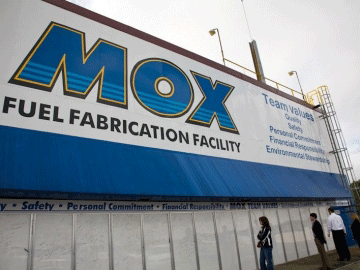 MOX project of little value http://beta.mirror.augusta.com/opinion/letters/2014-05-01/mox-
 project-little-value By Victor J. ReillyAiken, S.C. Thursday, May 1, 2014 MOX is a mix of oxides of uranium and plutonium that can be used as fuel for commercial nuclear reactors. It removes some plutonium from the sticky fingers of terrorists. Sound good? Yes, until the cost of doing this soared.
South Carolina Gov. Nikki Haley has recently said that if MOX is shelved, she wants the plutonium out of South Carolina. That is silly, but it reflects a 2002 federal law that U.S. Sen. Lindsey Graham had demanded.
Apparently, idiocy is endemic.
First, our plutonium problem. With welcome reductions in our nuclear arsenal, we now have about a hundred tons of plutonium in storage. In the wrong hands, less than 20 pounds of it could make a nuclear bomb. That would be a catastrophe. We must store it securely for decades. Savannah River Site would be logical for this job, with its huge area and a staff experienced in handling plutonium. This would provide good jobs that the governor should have jumped at.
MOX’s design capacity is to disable one ton of plutonium per year, so if MOX were the way to work it off, it would take more than a hundred years. A stock of one ton requires as much protection as for 100 tons.
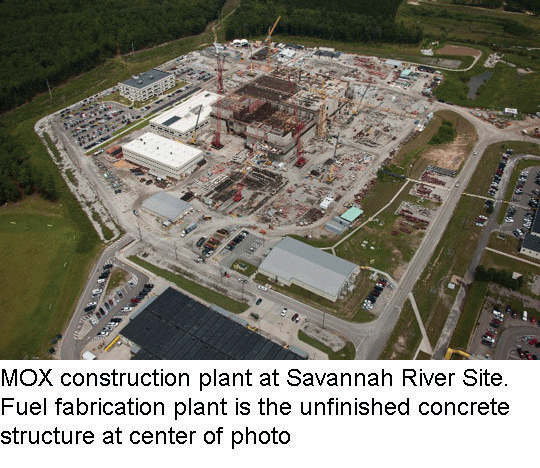
With the huge increase in fixed costs from construction, would it be profitable? If we plan to cancel the program, we would end up writing off the sunk costs, so why not do it anyway? Would it then be profitable? If MOX fuel can’t be sold at a profit, why continue with it?
In summary, MOX has no value in ridding us of our stored plutonium.
Alternatives must be sought for that. The United States will need to have one or several plutonium storage sites, indefinitely. South Carolina should accept the job for one of them.
Britain’s Sellafield – a nuclear security nightmare
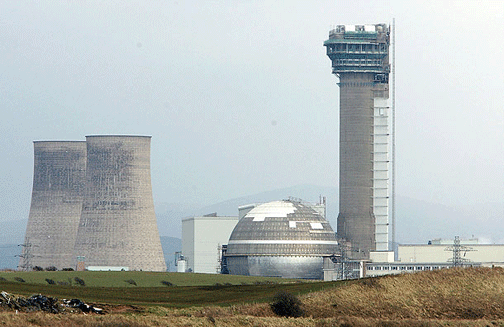
 Nuclear power undermines nuclear security, The Ecologist, Dr David Lowry 2nd May 2014 “…… In Britain, the biggest nuclear security problem is the huge nuclear facility at Sellafield, originally built in the early 1950 on England’s northwest coast, in Cumbria, which is also home of the wonderful Lake District National Park.
Sellafield however is also the home of hundreds of decaying and decrepit building, many stores of liquid and solid radioactive waste, and, from a security perspective, most importantly, 111 tonnes of weapons – useable plutonium.
Let me give you that figure in another way. 111 tonnes is 111,000 kilogrammes. A nuclear bomb can be made with as little as 5 kilograms of plutonium – a lump about the size of a large orange.
Note: the ‘Fat Man’ nuclear bomb detonated above Nagasaki in August 1945, with a blast equivalent to 21,000 tons of TNT, contained jut 6.2 kg of plutonium
The Sellafield deer
And how well prepared are Sellafield’s managers for the unexpected? Not very, as we can see from the story of the Sellafield deer.
As a result of a recent security review, the Sellafield management decided to strengthen the perimeter fence around the site. Unfortunately in doing so they unintentionally captured a small herd of wild deer.
But rather than releasing the corralled deer, they shot them, as the local newspaper, the Whitehaven News revealed early on 3rd April. Their headline ran: “Three deer shot dead as Sellafield carries out cull”.
Now – if the deer could find themselves, un-noticed, on the wrong side of the security fence, what about people? The insecurity of the storage buildings for the waste products arising from operating nuclear power reactor is a a huge and as yet unsolved problem.
We are often told these stores are robust against terrorist attack. …….
UK score on nuclear security: 11%
NTI publishes a table in its new report (see below) that ought to set the alarm bells ringing in DECC and across Whitehall. The NTI assessed the nuclear security of 25 countries identified as having the nuclear materials capable of making nuclear nuclear WMDs. The UK ranked bottom with a score of just 11/100.
But the problem is clearly systemic. The five permanent members of the UN Security Council, who also happen to be the ‘Big Five’ nuclear weapons states – the US, Russia, China, UK and France – all ranked 18th or worse out of 25, with scores of 34/100 or worse.
Intriguingly Iran – condemned by the US and other countries as representing a major nuclear proliferation hazard and punished by the Security Council with severe sanctions as a consequence – ranked 4th with a score of 89/100, putting the UNSC permanent members to shame……. http://www.theecologist.org/News/news_analysis/2381924/nuclear_power_undermines_nuclear_security.html
A 2 $billion stop gap measure- Chernobyl’s new tomb
Chernobyl’s Steel Radiation Shield Is the Biggest Moving Structure Ever, Gizmodo Kelsey Campbell-Dollaghan 29 April 14 (Terrific photos) In the normal world, it’s what you’d call a bad investment: Spending $2 billion to build the largest moveable structure ever—and knowing that it won’t work for longer than 100 years. But in Chernobyl, it’s the best available option for protecting a whole continent from the worst nuclear disaster in history.
Today is the 28th anniversary of the disaster, which killed 31 and subjects hundreds of others to extreme suffering, and left 200 tons of radioactive corium and 16 tons of uranium and plutonium exposed inside the smoking remains of Reactor 4. At the time, heroic workers quickly constructed an ad hoc shelter over the reactor to stop the spew of radioactive material across Ukraine and Western Europe, using 7,000 metric tons of metal and many more tons of concrete. But that shelter—known as the Sarcophagus—was never meant to last. And now, it’s in danger of collapsing.
Enter New Safe Confinement, a project that’s nearly as old as the meltdown it’s designed to contain. It’s a two-pronged plan: First, thousands of workers are constructing a 300-foot-tall steel arch that weighs more than 32,000-tons. Though it’s being built a few hundred meters away from Reactor 4, it’s eventually going to cover it, creating a thick steel cage around the reactor in case it collapses.
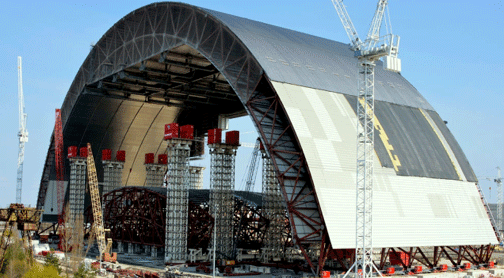
But because the area near it is too radioactive for workers to stay there for longer than a few minutes, this huge structure is being built next door—then, very very slowly, it will be slid on teflon-coated tracks to cover the
The Mixed Oxide (MOX) nuclear fuel stuff-up
A Botched Plan to Turn Nuclear Warheads Into Fuel Bloomberg, By Matthew Philips April 24, 2014 As the Soviet Union was unraveling and the Cold War was winding down in the early 1990s, negotiators in Washington and Moscow began talking about how best to dispose of the plutonium inside thousands of nuclear warheads the two nations had agreed to dismantle. The cheapest and easiest method was to immobilize the radioactive material by encasing it in molten glass and burying it. But the Russians balked at that, likening it to flushing gold down the toilet. Ultimately, it was decided that the plutonium would be converted into fuel for nuclear power plants. In September 2000, the U.S. and Russia signed an agreement under which each side would turn 34 tons of weapons-grade plutonium into mixed-oxide fuel, or MOX, that could be combined with uranium for use in commercial reactors.
In the U.S., that huge task would take place at an aging plutonium factory in South Carolina called the Savannah River Site. From the 1950s to the 1980s, the 310-square-mile facility had churned out about 36 tons of weapons-grade plutonium for nuclear warheads. Now, the plant would turn those same warheads into fuel rods. The Department of Energy initially estimated it would cost about $1 billion to convert the plant. Construction began in August 2007, with an expected completion date of 2016.
The U.S. government even had a ready customer for the rods. Charlotte-based Duke Energy (DUK), one of the largest nuclear power companies in the U.S., signed on as a buyer. From 2005 to 2008, the company ran tests of MOX fuel the Department of Energy got from France. The fuel worked fine. Everything was going according to plan.
Almost seven years after construction began, the MOX plant is now 60 percent built. But it’s looking increasingly likely that it won’t ever be completed….The MOX plant in South Carolina requires 85 miles of pipe, 23,000 instruments, and 3.6 million linear feet of power cables. The project is vastly over budget: The Department of Energy has sunk about $5 billion into it so far and estimates it will cost an additional $6 billion to $7 billion to finish the plant, plus an additional $20 billion or so to turn the plutonium into fuel over 15 years. In its 2015 budget request released in March, the Department of Energy announced it will place the MOX project on “cold standby,” effectively mothballing the project for the foreseeable future. “It’s a major fiasco,” says Edwin Lyman, a senior scientist at the Union of Concerned Scientists. “Billions of taxpayer dollars have been wasted. It’s a classic boondoggle.”
The MOX plant is the latest blunder for the Department of Energy, which has a reputation for mismanaging big, complicated projects, particularly those related to nuclear energy. Costs for a nuclear waste treatment plant in Washington State have nearly tripled to $13 billion. A uranium processing facility in Tennessee once estimated to cost around $1 billion is now tipping the scales at around $11 billion, according to an Army Corps of Engineers study. It’s also running about 20 years behind schedule. A Department of Energy spokesman declined to comment for this article…….http://www.businessweek.com/articles/2014-04-24/u-dot-s-dot-botches-plan-to-turn-nuclear-warheads-into-fuel
Hanford nuclear waste region produces high rate of rare birth defects
Rare Birth Defects Still Spiking in Washington State http://www.nbcnews.com/health/health-news/rare-birth-defects-still-spiking-washington-state-n86916 BY JONEL ALECCIA 22 April 14, Seven cases of a rare fatal birth defect were reported in a remote region of Washington state in 2013, making it the fourth consecutive year that rates have more than tripled the national average, health officials said Tuesday.
There’s still no clear reason for the spike in anencephaly, a severe defect in which babies are born missing parts of the brain or skull, according to Washington state health officials. NBC News investigated the issue in February.
But it brings to 30 the number of cases reported since 2010 in the area that includes Yakima, Benton and Franklin counties in central Washington state. The anencephaly rate jumped to 8.7 cases per 10,000 births in the region, far exceeding the national rate of 2.1 cases per 10,000 births.

“We’re really concerned about the fact that the anencephaly rates are still so high,” said Mandy Stahre, an Epidemic Intelligence Service officer with the Centers for Disease Control and Prevention based in Washington state. “We were sort of hoping that this may have been a statistical anomaly or would go away.”
State and federal officials plan to convene an advisory committee of national experts to review options for investigation and prevention, Stahre said. Next month, they’ll hold “listening sessions” in the community to hear public concerns about the rise in birth defects in the region. “The community members, they live here,” Stahre said. “They may be seeing things that we don’t.”
But that hardly seems like enough, said one mother whose baby was born with spina bifida last year and was considered part of a cluster of cases of neural tube defects in the region.
“It’s good that they want to know everybody’s thoughts, but what are they doing about it?” said Andrea Jackman, 30, who lived in an orchard in Yakima, Wash., while she was pregnant but now lives in Ellensburg. Her daughter, Olivia, is 7 months old.
“Why are they going to put the time and money into chatting with people who don’t know? Do the research.”
Stahre said one of the goals of the advisory committee will be to decide what focus future investigations should take.
“Do we go back and look even further back? Or do we just focus on current conditions and looking foward,” Stahre said.
The new count follows a report last summer that found more than two dozen cases of babies born with anencephaly and other neural tube defects in the region between 2010 and 2013.Researchers found no geographic, seasonal or other type of pattern to the cases, Stahre said.
Medical records indicate low rates of folic acid vitamin supplementation in the region, which has been linked to anencephaly. Other studies have shown ties between the defect and exposure to molds and pesticides. Critics have said state and federal officials need to do detailed interviews and a thorough investigation of the central Washington cluster.
Many local residents are convinced that leaking tanks of nuclear waste from the region’s nearby Hanford nuclear plant must be to blame, but Dr. Edith Cheng, a University Washington Medicine expert on birth defects, said there has not been a good evaluation of the plant’s impact on anencephaly or other problems.
Experts emphasize the need for all women of childbearing age to take folic acid supplements.
See the decline of nuclear power in these 7 graphs
 7 Interesting Nuclear Energy Graphs http://cleantechnica.com/2014/04/22/7-interesting-nuclear-energy-graphs/One of our readers recently passed along a couple of very interesting charts about nuclear energy as well as the nuclear energy report from which they came. The report, World Nuclear Report 2013, is well worth a more careful look, but for those who just love some interesting charts, here are the two that our ever-alert reader shared as well as a few more I pulled out: (more at original site)
America’s loyalty to the nuclear industry, rather than to sick, irradiated navymen
Is America Abandoning its Bravest Heroes Yet Again?, WhoWhatWhy By Karen Charman on Apr 21, 2014Reason for Navy Cover-up?“………..Because U.S. military personnel are prevented from suing the government, their only recourse is to go after TEPCO. But given the interests involved, the outcome for the Operation Tomodachi victims remains very much in doubt. Robert Alvarez, the nuclear investigator and former DOE deputy assistant secretary, points out that about a quarter of a million U.S. soldiers were subjected to open air nuclear weapons testing in the 1940s, 50s and 60s.
“If you use the treatment of atomic veterans who were involved in atmospheric testing as a benchmark, the government did everything it could to downplay the hazards, because from the military perspective, the mission is all important,” he says.
“Right now, the United States government and Japan are closing ranks because of their nuclear-related relationships,” he says. Although Japan’s 54 power-generating nuclear reactors are currently offline, the country still has the third largest number of nuclear reactors in the world.
But more important, Alvarez says, is the “extraordinary co-dependence” with Japan on nuclear-energy-related matters. “Because the U.S. has lost much of its capability in designing and building reactors, we have to depend on the Japanese and the French if we’re going to build any reactors or fabricate fuel or do anything to service the existing reactor fleet,” he explained. “We’re dependent on companies that are now owned by Japan and France.”
The case of the ill Operation Tomodachi veterans shines a spotlight on the intersection of competing interests between victims of radiation exposure, the nuclear power industry, and the U.S. government and its unwavering commitment to nuclear technology for both military and civilian use. So far, by denying the harm from the radiation U.S. military personnel were exposed to as they helped Japan clean up after the devastating earthquake and tsunami in March 2011—a position that supports the Japanese government and nuclear industry—the U.S. government is doing what it has almost always done: protect nuclear interests rather than its victims.
As the number of ill Operation Tomodachi veterans climbs, it remains to be seen whether their sacrifice will be acknowledged or if they, like so many others, will be left to fend for themselves. http://whowhatwhy.com/2014/04/21/america-abandoning-bravest-heroes-yet/#sthash.YiyEeRT1.dpuf
The dangerous myth of “Chernobyl wild paradise”
 Decay takes a holiday: the wickedness beneath the “Chernobyl wild paradise” myth and the rotten implications for ecosystems and radiation science http://www.beyondnuclear.org/russia-ussr/2014/4/18/decay-takes-a-holiday-the-wickedness-beneath-the-chernobyl-w.html 21 April 14
Zombie forest?
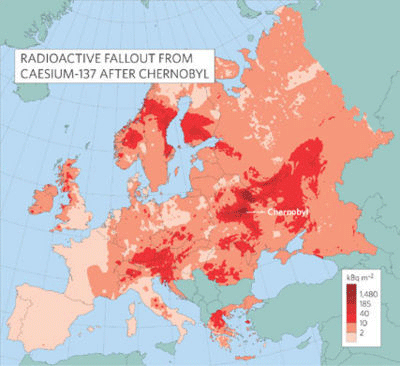
April 26, 2014 will mark 28 years since the Chernobyl nuclear reactor exploded causing an unprecedented nuclear catastrophe. In a creepy revelation, the forests around Chernobyl are having difficulty decomposing. A recently published study indicates that forest matter in the contaminated areas around Chernobyl is taking years or even decades longer to decay than it should. In the areas with low radiation, 70 to 90 percent of the leaves were gone after a year. Where radiation levels were higher, “leaves retained around 60 percent of their original weight…”(Smithsonian.com) This indicates a fundamental disruption to the natural cycle of death feeding life, and calls into question the forest’s longer-term viability. Creatures responsible for decay such as microbes, fungi and some types of insects, are essential components of any ecosystem because they recycle organic material back into the soil. Unfortunately, they do not function properly in the areas around Chernobyl, leaving a forest full of “petrified-looking pine trees that no longer seem capable of rotting.” GIZMODO
Radiation’s effect on decay processes should be expected, considering how it impacts microbes in food; or considering the results of a bizarre, cavalier and extremely ill-advised series of experiments performed using a “naked reactor” in the late 1950’s and early 1960’s. These experiments intentionally irradiated a number of varying materials and forest land 40 miles north of Atlanta, GA. Wood subjected to this radiation was produced in small-scale and called “Lockwood”, for Lockheed Aircraft Corporation who operated the Georgia Nuclear Laboratory. The building and land is still contaminated with radionuclides.
The lack of decomposer activity has researchers worried that nutrients which trees require for grow are not being recycled, causing trees in the area to grow more slowly. Improper plant decay has potential implications for animal decay as well, although there do not appear to be any Chernobyl studies investigating this yet.
Actual in-the-field examinations of regions contaminated by radioactivity from Chernobyl also reveal evidence for increased mutation rates, abnormal sperm with reduced swimming ability, developmental abnormalities, cataracts, tumors, smaller brains in both birds and mammals, and decreased tree growth rates, a finding of fundamental importance for ecosystem functioning that likely relates to effects on the microbial community. Fewer spiders and insects including bees, butterflies and grasshoppers—live there. Animals and plants show other impacts of radiation after the Three Mile Island nuclear disaster in the US and the Fukushima nuclear disaster in Japan.
Timothy Mousseau, a biologist at the University of South Carolina, Columbia, who collaborated on many of these studies, contends that, fundamentally, this evidence indicates low-dose rate exposures cause significant measurable impacts for the biota inhabiting contaminated regions of Chernobyl. Further, this evidence supports a hypothesis that suggests effects down to very low levels. Further implications for Fukushima should not be ignored.
Humans and animals alike: healthy looking on the outside, disintegrating on the inside
Referencing studies summarized in his book, Chernobyl: Consequences of the Catastrophe for People and the Environment, Alexey Yablokov states:
“Wildlife in the heavily contaminated Chernobyl zone sometimes appears to flourish, but the appearance is deceptive,” says Yablokov. “Levels of incorporated radionuclides remain dangerously high for mammals, birds, amphibians, and fish. Long-term observations of both wild and experimental animal populations in the heavily contaminated areas show significant increases in morbidity and mortality that bear a striking resemblance to changes in the health of humans – increased occurrence of tumours and immunodeficiencies, decreased life expectancy, early aging, changes in blood and the circulatory system, malformations, and other factors that compromise health.
“All of the populations of plants, fishes, amphibians and mammals studied there are in poor condition,” he continues. “This zone is analogous to a ‘black hole’, in which there is accelerated genetic degeneration of large animals – some species may only persist there via immigration from uncontaminated areas. The Chernobyl zone is a micro-evolutionary ‘boiler’, where gene pools of living creatures are actively transforming, with unpredictable consequences. We ignore these findings at our peril.”
Dr. Yablokov’s statement deftly presents the dichotomy between what is observed by a dilettante’s eye – such as lots of members in a wild animal population — versus what is actually happening to these members over time. What is happening to this wildlife has parallel implications for human health.
So where did this “paradise for wildlife” and “biodiversity sanctuary” myth come from? In 2006 the International Atomic Energy Agency, a nuclear power promoter and a member body of the United Nations, released a report entitled Environmental Consequences of the Chernobyl Accident and their Remediation: Twenty Years of Experience. This report references the creation of a nature preserve within the Chernobyl Exclusion Zone and remarks “Without a permanent residence of humans for 20 years, the ecosystems around the Chernobyl site are now flourishing. The CEZ has become a wildlife sanctuary…, and it looks like the nature park it has become.” From another report: “Indeed, the Exclusion Zone has paradoxically become a unique sanctuary for biodiversity.”
The Chernobyl Forum coalition makes this statement in support of “unique biodiversity” in spite of their recognition that “Genetic effects of radiation, in both somatic and germ cells, have been observed in plants and animals of the Exclusion Zone during the first few years after the Chernobyl accident. Both in the Exclusion Zone, and beyond, different cytogenetic anomalies attributable to radiation continue to be reported from experimental studies performed on plants and animals.” They conclude, however, “[w]hether the observed cytogenetic anomalies in somatic cells have any detrimental biological significance is not known.” In order to know this, one has to actually look.
The study summaries compiled by Alexey Yablokov, et al. (studies which had been mostly unavailable in the west until 2009) and the published examinations of researchers Mousseau, et al., indicate rather strongly that there is significant biological detriment to wildlife in the contaminated areas surrounding Chernobyl. And unlike these studies, the Chernobyl Forum documents provide very few references (under ten total) for any claims they make regarding the flourishing of wildlife.
Latest Nuclear PR Gimmick – reactors floating on the ocean

Christina Macpherson’s websites & blogs
What really fascinates me about this proposal is this bit -“the ocean serves as an “infinite heat sink,” which allows for the core to be cooled passively.”Now one current big argument FOR nuclear power, is that it would fight global warming. . Yet anyone who knows anything about global warming would know that heating up of the ocean is one of the major factors in global warming. This floating nuclear proposal is the clearest example yet, of how the nuclear industry CONTRIBUTES to global warming.
 MIT Wants to Mass Produce These Floating Nuclear Reactors JORDAN PEARSON 18 April 14, MIT RESEARCHERS WANT TO GO SURFING WITH NUCLEAR POWER. THEY’VE DESIGNED A FLOATING REACTOR THAT PROMISES INCREASED SAFETY—AND THE COST-EFFECTIVENESS AND MASS REPRODUCIBILITY OF FORD’S MODEL-T.
The reactor is essentially built like a floating oil rig, and its designers, MIT professors Jacopo Buongiorno, Michael Golay, and Neil Todreas, promise that it will be able ride out tsunamis, earthquakes, and that meltdowns will be essentially impossible. According to Buongiorno, the ocean serves as an “infinite heat sink,” which allows for the core to be cooled passively……….
If this scheme catches hold, in the future we could see mass-produced nuclear power plants, ranging in size, powering many of America’s coastal cities. For now, however, the design team has their eyes set on Asia, specifically Japan, as an area which has a growing need for power sources that can withstand tsunamis.
Yet floating reactors have an unmistakably ominous quality to them, not unlike the Titanic. Although meltdowns may be “virtually impossible,” they are certainly not impossible, and the big question is what happens if one of these cores goes, well, nuclear.,….The 1970s plan for nuclear energy at sea got about this far, as well, before it was shot down by a slew of environmental, economic, and social concerns. At the time, there was an outcry over the potential environmental impact of a core meltdown at sea. John O’Leary, a Department of Energy secretary, delivered what a staffer called a “grim—even alarming report.” After the Three Mile Island disaster, the curtains had closed on the plan to build reactors at sea. Until now, that is……http://motherboard.vice.com/read/mit-wants-to-mass-produce-these-floating-nuclear-reactors
What really fascinates me about this proposal is this bit -“the ocean serves as an “infinite heat sink,” which allows for the core to be cooled passively.”Now one current big argument FOR nuclear power, is that it would fight global warming. . Yet anyone who knows anything about global warming would know that heating up of the ocean is one of the major factors in global warming. This floating nuclear proposal is the clearest example yet, of how the nuclear industry CONTRIBUTES to global warming.
Deformities in Fukushima plants and insects
 Fairewinds Video: ‘Anomalies’ in plants and animals documented by Fukushima residents, some severely deformed — Scientists: Genetic mutations observed in Fukushima include trees with peculiar distortions, insect abnormalities, tumors in birds, more (PHOTO) http://enenews.com/fairewinds-video-anomalies-in-plants-and-animals-documented-by-fukushima-residents-some-severely-deformed-scientists-genetic-mutations-observed-in-fukushima-include-trees-with-peculiar-disto?utm_source=feedburner&utm_medium=email&utm_campaign=Feed%3A+ENENews+%28Energy+News%29
Fairewinds Energy Education, Apr. 10, 2014 — Chiho Kaneko, member of the Board of Directors of Fairewinds originally from Iwate, Japan (at 11:15 in): It’s not just people who are sicker. I met a home gardener who lives in Kawamata, Fukushima, 30-miles from Fukushima Daiichi. She grows luffas, whose fruit is often dried to make bath sponges. Last year, with some trepidation, she used the seeds saved from the year before. She found flower buds directly growing out of the fruit. Some of her pole beans were abnormally gigantic. Near Fukushima city, another person saw a frog so severely deformed that, at first, it was difficult to tell that it was a frog, save for its hopping. These are true events described by people I met who took notes and photographs of these environmental anomalies.
Asian Perspective Vol. 37, No. 4, Anders Pape Møller and Timothy A. Mousseau, Oct.-Dec. 2013: A careful observer [who visits Chernobyl or Fukushima] will quickly become aware of the peculiar distortions of tree growth, numerous abnormalities in insects, and tumors and cataracts in birds, all caused by genetic mutations induced by exposure to the radiation […] radiation causes damage to DNA molecules (leading to mutations if not repaired) […] We have known for more than eighty years that low-dose radiation has cytotoxic effects and causes mutations. […] we looked at 373 effect sizes from forty-six different studies […] they showed a statistically significant negative effect of radiation […] on mutation, physiology, immunology, and disease. As one would expect, effects were stronger on plants, which are stuck in one place, than on animals that can move around […] As the first scientists in both Chernobyl and Fukushima, we have performed [fifteen] published tests, of organisms ranging from plants and insects to birds and mammals in Chernobyl, that support the hypothesis that low-dose radiation disrupts development, and all fifteen studies show a higher degree of asymmetry in the more contaminated plots. […] we have assembled effect sizes from all published studies of mutation rates from Chernobyl, in total 151 estimates of mutations in forty-five studies of thirty-three species ranging from bacteria and plants to insects, birds, and mammals, including humans [The] findings are robust in showing a general, strong overall mean effect size of radiation on mutation rates. […] Mutations accumulate with time and across generations, so we may only be seeing the first stages of the negative public health consequences […] for humans.
Personal account from Tokyo, of government’s duplicity in radiation readings
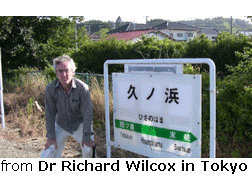 Japan’s Radioactive Potemkin Village: The Government’s Double-Dealing Data, rense.com. By Richard Wilcox, PhD, 4-12-14 “…….Can You Trust The Government?
According to the Japanese government official website, the Nuclear Regulation Authority , gamma radiation in Tokyo is just 0.034 microsieverts per hour (mcr sv pr hr) . This reading is taken 22 meters above the ground, in Shinjuku, a main hub of urban Tokyo. As luck would have it, I live not far from there and took a reading out my window several stories up in my apartment building and it regularly reads 0.13 mcr sv pr hr. According to the government chart, an estimated reading of 0.061 mcr sv pr hr is given for one meter above ground level. I measured one meter above ground where I live and the reading was 0.12 mcr sv pr hr.
What accounts for the noticeable discrepancy? Could it be the equipment or the location of measurement? The government chart gives an average reading for the ENTIRE CITY OF TOKYO, of 0.061, as if that is remotely accurate. I believe the government and authorities use two main tactics:
1. The place measurement monitoring devices high above the ground where it won’t read the worst radiation which naturally settles on the ground or in ditches;
2. They scrub and decontaminate the area in the immediate vicinity of the monitoring device in order to create a lower reading.
It could also be that tampering with the way devices are calibrated in order to get lower readings, or manipulating published data could occur, but I have no personal proof of these speculations.
Much of the problem with radiation science promoted by the nuclear establishment and their minions is that they limit the factors involved in their methodology and avoid the precautionary principle when drawing conclusions. In other words: don’t worry, be happy (even if your mitochondrial DNA is being damaged).
After the Fukushima accident I personally measured my kid’s school grounds. My readings were consistently higher what was reported by the school who simply measured above the ground in order to avoid the worst radiation.
When I was in the midwest in the US in March, I took outdoor readings above and on the ground that measured between 0.08 to 0.13 mcr sv pr hr. We now live in a manmade radioactively contaminated world due to above ground nuclear tests, nuclear power plant emissions, and nuclear accidents, in addition to natural background radiation from the sun or soil.
What I have witnessed first hand in Nihonmatsu is scientific fraud and misrepresentation of the facts. This is verified by my own dosimeter readings, and by the testimony of both Mr. Honda, the head of the temporary housing facility, and the experienced construction and decontamination worker who I talked with…..”
* Richard Wilcox is a Tokyo-based teacher and writer who holds a Ph.D. in environmental studies and is a regular contributor to the world’s leading website exposing the Fukushima nuclear disaster, Rense.com. He is also a contributor to Activist Post. His radio interviews and articles are archived at http://wilcoxrb99.wordpress.com and he can be reached by email for radio or internet podcast interviews to discuss the Fukushima crisis at wilcoxrb2013@gmail.com. http://www.rense.com/general96/jpsradioctv.html
Failure of Waste Isolation Pilot Plant (WIPP) has global implications
NuClear News No.61 April 2014 WIPP failure has global implications WIPP has played a crucial part in the history of nuclear waste proposals in the UK. In 1989, in the run-up to a referendum in Caithness in November of that year on whether or not to allow Nirex to search for a deep disposal site in the County, the Head of Information Services at Dounreay used WIPP as an example of a successful waste disposal site in an article he wrote for the John ‘O Groat Journal. In response a letter from the US Radioactive Waste Campaign described the article as “an outright lie”. McRoberts had claimed that WIPP was already receiving shipments and that the repository was dry. In fact the repository remained unopened at the time because in 1987 salt-laden water was fund to be seeping inside. One State Senator told the New Mexico press that:
 “Given that long-lived nuclear wastes are dangerous for thousands of generations, emplacing them deep underground is a possible ‘solution,’ but it certainly isn’t ‘guaranteed,’ ” he said. “Neither WIPP, nor the proposed Yucca Mountain site in Nevada, are ‘ideal’ and meet publicly accepted standards. Both sites were picked for political, not technical, reasons, so it is not surprising that they are inadequate.”
Small Modular Nuclear Reactors a dodgy dream
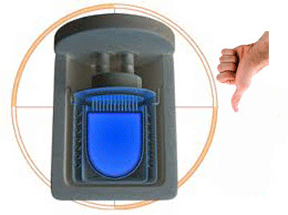 But the safety of the proposed compact designs is unproven—for instance, most of the designs call for weaker containment structures. And the arguments in favour of lower overall costs for SMRs depend on convincing Nuclear Regulators to relax existing safety regulations.
1 This Month



26 September – International Day for the Total Elimination of Nuclear Weapons


PLEASE OPPOSE HR 8255 AND S.3639 – bills would accelerate satellite deployment, with no environmental review or safeguards – https://ncstd5li.quorum.us/campaign/169331/
To see nuclear-related stories in greater depth and intensity – go to https://nuclearinformation.wordpress.com
-
Archives
- September 2026 (245)
- August 2026 (330)
- July 2026 (355)
- June 2026 (287)
- May 2026 (306)
- April 2026 (356)
- March 2026 (251)
- February 2026 (267)
- January 2026 (308)
- December 2025 (358)
- November 2025 (359)
- October 2025 (375)
-
Categories
- 1
- 1 NUCLEAR ISSUES
- business and costs
- climate change
- culture and arts
- ENERGY
- environment
- health
- history
- indigenous issues
- Legal
- marketing of nuclear
- media
- opposition to nuclear
- PERSONAL STORIES
- politics
- politics international
- Religion and ethics
- safety
- secrets,lies and civil liberties
- spinbuster
- technology
- Uranium
- wastes
- weapons and war
- Women
- 2 WORLD
- ACTION
- AFRICA
- Atrocities
- AUSTRALIA
- Christina's notes
- Christina's themes
- culture and arts
- Events
- Fuk 2022
- Fuk 2023
- Fukushima 2017
- Fukushima 2018
- fukushima 2019
- Fukushima 2020
- Fukushima 2021
- general
- global warming
- Humour (God we need it)
- Nuclear
- RARE EARTHS
- Reference
- resources – print
- Resources -audiovicual
- Weekly Newsletter
- World
- World Nuclear
- YouTube
-
RSS
Entries RSS
Comments RSS
 nuclear-news
