Water level drops at Daiichi Nuclear Power Plant Units 1 and 3
February 19, 2021
The Tokyo Electric Power Company (TEPCO) has announced that the water level inside the containment vessels of the Unit 1 and Unit 3 reactors at the Fukushima Daiichi Nuclear Power Plant, which are filled with water to cool down the melted down nuclear fuel, is dropping.
There is a possibility that a broken part of the containment vessel expanded after the earthquake on the 13th of this month, increasing the amount of water leaking out, but there has been no noticeable change in the values of monitoring posts, etc., and there is no impact on the outside.
According to the Tokyo Electric Power Company (TEPCO), at around 11:00 p.m. on the 18th, it was confirmed that the water level in the containment vessel of the Unit 1 reactor, which is used to cool down the melted down nuclear fuel, had dropped.
TEPCO confirmed the data and found that the water level has been declining since the 15th of this month in the Unit 1 reactor and since the 17th in the Unit 3 reactor.
The water level in the Unit 1 reactor is estimated to have dropped by 40 to 70 centimeters, and in the Unit 3 reactor by about 30 centimeters.
However, the thermometers installed at the bottom of the reactors do not show any rise in temperature, there is no noticeable change in the radiation level inside the containment vessel, and there is no abnormality in the values of the monitoring posts installed at the site boundary. There is no problem with the cooling of the nuclear fuel and no external impact.
The containment vessel was broken during the accident at the nuclear power plant, and a certain amount of cooling water that is poured into the vessel usually leaks out, but the earthquake on the 13th of this month may have widened the damaged area and increased the amount that leaked out.
In the towns of Okuma and Futaba, where the Fukushima Daiichi Nuclear Power Plant is located, a tremor of lower 6 on the Japanese intensity scale was observed.
If the water level continues to drop, TEPCO is considering increasing the water injection rate, which is currently set at 3 cubic meters per hour.
https://www3.nhk.or.jp/lnews/fukushima/20210219/6050013511.html?fbclid=IwAR0CjCLPZXz2hBtGGcV4DghnfenN5vssaY4zj-XGsOh7SeX_gFqtiVuaEqc
Fukushima Continues To Supply Surprises

Back-scattered electron (BSE) image of the cross section of the most radioactive particle (FTB26) accompanied by elemental maps of its major constituents. Credit: Satoshi Utsunomiya et al.
February 18, 2021
The 10 year anniversary of the Fukushima Daiichi nuclear accident occurs in March. Work just published in the Journal ‘Science of the Total Environment’ documents new, large (> 300 micrometers), highly radioactive particles that were released from one of the damaged Fukushima reactors.
Particles containing radioactive cesium (134+137Cs) were released from the damaged reactors at the Fukushima Daiichi Nuclear Power Plant (FDNPP) during the 2011 nuclear disaster. Small (micrometer-sized) particles (known as CsMPs) were widely distributed, reaching as far as Tokyo. CsMPs have been the subject of many studies in recent years. However, it recently became apparent that larger (>300 micrometers) Cs-containing particles, with much higher levels of activity (~ 105 Bq), were also released from reactor unit 1 that suffered a hydrogen explosion. These particles were deposited within a narrow zone that stretches ~8 km north-northwest of the reactor site. To date, little is known about the composition of these larger particles and their potential environmental and human health impacts.
Now, work just published in the journal Science of the Total Environment characterizes these larger particles at the atomic-scale and reports high levels of activity that exceed 105 Bq.
The particles, reported in the study, were found during a survey of surface soils 3.9 km north-northwest of reactor unit 1 (Fig. 1).
From 31 Cs-particles collected during the sampling campaign, two have given the highest ever particle-associated 134+137Cs activities for materials emitted from the FDNPP (specifically: 6.1 × 10⁵ and 2.5 × 10⁶ Bq, respectively, for the particles, after decay-correction to the date of the FDNPP accident).
The study involved scientists from Japan, Finland, France, the UK, and USA, and was led by Dr. Satoshi Utsunomiya and graduate student Kazuya Morooka (Department of Chemistry, Kyushu University). The team used a combination of advanced analytical techniques (synchrotron-based nano-focus X-ray analysis, secondary ion mass spectrometry, and high-resolution transmission electron microscopy) to fully characterize the particles. The particle with a 134+137Cs activity of 6.1 × 10⁵ Bq was found to be an aggregate of smaller, flakey silicate nanoparticles, which had a glass like structure. This particle likely came from reactor building materials, which were damaged during the Unit 1 hydrogen explosion; then, as the particle formed, it likely adsorbed Cs that had had been volatized from the reactor fuel. The 134+137Cs activity of the other particle exceeded 106 Bq. This particle had a glassy carbon core and a surface that was embedded with other micro-particles, which included a Pb-Sn alloy, fibrous Al-silicate, Ca-carbonate / hydroxide, and quartz (Fig. 2).
The composition of the surface embedded micro-particles likely reflect the composition of airborne particles within the reactor building at the moment of the hydrogen explosion, thus providing a forensic window into the events of March 11th 2011 (Fig. 3). Utsunomiya added, “The new particles from regions close to the damaged reactor provide valuable forensic clues. They give snap-shots of the atmospheric conditions in the reactor building at the time of the hydrogen explosion, and of the physio-chemical phenomena that occurred during reactor meltdown.” He continued, “whilst nearly ten years have passed since the accident, the importance of scientific insights has never been more critical. Clean-up and repatriation of residents continues and a thorough understanding of the contamination forms and their distribution is important for risk assessment and public trust.
Professor Gareth Law (co-author, University of Helsinki) added, “clean-up and decommissioning efforts at the site face difficult challenges, particularly the removal and safe management of accident debris that has very high levels of radioactivity. Therein, prior knowledge of debris composition can help inform safe management approaches”.
Given the high radioactivity associated with the new particles, the project team were also interested in understanding their potential health / dose impacts.
Dr Utsunomiya stated, “Owing to their large size, the health effects of the new particles are likely limited to external radiation hazards during static contact with skin. As such, despite the very high level of activity, we expect that the particles would have negligible health impacts for humans as they would not easily adhere to the skin. However, we do need to consider possible effects on the other living creatures such as filter feeders in habitats surrounding Fukushima Daiichi. Even though ten years have nearly passed, the half-life of 137Cs is ~30 years. So, the activity in the newly found highly radioactive particles has not yet decayed significantly. As such, they will remain in the environment for many decades to come, and this type of particle could occasionally still be found in radiation hot spots.”
Professor Rod Ewing (co-author from Stanford University) stated “this paper is part of a series of publications that provide a detailed picture of the material emitted during the Fukushima Daiichi reactor meltdowns. This is exactly the type of work required for remediation and an understanding of long-term health effects”.
Professor Bernd Grambow (co-author from IMT Atlantique) added “the present work, using cutting-edge analytical tools, gives only a very small insight in the very large diversity of particles released during the nuclear accident, much more work is necessary to get a realistic picture of the highly heterogeneous environmental and health impact”.
Reference
Morooka K, Kurihara E, Takehara M, et al. New highly radioactive particles derived from Fukushima Daiichi Reactor Unit 1: Properties and environmental impacts. Science of The Total Environment. 2021;773:145639. doi:10.1016/j.scitotenv.2021.145639
https://www.technologynetworks.com/tn/news/fukushima-continues-to-supply-surprises-345722
New highly radioactive particles found in Fukushima

Date: February 17, 2021 Source: University of Helsinki Summary: The 10 year anniversary of the Fukushima Daiichi nuclear accident occurs in March. Recent work documents new, large (> 300 micrometers), highly radioactive particles that were released from one of the damaged Fukushima reactors.
The 10 year anniversary of the Fukushima Daiichi nuclear accident occurs in March. Work just published in the Journal ‘Science of the Total Environment’ documents new, large (> 300 micrometers), highly radioactive particles that were released from one of the damaged Fukushima reactors.
Particles containing radioactive cesium (134+137Cs) were released from the damaged reactors at the Fukushima Daiichi Nuclear Power Plant (FDNPP) during the 2011 nuclear disaster. Small (micrometer-sized) particles (known as CsMPs) were widely distributed, reaching as far as Tokyo. CsMPs have been the subject of many studies in recent years. However, it recently became apparent that larger (>300 micrometers) Cs-containing particles, with much higher levels of activity (~ 105 Bq), were also released from reactor unit 1 that suffered a hydrogen explosion. These particles were deposited within a narrow zone that stretches ~8 km north-northwest of the reactor site. To date, little is known about the composition of these larger particles and their potential environmental and human health impacts.
Now, work just published in the journal Science of the Total Environment characterizes these larger particles at the atomic-scale and reports high levels of activity that exceed 105 Bq.
The particles, reported in the study, were found during a survey of surface soils 3.9 km north-northwest of reactor unit 1.
From 31 Cs-particles collected during the sampling campaign, two have given the highest ever particle-associated 134+137Cs activities for materials emitted from the FDNPP (specifically: 6.1 × 10⁵ and 2.5 × 10⁶ Bq, respectively, for the particles, after decay-correction to the date of the FDNPP accident).
The study involved scientists from Japan, Finland, France, the UK, and USA, and was led by Dr. Satoshi Utsunomiya and graduate student Kazuya Morooka (Department of Chemistry, Kyushu University). The team used a combination of advanced analytical techniques (synchrotron-based nano-focus X-ray analysis, secondary ion mass spectrometry, and high-resolution transmission electron microscopy) to fully characterize the particles. The particle with a 134+137Cs activity of 6.1 × 10⁵ Bq was found to be an aggregate of smaller, flakey silicate nanoparticles, which had a glass like structure. This particle likely came from reactor building materials, which were damaged during the Unit 1 hydrogen explosion; then, as the particle formed, it likely adsorbed Cs that had had been volatized from the reactor fuel. The 134+137Cs activity of the other particle exceeded 106 Bq. This particle had a glassy carbon core and a surface that was embedded with other micro-particles, which included a Pb-Sn alloy, fibrous Al-silicate, Ca-carbonate / hydroxide, and quartz.
The composition of the surface embedded micro-particles likely reflect the composition of airborne particles within the reactor building at the moment of the hydrogen explosion, thus providing a forensic window into the events of March 11th 2011. Utsunomiya added, “The new particles from regions close to the damaged reactor provide valuable forensic clues. They give snap-shots of the atmospheric conditions in the reactor building at the time of the hydrogen explosion, and of the physio-chemical phenomena that occurred during reactor meltdown.” He continued, “whilst nearly ten years have passed since the accident, the importance of scientific insights has never been more critical. Clean-up and repatriation of residents continues and a thorough understanding of the contamination forms and their distribution is important for risk assessment and public trust.
Professor Gareth Law (co-author, University of Helsinki) added, “clean-up and decommissioning efforts at the site face difficult challenges, particularly the removal and safe management of accident debris that has very high levels of radioactivity. Therein, prior knowledge of debris composition can help inform safe management approaches.”
Given the high radioactivity associated with the new particles, the project team were also interested in understanding their potential health / dose impacts.
Dr Utsunomiya stated, “Owing to their large size, the health effects of the new particles are likely limited to external radiation hazards during static contact with skin. As such, despite the very high level of activity, we expect that the particles would have negligible health impacts for humans as they would not easily adhere to the skin. However, we do need to consider possible effects on the other living creatures such as filter feeders in habitats surrounding Fukushima Daiichi. Even though ten years have nearly passed, the half-life of 137Cs is ~30 years. So, the activity in the newly found highly radioactive particles has not yet decayed significantly. As such, they will remain in the environment for many decades to come, and this type of particle could occasionally still be found in radiation hot spots.”
Professor Rod Ewing (co-author from Stanford University) stated “this paper is part of a series of publications that provide a detailed picture of the material emitted during the Fukushima Daiichi reactor meltdowns. This is exactly the type of work required for remediation and an understanding of long-term health effects.”
Professor Bernd Grambow (co-author from IMT Atlantique) added “the present work, using cutting-edge analytical tools, gives only a very small insight in the very large diversity of particles released during the nuclear accident, much more work is necessary to get a realistic picture of the highly heterogeneous environmental and health impact.”
Story Source:
Materials provided by University of Helsinki. Note: Content may be edited for style and length.
Journal Reference:
- Kazuya Morooka, Eitaro Kurihara, Masato Takehara, Ryu Takami, Kazuki Fueda, Kenji Horie, Mami Takehara, Shinya Yamasaki, Toshihiko Ohnuki, Bernd Grambow, Gareth T.W. Law, Joyce W.L. Ang, William R. Bower, Julia Parker, Rodney C. Ewing, Satoshi Utsunomiya. New highly radioactive particles derived from Fukushima Daiichi Reactor Unit 1: Properties and environmental impacts. Science of The Total Environment, 2021; 773: 145639 DOI: 10.1016/j.scitotenv.2021.145639
https://www.sciencedaily.com/releases/2021/02/210217134852.htm
Korean, Japanese bishops oppose discharge from Fukushima plant
Scientists, environmentalists and fishing groups are against the idea of releasing contaminated water into the sea

February 17, 2021
Catholic bishops in South Korea and Japan have issued a joint statement to strongly oppose the Japanese government’s decision to discharge radioactive water from the damaged Fukushima nuclear power plant into the sea.
Following years of debate over the disposal of the liquid which includes water used to cool the Fukushima Daiichi plant that was hit by a massive tsunami and earthquake in 2011, Japanese authorities have decided to release a million tonnes of treated water into the sea.
The initial plan was to start releasing the water from 2022 but a final decision has not been made, according to Japanese media.
Most of the radioactive isotopes have been removed using a complex filtration process. But one isotope, tritium, cannot be removed, so water has been stored in huge tanks that will fill up by 2022, the BBC reported.
Scientists, environmentalists and fishing groups have opposed the idea of releasing contaminated water into the sea, citing possible risks.
“We oppose the discharge of tritium-containing water, a radioactive material that has been purified and treated, into the ocean,” said a joint statement from the Justice and Peace Commissions of the bishops’ conferences of Korea and Japan, the Korean bishops’ ecological and environmental committee and the Japanese bishops’ subcommittee on nuclear for peace.
The statement has been signed by heads of each organization and concerns have been raised about the direct impact of the contaminated water on public health and marine life.
“The water contains tritium, which is a radioactive material, purified through the contaminated water treatment system of the Fukushima plant. Secondary treatment of radionuclides remaining in the treated water is still in the testing stage, and no definite results have been obtained,” the statement said.
The statement also pointed out that the report from the Japanese government did not mention the effects of the treated water on marine life, the marine environment and human health.
“Once released into the sea, radioactive material cannot be restored to its original state. It will have impacts on humans and nature. It will cause greater anxiety and damage to people around the world.”
In a separate statement, the Korean bishops’ ecological and environmental committee expressed concerns about the recent tritium leak at the Wolseong nuclear power plant in Gyeongju in South Korea.
On Jan. 7, Korean media reported on radioactivity leaking from the plant, prompting Korea Hydro and Nuclear Power Company to investigate. The initial results exposed a wide range of radioactive contamination in the plant and adjacent areas
The Korean Church demanded the government “conduct a thorough and transparent investigation into the leakage and immediate follow-up measures for radioactive leaks in all nuclear power plants.”
Japan’s Fukushima Meltdowns (New Video): Much Still Unknown 10 Years Later

By The Fairewinds Crew
February 17, 2021
As we approach the 10th commemoration of Japan’s March 11, 2011, Fukushima Dai-ichi triple meltdowns, organizations around the globe, including environmental groups, nonprofits (like Fairewinds Energy Education), engineering and pronuclear organizations, and media organizations like Japan’s Nippon TV, will release new information.
Some of this information is really new and recently uncovered. Other media events will bring people together to share and discuss what these major meltdowns meant to the people of Japan and communities worldwide. And sometimes, these media events are just a corporation or an agency marketing new nukes by putting their positive spin on nuclear power rather than acknowledging its dangers. For example, nuclear zealots continue to claim that atomic power reactors are safer for workers than working at Toys R Us, and reactors cannot meltdown and certainly will never blow up. The Fukushima disaster proved them wrong, but yet they persist!
As Fukushima Daichi Units One, Two, and Three were melting down, Nippon TV, the largest and flagship station of the Nippon Television Network System, dispatched television film crews to monitor the events as they unfolded. No one in the world has ever captured the core melting down, but Nippon TV captured two meltdown-induced explosions on film.
Now, Nippon TV has just released a new digital copy of the Fukushima Dai-ichi Unit One and Unit Three explosions.
At Fairewinds, we congratulate Nippon for the excellent work they did to create the original initial explosion footage in 2011 and on this essential remastered copy just completed in 2021. Nippon’s newly released digital footage is important historically and technically.
That said, the new video footage and Nippon’s ensuing interview with Tokyo Electric Company (TEPCO), the atomic power corporation that owns all six Fukushima Dai-ichi nuclear power plants, contain three glaring technical errors.
- First, Fairewinds continues to have significant concerns about TEPCO’s technical interpretations of these explosions’ cause.
- Second, TEPCO is blaming newly uncovered lethal radioactivity sitting at the top of the containment structure on the supersonic shockwave.
- Third, TEPCO does not discuss that there likely was a second explosion that occurred 3 seconds after the first.
Understanding the mechanics behind explosions is critical to understanding what happened at Fukushima and what such a danger means to nuclear power anywhere in the world.
- There are two explosion methods: a deflagration shock wave, which happened at Fukushima Unit One and Three Mile Island in Middletown, Pennsylvania, in the United States. While still destructive, a deflagration shockwave travels at subsonic speeds (less than 760 miles an hour, the speed of sound).
- The second type of explosion is called a detonation shockwave. It is much more destructive because it travels at supersonic speeds. In 2011, with Geoff Sutton’s assistance from the United Kingdom, Fairewinds clearly showed that the Unit Three explosion was the more destructive detonation shockwave while Unit One’s was a deflagration.
Does it matter whether or not an explosion at Fukushima was a detonation or a deflagration? Absolutely! Hydrogen gas at room (atmospheric) pressure cannot create a supersonic shockwave. Fairewinds’s 2011 findings that a detonation shockwave occurred should have changed the scientific and nuclear engineering analyses of such events worldwide.
No nuclear power radioactive release containment system built anywhere in the world will withstand a detonation shockwave!
The fact that a detonation shockwave did occur is something the nuclear industry has ignored since Fairewinds’ Arnie Gundersen and Geoff Sutton identified it did happen at Fukushima Unit Three in 2011.
The nuke industry and its regulatory handlers do not believe that a supersonic shockwave explosion will ever happen in a nuclear power plant. If they admitted that an atomic reactor containment system would fail by Does it matter whether or not an explosion at Fukushima was a detonation or a deflagration? Absolutely! Hydrogen gas at room (atmospheric) pressure cannot create a supersonic shockwave. Fairewinds’s 2011 findings that a detonation shockwave occurred should have changed the scientific and nuclear engineering analyses of such events worldwide.
No nuclear power radioactive release containment system built anywhere in the world will withstand a detonation shockwave!
The fact that a detonation shockwave did occur is something the nuclear industry has ignored since Fairewinds’ Arnie Gundersen and Geoff Sutton identified it did happen at Fukushima Unit Three in 2011.
The nuke industry and its regulatory handlers do not believe that a supersonic shockwave explosion will ever happen in a nuclear power plant. If they admitted that an atomic reactor containment system would fail by detonation, the nuke industry would also have to acknowledge that nuke plants’ containment systems are not failsafe. Nuclear power containment systems will fail when there is a supersonic shockwave explosion.
The supposedly failsafe containment system at Fukushima Dai-ichi Unit Three failed and released massive amounts of radioactivity into the local environment and the worldwide atmosphere. Such an enormous human tragedy will happen again at an atomic power reactor somewhere in the world.
Think about that. No nuke in the world can withstand a supersonic shockwave, and here is the evidence on international TV and across the Internet that it occurred in 2011, as Fairewinds said.
Fairewinds second area of concern about TEPCO’s analysis on this latest NIPPON video is the linkage of recently discovered lethal radiation levels at the top of the containment to the supersonic detonation. Ten years ago, immediately following the three meltdowns at Fukushima in 2011, Fairewinds identified superheated highly radioactive gases escaping from this same area that TEPCO suddenly claims it has just uncovered in 2021. The containment was leaking before the explosion and continued to spread radioactivity after the blast. Still, no nuclear engineer or scientist is surprised that significant contamination continues to leak from the damaged containment system. The containment was breached, which allowed this radiation to leak! However, there is no evidence to suggest that the explosion is the cause of that leak since the containment was leaking before the supersonic shockwave.
Finally, Nippon’s remastered video vividly shows Fairewinds’ third concern. The eye is drawn to the detonation’s sudden flash and the ensuing upward-moving black cloud of rubble. Now, look again. About three seconds after the initial vertical blast, a white cloud suddenly moves horizontally at ground level to the north.
Detonation, the nuke industry would also have to acknowledge that nuke plants’ containment systems are not failsafe. Nuclear power containment systems will fail when there is a supersonic shockwave explosion.
The supposedly failsafe containment system at Fukushima Dai-ichi Unit Three failed and released massive amounts of radioactivity into the local environment and the worldwide atmosphere. Such an enormous human tragedy will happen again at an atomic power reactor somewhere in the world.
Think about that. No nuke in the world can withstand a supersonic shockwave, and here is the evidence on international TV and across the Internet that it occurred in 2011, as Fairewinds said.
Fairewinds second area of concern about TEPCO’s analysis on this latest NIPPON video is the linkage of recently discovered lethal radiation levels at the top of the containment to the supersonic detonation. Ten years ago, immediately following the three meltdowns at Fukushima in 2011, Fairewinds identified superheated highly radioactive gases escaping from this same area that TEPCO suddenly claims it has just uncovered in 2021. The containment was leaking before the explosion and continued to spread radioactivity after the blast. Still, no nuclear engineer or scientist is surprised that significant contamination continues to leak from the damaged containment system. The containment was breached, which allowed this radiation to leak! However, there is no evidence to suggest that the explosion is the cause of that leak since the containment was leaking before the supersonic shockwave.
Finally, Nippon’s remastered video vividly shows Fairewinds’ third concern. The eye is drawn to the detonation’s sudden flash and the ensuing upward-moving black cloud of rubble. Now, look again. About three seconds after the initial vertical blast, a white cloud suddenly moves horizontally at ground level to the north.

Community-volunteer citizen-scientists Arnie met while collecting radioactive samples in Fukushima prefecture say they heard more than one explosion. They said it sounded like the snapping of bamboo burning in a fire. This new video shows that there were at least two explosions, one vertically and one horizontally. As more data becomes available, Fairewinds Energy Education will put forward the reasons why, but as of now, the entire explosion sequence at Fukushima Unit Three is something the nuclear industry zealots want to ignore. They continue to hope that history will not repeat itself while they continue to build and operate more lethally radioactive and highly risky atomic reactors.
Throughout the Nippon video, the announcer reverentially refers to TEPCO and the Japanese Regulators as “the authorities” and “officials”. This kind of public propaganda occurs because TEPCO, the Japanese Government and its regulators, and the International Atomic Energy Agency (IAEA) have successfully captured the Japanese media.
What was called for in 2011 and is still desperately required in 2021 are independent experts. These would be people from outside TEPCO, its captive regulators, or its allies embedded in the nuclear industry. Once again, Fairewinds calls for an independent consortium of experts who would be able to give a frank assessment of the magnitude and extent of the problems that lie ahead for the failed Fukushima cleanup.
Did you know that in 2013, Fairewinds and 16 other international experts coauthored a letter to the United Nations (UN) asking it to establish this independent panel? The UN never had the courtesy even to acknowledge that it received these serious requests and recommendations. Such machinations by TEPCO, the Japanese Government, and the international nuclear industry are indeed a human rights and environmental injustice issue!
Ten years have passed, yet Japan’s citizens still wait for independent oversight of the Fukushima disaster. The people of Japan deserve better than the authorities covering up the truth and lying to them.
Fukushima spillage raises questions about threat of future earthquakes
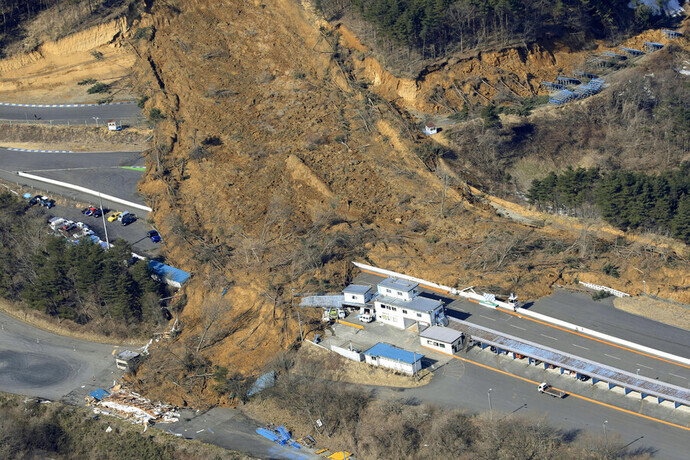
A road in Nihonmatsu has been blocked by a landslide on Feb. 14 following a 7.3-magnitude earthquake the day before in Japan’s Fukushima Prefecture.
Feb.16,2021
The occurrence of a 7.3-magnitude earthquake in the waters off of Fukushima on Feb. 13 is prompting growing concerns about the safety of the Fukushima Daiichi Nuclear Power Plant, as some mention the possibility of other quakes at a similar scale.
Experts said that with no way of knowing how large future earthquakes will be, swift preparations are needed to prevent damage to the plant.
According to reporting by Japan’s NHK television network on Feb. 15, the Japanese government’s Earthquake Survey Committee stressed the need to be on the alert over the next week or so for earthquakes at a “strong 6” on the Japanese seismic intensity scale. The warning suggested the possibility of additional quakes on par with the one on Feb. 13, which was a strong 6.
“We need to prepare,” the committee said, noting the possibility of eastern Japan being “ambushed by strong vibrations and/or a tsunami caused by a large-scale earthquake.”
In an interview with NHK, Tohoku University professor Shinji Toda said there was the “possibility of a 9.0-magnitude earthquake and tsunami occurring in the waters off of Fukushima and Miyagi, as well as the north and south of the area where the [2011 Tohoku] earthquake occurred 10 years ago and the area outside of the Japan Trench.”
Hong Tae-kyung, a professor of earth system sciences at Yonsei University, warned that the associated ground motion could be large relative to the scale of the earthquake itself.
“The scale of this earthquake was within a predictable level for the region, but the fact that the ground motion was so much larger gives pause,” he explained.
“Ground motion differs according to earthquake scale, sedimentary layer thickness, observation position and other factors, and it’s common for ground motion to be larger near the coast due to the sedimentary layer’s thickness. But even when you take all of that into account, the ground motion was very large,” he said.
“There’s a possibility the ground motion exceeded what the Fukushima nuclear power plant could withstand in terms of its design.”
With predictions that additional large-scale earthquakes could occur, observers are calling for swift preparations to prevent damage to the Fukushima plant. According to Kyodo News and other Japanese media, some spillage was determined to have occurred during the earthquake in tanks holding spent nuclear fuel at the upper layers of the No. 5 and 6 reactors at the Fukushima plant.
Japanese nuclear power authorities and the Tokyo Electric Power Company (TEPCO), which operates the plant, stated that there had been no radiation exposure as a result of the tank spillage.
Institute of Nuclear Safety director Han Byeong-seop agreed that the “nuclear power plant safety issues resulting from the earthquake were not at a concerning level,” but stressed the “need to prepare for a compound disaster in the wake of an earthquake.”
“The amount of water that spilled from the spent nuclear fuel in this earthquake was minute, so it wasn’t at a worrisome level, and there does not appear to have been any damage to the power plant,” he said.
“But with the Tohoku earthquake in 2011, there was major damage resulting from a compound disaster involving both an earthquake and tsunami, and there’s no way of predicting the scale of additional earthquakes that we might see this time,” he added.
“There need to be continued preparations for a compound disaster.”
Oh Chang-whan, a professor of earth and environmental sciences at Jeonbuk National University, said, “Nuclear power plants are designed to be safe during earthquakes, yet even so we saw issues with water spillage.”
“Nobody can predict for certain what kind of damage an earthquake or tsunami might cause. We need to prepare,” he urged.
http://english.hani.co.kr/arti/english_edition/e_international/983206.html
At the nuclear power plant in Fukushima found a leak of radioactive water
February 14, 2021
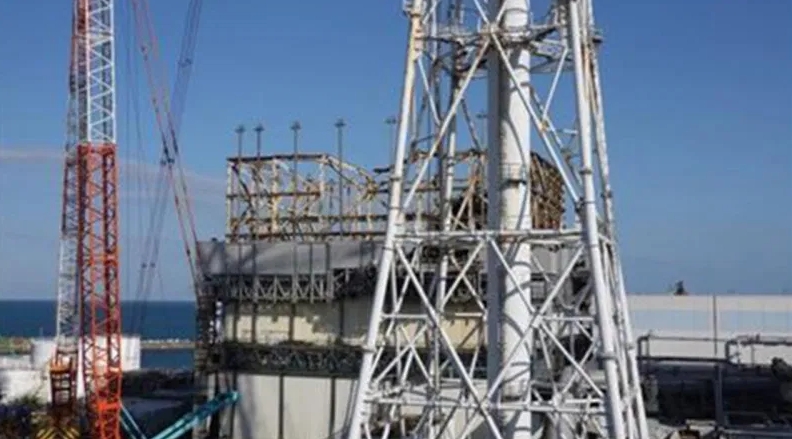
A radioactive water leak was discovered at the Fukushima nuclear power plant. It is reported by RIA Novosti citing a press release from TEPCO (Tokyo Electric Power Company).
TEPCO specialists found out that due to the earthquake in northeast Japan, a small amount of water poured out of the pools for storing spent nuclear fuel at various units of the Fukushima-1 and Fukushima-2 nuclear power plants.
Representatives of the company said that about 160 milliliters of water were spilled at the first power unit of the Fukushima-2 nuclear power plant, and another 1.4 liters spilled from another pool. They assured that this incident should not affect the cooling of the spent fuel. Local media also reported that about 600 milliliters of water spilled out at the fifth power unit of the emergency nuclear power plant “Fukushima-1”, and 1.6 liters of liquid at the sixth. Another 600 milliliters were missing in the common pool for the two power units.
It is noted that the spilled water does not pose a threat to the environment, since its volumes are too small, and the content of radioactive substances in it is insignificant.
Earlier it was reported that in northeast Japan happened powerful earthquake. The magnitude of the earthquake was 7.1, the epicenter was recorded in the area of Fukushima prefecture. The number of victims of the disaster exceeded 100 people.
Tremors continue in northeast Japan
February 14, 2021
People in northeastern Japan remain vigilant as several tremors have followed the magnitude 7.3 earthquake that struck late on Saturday night.
The Meteorological Agency warns that jolts as strong as the initial one could occur over the next week or so.
The initial quake registered six-plus on the Japanese scale of zero to seven in Miyagi and Fukushima prefectures.
The agency estimates that the focus was off the coast of Fukushima Prefecture, at a depth of 55 kilometers. The quake did not trigger any tsunami.
Jolts are continuing off the coast of the prefecture.
As of 6 p.m. on Sunday, the agency had reported one quake with an intensity of four, two with an intensity of three, 10 with an intensity of two, and 22 with an intensity of one.
There are reports of landslides and damaged buildings.
The agency says people in Miyagi and Fukushima prefectures should be on the alert for more landslides, as an approaching low-pressure system off the coast may bring strong winds and heavy rain.
Powerful magnitude 7.3 earthquake jolts Fukushima area
(Slight) leak from the spent fuel pool of the reactor #1 of Fukushima Daini, nothing said about Fukushima Daiichi yet. But as usual Tepco is never very trustworthy to forward vital information.
February 13, 2021
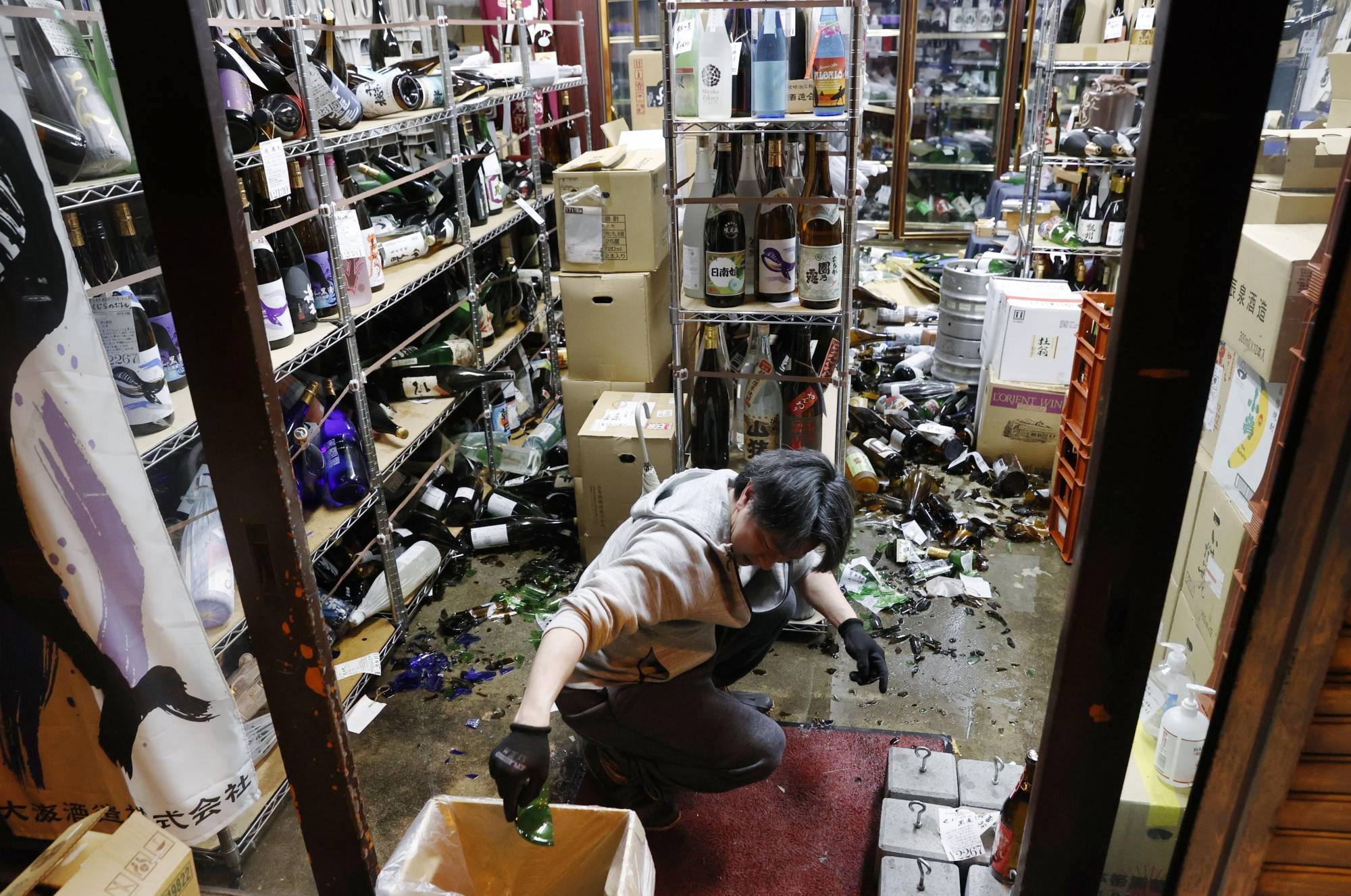
A powerful magnitude 7.3 earthquake, which measured a strong 6 on the Japanese seismic intensity scale — the second-highest level — jolted Miyagi and Fukushima prefectures in the Tohoku region late Saturday night. No tsunami warning was issued.
Local authorities in Miyagi and Fukushima prefectures reported a total of at least 20 people injured.
Nationwide, at least 950,000 homes were without power as of midnight, top government spokesman Katsunobu Kato said at a news conference. Kato added later that several power plants were offline.
The quake, which was also felt in Tokyo, where it registered a 4 on the Japanese scale, struck at around 11:08 p.m., according to the Meteorological Agency. The epicenter was off the coast of Fukushima, about 220 kilometers (135 miles) north of Tokyo. Its focus was estimated to be at a depth of about 60 kilometers.
At a news conference early Sunday morning, a Meteorological Agency official said aftershocks of up to a strong 6 on the Japanese scale could occur for at least a week. The official said Saturday’s quake was believed to be an aftershock of the Great East Japan Earthquake that struck the same region on March 11, 2011.
“Because (the 2011 quake) was an enormous one with a magnitude of 9.0, it’s not surprising to have an aftershock of this scale 10 years later,” said Kenji Satake, a professor at the University of Tokyo’s Earthquake Research Institute.
The quake registered a strong 6 in the southern part of Miyagi, and in the Nakadori central and Hamadori coastal regions of Fukushima, the agency said.
Power outages were reported in parts of Fukushima, Miyagi, Iwate, and Tochigi prefectures, according to media reports. Tokyo Electric Power Company Holdings reported blackouts across several prefectures as of early Sunday morning.
No abnormalities have been found at the Fukushima Nos. 1 and 2 nuclear power plants, according to Tokyo Electric Power. The same was true for Japan Atomic Power Co.’s inactive Tokai No. 2 nuclear power plant in the village of Tokai in Ibaraki Prefecture and Tohoku Electric Power Co.’s Onagawa nuclear plant in Miyagi Prefecture, according to their operators.
Following the quake, JR East temporarily halted operations of its Tohoku, Joetsu and Hokuriku shinkansen lines. Power outages occurred on some sections. A landslide had covered a section of the Joban Expressway in Soma, Fukushima Prefecture, officials said, but no vehicles were found to be trapped.
Horizontal shaking lasted for a few minutes inside a traditional inn in Minamisoma, Fukushima Prefecture, with plates for food scattered in its dining room.
“The initial jolt felt more powerful than the one I experienced in the Great East Japan Earthquake,” said Tomoko Kobayashi, 68, who works at the inn. “I wondered if it would end.”
After the 7.1 quake, many smaller earthquakes with magnitudes between 3 and 5 occurred off Fukushima.
Prime Minister Yoshihide Suga immediately directed government agencies to assess damage, rescue any potential victims, work with municipalities and provide necessary information about any evacuation plans and damage as soon as possible. The government was setting up a task force to examine the quake.
Defense Minister Nobuo Kishi directed the Self-Defense Forces to gather information on the scope of the damage and be prepared to respond immediately.
The quake, which comes less than a month before the 10th anniversary of the Great East Japan Earthquake, registered a 4 on the Japanese scale as far north as Aomori Prefecture and as far west as Shizuoka Prefecture. It was the strongest quake in the region since April 7 that year, the meteorology agency said.
https://www.japantimes.co.jp/news/2021/02/14/national/earthquake-fukushima/
Processed video sheds light on black smoke at Fukushima Daiichi
Footage of explosions at the Fukushima Daiichi nuclear power plant reprocessed by Nippon TV using state-of-the-art technology sheds light on the black smoke seen after the explosion at Unit 3.
Ten years on, economic growth is faltering in disaster-hit areas
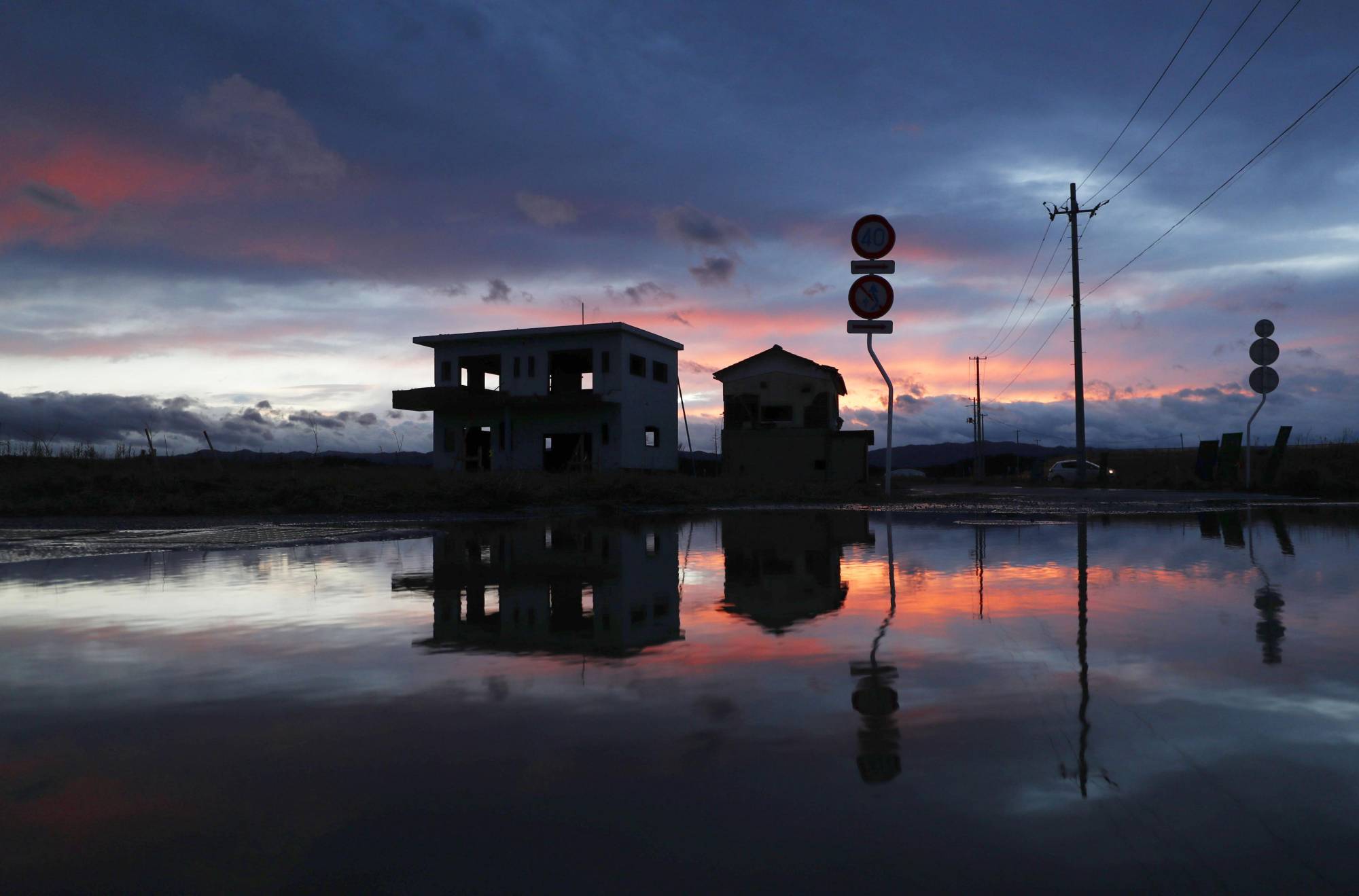
Namie, Fukushima Prefecture, was hit hard by the disaster on March 11, 2011, and an evacuation order remained in place for the subsequent six years
February 11, 2021
While Japan will soon mark the 10th anniversary of the 2011 Great East Japan Earthquake and tsunami, the economy of affected areas is showing signs of faltering.
The prefectures of Fukushima, Miyagi and Iwate have been shored up economically by public investment involving reconstruction projects since being devastated by the disaster on March 11, 2011, and the subsequent nuclear power plant meltdowns.
The three prefectures, however, are seeing reconstruction demand pass its peak.
As the triple meltdown at Tokyo Electric Power Company Holdings Inc.’s Fukushima No. 1 nuclear plant continues to cast a shadow over the coastal areas, the three prefectures now face the challenge of achieving autonomous economic growth orchestrated by firms and others in the private sector.
In the town of Namie, Fukushima Prefecture, an evacuation order issued shortly after the nuclear accident was partially lifted in March 2017. Although industrial complexes have been built and restaurants have opened their doors to customers once again in Namie, there are also many empty plots of land in the town, which shows that some former Namie residents had their houses torn down after giving up on returning from where they had been evacuated.
“Sales halved from before the disaster,” said Yasushi Niizuma, who reopened his restaurant in the town.
Meanwhile, some companies that were not doing business in Namie prior to the disaster have made inroads into the town.
“I don’t expect immediate changes, but I think the situation will be quite different 10 to 30 years from now,” Niizuma said with a sense of hope.
Prefectural gross product data show that the economy has recovered in the three prefectures since the disaster.
In 2011, the year of the disaster, the combined prefectural gross product in Fukushima, Miyagi and Iwate plunged ¥788 billion from a year earlier in nominal terms. But public investment increased sharply from 2012, with many restoration and reconstruction projects being implemented in disaster-affected areas. As a result, the combined gross product in the three prefectures in 2018 increased some ¥3.9 trillion from the 2011 level.
Noting that the region’s economy has been pushed up by public investment over the last 10 years, Yutaro Suzuki, economist at Daiwa Institute of Research Ltd., said, “It was not a self-sustaining growth.”
The three prefectures are seen to have suffered negative economic growth in 2020, chiefly reflecting a decrease in public investments and the spread of the novel coronavirus.
“An industrial recovery is crucial” for further economic growth in the region, Suzuki said.
Coastal areas in the three prefectures hit hard by the disaster are facing a serious population outflow. This is, in areas around the Fukushima No. 1 plant, including the town of Futaba, primarily due to the evacuation order still placed on some locations with high radiation levels.
“There are many areas (within Fukushima) that are nowhere near being restored,” Risa Ueda, head of the Bank of Japan’s Fukushima Branch, said.
While the central government is currently attempting to attract new industries to the region, the effects of such an initiative on the local economy are still unknown.
“Corporate performance has not recovered to the levels prior to the disaster at half of affected businesses,” Sachio Taguchi, president of Bank of Iwate , said. “We are still halfway down the road to reconstruction.”
Hiromi Watanabe, chairman of the federation of chambers of commerce and industry in Fukushima Prefecture, called on the Japanese government to look at the actual state of local economies and introduce precise measures, rather than end its support measures altogether.
As the economy has yet to recover to levels before the disaster in many parts of Fukushima and the coronavirus pandemic is also hitting the prefecture hard, Watanabe said, “What we need the most are job opportunities.”
https://www.japantimes.co.jp/news/2021/02/11/national/quake-disaster-economy/
Tepco ordered to pay ¥600 million over 2011 nuclear disaster
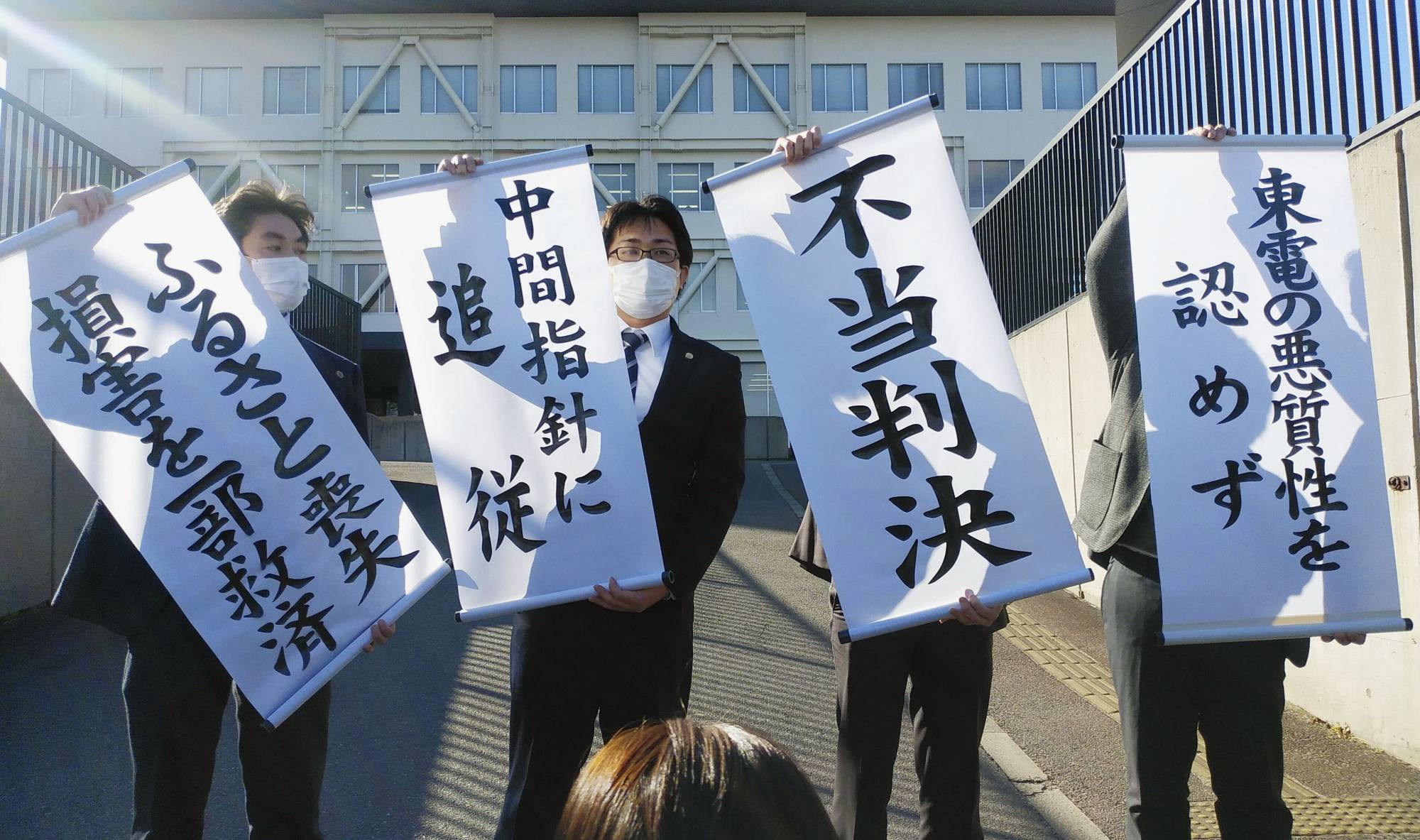
Lawyers representing residents who were forced to evacuate following the 2011 nuclear disaster in Fukushima Prefecture on Tuesday criticize the ruling by the Iwaki branch of Fukushima District Court as unjust, saying that the recognized damage is too small.
Feb 10, 2021
Fukushima – A court has ordered Tokyo Electric Power Company Holdings Inc. to pay a total of some ¥600 million to 271 plaintiffs over an evacuation caused by the 2011 nuclear disaster.
The Iwaki branch of Fukushima District Court reached its conclusion Tuesday in a lawsuit filed by 297 plaintiffs — which included residents of the heavily affected Yamakiya district in the town of Kawamata who were ordered to evacuate — seeking ¥14.7 billion in damages from Tepco.
The plaintiff side expressed its intention to appeal to a higher court.
The suit is the second in a series filed by evacuees who left their homes due to the triple meltdown at Tepco’s Fukushima No. 1 nuclear power plant triggered by the March 2011 earthquake and tsunami.
The plaintiffs excluded the state from the suit as it hoped to achieve an early resolution.
In the first suit, Sendai High Court last year ordered Tepco to pay a total of over ¥700 million to evacuees.
In the latest ruling, presiding Judge Yukitaka Najima said the amount of consolation money already paid to evacuees based on the government’s interim guidelines was reasonable. Najima thus stopped short of ordering additional payments.
The payments were made under the law on compensation for nuclear damage, which obliges the operator of a nuclear facility to compensate for damage arising from it regardless whether there was negligence.
Meanwhile, the Iwaki branch ordered Tepco to pay consolation money worth ¥2 million per person for their loss of hometown.
At the same time, the court rejected the plaintiffs’ claim that Tepco is liable under the Civil Code for failing to prevent the accident, which they believe was foreseeable.
A group of lawyers on the plaintiff side criticized the ruling as unjust, saying that the recognized damage is too small.
Tepco said it will examine the ruling and consider its response.
Dynamics of radiocesium in forests after the Fukushima disaster: Concerns and some hope
Dynamics of radiocesium in forests after the Fukushima disaster: Concerns and some hope
80% of the Fukushima prefecture are mountain forests.

February 3, 2021
Considering the massive threat posed by 137Cs to the health of both humans and ecosystems, it is essential to understand how it has distributed and how much of it still lingers.
w/reminder: there’s no such thing as ‘radioactive decontamination’ the correct term would be ‘trans-contamination’
Scientists compile available data and analyses on the flow of radionuclides to gain a more holistic understanding
Forestry and Forest Products Research Institute
After the Chernobyl disaster of 1986, the 2011 Fukushima Daiichi nuclear power plant (FDNPP) disaster was the second worst nuclear incident in history. Its consequences were tremendous for the Japanese people and now, almost a decade later, they can still be felt both there and in the rest of the world. One of the main consequences of the event is the release of large amounts of cesium-137 (137Cs)–a radioactive “isotope” of cesium–into the atmosphere, which spread farther away from the power plant through wind and rainfall.
Considering the massive threat posed by 137Cs to the health of both humans and ecosystems, it is essential to understand how it has distributed and how much of it still lingers. This is why the International Atomic Energy Agency (IAEA) has recently published a technical document on this specific issue. The fifth chapter of this “Technical Document (TECDOC),” titled “Forest ecosystems,” contains an extensive review and analysis of existing data on 137Cs levels in Fukushima prefecture’s forests following the FDNPP disaster.
The chapter is based on an extensive study led by Assoc. Prof. Shoji Hashimoto from the Forestry and Forestry Products Research Institute, Japan, alongside Dr. Hiroaki Kato from the University of Tsukuba, Japan, Kazuya Nishina from the National Institute of Environmental Studies, Japan, Keiko Tagami from the National Institutes for Quantum and Radiological Science and Technology, Japan, George Shaw from the University of Nottingham, UK, and Yves Thiry from the National Agency for Radioactive Waste Management (ANDRA), France, and several other experts in Japan and Europe.
The main objective of the researchers was to gain a better understanding of the dynamics of 137Cs flow in forests. The process is far from straightforward, as there are multiple elements and variables to consider. First, a portion of 137Cs-containing rainfall is intercepted by trees, some of which is absorbed, and the rest eventually washes down onto the forest floor. There, a fraction of the radiocesium absorbs into forest litter and the remainder flows into the various soil and mineral layers below. Finally, trees, other plants, and mushrooms incorporate 137Cs through their roots and mycelia, respectively, ultimately making it both into edible products harvested from Fukushima and wild animals.
Considering the complexity of 137Cs flux dynamics, a huge number of field surveys and gatherings of varied data had to be conducted, as well as subsequent theoretical and statistical analyses. Fortunately, the response from the government and academia was considerably faster and more thorough after the FDNPP disaster than in the Chernobyl disaster, as Hashimoto explains: “After the Chernobyl accidents, studies were very limited due to the scarce information provided by the Soviet Union. In contrast, the timely studies in Fukushima have allowed us to capture the early phases of 137Cs flow dynamics; this allowed us to provide the first wholistic understanding of this process in forests in Fukushima.”
Understanding how long radionuclides like 137Cs can remain in ecosystems and how far they can spread is essential to implement policies to protect people from radiation in Fukushima-sourced food and wood. In addition, the article also explores the effectiveness of using potassium-containing fertilizers to prevent the uptake of 137Cs in plants. “The compilation of data, parameters, and analyses we present in our chapter will be helpful for forest remediation both in Japan and the rest of the world,” remarks Hashimoto.
When preventive measures fail, the only remaining option is trying to fix the damage done–in the case of radiation control, this is only possible with a comprehensive understanding of the interplay of factors involved.
In this manner, this new chapter will hopefully lead to both timely research and more effective solutions should a nuclear disaster happen again.
###
Reference
Title: Environmental Transfer of Radionuclides in Japan following the Accident at the Fukushima Daiichi Nuclear Power Plant, Chapter 5 “Forest ecosystems”
Published in: International Atomic Energy Agency, IAEA TECDOC no. 1927
Link (open access): https://www.iaea.org/publications/14751/environmental-transfer-of-radionuclides-in-japan-following-the-accident-at-the-fukushima-daiichi-nuclear-power-plant
About the Forestry and Forest Products Research Institute, Japan
Inaugurated as a unit for forest experiments in Tokyo in 1905, the Forestry and Forest Products Research Institute (FFPRI) was largely reorganized in 1988, when it received its current name. During its history of over 110 years, the FFPRI has been conducting interdisciplinary research on forests, forestry, the timber industry, and tree breeding with an agenda based around sustainable development goals. The FFPRI is currently looking to collaborate with more diverse stakeholders, such as international organizations, government agencies, and industry and academic leaders, to conduct much needed forest-related research and make sure we preserve these renewable resources. Website: https://www.ffpri.affrc.go.jp/ffpri/en/index.html
About Dr. Shoji Hashimoto from the Forestry and Forest Products Research Institute, Japan
Shoji Hashimoto obtained Master’s and PhD degrees from The University of Tokyo, Japan, in 2001 and 2004, respectively. In 2005, he joined the Forestry and Forest Products Research Institute, Japan, where he now works as Senior Researcher. He is also Associate Professor at The University of Tokyo. He has published over 50 papers and is a referee for over 30 scientific journals. His main research interests are soil and forest science, environmental dynamics, and climate change, among others. Hashimoto has also been an organizer for various events, including two Symposiums on Fukushima Forests and the Japan?Finland Joint Seminar, and serves as the coordinator of a radioecology unit in International Union of Forest Research Organizations (IUFRO).
Israel lifts restrictions on imported Japanese food products
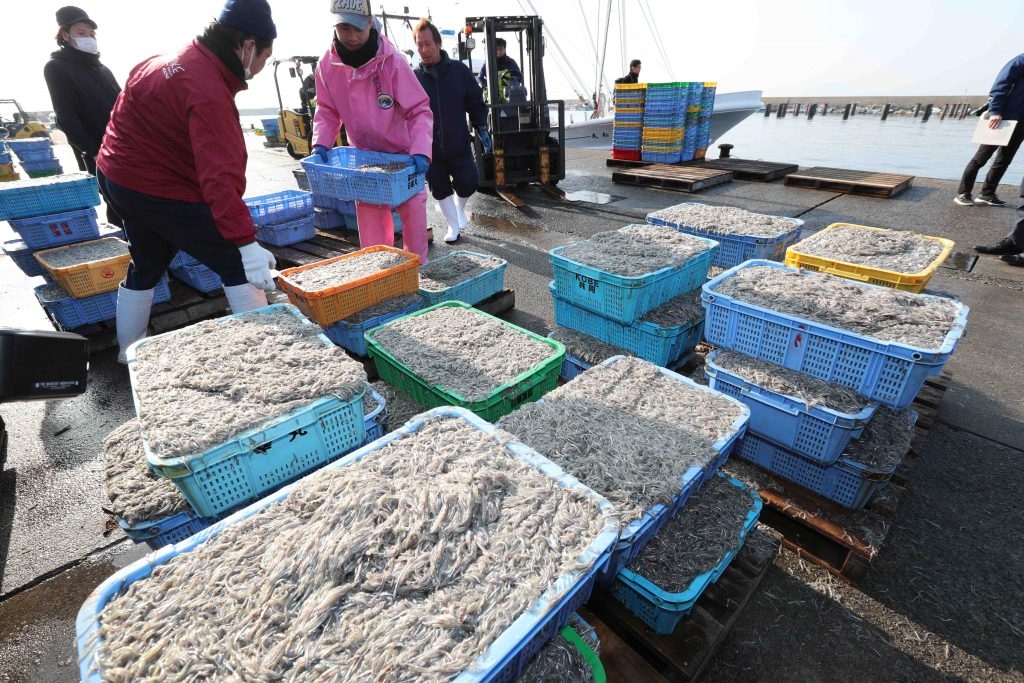
The 15 countries and regions maintaining restrictions on Japanese food imports include China, South Korea, and the US.
January 29, 2021
Israel has removed import restrictions on food items from Japan imposed due to the 2011 Fukushima nuclear disaster, reducing the number of countries and regions with such trade policies to 15.
All Fukushima food products and some items such as grain, seafood, and mushrooms from Iwate, Miyagi, Tochigi, Gunma, and Chiba prefectures were subjected to the import restrictions.
The restrictions include submitting radiation inspection certificates and having all the items tested upon entry.
Japan farm minister Kotaro Nogami urged countries and regions retaining import restrictions to ease or eliminate them
Israel is now among 39 countries and regions that have lifted import restrictions.
The 15 countries and regions maintaining restrictions on Japanese food imports include China, South Korea, and the US.
More theory on Fukushima nuclear reactor explosion
Japan’s Nuclear Regulation Authority unveils another theory concerning an explosion that occurred at Fukushima Daiichi nuclear power plant in March 2011 based on a video reprocessed by Nippon TV using state-of-the-art technology.
1 This Month

of the week – Shut Down Drone Warfare!


Tell the Ukrainian Government to Drop Prosecution of Peace Activist Yurii Sheliazhenko

Petition to revoke the licensing of the Near Surface Nuclear Disposal Facility (NSDF) at Chalk River. https://www.ourcommons.ca/petitions/en/Petition/Details?Petition=e-7247
To see nuclear-related stories in greater depth and intensity – go to https://nuclearinformation.wordpress.com
-
Archives
- April 2026 (68)
- March 2026 (251)
- February 2026 (268)
- January 2026 (308)
- December 2025 (358)
- November 2025 (359)
- October 2025 (376)
- September 2025 (257)
- August 2025 (319)
- July 2025 (230)
- June 2025 (348)
- May 2025 (261)
-
Categories
- 1
- 1 NUCLEAR ISSUES
- business and costs
- climate change
- culture and arts
- ENERGY
- environment
- health
- history
- indigenous issues
- Legal
- marketing of nuclear
- media
- opposition to nuclear
- PERSONAL STORIES
- politics
- politics international
- Religion and ethics
- safety
- secrets,lies and civil liberties
- spinbuster
- technology
- Uranium
- wastes
- weapons and war
- Women
- 2 WORLD
- ACTION
- AFRICA
- Atrocities
- AUSTRALIA
- Christina's notes
- Christina's themes
- culture and arts
- Events
- Fuk 2022
- Fuk 2023
- Fukushima 2017
- Fukushima 2018
- fukushima 2019
- Fukushima 2020
- Fukushima 2021
- general
- global warming
- Humour (God we need it)
- Nuclear
- RARE EARTHS
- Reference
- resources – print
- Resources -audiovicual
- Weekly Newsletter
- World
- World Nuclear
- YouTube
-
RSS
Entries RSS
Comments RSS
 nuclear-news