Comic tale of aging bar hostesses with social punch
I am surprised that this article was published on Yomiori Shimbun (Japan News), usually a pro-government media, with biased information.
This sentence must have escaped the censoring eyes of their editor.
I particularly like the: “Like Chihama, Arata comes from Fukushima Prefecture, where her parents’ home was destroyed in the Great East Japan Earthquake. Brazil in the past and contemporary Fukushima begin to look very similar, in the sense that “those affected are not told the truth.”

June 10, 2019
This week’s manga Sono Onna Jilba (Jitterbug The Forties)
By Shinobu Arima (Shogakukan)
Arata Usui has a job dealing with customers in a major supermarket chain store when she is transferred to the stockroom, out of sight. This was inevitable, as she is already past 40 and no longer young. Still single, with no boyfriend and no savings, she lacks confidence. One day, Arata is surprised to see a help-wanted notice for bar hostesses in the entertainment quarter of town. The criteria: women 40 or older! Is this some kind of a mistake? Mustering her courage, she opens the door to the Bar Old Jack & Rose, a watering hole aimed at senior citizens in which the average age of the hostesses is 70. Mesmerized by a world completely different from her own, she begins a side job as a trainee hostess under the alias of Arara. She soon learns about the legend of Jilba, the founder and inaugural manager of the bar.
“Jitterbug The Forties” is a comedy with cheering messages for an aging society, played out by lively bar hostesses who seem almost supernatural. The story starts out in such an atmosphere, which in itself is entertaining enough. But readers are taken to a much deeper level. As the hostesses recount their pasts, an alternative postwar history emerges that we have never been told. This transforms it into a work that offers a completely different impression.
Jilba, born Chihama Hoshi, emigrated to Brazil from Fukushima Prefecture. One thing that I learned from this manga was that immediately after the end of World War II, Japanese immigrants in Brazil were divided into two groups regarding the outcome of the war. One group, the “kachi-gumi” (the victors), blindly believed the false information that Japan defeated the United States. This group far outnumbered the other group, the “make-gumi” (the defeated), which believed that Japan lost. Conflicts between the groups eventually led to terrorist attacks, and there were scams targeting immigrants hastily trying to return to “victorious” Japan. Chihama, who loses her husband and children amid the chaos, arrives alone in a Japan that is little but burned-out ruins. She gathers women in similar dire straits and opens the bar. This is the other story line told in “Jitterbug The Forties.”
Like Chihama, Arata comes from Fukushima Prefecture, where her parents’ home was destroyed in the Great East Japan Earthquake. Brazil in the past and contemporary Fukushima begin to look very similar, in the sense that “those affected are not told the truth.” Quite impressed, I realized just how much of a hard-hitting, socially aware work this actually is at its core.
Even so, “Jitterbug The Forties” never loses its balance as a comedy, impressively maintaining a cheerful disposition over five volumes right up to its conclusion. “Jilba” is Japanese-English, originating from the American social dance known as the Jitterbug. No matter how arduous your past was, sweep it away with song and dance. Regardless of your age, life is not to be thrown away. This is a masterpiece that resonates with a powerfully encouraging message to all generations.
Ishida is a Yomiuri Shimbun senior writer whose areas of expertise include manga and anime.
According to Japan govt’s official statistics on pediatric cancer, children cancers doubled since Fukushima
From the Japan govt’s official statistics of children cancers:
The country has been taking statistics on pediatric cancer since 1975. Every year, 2,000 to 2,500 people were affected.
The least was in 2006, where there were 1861 people affected, the year before the Niigata Chuetsu Earthquake.
But the numbers of children cancers really much increased after Fukushima. In 2015, 3246 people, in 2016, 3161 people, in 2017, 3279 people.
I think the incidence of children cancers will continue to increase in the coming future.

Last fishing port in Fukushima to reopen

June 4, 2019
A fishing port in Tomioka in Japan’s Fukushima Prefecture is expected to reopen next month after being closed for more than eight years.
The massive earthquake and tsunami that hit eastern Japan in 2011 caused the severe Fukushima nuclear accident in Fukushima Prefecture.
Nine of the prefecture’s 10 fishing ports affected by the triple disaster have already reopened.
Tomioka Port is known as the main port for catching tasty flatfish and flounders.
Its wharves and breakwater were damaged by the quake and tsunami, and an evacuation order was issued for Tomioka and other fishing ports in Fukushima Prefecture.
That evacuation order was lifted in April 2017, and work has been underway to rebuild the port.
Fishing boats based at Tomioka Port were sent to other ports in the prefecture, such as Iwaki City and Namie Town. Officials say these boats are expected to return to Tomioka.
Tomioka Town and the local fisheries cooperative plan to hold a ceremony in July to celebrate the return of the fishing boats and fishers to the port.
Thyroid cancer diagnoses in Fukushima youth not linked to nuke disaster: panel
The lies of denial continue:
“Every lie we tell incurs a debt to the truth. Soon or later, that debt is paid.”
Quote from HBO mini-series “Chernobyl”

A doctor administers an ultrasound scan on a child to look for evidence of thyroid cancer in this file photo taken at a clinic in the village of Hirata, Fukushima Prefecture, on Feb. 23, 2016.
June 4, 2019
FUKUSHIMA — A prefectural panel of experts here concluded on June 3 that thyroid cancer diagnosed in a second round of prefecture-wide checks in fiscal 2014 and 2015 on people who were aged 18 and under at the time of the meltdowns at the Fukushima Daiichi Nuclear Power Station in March 2011 was unrelated to their exposure to radiation emanating from the disaster.
The panel is tasked with evaluating thyroid examinations conducted by the prefectural government as part of post-disaster health checkups on residents in Fukushima Prefecture, in the Tohoku region northeast of Tokyo. According to their results, the rate of thyroid cancer discovery was higher among children who were living closer to the nuclear plant at the time of the meltdowns. But when taking into consideration factors including age at examination, there was no correlation between high radiation exposure doses and an increase in chances of cancer discovery.
However, as individual exposure doses were not measured and there is no data on those who have yet to be examined, panel members emphasized that its conclusions are provisional. Gen Suzuki, the head of the panel, said, “We haven’t concluded that there are no long-term effects from radiation.” He pointed to the need to continue thyroid cancer screenings for the time being while informing the children and their guardians of the demerits of overdiagnosis.
Following fine adjustments to the content of the report, its conclusions will be presented to an executive examination committee.
The second round of screenings, held in the fourth and fifth years after the onset of the nuclear disaster, is essential for judging the potential effects of the nuclear disaster and were carried out on some 380,000 people. Of those, 71 people were suspected to have some form of the cancer, with at least 52 of them receiving operations for the condition.
(Japanese original by Ryusuke Takahashi, Fukushima Bureau)
2020 Tokyo Olympics Torch Relay Starts at the J-Village Sports Complex in Fukushima
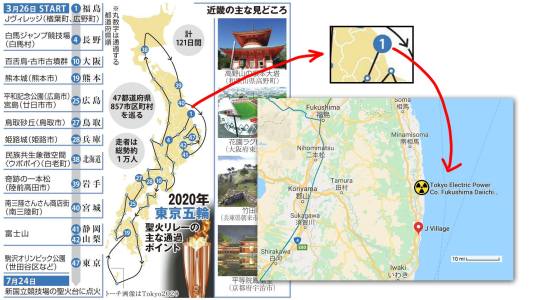
It’s official! The 2020 Tokyo Olympic torch relay starts at the J Village Sports Complex in Fukushima, which is just 10 miles from the crippled nuke plant.
Olympics: Tokyo 2020 torch relay route revealed, uniforms unveiled

June 1, 2019
TOKYO (Reuters) – Tokyo 2020 organisers on Saturday unveiled the uniforms to be worn by 10,000 volunteer runners during the torch relay and presented further details about the route the relay will take.
Organisers said the torch will travel through all 47 of Japan’s prefectures – from Hokkaido in the north to the southern island of Okinawa – and most of the country will have the chance to see the torch with 98% percent of the population residing within an hour’s distance from the route.
The 121-day relay will begin on March 16 at the J-Village in Fukushima, which is Japanese football’s national training centre and a symbol of resilience during the 2011 earthquake and tsunami that killed almost 16,000 people.
Games organisers have sought to stress the importance of Tokyo 2020 as the ‘reconstruction Olympics’ and it was evident in the choice of the route, which will pass through Okuma, where part of the Fukushima nuclear complex is located, and past Kumamoto Castle, which suffered heavy earthquake damage in 2016.
“It is not just about places where people can come or around landmarks, but the torch will also visit areas affected by the Great Japan Earthquake and Kumamoto Castle, recovering from the Kumamoto earthquake,” said Miho Takeda, a Tokyo 2020 committee member and five-time Olympic medallist in synchronized swimming.
“The relay will go through areas of Japan that are working hard to recover from natural disasters.”
The torch will also visit the Hiroshima Peace Memorial Park and pass Mount Fuji before arriving at the National Stadium in Tokyo on July 24 during the Olympics opening ceremony.
The runners’ uniform, designed by fashion designer Daisuke Obana, was unveiled by multiple Olympic gold medallist judoka Tadahiro Nomura.
The uniforms, which are produced in part from recycled plastic bottles, incorporate a diagonally-draped red sash similar to those used as batons in Ekiden, Japan’s famous long distance relay events.
“The torch bearer uniform is eco-friendly. Coca Cola collected plastic bottles in their company and recycled them to use them in the uniform material,” Nomura said.
Philippines lifts ban on Fukushima fish imports

Agriculture Secretary Emmanuel Piñol says the lifting of the ban is a gesture of goodwill as the Philippines also seeks to increase the market access of its agriculture exports to Japan
BAN LIFTED. The Department of Agriculture lifts the 7-year import ban on fish coming from Fukushima prefecture in Japan, which was affected by the nuclear power plant meltdown in 2011
May 29, 2019
MANILA, Philippines – The Philippines lifted the import ban on a number of fish species coming from Japan’s Fukushima prefecture after 7 years, according to Agriculture Secretary Emmanuel Piñol.
In a Facebook post on Wednesday, May 29, Piñol said the order, which approves the proposal of the Bureau of Fisheries and Aquatic Resources (BFAR), serves as a “gesture of goodwill” between Japan and the Philippines.
The Philippines imposed the ban on importing cherry salmon, sand lance, Japanese dace, and ayu or sweetfish in 2012, after the Fukushima Daiichi Nuclear Power Plant meltdown in 2011.
“I consider the ban, issued by the previous administration, as just a bureaucratic goobbledygook and an overreaction to an issue which did not really affect the Philippines,” Piñol said.
In turn, the Department of Agriculture also hopes to improve the market access of the Philippines’ agriculture exports to Japan by seeking lower tariffs for bananas and pineapples.
Piñol also said they are pushing for the entry of Hass avocado into Japan. (READ: DTI expects $5 billion in signed deals from Duterte’s Japan trip)
The lifting of the ban coincided with President Rodrigo Duterte’s visit to Japan for Nikkei’s 25th International Conference on the Future of Asia, where he has brought along 200 other delegates. (READ: Duterte promises Japanese businessmen he’ll ‘kill’ their problems) – Rappler.com
Olympics: Tokyo 2020 torch relay may include Fukushima reactor town

Japanese Prime Minister Shinzo Abe, center, attends a ceremony held on April 14, 2019, in Okuma, a Fukushima Prefecture town hit by the 2011 tsunami-quake disaster and subsequent nuclear crisis to celebrate the opening of the newly constructed town government building.
May 28, 2019
TOKYO (Kyodo) — The 2020 Tokyo Olympic Games torch relay may pass through a town in northeastern Japan’s Fukushima Prefecture that was devastated by nuclear meltdowns following the 2011 earthquake and tsunami, sources said Tuesday.
The Olympic torch relay course could include the environs of the No. 1 reactor at the crippled Fukushima Daiichi nuclear complex in Okuma as part of the organizers’ efforts to promote the games as the “reconstruction Olympics,” the sources said.
The government lifted its mandatory evacuation order over parts of Okuma last month, but most of the town still remains a no-go zone. The relay will pass through the parts of Okuma and the surrounding area where the evacuation order has been lifted.
After declaring that problems containing radioactive water accumulating at the No. 1 reactor were “under control” during the 2020 Olympic bid process, Prime Minister Shinzo Abe and the government have used the games to showcase Japan’s recovery from the massive earthquake and tsunami of March 11, 2011 and ensuing nuclear disaster.
But in districts of Okuma where the evacuation order has been lifted — which covers 40 percent of the town’s total land — only a tiny percentage of residents have returned, with some saying they have been left behind while more emphasis is placed on showing off the progress of recovery.
Organizers announced in July 2018 that Fukushima would be the starting point for the relay. In March, organizing committee president Yoshiro Mori revealed the relay will begin some 20 kilometers from Fukushima Daiichi at the J-Village national soccer training center, which was used as an operational base for handling the crisis.
The Olympic torch will arrive in Japan on March 20, 2020, and the flame will be taken to Ishinomaki Minamihama Tsunami Recovery Memorial Park in Ishinomaki, Miyagi Prefecture, which was devastated eight years ago.
It will then travel by train through Miyagi and Iwate prefectures — the two other prefectures hit hardest by the powerful earthquake and tsunami — before making its way to Fukushima.
The Japan leg of the relay will begin on March 26, 2020, two weeks after the flame lighting ceremony in Greece, and will travel across all 47 prefectures in Japan over a period of 121 days.
The Tokyo Olympics are scheduled to be held between July 24 and Aug. 9, followed by the Paralympics from Aug. 25 to Sept. 6.
” Tokyo – Next Olympic Venue, Is Our Home We Can’t Go Back Again”
May 28, 2019
Dear friends, wherever you are, here’s my sincere message as a mother. With all my wish to reach your heart.
〜*〜*〜*〜*〜*〜*〜*〜*
🔷 Ailing Daughter, Beaming Prime Minister
In the summer of 2013. I was at my home in Tokyo when the city won the place of 2020 Olympic venue.
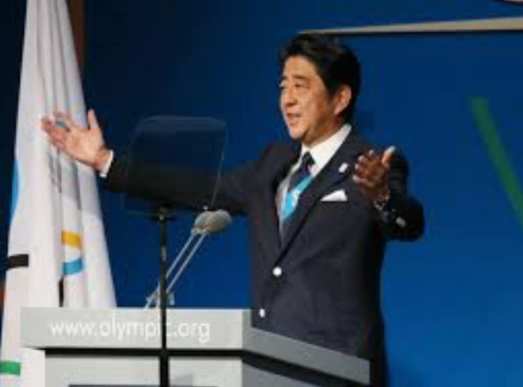
On TV, Prime Minister Abe, spreading both of his arms, addressing that the situation is under control about the Fukushima Daiichi Nuclear Plant Incident.
His speech was smooth with a smile, he claims it has never done and will never do any damage to Tokyo. Then he mentions the health issues in regards, he was telling that we definitely never had any problem neither in the past, at the present nor will be in the future.
Just then, sitting next to me was my eight-year-old daughter, whose health was deteriorating day by day. It had been a slow process.
“I feel sick. I have no strength left…”
“I”m woozy. I have a headache, I have a tummy ache, my legs hurt that I can’t walk, my hands are all in pain to my fingertips, I’m cold, my face is hot, Mummy I’m worn out”
Such condition started to bother us periodically after the accident. It started to worsen and never seemed to get better.
I used to be very ignorant about nuclear plants.
I started to research and read books frantically after the accident as if it was a wake-up call. My daughter’s health crumbled as if it was in parallel with my learning progresses. I first started to connect my daughter’s change with the radiation issue after I’ve developed my knowledge about internal radiation exposure.
🔷 Radiation Exposure in Tokyo? No way!
I was never sure. It can’t be radiation exposure, but what if it was? In Tokyo? No way. Doctors never took me seriously about having such concerns. They just chastised instead of giving any advice. My husband just laughed it off. He always ended up getting angry and we ended up fighting every time. I could never, ever talk about it to any of my friends. “Definitely no problem” the words come out of Prime Minister Abe’s mouth with a nice smile are, for us living in Tokyo, common sense like the air that fills all around us.
I don’t know. I don’t know what she was suffering about. I don’t know why she is suffering. I don’t know what I should be doing. How long does it last? I have no perspective about whether there be the day my daughter regains her health or not. Painful days.
The symptom was very identical to the “Bura Bura Disease.” My daughter was nothing but healthy until 5 years old. She was stronger than anyone. She used to be a girl who would play outside every day from early in the morning until the day falls dark.
I was beyond shocked when I heard our Prime Minister Abe told the lie “Under Control,” but that was nothing compared to the words that followed – “It has never done and will never do any damage to Tokyo.”
I was flabbergasted. That was back when I was not yet so sure of whether my daughter was a victim of the affected health, but the health was the problem I was facing each and every day with my daughter. I did not want Prime Minister, who had no idea what my daughter was facing, to be talking like that with such a big smile. I had this chilling feeling that we are being squashed and dumped, together with my daughter. Whatever happens, I will never approve of this Olympic. Such unforgiving phrase was etched deep in my heart. And since then my heart has never changed.So that was how I came to my understanding of this Olympic – it is to squash and cut the nuclear accident and the aftermaths.This is an Olympic to show off “recovery” by cutting us off with a smile.
Half a year later, my daughter’s health deteriorated to the point she has no day of strength. She can’t go to school. She can’t play with friends. When it is bad, she can not go to the bathroom by herself. It was 3 years after the accident.
🔷 She Gets Better! …When She Goes to Places with No Contamination
It was then I met Dr. Shigeru Mita, then the only doctor in Greater Tokyo who was dealing seriously with the problems in relation to the radiation exposure. I heard that symptoms vary by individual, some children recover conspicuously or show remarkable improvement in blood test results after moving to places such as Western Japan – where there is no contamination.
We made it and attend his last local lecture event. A month later the doctor migrated. He clearly stated my daughter’s case is the damage caused by radiation exposure.Hearing him say that, I was not shocked but felt a deep relief. Finally, I can start to face the real problem and start working towards her health. It was the doctor’s recommendation to recuperate, emigrate, move to the place without contamination.
Immediately , we moved our daughter to Toyama, where my family is. Then there was a miracle.
Our daughter, whom we had to piggy bag to use the toilet, walked 15 minutes to the local beach and swam in a pool. It was only a few days after she arrived Toyama. It was a miracle after a month of agony – she was feeling sick all the time, she would cry because her body was in pain. For a month, she could not get out of the house, not to mention going to school.
The same miracle happened when we recuperated her in Okinawa, then in Kobe, to where we later relocated. Then she falls back again when she came back to Tokyo. Her condition would be back after a week. Sometimes it comes back as soon as the night she returned.
“I can’t do the homework,” the daughter once recovered says, “I could not say I was feeling sick… I did not want to disappoint you Mum”
I will never forget the hopelessness every time I had to witness my girl swept away by the waves of symptoms. I will never forget the tears that she shed in despair.
🔷 Increasing “Degradation of Abilities” in the Metropolitan Area
Finally, we moved to Kobe in Western Japan. It was after we spent about 4 months without her health recovering except the time we relocated her for recuperation. We were lucky to have been able to move with all the family together. Many of evacuees from the Kanto Plain fell into serious financial strife because they had to move. Many mothers and children made a hard decision to move without their fathers who could not give up work to feed the family. I am thankful that we did not have to suffer from such financial strife, it was an easy start in Kobe although we were totally strange to the area. But more than anything, there is no word that can express how thankful I was to see my daughter coming back alive rapidly, started to play with many friends as if she was trying to recover the life she missed out. It was another miracle.
So what was happening to her body?
And what is happening to our body now?
After our relocation, we visited Mita Clinic in Okayama. Their examination and testing slowly uncovered the answers to my questions. We underwent multiple testing on our Pituitary Hormone which led us to understand the impact of radiation exposure on our brain. Important enough organ to be affected.
The deterioration of the hormone observed in my family including my daughter is said to be happening in many who lives in the Tokyo metropolitan. My family is healthy for the time being. Dr. Mita, however, says that more people are starting to suffer severe symptoms such as weakening of motivation, declined thinking and memory ability, and losing strength to fight against any kind of sickness to the point where they can no longer lead a normal life.Dr. Mita coined such symptoms as “Degradation of Abilities.”
Can we recover what had already been lost?
No one has the answer. We are the test subjects for keeps. The country is on the experimental bench and many of us, the test subjects, instead of sharing knowledge and unite in harmony for our recovery, are being made to run the exact opposite direction.
I was born and raised in Tokyo. It’s the city where I also raised my children and spent my entire life. My parents, siblings, and friends are in Tokyo. All my memory, nostalgia and love for my home is now lost without a trace.
I can not go home. I have even lost my wish to go home. That’s how intense it was. That’s the result of our experience with our daughter during our last 4 months in Tokyo. Now we must face the cruel test results of our pituitary gland hormone.
We must face what we can not see, smell, or feel. That’s the fear of radiation itself.But it doesn’t end there. The worst part is this horrible feeling that I can not share such a fierce feeling of crisis at all with any of the people I care and spend time with.
🔷 Olympic Brings on Sad Future
Do you still think Olympic would be a great idea?
As 2020 approaches, revulsion is creeping in to fill me. I’ve been having trouble finding the right word to let you understand how unpleasant a feeling can be.
That is the ground my daughter can never walk on anymore. That is the ground where many families, many mothers, and children evacuated from. That land we escaped from in order to protect our children, protect our own. That land we ran away from, hoping for the tomorrow without tormenting health damage.
My home town had been contaminated. We can not erase what is there. We can not say it never happened. We are blindfolded about the ongoing nuclear accident and nuclear contamination spreading throughout Eastern Japan. And they put this Olympic on our way we are walking towards as if some sort of culmination of achievement.
So this is the Olympic of recovery and regeneration.
Is Olympic our hope? Is it our future? What kind of hope, what sort of future are we meant expect with the Olympics, when we are blindfolded about the wounded bodies of our children, our own bodies in pain? Are we expected to push forward for the Olympic to show off “Recovery” with blindfolds?
Who is that for? What is it for?
My child hit my head hard. Then the blindfold fell. So I found out the existence of the blindfold. We can not protect our most precious things from radiation exposure because of the blindfold. So what sad future does that bring about? We should be able to learn
from the past nuclear bombs, nuclear accidents, nuclear disaster, and nuclear testings if we want to learn. My daughter is teaching me a tiny piece of the puzzle with her own body.
This Olympic is the biggest blindfold in history. Let us throw away the blindfold. Our wish is to live our own lives, with our own body that we are given by right.
To retrieve the tomorrow where our children can run with a healthy smile on their face, why not us the adults get over any barriers, hold hands and cooperate.
I will not not forgive this 2020 Olympic Games in Tokyo.

TEPCO decides not to hire foreign workers at nuclear plant

May 22, 2019
Workers check the advanced liquid processing system used to treat contaminated water at the Fukushima No. 1 nuclear plant in December. (Asahi Shimbun file photo)
Tokyo Electric Power Co. announced May 22 it was backtracking on plans to use foreign workers at its crippled Fukushima No. 1 nuclear power plant after the health ministry urged extreme caution.
The utility said it will not hire foreign workers at the plant “in the immediate future” as it will need “much more time to put a system in place to ensure their safety.”
The company noted that hiring foreign workers at the nuclear plant under a new specified skills visa category that took effect in April could result in work-related accidents and long-term health problems due to their lack of Japanese language skills and understanding of Japanese labor practices.
The announcement followed a health ministry caution May 21 for TEPCO to carefully reconsider its policy of using foreign workers at the complex.
The Ministry of Health, Labor and Welfare noted that TEPCO was keen to take advantage of a new specified skills visa category and hire foreign workers, but urged the company to exercise “extreme caution.”
The ministry was concerned about foreign nationals with a limited command of Japanese being in an environment contaminated with radioactive substances.
The ministry had said that if TEPCO went ahead with hiring foreign workers, the company and its contractors involved in decommissioning had to take at least the same level of protective measures that apply to Japanese workers to ensure that they fully understand safety sanitation and avoid the health risk of excessive radiation exposure.
Even though eight years have passed since the triple meltdown, radiation levels remain high in many areas of the Fukushima plant, especially around the reactor buildings.
The decommissioning process that is expected to take years will involve a range of gargantuan tasks, one being the removal of melted nuclear fuel debris from the reactors.
Under the recently revised immigration control law, foreign workers with specified skills are permitted to work at nuclear power plants.
The ministry acknowledges that it is ultimately up to individual employers to decide whether or not to accept foreign workers on their payrolls.
But experts in Japan and overseas who are keen for the new visa program to be a success have also voiced concerns about foreign workers at the Fukushima plant developing radiation-related health issues and being able to manage them after they return to their home countries.
Foreign workers arriving in Japan in one of the two categories of specified skills can stay in the country for up to five years.
“Since there are no legal constraints, the ministry moved one step ahead of TEPCO,” said a senior ministry official, referring to the request for a rethink of the policy.
Chief Cabinet Secretary Yoshihide Suga referred to the ministry’s caution at a May 21 news conference, saying that TEPCO should be prepared to fully address a range of health-related problems that may arise in the future.
The utility notified dozens of its contractors at a meeting in late March that it will accept foreign workers at the Fukushima plant.
Currently, about 4,000 people toil at the plant each day. Most areas of the complex are categorized as controlled areas to guard against radiation exposure.
Under the law, workers at a nuclear facility must not be exposed to more than 100 millisieverts of radiation over five years and 50 millisieverts a year.
TEPCO urged to be cautious about using foreign workers in Fukushima

This photo taken from a Kyodo News helicopter shows a trailer (bottom center) thought to be carrying nuclear fuel from one of the reactor buildings at Fukushima Daiichi Nuclear Power Plant.
May 21, 2019
TOKYO (Kyodo) — The Japanese government on Tuesday urged the operator of the disaster-stricken Fukushima Daiichi nuclear plant to carefully examine its plan to have foreigners work at the complex under a new visa program, citing difficulties in managing the long-term health risk.
“It is necessary to give very deliberate consideration” to whether foreigners who come to Japan under the new visa program should engage in decommissioning work at the plant, labor minister Takumi Nemoto told reporters.
Tokyo Electric Power Company Holdings Inc. said last month it plans to accept foreign workers at the facility hit by the 2011 megaquake and tsunami.
The minister expressed concern about the ability to conduct long-term health management for foreign workers after they return to their home countries upon expiration of their visas.
“It is necessary to establish a safety and health management procedure that is equivalent or more advanced than that for Japanese workers,” Nemoto said.
The new visa program launched this April is intended to bring in mainly blue-collar foreign workers to 14 labor-hungry sectors including construction, farming and nursing care in aging Japan. TEPCO has confirmed with the Justice Ministry that holders of visas under the scheme are eligible to work at the Fukushima plant.
The government also urged TEPCO to consider implementing measures to manage the amount of radiation exposure for workers engaged in decommissioning tasks.
It also requested the utility to study whether it can use native languages for safety training and when issuing safety warnings at workplaces for workers who lack general proficiency in the Japanese language and familiarity with the country’s customs.
The Ministry of Health, Labor and Welfare demanded TEPCO report back to the ministry on the outcome of its deliberations without setting a deadline.
TEPCO said it has told dozens of its subcontractors that foreigners coming to Japan under the new visa program can not only engage in decommissioning work at the plant, but also take up building cleaning roles and work in the provision of food service.
To prevent unsafe levels of radiation exposure, TEPCO has said foreign workers must have Japanese language abilities that enable them to accurately understand the risks and to follow procedures and orders communicated to them in Japanese.
In radiation-controlled areas, workers need to carry dosimeters. On average, approximately 4,000 people work for TEPCO subcontractors at the Fukushima Daiichi plant each day.
To address exploitation fears under the new visa system, the Justice Ministry has issued an ordinance requiring employers to pay wages equivalent to or higher than those of Japanese nationals.
Theatre for Fukushima: voices from the silence

“Still Life”, the play by Japanese author and playwright Miri Yu, is performed by twelve young people at Futaba Futur Public High School in Fukushima. Fifteen to seventeen years old, they play roles that are not foreign to them.
May 20, 2019
Where were you and what were you doing on that fateful day, 11 March 2011?
Eight years have gone by, and the then six to eight-year-old children are now high school students who use theatre as a channel for self-expression. Through their performance, they attempt to tell the story of their home towns and cities. It is also a way for them to assimilate the experience that changed the face of an entire region.
Still Life is the name of the play performed by six girls and six boys from the Futaba Future public high school in Fukushima. Aged between 15 and 17, the parts they play are based on their own life experiences. They tell the story of what the children went through, laying bare the complex web of emotions they have been caught in till this day. It is a tangled tale of love, childhood and suicide, seen through the unadulterated eyes of young people, who were just small children when the triple disaster struck. They are the youngest and will therefore be the last generation to keep a memory of those tragic events. And it is important for them to be able to share it.
The brown colour of the sea. A uniform left behind when a school was hastily closed down following the radiation alert. A teddy bear with a broken heart and the incessant ringing of a telephone searching for missing grandparents. Lampposts swaying dangerously on a hill, while children huddle together, remembering the adults’ instructions not to be left on their own. Innocently playing in a classroom with the water and sand spilt by the earthquake and cleaning it all up before heading for safety. Sleeping in the car with all the family when not a space was left in the sports centre. Memories of an earthquake, a tsunami, of radioactivity and the fear surrounding the decontamination process.
Until she was eight, Ayumi Ota lived in Tomioka, a town that was evacuated in the aftermath of the disaster. The 16-year-old actor was inspired to join the school theatre group by her elder brother. They are both part of the cast. With her inquisitive and lively gaze, Ayumi shines in her part as the likeable classmate spurring on the others, despite her own longing for a place to which she knows she will never be able to return. She enjoyed the experience so much that she is considering joining a theatre group: “When I’m acting, it brings back what we went through, although [acting] has not been so hard for me because I want to express myself. We are all interconnected, Fukushima and Tokyo, we’re not that different.”
Seventeen-year-old Minoru Tomonaga comes from the town of Iwaki. He likes to sing and wants to study in a professional academy. He admits that his main motive for taking part in the play is a girl he likes. Minoru found the whole process much harder to handle: “My mind was on overdrive. It was like hitting a wall, because each one of us had our own experiences. It was difficult to cope with all those feelings. But I do hope that we are listened to, in this time of fake news.”
After its debut in Fukushima, in September 2018, the young actors wanted to take the play to Tokyo. Writer Miri Yu, the soul of the play, recalls how, as the performance ended and the curtain went down, the students seemed to be glued to their desks.
“They had grown attached to their roles, so they had to do it. Audiences in Tokyo hadn’t experienced the earthquake, the tsunami and nuclear accident first-hand. How the play would be received was obviously a worry, but something always gets across.”
Miri Yu, who is also a playwright, has won a number of national literary awards, including the prestigious Akutagawa Award (1996). After a string of back-to-back, sold-out performances in Tokyo, Yu explains to Equal Times the importance of art and creation as a source of comfort and consolation. “The play is a still life that captures the sadness of the disaster-struck children. The pain or suffering we carry deep inside eventually ends up overflowing, like water in a dam. Otherwise, the pain breaks the dam and drags you along with it. To prevent this from happening, I wanted to build a channel in which to pour all this sadness. The play is the vessel in which it is collected. Isn’t sadness what we as human beings have most in common? We all carry certain sorrows in our lives; all of us, in Tokyo too. This play emerged as a beacon of light, a source of solace for young people.”
Kanako Saito works as an English teacher at Futaba Future High School. She is also in charge of the theatre group. This teacher, who supports her pupils and is also part of the cast, explains how theatre helps them. “Back then, they were just small children and were unable to express themselves. Their parents shielded them from what was happening, be it from the radiation or the decision to move. They weren’t allowed to watch television and had to play indoors, never outside the house. They had no way of venting their feelings. Eight years on, they now have the vocabulary to express themselves. As they build the drama, they focus on how they felt, which helps in their healing process. It also helps the families who, by watching their children acting, gain a better insight into what they went through. It helps people to move on.”
Starting over
Futaba Future High School has kept the name of the place where it had stood until radioactivity made it uninhabitable. Futaba is one of the towns nearest to the Daiichi Nuclear Power Plant. In 2015, the school relocated to Hirono, a nearby town that was outside the danger zone. Its guiding principle is to prepare global leaders that can contribute to tackling today’s new challenges.
Following the disaster, 470,000 people – which amounts to almost the entire population of cities like Lisbon or Edinburgh – were evacuated. According to the Reconstruction Agency, a body tasked with this unprecedented mission, by February 2019, the number of evacuees had reached 51,778. Places like Namie, Tomioka, Futaba and Okuma were totally or partially evacuated. Their names resonate throughout the play, when the budding actors relive their memories.
“The experience had a strong impact on everyone. The actors, who were little children back then, have barely taken in what they went through. The coast of Fukushima has not yet been fully reconstructed. The young locals and their families continue to be faced with great hardships. They have become displaced persons, constantly being shunted from one place to the next, and even now some of these young actors are still having to live in temporary accommodation,” says Yu.
In 2017, the government lifted evacuation orders – based on the area, the radiation levels and the progress made in the decontamination process – but places like Futaba are still classed as ‘difficult return’ or uninhabitable zones.
The decontamination work has also covered farming areas, 89 per cent of which have been recovered, according to the Reconstruction Agency. Reconstruction tasks have been completed in 64 municipalities over a seven-year period. In Fukushima, an area measuring 371 km², greater than the size of a country like Malta, was affected by the triple disaster.
The writer is currently living in Minamisoma, because of a promise she made and a radio show. In the aftermath of the disaster, under the state of emergency, she started working as a volunteer at a provisional radio station set up by the municipal authority to broadcast information to the population and the armed forces. She used to travel once a week from another part of Japan to do the show. Although only meant to last a year, her stay was successively prolonged until she ended up relocating for good, to fulfil her promise.
Today only 3,000 of the 13,000 residents are still living in her neighbourhood, and more than half of them are over 65 years old. Located 16 kilometres from the nuclear power station, the town now has a bookshop and a theatre. For Yu, culture is an integral part of the reconstruction process.
“In a place where people have lost everything, no one at the neighbourhood meetings organised by the government speaks out to ask for culture. People ask for their basic needs to be covered, such as infrastructure, hospitals or supermarkets. But even if the basic needs are met, can this be called a city? Can this be called reconstruction? Not in my view. Culture is something that enriches you, it is relaxing, enjoyable and valuable in its own right. It can be a book or a secondary role in a play.”
Disasters are also a threat to culture. And yet culture is vital to community identity and expression. In 2015, the United Nations adopted the 2015-2030 Sendai Framework for Disaster Risk Reduction, which sees culture as playing a key role in reducing vulnerability to disasters, aiding recovery and building peace.
At the end of the performance, the Japanese audience leaves in solemn silence. A young woman from Tokyo says it was important to listen to them. On leaving the theatre, people buy a copy of the book on which the play is based. A dedication penned by the author and playwright stands out as a declaration of intent from Fukushima: “Speak out from the heart of silence.”
Fukushima local produce set to feature on Tokyo 2020 Games menus

May 18, 2019
Dishes made for past Olympics using local Japanese ingredients are offered at Gran-Eat Ginza in Chuo Ward, Tokyo.
The 2020 Tokyo Olympics and Paralympics offer a prime opportunity to showcase local Japanese food products to both domestic and international audiences.
Promotion councils have been set up at the prefectural level to supply locally produced fruits, vegetables and marine products to the Olympic Village and competition venues. Preparations are moving ahead, including the provision of support to acquire food safety certifications and compile lists of ingredients.
In March, for example, pig farmers in Izumizaki, Fukushima Prefecture, acquired Good Agricultural Practices (GAP) certification, which guarantees food safety and other qualities.
GAP is administered in Japan by the Japan GAP Foundation — which was founded by agricultural producers and other entities — and prefectural governments, among other entities. The Tokyo Organizing Committee of the Olympic and Paralympic Games is asking producers to acquire GAP certification so they can supply agricultural and livestock products to the Olympic Village and other venues. Similar certification is also required to supply marine products to venues.
The Fukushima prefectural government established a promotional council in July 2017 to enhance its reputation following the Fukushima No. 1 nuclear plant disaster. The prefecture has supported producers through such measures as covering the costs of inspections required to obtain certification.
Sixty-eight products, including peaches and lettuces, have already received certification.
“Supplying our produce for the Olympics is a chance to objectively prove both the delicious taste and safety of Fukushima Prefecture’s foods,” a prefectural official said.
Iwate Prefecture promotes its wakame seaweed, saury and Konjiki no Kaze brand rice, among other products. It has obtained certification for at least 35 products, and plans to hold food fairs targeting business operators so it can expand into its target markets even after the Games end.
Hokkaido has compiled a list that contains information on local producers and agricultural, livestock and marine products, and introduces 67 items on its website.
“We’re able to supply not only summer vegetables such as tomatoes and green peppers, but also produce for a wide range of uses,” a prefectural official said.
Mie Prefecture, famous for its Matsusaka beef and Ise tuna, has invited chefs from hotels in Tokyo and elsewhere, and promotes its products by holding tours of production areas and other events.
Last winter, the Shimane prefectural Izumo Norin agriculture and forestry high school in Izumo, Shimane Prefecture, acquired certification for its grapes. Tsutomu Fujiwara, a teacher at the high school, explained that “if the grapes are used at the Olympics, the students will gain a sense of confidence and achievement.”
Japan is expected to provide 120,000 tons of food from 242 different products during the Tokyo Olympics and Paralympics.
“We should give priority to domestic products when making selections,” a member of the organizing committee said. The menu for the Olympic Village will be finalized as soon as this autumn, followed by selection of products to be sourced from various areas throughout Japan.
Meals from past and future
Some of the fare expected to be served at the Olympic Village and elsewhere during the Games can already be sampled.
At Gran-Eat Ginza, a restaurant that opened in Tokyo in March, certified products used to make dishes previously served at Olympic Villages can be enjoyed at the restaurant’s buffet.
The restaurant re-created a Brazilian soup served at the 2016 Rio de Janeiro Games using chicken from Gifu Prefecture, carrots from Chiba Prefecture and rice from Yamagata Prefecture.
A casserole dish served at the 2012 London Games is re-created using pork from Tategamori Ark Farm in Iwate Prefecture and apples from the Kakusho apple growers association in Aomori Prefecture.
Last summer, Gifu and Tokushima prefectures served dishes such as pasta and minced-meat cutlets using GAP-certified ingredients at prefectural government cafeterias.
The Yamagata prefectural government likewise offered “Chisan Chisho Bento” boxed lunches last autumn, promoting the concept of “locally produced and consumed.”
Rice planted in Fukushima town as farming trials begin

17 May 2019
Rice has been planted in a Japanese town which hosts Fukushima’s damaged nuclear power plant eight years after residents were first evacuated.
Officials and locals in Okuma town planted several crops, including sticky rice and premium quality rice, across more than 17,000 square feet of paddy fields.
The rice planting is the latest sign of life slowly starting to return to Okuma, one of a string of so-called “ghost towns” that were immediately evacuated due to soaring radiation levels after the 2011 earthquake, tsunami and nuclear crisis.
Evacuation orders for Okuma – which along with Futaba town, co-hosts nearby Fukushima Daiichi Nuclear Power Plant – were lifted last month, while its municipal government building also reopened earlier this week.
New public housing for former residents displaced by the disaster is also expected to open next month, while an agricultural manual is being prepared to encourage people to start growing crops again.
Government officials in Okuma have been monitoring radiation contamination in produce while conducting small-scale farming trials for several years, with test results reportedly showing levels below the national safety standards for food.
Fukushima was once famed for its high quality food produce, from peaches and grapes to rice and fish, with the region’s producers hit hard by the 2011 nuclear disaster.
Over the past eight years, the Japanese government has taken numerous steps to attempt to reassure the world that food from Fukushima is safe to eat following a regional clean-up, with rigorous radiation testing in place for all produce.
More than 50 countries introduced import restrictions in the immediate aftermath of the meltdown at the nuclear power plant, with 23 still keeping food limitations from Fukushima in place.
Last month, the Japanese government criticised a World Trade Organisation ruling that supported a continued South Korean ban on imports of a number of Japanese fishery products.
Meanwhile, locals who are slowly starting to return to the region as evacuation orders are lifted are apparently turning to increasingly inventive ways to rebuild local farming businesses.
One group of farmers in Hirata village, just under 28 miles from the Fukushima Daiichi plant, who were also hit hard by the disaster, have garnered widespread attention in Japan for their unusually-flavoured habanero soft ice cream, made from locally grown chilli peppers.
Government officials are also pinning hopes on the 2020 Olympics giving local revitalisation efforts a high-profile boost, with a number of baseball and soccer games scheduled to take place in the region.
Fukushima sake top-rated for 7th straight year

May 17, 2019
Twenty-two brands of sake from Fukushima Prefecture in northeastern Japan have won top prizes in an annual national sake contest. The figure is the highest in the country for a seventh straight year.
Judges evaluated the aroma and taste of over 850 brands in this year’s contest.
A local Fukushima newspaper issued extra editions announcing the achievement.
A man who received a copy said that even though some may still have a negative image of Fukushima, he wants more people to know about the prefecture’s charms through sake.
People working at the Fukushima prefectural government office showed excitement about the result.
Fukushima Tourism Promotion Bureau head Yasuji Miyamura said high recognition of Fukushima sake gives hope to local people and breweries who’ve faced hard times after the 2011 disaster.
TEPCO postpones work to remove exhaust stack at Fukushima plant

The exhaust stack for the No. 1 and No. 2 reactors at Fukushima No. 1 nuclear plant will eventually be dismantled using equipment seen on both sides
May 17, 2019
Tokyo Electric Power Co. has delayed the start of work to dismantle a dangerous and highly contaminated exhaust stack at the Fukushima No. 1 nuclear power plant because of a calculation error.
The company said May 16 that work on the 120-meter-tall chimney, which was initially scheduled to begin on May 20, will be postponed until June at the earliest.
TEPCO found that the height of special cutting equipment lifted by crane would be 1.6 meters lower than under the original plan, making it unable to reach the top of the stack.
“We believe that the lifting angle of the crane arm turned out to be different from the original plan because of an error in measuring equipment,” a TEPCO official in charge of the operation said.
The company is now considering adjusting the angle and the crane position or extending the arm length after it is lowered.
The exhaust stack was used for the No. 1 and No. 2 reactors at the plant.
When the nuclear disaster unfolded in March 2011, vapor containing highly radioactive substances was released through the stack. Metal poles used to support the chimney were damaged apparently by a hydrogen explosion.
The area around the base of the stack contains levels of radiation that are too dangerous for humans to work in, so the dismantling work will be conducted by remote control.
1 This Month

of the week – Shut Down Drone Warfare!


Tell the Ukrainian Government to Drop Prosecution of Peace Activist Yurii Sheliazhenko

Petition to revoke the licensing of the Near Surface Nuclear Disposal Facility (NSDF) at Chalk River. https://www.ourcommons.ca/petitions/en/Petition/Details?Petition=e-7247
To see nuclear-related stories in greater depth and intensity – go to https://nuclearinformation.wordpress.com
-
Archives
- March 2026 (244)
- February 2026 (268)
- January 2026 (308)
- December 2025 (358)
- November 2025 (359)
- October 2025 (376)
- September 2025 (257)
- August 2025 (319)
- July 2025 (230)
- June 2025 (348)
- May 2025 (261)
- April 2025 (305)
-
Categories
- 1
- 1 NUCLEAR ISSUES
- business and costs
- climate change
- culture and arts
- ENERGY
- environment
- health
- history
- indigenous issues
- Legal
- marketing of nuclear
- media
- opposition to nuclear
- PERSONAL STORIES
- politics
- politics international
- Religion and ethics
- safety
- secrets,lies and civil liberties
- spinbuster
- technology
- Uranium
- wastes
- weapons and war
- Women
- 2 WORLD
- ACTION
- AFRICA
- Atrocities
- AUSTRALIA
- Christina's notes
- Christina's themes
- culture and arts
- Events
- Fuk 2022
- Fuk 2023
- Fukushima 2017
- Fukushima 2018
- fukushima 2019
- Fukushima 2020
- Fukushima 2021
- general
- global warming
- Humour (God we need it)
- Nuclear
- RARE EARTHS
- Reference
- resources – print
- Resources -audiovicual
- Weekly Newsletter
- World
- World Nuclear
- YouTube
-
RSS
Entries RSS
Comments RSS
 nuclear-news