Japan slammed for ‘reckless decision’ on release of nuclear-contaminated water
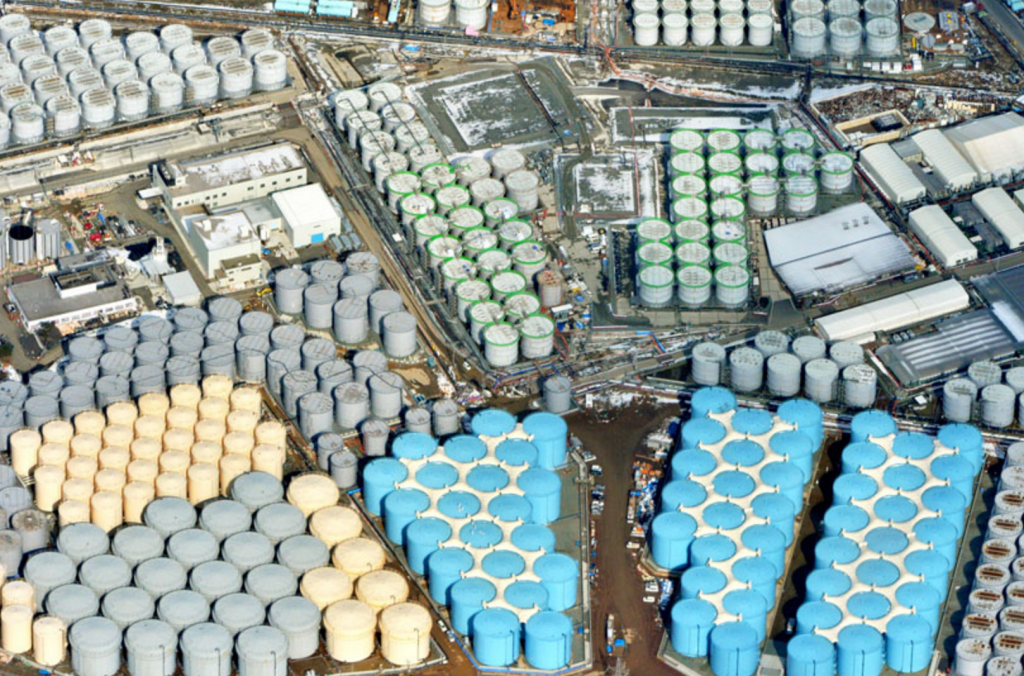
Jan 5, 2023
China on Wednesday slammed Japan for its “reckless and irresponsible” move to push forward a plan to release nuclear-contaminated water from the Fukushima Daiichi nuclear power plant into the sea, urging Tokyo to fully consult with stakeholders and relevant international institutions.
In response to the International Atomic Energy Agency’s third report on Fukushima water treatment published on Dec 29, Foreign Ministry spokeswoman Mao Ning said at a regular news conference that the ocean discharge plan for the contaminated water is “by no means” Japan’s domestic affair.
But as the work of the IAEA’s technical working group is still underway and no conclusion has been reached, Mao described Japan’s moves to push ahead with discharge preparations as “reckless and irresponsible”.
“China once again urges Japan to pay attention to the legitimate and justifiable concerns of the international community and fully consult with stakeholders, including its neighboring countries and Pacific Island countries, as well as relevant international institutions,” Mao said.
Japan should adopt an open, transparent, science-based and safe approach in disposing the water, and accept strict supervision by the IAEA, she added.
Mao said the report focuses on the disposal of nuclear-contaminated water and its environmental impact, and proposes methods and plans for the assessment and review of relevant data.
She noted that no conclusion has been reached yet on issues of great concern by all parties, such as the authenticity and accuracy of data and whether the data collection methods meet safety standards.
The IAEA report has once again demonstrated that the international community’s concerns over the accuracy of data on nuclear-contaminated water, the efficacy of the treatment system and the uncertainty of environmental impact are well-founded, Mao added.
In July, Japan’s Nuclear Regulation Authority officially approved Tokyo Electric Power Company’s discharge plan, which will be implemented from spring 2023.The endorsement provoked concerns from local fishermen and objections from Asian neighbors.
The IAEA Task Force’s review mission visited Japan in February and March last year and released relevant reports without any conclusive opinions.
http://eng.chinamil.com.cn/view/2023-01/05/content_10209946.htm
Fukushima: Japan takes all necessary precautions ahead of plans to discharge treated water
Twisted facts in this pro-nuc spinned propaganda.
- The contaminated water is treated in ALPS, the unit that removes virtually all radioactive substances: VIRTUALLY: untrue. Both filtering systems failed to remove all the 64 radionuclides in the contaminated water. They are removed only partially.
- But the storage tanks have reached their maximum capacity, meaning they have to be emptied into the sea: Yes but there is sufficient land space beside the nuclear plant to build more.
- However, one radioactive substance remains in small quantities: tritium: untrue. After filtering several radionuclides in small quantities still are present in that contaminated water.
- Tritium which is inseparable from the water: untrue. Tritium can be separated from water. The technology exists but it is expensive, so Tepco prefers to ignore that solution.
- As for the french scientist, it won’t be the first nor the last shill on the nuclear lobby payroll.

19/12/2022
11 years after the Fukushima disaster, Japan is facing a new challenge: the discharge of treated water into the sea. Since the tsunami of 11 March 2011, Japan has been continuing the decommissioning and the decontamination of the site, which should last 30 to 40 years.
But today the priority, explains one official of TEPCO, the operator of the plant, is water.
“The water that accumulates every day has been used to cool the molten fuel. And there is also water from underground springs or rainfall that accumulates”, explained TEPCO’s Kimoto Takahiro.
The contaminated water is treated in ALPS, the unit that removes virtually all radioactive substances. But the storage tanks have reached their maximum capacity, meaning they have to be emptied into the sea.
However, one radioactive substance remains in small quantities: tritium, which is inseparable from the water.
After a new treatment, the water will be released into the sea through a tunnel, which is one kilometer long and built at a depth of 16 meters. It will be completed in the spring.
Marine life
In the plant, fish are raised to analyse the impact on marine fauna. Opponents say tritium from a nuclear accident is more dangerous. But Jean-Cristophe Gariel, Deputy Director of the Institute of Radiological Protection and Nuclear Safety told Euronews that that isn’t true.
“Tritium is a radioactive element with a low hazard”, explained the French scientist. “The characteristics of tritium that will be released at Fukushima are similar to the characteristics of those released from nuclear power plants around the world.”
Nevertheless, the first concerned — the fishermen of Fukushima — are worried about the reputation of their products.
“What worries us the most is the negative reputation this creates”, said Nozaki Tetsu, Chairman of the Fukushima Prefectural Federation of Fisheries Cooperative Associations. “In terms of the explanations that we’ve had from the government over the last 10 years, their explanations have not been false – so we appreciate their efforts.”
Japan’s Ministry of Economy, Trade and Industry is pleased that Britain lifted import restrictions on products from the region last June — a sign of returning confidence.
Tanabe Yuki, Director for International Issues at the Ministry of Economy, Trade, and Industry’s Nuclear Accident Response Office told Euronews, “So far we have held about 700 meetings with stakeholders, including the fisheries industry, to listen to their opinions. We have developed concrete projects to combat the negative reputation.”
‘Remarkable progress’
Japan has taken all the necessary precautions on this sensitive issue of the discharge of treated water and has asked the International Atomic Energy Agency (IAEA) to supervise the operations.
In May 2022, Rafael Grossi, the director of the IAEA, visited Fukushima, and praised the “remarkable progress on decommissioning at Fukushima Daiichi since his last visit two years ago.”
The UN agency has set up a special task force. Last November, Gustavo Caruso, the head of this mission, returned to Fukushima Daiichi.
“Before the water discharge begins, the IAEA will issue a comprehensive report containing all collective findings until now, our conclusions about all this process. All the standards we apply are representing a high level of safety”, Caruso confirmed.
The first discharges are expected to begin next year, in what will be the new step in the reconstruction of a region that believes in its future.
Take Japan to court for nuclear water dumping
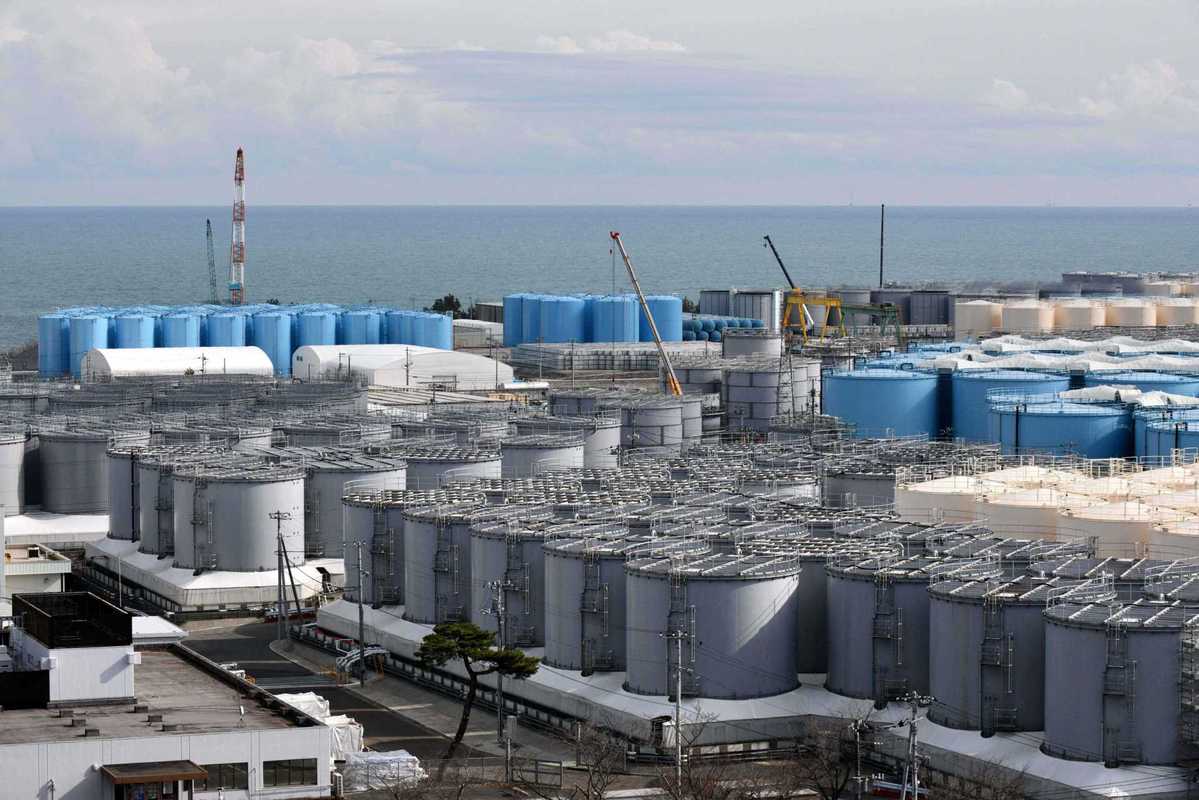
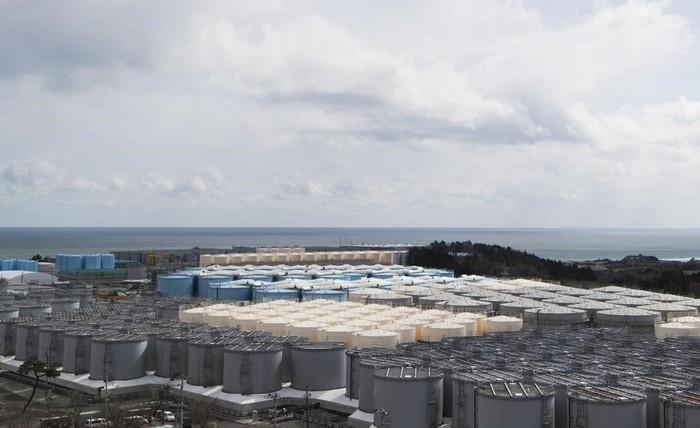
This file photo taken on February 3, 2020 shows storage tanks for contaminated water at the Tokyo Electric Power Company’s Fukushima Daiichi nuclear power plant in Okuma, Fukushima prefecture.
By Zhang Zhouxiang | China Daily | Updated: 2023-01-05
The Japanese government had announced in April 2020 that it plans to dump nuclear waste water from its wrecked Fukushima nuclear plant into the ocean from the spring of 2023.
As the date approaches, and given Japan’s record, it will not be surprising if Japan starts dumping the water any time soon without giving other countries advance notice.
While the action will save the Japanese government and the Tokyo Electric Power Company money and trouble, it will also shift the trouble and cost onto other nations, the Pacific ones in particular. There is a precedent here. Years after the United States carried out nuclear tests on the Bikini Atoll, also in the Pacific, from 1946 to 1958, radiation levels there were considered too high to allow resettlement in 1998.
Fishermen from China, the Republic of Korea and other Southeast Asian countries, including from Japan, depend on the waters in the region to make a living. No wonder, Japanese fishermen were protesting the move to dump nuclear waste into the waters.
The US, which Japan always looks up to, has supported Japan’s plan despite studies showing that the region most polluted by the discharge will be the US’ west coast in two years.
One can imagine the scale of disaster if over 1.3 million metric tons of nuclear waste is dumped into the ocean. As some environmentalists in the Pacific have said, that’s like waging a “nuclear war” on the Pacific people.
Senior Japanese officials, despite bowing politely at news conferences, have shown no sincerity in negotiating with their Pacific neighbors. When they announced the decision to dump the water into the ocean, they did not ask for understanding from any side except the US.
There is the UN Convention on the Law of the Sea and multiple nuclear safety conventions to which Japan is a signatory, but it has helped little. It is time for all sides involved to sue the Japanese government in international courts. Japan cannot do this evil deed and just walk away unpunished.
https://global.chinadaily.com.cn/a/202301/05/WS63b613aba31057c47eba7bd1.html
Ocean discharge of contaminated water from Fukushima nuclear power plant may be delayed from this spring to July
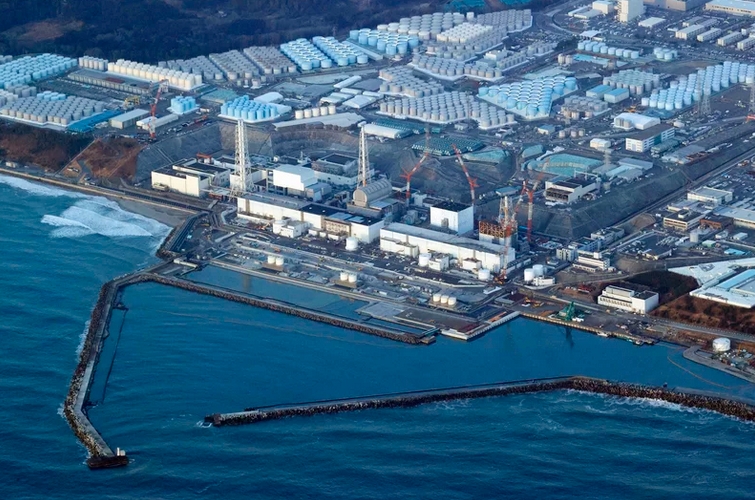
January 4, 2023
The Yomiuri Shimbun reported on the 4th that the start of ocean discharge of treated water from TEPCO’s Fukushima Daiichi Nuclear Power Plant is expected to be delayed from the original target of around April this year.
This delay in treated water is due to delays in installation of the discharge port attached to the tip of the undersea tunnel, etc., and TEPCO expects the completion of the discharge facility at the end of June this year, and the discharge of treated water will begin after July, after pre-use inspection. It is likely to become, the media added.
The Japanese government decided at a related ministerial meeting in April 2021 to set the time to start discharging treated water about two years later (from April 2021). Accordingly, TEPCO has set the goal of completing the discharge facility in August 2021 as April 2023.
The plan was to dig an undersea tunnel about 1km off the coast of the Fukushima nuclear power plant, and discharge treated water from the discharge port of the fleet into the sea. TEPCO started full-scale construction of the discharge facility on August 4 last year.
However, the installation of the outlet, which was scheduled for August, was delayed by about three months due to deteriorating weather conditions such as high waves, and was delayed to November 18th. Currently, it is said that the construction of filling the area around the discharge hole with concrete is in progress. TEPCO estimates that this construction alone will take about four months.
About 800m of the total length of the undersea tunnel was completed, and the remaining 200m will be excavated over 2 to 3 months after the completion of the concrete work. According to TEPCO, completion of the discharge facility is expected by the end of June this year.
According to Yomiuri, Japan’s Ministry of Economy, Trade and Industry is requesting that the construction be carried out so that emission can start as planned, but TEPCO says, “We want to shorten the construction period as much as possible with safety as the top priority.”
‘Treatment water’ is water from which most of the radioactive materials have been removed by purifying the contaminated water after cooling the melted and hardened nuclear fuel in the meltdown accident in 2011. Currently, about 1.32 million tons are stored in more than 1,000 tanks on the site of the nuclear power plant.
During the 3/11 Great East Japan Earthquake in 2011, contaminated water was generated as rain and groundwater flowed into the reactor building, where the core nuclear fuel (debris) of the decommissioned reactor melted in the Fukushima Daiichi Nuclear Power Plant accident remained.
Japan calls this contaminated water ‘treated water’ by filtering it through ALPS, but it is said that it is impossible to remove radioactive substances such as tritium (tritium) even after purification.
Source: Donga https://newsrebeat.com/world-news/132431.html
Japan must work with the Pacific to find a solution to the Fukushima water release issue – otherwise we face disaster Henry Puna
Based on our experience with nuclear contamination, continuing with ocean discharge plans is simply inconceivable
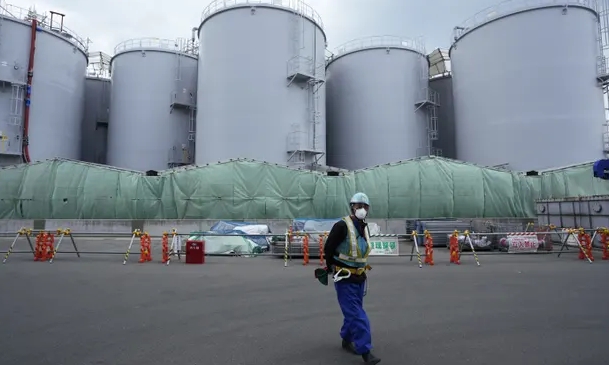
A worker helps direct a truck driver as he stands near tanks used to store treated radioactive water after it was used to cool down melted fuel at the Fukushima Daiichi nuclear power plant
Wed 4 Jan 2023
Over the past 20 months, Pacific Islands Forum (PIF) members have been in dialogue with the government of Japan on its proposed plans to release over a million tonnes of contaminated nuclear wastewater into the Pacific Ocean as announced in April 2021.
I was heartened by the very strong position taken by PIF Members from the outset, that Japan should hold off on any such release until we are certain about the implications of this proposal on the environment and on human health, especially recognising that the majority of our Pacific peoples are coastal peoples, and that the ocean continues to be an integral part of their subsistence living.
We have taken significant steps to work with Japan to understand their position and the rationale underpinning its unilateral decision. As a region, we committed to working with them at the technical level and engaged an independent panel of five scientific experts in key fields such as nuclear power and radiation, high energy physics, marine chemistry, biochemistry, marine biology, and oceanography to provide an independent scientific assessment of the impacts of such a release.
But the discussions this past year have not been encouraging. We have uncovered serious information gaps and grave concerns with the proposed ocean release. Simply put, more data is needed before any ocean release should be permitted. Despite this, Japan is continuing with plans for discharge in the spring of 2023, relying on the next four decades of discharge to figure it out.
Based on our experience with nuclear contamination, continuing with ocean discharge plans at this time is simply inconceivable and we do not have the luxury of time to sit around for four decades in order to “figure it out”.
It is imperative that we work together to ensure a common understanding of the full implications of this activity now, as I fear that, if left unchecked, the region will once again be headed towards a major nuclear contamination disaster at the hands of others. For the sake of present and future generations, now is the time to act to fully understand the impacts of such discharge on the environment and on human health before any decision is made. We owe it to our children and grandchildren to work towards ensuring that their futures are secured and safe. This is our moral and legal obligation.
Together, we must uphold the commitments that we have made through our Treaty of Rarotonga. We are legally bound to keep the region free of environmental pollution by radioactive and nuclear waste and other radioactive matter, and to uphold legal obligations to prevent ocean dumping and any action to assist or encourage dumping by other states.
I am reminded that this conversation is not a new one. Four decades ago, Forum leaders also urged Japan and other shipping states “to store or dump their nuclear waste in their home countries rather than storing or dumping them in the Pacific”. A mere four years after that political statement, in 1985, the Forum welcomed the Japan Prime Minister’s statement that “Japan had no intention of dumping radioactive waste in the Pacific Ocean in disregard of the concern expressed by the communities of the region”.
The decision for any ocean release is not and should not only be a domestic matter for Japan, but a global and transnational issue that should give rise to the need to examine the issue in the context of obligations under international law. Choosing and adopting the appropriate path in terms of international governance is key, and we must pursue every possible avenue including mechanisms available under international law.
We must take the time to closely examine whether current international safety standards are adequate to handle the unprecedented case of the Fukushima Daiichi.
Indeed, the unprecedented nature of this case is of major concern. How we handle this, as a global community, will set a precedent for future actions and responses. , This is particularly important given the climate crisis and growing intensity and scale of natural disasters, which pose significant challenges to the safety of nuclear power plants and infrastructure throughout the world.
Alternative options include safe storage and radioactive decay, bioremediation, and use of treated water to make concrete for special applications.
Before us is a golden opportunity to be proactive and to get it right without waiting for four decades of dumping to unfold. It would be unconscionable for us as a region to once again allow ourselves to be lulled into a false sense of security.
I am not asking that we discontinue the plans to discharge. I am asking that we take the time and work together to ensure scientific rigour in order to receive the assurance of safety needed for people’s health and for sound stewardship of the ocean. I am asking today, what our Pacific people did not have the opportunity to ask decades ago when our region and our ocean was identified as a nuclear test field. I am asking that we take the time to fully consider the implications of these actions on our region before choosing the course of action that is best for all.
Do not disregard us. Work with us. Our collective future and that of our future generations depends on it.
Henry Puna is the Pacific Islands Forum Secretary General
Water, water everywhere
Scientists and Pacific governments are worried by Japan’s plan to dump radioactive wastewater from Fukushima into the Pacific Ocean
“…For panel member Arjun Makhijani, a former nuclear engineer and IEER expert on nuclear safety, the lack of significant data is a crucial problem.
“From a scientific point of view, we as an expert panel felt there was really insufficient information to plan this huge operation,” he tells me. “We perceived early on that because most of the storage tanks had not been sampled, most of the radionuclides are not being sampled, and so there just wasn’t enough information to proceed.”
As time went on, says Dr Makhijani, the panel’s worries about the Japanese plans became stronger. “Do they know what they are doing? Do they have enough information? Have they done the measurements properly? Do they know if the capacity of the filtration system will be enough for the volume of liquids, so the concentration of radionuclides would be low enough? How long will it take if they have to repeatedly filter the liquids? There weren’t any clear answers to these questions.”
As they met with TEPCO and Japanese authorities, the expert panel began to raise a series of concerns: the failure to accurately sample different isotopes in the storage tanks, the level of radioactive contamination in sludge at the bottom of the tanks, and the models used to determine how elements like tritium will disperse and dilute in the vast Pacific Ocean.
For Dr Makhijani, the Japanese authorities have not provided enough information to ascertain what range and amounts of radionuclides will be found in each tank. Only nine of sixty-four radionuclides have been included in the data shared with the Forum.
“The vast majority of radionuclides are not being measured, according to the Japanese authorities themselves,” Dr Makhijani says. “In summary, most of the tanks have never been sampled. The sampling they do is non-representative of the water in the tanks and when they were stored. Are the measurements of what’s in the tanks accurate? The answer to this is no.”
…
The bulk of the radioactivity measured in the wastewater is from two isotopes: tritium and carbon-14. But current data also show a complex mix of other highly radioactive isotopes, including strontium-90, caesium-134, caesium-137, cobalt-60 and even tellurium-127, a fission product with a short half-life of nine hours that shouldn’t be present after years of storage.
The expert panel has noted that some tanks low in tritium are high in strontium-90, and vice versa, concluding that “the assumption that concentrations of the other radionuclides are constant is not correct and a full assessment of all radioisotopes is needed to evaluate the true risk factors.”
Also of concern is the fact that particles in the water may settle to the bottom of the storage tanks over time, creating contaminated sludge. Japanese authorities have confirmed that tanks filled with cooling water in the years immediately after the 2011 accident contain contaminated sediment of this kind.
“The sludges were not sampled then and have not been sampled since that time,” says Dr Makhijani. “How much of these sludges will be stirred up and complicate the filtration system as you pump out the water from the tanks? This issue has not been addressed.”
TEPCO plans to filter out most isotopes but dump vast amounts of tritium into the Pacific, relying on rapid dispersion and dilution. But many scientists are critical of the model used to measure the dilution of tritium in seawater, which is based on models using international standards for how much naturally occurring tritium can be safely ingested in drinking water. Environmental critics of the dumping plan are concerned tritium and other radioactive isotopes will accumulate in ocean sediments, fish and other marine biota.
According to Dr Makhijani, the expert panel was concerned that the proposed drinking water standard for tritium does not apply to ocean ecosystems. “The discharged concentration of tritium will be thousands of times the background level you find naturally or through historical nuclear testing,” he explains, “and then you’re going to discharge it for many decades.”
He believes a full modeling of the impact would include “an ecosystem assessment, both for sediments and for vegetal and animal biota that travel,” which hasn’t been done. “In TEPCO’s environmental impact assessment, they didn’t take account of any bioaccumulation of tritium, which does occur in all organisms. The question of bioconcentration in an ocean environment was totally ignored in the statement.”
In its report to Forum member governments in August, the expert panel concluded that Japan’s assessments of ecological effects and bioconcentration are seriously deficient and don’t provide a sound basis for estimating impact.”
20 December 2022
Early next year Japan plans to begin dumping 1.3 million tonnes of treated radioactive wastewater from the Fukushima nuclear reactor into the Pacific Ocean. Fiercely opposed by local fishermen, seaweed farmers and residents near Fukushima, the plan has also been challenged by China, South Korea and other neighbouring states, as well as by the Pacific Islands Forum.
At their annual summit in July, island leaders appointed an independent five-member expert scientific panel to probe the project’s safety. Forum secretary-general Henry Puna, concerned about harm to the fishing industry in Japan and the wider Pacific region, has reinforced regional concern that the scientific data doesn’t justify the plan.
“Experts have advised a deferment to the impending discharge into the Pacific Ocean by Japan is necessary,” Puna said last month. “Based on that advice, our members encourage consideration for options other than discharge, while the independent panel of experts continue to further assess the safety of the discharge in light of the current data gaps.”
In a confidential report to the Pacific Islands Forum, the expert panel outlined detailed concerns about the project, arguing that any decision to proceed should be postponed. Even though Japan’s Nuclear Regulation Authority has given the go-ahead for construction, a growing number of scientists are warning about the long-term implications of dumping more than a million tonnes of water containing radioactive isotopes into the Pacific.
The waste problem goes back to March 2011, when three nuclear reactors at the Fukushima Daiichi nuclear power plant were flooded after an offshore earthquake. A fourteen-metre tsunami hit the coast, causing massive damage to the reactors’ power supply and cooling systems. The partial meltdown of the reactor cores caused extensive damage as fuel rod assemblies burned through steel containment vessels and into the concrete base of the reactor buildings.
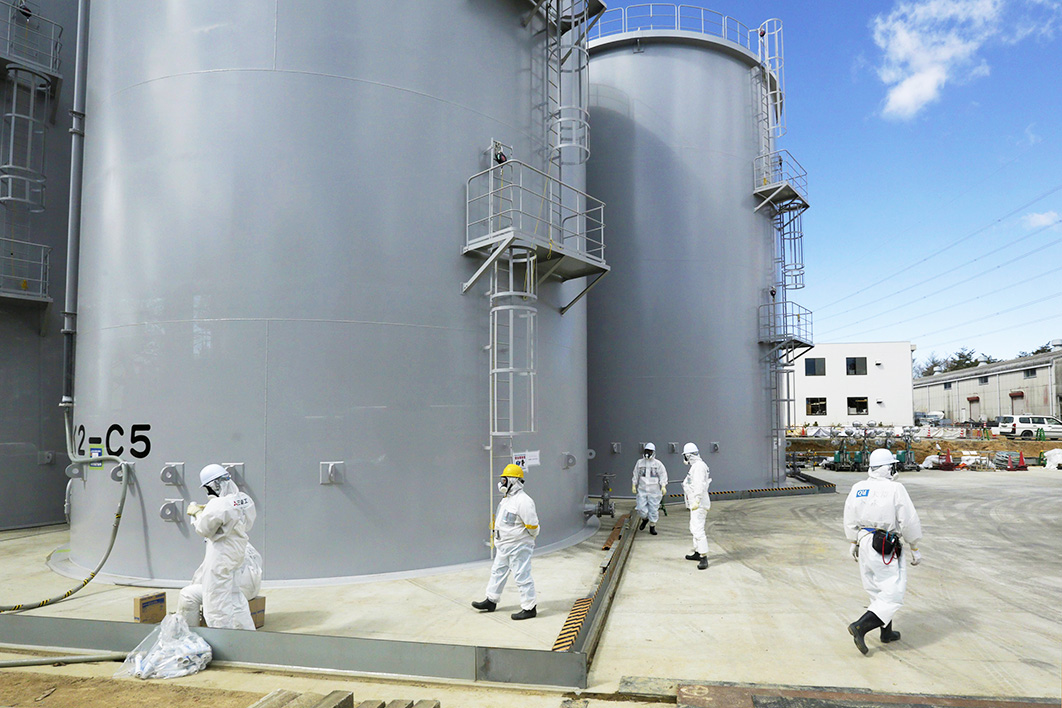
For more than a decade, the Tokyo Electric Power Company, known as TEPCO, has been using water to cool the excess heat still emanating from the melted fuel rods. The highly contaminated cooling water is then stored in more than a thousand tanks at the site. With more than a hundred tonnes of water collected every day, storage space is running out.
Japan proposes to dump this wastewater into the Pacific Ocean after passing it through an Advanced Liquid Processing System designed to remove most radioactive materials.
The cost of decommissioning the stricken Fukushima reactors has put TEPCO — and Japanese taxpayers — under massive pressure. Since 2011, more than ¥12 trillion (A$120 billion) has been spent on cleaning up the plant, decontaminating the site and compensating people affected by the accident. This accounts for half of the amount budgeted for work that must continue for many decades.
The Japanese government has already provided ¥10.2 trillion in no-interest loans to TEPCO. Last month Japan’s Board of Audit revealed that repayment of these loans will be delayed, highlighting TEPCO’s ongoing financial crisis.
Many analysts are concerned TEPCO is looking at ocean waste dumping as the cheapest option to resolve storage costs for the vast amounts of water contaminated with tritium and other radionuclides. As Benshuo Yang and Haojun Xu from the Ocean University of China report, alternatives include underground burial, controlled vapour release, and injection into the geosphere. Japan, they add, “has chosen the most cost-efficient, but most harmful one.”
Work on the ocean dumping plan is rushing ahead, ignoring international concern. In August, TEPCO began building the infrastructure needed to release the treated radioactive water into the sea, including a kilometre-long undersea tunnel and a complex of pipes to transfer the treated water from storage tanks.
Because Japan is a major donor to Pacific Island nations, some island governments are wary of directly condemning the plan. But anti-nuclear sentiment is strong in a region that still suffers from the radioactive legacies of fifty years of cold war–era nuclear testing, and many remember previous Japanese pledges to consult about plans to dump nuclear waste.
The expert panel was appointed to help bolster the islands’ dealings with Japan. Its five members have extensive expertise in the marine environment, nuclear radiation, reactor engineering and oceanography: Ken Buesseler works at the Woods Hole Oceanographic Institution, Antony Hooker is director of the Centre for Radiation Research, Education and Innovation at the University of Adelaide, Ferenc Dalnoki-Veress is with the James Martin Center for Nonproliferation Studies at Monterey, Robert Richmond is director of the Kewalo Marine Laboratory at the University of Hawai‘i at Mānoa, and Arjun Makhijani is president of the Institute for Energy and Environmental Research, or IEER.
TEPCO’s radiological impact assessment, released in November 2021, sidestepped many of the initial concerns raised by critics of the project. Throughout 2022, the expert panel held meetings with TEPCO and Japanese officials, receiving some data on the type of radionuclides held in storage by the company. The International Atomic Energy Agency has also contributed to the debate, with director-general Rafael Grossi visiting the Fukushima Daiichi nuclear power plant in May 2022 and briefing a Forum meeting in July.
For panel member Arjun Makhijani, a former nuclear engineer and IEER expert on nuclear safety, the lack of significant data is a crucial problem.
“From a scientific point of view, we as an expert panel felt there was really insufficient information to plan this huge operation,” he tells me. “We perceived early on that because most of the storage tanks had not been sampled, most of the radionuclides are not being sampled, and so there just wasn’t enough information to proceed.”
As time went on, says Dr Makhijani, the panel’s worries about the Japanese plans became stronger. “Do they know what they are doing? Do they have enough information? Have they done the measurements properly? Do they know if the capacity of the filtration system will be enough for the volume of liquids, so the concentration of radionuclides would be low enough? How long will it take if they have to repeatedly filter the liquids? There weren’t any clear answers to these questions.”
As they met with TEPCO and Japanese authorities, the expert panel began to raise a series of concerns: the failure to accurately sample different isotopes in the storage tanks, the level of radioactive contamination in sludge at the bottom of the tanks, and the models used to determine how elements like tritium will disperse and dilute in the vast Pacific Ocean.
For Dr Makhijani, the Japanese authorities have not provided enough information to ascertain what range and amounts of radionuclides will be found in each tank. Only nine of sixty-four radionuclides have been included in the data shared with the Forum.
“The vast majority of radionuclides are not being measured, according to the Japanese authorities themselves,” Dr Makhijani says. “In summary, most of the tanks have never been sampled. The sampling they do is non-representative of the water in the tanks and when they were stored. Are the measurements of what’s in the tanks accurate? The answer to this is no.”
The bulk of the radioactivity measured in the wastewater is from two isotopes: tritium and carbon-14. But current data also show a complex mix of other highly radioactive isotopes, including strontium-90, caesium-134, caesium-137, cobalt-60 and even tellurium-127, a fission product with a short half-life of nine hours that shouldn’t be present after years of storage.
The expert panel has noted that some tanks low in tritium are high in strontium-90, and vice versa, concluding that “the assumption that concentrations of the other radionuclides are constant is not correct and a full assessment of all radioisotopes is needed to evaluate the true risk factors.”
Also of concern is the fact that particles in the water may settle to the bottom of the storage tanks over time, creating contaminated sludge. Japanese authorities have confirmed that tanks filled with cooling water in the years immediately after the 2011 accident contain contaminated sediment of this kind.
“The sludges were not sampled then and have not been sampled since that time,” says Dr Makhijani. “How much of these sludges will be stirred up and complicate the filtration system as you pump out the water from the tanks? This issue has not been addressed.”
TEPCO plans to filter out most isotopes but dump vast amounts of tritium into the Pacific, relying on rapid dispersion and dilution. But many scientists are critical of the model used to measure the dilution of tritium in seawater, which is based on models using international standards for how much naturally occurring tritium can be safely ingested in drinking water. Environmental critics of the dumping plan are concerned tritium and other radioactive isotopes will accumulate in ocean sediments, fish and other marine biota.
According to Dr Makhijani, the expert panel was concerned that the proposed drinking water standard for tritium does not apply to ocean ecosystems. “The discharged concentration of tritium will be thousands of times the background level you find naturally or through historical nuclear testing,” he explains, “and then you’re going to discharge it for many decades.”
He believes a full modelling of the impact would include “an ecosystem assessment, both for sediments and for vegetal and animal biota that travel,” which hasn’t been done. “In TEPCO’s environmental impact assessment, they didn’t take account of any bioaccumulation of tritium, which does occur in all organisms. The question of bioconcentration in an ocean environment was totally ignored in the statement.”
In its report to Forum member governments in August, the expert panel concluded that Japan’s assessments of ecological effects and bioconcentration are seriously deficient and don’t provide a sound basis for estimating impact. Writing in the Japan Times, the five scientists noted:
The release of contaminated material from the Fukushima No. 1 nuclear power plant would take at least forty years, and decades longer if you include the anticipated accumulation of new water during the process. This would impact not only the interests and reputation of the Japanese fishing community, among others, but also the people and countries of the entire Pacific region. This needs to be considered as a transboundary and transgenerational issue.
Insufficient information is available to assess how environmental and human health would be affected, they argued, and issuing a permit at this time would be premature at best: “Having studied the scientific and ecological aspects of the matter, we have concluded that the decision to release the contaminated water should be indefinitely postponed and other options for the tank water revisited until we have more complete data to evaluate the economic, environmental and human health costs of ocean release.”
The potential for long-term damage to the ocean environment is echoed by expert panel member Robert Richmond from the University of Hawai‘i at Mānoa.
“This is truly a trans-boundary issue,” he says. “Fish don’t respect political lines, and neither do radionuclides or pollutants in the ocean. I really commend the members of the Pacific Islands Forum for recognising this is an issue they need additional information on.”
Soon after the 2011 Fukushima accident, scientists confirmed that Pacific bluefin tuna can transport radionuclides across the northern Pacific Ocean. A 2012 study from Stanford University reported tuna with traces of Fukushima-related contamination had been found on the shores of the United States.
“Pacific bluefin tuna can rapidly transport radionuclides from a point source in Japan to distant ecoregions and demonstrate the importance of migratory animals as transport vectors of radionuclides,” the study reported. “Other large, highly migratory marine animals make extensive use of waters around Japan, and these animals may also be transport vectors of Fukushima-derived radionuclides to distant regions of the North and South Pacific Oceans.”
Will perceptions of radioactive hazards from Japan’s ocean dumping damage the global market for tuna? Many island nations derive vital revenue from the deepwater fishing nations that pay to operate in Pacific Island exclusive economic zones, or EEZs.
Regional organisations have also sought to process and market tuna from the Pacific as another key source of revenue. For nearly a decade, island states have supported Pacifical, a brand that promotes sustainable distribution and marketing of skipjack and yellowfin tuna caught in their EEZs.
Speaking after her recent appointment as executive director of the Western and Central Pacific Fisheries Commission, Rhea Moss-Christian highlighted the potential damage of Japan’s decades-long project: “This is a massive release and a big, big potential disaster if it’s not handled properly.”
Moss-Christian is the first Pacific woman to head the commission, which manages the largest tuna fishery in the world, representing nearly 60 per cent of global production.
“I wish that the Japanese government would take some more time before its release,” she told journalists at December’s commission meeting. “There are a number of outstanding questions that have yet to be fully answered. They have focused a lot on one particular radionuclide, and not very much on others that are also present in the wastewater.”
Moss-Christian is a citizen of the Republic of the Marshall Islands, an island nation living with the consequences of radioactive fallout from sixty-seven US atmospheric nuclear tests on Bikini and Enewetak Atolls. A former chair of the Marshall Islands National Nuclear Commission, she is deeply aware of this radioactive legacy. Her nation struggles to control radionuclides leaching into the marine environment from the Runit Dome, a nuclear waste site on Enewetak Atoll created by the United States in the 1970s.
“We have a lot of experience in the Marshall Islands with lingering radioactive waste,” Moss-Christian said. “We don’t want to find ourselves in another situation, not just in the Marshall Islands, but in general in the region, where we agree to something without knowing what could potentially happen in the future. What are the contingency plans? What are the compensation mechanisms?”
At a time of growing US–China tension, the Japanese government is seeking to boost its role in the islands region. Tokyo is building closer ties with Australia and the United States through increased military operations and joint investments in the islands. In November, for example, Tokyo and Washington agreed to contribute US$100 million to support Australian underwriting of Telstra’s purchase of Digicel, blocking Chinese investment in the Pacific’s key mobile phone network.
Even as the Japanese government seeks to win hearts and minds in the region, community anger about the nuclear threat is growing. Church and civil society groups, including the Pacific Conference of Churches, Pacific Islands Association of Non-Governmental Organisations and Pacific Network on Globalisation, have criticised the proposed wastewater dumping plan.
When Japanese foreign minister Yoshimasa Hayashi visited Fiji last May, these community groups argued the proposed ocean dumping breached international agreements like the London Convention on the Prevention of Marine Pollution. A joint civil society statement concluded, “We believe there is no scenario in which discharging nuclear waste into the Pacific Ocean is justified for the health, wellbeing, and future safety of Pacific peoples and the environment.”
As Japan forges ahead with its plan and Australia works towards acquiring nuclear submarines under the AUKUS agreement, the gulf is growing between the two countries’ geopolitical agenda and the growing antinuclear sentiment across the Blue Pacific. •
VOX POPULI: Shame on you, prime minister, for your blatant about-face
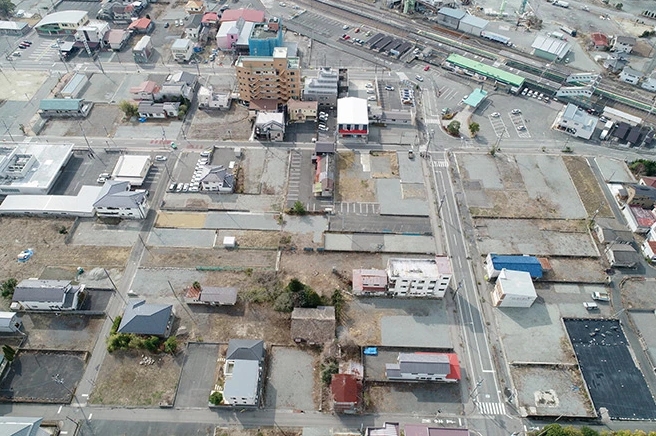
JR Namie Station, upper right, in Fukushima Prefecture is surrounded by vacant land in March 2019, after homes and shops damaged by the 2011 nuclear disaster were demolished.
December 24, 2022
Mariko Sato of the town of Namie, Fukushima Prefecture, said in March 2011: “Explosions at the nuclear power plant have forced me to evacuate twice already. What’s going to happen in the days ahead?”
“I’ve lived a bit too long. I saw something I didn’t want to see,” noted 102-year-old Fumio Okubo in April before he took his own life in front of his home in the village of Iitate.
One year later, 6-year-old Toya Matsuoka spoke of his dream: “I want to be rich when I grow up. I’m going to buy a big house that won’t be washed away by tsunami, so my entire family can live there.”
And Kunio Omori, 81, recalled his temporary return to his home in the town of Tomioka: “There were beautifully ripe, yellow fruits on apricot trees in my yard. But I couldn’t even pick them, let alone eat.”
Those are among comments by Fukushima residents who survived the Great East Japan Earthquake of March 2011 that triggered a nuclear disaster to tell their stories to The Asahi Shimbun.
Trying to remember what kind of future our nation sought back then, I re-read the clippings, placed side by side on my desk with stories that ran in yesterday’s paper.
And I was overcome with shocked disbelief: How could anyone completely forget something of such magnitude after only 11 years?
The Kishida administration on Dec. 23 announced a new policy to make “maximum use” of nuclear power.
The government will proceed with the hitherto “unanticipated” reconstruction of old facilities, will consider building new facilities and extend the life span of reactors to beyond 60 years.
The about-face is so total, I feel cheated.
And yet, the language of the new policy is shamelessly replete with lofty “assurances” such as, “Fukushima’s reconstruction is the basis on which (the nation’s) energy policy is to be pursued” and “the sobering lessons we learned from the accident will never be forgotten, not even for a second.”
A guilty heart is said to turn one’s ears red. And that is why the kanji for “haji” (shame) is made up of two radicals that stand for “ear” and “heart,” according to kanji scholar Shizuka Shirakawa (1910-2006), the author of “Joyo Jikai” (translated into English as The Keys to the Chinese Characters).
Prime Minister Fumio Kishida boasts about his “ability to listen.” I wonder if his new energy policy has made his ears turn red, even if for just a second.
If not, it’s just too sad.
Fukushima Daiichi Nuclear Power Plant Accident: Two workers who developed leukemia and other illnesses while working on the plant premises are certified as workers’ compensation workers

December 23, 2022
The Ministry of Health, Labor, and Welfare (MHLW) has recognized a causal relationship between work and two men who developed leukemia and other illnesses while working inside the TEPCO’s Fukushima Daiichi Nuclear Power Plant after the accident.
The two men, both in their 60s and 70s, worked for a TEPCO subcontractor and were involved in restoration work at the Fukushima Daiichi Nuclear Power Plant after the accident in March 2011.
According to the Ministry of Health, Labor, and Welfare, the man in his 60s was in charge of electrical system construction and was diagnosed in 2017 with “true red blood cell hyperplasia,” a cancer of the blood that increases the number of red blood cells.
Another man in his 70s was involved in the construction of new tanks and was diagnosed with leukemia last year.
Both men had been working at the Fukushima Daiichi Nuclear Power Plant since before the accident, and their total exposure doses exceeded the guidelines for certification. The Ministry of Health, Labour and Welfare recognized their work as having a causal relationship to their work.
Since the accident at the Fukushima Daiichi Nuclear Power Plant, eight workers have been diagnosed with leukemia and thyroid cancer, bringing the total number of workers’ compensation cases to 10.
https://www3.nhk.or.jp/news/html/20221223/k10013933321000.html?fbclid=IwAR1IVXivzuHbmjsDsjDVZ8Ht5gj3nSLkNE_fJEQlTaiVU92 PqsIdnoZuDJA
JP Gov estimates Tepco to take 42 more years to compensate

Storage building of residuals from the contaminated water https://www.tepco.co.jp/decommission/visual/photo/index-j.html
The Board of Audit of Japan has estimated that it will take until fiscal year 2064 to recover the funds lent to TEPCO for compensation for the Fukushima nuclear accident. Four years ago, the Board of Audit estimated that the maximum period would be until fiscal 2051, but this time it has been extended by 13 years. There is still room for the amount of compensation TEPCO will pay to the victims and others to increase, and the Board has pointed out that “the timing of the completion of recovery may be extended even further in the future than this trial calculation.”
TEPCO has paid compensation for victims and the cost of decontamination work. In order to financially support this company, the government borrows funds from private financial institutions and issues government bonds to provide funds to TEPCO through the Nuclear Damage Compensation and Decommissioning Facilitation Corporation. The organization is proceeding with de facto repayment by paying “general contributions” from TEPCO and other electric power companies to the government.
According to the Board of Audit, 13.5 trillion yen (97B USD) in government bonds have been issued to support TEPCO so far, and about 8 trillion yen (58B USD) has not been returned to the government by the agency. In addition to the general contribution, the agency uses “special contribution from TEPCO” and “profit on sale of TEPCO shares by the agency” as the source of funds for the return.
Nevertheless, TEPCO’s financial situation and stock price have not improved as planned, and in the worst scenario by this moment, it would take another 42 years until 2064 to recover the full amount.
Next spring, it is planned that contaminated water from decommissioning work will begin to be discharged into the Pacific, which is anticipated to increase the amount of compensation. In addition, since the amount of compensation determined in lawsuits filed by victims and evacuees across the country already exceeds the expected line by the government guidelines, the amount of compensation is likely to increase even further if the guidelines are updated.
For this reason, the Board of Audit stated, “If Tepco ends up making more loans from the government due to the increasing compensation liability, the burden on the people will also increase.”
Court rejects calls to halt Kansai Electric’s aging nuclear reactor

Dec 20, 2022
Osaka – The Osaka District Court on Tuesday rejected local residents’ calls to halt an aging nuclear reactor at Kansai Electric Power’s Mihama power plant in central Japan that started operations more than 40 years ago.
The court ruling marked the first judicial decision over the safety of an aging reactor. It was handed down after local residents sought suspension of the No. 3 unit of the plant in Fukui Prefecture due to safety concerns.
The decision came as the government seeks to extend the maximum service period for the country’s existing nuclear reactors beyond 60 years. The reactor is the only one that operates in Japan beyond the country’s 40-year service period in principle.
Nine residents in Fukui, Shiga and Kyoto prefectures living within a 10- to 80-kilometer radius of the plant argued the reactor would not be able to withstand a massive earthquake due to the likelihood that facilities and equipment have deteriorated over time.
Such a situation poses a risk of exposure to radiation caused by the spread of radioactive materials, the residents said, adding that the current evacuation plan is not effective, as the route passes by other nuclear plants and destination sites are located where radioactive materials could reach.
However, the court ruled that there is no problem with Kansai Electric’s safety measures against earthquakes and that steps taken against the aging of the reactor are also reasonable.
Kansai Electric had argued the safety of the reactor is ensured as it complies with the new regulatory standards established on lessons learned from the 2011 nuclear disaster that was caused by a massive earthquake and tsunami.
In June 2021, the No. 3 unit became the first nuclear reactor to operate beyond 40 years under the new rules that limit a reactor’s service period to 40 years in principle, although it can be extended by up to 20 years if approved by the Nuclear Regulation Authority.
The unit was halted just four months after being restarted as it failed to implement anti-terrorism measures in time and also suffered a water leakage before being started up again on Aug. 30 this year. It resumed operations on Sept. 26.
Units No. 1 and 2 of the Mihama plant were terminated in April 2015 in line with the 40-year limit.
https://www.japantimes.co.jp/news/2022/12/20/national/crime-legal/mihama-ruling/
Scope of Fukushima nuclear accident compensation expanded

A gate leading to a “difficult-to-return zone” is closed by a government official in a town in Fukushima Prefecture in May 2013.
December 21, 2022
Psychological damage stemming from the March 2011 Fukushima nuclear power plant accident is being recognized by a government panel as eligible for compensation.
This policy was included in interim guidelines being compiled for the first time in nine years by the Dispute Reconciliation Committee for Nuclear Damage Compensation on Tuesday.
It will significantly expand the scope of compensation for people affected by changes to their livelihood due to a long period of evacuation from areas around the Fukushima No. 1 nuclear power plant.
The guidelines set the standards for compensation from Tokyo Electric Power Company Holdings Inc. following the nuclear accident at its plant.
As part of the revisions to the guidelines, rulings in lawsuits filed by evacuees will also be applied to non-plaintiffs.
The new guidelines recognize psychological damage caused by changes in living conditions of people who not only lived in the “difficult-to-return zones,” but also those who live in other evacuation-designated zones. This means additional compensation of up to ¥2.5 million each for about 30,000 people living in “restricted residence zones” and about 40,000 residents of “evacuation order cancellation preparation zones.”
For people who used to live within a 20-kilometer radius of the plant, an additional ¥300,000 is set to be paid on the grounds that they were forced to endure harsh evacuation conditions.
As for former residents of Fukushima City and other areas that are not included in evacuation zones but were subject to voluntary evacuation, the new guidelines raise the amount of compensation. An adult who is not pregnant will be eligible for ¥200,000, up from ¥80,000.
“We don’t think of these guidelines as caps on compensation,” TEPCO President Tomoaki Kobayakawa said to reporters at the of Economy, Trade and Industry Ministry. “We would like to respond sincerely to the matter.”
Kobayakawa indicated that TEPCO would continue to provide compensation to the southern part of Fukushima Prefecture, which is not included in the guidelines.
The latest revision is expected to cost TEPCO additional compensation of ¥500 billion.
Source: https://japannews.yomiuri.co.jp/society/general-news/20221221-78746/
Government panel revises guidelines for Fukushima compensation

Dec. 20, 2022
A government panel has revised a set of guidelines for the amount of compensation to be paid to people in Fukushima who have been affected by the accidents at Fukushima Daiichi nuclear plant in 2011. This is the first revision of the guidelines in nine years.
The revised set of guidelines will make more people eligible for compensation.
People who have evacuated from some of the areas outside the government-designated no-go-zones will now be eligible for compensation worth 2.5 million yen per person.
Those who lived in “evacuation preparation zones” within a radius of 20 to 30 kilometers of the nuclear plant will be paid 500,000 yen in compensation.
The panel for the first time said that these sums will not be the ceiling.
It called on Tokyo Electric Power Company to be flexible in paying damages to those not included in the new guidelines.
Report: Tour of Interim Storage Facility and Date City Biomass Power Plant
Posted on December 18, 2022 by Aoki
On December 10-11, we went on a research tour to Fukushima. The objectives of the tour were as follows
(1) Observation of the current status of the interim storage facility
(2) Field survey of biomass power generation in Yanagawa Town, Date City, and a lecture at a study session for local residents
(3) Investigation of the actual contamination situation in Date City and soil sampling
The interim storage facility is a vast facility that spans the towns of Okuma and Futaba and is located in the shape of the town of Fukuchi. The tour was guided by JESCO (Japan Interim Storage and Environmental Safety Corporation), which operates the facility.

Interim Storage Facility Location
After watching a 10-minute information video and a briefing at the Interim Storage Construction Information Center, we took a JESCO microbus around the site. The previous tour (in April 2021) circled around the Futaba Town side, but this time the course circled around the Okuma Town side.
The first thing that surprised me when I entered the site was that most of the “removed soil” (i.e., contaminated soil) had already been brought in and processed. Most of the receiving flexible container bag dismantling facility, soil classification facility, combustible material incinerator, and 1.5 km long conveyor line that had been constructed for processing had already been dismantled and removed.
Landfill work for contaminated soil is also nearly complete.
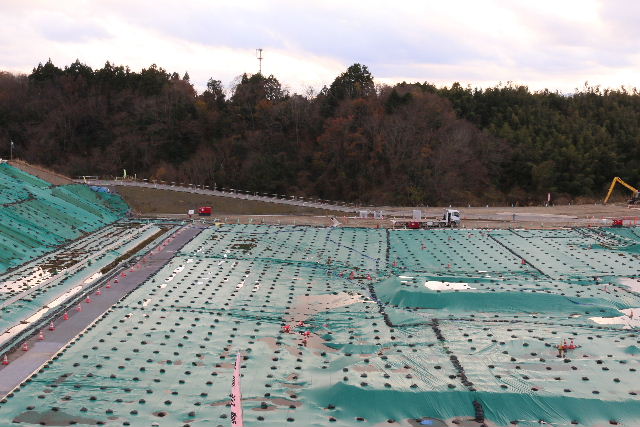
Contaminated soil landfill site (green sheet is rain protection) Cover this with soil
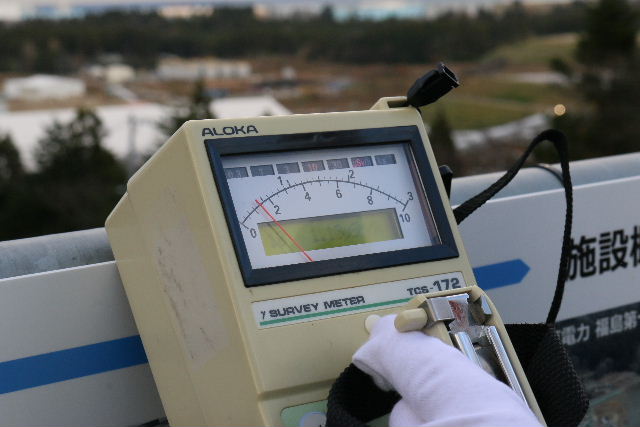
Dose at the observatory for visitors 1.18 μSv/h
According to JESCO, there are 20-30μSv/h in the forests by the roads.
About 7% of the vast area that stretches across the towns of Okuma and Futaba has not yet been contracted, so that area has been left untouched as an enclave. Of the remaining 93%, about 10% is under lease and 90% is being purchased by the government.
Even if all the contaminated soil could be moved out of the prefecture after 30 years, it would still be a vast area of state-owned land (the portion purchased by the government), with private land scattered throughout. It is hard to imagine that normal life or effective personal use would be possible on the scattered private lands.
The Ministry of the Environment is desperate to dispose of the waste in various locations outside of the prefecture, claiming that “volume reduction,” “reuse,” and “soil is an important resource,” according to the Japan Environmental Safety Corporation (JESCO) Act, which states that “final disposal will be completed outside of Fukushima Prefecture within 30 years after the start of interim storage. The recently announced “reuse” demonstration tests in Tokorozawa City, Shinjuku Gyoen, and other locations are a preparation for such tests.
Even if there were to be a place that would accept the soil, there would be enormous costs involved in digging up the huge amount of contaminated soil again and transporting it to the receiving site, as well as the risk of spreading the contaminated soil due to accidents during transportation.
It would be most reasonable now to revise the law and use an interim storage facility as the final disposal site.

Okuma Town Day Service Center for the Elderly (in the same condition as when evacuated immediately after the accident)

Cars in the day service center parking lot also remain in place.
http://chikurin.org/wp/?p=6526&fbclid=IwAR1Ji3AX-ouAA5vebPEvMdoOIfYh3G9FzLY2N2HisaMoorsjx0OEG4nMI_M
Ministry of the Environment Plans Demonstration Test for Reuse of Decontaminated Soil from Fukushima in Shinjuku Gyoen, Tokyo

Friday, December 9, 2022 11:53
Minister of the Environment Yoshiaki Nishimura announced that the Ministry of the Environment is planning to conduct a demonstration test at the Shinjuku Imperial Garden in Tokyo to see if the “decontaminated soil” generated during the decontamination process after the Fukushima Daiichi Nuclear Power Plant accident can be reused.
The government has indicated that it intends to reuse the large amount of “decontaminated soil” in Fukushima Prefecture for public works projects if the concentration of radioactive materials is below a certain standard value.
At a press conference today, Environment Minister Nishimura announced that the Ministry of the Environment is planning to conduct a demonstration test at the Shinjuku Gyoen, which is managed by the Ministry of the Environment, to demonstrate the reuse of the soil. The plan is to create flower beds using decontaminated soil in areas that are off limits to the general public, and to test the radiation levels in the surrounding areas.
This is the second time that a demonstration test is being planned outside of Fukushima Prefecture, following Tokorozawa City in Saitama Prefecture, and the other is in Tsukuba City, Ibaraki Prefecture.
https://newsdig.tbs.co.jp/articles/-/225831?display=1
Fukushima, Our ongoing accident.
Dec 19, 2022
What happens to the damaged reactors? The territories evacuated by 160 000 people? What are the new conditions for their return to the contaminated area since the lifting of the governmental aid procedures? Are lessons still being learned by our national operator for its own nuclear plants? We must not forget that a disaster is still unfolding in Japan and that EDF was supposed to upgrade its fleet on the basis of this feedback, which has still not been finalized.
Almost twelve years after the Fukushima disaster, Japan is still in the process of dismantling and ‘decontaminating’ the nuclear power plant, probably for the next thirty to forty years as well. In the very short term, the challenges are posed by the management of contaminated water.
- All the contaminated water will be evacuated into the sea, by dilution over decades
- Each intervention in the accident reactors brings out new elements
- This has an impact on the schedule and the efficiency of the means used
- At the same time, the Japanese government’s objective is to rehabilitate the contaminated areas at any cost
- None of the French reactors is up to date with its safety level according to the post-Fukushima measures promulgated
- Japan will resume its nuclear policy, time having done its work on memories
The great water cycle
Although Japanese politicians claim that they have finally mastered the monster, the colossal task of cleaning up the site is still far from being completed to allow for the ultimate dismantling, with the length of time competing with the endless financing.
After so many years of effort, from decontamination to the management of radioactive materials and maneuvers within the dismantled plant, the actions on site require more and more exceptional means, exclusive procedures, and unprecedented engineering feats (such as robotic probes), while the nuclear fuel inside continues to be cooled permanently by water (not without generating, to repeat, millions of liters of radioactive water).
But the hardest part is yet to come: containing the corium, an estimated 880 tons of molten radioactive waste created during this meltdown of the reactor cores, and managing the thousands of fuel rods. So much so that the complete cleanup and dismantling of the plant could take a generation or more for a total estimated cost of more than 200 billion dollars (according to an assessment published by the German insurer Munich Re, Japan is 150 billion euros), a low range since other estimates raise the bill between 470 and 660 billion dollars, which is not in contradiction with the costs of an accident projected by the IRSN in France.
The removal of this corium will remain the most essential unresolved issue for a long time. Without it, the contamination of this area will continue. In February 2022, the operator Tepco (Tokyo Electric Power Company Holdings Inc.) tried again to approach the molten fuel in the containment of a reactor after a few more or less unsuccessful attempts, the radioactivity of 2 sieverts/hour being the end of everything, including electronic robots. This withdrawal seems quite hypothetical, even the Chernobyl reactor has never been removed and remains contained in a sarcophagus.
(source: Fukushima blog and Japan’s Nuclear Safety Authority NRA)
Until that distant prospect arrives, the 1.37 million tons of water will have filled the maximum storage capacity. This water was used to cool the molten fuel in the reactor and then mixed with rainwater and groundwater. The treatment via an Advanced Liquid Processing System (ALPS) is touted as efficient, but does not remove tritium. Relative performance: Tepco has been repeatedly criticized for concealing and belatedly disclosing problems with filters designed to prevent particles from escaping into the air from the contaminated water treatment system: 24 of the 25 filters attached to the water treatment equipment were found to be damaged in 2021, an already known defect that resulted in no investigation of the cause of the problem and no preventive measures after the filters were replaced.
The management of this type of liquid waste is a problem shared by the Americans. On site, experts say that the tanks would present flooding and radiation hazards and would hamper the plant’s decontamination efforts. So much so that nuclear scientists, including members of the International Atomic Energy Agency (IAEA) and the Japanese Nuclear Regulatory Authority, have recommended controlled release of the water into the sea as the only scientifically and financially realistic option.
In the end, contaminated water would have to be released into the sea through an underwater tunnel about a kilometer offshore, after diluting it to bring the concentration of tritium well below the percentage allowed by regulation (the concentration would be below the maximum limit of tritium recommended by the World Health Organization for drinking water). Scientists say that the effects of long-term, low-dose exposure to tritium on the environment and humans are still unknown, but that tritium would affect humans more when consumed in fish. The health impact will therefore be monitored, which the government already assures us it is anticipating by analyzing 90,000 samples of treated water each year.
Assessment studies on the potential impact that the release of stored contaminated water into the ocean could have therefore seem insufficient. For tritium, in the form of tritiated water or bound to organic matter, in addition to its diverse behavior according to these configurations, is only part of the problem. Some data show great variability in the concentrations of contaminants between the thousand reservoirs, as well as differences in their relative quantities: some reservoirs that are poor in tritium are rich in strontium 90 and vice versa, suggesting a high variability in the concentrations of other radionuclides and a dilution rate that is not so constant. All the ignorance currently resides on the still unknown interactions of the long-lived radioactive isotopes contained in the contaminated water with the marine biology. It is in order to remove all questions that a complete and independent evaluation of the sixty or so radioisotopes is required by many organizations.
As it stands, with the support of the IAEA so that dilution meets expectations, depending on currents, flows …, the release of contaminated materials would take at least forty years. Opponents of such releases persist in proposing an alternative solution of storage in earthquake-resistant tanks in and around the Fukushima facility. For them, “given the 12.3-year half-life of tritium for radioactive decay, in 40 to 60 years, more than 90% of the tritium will have disappeared and the risks will be considerably reduced,” reducing the direct nuisance that could affect the marine environment and even the food chain.
Modelling of marine movements could lead the waste to Korea, then to China, and finally to the Federated States of Micronesia and Palau. As such, each of the impacted countries could bring an action against Japan before the International Tribunal for the Law of the Sea to demand an injunction or provisional measures under international law.
Faced with these unresolved health issues, China, South Korea, Taiwan, local fishing communities continue to oppose this management plan, but the work is far from being completed and the problem of storage remains. Just like the ice wall built into the floor of the power plant, the release of contaminated water requires huge new works: the underwater pipe starts at about 16 meters underground and is drilled at a rate of five to six meters per day.
Time is of the essence. The tanks should reach their maximum capacity by the fall of 2023 (the volume of radioactive water is growing at a rate of about 130 to 140 tons per day). But above all, it is necessary to act quickly because the area is likely to suffer another earthquake, a fear noted by all stakeholders. With the major concern of managing the uranium fuel rods stored in the reactors, the risks that radioactivity will be less contained increase with the years.In France, releases to the sea are not as much of a problem: the La Hague waste reprocessing site in France releases more than 11,000 terabecquerels per year, whereas here we are talking about 22 terabecquerels that would be released each year, which is much less than most of the power plants in the world. But we will come back to this atypical French case…
Giant Mikado
The operator Tepco has successfully removed more than 1500 fuel bundles from the reactor No. 4 of the plant since late 2014, but the hundreds still in place in the other three units must undergo the same type of sensitive operation. To do this, again and again, undertake in detail the clearing of rubble, the installation of shields, the dismantling of the roofs of buildings and the installation of platforms and special equipment to remove the rods… And ultimately decide where all the fuel and other solid radioactive debris will have to be stored or disposed of in the long term. A challenge.
The fuel is the biggest obstacle to dismantling. The solution could lie, according to some engineers, in the construction of a huge water-filled concrete tank around one of the damaged reactors and to carry out the dismantling work in an underwater manner. Objectives and benefits? To prevent radiation from proliferating in the environment and exposing workers (water is a radiation insulator, we use this technique in our cooling pools in France) and to maximize the space to operate the heavy dismantling equipment being made. An immersion solution made illusory for the moment: the steel structure enveloping the building before being filled with water is not feasible as long as radiation levels are so high in the reactor building, preventing access by human teams. In short, all this requires a multitude of refinements, the complexity of the reactors adding to the situations made difficult by the disaster.
Experience, which is exceptional in this field, is in any case lacking. What would guarantee the resistance of the concrete of the tanks over such long periods of time, under such hydraulic pressures? The stability of the soils supporting such structures? How can the concrete be made the least vulnerable possible to future earthquakes? How to replace them in the future?

All these difficulties begin to explain largely the delays of 30 to 40 to dismantle. The reactors are indeed severely damaged. And lethal radiation levels equivalent to melted nuclear fuel have been detected near one of the reactor covers, beyond simulations and well above previously assumed levels. Each of the reactors consists of three 150-ton covers, 12 meters in diameter and 60 centimeters thick: the radiation of 1.2 sieverts per hour is prohibitive, especially in this highly technical context. There is also no doubt that other hotspots will be revealed as investigations are carried out at the respective sites. The Nuclear Damage Compensation and Decommissioning Facilitation Corporation (NDF), created in 2014, has the very objective of trying to formulate strategic and technical plans in order to proceed with the dismantling of said reactors. Given the physical and radiological conditions, the technical and logistical high-wire act.
Also, each plan is revised as information is discovered, as investigations are conducted when they are operable. For example, the reinforcing bars of the pedestal, which are normally covered with concrete, are exposed inside Reactor No. 1. The concrete support foundation of a reactor whose core has melted has deteriorated so badly that rebar is now exposed.
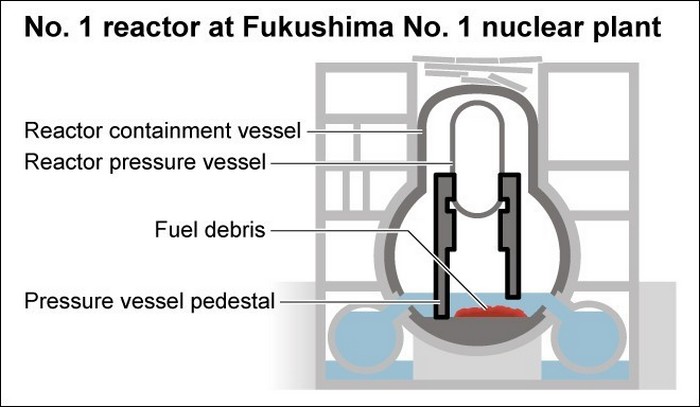
The cylindrical base, whose wall is 1.2 meters thick, is 6 meters in diameter. It supports the 440-ton reactor pressure vessel. The reinforcing rods normally covered with concrete are now bare and the upper parts are covered with sediment that could be nuclear fuel debris. The concrete probably melted under the high temperature of the debris. The strength of the pedestal is a major concern, as any defect could prove critical in terms of earthquake resistance.
Nothing is simple. The management of human material appears less complex.
Bringing back to life, whatever it takes
In the mountains of eastern Fukushima Prefecture, one of the main traditional shiitake mushroom industries is now almost always shut down. The reason? Radioactive caesium exceeding the government’s maximum of 50 becquerels per kilogram, largely absorbed by the trees during their growth. More than ten years after the nuclear disaster, tests have revealed caesium levels between 100 and 540 becquerels per kilogram. While cesium C134 has a radioactive half-life of about two years and has almost disappeared by now, the half-life of cesium C137 is about 30 years and thus retains 30% of its radioactivity 50 years after the disaster, and 10% after a century.
As more than two thirds of Fukushima prefecture is covered by forests, nothing seems favorable in the short term to get rid of all or part of the deposited radioactivity, as forests are not part of the areas eligible for ‘decontamination’, unlike residential areas and their immediate surroundings.
On the side of the contaminated residential and agricultural areas, ‘decontamination’ measures have been undertaken. But soil erosion and the transfer of contaminants into waterways, frequent due to typhoons and other intense rain events, are causing the radioactive elements to return, moving them incessantly. Scientists are trying to track radioactive substances to better anticipate geographical fluctuations in doses, but nothing is simple: the phenomena of redistribution of the initial contamination deposits from the mountains to the inhabited low-lying areas are eternal.
The Ministry of the Environment is considering the reuse of decontaminated soils (official threshold of 8,000 becquerels per kilogram), with tests to be conducted. For now, a law requires the final disposal of contaminated soil outside Fukushima Prefecture by 2045, which represents about 14 million cubic meters (excluding areas where radiation levels remain high). This reuse would reduce the total volume before legal disposal.
More generally, Japan has for some years now opted for the strategy of holding radiological contamination as zero and/or harmless. This is illustrated by the representative example of the financial compensation given to farmers, designed so that the difference between pre- and post-accident sales is paid to them as compensation for “image damage”, verbatim.
Finally, in the midst of these piles of scrap metal and debris, it is necessary to make what can be made invisible. Concerning radioactive waste for example, it must be stored in time. On the west coast of the island of Hokkaidō, the villages of Suttsu and Kamoenai have been selected for a burial project. Stainless steel containers would be stored in a vitrified state. But consultation with the residents has not yet been carried out. This is not insignificant, because no less than 19,000 tons of waste are accumulating in the accidental, saturated power plants, and must find a place to rest for hundreds of years to come.
In this sparsely populated and isolated rural area, as in other designated sites, to help with acceptance, 15 million euros are being paid to each of the two municipalities to start the studies from 2020. 53 million are planned for the second phase, and much more in the final stages. This burial solution seems inevitable for Japan, as the waste cannot remain at the level of the surface power plants and is subject at all times to the earthquakes that are bound to occur over such long periods (strong earthquakes have struck off the prefecture in 2021 and 2022). The degrees of dangerousness thus allow the government to impose a default choice, for lack of anything better.
On December 6, 2022, the Director General of the IRSN met with the President of Fukushima University and with a manager of the Institute of Environmental Radioactivity (IER). What was the objective? To show the willingness of both parties to continue ongoing projects on the effects of radioactive contamination on biodiversity and environmental resilience.
But France will not have waited for the health results of a disaster to learn and commit itself to take into account any improvement likely to improve the nuclear safety of its reactors. No ?
Experience feedback
After a few reactor restarts that marked a major change in its nuclear energy policy (ten nuclear reactors from six plants out of a total of fifty-four were restarted by June 2022), the Japanese government is nonetheless planning to build new generation nuclear power plants to support its carbon emission reduction targets. (A memorandum of understanding was signed by the Japan Atomic Energy Agency, Mitsubishi Heavy Industries and Mitsubishi FBR Systems with the American start-up TerraPower to share data for the Natrium fast neutron reactor project; the American company NuScale Power presented its modular reactor technology). But above all, the government is considering extending the maximum service life of existing nuclear reactors beyond 60 years. Following the disaster, Japan had introduced stricter safety standards limiting the operation of nuclear reactors to 40 years, but there is now talk of modernizing the reactors with safety features presented as “the strictest in the world”, necessarily, to meet safety expectations. Their program is worthy of a major refurbishment (GK).
But in France, where are we with our supplementary safety assessments?
The steps taken after the Fukushima disaster to reassess the safety of French nuclear facilities were designed to integrate this feedback in ten years. More than ten years after the start of this process of carrying out complementary safety assessments (CSA), this integration remains limited and the program has been largely delayed in its implementation.
Apparently, ten years to learn all the lessons of this unthinkable accident was not enough. Fear of the probable occurrence of the impossible was not the best motivation to protect the French nuclear fleet from this type of catastrophic scenario, based solely on these new standards. Concerning in detail the reality of the 23 measures identified to be implemented (reinforcement of resistance to earthquake and flooding, automatic shutdown in the event of an earthquake, ultimate water top-up for the reactor and cooling pool, detection of corium in the reactor vessel, etc.), the observation is even distressing: not a single reactor in operation is completely up to standard.
According to NegaWatt’s calculations, at the current rate of progress and assuming that funding and skills are never lacking, it would take until 2040 for the post-Fukushima standards to be finally respected in all French reactors. And even then, some of the measures reported as being in place are not the most efficient and functional (we will come back to the Diesels d’ultime secours, the DUS of such a sensitive model).
Even for the ASN, the reception of the public in the context of post-accident management could appear more important than the effectiveness of the implementation of the measures urgently imposed.
Then, let us complete by confirming that France and Japan have a great and long common history which does not stop in nuclear matters. Among this history, let us recall that Japan lacks facilities to treat the waste from its own nuclear reactors and sends most of it abroad, especially to France. The previous transport of highly radioactive Mox (a mixture of highly toxic plutonium oxide and reprocessed uranium oxide) to Japan dates back to September 2021, not without risk even for the British company specialized in this field, a subsidiary of Orano. The final request for approval for the completion of the Rokkasho reprocessing plant, an important partnership and technology transfer project, is expected in December 2022, although the last shipments to Japan suffered from defective products from Orano’s Melox plant, a frequent occurrence because of a lack of good technical homogenization of the products.
No one is immortal
In the meantime, the ex-managers of the nuclear power plant have been sentenced to pay 95 billion euros for having caused the disaster of the entire eastern region of Japan. They were found guilty, above all, of not having sufficiently taken into account the risk of a tsunami at the Fukushima-Daiichi site, despite studies showing that waves of up to 15 meters could hit the reactor cores. Precisely the scenario that took place.
Worse, Tepco will be able to regret for a long time to have made plan the cliff which, naturally high of 35 meters, formed a natural dam against the ocean and the relatively frequent tsunamis in this seismic zone. This action was validated by the Japanese nuclear safety authorities, no less culpable, on the basis of the work of seismologists and according to economic considerations that once again prevailed (among other things, it was a question of minimizing the costs of cooling the reactors, which would have been operated with seawater pumps).
The world’s fourth largest public utility, familiar with scandals in the sector for half a century, Tepco must take charge of all the work of nuclear dismantling and treatment of contaminated water. With confidence. The final total estimates are constantly being revised upwards, from 11,000 billion to 21,500 billion yen, future budgets that are borrowed from financial institutions, among others, with the commitments to be repaid via the future revenues of the electricity companies. A whole financial package that will rely on which final payer?
Because Tepco’s financial situation and technical difficulties are deteriorating to such an extent that such forty-year timetable projections remain very hypothetical, and the intervention of the State as a last resort is becoming more and more obvious. For example, the Japanese government has stated that the repayment of more than $68 billion in government funding (interest-free loans, currently financed by government bonds) for cleanup and compensation for the Fukushima Daiichi nuclear power plant disaster, owed by Tepco, has been delayed. Tepco’s mandatory repayments have been reduced to $270 million per year from the previous $470 million per year. It is as much to say that the envisaged repayment periods are as spread out as the Japanese debt is abysmal.
Despite this chaotic long-term management, the Japanese government has stated that it is considering the construction of the next generation of nuclear power plants, given the international energy supply environment and Japan’s dependence on imported natural resources. Once the shock is over, business and realpolitik resume.
On a human scale, only radioactivity is immortal.
1 This Month

of the week – Shut Down Drone Warfare!


Tell the Ukrainian Government to Drop Prosecution of Peace Activist Yurii Sheliazhenko

Petition to revoke the licensing of the Near Surface Nuclear Disposal Facility (NSDF) at Chalk River. https://www.ourcommons.ca/petitions/en/Petition/Details?Petition=e-7247
To see nuclear-related stories in greater depth and intensity – go to https://nuclearinformation.wordpress.com
-
Archives
- April 2026 (68)
- March 2026 (251)
- February 2026 (268)
- January 2026 (308)
- December 2025 (358)
- November 2025 (359)
- October 2025 (376)
- September 2025 (257)
- August 2025 (319)
- July 2025 (230)
- June 2025 (348)
- May 2025 (261)
-
Categories
- 1
- 1 NUCLEAR ISSUES
- business and costs
- climate change
- culture and arts
- ENERGY
- environment
- health
- history
- indigenous issues
- Legal
- marketing of nuclear
- media
- opposition to nuclear
- PERSONAL STORIES
- politics
- politics international
- Religion and ethics
- safety
- secrets,lies and civil liberties
- spinbuster
- technology
- Uranium
- wastes
- weapons and war
- Women
- 2 WORLD
- ACTION
- AFRICA
- Atrocities
- AUSTRALIA
- Christina's notes
- Christina's themes
- culture and arts
- Events
- Fuk 2022
- Fuk 2023
- Fukushima 2017
- Fukushima 2018
- fukushima 2019
- Fukushima 2020
- Fukushima 2021
- general
- global warming
- Humour (God we need it)
- Nuclear
- RARE EARTHS
- Reference
- resources – print
- Resources -audiovicual
- Weekly Newsletter
- World
- World Nuclear
- YouTube
-
RSS
Entries RSS
Comments RSS
 nuclear-news