I just wanted to live a normal life – Akiko Morimatsu
February 15, 2022
It will soon be 11 years since the accident at TEPCO’s Fukushima Daiichi Nuclear Power Plant.
It is estimated that 27,000 people have evacuated from Fukushima Prefecture and 39,000 people have evacuated to 915 cities, towns, and villages in 47 prefectures across Japan (all figures as of January 12, 2022, compiled by the Reconstruction Agency). (As of January 12, 2022, according to the Reconstruction Agency.) However, the exact number of evacuees is still unknown due to discrepancies between the totals of Fukushima Prefecture and those of municipalities, as well as cases where the government has mistakenly deleted evacuee registrations.
The accident is still ongoing.
We would like to share with you some of the stories we have heard from the evacuees.
This time, we would like to introduce Ms. Akiko Morimatsu, who gave a speech with Greenpeace at the UN Human Rights Council on the current situation of the victims.
(All information in this article is current as of 2018)
Akiko Morimatsu’s eldest daughter, who was a newborn infant at the time of the accident at TEPCO’s Fukushima Daiichi Nuclear Power Plant, is now in elementary school. In the seven years since she left Fukushima Prefecture, she has never lived with her father.
Her eldest son, who was three years old, is a father’s child. Whenever his father came to see his evacuated family once a month, he would return to Fukushima Prefecture, and I could not tell you how many times I wet my pillow with tears of loneliness and sadness.
In March of this year, Ms. Morimatsu made up her mind to stand on the stage of the United Nations Human Rights Council in Geneva, Switzerland.
Ms. Morimatsu is a so-called “voluntary evacuee. Housing support, which was the only support for “voluntary evacuees” from outside the evacuation zone, has been cut off, and now there are even eviction lawsuits against “voluntary evacuees” who cannot pay their rent.
In the fall of 2017, Greenpeace, together with the victims of the nuclear accident, appealed to the member countries of the United Nations Human Rights Council about these human rights violations that the victims continue to suffer. Many people who supported us with signatures and donations supported this project.
Subsequently, recommendations for correction were issued by Germany, Austria, Portugal, and Mexico. Greenpeace is calling on the Japanese government to accept these recommendations.
We hope that as many people as possible will know why Mr. Morimatsu decided to speak directly with Greenpeace about the current situation in front of the representatives of each country at the time when the decision to accept the recommendations will be announced.

In the midst of impatience, anxiety, and unpredictable fear
It was during the Golden Week holidays, two months after the disaster, that Ms. Morimatsu decided to evacuate.
Until then, she had been trying to rebuild her life in Fukushima Prefecture.
However, even though no evacuation order had been issued for the area called Nakadori, where he was living at the time, the kindergarten distributed disposable masks to all the children and instructed them to wear long sleeves and long pants. Elementary and junior high school students in the neighborhood drive their own cars to school, even if it is within walking distance. They are not allowed to go outside without permission, and of course they are not allowed to play outside either at the kindergarten or around their homes.
On weekends, the whole family travels to Yamagata and Niigata prefectures on the highway to take the children out to play. Radioactive materials have been detected in tap water and fresh food. We could not hang our laundry or futons outdoors.
No matter what we did, we had to first think about the possible effects of radiation on our children and pay close attention to everything.
No one can tell us what is the right thing to do.
I don’t even know if I should continue to live here. I feel impatient, anxious, and unpredictable.
One by one, families in the neighborhood and kindergartens were leaving Fukushima Prefecture, and it was the fathers of the children who first suggested to Ms. Morimatsu that she take the children to the Kansai region, where she had spent her school days, as they were planning to use the holidays to reorganize their living environment.
What she saw there was a media report about the danger of radioactive contamination, which had not been reported at all in Fukushima Prefecture.
What can we do to protect the future of children who are highly sensitive to radiation?
Only I, as a parent, could protect them.
It was time to make a decision.

I separated the children from their father.
With the encouragement of relatives and friends in the Kansai region, and with the agreement of her husband, who continues to work in Fukushima Prefecture, Morimatsu decided to evacuate with her children.
No evacuation order was issued for the area where the Morimatsu family was living. They had to pay separate rents and utility bills for the rental house they rented to replace their house that was damaged in the earthquake, and for the house they rented to house their mother and child in Osaka (*Housing support for voluntary evacuees ended in March 2017. Because Ms. Morimatsu had left public housing early, which had a short move-in period, she was not provided with housing after that and is not counted in the number of evacuees, forcing her to continue living as an evacuee completely on her own).
Even for fathers to come to see their young children, the high cost of transportation is prohibitive.
What kind of impact will not being able to see their fathers most of the time have on the children’s mental development?
How do fathers feel when they can’t watch their adorable children grow up?
Was the evacuation really the right thing to do, forcing families to live apart?
Mr. Morimatsu was in agony, but he decided to find a job in the evacuation area so that he could see his father and children as often as possible.
However, there was no way to take care of her oldest daughter, who was only one year old at the time, at the evacuation site.
Because of the risk of not receiving information from the local government regarding public support and health surveys for children, victims who are voluntarily evacuating cannot inadvertently report their departure. As a result, they were not able to receive services such as day-care centers smoothly in their evacuation areas.
As a result, although she was able to be placed on a waiting list for childcare, her childcare fees were also determined based on her household income, so her own income, which she had begun to work to supplement her double life, was added to her household income, which was quite high. Since she is not a widow, she is not eligible to receive subsidies for single-mother households.

The Best Choice in the Worst Situation
The number of people like Ms. Morimatsu who evacuated from areas where evacuation orders were not issued is a small minority compared to the total number of victims of the nuclear accident. She said that she felt guilty and conflicted about evacuating from a place where even temporary housing could be built for victims from areas where evacuation orders had been issued.
But no one would willingly abandon their current life to evacuate.
Ms. Morimatsu’s husband chose to continue working in Fukushima Prefecture even if it meant leaving his family.
Whether to evacuate or not, each victim’s decision should be respected as the best choice under the worst circumstances.
Voicing one’s anxiety or pointing out what one feels is wrong should not be denied.
But we are practically forced to close our eyes, keep our mouths shut, and pretend to forget about it.
The biggest victims are “children”.
Seven years have passed since the accident, and yet the “right to health” of children, who are the most vulnerable to radiation exposure, has not been given equally to everyone’s children?
I just want to live a normal life together with my child.
I want my children to live a long and healthy life, even if it’s just for a minute or a second.
It is a natural wish for parents to long for this.
The current situation is such that even this desire is being ignored.

Protecting the Human Rights of Victims of the Nuclear Accident
The right to avoid radiation exposure and protect one’s health continues to be violated regardless of whether one evacuates or not.
Is the right to avoid radiation exposure, in other words, the right to evacuate, equally recognized for those who want to evacuate?
The policy of not recognizing the right to evacuate, discontinuing the provision of housing without medical support or information, and effectively forcing victims to return home through economic pressure is a violation of human rights for the Morimatsu family and other victims of the nuclear accident.
If the same thing happened to you, what would you protect?
What would you value the most?
The right to life and health is a fundamental human right given to every individual, from the newborn baby to the elderly person whose life will end tomorrow.
Mr. Morimatsu is still evacuating with his children.
Greenpeace’s activities are based on scientific evidence derived from the results of radiation surveys conducted in the area immediately after the accident.
We will continue our research activities and human rights protection activities for the people affected by the accident.
11 years after the accident at the Fukushima Daiichi Nuclear Power Plant, residents angered by the retreat from decontamination of the entire area: “It is only natural to clean up the mess and return it.
February 19, 2022
It will soon be 11 years since the accident at TEPCO’s Fukushima No. 1 nuclear power plant. Many people who have left their homes in areas where it is difficult to return are still uncertain about their future. Last year, the government announced a new policy to decontaminate only the areas around the homes of those who wish to return to their homes in areas where the lifting of evacuation orders was not foreseeable. This is a step backward from the previous policy of decontaminating the entire area, and the residents are angry, saying, “They won’t decontaminate unless we decide to return? (Natsuko Katayama)

In August 2021, the government decided to partially lift the evacuation order for the remaining difficult-to-return areas in seven cities, towns, and villages in Fukushima Prefecture by decontaminating homes and roads by 2029 in response to requests from people who want to return to their homes and live there. The government plans to begin decontamination in fiscal 2024, but has yet to decide what to do with the homes and land of those who do not wish to return. The “designated recovery and revitalization zone,” where decontamination was prioritized within the zone, accounts for only about 8% of the area that is difficult to return to.

The trees around our house and in the fields have grown so thick that we can’t do anything about them… Every time Kazuo Kubota, 70, and his wife Taiko, 66, who have been living as evacuees in Fukushima City, return to their home in the difficult-to-return area of Namie Town in Fukushima Prefecture, they sigh.
Their house is located in the Hatsuki district of Tsushima, Namie Town, about 30 kilometers northwest of the nuclear power plant. The fields are overgrown with trees that can grow up to three meters high. We can’t even cut the kaya with a sickle anymore,” said Kazuo. The plastic greenhouse for leaf tobacco is now just a skeleton, with thick branches sticking up from below. His house was also ransacked by wild boars and other animals, and he gave up clearing it.

Still, Taiko feels relieved when she returns to Hatsuke. Surrounded by nature, she feels the four seasons. Horseradish grows in the stream beside my house, and salamanders live there. I want to return here as soon as possible.
He hopes to have the area around his house decontaminated and the house demolished, the land cleared, and the house rebuilt so that he and Kazuo’s mother, Tsuya (95), can return to the area together.
If we could have lived in Hatsuke, our family would have been much closer,” said Taiko. Before the nuclear accident, the family used to go everywhere together, but after the evacuation, they were separated.

Tsuya, who used to work in the fields early in the morning and take care of her favorite flowers, began to stay at home more and more often and developed dementia. The family became increasingly strained and quarrelsome. With no one to talk to about her care, Taiko developed alopecia areata and continued to go to the hospital.
In the same town of Tsushima, there is a “Specific Reconstruction and Regeneration Center Area (Reconstruction Center)” where decontamination is being carried out ahead of time, covering 1.6% of the total area of Tsushima. On the other hand, Hatsuke, located to the west of the Reconstruction Center, has relatively low levels of radiation, but has not been decontaminated except along the main road.
When Taiko sees places in Namie that have been decontaminated over and over again, she feels her guts boil over.
If the area had been decontaminated even once, I would have been motivated to do my best,” she said. Why is it that all other areas are decontaminated before being sent home, but the hard-to-return area, which has the highest radiation dose, is not decontaminated until the residents decide to return?

His eldest son is said to be saying, “I want to start a farm in Hatsuke after I finish raising my child. However, there is a strong concern that decontamination limited to the living areas of those who wish to return to the area will result in “unevenness” and many contaminated areas will remain.
That is why Kazuo is so angry. “I still want to go back here. My parents cultivated this land and passed it down to me. I want to leave it to the next generation. If we pollute the land, it is only natural to clean it up and return it.”
”Eleven years have passed. I want to go home. I want to go home. I’ll do whatever I can to return to Hatsuke and die,” Tsuya said, but then he said, “I’ve given up. I’ve given up.”
Taiko said as if she were praying. “I don’t know how long we will be able to move. I want the decontamination work to be done as soon as possible.”
Non-disclosure of official documents related to treated water from nuclear power plants: Fukushima Prefecture releases history

February 16, 2022
The Fukushima prefectural government has announced the series of events that led to the non-disclosure of official documents related to the treated water at the Fukushima Daiichi Nuclear Power Plant, saying that there was insufficient confirmation.
In this issue, 24 official documents from briefings and government meetings held for fishermen since April last year were uniformly not disclosed.
On April 15, the prefectural government reversed its decision of nondisclosure and indicated that it would disclose some of the official documents.
On the 16th, the prefecture announced the series of events and explained that the reason for the non-disclosure was “because the decision was made uniformly without sufficient confirmation of whether the documents should be open or closed.
The prefectural government also confirmed that there were other documents that should have been disclosed, and said it would disclose them additionally.
Fukushima Disaster’s Impact on Health Will Be Challenged in Court

By Thisanka Siripala
February 17, 2022
A link between radiation from the Fukushima nuclear disaster and cancer will be the focal point of the civil court case against operator TEPCO.
Almost 11 years have passed since the Fukushima Daiichi nuclear power plant catastrophe. But even as Fukushima prefecture gets ready to launch a new revitalization slogan – “Making Fukushima’s reconstruction a reality one step at a time” – it is still struggling to overcome the lingering aftereffects of the accident. Earlier this month, a group of six men and women diagnosed with thyroid cancer as children filed a class action case against Tokyo Electric Power Company (TEPCO), seeking $5.4 million in compensation.
Eastern Japan was hit by a massive magnitude 9.1 earthquake and 15-meter tsunami on March 11, 2011. The disaster shut off power and cooling to three reactors at the Fukushima Daiichi nuclear power plant, triggering the release of radiation for up to six days.
The plaintiffs, who are aged between 17 and 27, are seeking to hold TEPCO responsible for the thyroid cancer they developed. Two have had one side of their thyroid removed and four others have had a complete thyroidectomy and are planning or undergoing radiation therapy. The treatment has forced them to drop out of school or college and give up on their dreams. The plaintiffs argue that their thyroid cancer has created barriers to their education and employment as well as marriage and starting a family.
The Fukushima Daiichi meltdown was the worst nuclear accident since Chernobyl in 1986, which was followed by a spike in cancer cases in the region. In Japan a health survey conducted by the Fukushima prefecture found 266 cases of cancer among the 380,000 people aged under 18 at the time of the accident. The lawyers representing the plaintiffs argue that pediatric thyroid cancer is extremely rare, with an annual incident rate of two cases in one million people.
The plaintiffs added that in the past decade they have been forced to stay silent due to social pressure and the risk of public outrage over speaking out about the connection between the Fukushima nuclear accident and their thyroid cancer.
The Federation of Promotion of Zero-Nuclear Power and Renewable Energy, a civic group that includes five former Japanese prime ministers, sent a letter to the EU urging the elimination of nuclear power. In the letter, they stated that many children are suffering from thyroid cancer as a result of the Fukushima nuclear power plant accident.
However, the Japanese government believes there is no causal link between exposure to radiation from the accident and the children developing thyroid cancer. Prime Minister Kishida Fumio said at a House of Representatives Budget Committee meeting that “it is not appropriate to spread false information that children from Fukushima are suffering from health problems.”
At a press conference Takaichi Sanae, chairperson of the ruling LDP’s Policy Research Council refuted the letter sent by the federation. She stressed the government’s position that the cases of childhood thyroid cancer have been assessed by experts who have determined the accident is unlikely to have caused cancer.
Fukushima prefecture’s expert panel say there could be the possibility of “over-diagnosis” due to increased vigilance after the disaster, suggesting that some patients diagnosed with cancer did not need treatment. They say they are continuing to investigate the nature of each diagnosis. The Ministry of Environment also said they will continue to disseminate knowledge based on scientific findings to dispel rumors about the health effects of radiation.
Last week, the Fukushima reconstruction and revitalization council met to discuss the “diverse needs of the prefecture” and a long term response to support evacuees. Governor of Fukushima Uchibori Masao acknowledged that the prefecture is “facing many difficulties including the reconstruction and rehabilitation of evacuated areas and rebuilding the lives of evacuees and victims of the disaster.” There are also plans to establish a new national research and education organization in Fukushima that will devise measures to prevent and dispel rumors fueling discrimination toward evacuees and Fukushima food.
Taiwan recently lifted its blanket food import ban on Fukushima produce introduced in the wake of the disaster but there are 14 countries and regions that still maintain import restrictions. Additionally, Japan’s decision to discharge more than one million tonnes of low-level radioactive water from the crippled Fukushima nuclear power plant into the sea is another issue attracting negative publicity abroad.
https://thediplomat.com/2022/02/fukushima-disasters-impact-on-health-will-be-challenged-in-court/
UN to review Japan’s plan to release Fukushima water into Pacific
Transparency coming from Tepco is an oxymoron…

Taskforce will ‘listen to local people’s concerns’, as government plans to release more than 1m tonnes
February 18, 2022
A UN nuclear taskforce has promised to prioritise safety as it launches a review of controversial plans by Japan to release more than 1m tonnes of contaminated water into the ocean from the wrecked Fukushima Daiichi nuclear plant.
Japan’s government announced last April that it had decided to release the water over several decades into the Pacific Ocean, despite strong opposition from local fishers and neighbouring China and South Korea.
Lydie Evrard, the deputy director general of the International Atomic Energy Agency [IAEA], speaking after a team of experts visited the plant to collect water samples, said on Friday: “We listen very carefully to local people’s concerns and the inspection is designed to provide answers about safety in a transparent manner.” .
The controversy comes almost 11 years after a magnitude 9.0 earthquake triggered a huge tsunami that killed more than 18,000 people along Japan’s north-east coast.
Tsunami waves crashed into Fukushima Daiichi, knocking out its backup electricity supply, triggering meltdowns in three of its reactors and sending large quantities of radiation into the atmosphere. More than 150,000 people were forced to flee their homes, and evacuation orders in communities closest to the plant have only recently been partially lifted.
The Tokyo Electric Power company (Tepco) says its treatment technology can remove all radioactive materials from water except tritium, which is harmless in small amounts. It said the gradual release of the water, diluted with seawater, would not pose a threat to human health or the marine environment. In 2020, however, Greenpeace said the water still contained contaminants beside tritium and would have to be treated again.
The wastewater is being stored in about 1,000 tanks that officials say need to be removed so the plant can be decommissioned, an operation expected to take several decades. The tanks are expected to reach their capacity of 1.37m tonnes this summer.
The liquid includes water used to cool the damaged reactors, as well as rain and groundwater that seeps into the area.
Shaun Burnie, a senior nuclear specialist for Greenpeace East Asia, said he did not believe the IAEA would fully investigate and address safety and environmental concerns in its report.
Noting that the agency had welcomed the discharge option when it was announced last year, Burnie said: “The IAEA is not an independent agency in nuclear affairs – under statute its mission is to promote nuclear power. It has sought to justify radioactive marine pollution as having no impact and safe. But the IAEA is incapable of protecting the environment, human health or human rights from radiation risks – that’s not its job.
“The IAEA taskforce should be investigating the root cause of the contaminated water crisis and exploring the option of long-term storage and the best available processing technology as an alternative to the deliberate contamination of the Pacific.”
The IAEA team, which includes experts from South Korea and China, will report its findings at the end of April.
South Korea, which has yet to lift an import ban on Fukushima seafood introduced in 2013, has said that discharging the water would pose a “grave threat” to the marine environment. Pacific peoples have challenged Japan to prove the water is safe by dumping it in Tokyo.
Local fishers also oppose the water’s release, saying it would undo a decade’s work to rebuild their industry and reassure nervous consumers their seafood is safe.
Junichi Matsumoto, a Tepco official overseeing management of the treated water, said the utility was prioritising safety and the effect on the Fukushima region’s reputation. “Ensuring transparency and objectivity is crucial to the project,” he said this week. “We hope to further improve the objectivity and transparency of the process based on the review.”
Latest look inside Fukushima’s ruins shows mounds of melted nuclear fuel

February 16, 2022
A remote-controlled robot has captured images of melted nuclear fuel inside Japan’s wrecked Fukushima nuclear plant.
A massive earthquake and tsunami in 2011 damaged cooling systems at the power plant, causing the meltdown of three reactor cores.
Most of their highly radioactive fuel fell to the bottom of their containment vessels, making its removal extremely difficult.
A previous attempt to send a small robot with cameras into the Unit 1 reactor failed, but images captured this week by a ROV-A robot show broken structures, pipes and mounds of what appears to be melted fuel.
Other debris was also submerged in cooling water, according to Tokyo Electric Power Company Holdings (TEPCO), the plant operator.
About 900 tonnes of melted nuclear fuel remain inside the plant’s three damaged reactors, including about 280 tons in Unit 1.
Its removal is a daunting task that officials say will take 30-40 years. Critics say that’s overly optimistic.
The robot, carrying several tiny cameras, obtained the internal images of the reactor’s primary containment vessel while on a mission to establish a path for subsequent probes, TEPCO said.
TEPCO spokesperson Kenichi Takahara said the piles of debris rose from the bottom of the container, including some inside the pedestal — a structure directly beneath the core — suggesting the mounds were melted fuel that fell in the area.
Takahara said further probes will be needed to confirm the objects in the images.
At one location, the robot measured a radiation level of 2 sievert, which is fatal for humans, Takahara said. The annual exposure limit for plant workers is set at 50 millisievert.

The robot probe of the Unit 1 reactor began on Tuesday and was the first since 2017 when an earlier robot failed to obtain any images of melted fuel because of the extremely high radiation and interior structural damage.
The fuel at Unit 1 is submerged in highly radioactive water as deep as 2 meters (6.5 feet).
TEPCO said it will conduct additional probes after analyzing the data and images collected by the first robot.
The investigation at Unit 1 aims to measure the melted fuel mounds, map them in three dimensions, analyze isotopes and their radioactivity, and collect samples, TEPCO officials said.
Those are key to developing equipment and a strategy for the safe and efficient removal of the melted fuel, allowing the reactor’s eventual decommissioning.
Details of how the highly radioactive material can be safely removed, stored and disposed of at the end of the cleanup have not been decided.
TEPCO hopes to use a robotic arm later this year to remove an initial scoop of melted fuel from Unit 2, where internal robotic probes have made the most progress.
A lonely evening at home for Fukushima man retracing past

December 11, 2021
OKUMA, Fukushima Prefecture–Settling in for the night, Mitsuhide Ikeda poured sake into a glass and raised a toast to framed photos of his deceased parents: “I finally made it back home. Let’s drink together.”
The last time the 60-year-old cattle farmer spent a night at home was 10 years and nine months ago.
Large parts of this town that co-hosts the Fukushima No. 1 nuclear power plant were declared “difficult-to-return” zones after the triple meltdown triggered by the 2011 earthquake and tsunami disaster.
Ikeda’s parents died after the nuclear accident.
The Shimonogami district where the Ikeda’s home is located lies about five kilometers southwest of the Fukushima nuclear facility.
As part of efforts to rebuild the areas around the plant, the government recently began letting residents return home for an overnight stay as a means of preparing for the day when they can do so permanently.
Unsurprisingly, concerns about radiation levels are still on the minds of many former residents. His wife, Mikiko, 64, refused to accompany him for that reason. Ikeda was the only individual in his neighborhood who took up the offer to return home.
Dangerously high radiation levels registered immediately after the disaster that made it impossible for anybody to live in the area have gradually fallen. The government spent vast sums on the time-consuming process of decontaminating topsoil as a way of reducing radiation levels.
It intends to lift the evacuation order for some parts of Okuma in spring. That would be the first step for setting the stage for residents to return home.
The temporary overnight stay program began in Katsurao on Nov. 30 and is gradually being expanded to five other municipalities, including Okuma.
A check for radiation in November on the Ikeda plot found one spot with a reading of 3.8 microsieverts per hour, above the level deemed safe enough for the government to lift the evacuation order.
Even though the Environment Ministry is planning additional decontamination work, Mikiko was unsettled by the reading and concluded it would be impossible to pick up the threads of their past life in Okuma.
Other changes in the close to 11 years since the nuclear disaster make a return to Okuma unrealistic.
While a large supermarket, hospital and bank branch remain standing in the town, there is no indication when those facilities might resume operations.
In the interim, the Ikedas plan to commute to Okuma from the community they moved to as evacuees.
The overnight stay program is restricted to an area close to what was once the bustling center of the town. About 7,600 residents lived there before the nuclear disaster.
The town government envisions that as many as 2,600 people will reside in the town within five years of the evacuation order being finally lifted if plans proceed to rebuild social infrastructure.
But the writing is on the wall for many people.
According to the Environment Ministry, about 1,150 homes in the district had been torn down as of the end of September.
And as of Dec. 8, only 31 residents in 15 households applied for the overnight stays.
Even Ikeda admits that Okuma will likely never return to the community he knew before 2011.
“Too much time has passed,” he said.
Fresh pressure on Japan to reverse Fukushima discharge plan

February 17, 2022
Japan’s proposal to release contaminated water from the crippled Fukushima Daiichi nuclear power plant into the ocean was condemned again as a team from the International Atomic Energy Agency arrived in the country to review the plan.
The Northern Mariana Islands, a US territory that is located some 2,500 kilometers southeast of Japan, said Japan’s plan, officially announced last year, is unacceptable.
“The expectation is that the discharge will not happen until 2023. There is time to overturn this decision,” said Sheila Babauta, a member of the Northern Mariana Islands’ House of Representatives. In December, its government adopted a joint resolution opposing any nation’s decision to dispose of nuclear waste in the Pacific Ocean.
“The effort that went into the creation of the joint resolution exposed research and reports from Greenpeace East Asia highlighting alternatives for the storage of Japan’s nuclear waste, including the only acceptable option, long-term storage and processing using the best technology available,” Babauta added.
Under Japan’s proposal, the Japanese government will gradually dump the still-contaminated water in spring 2023. The water has been used to cool highly radioactive damaged reactor cores as the massive earthquake and tsunami in 2011 destroyed the Fukushima plant’s cooling systems, triggering the meltdown of three reactors and the release of large amounts of radiation.
The plan has provoked concerns since its first day by local fishers, coastal communities, neighboring countries and Pacific Island countries. Foreign ministries of China and South Korea had vocally expressed opposition and the Pacific Islands Forum, the intergovernmental organization for the region, said that “Japan has not taken sufficient steps to address the potential harm to the Pacific”.
Haruo Ono, a 69-year-old fisherman in Fukushima, told China Daily in December that the discharge will completely ruin the reputation of fishing industry of Fukushima.
“The (Japanese) government and Tokyo Electric Power Company (the plant’s operator) have been hiding information since the 2011 accident,” Ono said, adding that he and his fellow fishermen “can’t trust them for a second”.
On Monday, a team from the IAEA including experts from Argentina, China, France, South Korea, Russia, the United States, Vietnam, and the United Kingdom arrived in Tokyo to review Japan’s plan. They will hold a news conference on Friday after their five-day mission of visiting the site and observing the handling of the contaminated water.
Gustavo Caruso, director-coordinator of the IAEA’s nuclear safety and security department that heads the team, said the review would be carried out in an “objective, credible and science-based manner and help send a message of transparency and confidence to the people in Japan and beyond”.
Chinese Foreign Ministry spokesperson Wang Wenbin said on Tuesday: “Japan should face up to the international community’s concerns, revoke the erroneous decision on ocean discharge, and stop advancing relevant preparatory work. Unless consensus is reached with stakeholders including neighboring countries and relevant international organizations through full consultation, the Japanese side mustn’t wantonly start the ocean discharge.”
http://global.chinadaily.com.cn/a/202202/17/WS620daf49a310cdd39bc872b7.html
Last Fukushima town to reopen welcomes back its first residents
Three people have moved back to Futaba, which aims to attract about 2,000 over the next five years

February 16, 2022
Late last month, Yoichi Yatsuda slept in his own home for the first time in more than a decade.
As a resident of Futaba, a town in the shadow of the wrecked Fukushima Daiichi nuclear power plant, there was a time when simply spending the night in his family home had seemed an impossible dream.
The 70-year-old was one of tens of thousands of people who were forced to flee and start a life in nuclear limbo when the plant had a triple meltdown in March 2011.
As Japan reeled after the earthquake and tsunami that killed more than 18,000 people and triggered the world’s worst nuclear disaster since Chernobyl, Yatsuda and his wife, Analisa, and an estimated 160,000 other residents of Fukushima prefecture packed a few belongings and left, believing they would be back within weeks.
“If you had told me at the beginning that I would have to wait this long to come home, I would have given up straight away,” said Yatsuda, a retired professional keirin cyclist who has lived in more than 10 places since the disaster.
Today, the couple are attempting to rebuild their lives in Futaba, the last of dozens of towns and villages to have ended their status as no-go zones after radiation levels were deemed low enough for people to return.

They made periodic visits to repair and refurbish their house, which was once overrun by wild boar, and have been allowed to stay overnight on a trial basis since late January. Local authorities hope more people will follow when the evacuation order is officially lifted in parts of the town later this year.
Yatsuda’s homecoming has been bittersweet. Before the disaster, Futaba was home to about 7,000 people. Just 15 residents applied to take part in the trial, and to date only three, including Yasuda and his wife, have moved back permanently.
Many of his former neighbours have found jobs and built new lives in other parts of the region and across Japan. In a poll by the reconstruction agency, just 10% of Futaba’s former residents said they would like to return, while 60% had no plans to go back.
Those with young children are the most reluctant to contemplate returning to a town that has no schools, shops, restaurants, hospitals or public services. Those with homes that survived the tsunami – which killed 50 people in Futaba – have had them demolished, leaving the town dotted with empty plots of land.
Yatsuda’s only neighbour – although he lives a short drive away – is Yasushi Hosozawa, who lives in a tiny room above a parking space and a shed filled with his beloved fishing rods.
“I was born here, and I always felt that if I was ever given the chance to return, then I would take it,” said Hosozawa, whose wife and son run a restaurant in another Fukushima town farther inland. “I love fishing and have my own boat moored here … that was a big factor in deciding to come back.”

The 78-year-old, a former plumber and cafeteria owner, returned late last month to find that his water supply had yet to be reconnected, meaning he had to drive to the railway station to use the toilet. “There used to be lots of people here,” he said, pointing at patches of grass where his neighbours’ homes once stood. “But look at it now … it’s a wasteland.”
Like many Fukushima residents, Yatsuda has little positive to say about Tokyo Electric Power (Tepco), the company that operates the nuclear plant, where decommissioning work is expected to last decades. “I believed Tepco when they said that something like the 2011 disaster could never happen,” he said. “It’s all about trust. When I returned to Fukushima 40 years ago, I was assured that this was a safe place to live.”
While no one expects life in Futaba to ever return to its pre-disaster normality, local officials believe more people will resettle. The town has set a target of attracting about 2,000 people, including new residents, over the next five years, and new public housing for 25 households will open in October.

“Very few people want to come back, so can you really say that the town has recovered?” said Yatsuda, who will plant flowers in his garden this spring and, he hopes, reopen the gym behind his home where he trained aspiring keirin racers before the disaster.
“The problem is people can’t see physical signs of recovery with their own eyes. Unless the authorities do more to create jobs and attract new residents, I can’t see things improving much in the next 10 years.”
The stress of life as an evacuee has taken a toll on his mental and physical health, but he has no regrets about returning to a town that, its three current residents aside, still resembles a nuclear ghost town. “This is our house. This is where we played with our children when they were little,” he said.
While the couple have no concerns about radiation, they have accepted that, for now, they must travel outside the town to spend time with their eight grandchildren.
“We used to enjoy seeing friends and playing with our grandchildren here,” said Analisa. “It would be great if younger families moved here … I desperately want to see and hear children again.”
Health care for displaced persons in Fukushima to be phased out
November 10, 2021
According to Asahi, the Reconstruction Agency wants to phase out medical care for people displaced by the nuclear disaster and has started discussions with local authorities, as acknowledged by the minister in charge.
Currently, residents of 13 municipalities in Fukushima who had to evacuate either compulsorily or by recommendation receive a full or partial reduction of their health or nursing care costs. The number of evacuees from these municipalities amounted to 150,000 in August 2011. This assistance is expected to be phased out starting in 2023 for people in areas where evacuation orders were lifted before April 2017. It would still be maintained for the 22,000 people from the so-called difficult return areas.
In some communes, such as Minami-Sôma or Tamura, the only beneficiaries are the people who had to evacuate. The “voluntary evacuees”, who left on their own, do not benefit.
The end of aid worries some people who have seen their health conditions worsen following the evacuation. It should be better targeted to those who need it, regardless of their original status.

The agency spearheading rebuilding efforts stemming from the Fukushima nuclear disaster is now in talks with local authorities about phasing out assistance programs to help evacuees meet their medical and nursing care costs.
Kosaburo Nishime, the minister in charge of rebuilding, acknowledged Nov. 9 that the Reconstruction Agency is engaged in discussions to assess what local governments want in the planned overhaul of the program.
Under the current program, residents of 13 municipalities in Fukushima Prefecture who were ordered or advised to evacuate in the aftermath of the triple meltdown at the Fukushima No. 1 nuclear plant in 2011 have had full or partial reductions of their health or nursing care costs. The number of evacuees from those municipalities totaled 150,000 as of August 2011.
The agency plans to begin scaling back the size of the aid as early as in fiscal 2023, according to a senior agency official.
The target that will come under the review concerns residents of 11 municipalities where the evacuation orders had been lifted by April 2017.
The agency plans to phase out the assistance over several years after notifying the appropriate authorities a year in advance of the end of the aid program.
But about 22,000 evacuees, including those from Okuma and Futaba, the towns co-hosting the crippled nuclear plant, as well as those who are not allowed to return due to continuing high levels of radiation, will not come under the planned review, according to agency officials.
The agency will consider that situation at a later date.
The move toward a full-scale review was prompted by concerns raised within the agency about the fairness of extending the assistance program when many residents in the same municipality had no access to such benefits.
For instance, Tamura and Minami-Soma have two types of evacuees, depending on where affected communities are located in their cities: residents ordered to evacuate and those who evacuated voluntarily. The latter are not eligible to receive any reduction in their health and nursing care costs.
This has given rise to a growing sense of resentment among those without access to the assistance in light of the fact the aid program has now been in place for many years.
On the other hand, plans to review the program have already met with fierce opposition from local officials.
“It is totally unacceptable,” said Ikuo Yamamoto, the mayor of Tomioka.
Evacuation orders were lifted in April 2017 for most parts of the town. But some areas are still off-limits.
“We are still in the middle of rebuilding,” Yamamoto complained. “I strongly request that the central government keeps the current program going as it is.”
Yuichi Harada, who is 72 years old and lives as an evacuee in Nihonmatsu after he fled Namie, both in the prefecture, said a blanket review of the program was the wrong approach.
“Some evacuees have to pay a lot more in medical fees than before as their health started to deteriorate” due to the evacuation, he said. “The government should fine-tune the program to reach out to people who badly need assistance.”
The central government sets aside about 25 billion yen ($221 million) annually for health and nursing care assistance to evacuees.
Japan’s decision to release over 1.2 mil. tons of wastewater from nuclear plant under review
The IAEA promotes the nuclear industry, it is the accomplice of the nuclear industry. How in the hell could we ever expect of fair impartial review of Tepco’s radioactive water sea dumping plan? They are partners in crime, so it’s all B.S. play for the general public eyes….
February 16, 2022
Japan’s decision to release nuclear wastewater into the Pacific alarmed the international community last year. The International Atomic Energy Agency (IAEA) travelled to Japan this month to carry out another review of the safety of this plan.
Fukushima Thyroid Cancer in Kids – Epidemiologist Joseph Mangano – NH #556
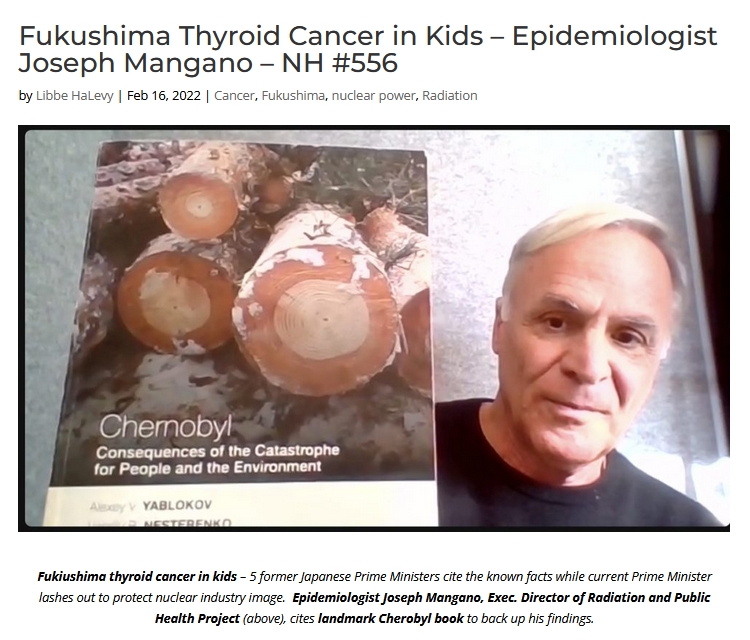
This Week’s Featured Interview on Nuclear Hotseat:
- Joseph Mangano is Executive director of Radiation and Public Health Project. He is an epidemiologist – one who searches for the cause of disease, identifies people who are at risk, determines how to control or stop the spread, or prevent it from happening again. Joe has over 30 years of experience working with nuclear numbers and comes from a history of teasing out health information from data. We spoke on Friday, February 11, 2022.
Once discharged, the nuclear contaminated water never goes back

15-Feb-2022
It has been almost 10 months since Japan initially announced its plan to discharge the contaminated water from the Fukushima Daiichi power station into the Pacific Ocean. Amid the roaring criticism and anger from across the globe, Japan chose to close its eyes and ears while stubbornly wading to the end of the cliff.
When this article goes to press, a delegation from International Atomic Energy Association (IAEA) is now visiting the Fukushima Daiichi power plant to review Japan’s discharge plan, which is the result of long and tiresome international bargain since it is always a tough job asking the Japanese government to correct its mistakes.
The 2011 Fukushima earthquake was an inevitably tragic accident, but the irresponsible treatment of the contaminated water is tantamount to a man-made disaster, setting the worst precedent of human response to nuclear threat.
By releasing the contaminated water into the Pacific Ocean, Japan is spreading the risk of nuclear exposure to every coast of the ocean and eventually the whole maritime system potentially poisoning creatures off-shore and under the sea alike.
A barely discussed issue about Japan’s decision is what a grave international human right abuse it could be. It deprived people both in Japan and beyond of the very basic human need – to live and thrive in a sound and healthy environment.
This is literally of everyone’s concern – the water we drink, the seafood we consume, the beaches on which we relax, and we don’t want all those things bright and beautiful screwed up by the enduring threats of nuclear radiation. Not a chance.
Releasing the nuclear contaminated water into the ocean is by no means a responsible solution. Many other options that are more scientific and eco-friendly are actually on the table. However, the Japanese government has chosen the least time-consuming and expensive one, i.e. to dump it into ocean, citing a crappy explanation such as a lack of storage space. And that is why the ceaseless and furious protests from local communities in Fukushima and neighboring countries have all been met with a deaf ear in Tokyo.
The act of Japanese government has not only disgraced itself internationally, but also stained Fukushima’s reputation and stigmatized the local people and food, for whom it should be most responsible. Historically, Hiroshima paid for the imperialist government’s evildoing and, sadly, became almost an acronym for nuclear destruction.
Now, Fukushima has paid for the current government’s irresponsibility and, sadly, has to risk becoming the acronym for man-made disastrous nuclear exposure. From Hiroshima to Fukushima, Japanese politicians sacrificed the fundamental interests of the Japanese people for their own mistakes.
According to the data released by Ministry of Health, Labour and Welfare of Japan recently, the radioactivity of cesium detected in Schlegel’s rockfish captured off the coast of Fukushima Prefecture reached 1400 Bq/kg, way exceeding the national standard of 100 Bq/kg. It is merely the tip of the iceberg.
Tremendously proud of its booming fishery industry, Fukushima feels stabbed in the back by its national government. But that surely won’t take one yen away from the pockets of the Japanese decision-makers, while those expensive but responsible and eco-friendly solutions will.
DPP sacrifices Taiwan people’s interests by lifting ban on Japan‘nuclear food’ for political gain
Deceit and Betrayal

February 13, 2022
The surprise lifting of a ban on importing food from five prefectures in Japan around the site of the 2011 Fukushima nuclear disaster by the Democratic Progressive Party (DPP) authority has sparked anger in the island of Taiwan.
After being banned for more than a decade, the “nuclear food” as it is known by Taiwan people, will finally be allowed to return to the island’s dinner tables, which is regarded by local media and observers as another betrayal of the public opinion by the DPP authority after the reauthorization of ractopamine-enhanced pork imports from the US.
Importing toxic food and generously gifting scarce masks to the US in the face of local emergency shortages, the DPP has engaged in countless cunning political calculations against the interests of the Taiwan people, to enhance international visibility or initiate skewed “international cooperation.”
To pursue its political interests and separatist conspiracy, the DPP goes against the will of people on the island, negatively impacting public health and safety, said Ni Yongjie, deputy director of the Shanghai Institute of Taiwan Studies. “It is messing up Taiwan with fascist-like deeds.”
Artificial arguments down people’s throats
Following the Fukushima nuclear power plant disaster caused by the massive in 2011, Taiwan’s authorities banned food imports from Fukushima for over a decade. In 2018, the island held an anti-nuclear food referendum where Taiwan people supported the existing ban with 7.79 million votes.
However, the sudden announcement by the DPP authority to lift the ban is not a change in public opinion in Taiwan. The Japan Times said that island’s leader, Tsai Ing-wen, prioritized Japan-related food issues in trying to win Japan’s support for Taiwan’s entry into the Comprehensive and Progressive Agreement for Trans-Pacific Partnership (CPTPP).
In the face of fierce public protest, Tsai asserted that since 2016, the local authorities have completed six assessment and investigative reports, and enacted strengthening measures on the imported foods monitoring.
Ironically, local media cited expert analyses as saying that much of the leaked radioactive material is still radioactive.
The Chinese Kuomintang (KMT) party revealed that the DPP intentionally shortened the policy notice period from 60 to 10 days, and only Kaohsiung, Taichung, and New Taipei City presently have radiation inspection equipment, Tsai and the DPP’s alleged commitment has only been lip service.
Some DPP members on January 16 suggested that the food should be referred to as “Fu food” rather than “nuclear food.” “Fu food” may refer to Fukushima food but also means “blessed food” in Chinese, a term likely more acceptable to Taiwan people.
The DPP even released a so-called poll on February 9, indicating that 58.7 percent of the public support the distribution of Fukushima food
The KMT revealed that the “poll” only used “Japanese food” as a substitute, failed to mention the radiation risk associated with such food.

“It showed DPP’s hand by directly announcing the embrace of ‘nuclear food’ by the end of month,” Ni sighed. “The DPP authority completely forgets about public interests.”
By opening the door to “nuclear food,” the DPP authority rush to improve relations with Japan. The DPP regards Japan as a main ally on the “international stage” that can help with DPP’s secessionist strategy, Ni said.
Put Taiwan people aside
Looking back at Tsai’s recent years in office, the island has been gripped by concerns over food safety and public health.
Taiwan reportedly started importing ractopamine-enhanced pork from the US in January 2021, after the island’s DPP-dominated legislative body approved acts to lift restrictions on such pork.
Ractopamine is banned from food production in at least 160 countries and regions including the European Union. Regardless of the 70 percent dissent by the Taiwan residents, as a local poll showed, the DPP actively paved the way for imports of the controversial pork to appease the US.
Head of Taiwan’s health authority Chen Shih-chung once said he was willing to “eat ractopamine-enhanced pork for three consecutive months” as importing the pork could enhance Taiwan’s “international status,” though such attempts did nothing to quell public anger.
During the COVID-19 pandemic, the Tsai authority further enraged the Taiwan public by utilizing essential anti-epidemic supplies including medical masks and vaccines to pursue its separatist agenda.
In March 2020, DPP reportedly signed a “jointly statement” with the US and promised to provide it with 10,000 medical masks per week. A month later, the DPP announced a total of 16 million donated masks globally.
Ironically, the DPP made the promise when the island seriously lacked masks. As Taiwan media reported in February and March of 2020, local residents were only allowed to buy two or three masks each week. There were long queues at the pharmacies at that time.
In May 2021, the DPP authority announced the purchase of 10 million doses of COVID-19 vaccines from local producers Medigen Vaccine Biologics Corp (MVC) and United BioPharma (UB) at a cost of NT$750-881 ($26.9-31.6) per dose, much more expensive than the vaccine produced by the world’s current major brands including Oxford-AstraZeneca ($4) and Moderna ($15), reported Taipei-based United Daily News in June 2021. Prior to that, DPP had rejected vaccines provided by the Chinese mainland, and turned down private purchases or donations even amid severe vaccine shortages.
According to an exclusive report by Reuters in June 2021, UB-612 vaccine is developed by private US firm COVAXX. Sources told Reuters that Erik Prince, former head of Blackwater, invested in COVAXX in 2020.
Blackwater is known for providing intelligence, training, and security services to the US army and government. After the real entity behind the development of the UB-612 vaccine was revealed, Taiwan social media platforms were flooded with recriminations about DPP’s lies to the people in the interests of American big business and a possible US-led political alliance.
“The government uses large amount of public money to purchase the [UB-612] vaccine in the name of ‘supporting a Taiwan-developed vaccine; but the fact is, the vaccine is from the US,” Taiwan’s TV commentator Huang Chih-hsien wrote on Facebook in June 2021.

The DPP authority have frequently caused public anger due to their traitorous behaviors during the past years, and they are aware of the anger caused, Ni said. “They just don’t care, as long as this separatist party can benefit,” he said.
Sadly, the DPP’s behaviors were paid by the whole of Taiwan, Ni noted. “The consequences of it ignoring food security and public health will be borne by all the residents and their offspring on the island,” he told the Global Times.
Fukushima residents rally against plan to discharge nuclear-contaminated water into sea

16 February 2022
Protests have been held in Japan’s Fukushima Prefecture against the government’s controversial plan to release contaminated water from the wrecked Fukushima Daiichi nuclear power plant into the Pacific Ocean.
Dozens of local residents gatheredin front of the Fukushima prefectural government office building on Tuesday, calling for the cancellation of the move, while also demanding protection for the ocean, as they waved banners with slogans written in several languages in a bid to bring international attention to their concerns.
The Fukushima Daiichi nuclear plant, located on Japan’s northeast coast, was crippled after going into meltdown following an earthquake and tsunami in 2011.
Around 1.25 million tons of water, used to cool the reactors after the meltdown, are currently stored in tanks in and around the plant.
Local polls have shown that more than 70 percent of non-governmental organizations in Fukushima object to the plan of releasing the radioactive water into the ocean. Many people worry the plan will cause great harm to their health.
“If nuclear contaminated water is discharged into the sea, people may be affected by eating fish or other sea food. This may bring sustained harm to people’s health. Since the release plan will take a long time to complete, I am worried the harm will increase day by day,” said a local resident.
“I want to protect the health and future of younger generations, so I oppose dumping the contaminated water into the ocean,” said another local resident.
The protesters also voiced concern that Tokyo Electric Power Company (TEPCO), the operator of the nuclear power plant, had failed to fully disclose information about the Fukushima nuclear disaster or verify the data about the nuclear contaminated water.
“Although the release plan says the radioactive water will be diluted before being discharged into the sea, the total amount of nuclear elements in the water will not change at all. So I think it’s not right to dump the wastewater into the ocean and spread contamination,” said a local resident.
Tuesday’s protest took place as a team from the International Atomic Energy Agency (IAEA) was slated to conduct safety reviews at the plant.
The 15-member team arrived in Japan on Monday to review the government’s plan to release the treated radioactive water into the ocean from the destroyed Fukushima nuclear plant — a review that Tokyo hopes will instill confidence in the plan, which is opposed by neighboring countries.
The task force, headed by Gustavo Caruso, director of the IAEA’s Office of Safety and Security Coordination, is due to stay in Japan through Friday.
Japan and the IAEA have agreed to compile an interim report on the review later this year.
Last April, the then-Japanese Prime Minister Yoshihide Suga said TEPCO would be allowed to release nuclear contaminated water from Fukushima into the Pacific Ocean starting in 2023, leading to a massive outcry from both local residents and the international community.
Local fishing communities expressed opposition as well, saying that the water discharge would undermine years of work to restore confidence in seafood from the region.
The radioactive water, which increases in quantity by about 140 tons a day, is now being stored in more than 1,000 tanks, and space at the site is expected to run out around next autumn.
To meet international standards before disposal, the nuclear wastewater, however, needs to be filtered to remove harmful isotopes. The process, however, cannot remove tritium, an isotope of hydrogen that experts say will be harmful to human health in large doses.
1 This Month
19 February – VIRTUAL EVENT-Decision Time: AI and Our Nuclear Arsenal
12:45 p.m. Central / 1:45 p.m. Eastern
To see nuclear-related stories in greater depth and intensity – go to https://nuclearinformation.wordpress.com
-
Archives
- February 2026 (128)
- January 2026 (308)
- December 2025 (358)
- November 2025 (359)
- October 2025 (376)
- September 2025 (258)
- August 2025 (319)
- July 2025 (230)
- June 2025 (348)
- May 2025 (261)
- April 2025 (305)
- March 2025 (319)
-
Categories
- 1
- 1 NUCLEAR ISSUES
- business and costs
- climate change
- culture and arts
- ENERGY
- environment
- health
- history
- indigenous issues
- Legal
- marketing of nuclear
- media
- opposition to nuclear
- PERSONAL STORIES
- politics
- politics international
- Religion and ethics
- safety
- secrets,lies and civil liberties
- spinbuster
- technology
- Uranium
- wastes
- weapons and war
- Women
- 2 WORLD
- ACTION
- AFRICA
- Atrocities
- AUSTRALIA
- Christina's notes
- Christina's themes
- culture and arts
- Events
- Fuk 2022
- Fuk 2023
- Fukushima 2017
- Fukushima 2018
- fukushima 2019
- Fukushima 2020
- Fukushima 2021
- general
- global warming
- Humour (God we need it)
- Nuclear
- RARE EARTHS
- Reference
- resources – print
- Resources -audiovicual
- Weekly Newsletter
- World
- World Nuclear
- YouTube
-
RSS
Entries RSS
Comments RSS
 nuclear-news