Joy and delight! Australia is to have a booming rare earths industry, mining and PROCESSING – jobs jobs jobs! Money money money!. And we can stick it up to China, confronting its near monopoly on the industry!
The reality is something very different.
Apart from the enormous and time-consuming problems involved in establishing this industry, and in competing economically with China, there’s that other unmentionable problem – RADIOACTIVE WASTES.
Western Australia’s Lynas Rare Earths company knows all about this. They’ve had no end of trouble with their rare earths processing and its radioactive wastes. They were smart enough, had the foresight, to set up processing in another country. Lynas moved its rare earths processing to Malaysia because of Malaysia’s less stringent laws. But what they didn’t reckon with, was Malaysia’ ‘s history, and awareness of radioactive waste danger. As Lynas’ plant started operations in 2012 – in Kuala Lumpur: 10,000 marched for 13 days, rally against Lynas rare earths processing plant. Former Malaysian Prime Minister Mahathir Mohamad imposed stringent conditions on Lynas’ operations.
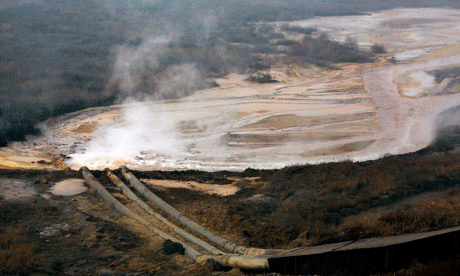
Malaysians remember the environmental and health disaster of Bukit Merah; where, early this century, rare earth processing left a toxic wasteland.
A longer explanation is provided in this documentary –
It is very hard to get information on Lynas’ processing operations in Malaysia. I remember that a few years ago, there was a controversy, and an Australian protest movement against Lynas’ plan to dump these wastes into an old growth forest in Malaysia. I can now find no record of this. And indeed, many news items of the controversies of Lynas’ Malaysia operations have now vanished from the internet.
If Malaysia’s history of radioactive pollution from processing of rare earths is scandalous, – what about China’s history?
I know that in recent years, China has cleaned up its act on industrial pollution. But its history is shocking – with a legacy of “cancer villages” –
Whole villages between the city of Baotou and the Yellow River in Inner Mongolia have been evacuated and resettled to apartment towers elsewhere after reports of high cancer rates and other health problems associated with the numerous rare earth refineries there. – China’s legacy of radioactive pollution from rare earths processing.
Well, is everybody now pretending that that to introduce rare earths processing in Australia is a good thing, no problem, it’s progress – blah blah?
This new development comes just as Australia’s government introduces its new reforms to the Environment Protection and Biodiversity Conservation Act – including the aim to simplify and speed up approvals for development. We wait to see what that entails – could it be the weakening of environmental standards?
Coincidentally, Mr Trump’s USA is changing the standards on radiation safety. An Executive Order from the White House states:
“In particular, the NRC shall reconsider reliance on the linear no-threshold (LNT) model for radiation exposure and the “as low as reasonably achievable” standard, which is predicated on LNT. Those models are flawed”, – ORDERING THE REFORM OF THE NUCLEAR REGULATORY COMMISSION.
This will likely result in a significant weakening of the current standards at a time when the evidence strongly suggests that they are in need of further tightening.
The environmental movement fights on – but with a wave of enthusiasm for renewable energy development. A recent article discussed recycling of rare earths from our many digital devices. That’s an idea that seems to be ahead of its time, especially given the extreme difficulty of retrieving those elements from mobile phones, laptops etc.fficulty of retrieving those elements from mobile phones, laptops etc.
Well, it’s the (?) futuristic idea of the circular economy. It fits in with those unfashionable concepts of energy efficiency, energy conservation. We used to hear about them, in the early days of action on climate change.
These concepts are anathema to our billionaire leaders, as we are all drawn into the mindless rollercoaster of ever more artificial intelligence, with its ever more energy use.
Australia, federally and in each State has strong restrictions on radioactive processes. The nuclear lobby has tried for decades to weaken or overthrow those restrictions, and to introduce radioactive waste dumping in a big way.
We’ll be pitched the story that the radioactive wastes from rare earths processing are “minor” “low key” – acceptable. Let’s not worry – after all, the whole rare earths thing is so complex, and so far into the future.
But Albanese so readily agreed with Trump, that Australia can have both the mining and the processing of rare earths – it opens the door up to radioactive waste dumping,
Meanwhile, the issue is also relevant to Australia’s agricultural industry, particularly in Victoria. Victoria being blessed with rich agricultural land, regions like the Wimmera and Gippsland could be threatened by these new industries. The nuclear lobby, too, has long salivated on the possibility of a thorium industry there, too
It’s a sad thing – that history is forgotten, in these days of super-fast “progress’ into the Age of AI. We are being led by the nose by those technobillionaires surrounding Donald Trump – to believe that we don’t need to do much working, or thinking – as we race into this golden age, and embrace this new radioactively-polluting industry.
Albanese may come to regret his meeting with Trump, the deal and the endorsement by Trump. He may have underestimated the risk in kissing the ring of the Confidence Man.
but now he was a man of compromise, the politician who has exchanged principles for politics.
Australia should have put AUKUS on hold to let the people decide whether it should proceed. After all, we will pay for AUKUS, and we pay the salaries of the representatives of the people
Australia is paying for America’s submarines, striking a deal with a President we still have to fact-check. Dr Kim Sawyerreports.
HE IS THE MASTER showman. He knows where to position the actors, where to position the cameras, where to position the lights. He knows how to spray on his make-up and the make-up of others. Every press conference, every Cabinet meeting is the reality show of the showman.
“Young Donald Trump had been an athlete as a teenager, and he aspired to a career in Hollywood. He ultimately fulfilled his father’s desire for a successor in the family business in real estate. But what the son really always wanted was to be a star.”
The reality show The Apprentice made him a star. The Apprentice was his apprenticeship. Trump knows who is willing to be conned; he knows their price or how to determine their price. He thinks he knows the price of everything and everyone, but really knows the value of nothing. He is the confidence man.
Trump is the confidence man of fiction best understood by reading Ibsen’s Master Builder or by viewing the 1958 episode‘The End of the World’ of the CBS series Trackdown that featured a character who wanted to build a wall, and who had all the confidence of the confidence man. Sound familiar? The fictitious character was called Trump. He was finally exposed as a fraud. The fictitious Trump was finally arrested.
The meeting of Trump and Albanese was his latest reality show, the Master and the Apprentice. The Master got what we wanted. He got the deference he craved. He got the deal he wanted. The Apprentice got what he wanted. He got the endorsement of power of the Confidence Man.
The art of the deal.
Perforce, the deal is a con. Turnbull and Keating understand. Morrison and Albanese do not. We should never have agreed to AUKUS. It’s not just the cost of $368 billion over 30 years that includes $123bn as a contingency for the risk of a cost blowout. The risks are everywhere.
We have already paid more than $3 billion, the premium for a very uncertain insurance policy. As Turnbull has noted, the submarines are currently being produced at a rate of 1.1 per year.
“They need to get to two by 2028 to be able to meet their own requirements, and to 2.33 to meet their own, plus Australia’s. And they have not been able to lift production rates despite expenditure of over $10 billion over the last six or seven years. So, they’ve got a real problem.”
We’ve got a bigger problem.
Governments are like portfolio managers. The government needs to understand diversification, that you do not put all your eggs in a basket of submarines. The defence budget is so tied up in submarines, we don’t have room to invest in emerging defence technologies, in patrol boats, frigates or the amphibious landing craft we need for immediate problems like evacuations. The budget is being skewed towards submarines that will not be supplied until the early 2030s, away from writing off the $70 billion of student debt that three million young Australians face. The cost of the deal.
We have become so inured to the lies of the conman, we have to fact-check everything he says. When Trump said he had been to Australia, I thought it was another porky, but no, he had visited Australia, not as the President but as a spruiker to the National Achievement Congress in 2011. The conman spruiked the message of the grifter as to how to get everyone else to pay his debts. It wasn’t Trump’s first visit to the antipodes. In August 1993, Trump visited Auckland as part of a consortium bidding for a casino operator’s licence. At the time, Trump was mired in debt. The bid was unsuccessful.
Truth and falsity are transactional for Trump. He has always used the mantra. “If you say something often enough, it becomes true.” Interviewed by the Sydney Morning Herald in 2011, Trump criticised Obama’s job plan as doomed and unlikely to have any impact. At the time, the unemployment rate was nine per cent, at the end of Obama’s term, unemployment was 4.9 per cent. Trump was always anti-Obama. Trump was always false.
The other leading actor in the show that we watched last Monday was our own Prime Minister. Albanese had a lot to thank Trump for; perhaps that’s why he had wanted so much to meet him. The polls in February 2025 had the coalition leading 51–49, and then the Trump-Dutton factor came into play. Dutton was Albo’s trump card. No wonder he wanted the selfie with Trump. He invited Trump to visit, perhaps to spruik why Australia is paying for America’s submarines.
Albanese wore a lot of make-up to the meeting. The real Albo shared his confidences in private, perhaps with the other actor who sat opposite Trump, the Ambassador who Trump did not like. Albanese may come to regret his meeting with Trump, the deal and the endorsement by Trump. He may have underestimated the risk in kissing the ring of the Confidence Man.
The risk was everywhere to be seen. Two days before, 7 million joined the No Kings’ protests. Thirty years ago, when Albo was a man of principle, he may have joined those same protests, but now he was a man of compromise, the politician who has exchanged principles for politics.
On the day that Albo met Trump in the Whitehouse, the East Room was being demolished. In 1984, on a tour of the Whitehouse, we were asked to stand still, as the President appeared. Reagan had just left the East Room, where he had given a speech, where Carter, Obama, and FDR gave speeches. The East Room was built by President Theodore Roosevelt in 1902.
Apparently, there was no heritage overlay, at least for Trump. Betty Ford reflected on its significance. “If the West Wing is the mind of the nation, then the East Wing is the heart.” Confirmation that Trump is heartless.
Australia should have put AUKUS on hold to let the people decide whether it should proceed. After all, we will pay for AUKUS, and we pay the salaries of the representatives of the people. However, most will never get to see the submarines, not like the HECS debt on their tax bill. Australia has been too subservient, too sycophantic, too risk-averse in our dealings with Trump. There is a cost to being risk-averse just as there is a cost to being a risk-taker.
The Democrats paid the price for not dealing with Trump as they should have dealt with him. Dealing with Trump is like dealing with the devil; you must deal on your terms, not his terms. He is a convicted felon, a fraudster, a showman, the confidence man who became President.
The No Kings protests showed the divergence between the people and the institutions, between those who will not defer to Trump and those who will defer to him; between right and wrong. History may rewrite some of the story, but not the story of the Master and the Apprentice.
“Submarines in our time!” He didn’t say it, but Anthony Albanese might as well have, as he returned triumphantly from his meeting with Donald Trump this week.
AUKUS is indeed a fantastic deal. For the Americans, at least.
“Trump is not going to cancel AUKUS”, a well-connected industry source told MWM two weeks ago.
“AUKUS is so good for US industry – Australia is spending billions on their shipyards, and then there’s the purchase of the submarines themselves. General Dynamics Electric Boat and Huntington Ingalls Industries will see tens of billions of Australian dollars flow their way, as will Lockheed Martin and Raytheon”, said the source.
“And assuming things go well, the shipyard mess in the UK will see us going from three US Virginia-class subs to five, and then likely eight. Australia will abandon the UK AUKUS-designed subs, and even more Australian money will flow into the bank accounts of US companies.”
‘They’ll be lobbying the White House to ensure this cash keeps on flowing.’
And clearly, the lobbying has worked so far. Trump has endorsed AUKUS. It’s the sort of deal he likes.
As former Prime Minister Malcolm Turnbull stated in the lead-up to the meeting, it wasn’t going to be in Trump’s interest to withdraw, “The AUKUS deal is a fantastic deal for the Americans, a terrible deal for Australia, so there is no way Donald Trump will walk away from it because what does he get?” he said.
Turnbull was right. He was also right in his analysis after the meeting, “warm words don’t build submarines”.
Submarine woes
The United States is not building enough Virginia-class subs. They’re not building enough for their own Navy, let alone ours. That is the determining fact sitting in the middle of the AUKUS slipway.
For more than a decade, the US Government has been trying to build two Virginia subs per year. But they haven’t been able to move the shipbuilding dial. They’re currently struggling along at 1.1 submarines per annum, not enough to meet their own demand, let alone the 2.3 boats per annum they need to hit to be able to spare a submarine or three for Australia.
The spin from US and Australian politicians is turning in the opposite direction to the analysis of the United States Congressional Research Service, the US Government Audit Office and the US Chief of Naval Operations. No matter the spin from politicians, they can’t cause a change in the engineering and construction taking place at Groton, Connecticut and Newport News, Virginia.
Trump needn’t be worried though; he won’t be the President in the early 2030s when the first Virginia Class sub can’t be delivered because doing so,
will have a detrimental effect on the US Navy’s undersea warfare capability.
The US Congress has enshrined that “America First” requirement in their AUKUS legislation, and the crunch point is already less than a decade away – too little time for the US submarine industrial base to make the enormous strides that are so easily spruiked but so difficult, if not impossible, to achieve.
Eroding our sovereignty
Meanwhile, MWM’s industry source has foreshadowed the closing down of some Australian Defence companies struggling to make ends meet after Defence has cancelled a range of local programs, and is not initiating replacement work, so that they can meet the almost $10B in payments to both the US and UK governments to invest in their industry.
‘AUKUS is sending Australia into a sovereignty-eroding spiral.’
We are already tightly integrated into the US military with common hardware, common ordinance and common tactics. As the US turns its eye towards its superpower competitor, China (incidentally, our biggest trading partner), we are also seeing an expanding US military footprint on Australian soil, including:
and logistics storage in both Victoria and Queensland.
the long-standing Pine Gap joint communications and intelligence facility at Alice Springs,
the critical submarine very low frequency communications station at WA’s North West Cape,
a new mission briefing/intelligence centre and aircraft parking aprons at RAAF Darwin,
fuel storage at Darwin Port, infrastructure at RAAF Tindal near Katherine,
And there’ll be a forward staging base for US Navy Virginia-class subs out of HMAS Stirling near Perth from 2027.
US nuclear-powered, and by the early 2030s likely nuclear-armed, submarines will be using Western Australia as a strategic base for operations extending from the Gulf of Aden and Arabian Sea, the Bay of Bengal, to the South China Sea and the East China Sea and beyond.
‘All th’is is about strategic competition with China.‘
The Australian Defence Force, as it diverts money to AUKUS, will suffer in terms of independent capability. Industry will suffer. The taxpayer will suffer.
Best deal in history
Trump must be rubbing his hands together. This will play out well for the US.
Billions of Australian dollars will flow into the continental US to contribute to its submarine industry – this is a certainty. In contrast, the US will almost certainly not deliver. There is no clawback of expended money for non-delivery.
Australia’s Collins Class submarine capability will atrophy further, as will the general capabilities of the Australian Defence Force, starved of funds. More reliance on the US will see the US Navy station more subs in WA, the US Air Force stationing and staging additional air capabilities in our north, and an increase in the number of US Marines rotating through Darwin.
More than ever, Australia will be reduced to being “a suitable piece of real estate” in US war planning (to adopt the words of one of Australia’s most insightful strategic critics, the late Professor Des Ball).
Australia will have little choice but to let the US do this … and we might be pressured into much more.
‘There will be no choice but to follow the US into conflict with China.‘
We will have limited capabilities and will be left totally reliant on red, white and blue military capabilities. When Richard Marles talks of sovereign capabilities and decision-making, it’s just a political con job.
Trump will, in retirement, post on Truth Social his genius and how he suckered retired Prime Minister Albanese into what Paul Keating would call, in the view from the White House and Pentagon, the best deal in all of history.
Rex Patrick is a former Senator for South Australia and, earlier, a submariner in the armed forces. Best known as an anti-corruption and transparency crusader, Rex is also known as the “Transparency Warrior.”
Australian media coverage of Prime Minister Anthony Albanese’s meeting with US President Donald Trump was teetering on the brink of euphoria.
Emerging from the cabinet room where the meeting took place, the ABC’s reporter Jane Norman appeared breathless in her account of the big moment. Even Sally Sara, host of Radio National’s Breakfast, who is usually calm and is known to ask probing questions, seemed to have abandoned her cool. She pronounced: “Well, the bonds between the United States and Australia appear tighter than ever today.’
But our prime minister didn’t rest on his laurels, even after securing various assurances from Trump. Albanese seemed to feel he needed to further convince the Americans of our nation’s commitment to their nation. As he told a roomful of US Congress members: “We’ve already contributed a billion dollars to your industrial base; there’ll be a billion dollars on its way before Christmas.”
He went on to say there would be “a further billion dollars next year because … we want to uplift your industrial capacity. … We’ll be providing a capacity for maintenance of your subs from 2027 on top of the facilities that we have already in the West.” And just to ensure his audience understood his message, he added, “It will increase your capacity to forward project.”
In other words, he wanted to drive home that AU
When asked by Sara what securing a commitment from Trump meant, the ABC’s John Lyons said: “From America’s point of view, why wouldn’t you? When a country comes along and says we will pay you $380 billion to boost your manufacturing industry in America for submarines you may one day see, of course! America loves the deal.”
But Lyons didn’t mention that while the AUKUS contract commits the US to deliver eight nuclear-powered submarines to Australia by 2032, there’s a condition: under the US legislation, the president of the day can stop the transfer if the American government believes the sale could affect its undersea capabilities, thereby undermining the national interest. To put it plainly: Australia has no way of recovering its money, even if we end up with no submarines.
If AUKUS is such a good deal for the Americans, why does our prime minister feel the need to keep talking up AUKUS to them? KUS is really in America’s national interest.
Could the Albanese government be so desperate to secure a continuous commitment because it needs to convince Australian voters it is doing its utmost to persuade America to stay the course, so that their taxpayer money won’t go down the drain? Perhaps the government believes it can’t afford to let up on the PR surrounding AUKUS in both the US and Australia, even though it isn’t certain the submarines will eventually turn up, nor that they will deter Australia’s enemies?
Australia’s news media are prone to switch from pursuing a “public interest” mandate to a “national interest” mandate when covering foreign policy. For this reason, despite Trump’s assurances this week, they will doubtlessly continue to focus on the trope of “Is AUKUS on track or is it in trouble?” They are likely to keep ignoring or downplaying critical questions such as “What does Australia get out of the AUKUS deal?” and “Will the US submarines keep us safe?”
Although middle powers have less global influence, they nevertheless exercise agency strategically in the emerging multipolar world as great powers contest the rules of order. They gain influence by mediating between great powers through what international relations theorists call “hedging”.
Such scholars believe that hedging enables middle powers to engage with competing great powers, while avoiding alignment that limits their autonomy. Through hedging, less powerful states preserve sovereignty in a context of uncertainty by balancing engagement and resistance. Our Asian neighbours, such as India, Indonesia and Singapore, do precisely that.
Despite our leaders’ rhetoric, signing up to AUKUS seems to signal that Australia has somewhat voluntarily relinquished its capacity as a middle power to practise effective hedging.
For instance, Sydney University’s James Curran believes AUKUS could mean the US would expect Australia to join them in a potential war with China over Taiwan:
Similarly, the Lowy Institute’s Sam Roggeveen argues that Australia’s deeper alignment with the US and the hosting of US bomber capabilities at Tindal and future nuclear-submarine infrastructure raises the likelihood of Australia becoming “an important target” in a conflict with China.
Neither of the major parties has ruled in or out the possibility that Australia would join the US in a potential war. But despite Defence Minister Richard Marles’ rebuttal of criticism from AUKUS critics over the issue of sovereignty, one thing is clear: unlike many Western European and Scandinavian middle powers, Australia’s constitution implies that decisions to engage in armed conflict are made by the executive government under prerogative powers, not by parliament as a whole.
In other words, the Parliament of Australia apparently has no power to stop Australia from going to war, even though it could be consulted.
It is for these reasons that Clinton Fernandes, in the Future Operations Research Group at UNSW Canberra, believes that “rules-based international order” is a “euphemism” for the US-led imperial order, and that Australia is really a “subimperial power upholding a US-led imperial order”.
Without giving a full account of the myriad concerns raised by critics of AUKUS, let’s just say here that with AUKUS, Australia’s capacity to function as a true middle power — one that is confident of its sovereignty, autonomy and capacity to exercise agency to influence superpowers — seems gravely in doubt. And signing up to AUKUS may be another case study that supports Fendandes’s argument.
Wanning Sun is a professor of media and cultural studies at the University of Technology, Sydney. She also serves as the deputy director of the UTS Australia-China Relations Institute. She is a fellow of the Australian Academy of the Humanities and a member of the Australian Research Council’s College of Experts (2020-23). She is best known in the field of China studies for her ethnography of rural-to-urban migration and social inequality in contemporary China. She writes about Chinese diaspora, diasporic Chinese media, and Australia-China relations.
It is clear to many that AUKUS, in particular its early fulfilment stages, is becoming a debacle. In February, Defence Minister Richard Marles lauded as a ‘very unique’ arrangement Australia’s gift to the United States of $4.7 billion to bolster America’s struggling submarine output, highlighting that such an arrangement hasn’t been seen in other defence pacts globally.
Of course such an arrangement hasn’t been seen elsewhere! Most other countries wouldn’t agree to hand over this massive sum without ensuring there were provisions for a refund should the promised submarines fail to arrive.
In an inept performance in Senate Estimates in June 2024, Vice Admiral Jonathan Mead, head of the Australian Submarine Agency, woodenly refused to answer a straightforward question from Greens’ Senator David Shoebridge about whether the agreement Australia has struck with the US contains a clawback provision should the promised submarines fail to be supplied.
Mead’s performance, as recorded in Hansard, is mordantly comical:
It is thus obvious that Australia has no contractual way of recovering its money should the current or a future US President block the transfer of the submarines, as the US President is entitled to do under US legislation.
Australia is certainly ‘very unique’ in its willingness to part with almost $10 billion (the UK is getting a similar amount) in public funds with no strings attached.
Australia made the first payment of $800 million to the US in February and quietly transferred the second payment, a further $800 million, in July. It has committed to paying a total of US$2 billion ($3 billion) by the end of 2025, with the remainder to be paid over the decade to 2035‒36.
Under the AUKUS deal, both major political parties have committed to spending vast public resources with no consultation and minimal transparency and accountability.
Even though the Australian National Audit Office has exposed, in report after report, serious probity breaches in defence procurement, including unethical conduct between global weapons companies and the Australian government, these transgressions are routinely ignored. The weapons deals continue regardless.
The big winners from AUKUS so far have been nuclear submarine manufacturers in the United States and the United Kingdom. Australia has committed to providing almost $10 billion to boost the output of these companies, helping secure jobs for workers in America and the United Kingdom.
As there are no clawback provisions in either of these agreements, should President Trump ditch AUKUS, or if the submarine manufacturing capacity in the US and UK doesn’t sufficiently increase, Australian taxpayers will be picking up another multibillion-dollar defence tab with nothing to show for it. We’ve already shelled out $3.4 billion for no submarines, following former PM Scott Morrison’s shredding of the pre-AUKUS French submarine contract.
This is far from the only example of waste, misdirection and incompetence in Australia’s dealings with the global arms industry. Take the Albanese government’s engagement with global arms giant Thales. In October last year, the government signed up Thales to a further munitions manufacturing contract and a ‘strategic partnership’ in the new domestic missile-making endeavour, the Guided Weapons and Explosive Ordnance (GWEO) enterprise.
The new deal with Thales was struck despite the fact that Thales is currently being investigated by four countries for widespread criminal activity in three separate corruption probes. …………………….https://undueinfluence.substack.com/p/nothing-to-see-here-says-australia………………………………………… The Thales example illustrates how a key democratic accountability mechanism, the National Audit Office and its reports, is routinely ignored.
…………………………………………………How is it that such imbroglios occur again and again? Australian governments are highly susceptible to the ‘revolving door’ process in which politicians, the military and public servants move effortlessly between government, lobbying and the industry itself.
In what follows, no suggestion is being made of unlawful activity by any person named, nor that any of the appointments noted was unlawful.
The problem for Australia is not one of legality but of the perfectly legal influence of industry insiders within government, the lack of transparency, and the absence of management of the ‘revolving door’.
The revolving door
The ‘revolving door’ describes the movement of public officials into related private roles, and industry executives into related public roles. It is a widespread problem that undermines democracy, yet in Australia it remains unmonitored and unpoliced.
A large number of Australia’s senior government ministers and their staffers, military officers, and defence department officials move through the revolving door into paid roles with the weapons industry. Such moves are not illegal but they require a robust management framework—with rules that are enforced—to mitigate the inherent conflicts of interest. Australia’s feeble attempts at managing the revolving door have been completely ineffective
……………………………………………………………………………………………………………..In the lobby
There are also plenty of former senior military officers pulling strings on behalf of weapons companies too. Examples are listed below.
The federal register of lobbyists provides some transparency, but does not cover the majority of people who lobby politicians. The register applies only to third-party lobbyists. These people operate as paid professionals, either individually or as an employee of a lobbying firm, on behalf of clients. Third party lobbyists make up just 20% of all lobbyists. The remaining 80% include, amongst others, company CEOs and people employed by corporations as ‘government relations’ advisers. This enables employees of major weapons companies to lobby politicians easily and legally, with zero transparency.
Reverse cycle: private to public
The government’s engagement with UK weapons giant BAE Systems’ local subsidiary best illustrates how this works.
The government gave former senior BAE Systems executives influential behind-the-scenes roles both before and during the tender process for Australia’s largest ever surface warship procurement, the $46 billion Hunter class frigates, a contract BAE went on to win. Few of these roles were publicly acknowledged. https://undueinfluence.substack.com/p/sinking-billions-revolving-doors
BAE Systems was awarded the frigates contract by the Turnbull government in mid-2018. The names of the people appointed to an expert advisory panel to oversee the tender evaluation process were not made public. Here’s why: serious conflicts of interest…………………………………………………………………………………………………..
Lockheed Martin utilises the revolving door heavily in the US. Until recently, it had openly adopted the same strategy in Australia. From October 2013 until the end of 2021, the board of Lockheed Martin Australia boasted multiple former senior Australian public officials: at least two at any one time, more often three, and even four during one 20-month period.
They included a roll call of defence heavies from past decades,………………………………………………………………………………………
The UN Special Rapporteur on the occupied Palestinian territory, Francesca Albanese, released a report in July addressing the ‘economy of genocide’ in which she makes special note of Lockheed Martin’s F-35 program…………………………….
Australia’s refusal to cease the supply of parts and components into Lockheed Martin’s F-35 global supply chain places the nation at risk of being found complicit in Israel’s genocide.
Complicity in the world’s worst international crime is just one of the democracy-undermining consequences of Australia’s deep enmeshment in the US and broader Western military industrial complex.
A vast and highly trained workforce is needed to command, crew, supply and maintain nuclear submarines. Some say that’s impossible for Australia.
“Vice-Admiral Mead, you’re free to go home … good to see you cracking a smile.”
The head of the Australian Submarine Agency had spent a withering three hours before Senate estimates, parrying a barrage of questions about Australia’s ambitious Aukus nuclear submarine plan: interrogatives on consultants, on hundreds of millions of dollars sent to US and UK shipyards, on sclerotic boat-building on both sides of the Atlantic.
But while so much focus has been on Australia’s nuclear submarines’ arrival, their price tag and their “sovereign” status, the greatest challenge to the Aukus project, Mead told the Senate, would be finding the people to keep them afloat and at sea.
If Australia’s nuclear submarines arrive on these shores – and that remains a contested question, with expert opinion ranging from an absolute yes to a certain no – will Australia be able to crew, supply and maintain them?
“It is a challenge we are continuing to meet,” Mead told senators. “Australian industry and navy personnel continue to build critical experience through targeted international placements.”
Others are less sanguine.
“The Aukus optimal pathway is a road to a quagmire,” says a former admiral and submarine commander, Peter Briggs, arguing that Australia’s small submarine arm can’t be upscaled quickly enough. “It’s not going anywhere. It will not work.”
Onshore trades, too, are perilously short. Without an additional 70,000 welders by 2030, that trade’s peak body says: “The Aukus submarine program is at serious risk of collapse.”
Mead was asked directly by senators: “Are you still confident of meeting the government’s agenda and timings?”
“Yes,” he replied, “I am.”
‘An eye-wateringly long process’
Briggs, a past president of the Submarine Institute of Australia, says the Aukus plan reads like one “designed by a political aide in a coffee shop”.
The navy’s submarine arm is approximately 850 sailors and officers (the defence department declined to give exact figures). The former chief of navy previously told parliament it needed to grow to 2,300 by the 2040s.
But Briggs estimates that to crew and support Australia’s Virginia-class, and later, Aukus-class submarines, the navy will need to more than treble its existing complement to about 2,700.
Virginias are massive submarines – nearly 8,000 tons – and carry a crew of 134, more than twice the existing Collins-class crew of 56. The Aukus submarines to be built in Adelaide will be bigger again. More tonnage, more people.
“That’s a huge increase in what is already in very scarce supply,” Briggs argues…………………………………………………………
The new generation of submariners is needed for between three and five Virginia-class submarines, then up to eight Australian-built Aukus boats.
“To get to be chief engineer of a nuclear submarine takes 16 to 18 years,” Briggs says. “It’s an eye-wateringly long process and of course you lose people along the way.
“That’s why you need a broad base, a critical mass, and Australia simply doesn’t have that right now. There is no way a navy the size of ours can manage this mix.”
Briggs does not believe the US will withdraw from Aukus: the presence of nuclear submarine bases on Australian soil is too great a prize for a superpower wanting to project power into the Pacific. But Australia’s unreadiness could lead to nuclear submarines under domestic command being delayed.
“We’ve got no warranty clause, no guarantee of anything. The cop-out could come in 2031, the US might say, ‘Look, you’re not quite ready yet, let’s push everything back three years, check in again in 2034.’ And it’s Australia that’s left exposed.”
‘Beyond frustrating, it’s dangerous’
Beyond the complexity of commanding and crewing a nuclear submarine, the vessels need a vast and highly trained workforce to keep them supplied, afloat and at sea………………………………………………………………………
“This is not just a workforce challenge,” its chief executive, Geoff Crittenden, said in a statement. “It’s a full-blown capability crisis … If we don’t address this issue now, Aukus will fail.”
Aukus represented a “perfect storm”, he said, and failure to address worker shortages was “beyond frustrating, it’s dangerous”.
“A once-in-a-generation opportunity like Aukus demands a long-term, strategic response, not just investment in ships and steel, but in people. We estimate that Australia will be at least 70,000 welders short by 2030. Without immediate action, the project is doomed to delays, cost blowouts, or worse.”…………………………………………………………………………
The first cohort won’t be Australian. “In the short term there will have to be an influx of international talent, as we train and upskill our own people.”
Tier two is a nuclearised workforce of skilled professionals – scientists, electrical and mechanical engineers, technical managers, reactor operators and health physicists – with advanced training and between seven and 10 years’ experience. The majority of a submarine crew would sit in this tier. Obbard estimates that about 5,000 tier-two workers will be needed.
Tier three is a further cohort of “nuclear-aware” workers – between 5,000 and 6,000 again – tradespeople including machinists, fitters and welders, who will require some nuclear training.
“The Aukus plan cannot work without building this workforce and the wider engineering community this workforce is drawn from.”
Does it make sense?’
Jack Dillich is uniquely placed to observe Australia’s transformation to a nuclear submarine power. A former submarine officer, he holds an advanced degree in nuclear engineering and served on the executive of the Australian Nuclear Science and Technology Organisation, where he was responsible for the country’s sole nuclear reactor, and as head of the regulatory branch at the Australian Radiation Protection and Nuclear Safety Agency. He now teaches a nuclear course at the Australian Defence Force Academy………………………………….
The morning of Friday, 10 October 2025 saw the Australian Global Sumud Flotilla participants arrive back in our nation, after attempting to breach the Gaza blockade and then being illegally apprehended by Israel. A sizable crowd gathered on Gadigal land at Sydney Airport to welcome them back. However, another Australian flotilla participant has been in Israeli custody and again Australia’s top ministers are silent.
The Global Sumud Flotilla was part an ongoing campaign to breach the 18-year-long goods blockade on Gaza. Six Australians were taken into custody by Israel in international waters last week, amongst over 400 foreign nations, and they were then brutalised and mistreated in prison, while Australian woman Madeline Habib, a participant in a second flotilla, is likely in the hands of Tel Aviv now.
The participants themselves, as well as publics across the planet, have been shocked by the brutalisation and intimidation Israeli forces have subjected the more than 400 illegally detained foreign nationals to. And what’s resulted in equal dismay is the fact that our PM and foreign minister have failed to raise issue over the kidnapping of their fellow citizens, including the plight of Habib.
After focusing on the six Australians in Israeli custody that federal Labor publicly ignored, while the Department of Foreign Affairs and Trade sought to provide them with consular assistance, the mainstream media has failed to raise the alarm over Habib’s detention, even though the testimonies arising from the Sumud Flotilla mean she’s likely being abused by an allied nation as well.
“The Australian government is absolutely shameful in our extraction,” said Australian Global Sumud Flotilla participant Julie Lamont, speaking to the ABC from Jordan on Wednesday, after being released from Israel’s notorious Ktzi’ot prison. “It did not really support us at all. We were the last people out of 50 nationalities. We were left their probably because it was October 7.”
In response to an ABC question as to whether our government arranged the flight out of Israel to the Jordanian capital of Amman, Lamont said, “No. We were facilitated by other governments not the Australian government. And now we are here trying to find a way to come back to Australia, and we really are upset that the Australian government have been so shameful in support of their citizens.”
Lamont said Italy had risen to support flotilla participants, whereas her government hadn’t. The documentary filmmaker added that she’d thought they might be detained for months, while fellow local participant Surya McEwen was reportedly singled out for extra rough treatment by the Israeli military, which included beatings, dislocating his arm and slamming his head into a concrete floor.
Lamont and the other Australians were released by Israel on Wednesday. They were part of the final one-third of participants still detained in Ktzi’ot prison. The fact that the Australian government was less responsive to its own nationals would have compounded the hard time they were receiving at the hands of a rogue nation that’s developed diplomatic tensions with ours over recent months.
A spokesperson for foreign minister Penny Wong released a statement on Wednesday that suggested DFAT officials were working hard to assist detained Australians. The spokesperson for the minister said officials conducted welfare checks at the prison and liaised with Israeli officials to obtain their release. However, the statement failed to explain why Israel was illegally detaining these people.
Israeli immunity
The disturbing fact that Australia’s top ministers don’t appear to consider there is any reason to waste their breath while citizens who’d risked their lives to feed a group of people being purposefully starved to death are being illegally imprisoned and subjected to harsh conditions has been coupled by the reacquaintance with the realisation that Israel can harm foreign nationals with impunity.
The flotilla apprehended this week with Habib was the fourth such attempt to breach the Gaza blockade since June. Participants are aware they are risking their lives, because the six boats making up a 2010 FFC flotilla were boarded by Israeli soldiers in international waters, and then nine foreign nationals were shot dead on sight, with a tenth dying later in a coma.
Irish comedian Tadhg Hickey was also part of last week’s Global Sumud Flotilla. Following his release, Hickey told a reporter that he had considered that if he ended up in an Israeli prison, he wouldn’t be subjected to the levels of brutality and deprivation that he was subjected to at the hands of the Israeli Defence Forces, due to the fact that he is a westerner and a white person.
To face the level of sadism and inhumanity that they displayed was really quite shocking,” Hickey explained. “I mean in the five to six days that we were incarcerated, no access to doctors, no access to medicine, no contact with the outside world” and “no lawyers”. He then explained that one of his fellow participants, a 75-year-old, was deprived of his insulin, which could have killed him.
“In my opinion, they were very happy to let him die,” continued Hickey. “It’s not even a patch of what Palestinians are going through. That was on my mind the whole time. I was thinking, ‘If they’re treating me like this, with the passport I have and the privilege I have, imagine what they are doing to Palestinians in prison, many of whom are children.”
A dereliction of duty
The Gaza Freedom Flotilla Instagram page reported on Friday that the participants in the latest flotilla have begun appearing before an Israeli court. Several participants had already been deported. The detainees were also reporting that they had too been subjected to punishing treatment at the hands of the Israeli military, although there was no specific word on Australian citizen Habib.
A large sector of the Australian public that had been aware that foreign nationals would be subjected to human rights violations at the hands of the Israeli state have been given a quick starter course on how there is one nation on the planet that is provided such impunity that it can violate and breach international laws and standards in a completely unbridled manner.
The other lesson Australia learnt is that while Israel might illegally detain and brutalise Australians, this won’t be an issue officially addressed because it is permissible. And this week was really a confirmation after Israel killed Australian aid worker Zomi Frankcom and six others last year and all the foreign minister could do to respond was produce a declaration on the protection of aid workers.
The ACT government continues to reap the rewards for its early and bold push to 100 per cent renewables, which is now looking like the smartest policy of all – shielding its residents from the ravages of largely fossil-fuelled electricity price hikes.
The latest quarterly data assessing the cost of the ACT government’s commitment to sourcing the equivalent of its annual demand from wind and solar – which it met on schedule in 2020 – shows the additional cost of the policy in the latest quarter was just $3 a megawatt hour. Indeed, three of the wind farms contracted by the ACT government returned significant sums of money (a total of $4.4 million) to the ACT because the contract prices they agreed to are significantly lower than current wholesale electricity prices.
AUKUS is a hugely expensive Defence project facing considerable and, many argue, insurmountable hurdles. But does Defence have a Plan B? Rex Patrick reveals a crack in Defence PR’s high tensile pressure hull steel.
There has to be an AUKUS Plan B, surely. So MWM FOI’ed the Australian Submarine Agency (ASA) to find out.
Hit ‘em with your Talking Points.
In response, the ASA partially released one document showing ‘talking points’ that had been given to the Project lead, Vice Admiral Jonathon Mead, in case he was asked about the US’s AUKUS review.
At first glance, MWM thought that the ASA’s back-up plan to defend the Nation was to
“roll out some talking points to fire at an approaching enemy.“
roll out some talking points to fire at an approaching enemy.
But a closer look revealed more.
A Crack in the Submarine Pressure Hull
The talking points weren’t the only documents.
Despite the public bravado, the FOI decision shows that there is some discussion going on behind the scenes.
There were three more documents that met the terms of MWM’s request. The decision letter reveals that the Government has been discussing with our AUKUS partners, and internally, on what to do if it all goes to hell in a nuclear handbasket.
Self-confidence Bluster Exposed
The ASA has claimed the documents are sensitive (something we’ll push back on with an appeal), and so we can’t see the exact details of what’s being said.
But we know there are conversations taking place.
“That’s a good thing.“
1×1515
1:36 / 2:23
Listen to this story
2 min
AUKUS is a hugely expensive Defence project facing considerable and, many argue, insurmountable hurdles. But does Defence have a Plan B? Rex Patrick reveals a crack in Defence PR’s high tensile pressure hull steel.
There has to be an AUKUS Plan B, surely. So MWM FOI’ed the Australian Submarine Agency (ASA) to find out.
FOI Asking about a Plan B
Hit ‘em with your Talking Points.
In response, the ASA partially released one document showing ‘talking points’ that had been given to the Project lead, Vice Admiral Jonathon Mead, in case he was asked about the US’s AUKUS review.
US AUKUS Review talking Points (Source: Defence)
At first glance, MWM thought that the ASA’s back-up plan to defend the Nation was to
roll out some talking points to fire at an approaching enemy.
But a closer look revealed more.
A Crack in the Submarine Pressure Hull
The talking points weren’t the only documents.
Despite the public bravado, the FOI decision shows that there is some discussion going on behind the scenes.
More Documents about Plan B (Source: Defence)
There were three more documents that met the terms of MWM’s request. The decision letter reveals that the Government has been discussing with our AUKUS partners, and internally, on what to do if it all goes to hell in a nuclear handbasket.
Plan B Talk Going On (Source: Defence)
Self-confidence Bluster Exposed
The ASA has claimed the documents are sensitive (something we’ll push back on with an appeal), and so we can’t see the exact details of what’s being said.
But we know there are conversations taking place.
That’s a good thing.
Greens Senator David Shoebridge, commenting on the FOI decision, said, “Labor has managed to combine two of their worst behaviours in one go here, using exemptions in FOI to refuse to release documents while secretly doubling down on a plan B for AUKUS. I don’t think treating the Australian public like mushrooms is a viable long-term political strategy for Albanese”.
It’s Senate Estimates this coming week. The Coalition is a unity cheer squad with Labor when it comes to AUKUS, so we won’t see them probing hard on a Plan B. Hopefully, Shoebridge will squeeze some more out of Defence, at least until MWM’s FOI appeal is finalised.
For now, at least, we now know the ASA’s public AUKUS bluster is a deception. They’re not so confident after all.
Rex Patrick
Rex Patrick is a former Senator for South Australia and, earlier, a submariner in the armed forces. Best known as an anti-corruption and transparency crusader, Rex is also known as the “Transparency Warrior.”
The South Australia state government has appointed ASL to run its first auction for long duration storage, as the world’s most advanced wind and solar grid seeks around 700 MW of new firm capacity over the next six years.
South Australia leads the world in the uptake of wind and solar – which together accounted for 75 per cent of its local electricity demand over the last 12 months – and has set a world-leading target of reaching 100 per cent “net” renewables by the end of 2027. It already has seven big battery projects operating in the state, and another dozen under construction or contracted, but it is now seeking longer duration storage through the Firm Energy Reliability Mechanism (FERM) that it announced earlier this year.
I was scheduled to give a talk at the National Press Club of Australia on October 20 called “The Betrayal of Palestinian Journalists.” It was to focus on the amplification of Israeli lies in the press, which most reporters know are lies, betraying Palestinian colleagues who are slandered, targeted and killed by Israel. But, perhaps inadvertently proving my point, the chief executive of the press club, Maurice Reilly, cancelled the event. The announcement of my talk disappeared from the web site. Reilly said “that in the interest of balancing out our program we will withdraw our offer.”
The Israeli Ambassador, retired Lt. Colonel Amir Maimon, who spent 14 years in the Israeli military, is reportedly being considered to speak.
It is true that I know only one side of the picture from the seven years I spent covering Gaza. I was on the receiving end of Israeli attacks, including being bombed by its air force and fired upon by its snipers, one of whom killed a young man a few feet away from me at the Netzarim Junction. We lifted him up, each person taking hold of an arm or a leg, and lumbered up the road as his body swayed like a heavy sack. I saw small boys baited and shot by Israeli soldiers in the Gaza refugee camp of Khan Younis. The soldiers swore at the boys in Arabic over the loudspeakers of their armored jeep. The boys, about 10 years old, then threw stones at an Israeli vehicle and the soldiers opened fire, killing some, wounding others.
I was present more than once as Israeli troops shot Palestinian children. Such incidents, in the Israeli lexicon, become children caught in crossfire. I was in Gaza when F-16 attack jets bombed overcrowded hovels in Gaza City. I saw the corpses of the victims, including children. This became a surgical strike on a bomb-making factory. I have watched Israel demolish homes and entire apartment blocks to create wide buffer zones between the Palestinians and the Israeli troops that ring Gaza. I have interviewed the destitute and homeless families, some camped out in crude shelters erected in the rubble. The destruction becomes the demolition of the homes of terrorists. I have stood in the gutted remains of schools as well as medical clinics and mosques and counted the bodies. I have heard Israel claim that errant rockets or mortar fire from the Palestinians caused these and other deaths, or that the buildings were being used as arms depots or launching sites.
I, along with every other reporter I know who has worked in Gaza, including the over 278 Palestinians journalists and media workers who have been killed by Israel since the start of the genocide, many in targeted assassinations, have reported a reality in Gaza that bears no resemblance to how it is portrayed by Israeli politicians, its military and many media outlets that serve as Israel’s echo chamber.
Lt. Colonel Maimon can obviously, if he chooses, enlighten us about the artificial intelligence-based program known as “Lavender” and how it selects people, along with their families, in Gaza for assassination.
He can explain how Israel determines the quotas of civilian dead, how soldiers are permitted to kill as many as 20 civilians in order to target a Palestinian fighter and hundreds for a Hamas commander. He can let us know why Israel continues the mass slaughter when an internal Israeli intelligence database indicates that at least 83 percent of Palestinians killed are civilians. He can tell us how Palestinian civilians are abducted, dressed in Israeli army uniforms, have their hands tied, and are then forced to walk as human shields in front of Israeli troops into buildings and underground tunnels that are potentially booby-trapped. He can explain how the special unit called the “Legitimization Cell” carries out propaganda campaigns to portray Palestinian journalists as Hamas operatives to justify their assassinations. He can detail the targeting, bombing and controlled demolitions that have damaged or destroyed 97 percent of Gaza’s educational system, including every university and nearly all its hospitals. He can explain how, after Israel blocked all humanitarian aid on March 2 to starve the Palestinians in Gaza, Israeli officials set up the so-called Gaza Humanitarian Foundation to lure emaciated and malnourished Palestinians to four aid hubs in the south — aid hubs with little food and which Human Rights Watch calls “death traps” and Doctors Without Borders calls “orchestrated killing.” These hubs, open only an hour, usually at 2:00 am, ensure a chaotic scramble for scraps of food. Israeli soldiers, along with U.S. mercenaries, who include members of the Infidels Motorcycle Club, a self-professed anti-“radical jihadist” biker group that counts members with Crusader tattoos among its ranks, fire live rounds into the crowds killing over 1,400 Palestinians and injuring thousands more in and around the hubs since May. He can lay out the plans for the concentration camps in southern Gaza and the efforts to ultimately expel the Palestinians from Gaza and repopulate it with Jewish colonists. He can explain why Israel abandoned its own hostages, why it fired on vehicles headed into the Gaza strip on October 7 carrying Israeli captives and why it used Hellfire missiles to obliterate the Erez Crossing installation when it was seized by Palestinian fighters knowing that dozens of Israeli soldiers were inside.
If Lt. Colonel Maimon spoke with this honesty and candor we could call this balance. It would fill in a side of the equation I glimpse from the outside. It would complete the circle. It would match truth with truth.
But Lt. Colonel Maimon, I see from his past statements, will spew out the mendacious narratives used by Israel to justify genocide — Hamas uses Palestinians as human shields, it operates command centers in hospitals, it sexually assaulted Israeli women on October 7 and beheaded babies. He will make the spurious claim that Israel “has the right to defend itself,” ignoring the fact that Hamas and other Palestinian resistance groups, which lack an air force, mechanized units, artillery, a navy, fleets of militarized drones and missiles, pose no existential threat to Israel. More important, he will not address Israel’s flagrant violation of international law by occupying and settling colonists on Palestinian land and carrying out a livestreamed genocide.
This is not balance, unless we accept a world where truth is balanced by lies. It is an abandonment of the fundamental mission of journalists — to hold power accountable. But most egregiously, it is a terrible betrayal of our colleagues in Gaza who have been killed for chronicling the daily savagery in Gaza, for doing their job.
No doubt, the corporate sponsors and wealthy donors of the press club are pleased. No doubt, the club is able to slither away from its journalistic integrity. No doubt, it is spared the attacks that would come from allowing me to speak.
But please, have the decency to remove the word press from your club.
President Trump has spoken at the United Nations, and now Prime Minister Anthony Albanese has too.
The contrast could not have been starker. Trump rambled like a man who’d just been handed the microphone at a small-town karaoke night – except the song was foreign policy and he didn’t know the words. He wandered through half-baked grievances, boasted about imaginary achievements, and at one point seemed to forget which country he was president of.
Albanese, meanwhile, spoke like an actual world leader – calm, confident, and passionate. He talked about climate action, regional security, and cooperation with the kind of clarity that makes you think, “Ah yes, this person knows what he’s talking about.”
And yet, if you relied on Australia’s right-wing media, you’d think you’d just watched two completely different events. To them, Trump was basically Moses parting the Red Sea with one hand while balancing the U.S. economy on the other. Albanese, apparently “reckless,” was a bumbling tourist who accidentally stumbled into the General Assembly and asked for directions to Times Square.
One commentator even claimed Trump was “extraordinary” – which is technically true if you count all the diplomats burying their heads in their hands. Meanwhile, Albanese’s calm and measured speech was branded “utterly humiliating” and dismissed as nothing but “symbolic gestures,” because apparently international diplomacy should be performed like a WWE entrance.
This is the theatre we live with now: policy and substance don’t make headlines, but a man ranting about wind turbines does. If Trump had started selling selfies from the UN podium, they’d have called it “bold economic diplomacy.”
The world saw two very different leaders this week – one looking like he could chair a serious discussion about global challenges, the other looking like he should be gently escorted back to his seat before he accidentally sanctioned Canada.
Forty local organisations and community groups are launching a joint Port Kembla Declaration today, opposing the establishment of a nuclear submarine base at Port Kembla.
They’re calling for the federal government to rule it out, saying the risks are far too great, the declaration has been endorsed by many organisations, including health, faith, and social justice.
Tina Smith, President of the South Coast Labour Council, said they reject the idea of turning the region into a frontline for war games or nuclear escalation.
Dan Tehan told Sky News he planned to visit Idaho to investigate developments relating to small modular reactors (SMRs). But the only significant recent SMR ‘development’ in Idaho was the 2023 cancellation of NuScale’s flagship project after cost estimates rose to a prohibitive A$31 billion per GW.
The NuScale fiasco led the Coalition to abandon its SMR-only policy and to fall in love with large, conventional reactors despite previously giving them a “definite no”.
SMR wannabes and startups continue to collapse on a regular basis. WNISR-2025 reports that two of the largest European nuclear startups Newcleo (cash shortage) and Naarea (insolvent) are in serious financial trouble.
Ultra Safe Nuclear Corporation filed for bankruptcy protection in the US last year – just a year after a company representative falsely told an Australian Senate inquiry that it was constructing reactors in North America. The Nuward project was suspended in France last year following previous decisions to abandon four other SMR projects in France.
The latest edition of the World Nuclear Industry Status Report paints a glum picture for the nuclear power industry — the number of countries building reactors has plummeted from 16 to 11 over the past two years — and gives the lie to claims by the Coalition that Australia risks being ‘left behind’ and ‘stranded’ if we don’t jump on board.
That appears to be news to new Coalition energy spokesman Dan Tehan, who has taken over the portfolio from Ted O’Brien, the chief architect of the nuclear power policy that cost the Coalition around 11 seats in the May 2025 election.
Speaking to Sky News from the US, where he says he is on a nuclear “fact-finding” mission, Tehan said Sky News that “every major industrialised country, apart from Australia, is either seriously considering nuclear or is adopting nuclear technology at pace”.
Continuing with the theme, Tehan said: “Australia is going to be completely and utterly left behind, because we have a nuclear ban at the moment in place, and if we’re not careful, the rest of the world is going to move and we are going to be left stranded.”
The simple fact is, however, that there isn’t a single power reactor under construction in the 35 countries on the American continent; and the number of countries building reactors has plummeted from 16 to 11 over the past two years.
World Nuclear Industry Status Report
Tehan could — but won’t — read the latest edition of the World Nuclear Industry Status Report (WNISR-2025), released on Monday. For three decades, these annual reports have tracked the stagnation and decline of the nuclear industry.
There are two related factoids that nuclear enthusiasts can latch onto among the 589 pages of bad news in WNISR-2025: record global nuclear power generation of 2,677 terawatt-hours in 2024 and record capacity of 369.4 gigawatts (GW) as of December 2024. But they are pyrrhic wins. Both records are less than one percent higher than the previous records and they mask the industry’s underlying malaise.
Nuclear power generation has been stagnant for 20 years. Then, a relatively young reactor fleet was generating a similar amount of electricity. Now, it’s an ageing fleet. WNISR-2025 notes that the average age of the 408 operating power reactors has been increasing since 1984 and stands at 32.4 years as of mid-2025.
For the 28 reactors permanently shut down from 2020-24, the average age at closure was 43.2 years. With the ageing of the global reactor fleet and the closure of more and more ageing reactors, the industry will have to work harder and harder just to maintain the long pattern of stagnation let alone achieve any growth. Incremental growth is within the bounds of possibility; rapid growth is not.
Further, the global figures mask a striking distinction between China and the rest of the word. WNISR-2025 notes that in the 20 years from 2005 to 2024, there were 104 reactor startups and 101 closures worldwide. Of these, there were 51 startups and no closures in China. In the rest of the world, there was a net decline of 48 reactors and a capacity decline of 27 GW. So much for Tehan’s idiotic claim that Australia risks being “left behind” and “stranded”.
Even in China, nuclear power is little more than an afterthought. Nuclear’s share of total electricity generation in China fell for the third year in a row in 2024, to 4.5 percent. Nuclear capacity grew by 3.5 GW, while solar capacity grew by 278 GW. Solar and wind together generated about four times more electricity than nuclear reactors.
Since 2010, the output of solar increased by a factor of over 800, wind by a factor of 20, and nuclear by a factor of six. Renewables, including hydro, increased from 18.7 percent of China’s electricity generation in 2010 to 33.7 percent in 2024 (7.5 times higher than nuclear’s share), while coal peaked in 2007 at 81 percent and declined to 57.8 percent in 2024.
Global data
In 2024, there were seven reactor startups worldwide — three in China and one each in France, India, the UAE and the US. There were four permanent reactor closures in 2024 — two in Canada and one each in Russia and Taiwan. The 2025 figures are even more underwhelming: one reactor startup so far and two permanent closures.
As of mid-2025, 408 reactors were operating worldwide, the same number as a year earlier and 30 below the 2002 peak of 438.
Nuclear’s share of total electricity generation fell marginally in 2024. Its share of 9.0 percent is barely half its historic peak of 17.5 percent in 1996.
The number of countries building power reactors has fallen sharply from 16 in mid-2023 to 13 in mid-2024 and just 11 in mid-2025. Only four countries — China, India, Russia, and South Korea — have construction ongoing at more than one site.
As of mid-2025, 63 reactors were under construction, four more than a year earlier but six fewer than in 2013. Of those 63 projects, more than half (32) are in China.
As of mid-2025, 31 countries were operating nuclear power plants worldwide, one fewer than a year earlier as Taiwan closed its last reactor in May 2025. Taiwan is the fifth country to abandon its nuclear power program following Italy (1990), Kazakhstan (1999), Lithuania (2009) and Germany (2023).
Nuclear newcomers
Only three potential newcomer countries are building their first nuclear power plants — Bangladesh, Egypt and Turkiye. All of those projects are being built by Russia’s Rosatom with significant financial assistance from the Russian state.
(According to the World Nuclear Association, only one additional country — Poland — is likely to join the nuclear power club over the next 15 years.)
The number of countries operating power reactors reached 32 in the mid-1990s. Since then it has fallen to 31. That pattern is likely to continue in the coming decades: a trickle of newcomers more-or-less matched by a trickle of exits.
Russia is by far the dominant supplier on the international market, with 20 reactors under construction in seven countries (and another seven under construction in Russia). Apart from Russia, only France’s EDF (two reactors in the UK) and China’s CNNC (one reactor in Pakistan) are building reactors abroad.
WNISR-2025 notes that it remains uncertain to what extent Russia’s projects abroad have been or will be impacted by sanctions imposed on Russia following its invasion of Ukraine. Sanctions — including those on the banking system — have clearly delayed some projects.
Construction of nine reactors began in 2024: six in China, one in Russia, one Chinese-led project in Pakistan, and one Russian-led project in Egypt.
Chinese and Russian government-controlled companies implemented 44 of 45 reactor construction starts globally from January 2020 through mid-2025, either domestically or abroad. The one exception is a domestic construction start in South Korea.
Small modular reactors
Dan Tehan told Sky News he planned to visit Idaho to investigate developments relating to small modular reactors (SMRs). But the only significant recent SMR ‘development’ in Idaho was the 2023 cancellation of NuScale’s flagship project after cost estimates rose to a prohibitive A$31 billion per GW.
The NuScale fiasco led the Coalition to abandon its SMR-only policy and to fall in love with large, conventional reactors despite previously giving them a “definite no”.
Or perhaps Tehan was at Oklo’s SMR ‘groundbreaking ceremony’ in Idaho on Monday. Oklo doesn’t have sufficient funding to build an SMR plant, or the necessary licences, but evidently the company found a shovel for a ‘pre-construction’ ceremony and photo-op.
Worldwide, there are only two operating SMRs plants: one each in Russia and China. Neither of the plants meet a strict definition of SMRs (modular factory construction of reactor components). Both were long delayed and hopelessly over-budget, and both have badly underperformed since they began operating with load factors well under 50 percent.
WNISR-2025 notes that there are no SMRs under construction in the West. Pre-construction activity has begun at Darlington in Canada. But as CSIRO found in its latest GenCost report, even if there are no cost overruns in Canada, the levelised cost of electricity will far exceed the cost of firmed renewables in Australia.
Argentina began planning an SMR in the 1980s and construction began in 2014, but it was never completed and the project was abandoned last year.
SMR wannabes and startups continue to collapse on a regular basis. WNISR-2025 reports that two of the largest European nuclear startups Newcleo (cash shortage) and Naarea (insolvent) are in serious financial trouble.
Ultra Safe Nuclear Corporation filed for bankruptcy protection in the US last year – just a year after a company representative falsely told an Australian Senate inquiry that it was constructing reactors in North America. The Nuward project was suspended in France last year following previous decisions to abandon four other SMR projects in France.
Nuclear vs. renewables
For two decades, global investments in renewable power generation have exceeded those in nuclear energy and are now 21 times higher.
Total investment in non-hydro renewables in 2024 was estimated at US$728 billion, up eight percent compared to the previous year.
In 2024, solar and wind capacity grew by 452 GW and 113 GW, respectively, with the combined total of 565 GW over 100 times greater than the 5.4 GW of net nuclear capacity additions.
In 2021, the combined output of solar and wind plants surpassed nuclear power generation for the first time. In 2024, wind and solar facilities generated over 70 percent more electricity than nuclear plants.
In April 2025, global solar electricity generation exceeded monthly nuclear power generation for the first time and kept doing so in May and June 2025. In 2024, wind power generation grew by 8 percent, getting close to nuclear generation.
Renewables (including hydro) account for over 30 percent of global electricity generation and the International Energy Agency expects renewables to reach 46 percent in 2030. Nuclear’s share is certain to continue to decline from its current 9 percent.
WNISR-2025 concludes: “2024 has seen an unprecedented boost in solar and battery capacity expansion driven by continuous significant cost decline. As energy markets are rapidly evolving, there are no signs of vigorous nuclear construction and the slow decline of nuclear power’s role in electricity generation continues.”
The crowd broke into laughter as the audience was invited to attend a planned “fun day” to learn more about nuclear.
“This event really highlighted the deep level of community concern and opposition to AUKUS … The officials did all they could to avoid answering the hard questions,” -WA Greens MLC Sophie McNeill
The agency in charge of arming the nation with nuclear submarines has sought to earn the trust of residents in Perth’s south by holding a community information session.
The event drew protesters opposed to the AUKUS pact and a local defence hub being used to maintain nuclear submarines.
The Australian Submarine Agency assured event attendees about nuclear’s safety and Australia’s sovereignty, but many people seemed unconvinced.
Rigour, precision and safety, safety, safety — these are the values of the “nuclear mindset” the agency in charge of arming the nation with nuclear submarines has urged Australians to adopt.
The Australian Submarine Agency (ASA) has taken its self-described first steps towards earning the trust of the public.
A line-up of uniformed naval officers and delegates travelled to Western Australia to front the City of Fremantle’s community on Thursday night.
The meeting was touted as an “information session”, but a protest outside the town hall just before it started gave an early indication of how the night would go.
Nuclear fun day
The agency’s AUKUS advocate, Paul Myler, leaned on the US and UK’s seven decades of nuclear experience to assure the crowd of its safety credentials.
“We don’t get to automatically rely on that reputation. We have to earn that part, that legacy, and build our trust with our communities — and that’s what we’re starting here,” he said.
But the delegates made it clear they were not there to pitch AUKUS.
“That decision has been made by a succession of Australian governments,” the crowd was told in a preamble before the floor was opened to questions.
The crowd broke into laughter as the audience was invited to attend a planned “fun day” to learn more about nuclear.
WA Greens MLC Sophie McNeill, who attended the session, said it was alarming how removed the government was from the communities on the doorsteps of AUKUS.
“This event really highlighted the deep level of community concern and opposition to AUKUS … The officials did all they could to avoid answering the hard questions,” she said.
“It felt like an episode of Utopia.”
S for safety and sovereignty
Safety and sovereignty were the hot topics being thrown at the ASA.
One local questioned the record of Australia’s AUKUS partners on nuclear, citing the UK’s weapons testing in the 1950s which has left nuclear contamination at the Monte Bello Islands off WA’s coast and at Maralinga and Emu Field in South Australia.
“Nuclear weapons and nuclear testing are a completely separate issue … Australia’s position on that is very, very clear,” the crowd was told in response.
“We are not, and will not be, a nuclear weapon state.”
The agency also returned with its own S-word, stewardship, which it said described the “responsible planning, operation, application and management of nuclear material”.
Part of that stewardship includes planning for how nuclear waste will be managed.
In short, low-level nuclear waste will be temporarily stored at the HMAS Stirling naval base on Garden Island.
“The technical solutions can keep that waste safe for many years, decades I believe as a contingency, [but] we do expect the waste to be able to be moved much sooner,” a spokesperson said.
There are no plans as of yet for where high-level nuclear waste and spent nuclear fuel will be stored long term or disposed of. However,ASA said it would not be required until at least 2050.
The public also queried who would have command of Australia’s nuclear-powered submarines once they were built.
“I get asked a lot of hard questions. That one has a simple answer,” ASA director-general Vice Admiral Jonathan Mead said.
“Australian sovereignty, Australian officers, the Australian government — no other answer.”
Murmurs in the crowd indicated they were not convinced.
Protected or pawns
The room filled with claps and cheers when one local questioned the true intentions of AUKUS and labelled it an “appalling waste” of taxpayer dollars.
“We are being used as pawns to line up in a war against China, and it’s just not acceptable,” the resident said.
Mr Myler insisted it was about defence, and said developing Australia’s “strike capability” was key to protecting the nation.
“I can’t convince you, but I can only give you my own insight,” the AUKUS advocate said.
“Australian defence staff and Australian diplomatic staff and Australian government staff fight every day. Our sovereignty is absolutely at the core of everything we do.”
“They [Rio Tinto] paid no penalty, and then we found out that the maximum penalty for dropping [the capsule] in WA is only a thousand dollars,” they said.
Mr Myler offered a contrary view, describing the response to the missing capsule as impressive.
“It proved that West Australians had their act together, knew how to do this, knew how to respond, and the whole ecosystem coordinated and got that solved,” he said.
Mr Myler went on to say the “nuclear mindset” put the agency at a level “well above where private sector industry is”.
Australian Nuclear Science and Technology Organisation (ANSTO) social licence adviser Cassandra Casey noted Australia’s nuclear experience with research and nuclear medicines at a facility in Engadine, in New South Wales.
“The community, which is also my community, has grown up around ANSTO, and today the nearest homes in Engadine are just 820 metres … from that facility,” she said.
The information session began with an introduction about ASA earning the nation’s trust. The reaction of attendees indicated few minds were changed, something Mr Myler acknowledged.
“We all understand the risks around some nuclear programs. We have to do a lot more to build confidence in our nuclear program,” he said.