All energy costs rise but small nuclear most reactive.

Small modular nuclear reactors proved the most expensive technology of the eight options by a large margin, with the report basing its costs on Canada’s Darlington nuclear project, announced in May.
Small modular nuclear reactors proved the most expensive technology of the eight options by a large margin, with the report basing its costs on Canada’s Darlington nuclear project, announced in May.
By Jennifer Dudley-Nicholson, July 29 2025 , https://www.canberratimes.com.au/story/9027259/all-energy-costs-rise-but-small-nuclear-most-reactive/
Next-generation nuclear reactors are the most expensive of all energy-producing technologies, a report has found, and would significantly increase electricity prices in Australia.
Establishing a large-scale nuclear power plant for the first time would also require more than double the typical costs, and estimates for wind projects had inflated by four per cent due to unforeseen requirements.
The CSIRO, Australia’s national science agency, released its GenCost report on Tuesday, revealing rising construction and finance costs would push up prices for energy projects of all kinds in the coming years.
The findings come after a heated debate about introducing nuclear power to Australia and after members of the federal coalition questioned the nation’s reliance on renewable energy projects to achieve net zero by 2050.
The final GenCost report for 2024-2025 analysed the cost of several energy-generating technologies, including variations of coal, gas, nuclear, solar and wind projects.
Renewable technology continued to provide the cheapest energy generation, the report’s lead author and CSIRO chief energy economist Paul Graham said.
“We’re still finding that solar PV and wind with firming is the lowest-cost, new build low-emission technology,” he told AAP.
“In second place is gas with (carbon capture storage) … then large-scale nuclear, black coal with CCS, then the small modular reactors.”
Small modular nuclear reactors proved the most expensive technology of the eight options by a large margin, with the report basing its costs on Canada’s Darlington nuclear project, announced in May.
The 1200-megawatt development is estimated to cost $23.2 billion and will be the first commercial small modular reactor built in a Western country.
The new reactors produce one-third the power of typical nuclear reactors and can be built on sites not suitable for larger plants, but have only been built in China and Russia.
“This is a big deal for Canada – it’s their first nuclear build in 30 years,” Mr Graham said.
“It’s not just about meeting electricity demand … they’ve said a few things that indicate they’re trying to build a nuclear SMR industry and export the technology.”
In addition to the cost of different technologies, the report estimated “premiums” for establishing first-of-a-kind energy projects, with the first large-scale nuclear project expected to command 120 per cent more and the first offshore wind development expected to cost an extra 63 per cent.
The cost of wind projects also grew by four per cent as researchers factored in building work camps to accommodate remote employees, and capital financing costs rose by one per cent.
Developing energy projects was also expected to cost between six and 20 per cent more by 2050, the report found, due to the rising price of materials such as cement and wages, as detailed in a report by Oxford Economics Australia.
Findings from the CSIRO report would help inform the design of future energy infrastructure, Australian Energy Market Operator system design executive general manager Merryn York said.
“We’ll use the capital costs for generation and storage from GenCost in the upcoming Draft Integrated System Plan in December,” she said.
Nuclear technology is banned as an energy source in Australia, which has a target of achieving 82 per cent renewable energy in the national grid by 2030 and reaching net zero by 2050.
Out of Step with the World: Australia’s Refusal to Recognise Palestine is a Moral Failure
27 July 2025, Michael Taylor, https://theaimn.net/out-of-step-with-the-world-australias-refusal-to-recognise-palestine-is-a-moral-failure/
In a world that is finally waking up to the urgent need for justice and peace in the Middle East, Australia has chosen silence and hesitation. While 147 of the 193 United Nations member states have formally recognised the State of Palestine – including France, Spain, Ireland, and Norway – Australia continues to sit on its hands. This refusal is not only out of step with global momentum; it is out of step with the values of fairness, dignity, and the will of the Australian people.
Recognition of Palestine is not an endorsement of violence, nor is it a rejection of Israel’s right to exist. It is a simple acknowledgement that the Palestinian people – stateless for 76 years – deserve the same rights and recognition afforded to others. It is a step toward equality, toward dialogue, and ultimately toward peace.
Yet Australia clings to a failed policy of “not yet” – as though Palestinian dignity must forever be postponed for fear of offending a powerful ally. In doing so, our government aligns itself not with justice or international law, but with the shrinking minority of countries who continue to look the other way.
This decision does not reflect the views of the Australian public. Poll after poll shows a majority of Australians support Palestinian statehood and an end to the occupation. We are a people who believe in the fair go, in standing up for the underdog, in peace over power. And yet, our government refuses to act – cowed by geopolitical caution and domestic political pressure.
Refusing to recognise Palestine is not a neutral act. It is a political choice – one that undermines the international consensus, emboldens the status quo, and tells the Palestinian people that their suffering is invisible.
Australia once stood tall in the fight against apartheid. We helped build international pressure that led to its end in South Africa. Why, then, do we hesitate now?
If we truly believe in a two-state solution – if we truly believe in peace – then we must recognise both states. It is time for Australia to find its moral courage and join the vast majority of the world in recognising Palestine.
Justice delayed is justice denied.
AUKUS Submarine Regulations: Friends of the Earth Adelaide submission

Friends of the Earth Adelaide > Publications > Adelaide FoE Notes > AUKUS Submarine Regulations: FoE Adelaide submission
Philip White July 24, 2025, https://adelaidefoe.org/aukus-submarine-regulations-foe-adelaide-submission/
Friends of the Earth Adelaide today (24 July 2025) sent a submission in response to the government’s call for public comments on draft Australian Naval Nuclear Power Safety Regulations. These Regulations were drafted under the Australian Naval Nuclear Power Safety Act, which was passed in October last year. Our submission can be accessed here.
The consultation is open until 30 July 2025. Details can be found on the following web site: https://www.defence.gov.au/about/reviews-inquiries/australian-naval-nuclear-power-safety-regulations-public-consultation
FoE Adelaide’s submission can be summarised as follows:
— AUKUS should be cancelled. It compromises Australia’s sovereignty and is not in our strategic, economic, or environmental interests.
— If it is not cancelled, there should be a proper consultation about the Stirling and Osborne designated zones, which were declared in the Australian Naval Nuclear Power Safety Act without consultation.
— The principles of “free, prior and informed consent” should be followed in siting any site for storage and disposal of radioactive waste.
— That includes respecting laws of State and Territory governments that restrict or prohibit siting of nuclear waste facilities.
— The Regulator must be completely independent of the Defence portfolio. In the current proposal it will be answerable to the Minister for Defence.
— All submissions should be published in full, unless the submitter specifically requests otherwise. Government representatives informed us on 17 July at a public forum in Port Adelaide that they only intend to publish a summary put together by bureaucrats.
Trillion dollar AUKUS subs plus nuclear waste in perpetuity?

by Rex Patrick | Jul 22, 2025 , https://michaelwest.com.au/trillion-dollar-aukus-subs-plus-nuclear-waste-in-perpetuity/
Everything about AUKUS nuclear waste is a political secret, including the cost, which will more than double the $368B announced AUKUS price tag. Former submariner Rex Patrick with the story.
Rex Patrick with the story.
If we ever get these subs, the total price tag may well be over $1 trillion. I’m in the Federal Court at present, trying to pry open a November 2023 report into how the Government intends to deal with the high-level nuclear waste from AUKUS submarines.
But there’s already a lot we can deduce by combining what has been extracted from the Government using Freedom of Information (FOI) laws, from Senate testimony and also looking at how the United States does and doesn’t take care of its naval nuclear waste.
Cost explosion
For starters, there was a short but insightful exchange in Senate Estimates last year between Senator Lidia Thorpe and the head of the Australian Submarine Agency (ASA), Admiral Jonathon Mead.
After making quick reference to the cost of nuclear waste facilities overseas, Senator Thorpe asked about the waste costs for AUKUS, “There’s no costing as yet; is that right?” Mead responded, “That’s correct”.
For an organisation that is required to cost its capability from cradle to grave, including support facilities, it’s a huge omission. It might be the case that
“they’re too frightened to do the math.”
As I will set out below, the price of safely storing AUKUS waste is likely to double the AUKUS price tag. But first, we need to take a look at what radioactive waste AUKUS will produce and what will be done with it.
Low-level waste
We know that Australia’s nuclear-powered submarines will produce small amounts of low-level waste every year (disposable gloves, wipes, reactor coolant and Personal Protective Equipment). ASA Senate Estimates briefs obtained under FOI suggest that this will amount to “roughly the volume of a small skip bin each year.”
This, along with low-level waste from US and UK submarines operating out of Perth, will be stored at HMAS Stirling until the Australian Waste Management Agency builds and commissions the National Radioactive Waste Management Facility.
Barely noticed by the national media, the Parliamentary Standing Committee on Public Works approved the construction of a ‘Controlled Industrial Facility’ at HMAS Stirling in August 2024.
High-level waste
When each AUKUS submarine decommissions, Australia will need to handle the recovery, transport, storage and disposal of two different types of high-level nuclear waste: spent nuclear fuel, about the size of a small hatchback, and the reactor compartment, about the size of a four-wheel drive.
Noting the total lack of transparency around Australia’s plans, MWM is making a reasonable assessment as to how this waste will be handled by looking to the US.
Fuel rods will be removed from the submarine at a decommissioning yard (possibly Henderson in WA for the Virginia Class and Osborne in SA for the SSN-AUKUS submarines).
The hull is cut open, and a defueling enclosure is installed on the submarine to provide a controlled work area. The fuel is removed into a shielded transfer container and moved to a wharf enclosure. It’s then placed into a specially designed shipping container for transfer to, in the case of the US, an intermediate ‘storage site’ in Idaho. Despite 70 years of nuclear-powered submarine operations (USS Nautilus was commissioned in 1955), the US has not yet sorted out its long-term ‘disposal site’.
It is not clear whether Australia will have an intermediate ‘storage site’ and a ‘disposal site’ or a combined site. Certainly, both storage and disposal are talked about in the information that has been released under FOI.
Australia is not permitted, by the text of the AUKUS Treaty and by commitments made to the International Atomic Energy Agency, to reprocess the fuel. Reprocessing involves separating the plutonium and fissile uranium from the spent fuel to reduce the amount of spent fuel that needs to be stored long term, but doing so raises nuclear weapon proliferation concerns.
For Australia, we have to find a geologically suitable place to bury the fuel in the state it was when it left the submarine. Whilst the Defence Minister has declared this will be on ’Defence land’, the ASA can identify a news site and the Minister can compulsory acquire it – anywhere in Australia.
Reactor compartment
To deal with the reactor compartment, all of the elements of the reactor that will remain in the compartment – the pressure vessel, piping, tanks and fluid system components – are drained to the maximum extent practicable. About 2% of the liquid remains trapped in discrete pockets.
All openings are then sealed.
The reactor compartment is then cut from the submarine, and with the pressure hull remaining as part of the disposal package, the high-strength steel serves as an outer seal.
In the United States, the reactor compartment is transported to “Trench 94” in Washington state.
It is not yet known whether the Australian Government will bury the reactor compartments in a final disposal site.
Looking after high-level nuclear waste is complex. You can’t responsibly just bury it or dump it in a deep mine shaft.
Nuclear waste facility
A waste facility must be carefully located, away from seismic activity, away from flooding and other weather events and generally where geological structure allows for deep, very long-term storage. Geoscience Australia has looked at suitable locations for a high-level radioactive Waste store on occasions between 1976 and 1999 (subject to a National Archives request).
It must also be located with suitable transport pathways from the submarine dismantling yard or possibly several yards.
The site must be prepared and built/bored. It must have access to electricity supplies, water, communications and sewerage. It must allow for the safe receipt and storage of fuel and the reactor compartments, it must be resilient to loss of heating or ventilation, loss of electricity, flow blockages, structural failures, etc.
“It must be resilient for well over a millennium.”
It must also be designed with the necessary security in mind, with access control, constant monitoring, intrusion detection and central alarms in place, and be secure in relation to protest and sabotage and have a co-located response capability. It must provide for safe long-term storage, with multiple barriers in place to prevent release of radioactive material, and be designed to deal with large accidental radioactive releases.
At the same time, the facility will be subject to international non-proliferation safeguards overseen by the International Atomic Energy Agency, which will require periodic access and perhaps remote monitoring and surveillance.
It will likely need a level of remoteness, but be able to be staffed by relevantly qualified personnel, and to receive surge responders in the event of an emergency.
Design and construction would take close to ten years.
What will it take?
The Government has committed to consultation as it selects a site for long-term disposal, yet the law does not require it.The decision to locate a National Radioactive Waste Management facility at Kimba in South Australia involved a lot of communication, some consultation, but very little listening. The Federal Court ultimately found that the decision-making process for that site was seriously flawed. The Liberals get a D minus.
Labor got the Parliament to declare both HMAS Stirling in Perth and the shipyard precinct at Osborne in Adelaide a ‘designated zone’ for nuclear activities. There was no consultation, so they get an F.
Section 10(2)(c) of the Australian Naval Nuclear Power Safety Act 2024 allows the minister to designate more zones. The consultation can be of a ‘tick-the-box’ nature.
While we don’t know what the cost of an underground storage/disposal facility would be, documents released under FOI show that a 2019 cost estimates study by Altus Expert Services placed the cost of an above ground facility at Kimba at $923 million. We could reasonably expect a deep storage facility could cost billions.
Then there are the ongoing operational costs of the facilities, over several hundred years.
Even at an annual cost of only $30 million per annum, that’s close to $4B over 120 years. And if the site is then sealed for 100,000 years, as the Finnish intend to do with their underground facility, there’s even more cost. Even if monitoring of sealed waste only cost 1/10th of the yearly operating cost, say $3million, the cradle-to-grave cost of dealing with AUKUS high level waste will add up to more than $300 billion; $300B that seems to have slipped ASA’s minds.
One thing’s for sure, there’s been too much secrecy around this radioactive hot potato. Maybe things will fall my way in the Federal Court. But it would be much better if the Government was just be up-front with everyone, particularly as we tax-payers have to pay for it.
Rex Patrick
Rex Patrick is a former Senator for South Australia and, earlier, a submariner in the armed forces. Best known as an anti-corruption and transparency crusader, Rex is also known as the “Transparency Warrior.”
Australia obstructed probe into deadly ‘Rainbow Warrior’ bombing
David Robie, July 10, 2025 , https://johnmenadue.com/post/2025/07/australia-obstructed-probe-into-deadly-rainbow-warrior-bombing/
France’s ‘Operation Satanique’ bombing of the Greenpeace ship Rainbow Warrior, 40 years ago this month, was state-sponsored terrorism – and Australia had a part in helping French secret agents to escape.
A DECLASSIFIED AUSTRALIA SPECIAL REPORT
The French Government terror bombing of Greenpeace ship, Rainbow Warrior, 40 years ago in Auckland harbour backfired on the French disastrously. It added to mounting Pacific and global pressure to force France 11 years later to abandon nuclear testing on its Pacific island colonies.
Australia’s obstruction of the New Zealand police investigation of the French secret agents who conducted the terror bombing still rankles, 40 years on.
David Robie, the only journalist on board the ship in the weeks leading up to the bombing, looks back on the event and on the legacy of this sordid act of state terrorism in a New Zealand port.
Was dubbed “Blunderwatergate”. This was an apt epithet for the Jacques Tati-like farce marking the bombing of the Rainbow Warrior by French secret agents on 10 July 1985.
And the bungled attempts to cover up the murky trail leading back to the highest levels of government, the military and intelligence in Paris.
It was tragic too. The killing of Greenpeace’s photojournalist Portuguese-born Fernando Pereira that night at Auckland’s Marsden Wharf was a shock to the crew – and to me as a journalist who had been on board documenting the ship’s voyage for 10 weeks.
But we had no illusions about French involvement. The Greenpeace ship had just arrived in Auckland and was preparing for a protest voyage to Moruroa Atoll, in the French Pacific territory of Tahiti, to highlight the French nuclear testing.
A combination of a swift investigation by New Zealand police, and curious bystanders, led to the arrest and charging with murder of two French secret agents from France’s secret service, the Directorate-General for External Security (DGSE). The arrested agents had been posing as Swiss honeymooners in the days that followed the bombing.
A lack of co-operation and actual obstruction by Australian authorities stymied an attempt to arrest four more French DGSE agents who had fled to Australian territory of Norfolk Island.
French terror in Opération Satanique
In a sense it was lucky that the death toll on board the Rainbow Warrior that night wasn’t a lot higher. Fernando had gone below deck after the first blast looking for a missing crew member and to rescue his camera gear.
In their appropriately titled “Opération Satanique”, the French spies used a deadly double detonation to bomb the ship twice, precisely seven minutes apart. This technique has similarities to the now-familiar “double tap” bombing that often results in first responders and rescuers being targeted, and has been described as a war crime as it violates the Geneva Convention by targeting civilians and the wounded.
Fernando died when the second bomb exploded, rapidly flooding the ship further and crippling the propellor shaft just behind his cabin – and next to my own.
Ten other crew members on board scrambled off, some thrown into the water. More people could have died, as several had been asleep after the lively 29th birthday party for campaign co-ordinator Steve Sawyer earlier in the evening.
Some were still chatting in the mess when the first French Naval limpet mine went off, blasting a massive hole the size of a garage door in the hull at the engine room, at 10 minutes to midnight.
There had been no warning from the French to the crew or others on board in this worst case of state terrorism ever to happen in New Zealand. And no warning of the second blast to come.
The final voyage
The man killed in the blast, Fernando Pereira, aged 36 and the father of two young children, was on the Rainbow Warrior’s Pacific voyage almost by chance.
At the beginning of the voyage, co-ordinator Steve Sawyer had been seeking a wirephoto machine for transmitting photographs to the world of the campaign voyage to the Marshall Islands.
He phoned Fiona Davies, then heading the Greenpeace photo office in Paris. But he wanted the machine and a photographer separately.
“No, no – I’ll get you a wire machine,” replied Davies. “But you’ll have to take my photographer with it.”
So Fernando Pereira joined the Rainbow Warrior in Hawai’i and he covered the voyage to Rongelap Atoll in the Marshall Islands The islanders there wanted help to leave their contaminated ancestral home, and in May 1985, Greenpeace’s ship, the Rainbow Warrior, set out to help them.
They suffered serious health problems because of radioactive fallout that had dusted their island home from at least five “dirty” US nuclear bomb tests in the 1950s. Marshall Islands, 3500kms north-east of Australia, had been occupied by US forces since WW2, and in 1979 voted to exercise sovereignty in a Compact in Free Association with the United States.
The 15-megaton “Bravo” test on 1 March 1954, a thousand times more powerful than the US atomic bomb that devastated Hiroshima, was the most lethal to the islanders. Hundreds of people were living on the downwind atolls of Rongelap, Rongerik and Utirik, barely 150km to the east. They are left with a deadly legacy of thyroid tumours, cancers, still births, and a host of other illnesses.
Neglected by both the US and Marshall Islands authorities, and despite losing their homes and much cultural heritage, the islanders urged the Greenpeace flagship to evacuate them to Mejatto on Kwajalein Atoll, 120km away.
It took four return voyages for the Rainbow Warrior to move about 320 Rongelapese with their dismantled homes and belongings — some hundreds of tonnes — to their new atoll.
Their future and their health remain uncertain four decades after Greenpeace helped them. But the media spotlight on the humanitarian voyage helped pressure the US to partially make amends.
The US did provide US$150 million as part of the agreement for the Compact of Free Association, to establish a Nuclear Claims Tribunal to deal with health claims over the testing. Established in 1988, the Tribunal ran out of funds in 2011 and ceased to function.
It also provided US$45 million to the Rongelap people to “clean up” the atoll – but so far just one of 60 islands has been cleaned up. The islanders are debating a return to their homeland of Rongelap, but many are not convinced that their atoll is safe yet.
Australian involvement in Opération Satanique
One aspect of the police investigation that rankled with New Zealanders was the lack of co-operation verging on obstruction by Australian authorities. This was the pursuit of the DGSE agents posing as the crew of the yacht Ouvéa that had been chartered in New Caledonia and was suspected of smuggling the explosives into New Zealand.
On 15 July, five days after the deadly bombing, a team of eight New Zealand detectives — including two French speakers — and a forensic scientist on the hunt for the fleeing French agents, were flown in a New Zealand Air Force plane to Australia’s Norfolk Island.
They interviewed the three crew on board (they missed the leader Dr Xavier Maniguet, who had earlier managed to fly to Sydney) – DGSE agents Chief Petty Officer Roland Verge, 32; Petty Officer Gerald Andries, 32; and Petty Officer Jean-Michael Barcelo, 33. They all claimed to be “tourists”.
The next day the detectives searched the Ouvéa, took scrapings from the yacht’s bilges to check for explosives, and seized documents. They also found a map of Auckland with a near-harbour Ponsonby address of a Greenpeace member handwritten on it – later shown to be a map sent by the French spy Christine Cabon, who had infiltrated Greenpeace, to the DGSE. She later fled to Israel, but managed to elude a New Zealand detective who tracked her down.
The 11-metre yacht the Ouvéa had been secretly chartered by the “covert action” arm of the DGSE French spy agency, to carry the two limpet bombs, the diving gear, a zodiac dingy, and radios and other gear to Auckland harbour.
The information collected after analysis produced enough evidence to charge the three agents with murder on the same basis as the two DGSE agents already arrested, but the New Zealand police needed time for the analytics, and even the passport checks took five days.
However, the Australian police and immigration officials on Norfolk Island, without doubt operating under instructions from Canberra (where the Bob Hawke Labor Government was in power), would not allow extra time for holding the suspects.
They gave New Zealand police just one day — an impossible deadline of 2pm on 16 July — and after that the yacht crew and their boat were free to depart, unimpeded by Australian authorities.
By the time the New Zealand police had obtained arrest warrants for the arrest of the Ouvéa crew on 26 July on charges of arson and murder, they and their boat had already sailed away from Australian territory.
Australian assistance to the French may have been more than mere obstruction.
A former head of DGSE in his memoir admitted to many covert sabotage and espionage operations against Greenpeace. He described how its “traditional allies” had ”on several occasions” been informed of plans for covert operations and had either lent a hand or “turned a blind eye on such-and-such a day”.
Whether Australia’s intelligence agencies also directly assisted the French with intelligence, surveillance, or preparations for carrying out the bombing, or in the escape of their agents, is unclear.
Tahitian sources said the DGSE agents, after being released by Australian authorities from Norfolk Island, had rendezvoused with the French Navy’s nuclear-powered attack submarine Rubis which was used for Special Forces deployment and surveillance, and had been conveniently deployed to the Coral Sea area.
The Ouvéa yacht was then scuttled. An empty life raft was detected in the area shortly after by a New Zealand Air Force P-3 Orion surveillance plane dispatched to hunt for the yacht and for the French submarine known to be in the area. The DGSE agents were landed ashore from the submarine at the French Pacific territory of Tahiti.
Four other French agents remained undetected in New Zealand. One of the agents nonchalantly flew out unimpeded through Sydney, while the others laid low under cover for two weeks before quietly slipping out of the country.
French state violence against Greenpeace
So why was the Rainbow Warrior bombed? Many in the French military were blinded by an intense paranoia over Greenpeace and other activists working to highlight nuclear testing in the South Pacific and in supporting independence struggles in their Pacific colonies.
The French secret service, the DGSE, was given a free hand by Defence Minister Charles Hernu to “neutralise” the environmental organisation.
The French prime minister at the time, Laurent Fabius, claimed in a TVNZ interview in 2005 that he had been “betrayed” by his defence minister. Hernu died in 1990 – still popular in France over the bombing.
The sabotage attack on the Rainbow Warrior certainly wasn’t out of character with many other brutal actions taken by French authorities against Greenpeace vessels protesting against nuclear testing in the Pacific.
In 1973, for example, French commandos boarded the Greenpeace yacht Vega off Moruroa Atoll and savagely beat two of the crew, including one of the founders of Greenpeace, David McTaggart, who almost lost an eye.
McTaggart filed a civil action against the French Navy, accusing it of piracy. The Paris court found the Navy guilty of having deliberately rammed the Vega.
In 1995, Greenpeace led another flotilla to Moruroa. Ten years after the lethal bombing in Auckland, French commandos boarded the Rainbow Warrior II, smashed equipment, fired tear gas at crew on the ship’s bridge, arrested Greenpeace activists, and seized the ship.
France only returned the vessel to Greenpeace several months later.
And I also had my personal run-ins with French authorities as a journalist covering environmental and independence issues in the 1980s.
In January 1987, a year after the first edition of my book, Eyes of Fire: The Last Voyage of the Rainbow Warrior, was published, I was arrested at gunpoint by French troops in the French Pacific territory of New Caledonia /Kanaky, near the New Caledonian village of Canala.
The arrest followed a week of being tailed by secret agents in the capital, Nouméa. When I was handed over by the military to local gendarmes for interrogation, accusations of my being a “spy” and questions over my book on the _Rainbow Warrior_bombing were made in the same breath.
After about four hours of questioning by the gendarmes, I was released.
Greenpeace, after being awarded $8 million in compensation — but no apology — from France by the International Arbitration Tribunal, finally towed the Rainbow Warrior to Matauri Bay and scuttled her off Motutapere, in the Cavalli Islands in northern New Zealand on 12 December 1987, to create a living reef.
Her namesake, the Rainbow Warrior II, formerly the Grampian Fame, was launched in Hamburg exactly four years after the bombing, to continue the environmental advocacy work
Cutting a deal
The diplomatic pressure from France heaped upon New Zealand to release the DGSE agents was huge. A deal was finally agreed but it sparked almost as much anger in New Zealand as the bombing itself, when France threatened to block trade access to New Zealand’s European markets.
The compensation deal for New Zealand, mediated in 1986 by then UN secretary-general Javier Perez de Cuellar, awarded the government $13 million. The money was used to fund anti-nuclear projects and the Pacific Development and Conservation Trust.
The compensation agreement and an apology by France was in exchange for the deportation of the two jailed DGSE secret agents, Alain Mafart and Dominique Prieur (“the honeymooners”), after they had served less than a year of their 10-year sentences for manslaughter and wilful damage of the bombed ship.
They were transferred to Hao Atoll in French Polynesia to serve three years in exile at a “Club Med”-style nuclear and military base.
But the bombing scandal didn’t end there. The same day as the “burial at sea” of the Rainbow Warrior in 1987, the French government told New Zealand that Mafart had a “serious stomach complaint”.
French authorities repatriated him to France – in defiance of the terms of the UN agreement and protests from David Lange’s Labour Government.
It was later claimed by a Tahitian newspaper, Les Nouvelles, that Mafart was being smuggled out of Tahiti on a false passport hours before New Zealand was even told of his “illness”.
The other French agent, Prieur, was also repatriated to France in May 1988 because she was pregnant. France ignored protests by the New Zealand Government, and the secret agent pair were honoured, decorated and promoted in their homeland.
A supreme irony is that such an act of terrorism should be publicly rewarded, given the past two decades efforts against terrorism in the so-called “war on terror”.
Satanique mea culpa
In May 2005, the French agents’ lawyer, Gerard Currie, tried to block footage of their 1985 guilty pleas in the New Zealand High Court — shown on closed circuit to journalists, including myself, at the time but not seen publicly — from being broadcast in TVNZ’s Sunday program.
Losing the High Court ruling, the DGSE ‘s lawyer appealed against the footage being broadcast. But the two former agents had lost any spurious claim to privacy over the act of terrorism by publishing their own memoirs – Agent Secrete (Prieur, 1995) and Carnets Secrets (Mafart, 1999).
More than three decades after the bombing, in September 2015, the French secret agent who planted the French Naval limpet mines on the hull of the Rainbow Warrior, “outed” himself and apologised to Greenpeace, the Pereira family, and the people of New Zealand, describing the operation as a “big, big failure”.
Retired colonel Jean-Luc Kister (alias Alain Tonel), revealed in simultaneous interviews with TVNZ’s Sunday program reporter John Hudson and French investigative journalist Edwy Plenel, publisher of _Mediapart_, his role in the sabotage.
Colonel Kister revealed that an early French proposal to merely damage the ship’s engine in Auckland Harbour was rejected.
“There was a willingness at a high level to say: ‘This has to end once and for all. We need to take radical measures’.
“We were told we had to sink it,” Kister said in the interview.
“I have the blood of an innocent man on my conscience, and that weighs on me. We are not cold-blooded killers. My conscience led me to apologise and explain myself.”
The legacy of nuclear resistance
Bengt Danielsson, a Swedish anthropologist, and his French wife, Marie-Thérèse, were an inspiration to the nuclear-free and independent Pacific movement, especially in the Cook Islands, New Zealand and Tahiti.
Along with Elaine Shaw of Greenpeace Aotearoa, they played a vital role in raising public awareness of the plight of Tahitians harmed by the years of French atmospheric nuclear tests.
While the Danielssons published several scientific studies and popular books on the islands, including _Moruroa, Mon Amour_ and Poisoned Reign, they constantly campaigned to expose French nuclear colonialism.
They were honoured for their commitment and achievements with Bengt being awarded the Right Livelihood Award, an alternative Nobel Peace Prize-style international recognition, “exposing the tragic results of and advocating an end to French nuclear colonialism”.
However, Bengt Danielsson’s health deteriorated after this honour and he died in July 1997, barely a year after French nuclear testing in the Gambier Islands ended for good. Marie-Thérèse died six years later in 2003.
France agreed to sign the Comprehensive Test Ban Treaty after a swansong package of eight planned nuclear tests to provide data for simulation computer software.
However, such was the strength of international hostility and protests and riots in Pape’ete that Paris ended the nuclear program after just six tests. France officially ratified the CTBT on 10 September 1996.
Elaine Shaw worked for Greenpeace Aotearoa for 16 years and developed it with a core group into the small but lively movement it had become by the time of the bombing.
But she was not comfortable with the changes and rapid growth of the organisation after the bombing. She worked tirelessly for the people of Rongelap as well as “French” Polynesia, the victims of nuclear testing until she died of cancer in 1990.
“I sensed that her interest stemmed from her concern for the people rather than any political ideology,” said Tahitian activist Tea Hirshon. “She went to many islands and saw for herself what people in the Pacific wanted.”
Still other Greenpeace stalwarts have died since the Rainbow Warrior bombing, including Warrior of the Rainbow author and journalist Robert Hunter (2005), founding president of Greenpeace; and David McTaggart (2004), for many years the inspirational chairman of Greenpeace International.
Kawhia-based Owen Wilkes, who had joined a Vega voyage to the Cook Islands in mid-1986, and Fijian nuclear-free and independent Pacific campaigner Amelia Rokotuivuna, both also died in 2005.
The campaign co-ordinator of the fatal voyage, Steve Sawyer, died of pneumonia caused by lung cancer in 2019. One of the crew members on the Rongelap mission, the Rainbow Warrior’s chief engineer Davey Edward, also died of cancer in 2021.
The best possible memorial for Elaine Shaw, Amelia Rokotuivuna, Owen Wilkes, the Danielssons and other Pacific campaigners came in 2004 when Tahitians elected Oscar Temaru as their territorial President.
He had established the first nuclear-free municipality in the Pacific Islands when he was mayor of the Pape’ete suburb of Faa’a.
Since the Temaru coalition came to power, demands increased for a full commission of inquiry to investigate new evidence of radiation exposure from the atmospheric tests in the Gambiers in French Polynesia from 1966-1974.
Altogether France carried out 193 nuclear tests in the South Pacific, 46 of them dumping more than nine megatons of explosive energy into the atmosphere – 42 over Moruroa, and four over Fangataufa atolls.
It was recently revealed that the French Atomic Energy Commission has spent at least €90,000 in a vain campaign to undermine the research by an investigative journalism unit called Disclose and revealed in the book _Toxique,_ published in 2021 and an associated website “The Moruroa Files“.
The investigators trawled some 2000 pages of declassified documents and carried out scores of interviews, concluding that French authorities consistently underestimated the scale of the impact on the environment, geology and the health of the islanders of the French nuclear testing in Polynesia.
The CEA produced its own booklet, “Nuclear tests in French Polynesia: why, how and with what consequences”, printed 5000 copies, and distributed these around Pacific countries.
However, the pressure on France to atone for its actions will continue.
From death springs life
The sordid Rainbow Warrior affair was a diplomatic debacle for the French, and it has taken years for Paris to recover some mana — spiritual power and authority — in the South Pacific region.
Greenpeace and the general environmental movement have grown dramatically and matured over the past four decades. Greenpeace is currently operating Rainbow Warrior III as its campaign flagship.
Campaigns have broadened from the dangers of nuclear power, into issues such as the climate crisis, driftnet fisheries, genetic engineering, glacier retreat, the illegal rainforest timber trade, and now the growing threat of deep sea mining industry.
The original Rainbow Warrior’s last voyage and the death of Fernando Pereira were not in vain. The struggle lives on.
Republished from Declassified Australia , 1 July 2025
A Vassal’s Impulse: Australia Backs US Strike on Iran

The Australian position, along a number of European states, also failed to acknowledge the General Conference Resolutions of the International Atomic Energy Agency (in particular GC(XIXI)/RES/444 and GC(XXIV)/RES/533) declaring that “any armed attack on and threat against nuclear facilities devoted to peaceful purposes constitutes a violation of the United Nations Charter, international law and the Statute of the Agency.”
29 June 2025 Dr Binoy Kampmark, https://theaimn.net/a-vassals-impulse-australia-backs-us-strike-on-iran/
The initial statement from Australian government sources was one of constipated caution and clenching wariness. Senator Penny Wong’s time as head of the Department of Trade and Foreign Affairs has always been about how things come out, a process unsatisfyingly uncertain and unyielding in detail. Stick to the safe middle ground and sod the rest. These were the cautionary words of an Australian government spokesperson on June 22: “We have been clear that Iran’s nuclear and ballistic missile program has been a threat to international peace and security.”
That insipid statement was in response to Operation Midnight Hammer, a strike on three nuclear facilities in Iran by the US Air Force, authorised by US President Donald Trump on June 22. With such spectacular violence came the hollow call for diplomatic prudence and restraint. There was an importantdifference: Tehran, not Israel or Washington, would be the subject of scolding. Iran would not be permitted nuclear weapons but jaw jaw was better than war war. “We note the US president’s statement that now is the time for peace,” stated the spokesperson. “The security situation in the region is highly volatile. We continue to call for de-escalation, dialogue and diplomacy.”
Within twenty-four hours, that anodyne position had morphed into one of unconditional approval for what was a breach of the United Nations Charter, notably its injunction against the threatened or actual use of force against sovereign states in the absence of authorisation by the UN Security Council or the necessity of self-defence. “The world has long agreed Iran cannot be allowed to get a nuclear weapon, and we support action to prevent this. That is what this is,” accepted Wong.
This assessment was not only silly but colossally misguided.It would have been an absurd proposition for the US to make the claim that they were under imminent threat of attack, a condition seen as necessary for a pre-emptive strike. This was a naked submission to the wishes of a small, destabilising and sole (undeclared) nuclear power in the Middle East, a modern territorial plunderer celebratory of ethnonational supremacy.
The Australian position, along a number of European states, also failed to acknowledge the General Conference Resolutions of the International Atomic Energy Agency (in particular GC(XIXI)/RES/444 and GC(XXIV)/RES/533) declaring that “any armed attack on and threat against nuclear facilities devoted to peaceful purposes constitutes a violation of the United Nations Charter, international law and the Statute of the Agency.”
Wong also misrepresented the circumstances under which Iran was told they could negotiate over their nuclear program, erroneously accepting the line from the Trump administration that Tehran had “an opportunity to comply”. Neither the US diplomatic channel, which only permitted a narrow, fleeting corridor for actual negotiations, nor Israel’s wilful distortion of the IAEA’s assessment of Iran’s uranium enrichment plans and prevarication, ever gave chance for a credible resolution.Much like the calamitous, unlawful invasion of Iraq in 2003 by a crew of brigand nations – the merry trio of US, UK and Australia stood out – the autopilot to war was set, scornful of international law.
Wong’s shift from constipated caution to free flow approval for the US attack, with its absent merits and weighty illegalities, was also a craven capitulation to the warmonger class permanently mesmerised by the villain school of foreign relations. This cerebrally challenged view sees few problems with attacking nuclear facilities, the radioactive dangers of doing so, and the merits of a state having them in the first place.
The US attack on Iran found hearty approval among the remnants of the conservative opposition, who tend tospecialise in the view that pursuing a pro-Israeli line, right,wrong, or murderous, is the way to go. Liberal Senator and former Australian ambassador to Israel, David Sharma, thought the Albanese government’s initial response “underwhelming and perplexing,” claiming that support for this shredding of international law “a straightforward position for Australia to adopt.” Sharma is clearly getting rusty on hislaw of nations.
His side of politics is also of the view that the attacked party here – Iran – must forgo any silly notion of self-defence and retaliation and repair to the table of diplomacy in head bowedhumiliation. “We want to see Iran come to the negotiating table to verify where that 400 kilos of enriched uranium is,” stated a very stern opposition home affairs minister, Andrew Hastie. “I’m very glad to see that Penny Wong has essentially endorsed our position and I’m glad we have bipartisanship on this.”
Australia’s response has been that of the weary poltroon. Little has been asked about Canberra’s standout complicity in assisting the US imperium fulfil its global reach when it comes to striking targets. The role of the intelligence signals facility in Pine Gap, cutely and inaccurately called a joint venture, always lends its critical role to directing the US war machine through its heavy reliance on satellite technology. Wong, when asked about the role played by the facility in facilitating the attacks on Iran, had little to say. Australian Prime Minister Anthony Albanese was also cold towards disclosing any details. “We are upfront, but we don’t talk about intelligence, obviously. But we’ve made very clear this was unilateral action taken by the United States.”
At least on this occasion, Australia did not add its forces to anillegal adventure, as it all too wilfully did in 2003. Then, Iraq was invaded on the spurious grounds that weapons of mass destruction not only existed but would somehow be used either by the regime of Saddam Hussein or fictional proxies he might eventually supply. History forever shows that no such weapons were found, nor proxies equipped. But the Albanese government has shown not only historical illiteracy but an amnesia on the matter. Unfortunately, it’s the sort of amnesia that has become contagious, afflicting a goodly number of Washington’s satellites, vassals and friendly states.
Three Blows Against Zionism in a Single Day

A court ruling in Australia, an election result in New York and a military setback for Israel, all coming on Tuesday this week, signaled a serious turn of events for Zionism and its supporters, writes Joe Lauria.
By Joe Lauria, Consortium News, https://consortiumnews.com/2025/06/26/three-blows-against-zionism-in-a-single-day/
The impunity with which Zionism invades and bombs its neighbors and shuts up its critics in Western nations was thrown into question perhaps as never before on Tuesday as Zionism suffered a legal, a political and a military defeat all in one day.
A Military Defeat in the Morning
On Tuesday morning Washington time, President Donald Trump announced that Israel and Iran had agreed to a cessation of hostilities after an 11-day war that saw Israel seriously deplete its air defenses, undermine its economy and suffer the worst damage from enemy fire in memory.
A war that Israel — and especially its prime minister Benjamin Netanyahu — had lusted after for three decades had finally been launched. Netanyahu at last found an American president willing to join him in unprovoked aggression against Iran to extend Israel’s regional dominance well beyond the Jordan River.
That would require the destruction of Iran’s nuclear enrichment program and the overthrow of the Iranian government to be replaced by a puppet regime led by Israel and the United States.
Instead, Israel had to cut short the operation despite U.S. involvement because it was not going to plan. U.S. intelligence says the so-far merely civilian nuclear program was only set back a few months and the Iranian government has never been made more secure.
As it touts itself as the most invincible (and “moral”) army, the failure to achieve its goals in Iran and the physical damage it took from Iranian missile and drone attacks makes what just transpired a humiliating military defeat for Zionism.
And though U.S. presidents have privately groused about Israeli leaders before, never has Israel been cursed out before in public by a president, as Trump did on Tuesday morning.
A Legal Defeat in the Evening
Then at 8:15 pm Tuesday, U.S. East Coast time (10:15 am Wednesday in Australia), a federal judge in Sydney found the courage to stand up to the organized thuggery of Zionist lobbies by ruling that the Australian Broadcasting Corporation (ABC) had succumbed to intense pressure from Israel lobbyists to sack a radio presenter because she shared an instagram post from Human Rights Watch which accurately reported that Israel was using starvation as a weapon of war.
That is the exact charge formally leveled in Netanyahu’s arrest warrant issued by the International Criminal Court (ICC). The Australian judge ruled that the presenter, Antoinette Lattouf, was wrongly dismissed and that the ABC must pay her restitution.
Judge Daryl Rangiah said the ABC had “appease[d] … pro-Israel lobbyists” because Lattouf “held political opinions opposing the Israeli military campaign in Gaza.” Rangiah said that “the complaints [to the ABC] were an orchestrated campaign by pro-Israel lobbyists to have Ms Lattouf taken off air.”
ABC managing director Hugh Marks apologized to the public on air, saying, “Any undue influence or pressure on ABC management or any of its employees must always be guarded against.”
It was a major setback for a powerful Israel Lobby in a Western nation. These lobbies have been untouchable until now no matter what underhanded tactics they employ to create cover for genocide and wars of aggression by smearing and silencing legitimate critics of Israel.
A Political Defeat in the Night
Still on Tuesday, at around 11 pm in New York City, a Muslim politician who has vowed to arrest Netanyahu based on the ICC warrant if he steps foot in the city while he is mayor, defeated a Democratic Party machine politician in the party’s primary election for mayor.
Despite being repeatedly smeared as an anti-semite, Zohran Mamdani has refused to renounce his strong support for Palestinians, including refusing to retract his labelling of Israel’s war on Gaza “genocide.”
Mamdani’s electoral victory has incensed Zionists everywhere, setting off gnashing of teeth. “NY Democrats have fully embraced Marxism, antisemitism, anti-capitalism, and sheer insanity,” said fanatical Zionist Congresswoman Elise Stefanik. U.S. Rep. Mike Lawler called Mamdani “a radical, antisemitic socialist.”
The election result shows that a sizeable number of voters in the city with the largest population of Jews after Tel Aviv don’t care anymore about the taboos constructed and enforced against criticizing Israel. Israel has their live-streamed genocide to thank for that.
A Beginning, Not an End
Anyone of these events alone would signify a momentous turning of the tide against decades of built-up injustice committed by Israel and its lobby. The baseless smears of anti-semitism are losing their effect. The image of an all-powerful Israeli military is tarnished.
June 24, 2025 may be seen as the day in which fear of Israel was overcome on a scale not seen before. There is a long road ahead filled with enormous obstacles, but this day could usher in an era in which Israel and its enablers are at last held accountable for their many crimes.
Joe Lauria is editor-in-chief of Consortium News and a former U.N. correspondent for The Wall Street Journal, Boston Globe, and other newspapers, including The Montreal Gazette, the London Daily Mail and The Star of Johannesburg. He was an investigative reporter for the Sunday Times of London, a financial reporter for Bloomberg News and began his professional work as a 19-year old stringer for The New York Times. He is the author of two books, A Political Odyssey, with Sen. Mike Gravel, foreword by Daniel Ellsberg; and How I Lost By Hillary Clinton, foreword by Julian Assange.
Why is Australia Supporting the US Attack on Iran?

24 June 2025 AIMN Editorial, By Denis Hay https://theaimn.net/why-is-australia-supporting-the-us-attack-on-iran/
Description
Why is Australia supporting the US attack on Iran despite no proven nuclear threat? Explore the truth behind the alliance and why our national interest is at stake.
Introduction: The Flashpoint
Location: Parliament House, Canberra – just hours after the US launched strikes on Iranian facilities.
The Prime Minister steps up to the podium. Flashbulbs pop. He says solemnly, “We support action to prevent Iran from acquiring nuclear weapons.”
But there’s a problem: Iran does not have nuclear weapons. Nor has the International Atomic Energy Agency (IAEA) found proof of an active nuclear weapons program. Yet, Australia is once again supporting US attack on Iran, despite lacking credible evidence.
By supporting the US attack on Iran, Australia reinforces a troubling trend of endorsing military aggression based on disputed intelligence.
This article delves into the underlying reasons behind this decision, separating rhetoric from reality.
The Problem: Why Australia Is Supporting the US Attack on Iran
A History of Following Washington
Since Vietnam, Australia has followed the US into conflicts: Iraq, Afghanistan, and Syria. The justification is often “shared values”, but the outcomes? Displacement, destabilisation, and destruction.
“We’re not a central player,” the PM insists. Yet, we continue to echo Washington’s every move.
No Proof, Yet Full Support
The IAEA has repeatedly said there’s no verified Iranian nuclear weapons program. Iran enriched uranium to 60%, but weapons-grade is 90 %+. Still, our leaders claim this is reason enough for supporting the US attack on Iran, even without definitive proof.
What Was Actually Hit?
According to US sources, the strikes targeted “nuclear-related sites”. But independent verification is scarce. And our Prime Minister won’t confirm whether Pine Gap or other Australian resources were involved. This silence raises concerns that supporting the US attack on Iran also involves more profound complicity behind the scenes.
The Consequences of Obedience
Civilian Risk and Global Fallout
Imagine being an Australian working in Tehran. One day, you’re sending postcards home. Next, you’re rushed to the Azerbaijani border under armed escort. Over 3,000 Australians were left scrambling.
“We’re evacuating staff,” Foreign Minister Wong said. “Airspace is closed.”
Damaged Diplomacy, Rising Insecurity
Supporting the US attack on Iran damages Australia’s credibility as an independent voice in global affairs. We’re seen less as an independent nation and more as a military proxy. This makes us, and our citizens, potential targets.
The Illusion of Peace Through Bombs
Our leaders claim they “support de-escalation.” Yet, they support an illegal airstrike that has only escalated tensions.
Peace isn’t achieved through provocation – it’s forged through diplomacy.
Double Standards in Nuclear Politics
The Real Nuclear Threats: Israel and the USA
While Iran is accused of developing nuclear weapons without proof, Israel, a state with confirmed nuclear warheads, faces no sanctions or inspections. Worse still, Israel continues to violate international law, commit human rights abuses, and face allegations of war crimes. Yet, it is never threatened with airstrikes.
The United States remains the only country in history to use nuclear weapons in war, dropping them on the civilian populations of Hiroshima and Nagasaki in 1945. Despite indications that Japan was already seeking surrender, the bombs were deployed, not just to end the war, but as a geopolitical message to the world.
Many historians now consider the attacks to have been militarily unnecessary and politically motivated.
“You don’t stop a nuclear war by attacking countries that don’t even have nuclear weapons. You stop it by holding those with them accountable.”
US Militarism: A Global Record of Havoc and Misery
From Vietnam to Iraq, Libya to Syria, and coups in Latin America and Africa, the United States has caused immense suffering worldwide. Their justification – “freedom” and “democracy” – rarely materialises for the people left behind.
Australia’s uncritical support not only aligns us with this destruction, but it also makes us complicit.
A Foreign Policy True to Australia’s Interests
Uphold International Law, Not Just Alliances
Australia must reaffirm its commitment to the UN Charter, which permits the use of military force only in self-defence or with the approval of the Security Council. Unilateral aggression is illegal.
Prioritise Evidence Over Allegiance
Before expressing support for military action, the Australian Government must demand verifiable intelligence. Without proof, there should be no participation – military or moral.
Transparency About Pine Gap and Involvement
Pine Gap plays a critical role in US surveillance and drone strikes. Citizens have a right to know whether their country is taking actions that violate international law.
Leverage Our Dollar Sovereignty
Australia issues its own currency, meaning we are not financially dependent on any foreign state. We can afford to fund independent diplomacy, peace building, and humanitarian aid rather than militarism.
“We are not broke. We are not beholden. Let’s act like it.”
The Price of Following, The Power of Leading
For decades, Australia has marched in step with the United States, often at the cost of our principles, safety, and independence.
This time, we are supporting the US attack on Iran, a strike on a country accused of a crime without evidence, risking war, instability, and the lives of Australians abroad.
Yet, we have the means, through monetary sovereignty, public accountability, and diplomacy, to reject supporting the US attack on Iran and shape a better, more independent path. We need the political will to make the choice.
Q&A Section
Q1: Was Iran about to build a nuclear weapon?
A: The IAEA has confirmed Iran has enriched uranium to 60%, which is not weapons-grade. There is no verified evidence of an active nuclear weapons program.
Q2: Could Australia have refused to support the strike?
A: Yes. Australia is a sovereign nation that can choose an independent foreign policy. We were not compelled to support a strike, especially without legal backing.
Q3: What role does Pine Gap play in US operations?
A: Pine Gap is a joint US-Australia intelligence base. While our leaders avoid specifics, it’s widely known that Pine Gap supports surveillance and targeting data for US military operations, including drone strikes.
Aukus will cost Australia $368bn. What if there was a better, cheaper defence strategy?
Jonathan Barrett and Patrick Commins, Guardian, 15 June 25
As questions swirl around the nuclear submarine deal, some strategists are pushing for an alternative, ‘echidna’ policy that focuses less on offensive capability
As Australia’s nuclear submarine-led defence strategy threatens to fray, strategists say it’s time to evaluate whether the military and economic case of the tripartite deal still stacks up.
The defence tie-up with the US and UK, called Aukus, is estimated to cost up to $368bn over 30 years, although the deal could become even more costly should Donald Trump renegotiate terms to meet his “America first” agenda.
The current deal, struck in 2021, includes the purchase of three American-made nuclear-powered submarines, the construction of five Australian-made ones, as well as sustaining the vessels and associated infrastructure.
Such a price tag naturally comes with an opportunity cost paid by other parts of the defence force and leaves less money to address societal priorities, such as investing in regional diplomacy and accelerating the renewable energy transition.
This choice is often described as one between “guns and butter”, referring to the trade-off between spending on defence and social programs.
Luke Gosling, Labor’s special envoy for defence and veterans’ affairs, last year described Aukus as “Australia’s very own moonshot” – neatly capturing both the risks and the potential benefits.
Opportunity cost
Sam Roggeveen, director of the Lowy Institute’s international security program, says there are cheaper ways to replicate submarine capabilities, which are ultimately designed to sink ships and destroy other submarines.
These include investing in airborne capabilities, more missiles, maritime patrol aircraft and naval mines, he says.
“If you imagine a world without Aukus, it does suddenly free up a massive portion of the defence budget,” says Roggeveen.
“That would relieve a lot of pressure, and would actually be a good thing for Australia.”
Roggeveen coined the term “echidna strategy” to argue for an alternative, and cheaper, defence policy for Australia that does not include nuclear-powered submarines.
Like the quill-covered mammal, the strategy is designed to build defensive capabilities that make an attack unpalatable for an adversary. The strategy is meant to radiate strength but not aggression.
“The uncertainty that Aukus introduces is that we are buying submarines that actually have the capabilities to fire Tomahawk cruise missiles on to an enemy land mass,” says Roggeveen.
“That is an offensive capability that’s ultimately destabilising. We should be focusing on defensive capabilities only.”
Those advocating for a more defensive approach, including Albert Palazzo from the University of New South Wales, point out that it is more costly to capture ground than it is to hold it…………………..
Social cost
…………………..Saul Eslake, an independent economist, says higher defence spending is coming at a time of substantially higher demands on the public purse across a range of areas, from aged care, to disability services and childcare………………………..
Political cost
While expert opinion divides over whether nuclear-powered submarines are the best strategic option for Australia’s long-term defence strategy, there’s a separate question over whether the submarines will be delivered……………………………….. https://www.theguardian.com/world/2025/jun/15/aukus-will-cost-australia-368bn-what-if-there-was-a-better-cheaper-defence-strategy?fbclid=IwY2xjawLHNQpleHRuA2FlbQIxMQBicmlkETFyMEl3YVlwYXlzdE5HaUFzAR7t2VVyRqzmPs-WhsC_dhvz9susqUAqTdxsascsmPSKfkWBQ93MS4DJ24z_9Q_aem_lR5byRgSjQDcUUkIsx-k0w
Plutonium Levels in Sediments Remain Elevated 70 Years After Nuclear Tests

June 24, 2025,
https://www.marinetechnologynews.com/news/plutonium-levels-sediments-remain-650328
Researchers from Edith Cowan University (ECU) in Australia have confirmed plutonium levels in sediment up to 4,500 times greater than the Western Australian coastline.
Three plutonium-based nuclear weapons tests were conducted at the Montebello Islands in the 1950’s, which introduced radioactive contamination to the surrounding environment. The first nuclear test, coded Operation Hurricane, had a weapon’s yield of some 25kT, and formed a crater in the seabed, while the second and third tests, dubbed Operation Mosaic G1 and G2, had weapons yields of around 15kT and 60kT, respectively.
The three tests released radioactive isotopes including plutonium, strontium (90Sr) and caesium (137Cs) into the surrounding marine environment.
“Plutonium is anthropogenic, which means that it doesn’t exist on its own in nature. The only way it is introduced into an environment is through the detonation of nuclear weapons and from releases from nuclear reprocessing plants and, to a lesser extent, accidents in nuclear power plants,” said ECU PhD student and lead author Madison Williams-Hoffman.
“When plutonium is released into a coastal setting in the marine environment, a significant fraction will attach to particles and accumulate in the seabed, while some may be transported long distances by oceanic currents.”
The region is not inhabited by humans and has not been developed, however it is visited by fishing boats, so collecting data on the levels of contamination in the marine environment is important.
Currently, the protected island archipelago and surrounding marine areas also reside within the Montebello Islands Marine Park (MIMP). The MIMP is ecologically significant due to the presence of numerous permanent or migratory species, and its high-value habitat is used for breeding and rearing by fish, mammals, birds and other marine wildlife.
The water and sediment quality within the MIMP are currently described as ‘generally pristine’, and it is fundamental to maintain healthy marine ecosystems in the region.
The concentrations of plutonium at Montebello Islands were between 4 to 4,500 times higher than those found in sediment from Kalumburu and Rockingham from the Western Australian coastline, with the northern area of the archipelago, close to the three detonation sites, having four-fold higher levels than the southern area.
The concentrations of plutonium found in the sediment at Montebello Islands were similar to those found in the sediment at the Republic of Marshall Islands (RMI) test sites, despite 700-fold higher detonation yields from nuclear testing undertaken at RMI.
Plutonium is an alpha emitter so, unlike other types of radiation, it cannot travel through the skin and is most dangerous when ingested or inhaled.
The research was undertaken by Williams-Hoffman, under the co-supervision of Prof. Pere Masqueand at ECU and Dr Mathew Johansen at ANTSO.
AUKUS collapse offers Australia the chance to navigate an innovative future.

(Cartoon by Mark David / @MDavidCartoons)
By Alan Austin | 23 June 2025, https://independentaustralia.net/politics/politics-display/aukus-collapse-offers-australia-the-chance-to-navigate-an-innovative-future,19859
Donald Trump’s likely abandonment of the AUKUS contract offers the Albanese Government a welcome reprieve from a costly folly, as Alan Austin reports.
THE USA LOOKS LIKE it is abandoning the controversial AUKUS contract signed by the miserably inept Morrison Government in its dying days.
The corrupt and incompetent U.S. President Donald Trump wants out. He has proven to the world that the only projects he strongly supports are those that enrich himself and his companies directly. Australia, with other Westminster nations, refuses to pay direct bribes to individual national leaders — as it should.
Now showing advanced cognitive decline and a failing grip on reality, Trump has effectively signalled the contract’s demise by calling for a formal review by Defence Under Secretary Elbridge Colby. Colby has long been a vocal AUKUS critic and will probably recommend cancellation.
Sound reasons to abandon AUKUS
The first pillar of the deal between Australia, the UK and the USA is for the Americans to supply Australia with nuclear-powered attack submarines for its defence, starting with three Virginia-class submarines in the early 2030s.
The second pillar is collaboration between the three nations on new military technology. These include undersea capabilities, artificial intelligence, electronic warfare and advanced cyber, hypersonic and counter-hypersonic capabilities.
Colby’s argument against the AUKUS deal is simply that the USA doesn’t have enough submarines for their own needs and can’t build them fast enough to have any to spare in the foreseeable future. That is true. The current U.S. Administration is the least competent in its history.
Other AUKUS critics have more compelling reasons for its abandonment. The most cogent of these, articulated by former prime ministers Paul Keating and Malcolm Turnbull and others, is that nuclear subs supplied by the USA will necessarily be operated by American personnel and automatically commandeered by the U.S. military in the event of hostilities between the USA and China, over Taiwan or any other conflict.
It would be disastrous for Australia’s relationship with China and other nations, Keating argues, to be dragged into such a war.
Resources lost forever
If AUKUS collapses, Australia has little chance of getting back the billions already invested.
Among the countless failures of the monumentally inept Morrison Coalition Government was leaving out of the contract any penalties for defaults.
In any event, the lifelong criminal grifter currently running the White House has never felt obliged to fulfil contracts, however legally or morally binding.
The losses to Australia as a result of the incompetence of the Coalition from 2014 to 2022 now amount to hundreds of billions of borrowed dollars, including the billions paid out for AUKUS so far.
These simply have to be accepted as penalties citizens must bear for the abject stupidity of those who elected such a hopeless rabble to try to run the country.
Visionary naval future
If AUKUS fails and Australians write off the losses, they can then grasp this as an opportunity to pursue advantageous alternatives.
The future of underwater naval warfare increasingly appears to be in unmanned underwater vessels (UUVs). Australia is well-placed to build these for its own purposes and then sell them to regional neighbours and beyond.
This may seem a quantum leap for shipbuilding in Australia, but it can be accomplished.
Australia proved to the world it could build the Collins-class submarines during the Hawke/Keating period and has successfully procured other military ordnance since then.
In its first term, the Albanese Government began its investment in small UUVs. Australian marine vessel manufacturer Anduril Australia, a subsidiary of the American Anduril Industries, is already building a modest UUV which it calls Ghost Shark.
Although technical information is restricted, military monitor The War Zone has revealed details of the partnership involving Anduril, the Royal Australian Navy (R.A.N.) and the Defence Science and Technology Group.
A Ghost Shark prototype, according to The War Zone, has a 3D-printed exterior, weighs 2.8 tons, is 5.6 metres long and can operate at a depth of 6,000 metres for ten days. Advanced AI technology enables autonomous operations.
The R.A.N. hopes to get three UUVs suitable for both military and non-military missions between 2025 and 2028.
Challenges for the future, beyond Ghost Shark, are for vessels capable of higher speeds, deeper dives, longer missions, greater stealth and more advanced assignments, including accurate delivery of lethal weapons.
If Australia’s current submarines can be replaced with technologically advanced UUVs, costs will be much lower and risks to personnel dramatically reduced. This may allow Australia to cut military spending overall.
Potential partnerships
Australia does not have the resources to build UUVs alone. Just as the Collins-class submarines were built collaboratively with Swedish shipbuilder Kockums, new ventures will require partners.
Possibilities, besides American firms like Anduril, are many. Current UUVs in service include Germany’s Greyshark, France’s XLUUV and vessels from Japan and South Korea.
Prime Minister Anthony Albanese’s discussion topics with his Canadian counterpart, Prime Minister Mark Carney, at last week’s G7 meeting included Canada joining AUKUS. That’s another possible partner.
Grounds for optimism
Australia has shipyards in South Australia and the solid experience of designing, building and maintaining the Collins-class submarines from the 1980s to the present.
Australia enjoys the goodwill of all neighbouring nations, has no current engagement in any conflict and sees no threats on the horizon.
Australians have banished the destructive Coalition parties from any chance of forming government for the foreseeable future.
So, to borrow a line from Michael J Fox in The American President, let’s take this 94-seat majority out for a spin and see what it can do.
Out of pocket and stranded: What happens if Trump pulls out of AUKUS | Four Corners Documentary
Australia backs US strikes on Iran while urging return to diplomacy
Australia’s explicit expression of support for the strikes goes a step further than allies including the UK, Canada and New Zealand
By political reporter Tom Crowley ABC News 23 June 25
In short:
Australia has given its support to US strikes on Iranian nuclear facilities but has repeated calls for de-escalation to avoid a wider war.
Penny Wong said Australia had not received a request for assistance and declined to speculate on how any request would be met.
What’s next?
A National Security Meeting was held in Canberra on Monday morning.
Australia has given its support to US strikes on Iranian nuclear facilities but has repeated calls for de-escalation to avoid a wider war.
Prime Minister Anthony Albanese said on Monday Australia was in favour of action to prevent Iran getting a nuclear weapon, echoing comments made earlier on Monday by Foreign Minister Penny Wong.
“The world has long agreed Iran cannot be allowed to get a nuclear weapon, and we support action to prevent that. That is what this is,” the PM told reporters.
The government initially adopted a more cautious tone, declining to give its explicit support.
Senator Wong said Australia had not received a request for assistance and emphasised the US action was “unilateral” when asked whether Pine Gap, a shared military facility, had been engaged.
While the PM and foreign minister declined to speculate on the response to any such request, Mr Albanese said Australia was “deeply concerned” about the prospect of escalation, placing the onus on Iran.
“We want to see diplomacy, dialogue and de-escalation … Iran had an opportunity to comply, they chose not to and there have been consequences of that,” he said.
Earlier, Senator Wong cited a UN watchdog finding that Iran had acquired enriched uranium at “almost military level”.
“The key question for the international community is what happens next … It’s obviously a very precarious, risky and dangerous moment the world faces,” she said.
The National Security Committee, comprised of key ministers, met in Canberra this morning.
Australia’s explicit expression of support for the strikes goes a step further than allies including the UK, Canada and New Zealand, although all three countries have emphasised the risk of Iran gaining nuclear weapons.
Opposition supports strike, Greens opposed
The Coalition supported the strikes on Sunday and also says it does not want further war, but has put the onus on Iran to negotiate peace.
“We want to see Iran come to the negotiating table to verify where that 400 kilos of enriched uranium is,” Andrew Hastie told ABC Radio National……………………………………..
Dave Sharma, a Liberal senator and former Australian ambassador to Israel, said the government’s response was “underwhelming and perplexing” on Sunday and that support for the strikes “should be a straightforward position for Australia to adopt”.
The Greens are against the strike, with defence spokesperson David Shoebridge calling Donald Trump a “warmonger” and demanding Australia clarify it will not get involved.
“You cannot bomb your way to peace … and the people who are always going to pay the price are the ordinary people on the street,” he said.
……………………………………………….. Five Eyes partners respond
UK Prime Minister Keir Starmer spoke to Mr Trump via phone, emphasising the “grave risk” of Iran’s nuclear program and placing the onus on Iran “returning to the negotiating table as soon as possible”, according to a readout of the call.
A joint statement from the UK, France, Germany and Italy urged Iran not to “take any further action that could destabilise the region” but did not include an explicit position on the strike.
The New Zealand government has “acknowledged” the strike, and called for diplomacy, Foreign Minister Winston Peters saying “ongoing military action in the Middle East is extremely worrying”.
Canadian PM Mark Carney said Iran should not be allowed to obtain a nuclear weapon and that the US strike “was designed to alleviate that threat”, but stopped short of explicitly endorsing it and called for “all parties” to return to the negotiating table. https://www.abc.net.au/news/2025-06-23/australia-backs-us-strikes/105448088
Going to war with China will be an unequivocal disaster for Australia

Perhaps the Honourable Minister should also be and remain quiet – or better still be removed from his portfolio – because he is doing nothing for the Labor cause; and seems to be actively attempting to reduce Labor’s chance at a second term. He should unequivocally realise that if Australia goes to war the Liberal mantra will become, ‘this is on you Labor, you dragged us into this war and it is up to the LNP to get us out.’
the US will not place any of its assets at risk in order to defend Australia, this should be fundamentally and clearly understood by the people of Australia.
19 June 2025 AIMN Editorial, By Dr Strobe Driver https://theaimn.net/going-to-war-with-china-will-be-an-unequivocal-disaster-for-australia/
“Up shit creek in a barbed-wire canoe, without a paddle”: The implausible direction Australia’s current Defence Minister is taking the country.
For those of you who aren’t familiar with the above mentioned expression it means things are about as bad as they can get; likely to get worse; and are as it stands, a continuum of a disaster.
This is where Australia stands at the moment when examining Australia’s role in the Asia-Pacific; the rise of China; the ‘position’ this is placing Australia in terms of it being a ‘middle power’ in the region; the dependence on the United States of America (US) as an ally; and the way in which the current Defence Minister (the Honourable Richard Marles (MP) is approaching the current and future components of the regional strategic situations.
The spat between former prime minister Keating and the current Deputy Prime Minister and Defence Minister Marles is ongoing and is far too detailed to go into here other than to mention Keating believes Marles has essentially ‘ceded Australia’s sovereignty’ to another country (the US); and Marles wants ‘strategic transparency from China in its regional military build-up’ and of course the well-worn argument that Australia will be dragged into a war should the US-China situation become ‘kinetic’ – in other words the fighting becomes real. So, with this in mind let’s ‘cut to the chase’ and figure out how Australia would actually ‘fair’ in the outbreak of a war with China and utilise some rationale.
First and foremost, and as I have previously stated in my book The Brink of 2036, the US having sought and gained assurance that Australia is its ‘closest ally’ decides it will ‘go after’ China over its retrocession claims on Taiwan and a war breaks out – the question that begs is, what does that make Australia? This makes Australia an enemy of China and therefore, the Chinese military is now legally entitled to strike Australia.
China would veto any and all conversation in the UNSC (as it is a Permanent Five (P5) member) and use all of its legal powers to circumvent any and all United Nations’ debate about its use of force against US allies. Secondly, the US will not place any of its assets at risk in order to defend Australia, this should be fundamentally and clearly understood by the people of Australia. The US may come to Australia’s aid – it will utilise discretion – however, should it be deemed necessary, it will only enter into any and all aspects associated with the protection of Australia when its assets are not at a high risk of destruction/incapacitation. Where does this leave Australia? One could safely argue a dyad: alone, unless the US’ intervenes.
For the purpose of this essay war has been declared and therefore, a perspective is needed.
The most telling perspective is that Australia faces a rising power and bearing in mind China has continued its rise exponentially since circa-2010, as before that one could safely argue its rise was only incremental, and thus, it is now a major regional power – soon to become a global one. Hence, Australia will have become the enemy of an enormously powerful country.
What then, would said country do to its middle-power regional enemy? There are no surprises here as it is being played out by Israel in the Gaza strip; and the Russian Federation in Ukraine and moreover, it is exceedingly visible; and easy-to-understand. As a side issue, though an important one, and just to strike further terror into the hearts of Australians, the US and Russia as members of the P5 have shut down through the power of veto any and all conversation about whether Israel’s incursion into Gaza and Russia’s invasion of Ukraine are not warranted. One need not even bother to assume what pathway China will take in its war/fight with Australia. With this in mind let’s move towards China’s kinetic tactics on Australia.
As with any war the first things that need to be destroyed are ‘bases and bridges.’ Bases because they house personnel and vital equipment and bridges which essentially refer to anything (not just bridges over a waterway) that equipment can be transported from in order to get ‘to’ a place/location. China with its significant and enormous amount of missiles and the ability to place them through assets (submarines in particular), will fire hundreds of them into Australian assets – some for advantage and some for ‘publicity,’ that is to say, ‘here’s what we can do.’ The former will be RAAF bases, RAN and RAA bases with a single focus on maintenance and repair facilities; and the latter will be major railway lines (the Ghan; Indo-Pacific; and north east coast public lines); and then major highways the Bruce Highway in particular, will be targeted as will the Darwin-Adelaide highway.
As with any war the first things that need to be destroyed are ‘bases and bridges.’ Bases because they house personnel and vital equipment and bridges which essentially refer to anything (not just bridges over a waterway) that equipment can be transported from in order to get ‘to’ a place/location. China with its significant and enormous amount of missiles and the ability to place them through assets (submarines in particular), will fire hundreds of them into Australian assets – some for advantage and some for ‘publicity,’ that is to say, ‘here’s what we can do.’ The former will be RAAF bases, RAN and RAA bases with a single focus on maintenance and repair facilities; and the latter will be major railway lines (the Ghan; Indo-Pacific; and north east coast public lines); and then major highways the Bruce Highway in particular, will be targeted as will the Darwin-Adelaide highway.
As with any war the first things that need to be destroyed are ‘bases and bridges.’ Bases because they house personnel and vital equipment and bridges which essentially refer to anything (not just bridges over a waterway) that equipment can be transported from in order to get ‘to’ a place/location. China with its significant and enormous amount of missiles and the ability to place them through assets (submarines in particular), will fire hundreds of them into Australian assets – some for advantage and some for ‘publicity,’ that is to say, ‘here’s what we can do.’ The former will be RAAF bases, RAN and RAA bases with a single focus on maintenance and repair facilities; and the latter will be major railway lines (the Ghan; Indo-Pacific; and north east coast public lines); and then major highways the Bruce Highway in particular, will be targeted as will the Darwin-Adelaide highway.
The Honourable Defence Minister should cease and desist with his current monologue and political ineptness toward China and should be upfront with the Australian people in what will happen, should we go down this ‘rabbit hole’ of exceptionalism in the region; and yet, willingly yet aimlessly back the US. Australia will become a failed state if we go to war and it is timely to remind the Australian public there are (approximately) as many personnel in the NYPD as there are personnel in the Australian Defence Force.
Perhaps the Honourable Minister should also be and remain quiet – or better still be removed from his portfolio – because he is doing nothing for the Labor cause; and seems to be actively attempting to reduce Labor’s chance at a second term. He should unequivocally realise that if Australia goes to war the Liberal mantra will become, ‘this is on you Labor, you dragged us into this war and it is up to the LNP to get us out.’
The level of political-ineptness and downright political-maladroitness shown by this minister is however nothing new, as Australia seems to have had a cavalcade of utterly hopeless defence ministers over the past three decades. The real problem this time is this one is politically stupid-to-the-core when Australians need astute, articulate and well-defined decision-making.
Meanwhile, China continues to plan its ongoing rise to ‘pax-Sino’ and we have someone at the helm who is plainly and insufferably politically incompetent when there is a dire need to truly understand the milieu of Australia’s defence needs.
‘Punishment phase’ explained: The punishment phase of aerial bombardment is designed to ‘inflict enough pain on enemy civilians to overwhelm their territorial interests’ and in doing so induce surrender, or hasten total defeat. See: Robert Pape. Bombing To Win: Air Power and Coercion in War. New York: Cornell University Press, 1996, 59.
Dr Strobe Driver – Strobe completed his PhD in war studies in 2011 and since then has written extensively on war, terrorism, Asia-Pacific security, the ‘rise of China,’ and issues within Australian domestic politics. Strobe is a recipient of Taiwan Fellowship 2018, MOFA, Taiwan, ROC, and is an adjunct researcher at Federation University.
Cross your fingers, Australia, and hope the AUKUS deal collapses

he Americans agreed to the deal because they saw it to be in their strategic interest, not ours. As then-U.S. Deputy Secretary of State Kurt Campbell observed (indiscreetly) last year, “we have them locked in now for the next 40 years.”
All that AUKUS and its associated alliance commitments have done for Australia is paint more targets on our back.
The crazy irony is that we are spending huge sums to build a new capability intended to defend us from military threats that are most likely to arise simply because we have that capability
The U.S. sub purchase was a bad deal then and it makes even less sense now.
By Gareth Evans, Project Syndicate, https://www.japantimes.co.jp/commentary/2025/06/18/world/australia-should-hope-for-aukuss-collapse/
MELBOURNE –
The AUKUS partnership, the 2021 deal whereby the United States and the United Kingdom agreed to provide Australia with at least eight nuclear-propelled submarines over the next three decades, has come under review by the U.S. Defense Department.
The prospect of its collapse has generated predictable handwringing among those who welcomed the deepening alliance, and especially among those interested in seeing Australia inject billions of dollars into underfunded, underperforming American and British naval shipyards. But in Australia, an AUKUS breakdown should be a cause for celebration.
After all, there has never been any certainty that the promised subs would arrive on time. The U.S. is supposed to supply three or possibly five Virginia-class submarines from 2032, with another five newly designed SSN-AUKUS-class subs (built mainly in the U.K.) coming into service from the early 2040s. But the U.S. and the U.K.’s industrial capacity is already strained, owing to their own national submarine-building targets and both have explicit opt-out rights.
Some analysts assume that the Defense Department review is just another Trumpian extortion exercise, designed to extract an even bigger financial commitment from Australia. But while comforting to some Australians (though not anyone in the Treasury), this interpretation is misconceived.
There are very real concerns in Washington that even with more Australian dollars devoted to expanding shipyard capacity, the U.S. will not be able to increase production to the extent required to make available three — let alone five — Virginia-class subs by the early 2030s. Moreover, Elbridge Colby, the U.S. under-secretary of defense for policy who is leading the review, has long been a skeptic of the project and he will not hesitate to put America’s own new-boat target first.
Even in the unlikely event that everything falls smoothly into place — from the transfers of Virginia-class subs to the construction of new British boats, with no human-resource bottlenecks or cost overruns — Australia will be waiting decades for the last boat to arrive. But given that our existing geriatric Collins-class fleet is already on life support, this timeline poses a serious challenge. How will we address our capability gap in the meantime?
Cost-benefit analysis should have killed the project from the outset. But in their eagerness to embrace the deal, political leaders on both sides of parliament failed to review properly what was being proposed. Even acknowledging the greatly superior speed and endurance of nuclear-powered subs and accepting the heroic assumption that their underwater undetectability will remain immune from technological challenge throughout their lifetimes, the final fleet size seems hardly fit for the purpose of national defense.
Given the usual operating constraints, Australia would have only two such subs deployed at any one time. Just how much intelligence gathering, archipelagic chokepoint protection, sea-lane safeguarding or even deterrence at a distance will be possible under such conditions? Moreover, the program’s eye-watering cost will make it difficult to acquire the other capabilities that are already reshaping the nature of modern warfare: state-of-the-art drones, missiles, aircraft and cyber defense.
The remaining reason for believing, as former Australian Prime Minister Paul Keating put it, that an American opt-out “will be the moment Washington saves Australia from itself,” concerns AUKUS’s negative implications for Australia’s sovereignty. The Americans agreed to the deal because they saw it to be in their strategic interest, not ours. As then-U.S. Deputy Secretary of State Kurt Campbell observed (indiscreetly) last year, “we have them locked in now for the next 40 years.”
It defies credibility to believe that the U.S. would transfer such a sensitive technology to us — with all the associated emphasis on the “interchangeability” of our fleets and new basing arrangements in Australia — unless it could avail itself of these subs in a future war. I have had personal ministerial experience of being a junior U.S. ally in a hot conflict situation — the first Gulf War in 1991 — and my recollections are not pretty.
Alongside the Pine Gap satellite communications and signals intelligence facility — which has always been a bull’s-eye — one can add Perth’s Stirling submarine base, the Northern Territory, with its U.S. Marine and B-52 bases and possibly a future east-coast submarine base.
The crazy irony is that we are spending huge sums to build a new capability intended to defend us from military threats that are most likely to arise simply because we have that capability — and using it to support the U.S., without any guarantee of support in return should we ever need it.
If the AUKUS project does collapse, it would arguably still be possible for Australia to acquire replacements for its aging submarine fleet within a reasonable time frame — and probably at less cost, while retaining real sovereign control — by purchasing off-the-shelf technology elsewhere. One can even imagine us going back to France, which was snubbed in the AUKUS deal, and making a bid for its new-generation Suffren-class nuclear-powered sub.
But a better defense option may simply be to recognize that the latest revolution in military technology is real and that our huge continent and maritime surroundings will be better protected by a combination of self-managed air, missile, underwater and cyber capabilities than by a handful of crewed submarines. There is no better time to start thinking outside the U.S. alliance box.
Gareth Evans was Australia’s foreign minister (1988-1996), president of the International Crisis Group (2000-2009) and chancellor of the Australian National University (2010-2019). © Project Syndicate, 2025
Why the AUKUS ‘dream’ was never realistic and is likely to die

it has always been clear that Washington will sell us its submarines only if it is absolutely certain Australia would commit them to fight if the US goes to war with China.
The Albanese government has never acknowledged it is willing to make that commitment.
it has always been clear that Washington will sell us its submarines only if it is absolutely certain Australia would commit them to fight if the US goes to war with China.
The Albanese government has never acknowledged it is willing to make that commitment.
Hugh White, Jun 16, 2025, https://www.thenewdaily.com.au/opinion/2025/06/16/aukus-submarines-review-australia
The first clear sign the Trump administration was taking a long hard look at AUKUS came two weeks ago, when US Secretary of Defence Pete Hegseth gave his first major speech on US strategic policy in Asia at the annual Shangri-La Dialogue in Singapore.
In a long presentation that catalogued a host of initiatives with America’s Asian allies, AUKUS was not mentioned once.
This was noteworthy, because under the Biden administration, AUKUS was the poster-child for US military engagement in the region, name-checked at every opportunity. Now we understand why.
The Pentagon’s review of AUKUS, announced last week, marks the first time any of the three partners – the US, Britain and Australia – has tested the AUKUS dream against hard military and strategic realities. It is unlikely to survive.
AUKUS was always a long shot, right from the start. That was clear from the moment, back in September 2021, that then prime minister, Scott Morrison, sprung the dream of an Australian nuclear-powered submarine force on an astonished public. For that dream to be realised, a lot of things would have to go right, and most of them were much more likely to go wrong.
But the flaw that looks set to kill the AUKUS dream is one that was not part of the original plan. The way Morrison and his then defence minister, Peter Dutton, originally conceived it, there would be no need for Australia to acquire US-built Virginia-Class subs in the 2030s before taking delivery of Australian-built subs to replace the Collins-class boats. They were confident that subs built in Australia, almost certainly to a British design, could be delivered fast enough to enter service as the old Collins subs were being retired, ensuring no gap in our capability.
It became clear this was not going to work out only after Labor took office in 2022, as the new government tried to turn Morrison’s vague idea into a viable project. It soon found there was simply no way to bring new Australian-built nuclear subs into service until long after the Collins boats had to be retired.
To save the AUKUS dream, it was necessary to fill the gap between the retirement of the Collins and the delivery of the first of what we now know as the UK-designed, Australian-built SSN-AUKUS class of submarine. That was when the idea of Australia getting ex-US Navy Virginia class boats first surfaced.
It was a desperate measure that vastly increased the already formidable risks of the whole AUKUS idea. One reason is that it meant the Royal Australian Navy had the almost impossible task of managing and operating not one but two very different kinds of nuclear submarine, powered by two very different nuclear power plants.
For a navy that has struggled to keep the much simpler Collins subs at sea, the task of operating just one class of nuclear-powered subs was truly formidable. To expect it to effectively operate two quite different classes of nuclear submarine simultaneously was frankly absurd.
But there is another reason why the decision to buy Virginia subs to cover the capability gap undermined the viability of the whole AUKUS plan.
Very simply, the US has no submarines to spare. The facilities and workforce that build and maintain its submarines have never recovered from the savage cuts imposed in the 1990s after the end of the Cold War. No serious steps were taken to rebuild it even after it became clear China had become a formidable new maritime rival.
The result is that America’s two submarine construction yards have for many years been delivering barely half as many Virginia-class subs as the Pentagon now says America needs – about 1.2 a year instead of two a year.
This problem was acknowledged when the AUKUS partners announced the detailed plan in 2023. It was optimistically claimed that everything necessary would be done to increase production to the level of 2.3 subs a year required to meet US needs and provide extra boats for Australia.
So far, there is no sign of that happening. Elbridge Colby, the senior US official conducting the Pentagon’s AUKUS review, will almost certainly puncture the irresponsible optimism around this crucial issue and make it clear that unless there is a miracle in US submarine production, America will not sell any Virginia-class subs to Australia.
But that’s not all. Even if that miracle is achieved, US leaders and officials still have to ask whether it makes sense for America to pass the extra submarines to Australia rather than bring them into service with the US Navy.
Any subs sold to Australia weaken America at a time when it is already struggling to match China’s fast-growing navy. So it has always been clear that Washington will sell us its submarines only if it is absolutely certain Australia would commit them to fight if the US goes to war with China.
The Albanese government has never acknowledged it is willing to make that commitment. The Biden administration, desperate for its own reasons to keep the AUKUS dream alive, did not press Canberra on this very sensitive point.
The Trump administration will be much tougher. Colby’s review will also certainly conclude that America should not sell Virginia-class subs to Australia, unless Canberra offers much clearer and more public guarantees that Australia will go to war with China if the US ever does.
For Canberra, this could well be a deal-breaker, making the end of the AUKUS dream. It certainly should be.
Hugh White’s new Quarterly Essay, Hard New World: Our Post-American Future, is published this month.
Hugh White, Emeritus Professor of Strategic Studies at the Strategic and Defence Studies Centre, Australian National University
1 This Month


4 August – WEBINAR – Hiroshima & Nagasaki: Nuclear Bombs Never Again
Tuesday, Aug. 4 at 5 pm PT / 8 pm ET.
Aug 5, 2026 10:00 AM in Australia/Melbourne
Join the Nuclear Bombs Never Again webinar on August 4th at 5pm Pacific Time / 8pm Eastern Time / 9am Japan Standard Time.
Cross generational voices at the intersection of Japan-Korea-US policy and militarization will share their lived experiences, nuclear impacts in these contexts, anti-war strategies, and actions you can take to advocate for a world with Nuclear Bombs Never Again. This 75-minute event is co-hosted by WILPF US and Korea Peace Now.
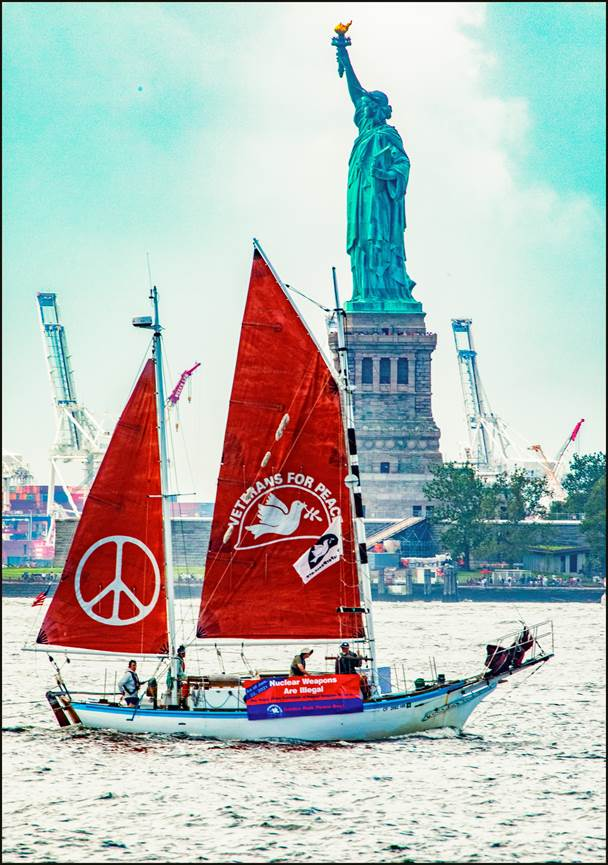
22,000+ miles voyaging for nuclear disarmament
and a radiation-free environment https://vfpgoldenruleproject.org/
To see nuclear-related stories in greater depth and intensity – go to https://nuclearinformation.wordpress.com
-
Archives
- July 2026 (251)
- June 2026 (287)
- May 2026 (306)
- April 2026 (356)
- March 2026 (251)
- February 2026 (267)
- January 2026 (308)
- December 2025 (358)
- November 2025 (359)
- October 2025 (375)
- September 2025 (257)
- August 2025 (319)
-
Categories
- 1
- 1 NUCLEAR ISSUES
- business and costs
- climate change
- culture and arts
- ENERGY
- environment
- health
- history
- indigenous issues
- Legal
- marketing of nuclear
- media
- opposition to nuclear
- PERSONAL STORIES
- politics
- politics international
- Religion and ethics
- safety
- secrets,lies and civil liberties
- spinbuster
- technology
- Uranium
- wastes
- weapons and war
- Women
- 2 WORLD
- ACTION
- AFRICA
- Atrocities
- AUSTRALIA
- Christina's notes
- Christina's themes
- culture and arts
- Events
- Fuk 2022
- Fuk 2023
- Fukushima 2017
- Fukushima 2018
- fukushima 2019
- Fukushima 2020
- Fukushima 2021
- general
- global warming
- Humour (God we need it)
- Nuclear
- RARE EARTHS
- Reference
- resources – print
- Resources -audiovicual
- Weekly Newsletter
- World
- World Nuclear
- YouTube
-
RSS
Entries RSS
Comments RSS
 nuclear-news