Australia destroyed Aboriginals’ reputation, to get land for uranium mining
 Government had made it clear that it wished to re-engage itself more directly in the control of community land through leasing options as well as to open up Aboriginal land for development and mining purposes.
The plan was to empty the homelands, and this has not changed. However, it was recognised that achieving this would be politically fraught – it would need to be accomplished in a manner that would not off-side mainstream Australia. Removing Aboriginal people from their land and taking control over their communities would need to be presented in a way that Australians would believe it to be to Aboriginal advantage, whatever the tactics.
So began the campaign to discredit the people and to publicly stigmatise Aboriginal men of the Northern Territory
And even in 2009 when the CEO of the Australian Crime Commission, John Lawler, reported that his investigation had shown there were no organised paedophile rings operating in the NT, no formal apology was ever made to the Aboriginal men and their families who were brutally shamed by the false claims.
 Sixth Anniversary of the Northern Territory Intervention – Striking the Wrong Note Lateral Love Australia‘concerned Australians’ Michele Harris, 21 June 13 Aboriginal advocate Olga Havnen, in her Lowitja O’Donoghue oration has asked a critical question. She asks what has been the psychological impact of the Intervention on Aboriginal people of the Northern Territory. It is surprising that so little attention has been given to this critical, yet in some ways tenuous, link before now.
Even before the Intervention began in June 2007, government had long planned a new approach to the ‘management’ of Aboriginal people in the Northern Territory. It was no longer part of government thinking that self-determination and Aboriginal control over land could be allowed to continue. These were the Whitlam notions of 1975 and they were no longer acceptable. Continue reading
Man made greenhouse emissions caused Australia’s hottest summer
Manmade Emissions Led to the Heat Wave That Baked Australia Motherboard, By Jason Koebler, 27 June 13 Scientists are 90 percent sure this year’s Australian heat wave couldn’t have happened without manmade influence. Photo: CIA
Surprise, surprise: The record-breaking heat wave that plagued Australia earlier this year with temperatures that reached up to 121 degrees was almost certainly caused by humans, according to a new study.
The study, published in Geophysical Research Letters by scientists at the University of Melbourne and Australia’s ARC Centre of Excellence for Climate Systems Science, highlights how humans have heightened drought effects on the continent. According to the authors, “human contribution to the increased odds of Australian summer extremes like 2013 was substantial, while natural climate variations alone, including El Niño Southern Oscillation, are unlikely to explain the record temperature.”
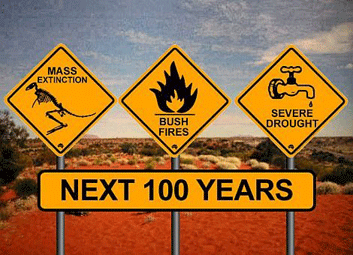
The so-called “angry summer” was easily the hottest on record, with temperatures hitting more than 27 degrees above average in some parts of the country during the first week of January. When it was happening, meteorologists with the Australian government said that though “Australia has always experienced heat waves … the event affecting much of inland Australia has definitely not been typical.”…..”The model experiments also show that these types of extreme Australian summers will become more severe and more frequent in the future, with further global warming,” she said. ”Extreme summers occur 8 times more frequently in the climate model simulations that include human influences, such as greenhouse gases, compared to the climate model simulations with only natural climate variations.” http://motherboard.vice.com/blog/manmade-emissions-led-to-the-heat-wave-that-baked-australia-1#ixzz2XZtGQ5uR
Renewable energy worldwide to overtake gas by 2016

The report comes on the heels of recent research suggesting the threat of climate change is greater than earlier estimates.
An IEA report released earlier this month warned the world is on track to surpass by more than double the two-degree Celsius warming goal set by the United Nations, unless urgent measures are taken.
The IEA’s recommendations include curtailing coal-fired power stations and phasing out fossil fuel subsidies.
Renewable energy use gaining worldwide:IEA http://www.theaustralian.com.au/business/breaking-news/renewable-energy-use-gaining-worldwideiea/story-e6frg90f-1226670621465 AAP June 27, 2013 RENEWABLES like solar and wind power represent the fastest-growing source of energy generation and will make up a quarter of the global power mix by 2018, the International Energy Agency IEA says. Continue reading
Dispossession of Aboriginal land for the benefit of mining companies
The Intervention’s extraordinary damage to the Aboriginal sense of control and wellbeing makes it the gravest policy disaster in Australia since the removal of Aboriginal children in the Stolen Generations.
The Australian Government is facilitating this exploitation of mineral wealth as well as directing the major
development contracts not to Aboriginal communities but to those tycoons heading mining companies and construction alliances.
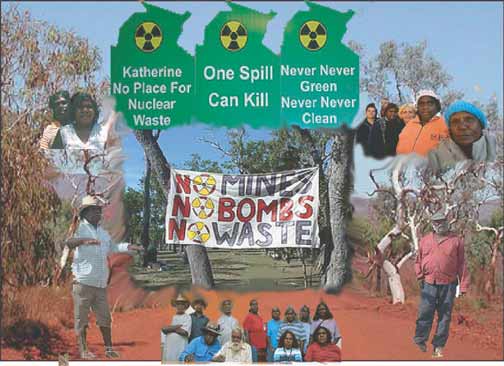
THE WAY AHEAD: The new land grab Tracker, BY JEFF MCMULLEN, JUNE 21, 2013 Neo-liberalism is ahungry beast and this 21st Century strain of capitalism is shaping the agenda for control of Aboriginal lands…..
Australian Government policy is heavily influenced by neo-liberalism through its extraordinary emphasis on managing access for mining companies to resources on Aboriginal lands. This involves controlling
what is still perceived as ‘the Aboriginal problem’ and forcing a social transition from traditional values and Cultural practice to ‘mainstream’ modernism of a particular brand. It also involves displacing many Aboriginal people from their traditional lands and concentrating them in ‘growth towns’……
Now the struggle for Aboriginal land and rights is entering a new phase because of the aggressive global marketing of the resources most essential for a fast growing human population, including water, food,
minerals, energy and the land itself.
To make any sense of the aggression behind most current Indigenous policy in Australia you need to study the impact of neo-liberalism around the globe….. Make no mistake, neo-liberalism is about dispossession. Continue reading
Catholic Pope and other religions acting on climate change
Climate change gets religious SMH, 19 June 13 Few religious communities have gone as far in fighting climate change as a church in Queensland which has 24 solar panels bolted to the roof in the shape of a Christian cross. “It’s very effective. It’s inspired some members of our congregation to install panels on their homes,” Reverend David Lowry said of the “solar cross” mounted in 2009 on the Caloundra Uniting Church, which groups three Protestant denominations.
Many religions have been wary of moving to install renewable energy sources on their places of worship, from cathedrals to mosques – or of taking a strong stand on climate change in general – despite teachings that people should be custodians of nature.
But slowly, that may be changing, thanks to new religious leaders including Pope Francis, the head of the Roman Catholic Church.
Cameco’s Australian uranium project in doubt, with 4 year record low price
Spot Uranium Falls Below $40/Pound Benchmark for First Time in Four Years http://uraniuminvestingnews.com/14766/spot-uranium-falls-below-40pound-benchmark-for-first-time-in-four-years.html June 7, 2013,The West Australian reported that spot uranium prices fell to below $40/pound for the first time since August 2009, placing pressure on uranium explorers.
As quoted in the market report:
A hearty increase in the spot price is needed to force WA’s fledgling uranium sector into first gear, with Canadian giant Cameco indicating a price of more than $70/lb is needed before it can give the green light to its massive Yeelirrie or Kintyre deposits.
Transferring nuclear wastes – it’s like a game of “Pass The Parcel”
 Australia-Euratom Nuclear Safeguards: Plutonium Retransfers …..The Agreement will enter into force when Australia notifies the Delegation to the European Commission that all domestic requirements necessary to give effect to the Agreement have been satisfied…. Department of Foreign Affairs and Trade – Australian Government 01/06/2013 | Press release distributed by noodls http://www.noodls.com/view/2FBAFE516E5E78B9F15B62CBEB136F9A32994CC7
 Australia and the European Atomic Energy Community (Euratom) exchanged diplomatic notes in Canberra on 28 May 1998 as the first step towards bringing into force an Agreement under which Australia will – subject to certain conditions – broaden its consent for the return from the European
  Union to Japan of Australian obligated plutonium following the reprocessing of Japanese spent fuel in Europe. The European Union is an important provider of nuclear fuel cycle services for countries purchasing Australian uranium and Japan is a major market for Australian uranium exports. Continue reading
Australian uranium companies hit by 90% fall in share price
 Coal, uranium and gold stocks among the hardest hit as good times end BY:ROBIN BROMBY The Australian May 20, 2013 “…… Among those hardest hit are coal, uranium and gold. The base metal stocks don’t seem to have suffered to quite the same degree, although few stocks have come off less than about 60 per cent.
Among those with declines of more than 90 per cent since their peak are leading uranium stocks. In their case, their peak was back in 2007. Producer Energy Resources of Australia (ERA) has come down from $18.92 then to $1.04 now. Paladin Energy (PDN) hit $10.80 back in 2007 and now sits at 94c. Bannerman Resources (BMN) with its Namibia project was a star back then at a high of $4.14, now at 5.8c…..”
Printing solar photovoltaic cells – an Australian breakthrough
“We’re using the same techniques that you would use if you were screen printing an image on to a T-Shirt,” he says.
VIDEO Printing Australia’s Largest Solar Cells http://cleantechnica.com/2013/05/19/printing-australias-largest-solar-cells/#I2hPrL1dDL6WTXwD.99 20 May 13, Scientists have produced the largest flexible, plastic solar cells in Australia – 10 times the size of what they were previously able to – thanks to a new solar cell printer that has been installed at CSIRO. The printer has allowed researchers from the Victorian Organic Solar Cell Consortium (VICOSC) – a collaboration between CSIRO, The University of Melbourne, Monash University and industry partners – to print organic photovoltaic cells the size of an A3 sheet of paper.
According to CSIRO materials scientist Dr Scott Watkins, printing cells on such a large scale opens up a huge range of possibilities for pilot applications.
“There are so many things we can do with cells this size,” he says. “We can set them into advertising signage, powering lights and other interactive elements. We can even embed them into laptop cases to provide backup power for the machine inside.”….. Continue reading
Bad news for some years for the uranium ndustry
 Uranium on the nose, The Motley Fool By Mike King – May 16, 2013 More than 26 months after the nuclear accident at Fukushima, Japan, the nuclear industry is still feeling the effects with depressed uranium prices and cost pressures that are squeezing margins……
The price for uranium has fallen 40% since Fukushima to US$40 a pound, as Japan suspended its fleet of nuclear plants, while Germany…
….. the uranium price could stagnate at current levels for many years, much like it did after previous nuclear incidents. Japan may not restart its reactors, preferring instead to seek other energy alternatives, and reactors currently under construction could still be cancelled or postponed.
That is not good news for ASX listed uranium miners Paladin, Energy Resources of Australia (ASX: ERA), Toro Energy (ASX: TOE) or Deep Yellow Limited (ASX: DYL). http://www.fool.com.au/2013/05/16/uranium-on-the-nose/
Secretive Trans Pacific Partnership can put USA companies above national laws
 Audio The secret trade deal that could let multinationals sue states ’ http://www.abc.net.au/radionational/programs/breakfast/trade-talks/4689004 RN Breakfast Presented by Fran Kelly 14 May 2013 Cathy Van Extel The latest round of negotiations for the controversial Trans Pacific Partnership starts today in Lima, Peru. The TPP is a multinational trade deal involving 12 countries, including the US and Australia, and if finalised it will
  account for 40 per cent of the global economy. Cathy Van Extel reports that the outcome of the Australian federal election is likely to have a big impact on the terms of the deal. The latest round of negotiations for the controversial Trans Pacific Partnership is kicking off in the Peruvian capital of Lima today.
The TPP is a multinational trade deal involving 12 countries including the US and Australia. If finalised it’ll account for 40 per cent of the global economy.
The trade talks are heavily shrouded in secrecy—and critics are concerned the TPP will benefit multinational corporations at the expense of existing labour and social protections.
The US has been pushing for an agreement by October this year and the Australian federal election is likely to have a big impact on the terms of the major trade deal. The wide ranging trade deal has been under negotiation since 2010 behind closed doors, and that’s a worry for critics like Jane Kelsey, professor of law from the University of Auckland and an activist academic.
She says it’s being rushed through with no public scrutiny. Continue reading
Rotten nuclear colonialism – example, Paladin uranium in Malawi
Of the profits made, Paladin, for instance rakes in about 80% and has a paltry 1.5% for the Malawi nation
Paladin says in one breath it paid over U$5.6 million in taxes to the Malawi government, and in its other breath through its published annual report, indicates it paid about U$9.3 million in taxes.
the British silently stole our uranium and left when their projections did not add up to their whims, and now we have the Aussies who are refusing to deal fairly.
Killing Malawians through the rotten extractives deals: The case of Paladin’s uranium mining http://www.nyasatimes.com/2013/04/24/killing-malawians-through-the-rotten-extractives-deals-the-case-of-paladins-uranium-mining/ Patricia Masinga, April 24, 2013 Malawi has in the few weeks been engaged by a plethora of stakeholders discussing strategies to revive, or more on the ground, reclaim the benefits that Malawians are been milked of by the so-called extractive industry multi-national corporations.
They call themselves investors, and government believes that the Malawi Development Goals (MDGs – who cares if it’s the second phase) will be boosted, particularly that mining alone through Kayerekera of Paladin Energy Limited group of companies (trading as Paladin (Africa) Ltd in Malawi?) could provide a large economic base.
But that is all a fat lie. Paladin and many other foreign multinational mining countries are least interested to contributing to the Malawi economic growth. They are here to milk the country – exploiting all that it has rich in minerals and dump us when the time is right even poorer.
Imagine, to screw Malawians of their rightful economic gains, the company, incorporated in Australia first listed on the Australian Stock Exchange (ASX) on March 29, 1994 under code ‘PDN’, and quickly changed its name from Paladin Resources NL to Paladin Resources Ltd in 2000 and listed under the Toronto Stock Exchnage (TSX) in Canada April 29, 2005, and again changed its name to Paladin Energy Ltd in November 2007 and listed on the Namibian Stock Exchnage on February 2008.
By such trends, one is compeled to question the motive, Continue reading
Radiation is “good for you”claim by Australian uranium mining company
Stuff to do with Hormesis, Paul Langley’s Nuclear History Blog, 25 April 13, “Addressing the South Australian Chamber of Mines and Energy in Adelaide, chair of the uranium company Toro Energy Erica Smyth said the true cost of coal was not yet being paid for by the community. She also said that there was a strong argument that some radiation “was good for you” …..” Adelaide Advertiser newspaper, August 13, 2011 page 7.
Smyth, representing her employer, a uranium miner, states that a “strong” “argument” claims that “some radiation” was “good for you”.
How much uranium is required to produce this “good radiation” ? And how is that “good radiation” to delivered to the people of this state? Via the milkman? The radiation emitted by uranium and its decay products have to be present within the human body to have any effect. How would a purchaser of the product know that the radiation emitted was “good”?
What are the “arguments” Smith refers to? She does not say.
How “strong” are these arguments? We don’t know, Smyth does not debate the issue, she merely states her position in relation to the “strong argument”. Smith is obviously all for the idea that “some” radiation is “good for you”. If one is not thinking, but listening as if the information were an advert for a desirable product, one might really want it……
The substances extracted by uranium mining consist of uranium and its decay products. So let’s have a look at these substances and the radiations they emit. Continue reading
Australian doctors reject uranium lobby’s push to remove safeguards
It is essential that appropriate environmental and human safeguards remain, and that uranium mining and milling remains within the definition of “nuclear actions” for the purposes of the EPBC Act. There is a clear need for federal oversight to ensure clear and consistent implementation of these measures
 Medical Assocation for the Prevention of War (MAPW) SUBMISSION ON FEDERAL REGULATION OF URANIUM MINING, by Dr Margaret Beavis April 2013 The uranium mining industry is attempting to remove federal overview of uranium mining. MAPW Vice-President Dr Margaret Beavis has prepared this submission to the Productivity Commission arguing that federal oversight should remain, and noting that as risks to health and the environment become more apparent, radiation regulation is increasing internationally.:
It is concerning that the uranium industry has used the expression “mild radiation” to describe its radiological environmental impacts, when there is no regulatory basis or definition to use this term, potentially giving the impression that the levels of radiation in the uranium mining industry are without risk to the environment. The evidence is clear and unassailable that this is not correct. Furthermore, it is appropriate that uranium mining continue to be considered a ‘nuclear action’ as specified by the EPBC Act as the radioactivity derives specifically from nuclear decay processes. Tailings from uranium mining are radioactive for millennia, resulting in unique environmental considerations for every uranium mine.
The International Commission on Radiological Protection has determined that the dose coefficient for radon gas, one of the sources of radioactivity from uranium mining, needs to be doubled, indicating that it is actually thought to be double the previously estimated carcinogenic hazard.1. ARPANSA is currently in the process of revising dose estimates to workers. It follows that risks to others is doubled and makes it even more essential appropriate mitigation strategies are introduced. It also follows that the environmental risk is also increased. Continue reading
Asbestos killed a town. Uranium towns next?
WA GOVERNMENT TO MOVE LAST RESIDENTS FROM ASBESTOS TOWN ABC Radio National 3 April 2013 By:Catherine Van Extel The West Australian Government is looking to move a group of residents who continue to live in the deadly asbestos mining town of Wittenoom, in the Pilbara region of Western Australia. But while there are moves to finally clean up the toxic site, many continue to face the legacy of their time spent growing up in or visiting the notorious town.
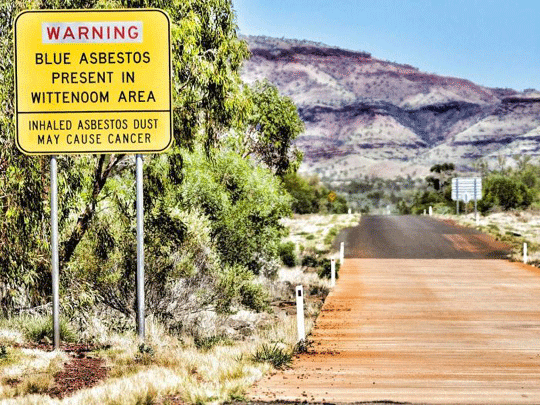
The 1990 Midnight Oil song ‘Blue Sky Mine’ was inspired by Wittenoom and its deadly mining industry. It’s estimated that more than 20,000 people lived at Wittenoom before the mine closed in 1966.
Asbestos-related diseases have killed more than 2000 former workers and family members of Wittenoom, a death toll that continues to rise.
In 2007, the state government withdrew Wittenoom’s town status—disconnecting services like water and electricity—but a small group of residents stayed. Now the government wants them out in order to remediate the contaminated site. Continue reading
1 This Month



26 September – International Day for the Total Elimination of Nuclear Weapons


PLEASE OPPOSE HR 8255 AND S.3639 – bills would accelerate satellite deployment, with no environmental review or safeguards – https://ncstd5li.quorum.us/campaign/169331/
To see nuclear-related stories in greater depth and intensity – go to https://nuclearinformation.wordpress.com
-
Archives
- September 2026 (245)
- August 2026 (330)
- July 2026 (355)
- June 2026 (287)
- May 2026 (306)
- April 2026 (356)
- March 2026 (251)
- February 2026 (267)
- January 2026 (308)
- December 2025 (358)
- November 2025 (359)
- October 2025 (375)
-
Categories
- 1
- 1 NUCLEAR ISSUES
- business and costs
- climate change
- culture and arts
- ENERGY
- environment
- health
- history
- indigenous issues
- Legal
- marketing of nuclear
- media
- opposition to nuclear
- PERSONAL STORIES
- politics
- politics international
- Religion and ethics
- safety
- secrets,lies and civil liberties
- spinbuster
- technology
- Uranium
- wastes
- weapons and war
- Women
- 2 WORLD
- ACTION
- AFRICA
- Atrocities
- AUSTRALIA
- Christina's notes
- Christina's themes
- culture and arts
- Events
- Fuk 2022
- Fuk 2023
- Fukushima 2017
- Fukushima 2018
- fukushima 2019
- Fukushima 2020
- Fukushima 2021
- general
- global warming
- Humour (God we need it)
- Nuclear
- RARE EARTHS
- Reference
- resources – print
- Resources -audiovicual
- Weekly Newsletter
- World
- World Nuclear
- YouTube
-
RSS
Entries RSS
Comments RSS
 nuclear-news