Solar’s stunning journey from lab curiosity to global juggernaut wiping out fossil fuels
One of the four Australian solar researchers who have won the world’s most
prestigious engineering prize says it won’t be long before solar is at a
cost level across the world where it will “wipe fossil fuels out of the
global economy.
Renew Economy 10th Feb 2023
The US is preparing Australia to fight its war against China

The United States is not preparing to go to war against China. The United States is preparing Australia to go to war against China.
Defence and military weapons manufacturing industries in Australia are now largely owned by US weapons corporations – Lockheed Martin, Raytheon, Boeing, Thales, NorthropGrumman. The deep integration of Australia’s defence industries and economy into the US military-industrial complex greatly influences Australia’s foreign/defence policies.
The Threat. All these preparations are justified by the false premise that China presents a military threat. China has not invaded anywhere. It has never proposed use of force against other countries. It has enshrined in its Constitution the ‘Three No’s – No military alliances; No military bases; No use, or threat to use, military force. China has, however, reserved the right to use force to prevent secession by Taiwan.
Guardian, By John Lander, Feb 1, 2023 Edited transcript of a speech to the Committee for the Republic, Salon, 18 January 2023.
The ANZUS Treaty
A look at the ANZUS Treaty and the way it has been manipulated over time will explain why I have come to this conclusion.
Originally defensive in concept, the ANZUS Treaty was seen by Australia from its very beginning as a means to “achieve the acceptance by the USA of responsibility in SE Asia” (Percy Spender) to shield Australia from perceived antagonistic forces in its region. It has, however, developed into an instrument for the furtherance of US ability to prosecute war globally – previously in Iraq and Afghanistan, currently against Russia and potentially against China.
The ANZUS Treaty, usually referred to in reverential tones as “The Alliance”, has been elevated to an almost religious article of faith, against which any demur is treated as heresy amounting to treachery. Out of anxiety to cement the US into protection of Australia, the Alliance has been invoked as justification for Australia’s participation in almost every American military adventure – or misadventure – since WW II.
Unlike NATO or the Defence Treaty with Japan, the ANZUS treaty actually provides no guarantee of protection, merely assurances to consult on appropriated means of support in the event that Australia should come under attack.
On the other hand, the Alliance has facilitated the steady growth of American presence in Australia, to the point that it pervades every aspect of Australian political, economic, financial, social and cultural life. Australians fret about China “buying up the country”, but American investment is ten times the size.
They are unaware or uncaring that almost every major Australian company across the resources, food, retail, mass media, entertainment, banking and finance sectors has majority American ownership. Right now US corporations eclipse everyone else in their ability to influence our politics through their investment in Australian stocks.

The transfer of Australian assets to American ownership has continued unabated: In the second half of 2021 then Treasurer Josh Frydenberg approved the transfer of $130 billion of Australian assets to foreign private equity funds, benefiting Goldman Sachs who facilitated the transactions, by multimillions of dollars. Josh Frydenberg now is employed by Goldman Sachs:
- Sydney Airport – Macquarie Bank led by a NY investment banker
- AusNet (electricity infrastructure) $18 billion takeover by Brookfield – NY via Canada
- SparkInfrastructure (electricity) $5.2 billion takeover by American interests
- AfterPay financial transaction system $39 billion takeover
- Healthscope, second-biggest private hospitals group (72 Hospitals) taken over by Brookfield and now controlled in the Cayman Islands.
The USA and the UK between them represent nearly half of all foreign investment. China plus Hong Kong represents 4.2%. The 4 big “Aussie” banks are dependent on foreign capital which dictate local banks’ policies and operations.
Defence and military weapons manufacturing industries in Australia are now largely owned by US weapons corporations – Lockheed Martin, Raytheon, Boeing, Thales, NorthropGrumman. The deep integration of Australia’s defence industries and economy into the US military-industrial complex greatly influences Australia’s foreign/defence policies.
That, plus US capture of Australia’s intelligence and policy apparatus through the “Five Eyes” network and ASPI (which has lobbyists from American arms manufacturers on a Board headed by an operative trained by the CIA) means that the US is able to swing Australian policy to support America in almost all its endeavours.
Despite the fact that it contains no guarantee of US protection of Australia, the Treaty and further arrangements under its auspices, such as the 2014 Force Posture Agreement and now AUKUS, have greatly facilitated US war preparation in Australia. This has accelerated exponentially in the past few years. The US now describes Australia as the most important base for the projection of US power in the Indo-Pacific.
Indicators of war preparations
* 2,500 US marines stationed in Darwin practicing for war with the Australian Defence Forces, soon to include the Japanese Defence Forces
* Establishment of a regional HQ for the U.S. Indo-Pacific Command in Darwin
* Lengthening the RAAF aircraft runways in Northern Territory at our expense for servicing US fighters and bombers
* Proposed stationing of 6 nuclear weapons-capable B52 Bombers at RAAF Tindal in NT
* Construction of massive fuel and maintenance facilities in Darwin NT for US aircraft
* Proposed acquisition of eight nuclear-propelled submarines at the cost of $170 billion for hunter-killer operations in the Taiwan Strait
* Construction, at the cost of $10 billion, of a deep water port on Australia’s east coast for US and UK nuclear powered and nuclear missile-carrying submarines
* The long-established satellite communications station known as Pine Gap in central Australia has recently, and is still being, expanded and upgraded. It is key to the command and control of US forces in the Indo-Pacific (and even as far afield as Ukraine)
The Government and right wing anti-China analysts and commentators, whose opinions dominate main stream media, accept the Defence Minister’s contention that this militarisation enhances Australia’s sovereignty by strengthening the range and lethality of Australia’s high-end war-fighting capability to provide a credible deterrent to a potential aggressor.
Many analysts and commentators outside the governing elite, including myself, argue that these arrangements effectively cede Australian sovereignty to America. This is especially because of the provisions of the Force Posture Agreement of 2014, entered into under the auspices of ANZUS.
I understand that a paper has been circulated to the Committee, expounding the details of the FPA, so in summary, it gives unimpeded access, exclusive control and use of agreed facilities and areas to US personnel, aircraft, ships and vehicles and gives Australia absolutely no say at all in how, when where and why they are to be used.
All Australian analysts, whether sympathetic or antipathetic to China, agree on one point. That is, that if the US goes to war against China over the status of Taiwan, or any other issue of contention, Australia will inevitably be involved.
The Threat
All these preparations are justified by the false premise that China presents a military threat. China has not invaded anywhere. It has never proposed use of force against other countries. It has enshrined in its Constitution the ‘Three No’s – No military alliances; No military bases; No use, or threat to use, military force. China has, however, reserved the right to use force to prevent secession by Taiwan.
It has recently rapidly increased its defence capability in response to the fearsome US naval presence and war-fighting exercises just off its coastline. Its defence budget is one third that of the US and the bases that it has constructed in the South China Sea pale into insignificance compared to the hundreds of bases that the US has ranged all around China.
So, if China is not a military threat, why is it designated as the primary systemic threat of the collective West, led by the US? The answer lies in the word “systemic”. China has expressed a determination to revamp the global financial system to make it fairer for developing countries. Kissinger is reputed to have said: “If you control money, you control the world”. The US currently controls world finance and China (with Russia) is out to change that.
The US, which played the leading part in the establishment of the post-World War II institutions, has become a leading revisionist, abandoning the UN for “coalitions of the willing”. The US has declined to join important Conventions like those on the Law of the Sea and on Climate. It has refused to accept the jurisdiction of the International Court of Justice and the International Criminal Court, and has exempted itself from the Genocide Convention. It has played a leading part in the weakening of the World Trade Organisation by imposing trade restrictions on other countries, while not agreeing to new appointments to the WTO’s appellate tribunal, so preventing that body from functioning.
China is the second-largest (or by some calculations, the largest) economy in the world. It is the major trading partner of over 100 countries, mainly in the global south, but including Australia and a number of other Western countries. Hence China has the clout to undermine the “international rules-based order” set up by, and for the benefit of, the West.
China has already established an alternative to the Anglo-American international financial transaction system: – the Cross-border Interbank Payments System CIPS, (in which, ironically a number of Western banks are shareholders). In collaboration with Russia and within the BRICS (Brazil, Russia, India, China & South Africa) China is creating an alternative to the almighty dollar as the preferred currency for trade and for national reserve holdings.
It seems that the US has concluded that, since it can’t constrain China economically, it will have to get it bogged down in a long-drawn-out war to hinder its economic growth and hamper its infrastructure development cooperation with other countries. On 25 March 2021 President Biden vowed to prevent China from overtaking the US as the most powerful country in the world – “not on my watch” he said.
Nevertheless, the latest CSIS computer modelling, like previous modelling by the Rand Corporation, indicates that all involved in a Sino-US war would lose.
Proxy War
All of these analyses overlook one significant point. US determination to pursue the Wolfowitz doctrine of preventing the rise of any power that could challenge US global supremacy (neither Russia, nor Europe, nor China) has not diminished, but has morphed into a strategy of fighting its adversaries by proxy.
This has been clearly demonstrated by the war in Ukraine. A White House press briefing on 25 January 2022, before the Russian intervention, stated that “the US, in concert with its European partners, will weaken Russia to the point where it can exercise no influence on the international stage”.
Political leaders from Biden, through Pelosi and on to Members of Congress have told Ukraine that “your war is our war and we are in it for as long as it takes”. Congressman Adam Schiff put it bluntly that “we support Ukraine… to fight Russia over there, so that we don’t have to fight it over here”.
In the case of China, defined in the NDS as the principal threat to the US, the proxy of choice is clearly Taiwan. The strategy envisages:
• a world-wide media campaign (going on for several years already) to portray China as the aggressor;
• goading China into taking military action to prevent Taiwan’s secession;
• leaving Taiwan to conduct its own defence, with constant resupply of arms and equipment from the US, at great profit to the military/industrial complex;
• sustaining Taiwan sufficiently to keep China ‘bogged down’, thus hampering its economic development and its infrastructure cooperation with other countries;
• avoiding direct military engagement, in order to maintain the full capacity of US forces, while China’s would be significantly depleted; Although Biden has publicly re-affirmed adherence to the ‘One China’ principle, the US has been goading China by;
• stationing the bulk its naval power off the coast of China;
• ‘freedom of navigation’ and combat exercises in the South China Sea and Taiwan Straits;
• visits by senior US officials using US military aircraft;
• creation of a putative ‘Air Defence Identification Zone’ (ADIZ) extending well over mainland territory and then alleging Chinese violation of it;
• secretly providing military training personnel (whilst denying it);
• including Taiwan in the Summit for Democracy (9-10 December 2021), implying it is a separate country;
Many Australian politicians, (although not the present government), joined in goading China, by encouraging Taiwan to consider the possibility of declaring independence, which would trigger military action by China.
If Australia were to make good on its promise to ‘save Taiwan’, it would be devastated:
• The Australian navy would be obliterated, given the disparity between China’s and Australia’s forces;
* command/control centres (and possibly cities) in Australia could be wiped out by Chinese missiles. Australia has no anti-missile defence;
• To preserve its own assets, and to forestall the descent into nuclear conflict, the US would not engage directly in defence of Australia;
• US ‘support’ would be through massive arms sales to replace our losses – just as in Ukraine – at further profit to the US military/industrial complex;
• ASEAN is unlikely to support Australia. It has renewed and up-graded its Comprehensive Strategic Partnership with China. Each member country has infrastructure projects under China’s BRI, which they would not want to jeopardise in a ‘no-win war’;
Support from India is unlikely, despite its membership of the Quad – which is nothing more than a consultative dialogue. India has security commitments to China under the SCO and gets its arms from Russia, which has a “better than treaty” relationship with China.
• Australia relies heavily on China for many daily necessities. In a war, deliveries from China would be severely disrupted.
The increasing size of China’s economic (and, by extension military) strength, to which Australia contributes important resources and from which it derives so much benefit, is portrayed as a threat to Australia’s security. This has Australia trapped in the absurd policy paradox of preparing to go to war against China to protect Australia’s trade with China.
Recent developments in Taiwan, particularly the county and municipal elections, which caused the President, Tsai Ingwen, to resign her leadership of the pro-Independence Party, suggest that Taiwan prefers the status quo and is unwilling to be the proxy of the US in a war with Beijing.
Australia thus becomes the potential proxy.
In the name of the Alliance, American service personnel (active and retired) are now embedded in Australian defence policy making institutions and in command and control positions within the ADF. All of the American military assets installed in Australia under the Alliance and the AUKUS deal, are now “interchangeable” with the ADF, making it possible to use them as putative Australian forces against China, while the US stands aside and maintains the same pretence of “no engagement”, as it is doing in Ukraine.
This is why I said at the beginning that the US is preparing to send Australia to war against China.
Whilst these are the dangers that the ANZUS Alliance poses for Australia if the US instigates a war against China, there are risks for the US also.
1. There would be crippling expense that further exacerbates the US wealth divide and related domestic political breakdown. Supplying the weaponry and everything else required for a proxy war with China would be a bigger drain on the US budget than the Ukraine conflict. The expenditure would flow back to the military industrial complex, constituting a further massive transfer of wealth from the ordinary taxpayer to the plutocrat billionaires. It would blow out the already unsustainable national debt, and either take away from expenditure on essential services and infrastructure, or, if they print money, further blow out inflation. The political and social breakdown that the US is already suffering as a consequence of its real economic decline and widening wealth gap could only intensify to breaking point.
2. The slide into a direct war would probably be inevitable. Planning a proxy war is all very well as an academic exercise, but sticking with those plans when the fighting starts will be very difficult. There are already lunatic politicians and “experts” in the US who think America can win a direct war, so when China starts bombing Australia, and good old Aussie “mates” are dying in massive numbers, the voices of those in the US advocating direct engagement will be amplified. Combined with the already extreme polarisation of US politics in which ONLY war is bipartisan, the risk that extremists will take the US into direct conflict, and a nuclear showdown with China, is very serious.
3. The folding in of Japan into the AUKUS arrangements will increase the risk that Japan would be obliged to assist Australia in any military conflict with China. The US, because of its Defence Treaty with Japan, would then be obliged to join in the fighting, vitiating its plan to avoid direct military engagement.
A point of historical irony:
I’ll wind up with a bit of historical irony, in which I was personally involved:
In the early 70’s, we had been kept completely in the dark about the secret Kissinger visits to China, until the plan for Nixon to visit was announced. Feeling blindsided by a momentous change in US policy towards China, we produced Policy Planning Paper QP11/71 of 21 July 1971.
It recognised.. “political disadvantage resulting from the manner in which the United States conducts its global policies” and argued that this would mean that. “The American alliance, in a changing power balance, will mean less to us than it has in the past.”
It went on:
“If anything, this argument has been strengthened by recent United States actions and America’s failure to consult us on issues of primary importance to Australia. Accordingly, we shall need, now more than ever, to formulate independent policies, based on Australian national interests and those of our near neighbours…”
This is even more true today than it was in the 1970’s. For example, Australia was not consulted in the precipitate US withdrawal from Afghanistan, despite our role as ‘loyal’ supporter of the US in that ill-advised conflict. Our indignant protestations were met with Biden’s statement that “America acts only in its own interests”.
Our present predicament is due largely to the failure of a succession of Australian Governments to take this analysis to heart and act upon it. Prime Minister Fraser, who replaced Whitlam, ironically came to a very similar view towards the end of his life, which he set forth in detail in his book ‘Dangerous Allies’, but too late to do anything about it. He identified the paradox that Australia needs the US for its defence, but it only needs defending because of the US.
A couple of pertinent quotes, first from the late Jim Molan:
“Our forces were not designed to have any significant independent strategic impact. They were purely designed to provide niche components of larger American missions.”
We were, in his view, abdicating our own defence and cultivating complete dependence on the Americans.
And from Chris Hedges:
“Finally, the neo-cons who have led the U.S. into the serial debacles of Afghanistan, Iraq, and now Ukraine, costing the country tens of trillions of dollars and even greater amounts of destroyed reputational capital, will claim their customary immunity from any accountability for their savage failures and cheerily move on to their next calamity. We need to be on the lookout for their next gambit to pillage the treasury and advance their own private interests above those of the nation. It will surely come.”
An (incomplete) list of some of the commentators from whom I have drawn:
John Menadue – former secretary PM&C
Richard Tanter – military analyst, Nautilus Foundation
Brian Toohey – author (political and historical analysis)
Mike Scrafton was a senior Defence executive, and ministerial adviser to the minister for defence
Paul Keating was the prime minister of Australia from 1991 to 1996.
Geoff Raby AO was Australia’s ambassador to China (2007–11); He was awarded the Order of Australia for services to Australia–China relations and to international trade.
Gregory Clark began his diplomatic career with postings to Hong Kong and Moscow. He is emeritus president of Tama University in Tokyo and vice-president of the pioneering Akita International University.
Dr Mike Gilligan worked for 20 years in defence policy and evaluating military proposals for development, including time in the Pentagon on military balances in Asia.
Jocelyn Chey AM is Visiting Professor at the University of Sydney and Adjunct Professor at Western Sydney University and UTS. She formerly held diplomatic posts in China and Hong Kong. She is a Fellow of the Australian Institute of International Affairs.
Joseph Camilleri is Emeritus Professor at La Trobe University in Melbourne, a Fellow of the Australian Academy of Social Sciences, and President of Conversation at the Crossroads
David S G Goodman is the Director, China Studies Centre, University of Sydney.
Geoff Miller was Director-General, Office of National Assessments, deputy secretary, Department of Foreign Affairs, Ambassador to Japan and the Republic of Korea, and High Commissioner to New Zealand.
Cavan Hogue was Ambassador to USSR and Russia. He also worked at ANU and Macquarie universities.
Australia’s Defence Minister insists nuclear submarine deal will not damage Australia’s sovereignty

By Richard Wood • Senior Journalist 9 News, Feb 9, 2023
Defence Minister Richard Marles is hitting back at claims the AUKUS military alliance will undermine the future of Australia’s military sovereignty.
In a speech to Parliament today, he will seek to ease worries that the defence pact between Australia, Britain and the US poses any risk.
Former prime ministers Paul Keating and Malcolm Turnbull have critcised AUKUS, saying it makes Australia too dependent on the US…………
Marles’ speech to MPs comes ahead of next month’s announcement about the type of nuclear-propelled submarine technology Australia will obtain. https://www.9news.com.au/national/aukus-submarine-pact-will-not-compromise-australian-sovereignty-defence-minister-says/906cf0bc-0c2f-426b-9720-0acaae9ad5c8
‘We need a plan B’: Australian Unions have ‘deep concerns’ about AUKUS pact

The shipbuilding federation – which represents unions including the AMWU, Electrical Trades Union and the Australian Workers Union – is urging the government to build an additional six conventionally powered submarines in Australia before the arrival of a fleet of nuclear-powered submarines.
The shipbuilding federation – which represents unions including the AMWU, Electrical Trades Union and the Australian Workers Union – is urging the government to build an additional six conventionally powered submarines in Australia before the arrival of a fleet of nuclear-powered submarines.
Matthew Knott, February 7, 2023 https://www.theage.com.au/politics/federal/we-need-a-plan-b-unions-have-deep-concerns-about-aukus-pact-20230206-p5ciaf.html
Labor’s traditional union allies say they harbour deep concerns about Australia’s plan to acquire a fleet of nuclear-powered submarines and fear the AUKUS pact will not deliver the promised bonanza of Australian manufacturing jobs.
The federal government is preparing to announce the details of its nuclear-powered submarine plan in March, with preparation under way for Prime Minister Anthony Albanese to travel to Washington for a possible joint press conference with US President Joe Biden and British Prime Minister Rishi Sunak
During a visit to Washington over the weekend, Defence Minister Richard Marles said AUKUS would create “thousands” of new local jobs and expressed confidence Australia would not be left with a capability gap between the retirement of the current Collins class fleet and the arrival of nuclear-powered vessels.
Despite Marles’ assurances, Australian Shipbuilding Federation of Unions national convener Glenn Thompson said he remained “apprehensive” about a possible capability gap and urged the government to develop a backup plan in case AUKUS falls over.
“It’s one thing to say that this is going to create thousands of jobs, but you actually have to be able to build something well in advance of whatever AUKUS comes up with,” said Thompson, an assistant national secretary of the Australian Manufacturing Workers Union (AMWU).
“It’s of great concern to us about where the workforce is coming from and how are we addressing the issue of Australia’s sovereignty.”
Thompson noted there had been no pledge from the government that AUKUS would create as many local jobs as the 5000 positions promised under the cancelled contract with French company Naval Group.
The shipbuilding federation – which represents unions including the AMWU, Electrical Trades Union and the Australian Workers Union – is urging the government to build an additional six conventionally powered submarines in Australia before the arrival of a fleet of nuclear-powered submarines.
Marles last week stated definitively that the government “has no plans for any conventionally powered interim submarine capability, as we move towards gaining the nuclear-powered submarine capability”. Senior defence figures, including in the Navy, have fiercely resisted the idea of an interim conventional submarine.
“There’s a whole lot of uncertainties,” Thompson said of the AUKUS pact. “I just think from a capability perspective the country needs to have a plan B.”
Thompson said he feared local construction of the nuclear-powered submarines would not begin until the late 2040s or early 2050s, a decade after the Collins-class vessels begin being decommissioned.
“It’s very rare that these defence projects deliver on time,” he said. “By the mid-2040s you could have two-thirds of the existing fleet retired, so there could be a substantial capability gap.”
Marles told The Sydney Morning Herald and The Age last month that AUKUS would be “a genuine three-country collaboration”, raising expectations Australia will acquire a joint next-generation submarine model combining American and British technology.
While not specifying what proportion of the submarines would be built in Australia, Marles said the Osborne Naval Shipyard in Adelaide would play a major role in the project.
“We must develop an industrial capability in Australia,” he said. “That’s the only way this can work, and that’s what will be expected of us by both the UK and the US.”
Marles told parliament on Monday the government was “on track” to make its AUKUS announcement in the very near future.
He said while there had been a “very real potential of a capability gap opening up with our submarines, I am confident that the pathway we announced will provide a solution to this”.
The US shooting down a Chinese spy balloon is a risk for Australia
Michael West Media, by Rex Patrick | Feb 6, 2023 |
For many Australians watching the events over the past week, where the United States Air Force tracked a Chinese balloon overflying US territory and then shot it down, might seem to be of indirect significance to our security. Former senator and submariner, Rex Patrick suggests that it is of direct significance to Australia, increasing the risk we might be drawn into war in South East Asia.
Over the weekend the US Air Force shot down a Chinese balloon. The United States have said that the balloon was carrying out intelligence gathering. The Chinese Government has said it wasn’t. They claim it was just a wandering weather balloon. That’s important for reasons I’ll come back to, but I first need to provide some background – not about balloons, but about another surveillance platform.
What submarines do
Submarines can perform a whole range of different tasks in time of war……………………….
In preparing for war they train, they engage in tactical development and they conduct intelligence gathering. It is the latter which is their most important and challenging tasks………………….
Balloons and ballast tanks
…. Imagine a South Korean, Japanese or Australian submarine operating very close to (or perhaps inside) China’s territorial waters conducting intelligence gathering. China might now be inclined to treat that submarine the same way the United States treated a balloon purported to be conducting intelligence collection.
If detected, even if just outside of their territorial waters, the Chinese will just say they were inside their waters when, or in the minutes before, they were engaged. We’ll say, just as the US has for the balloon, that we weren’t spying and they’ll say we were.
And getting detected in our newest Australian submarine, the 20 year old HMAS Rankin, is far more likely than is the case for South Korea’s newest submarine, the 1 year old ROKS Dosan Ahn Changho, or Japan’s newest submarine, the 1 year old Tōryū.
The stakes are greater for us because Australian governments of various political flavours have left us with ageing Collins Class submarines to carry out this most serious and complex of peace time tasks.
One option would be to eventually withdraw our ageing Collins class submarines from surveillance operations anywhere close to Chinese waters, but that’s unlikely. Our Navy and our government will be anxious to continue to do all they can to assist the United States Navy in the Northern Pacific, in the Sea of Japan and the South China Sea.
Alliances are not just pieces of paper, they are dynamic relationships in which there’s a strong obligation to contribute and share risk.
The China risk
The risks are likely to increase in the years ahead, as China continues to ramp up military tensions in an effort to coerce Taiwan into some form of political subordination to Beijing.
The possibility that China will choose a vessel of a US ally to make an example of cannot be dismissed.
And that risk will be disproportionately carried by our Navy as it operates a submarine force with decreasing relative capability across the next two decades or longer. Thanks to government spending $170bn pursuing a distant nuclear-powered capability, our submariners will be at greater risk in less capable vessels than our so-called ‘great and powerful’ friend.
For a long time, we’ve been able to see Defence procurement failures and kick ourselves on account of cost to the taxpayer. Now, as the balloon goes up in the South China Sea, the lack of capability may well cost us many lives.
It’s not just about a war before the arrival of new submarines in 2040, its all the peace time intelligence operations between now and then. https://michaelwest.com.au/the-us-shooting-down-a-chinese-spy-balloon-is-a-risk-for-australias-tired-submarine-fleet/—
‘Save the only planet we have’: Tony Abbott joins climate-sceptic think tank
The former Australian PM says he has joined the Global Warming Policy Foundation, a UK think tank founded by a ‘climate denier-in-chief’.
Former prime minister Tony Abbott, who once compared taking action on climate change with killing goats “to appease volcano gods”, has joined the board of a UK climate-sceptic think tank founded by a politician dubbed “the climate denier-in-chief”.
Abbott said he was pleased to join the Global Warming Policy Foundation (GWPF), which “consistently injected a note of realism into the climate debate”, despite the charity spearheading the backlash against the UK government’s net-zero goal.
“All of us want to save the only planet we have, but this should not be by means which impoverish poorer people in richer countries and hold poorer countries back,” Abbott said of his appointment.
“Right now, in countries like Australia, the impact of climate policy is to make electricity less affordable and less reliable rather than perceptibly to cool the planet.
“We need more genuine science and less groupthink in this debate. That’s where the GWPF has been a commendably consistent if lonely voice.”
The GWPF was founded in 2009 by Thatcher-era chancellor Nigel Lawson, who reportedly resigned from the House of Lords last month. Described by UK Green Party co-leader Adrian Ramsay as the “climate denier-in-chief”, Lawson claimed that “global warming is not a problem” in a 2021 article written for The Spectator during the COP26 in Glasgow.
The foundation’s director, Benny Peiser, also made headlines for spurious statements, including that he found it “extraordinary that anyone should think there is a climate crisis” and that climate “alarmism” was driven by “scientists’ computer modelling rather than observational evidence”.
Despite Lawson’s apparent departure from politics, his foundation continues to cause a headache for UK Prime Minister Rishi Sunak. There has been outrage after a UK register of interests disclosure revealed Conservative MP Steve Baker accepted a £10,000 (A$17,464) donation from the chair of GWPF’s Net Zero Watch.
The campaign arm has urged the UK government to recommit to fossil fuels, commission a fleet of coal-fired power plants, and wind down wind and solar completely, while its alleged breaches of charity law were the subject of a complaint from three British MPs in October.
This isn’t Abbott’s first brush with the foundation. In 2017 he delivered an eyebrow-raising annual lecture that suggested climate change was “probably doing good; or at least, more good than harm”.
Abbott also claimed that photos from his electorate showed the sea level hadn’t risen. (The Bureau of Meteorology found last year that the rates of sea level rise to the north and south-east of Australia have been “significantly higher” than the global average for the past 30 years.)
“Contrary to the breathless assertions that climate change is behind every weather event, in Australia the floods are not bigger, the bushfires are not worse, the droughts are not deeper or longer, and the cyclones are not more severe than they were in the 1800s,” Abbott said at the time.
In an echo of Lawson’s claim that rising temperatures are “no bad thing: many more people die each year from cold-related illnesses than from heat-related ones”, Abbott suggested in 2017 that sweltering heatwaves are good, actually.
“There’s the evidence that higher concentrations of carbon dioxide (which is a plant food after all) are actually greening the planet and helping to lift agricultural yields,” he said. “In most countries, far more people die in cold snaps than in heatwaves, so a gradual lift in global temperatures, especially if it’s accompanied by more prosperity and more capacity to adapt to change, might even be beneficial.”
Heat is the biggest natural killer in Australia (and in the US) and has been for the past 200 years, with fatalities outstripping all other natural killers including bushfires, cyclones and floods. Research has found there were 36,000 deaths associated with heat in Australia between 2006 and 2017.
The American Colony of Australia
19 Feb 2021Western media portrays Australia as a beautiful nation with independent people and a close ally of the United States. But the American Empire has no allies, only vassal states. Australia became a colony of the American empire in 1975 after an Anglo-American coup. Australians noticed nothing since Australia had been an British colony since its inception and dispatches military forces when ordered to fight empire wars.
Missing radioactive capsule found in Western Australia
Authorities in Australia say they have found a tiny radioactive capsule
which went missing last week. Emergency services had “literally found the
needle in the haystack”, authorities in Western Australia said. A huge
search was triggered when the object was lost while being transported along
a 1,400km (870-mile) route across the state.
Mining giant Rio Tinto
apologised for losing the device, which could have posed a serious danger
if handled. The capsule – which is 6mm (0.24 inches) in diameter and 8mm
long – contains a small quantity of Caesium-137, which could cause skin
damage, burns or radiation sickness.
Emergency services used specialised
equipment including radiation detectors during their hunt. Announcing their
find on Wednesday, the state emergency services paid tribute to
“inter-agency teamwork in the face of seemingly insurmountable odds”. The
capsule was found when a vehicle equipped with specialist equipment, which
was travelling at 70 km/h, detected radiation, officials said. Portable
detection equipment was then used to locate the capsule, which was found
about 2 metres from the side of the road, they added.
BBC 1st Feb 2023
https://www.bbc.co.uk/news/world-australia-64481317
Times 1st Feb 2023
https://www.thetimes.co.uk/article/missing-radioactive-capsule-found-australia-search-vk5crqk03
Australian Radiation Protection and Nuclear Safety Agency (ARPANSA) sends specialist team to Western Australia in search for missing radioactive capsule
Nuclear safety agency joins radioactive capsule hunt
By Michael Ramsey, January 31 2023 https://www.canberratimes.com.au/story/8067912/nuclear-safety-agency-joins-radioactive-capsule-hunt/
Federal authorities are set to join the massive search for a dangerous radioactive capsule missing in Western Australia.
The 8mm by 6mm item fell out of a density gauge while being trucked from a Rio Tinto mine in the Pilbara to Perth.
Emergency services are searching a 1400km route amid warnings the Caesium-137 in the capsule could cause radiation burns or sickness if handled and potentially dangerous levels of radiation with prolonged exposure.
The Australian Radiation Protection and Nuclear Safety Agency (ARPANSA) on Tuesday said it had sent a deployment team with specialised car-mounted and portable detection equipment to join the search.
Led by WA’s Department of Fire and Emergency Services, the hunt is expected to take five days with vehicles travelling at 50km/h.
Radiation services specialists and detection and imaging equipment are also being sent to WA by the Australian Nuclear Science and Technology Organisation.
Rio Tinto has apologised and ordered an investigation into what went wrong during the haul, which was carried out by a contractor.
Emergency Services Minister Stephen Dawson flagged the WA government was likely to also probe the incident.
“How these are transported does need to be looked at,” he told ABC radio.
“It does puzzle me how such a thing can fall off the back of a truck.”
Rio said a bolt that secured the capsule within the gauge appeared to have sheared off, creating a hole just big enough for the item to escape.
The truck arrived in the Perth suburb of Malaga on January 16 but it wasn’t until nine days later that a technician realised the capsule was missing.
The capsule is smaller than a 10 cent coin but the amount of radiation it emits is equivalent to receiving 10 X-rays in an hour.
Drivers have been warned it could have become lodged in their car’s tyres.
Missing radioactive capsule: Western Australia officials admit it was weeks before anyone realised it was lost

Fire and Emergency Services official says capsule left Rio Tinto mine site on 10 January but was not found missing for 15 days
Guardian, Mostafa Rachwani, 28 Jan 23
Western Australian authorities are scrambling to find a missing radioactive capsule that is a fraction of the size of a 10c coin, conceding it was not found missing until more than two weeks after it left a Rio Tinto mine site.
The 8mm by 6mm capsule is a 19-gigabecquerel caesium 137 ceramic source, commonly used in radiation gauges, and was supposed to be contained in a secure device which had been “damaged” on a truck which travelled from the mine site north of Newman in the Pilbara to a depot in Perth.
Authorities are now searching along the 1,400km stretch of the Great Northern Highway for the capsule, which they warn can cause skin burns, radiation sickness and cancer.
At a news conference on Saturday, Darryl Ray, the acting superintendent for Western Australia’s Department of Fire and Emergency Services, said authorities were largely searching for the capsule at “strategic sites”.
He said an incident management team including the Department of Health and police had been formed.
“We have continued the search on strategic sites along the route that the vehicle had taken, concentrating on sites close to high-population areas within the metropolitan suburbs,” he said. “The search involves the use of radiation survey meters to detect the radiation levels which will help us locate the small device.
“What we are not doing is trying to find a tiny little device by eyesight. We are using the radiation detectors to locate the gamma rays, using the meters, that will help us then locate the small device.
“We have secured the GPS data from the trucking company to determine the exact route and stops that the vehicle has taken on its journey.
“We will continue to use specialist equipment to help us search the remaining known locations … in particular, the Great Northern Highway between Perth and Newman.”
The WA chief health officer, Andrew Robertson, said there were screws missing from the protective gauge holding the capsule when it was discovered missing.
“These gauges are designed to be robust and to be used in industrial settings where they may be exposed to weather and vibration, so it is unusual for a gauge to come apart like this one has,” Robertson said.
“We are conducting an investigation on all of the circumstances from when it was originally transported from the mine site, the whole of the transport route, and then its handling on arrival in Perth.”
Robertson urged anyone who found the capsule not to handle it.
“People could end up developing redness of the skin and eventually burns of the skin from the beta radiation,” he said. “If it were kept long enough and they were exposed long enough, they could also have some acute effects, including impacts on their immune system and the gastrointestinal system.”
Robertson said the capsule was “most dangerous if it is handled or if it is close to the body”.
“If you are further than five metres away from the source, certainly if you are more than 20 metres away from the source, it will pose no danger to you,” he said. “If it is closer than that, and we strongly discourage people from picking it up, certainly don’t put it in your pocket or put it in your car, don’t put it on your sideboard, it will continue to radiate.
“While you may not have immediate health effects, they can occur relatively rapidly over a short period of time if it is close to the body………………
Robertson said officials did not know the date the capsule fell off the truck.
Ray said the capsule was placed on to the pallet on 10 January at the mine site, transited and arrived at the radiation service company in Malaga on 16 January.
“It was not until the 25th, late morning, when they opened it up to reveal that the device had fallen apart, was damaged in transit, and that the actual capsule was discovered missing, which is when authorities were first notified.” ………… more https://www.theguardian.com/australia-news/2023/jan/28/missing-radioactive-capsule-wa-officials-admit-it-was-weeks-before-anyone-realised-it-was-lost
Urgent public health warning issued over lost radioactive capsule in Western Australia
“It emits both beta rays and gamma rays so if you have it close to you, you could either end up with skin damage including skin burns,” .
“And if you have it long enough near you, it could cause acute radiation sickness.
DFES have issued a warning for people to stay at least five metres away from it if they see something that resembles the capsule.
https://www.abc.net.au/news/2023-01-27/radioactive-capsule-lost-in-wa-emergency-public-health-warning/101901472 By Cason Ho 28 Jan 23
A missing radioactive capsule lost somewhere between Perth and a Pilbara mine site over an area of 1,400 kilometres has sparked an urgent health warning.
Key points:
- A capsule containing a radioactive substance has been lost
- The capsule is 6mm in diameter and 8mm wide
- People are being urged not to get close to the capsule
In an emergency press conference on Friday afternoon, WA’s chief health officer urged people to stay away from the capsule if they see it because of its radioactive properties.
The capsule is tiny – 6mm diameter by 8mm high.
The radioactive gauges are commonly used in mining. It went missing from a truck sometime after January 10.
WA radioactive substance risk alert
The radioactive capsule could be anywhere along the more than 1,400 km journey between Malaga, in Perth and Newman in WA’s remote north
Any motorists who have travelled along the Great Northern Highway between Newman and Perth since January 10 should check their tyres, in case the capsule has become lodged in them.
Chief Health Officer Andy Robertson said the capsule was lost while it was being transported, somewhere between a mine site north of Newman and Malaga, north east of Perth.
It is believed the capsule fell through the gap left by a bolt hole, after the bolt was dislodged when a container collapsed as a result of vibrations during the trip.
Authorities are searching Great Northern Highway in a desperate effort to find the capsule, which is smaller than a 10-cent piece.
DFES said the capsule “cannot be weaponised” but are still urging caution due to potentially serious health consequences.
Radiation equivalent to 10 X-rays an hour
Mr Robertson said it does emit a “reasonable” amount of radiation.
He says the radiation emitted is equivalent to receiving 10 X-rays in one hour, if you were within one metre of it, or the amount of natural radiation a body is exposed to over a year.
The half-life of the substance is 30 years.
“It emits both beta rays and gamma rays so if you have it close to you, you could either end up with skin damage including skin burns,” he said.
“And if you have it long enough near you, it could cause acute radiation sickness.
“Now that will take a period of time but obviously we are recommending people not be close to it or hang on to it.”
Mr Robertson advised anyone who finds the capsule not to go near it, and to rather call DFES on 133 337.
The Department of Fire and Emergency Services is leading search efforts, coordinating a team involving the Department of Health, WA Police, and other subject matter experts.
DFES Country North chief superintendent David Gill said there would be “challenges” in locating such a small object.
“The start and finish of the transportation from the mine site north of Newman, and the transport depot in Perth, are among some of the locations that are searched, and being searched yesterday, but the capsule remains unfound,” he said.
“There are challenges here. It is 1,400 kilometres between the mine site … to the north of Newman, and Perth.”
DFES have issued a warning for people to stay at least five metres away from it if they see something that resembles the capsule.
People are urged to avoid coming into contact with it, and immediately contact DFES.
Documents show no sign Australia’s Albanese government lobbied the US to bring Julian Assange home

https://michaelwest.com.au/documents-show-no-sign-albanese-government-lobbied-the-us-to-bring-julian-assange-home/, by Rex Patrick | Jan 24, 2023
The government is hosting a media freedom roundtable yet Freedom of Information inquiries show no evidence of entreaties to the Biden administration to free Australia’s number one victim of political and media persecution, Julian Assange. Actions speak louder than words, writes Rex Patrick.
When Independent MP Monique Ryan stood up in the Parliament in late November and asked Prime Minister Anthony Albanese if his Government would intervene to bring Australian journalist Julian Assange home, those in the community that care about freedom of the press were provided with a glimmer of hope.
The PM answered: “I, some time ago, made my point that enough is enough. It is time for this matter to be brought to a conclusion. In that, I don’t express any personal sympathy with some of the actions of Mr Assange. I do say though that this issue has gone on for many years now, and when you look at the issue of Mr Assange and compare that with the person responsible for leaking the information, Bradley Manning, now Chelsea Manning, she is now able to participate freely in US society.”
He went on to say:
The government will continue to act in a diplomatic way, but can I assure the member for Kooyong that I have raised this personally with representatives of the United States government. My position is clear and has been made clear to the US administration that it is time that this matter be brought to a close.
Press protections or press protection?
When the Attorney General, Mark Dreyfus MP, KC announced on the 19th of this month that he was calling together media organisations to discuss improved protections for press freedom, Assange supporters could also reasonably crack a smile. Dreyfus pronounced:
“The Albanese Government believes a strong and independent media is vital to democracy and holding governments to account. Journalists should never face the prospect of being charged or even jailed just for doing their jobs.”
But it’s now clear there’s a big difference between saying, and doing. A set of Freedom of Information (FOI) requests has bought the Government’s Assange façade crumbling to the ground.
In response to a Freedom of Information request to the Prime Minister for all correspondence or other records of communication sent after 23 May 2022 by or on behalf of the Prime Minister, the Hon Anthony Albanese MP, to United States President Joe Biden that related to Julian Paul Assange, his office has come up with nothing.

In response to a Freedom of Information request to the Attorney General for correspondence or records of communication between him and his US counterpart Merrick Garland that relates to Assange his office also came up bare.
FOI Response from Houston Ash, Senior Adviser to the Attorney-General
It’s a response that’s left independent MP Monique Ryan disturbed.
“The US Government’s prosecution of Australian journalist and publisher Julian Assange poses a major threat to press freedom around the world. Unfortunately, the evidence now available shows that, contrary to their statements, Prime Minister Albanese and his Ministers have done little to secure Mr Assange’s freedom. None of them has written to their US counterparts to press for the espionage prosecution to be dropped”, said Ms Ryan.
She’s now rightly called on the government to disclose exactly what they have done, and will do, to secure Assange’s release.
In media statements she referred also to a further request made to Foreign Minister Penny Wong’s office for Assange related correspondence between her and United States Secretary of State Antony J Blinken. It also drew a blank.

Ms Ryan observed:
“If the Albanese Government was serious about working to secure an end to the US prosecution and Mr Assange’s release, then he and his Ministers would have raised the matter formally, in writing, with their counterparts at the top levels of the US Government”, It is now confirmed that they have not done so via any formal means.”
Ms Ryan went on to highlight the Attorney’s duplicitous stand. “Last week, in announcing a forthcoming national media roundtable, Attorney-General Dreyfus declared that ‘Journalists should never face the prospect of being charged or even jailed just for doing their jobs‘.” Julian Assange is an Australian journalist who faces lifelong imprisonment for doing his job.”
The Independent MP for Kooyong has signalled her intent to take the matter further. “When the Federal Parliament reconvenes in February, the Government will need to explain – in much more detail – when we can expect to see Mr Assange return to Australia”
The Albanese Government has been caught out saying something but not meaning it. They just want to appear that they’re doing something, when behind the scenes they’re doing very little, if anything much at all.
Nothing is to be gained by the continuing prosecution of Julian Assange. The US espionage prosecution sends precisely the wrong message at a time when freedom of the press is under threat in many countries worldwide.
The Albanese Government serve the United States better, and promotes a solid position itself, in pressing for the attack on Assange and media freedom to stop.
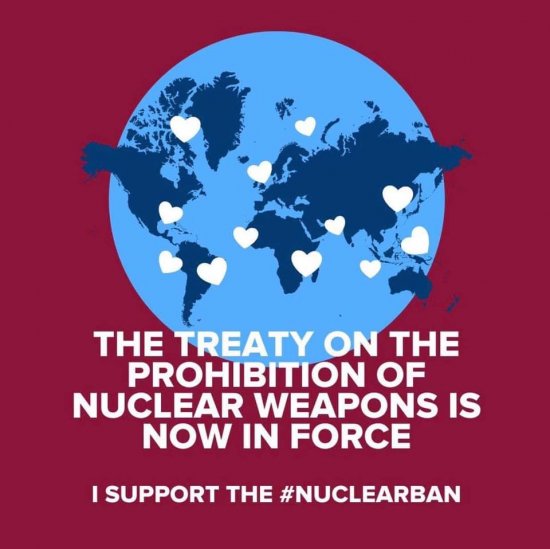
The Treaty on the Prohibition of Nuclear Weapons is a good step towards a nuclear-free world
https://www.canberratimes.com.au/story/8054916/nuclear-danger-is-strong-but-landmark-agreement-offers-hope/ By Marianne Hanson, Margaret Beavis, January 21 2023
January 22 marks the two-year anniversary of the entry into force of the United Nations Treaty on the Prohibition of Nuclear Weapons (TPNW), a landmark agreement that made nuclear weapons illegal on the basis of international humanitarian law.
Yet the potential for nuclear war remains as great as ever.
Fears that the unthinkable might happen were raised most clearly last year when President Vladimir Putin implied that Russia would consider using ‘all forces and means’ necessary in its fight against Ukraine.
It reminded us of the Cuban missile crisis 60 years earlier, once again bringing to the fore the prospect that nuclear war was in fact quite thinkable.
Thankfully, no nuclear weapons have been used in this war, but we cannot be complacent. Deterrence cannot be relied on forever. If Russia (or the United States) were to use even one small “tactical” nuclear weapon, a greater conflagration could easily follow.
It is not only Putin who has threatened to use nuclear weapons; nor is it the case that nuclear dangers vanished after the Cuban crisis or even after the end of the Cold War.
The leaders of every one of the nine states which possess these weapons of mass destruction – Russia, the US, France, China, Britain, India, Pakistan, Israel and North Korea – regularly signal that they would indeed use these weapons.
Their nuclear doctrines, the ongoing modernisation of their nuclear arsenals, their war-fighting practices and nuclear targeting all threaten the use of weapons which have the potential to kill millions and devastate the planet.
The end of the Cold War did nothing to reduce these dangers. While there was a period when goodwill between the major powers prevailed, and the US and Russia embarked on a program of reduction via the Strategic Arms Reduction Treaties, in truth a window of opportunity was lost when the nuclear-armed states refused to move seriously to eliminate their nuclear arsenals completely.
At the time, Australia was at the forefront of calls for the total elimination of nuclear weapons; the Labor government’s Canberra Commission in 1996 put forward a sober and considered assessment of the utility of nuclear weapons.
Nineteen commissioners from around the world, including several military leaders from the US, Britain and elsewhere, concluded that nuclear arsenals had very little military utility, that their existence continued to threaten the world – via deliberate or accidental use – and that as long as any one state possessed nuclear weapons, other states would want them too.
As predicted, three more states have acquired these WMDs since the Cold War ended.
The Canberra Commission set out a comprehensive program to encourage the phased, balanced, mutual, and verified elimination of nuclear weapons. It did not call for unilateral disarmament, nor did it insist that this should happen overnight. But it did warn that dangers would increase if the world did not act to eliminate these most destructive of all weapons.
Several other organisations and think tanks around the world added to the Canberra Commission’s message in subsequent decades and the nuclear states made clear promises to disarm. But they have stalled in the process of disarmament and are, instead, making their existing arsenals even more destructive than they were before.
Thoroughly fed-up with this intransigence, more than 120 states at the United Nations in 2017 voted to adopt a treaty outlawing nuclear weapons. The TPNW entered into force two years ago, and now has 92 state signatures.
Formed in Melbourne, the International Campaign for the Abolition of Nuclear weapons (ICAN) was awarded the Nobel peace prize for its work in raising awareness of nuclear dangers and its contribution towards the new treaty. This was the first and only time that an Australian-born group has been awarded the Nobel peace prize.
ICAN’s work was premised on the history of banning other weapons considered to be inhumane, unjust, and uncivilised. Landmines have been banned and are hardly used at all today, a far cry from a few decades ago. Chemical and biological weapons have been banned, and any state that attempts to use them is immediately stigmatised and reprimanded.
In the same way, the TPNW is designed to stigmatise, delegitimise, and in time lead to the elimination of nuclear weapons. ICAN, the 92 governments which have signed, and people around the world who support nuclear disarmament understand that a legal instrument banning nuclear weapons is a necessary step in the move to a nuclear weapons-free world.
It might surprise readers to know that several prominent politicians and military leaders also support this goal; Henry Kissinger and William Perry from the US are notable advocates of disarmament; so too were Ronald Reagan and Mikhail Gorbachev. Here in Australia, Labor promised at its 2018 and 2021 National Conferences that it will sign the TPNW when in government.
More than 100 federal parliamentarians have called on Canberra to fulfil this promise, as have hundreds more from around Australia, including in local government.
The call to eliminate nuclear weapons also finds strong support at the grassroots level in Australia; doctors and other health practitioners, environmental groups, trade unions, faith-based leaders, lawyers and others are calling on the government to sign the TPNW.
This is because banning and abolishing nuclear weapons is seen as a public health and humanitarian imperative. Our planet is worth preserving and human life should be valued. The Australian Red Cross as well as prominent Rotarians around the world are calling for the elimination of nuclear weapons, in the same way that they are working to eliminate polio and malaria.
On this second anniversary of the Treaty on the Prohibition of Nuclear Weapons’ entry into force, Australia must again take up the message of the Canberra Commissioners. Indeed, while Australia’s high-risk nuclear propelled submarine proposal clearly creates global proliferation concerns, by signing the TPNW Australia can demonstrate its non-proliferation commitments.
A nuclear-free world requires visionary and bold leadership. It is a global public good. Signing the TPNW, and playing an active role internationally for balanced, phased and verified disarmament will be an excellent start.
- Associate Professor Marianne Hanson and Dr Margaret Beavis are co-chairs of the International Campaign to Abolish Nuclear Weapons (Nobel peace prize 2017) Australia.
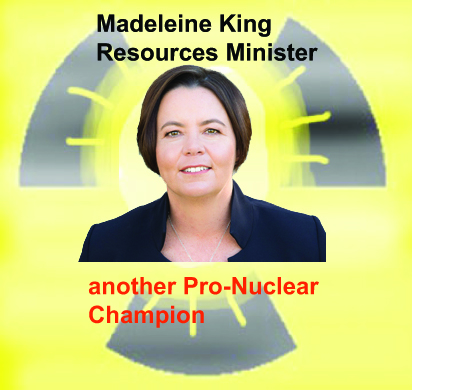
Minister Madeleine King visits Australia’s proposed nuclear waste dump site – methinks the lady doth protest too much.
Peter Remta 14 Jan 23 Minister visits Kimba to discuss Nationa Radioactive Waste Management Facility, 13 January 2023
Minister for Resources and Northern Australia, the Hon Madeleine King MP, has visited Kimba to meet with local community members and view the planned site for the National Radioactive Waste Management Facility.
It is going to be a long wait for another 10 years
The town of Kimba, on South Australia’s Eyre Peninsula, has been involved in more than seven years of consultation on the location of Australia’s National Radioactive Waste Management Facility.
Still have not provided a safety case or even details of the radionuclide inventories and activity of the intermediate level waste.
Will the high-level light waste processed in France be included in the storage?
“It was a pleasure to visit Kimba for the first time as Minister for Resources and Northern Australia and meet with community members to understand their views firsthand,” Minister King said.
“I was also able to meet with representatives from the Barngarla Determination Aboriginal Corporation (BDAC) Board in Kimba and other Traditional Owners.”
Minister King said she was strongly committed to protecting the cultural heritage of the site.
If she is so committed why does she continue opposing the Barngarla peoples’ review litigation?
The National Radioactive Waste Management Facility will consolidate Australia’s low level radioactive waste permanently and intermediate level waste temporarily, which is currently stored in more than one hundred locations across the country.
Please correct this total lie as many of the more than one hundred locations handle their own low-level waste and in the federal government’s own previous statements it will be lucky to get 10% of that waste for disposal at the national facility.
Most of this waste comes from nuclear medicine production, which is an essential part of an advanced healthcare system like ours and one that most Australians will benefit from over their lifetimes.
Again please don’t be cute as the waste you are speaking about is the intermediate level waste generated at Lucas Heights in the course of producing nuclear medicine and that should soon be dramatically reduced as the medical profession worldwide is turning away from reactor generated medicine
“As part of my visit, I engaged with a number of local community groups and stakeholders to discuss how the social and economic benefits of the project could be maximised for the local community,” Minister King said.
None of this will in any way improve or safeguard the community from all the potential problems of the aboveground facility and the destruction of its agricultural industry.
“I understand there is a wide range of views about the project in this community and I wanted to listen to those views firsthand.”
Minister King also met members of the community at a sundowner event at the upgraded Kimba Medical Centre, which was funded under the National Radioactive Waste Management Facility Community Benefit Program.
“The upgrades to the Kimba Medical Centre will drive health and social improvements in a community that sorely needs it,” Minister King said.
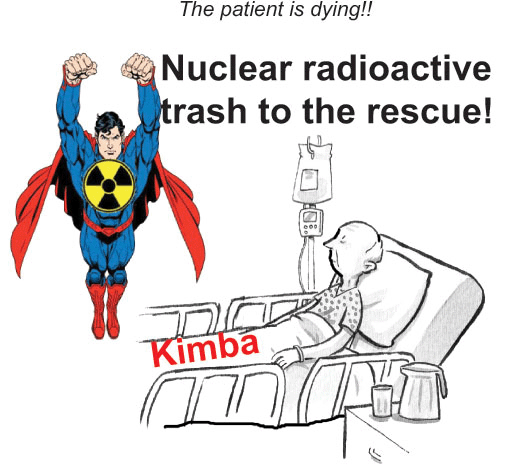
[Ed note: I understood that Kimba was a thriving, healthy community, a State leader in agriculture.
Are we to understand that instead, it is a sickly pathetic situation, and indeed, the radioactive waste dump’s purpose is to be the saviour of this sad place?]
The only benefit of upgrading the so-called medical centre will be hopefully to provide better care for the people who are affected by radiation – and there will be quite a few believe me with the above ground facility.
Other projects funded in previous rounds include the upgrades to the Kimba Medical Centre, resurfacing Kimba District sporting fields, as well as various mental health initiatives.
[Ed. note. I wonder how much mental health and community cohesion have been damaged by this whole nuclear waste fiasco?]
To find out more about the facility, visit: radioactivewaste.gov.au.
Australia’s contribution to AUKUS should be a next generation conventional submarine

By Kym Bergmann, 08/01/2023 https://asiapacificdefencereporter.com/australias-contribution-to-aukus-should-be-a-next-generation-conventional-submarine/
Sherlock Holmes teaches us that when all possible explanations have been eliminated, the only remaining answer – no matter how improbable – must be correct. As prospects are diminishing that Australia will be able to receive a nuclear-powered submarine before the 2050s, policy makers are faced with two choices: do nothing, or fast track something that will add significantly to the undersea warfare capabilities of the three AUKUS partners.
The latest development is that two US Senators – one serving and one just retired – Democratic Chair of the Senate Armed Services Committee Jack Reed and his Republican predecessor Senator James Inhofe, have warned that the US does not have the capacity to build submarines for Australia. Previously, Australian officials have dismissed any negative commentary about the nuclear submarine plan as “noise”, but this is getting hard to ignore.
Maybe the report by the nuclear-powered submarine task force due in March will prove the critics wrong, but unless it comes up with a concrete schedule with dates, legally enforceable commitments and so on, Australia needs to have a Plan B. A document that emphasises intentions, good will, more discussions, dialog, harmonising requirements, committees, and further investigations gets us nowhere.
Even the most vocal critics of conventional submarine technology concede that they nevertheless retain some performance advantages, such as in complex, shallow water littoral environments. They are also comparatively cheaper to build and – depending on their size and complexity – a nation can acquire at least three conventional submarines for every nuclear-powered boat.
A new generation fleet of Australian conventional submarines could see some of them permanently based in Guam – or even Japan – making an important contribution to USN-led coalition operations in areas such as the South China Sea. Some could also travel to the UK, though what contribution they could make to joint security from there is unclear, but the gesture might be politically worthwhile.
A commitment to actually doing something to help ourselves would also go over well in Washington. US figures are reportedly surprised and disappointed at the supine position of Australia, which seems to believe a solution for our defence needs will be handed to us on a platter. Why should Australia expect the US to solve our submarine problems for us? First and foremost, this a challenge to be met by the sovereign Australian government and not offshore it like some sort of strategic help line.
The quickest solution for Australia would be to forget about the Collins Life of Type Extension due to start in 2026 and fast track the local construction of the South Korean KSS-III Batch 2 design – now owned by Hanwha – which could see boats in the water from 2030. These are long-range conventional submarines that achieve a very low indiscretion rate by using lithium-ion batteries and other advanced technologies that were never part of the cancelled Attack class program. Their endurance could be further expanded by building a resupply base on Christmas Island – surrounded by deep water and easy to protect – that would give them an extra 25% time on station.
Another option would be a Next Generation Collins class – a larger version of the Swedish A26 submarine, similar to the one favoured to be chosen by the Netherlands to meet their need for a long-range oceanic submarine. A Third Generation Collins in the 2050s could be nuclear-powered, with the involvement of both the US and the UK. That’s called long term planning and is probably closer to the spirit of AUKUS because it would contribute to sovereign capability.
For all the boosters of nuclear-powered submarines, we say this: unless Australia has a highly skilled construction base, we will be condemned to forever seeking to buy them from the US or the UK – and, as we are witnessing, the chances of that ever happening are receding. As those two nations learned from the Sea Wolf and Astute programs, without a continuous submarine construction program, the loss of skills can be catastrophic.
The only sure way to guarantee that Australia will be able to build nuclear powered submarines – other than the reactors themselves – is to be able to transition from building large, advanced conventional submarines to something with a different propulsion system. Put simply: those arguing that an interim submarine is too inconvenient are condemning to death the idea of the local build of a nuclear-powered boat. We will need a skilled, experienced, existing workforce, existing program management and existing local supply chains.
The only sure way to guarantee that Australia will be able to build nuclear powered submarines – other than the reactors themselves – is to be able to transition from building large, advanced conventional submarines to something with a different propulsion system. Put simply: those arguing that an interim submarine is too inconvenient are condemning to death the idea of the local build of a nuclear-powered boat. We will need a skilled, experienced, existing workforce, existing program management and existing local supply chains.
1 This Month


26 September – International Day for the Total Elimination of Nuclear Weapons


PLEASE OPPOSE HR 8255 AND S.3639 – bills would accelerate satellite deployment, with no environmental review or safeguards – https://ncstd5li.quorum.us/campaign/169331/
To see nuclear-related stories in greater depth and intensity – go to https://nuclearinformation.wordpress.com
-
Archives
- September 2026 (206)
- August 2026 (330)
- July 2026 (355)
- June 2026 (287)
- May 2026 (306)
- April 2026 (356)
- March 2026 (251)
- February 2026 (267)
- January 2026 (308)
- December 2025 (358)
- November 2025 (359)
- October 2025 (375)
-
Categories
- 1
- 1 NUCLEAR ISSUES
- business and costs
- climate change
- culture and arts
- ENERGY
- environment
- health
- history
- indigenous issues
- Legal
- marketing of nuclear
- media
- opposition to nuclear
- PERSONAL STORIES
- politics
- politics international
- Religion and ethics
- safety
- secrets,lies and civil liberties
- spinbuster
- technology
- Uranium
- wastes
- weapons and war
- Women
- 2 WORLD
- ACTION
- AFRICA
- Atrocities
- AUSTRALIA
- Christina's notes
- Christina's themes
- culture and arts
- Events
- Fuk 2022
- Fuk 2023
- Fukushima 2017
- Fukushima 2018
- fukushima 2019
- Fukushima 2020
- Fukushima 2021
- general
- global warming
- Humour (God we need it)
- Nuclear
- RARE EARTHS
- Reference
- resources – print
- Resources -audiovicual
- Weekly Newsletter
- World
- World Nuclear
- YouTube
-
RSS
Entries RSS
Comments RSS
 nuclear-news