In Malawi, Namibia, Niger workers making trouble for uranium mining companies
Conflicts with unions and management may have even larger impacts in the future,
Uranium Miners in Africa Facing Labor Disputes, Business Insider, Resource Investing News | May 16, 2012, Uranium mining companies are operating in difficult environments in many jurisdictions, facing challenges ranging from regulatory compliance,
environmental delays, rising costs, and labor relations. Over the last year, the labor challenges seem to have become more accentuated for African uranium mining companies, with several companies having reporting strikes. Continue reading
South African govt’s aim for nuclear power is looking unconvincing
 The government’s pretence that there is a bidding war between nuclear power providers is also unconvincing. Companies from the US, South Korea and Russia have given up and a joint French-Chinese bid is the only game in town.
 Nuclear drive more about foreign policy than energy, ANTHONY BUTLER: http://www.businessday.co.za/articles/Content.aspx?id=171008 State’s campaign to win public support for proposed nuclear power programme hampered by logic and chronology 2012/05/04 THE government’s belated campaign to win public support for its proposed nuclear power programme has been hampered by logic and chronology. Continue reading
Nuclear power will make South African society even more unequal
The only conclusion is that there is an immense amount of money in the nuclear industry for those involved and in power. They will reap the financial benefits, not the majority of South Africans. This will exacerbate the poverty-wealth gap.
 Nuclear power will worsen the wealth gap Bishop Geoff Davies:Mail & Guardian, Apr 20 2012 “…..In the Southern African Faith Communities’ Environment Institute, we believe we have to apply moral principles of justice and equity when making energy choices. We made this call at the COP17 climate talks in Durban in our Act Now for Climate Justice campaign — that is, justice for people and planet. ….
We are deeply concerned about the government’s nuclear plans because it is the wrong direction to take. Nuclear energy requires a centralised grid system and is extremely costly. Taking into account the mining of uranium, its transport and the construction of power plants, nuclear energy is certainly neither carbon-neutral nor “clean”. Continue reading
Uranium mining damages health of workers and environment
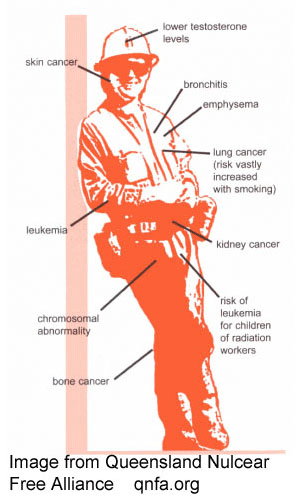 the World Health Organisation (WHO) acknowledges that Radon, which is a heavy gaseous radioactive chemical, is the second cause of lung cancer after smoking.
Uranium, even when purified, Chareyron said is radioactive and miners cannot really be protected from it.
 Concerns over uranium mining New Era, 12 Apr 2012 – by Irene Hoaës WINDHOEK – Renewed concern has been expressed regarding uranium mining activities along the coastal areas and its impact on the environment following tests undertaken by the Commission for Independent Research and Information about Radiation (CRIIRAD) and EARTHLIFE Namibia.
These mining activities have a direct bearing on people’s health as they reportedly cause cancer, especially to people that get exposed to them.
According to CRIIRAD, people that spend 30 minutes to 35 hours at a distance below 25 meters from the waste rock dump, would receive an external radiation dose above the trivial dose of 10 microsieverts per year.
One of the main concerns is uranium concentrates found in underground water sources and on sediments in areas where Rössing and the Langer Heinrich mines are found, especially along the Khan and Gawib rivers.
According to Bruno Chareyron, a Nuclear Physics Engineer and Director of the CRIIRAD Laboratory, the radioactive tailings (waste) of the mines are not covered and dust particles from the tailings are accumulating on bushes and slopes.
“When it rains, this dust is even washed off the waste rock dumps that are situated next to the river banks and therefore deposited into the river system,” the nuclear engineer said. Continue reading
Nigeria’s President sure that Nigeria’s nuclear power will be safe
Jonathan assures the world of Nigeria’s nuclear safety, Vanguard, MARCH 26, 2012 · By Emma Ujah ABUJA — President Goodluck Jonathan has assured the global community that Nigeria will ensure that adequate safety measures are deployed when the country introduces nuclear power into its energy mix.
Speaking at the opening of the Nuclear Security Summit in the South Korean capital, President Jonathan declared that Nigeria remained fully committed to complying with all international legal and regulatory requirements for safety and security in the use of nuclear
energy……. http://www.vanguardngr.com/2012/03/jonathan-assures-the-world-of-nigerias-nuclear-safety/
Insecurity in Nigeria, with crooked practices in oil and gas industry
 Nigeria loses over $20bn to illegal bunkering, oil theft yearly – Presidential aide Nigerian Tribune, 26 March 2012 EVERY year, Nigeria loses about 40 million metric tonnes of petroleum products amounting to about $20 billion (N3 trillion) to crude oil theft and illegal bunkering, Mr Leke Oyewole, a Senior Special Adviser to President Goodluck Jonathan on Maritime Affairs has said….. He said the loss was sequel to sharp practices characterised by numerous leakages, adulteration of products, as well as diversion of refined imported products by some of the players in the upstream and downstream sectors of the oil and gas industry……NIMASA and NPA ought to collaborate to address issues in the offshore operations in the oil industry and mitigate the insecurity arising therefrom…….
http://tribune.com.ng/index.php/news/38181-nigeria-loses-over-20bn-to-illegal-bunkering-oil-theft-yearly-presidential-aide

Tanzania’s battle over uranium tax
The fierce battle for $205m uranium tax, BY FLORIAN KAIJAGE 11th March 2012 As the Russian firm seeks court order Tanzania Revenue Authority (TRA) and Russian company JSC Atomredmetzoloto (AMRZ) are in fierce legal battle over the $205.8 million (Sh330billion) that TRA demands from the company as an income tax and stamp duty emanating from thelatter’s purchase of Mkuju River Uranium mining site from Mantra
Resources of Australia in 2011.
The legal battle is before the Tax Revenue Appeals Board that begun hearing of the matter on Monday March 5, 2011 in Dar es Salaam under the chairmanship of Pentarin Kente…. The amount of money involved is staggering; this is a record amount in Africa just on income tax. It
is $196 million that equivalent to Sh320 billion, 2 percent of the country’s GDP (Gross Domestic Product); it is not a small amount by local or international standards…. http://www.ippmedia.com/frontend/index.php?l=39338
Japan’s taxpayers up for $6 billion costs from nuclear disaster – it could happen to South Africans
the Japanese taxpayer is liable for losses caused by the nuclear meltdown. The fall out in Japan has cost an estimated 500 to 600 billion dollars according to Greenpeace.
Adam says clauses in South African law limit the liability nuclear power plants pay if a disaster occurs. If a disaster happens in South Africa “the ordinary citizen will be paying for a clean-up,” says Adam.
Greenpeace launches anti-nuclear energy campaign, Times Live, Pearl Boshomane and Katharine Child | 28 February, 2012 Environmental activist organisation Greenpeace has launched a campaign urging the government to abandon the move towards using nuclear energy in South Africa. This comes on the heels of an announcement by Energy minister Dipuo Peters on Tuesday that the government will allocate more funds — R300 billion– towards nuclear power plant construction
Also on Tuesday, Greenpeace released the ‘Lessons from Fukushima’ report, which states that the Japanese nuclear disaster of last year was a result of governmental and nuclear industry failures as opposed to a natural disaster. Continue reading
South Africa’s government silence as it gives R300bn to nuclear industry
 “Strangely, neither President [Jacob Zuma] nor the minister of finance saw fit to mention the largest-ever procurement in South African history in the state-of-the-nation address or the Budget speech.
Greyling said there had also been no opportunity for the public to scrutinise a nuclear programme.
R300bn for nuclear plants not ‘end amount’ News 24, 2012-02-28 Cape Town – The R300bn allocated in the Budget for building new nuclear power plants is not the final amount for the project, Energy Minister Dipuo Peters said on Tuesday. Continue reading
Poverty prevents Nigerians from legal wins over mining corporations
 Nigerians ‘too poor to sue over corporate abuse’, News 24 2012-02-22 Geneva – Victims of environmental disasters or other abuses inflicted by corporations in Nigeria are being denied justice as they are too poor or do not know how to seek legal recourse, jurists said on Wednesday.
“Poor rural victims of corporate human rights abuse are usually unaware of their legal rights and don’t have the financial resources to file court process, gather information and evidence, and afford legal services,” said Carlos Lopez, the International Commission of Jurists’ senior legal advisor in a report.
Even though a legal aid scheme exists, it “suffers from chronic underfunding”. “As a result, it fails to help those most in need to access judicial remedies,” added Lopez.
The problem is illustrated by the small numbers of litigations against corporations, despite several instances of serious pollution generated over the decades of oil or mineral extraction. Of the few that make it to court, even fewer manage to obtain rulings in favour of victims, noted the report…….
The UN environment agency had said that decades of extensive oil pollution in the Ogoniland region – which lies in the Niger Delta – may require the world’s biggest ever clean-up. ….
http://www.news24.com/Africa/News/Nigerians-too-poor-to-sue-over-corporate-abuse-20120222
Hasty and secretive nuclear power move in South Africa
 R300bn nuclear tender shouldn’t be sneaked through – DA, Politics web, 26 February 2012 Lance Greyling says nuclear build programme must be properly scrutinised in parliament Nuclear Build Programme must be debated in Parliament In the budget review for 2012, a price tag of R300 billion appears for Eskom’s nuclear fleet build programme. The programme is designed to deliver 9,600MW of nuclear capacity by 2029 and is described as being in the “final stages of consideration before financial proposals can be determined”
This is all rather curious.
The President did not mention the R300 billion nuclear build programme in his State of the Nation Address. The Minister of Finance did not mention it explicitly in his Budget Speech. Now, apparently, it is in its “final stages”.
There has been no debate in Parliament and no opportunity for the public to scrutinise a nuclear programme that could have a very real impact on all of our lives. Not only will it cost nearly a third of our annual budget, but there are serious safety and environmental concerns to consider.
Given that the shadow of Arms Deal corruption continues to darken our democracy, government should be extra careful about the nuclear build programme. It must err on the side of more transparency, not less. For this reason, the DA will table a motion to debate the nuclear build programme in Parliament at the first opportunity.
From a technical point of view, an Environmental Impact Assessment (EIA) and Feasibility study for the programme should be in the public domain before any project of this magnitude is seriously considered. If a specific amount has already been allocated in the budget, the public has a right to see the evidence on which the budgetary allocation was decided…. http://www.politicsweb.co.za/politicsweb/view/politicsweb/en/page71654?oid=282389&sn=Detail&pid=71616
First Uranium company teeters on the brink of collapse
 What will happen to First Uranium? First Uranium is looking at a distress sale of assets to settle upcoming debts, a move that would have a number of implications for shareholders Christy Filen , 22 Feb 2012 JOHANNESBURG (MINEWEB) –
It is no secret that First Uranium is in a pickle. Releasing a forecast that shows its cash will run out by the end of March will be cold comfort to shareholders and creditors alike…. First Uranium has turned to what is conceivably its only option and that is a distress sale of its assets in an effort to settle upcoming debts….. As if this wasn’t enough First Uranium’s Ezulwini operation is not making the gradeand its Mine Waste Solutions (MWS) is fighting licensing issues with environmentalists and the Department of Mineral Resources. In terms of the results of an impairment exercise of the Ezulwini Mine’s assets, an impairment adjustment of $180m was recognised in the company’s financial statements…. “The Company’s ability to continue as a going concern is dependent upon its ability to bring these proposed transactions to fruition” said First Uranium….. http://www.mineweb.com/mineweb/view/mineweb/en/page34?oid=145826&sn=Detail&pid=102055
How some uranium mining corporations deceive developing countries
Mining deals worry industry grouping The Daily Times, 21 February 2012 Isaac Masingati An international mining industry grouping, Intergovernmental Forum on Mining, Minerals, Metals and Sustainable Development (IGF), says it is concerned with contracts between investors and governments especially in developing countries, saying they tend to be skewed in favour the investor.
IGF President Leonard Kalindekafe told the Business Times in Zomba on Friday that there was a concern among members of the grouping that some investors were taking advantage of governments’ lack of expertise to strike deals that bring little profits. ”This is a big concern to the Forum because some bona fide countries are not able to realise full benefits from their minerals,” he said. Continue reading
Great potential for decentralised solar and wind energy in Kenya
Kenya receives an estimated 4 to 6 kWh per square meter per day of solar insolation, equivalent to about 300 million tonnes of oil according to African Energy Policy Research Network 2004.
Kenya has one of the best wind resources in the world averaging between 3 and 10m/s with northern Kenya recording speeds of up to 11m/s.
 Innovation and Diversification Are Key for Kenya’s Renewable Energy Industry, Renewable Energy World, By Peter Kahare, February 20, 2012 KENYA — Decentralizing and diversifying renewable energy power generation technologies could be the panacea to save Kenyans from unreliable and expensive power supplied by hydro and thermal power generation, a recent study has found.
The new study by Christian Aid, an international agency that seeks solutions to chronic poverty in various nations says that empowering communities in rural areas in Kenya to produce power through renewable, cleaner sources could reduce overreliance on hydropower and fully exploit the renewable energy potential while offering opportunity to unlock economic growth. Participation of local communities in renewable energy technology projects such as
small/micro hydro, wind, solar, bagasse cogeneration and improved stoves could increase energy security and mitigate against climate change effects that badly affect the hydro power generation technology,” says Alison Doig, the report’s lead author and senior climate change advisor at Christian aid. Continue reading
The human consequences of uranium mining
“The most difficult part for the victims of uranium exposure is to prove that their symptoms are directly related to the work they were doing in those mines,” Hecht said. Due to this difficulty, workers do not receive any compensation.
Lecture tackles global uranium trade, The Brown Daily Herald. Alissa Haddaji, February 17, 2012 To understand the consequences of global uranium trade in Africa, the intricate interaction between political lobbying, government and human interests must be explored, said Gabrielle Hecht, professor of history at the University of Michigan, in a lecture hosted by the science and technology studies program Thursday.
The presentation — held in Smith-Buonanno 106 — was part of the program’s lecture series “Nothing Can Go Wrong: Rethinking Nuclear Energy in the 21st Century” and introduced themes from Hecht’s forthcoming book, “Being Nuclear: Africans and the Global Uranium
Trade.” …. Continue reading
1 This Month



26 September – International Day for the Total Elimination of Nuclear Weapons


PLEASE OPPOSE HR 8255 AND S.3639 – bills would accelerate satellite deployment, with no environmental review or safeguards – https://ncstd5li.quorum.us/campaign/169331/
To see nuclear-related stories in greater depth and intensity – go to https://nuclearinformation.wordpress.com
-
Archives
- September 2026 (206)
- August 2026 (330)
- July 2026 (355)
- June 2026 (287)
- May 2026 (306)
- April 2026 (356)
- March 2026 (251)
- February 2026 (267)
- January 2026 (308)
- December 2025 (358)
- November 2025 (359)
- October 2025 (375)
-
Categories
- 1
- 1 NUCLEAR ISSUES
- business and costs
- climate change
- culture and arts
- ENERGY
- environment
- health
- history
- indigenous issues
- Legal
- marketing of nuclear
- media
- opposition to nuclear
- PERSONAL STORIES
- politics
- politics international
- Religion and ethics
- safety
- secrets,lies and civil liberties
- spinbuster
- technology
- Uranium
- wastes
- weapons and war
- Women
- 2 WORLD
- ACTION
- AFRICA
- Atrocities
- AUSTRALIA
- Christina's notes
- Christina's themes
- culture and arts
- Events
- Fuk 2022
- Fuk 2023
- Fukushima 2017
- Fukushima 2018
- fukushima 2019
- Fukushima 2020
- Fukushima 2021
- general
- global warming
- Humour (God we need it)
- Nuclear
- RARE EARTHS
- Reference
- resources – print
- Resources -audiovicual
- Weekly Newsletter
- World
- World Nuclear
- YouTube
-
RSS
Entries RSS
Comments RSS
 nuclear-news