Australian uranium miner Paladin’s share price tumbles
Shares of uranium miner Paladin dive after cancelled sale Reuters, Aug. 02 2013, Shares of Australian uranium miner Paladin Energy Ltd. fell as much as 29 per cent in Toronto on Friday after the company cancelled plans for now to sell a minority interest in an African mine, and instead raised funds through a private placement of shares. Paladin said it ended negotiations with a potential investor on Thursday and all other parties for a stake in its Langer Heinrich mine in Namibia. The company said it was unlikely to get the price it wanted because of low uranium prices….. Trading of Paladin stock was halted in both Canada and Australia on Thursday, pending news.
Paladin’s stock was down 28 per cent, or 26 Canadian cents to 66 Canadian cents in early trading on the Toronto Stock Exchange. http://www.theglobeandmail.com/report-on-business/industry-news/energy-and-resources/shares-of-uranium-miner-paladin-dive-after-cancelled-sale/article13572589/
Unsustainable deal – Paladin’s uranium scam in Malawi
In the wake of the Kayelekera scam, Malawi needs to realise that tax is a governance issue. …. The cost of tax incentives given to Paladin is enormous. We can’t sustain it.
 Malawi gov’t and Paladin: Act on Kayelekera uranium raw deal now! Nyasa Times, By Veronica Maele-Magombe July 30, 2013 Since last week’s stinging observation by UnitedNations (UN) Special Raportuer on the Right to Food Olivier De Schutter regarding Malawi’s Kayelekera Uranium Mine deal, two elusive culprits remain pretty much intact in their hard shells. It is as if the country’s most guarded contract between government and Australian company, Paladin Africa Ltd has not been unravelled as the worst possible swindle. Continue reading
Western leaders’ hypocrisy on uranium investment scandals in Africa
Malawi gov’t and Paladin: Act on Kayelekera uranium raw deal now! By Veronica Maele-Magombe Nyasa Times, By Veronica Maele-Magombe July 30, 2013 “……one cannot underestimate the ‘politicking’
surrounding foreign investment. There is the brainwashing and fear
that African leaders endure in their struggle to appease donors who
are sometimes capable of clamping on aid or trade deals if a poor
country like Malawi is ‘hostile’ to western investors. In the un-coded
diplomatic language of foreign investment it means, treat business
clients from the west well and we will handle your aid and loan
cheques accordingly.
Western leaders have continued to hypocritically talk about fair trade
and dealings with Africa whilst winking an eye to their investors.
And, tightening the shackles of neo-colonialism on their behalf has
been IMF – convincing poor countries to lure foreign investor with a
portfolio of incentives. Just last year, IMF advised poor Gambia to
reform its tax system so that the country avoids discouraging foreign
investors with many taxes. Resident Representative, Meshack Tunee,
noted: Continue reading
Doubts on whether nuclear energy has a future in South Africa
Russia’s state energy group Rosatom and the French Areva – will be watching upcoming developments in South Africa with interest. In addition to safety and financial viability, concern has also been raised around the opacity of the government’s nuclear plans. All of these issues are discussed in a recent Occasional Paper titled, “South Africa’s Nuclear Future”, published by the South African Institute of International Affairs (SAIIA). The paper argues that unless South Africa’s nuclear planners meet the concerns mentioned above head-on, their programmes will fail to inspire confidence, both at home and abroad.
Africa: Nuclear Future Requires Urgent Clarity ALL AFRICA BY MARI-LISE DU PREEZ, 22 JULY 2013 Observers hoping to gain insights into South Africa’s nuclear energy plans have had their hopes dashed. Two International Atomic Energy Agency (IAEA) conferences have recently taken place in quick succession. The first, an International Ministerial Conference on Nuclear Power in the 21st Century held in St Petersburg Russia from 27 to 29 June 2013, saw the last minute withdrawal of both the Energy Minister and the CEO of Eskom.
This seemed to indicate that the tussle between the Department of Energy (DoE) and the National Planning Commission (NPC) on the future of nuclear energy in South Africa is yet to be resolved. Continue reading
UN examines Australian uranium miner Paladin’s Malawi operations
UN rubbishes Malawi’s Paladin uranium deal, fertilizer subsidy By Hudson Mphande, Nyasa Times July 23, 2013 United Nations Special Raportuer on the Right to Food Olivier De Schutter who was in Malawi for an assessment of the food situation in the country has rubbished Kayerekera uranium mine deal between Malawi and Australian Paladin Mining Company saying the Southern African country has had a raw deal that is robbing the poor.
The UN Raportuer said the uranium mining deal was one of the investments in Malawi through which the country is losing resources that could otherwise make a difference in food security and other pro-poor initiatives. He said in the life span of the mine Malawi is expected to lose almost US$281 million…
“Mining companies are exempt from customs duty, excise duty, value added taxes on mining machinery, plant and equipment. They can also sign special deals on the rate of royalty owed to the government. I believe that there are more reasons that investors would come to Malawi without such incentives,” he said.
De Schutter was addressing journalists in the capital Lilongwe at the end of his 11-day tour of the country.
He bemoaned that due to illicit financial flows, tax envasion as well as tax incentives that the country offer to both domestic and foreign companies currently Malawi was failing to get maximum use of its resources.
De Schutter said that revenue losses from special tax incentives to Paladin Africa Mining alone are estimated at almost K67 billion (US$205 milion) since the mine started its operations and could reach almost K92 billion (US$281 million) over its13-year lifespan.
“Paladin alone is costing the budget more than US$20 million (almost K8 billion) a year in taxes,” he said.
He added: “I am convinced that unless combined with a comprehensive enhancement and optimisation of tax revenue, current macro-economic reforms may not have substantive positive impacts. There is need for
Malawi to examine its national tax laws and policies towards preventing illicit capital flight. As mining develops, Malawi can simply not afford business-as-usual.”
The UN Special Raportuer said it is estimated that the country has lost over 10 percent of its growth domestic product (GDP) to illicit outflows and tax evasion over the period 1980 to 2009……..
De Schutter also specifically expressed concerns on the country’s current minimum wage currently at K371 ($1.12) per day, describing it as the lowest in the world…… The UN special rapporteur said he will give a report and his recommendations to both the UN Human Rights Commission and the Malawi Government. http://www.nyasatimes.com/2013/07/23/un-rubbishes-malawis-paladin-uranium-deal-fertilizer-subsidy/
Paladin Energy “screwing” Malawians in uranium mining deal
all a fat lie. Paladin and many other foreign multinational mining countries are least interested to contributing to the Malawi economic growth. They are here to milk the country – exploiting all that it has rich in minerals and dump us when the time is right even poorer.
Killing Malawians through the rotten extractives deals: The case of Paladin’s uranium mining Nyasa Times, by Patrica Masinga, 24 April 13, Malawi has in the few weeks been engaged by a plethora of stakeholders discussing strategies to revive, or more on the ground, reclaim the benefits that Malawians are been milked of by the so-called extractive industry multi-national corporations.
They call themselves investors, and government believes that the Malawi Development Goals (MDGs – who cares if it’s the second phase) will be boosted, particularly that mining alone through Kayerekera of Paladin Energy Limited group of companies (trading as Paladin (Africa) Ltd in Malawi?) could provide a large economic base.
But that is all a fat lie. Paladin and many other foreign multinational mining countries are least interested to contributing to the Malawi economic growth. They are here to milk the country – exploiting all that it has rich in minerals and dump us when the time is right even poorer.
Imagine, to screw Malawians of their rightful economic gains, the company, incorporated in Australia first listed on the Australian Stock Exchange (ASX) on March 29, 1994 under code ‘PDN’, and quickly changed its name from Paladin Resources NL to Paladin Resources Ltd in 2000 and listed under the Toronto Stock Exchnage (TSX) in Canada April 29, 2005, and again changed its name to Paladin Energy Ltd in November 2007 and listed on the Namibian Stock Exchnage on February 2008.
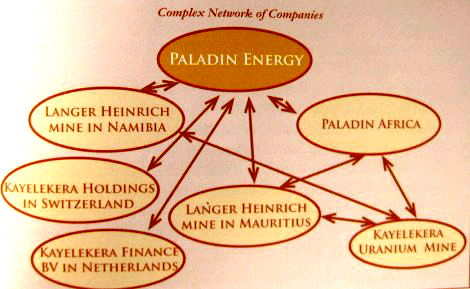
By such trends, one is compelled to question the motive, considering also that in Namibia itself the company owns the Langer Heinrich Uranium Mine where it started production in 2008 and has Kayerekera Uranium Mine as its second largest mining venture in this part of Africa acting also as a good supllment to the Langer Heinrich Uranium Mine.They call themselves investors, and government believes that the Malawi Development Goals (MDGs – who cares if it’s the second phase) will be boosted, particularly that mining alone through Kayerekera of Paladin Energy Limited group of companies (trading as Paladin (Africa) Ltd in Malawi?) could provide a large economic base.
But that is all a fat lie. Paladin and many other foreign multinational mining countries are least interested to contributing to the Malawi economic growth. They are here to milk the country – exploiting all that it has rich in minerals and dump us when the time is right even poorer. Continue reading
Health and environmental destruction in Africa, by foreign uranium companies
Health hazards posed by uranium mining IPP MEDIA 5th July 2013“……..History has it that uranium mining companies had never solved problems associated with extraction of uranium and also never employed good practice of settling uranium radioactive waste seriously after the mining activity is complete.
Of course, these foreign companies have their eyes fixed on maximising profits against corresponding safe infrastructure investment. Some of the companies run away from implementing this social cooperative responsibility to the poor ignorant communities.
This happens in countries where local atomic energy commissions are non-existent, or if present are under- equipped with the necessary human and material resources for effective supervision, monitoring and control of  the foreign mining companies for radiation protection to the miners and the environment.
The whole population in the area surrounding the mines is endangered with the diseases mentioned above, lung cancer being the most serious for miners due to inhalation of radon gas in the pits and in the dusty atmosphere of the processing mills.
Uranium radioactive waste stored close to the mines can leach into ground water and contaminate drinking water. Other possibilities of radioactivity reaching humans and environment are a result of deficient radioactive waste management practices by the mining companies, Continue reading
Australian uranium mining company Paladin in trouble in Namibia, as well as in Malawi
Some of the issues pertain to female worker’s miscarriages; [CEO] Duvenhage’s apparent failure to engage with the union; the company’s reluctance to give workers a “single cent” for an annual increment; unfair performance bonuses; nepotism and corruption.
Australian-based Paladin Energy Ltd. (TSE:PDN) owns 100% interest in the mine.
Protests hit second largest uranium mine in Namibia http://www.mining.com/protests-hit-second-largest-uranium-mine-in-namibia-85919/ Vladimir Basov | July 2, 2013 About 300 workers, including mine staff and contractor employees, picketed at Langer Heinrich Uranium (LHU) mine last Thursday over pay and working conditions, The Namibian reported.
Workers and media were barred from the minesite where the demonstration was supposed to take place although the protesters had organized the peaceful demonstration at the beginning of last week and had announced it to the mine’s management.
As a result, all day shift buses were forced to stop inside the concession area where workers then had to disembark – about five kilometres away from the actual site. To their dismay, the protesters were forced to picket at the concession area. The Mineworkers Union of Namibia (MUN) branch executives felt that the mine’s management snubbed what it termed a legal and democratic action. Continue reading
Paladin uranium’s losses, but its CEO does very well financially
Paladin boss earnings increase while Kayelekera cut jobs http://www.nyasatimes.com/2013/02/14/paladin-boss-gets-massive-pay-hike-after-malawi-job-cuts/ By Nyasa Times Reporter February 14, 2013 Despite uranium miner, Paladin Energy limited claiming that its Malawi operations in the northern district of Karonga at Kayelekera are operating on massive losses and that world uranium prices are low, the company’s managing director John Borshoff elected to cash in his leave entitlementment, Nyasa Times has established.
Paladin’s annual report reveals that despite Borshoff honouring a promise to cut his salary by 25% between November 2011 and November 2012 – a promise he extended to June 2013, the CEO was able to boost his remuneration after a review of annual leave entitlements thereby pocketing a 52% rise in earnings. The review focused on annual and long-service leave in a bid to cut Paladin’s liabilities, and Borshoff responded by cashing out 220 days of leave.The transaction approaved by the remuneration Committee and the board netted Borshoff $1,717,000 and helped increase his remuneration to $3,464,000, from $2.26 million in 2012.
The uranium miner recently retrenched 110 staff from its Kayelekera mine in Malawi in an austerity drive which others commentators fault Boshoff for excercising his right to cash in the leave entitlement when local staff just had their calls for a 66 per cent pay rise rejected.
”Its total mockery to the Malawian workers at Kayelekera who were retrenched but have not had their benefits yet. These people are suffering. That’s a wake-up call to Malawi Government that Paladin is making profits despite plunge in prices” Karonga Business Community Chairperson Wavisanga Silungwe said in a statement made available to Nyasa Times.
“While production has gone up, the uranium price has not; hence Kayelekera continues to operate at a loss. We had warned government that this situation was unsustainable and would lead to job losses unless the uranium price improved, which it has not,” said Paladin’s (African) Ltd General Manager, international affairs, Greg Walker.
Walker said the staff reduction is in “response to economic pressures on the company caused by the continuing depressed uranium price” Borshoff’s contract with Paladin has one year left, and provides him with three months’ long-service leave for every five years of service. He is entitled to two years of double base salary when he retires or has his employment terminated.
Share price falls as Paladin’s sale of Langer Heinrich uranium mine is delayed
Uranium producer Paladin’s shares slide after stake sale delay BY:BARRY FITZGERALD The Australian June 27, 2013 SHARES in African uranium producer Paladin have been pulled back to near 52-week lows because of a delay in a planned debt-reducing sale of a minority equity position in the group’s flagship Langer Heinrich operation in Namibia.
It had been hoped that Paladin would make inroads into its $US740 million debt pile by making the sale the news of which pushed the shares from an April low of 70c to more than $1 a share in late May. But recent concerns that the previously advised June 30 target date would not be met have sent the shares lower.
The concerns were well placed, with Paladin saying yesterday that the planned sale had been delayed until mid-to-late August. Paladin shares closed 6c, or 6.8 per cent, lower at 82c.
The fall came despite Paladin managing director John Borshoff remaining confident a sale will be achieved. The planned deal is with two unnamed nuclear groups……http://www.theaustralian.com.au/business/mining-energy/uranium-producer-paladins-shares-slide-after-stake-sale-delay/story-e6frg9df-1226670445221
Wind and solar power the lowest cost options for Africa
Renewable Energy Becomes Cost Competitive in Africa http://designbuildsource.comau/renewable-energy-becomes-cost-competitive-in-africa By Marc Howe, 24 June 13 The African continent is witnessing a stunning surge in the use of renewable energy as supply sources such as solar and wind power emerge as the lowest cost options for developing countries still struggling with poor infrastructure.
South Africa plans to bring 6.9 gigawatts of renewable energy capacity into play by the end of this decade, awarding 2.4 gigawatts in contracts via the first two windows of its procurement program.
At the other end of the continent, Morocco has also launched its own swathe of ambitious renewable energy programs. It plans to develop 850 megawatts in wind capacity in the form of five projects, which the goal of installing two gigawatts in capacity by 2020.
In the area of solar power, Morocco is on track to build the world’s largest concentrated solar power plan in the form of the 500 megawatt Ouarzazate project. Phase one of the project is already under construction, while Phase two is in the midst of procurement.
Despite a sharp decline in total global investment in renewable energy in 2012, which fell to $244 billion from $279 billion the preceding year, the Middle East and Africa experienced aremarkable increase in regional spending, surging 228 per cent to hit $12 billion.
For rural African communities, renewable energy has become cheaper than diesel or coal-fired generators once fuel costs are taken into consideration as a result of limited refining capacity and poor pipeline networks.
“Certain categories of renewable energy have become the de facto least cost generation option when compared to conventional new build alternatives,” says Christopher Clarke, founding partner of Inspired Evolution Investment Management.
“The average price for wind in the last bid was 89 Rand cents per kilowatt-hour, which is cheaper than the equivalent cost of cleaner coal new build in South Africa.”
Trouble in Malawi, arrests at Paladin Energy’s uranium mine
the development has stunned most workers who think management’s move is aimed at eliminating workers deemed to be fighting for the employees’ welfare.Management already eliminated other employees through “unfair dismissals and retrenchment” of 25th January 2013.
Five held for ‘bomb’ threats at Paladin’s Malawi uranium mine, Nyasa Times By Nyasa Times Reporter, June 19, 2013 Malawi Police in the northern border district of Karonga are keeping in custody five Kayelekera Uranium Mine workers on allegations they threatened management to blow up the mine.
The five, arrested last Friday, are also suspected of being linked to the theft of explosives worth US$5780.76 (about K2, 150, 600) belonging to China Road and Bridge Construction Company in Chitipa.
There was no immediate comment from Karonga Police as officers said they are “still investigating”. But Nyasa Times sources said the five were arrested on orders from Paladin Energy Limited (owners of Kayelekera). The five, who are production plant operators, are reported to have threatened Kayelekera management that they would blow up the process plant if their salaries were not increased and foreign workers laid off…….. Continue reading
Rio Tinto’s losses mean that Rossing uranium mining’s future is precarious
Rössing Uranium fights on for survival INFORMANTE BY FLORIS STEENKAMP 12 JUNE 2013 Rio Tinto Rössing Uranium incurred an operational loss of N$474 million in 2012, some N$10 million more than the losses the mine made in 2011. Despite this, the mine will continue to battle on and bolster cost savings and operational efficiency to ensure its long term survival.
This was the message of the outgoing managing director of Rio Tinto Rössing, Chris Salisbury, on 6 June Swakopmund.
Uranium mines globally continues to operate in adverse economic conditions…… Since Japan and many other nations started to shy away from nuclear power generation as the future of clean energy, uranium market prices plummeted by more than 36%.
Uranium mines globally continues to operate in adverse economic conditions…… Since Japan and many other nations started to shy away from nuclear power generation as the future of clean energy, uranium market prices plummeted by more than 36%.
At the Rössing mine not even a production output increase of 36% and drastic cost-saving measures could avert the 2012 losses, as this market dip was too severe….. Salisbury confirmed that he will be assuming another position in the Rio Tinto Group in Australia and said a successor would be sourced within months.http://www.informante.web.na/index.php?option=com_content&view=article&id=12165:roessing-uranium-fights-on-for-survival&catid=1:coastal&Itemid=103

Uranium is France’s major strategic economic interest in the Sahel,
How long before the bombings hit Paris?
Niger’s Uranium Facilities Under Assault Oil Price, By John Daly, 03 June 2013 One of the scariest scenarios for Western intelligence analysts is the possible nexus between terrorism and nuclear materials Recent events in Africa have heightened these scenarios. Continue reading
South African renewable energy investment by Google
Google Is Investing in the Next Hotspot for Renewable Energy: South Africa By Todd Woody, Quartz | National Journal 30 May 13, There’s a place where a developer can propose, finance and build a big solar power project in a matter of months. That place is notCalifornia, Germany or China. It’s South Africa. And the country’s embrace of renewable energy has attracted investors like Google, which today said it is helping finance a 96 megawatt (MW)photovoltaic power plant in the Northern Cape province.
South Africa had “the highest growth in clean energy investment in the world last year,” Rick Needham, Google’s director of energy and sustainability, noted in a blog post about the Jasper Power Project. Google has put more than $1 billion into renewable energy, but this is only its second overseas venture. (The company put $5 million into a German photovoltaic power plant in 2011.) The search giant’s stake in Jasper is relatively small—103 million rand, or $12 million of the $260 million total cost—but the solar power station will be one of Africa’s largest, supplying enough electricity to power 30,000 homes.
Latest from Quartz: South Africa aims to install 20,000 MW of renewable energy over the next 15 years. That’s attracted SolarReserve, a California-based startup, which is developing the Jasper project as well as two other 75 MW photovoltaic power plants. …… http://news.yahoo.com/google-investing-next-hotspot-renewable-energy-south-africa-132603943.html
1 This Month

26 September – International Day for the Total Elimination of Nuclear Weapons


PLEASE OPPOSE HR 8255 AND S.3639 – bills would accelerate satellite deployment, with no environmental review or safeguards – https://ncstd5li.quorum.us/campaign/169331/
To see nuclear-related stories in greater depth and intensity – go to https://nuclearinformation.wordpress.com
-
Archives
- September 2026 (206)
- August 2026 (330)
- July 2026 (355)
- June 2026 (287)
- May 2026 (306)
- April 2026 (356)
- March 2026 (251)
- February 2026 (267)
- January 2026 (308)
- December 2025 (358)
- November 2025 (359)
- October 2025 (375)
-
Categories
- 1
- 1 NUCLEAR ISSUES
- business and costs
- climate change
- culture and arts
- ENERGY
- environment
- health
- history
- indigenous issues
- Legal
- marketing of nuclear
- media
- opposition to nuclear
- PERSONAL STORIES
- politics
- politics international
- Religion and ethics
- safety
- secrets,lies and civil liberties
- spinbuster
- technology
- Uranium
- wastes
- weapons and war
- Women
- 2 WORLD
- ACTION
- AFRICA
- Atrocities
- AUSTRALIA
- Christina's notes
- Christina's themes
- culture and arts
- Events
- Fuk 2022
- Fuk 2023
- Fukushima 2017
- Fukushima 2018
- fukushima 2019
- Fukushima 2020
- Fukushima 2021
- general
- global warming
- Humour (God we need it)
- Nuclear
- RARE EARTHS
- Reference
- resources – print
- Resources -audiovicual
- Weekly Newsletter
- World
- World Nuclear
- YouTube
-
RSS
Entries RSS
Comments RSS
 nuclear-news