Renewable energy – the way to empower women in Southern Africa
In Southern Africa, women led cooperatives could become part of a decentralised renewable energy  revolution. For instance, solar roof top energy systems generate energy at the place it is needed, increasing efficiency while allowing it to remain under the control of the people who use it.
Renewable energy is never just about energy, but rather about all the opportunities it creates. If society committed to this sustainable option, we would literally and figuratively be putting power in women’s hands.
The benefits extend far beyond environmental preservation, to a society where women are less burdened and abused, but instead empowered, independent and equal.
Southern Africa: Renewable Energy Can Give Women Power http://allafrica.com/stories/201311281197.html BY GLEN TYLER, 27 NOVEMBER 2013 Johannesburg — Climate change is happening fast. Africa is already feeling the negative effects, yet this continent is the least responsible for it.
While Greenpeace continues to campaign and lobby for climate justice and environmental sustainability, corporations and government continue to drag us into climate chaos. However, it is seldom acknowledged that women bear the brunt of this chaos and that climate justice is linked to gender justice. Continue reading
Stolen uranium seized in Durban
Durban uranium stash sparks nuclear alert 2013-11-19 Rowan Philip and Jonathan Erasmus, The Witness Durban – A shopping bag filled with stolen uranium has been seized in a sting operation in Durban, triggering alarm among local and international nuclear watchdog agencies.
The kilogram of the radioactive material confiscated is believed to be a mere sample from a much larger batch, for which police are now hunting.
In a joint operation involving the Durban organised crime unit, crime intelligence and the department of minerals and energy, two men were arrested in their car opposite a shopping centre on the Bluff, following an informant’s tip-off…..
Water shortage affecting uranium mining industry in Namibia
Rio Tinto, Paladin Uranium Mines in Namibia Face Water Shortage, Bloomberg News By Felix Njini November 18, 2013 Uranium mines operated by companies including Rio Tinto Plc (RIO) and Paladin Energy Ltd. in Namibia face a water shortage as a drought in the southwest African nation curbs supply to the operations and three coastal towns.
Volumes from the Omaruru Delta acquifer, about 200 kilometers (124 miles) northwest of the capital, Windhoek, have declined to 4 million cubic meters this year from 9 million cubic meters a year earlier, said Nehemia Abraham, under-secretary for water and forestry in the Ministry of Agriculture.
The source is in the semi-arid Erongo region, which supplies the towns of Swakopmund, Walvis Bay and Henties Bay and suffers from severe shortages. Water from a desalination plant owned by Areva SA (AREVA), the country’s first such facility, isn’t enough to meet needs of Paladin’s Langer Heinrich uranium mine, China Guangdong Nuclear Power Co.’s Husab uranium project and Rio’s Rossing complex.
“The water-supply situation at the coastal area has become too critical,” Abraham said by phone yesterday. “Mining companies in the area will have to operate with less water. We are reviewing the situation now and from end of November we might be unable to get enough water from the aquifer to supply to mines.”
Langer Heinrich spokeswoman Ratonda Murangi didn’t immediately respond to e-mailed questions. Botha Ellis, a spokesman for Rossing, directed queries to Namibia Water Corp., the country’s state-owned utility known as Namwater.
Water Needs
Rossing’s total water requirement for 2012 was 7.48 million cubic meters, 41 percent of which was for fresh water, while the rest was recycled, according to its website.
The three towns use about 4.5 million cubic meters and there is currently no spare capacity from the aquifer, known as Omdel, Abraham said…… http://www.businessweek.com/news/2013-11-18/rio-tinto-paladin-uranium-mines-in-namibia-face-water-shortage
South Africa’s speedy connection – solar energy to the grid
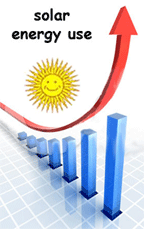
 South African solar plant connects to the grid three months ahead of schedule, Renewable Energy Magazine, Robin Whitlock Friday, 15 November 2013 The 75MW Kalkbult solar plant will generate 135 million kilowatt hours per year and displace 115,000 tons of greenhouse gas emissions A solar plant built by Scatech Solar in cooperation with local partners has become the first utility-scale renewable energy facility to supply electricity to South African public utility Eskom after connecting to the country’s electricity grid three months ahead of schedule.
The 75MW Kalkbult solar PV plant near Petrusville in the Northern Cape, was officially opened on Tuesday 12thNovember. It will generate 135 million kilowatt hours per year, equivalent to the annual electricity consumption of 33,000 households. The plant covers 105 hectares of a working sheep farm and consists of 312,000 solar panels linked to inverters, transformers and a high-voltage sub-station. More than 600 people were employed during its construction, many from the local community…….
The plant is among 47 solar, wind and mini-hydro projects awarded 20-year electricity generation contracts under the South African government’s Renewable Energy Independent Power Producer Procurement Programme (REIPPPP), introduced three years ago by the Department of Energy. Total investment in the programme is estimated at R74 billion which will climb above R100 billion following the government’s acceptance of 17 new bids. The aim of the programme is to help the country combat climate change by reducing its current near-total dependence on coal-based electricity and accompanying high level of greenhouse gas emissions. The Kalbult plant is intended to displace annual greenhouse gas emissions of 115,000 tons.
The project will also add momentum to the country’s Green Economy Accord signed three years ago with the aim of creating 300,000 new jobs in renewable energy generation, energy efficiency, biofuel production, manufacturing in support of green projects and natural resource conservation and rehabilitation. http://www.renewableenergymagazine.com/article/south-african-solar-plant-connects-to-the-20131115
Solar energy for Ghana
Renewables get big boost as 50MW solar plant to be built Ghana Web 15 Nov 13 Ghana’s energy stock will receive 50 megawatts (MW) of solar power by 2015 as Scatec Solar, a Norwegian energy company, plans to build Africa’s second-largest solar power plant through its local partner Scatec Solar Ghana.
The project will cost about €70million and will be sited in the northern part of the country. “We are in discussion with ECG, the main off-taker, and we hope to progress with those discussions. So far everything is going well. We have had engagement with the Energy Commission and the Public Utilities Regulatory Commission (PURC), and we think that with all the efforts from these various institutions Scatec Solar will come onstream as planned,” Fred Nuerte Nuer, Director of Scatec Solar Ghana, said.
When completed, the project will become the first large utilities-scale solar power plant in West Africa and the second-largest in Africa, after the company unveiled a 75MW solar plant in South Africa early this week……
African bank backs renewable energy
Africa must look at renewable energy Standard Bank Wed, 2013/10/30 – Power is key to economic growth and competitiveness in Africa. The continent has massive potential to use renewable energy sources as it seeks to address an electricity shortage that has left more than half of the continent’s one billion people without access to power. Ntlai Mosiah, who heads up the Power, Infrastructure  & TMT (Technology, Media, Telecoms) team at Standard Bank Group, looks at the opportunities and costs of untapping this resource.
Questions have been raised about whether renewable energy might be too expensive for Africa given the abundance of cheap coal, but it is now clear that this has changed as the cost of renewable technology is steadily falling while the capital expenditure costs of coal-fired power stations are rising Continue reading
South African govt influenced by coal industry to hold back renewable energy
SA renewable energy held up by politics, says Greenpeace News 24 Duncan Alfreds, 17 Oct 13 Duncan Alfreds Cape Town – Renewable energy has proven itself and the government should move ahead swiftly with implementation, an environmental organisation has urged.
“It has been proven that there are no technical or economic barriers to renewable energy, leaving only the lack of political will as a barrier to RE,” Ruth Mhlanga, Greenpeace Africa Youth and solutions campaigner told News24.
She accused the government of being influenced by incumbent industry players to ensure that the status quo of energy supply networks remained unchanged.
“Vested interests in the fossil fuel industry with strong political ties use this influence to promote investments in fossil fuels rather than renewable energy,” said Mhlanga.
Recently, Trade and Industry Minister Rob Davies announced plans for a third massive coal-fired power station dubbed “Coal 3” though the Medupi and Kusile projects have been hampered by delays and allegations of poor workmanship……
“In fact, the huge problems at both Medupi and Kusile clearly show that new investments in coal are likely to sabotage the South African economy, and renewable energy can come online and feed into the electricity grid far more quickly and more cheaply than coal can,” Mhlanga said.
It does appear that the Cabinet is not fully united behind the idea of a third coal-fired power plant.
Beeld reported that Science and Technology Minister Derek Hanekom said government would have to rethink its plans for a third mega coal-fired power station…….
Coal power also impacts negatively on the environment and Greenpeace said that South Africans ought to consider the true cost of fossil fuel electricity generation.
“Delays and poor delivery are just the tip of the iceberg when it comes to coal. There are also major hidden costs related to water scarcity, human health impacts and climate change – amounting to billions of rands every year, and it is ordinary South Africans who have to pay the price,” said Melita Steele, Greenpeace Africa Climate and Energy campaigner. http://www.news24.com/Green/News/SA-renewable-energy-held-up-by-politics-says-Greenpeace-20131017
Thousands march in Niger to protest against AREVA
5,000 march against French uranium miner in Niger http://www.mining.com/5000-march-against-french-uranium-miner-in-niger-17954/Frik Els | October 12, 2013 Thousand of protestors marched against French uranium miner Areva (EPA:AREVA) in the remote town of Arlit in Niger on Saturday.
Areva has been operating in Niger for more than 50 years with two sites, Somair and Cominak, currently producing, and its long-term deal with the government of Niger is up for renegotiation at the end of 2013.
The roughly 5,000 protesters in Arlit were out in support of a Niger government audit to determine how to better distribute revenues from the two mines Reuters reports:
“We’re showing Areva that we are fed up and we’re demonstrating our support for the government in the contract renewal negotiations,” Azaoua Mamane, an Arlit civil society spokesman, said in an interview with a private radio station.
“We don’t have enough drinking water while the company pumps 20 million cubic meters of water each year for free. The government must negotiate a win-win partnership,” Mamane said.
The two mines together produce 4,500 tonnes of uranium for export to France and another project at Imouraren, which will be the largest uranium mine in Africa, is set to start operations in 2015.The Somair mine was back to full production in August, after a suicide attack in May killed one worker and injured 14 partially shutting down mining.
Prices for uranium are languishing at 8-year lows of $34 a pound and have not recovered since the Fukushima disaster in Japan in 2011
Niger aiming to get more taxes from Areva’s uranium mning
Niger’s Hedges Bets on French Uranium Assets Oil Price.com. By Editorial Dept | Fri, 04 October 2013 Bottom Line: Under constant threat of terrorist attacks in the security nightmare of Niger, French nuclear group Areva will now face an audit of its uranium mines as the Nigerien government seeks a better deal.
Analysis: Areva has two mines in Niger: Somair and Cominak. Together these two facilities produce about one-third of France’s nuclear power. But the 10-year contract for these mines ends this year, and the government of Niger is planning to take advantage of that by auditing the company and determining how it can get a better deal. The plan will be to increase tax revenues from Areva and to force it into more significant investments in infrastructure. Areva was operating at a loss last year, but is eyeing over 1.1 billion euros in operating profits for this year—and Niger is hoping to get a bigger chunk of this through taxes and infrastructure deals. The government of Niger already owns a 36.4% stake in Somair and a 31% stake in Cominak. Areva will now be audited first based on claims from some groups that it is not transparently reporting its revenues and operating costs. A third mine that is under construction—Areva’s Imouraren uranium mine—is also under scrutiny. The government of Niger has warned that the company will face fines if there are any further delays to the opening of this mine, now slated for 2015.
Recommendation: This could all play into the security question due to the level of government corruption in Niger,…(furher reading -subscription only) http://oilprice.com/Alternative-Energy/Nuclear-Power/Nigers-Hedges-Bets-on-French-Uranium-Assets.html
Even Eskom admits nuclear power is by far South Africa’s most expensive energy option
 The intended nuclear plan would be “very costly” and if anything went wrong it would have a devastating impact on people and the environment
Doubts over nuclear costs Business Report (South Africa) September 29 2013 By Donwald Pressly. REUTERS The Government is forging ahead with its nuclear build programme to boost the electricity supply although details of its costings are scant, but Eskom’s own figures indicate it will be the most expensive option.
In the wake of an announcement on Thursday by Energy Minister Ben Martins that a detailed costing and the extent of the nuclear programme would be made known before the end of the financial year, a range of organisations have come out against the government’s stance in favour of extending South Africa’s nuclear power footprint beyond Koeberg…….
.While Eskom has not provided recent build programme cost estimates, it did provide comparative figures in its third multiyear price determination application to Nersa of gas, coal, wind, solar and concentrated solar power (CSP). Nuclear ended up being the most expensive by far. Continue reading
Niger government wants French uranium company AREVA to stop ripping it off
 Niger audits Areva uranium mines, seeking better deal By Daniel Flynn and Abdoulaye Massalatchi NIAMEY | Fri Sep 20, 2013 (Reuters) – Niger has ordered an audit of French nuclear group Areva’s (AREVA.PA) uranium mines in the West African country as it presses for a better deal in talks over a new long-term contract, Mining Minister Omar Hamidou Tchiana told Reuters.
Areva’s two mines in Niger – Somair and Cominak – produce the fuel for roughly one-third of France’s nuclear power, providing some of the cheapest electricity in the West.
Niger, a former French colony and one of the world’s poorest countries, has long complained it does not reap enough benefits from these resources……..
Extractive industries watchdogs, including the local branch of Publish What You Pay, have accused Areva of a lack of transparency in its revenues and costs in Niger…….
Previous Niger governments have struggled to substantially increase the state’s take from uranium and details of the 2003 mining contract have been kept confidential. The IMF estimates Niger’s gross domestic product at around 5.5 billion euros, only just over half of Areva’s revenues of 9.3 billion in 2012……..http://www.reuters.com/article/2013/09/20/us-niger-areva-idUSBRE98J0MY20130920
Arms and uranium trade pact between Zimbabwe and North Korea
Zimbabwe in ‘arms for uranium’ pact with North Korea Nehanda Radio 19 Sept 13, President Robert Mugabe’s military henchmen have reportedly signed an arms trade agreement worth millions of dollars with North Korea, in return for allowing Pyongyang access to Zimbabwe’s controversial Kanyemba district, which has sparked a uranium mining race pitting Iran and other powers, Nehanda Radio has been told.
Kanyemba district is about 160 miles north of the capital, and is believed to be holding significant uranium reserves, first discovered in the 1970s by German prospectors, but never exploited due to low world prices at the time.
Several other countries have sought the rights to mine Zimbabwe’s untapped uranium deposits, and these include Russia, China and a failed bid by neighbouring South Africa and Namibia, as they scramble for the Yellow cake which is a key ingredient needed for the production of nuclear bombs. Continue reading
Tanzania warned about health dangers of uranium mining
The big lesson here for Tanzania with its Uranium deposit soon to be exploited is that; until now there is no proper way of destroying completely remains of uranium mining, and therefore it is difficult to control the effects of the mineral that will end thousands of years. Above all the cost of cleaning up the environment and avoidance of effects caused by remains of big uranium mines and management of radioactive waste will put a big strain on the already ailing country’s economy. A section of the Tanzanian media on June 8, 2013 quoted Energy and Minerals minister Professor Sospeter Muhongo as telling a visiting delegation of experts from the European Union that uranium mining will start soon in Tanzania and that the government has satisfied itself that this process will have no hazardous health effects to the population. It is hoped that this official statement was issued after consultations with the Tanzania Atomic Energy Commission which is legally responsible for all radioactive materials in the country, uranium being no exception. In summary, such statements should dwell first with the technical matters and let experts and responsible institutions take the major part on advising and educating the public on at least five aspects. One: Key steps taken to ensure safety and safeguarding of the communities around and the environment for the present generation and future ones. Two: How the uranium mining radioactive wastes (tailings) will be handled during and after the mining. Three: The degree to which the population around the mines is aware of what is going on and how to react upon any unexpected event; Four: The results of the baseline studies that need to be carried out before the commencement of the mining. Five: The safety measures and programmes aimed at protecting workers and the environment against radiation and radioactive materials. These are among the key questions that need to be answered by the experts and indeed the responsible institutions before such statements are issued by high-calibre politicians.
Secrecy in South Africa, as government mulls subsidies for nuclear power
 Regardless of how the financing will be structured it is clear that most of the money will come from debt, which South Africans will ultimately pay for through higher electricity tariffs or increased taxes. The details of these financing structures are also unlikely to be transparent.
SA still in the dark over nuke money, Mail and Guardian, South Africa 02 AUG 2013 NEWS ANALYSIS LYNLEY DONNELLY Vendor financing is a possibility, but questions remain over the country’s finances. The government appears intent on hitching its star to a big nuclear wagon, despite serious misgivings within its own ranks over whether the need for nuclear power is as urgent as once believed, the possibility of emerging alternatives and the continued opposition from business and civil society.
Chief among the reasons for a rethink of South Africa’s nuclear ambitions is the ability to pay for it, according to energy experts and economists, although there are international financing models.
The state has so far refused to pronounce on the cost, but it is estimated that it will be between R400-billion and R1-trillion. Continue reading
South Africa’s poor will not be able to afford nuclear electricity
Direct and associated coal, nuclear and other fossil fuel costs continue to rise, while solar and wind costs continue to drop………… Through smart planning and a move away from energy-intensive economic sectors, South Africa can decouple electricity demand from economic growth.
This will enable us to replace coal, fossil fuel-based and nuclear power plants as they retire with renewable energy technologies.
New power plan jeopardises electricity access for poor 02 AUG 2013 Mail and Guardian, South Africa ROBERT FISCHER The cost of electricity is the subject of talks around every table in every home in the country.
These costs are heavily influenced by the cost of generating electricity.
Now the Mail & Guardian tells us that President Jacob Zuma is pushing ahead with plans for nuclear plants, “despite uncertainty about the affordability of nuclear energy and the availability of sufficient expertise” (“Zuma slips into nuclear driver’s seat”, July 25). Eskom told the National Energy Regulator of South Africa that it “need[s] to recover the cost of producing electricity, which includes operating costs as well as the costs of financing new capacity,” through its tariffs. An extremely expensive nuclear programme could seriously jeopardise the crucial social investment of providing electricity.
When you consider that the poorest households spend 32% of their income on electricity, housing, water, gas and other fuels (excluding transport), turning on the lights becomes an expensive option. Continue reading
1 This Month

26 September – International Day for the Total Elimination of Nuclear Weapons


PLEASE OPPOSE HR 8255 AND S.3639 – bills would accelerate satellite deployment, with no environmental review or safeguards – https://ncstd5li.quorum.us/campaign/169331/
To see nuclear-related stories in greater depth and intensity – go to https://nuclearinformation.wordpress.com
-
Archives
- September 2026 (206)
- August 2026 (330)
- July 2026 (355)
- June 2026 (287)
- May 2026 (306)
- April 2026 (356)
- March 2026 (251)
- February 2026 (267)
- January 2026 (308)
- December 2025 (358)
- November 2025 (359)
- October 2025 (375)
-
Categories
- 1
- 1 NUCLEAR ISSUES
- business and costs
- climate change
- culture and arts
- ENERGY
- environment
- health
- history
- indigenous issues
- Legal
- marketing of nuclear
- media
- opposition to nuclear
- PERSONAL STORIES
- politics
- politics international
- Religion and ethics
- safety
- secrets,lies and civil liberties
- spinbuster
- technology
- Uranium
- wastes
- weapons and war
- Women
- 2 WORLD
- ACTION
- AFRICA
- Atrocities
- AUSTRALIA
- Christina's notes
- Christina's themes
- culture and arts
- Events
- Fuk 2022
- Fuk 2023
- Fukushima 2017
- Fukushima 2018
- fukushima 2019
- Fukushima 2020
- Fukushima 2021
- general
- global warming
- Humour (God we need it)
- Nuclear
- RARE EARTHS
- Reference
- resources – print
- Resources -audiovicual
- Weekly Newsletter
- World
- World Nuclear
- YouTube
-
RSS
Entries RSS
Comments RSS
 nuclear-news