South Africa’s growth in renewable energy
Africa: South Africa to Procure Still More Renewable Energy http://allafrica.com/stories/201404151599.html15 APRIL 2014 South Africa’s Department of Energy is to increase the amount of energy it will be procuring under the third window of its renewable energy programme for independent power producers, Energy Minister Ben Martins announced on Tuesday.
In November, the department signed agreements with 17 new preferred bidders in the third round of the programme, following the signing off of 47 projects in the first and second rounds, bringing to 64 the total number of renewable energy projects approved by the government since December 2011.
Once they are all operational, the 64 projects – representing foreign and domestic investment of over R100-billion – will add around 3 900 megawatts (MW) of wind, solar photovoltaic and concentrating solar power to South Africa’s energy mix.
On Tuesday, Martins said in a statement that this department would be allocating additional megawatts to the third window of the programme, thus including additional bidders, due to the increasingly competitive pricing offered by the round three bids.
Business Day reported in November that the average price offered for power generated from wind – which received the bulk of the third-round allocation – had dropped from R11.43 per kilowatt hour (kWh) in the first round to R6.65/kWh in the third round.
“The department will, in this regard, follow due procurement process to include additional bidders under window 3,” Martins said, giving no further specifics.
He added that submissions for the fourth window of the programme, which entails the procurement of a further 1 000 MW of renewable energy, was on track to close in August. The programme has five windows altogether.
While renewable energy accounted for less than 1% of South Africa’s energy mix in 2012, this is expected to reach 12% by 2020. According to research released in October by analysts Frost & Sullivan, this would place South Africa in the “global top 15 countries” with regard to the implementation of renewable energy projects.
Announcing the latest 17 preferred bidders in November, Martins noted that South Africa was currently rated as the 12th most attractive investment destination for renewable energy.
“This bodes very well for South Africa, as the programme has achieved international acclaim for fairness, transparency and certainty of programme,” Martins said, adding that there had been a progressive increase in the local content and job creation numbers offered by the bidders.
The department’s director-general, Nelly Magubane, said that some bidders had exceeded the local content requirement of no less than 40%, with some indicating that their projects would involve up to 56% local content.
Martins said the energy sector was expected to play a major role in creating green sector jobs, developing skills and transferring technology into South Africa’s economy.
Employment boost for South Africa due to renewable energy projects
Green energy IPPs create 14 000 jobs http://www.iol.co.za/business/companies/green-energy-ipps-create-14-000-jobs-1.1675332 April 14 2014 Independent power producers (IPPs) using renewable energy had created about 14 000 jobs over the past three years, Energy Minister Ben Martins said on Friday. “One of the imperatives of government is to ensure that all departments assist in job creation. Through the independent power producers programme, more than 14 000 have been created,” Martins said following a summit with 61 IPPs. “At the meeting, we acknowledged and expressed appreciation of the fact that to date more than R100 billion has been invested into this particular sector.” IPPs are entities which either own and or operate facilities that generate electric power. They then sell the power to a utility, central government buyer or to end users. The meeting was also attended by representatives of the Development Bank of Southern Africa, Eskom and the Public Investment Corporation. Diplomats representing Denmark, Spain, Germany, Norway, and the UK were also present at the Pretoria meeting. Martins said the IPP project had brought significant direct foreign investment. – Sapa
Uranium mining affected by water shortage, water prices
 Uranium Miners in Namibia Face Rise in Water Price, Paladin Says http://www.businessweek.com/news/2014-04-04/uranium-miners-in-namibia-face-rise-in-water-price-paladin-says By Felix Njini April 04, 2014 Uranium miners in Namibia, already coping with water shortages in the semi-arid Erongo region, face a steep rise in costs, Paladin Energy (PDN) Ltd. said.
“When we get it, sometimes we have problems with the quality of the water and the cost,” said Simon Solomons, managing director of Paladin’s Langer Heinrich mine. “At the moment there is no long-term solution to the water-supply situation.”
The mines operated by Paladin, Rio Tinto Plc and China General Nuclear Power Group rely on water from a 20 million-cubic-meter capacity desalination plant operated by Areva SA, a French reactor maker. Areva is in talks to sell a majority stake in the plant to state utility Namibia Water Corp. after shelving its Trekkopje project in 2012 as uranium prices slumped in the wake of the Fukushima disaster.
Namwater has “to look for finance to buy the plant,” Solomons said yesterday during a tour of the Subiaco, Western Australia-based company’s mine. “They will pass on those charges to the uranium mines.”
Calls to Namwater weren’t immediately answered.
The three mines, which require as much as 10 million cubic meters of water a year, were previously supplied by the Omaruru Delta aquifer, which has dwindling volumes as demand from the mines and surrounding towns of Swakopmund and Walvis Bay rises.
Langer Heinrich, which consumes 130,000 cubic meters of water a month, has had “no long-term and no firm discussion” with Namwater over supplies, Solomons said.
Namibia is the fourth-largest uranium producer after Kazakhstan, Canada and Australia.
To contact the reporter on this story: Felix Njini in Windhoek at fnjini@bloomberg.net
Nuclear power is getting just too expensive for South Africa
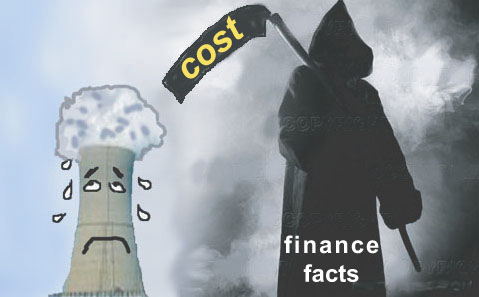 Nuclear development in South Africa likely on hold unless funds incorporated from private sector, Enformable Lucas W Hixson 19 Mar 14 South African President Jacob Zuma and Energy Minister Ben Martins have continuously committed the nation to build up a nuclear industry.
The government has adopted a 20-year Integrated Resource Plan (IRP) which says that coal, nuclear, hydro, shale gas, and renewable energy are all included in potential generation methods of increasing the nation’s power supply. The IRP is revised every two years, the latest update proposes that the nation delay construction of more nuclear plants and instead focus more on coal, hydro and gas.
Energy Minister Martins has said that South Africa’s goal is to be self-sufficient in all aspects of the nuclear energy industry, but there are concerns about whether South Africa’s construction industry is even large enough to handle the additional resources and manpower which would be required.
President Zuma announced that the South African government would work to procure 9,600 MW of energy from nuclear power, based on the IRP released in 2010. The new IRP said that little or no nuclear power will be required.
If President Zuma’s goal of installing 9,600 MW of nuclear energy, the government must find at least 1 trillion rand ($93.2 billion USD), to support a nuclear fleet of three new nuclear power plants in South Africa.
On Tuesday, Rob Adam, president of the Nuclear Industry Association of South Africa and director of the construction group Aveng, spoke at an energy conference in Johannesburg and told attendees that the government would likely be forced to incorporate funds from the private sector to invest in the nuclear industry in South Africa…….
Eskom is not currently fiscally stable enough to finance a nuclear power plant. According to experts in South Africa, given the nation’s tight fiscal budget, it is extremely unlikely that the government would be able to allocate any funds for the proposed nuclear build.
The nuclear proposal is seemingly causing a rift in the South African government. Some agencies like the departments of energy, public enterprises, trade and industry to name a few are big proponents of a nuclear build, while other agencies like the National Planning Commission and the treasury are concerned with the high costs of nuclear energy. http://enformable.com/2014/03/nuclear-development-south-africa-likely-hold-unless-funds-incorporated-private-sector/
Revolutionary new system for solar power in remote parts of Africa
 Renewable energy: Samsung introduces digital village concept Ghana Web 12 Mar 14, Samsung Electronics is developing a concept that will make use of sunshine, which is an abundant natural resource in Africa, to change and improve the lives of inhabitants of rural communities in Africa.
The leading provider of digital solutions will use sunshine as a renewable source of energy in Africa to establish various facilities that can be operated through transportable solar-powered generators.
Officials of Samsung therefore seek to introduce what is called the digital village with solar integrated solutions, a unique concept that harnesses technology in a way that breaks through traditional, social and economic barriers and takes real support and opportunities to people where they live.
Mr Thierry Boulanger, Director of Information Technology (IT) and Business to Business (B2B) Solutions of Samsung Electronics in charge of Africa, said the solar-powered generators constituted the heart of the digital village that could be erected in 60 minutes of arrival.
He said the solar-powered generators could be used to power classrooms, small businesses, government offices, health facilities and remote -controlled gates…….
Confusion and secrecy over costs of proposed nuclear energy for South Africa
 Can we afford it?
The department’s nuclear costs study is understood to be complete, but the findings have not been made public.
 Nuclear plan slips under budget radar Mail & Guardian, Africa, 28 FEB 2014 LIONEL FAULL If it goes ahead it will be SA’s largest contract ever, yet Pravin Gordhan failed to mention it. Indications of policy confusion at the highest levels of the government were reinforced this week when the budget failed to build on President Jacob Zuma’s State of the Nation pronouncement that “we expect to conclude the procurement of 9 600MW of nuclear energy”.
The cost of 9 600MW of nuclear power has been estimated at anything between R400-billion and more than R1-trillion, and would dwarf any other tender in South Africa’s history.
In contrast with Zuma’s definitive pronouncement for the coming year, Finance Minister Pravin Gordhan did not mention nuclear at all in his budget speech. He mentioned renewables four times, and shale gas exploration once.
Even the energy department, in the estimates of national expenditure that accompany the budget, did not commit to any looming procurement decisions. Continue reading
AREVA now finding it harder to rip off Niger in uranium projects
 Niger fails to reach uranium mining deal with French nuclear firm Areva Deadlock over royalties as Oxfam points out Areva’s global turnover is more than four times Niger’s entire annual budget Guardian Celeste Hicks in Niamey, 28 Feb 14, Another deadline has passed without agreement in Niger in the government’s ongoing negotiations with the French nuclear company Areva on the renewal of the company’s license to operate in the country.
After months of discussions, the mining minister, Omar Tchiana, said last week that Friday would be the final deadline for the two sides to strike a deal. Now it has been agreed that talks will continue without a fixed deadline.
The negotiations are deadlocked on the issue of the royalties Areva pays Niger for the rights to two large uranium mines, Somair and Cominak in the arid north of the country. The terms of the original deal struck in the early 1970s have never been made public, but government sources say the company pays about 5.5% of its revenues in royalties. Niger wants the terms of a new mining code passed in 2006 to be implemented, which would force Areva to pay between 12% and 15% in royalties, and end a number of tax breaks on materials and equipment.
“Niger has not benefited at all from uranium production for 40 years. These contracts need to be win-win for Niger and not just for the benefit of France and Areva” said Ali Idrissa, the executive co-ordinator of the civil society group Rotab. The issue is of huge significance to the country, which ranks bottom of the UN’s human development index. According to Oxfam, Areva’s annual turnover of €9bn ($12.4bn) is more than four times Niger’s entire annual budget of €2bn…….
the current negotiations between Areva and the government are still less than transparent, and steps towards establishing a FGF and prioritising its spending have not been implemented…….
It is likely that Niger will be able to leverage a better deal from Areva, despite the company’s claims that a higher royalty rate could make the operation prohibitively unprofitable……http://www.theguardian.com/global-development/2014/feb/28/niger-fails-uranium-mining-deal-french-firm-areva
THe Nuclear Medusa AREVA and its uranium mining harm to Niger
 No matter where Uranium is mined on this planet the story is the same. The marketeers operate without conscience. Uranium should not be a marketable commodity.
 World’s Poorest Suffer From Radioactive Sickness as Areva Mines for Uranium http://ecowatch.com/2014/01/24/worlds-poorest-radioactive-areva-uranium/Brandon Baker | January 24, 2014 More than 60 percent of Niger’s population lives on less than $1 per day, and even more have no electricity.
Still, French company Areva keeps contaminating those residents and their environment while mining away for uranium—one of the few resources the world’s poorest country still has. Continue reading
Wide implications for uranium industry of test case in Niger
Niger uranium mining dispute a test case for use of African natural resources by Mark Tran Friday 10 January 2014 theguardian.com The wrangle between Niger and a state-owned French firm over payments for uranium extraction has wider ramifications
The protracted negotiations on uranium mining between Niger andAreva, the French energy multinational, are not just a trial of strength between an African government and a big company. The face-off will also test whether there is more than just pious sentiment to the notion that African countries should derive greater benefit from their natural resources.
Areva, which owns stakes in the Somair and Cominak mines, has been negotiating with Niger over new uranium mining contracts for two years. The mines’ 10-year licences expired on 31 December without a new agreement, although Niger issued a decree on 27 December providing a legal framework under the 2006 mining law for operations to continue.
The company is tight-lipped on discussions……..
The mines have been closed since mid-December for what Areva describes as routine maintenance. Some see the move as hardball tactics by the company to put pressure on the Nigerien government.
At heart of the matter is the country’s desire for a better deal. Niger accounts for more than a third of Areva’s uranium production, and President Mahamadou Issoufou’s government wants to increase the royalties the company pays from 5.5% of revenues to 12%, officials told Reuters…….
Niger is desperately poor, ranking last of the 187 countries in the 2012 UN Human Development Index. Three-quarters of its people live on less than $2 a day and malnutrition is rife, with the country beset by droughts. Although mining made up 70.8% of Niger’s exports in 2010, it contributed only 5.8% of the country’s gross domestic product.
According to a report from Oxfam France and the Niger arm of Publish What You Pay, the transparency group, Areva’s two mines produced uranium worth more than €3.5bn (£2.9bn) in 2010, but Niger received just €459m, or 13% of this amount. In 2012 Areva received tax exemptions worth €320m, the report says….http://www.theguardian.com/global-development/poverty-matters/2014/jan/10/niger-uranium-mining-dispute-african-natural-resource
Uranium mining in Tanzania to destroy environment, health and tourism
poaching, which has been rampant in the Selous and government is doing little to stop it because word has it senior people are benefiting from the trade in blood ivory……
So perhaps, cynical as we know them to be, they let the reserve be poached empty and then shrug and tell us that is is no longer suitable for tourism and did they not always say mining is the future for the country?
No one will dare to really expose the dangers of uranium mining to the Tanzanian public and so most people will only get the uptalk of government and not the downside of the environmental fallout’.
Tanzania conservationists reject uranium mining approvals BY PROF. DR. WOLFGANG H. THOME, ETN AFRICA CORRESPONDENT | DEC 27, 2013 Reactions to media reports in Tanzania, publishing details of approvals for uranium mining given by the country’s Atomic Energy Commission, were swift and harsh, and predicatably given on condition of anonymity, no wonder considering Tanzania’s record of often brutal suppression of dissent, especially when big commercial interests are at stake……
Uranium mining in the Selous has led to world wide protests and led to the government putting a mechanism into place to carve out over 200 square kilometres of the Selous territory to evade sanctions by UNESCO, which had made the Selous Game Reserve a World Heritage Site – for the Tanzanian government not an issue it seems as they habitually ignore that status in favour of ‘development’ Continue reading
One nation that abandoned nuclear weapons – South Africa
Unfortunately, South Africa is still the only state that has ever voluntarily dismantled its entire nuclear weapons capability. Nuclear states continue to do lip service to the goal of nuclear disarmament, but little has been achieved in practice. South Africa has illustrated that long-term security can be far better assured by the abrogation of nuclear weapons than by their retention.
South Africa: Nation that gave up its nuclear arsenal The solution was not the acquisition of greater military power through the development of nuclear weapons but the abolition of apartheid Gulf Times, F.W. de Klerk Former president of South Africa December 25, 2013It will be a mistake to think that the end of the Cold War also ended the threat posed by nuclear weapons. Nuclear-armed states continue to deploy huge arsenals of nuclear weapons, other states continue with their efforts to acquire nuclear weapons and there is the alarming possibility that such weapons may fall into the hands of terrorists. Accordingly, it may be helpful to consider the factors that led South Africa to develop nuclear weapons in the 1970s and the reasons why it decided to dismantle them in 1989…..
Soon after I became president in 1989, foreign minister Pik Botha urged me to take two key steps if we wished to improve South Africa’s relationship with the world: The first was to release Nelson Mandela and the second was to dismantle our nuclear weapons and accede to the Nuclear Nonproliferation Treaty (NPT). Continue reading
Quest for uranium underlies France’s military intervention in Central African Republic
Paris is focusing on the uranium deposits in the Bakouma sub-prefecture of the Mbomou prefecture, in south-eastern CAR.
The primary sources of France’s uranium in southern Algeria and northern Mali and Niger are increasingly threatened ….
escalation of jihadist operations added a sense of urgency to the French quest for the uranium resources
Behind France’s intervention in CAR: Uranium supply security WorldTribune.com By Yossef Bodansky, Senior Editor, Global Information System/Defense & Foreign Affairs 17 Dec 13 Operation Sangaris (a local exotic butterfly) — the French and MISCA (the French acronym for the International Support Mission to the Central African Republic) military intervention in the Central African Republic (CAR) — is escalating.
The French contingent will now be 1,600-troop strong, rather than the 1,200 agreed-upon at the United Nations Security Council (UNSC). The African Union’s (AU’s) MISCA force will grow to a total of 6,000 troops from Francophone African states, rather than the original estimate of 3,500 troops.
The hasty deployment of these forces only aggravates an already explosive situation in the country and region, and sparks new fighting where none existed before the international intervention had been announced. Most notably is the sudden resumption of fighting in Bangui, a city and region which had been completely quiet and secure literally until the day before the arrival of the new French forces.
The French-led Operation Sangaris had nothing to do with the oft-declared threat of “seeds of genocide” in the CAR. The French administration of President François Hollande is driven by the French desire for uranium ores. Continue reading
Catastrophic radioactive spill at Rio Tinto’s Rossing uranium mine
Rössing shuts operations after ‘catastrophic leak’ Namibia Times, December 6, 2013 By Jade McClune & Marshallino Beukes All milling operations at Rössing Uranium Mine ground to an immediate halt after “a catastrophic structural failure” at one of twelve leach tanks in the processing plant on Tuesday.
The incident triggered a veritable crisis, reinforcing widespread fears of a radioactive leak.
Sources at the mine told the Namib Times on Tuesday that they had heard some “kind of explosion”.
The mine has since confirmed that a leak was detected near one of the leach tanks and said there was “a very serious incident”, but did not mention any explosion.
A Red Banner Health and Safety Alert was sent out to all employees of the mine on Wednesday, confirming that there had been a “leach tank failure” at around 18:30 on Tuesday, 3 December.
The actual outcome of the incident was described as “serious” and the “maximum reasonable outcome: critical”……..http://www.namibtimes.net/forum/topics/rossing-shuts-operations-after-catastrophic-leak
Call for a fair deal from AREVA, for Niger
Niger says seeks better uranium terms from French Areva au news 6 Dec 13Paris (AFP) – Niger’s President Mahamadou Issoufou said in Paris on Friday that his country wanted to renew its uranium mining agreement with French nuclear giant Areva, but on more equitable terms….. Areva’s contract to extract uranium in the west African country expires on December 31, after more than four decades of mining at two sites on the southern edge of the Sahara, with a third under development………http://au.news.yahoo.com/thewest/business/world/a/20197961/niger-says-seeks-better-uranium-terms-from-french-areva/
Russia aggressively marketing nuclear power to South Africa
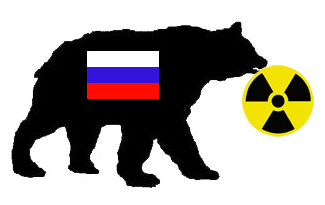
the draft Russian agreement, which Business Day has seen, had a veto clause, which would allow the parties to block the involvement of a third country
Russia turns up heat on ambitions for nuclear build in SA BUSINES DAY LIVE, BY CAROL PATON, 29 NOVEMBER 2013 THE RUSSIAN GOVERNMENT IS PUMPING UP THE PROPAGANDA SURROUNDING THE COUNTRY’S NUCLEAR AMBITIONS IN SOUTH AFRICA WITH A SERIES OF REPORTS ON THE OFFICIAL INTERNATIONAL BROADCASTER VOICE OF RUSSIA THAT A DEAL HAS BEEN STRUCK TO BUILD SOUTH AFRICA’S PLANNED NUCLEAR POWER PLANTS.
Several countries are jockeying for position in South Africa’s nuclear build programme, which envisages the construction of three nuclear power plants to supply 9,600MW at the cost of at least R1-trillion. The government has said the procurement process is close to finalised and there is high expectation among bidders that it will go ahead next year.
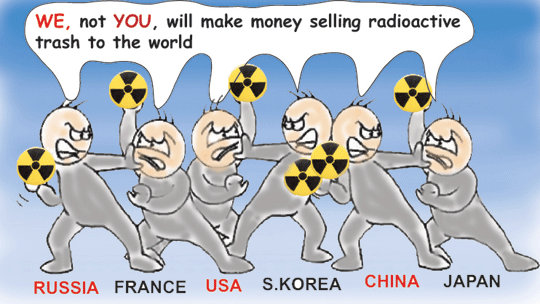
This week, the temperature over the nuclear build was further heightened when state-owned Russian corporation Rosatom hosted a nuclear suppliers’ forum in Johannesburg “with the aim of establishing and developing lasting partnerships in South Africa”.
At the forum on Monday, a memorandum of understanding was signed between the Nuclear Energy Corporation of South Africa (Necsa) and a Rosatom subsidiary. Continue reading
1 This Month

26 September – International Day for the Total Elimination of Nuclear Weapons


PLEASE OPPOSE HR 8255 AND S.3639 – bills would accelerate satellite deployment, with no environmental review or safeguards – https://ncstd5li.quorum.us/campaign/169331/
To see nuclear-related stories in greater depth and intensity – go to https://nuclearinformation.wordpress.com
-
Archives
- September 2026 (194)
- August 2026 (330)
- July 2026 (355)
- June 2026 (287)
- May 2026 (306)
- April 2026 (356)
- March 2026 (251)
- February 2026 (267)
- January 2026 (308)
- December 2025 (358)
- November 2025 (359)
- October 2025 (375)
-
Categories
- 1
- 1 NUCLEAR ISSUES
- business and costs
- climate change
- culture and arts
- ENERGY
- environment
- health
- history
- indigenous issues
- Legal
- marketing of nuclear
- media
- opposition to nuclear
- PERSONAL STORIES
- politics
- politics international
- Religion and ethics
- safety
- secrets,lies and civil liberties
- spinbuster
- technology
- Uranium
- wastes
- weapons and war
- Women
- 2 WORLD
- ACTION
- AFRICA
- Atrocities
- AUSTRALIA
- Christina's notes
- Christina's themes
- culture and arts
- Events
- Fuk 2022
- Fuk 2023
- Fukushima 2017
- Fukushima 2018
- fukushima 2019
- Fukushima 2020
- Fukushima 2021
- general
- global warming
- Humour (God we need it)
- Nuclear
- RARE EARTHS
- Reference
- resources – print
- Resources -audiovicual
- Weekly Newsletter
- World
- World Nuclear
- YouTube
-
RSS
Entries RSS
Comments RSS
 nuclear-news