Nuclear fraud in Nigeria
INVESTIGATION: At Nigeria’s abandoned nuclear centre, failed projects, idle staff and ‘fraud’ [Part 2] Premium Times, Kemi Busari Awarded at over N400 million in 2009, what was supposed to be a radioactive waste management facility at Nigeria’s Nuclear Technology Centre never came to life.

Instead, a building overgrown with scrubs lies east of the gamma irradiation facility. Waste management plants and equipment comprise various devices and machines used for treating, converting, disposing and processing wastes from various sources.
The construction of low/medium radioactive waste management facility was awarded at the contract sum of N401.4 million to Commerce General Limited and so far, N312 million has been paid to the contractor, the Nigeria Atomic Energy Commission (NAEC) said in response to a Freedom of Information request made over a month ago.
The project, according to NAEC, was 78 percent complete and has “only suffered delays.”
“The project was not abandoned. It only suffered delays due to factors outside the control of the commission,” the agency said.
The delays, NAEC said, include; “inadequate funding of capital projects generally, over the years, modification of the original design, as recommended by IAEA experts, which has resulted into changes in the BOQ figures and this development is being discussed with the contractor,” and also, “no outstanding Interim Payment Certificate on the project.”
A staff of the NTC, who was privy to the contract and execution since 2009, said the project had been used to embezzle money from government since the time of award.
“It is true that they changed the plan of the plant but they’ve never done anything meaningful there since they mounted these blocks,” he said.
“The contractor is not qualified and along the line, he got stuck in the project and we’ve not seen or heard about him for many years now.”
PREMIUM TIMES’ efforts to reach the management of Commerce Nigeria Limited were unsuccessful as the company has no website or any visible record.
Its recorded address at Plot 3, Railway Avenue, Kachia Road, Kakuri, Kaduna South, Kaduna, does not exist, this paper found out during a visit there.
“We’ve never heard of that place,” several residents of Kachia told this reporter after attempts were made to locate the company.
In Nigeria, it is not uncommon for ‘brief case’ contractors, most times in connivance with the awarding entity, to register a company for the sole purpose of bidding for contracts and making quick money.
As alleged by staff of the centre, this may be the case as even the figures quoted in FOI response by NAEC are contradictory.
While the commission said the project was 78 percent complete, a visit to the facility told a different story: an expanse of land overgrown with weeds and a construction no way near half-way complete which, in no way, justified the commission’s claim of paying almost 80 percent of the total contract sum to the contractor.
If the contract was awarded at N401. 4 million and N312 million had been paid so far, the balance should be about N89 million. But NAEC quoted N329 million.
‘Abandoned’ nuclear instrumentation laboratory
One of the components of the masterplan of the centre is the nuclear instrumentation laboratory which is supposed to serve as workshop for students, researchers and others in the nuclear field.
The project was awarded at the cost of N829.6 million to Trois Associate Limited in 2012 and it is 68% complete, NAEC’s response to an FOI stated………….
Nigeria joined IAEA, an international body for cooperation in the nuclear field in promoting safe, secure and peaceful use of nuclear technologies, in 1964.
The IAEA safety standards, was enshrined to ensure protection of people and the environment against radiation risks, safety of facilities and activities that give rise to radiation risks. The world body recognised this to include, safety of nuclear installations, radiation safety, the safety of radioactive waste management and safety in the transport of radioactive material.
The world body listed some fundamentals which must be observed by member states in section 3.30 of the safety standard………
As presented in the first part of this story, PREMIUM TIMES investigation has revealed that the centre has violated the core of safety principles expected at the centre and thus, risk withdrawal of its license……..https://www.premiumtimesng.com/news/headlines/256828-investigation-nigerias-abandoned-nuclear-centre-failed-projects-idle-staff-fraud-part-2.html
Not easy, nor cheap, to shut down South Africa’s Koeberg nuclear plant
The Conversation 25th Jan 2018, Why decommissioning South Africa’s Koeberg nuclear plant won’t be easy.
Koeberg has two units, each generating 930 MW, which contribute about 4% of
South Africa’s power capacity. They were built by French developer
Framatome, now called Areva.
Researchers in France, Germany and the UK have
calculated widely different costs for nuclear cleanups (including waste
disposal) in their countries. The potential cost of decommissioning a site
comparable to Koeberg according to the French costing model would be R8.4
billion. Some analysts say this is unrealistically low. The German model
puts the number at around R39 billion and the UK model at R76 billion.
https://theconversation.com/why-decommissioning-south-africas-koeberg-nuclear-plant-wont-be-easy-89888
South Africa has no money for nuclear power: Ramaphosa
SA has no money for nuclear power: Ramaphosa, ENC.com, SOUTH AFRICA, JOHANNESBURG – “We have excess power right now and we have no money to go for major nuclear plant building.”
Under the Russian wing, Zambia becomes a Rosatom nuclear power customer
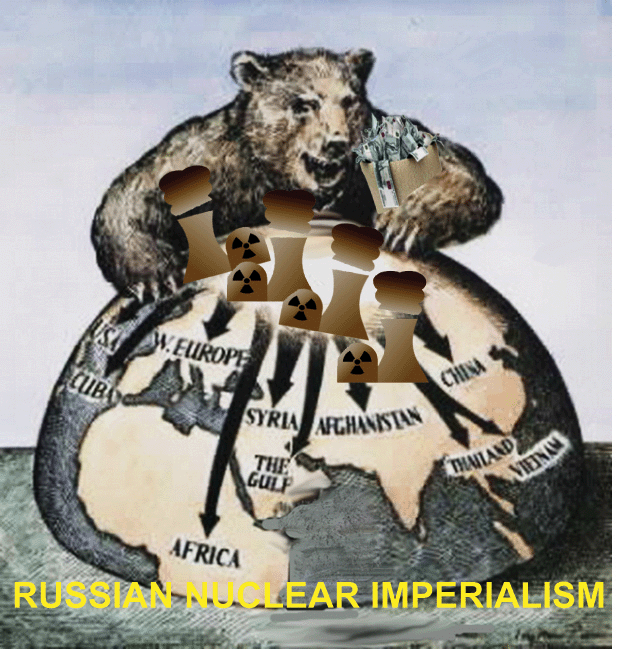 Zambia establishes an Interim Secretariat on Nuclear Science and Technology, Lusaka Times, January 23, 2018, Government has established an Interim Secretariat on Nuclear Science and Technology (ISNST) constituted by senior officers from various Government Ministries and Institutions. The Units under the ISNST include Nuclear Applications, Public Awareness and Consultation, Economics Assessment, Legal and Regulatory, and Programme Development.
The ISNST will spearhead implementation of Zambian’s nuclear energy programme as well as the development of the Centre for Nuclear Science and Technology (CNST). The officers have since commenced work, which among others, will involve public awareness and consultations……..Government is hopeful that the nuclear energy programme will transform the country into an industrial hub in the region. A group of students have already been sent to Russia to study in various areas of nuclear science, who upon completing their studies would work in the CNST.
Government has since signed various agreements with the Russian Federation that have culminated into the implementation of the nuclear energy programme………
The ISNST has embarked on a robust public sensitisation programme beginning with Members of the Cabinet and Members of Parliament. https://www.lusakatimes.com/2018/01/23/zambia-establishes-interim-secretariat-nuclear-science-technology/
International Atomic Energy Agency getting desperate? Hopes to get Uganda buying nuclear power.
 Uganda pushes for nuclear energyBy Vision Reporter, New Vision, 18th January 2018 People are not aware that you can use nuclear very peacefully for the well-being of humanity,Museveni said. KAMPALA – President Yoweri Museveni has said that unless solar becomes a cheaper alternative source of clean energy, Africa and Uganda in particular will have to use nuclear energy to improve the welbeing of its people…….The main issue is energy resource. Nuclear is clean energy, better than fossil fuels…….Museveni was meeting the Director General of the International Atomic Energy Agency (IAEA) Yukiya Amano at State House Entebbe on Wednesday. ……
Clear danger of South Africa’s energy company Eskom defaulting on its debt
S&P Sees ‘Clear Danger’ of Default by South Africa’s Eskom, Bloomberg, By Loni Prinsloo, January 18, 2018,
- Yields on Eskom’s dollar bonds climb after Reuss’s comments
- Finance Minister Gigaba says Eskom is his ‘biggest worry’
- There is a “clear danger” that South Africa’s state-owned power utility, Eskom Holdings SOC Ltd., could default on its debt, S&P Global Ratings said.
- “We are very concerned about liquidity issues,” Konrad Reuss, the managing director of S&P for sub-Saharan Africa, said at an event in Johannesburg Thursday.
- Eskom is the biggest recipient of state guarantees at a time when domestic power demand is the lowest in more than 10 years and as South Africa’s finances buckle under lower tax revenue and rising debt. The company needs 20 billion rand ($1.6 billion) of funding by the end of its fiscal year on March 31, the Mail & Guardian newspaper reported last week, citing the utility…….. https://www.bloomberg.com/news/articles/2018-01-18/s-p-sees-clear-danger-of-default-by-south-africa-s-eskom
Growing concerns on the safety and feasibility of Kenya’s planned Sh2 trillion nuclear energy project
Kenya’s nuclear quest: A case of extreme optimism? As the country moves towards the reality of nuclear energy by 2027, questions on expertise and safety concerns abound. Daily Nation, 2 Jan 17 “………While the government brags that over 60 per cent of the country’s population has access to power, unreliable power supply and frequent power outages steal the thunder from this achievement, pushing the government into overdrive to boost power production.One of the strategies is to put up a nuclear energy plant by 2027, in a fervent push to lower the country’s energy deficit and electricity tariffs.
The project will cost a staggering Sh2 trillion begging the question of whether it will lower energy tariffs and still remain afloat.
Sceptics also argue that a sunshine-rich country such as Kenya should never think of going the risky route of nuclear energy……
While government officials strongly defend the nuclear project, questions abound about how a country whose major cities – Nairobi, Kisumu, and Mombasa – have failed to handle minor fire disasters and basic household waste will effectively deal with toxic wastes, which are the by-product of nuclear power generation.
In Nairobi for instance, where every individual generates about two kilogrammes of waste every day, garbage is littered all over, with roads becoming impassable when it rains. Moreover, some hospitals and clinics carelessly dispose their medical waste in landfills ran by cartels, yet the government insists it can handle nuclear waste.
One of the critics of nuclear power generation is North Horr Member of Parliament Chachu Gaya, who says that the government should explore safer sources of energy such as solar and wind energy, and only consider nuclear as an energy source of last resort……
Opponents are also worried about health hazards, safety and radioactive waste management, with questions about the country’s preparedness to deal with radioactive waste and accidental leaks which advanced economies like Japan have grappled with.
“Kenya only rides on optimism in its quest to generate nuclear power, but lacks human capital or infrastructure to roll out the technology,” says Oyath, adding that Kenya’s poor waste management strategies and pitiable response to disasters are considerable grounds to dismiss the project……..http://www.nation.co.ke/health/Ready-for-nuclear/3476990-4248378-l09oc2/index.html
Nuclear power for Kenya: an expensive and unrealistic dream
Why Kenya’s push for nuclear power rests on false or fanciful premises, Mail and Guardian, Kenya wants to go nuclear. Since 2012, Nairobi has been talking the talk and walking the walk. It has engaged the International Atomic Energy Agency and signed multilateral letters of intent in pursuit of nuclear power.
To date, Kenya reportedly has memoranda of understanding with Russia, China, South Korea and Slovakia which involve the building of four nuclear power plants with a total output of 4 000 MW. France is apparently also eyeing the potentially lucrative deals which would nearly double Kenya’s current electricity capacity.
Kenya’s Nuclear Electricity Board secured the global atomic energy agency’s approval in 2016. It hopes to have the first plant online anywhere from 2022 to 2027, leading a new African push for nuclear power. The only country currently generating nuclear is South Africa……..
The cost of the Kenya plant is estimated at Sh500 billion. This is costly and, given the current energy consumption patterns in Kenya, would be a massive waste of money.
Myths about Kenya’s power situation
According to the popular narrative, Kenya suffers from the twin evils of electricity that is overly expensive and in short supply. Yet there is strong evidence that Kenya’s power is relatively cheap and that successive governments have exaggerated both it’s economic growth trajectory and its need for a massive increase in power generation.
For example, Kenya has an installed capacity of just over 2 400MW, against a peak demand of just over 1 600MW. This is 800MW above peak hours demand.
While economies are required to have surplus power capacity, excess capacity can lead to higher power bills as consumers are often charged for idle power plants.
Thus the government, while promising ever cheaper power to consumers may actually be undercutting this promise in its pursuit of nuclear power plants and other costly projects that fail to reflect both industrial and private consumer demand.
Note of caution
A recent study by a German engineering consultancy further confirmed how exaggerated government figures about demand have been. It noted that Kenya’s maximum power demand would
grow 72% to 2 259MW by 2020 from the current 1 620MW, when projects such as the standard gauge railway start operating fully.
Government estimates, on the other hand, project peak demand will jump threefold to 4 755 megawatts in the three-year period. This is twice as much as the consultant’s estimates.
On top of this, Kenya’s problem isn’t that it needs more energy. Rather it needs to address distribution issues.
Any project involving the generation of more power needs to pay equal attention to Kenya’s grid and distribution system which currently can’t handle additional power. This includes corresponding efforts at regular, systematic maintenance work. Without these, any extra power generated from renewable and other energy sources will remain costly and wasted.
Yet another note of caution is in order. Demand from Kenya’s domestic consumers remains low even though a total of 5.8 -million customers now have connections to power – a five-fold increase in the past seven years.
Why is this the case?
Neither a lack of connectivity nor an unreliable supply is to blame for the low consumption of electricity by the vast majority of Kenyan consumers. Nor is it because of reportedly relatively high electricity tariffs.
Rather, it is simply because the majority of Kenyans still have low income levels. Many Kenyans simply cannot afford the luxury of modern appliances for cooking, heating or refrigerating.
This simple fact has neither been figured into government prognostications nor donor-driven last-mile connectivity scenarios………
Adding extremely expensive nuclear power to Kenya’s energy mix along with power from other inadvisable projects such as the Lamu coal power plant is arguably inexcusable as well as profligate. Lamu is expected to produce 5 000MW of power within a period of three years.
As such, Kenya needs to work overtime to set a power generation agenda that identifies real versus perceived needs. The country’s electricity agenda must not be driven by estimated consumption figures that fail to correspond to the true energy needs. In the words of a former Kenyan energy official,
It does not take much effort to notice the gap between what is on paper and the economic reality.
Brendon J. Cannon, Assistant Professor of International Security, Department of Humanities and Social Science, Khalifa University
This article was originally published on The Conversation https://mg.co.za/article/2017-12-20-why-kenyas-push-for-nuclear-power-rests-on-false-or-fanciful-premises
The fantasy of Small Modular Nuclear Reactors for outback Australia
Volunteers wanted – to house small modular nuclear reactors in Australia,Online Opinion, Noel WAuchope , 11 Dec 17,
We knew that the Australian government was looking for volunteers in outback South Australia, to take the radioactive trash from Lucas Heights and some other sites, (and not having an easy time of it). But oh dear– we had no idea that the search for hosting new (untested) nuclear reactors was on too!

Well, The Australian newspaper has just revealed this extraordinary news, in its article “Want a nuclear reactor in your backyard? Step this way” (28/11/17). Yes, it turns out that a Sydney-based company, SMR Nuclear Technology, plans to secure volunteers and a definite site within three years. If all goes well, Australia’s Small Modular Reactors will be in operation by 2030.
Only, there are obstacles. Even this enthusiastic article does acknowledge one or two of them. One is the need to get public acceptance of these so far non-existent new nuclear reactors. SMR director Robert Pritchard is quoted as saying that interest in these reactors is widespread. He gives no evidence for this.
The other is that the construction and operation of a nuclear power plant in Australia is prohibited by both commonwealth and state laws.
But there are issues, and other obstacles that are not addressed on this article. A vital question is: does SMR Nuclear Technology intend to actually build the small reactors in Australia, or more likely, merely assemble them from imported modular parts – a sort of nuclear Lego style operation?
If it is to be the latter, there will surely be a delay of probably decades. Development of SMRs is stalled, in USA due to strict safety regulations, and in UK, due to uncertainties, especially the need for public subsidy. That leaves China, where the nuclear industry is government funded, and even there, development of SMRs is still in its infancy.
As to the former, it is highly improbable that an Australian company would have the necessary expertise, resources, and funding, to design and manufacture nuclear reactors of any size. The overseas companies now planning small reactors are basing their whole enterprise on the export market. Indeed, the whole plan for “modular” nuclear reactors is about mass production and mass marketing of SMRs -to be assembled in overseas countries. That is accepted as the only way for the SMR industry to be commercially successful. Australia looks like a desirable customer for the Chinese industry, the only one that looks as if it might go ahead, at present,
If, somehow, the SMR Technologies’ plan is to go ahead, the other obstacles remain.
The critical one is of course economics. …….
Other issues of costs and safety concern the transport of radioactive fuels to the reactors, and of radioactive waste management. The nuclear industry is very fond of proclaiming that wastes from small thorium reactors would need safe disposal and guarding for “only 300 years”. Just the bare 300!
The Australian Senate is currently debating a Bill introduced by Cory Bernardi, to remove Australia’s laws prohibiting nuclear power development. The case put by SMR Technologies, as presented in The Australian newspaper is completely inadequate. The public deserves a better examination of this plan for Small Modular Reactors SMRS. And why do they leave out the operative word “Nuclear” -because it is so on the nose with the public? http://www.onlineopinion.com.au/view.asp?article=19460&page=2
South Africa’s Energy Minister – nuclear build will push ahead, regardless of the correct planning system
 Nuclear will happen, Fin 24, Dewald van Rensburg Johannesburg -South Africa would procure several thousand megawatts of new nuclear power generation capacity, new Energy Minister David Mahlobo declared this week.
He would not say exactly how much, but seemingly intends for nuclear to be 20% of the local power supply by 2030……..
This will result in anything between R25 billion and R50 billion more being spent per year on power in South Africa by 2030 – compared with what would happen under a “least cost” strategy involving no new nuclear and no new coal stations, said Bischof-Niemz.
The wide range is due to the question mark over the cost of nuclear.
Having 20% of power come from nuclear was always the plan and was never really up for consultation, Mahlobo said this week.
On Tuesday, he subjected nongovernmental organisations to a two-hour lecture, and then proceeded to give journalists almost the same lecture at a bizarre and hastily arranged energy indaba on Thursday.
This apparent repudiation of South Africa’s existing system for planning energy investments was presented as obvious and uncontested.
Everyone else just misunderstood South Africa’s energy policy, said the former security minister who inherited the energy portfolio after President Jacob Zuma’s Cabinet reshuffle last month.
Mahlobo used the indaba to quietly announce that the long-awaited Integrated Resource Plan (IRP) had already been approved by Cabinet and that there would be no more consultations on it.
This was not said in the main plenary attended by more than 700 people, but told to journalists at a press conference afterwards that was mostly attended by Mahlobo’s staff, who applauded his answers to the journalists’ questions…….
The official programme was a strange mishmash of presentations and then parallel “commissions” to separately discuss coal, renewable energy, gas, liquid fuels and nuclear.
In the commission on renewable energy, the room was awkwardly silent when moderator Nelisiwe Magubane started the session by instructing everyone that “this is not a platform to discuss the IRP”.
There were chuckles and sighs in the room.
When she asked why no one had any questions, there were murmurs: “They’re all about the IRP!”
When a delegate pointed out that the IRP was central to the discussion, Magubane said that it could not be discussed because “the minister had a meeting with civil society and indicated this is not part of the consultation on the IRP”.
At this point, no one in the room knew that Cabinet had already approved the IRP and precluded any further consultations anyway.
Cabinet spokesperson Phumla Williams confirmed this, and said it was not mentioned in the normal Cabinet statement issued this week because it was felt that Mahlobo should announce it.
The news turns the long battle around energy policy on its head and will almost certainly lead to a new court challenge from environmental groups, which earlier this year succeeded in getting the old decision to procure 9 600MW of nuclear scrapped in court.
Up to now, the expectation had been that a new draft IRP would be produced and offer various options and scenarios for future power investments, followed by extensive public consultations.
Not so, said Mahlobo.
According to the minister, the original IRP of 2010 is still in effect and the apportionment of power sources set in 2010 remains the target.
All that will have changed from the original 2010 IRP is the overall forecast of national power demand, Mahlobo said.
This has two major effects – it demotes renewables back down to 9% of the mix and promotes nuclear back up to 20%.
Modelling done early this year with the latest technology costs created a “least cost” outcome that excludes nuclear and massively scales up renewables, which have become far cheaper in recent years……
A draft IRP released late last year was pilloried for setting arbitrary limits on renewables, which had the effect of putting nuclear back into the energy mix the mathematical model proposes.
The department of energy has since refused to provide documentation on how it modelled the cost of nuclear or to justify its limits on renewables, fuelling speculation that the IRP was being rigged to facilitate a nuclear deal.
“Nuclear, we are going to do it,” Mahlobo told journalists.
According to the minister, there will be new nuclear plants in the Western Cape and the Eastern Cape…….https://www.fin24.com/Economy/nuclear-will-happen-20171210-2
South Africa’s Energy Minister agrees to follow proper process, on nuclear power development
Business Report 29th Nov 2017, A court challenge to block the South African government from rushing
through a nuclear procurement deal was postponed on Wednesday after Energy
Minister David Mahlobo agreed to follow proper process.
Earthlife Africa Johannesburg (ELA-JHB) and the Southern African Faith Communities’
Environment Institute (SAFCEI) in April won a Cape Town high order stating
that nuclear procurment would not be legal without involving the National
Energy Regulator of South Africa (Nersa) and public participation. “SAFCEI
and ELA came back to court to ask the minsiter of Energy and Eskom to agree
to abide by the court ruling we got in April which said that they may not
procure nuclear energy without proper process and that includes involving
all of us – public participation – in the decision-making process,” SAFCEI
executive director Francesca de Gasparis said.
https://www.iol.co.za/business-report/energy/ngos-take-on-sa-energy-minister-on-nuclear-power-12194414
South Africa’s anti nuclear movement ready for President Zuma’s next pro nuclear move
Zuma’s ANC countdown puts anti-nuclear groups on high alert, Fin 24, , Matthew le Cordeur,
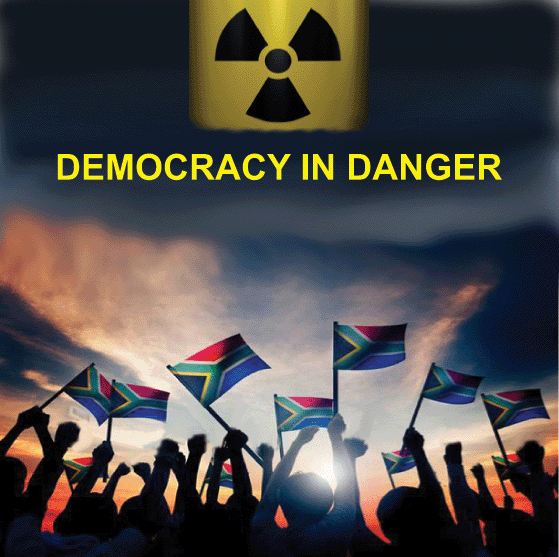
WITH the countdown to the African National Congress (ANC) elective conference having started, civil society is on high alert that President Jacob Zuma – and his supportive Energy Minister, David Mahlobo – will sign a deal with the Russians to build a fleet of nuclear power stations. Fin24’s Matthew le Cordeur explains…
THE level of anxiety regarding a possible nuclear deal being struck before the year is up has been evident with the media analysis on Mahlobo’s every utterance, civil societies’ concern regarding an energy indaba next week and Wednesday’s urgent court interdict against a nuclear deal rushing ahead.
The unproven and denied allegation that Zuma has been bribed with billions of dollars by the Russians as part of a “secret nuclear deal” has driven the debate against nuclear energy in recent years. Zuma himself said South Africa is committed to procuring nuclear energy at a “pace and scale South Africa can afford”.
However, if the allegations are true, the ANC elective conference from December 16 to 20 is a major deadline for the “secret deal” to go through. If Cyril Ramaphosa succeeds Zuma as ANC president, the nuclear plans will likely be scrapped because it is seen as fiscal suicide by Ramaphosa’s faction.
If the allegations are true and if Zuma feels threatened by Ramaphosa’s chances of a victory, it would make sense to sign a nuclear procurement deal with Rosatom before then.
The official nuclear procurement programme run by Eskom this year would have likely been signed by now. However, a court ruling in April changed that and the Department of Energy under newly-appointed Minister Mmamoloko Kubayi said government would start from scratch……….
there is still concern that Mahlobo intends pushing through the energy policy document following what some believe may be a sham public participation process next week. If the new energy policy states that large amounts of nuclear energy is required, the government may see this as enough to start the process.
That is why over 20 civil society organisations wrote to Mahlobo on Tuesday asking him to clarify the purpose of the department’s Energy Indaba being held next week on Thursday and Friday in Midrand.
Action group OUTA also wrote to Mahlobo on Wednesday asking for clarity, saying that “the event programme has not yet been circulated and clarity is required on the accessibility of this indaba to the public [both interested and affected parties].”
“According to the ministry, it would appear the planned Energy Indaba constitutes a formal public engagement process on energy matters in general, including on the nuclear energy matter.
“We believe the planned Energy Indaba in the format currently being pursued falls well short of the requirements in law and reason for meaningful engagement on decisions relating to energy mix and procurement,” OUTA told the minister.
The civil society groups that wrote to Mahlobo on Tuesday include WWF, Earthlife Africa, Safcei, Greenpeace Africa and the Centre for Environmental Rights…….
With the alarm sounded, all eyes will remain on Zuma and Mahlobo regarding nuclear in the coming weeks.
Secret deal or not, the opposition groups to nuclear energy are on full alert and will turn to the courts to fight the process to the last drop. https://www.fin24.com/Opinion/zumas-anc-countdown-puts-anti-nuclear-groups-on-high-alert-20171129
Protest against South African govt’s plan s for nuclear power
Greenpeace activists stage nuclear protest https://www.iol.co.za/pretoria-news/greenpeace-activists-stage-nuclear-protest-12205544, PRETORIA NEWS / 30 NOVEMBER 2017 MATLHATSI DIBAKWANE matlhatsi.dibakwane@iml.co.za
A group of 15 Greenpeace activists have blocked the main entrance of the Department of Enviromental Affairs with nuclear barrels to send a message to the department to stop nuclear as they said it was never safe.
The group sat on the department’s entrance demanding with a huge banner that read “Stop nuclear! Protect our future” that they want the Department of Environmental Affairs to withdraw the environmental authorisation that has been issued for a proposed nuclear power station at Duynefontein.
They did so early in the early hours of the morning by unloading nuclear barrels filled with smoke and staged what could happen in a nuclear disaster.
Melita Steele senior climate and energy campaign manager for Greenpeace Africa said the protest was to send a message to the department that nuclear was dangerous and expensive and should not be under consideration in South Africa.
Steele added that the approval and the construction of a nuclear power station was negligent and that the minister of environmental affairs was putting all South Africans at risk.
“South Africans are clearly saying no to nuclear, and there is no point coming to work if you are going to completely fail to do your job,” she said.
Gabon’s uranium miners’ long wait for compensation for radiation-caused illness
The 82-year-old is a retired geochemist who used to work in a uranium mine in Gabon owned by French nuclear giant Areva.
He and hundreds of other former workers say they fell ill from their work to extract the uranium — a source of nuclear power and warheads, but toxic and potentially carcinogenic.
The miners worked for an Areva subsidiary — the Compagnie des mines d’uranium de Franceville, better known by its abbreviation of COMUF.
Over 38 years, the mine extracted some 26,000 tonnes of uranium near Mounana, southeastern Gabon, before closing in 1999 after the global price of uranium fell and the seam of ore began to thin.
By the end of 2016, 367 former workers had died from “pulmonary respiratory infections” linked to working in the mine, according to MATRAC, a campaign group gathering 1,618 former employees.
The surviving miners, many of them old and sick, have unsuccessfully demanded compensation for 12 years in the belief they were exposed to dangerous levels of uranium contamination.
Areva, a multi-billion-dollar business majority-owned by the French state, has repeatedly denied that it has any case to answer. “No occupational disease related to exposure to ionising radiation” has ever been detected, it says.
‘Many serious diseases’ An internal company mail dating from 2015, seen by AFP and independently verified, acknowledges that the company was aware many of its former employees had developed serious ailments.
In the mail, Areva’s health director, Pierre Laroche, wrote that “many serious diseases have been detected among former employees, for example contagious tuberculosis”.
For former workers, this proves the company’s liability and justifies their claims for compensation, even if it does not legally prove all their illnesses are directly linked to excessive levels of uranium exposure.
The firm has refused to give payouts to the vast majority of its employees, apart from compensation payments in 2011 to the families in France of two French former mine workers who died of lung cancer.
The company has repeatedly argued it was difficult to establish if the rate of cancer cases among former miners was greater than those occurring in the wider population.
“That there was radioactivity in Mounana is a reality. (But) to what degree and to what extent the workers were affected, it will be very difficult to establish,” a former senior executive of the mine told AFP, on condition of anonymity.
In similar disputes elsewhere in the world, experts acknowledge the difficulty of pinning cancer and respiratory diseases on nuclear exposure at work.
Smoking and other “lifestyle” habits could, for instance, be a cause.
‘We are sick’
Areva has been under pressure to compensate its employees for more than a decade.
In 2007, French NGOs Sherpa and Medecins du Monde (Doctors of the World) carried out field surveys in Mounana and in Niger, another Areva uranium mining site.
They published a report denouncing what they described as high rates of cancer among former employees.
Areva agreed to investigate the situation and launched a health initiative in 2009 — the Mounana Health Observatory (OSM) — promising to pay compensation and treat former miners who fell ill, provided scientific and medical panels confirmed their disease was attributable to industrial causes.
Seven years on, not one former employee has been compensated.
“I’ve had difficulty breathing for 10 years,” says 77-year-old Roland Mayombo, who spent 27 years in the mine.
“I went to the OSM four times a year, but I have never had a result,” he complained.
“We decided to stop going (to the OSM) because no one has ever given us our analysis results,” said Estime Beno Ngodi, president of MATRAC, who says he is suffering from lung cancer.
COMUF accuses MATRAC of spreading “misinformation” and defends its handling of the health initiative.
It looked at more than 650 former workers but suspended the project in 2015 because of a boycott by MATRAC, says Gilles Recoche, COMUF’s director of the board.
“We’re proud of having set up a unique tripartite structure, which enabled former COMUF workers to benefit from a free medical visit,” he adds.
For the surviving miners, their long battle to prove a direct link between their illness and uranium contamination goes on. But, for many, age and sickness are wearing them down.
Legal action in South Africa’s High Court against government’s rushed nuclear energy deal
 Two NGOs launch urgent High Court application against nuclear energy deal https://www.businesslive.co.za/bd/national/2017-11-17-two-ngos-launch-urgent-high-court-application-against-nuclear-energy-deal/ 17 NOVEMBER 2017 KYLE COWAN On Thursday, two non-governmental organisations (NGOs) launched an urgent court application to halt what they are calling a “rush by government in decision-making on the nuclear energy deal”.Earthlife Africa Johannesburg and the Southern African Faith Communities’ Environment Institute said in a statement on Friday that they have approached the High Court to ask for an order to stay the process.
Last week, the same NGOs sent a request to Public Enterprises Minister Lynne Brown and Energy Minister David Mahlobo‚ as well as the National Energy Regulator of SA (Nersa)‚ asking for a commitment to follow legal processes and allow public consultation on proposed nuclear deals.
The three parties had not responded to the request by Wednesday‚ the statement said.
Earthlife’s Makoma Lekalakala said: “We are part of an international movement against dirty nuclear energy‚ where we have seen governments enter into nuclear deals that are not in the interests of their people. That must not happen in SA.”
According to Earthlife‚ Mahlobo’s recent “utterances in the press” suggested that the finalisation of the integrated resource plan and the nuclear programme was being fast-tracked, “yet government has failed to implement the necessary public participation required by the court judgement that was delivered on 26 April 2017”.
The NGOs will ask the court to declare that:
• No steps‚ including the issuing of requests for proposals or request for information‚ be taken for the procurement of new electricity-generation capacity‚ derived from nuclear power.
• Steps not be taken in the absence of a lawful determination in terms of s34 of the Electricity Regulation Act‚ in concurrence with Nersa‚ following a procedurally fair public participation process.
“This determination would have to specify that new, nuclear energy electricity generation is needed‚ and what percentage of SA’s energy mix it would fulfil.”
Finance Minister Malusi Gigaba has also indicated that the country may not be able to afford the nuclear programme‚ which is estimated will cost upwards of R1-trillion.
The court will also be asked to direct Mahlobo and Eskom to provide written reports on what steps they have taken, or plan to take, on plans for nuclear power. Should evidence exist that they have taken steps to forge ahead with the nuclear programme‚ the court will be asked to declare Mahlobo and Eskom in contempt of court for violating the April court order.
“We cannot have unaccountable government,” said Liz McDaid of the faith communities’ institute. “We have now seen overwhelming evidence emerging in the public arena that shows how state institutions have been captured and how money that is meant to deliver services to South Africans has gone into the pockets of looters.”
“The nuclear deal‚ purportedly worth more than R1-trillion‚ is yet another one of these deals. SA cannot afford‚ nor does it need, new nuclear power-generation capacity. I think South Africans have had enough.”
1 This Month



Shut down the radiation-damaged Heysham nuclear reactors now
To see nuclear-related stories in greater depth and intensity – go to https://nuclearinformation.wordpress.com

Say No to NASA’s Reckless Nuclear Reactor on the Moon
Say No to NASA’s Reckless Nuclear Reactor on the Moon
-
Archives
- October 2026 (256)
- September 2026 (339)
- August 2026 (330)
- July 2026 (355)
- June 2026 (287)
- May 2026 (306)
- April 2026 (356)
- March 2026 (251)
- February 2026 (267)
- January 2026 (308)
- December 2025 (358)
- November 2025 (359)
-
Categories
- 1
- 1 NUCLEAR ISSUES
- business and costs
- climate change
- culture and arts
- ENERGY
- environment
- health
- history
- indigenous issues
- Legal
- marketing of nuclear
- media
- opposition to nuclear
- PERSONAL STORIES
- politics
- politics international
- Religion and ethics
- safety
- secrets,lies and civil liberties
- spinbuster
- technology
- Uranium
- wastes
- weapons and war
- Women
- 2 WORLD
- ACTION
- AFRICA
- Atrocities
- AUSTRALIA
- Christina's notes
- Christina's themes
- culture and arts
- Events
- Fuk 2022
- Fuk 2023
- Fukushima 2017
- Fukushima 2018
- fukushima 2019
- Fukushima 2020
- Fukushima 2021
- general
- global warming
- Humour (God we need it)
- Nuclear
- RARE EARTHS
- Reference
- resources – print
- Resources -audiovicual
- Weekly Newsletter
- World
- World Nuclear
- YouTube
-
RSS
Entries RSS
Comments RSS

