To save Eskom from ruin, SA should ditch nuclear plan and cut coal power – study, Fin w24 Nov 16 2017 Cape Town– Eskom should cut down on its coal power network – including curtailing work at Kusile – and should not embark on any new nuclear, gas or coal building programmes if it wants to save itself from financial ruin, a new study has found.
This comes as an Eskom report seen by Fin24 and EE Publishers shows that the power utility is projecting a R3.55bn loss by the end of its current financial year. It also shows the power utility’s poor governance has left it teetering on the edge of insolvency, with only R1.2bn of liquidity reserves expected to be in hand at the end of the month.
Amidst Eskom’s governance and financial crisis, President Jacob Zuma has repeatedly said that South Africa is committed to developing new nuclear power stations at a pace and scale it can afford. Critics, who believe it could cost over R1trn and that would threaten the country’s fiscal framework policy, want the nuclear policy scrapped altogether.
Now, the new research report, which was published on Thursday by Meridian Economics, shows that Eskom should decommission its older coal-fired power stations and consider curtailing the Kusile construction programme in order to save costs.
These interventions can be achieved without affecting security of supply, it shows.
The study also shows that South Africa does not need a nuclear, coal or gas power procurement or construction programme. Instead, it should accelerate its transition to cleaner, cheaper, and more sustainable renewable energy when further capacity is required.
“Stagnant demand and Eskom’s large power station construction programme has resulted in a growing surplus of expensive generation capacity,” Meridian Economics managing director Dr Grové Steyn said in a statement on Thursday.
“At the same time, the operating costs of Eskom’s coal-fired power stations have consistently increased. This has forced Eskom to implement the highest tariff increases in recorded history, and has led to a growing solvency and – at the time of writing – a liquidity crisis.
“If the system can meet demand over the same period by using alternative resources such as other existing coal stations, wind and solar – but at a lower cost than the cost of electricity from a particular coal-fired power station – it makes economic sense to decommission that station early, or not to complete it.”
A system analysis undertaken by the Council for Scientific and Industrial Research Energy Centre found that new coal and nuclear plants are simply no longer competitive against the falling costs of renewables and associated technologies, the report said.
For the foreseeable future no gas fired power stations are required (peaking gas turbines can run on liquid fuel).
“This means that South Africa does not need a nuclear, coal or gas power procurement or construction programme.”
Eskom shows no commitment to decommission older plants
Despite Eskom’s dire financial circumstances, it nonetheless has not yet committed to decommission any of its older plants, even as they approach the end of their lives and the costs of running the older stations increase, Meridian Economics explained.
“With Eskom’s on-going governance crisis, it appears that government and Eskom are partially paralysed, and could struggle to take the right decisions in the public interest. It is therefore critical that the National Energy Regulator (Nersa) ensures that these issues are investigated and addressed, and that Eskom is only allowed to recover efficient costs in its tariffs,” Meridian Economics said.
“If Eskom’s financial crisis continues to worsen, as we suspect it might, more drastic steps must be considered in light of the systemic risk to the state and the entire economy,” said Steyn.
COP23: African youth fighting for climate action, DW, 12 Nov 17Africa is harnessing the power of its emerging youth demographic to spearhead efforts to tackle climate change. By 2050, UNICEF estimates that approximately two out of every five children on our planet will be African. Africa’s rapidly burgeoning young generation is viewed by some as a precursor to a range of serious problems across the continent, ranging from unemployment to further migration crises. But they could very well be the key to confronting one of the biggest challenges of our time: climate change.
As delegates from across Africa gather for the latest round of international climate talks in Bonn this week, young African leaders and experts are hosting their own side-events to draw attention to their own fight against climate change, while highlighting the importance of African youth getting involved in the process.
The African Youth Initiative on Climate Change (AYICC) was established back in 2006 shortly before COP12 talks kicked off in Nairobi, Kenya. Since then, support for climate change action among the African youth has grown considerably, as they actively work to raise awareness in their communities and hold their governments to account for inaction.
Young generation best equipped to tackle climate change
Maureen Sigauke is the co-founder of the community-based organization, Green Active Citizens Trust in Zimbabwe and was a speaker at WWF’s COP23 Africa Day panel, Youth and Climate Change in Africa. She explained to DW why young Africans should act now to secure their futures, when the effects of climate change will be more clearly felt across the continent.
“I think that it is important to know that climate change is a threat to development; it is a threat to job security – if floods happen it can threaten your job – it’s a threat to human rights, it’s a threat to economic development, it’s a threat to sustainable access to basic human rights such as food, shelter and poverty alleviation, particularly in the African case. So that’s why people should care, because everything that we know could change if climate change continues unabated.”…….http://www.dw.com/en/cop23-african-youth-fighting-for-climate-action/a-41333083
ZUMA’S ALLIES ARE GUNG-HO ABOUT NUCLEAR. WILL THEY GET THEIR WAY? http://ewn.co.za/2017/11/10/analysis-zuma-s-allies-are-again-gung-ho-about-nuclear-will-they-get-their-waySouth Africa’s nuclear build programme seems to be back on the agendaafter earlier indications that it was dead. Recent comments by President Jacob Zuma and his new Minister of Energy David Mahlobo signal a final push to bag the nuclear deal while Zuma is still in power. In December Zuma’s term as president of the African National Congress will come to an end when the ruling party elects a new leadership. His term as president of the country ends in 2019. The Conversation Africa’s business and economy editor Sibonelo Radebe asked Keith Gottschalk to assess the situation.
Is it still possible for the Zuma administration to bag the nuclear energy programme?
The worsening financial plight of the state and its parastatals makes the estimated R1 trillion cost of the proposed nuclear build programme increasingly unaffordable. The new Finance Minister Malusi Gigaba said as much. Slow economic activity is squeezing the tax revenue base while social expenditure demands keep rising. This has caused the deficit indicators to rise, a cause for serious concern. It’s ludicrous for government to insist on adding the humongous nuclear build programme into such a dire state of public finances.
It’s also important to consider that government’s atomic ambitions go far beyond the 9,600 MW of extra nuclear power stations. It also wants to rebuild a uranium enrichment plant that dates back to former apartheid-era President PW Botha in the 1980s. South Africa gave up its nuclear capability in 1989. It was the only country in Africa that had the ability to make a nuclear bomb.
Zuma’s administration wants to regain some of the lost nuclear capacity. It wants to construct a fuel element fabrication factory. It has talked of a nuclear fuel reprocessing plant. All these also bear steep price tags.
What can stop it? It’s been reported that Mahlobo, the former State Security Minister turned Energy Minister, wants to rush through the new process of guiding the nuclear energy plan to fruition. So it’s not going to be easy to stop it.
But South Africa’s nuclear ambitions face stiff opposition from different directions. These include environmentalist critics of nuclear power generation who use a blend of media, street theatre, objections at public consultation processes, and lawfare to try and stop the government’s ambitions.
The SA Faith Community Environmental Initiative group won an important victory earlier this year when the Cape High Court ruled that the government had not followed due process in its nuclear energy plans, and that they had to be halted. This effectively sent government back to square one.
Opposition parties have also been active, using parliamentary channels. They’re also considering taking the legal route to halt the nuclear juggernaut.
And there is palpable opposition within the ANC itself. A number of ANC branches sent motions critical of the costs of nuclear electricity to the ANC’s national policy conference. That conference’s report censored out all these motions.
The administration seems to be pulling out all the stops to bag this programme: What’s at stake? By now, scandal-weary South Africans will react by saying: follow the money. In December 2016 the government dropped the bombshell that the procurement of its nuclear build programme would be taken away from the Department of Energy and done instead through Eskom.
The reason became clear when months of media headlines revealed that Eskom’s procurement mechanisms had been infiltrated and subverted by the Gupta family conglomerate to become a corporate feeding trough. With close ties to Zuma, the Guptas stand accused of operating an elaborate mission to capture state business with a keen eye on the nuclear energy build programme.
Every nuclear build contract, from “consulting” to turbines, would be inflated by one-fifth to build in the kickbacks to the corrupt middlemen tenderpreneurs.
Does South Africa need nuclear energy at this stage?
South Africa does not need nuclear energy at any stage.About a decade ago, the government argued that South Africa’s economic growth was 5% per year every year, and that the resultant increase in electricity demand necessitated building 9,600 MW of new nuclear power stations. Critics pointed out that these figures were inaccurate.
Economic growth has shrunk significantly since then together with future projections of electricity demand. But the government still insist that the 9,600 MW of nuclear power proposition is backed by economic fundamentals. Clearly, this is a political decision uncoupled from economic realities.
On top of this, the most cost-effective generation of electricity would be a blend of imported hydro, imported gas, solar and wind. But these avenues seem to have been blocked by nefarious agendas.
In 2010, the Department of Energy proudly announced a 5,000 MW solar park to be built outside Upington. It hosted an international investors’ conference to kickstart progress. Since then, nothing has happened.
In 2014 the department proudly put up on the internet a slide show of how Zuma and the DRC’s President Kabila had signed a treaty guaranteeing South Africa over 10,000 MW of imported hydropower once the Inga dams were constructed.
By December 2016 the department had effectively airbrushed these out of its presentations. Clearly, political power had been applied to compel the department to drop Eskom’s renewable division, and to suck up to its nuclear division. Which political power this was became exposed this week when Zuma smeared opponents of his nuclear plans as western puppets.
What are global trends saying about nuclear energy?
The building of new nuclear power stations in developed countries is drastically declining. The UK is alone in signing a contract to build a new one. Nuclear vendors have stepped up their sales campaigns in developing countries to compensate.
Keith Gottschalk is a political scientist, University of the Western Cape.
His recent dramatic push to fast-track an expensive and highly controversial nuclear power station build is therefore very much out of character. But Zuma’s advocacy of the nuclear build needs to be understood in terms of another hallmark of his presidency – state capture. This expression refers to the systematic takeover of state institutions by presidential allies and the resulting exploitation of institutions for commercial advantage and profit by his benefactors.
It’s already become clear who is likely to benefit from South Africa pursuing the option to build nuclear power stations. The list includes the Gupta brothers and Zuma’s son Duduzane through their links to the Shiva uranium mine.
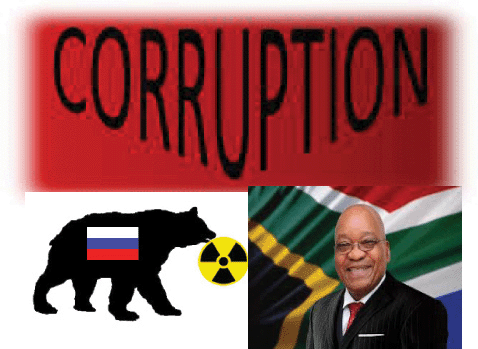
And then there’s Zuma himself. Speculation about why the president appears to be favouring a deal with Russian company Rosatom ranges from allegations of grand scale individual kickbacks to alleged commitments linked to funding for the African National Congress.
The controversy around the nuclear power option was precipitated three years ago when it emerged that the government had signed an agreement with Russia that paved the way for the use of Russian technology in planned new nuclear power stations. The problem was that there’d been a complete lack of due process – no costing, no public consultation, no proper proclamation and no competitive bidding. It was no surprise that the courts declared the awarding of the nuclear build to Russia illegal.
On top of this a very strong case has been mounted against South Africa pursuing nuclear power. Reasons include the fact that it can’t afford it, and doesn’t need nuclear in its energy mix.
Despite all of these developments, and the growing controversy and mounting opposition to the deal, Zuma appears determined to get it done before his term as president of the ANC ends in December. In the last of the reshuffles he appointed one of his closest allies, David Mahlobo, to the energy portfolio. This is generally seen as a last ditch attempt to roll out the nuclear build in the face of now massive opposition.
Reports suggest that this reshuffle was occasioned by Russian displeasure over what they see as a broken promise to award the building contract to Rosatom.
The energy minister’s next steps
Mahlobo appears to have devoted his first few weeks in office entirely to furthering the nuclear project. He has been active in the media declaring the nuclear build as a given – and necessary.
Mahlobo’s next steps are likely to be:
He is reported to be planning to release – in record time – a new energy plan. This, some suspect, will be biased towards nuclear.
The issuing of a request for proposals to build the nuclear plants to potential developers like Rosatom. Most observers expect the evaluation to favour Rosatom regardless of the merits of the other bidders.
Signing an agreement with Rosatom. This could mirror the USD$30 billion deal Russia signed with Egypt which, on the surface, will appear attractive because it would offer favourable terms such as annual interest of only 3% and the commencement of repayments after 13 years. But when scaling the 4.8 GW Egyptian agreement up to the 9.6 GW envisioned for South Africa, the total cost then already exceeds R1 trillion. Annual repayments from year 14 to year 35 then amount to about 5% of South Africa’s annual fiscus. Any cost overruns, which are common in many other nuclear builds, would vastly increase the debt further.
What’s changed
The global energy landscape has changed dramatically since South Africa first mooted the idea of supplementing its power mix with more nuclear. Major developments and changes include:
Nuclear plants are major long term investments, and these projects will not survive lengthy construction and operation periods without broad public support. There is definitely a lack of public support in South Africa.
The Zuma-Mahlobo work plan will face major opposition by other parties, civil society and even critics within the ruling party. Lengthy court challenges will query the validity of the energy plan process, the public consultation, the regulatory aspects, the site selection and the constitutionality of the entire process. Public protests highly effective in other spheres would now be directed against the nuclear build. The ruling party would probably abandon the scheme if it proves politically costly.
The danger is, however, that huge funds will have been wasted in coming to this realisation.
The stakes are high. Zuma’s efforts to promote this unpopular nuclear project are weakening him politically. Even party comrades perceived to be in his inner circle – like newly appointed Finance Minister Malusi Gigaba – recognise that going ahead with the programme at this stage would cripple the country economically. Repeated ministerial reshuffles to sideline his critics has further damaged Zuma’s standing in the ruling party and in broader society.
The Brothers Who Bought South Africa, The continent’s most important economy now appears to function for the benefit of one powerful family. Bloomberg, By Matthew Campbell and Franz Wild, 9 Nov 17
“….– Since Nene’s firing, long-standing questions about the scale of the Guptas’ power in South Africa have exploded into the most severe political and economic crisis since the end of apartheid. The family has been accused by activists and opposition politicians of stacking the leadership of powerful state companies, rigging bids in favor of suppliers it controls, and even helping orchestrate a planned $70 billion nuclear-power deal with Russia, for which it could supply vast quantities of uranium—all while using an alliance with Zuma to neuter law enforcement agencies that would otherwise shut down its efforts. Blue chip companies including McKinsey, KPMG, and SAP have been embroiled in what’s fast becoming a global scandal……..
In 2005 the brothers began putting Zuma’s family on their payroll. They hired his son Duduzane, then in his early 20s, as an IT specialist; appointed Duduzane’s twin sister, Duduzile, as a company director; and made one of Zuma’s wives (polygamy is legal in South Africa, and Zuma currently has four) a communications officer.
Over the years, Duduzane became an integral node in the Guptas’ empire, both as a shareholder in uranium and coal mines and a director in a string of other companies. …….
There was at least one more avenue by which money might flow from Eskom to Gupta-connected companies. In 2010 the family’s investment company borrowed about 250 million rand from a state bank to buy a South African uranium mine. It was a curious purchase—there was no real buyer for the uranium, because South Africa has only one aging nuclear plant. In 2014, however, Zuma’s administration laid out a grand plan that would make the mine’s value soar: He proposed building six massive nuclear plants for Eskom at an ultimate cost that could exceed $70 billion.
The idea was controversial from the start. In addition to immense reserves of coal, South Africa has a vibrant renewable-energy sector and no obvious need for nuclear power.
Zuma has dismissed the criticism, arguing the country needs to diversify its energy sources—and strategic alliances. In 2014, he and President Putin agreed that Russia’s state nuclear agency, Rosatom Corp., would provide technology for the plants.
The next summer, Zuma was back in Russia for an economic summit, joined by his senior ministers—including Nene, the then-finance chief. Toward the end of the conference, according to two officials who were present, Zuma cornered Nene in a briefing room about the nuclear deal. The president and several other ministers demanded that Nene provide financial guarantees that would allow Eskom and Russia’s relationship to move ahead. Nene refused; even under the most optimistic projections, he said, a nuclear project of the scale Zuma envisioned would severely strain South African finances.
Zuma complained bitterly about Nene’s resistance, the summit officials say. Not long afterward, Nene’s deputy, Jonas, found himself in the Guptas’ sitting room at Saxonwold, being offered his boss’s job…….
Abide by nuclear procurement ruling or we go to court, state told https://www.businesslive.co.za/bd/national/2017-11-10-abide-by-nuclear-procurement-ruling-or-we-go-to-court-state-told/ Failure by Energy Minister David Mahlobo, Eskom and Nersa to halt any tender process for nuclear energy will end in court 10 NOVEMBER 2017 LINDA ENSOR The government, Eskom and the National Energy Regulator of SA (Nersa) have been urged to abide by the judgment of the High Court in Cape Town and immediately halt any tender process for nuclear energy.
The call comes from the Southern African Faith Communities Environment Institute and Earthlife Africa.
Failure by Energy Minister David Mahlobo, Eskom and Nersa to give an undertaking by Monday that they will halt the process could result in an urgent application being brought to the high court to ensure that its judgment is respected and that the government acts “openly and transparently” with regard to nuclear procurement.
The two organisations have sent lawyers’ letters to Mahlobo, Public Enterprises Minister Lynne Brown, Eskom and Nersa recalling the April judgment, which ruled that any decision made about new electricity generation must be made in conjunction with Nersa through a lawful and procedurally fair determination under section 34 of the Electricity Regulation Act.
The determination would have to specify why new
nuclear energy electricity generation was needed so urgently and what percentage of SA’s energy mix it would fulfil.
Earthlife Africa’s Johannesburg co-ordinator, Makoma Lekalakala, noted that the judgment emphasised the need for public participation as part of the determination processes.
The letters follow news reports that Mahlobo is fast-tracking finalisation of the Integrated Resource Plan by four months so he can expedite nuclear procurement. The plan will determine the energy mix the country will require in future, what proportion of this will be provided by nuclear and when the construction of new nuclear plants should begin.
Eskom has signalled its intention to begin the tender process immediately if the Integrated Resource Plan showed the nuclear programme could go ahead.
Liz McDaid of the Southern African Faith Communities’ Environment Institute said the fast-tracking of the plan was being undertaken despite Finance Minister Malusi Gigaba having stated that the country did not need nor could it afford new nuclear plants.
The many serious allegations of state capture and irregular procurement processes by senior Eskom officials could not be ignored, McDaid added.
Africa buys into nuclear dream, Mail and Guardian, Lynley Donnelly
Risky: Nigeria has oil but infrastructure maintenance is poor. It is considering the nuclear option. (Akintunde Akinleye, Reuters)
While questions swirl around the progress of South Africa’s nuclear plans, Russia’s state nuclear agency Rosatom is losing no time in selling the atomic dream to other African countries.
Last week the company signed project-development agreements with the Nigerian government for the construction and operation of a nuclear power plant and research centre housing a multipurpose research reactor.
Nigeria has extensive oil and gas reserves but suffers from chronic electricity shortages.
Media reports suggest the deal could cost about $20-billion, but Rosatom said the costs have yet to be determined.
The agreements were signed in order to adopt the appropriate approach and establish the project’s implementation details, a Rosatum official said. “Cost estimations and project specifications will be evaluated in accordance to this agreement,” the official said.
Paladin has ignored our requests to provide its estimate of the cost of rehabilitating Kayelekera, but we can safely say that the figure will be multiples of the US$10 million bond. Just keeping Kayelekera in care-and-maintenance costs US$10–12 million annually.
As things stand, if Paladin goes bankrupt and fails to rehabilitate Kayelekera, either rehabilitation will be coordinated and funded by the Malawian government (with a small fraction of the cost coming from Paladin’s bond) or the mine-site will not be rehabilitated at all.
It does Australian companies investing in mining ventures abroad no good whatsoever to leave Kayelekera unrehabilitated, a permanent reminder of the untrustworthiness and unfulfilled promises of an Australian miner and the indifference of the Australian government.
The company’s environmental and social record has also been the source of ongoing controversy and the subject of countless critical reports.
Julie Bishop, the WA government, Paladin and its administrators from KPMG need to liaise with the Malawian government and Malawian civil society to sort the rehabilitation of Kayelekera. An obvious starting point would be to prioritise the rehabilitation of Kayelekera if and when Paladin goes bankrupt and its carcass is being divided up. (picture below shows uranium sludge going to river)
Perth-based uranium mining company Paladin Energy was put into administration in July and the company is teetering on the brink of bankruptcy. Critics of the uranium industry won’t miss the company if it disappears. Other uranium mining companies won’t miss Paladin; in an overcrowded market, they will be pleased to have less competition.
But the looming bankruptcy does pose one major problem. Paladin’s Kayelekera uranium mine in Malawi, the ‘warm heart of Africa’, needs to be rehabilitated and Paladin hasn’t set aside nearly enough money for the job.
Under the leadership of founder and CEO John Borshoff, described as the grandfather of Australian uranium, Paladin has operated two uranium mines over the past decade. The Langer Heinrich mine in Namibia was opened in 2007, and Kayelekera in 2009.
They were heady days ‒ there was an endless talk about a nuclear power ‘renaissance’ and the uranium price tripled between June 2006 and June 2007. The Australian Financial Reviewreflected on Paladin’s glory days: “John Borshoff was once one of Western Australia’s wealthiest businessmen. The founder of Perth-based Paladin Energy developed an enviable portfolio of African uranium mines supposed to satiate booming global demand for yellowcake. When the company’s Langer Heinrich mine began shipments in March 2007, as the spot price for uranium eclipsed $US100 per pound, Paladin was worth more than $4 billion.”
Paladin was once the best-performed stock in the world according to The Australian newspaper. The company’s share price went from one cent in 2003 to A$10.80 in 2007. Borshoff made his debut on the Business Review Weekly’s‘Rich 200’ list in 2007 with estimated wealth of A$205 million.
But the good times didn’t last. The uranium bubble burst in mid-2007, and the Fukushima disaster in 2011 ensured that there would be no nuclear power renaissance and that the uranium industry would remain depressed for years to come. Borshoff left Paladin in 2015, and in 2016 Paladin’s new CEO Alexander Molyneux said that “it has never been a worse time for uranium miners”.
The loss-making Kayelekera mine in Malawi was put into care-and-maintenance in July 2014, leaving Paladin with the modest Langer Heinrich mine plus a number of projects the company describes as ‘nonproducing assets’ (such as uranium projects in jurisdictions that ban uranium mining).
Paladin was put into administration in July this year, unable to pay its debts. Even if Paladin sold its 75% stake in Langer Heinrich, its only revenue-raising project, it couldn’t repay all its debts.
Administrators from KPMG are attempting to sort out the mess and bondholders are reportedly being asked to fund a recapitalisation of Paladin. Bankruptcy would seem a much more likely option given the weakness of the company and the weakness of the global uranium market.
Paladin has said that a uranium price of about US$75 per pound would be required for Kayelekera to become economically viable ‒ almost four times the current uranium spot price, and well over twice the current long-term contract price. Even if the uranium price did rebound, Kayelekera would operate for only around four years; it isn’t a large deposit.
The likelihood of uranium prices reaching US$75 in the foreseeable future is near-zero. John Borshoff said in 2013 that the uranium industry “is definitely in crisis … and is showing all the symptoms of a mid-term paralysis”. Former World Nuclear Association executive Steve Kidd said in May 2014 that the industry is set for “a long period of relatively low prices, in which uranium producers will find it hard to make a living”. Nick Carter from Ux Consulting said in April 2016 that he did not anticipate a uranium supply deficit until the late 2020s. Other industry insiders and market analysts have made similar comments about the bleak future for uranium ‒ and the bondholders being asked to recapitalise Paladin would surely know that their money would be better invested in a long-shot at Flemington.
Who cleans up Kayelekera?
Assuming Paladin goes bankrupt, who cleans up the Kayelekera open-pit uranium mine? The company was required to lodge a US$10 million Environmental Performance Bond with Malawian banks, and presumably that money can be tapped to rehabilitate Kayelekera. But US$10 million won’t scratch the surface. According to a Malawian NGO, the rehabilitation cost is estimated at US$100 million ‒ ten times the amount set aside by Paladin. The cost of rehabilitating the Ranger uranium in the Northern Territory ‒ also an open-pit uranium mine, albeit larger than Kayelekera ‒ is estimated at just under US$500 million.
Paladin has ignored our requests to provide its estimate of the cost of rehabilitating Kayelekera, but we can safely say that the figure will be multiples of the US$10 million bond. Just keeping Kayelekera in care-and-maintenance costs US$10–12 million annually.
As things stand, if Paladin goes bankrupt and fails to rehabilitate Kayelekera, either rehabilitation will be coordinated and funded by the Malawian government (with a small fraction of the cost coming from Paladin’s bond) or the mine-site will not be rehabilitated at all.
Is it reasonable for Australia, a relatively wealthy country, to leave it to the overstretched, under-resourced government of an impoverished African nation to clean up the mess left behind by an Australian mining company? If the Malawian government cleans up Paladin’s mess, that will necessarily come at the expense of other priorities. Malawi is one of the poorest countries in the world. According to a 2013 U.N. report, more than half the population live below the poverty line, and about half of all children under the age of five show signs of chronic malnutrition.
Foreign Minister Julie Bishop should intervene to sort out the situation at Kayelekera and to prevent a repetition of this fiasco. We imagine that the Minister’s eyes might glaze over in response to a moral argument about the importance of Australia being a good global citizen. But there is also a hard-headed commercial argument for intervention to clean up Kayelekera.
It does Australian companies investing in mining ventures abroad no good whatsoever to leave Kayelekera unrehabilitated, a permanent reminder of the untrustworthiness and unfulfilled promises of an Australian miner and the indifference of the Australian government. Australia is set to become the biggest international miner on the African continent, perhaps as early as this year, according to the Australia-Africa Minerals & Energy Group. But Australian companies can’t expect to be welcomed if travesties such as Kayelekera remain resolved.
‘Overly sophisticated’
Back in 2006, John Borshoff told ABC television that Australia and Canada have become “overly sophisticated” with their thinking about environmental and social issues associated with the mining industry. Hence Paladin’s focus on projects in Africa.
One advantage ‒ if that’s the word ‒ of mining in Africa is that Paladin hasn’t had to set aside sufficient funds to rehabilitate Kayelekera. The company’s environmental and social record has also been the source of ongoing controversy and the subject of countless critical reports.
Paladin has lost money on Kayelekera, and the economic benefits for Malawi have been pitiful. Paladin has exploited the country’s poverty to secure numerous reductions and exemptions from payments normally required by foreign investors. United Nations’ Special Rapporteur Olivier De Schutter noted in a 2013 report that “revenue losses from special incentives given to Australian mining company Paladin Energy, which manages the Kayelekera uranium mine, are estimated to amount to at least US$205 million (MWK 67 billion), and could be up to US$281 million (MWK 92 billion) over the 13 year lifespan of the mine.”
The official line from Australia’s Department of Foreign Affairs and Trade is that “mining offers African countries an unparalleled opportunity to stimulate growth and reduce poverty. If well managed, the extractives sector can drive innovation, generate revenue to fund critical social services and upgrade productive physical infrastructure, and directly and indirectly create jobs.”
The reality at Kayelekera is starkly different from the picture painted by the bureaucrats in Canberra.
Two years ago, then WA Premier Colin Barnett told a mining conference in South Africa that Australian mining companies have “brought both expertise and ethical standards. It is a matter of pride for many companies that the standards applied in Australia are also applied in Africa.”
But standards at Kayelekera fall a long way short of Australian standards. Moreover, Barnett’s claims sit uncomfortably with the highly critical findings arising from a detailed investigation by the International Consortium of Independent Journalists. The Consortium noted in its 2015 report that since 2004, more than 380 people have died in mining accidents or in off-site skirmishes connected to Australian mining companies in Africa (there have been six deaths at Kayelekera). The reportfurther stated: “Multiple Australian mining companies are accused of negligence, unfair dismissal, violence and environmental law-breaking across Africa, according to legal filings and community petitions gathered from South Africa, Botswana, Tanzania, Zambia, Madagascar, Malawi, Mali, Cote d’Ivoire, Senegal and Ghana.”
Not even Collin Barnett would argue that Paladin is a source of pride for Australia. Quite the opposite. Likewise, Foreign Minister Julie Bishop surely didn’t have Paladin’s open-cut mine in mind when she told the Africa Down Under mining conference in Perth in September that many Australian mining projects in Africa are outposts of good governance and that the “Australian Government encourages the people of Africa to see us as an open-cut mine for lessons-learned, for skills, for innovation and, I would like to think, inspiration.”
Julie Bishop, the WA government, Paladin and its administrators from KPMG need to liaise with the Malawian government and Malawian civil society to sort the rehabilitation of Kayelekera. An obvious starting point would be to prioritise the rehabilitation of Kayelekera if and when Paladin goes bankrupt and its carcass is being divided up. Surely Kayelekera should take precedence over debtors such as French state-owned utility EDF, which is owed US$277 million by Paladin ‒ all the more so since the French state has its own sordid history of uranium mining in Africa.
Morgan Somerville is an International Relations student at La Trobe University. Dr Jim Green is the national nuclear campaigner for Friends of the Earth.
Financing for Eskom to develop nuclear program was discussed
Talks also included options to assist South African Airways
South Africa’s Finance Minister Malusi Gigaba met with representatives of the World Bank last week to discuss financing for development of a nuclear power program in the country, according to two people familiar with the meeting.
Gigaba met with the bank on Friday to discuss funding options available to state-owned power utility Eskom Holdings SOC Ltd. for the program, said the people, who asked not to be identified because the information is not public. South African Airways, the national airline that is struggling to meet debt obligations, was also discussed at the meeting, said one of the people.
Eskom last year began a process to add 9,600 megawatts of nuclear power capacity beyond its single existing plant by issuing a request for information from vendors. There were 38 responses to the notice, Kelvin Kemm, chairman of the South African Nuclear Energy Corp., told lawmakers in Cape Town on Tuesday.
South Africa’s nuclear investment plans have become a focal point for critics of President Jacob Zuma’s policies. The affordability of the program was a key point of dispute between Zuma and former Finance Minister Pravin Gordhan and the procurement process stalled in April after a provincial court ruled that the government didn’t follow the correct procedure in pursuing the nuclear program.
Gigaba declined to comment on Tuesday when asked about the meeting. The World Bank didn’t immediately respond to questions sent by email but confirmed receipt.
Gigaba said Oct. 26 that South Africa can’t afford to build new reactors for at least five years and that it doesn’t need more baseload, or continuous, power capacity. Nuclear still remains a part of the energy plan and the government will look at it as an option when needed and when it can afford it, he said.
South Africa Energy Minister David Mahlobo, who was appointed last month, said on Oct. 23 that a legal procurement process would be followed for a nuclear program, noting the Western Cape High Court decision.
The World Bank has previously supported energy projects through Eskom. However, an inspection panel from the organization in 2012 found instances of non-compliance in its award of a $3.75 billion loan to the utility for construction of the Medupi coal-fired power plant. The impacts and risks for other local water users weren’t properly considered and the project would place strain on water resources in an area already suffering from scarcity, it said at the time.
The discussions between Gigaba and the World Bank also included options to assist South African Airways, according to one of the people.
We’ll interdict any nuclear deal – DA Fin 24 Nov 05 2017 Liesl Peyper Cape Town – The Democratic Alliance (DA) says it is ready to interdict any attempt by Energy Minister David Mahlobo to force through a nuclear deal.
The party’s energy spokesperson Gordon Mackay said in a statement the DA will use “every legal and Parliamentary tool at its disposal” to ensure that South Africans won’t be “shackled” to the massive debt that will flow from an unaffordable and unnecessary nuclear deal, estimated at around R1trn.
City Press reported on Sunday that officials at the Energy Department have been forced to work overtime, including weekends, to complete the Integrated Resource Plan (IRP) by November 14 – four weeks ahead of schedule.
The IRP, which will determine the energy mix the country needs, was expected to be finalised in February next year, but will now be finished in the next two weeks………
Last week, Finance Minister Malusi Gigaba told City Press that nuclear energy was neither affordable for the sluggish economy, nor immediately necessary.
The stance was repeated by National Treasury deputy director general Michael Sachs who told Parliament on Friday that neither South Africa’s budget nor the country can afford nuclear.
Sachs said National Treasury in 2015 already said 9.6GW of nuclear energy would have a negative effect on the total debt burden and the balance of payments.
“It would not be prudent to proceed with that prior to the stabilisation of national debt and that stabilisation has been pushed out. All I can say over medium term we haven’t allocated resources. Our view is that it’s not affordable at present. I can’t give categorical commitments, but we don’t foresee it being affordable over the current medium term expenditure framework.”
Mahlobo, however, who has been in his new job for just more than two weeks after three years as state security minister, has contradicted Gigaba and National Treasury about South Africa’s pursuit of a nuclear build programme……….
Mahlobo was appointed Energy Minister early in October during a surprise Cabinet reshuffle, which some commentators took as a sign that SA wanted to fast-track its nuclear ambitions.
Mahlobo rushes nuclear deal, News 24, Setumo Stone, 5 Nov 17, As Energy Minister David Mahlobo forces his nuclear power plans into action, officials at his department are working weekends to finalise the country’s reviewed integrated energy resource plan – four months ahead of schedule.
The plan to determine the energy mix the country needs was expected to be finalised in February next year, but will now be finished in the next two weeks.
“We would have been talking February, but now we are talking November 14,” said an insider, vouching for the level of hard work the minister was putting into his job.
This would enable Mahlobo to make projections of the country’s future energy demands based on “empirical evidence”.
Last week, Finance Minister Malusi Gigaba told City Press that nuclear energy was neither affordable for the sluggish economy, nor immediately necessary. Mahlobo, who has been in his new job for just more than two weeks after three years as state security minister, is now on a collision course with Gigaba and Treasury.
The nuclear energy plan is expected to cost South Africa about R1 trillion, an amount that economists and politicians from across the spectrum – including the ANC – say the country’s struggling economy cannot afford. ……..
The countries with the leading technology are France, Russia, the US, South Korea and China. Companies from these countries as well as their governments have been aggressively wooing South Africa’s decision-makers and working to sway public opinion their way. But many believe that President Jacob Zuma’s cosy relationship with his Russian counterpart Vladimir Putin, as well as Mahlobo’s own close ties to the Kremlin and its security establishment, has already tilted the scales in that country’s favour.
When Mahlobo’s predecessor Mmamoloko Kubayi was moved out of the department in the Cabinet reshuffle last month, there was widespread speculation that it was because she was not moving with haste on the nuclear programme……….
Staff Writer5 November 2017 An Eskom contract manager allegedly received R20 million as a bribe to ensure Tubular Construction Projects got a large tender at the Kusile project, stated the Rapport.
According to the report, the money has been in the account of Hlakudi Translation and Interpretation CC since 2015.
France Hlakudi, an Eskom contract manager for the Medupi and Kusile projects, is the only member of the closed corporation. He denies there are any irregularities.
The report alleges that large sums of money were withdrawn from the account over the same period, suggesting it may have been used for money laundering.
These revelations were brought to light as a result of the disciplinary hearing of Matshela Koko, the suspended Eskom CEO.
Koko said Hlakudi must be removed from the Kusile project in February.
Koko allegedly did so without following the correct procedures, but he maintained he acted within his authority and he will testify about why he removed Hlakudi.
Rapport stated that a letter from a whistleblower to interim Eskom chair Zethembe Khosa also provides details about the R20-million payment.
Hlakudi is still the contract manager of Medupi and Kusile. The two projects have cost at least R160 billion to build – initial budgets were set at R118 billion.
The news comes alongside a report that Energy Minister David Mahlobo is forcing his nuclear energy plan into action.
While Eskom waits for its R1.5 billion from Trillian and McKinsey and company, thousands of people who installed solar geysers under the solar geyser home incentive scheme remain out of pocket.
The real number is unknown at this stage and the cessation of the programme – believed to be since January 2016 – speaks directly to Eskom’s appeal to the National Energy Regulator of South Africa to approve its request for a 19.9% price hike.
Eskom has become a victim of its own successful campaign during the rolling blackouts to use as little of its product as possible.
Now, it is producing surplus electricity – 5 600MW at peak in January – and is hell-bent on making as many people as possible pay for electricity to use its product.
It had 162 104 customers connected to the grid between January and October, and it appears the organisation is more focused on turning bucks than in green targets.
Meanwhile, the Independent Power Producer Procurement Programme has said: “South Africa has a high level of renewable energy potential and in line with the national commitment to transition to a low carbon economy, 17 800MW of the 2030 target (according to the IRP 2010) of newly generated power to be developed are expected to be from renewable energy sources, with 5 000MW to be operational by 2019 and a further 2 000MW (i.e. combined 7 000MW) operational by 2020.”
The question is why does Eskom and the department of energy (DE) not make surplus electricity available at a cheaper rate, for economic development.
The answer lies perhaps in an article on The Conversation by University of Johannesburg professor of physics Hartmut Winkler.
Winkler has postulated that two powerful lobbies against renewable energy were at work. “One is pro-coal, the other pro-nuclear. This has made the success of the renewable energy projects a target for attacks from interested parties in both,” said Winkler.
“Disrupting the renewable energy sector would ensure that the coal sector remains dominant. And that, over time, it is gradually displaced by nuclear,” he wrote.
“The lobby groups attached to coal and nuclear appear to have had powerful allies on the state utility’s board. There is mounting evidence that they have been furthering the interests of a group linked to the Gupta family,” Winkler claimed.
All the dithering, corruption and cover-ups have consequences for ordinary folk. Meanwhile, Eskom said the organisation has established the National Solar Water Heating programme on behalf of the DE.
For more than a week, Saturday Citizen has attempted to obtain answers from the DE, but its spokesperson, Johannes Mokobane, kept referring us to the website. – amandaw@citizen.co.za
Fin24 29th Oct 2017, Finance Minister Malusi Gigaba says drastic steps are needed to help South
Africa’s ailing economy – including freezing senior civil servants’
salaries and selling chunks of state-owned enterprises. In an exclusive
interview with City Press on Friday, Gigaba unveiled the surprise moves,
which include slamming brakes on the country’s estimated R1 trillion
nuclear build programme, saying it is neither affordable nor currently
necessary. https://www.fin24.com/Budget/gigaba-says-no-to-nuclear-20171029-3
Zuma was responding to a question in parliament by opposition leader Mmusi Maimane who asked why finance minister Malusi Gigaba had said the expansion would be delayed while energy minister David Mahlobo said the opposite.
“We have a policy of mixed energy and that includes nuclear,” Zuma said. “We are not saying we have changed policy … Its a question of timing, when do we do it. We have been discussing that issue all the time in the government.”