Russia to help with Ethiopia’s nuclear energy ambitions, African News
Source: Xinhua 2018-03-10 00:32:45
ADDIS ABABA, March 9 (Xinhua) — Ethiopia and Russia agreed on Friday to boost cooperation in nuclear energy during a visit by Russian Foreign Minister Sergey Lavrov.
Speaking to local and international media, Lavrov said Russia will assist Ethiopia’s nuclear energy ambitions as part of efforts to strengthen political, economic and cultural ties between the two nations…..http://www.xinhuanet.com/english/2018-03/10/c_137028152.htm
Business Report 5th March 2018,The Department of Environmental Affairs recently granted an environmental
permit for a new 4000-megawatt nuclear plant, close to the continent’s
only existing nuclear site, at Koeberg in the Western Cape.
This is despite former finance minister Malusi Gigaba recently stating that construction of
a new plant was unaffordable. Greenpeace Africa has vowed to protest the
construction of the new nuclear plant, saying it would infringe on the
environmental rights of present and future citizens of the country.
This fear is also present in The word Areva is scary. It’s a taboo subject unless it’s to magnify the business. People want to talk, but like the Nigerian government, they feel helpless against this multinational. When I was doing my scouting, many people told me that I was putting myself in danger. Here, when you talk about Areva, it’s like a God, you should not call your name out loud.
In the documentary, you show this radioactive dust, poisoned water, houses built with land mines, contaminated food, livestock dying .
Houses must even be destroyed because the clay walls contain radioactivity.
The uranium deposits exploited by Orano (formerly Areva) are poisoning the population, explains Amina Weira, author of a documentary on the subject.
It was a Tuareg encampment swept by bursts of Saharan simoun. Today it is a city that bears the mark of its development as its decadence. In Arlit, in northern Niger, uranium has been a source of hope since the French group Areva (renamed Orano in January) began mining the deposits in the 1970s.
Many nomads and workers came to this arid region. the workers’ city which was then called “the second Paris”. None knew the invisible danger of radioactivity.
Forty years later, Niger became the second largest supplier of uranium to Areva, but the mining of Cominak and Somair contaminated the population in its daily activities. It is in the sanded streets of her childhood that Amina Weira, a 29-year-old Nigerian filmmaker, posed her camera in front of the elders who lived through the early days of mining. In this film entitled La Rage dans le vent, presented in Dakar as part of the Films Femmes Afrique festival, she shows the invisible threat hanging over Arlit. Interview.
In your movie, the main protagonist is your father. You visit your relatives and tell the city of your childhood. Why did you choose this intimate setting?
Amina Weira: Because mine has always been part of our lives. My father worked there as an electrician. When my sisters and I saw him go to work, we imagined he was going to an office. The mine was visible from a distance, until in 2010 we visited his place of work and realized that he was going down into this big hole. I decided to make a film about it. I quickly understood, after research, that behind this activity was hiding something else less visible: irradiation. So I directed my film on the health aspect.
How did you realize the impact of the mine on the health of the inhabitants?
When I was little already, the mother of one of my classmates had health problems every time she came to Arlit. It was necessary to evacuate it to Niamey, more than a thousand kilometers, to cure it. I did not understand why she could not live here. Later, when I wanted to do the film, I asked scientists and doctors about the dangers of mining. In Arlit, there are many health problems. Respiratory difficulties, cancers, women who give birth to poorly trained children … Small, we saw all that, but we did not make the link. People used to say, as often in Africa, “it’s his destiny, it’s God who gave him a child like that”. It is mostly mine retirees who are affected. Many die of paralysis and strange diseases.
In the documentary, you show this radioactive dust, poisoned water, houses built with land mines, contaminated food, livestock dying …
I wanted to bring out everyday life, show all the activities of the city. We see the manufacture of pots: people recover the scrap metal from the mine, melt it and transform it into kitchen utensils that they sell to the population or export to Nigeria. They do not measure the danger of this activity. When they melt iron, the radioactivity is released. This is where Areva must intervene, preventing the population from recovering this contaminated scrap metal.
Houses must even be destroyed because the clay walls contain radioactivity.
It should be understood that in the beginning, Arlit was a camp, a city of miners, then people came to settle, hoping to take advantage of this activity. Today, there are nearly 150,000 inhabitants, including about 4,000 mine workers. Areva created this city from scratch. The workers had to have all the conditions to stay. They had children, it took schools. They were sick, it took hospitals. To build, the inhabitants used the contaminated clay around them. Some neighborhoods are within 200 meters of the mine. The standards are not respected. And sandstorms propagate radioactivity in the city.
We also see women whose livestock die inexplicably.
When we drink Arlit’s water, we feel that it is not quite drinkable, that it is different from the rest of the country. The women talk about Areva employees who only drink mineral water, when they can not afford it. One of the mines is below the water table. Some are therefore deliver water from neighboring regions. A water tower has just been built, but it is not enough to supply the entire city.
You do not present your film as an investigation, there are no scientists or organizations that support your remarks. Why ?
I did not want to dwell on the numbers, but to give the floor to the people. Too often, we give the floor to the leaders of Areva. But many organizations have researched and analyzed radioactivity in the region, such as the Criirad [Commission for Independent Research and Information on Radioactivity], Greenpeace, WHO [World Health Organization]. Radioactivity levels are higher than the rest of the country.
What do you say to Areva?
That they have monopolized our wealth without warning the workers of the risks incurred. They have relied on the ignorance of the people to make profit. The workers live in a city where they pay neither water nor electricity nor rent. There is a certain luxury that keeps them in silence, because it is difficult to spit in the soup. Niger has a very high unemployment rate. An unemployed youth is not going to think twice about offering these benefits. He gets used to this luxury and even if he realizes the harmful effects on his health, he will not say anything for fear of losing his job.
Have you been pressured by Areva during filming?
No, not at all, it is rather the Nigerian authorities who wanted to block me. I had obtained filming authorizations from the National Film Center and Arlit Town Hall. We were arrested twice, but since I was in good standing, they left me alone. The title of the movie, Anger in the Wind, helped me a lot. They thought I was making a film about the wind, the desert, without much knowledge of the synopsis. Why was the film censored in Niger? By fear. When I propose the film to movie theater operators, they say they do not want any problems. They are afraid that my producers, who are part of the alternative environment, are perceived as opponents. I broadcast my film in several French institutes in Africa. That of Niamey also wanted to disseminate it, but it has not received the approval of the Embassy of France.
This fear is also present in the population?
The word Areva is scary. It’s a taboo subject unless it’s to magnify the business. People want to talk, but like the Nigerian government, they feel helpless against this multinational. When I was doing my scouting, many people told me that I was putting myself in danger. Here, when you talk about Areva, it’s like a God, you should not call your name out loud.
Has the film been successful abroad? Yes, it has been around the world since 2016 and has won a dozen awards. After Brazil and the United States, I was invited to Japan. I did not think one day make a movie that would be seen until there. It’s a pride, I tell myself that my work has served something. But I made this film for my country first and I hope that someday it can be seen there.
Towards the end of the film, a group of young Nigerians said, “We have richness in our basement, but all we are left with is radioactivity. Is it a shared feeling? These young people are part of an association whose slogan is “the post-mine”. They say that uranium is a natural resource that will run out one day or another. In Arlit, which exists only by uranium, if this resource disappears or if Areva decides to no longer exploit it, what will become of it? Will the city continue to exist? If Areva leaves today, the only legacy left to them is this radioactive waste. This “post-mine” must be planned now. You have to prepare for that.
Mahlobo must accept death knell of Nuclear Deal – Gavin Davis, Politics Web, Gavin Davis | 22 February 2018
DA MP says President must stop the gazetting of Integrated Resource Plan
Nuclear Deal: Ramaphosa must stop the gazetting of the Integrated Resource Plan
22 February 2018
Minister Gigaba’s Budget Speech, which contained no funding for a new nuclear build, should signal the death knell of the nuclear deal.
The time has come for Minister Mahlobo to accept that his attempt to deliver the nuclear deal has failed. With Zuma gone, he has outlasted his usefulness and should be removed from Cabinet without delay.
The Integrated Resource Plan (IRP), that was apparently approved by the Zuma Cabinet in December, left the door open for a new nuclear build. This was despite every credible study rejecting new investment in nuclear as part of the IRP and recommending investment in renewables and gas instead.
We call on President Ramaphosa to put a stop to the gazetting of Mahlobo’s IRP. Instead, Minister Mahlobo should be removed from office and a new Minister appointed to ensure that the new IRP is based on the latest cutting-edge modelling and research……..
South Africa’s Electricity Choice, Part 4: The dangers of dealing with Russia, Daily Maverick, ANTON EBERHARD & AMORY LOVINS, SOUTH AFRICA, 19 FEB 2018
Read parts 1, 2 and 3 of this series here,here and here
.
Courts may have struck down the nuclear agreement between South Africa and Russia but ministers in the Zuma government have indicated they are not done discussing nuclear power and Russian involvement. This is of major concern to many – not only because of a possible compromise in SA’s national sovereignty and independence but also due to the ulterior motives Russia might have due to its economic troubles and the dubious need to build nuclear power plants despite lacking the capital to finance it.
Procurement and financial risks
South African officials have made a wide range of statements in the past few years about whether the government intends a “fair, transparent and competitive procurement process”, or a process with that form but not its substance (as vendors may expect), or an opaque direct negotiation between the South African government and another government, most likely that of the Russian Federation. During a series of private presidential meetingsover the past seven years, these two countries concluded an unusually strong and specific nuclear agreement. It gave Russia a veto over South Africa’s nuclear co-operation with any other country, enabled Russia to withhold any data it wishes from public scrutiny, exempted Russia from any accident liability and promised Russia favourable tax and financial treatment. While denying favouritism, South Africa did not appear to have offered similar terms to any other potential partner. Though the April 2017 decision of the Western Cape High Court set aside this agreement, officials have continued to imply that a nuclear deal with the Russians is likely……..
is Russia a credible and reliable financial partner?Its National Wealth Fund, estimated at $72-billion, is under pressure; by early 2015 it was already overextended by $24-billion pledged to finance nuclear exports to four countries. (Those included the Hungarian Paks nuclear deal, whose low-interest loan commitment helped crash Russia’s foreign-trade bank needing an $18-billion bailout.) About another $64-billion would be needed to fulfil other offers already extended. And even that couldn’t go far if more than a handful of deals were like the proposed Bangladeshi Rooppur plant mentioned above – 90% financed ($12-billion) at 2.55 percent annual interest with a 10-year grace period, then an 18-year repayment.
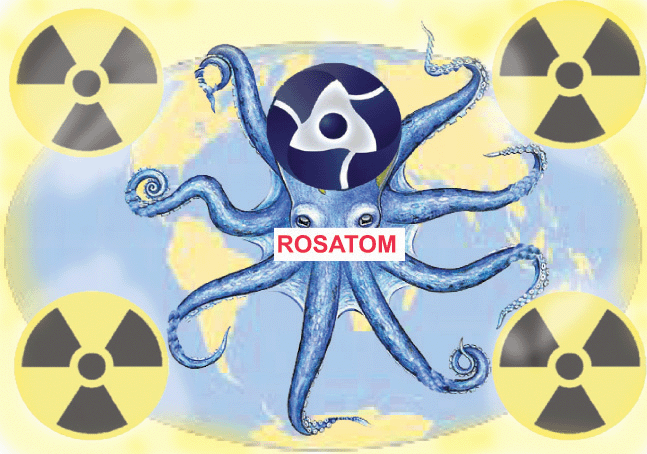
Rosatom, the self-regulated state nuclear enterprise, is led by a former prime minister reporting to President Vladimir Putin and exempted from all normal state controls. Independent experts agree that Rosatom (or any other state entity) would be lucky to build half the 30 additional nuclear projects it’s trying to sell for $300-billion to a dozen more countries including South Africa. Russia’s interest rate in early 2016 was twice (and in an earlier spike, over three times) what any coal-competitive nuclear project would require. The Russian state’s capacity to absorb the spread is quickly vanishing. Russia’s domestic reactor starts halved in 2015; all state nuclear subsidies are to halt in 2016. Yet without those subsidies, “Rosatom wouldn’t complete a single project anywhere”.
Russia needs huge amounts of outside capital to finance its nuclear commitments. …….
Not just Russian but any nuclear new-build is a poor choice for South Africa. It cannot compete with efficiency and renewables, by every relevant measure: cost, timeliness, financing, jobs, economic development, environmental and safety risk, independence, security, abundance of eternally free local energy sources, and the social good of “energy democracy”. These goals support and are advanced by the agenda of “an electricity sector that will deliver, transparently, competitively, reliably and sustainably, the electric services that will power economic growth and improve the welfare of all our people”.
It has come to this: ever more sales-starved nuclear vendors, seeking ever less solvent customers, now offer a risky project the seller can’t finance to a customer who can’t pay – a customer with no need, enchanted by the same nuclear devotees whose broken promises already cost the nation dearly, and with no apparent accountability.
The South African civil society groups and opposition parties have been pushing back on government’s plan to add 9 600 megawatts of electricity to the grid through nuclear plants.
Happy Khambule, the political advisor at Greenpeace Africa notes that there is a tough job ahead for the new leadership of the country. “We believe one of the most pressing issues is to start to create stability, increase trust in the country’s government, and to choose a new pathway in establishing transparency and accountability in the energy sector”.
In an interview with the eNCA, Khambule has said that they will utilize all communication platforms at their availability to engage with the relevant government departments in ensuring that Greanpeace influences Ramaphosa’s decisions on energy matters.
Greenpeace Africa also looks forward to the new Integrated Resource Plan and calls on Ramaphosa to “stop that coal”.
Khambule feels that there was a distant relationship between the former president Jacob Zuma and the energy advocacy groups.
“It is time to remove the barriers to renewable energy, which can enable the achievement of universal access to energy and power disadvantaged communities much faster and at a cost South Africans can afford. We call on the President to push ahead with a renewable-powered future that will not leave South Africans in the dark,” this organisation said in a statement.
Ramaphosa recently commented at the World Economic Forum in Davos, that South Africa had “excess power right now and we have no money to go for major nuclear plant building”.
Melita Steele, the senior campaign manager at Greenpeace Africa said, “Greenpeace has long argued that nuclear is never safe, and is simply unaffordable”.
She further said that the organisation looks forward to the updated IRP without the inclusion of crushing nuclear energy investments.
Meanwhile, Ramaphosa will soon elect his new cabinet and the Energy Minister, David Mahlobo is unlikely to retain his position, according to lobby groups and economists.
Wayne Duvenage, the CEO of the Organisation Undoing Tax Abuse told Business Report that Mahlobo has limited experience on energy and his appointment as the Energy Minister was based on Zuma’s interest in speeding up the nuclear deal with Russia. “Ramaphosa will be problematic with him in this regard”.
Russia and Congo to cooperate in nuclear power, WNN, 14 February 2018 Rosatom and the Ministry of Scientific Research and Technological Innovations of the Republic of Congo have signed a Memorandum of Understanding (MoU) on cooperation in the peaceful uses of nuclear energy.
The document was signed yesterday in Moscow by the Russian state nuclear corporation’s deputy director general for international relations, Nikolay Spassky, and the ambassador extraordinary and plenipotentiary of the Republic of the Congo in Russia, David Maduka.
The document establishes a legal basis for the implementation of bilateral cooperation in a wide range of areas, Rosatom said. These include the development of nuclear infrastructure in the Republic of Congo and programmes aimed at increased awareness of nuclear technologies and their applications…..http://www.world-nuclear-news.org/NP-Russia-and-Congo-to-cooperate-in-nuclear-power-14021801.html
NJ Ayuk, who is widely recognised as one of the top influential businessman in the sector globally, said there was no reason for South Africa to consider nuclear energy and instead it should invest in clean renewable energy to create jobs and grow its economy.
Ayuk said the consideration for nuclear could lead to the country succumbing to external pressures.
“We need to stop having short-term fixes to our challenges. If we continue to look to other powers for solutions, we will have to succumb to what they want. Is that what South Africa wants?” he asked.
With South Africa’s bid for a non-permanent seat on the UN’s Security Council this year, Ayuk warned if the country were to consider nuclear energy and partner with another country, this would diminish its position on the influential body.
Speculation about South Africa seeking partnership with Russia has come to the fore over the past year, with the government denying that a deal had been made.
“Do you want a member of the Security Council that’s dependent on another country for its energy security and needs? Africa needs a representative that will articulate its views and not one that will be perceived to be captured by another strong power,” he said.
For decades South Africa relied on coal for electricity and synthetic fuel production but needs to look at other energy sources to meet its climate change commitments.
Recent studies have also shown a decline in global demand for coal.
“Renewable energy must be the core part of the energy mix as it has the potential to alleviate poverty. We need to put in the right investment in it. It will create jobs and allow small businesses to participate in the sector,” he said.
He said the country and other African countries endowed with mineral resources should start looking at establishing an enabling environment for investments and growth in the sector.
Ayuk said the political change in South Africa gave hope that there would be a re-focus on the energy sector and that “homegrown” solutions for energy problems would be found.
“We have to be futuristic. It doesn’t help any country to have big projects and the skills cannot be found within it because jobs are not created or if they are they are low skilled jobs”, Ajuk said.
He also advocated better management of mineral resources throughout the continent and better frameworks to “empower communities”.
“Africa needs to start thinking of sharing skills and expertise to create intra-trade. We have the technology in most of the countries, we need to enhance what we already have.”
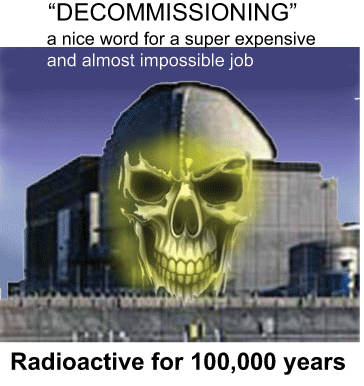
Why decommissioning South Africa’s Koeberg nuclear plant won’t be easy The Conversation, Hartmut Winkler, Professor of Physics, University of Johannesburg, January 26, 2018
Africa’s only operational nuclear power plant is in an area called Koeberg, outside Cape Town in South Africa. The life span of the plant was originally meant to end in 2024. But after an upgrade it’s now expected to operate until around 2044.
The funding for decommissioning, which is an expensive process, needs to be secured well in advance. Failing to decommission the site properly would saddle Cape Town with a dangerous radiation hazard for generations to come.
Responsibility for Koeberg’s site rehabilitation rests with its operator, the state electricity utility, Eskom. For now decommissioning Koeberg is not a priority for Eskom’s newly appointed board given its need to deal with the financial pressure and allegations of corruption the utility is facing.
But it will nevertheless need to start planning soon……….
All nuclear power plants accredited by the International Atomic Energy Agency must regularly set aside funds to finance the eventual decommissioning. By 2016, Eskom had paid R10.9 billion into a trust for this purpose.
But these provisions seem insufficient and the utility will probably need to raise additional funding to shut down Koeberg.
Eskom is responsible to pay for the site’s rehabilitation, but not for final waste disposal. The funding of that process ultimately becomes the responsibility of the state.
Waste from Koeberg
The arrangement is that low and intermediate-level nuclear waste is transported to a site called Vaalputs in sparsely populated Namakwaland, about 500 km north of Cape Town. High-level waste is kept on site in Koeberg in what are known as fuel pools.
South Africa doesn’t have storage facilities for its high-level waste. Like the rest of the world, construction of nuclear plants was initiated without a specific waste disposal plan, with the understanding that each country would manage and pay for it themselves.
Unfortunately South Africa is likely to approach decommissioning Koeberg in the same way other countries have done it – by effectively leaving the waste on site indefinitely in temporary storage facilities. This avoids the expense of waste processing as well as making difficult political decisions. But it passes the problem to future generations while continuing to expose the nuclear plant’s neighbourhood to contamination risk. This is a serious risk at Koeberg given that it’s a mere 30 km from the Cape Town city centre.
Koeberg’s decommissioning is an awkward reality that cannot be ignored for much longer. This should become the main focus for nuclear professionals in South Africa, rather than new plants. Eskom and other parties in the energy space need to develop detailed, credible decommissioning work plans with realistic costing scenarios and funding strategies. A crisis can be avoided, but only through early and proper planning. https://theconversation.com/why-decommissioning-south-africas-koeberg-nuclear-plant-wont-be-easy-89888
Under the presidency of Jacob Zuma, South Africa has been trying to implement a massive new nuclear programme. The initiative stood against a growing body of evidence pointing to the fact that nuclear isn’t needed, is too costly and is hard to finance. There is also the fact that the case for renewables looks increasingly favourable than nuclear. And last year, civil society groups secured a court order that halted the nuclear build programme temporarily on grounds that government had not followed due consultative process.
But Zuma has insisted on the nuclear programme, going so far as to appoint a minister to the energy portfolio who continues to argue that the country needs nuclear energy. But the facts are still against him, as they were against the previous four ministers who failed to deliver Zuma’s nuclear project.
The argument against nuclear energy can be broken down into five key themes.
1. Large chunks of new power aren’t needed
South Africa has surplus energy capacity. Along with new capacity that is coming online, the country does not need nuclear power to meet electricity demand for many years, despite the scheduled closure of some old coal plants. In fact, demand has fallen in South Africa and is lower than it was a decade ago.
This is not simply a result of slow economic growth. Steep hikes in electricity prices have accelerated investments in energy efficiency and electricity savings.
The structure of South Africa’s economy is also changing with the energy-intensive primary sector declining and the tertiary and services sector accounting for a larger share of the economy.
2. Good news on renewables
At the same time, renewable energy prices have plummeted globally and rival or even undercut the operating costs of many existing nuclear or fossil-fuelled power stations. Within just one year (2016), world costs for new onshore windpower fell by 18%, for offshore wind by 28%, and for utility-scale photovoltaics (PV) by 17%, while low bids fell 37% for Mexican PV and 43% for EU offshore wind. In South Africa, transparent auctions have already cut solar PV electricity prices by close to 80% and wind energy by nearly 50%.
Government’s nuclear policy consistently cites as its analytic basis the Integrated Resource Plan(IRP) for Electricity 2010 to 2030, formally published in May 2011 and updated several times since then. But over this time, the economic rationale for nuclear, never particularly strong, has weakened considerably. So much so that nuclear energy is not picked in any South African modelling scenarios, other than one where artificial constraints are placed on how much solar and wind energy can be built and where additional carbon budget limits are imposed. Even in this extreme scenario, nuclear energy might only be required after 2039.
Instead, the models favour solar and wind plus gas as the cheapest option for sustainable electricity supply. Renewables also perform well on the question of reliability. A recent engineering studyconfirms that the South African power system will be sufficiently flexible to handle very large amounts of wind and solar power generation to cope with increased flexibility requirements.
3. Nuclear power is dying globally
Global nuclear enterprise is slowly dying from an incurable attack of market forces. Financial distress stalks vendors, with cascading insolvencies spreading in the past two years. Construction cost and delays keep rising worldwide.
The global nuclear industry continues to suffer major risks of project failure or abandonment. For example, of 259 US nuclear units ordered between 1955-2016, 128 (49%) were abandoned before start-up and 34 (13%) prematurely closed later. Of the 97 units (37%) operating in mid-2017, 49 were deemed uneconomic to run; 35 suffered 45 year-plus safety-related outages. And only 28 units (11%) remain economically viable.
By contrast, renewable energy is dominating new investment in power generation worldwide. Bloomberg New Energy Finance estimates renewable energy will capture 72% of global power generation investment by 2040 as costs drop by a further 66% for solar power, 47% for onshore wind, and 71% for inshore wind plants.
China has generated more wind power than nuclear electricity since 2012. India has quadrupled its renewables target and is planning 100 GW of solar power (now cheaper than coal power) by 2022. Over three billion people now get more non-hydro renewable than nuclear electricity, in three of the world’s four top economies (China, Germany, Japan) and in Brazil, India, Mexico, Holland, Spain, and the United Kingdom.
4. Renewable energy is good for business
The International Renewable Energy Agency has found that worldwide, doubling renewables’ energy share by 2030 could raise global GDP up to 1.1%, improve welfare up to 3.7%, and support over 24 million renewable-energy jobs.
In South Africa, important economic benefits have already been seen due to renewable energy initiatives. These have created a total of 32 532 job years.
Renewable energy projects also aid development in previously marginalised and disadvantaged groups and communities. Thanks to novel economic development criteria built into South Africa’s world-recognised renewable energy independent power producer programme. Black South Africans own, on average, 31% of projects that have reached completion. Black local communities further own on average 11% of the equity of projects.
5. The Russians can’t be trusted
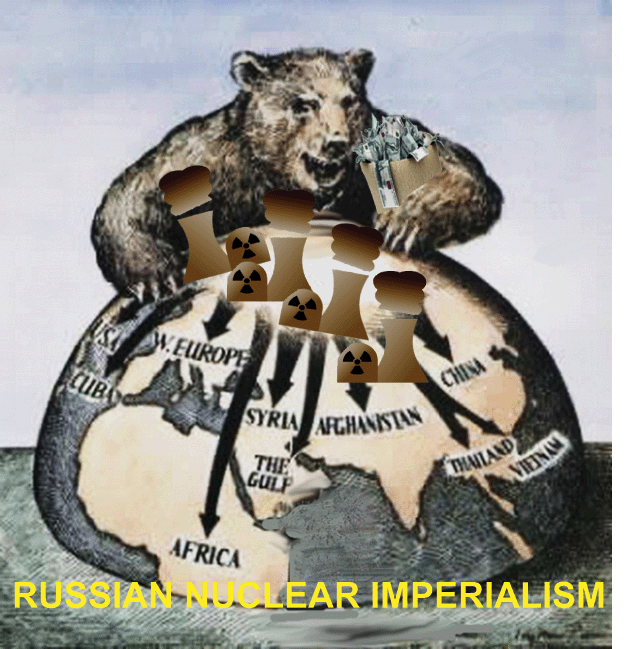
The above facts demonstrate that nuclear lacks a business case for South Africa, whichever country provides the technology. But there is special cause for concern about South Africa’s proposed nuclear deal with Russia. During a series of private presidential meetings over the past seven years, South Africa concluded an unusually strong and specific nuclear agreement with Russia, since struck down by the courts.
Concerns are several. Firstly, a deal which makes South Africa dependent on Russia for a large share of electricity supply – as well as for nuclear safety – must raise serious questions about South African national sovereignty and independence.
Additionally, Russia is facing economic challenges, sliding in terms of rated world economies to number 15, below Mexico. Sovereign debt is a real concern and low oil prices and Western sanctions in response to Russia’s aggression towards the Ukraine and other areas are making matters worse.
Russia wants to build nuclear power plants but needs huge amounts of capital to finance its nuclear commitments around the world. It hardly appears to be a stable financial partner.
A rational choice is needed
South Africans deserve reliable and affordable electrical services. At issue is how much money, time, and opportunity for national advancement will be lost before the country finally abandons the folly of procuring new nuclear power plants.
Amory Lovins, chief scientist at Rocky Mountain Institute, co-authored this article.
INVESTIGATION: At Nigeria’s abandoned nuclear centre, failed projects, idle staff and ‘fraud’ [Part 2] Premium Times, Kemi BusariAwarded at over N400 million in 2009, what was supposed to be a radioactive waste management facility at Nigeria’s Nuclear Technology Centre never came to life.
Instead, a building overgrown with scrubs lies east of the gamma irradiation facility. Waste management plants and equipment comprise various devices and machines used for treating, converting, disposing and processing wastes from various sources.
The construction of low/medium radioactive waste management facility was awarded at the contract sum of N401.4 million to Commerce General Limited and so far, N312 million has been paid to the contractor, the Nigeria Atomic Energy Commission (NAEC) said in response to a Freedom of Information request made over a month ago.
The project, according to NAEC, was 78 percent complete and has “only suffered delays.”
“The project was not abandoned. It only suffered delays due to factors outside the control of the commission,” the agency said.
The delays, NAEC said, include; “inadequate funding of capital projects generally, over the years, modification of the original design, as recommended by IAEA experts, which has resulted into changes in the BOQ figures and this development is being discussed with the contractor,” and also, “no outstanding Interim Payment Certificate on the project.”
A staff of the NTC, who was privy to the contract and execution since 2009, said the project had been used to embezzle money from government since the time of award.
“It is true that they changed the plan of the plant but they’ve never done anything meaningful there since they mounted these blocks,” he said.
“The contractor is not qualified and along the line, he got stuck in the project and we’ve not seen or heard about him for many years now.”
PREMIUM TIMES’ efforts to reach the management of Commerce Nigeria Limited were unsuccessful as the company has no website or any visible record.
Its recorded address at Plot 3, Railway Avenue, Kachia Road, Kakuri, Kaduna South, Kaduna, does not exist, this paper found out during a visit there.
“We’ve never heard of that place,” several residents of Kachia told this reporter after attempts were made to locate the company.
In Nigeria, it is not uncommon for ‘brief case’ contractors, most times in connivance with the awarding entity, to register a company for the sole purpose of bidding for contracts and making quick money.
As alleged by staff of the centre, this may be the case as even the figures quoted in FOI response by NAEC are contradictory.
While the commission said the project was 78 percent complete, a visit to the facility told a different story: an expanse of land overgrown with weeds and a construction no way near half-way complete which, in no way, justified the commission’s claim of paying almost 80 percent of the total contract sum to the contractor.
If the contract was awarded at N401. 4 million and N312 million had been paid so far, the balance should be about N89 million. But NAEC quoted N329 million.
‘Abandoned’ nuclear instrumentation laboratory
One of the components of the masterplan of the centre is the nuclear instrumentation laboratory which is supposed to serve as workshop for students, researchers and others in the nuclear field.
The project was awarded at the cost of N829.6 million to Trois Associate Limited in 2012 and it is 68% complete, NAEC’s response to an FOI stated………….
Nigeria joined IAEA, an international body for cooperation in the nuclear field in promoting safe, secure and peaceful use of nuclear technologies, in 1964.
The IAEA safety standards, was enshrined to ensure protection of people and the environment against radiation risks, safety of facilities and activities that give rise to radiation risks. The world body recognised this to include, safety of nuclear installations, radiation safety, the safety of radioactive waste management and safety in the transport of radioactive material.
The world body listed some fundamentals which must be observed by member states in section 3.30 of the safety standard………
The Conversation 25th Jan 2018, Why decommissioning South Africa’s Koeberg nuclear plant won’t be easy.
Koeberg has two units, each generating 930 MW, which contribute about 4% of
South Africa’s power capacity. They were built by French developer
Framatome, now called Areva.
Researchers in France, Germany and the UK have
calculated widely different costs for nuclear cleanups (including waste
disposal) in their countries. The potential cost of decommissioning a site
comparable to Koeberg according to the French costing model would be R8.4
billion. Some analysts say this is unrealistically low. The German model
puts the number at around R39 billion and the UK model at R76 billion. https://theconversation.com/why-decommissioning-south-africas-koeberg-nuclear-plant-wont-be-easy-89888
SA has no money for nuclear power: Ramaphosa, ENC.com, SOUTH AFRICA, JOHANNESBURG – “We have excess power right now and we have no money to go for major nuclear plant building.”
That is according to Deputy President Cyril Ramaphosa, speaking during a media briefing at the World Economic Forum in Davos, Switzerland.
South Africa’s nuclear plans have been shrouded in controversy, with local activists and the media raising concerns about transparency, costs, safety and environmental risks.He said the country is dealing with all the issues raised by investors at the meeting of world powers and global business leaders.
Zambia establishes an Interim Secretariat on Nuclear Science and Technology, Lusaka Times, January 23, 2018,Government has established an Interim Secretariat on Nuclear Science and Technology (ISNST) constituted by senior officers from various Government Ministries and Institutions. The Units under the ISNST include Nuclear Applications, Public Awareness and Consultation, Economics Assessment, Legal and Regulatory, and Programme Development.
The ISNST will spearhead implementation of Zambian’s nuclear energy programme as well as the development of the Centre for Nuclear Science and Technology (CNST). The officers have since commenced work, which among others, will involve public awareness and consultations……..Government is hopeful that the nuclear energy programme will transform the country into an industrial hub in the region. A group of students have already been sent to Russia to study in various areas of nuclear science, who upon completing their studies would work in the CNST.
Government has since signed various agreements with the Russian Federation that have culminated into the implementation of the nuclear energy programme………
Uganda pushes for nuclear energyBy Vision Reporter, New Vision, 18th January 2018People are not aware that you can use nuclear very peacefully for the well-being of humanity,Museveni said. KAMPALA – President Yoweri Museveni has said that unless solar becomes a cheaper alternative source of clean energy, Africa and Uganda in particular will have to use nuclear energy to improve the welbeing of its people…….The main issue is energy resource. Nuclear is clean energy, better than fossil fuels…….Museveni was meeting the Director General of the International Atomic Energy Agency (IAEA) Yukiya Amano at State House Entebbe on Wednesday. ……
The DG Yukiya Amano said as IAEA, they are doing a lot in making nuclear energy for peaceful use and is already supporting Uganda in implementing projects that use nuclear for peaceful purposes for the wellbeing of the people………
He said it is no longer the energy for only developed countries. Despite it requiring a lot of preparations, it is important that the transfer of technology from IAEA to other countries to increase on the welfare of the people…….The important issues are; public acceptance, money and technology. IAEA is very happy to work with you and help you at every level,” he said………https://www.newvision.co.ug/new_vision/news/1469249/uganda-pushes-nuclear-power








 nuclear-news