A forgotten community The little town in Niger keeping the lights on in France, Beyond Nuclear By Lucas Destrijcker & Mahadi Diouara, 1 July 18 Reprinted with kind permission from African Arguments
Welcome to Arlit, the impoverished uranium capital of Africa.
From Niamey, the capital of the landlocked West African nation of Niger, we call ahead to a desert town in the remote north of the country.
“Journalists? On their way here? It’s been a while”, we hear down the phone from our contact. “We welcome you with open arms, but only on the pretence that you’re visiting to interview migrants on their way to Algeria. If they find out you’re poking your nose in their business, it’s a lost cause.”
That same evening, the public bus jolts as it sets off. Destination: the gates of the Sahara.
The stuffy subtropical heat gradually fades into scorching drought and plains of seemingly endless ochre sands. About two days later, we pass through a gateway with “Arlit” written on it in rusty letters.
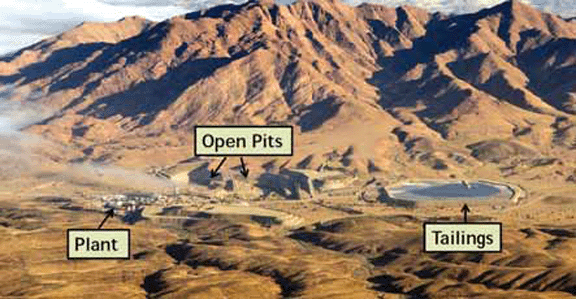
The town of about 120,000 inhabitants is located in one of the Sahel’s most remote regions, not far from the Algerian border. The surrounding area is known to be the operating territory of numerous bandits and armed groups, including Islamist militants. It is like an island in the middle of the desert, an artificial oasis with only one raison d’être: uranium………
approximately 150,000 tonnes of uranium have been extracted by the majority state-owned French company Areva, which is now one of the largest uranium producers in the world. The two mines around Arlit – Somaïr and Cominak – account for around a third of the multi-billion-dollar company’s total global production.
France uses this uranium to generate nuclear power, some of which is sold on to other European countries. According to Oxfam, over one-third of all lamps in France light up thanks to uranium from Niger.
However, in contrast to France, Niger has failed to see similar benefits. The West African country has become the world’s fourth largest producer of uranium, which contributes tens of millions to the nation’s budget each year. Yet it has remained one of the world’s poorest and least developed countries, with almost half its 20 million population living below the poverty line. Its annual budget has typically been a fraction of Areva’s yearly revenue.
The main reason for this is the deal struck between Areva and Niger. The details have not been made public, but some journalists and activists such as Ali Idrissa, who campaigns for more transparency in the industry, have seen the agreement. Amongst other things, the documents suggest that the original deal generously exempted Areva from customs, export, fuel, materials and revenue taxes………
Apart from criticising the Nigerien government for not spending its uranium revenue where it is most needed – such as in health care, education and agriculture – Idrissa ( Ali Idrissa, who campaigns for more transparency in the industry ) emphasises the bigger geopolitical picture: “Don’t forget that Niger isn’t just negotiating with a regular company, but with the French state. Their development aid, military and political support means that we cannot ignore our former coloniser. Our dependency from France goes hand in hand with crooked business deals.”
Forgotten in the desert
Exhausted from the long journey to Arlit, we’re received in the dingy office of Mouvement Unique des Organisations de la Société Civile d’Arlit (MUOSCA), a local umbrella group for environmental and humanitarian NGOs.
“If either Areva or the government were to find out you’re poking your nose in their business, they’ll go to any length to make your work very difficult”, says MUOSCA’s director Dan Ballan Mahaman Sani as he wipes the sweat from his brow. “Besides that, Westerners are attractive targets in this region.”
Indeed, there is a history of Islamist militant attacks and kidnappings in the area, including some directly targeting Areva. In 2010, seven of the company’s employees were abducted, including five French nationals. In 2013, an attack on the Somaïr mine left one dead and 16 injured.
While the world held its breath as armed groups stepped up operations in the region, Areva, managed to extract over 4,000 tons of uranium, up from two years before, without too much trouble.
Dan Ballan says this illustrates how far the Nigerien uranium industry stands apart from the country’s social environment and how isolated Arlit has become especially amidst regional insecurity.
“International NGOs or UN agencies don’t exist here, and Areva has nothing to fear from the Nigerien government,” he says. “We’re literally a forgotten community, completely left to the mercy of the multinational.”
Finding water
According to Dan Ballan and others, the uranium mining industry has taken a huge toll on Arlit and the region. While Areva has a multi-billion-dollar turnover, the majority of people here live in a patchwork of corrugated iron shelters on sandstone foundations. Poverty is rife. Power outages lasting two or more days are regarded as normal.
Moreover, while the uranium mines consume millions of litres each day, only a small proportion of Arlit’s Nigerien population enjoy running water. A 2010 Greenpeace study estimated that 270 billion litres of water had been used by the mines over decades of operations, draining a fossil aquifer more than 150 metres deep. The depletion of these ancient water reserves has contributed to desertification and the drying up of vegetation.
The water in Arlit, however, is not only scarce. Researchers over the years also suggest that, along with the soil and air, it contains alarming levels of radiotoxins.
Bruno Chareyon, director of the French Commission for Independent Research and Information on Radiation (CRIIAD), has been measuring radioactivity in and around Arlit for over a decade. His studies from 2003 and 2004 suggested that the drinking water contains levels of uranium at ten to hundred times the World Health Organisation’s recommended safety standards.
“Despite these findings, Areva has stated continuously that they haven’t measured any excess radioactivity during their biannual examinations,” he says.
In 2009, Greenpeace conducted their own tests and found that five of six examined wells – all used to get drinking water – contained excess radioactivity as well as traces of toxins such as sulphates and nitrates.
……… Toxic waste
At the bustling local market in Arlit, down some meandering alleyways, there are the normal wares, but among them one finds some more peculiar items: large industrial cogs; parts of metal cranes; digging equipment; and even a dump truck.
“All of these are cast-downs from the mines,” says Dan Ballan. “Useless material finds its way to local merchants, who recuperate it and sell it on. Most of them have no idea of the risks.”
CRIIRAD readings of goods at the market from 2003 and 2004 showed radioactivity levels at up to 25 times the maximum standards. “People buy radioactive material to cook with, build their homes with, or raise their children with,” says Dan Ballan…….
Greenpeace and CRIIRAD confirm that radioactive dust spreads far and wide, sometimes to hundreds of kilometres away. But contrary to claims of a “superfast decay”, they say that while some products have half-lives of just days, others have half-lives of tens of years.
Furthermore, researchers say that radioactive waste is not simply dispersed. “The same radioactive rubble was used in Arlit on more than one occasion for landfills or building roads and homes”, alleges Chareyron. In 2007, CRIIRAD found that some road surfaces had radioactive values over a hundred times standard values.
………. Living with uranium
It is not difficult to come across Arlit residents suffering from serious health problems. ………..
The only hospitals in Arlit are run by Areva, with all the medical staff on the company payroll. The government provides no healthcare here. At the Cominak facility, Dr Alassane Seydou claims to have never diagnosed someone with a disease that could be linked to radiation or toxins. He says that in more than 40 years, not a single case of cancer has been discovered. “All employees are systematically examined, but we haven’t encountered any strange diseases,” he claims.
In 2005, the French law association Sherpa launched an investigation into Areva’s activities in Arlit. Speaking to them, one former employee at Somaïr hospital alleged that patients with cancer had been knowingly miscategorised as having HIV or malaria. The surgeon-in-chief at the hospital denied those claims.
There have been no official, large-scale health studies conducted in Arlit, but some smaller-scale studies give an indication of the prevalence of illness among residents and former Areva employees.
In 2013, the Nigerien organisation Réseau Nationale Dette et Développement interviewed 688 former Areva workers. Almost one quarter of them had suffered severe medical issues, ranging from cancer and respiratory problems to pains in their joints and bones. At least 125 had stopped work because of these health issues.
A similar survey was carried out on French former employees around the same time. In 2012, Areva was found culpable in the death of Serge Venel, an engineer in Arlit from 1978-1985. A few months before his passing, doctors had found that his cancer was caused by the “breathing of uranium particles”. The case went to court, with the judge ordering Areva to pay compensation for its “inexcusable fault”. Before the court of appeals, only the Cominak mine was found responsible.
Following the verdict, Venel’s daughter, Peggy Catrin-Venel, founded an organisation to protect the rights of former Areva employees. As part of this project, she managed to trace around 130 of about 350 French workers who had lived in Arlit at the same time as her father. 60% of those she was able to find information on had already died, most of them from the same cancer as her father.
Standing up
Catrin-Venel continues to fight against Areva, but she is not alone. As shown in the documentary Uranium, L’héritage Empoisonné, Jacqueline Gaudet is also standing up to the company.
She founded the organisation Mounana after she lost her father, mother and husband all to cancer in the space of just a few years. Her husband and father had worked at an Areva uranium mine in Gabon, while her mother lived there in a house built from mining rubble. Their cancers were reportedly caused by excessive exposure to radon, which is released during uranium extraction. In collaboration with lawyers from Sherpa and Doctors of the World, Gaudet’s organisation works to collect testimonies from former employees in order to build cases.
For Michel Brugière, former director of Doctors of the World, it’s still unthinkable that so many employees of the French state-owned company could fall ill like this. Speaking in the documentary, he commented: “How can one allow one’s staff to live and work in such a polluted environment? This is unbelievable. It’s reminiscent of long gone abuses.”
In the same vein, Greenpeace describes Arlit as a forgotten battlefield of the nuclear industry. “There are few places where the catastrophic effects of uranium mining on nearby communities and the environment are felt more distinctly than in Niger”, said researcher Andrea Dixon.
Back in Arlit, the stories of French former employees standing up to Areva are well-known. But the struggle for Nigerien workers to get recognised is even steeper than in Europe. “Both the legal system and the financial means to stand up for our rights are lacking”, says Dan Ballan. “In a couple of years, the uranium reserves will be depleted and Areva will leave, however the pollution and underdevelopment will stay behind.”
He may be right, but Areva will not be going far. About 80km away, a third and enormous new Nigerien uranium mine called Imouraren is being developed. “Lacking any perspective of another job, the workers will eventually move
wherever the mine is”, says the local activist……..
December 2017 marked the beginning of significant political changes in South Africa. Former President Jacob Zuma was replaced by Cyril Ramaphosa as president of the African National Congress (ANC). On 14 February 2018, Zuma stepped down as president of the Republic of South Africa (RSA), almost one year short of completing his second and final term. He was replaced by the newly elected president of the ANC, Cyril Ramaphosa.
This has brought about significant changes in South Africa. However, what this means for Government’s nuclear energy ambitions is not yet clear. While the Zuma administration remained unwaveringly committed to the Nuclear Energy New Build Programme in its full 9.6GW glory, mixed messages about the future of nuclear energy have emerged from President Ramaphosa and his newly appointed Minister of Energy, Jeff Radebe.
Given this uncertainty, as well as the country’s questionable track record with pursuing nuclear energy procurement under the Zuma administration, those opposed to the nuclear new build programme are left in limbo.
Will government continue to pursue nuclear energy despite its prohibitively high costs; the lack of energy demand to justify a build on this scale; the fact that we don’t have the money to finance it; and the continued resistance from many constituencies throughout South Africa? If it does, will the procurement process be more open and transparent than it was under the Zuma administration and will government engage with and listen to the concerns of its people?
These are critical questions because the energy choices we make now will have significant impacts not only on our energy security and economic performance today but also in the future.
Furthermore, as we enter into a new period of optimism in South Africa, the need to ensure Energy Democracy, understood in its broadest sense to mean that all South Africans are informed about and have a say in our energy future, is critical.
It is in this spirit that the World Wide Fund for Nature (WWF) undertook two studies to explore the future of nuclear energy in South Africa. The purpose of these studies is two-fold. First, it seeks to understand what we can learn from the decisions made and strategies pursued to push nuclear energy under the Zuma administration. Second, it seeks to highlight the potential points of intervention available to those seeking to oppose nuclear energy deployment, or at the very least ensure accountability in the procurement thereof.
The first study, South Africa’s nuclear new-build programme: Who are the players and what are the potential strategies for pushing the nuclear new-build programme, maps the most vocal constituencies in the nuclear energy debate and their reasons for either opposing or supporting the new build programme. What it reveals is that across the board, irrespective of ideological positions or technology preferences, South Africans are opposed to the nuclear programme. The reasons given by these commentators include, the prohibitively high costs involved, the lack of energy demand to justify the programme, the lack of finance to fund such a programme, the secrecy associated with nuclear procurement and the potential for corruption, among others.
The study also unpacks some of the lessons we can learn from government’s strategy to push the nuclear programme under the previous administration. Importantly, it unpacks the Earthlife Africa and Southern African Faith Communities’ Environment Institute (SAFCEI) legal challenge, which saw the Western Cape High Court declare Government’s Intergovernmental Agreement with Russia unlawful and what those opposed to nuclear energy can learn from this process. It attempts to understand what, given the High Court decision, are the strategies available to Government if it is to continue to pursue nuclear energy in South Africa.
The second study, South Africa’s nuclear new-build programme: The domestic requirements for nuclear energy procurement and public finance implications, provides insight into the various legislative requirements for large infrastructure builds in South Africa.
What it reveals is that SA has a robust legislative framework in place to ensure that due process is followed in large infrastructure procurement. In particular, Treasury’s various procurement rules impose a number of checks and balances to prevent cost overruns and delays and to ensure transparency and accountability. These are critical to understand, not only in the context of nuclear energy, but for any infrastructure build we might seek to undertake.
The second report also shows unequivocally that SA cannot afford to pursue the nuclear new build programme. Using very conservative cost estimates, it shows not only that the fiscus can neither finance the programme nor provide the guarantees necessary to seek financial support elsewhere.
Given this, and as we move into a new period in SA’s democracy, it is critical we entrench inclusive and accountable decision making from the get go. This requires that we ensure that government engages with and listens to all stakeholders when making important decisions about our energy future.
Going into this new period, we can draw on two fundamental lessons from our past. The first is that everyone has the power to make a difference. Against all odds, Earthlife Africa and SAFCEI, were able to change the course of our energy future. The second is that in order to exercise this power we need to be informed. The energy space is unnecessarily complicated. It is time for those working in this space, to move away from the technical language that excludes participation by most South Africans and start driving Energy Democracy in its truest form.
– Ellen Davies is the Project Manager of Extractives Industry at the World Wide Fund for NatureSaliem Fakir is the Head of the Policy & Futures Unit at the World Wide Fund for Nature South Africa.
Russia’s Rosatom and the Ministry of Infrastructure of Rwanda have signed a Memorandum of Understanding on cooperation in the peaceful uses of nuclear energy. The document was signed on 22 June by Rosatom Deputy Director General Nikolay Spassky and Ambassador Extraordinary and Plenipotentiary of the Republic of Rwanda to the Russian Federation Jeanne d’Arc Mujawamariya……
Australian mining companies have a poor track record operating in Africa. Australian uranium company Paladin Energy has now put two of its mines into ‘care-and-maintenance’ and bankruptcy looms. But who cleans up the company’s mess in Namibia and Malawi, asks JIM GREEN
Many Australian mining projects in Africa are outposts of good governance – this is what Julie Bishop, the country’s Foreign Minister, told the Africa Down Under mining conference in Western Australia in September 2017. The Australian government “encourages the people of Africa to see us as an open-cut mine for lessons-learned, for skills, for innovation and, I would like to think, inspiration,” the minister said.
But such claims sit uneasily with the highly critical findings arising from a detailed investigation by the International Consortium of Independent Journalists (ICIJ). The ICIJ noted in a 2015 report that since 2004, more than 380 people have died in mining accidents or in off-site skirmishes connected to Australian mining companies in Africa.
The ICIJ report further stated: “Multiple Australian mining companies are accused of negligence, unfair dismissal, violence and environmental law-breaking across Africa, according to legal filings and community petitions gathered from South Africa, Botswana, Tanzania, Zambia, Madagascar, Malawi, Mali, Cote d’Ivoire, Senegal and Ghana.”
Paladin Energy’s Kayelekera uranium mine in Malawi provides a case study of the problems with Australian mining companies in Africa. Western Australia-based Paladin exploited Malawi’s poverty to secure numerous reductions and exemptions from payments normally required by foreign investors.
United Nations’ Special Rapporteur Olivier De Schutter noted in a 2013 report that “revenue losses from special incentives given to Australian mining company Paladin Energy, which manages the Kayelekera uranium mine, are estimated to amount to at least US$205 million (MWK 67 billion) and could be up to US$281 million (MWK 92 billion) over the 13-year lifespan of the mine.”
Standards at Kayelekera fall a long way short of Australian standards ‒ and efforts to force Australian mining companies to meet Australian standards when operating abroad have been strongly resisted. The Kayelekera project would not be approved in Australia due to major flaws in the assessment and design proposals, independent consultants concluded.
Care-and-maintenance
Kayelekera was put into care-and-maintenance in May 2014, another victim of the uranium industry’s post-Fukushima meltdown. And just last month, Paladin announced that its only other operating mine ‒ the Langer Heinrich mine (LHM) in Namibia ‒ will be put into care-and-maintenance.
Perhaps the most striking aspect of the decision to mothball LHM is that Paladin claims it is the lowest cost open-pit uranium mine in the world. Moreover, the company wasn’t even paying to mine ore ‒ mining ceased in November 2016 and since then ore stockpiles have been processed. Thus a low-cost mine can’t even turn a profit processing mined stockpiles.
The cost of production was US$23.11 / lb uranium oxide in December 2017, and the average realised sale price in the second half of 2017 was $21.82.
Anticipating the decision to mothball LHM, Paladin Energy CEO Alex Molyneux said in late-April: “The uranium market has failed to recover since the Fukushima incident in 2011, with the average spot price so far in 2018 the lowest in 15 years. It’s deeply distressing to have to consider suspending operations at LHM because of the consequences for our employees, and the broader community. However, as there has yet to be a sustainable recovery in the uranium market, and with the aim of preserving maximum long-term value for all stakeholders, it is clearly prudent to consider these difficult actions.”
Paladin hopes to resume mining at LHM and Kayelekera following “normalization” of the uranium market, which it anticipates in the next few years. But with no operating mines, Paladin may not survive for long enough to witness a market upswing.
Paladin was placed into the hands of administrators in July 2017 as it was unable to pay French utility EDF a US$277 million debt.
In January 2018, Paladin’s administrator KPMG noted that an Independent Expert’s Report found that the company’s net debt materially exceeds the value of its assets, its shares have nil value, and if Paladin was placed into liquidation there would be no return to shareholders.
The company was restructured, with Deutsche Bank now the largest shareholder, and relisted on the Australian Securities Exchange in February 2018.
Perhaps LHM will be sold for a song, either before or after Paladin goes bankrupt. A subsidiary of China National Nuclear Corporation (CNNC) has held a 25 percent stake in LHM since January 2014. Last year, the CNNC subsidiary considered exercising its contractual right to buy Paladin’s 75 percent stake in LHM, but chose not to exercise that right following an independent valuation of US$162 million for Paladin’s stake.
Mine-site rehabilitation
Paladin hopes to resume mining following “normalization” of the uranium market ‒ but low prices could be the new normal. Former World Nuclear Association executive Steve Kidd said in May 2014 that the industry is set for “a long period of relatively low prices”. Prices were far higher in 2014 than over the past twelve months. Paladin’s CEO Alexander Molyneux said that “it has never been a worse time for uranium miners” in 2016 and the situation has worsened since then for the industry ‒ prices have fallen further still.
Sooner or later ‒ probably sooner ‒ both the LHM and Kayelekera mine-sites will need to be rehabilitated. Yet it is extremely doubtful whether Paladin has set aside adequate funds for rehabilitation. Paladin’s 2017 Annual Report lists a ‘rehabilitation provision‘ of US$86.93 million to cover both LHM and Kayelekera.
One problem is that the funds might not be available for rehabilitation if Paladin goes bankrupt. A second problem is that even if the funds are available, they are unlikely to be sufficient.
For comparison, Energy Resources of Australia’s provision for rehabilitation of the Ranger uranium mine in Australia ‒ also an open-pit uranium mine, like LHM and Kayelekera ‒ is US$403 million (A$526 million). That figure is additional to US$346 million (A$452 million) already spent on water and rehabilitation activities since 2012 ‒ thus total rehabilitation costs could amount to US$749 million (A$978 million) … and the current cost estimates could easily increase as they have in the past.
Rehabilitation of LHM and Kayelekera could be cheaper than rehabilitation of Ranger for several reasons, such as the relative size of the mine-sites. However it stretches credulity to believe that the cost of rehabilitating both LHM and Kayelekera would be an order of magnitude lower than the cost of rehabilitating one mine in Australia.
Paladin was required to lodge a US$10 million Environmental Performance Bond with Malawian banks and presumably that money can be tapped to rehabilitate Kayelekera. But US$10 million won’t scratch the surface. According to a Malawian NGO, the Kayelekera rehabilitation cost is estimated at US$100 million.
Paladin has ignored repeated requests to provide information on the estimated cost of rehabilitating Kayelekera (and also ignored an invitation to comment on a draft of this article), but the figure will be multiples of the US$10 million bond and it is extremely unlikely that Paladin’s provision of US$86.93 million for the rehabilitation of both LHM and Kayelekera is adequate.
If Paladin goes bankrupt, it seems likely that most of the costs associated with the rehabilitation of LHM and Kayelekera will be borne by the Namibian and Malawian governments (with a small fraction of the cost for Kayelekera coming from the bond) ‒ or the mine-sites will not be rehabilitated at all.
Even if Paladin is able to honour its US$86.93 million provision, additional costs necessary for rehabilitation will likely come from the Malawian and Namibian governments, or rehabilitation will be sub-standard.
Problems most acute for Kayelekera
The problem of inadequate provisioning for rehabilitation is most acute for Kayelekera ‒ it is a smaller deposit than LHM and more expensive to mine (Paladin has said that a uranium price of about US$75 per pound would be required for Kayelekera to become economically viable ‒well over twice the current long-term contract price). Thus the prospects for a restart of Kayelekera (and the accumulation of funds for rehabilitation) are especially grim.
Is it reasonable for Australia, a relatively wealthy country, to leave it to the overstretched, under-resourced government of an impoverished nation to clean up the mess left behind by an Australian mining company? Malawi is one of the poorest countries in the world. According to a 2013 UN report, more than half of the population live below the poverty line.
Australia’s Foreign Minister Julie Bishop should intervene to sort out the situation at Kayelekera and to prevent a repetition of this looming fiasco. The conservative Minister’s eyes might glaze over in response to a moral argument about the importance of Australia being a good global citizen. But there is also a hard-headed commercial argument for intervention to ensure that the Kayelekera mine-site is rehabilitated.
It does Australian companies investing in mining ventures abroad no good whatsoever to leave Kayelekera unrehabilitated, a permanent reminder of the untrustworthiness and unfulfilled promises of an Australian miner and the indifference of the Australian government.
Australia is set to become the biggest international miner on the African continent according to the Australia-Africa Minerals & Energy Group. But Australian companies can’t expect to be welcomed if problems such as Kayelekera remain unresolved.
Dr Jim Green is the national nuclear campaigner with Friends of the Earth Australia and editor of the Nuclear Monitor newsletter, where a version of this article was originally published. He is co-author of a new report titled ‘Undermining Africa: Paladin Energy’s Kayelekera Uranium Mine in Malawi’.
Another nuclear safety scare at Pelindaba as management fumbles, amaBhungane, 7 June 18
Whistleblowers have accused the South African Nuclear Energy Corporation of sidelining qualified staff in favour of inexperienced technicians.
Another safety incident has shaken the Pelindaba nuclear facility outside Johannesburg, resulting in the total shutdown of the NTP Radioisotopes plant which produces vital supplies of nuclear medicine and radiation-based products.
Senior NTP staff point fingers at parent company the South African Nuclear Energy Corporation (Necsa).
The sudden halt in production, which can be lifted only once the National Nuclear Regulator gives the all-clear, threatens global medicine supply.
AmaBhungane understands that the NTP facility was shut down after a dangerous spike in hydrogen gas levels was detected last Thursday (May 31). This, according to a senior technical employee, “could have resulted in an explosion”.
Necsa group chief executive Phumzile Tshelane, speaking on behalf of Necsa and NTP, ignored most questions put to him, saying: “We cannot disclose classified information.”
He did, however, attempt to downplay the incident. “This was a minor incident followed by vigilant safety protocols which ensured that there is no danger as alleged by your source.”
Tshelane cautioned against what he called “dangerous and alarmist allegations”.
This is the latest in a string of setbacks for NTP, the owner of the plant. In November last year, the plant was shuttered by the nuclear regulator after faulty calibrations in an instrument for analysing hydrogen levels.
Several employees claimed that since the November incident the new acting management brought in to get the plant restarted has bungled the recovery process and created unsafe work conditions.
……. AmaBhungane is in possession of correspondence between the regulator and Necsa/NTP from February to May that suggests the recovery process has been far from smooth.
The correspondence paints a picture of a breakdown of safety culture at the plant, where those working on returning the facility to full production are out of their depth.
In their communications with Necsa/NTP, the regulator flags among other things: the submission of falsified results; inaccuracies in tables submitted; the failure to demonstrate repeatability of tests; the unsuitability of a particular individual to provide theoretical training to NTP staff; a lack of due diligence in calibration; failure to submit hydrogen calibration schedules; and a repeated failure to address the poor quality of graphs.
In a letter from March, the regulator writes: “Noting the falsification of information, highlighted by the regulator… and recognising that that similar issue (sic) was previously raised by the regulator… Necsa/NTP Management is required to confirm what action(s) have been taken with regard to this matter.”
The protected disclosure also notes two separate incidents that were incorrectly handled by Necsa deployees.
On Monday, 4 June 2018, comments from the public on the draft Integrated Planning Framework Bill are due to the Department of Performance Monitoring and Evaluation (DPME) in the Presidency.
The call for comments makes the draft bill sound fairly benign, in that the DPME says the bill will provide for the functions of the department and establish an institutional framework for “a new predictable planning paradigm and discipline within and across all spheres of government”.
However, upon analysis, the bill could be the latest worrying development in the relentless bid to push the new-nuclear build programme forward.
On 17 May 2018, Loyiso Tyabashe, senior manager of nuclear new build at Eskom, said at African Utility Week that Eskom is continuing with front-end planning for a nuclear build programme. This despite Cyril Ramaphosa sending clear signals at the World Economic Forum in Davos in January that South Africa does not have money to pursue a major nuclear plant build.
Within this context, consider the following lines contained in the draft integrated planning framework bill, which says that the Minister in the Presidency must:
(c) annually in consultation with the Minister of Finance develop a budget prioritisation framework in order to guide the allocation of resources to organs of state in the national sphere of government;
(d) annually give input to the Minister of Finance in the preparation of the budget on—
the status of the economy and the possible macro-economic interventions;
its alignment with the National Development Plan; and
the proposed capital and development projects and programmes and related expenditure;
Nkosazana Dlamini Zuma is Minister in The Presidency responsible for Planning, Monitoring and Evaluation. This bill would give the minister the ability to develop a budget prioritisation framework that outlines which capital programmes to prioritise and to propose the related expenditure. Capital projects could include such contentious projects as the nuclear build, the Moloto Rail and the Mzimvubu dam.
In February 2018, which is after Cyril Ramaphosa signalled at the World Economic Forum that South Africa has no money for major nuclear expansion, the DPME launched a discussion paper on energy. The DPME’s website notes that enquiries related to this discussion paper could be directed to Tshediso Matona.
Tshediso Matona is the Secretary for National Planning at the DPME and is also the fired former Eskom boss to whom former President Jacob Zuma apologised about the way he was treated when he was fired.
The discussion paper reiterates that “the promulgated IRP 2010-2030 included 9.6 GW of nuclear power generation capacity, which has been confirmed as existing policy on numerous occasions. The Draft IRP 2016 that is in the public domain for consultation following a significant time-lapse since the promulgation of the IRP 2010-2030 in 2011 has a Base Case that requires nuclear power by 2037 (earliest) while a Carbon Budget scenario requires it by 2026.”
The discussion paper does acknowledge that the court case in which the Inter-Governmental Agreements (IGAs) with the United States of America, the Republic of Korea and the Russian Federation were legally challenged, determined the IGAs to be irrational, unlawful and unconstitutional. The court ruled that they should be set aside.
However, the paper then continues to say that the opportunity for small modular reactors to be included in the integrated energy planning framework should be considered. While it says that appropriate realistic costs should be considered, the paper outlines in the line immediately before that small modular reactors have typically been considered prohibitively expensive. With regards to the small modular reactors, the paper refers to revived research and previous research in preparation for the shelved Pebble Bed Modular Reactor which cost about R10-billion before it was shut down.
So, if a smaller nuclear build at an appropriate realistic cost could be possible, should taxpayers be worried? According to two recently released reports by the World Wide Fund for Nature (WWF), there is cause for concern. The WWF reports look at the players’ potential strategies for pushing the nuclear new-build programme as well as the domestic procurement and public finance implications. WWF cautions that suggestions for smaller amounts of installed nuclear capacity appear to be an attempt to gain support for smaller amounts of nuclear energy and use these as a stepping stone towards building the full 9.6 GW.
How might the Integrated Planning Framework Bill play a role in the continued push for nuclear? If the bill is legislated it would give the Minister in the Presidency responsible for Planning, Monitoring and Evaluation the ability to give input to the Minister of Finance on proposed capital and development projects and programmes and related expenditure. The financing would need to come from somewhere.
WWF notes that finance for electricity generating plants typically comes from “corporate finance, government equity, government guarantees, loans from development finance institutions, a long-term loan from an export credit agency, and extra cash generated from regulated tariffs”.
However, says the WWF, it is unlikely that corporate finance would be used; government-to-government loans or financing from state banks or development finance institutions of the vendor’s home country are more likely to be used, with sovereign wealth funds another possibility. In order to enable a loan, National Treasury may need to put up a loan guarantee. Given the alarming trend of State-owned Entities including Eskom needing bailouts, the possibility of the loan being called in would be a risk. The ratings downgrade that Eskom received would also mean that a loan, if it were granted to Eskom, would attract a higher interest rate than previously.
The draft Integrated Planning Framework bill is currently in white paper form. When it comes before Parliament, there is a strong rationale for civil society to study it closely and make submissions to ensure that it is not used as a tool to push corrupt capital projects through the system. DM
SA no longer has agreement with Russians on nuclear, says Radebe, Fin 24, Jun 04 2018 Khulekani Magubane Cape Town –Minister of Energy Jeff Radebe told eNCA on Sunday evening that South Africa no longer had an agreement with the Russians to procure for the development of nuclear energy for the country.
Speaking to journalist and political analyst Karima Brown on the news network’s show The Fix, Radebe said he was of the view that government did not appeal the court ruling in 2017 which invalidated the nuclear deal at that time.
The energy portfolio in national government has seen unparalleled instability with at least five ministers of energy in the past eight years, and a subsequent lack of clarity as to whether the Intergovernmental Framework Agreement which mentions nuclear would still be pursued and what role nuclear would play in the energy mix…….https://www.fin24.com/Economy/sa-no-longer-has-agreement-with-russians-on-nuclear-says-radebe-20180604
Paladin mothballs Namibia uranium mine Creamer Media’s Mining Weekly 25TH MAY 2018 BY: ESMARIE SWANEPOELCREAMER MEDIA SENIOR DEPUTY EDITOR: AUSTRALASIA PERTH (miningweekly.com) 27 May 18 – Dual-listedPaladin Energy on Friday confirmed that its Langer Heinrich uranium mine, in Namibia, was being placed under care and maintenance, but said that the low-cost openpit operation would be one of the first to resume production when the uranium market normalised.
Paladin in April said that it was unlikely to resume physical mining activities at the mine despite the medium-grade ore stockpile currently feeding the processing plant set to be exhausted before mid-2019.
The ASX and TSX-listed company on Friday said that it had received consent from all the relevant stakeholders to place the operation under care and maintenance, and had now stopped presenting ore to the plant.
There would be a run-down phase of up to three months where various stages of the plant would be progressively suspended and cleaned, and during this time, there would be some continued production of finished uranium.
Eskom continues with front-end nuclear preparation May 17 2018 Carin Smith
Cape Town – Eskom is continuing with front-end planning for a nuclear build programme, Loyiso Tyabashe, senior manager of nuclear new build at Eskom, said at African Utility Week on Thursday.
During a discussion on nuclear energy, Professor Anton Eberhard of the University of Cape Town asked Tyabashe why Eskom was still focusing on nuclear development when it did not seem to be on President Cyril Ramaphosa’s radar.
China to help Uganda build nuclear power plants, Reuters Staff, 17 May 18 KAMPALA (Reuters) – China will help Uganda build and operate nuclear power plants under a deal signed last week.
Uganda has some uranium deposits and President Yoweri Museveni has said his government was keen to exploit them for potential nuclear energy development.
Eight potential sites have been identified in the country’s central, southwest and northern regions that could potentially host nuclear power plants, the government said on Thursday. It signed a deal with Russia last year to cooperate on nuclear power.
China is already a major investor in Ugandan infrastructure projects and China National Nuclear Corporation (CNNC) signed a memorandum of understanding on May 11 to help Uganda build capacity “in the use of atomic energy for peaceful purposes”, Uganda’s energy ministry said in a statement issued on Thursday……
Co-operation between CNNC and Uganda will involve the development of nuclear power infrastructure including the design, construction and operation of nuclear power plants.
In June last year Uganda signed a similar memorandum of understanding with Russian State Atomic Energy Cooperation (ROSATOM) to facilitate the two countries’ cooperation on nuclear power.
The energy minister spoke extensively about successes in renewables and made no mention of nuclear power, at the conference in Cape Town, 15 MAY 2018 TANYA FARBER
Just hours after being sworn in as acting president‚ Jeff Radebe nailed his colours to the renewable energy mast at African Utility Week, on Tuesday.
Radebe was speaking at the Cape Town International Convention Centre‚ where 7‚000 delegates from around the world gathered to talk about water‚ energy and power.
The energy minister‚ who is acting president while President Cyril Ramaphosa and Deputy President David Mabuza are out of the country‚ spoke extensively about successes in renewables and made no mention of nuclear power.
“To date we have concluded 91 projects with a capacity of 63‚000 megawatts (MW). Sixty-two of these projects have the combined capacity of 3‚800MW, which already is connected to the grid‚” he said.
He told delegates that SA had seen a “significant decline in tariffs of about 55% for wind and 76% for solar” energy. About R136bn had been invested in renewable energy‚ with another R56bn to be spent over the next 3-5 years, when the construction of 27 renewable power projects — signed off in April — will begin.
These projects would save water‚ create 39‚000 jobs and reduce carbon dioxide emissions by 23-million tonnes.
Radebe said the resource plan, which maps out the country’s energy mix for the next two decades, would be finalised in August.
The report is seen as the litmus test for whether Ramaphosa’s government has distanced itself from the nuclear aspirations of his predecessor‚ Jacob Zuma.
Although the nuclear deals were deemed unlawful‚ there is a chance they could re-emerge. But if Radebe’s speech was anything to go by‚ nuclear might finally be fading into the background.
Daily Maverick 14th May 2018, If South Africa’s new energy plan contains nuclear power as part of the
country’s future energy mix, it suggests that State Capture is still
embedded in government, anti-nuclear lobby groups say.
The new Integrated Resource Plan (IRP), a road map laying out South Africa’s future energy
mix for the next 20 years, will be presented to Cabinet on 15 August,
Energy Minister Jeff Radebe said last week. An energy policy expert has
warned that a nuclear programme in South Africa is “unfinanceable” –
even if Russia pays.
After South Africa’s controversial nuclear deals signed with Russia, Korea and the US, backed by former President Jacob Zuma, were found to be unlawful and unconstitutional by the Western Cape
High Court in 2017, there has been speculation as to whether this spells
the end of the nuclear expansion programme, or whether the government would
begin afresh.
The new IRP will reveal which way government intends to go.
If the energy minister knows, he is not saying. At a ministerial briefing
of the energy portfolio committee on Tuesday last week, MPs asked Radebe
three times if the government intended pursuing the nuclear programme, and
three times he gave a wait-and-see answer. Anti-nuke campaigner Liz McDaid
of the SA Faith Communities’ Environment Institute (SAFCEI), who with
Earthlife Africa’s director Makoma Lekalakala brought the nuclear court
case against the government, said none of the expert reports on South
Africa’s future electricity mix had found that there was a need for
nuclear power. https://www.dailymaverick.co.za/article/2018-05-14-industry-experts-are-watching-to-see-if-state-capture-still-has-a-role-in-future-of-energy-in-south-africa/
Energy Minister Jeff Radebe says he hopes to present the review of the Integrated Resource Plan to Cabinet by mid-August. Lindsay Dentlinger , 8 May 18, CAPE TOWN – Energy Minister Jeff Radebe says the country’s controversial nuclear build programme is under review.
He says no further decisions will be taken until the long-overdue review of the Integrated Resource Plan (IRP) has been finalised.
Radebe says he hopes to present the document to Cabinet by mid-August.
The minister on Tuesday appeared before Parliament’s Energy Committee for the first time since his appointment in February.
Radebe batted away MPs’ questions about the country’s nuclear power intentions, saying he doesn’t want to pre-empt the determination of the IRP.
The deadline for the review of the outdated 2010 document was changed by each of Radebe’s two predecessors, and he too has set a new date for submission to Cabinet.
For now Radebe says the focus is on complying with a High Court ruling which found government’s cooperation agreements on nuclear to have been unconstitutional.
Radebe said: “The issue of cost…I think those were determined at a time when a decision is taken whether or not to proceed.”
Radebe has given a commitment to MPs that there will be more consultation on the IRP including with the public.
Liz McDaid and Makoma Lekalakala have been awarded the prestigious Goldman Environmental Prize for their role in stopping a controversial nuclear deal between South Africa and Russia.
Now they are urging other women to step up and fight against injustice.
“I think it’s like when you come up against bullies, at a certain point, you actually say enough is enough,” Ms McDaid said.
“It’s within the grasp of ordinary people. Let the politicians keep shouting, but let’s get on and make a difference.”
The fight of their lives
The two women, both aged in their fifties, one white and one black, took on the South African Government in 2014.
Together they led a campaign to stop a multi-billion-dollar deal with Russia, to build a series of nuclear power stations in South Africa.
The agreement had not passed through the normal checks, balances and scrutiny of parliament.
South Arica had also signed deals with the United States and South Korea.
Ms Lekalakala believed the project was unsafe, unnecessary and unaffordable.
“This deal was literally going to bankrupt the country,” she said.
“For us, challenging the abuse of power and protecting our constitutional right, this is fundamental.”
Their organisations — Earthlife Africa and the Southern Africa Faith Communities Environmental Institute — teamed up with other groups, including environmental lawyers, to take on the government.
Ms McDaid said she was confident she and Ms Lekalakla, along with their supporters, would win.
“I think what is really nice is that in a world that is often being led by men, this was a space where two women could actually work together,” she said.
“We have the same sort of energy, same attitudes and value system. So, we worked very well together.”
The environmentalists filed a case against the President of South Africa, the Department of Energy and the Speaker of Parliament.
“To say no nuclear energy should proceed without having satisfied all the legislative and regulatory processes,” Ms McDaid said.
On the 26th of April 2017, the High Court in Cape Town found the Government had not followed due process.
As a result, the deal was declared invalid and unconstitutional.
Ms Lekalakala and Ms McDaid began their activism against the apartheid regime in the 1980s.
Ms McDaid said people should not believe the story that they are powerless.
“We do live in a democracy, we have the right to stand up, we have the right to protest, and so people must use it,” she said.