‘There should be no nuclear in climate financing’

https://www.dw.com/en/there-should-be-no-nuclear-in-climate-financing/a-4674097813 Jan 19
Prize-winning South African activist Makoma Lekalakala’s successful legal battle to stop a secret nuclear power deal in her homeland won her international acclaim. She tells DW about defending the environment in court.
DW: What have you been campaigning for?
Makoma Lekalakala: My major campaigning issue, it’s mitigation against climate change and with a specific focus on electricity generation in the country [South Africa] — it’s almost 90 percent from coal. And we know that coal is a major contributor of greenhouse gas emissions, so our campaign has been for a just transition towards a low carbon development.
We’re demanding a greater investment in renewable energy technologies, particularly that we can have a decentralized electricity system where solar and wind would play a major role.
The technology, we need a lot of investment in that so that we can be able to eradicate energy poverty. Local people can have their own socially-owned and community-owned renewable energy projects and co-operatives so that they can have access to electricity.
For us to be able to do that, a just transition for us would mean phasing out coal electricity generation and having no nuclear at all as part of the energy mix, and having wind and solar being increased as part of our energy mix.
Our main mission is for me to ensure that, or to advocate that, there should be no nuclear in climate financing.
Why are you against nuclear power?
Earth Life is an anti-nuclear organization, because we believe that nuclear, it’s not safe. It’s an old technology that comes from the war era and it’s not even safe for us to be able to use for various reasons. It’s not economic, it’s quite expensive, it’s not safe, it’s quite dangerous.
We can remember all the accidents that have taken place, from Fukushima, from Three Mile Island, and nuclear also leaves a legacy of radioactiveness for hundreds and hundreds of years to come.
South Africa has got a principal policy on having an energy mix as part of the energy supply of the country. However, that legislation and regulations imply that if we have an energy mix we should also decide what kind of energy we would want to be part of the mix.
What we have in South Africa, which is written in the legislation, is that the energy choice should be least cost. That is having less externalized costs to the environment, to the atmosphere.
This is not the case around nuclear. And what we’ve seen is that the government also had flouted regulations and legislation by forcing some Africans to accept nuclear power.
Can you tell us more about your legal battle against the controversial secret nuclear power deal between South Africa and Russia?
In 2015 October, Earth Life Africa filed papers against the state president, against the Department of Energy, against the National Energy Regulator of South Africa, because we felt that these three institutions were supposed to be able to forward the information that was public information. It was suspected that the political elites in the country were actually the drivers of the nuclear deal.
We went to the court based on the legislative and regulatory processes in the country that were flouted, not followed, because all the other agreements were done in secret. That’s how the nuclear industry operates.
So we were vindicated that all the processes in the constitution, our regulations, were not followed at all in favor of the Russians to get to build or to construct the nuclear reactors.
One of the main issues why we opposed, or why we are opposing nuclear energy, is that we don’t want to turn our country, our continent and the world as a radioactive zone where life cannot exist.
What are the main environmental issues in South Africa?
The main environmental issue in South Africa, it’s pollution. As we speak now, South Africans, particularly in hotspot pollution areas, are unable to breathe. In Mpumalanga, where there’s almost about 11 coal-fired power stations and coal mines, this is an area that is very highly polluted and it’s one of the most polluted areas in the world.
Makoma Lekalakala is director of Earthlife Africa’s Johannesburg branch, an environmental non-profit organization. Together with Liziwe McDaid, she won the Goldman Environmental Prize for 2018 for stopping a controversial nuclear power deal between South Africa and Russia.
This interview was conducted by Louise Osborne and edited by Melanie Hall.
USA-China co-operation in removing nuclear material from Nigeria
How the US and China collaborated to get nuclear material out of Nigeria — and away from terrorist groups, Defense News, By: Aaron Mehta, 14 Jan 19, “……… Moving the nuclear material out of Nigeria has been a long-sought goal for the United States and nonproliferation advocates. But the goal has taken on increased importance in recent years with the rise of militant groups in the region, particularly Boko Haram, a group the Pentagon calls a major terrorist concern in the region.
It was the mid-1990s when Nigeria, with technical support and backing from China, began work on what would become Nigerian Research Reactor 1, located at Ahmadu Bello University in Kaduna. The location opened in 2004, and is home to roughly 170 Nigerian workers.
The design, however, used highly enriched uranium, or HEU, a type of nuclear substance often referred to by the general public as weapons-grade uranium. This kind of uranium forms the core of any nuclear weapons material, and the Nigerian material was more than 90 percent enriched, making it particularly attractive for anyone looking to use it.
Since NIRR-1 went online, however, improvements in technology meant that experiments involving highly enriched uranium could now be run with a lesser substance. Across the globe, the IAEA and its partners have worked to swap out weapons-grade material with lightly enriched uranium, or LEU, which is enriched at less than 20 percent, and hence unusable for weapons. In all, 33 countries have now become free of HEU, including 11 countries in Africa.
With just over 1 kilogram of HEU, the Nigerian material, if stolen, would not be nearly enough to create a full nuclear warhead. However, a terrorist group would be able to create a dirty bombwith the substance or add the material into a stockpile gathered elsewhere to get close to the amount needed for a large explosion.
They’re small reactors, they’re not power reactors where the fuel is so radioactive it kills you,” he said. “This is very attractive to a proliferation point of view, and they are research reactors, so they are often at universities without high security.”
Replacing HEU with LEU in research reactors naturally requires caution, as anything nuclear-related comes with risks. But the Nigerian mission was particularly difficult because of security concerns, Hanlon said. He noted that Boko Haram, while not in the Kaduna region, has been operating in Nigeria for quite some time.
“All of our partners understood that operational security was paramount,” Schwartz said. “The world is a safer place today as a result of the determined work to remove this weapons useable Uranium from Nigeria.”
China’s role
The removal operation cost roughly $5.5 million, with the United States contributing $4.3 million. The United Kingdom ($900,000) and Norway ($290,000) also chipped in. But while it didn’t contribute money, China’s role in the operation was outsized — and occurred as the war of words from the Trump administration toward Beijing was reaching a fever pitch, one that did not die down in the weeks to come.
As the October operation was just hours from starting, U.S. President Donald Trump took to the press to discuss nuclear material and China.
“Until people come to their senses, we will build [the nuclear arsenal] up,” Trump told reporters just hours before the Nigeria operation was to begin. “It’s a threat to whoever you want. And it includes China, and it includes Russia, and it includes anybody else that wants to play that game. You can’t do that. You can’t play that game on me.”
By the time the Antonov plane — carrying the HEU, along with American inspectors and security — arrived at Shijiazhuang airport in China on Dec. 6, the arrest of a Chinese technology executive in Canada had inflamed fears of a trade conflict between the two countries.
“Even though the national level conversation is really poor because of trade and other issues, the technical collaboration between laboratories, between nuclear engineers, that’s generally gone pretty well,” he said. He added that China has invested heavily in LEU over the last decade, and therefore also has an interest in encouraging others to switch to that technology.
Whether that cooperation continues if relations between the two nations continue to deteriorate will be a true test going forward……… https://www.defensenews.com/news/pentagon-congress/2019/01/14/how-the-us-and-china-collaborated-to-get-nuclear-material-out-of-nigeria-and-away-from-terrorist-groups/
Makoma Lekalakala: ‘There should be no nuclear in climate financing’

https://www.dw.com/en/there-should-be-no-nuclear-in-climate-financing/a-46740978-14 Dec 18, Prize-winning South African activist Makoma Lekalakala’s successful legal battle to stop a secret nuclear power deal in her homeland won her international acclaim. She tells DW about defending the environment in court.
Makoma Lekalakala: My major campaigning issue, it’s mitigation against climate change and with a specific focus on electricity generation in the country [South Africa] — it’s almost 90 percent from coal. And we know that coal is a major contributor of greenhouse gas emissions, so our campaign has been for a just transition towards a low carbon development.
We’re demanding a greater investment in renewable energy technologies, particularly that we can have a decentralized electricity system where solar and wind would play a major role.
The technology, we need a lot of investment in that so that we can be able to eradicate energy poverty. Local people can have their own socially-owned and community-owned renewable energy projects and co-operatives so that they can have access to electricity.
For us to be able to do that, a just transition for us would mean phasing out coal electricity generation and having no nuclear at all as part of the energy mix, and having wind and solar being increased as part of our energy mix.
Our main mission is for me to ensure that, or to advocate that, there should be no nuclear in climate financing.
Why are you against nuclear power?
Earth Life is an anti-nuclear organization, because we believe that nuclear, it’s not safe. It’s an old technology that comes from the war era and it’s not even safe for us to be able to use for various reasons. It’s not economic, it’s quite expensive, it’s not safe, it’s quite dangerous.
We can remember all the accidents that have taken place, from Fukushima, from Three Mile Island, and nuclear also leaves a legacy of radioactiveness for hundreds and hundreds of years to come.
South Africa has got a principal policy on having an energy mix as part of the energy supply of the country. However, that legislation and regulations imply that if we have an energy mix we should also decide what kind of energy we would want to be part of the mix.
What we have in South Africa, which is written in the legislation, is that the energy choice should be least cost. That is having less externalized costs to the environment, to the atmosphere.
This is not the case around nuclear. And what we’ve seen is that the government also had flouted regulations and legislation by forcing some Africans to accept nuclear power.
Can you tell us more about your legal battle against the controversial secret nuclear power deal between South Africa and Russia?
In 2015 October, Earth Life Africa filed papers against the state president, against the Department of Energy, against the National Energy Regulator of South Africa, because we felt that these three institutions were supposed to be able to forward the information that was public information. It was suspected that the political elites in the country were actually the drivers of the nuclear deal.
We went to the court based on the legislative and regulatory processes in the country that were flouted, not followed, because all the other agreements were done in secret. That’s how the nuclear industry operates.
So we were vindicated that all the processes in the constitution, our regulations, were not followed at all in favor of the Russians to get to build or to construct the nuclear reactors.
One of the main issues why we opposed, or why we are opposing nuclear energy, is that we don’t want to turn our country, our continent and the world as a radioactive zone where life cannot exist.
What are the main environmental issues in South Africa?
The main environmental issue in South Africa, it’s pollution. As we speak now, South Africans, particularly in hotspot pollution areas, are unable to breathe. In Mpumalanga, where there’s almost about 11 coal-fired power stations and coal mines, this is an area that is very highly polluted and it’s one of the most polluted areas in the world.
Makoma Lekalakala is director of Earthlife Africa’s Johannesburg branch, an environmental non-profit organization. Together with Liziwe McDaid, she won the Goldman Environmental Prize for 2018 for stopping a controversial nuclear power deal between South Africa and Russia.
This interview was conducted by Louise Osborne and edited by Melanie Hall.
Nuclear Energy Corporation of South Africa (Necsa) embroiled in dodgy deals, conflicts of interest
Radio-active legacy of Zuptoid nuclear interference – Yelland, BIZ News, By Chris Yelland, 3 Dec 18, Independent reports are being received by EE Publishers that energy minister Jeff Radebe has requested the Necsa board to provide reasons why it should not be removed, and that issues relating the Necsa chairman are central to this matter.
It appears that the issues raised by the minister with the board concern matters of governance, engagements with Russian nuclear interests and possible unauthorised research reactor deals with Russia’s Rusatom, overseas trips by the Necsa chairman, unauthorised media releases, articles and/or communications, and apparent conflicts of interest.
Formal questions have been put to Minister Radebe, to Necsa chairman Dr Kelvin Kemm and to Necsa CEO Phumzile Tshelane, including a request for confirmation as to whether the reports being received are correct or not……
Necsa is the Nuclear Energy Corporation of South Africa, a state-owned enterprise undertaking R&D and commercial activities in the field of nuclear energy and radiation sciences, and the production of medical nuclear radioisotopes and associated services. Necsa is also responsible for processing source material, including uranium enrichment, and co-operating with other institutions, locally and abroad, on nuclear and related matters.
Apart from its main activities at Pelindaba, near Pretoria in South Africa, which include operation and utilisation of the SAFARI-1 research reactor, Necsa also manages and operates the Vaalputs National Radioactive Waste Disposal Facility in the Northern Cape on behalf of the National Radioactive Waste Disposal Institute (NRWDI).
Over the last few years, Necsa has been embroiled in a number of debilitating operational, financial and governance challenges.
As a result of safety procedure lapses, Necsa’s NTP Radioisotopes plant, which produced a significant share of the world’s commercial medical nuclear radioisotope, Molybdenum-99, was shut down by South Africa’s National Nuclear Regulator (NNR) in November 2017, which lasted almost a full year. ………
It was announced in mid-November that the NTP Radioisotopes plant was back in operation after conditional approval to restart was given by South Africa’s National Nuclear Regulator (NNR).
NTP Radioisotopes normally has a revenue of about R1.3bn a year, providing a contribution of more than 50% to the revenue of the Necsa group. The closure of the NTP production plant for a year has therefore obviously had a devastating financial impact.
There are also wider concerns regarding the financial health of Necsa. The Auditor General (AG) has raised ongoing concerns about inadequate financial provisions by Necsa for decommissioning and dismantling (D & D) costs at the end-of-life of Necsa’s SAFARI-1 research reactor.
As a result, Necsa’s annual financial statements for the year ending 31 March 2018, which were due to be published by end September 2018, have still not been tabled.
Note: This article will be updated as further information comes to hand, and/or a response from energy minister Jeff Radebe is received. https://www.biznews.com/thought-leaders/2018/12/03/necsa-board-chairman-ceo-ropes-yelland
South Africa’s Portfolio Committee on Energy (PCE) praises Nuclear power, glosses over cost, waste, problems
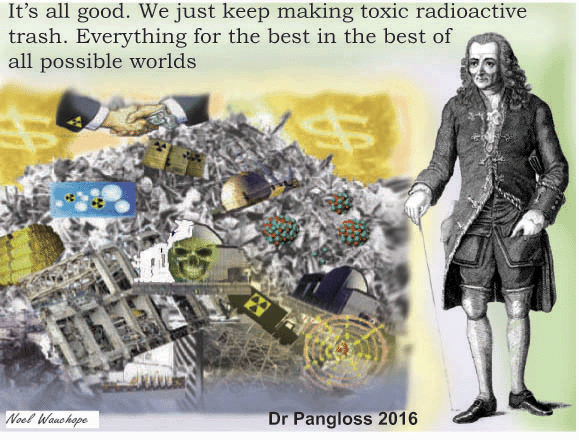 IAfrica 29th Nov 2018 , Yesterday, the Portfolio Committee on Energy (PCE) delivered its report on
the Department of Energy’s (DoE) Integrated Resource Plan (IRP), to Parliament.
According to the Southern African Faith Communities’ Environment Institute (SAFCEI), Parliament has once again failed to act in the people’s best interest, stating that it found “no persuasive arguments against nuclear”. In the report – which was based on the public hearings on the IRP, held in October – the PCE was in no doubt that “nuclear technology is the cleanest, safest and cheapest technology.”
However, SAFCEI’s Energy Justice Coordinator, Vainola Makan says that during the public hearings, various issues with nuclear, were mentioned. Says Makan, “Over and above the high costs of building a nuclear power plant – which are often marred by delays and related cost overruns – there are further costs associated with maintaining and securing the plant, as well as dealing with waste.”
Makan, who recently held SAFCEI’s People’s Power Learning Fest says, “We are learning that none of the current nuclear waste disposal solutions are real solutions, because the radioactive waste will always be there, and it will always be a risk to all things living in the areas where they are buried. At Koeberg, for example, the concentration of high-level radioactive wastecontinues to increase, and there is still no clear plan for dealing with it.”
https://www.iafrica.com/public-outcry-at-disappointing-energy-planning-report-on-nuclear-to-parliament/
Doubts on future of South Africa’s nuclear research reactors, with glut of medical isotopes, and with particle accelerator production
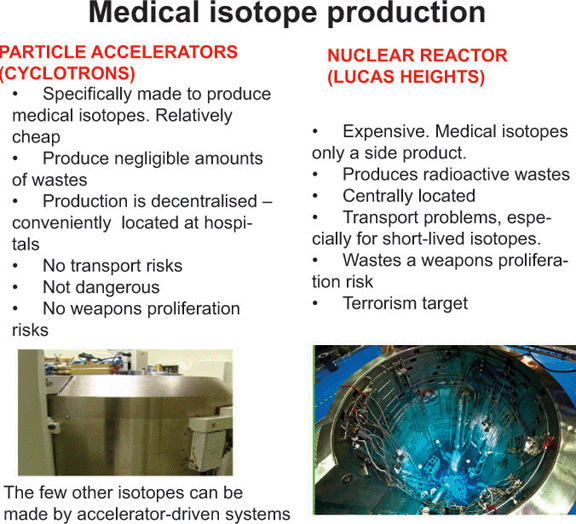
The facility is the main supplier of medical nuclear radio-isotopes such as Molybdenum-99 in Africa, and one of only four such facilities globally. As a result of safety procedure lapses, the plant was shut down in November 2017, which lasted almost a full year. Several attempts had been made in the interim to restart the plant, but without success.
The process of rectifying shortcomings and bringing the operating and safety procedures in line with the requirements of the NNR has been marred by what appears to be conflict between NTP and its parent company, the Necsa……..
An investigation was held which resulted in the suspension of a number of NTP staff. Following a number of further senior executive and staff replacements, suspensions and reinstatements, Necsa placed its own employees in charge of the plant, who then attempted to rectify the problems and restart the production facility.
………Several incidents occurred which caused restarts to be halted or abandoned. One example that has been cited is the institution of various changes to parameters which were unrelated to the cause of problems. The reasons for Necsa’s actions in this regard are unclear……
following an announcement during the recent Brics Summit in Sandton of a cooperation agreement in the field of nuclear medicine between NTP and Rusatom, the nuclear medical subsidiary of Russian state-owned nuclear company Rosatom, there are some questions as to whether a second or replacement nuclear research reactor will be built.
NTP said that the current global production over-capacity of medical radio-isotopes does not justify a second nuclear research reactor, since the Safari-1 reactor at Pelindaba still has between 15 and 20 years of life, and this could be extended still further. The Safari-1 nuclear reactor produces medical nuclear radio-isotopes by bombarding target plates of low-enriched uranium with neutrons.
Furthermore, medical nuclear radio-isotopes can also be produced by particle accelerators such as cyclotrons, which could make the consDtruction of second or replacement nuclear research reactor unnecessary, the company said.
There are also concerns regarding the financial health of Necsa. The Auditor-General has raised ongoing concerns about inadequate financial provisions by Necsa for decommissioning and dismantling costs for the Safari-1 reactor end-of-life.
South Africa’s Public Enterprises Minister Pravin Gordhan’s evidence at the State Capture Commission
 I WARNED ZUMA OF NUCLEAR PROCUREMENT IMPLICATIONS, SAYS GORDHAN https://ewn.co.za/2018/11/19/i-warned-zuma-of-nuclear-procurement-implications-says-gordhan
Public Enterprises Minister Pravin Gordhan says he advised former President Jacob Zuma that nuclear procurement would be a complex issue. Clement Manyathela 20 Nov 18 JOHANNESBURG – Public Enterprises Minister Pravin Gordhan has told the state capture commission that former President Jacob Zuma was determined to go ahead with the nuclear build programme despite the reality that the country could not afford it. Gordhan appeared before the inquiry on Monday in Parktown.
His interactions with the Gupta family are among other issues he is expected to deal with.
The minister says he advised Zuma that nuclear procurement would be a complex issue.
“I indicated to the former president that it would be lawful to follow procurement processes for such an expensive process to avoid being marred in scandals such as the arms deal.”
He says he wanted Zuma to be aware of the cost implications.
“I wanted to impress upon the former president that that undertaking, the nuclear procurement, required careful consideration of its costs, choice of supplier and due process.”
Last month, former Finance Minister Nhlanhla Nene told the commission Zuma was so determined to proceed with the nuclear build programme that he showed disregard and no appreciation for the financial ramifications for the country.
Gordhan will continue his testimony on Tuesday.
South Africa: leaked report shows Zuma government’s secret plans for nuclear power
GORDHAN’S LEAKED REPORT DETAILS BEHIND-THE-SCENES PLAN TO PROCURE NUCLEAR ENERGY https://ewn.co.za/2018/11/08/gordhan-s-leaked-report-details-behind-the-scenes-plot-to-procure-nuclear-energy– Lindsay Dentlinger 9 Nov 18 Former President Jacob Zuma was insistent the country needed to enter into a nuclear deal. CAPE TOWN – Public Enterprises Minister Pravin Gordhan has detailed the behind-the-scenes machinations for government to procure more nuclear energy.
It’s contained in a statement that Gordhan is expected to deliver to the Zondo Commission of Inquiry into state capture next week.
It was leaked to the media overnight.
In it, Gordhan says former President Jacob Zuma was insistent the country needed to enter into a nuclear deal.
As the Finance Minister at the time, Gordhan says he warned Zuma that the process had to be above board to avoid another arms-deal scandal.
Gordhan says it was at a meeting at the presidential residence with Zuma and one of his advisors Senti Thobejane in 2013, that the former president made it clear he wanted South Africa to procure nuclear power.
Gordhan says he was not told ahead of the meeting what would be discussed, but he impressed on Zuma that costs, choice of supplier, due process and likely challenges should all be considered.
He says Treasury raised concerns with a draft agreement with Russia because of the firm fiscal commitments it aimed to enforce.
During his tenure as Finance Minister, Gordhan says Treasury officials insisted that proper evaluations of the true cost of nuclear power, and financial risks to the country be carried out.
He says once he was moved to the portfolio of Cooperative Governance, he was no longer privy to discussions around the nuclear deal.
Gordhan says he was also not present at the Cabinet meeting in December 2015 when the deal was approved.
But he points out that it was on the same day that Zuma announced Gordhan’s successor as Finance Minister, Nhlanhla Nene, would be replaced by Des van Rooyen. A move that sent markets and the local currency into a tailspin and culminated in Gordhan’s reappointment to the post just three days later.
(Edited by Zamangwane Shange)
Nuclear corruption: former South African government planned to conceal costs on nuclear plan
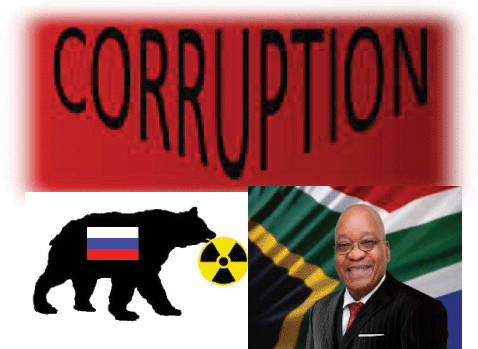 State was willing to lie to SA over costs of Zuma’s nuclear plan, City Press News 24
Cabinet also decided to go ahead with the nuclear power deal on the grounds of hopelessly incorrect and over optimistic “facts” that the energy department presented to Cabinet – such as an assumption that the exchange rate would stay at R10 a dollar.
A top secret Cabinet notice and accompanying memorandum – which have now been declassified and were handed to the state capture commission last week, revealed for the first time how close South Africa was on the edge of an economic crisis, and how desperate Zuma and his cronies were to push through the nuclear power deal.
Last week, Finance Minister Nhlanhla Nene told the commission investigating the extent of state capture how Zuma chastised him because he wasn’t making quick enough progress over the nuclear deal.
During a state visit to Russia in July 2015, then minister of energy Tina Joemat-Pettersson wanted Nene to sign a one-page agreement.
It was a letter addressed to the Russian authorities, Nene said, adding that he couldn’t remember the precise details of the letter but he remembered that it effectively gave a guarantee to the Russian authorities over the nuclear programme, if they agreed to finance it.
Nene refused to sign it because it would have been catastrophic for the country, he said.
Zuma wasn’t impressed, because he wanted to be able to present something to President Vladimir Putin when they met.
A few months later, Joemat-Pettersson’s department was still forging ahead with the project, despite warnings from Treasury.
On December 9 2015, the day Cabinet approved the nuclear deal, Nene recalled been summoned into a meeting with then president Zuma. It lasted less than five minutes and he was informed that he was being removed from his role as finance minister.
He was replaced by Des van Rooyen, which set off a spiral of uncertainty for the markets.
The secret Cabinet notice showed that the government wanted to downplay the cost implications of the deal. Prices should not be communicated prior to the procurement process being completed, it said, and if any communication was to be done around the costs of the programme, it was decided to talk about the low end of the range……..
The numbers show that nuclear would have ruined South Africa
A nuclear engineer from a large Western nuclear power company, who also tendered for the project, told Rapport that the numbers were completely unrealistic.
The number of $2500 a kilowatt was from nuclear power stations being built in Asia – mainly China and Korea. It would be unrealistic to think that it would be possible to build a nuclear power station in South Africa at such a low price, he said.
“In South Africa, if everything goes according to plan, you could bank on it costing about $5000 per kilowatt,” he said.
Both the engineer and Serfontein said that, under the best circumstances, the project would cost more than R1 trillion.
If Cabinet had gone ahead with this binding agreement, it would have ruined South Africa financially, they both said………
At that time it was widely known that the Russian state-owned nuclear power company, Rosatom, would be the preferred bidder because Joemat-Pettersson had signed a framework agreement with Rosatom more than a year before, on September 22 2014, that would make the Russians the sole supplier for South Africa’s nuclear power programme.
Last year, the High Court set aside this agreement and framework agreements with other countries. https://city-press.news24.com/News/state-was-willing-to-lie-to-sa-over-costs-of-zumas-nuclear-plan-20181008
South African Finance Minister Nhlanhla Nene testified to the nuclear corruption in former South African regime
Nene refused to sign off on nuclear energy – and it cost him his job https://businesstech.co.za/news/energy/275039/nene-refused-to-sign-off-on-nuclear-energy-and-it-cost-him-his-job/ 3 October 2018 South African Finance Minister Nhlanhla Nene said he met repeatedly with members of the Gupta family, who have been implicated in a corruption scandal related to former President Jacob Zuma and separately was twice pressured to sign a multi-billion Russian nuclear-power deal by former Energy Minister Tina Joemat-Pettersson.
Nene made his comments in a statement accompanying his testimony at a judicial inquiry into allegations of corruption and so-called state capture which involve the Guptas, who are friends with the former president.
Nene denied wrongdoing in his meetings with the family and said he refused to sign the agreement for Russia to provide nuclear energy, a plan that had been publicly backed by Zuma.
President Cyril Ramaphosa came to power in February and has changed the top management at the likes of the revenue authority and the state power utility as part of his pledge to fight corruption. He reappointed Nene as finance minister, a move that helped bolster investor confidence after years of economic mismanagement and regular cabinet changes under Zuma.
Nene first served as finance minister until December 2015, when Zuma fired him, causing a plunge in the rand and bonds. Mcebisi Jonas, who was Nene’s deputy, told the commission the Guptas offered him a bribe to take over the finance minister post, which he declined.
Nene rejected pressure to approve the construction of as many as eight nuclear reactors, which would have the capacity to generate 9,600 megawatts of energy. The costs of the project, championed by Zuma, would have been “astronomical,” he said in his statement.
In July 2015, Nene twice refused to sign a letter from Joemat-Pettersson providing a guarantee to the Russian government on the nuclear program.
“As a result of my refusal to sign the letter, I was seen as the person standing in the way of the nuclear deal,” he said. “I was accused of insubordination, not only by the president but by some of my colleagues.”
Kenya postpones its nuclear power plans
Kenya now pushes nuclear power plant plan to 2036, https://www.businessdailyafrica.com/economy/Kenya-now-pushes-nuclear-power-plant-plan-to-2036/3946234-4777866-b05oauz/index.html, By PATRICK ALUSHULA, SEPTEMBER 25, 2018 Kenya was already hunting for a partner to produce nuclear power by 202.
Kenya has postponed its plan to build Sh968 billion nuclear power plant by nine years to 2036 in favour renewable energy projects and coal plant.
Updated power development plan prepared by the Ministry of Energy and covering the period 2017 to 2037, now show that the earliest the country can build the nuclear plant is 2036 and not 2027 as initially planned.
In the revised plan, the first unit is expected to be completed in 2036, followed by another in 2037, making it the last project in the ministry’s 20-year plan for power generation expansion.
“All energy sources were considered in the system expansion planning. However, it is noteworthy that nuclear was not brought on board in both optimised and fixed MTP cases,” reads the updated plan shared by the Ministry.
ADVERTISEMENT
In addition to the delay, the plan size has been scaled down. Initially, Kenya was to construct two nuclear power plants, each with a capacity of 1,000 megawatts (MW) at a total cost of $4.05 billion (Sh405 billion) per plant.
However, the new plan is to have each plant with a capacity of 600MW at a cost of $4.84 billion (Sh484) billion.
The Ministry did not explain why the cost had gone up despite cutting the capacity of each unit by 40 per cent.
Kenya was already hunting for a partner to produce nuclear power by 2022 to help match-up rising demand and diversify from hydropower and geothermal.
It joins South Africa South Africa, which in August cancelled plans to add 9,600 MW of nuclear power by 2030 and will instead aim to add more capacity in natural gas, wind and other energy sources.
South Africa not planning for nuclear power, as renewable energy costs go down
Instead, he says the country’s energy demands have decreased.
Briefing Parliament’s energy committee on Tuesday, Radebe also pointed out that the cost of renewable energy technology has also come down.
According to the draft IRP, nuclear energy will only account for about 4% of the country’s energy mix by 2030.
This means no nuclear build programme is being envisaged.
Radebe says there are some misunderstandings about the decision taken on nuclear energy.
“It is not in the plan together with a number of other technologies for the period ending 2030 due to lower demand and lower cost of other technologies.”
MPs say they are relieved a new nuclear project has been scrapped for now, because it is not only unaffordable but would open the door to corruption.
(Edited by Thapelo Lekabe)
International Committee of the Red Cross’s (ICRC) lobby for African nations to ratify comprehensive nuclear test ban treaty
 African countries can help ban nuclear weapons – ICRC https://www.news24.com/Africa/News/african-countries-can-help-ban-nuclear-weapons-20180905, 2018-09-05
Carien du Plessis, correspondent African countries have the power to force the rest of the world to ban nuclear weapons – if almost all of them adhered to the treaty on this.
The International Committee of the Red Cross’s (ICRC) Head of Regional Delegation for Southern Africa Vincent Cassard urged African officials at the start of a four-day seminar on Tuesday on international humanitarian law at the Department for International Relations to lobby their governments to ratify the treaty on the comprehensive ban on nuclear weapons, which opened for signature almost a year ago, on September 20.
“The ICRC’s position has been consistent over the last half a century: the use of nuclear weapons would never comply with rules of international humanitarian law,” he said. “The consequences would render humanitarian assistance impossible.”
Ten countries have so far ratified the treaty, but 50 ratifications are needed for the treaty to come into effect. The African Union has 55 member states.He said although southern Africa was largely peaceful, the focus of the international humanitarian law seminar was on peacekeeping operations, such as those in the Democratic Republic of Congo, which involved military help from neighbouring countries.
Participating officials had to ponder questions on whether it was legally acceptable to torture soldiers for information about secret military bases, and on when to attend to wounded soldiers from the enemy side.
The seminar ends on Friday.
Cassard told News24 even small countries like eSwatini (previously Swaziland) and Lesotho had a lot of power, because their ratification carried the same weight as that of large countries.
He said although southern Africa was largely peaceful, the focus of the international humanitarian law seminar was on peacekeeping operations, such as those in the Democratic Republic of Congo, which involved military help from neighbouring countries.
Participating officials had to ponder questions on whether it was legally acceptable to torture soldiers for information about secret military bases, and on when to attend to wounded soldiers from the enemy side.
The seminar ends on Friday.
After PREMIUM TIMES report, contractors complete abandoned projects at Nigeria’s Nuclear Technology Centre
Premium Times Nigeria, August 12, 2018, Kemi Busari Seven months after PREMIUM TIMES published an investigation on the sorry state of Nigeria’s Nuclear Technology Centre, some abandoned projects within the centre have been completed.
Following the report of security loopholes in the investigation, the management of the Nigeria Atomic Energy Commission (NAEC) which oversees the centre also contracted a private firm to provide security for the centre.
In the two-part series published by PREMIUM TIMES in January, three projects were designated as abandoned as work had stopped on them.
Read first and second part of the investigation.
Identified as uncompleted were the centre’s recreational and educational facility, instrumentation laboratory and waste management plant.
In the report, some workers of the centre complained of idleness due to the inadequate facilities
The report also beamed a search light on the porous security at the centre which is partly due to the management’s insensitivity to the centre’s peculiar needs and a failed surveillance project………..
Waste Management
Meanwhile, works have continued on the radioactive waste management facility at the centre.
Awarded at over N400 million in 2009, a building that was supposed to serve as the radioactive waste management facility was overgrown with weed when this reporter first visited September 2017.
Waste management plants and equipment comprise various devices and machines used for treating, converting, disposing and processing wastes from various sources.
The construction of low/medium radioactive waste management facility was awarded at the contract sum of N401.4 million to Commerce General Limited and so far, N312 million has been paid to the contractor, the Nigeria Atomic Energy Commission (NAEC) said in response to a Freedom of Information request.
During the last visit, PREMIUM TIMES reporter observed the presence of the contractor at the site of the facility.
The management of NAEC did not respond to multiple inquiries on the rationale for redesign of the facility.
One of the staff members told this newspaper that the redesigning is unavoidable to correct the flaws of the contractor that first worked on the project.
He expressed optimism at the prospect of the facility.
“A lot of hazards will be reduced once it’s completed. As it is now, the country does not have a place to properly dispose our nuclear wastes. If it is completed and put to use, these hazards will be reduced. There is much to be benefitted if completed.”
Improved Security
………..But the level of security is not enough as expected of a nuclear technology centre says a staffer.
“The security is better but it’s not commensurate with what we expect in a nuclear environment. We commend the management for getting these people but they should give them orientation and we need armed security.
“There are differences. Before, if you come here, you won’t see anybody (at the gate). But now, it’s no longer like that. Even at weekends, you’ll meet them and policemen too. They are new and we feel that security of such places as this should be saddled with people that have at least basic educational level on nuclear technology,” he concluded. https://www. premiumtimesng.com/news/ headlines/279786-after- premium-times-report- contractors-complete- abandoned-projects-at- nigerias-nuclear-technology- centre.html
South Africa can’t afford nuclear power expansion, but still open to nuclear deals with Russia
 South Africa Opens Door to Future Russian Nuclear Power Deal, US News, July 26, 2018 , BY ALEXANDER WINNING, JOHANNESBURG (Reuters) – South Africa cannot afford large-scale expansion of its nuclear power capacity but would still be open to future deals with Russia, a senior ruling party official said on Thursday, shortly before the arrival of President Vladimir Putin for a summit.
Russian state firm Rosatom was one of the front runners for a project to increase South Africa’s nuclear power-generating capacity championed by former president Jacob Zuma.
South African President Cyril Ramaphosa has put nuclear expansion on the back burner since taking office in February, saying it is too expensive, and has focused instead on pledges to revive the economy and crack down on corruption.
African National Congress Treasurer General Paul Mashatile, one of the six most powerful members of the ruling party, said Pretoria would not rush into major nuclear investments but that it was still open to deals. ………
Russia wants to turn nuclear energy into a major export industry. It has signed agreements with African countries with no nuclear tradition, including Rwanda and Zambia, and is set to build a large nuclear plant in Egypt.
Rosatom signed a separate agreement with South Africa’s state nuclear firm on Thursday to explore joint production of nuclear medicines and other ways of harnessing nuclear technology, a statement from the two firms showed.
The agreement, which is non-binding and is not related to large-scale power generation, is a further sign that Rosatom is keen to cement its position on the African continent.
The deal will involve the construction of two small reactors and a commercial cyclotron to produce medical isotopes and radiopharmaceuticals at a facility near Pretoria. https://www.usnews.com/news/world/articles/2018-07-26/south-africa-cannot-afford-major-nuclear-expansion-top-anc-official
1 This Month


Shut down the radiation-damaged Heysham nuclear reactors now
To see nuclear-related stories in greater depth and intensity – go to https://nuclearinformation.wordpress.com

Say No to NASA’s Reckless Nuclear Reactor on the Moon
Say No to NASA’s Reckless Nuclear Reactor on the Moon
-
Archives
- October 2026 (247)
- September 2026 (339)
- August 2026 (330)
- July 2026 (355)
- June 2026 (287)
- May 2026 (306)
- April 2026 (356)
- March 2026 (251)
- February 2026 (267)
- January 2026 (308)
- December 2025 (358)
- November 2025 (359)
-
Categories
- 1
- 1 NUCLEAR ISSUES
- business and costs
- climate change
- culture and arts
- ENERGY
- environment
- health
- history
- indigenous issues
- Legal
- marketing of nuclear
- media
- opposition to nuclear
- PERSONAL STORIES
- politics
- politics international
- Religion and ethics
- safety
- secrets,lies and civil liberties
- spinbuster
- technology
- Uranium
- wastes
- weapons and war
- Women
- 2 WORLD
- ACTION
- AFRICA
- Atrocities
- AUSTRALIA
- Christina's notes
- Christina's themes
- culture and arts
- Events
- Fuk 2022
- Fuk 2023
- Fukushima 2017
- Fukushima 2018
- fukushima 2019
- Fukushima 2020
- Fukushima 2021
- general
- global warming
- Humour (God we need it)
- Nuclear
- RARE EARTHS
- Reference
- resources – print
- Resources -audiovicual
- Weekly Newsletter
- World
- World Nuclear
- YouTube
-
RSS
Entries RSS
Comments RSS

