UK government’s fantasy of a nuclear fusion energy plant at Bradwell
**Fusion** The announcement by the Government that Bradwell is on the long list of
fifteen possible sites for the UK’s prototype fusion energy plant has
come out of the blue. Chair of the Blackwater Against New Nuclear Group
(BANNG) Professor Andy Blowers, described the idea to develop fusion
(essentially the process that goes on inside the sun and in hydrogen bombs)
to produce electricity as ‘yet another nuclear fantasy, like the
philosopher’s stone full of golden promise but impossible to realise.
Bradwell is not a soft touch for such speculative and dangerous
experimentation’.The Government has committed £400M to the fusion
programme and the UK Atomic Energy Authority (UKAEA) put out a call for
sites to host STEP (the Spherical Tokamak for Energy Production), the
prototype fusion plant. The fifteen sites include the usual suspects –
Sellafield, North Wales, Dounreay – together with other nuclear sites,
former coal-fired power station sites and, at the end of the list, Bradwell
nominated by Belport Ltd., an entrepreneurial property and asset management
company.
BANNG 22nd June 2021
The Taishan death blow

China’s EPR reactor accident should end French reactor projects
The Taishan death blow — Beyond Nuclear International Radioactive leak at Chinese reactor could finish French nuclear exports https://wordpress.com/read/feeds/72759838/posts/3403922693
By Stéphane Lhomme, Nuclear Observatory
If the opacity maintained by the Chinese regime prevents us, for the time being, from knowing the exact consequences of the radioactive leak involving the EPR no.1 reactor at Taishan, revealed on June 14 by CNN, it is, on the other hand, already possible to see how this unfolded and to recommend some next steps.
The fault in the fuel duct seals inside the Taishan EPR dates back to October 2020, that is to say, it had already been going on for more than eight months: the operators of the reactor — the Chinese and the French company Framatome — were perfectly well aware of the gravity of the situation and had jointly decided to hide the existence of the problem from not only the surrounding population but also from the International Atomic Energy Agency.
Luckily, the information ended up seeping out via the American subsidiary of Framatome (Areva NP Inc.). This latter, likely after discussions with the CIA and the White House, happily informed CNN.
Indeed, now that the situation at the EPR at Taishan is known around the world, it will be difficult for the Chinese to continue to operate the reactor under conditions that are most likely beyond its “scope of authorized operational safety” — contrary to what Framatome claims in order not to offend the Chinese.
It is widely known publicly that China and the USA, the two biggest global powers, are huge geopolitical and economic rivals. It is clear that if the Taishan 1 EPR, and perhaps its twin, Taishan 2, must be shut down for an extended period, this will be an inconvenience for China, which occasionally lacks electricity in this region. Hence the guilty pleasure felt by the Americans in revealing the problem.
But this will still remain only a limited problem for China where, contrary to what one sometimes reads or hears, nuclear power is a marginal energy source, consisting of less than 1% of the country’s energy consumption.
On the other hand, it is quite possible that the French nuclear industry will be the big loser in this affair, one that could represent a fatal blow for EDF’s EPR construction projects in France and overseas. Indeed, given that the EPR construction sites managed by the French — Areva in Finland, EDF in France and Great Britain — are veritable industrial and financial disasters, the promoters of the EPR reactor have been desperately clinging to the “good Chinese example”.
That is because the two EPRs at Taishan were built and brought on line (in December 2018 and September 2019 respectively) with “only” a few years delay and the cost overruns were officially limited to a few billion (according to China which, one must remember, is a dictatorship where “information” is totally controlled).
The situation currently unfolding in China demonstrates that, despite the alleged prowess of the Chinese nucleocrats, the Taishan EPRs are not going any better than those the French are trying desperately to build. This event will certainly sow enormous doubt among the few foreign leaders who are still considering ordering EPR reactors, despite all their setbacks. It is surely the straw that broke the camel’s back, or rather the radioactive leak that caused the (defective) EPR containment to overflow.
Likewise, this incident should motivate French political leaders (but also Finnish and British ones) to finally take responsibility and definitively halt EPR construction at Olkiluoto (Finland), Flamanville (France) and Hinkley Point (Great Britain), and to stop announcing future EPR projects in India and elsewhere.
Safety concerns on Taishan reactor, but China wants to be world’s nuclear leader by 2050
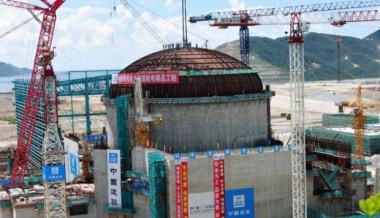
China’s nuclear safety queried over Taishan reactor, but it wants to lead world by 2050 SCMP, Stephen Chen in Beijing, 21 June 21
- Road map drawn up by the country’s nuclear experts sets series of goals to help it catch up with the West on safety
- Increase in radioactivity in Taishan did not spread outside reactor, data showed, but Chinese nuclear industry trails in software and hardware
China aims to become a dominant player in the world nuclear market in less than 30 years and have the highest safety standards and lowest costs, a government advisory body has said.
For decades, China tried to catch up with safety standards in Western countries, led by the United States and France. But now China plans to challenge them, the Chinese Academy of Engineering (CAE) said in a report published last Tuesday…….
by 2050, the road map describes China leading the setting of new industry standards for global nuclear power and taking “a bigger share in the international market”.
The increase in radioactivity in Taishan was caused by leaking fuel rods known as “leakers”
They are still used by many nuclear power plants globally, but the US had by 2013 eradicated them from more than 90 per cent of its reactors, …….
The Taishan radioactivity was viewed in some quarters as an environmental threat that the Chinese government had tried to cover up.
China’s National Nuclear Safety Administration had posted the event on its website on April 7, but the scientists who produced the road map admitted that the country’s nuclear safety was not yet up to the standards in the West, even if its nuclear reactors had no safety incidents in the past three decades.
Safety improvements require cutting-edge technology such as computer programs simulating the operation of a reactor, and materials to make critical components. The Chinese nuclear industry is behind in both software and hardware, according to the report.
Chinese nuclear power companies have produced numerous software products for nuclear plant design, operation and safety evaluation, but did so in isolation, and their reliability and modelling of serious accidents had room for improvement, said senior nuclear safety scientist Huang Hongwen in the report commissioned by the CAE.
China has also been dependent on Western suppliers of some hardware components critical to safe operation of nuclear plants, according to the report.
“Some of our high-precision nuclear safety equipment is still in the hands of others,” Huang wrote.
The US government imposed a sanction – which remains in place – on the Chinese nuclear power industry in 2019, banning the sale of any nuclear-related technology or goods to China except in the event of an immediate environmental threat such as radioactive leakage. The US government said it was investigating the Taishan event………….
Wang Junhao, president of Zhejiang University of Finance and Economics, wrote in the journal Economic Theory and Business Management in April that the penalties for safety lapses were too light to act as a deterrent.
“When a hidden safety hazard was discovered by regulatory inspections, the financial loss was too small,” Wang said. “There must be greater punishments.” https://www.scmp.com/news/china/science/article/3138214/chinas-nuclear-safety-queried-over-taishan-reactor-it-wants-lead
Nuclear Regulatory Commission launches special investigation at Southern Georgia Vogtle 3 nuclear unit
U.S. NRC launches investigation at Southern Georgia Vogtle 3 nuclear unit, June 21 (Reuters) – The U.S. Nuclear Regulatory Commission (NRC) said Monday it launched a special inspection at Southern Co’s (SO.N) Vogtle nuclear power plant in Georgia to identify what led to remediation work at the third unit, which is under construction.
The NRC said its team will focus on the electrical cable raceway system, which is designed to prevent a single event from disabling redundant safety-related equipment.
Southern has said the two units under construction at Vogtle, which are billions of dollars over budget and years behind schedule, were on track to enter service next year with Unit 3 in January and Unit 4 by its regulatory-approved in service date of November 2022. …………
When Georgia approved the Vogtle expansion in 2009, the two 1,117-megawatt Westinghouse AP1000 reactors were expected to cost about $14 billion and enter service in 2016 and 2017.
Some analysts estimate costs have ballooned to more than $27 billion due to delays related to a nuclear accident at Japan’s Fukushima plant in 2011 and the 2017 bankruptcy of Westinghouse, the project’s former contractor.
Southern estimated the capital cost for its 45.7% share of the new Vogtle reactors at about $8.7 billion.Reporting by Scott DiSavino Editing by Marguerita Choy https://www.reuters.com/business/energy/us-nrc-launches-investigation-southern-georgia-vogtle-3-nuclear-unit-2021-06-21/
No need for nuclear arsenal once Kashmir issue is resolved: Pakistan PM
, Business Standard, 20 June 21
Pakistan’s nuclear arsenal is “simply a deterrent” to protect the country and there will no longer be any need for it once the Kashmir issue is resolved, Prime Minister Imran Khan has said
Pakistan’s nuclear arsenal is “simply a deterrent” to protect the country and there will no longer be any need for it once the Kashmir issue is resolved, Prime Minister Imran Khan has said as he asserted that if the Americans have the resolve and the will, the issue can be sorted out.
Pakistan has 165 nuclear warheads as of January this year and it appears to be expanding its nuclear arsenals, a study by Stockholm International Peace Research Institute (SIPRI) said last week. Pakistan had 160 nuclear warheads as of January last year, it said.”I don’t know where they’ve come up with this. Pakistan’s nuclear arsenal is simply a deterrent, to protect ourselves,” Prime Minister Khan said during an interview with the news programme Axios on HBO, which was reported by Dawn online.
Khan said that he was “not sure” whether it was growing. “As far as I know, it’s not an offensive thing. Any country which has a neighbour seven times its size would be worried.
He was responding to a question by the interviewer who asked, “Intelligence analysts say Pakistan has the fastest growing nuclear arsenal anywhere in the world. Why?”
Khan went on to say that he was “completely against nuclear arms”.
“I always have been. We’ve had three wars against India and ever since we have had a nuclear deterrent, there has been no war between the two countries. We’ve had border skirmishes but we’ve never faced war.
“The moment there is a settlement on Kashmir, the two neighbours would live as civilised people. We will not need to have nuclear deterrents,” the cricketer-turned-politician said.
To another question, Khan said that the US had a big responsibility when it came to Kashmir.
“If the Americans have the resolve and the will, [the Kashmir issue] can be sorted out,” he said.,,,,,,,, https://www.business-standard.com/article/current-affairs/no-need-for-nuclear-arsenal-once-kashmir-issue-is-resolved-pakistan-pm-121062101422_1.html
House-building plans thrown into doubt as doubts grow about Wylfa nuclear project
Councillor secures debate amid Welsh language fears Sunday, 20 June 2021 – by Gareth Wyn Williams – Local democracy reporter,
An extraordinary meeting of Gwynedd Council has been called regarding the second homes housing crisis and Welsh language fears.
Backbench members have triggered a mechanism to call a full council meeting amid concerns over the existing Joint Local Development Plan (JLDP).
The document proposes why and where up to 7,184 new homes should be built across Anglesey and Gwynedd over the period up to 2026.
The plan was ratified separately by both authorities in 2017, with a scheduled monitoring review set to take place this year.
But after reaching the minimum allowed threshold of five councillors to trigger an extraordinary meeting of all 75 members, one Llyn councillor has called for a debate on the plans.
Even when Gwynedd Council approved the plan, the knife-edge decision was only made thanks to the casting vote by the council’s chair, facing much opposition due to concerns it would lead to a drop in the number of Welsh speakers in both counties.
Cllr Gruffydd Williams, the unaffiliated member for Nefyn, believes there is a need to go further than the scheduled review and asked councillors to also consider 12 recommendations raised by Porthmadog academic, Dr Simon Brooks, in a recent report on second homes and their impact on Welsh speaking communities.
He said: “When you take into account Brexit, Covid-19 and Wylfa Newydd, so many things have changed since the plan was adopted, house prices are shooting up and the plight of Welsh speaking communities looking more perilous than ever.
“I wanted to called this meeting, having already spoken to around 30 councillors, as I feel it’s only right that all members of Gwynedd, and Anglesey councils in fairness, are given a chance to have their say rather than all the burden being placed on the few that sit on the JLDP committee”
Cllr Williams noted: “It would be desirable to give particular priority, going past what is noted as the usual monitoring period within the plan itself and to submit proposals which correspond to Dr Simon Brooks’ report “Second Homes – Developing New Policies in Wales” which was commissioned by the Welsh Government.”
Adding that with any prospect of a major nuclear development on Anglesey looking more uncertain than ever, he argued that this should be taken into consideration as it was a major cornerstone of the plan when first ratified.
While Wylfa Newydd had been earmarked for a site near Cemaes in northern Anglesey, Gwynedd Council had also made arrangements for increased demand on housing in the Arfon area.
Anti-Nuclear group PAWB has long argued that both the JLDP and the North Wales Growth Plan were drawn up on the assumption that Wylfa B “would happen and that it would be a good thing.”……….The extraordinary meeting will be held next Monday, 28 June https://www.cambrian-news.co.uk/article.cfm?id=136455&headline=Councillor%20secures%20debate%20amid%20Welsh%20language%20fears&searchyear=2021
The Fukushima nuclear disaster and the Tokyo Olympics

“There was a very clear political agenda by Shinzo Abe, to use the Olympics to rehabilitate the impression of both Fukushima and the nuclear disaster domestically and globally,”
“It’s hard for me to support the idea of using the Olympics to present a narrative of recovery, where so much recovery remains to be done.”
The Fukushima nuclear disaster and the Tokyo Olympics, Engineering and Technology, By Max Bernhard
Wednesday, June 16, 2021 Before Covid-19 forced a delay, Japan’s government saw the ‘Recovery Olympics’ as a way to show the Fukushima nuclear disaster was under control. 10 years on, critics say many issues remain unresolved.
Members of the Japan women’s soccer team began the Olympic torch relay on 25 March this year, kicking off a four-month countdown to the Tokyo Summer Games after a year-long delay due to the Covid-19 pandemic. The brief opening ceremony – closed to the public and attended only by a small number of dignitaries – took place on a football pitch in J-Village. The sports complex lies just 20km south of Japan’s Fukushima Daiichi nuclear power plant, where a devastating earthquake and subsequent tsunami killed more than 18,000 people and triggered a triple nuclear meltdown in 2011. J-Village was used as a base for the thousands of clean-up workers tasked with decommissioning the plant.
Long before the pandemic forced Japan to delay the Games, then-Prime Minister Shinzo Abe pegged the sporting mega-event as a way to show that Japan had overcome the disaster and to promote reconstruction efforts in the region. Ten years on, questions over radiation in the area, its prospects for recovery, and the decommissioning of the reactor, as well as Japan’s overall energy policy, remain.
Abe’s successor Yoshihide Suga has said the Games would also be a sign of overcoming another tragedy. Going ahead with the event would be “proof that humanity has defeated the pandemic”, he said last year. But here, too, not everyone agrees. With less than two months to go until the official start of the Olympics, the Japanese government has recently extended its state of emergency in Tokyo and several other prefectures until at least 20 June. While the number of new Covid-19 infections has been going down and cases remain relatively low in an international comparison, a stretched-out fourth wave has strained the country’s medical sector.
Meanwhile, Japan’s vaccination efforts have been significantly lagging behind other developed nations. Less than 3 per cent of the population have been fully vaccinated as of 27 May 2021 and polls show that most of the public wants the Games cancelled. Despite that, Suga has been iterating his commitment to hold the Olympics in Tokyo this summer.
To assure members of the International Olympic Committee (IOC) that the event in Tokyo would be safe, then-Prime Minister Abe promised in his 2013 pitch to host the 2020 Games that the situation at the destroyed Fukushima nuclear plant was “under control”.
Three years later, Junichiro Koizumi, a former prime minister and fellow member of Abe’s Liberal Democratic Party, called this promise a lie. “I think Abe understands the arguments on both sides of the debate, but he has chosen to believe the pro-nuclear lobby,” Koizumi, who became an outspoken critic of nuclear energy following the catastrophe, said at a press conference in Tokyo in September 2016.
“There was a very clear political agenda by Shinzo Abe, to use the Olympics to rehabilitate the impression of both Fukushima and the nuclear disaster domestically and globally,” says Sean Burnie, a senior nuclear specialist for Greenpeace East Asia, who has surveyed radiation in Fukushima dozens of times since the nuclear meltdowns happened.
Following the disaster, Japan halted all its nuclear reactors. Since then, it has restarted only nine out of a possible 42 across five power plants, while more than 20 are set to be decommissioned. Before the 2011 disaster, Japan generated about a third of its energy from nuclear power, and there were plans to increase that to around 40 per cent. The Japanese government’s current energy policy plans for 30 to 35 reactors operating by 2030, meaning about 20 per cent of the country’s power would come from nuclear energy. That target is also part of the government’s plan to significantly reduce carbon emissions in the country by the end of the next decade. This target requires at least a further 21 reactors to be back online.
One of the major obstacles to those restarts is public opinion, says Burnie. “The perception of Fukushima is that because you have an accident, you can’t rehabilitate, you can’t bring people back to live there, it’s not safe, and the decommissioning of the plant will take many, many decades, or centuries longer,” he adds. “So trying to create a new image, a new perception of Fukushima on the nuclear issue is really important [to the Japanese government].”
Changing public perception played a significant role in the government’s decision to host events in Fukushima and to use the framework of the ‘Recovery Olympics’, Burnie says, adding that the desire of the prefectural government and general society in Fukushima to communicate their region’s recovery was also a factor. “I think it creates a sense of slight schizophrenia because people want to have some good news … the Olympics were seen as perhaps a positive.”
At the same time, there was widespread criticism because the significant investments into the Olympics were seen as taking resources away that could have gone towards the area’s general reconstruction. The entire cost of hosting the 2020 Games is projected to be more than $15bn (£10.6bn), including $2.8bn for the postponement and an estimated $900m for measures to curb the spread of Covid-19. The Tokyo Games are the most expensive to date, according to a 2020 University of Oxford study that looked at Olympic costs since 1960. “There are still tens of thousands of people displaced, people still living in emergency housing. Obviously, the whole radiological situation is still complex and hazardous. There were mixed feelings about it,” Burnie says.
A year ago, when international visitors to the Games were still considered a possibility, some questioned whether it was safe for athletes and spectators to visit sporting venues in Fukushima or even Japan in general. South Korea reportedly considered providing its own food for athletes out of radiation concerns, although the move was seen as political by some.
Levels of radiation in Japan have decreased thanks in part to a massive programme by the government to remove the top layer of soil in affected areas. The contaminated soil is stored in millions of black one-cubic-metre bags that are piled up on temporary open-air areas scattered across the prefecture before being transported to interim storage sites. As of April 2020, about 6.7 million of the black bags were still stored in Fukushima, according to the Ministry of Environment.
While the plant’s operator managed to stabilise the damaged reactors at Fukushima Daiichi, melted nuclear fuel buried deep into the ground below the plant is still to be located and removed – an endeavour that is projected to take at least four more decades. Meanwhile, in April, the government approved plans to gradually release more than one million tonnes of contaminated water into the sea…………………
at the end of 2019 Greenpeace conducted radiation measurements around J-Village, where the Olympic torch relay would later kick off, and found several hotspots.
Continue readingINTERVIEW/ Daniel Ellsberg: Smart statesmen can make bad decisions leading to nuclear war

Asahi Shimbun, , By KOJI SONODA/ Correspondent, June 19, 2021 WASHINGTON—U.S. President Dwight D. Eisenhower seriously considered launching a nuclear attack against China during the Second Taiwan Strait Crisis in 1958, according to a former Department of Defense official.
Daniel Ellsberg, 90, a nuclear policy expert who has disclosed a confidential document about the incident, said Eisenhower was prepared for possible nuclear retaliation from the Soviet Union.
In an interview with The Asahi Shimbun on May 25, Ellsberg also expressed strong concerns about the current tensions between Washington and Beijing over the Taiwan Strait.
“We’re talking now about possibly intervening in the civil war between China and Taiwan with U.S. force,” Ellsberg said. “I felt that this study was particularly relevant now to public debate and consideration.”
Ellsberg is famed for his acquisition and exposure of the classified Pentagon Papers in 1971, which he created with other staff members at the U.S. Department of Defense for the Vietnam War.
At that time, Ellsberg made a copy of another top-secret document written and examined by Morton Halperin, a former deputy assistant secretary of defense, in connection with the Second Taiwan Strait Crisis.
The secret document shows that Eisenhower and high-ranking military officers at a meeting were considering the use of tactical nuclear weaponry for a pre-emptive strike against mainland China.
Ellsberg, who was deeply engaged in compiling the U.S. nuclear war plan, said, “When we look at decision-making that led to catastrophe … there is a very strong tendency for people to think: ‘Well, that was long ago. Those people were dumb.’
“That’s absurd,” he continued. “The statesmen (then) were at least as smart people as the ones right now or in between. They made horribly unwise judgments.”
Ellsberg was quite concerned about the possibility of the current U.S.-China friction leading to an all-out war.
“Both sides would suffer very great costs,” he said. “If they are not stupid and foolish and reckless and crazy, they will not start a war … . But you know, that doesn’t mean it won’t happen.”
Excerpts from the interview follow:……………………………………………………….
The Cuban Missile Crisis, in which I participated as a consultant right below the level of the White House, the executive committee of the National Security Council, I was reporting to them, and studied that for a great deal. I conclude that, contrary to their public statements, neither Kennedy nor Khrushchev had any intention of going to armed conflict. They were, in effect, bluffing.
They were threatening the others and intimidating the others, and were deploying in readiness for nuclear war, but they had no intention actually of carrying out a nuclear war. And nevertheless, as my book “Doomsday Machine” and other places show, they came within a hair’s breadth of an all-out nuclear war because of actions of subordinates who did not realize that their leaders were bluffing, and who were readying for nuclear war in a way that almost exploded into all-out nuclear war……………….
When we look at decision-making that led to catastrophe, like World War I, by almost all parties, or the decision-making in Japan in 1940-41, which looks inconceivably bad when you look at it, or the decision-making in Vietnam, or invasion of Iraq, or in 1958, there is a very strong tendency for people to think: “Well, that was long ago. Those people were dumb. They were naive. They were immature. We’re not like that now. Weren’t they strange and awful?” And so there’s no lesson to be learned for us. That’s absurd.
The statesmen in 1914 were at least as smart people as the ones right now or in between. They made horribly unwise judgments. And that is equally available to our decision-makers right now. http://www.asahi.com/ajw/articles/14373137
Biden and Putin agree: ‘Nuclear war cannot be won and must never be fought’
Biden and Putin agree: ‘Nuclear war cannot be won and must never be fought’ DW, 17 June 21
US President Joe Biden and Russian President Vladimir Putin have concluded a high-stakes summit aimed at cooperation but dominated by deep disagreements.
US President Joe Biden and his Russian counterpart Vladimir Putin have ended their highly anticipated summit in Geneva.
The leaders’ first in-person meeting since Biden became president took place at a lakeside villa amid soaring tensions between their two countries.
As talks ended after less than the five hours either side thought they would need, Biden gave a thumbs up. Members of the US team said the meeting had been “quite successful.”
After the meeting, the two sides released a joint statement on one of the main topics of discussion, nuclear proliferation. The statement read, “Nuclear war cannot be won and must never be fought.”
DW Moscow correspondent Emily Sherwin said, “Biden managed to walk a fine line with Putin,” recognizing Russia’s desire to be seen as a major geopolitical power.
The joint US-Russian statement said progress on shared goals could be achieved, “even in periods of tension,” going on to state, “The United States and Russia will embark together on an integrated bilateral Strategic Stability Dialogue in the near future that will be deliberate and robust.”
The statement added that the countries “seek to lay the groundwork for future arms control and risk reduction measures.” …………………… https://www.dw.com/en/biden-and-putin-agree-nuclear-war-cannot-be-won-and-must-never-be-fought/a-57921072
U.S. Space Force wants to use directed-energy weapons for space superiority,
 |
The Space Force wants to use directed-energy weapons for space superiority,
|
Nathan Strout, 17 June 21, WASHINGTON — The head of the Space Force acknowledged that the U.S. is developing the “appropriate” directed-energy systems to maintain American space superiority, although he declined to provide details in the unclassified setting of a June 16 congressional hearing.
Noting that directed-energy systems could be a possible defensive tool for American satellites, Rep. Jim Langevin, D-R.I., asked Chief of Space Operations Gen. Jay Raymond whether the United States was adequately developing a directed energy portfolio “to be an effective capability for space dominance.”
“Yes sir, we are,” Raymond responded, suggesting that they discuss the issue in more detail in a classified setting. “We have to be able to protect these capabilities that we rely so heavily on.”
n a statement to C4ISRNET, a Space Force spokesperson said, “General Raymond has stated many times that China and Russia have directed energy capabilities that are designed to damage or destroy our satellites. His response to Congressman James Langevin’s question was confirming that our architecture developments in the face of these threats are appropriate.”
The Missile Defense Agency has explored using space-based lasers to intercept ballistic missiles in the past, and other nations have fielded ground-based laser dazzling weapons that can blind on orbit sensors. However, the Space Force has been effectively mum on what weapon systems — conventional or directed energy — it is developing to protect its satellites or defeat enemy satellites. Raymond’s acknowledgement at the hearing might be the first time he’s publicly confirmed the directed energy systems are under development.
The government cited the development of anti-satellite (ASAT) weapons by China and Russia as a justification for the creation of Space Command and the Space Force, and since their establishment military space leaders have been quick to criticize ASAT development and testing. U.S. Space Command’s Gen. James Dickinson has heavily criticized direct-ascent missile tests by Russia, which demonstrated the ability to take out satellites in low Earth orbit and the potential to cause dangerous space debris. Perhaps more concerning is a mysterious Russian satellite that has shown the ability to fire a projectile in space. Raymond refers to the spacecraft as an on-orbit weapon system.
Russia has made space a war-fighting domain by testing space-based and ground-based weapons intended to target and destroy satellites. This fact is inconsistent with Moscow’s public claims that Russia seeks to prevent conflict in space,” said Dickinson after a Russian ASAT test in December. “Space is critical to all nations. It is a shared interest to create the conditions for a safe, stable and operationally sustainable space environment.”
However, the Space Force — and the Air Force before it — have always been secretive about what ASAT weapons the U.S. military has or is developing. The one with the most public details is the Counter Communications System, a transportable system that can jam enemy satellites. And while the Air Force is developing laser weapons, it’s not clear what plans — if any — there are to attach them to space systems or direct them at enemy satellites. The U.S. also has missiles that can reach satellites in low Earth orbit.
Reports from the intelligence community and observers have highlighted the development of kinetic weapons — such as those mentioned above — as well as non-kinetic weapons — such as ground-based jammers or laser systems that can effectively blind satellite sensors — by nations deemed American adversaries.
In a report earlier this year, the Center for Strategic and International Studies suggested that the Space Force develop orbital laser weapons to defend American satellites. Titled “Defense Against the Dark Arts in Space,” the report lays out the various types of ASAT weapons and describes several ways the Space Force could defend against them. That includes passive defenses, like building a redundant space architecture that could survive the loss of one or even multiple satellites, and active defenses, such as satellite-mounted lasers that could blind incoming threats.
The U.S. has invested heavily in building passive defenses, such as a distributed architecture like the one described in the report, but it’s less forthcoming on its active defenses. Other nations are less secretive. Most notably, France has stated that it could equip its satellites with weapons — possibly lasers — to defend themselves from adversaries.
While Raymond’s brief comments didn’t give any insight into what the U.S. is developing in regards to directed energy systems for space, they didn’t rule out the types of weapons laid out in the CSIS report.
“It was a limited exchange, but the context of the statements and the statements themselves certainly leave the door open to nonkinetic defensive space capabilities of some kind,” said Todd Harrison, director of the CSIS Aerospace Security Project. “As we noted in our report, on-board electronic countermeasures, such as laser dazzlers and radar jammers, can be an effective way to defend satellites against certain types of kinetic attacks. And it has the advantage of protecting satellites without producing space debris, which is important to the long-term viability of the space domain for all users, not just the U.S. military.”
Renewable energy consumption grew in 2020 as fossil fuels and nuclear shrank.

Sunrise brief: Renewable energy consumption grew in 2020 as fossil fuels and nuclear shrank, PV Magazine , 17 June 21,
Also on the rise: Black & Veatch unit sets financing for 137 MW Texas project, Rockefeller Foundation partners to fund distributed renewable projects in Africa, and DroneBase closes a funding round as it expands its solar presence.JUNE 16, 2021 DAVID WAGMAN Consumption of renewable energy grew for the fifth year in a row in 2020, reaching a record high of 11.6 quadrillion British thermal units (Btu), or 12% of total U.S. energy consumption.
The Energy Information Administration (EIA) reported the data and said that renewable energy was the only source that increased in 2020 from 2019; fossil fuel and nuclear consumption declined.
Hydroelectric power accounted for about 22% of U.S. renewable energy consumption. Consumption has remained relatively flat since the 1970s, but fluctuates with seasonal rainfall and drought conditions.
Financing set for Texas solar project
Black & Veatch unit Diode Ventures said it reached financial close on the Grizzly Ridge Solar Project, a 137.7 MW solar project located in Hamilton County, Texas, southwest of Fort Worth. The project was co-developed with RKB Energy. Details of the financing were not disclosed.
Once complete, Grizzly Ridge will provide energy to the ERCOT North Zone, a growing economy and power market where there is high demand for all forms of electricity.
The project has an executed interconnection agreement with Brazos Electric Cooperative, the transmission service provider. The area will undergo an upgrade from 69 kV to 138 kV. Diode also is in discussions to add an on-site battery energy storage system to the project.
Rockefeller Foundation partners to bolster renewables
The International Finance Corp., the private sector arm of the World Bank Group, and The Rockefeller Foundation announced a partnership to deploy $150 million of capital in blended finance to leverage up to $2 billion of private sector investment in distributed renewable energy.
The two will prioritize countries in Sub-Saharan Africa and other regions, where both organizations have identified immediate opportunities.
By blending philanthropic and private investment funding, the Rockefeller Foundation and IFC hope to de-risk capital investment in distributed renewable projects in emerging markets and help to address global energy access needs.
An initial “rapid deployment” phase will distribute $30 million in blended concessional finance and grant capital to leverage an active pipeline of distributed renewable energy projects developed by IFC. The funding will go toward IFC’s prototype scaling mini-grid program in addition to distributed renewable energy generation, battery energy storage, and other clean energy technologies to facilitate access………. https://pv-magazine-usa.com/2021/06/16/sunrise-brief-renewable-energy-consumption-grew-in-2020-as-fossil-fuels-and-nuclear-shrank/
Countering a love letter to the nuclear industry

We’re not in the business of debating paid shills.
Countering a love letter to the nuclear industry https://thecoastnews.com/commentary-countering-a-love-letter-to-the-nuclear-industry/by commentaryJune 18, 2021
By Bart Ziegler
In his May 27 commentary, “Correcting the record on SONGS,” Al Bates writes a love letter to the nuclear industry. Bates fiercely defends the safety measures at San Onofre’s nuclear waste storage facilities. This impassioned defense comes from — you guessed it — a career man in the nuclear industry who took that nuclear engineering degree straight to San Onofre for a job starting in 1980.
We’re not in the business of debating paid shills.
But we stand by the point we made in April to the Encinitas Environmental Commission — that San Onofre needs a facility where nuclear waste canisters can be repaired and replaced without exposing the environment to deadly, radioactive contamination.
This month, to Protect Our Coast, we are bringing Southern California Edison and the California Coastal Commission to court to demand such a facility. Call it a Plan B. Find out how you can support this case by visiting our website.
While Bates and company are quick to obfuscate with technical hairsplitting, we present simple truths:
- Edison is storing 3.6 million pounds of spent nuclear fuel just 100 feet from the ocean;
- Sea levels are rising;
- Climate change increases risks associated with nuclear waste storage;
- Waste canisters at San Onofre are prone to corrosion and cracking;
- No one has a plan to move the waste; and
- Scientific information that Bates says we’re missing can be found on our website.
Learn more at www.samuellawrencefoundation.org. Bart Ziegler is president of the Samuel Lawrence Foundation.
We don’t need costly, slow, nuclear power: solar, wind, tidal and wave power can amply do the job

WHEN I visited Orkney in the 1970s, it was deeply involved in the North
Sea Oil boom. The Flotta oil terminal is still operating but renewable
energy – mainly wind and some tidal – generates up to 120 percent of the
electricity needed by Orkney’s 22,000 inhabitants.
The European Marine Energy Centre based in Stromness is trialling 48 tidal and wave power
projects. These include the world’s most powerful tidal turbine, Orbital
Marine Power’s O2 which from the air looks like a giant 250ft long rowing
boat off the isle of Eday. Its 2MW capacity means it could generate enough
clean, predictable electricity to meet the demand of around 2,000 UK homes
and offset approximately 2,200 tonnes of CO2 production per year.
It is just one of countless schemes around the world testing the potential of
renewables other than wind and solar to power the world and save it from
climate change. At an earlier stage of development and planned for near
Liverpool is the £3billion TPGen24, the brainchild of engineer Stuart
Murphy. Its promotional video says: “There is more than enough energy in
the UK’s tidal waters to satisfy the entire needs of the country, if only
it could be captured.
Does Britain need nuclear power to turn us green?
Yes, says Professor Ian Fells, Technical Director of Penultimate Power UK
Ltd which builds compact nuclear High Temperature Gas-cooled Reactor Energy
Hubs.
NO Says Dale Vince Eco-entrepreneur Energy independence from clean,
green renewables is a prize well worth having – and perfectly feasible. We
have enough wind and sun to power this country many times over. Throw in
other sources, such as geothermal – heat from deep under the ground – and
marine power and there should be no need for the UK to waste £50billion a
year and rising on importing oil and gas.
Nuclear has many problems. It is hugely expensive. Nuclear power stations take 10 years to design, 10 years
to build and another 10 years to pay back their carbon debt. We don’t
have time. And at three times the cost of renewables, we don’t need to
pay for that. We can power the grid entirely from renewable energy, at a
fraction of the price in a fraction of the time and have real carbon
reductions almost straight away.
Express 14th June 2021
https://www.express.co.uk/news/nature/1449592/Green-Britain-tide-turning-renewable-energy
Tough when even a pro nuclear voice has to deplore the corruption in the nuclear industry
FirstEnergy Scandal Could Do Irreparable Harm To Nuclear Power. Forbes , 16 June 21,
Ohio’s Republican-dominated state legislature stood firm against its former speaker of the house: Rep. Larry Householder, who was indicted last July along with others for allegedly taking bribes to protect the state’s nuclear power industry. Two of the accused have already pled guilty. The beneficiary of the $1 billion state bailout, FirstEnergy FE-1.6% Corp., is reportedly in talks with prosecutors.
Unfortunately for the nuclear industry, this event cannot be viewed in isolation: it will have a rippling effect that will no doubt jar an industry that is perpetually trying to regain its balance. Once the case fully comes to light, the fallout from it could be much worse than any preceding event — a reference to Three Mile Island and the San Onofre Nuclear Station in Southern California,
“FirstEnergy also admits it paid $250,000 to Generation Now in March of 2017″ when the alleged scheme began, says the Energy and Policy Institute. Altogether, the utility admits to paying $56.6 million. “Longstreth and Generation Now were both indicted alongside Householder last year, and have since pleaded guilty to participating in a racketeering conspiracy.”
Prosecutors allege that “Company A” is at the heart of the matter — an entity that everyone knows: FirstEnergy. It is now alleged to have taken monies from its regulated transmission and distribution units in multiple states and to have given it to this shadowy group called Generation Now. ………
At issue is an Ohio law calling for a $1.3 billion rescue package — a measure that essentially taxes every electricity consumer and then directs that money to bail out FirstEnergy’s nuclear operations. The $60 million alleged bribes also helped beat back a voter initiative that would have thrown out that law.
The Damage Done
FirstEnergy, realizing this event has soiled its reputation, fired some key executives — ranging from the ethics officer to the chief executive officer, Charles Jones. Prosecutors alleged that Jones and Householder had 84 phone contacts between 2017 and 2019. While both men deny wrongdoing, FirstEnergy’s annual financial filings said that it was discussing a “deferred prosecution” — an agreement in which prosecutors grant amnesty if certain requirements are met. For starters, the utility would have to pay back customers for the monies it took from them and then misappropriated.
“This is likely the largest bribery, money laundering scheme ever perpetrated against the people of the state of Ohio,” said then-U.S. Attorney David DeVillers, at the time of the indictments. “This was bribery, plain and simple. This was a quid pro quo. This was pay to play.” The prosecution alleges that the payments were tantamount to “bags of cash” that went unregulated and unreported. …..
”Advanced” nuclear reactor designs – the latest version of nuclear wishful thinking

Clean Technica 16th June 2021, Some nuclear energy developers are now promoting what they call “advanced” reactor designs as a solution. Unlike light-water reactors, these non-light-water designs rely on materials other than water for cooling, including liquid sodium, helium and molten salt. Some developerscontend these reactors, which are still in the concept stage, will solve all the problems that plague light-water reactors and be ready for prime time by the end of the decade. The siren song of a cheap, safe and secure nuclear reactor in the offing has attracted the attention of Biden administration officials and some key members of Congress, who are looking for any and all ways to curb carbon emissions. But are so-called advanced reactors merely the latest version of nuclear wishful thinking? A comprehensive Union of Concerned Scientists (UCS) analysis of non-light-water reactor concepts in development suggests they are. Published in mid-March, the 140-page report found that these designs are no better — and in some respects significantly worse — than the light-water reactors in operation today. The report, “Advanced” Isn’t Always Better, assesses the pros and cons of three main types of non-light-water reactors: sodium-cooled fast reactors, high-temperature gas-cooled reactors and molten salt–fueled reactors. It rates each type on three broad criteria: safety; nuclear proliferation and terrorism risks; and sustainability, which refers to how efficiently they use uranium and how much long-lived nuclear waste they generate. https://cleantechnica.com/2021/06/16/when-it-comes-to-nuclear-power-advanced-isnt-always-better/ |
1 This Month

Read the Public Inquiry Report, the Commissioners’ report, Surrendering Australia: The AUKUS Deception is available to download for free at aukuspublicinquiry.com. Or just watch the replay of the National Press Club Luncheon.


19 November – Webinar – The Reality of Reprocessing
Time: 11:00 AM Pacific Time (US & Canada) / 2:00 PM Eastern / 7:00 PM UK / 8:00 PM CET
Register for the Zoom Event Here



Shut down the radiation-damaged Heysham nuclear reactors now
To see nuclear-related stories in greater depth and intensity – go to https://nuclearinformation.wordpress.com

Say No to NASA’s Reckless Nuclear Reactor on the Moon
Say No to NASA’s Reckless Nuclear Reactor on the Moon
-
Archives
- November 2026 (103)
- October 2026 (302)
- September 2026 (339)
- August 2026 (330)
- July 2026 (355)
- June 2026 (287)
- May 2026 (306)
- April 2026 (356)
- March 2026 (251)
- February 2026 (267)
- January 2026 (308)
- December 2025 (358)
-
Categories
- 1
- 1 NUCLEAR ISSUES
- business and costs
- climate change
- culture and arts
- ENERGY
- environment
- health
- history
- indigenous issues
- Legal
- marketing of nuclear
- media
- opposition to nuclear
- PERSONAL STORIES
- politics
- politics international
- Religion and ethics
- safety
- secrets,lies and civil liberties
- spinbuster
- technology
- Uranium
- wastes
- weapons and war
- Women
- 2 WORLD
- ACTION
- AFRICA
- Atrocities
- AUSTRALIA
- Christina's notes
- Christina's themes
- culture and arts
- Events
- Fuk 2022
- Fuk 2023
- Fukushima 2017
- Fukushima 2018
- fukushima 2019
- Fukushima 2020
- Fukushima 2021
- general
- global warming
- Humour (God we need it)
- Nuclear
- RARE EARTHS
- Reference
- resources – print
- Resources -audiovicual
- Weekly Newsletter
- World
- World Nuclear
- YouTube
-
RSS
Entries RSS
Comments RSS

