Tremors in MAGA: Joe Kent, the Iran War and the Antisemitism Smear
21 March 2026 Dr Binoy Kampmark, https://theaimn.net/tremors-in-maga-joe-kent-the-iran-war-and-the-antisemitism-smear/
Joe Kent, the now former US Director of the National Counterterrorism Center, always seemed a bit off, especially to liberals. As a combat veteran of MAGA pedigree, he found favour with President Donald J. Trump, who rewarded him for his conspiracy blustering in a manner befitting other nominees baptised in the truth repelling River of Fox News. But the mindless adventurism in attacking Iran in league with Israel was a step too far.
In his resignation letter, Kent asserted that he could not “in good conscience support the ongoing war in Iran. Iran posed no imminent threat to our nation, and it is clear that we started this war due to pressure from Israel and its powerful American lobby.” Till June 2025, the President had “understood that the wars in the Middle East were a trap that robbed America of the precious lives of our patriots and depleted the wealth and prosperity of our nation.”
Then came the machinations of “high-ranking Israeli officials and influential members of the American media” with their “misinformation campaign that wholly undermined your America First platform and sowed pro-war sentiments to encourage a war with Iran.” From there came the “echo chamber” that deceived Trump “into believing Iran posed an imminent threat to the United States, and that should you strike now, there was a clear path to a swift victory.” The same tactics had been used by Israel in drawing the US “into the disastrous Iraq War that cost our nation the lives of thousands of our best men and women.”
Israel comes in for a further lashing for having left its personal mark on Kent’s life. “As a veteran who deployed to combat 11 times and as a Gold Star husband who lost my beloved wife Shannon in a war manufactured by Israel, I cannot support sending the next generation off to die in a war that serves no benefit to the American people nor justifies the cost of American lives.”
The portrait of Kent is an unremittingly spiky and jarring one. Even before the resignation, he was already under investigation by the FBI’s criminal division for alleged leaks of classified information, which should commend him to the fifth estate. (Such leaks in any administration, and most certainly one like the Trump administration, should be treasured, not abominated.) Former deputy White House chief of staff Taylor Budowich was of the view that Kent was “often at the centre of national security leaks” and “spent all his time working to subvert the chain of command and undermine the President of the United States.”
The language of the resignation note was also bound to stir the blood of those willing to see antisemitism rearing its vast, deformed head. This was made easier given Kent’s checkered history, a point made by the Anti-Defamation League (ADL) and the Southern Poverty Law Center (SPLC) during last year’s confirmation hearings on Capitol Hill. In a February 2025 statement, the ADL noted his tendency to promote “multiple conspiracy theories” and forge links “with individuals who have extremist ties, including to groups such as the Proud Boys, Groypers and Three Percenters, some of which have a history of violence.”
In a June 2025 joint letter authored with the Western States Center, the SPLC similarly noted a past heavily salted with conspiracy theorising and links to right wing extremism and white supremacists. Kent had not only “embraced discredited anti-government conspiracy theories – including that the FBI and the intelligence community were involved in the January 6, 2021 deadly attacks at the US Capitol” but had “connections with bigoted individuals, far right violent extremists, and anti-democratic movements.” He had, for instance, discussed social media strategy with the white nationalist and antisemite Nick Fuentes and conducted an interview with Greyson Arnold, a live streamer who thought Hitler “a complicated historical figure which many people misunderstand.”
The ADL and the American Israel Public Affairs Committee (AIPAC) who nakedly operate as open fronts of Israeli opinion, were bound to play the ad hominem game in attacking the man over opinion. According to the ADL, Kent’s letter trafficked “in old-age antisemitic tropes.” It was hardly a “surprise that he would blame Israel and the media for pushing the President into war against the Iranian regime.” Refusing to consider the pathological lunacy underlying the pre-emptive war on Iran, Ilan Goldenberg of the liberal pro-Israel advocacy group J Street could only see “ugly stuff that plays on the worst antisemitic tropes.”
These inane airings are unsurprising. The ADL refuses to acknowledge the sheer depth of Israeli involvement and support in the US
political and religious establishment, much of it unhealthy and a good deal of it undemocratic. Suggestions that Israel might be distorting the perspective of US strategists and policy makers are shouted down in frothing fury. The organisation can barely stomach the term “Israel lobby,” something evidenced in the organisation’s travesty of a review of a work bearing that name by John J. Mearsheimer and Stephen M. Walt. Here was, in the words of the ADL’s unlettered hatchet job, “a classical conspiratorial anti-Semitic analysis invoking the canards of Jewish power and Jewish control.” Unmissable here is that Mearsheimer and Walt had, like Kent, also noted the poisonous hold Israel had exerted over the Washington establishment in encouraging the pre-emptive, illegal war waged against Iraq in 2003. The lie of the imminent threat has some form.
Kent also had another handicap from the past that was bound to be exploited by the administration. On that platform of handy bile and venom called Truth Social, Trump posted a tweet from January 2020 in which Kent encouraged attacking Iran. “We should not sit and wait for the next attack, wipe Iran’s ballistic capability out and get our troops out of Iraq – they are only targets now.” The post on what was then Twitter was made in the aftermath of Trump’s order to assassinate the Iranian commander of the Quds force, General Qassem Soleimani. “No US WIA/KIA is a tribute to the professionalism of our military and intel professionals not Iranian restraint.”
As the letter itself indicates, Kent may have changed his mind. He even acknowledged that Soleimani’s assassination was a decisive application “of military power without getting us drawn into never ending wars.” (MAGA is for slaying foreign officials, as long as the operation is scrupulously limited.) For the dogmatist followers of the Trump MAGA brand, something deeper is underfoot. The prospects for conscientious objections to the war by service members reluctant to serve in the conflict have also improved. Prolonging the absurd, illegal, and increasingly catastrophic war against Iran will prove telling in that regard. And just because it is deemed such by a person as sketchy as Kent is hardly a reason to ignore the premise.
Russia summons Israeli envoy over missile strike on journalists in Lebanon- Zakharova: “Cannot be called accidental”
Russia has told Israeli envoy Oded Joseph that Moscow wanted an investigation into the attack in southern Lebanon wherein two Russian state TV journalists were injured.
Sharangee Dutta, India Today, Fri, 20 Mar 2026, https://www.sott.net/article/505250-Russia-summons-Israeli-envoy-over-missile-strike-on-journalists-in-Lebanon-Zakharova-Cannot-be-called-accidental
The Russian Foreign Ministry summoned Israeli envoy Oded Joseph on Friday to lodge a formal protest over an Israeli missile strike in southern Lebanon in which two Russian state TV journalists were injured, TASS reported. Moscow has told Joseph that they want an investigation into the attack, which happened on Thursday, and want assurances that such incidents would not be repeated.
A video of the strike, which landed barely 10 metres away from the filming location of RT correspondent Steve Sweeney and his cameraman Ali Rida, was captured on the latter’s camera. Sweeney ducked for cover just in time with the viral clip showing how the strike turned the site into a massive ball of fire.
Both of them survived the attack and received treatment at a local hospital. In one of the videos posted by Rida, doctors are seen removing shrapnel from Sweeney’s arm. The cameraman alleged that Israel intentionally struck the area despite their jackets displaying press credentials.
Russian Foreign Ministry spokesperson, Maria Zakharova, echoed Ali Rida, and condemned the strike. Taking to Telegram, she posted that the attack on the journalists wearing press jackets “cannot be called accidental” considering the killing of 200 correspondents in Gaza.
“Especially since the rocket did not hit a ‘significant strategic military facility’, but rather the location where the report was being filmed,” Zakharova wrote on the social media platform, adding that Moscow was waiting for a response from the international organisation.
Sweeney and Rida were filming near a local military base in southern Lebanon, close to the Al-Qasmiya Bridge. The site is a crucial crossing point over the River Litani, which has faced constant Israeli strikes over the past few days. Israel has claimed that the river crossings are being used by the Iran-supported group Hezbollah to move fighters and weapons amid the war.
In response, Israel said that it had repeatedly given warnings for civilians and residents to move out of the area and that the strike was launched after adequate time had passed. It also stressed that Tel Aviv does not target civilians or journalists and functions in accordance with international law.
This Infamous Radioactive ‘Tomb’ Is Leaking, And Experts Are Worried
20 March 2026, ByJess Cockerill, https://www.sciencealert.com/this-infamous-radioactive-tomb-is-leaking-and-experts-are-worried
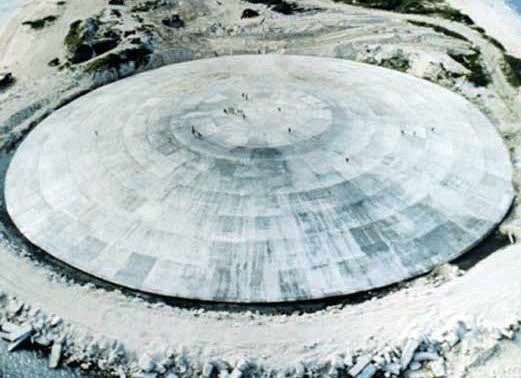
A gaping hole was left on a small island in the Pacific Ocean when the United States military released an 18-kiloton nuclear blast in 1958, known as the ‘Cactus‘ test.
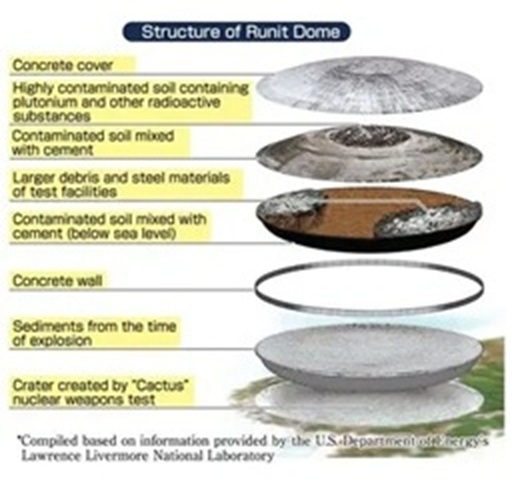
After the blast took place on the Marshall Island’s Runit Island, the military filled it in with contaminated soil and debris, creating a ‘tomb’ of nuclear waste known now as the Runit Dome.
Almost 50 years after the dome’s construction, experts are concerned that cracks in the concrete-capped radioactive landfill indicate just how vulnerable the site is to rising seas encroaching upon the narrow island’s shores.
The 115-meter (377 feet)-wide dome, built between 1977 and 1980 as part of military cleanup efforts, rests above more than 120,000 tons of material that were contaminated by US nuclear testing across Enewetak Atoll, including lethal quantities of plutonium.
The dome was intended as a temporary solution to contain material left behind by the nuclear tests, some of which exceeded the magnitude of Hiroshima and Nagasaki 1,000 times over.
But since its construction, groundwater has penetrated the otherwise-unlined crater, beneath which there lies a bed of porous coral sediment. So far, this is the main source of leaks, but there are concerns that layers of the dome intended to sit above sea level are not going to stay above water much longer.
In 2020, following a major report by the Los Angeles Times, Woods Hole Oceanographic Institute marine radioactivity expert Ken Buesseler pointed out that radioactive leaks from the Runit Dome are, so far, “relatively small,” in an interview for the institute’s journal
“As long as the plutonium stays put under the dome, it won’t be a large new source of radiation to the Pacific Ocean,” Buesseler told journalist Evan Lubofsky at the Los Angeles Times.
“But a lot depends on future sea-level rise and how things like storms and seasonal high tides affect the flow of water in and out of the dome. It’s a small source right now, but we need to monitor it more regularly to understand what’s happening, and get the data directly to the affected communities in the region.”
Columbia University chemist Ivana Nikolic-Hughes has been involved in ongoing research into the persistent contamination of the Marshall Islands following nuclear testing, and recently told journalist Kyle Evans at the Australian Broadcasting Corporation that she saw the dome’s cracks first-hand while taking soil samples on the island back in 2018.
In her research, Nikolic-Hughes has found elevated radiation levels and significant quantities of five radionuclides in soil samples from the island, outside the dome.
This could be evidence of the nuclear tomb leaking – though it may also be the result of the haphazard nature of the cleanup efforts, which also resulted in much waste being dumped into the lagoon.
Either way, the presence of plutonium-239, a component of nuclear weapons that remains dangerous for more than 24,000 years, warrants grave concerns about its vulnerability to rising sea levels and climate change.
“Given that sea levels are rising and there’s indications storms are intensifying, we worry the integrity of the dome could be in jeopardy,” Nikolic-Hughes told Evans.
“Runit is about 20 miles from where people live and they use the lagoon, so the implications are potentially devastating.”
In 2024, the US Department of Energy’s Pacific Northwest National Laboratory conducted an investigation into the potential impacts of climate change on the Runit Dome site, finding that storm surges and gradual sea level rise would indeed be the biggest factor in spreading radionuclides through the atoll.
Most of Runit Island sits just 2 meters (6.5 feet) above sea level.
Viewed from above, it is easy to imagine what an impact just 1 meter of extra water could do to the atoll and Runit Island’s crumbling nuclear tomb. That is the amount of sea level rise climate scientists predict for the Marshall Islands by 2100.
Related: Parts of The Marshall Islands Are Now More Radioactive Than Chernobyl, Study Finds
Nikolic-Hughes and her fellow researcher Hart Rapaport have previously urged the United States to take responsibility for proper cleanup of nuclear waste on the islands, as one part of ensuring a safe future for Marshallese residents.
As United Nations special rapporteur Paula Gaviria Betancur said back in 2024: “Legacies of nuclear testing and military land requisitions by a foreign power have displaced hundreds of Marshallese for generations, while the adverse effects of climate change threaten to displace thousands more.”
The Nightmare of Fukushima 15 Years Later

SCHEERPOST, By Joshua Frank, March 20, 2026
“…………………………………………………………………………………… The Fukushima Daiichi nuclear plant, built by General Electric (GE) in the mid-1960s, was designed to withstand natural disasters, but its creators never foresaw an earthquake like that. When the plant’s sensors detected the quake, its reactors automatically shut down. That emergency shutdown (or scram) halted its fission process, triggering backup power to keep cold seawater flowing through the reactors and spent-fuel containers to prevent overheating. Things at Fukushima were going according to plan until that massive tsunami battered the plant, washing away transmission towers and damaging electrical systems. There were backup generators in the basement, but those, too, had been inundated by waves of seawater, and an already bad situation was about to get far worse.
A power outage at a nuclear power plant is known as a “station blackout.” As you might imagine, it’s one of the worst scenarios any nuclear facility could possibly experience. If all electricity is lost, that means water is no longer being pumped into the reactor’s scalding-hot core to cool it down. And if that core isn’t constantly being cooled, one thing is certain: disaster will ensue. The fission process itself may be complicated, but that’s basic physics. To make matters worse, there were three operating reactors at Fukushima Daiichi. Luckily, three others had already been shut down for maintenance. If power wasn’t restored in short order, that would mean that all three of Fukushima’s reactors were in very big trouble.
We would later learn that no one — not at TEPCO, GE, or among Japanese regulators — had ever considered the possibility that all the reactors might lose electricity at once. They had only drawn up plans for one reactor to go down, in which case the others could keep the plant running. But all of them offline, and every generator out of commission? There was no precedent or playbook for that.
The nuclear industry has a reasonably polite name for a disaster like the one that was rocking Fukushima. They refer to it as a “beyond design-basis accident” because no single nuclear plant design can account for every possible problem it might encounter in its lifetime. The fact that there’s a term for this should make you anxious.
Meltdowns and Fallout
Over the next several days, the emergency at Fukushima Daiichi only worsened. Every effort to restore power to its reactors hit a dead end. On-site radiation-detection equipment, which would have triggered warnings and guided evacuation efforts for those in danger, was no longer functioning. Plans to pump water into the reactors to cool them had faltered. Their cores kept overheating, and the boiling pools of spent fuel were at risk of drying out, potentially triggering a massive fire that would release extreme amounts of radiation.
Within three days, following a series of fires, hydrogen explosions, and panic among those aware of what was happening, Fukushima’s Units 1, 2, and 3 experienced full-scale core meltdowns. Over 150,000 people within an 18-mile radius had already been forced to evacuate, and radiation plumes would take two weeks to spread across the northern hemisphere, although the Japanese government wouldn’t admit publicly that any meltdown had occurred until June 2011, three months later.
The only good news for the 13 million people living 150 miles south in Tokyo was that, during and immediately after the meltdowns, prevailing winds carried much of Fukushima’s radioactive material away from the smoldering reactors and out to sea. It’s estimated that 80% of the fallout from Fukushima ended up in the ocean, meaning most of it headed east rather than toward population centers to the south and west. The other fortunate news was that the spent fuel containers had somehow survived it all. If their water levels in the pools had been drained, far more radiation would have been released.
But Tokyo wasn’t completely spared. After years of research, scientists discovered that cesium-rich microparticles had blanketed the greater Tokyo area, an unpopular discovery that drew backlash and threats of academic censorship. Areas around the Fukushima exclusion zones recorded the highest radiation levels. Japanese government officials continually downplayed the dangers of the accident and were reluctant to even classify the event as a Level 7 nuclear disaster, the highest rating on the International Nuclear Event Scale, which would have placed it on a par with the 1986 Chernobyl nuclear disaster. Japanese officials have also failed to conduct long-term epidemiological studies that would include baseline measurements of cancer rates, which has cast doubt on thyroid screenings that found troubling incidents of cancer far higher than researchers expected.
Radioactive Fish
Prior to the earthquake, the ocean’s cesium-137 levels near Fukushima were 2 Becquerels (a unit of radioactivity) per cubic meter, well below the recommended drinking water threshold of 10,000 Becquerels. Just after March 11, 2011, cesium-137 levels there spiked to fifty million before decreasing as sea currents dispersed the radioactive particles away from the coast. The ocean, however, had been poisoned.
In the years that followed the Fukushima nuclear disaster, researchers documented a frightening, yet predictable trend. Radioactive isotopes in seawater were taken up by marine plants (phytoplankton), which then moved up the food chain into tiny marine animals (zooplankton) and, eventually, to fish.
Cesium-137 consumed by fish can reside in their bodies for months, while Strontium-90 remains in their bones for years. If humans then eat such fish, they will also be exposed to those radioactive particles. The more contaminated fish they eat, the greater the radioactive buildup will be.
In 2023, over a decade after the incident, radiation levels remained sky-high in black rockfish caught off the Fukushima coast. Other bottom-dwelling species have been found to be laden with radioactivity, too, including eel and rock trout. Further concerns have been raised about the treated radioactive water that TEPCO continued to release into the ocean, prompting China to suspend seafood imports from Japan. Aside from those findings, there have been very few studies examining the effects of Fukushima’s radiation on ecosystems or on the people of Japan.
“Japan has clamped down on scientific efforts to study the nuclear catastrophe,” claims pediatrician Alex Rosen of International Physicians for the Prevention of Nuclear War. “There is hardly any literature, any publicized research, on the health effects on humans, and those that are published come from a small group of researchers at Fukushima Medical University.”
Recognizing such levels of radiation, even if confined to the waters near Fukushima, would cast the country’s nuclear industry as a significant threat — not only to Japan but globally. Any admission that Fukushima’s radiation is linked to increased cancer rates would raise broader concerns about nuclear power’s future viability. Radiation exposure is cumulative and, although Fukushima didn’t immediately cause mass casualties, it wasn’t a benign accident either. It took decades before it was accepted that Chernobyl had caused tens of thousands of excess cancer deaths. It may take even longer to completely understand Fukushima’s full effects. In the meantime, the still ongoing cleanup of the burned-out facilities may cost as much as 80 trillion yen ($500 billion).
It’s been 15 years since Fukushima’s reactors experienced those meltdowns and we still don’t fully understand their long-term repercussions. Nuclear power advocates will argue that Fukushima wasn’t a serious incident and that nuclear technology is still safe. They’ll minimize radiation threats, remain optimistic that new reactor designs will never falter, dismiss the fact that there’s simply no permanent solution for radioactive waste, and overlook the inseparable connection between nuclear power and atomic weapons. After all, among other things, we’ll undoubtedly need nuclear energy to help power the artificial intelligence craze, right?………………………………………………………………………………………………………………………………………………………………………. With nine nuclear-armed nations and roughly 12,000 nuclear warheads on this planet, worries about nuclear war are unavoidable. However, the danger of a nuclear disaster at a seemingly “peaceful” nuclear facility is often ignored. The future of atomic energy remains uncertain, but it is our duty to eliminate this hazardous energy source before another Fukushima triggers a war-like catastrophe all its own.mhttps://scheerpost.com/2026/03/20/searching-for-solace-in-a-nuclearized-world/
Joshua Frank, a TomDispatch regular, is co-editor of CounterPunch and co-host of CounterPunch Radio. He is the author of Atomic Days: The Untold Story of the Most Toxic Place in America, and the forthcoming Bad Energy: AI Hucksters, Rogue Lithium Extractors, and Wind Industrialists Who are Selling Off Our Future, both with Haymarket Books.
Macron slams ‘unacceptable’ Israeli attacks on Lebanon
The French president stressed that the Jewish state’s military operation violates international law and will not enhance its security.
20 Mar, 2026, https://www.rt.com/news/635660-macron-condemns-israel-lebanon-attacks/
Israel’s ongoing military operation in Lebanon violates international law, French President Emmanuel Macron has said.
Speaking at a European Council press conference in Brussels on Thursday, Macron also criticized the attacks on Israel being carried out by Lebanese-based militant movement Hezbollah, which has vowed to avenge the US-Israeli killing of Iranian Supreme Leader Ali Khamenei.
Macron rejected the notion that a third party could resolve the conflict with the Iran-linked group through force, emphasizing that only Lebanese authorities have the legitimacy to address the issue.
“We don’t think that the fight against Hezbollah and the removal of its weapons can be carried out by a third power,” Macron told reporters. “We believe that Israel’s ground military operation and bombardments are inappropriate and even unacceptable in terms of international law and the interests of both the Lebanese and Israel’s long-term security.”
Macron also pointed out that Israel has conducted similar operations in Lebanon for years without ever producing the “expected results.”
The French leader’s comments come as Israel has expanded its military campaign against Hezbollah following the US-Israeli strikes on Iran that began late last month. The Israel Defense Forces announced “limited and targeted ground operations against key Hezbollah strongholds” earlier this week, escalating cross-border hostilities that have already claimed hundreds of lives.
Lebanese authorities report that Israeli strikes have killed over 880 people over the past two weeks, with more than 2,000 injured and over 1 million displaced. The strikes have targeted residential districts, a UN peacekeeping position, and a Russian cultural center in the southern city of Nabatieh.
On Thursday, RT correspondent Steve Sweeney and his cameraman Ali Rida Sbeity were also injured in what appeared to be a deliberate Israeli airstrike on their filming position, despite them wearing clearly labeled press uniforms.
Moscow has condemned Israel over the strike, with Russian Foreign Ministry spokeswoman Maria Zakharova stressing that the attack on journalists wearing press markings “cannot be called accidental given the killing of two hundred journalists in Gaza.”
Iran’s Retaliation Reignites Discontent With US Military Bases in Middle East
The US spent decades building an empire of military bases throughout the Middle East. Now they’re under attack.
By Shireen Akram-Boshar , Truthout, March 20, 2026
n Thursday, March 19, Saudi Arabia’s foreign minister Prince Faisal warned Iran that tolerance for its regional attacks was running short — and that the Saudi regime has “the right to take military actions if deemed necessary.” He elaborated that Saudi Arabia and other Gulf states have “very significant capacities and capabilities that they could bring to bear” if the attacks continue. This came a day after Iranian attacks on Gulf energy sites in Saudi Arabia, Qatar, and the United Arab Emirates, which Iran said was in retaliation for an Israeli strike on an Iranian gas field.
Over the past three weeks of the U.S.-Israeli war on Iran, Iran has increasingly targeted sites across the Gulf, further regionalizing the war. Among its prime targets are U.S. military bases in the region: Iran has targeted, and damaged, at least 17 U.S. sites in the region, 11 of which are military bases. The two largest bases, Al Udeid Air Base in Qatar and the U.S. Navy’s Fifth Fleet in Bahrain, host 10,000 and 9,000 U.S. military personnel, respectively — of an estimated 50,000 U.S. military personnel across the region.
The existence of these military bases should alert us to a larger problem — that the U.S. has come to dominate the region militarily, building relationships with local regimes that further encourage repression and domination. Now, Iranian retaliation against these bases spurred by U.S.-Israeli attacks is reigniting a divide between Gulf leaders and their populations……………………………………………………………………………………………………………………………………………..
But the real expansion of U.S. military bases across the Middle East began in the early 1990s during and after the Gulf War, with the establishment of permanent U.S. bases in Kuwait, Qatar, and Bahrain, as well as sites in Saudi Arabia that the U.S. would use for long stretches. Though many expected U.S. global military presence to decrease after the collapse of the Soviet Union, the 1990 Gulf War saw a seismic expansion of U.S. troops in the Middle East along with the start of a unipolar world order dominated by the U.S. With the fall of the Soviet Union, the U.S. was now the world’s sole superpower, and the Middle East would experience its military might.
Following the 1990-’91 Gulf War, Kuwait, Bahrain, Qatar, and the UAE all signed public, formal defense agreements with the U.S., granting the U.S. access to each country’s bases and other facilities. With the exception of Saudi Arabia, U.S. military presence was now well-known rather than discreet. And soon after the U.S.-led campaign ended Iraq’s occupation of Kuwait, the U.S. played a role in bringing the Palestinian First Intifada to an end, pushing for first the Madrid Conference and then the Oslo Accords to contain and end the uprising that challenged Israel’s brutal status quo.
In the wake of the Oslo Accords, the U.S. also facilitated neoliberal transitions throughout the Middle East, accelerating privatization, deregulation, and the selling off of state assets — thereby reversing the nationalization policies of earlier decades and aligning the region with U.S. political and economic interests through a set of reforms and interventions commonly called the Washington Consensus. Thus, in the few years after the fall of the USSR, the U.S. managed to restructure the Middle East according to its designs; its military bases represented one pillar of its dominance and control over the region.
An Empire of Bases and Local Authoritarian Regimes
In 2001, the U.S. expanded its military bases even further, creating an “empire of bases” in the region as it launched its endless “war on terror.” During its wars on Afghanistan and Iraq, the U.S. held more than 1,000 installations in those two countries alone. New bases were established and old ones expanded in Qatar, the UAE, Kuwait, Iraq, and Jordan.
Though international and regional dynamics have changed over the past two-and-a-half decades, U.S. bases still dominate the region. The presence of these bases has also further encouraged U.S. support for authoritarian regimes capable of suppressing popular opposition to U.S. imperialism and support for the Palestinian cause. This is particularly obvious in the case of Bahrain, which hosts the U.S. Navy’s Fifth Fleet and some 9,000 U.S. troops — the second largest base in the region after Qatar’s Al Udeid Air Base — and is thus seen as a crucial base in the region…………………………………………………………………………………………………..
The US-Israeli war on Iran and the regionalization of the war highlight both the U.S.’s historic domination of the region, and the extent to which the region’s regimes have normalized relations with the U.S — straying far from the anti-imperialist sentiments that dominated the region in the 1950s and ‘60s. Instead, it is a reactionary status quo that is entrenched across the Middle East. While Bahraini people dare to protest against their regime, the U.S., and Israel, the Gulf states’ ruling regimes double down in their reliance on U.S. military support, making their alignment clear. Qatar in particular has used its military base to cozy up to Trump.
And yet it is this U.S. military presence itself that has pulled them into the increasingly regionalized war. Still, the large U.S. military presence remains in tension with the wishes of the vast majority of the population in most countries in the region, and it remains to be seen if the current U.S.-Israeli war on Iran, and Iran’s widespread retaliation against this network of bases, will once again reshape the U.S. military presence in the Middle East. https://truthout.org/articles/irans-retaliation-reignites-discontent-with-us-military-bases-in-middle-east/?utm_source=Truthout&utm_campaign=accdbb6382-EMAIL_CAMPAIGN_2026_03_20_06_50_COPY_01&utm_medium=email&utm_term=0_bbb541a1db-1f909890d7-650192793
A MAN and woman have been arrested after attempting to enter Faslane naval base.
20th March, https://www.thenational.scot/news/25954299.man-woman-arrested-attempting-enter-faslane-naval-base/
The incident, which took place at around 5pm on Thursday, saw the pair reportedly ask if they could enter.
They were refused permission and were then arrested shortly after. It is understood the pair did not try to force their way into the base.
According to the PA news agency, the man is understood to be Iranian.
The Faslane naval base, also known as HM Naval Base Clyde, is located on the eastern shore of Gare Loch in Argyll and Bute.
It is home to the core of the UK’s submarine fleet and the Trident nuclear deterrent.
A Police Scotland spokesman said: “Around 5pm on Thursday, 19 March, 2026, we were made aware of two people attempting to enter HM Naval Base Clyde.
“A 34-year-old man and 31-year-old woman have been arrested in connection and enquiries are ongoing.”
A Navy spokesperson said: “Police Scotland have arrested two people who unsuccessfully attempted to enter HM Naval Base Clyde on Thursday 19 March.
“As the matter is subject to an ongoing investigation, we will not comment further.”
The Warmongers Will Never Admit They Were Wrong And Will Never Learn From Their Mistakes
Cait;in Johnstone, 20 Mar 26, https://mail.google.com/mail/u/0/?tab=rm&ogbl#inbox/WhctKLcDqcPgHJwXCXxhJgcDpJZFXpkgKlZRLMBbTfNgLndgLLjFjSMrWXffFBwHrWcdXkb
| Trump’s former national security advisor John Bolton has a tweet that’s got me absolutely fuming right now.“In 2018–2019, I made the case for regime change in Iran as often as I could. Voices in Trump’s orbit often cited Iran’s capacity to close the Strait of Hormuz as a reason against regime change. Trump has been fully aware this is a possibility, and yet did not prepare,” Bolton posted. |
Can you believe this shit? Dude’s like “Hey, Trump should have known this war would be hard because people tried to warn him not to listen to me!”
Motherfucker THIS WAS YOUR WAR. You were THE “bomb Iran” guy! You made it your entire personality for DECADES. Over the years I’ve used your name God knows how many times whenever I needed an example of a Beltway swamp monster who’s got a throbbing hard-on for war with Iran. Now you’ve finally got it and it’s going exactly as badly as everyone said it would, and you’re like “Yeah well he should’ve known better, people tried to warn him about the Strait of Hormuz”? Fuck you.
These professional warmongers never, ever learn from their errors. Many years after the Iraq invasion turned out to be a disaster, John Bolton was still out there telling the media he believed it was a “resounding success,” conceding only “mistakes that were made subsequently” to the ousting of Saddam Hussein.
They never admit they were wrong. They never admit that their war was a bad idea. They only ever acknowledge that it didn’t happen in exactly the way they imagined it happening in their minds. They live in this fantasy world where all their war agendas would unfold beautifully so long as they could personally control every molecule of matter involved in how it happens, completely ignoring that this is impossible and any war is always going to have an unfathomable number of moving parts you can’t control.
In their eyes the wars are never wrong, they’re only ever executed incorrectly. US military interventionism can never fail, it can only be failed.
Bolton doesn’t even seem to have any idea what Trump could have done differently to stop Iran from closing the Strait of Hormuz. I listened to an NPR interview the other day where he slammed Trump for not having “done the planning in advance” to prevent the Iranian blockade, but he never at any time outlined what Trump could have done to accomplish this. He just said there was “a huge hole in the planning” and that “they apparently didn’t take as seriously as they should have the potential to mine the Strait of Hormuz,” without ever saying what they could have done.
These are the kinds of minds they have spearheading the US empire’s wars.
All the worst people are getting exactly what they want, and it turns out they don’t even want it, like Elon Musk tweeting “Whoever said ‘money can’t buy happiness’ really knew what they were talking about” last month. They’re getting everything they asked for and it’s making everyone miserable, and it’s not even making THEM happy.
The imperial status quo elevates the worst among us. The least wise. The least insightful. The least compassionate. The least deserving. The least qualified.
We need drastic revolutionary change, and we need it now.e doesn’t know. He himself, Mister Iran War, had no plan for how to carry out this war without disastrous consequences for the US and its allies. He’s spent his entire blood-soaked career pushing for a war he never had any idea how to actually carry out.
Conscientious objector and human rights defender Yurii Sheliazhenko detained.

The undersigned organisations are shocked by the detention and deprivation of liberty of human rights defender Yurii Sheliazhenko, today March 19th, by the Ukrainian authorities in Kyiv. This is just weeks after a joint call to the authorities to withdraw from such persecutions of conscientious objectors and withdraw their ongoing persecution of Mr. Sheliazhenko.1
According to the information available, Mr. Sheliazhenko was apprehended by officers of the Pechersk District Police in Kyiv without a proper legal basis and without compliance with the procedural safeguards required by Ukrainian law. In particular, there are indications that:
– no detention protocol was drawn up;
– no clear legal grounds for the deprivation of liberty were provided;
– access to legal counsel was obstructed;
– contact with the Ukrainian State Bureau of Investigation was obstructed;
– he was transferred, or intended to be transferred, to a Territorial Centre of Recruitment and Social Support (TCC) without due legal procedure.
We note that any involvement of the TCC does not exclude the responsibility of law enforcement officers for the initial deprivation of liberty. These actions may constitute violations of the Constitution of Ukraine and the European Convention on Human Rights, in particular Article 5 (right to liberty and security), and Article 9 of the International Covenant on Civil and Political Rights (ICCPR).
Yurii Sheliazhenko is a well-known conscientious objector, publicly declared since 1998, a pacifist and a human rights defender. He is also an academic, the executive secretary of the Ukrainian Pacifist Movement (member organisation of War Resisters International), Director of the Institute of Peace and Law in Ukraine, and a Board member of the European Bureau for Conscientious Objection and of World Beyond War.
Tragically, he has previously reported on the cruel practices of “busification”, forced conscription and compulsory military registration occurring in Ukraine, which in some cases have even led to tortures and deaths in military recruitment centers.2
We strongly condemn all these actions as grave human rights violations that have no place in democratic countries.
We urge the Ukrainian authorities to immediately release Yurii Sheliazhenko and cease all procedures of forced conscription.
We remind that his case has been previously included in a Communication by the Mandates of the Special Rapporteur on the rights to freedom of peaceful assembly and of association; the Special Rapporteur on minority issues and the Special Rapporteur on freedom of religion or belief.3 The case of Mr. Sheliazhenko, the communication of the Special Rapporteurs and the response of the Ukrainian authorities were highlighted also by the OHCHR, in its report concerning Conscientious objection to military service, and particularly in the chapter titled “Refrain from unduly restricting the human rights of those representing or advocating for the rights of conscientious objectors”.4 His case has been highlighted also in Amnesty International’s Annual Report 2023/2024.5
We repeat our call to the international community to exercise all proper actions to ensure that human rights defenders and peace activists are not criminalised for their actions for peace and nonviolence; moreover, that the right to conscientious objection is fully implemented in line with international standards and that conscientious objectors are provided with the necessary protection against persecution in their country of origin, also with asylum.
Connection e.V.
European Bureau for Conscientious Objection
International Fellowship of Reconciliation
War Resisters’ International
- https://ebco-beoc.org/press-release/2026-01-23-yurii-sheliazhenko-conscientious-objector-to-military-service-and-human-rights-defender-under-immediate-threat ↩︎
- https://ebco-beoc.org/ukraine/2024 ↩︎
- AL UKR 1/2023, 8 November 2023, p. 5-6. https://spcommreports.ohchr.org/TMResultsBase/DownLoadPublicCommunicationFile?gId=28562 ↩︎
- A/HRC/56/30, 23 April 2024, para. 45. https://docs.un.org/en/A/HRC/56/30↩︎
- https://www.amnesty.org/en/documents/pol10/7200/2024/en/ p. 385↩︎
What a recent court win reveals about the Trump administration’s unlawful attacks on climate science

Bulletin, By Rachel Cleetus | Opinion | March 18, 2026
The second Trump administration is taking its hostility to climate science to new levels. In addition to its rhetoric dismissing climate change as a con or scam, recently released government documents show how the administration is seeking to replace scientific facts with propaganda and disinformation.
The Environmental Defense Fund and the Union of Concerned Scientists recently won a court case against the administration which forced it to release of a trove of government documents related to a secretive “Climate Working Group” illegally convened by Energy Secretary Chris Wright. These documents show that the Trump administration secretly enlisted a handpicked group of climate contrarians to write a biased climate report specifically designed to undermine the EPA’s Endangerment Finding. This science-based finding establishes the known harms to human health and well-being from global warming pollution, facts that were clear in 2009 and even more so today, as affirmed by a recent National Academies report……………………………………………………………………………………………………………………………..
Propaganda and disinformation about climate science are now the official position of the US government. Meanwhile, scientists confirm that the world is on the verge of overshooting 1.5 degrees Celsius of global warming within the next few years. Costly and deadly climate impacts—extreme heatwaves, record-breaking floods, intensified storms, catastrophic wildfires—are worsening, and the risks of irreversible, multi-century harms are growing. And yet this deeply anti-science administration continues to prop up fossil fuel interests rather than protecting people’s safety and the health of the planet.
The successful Federal Advisory Committee Act lawsuit has resulted in some crucial wins, including shining a light on the Trump administration’s deceptive tactics to undermine climate science. . And the administration’s harmful actions will continue to be challenged in court. The Union of Concerned Scientists and the Environmental Defense Fund, together with many other groups, have recently joined a lawsuit challenging the unlawful repeal of the endangerment finding. Try as it might, this administration cannot bury the evidence of climate harms so readily apparent to communities across the nation. The American people deserve genuine solutions to the climate crisis, not more self-serving lies.https://thebulletin.org/2026/03/what-a-recent-court-win-reveals-about-the-trump-administrations-unlawful-attacks-on-climate-science/
Deader than a doornail -UK’s new nuclear
Several days after announcing the new cost hikes at Hinkley, news broke about similarly soaring electricity prices predicted for the Sizewell C nuclear power plant, another French twin EPR plant targeted for the steadily eroding and submerging UK Suffolk coast.
by beyondnuclearinternational, https://beyondnuclearinternational.org/2026/03/15/deader-than-a-doornail/
Electricity prices from new nuclear plants will be sky high with more delays to completion while jobs don’t materialize.
If you wanted to sum up the most compelling reasons not to build new nuclear power plants, Hinkley Point C, the two-reactor project under construction in Somerset in the UK, encapsulates almost all of them.
When the UK government, still miraculously led by the clinging-by-his-fingernails beleaguered Labour prime minister, Keir Starmer, announced its Golden Age of nuclear last September, obediently gliding in Trump’s gilded wake, it claimed that the new nuclear power plants planned for Britain “will drive down household bills in the long run.” Nothing could be further from the truth.
Far from driving down consumer costs, the Hinkley Point C project, consisting of two 1,630 MW French Evolutionary Power Reactors (EPR), could see the original agreed strike price of $123.50 per megawatt — already considerably higher than the price Britons were paying at the time it was set in 2012 — soar even higher by the time the plant is finished, since prices are designed to increase annually in line with the Consumer Price Index.
The original estimated cost of $24 billion for the two Hinkley C EPRs has now almost tripled, having sky-rocketed to almost $67 billion as announced last week, along with new delays.
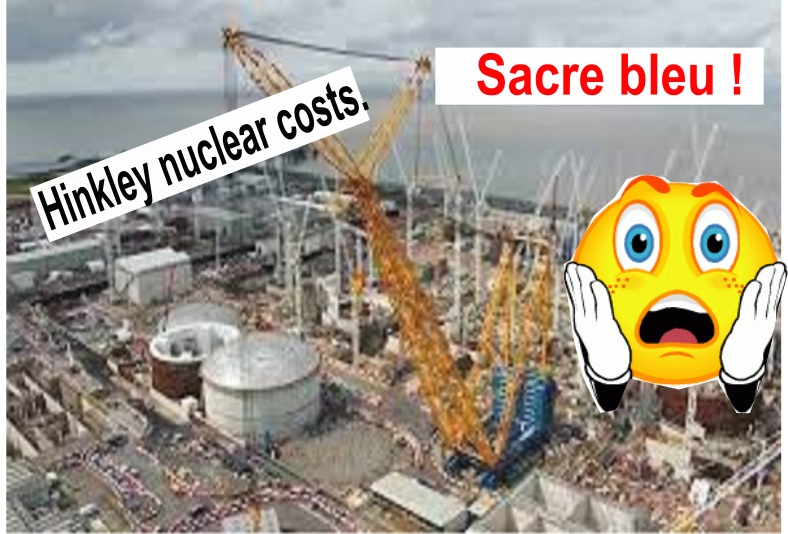
In 2007, when EDF first proposed its Hinkley Point C scheme, an officer with the company predicted locals would be cooking their turkeys using electricity from Hinkley C by Christmas 2017. That’s the same year — in March — that construction eventually began.
The Hinkley C completion date has now been pushed to at least 2030, another deadline extension it probably won’t meet. If the plant does show up in 2030, it will have taken 22 years, 13 longer than planned.
That’s a long time to wait for those new jobs the UK government’s ‘Golden Age’ promised. “Working people will benefit from jobs and growth as companies in the UK and United States sign major new deals that will turbocharge the build-out of new nuclear power stations in both countries,” said that September announcement, embracing yet more hyperbolic rhetoric.
Several days after announcing the new cost hikes at Hinkley, news broke about similarly soaring electricity prices predicted for the Sizewell C nuclear power plant, another French twin EPR plant targeted for the steadily eroding and submerging UK Suffolk coast.
The Sizewell C project was first proposed in 2010 but there are still no shovels in the ground for the plant itself, only site preparation (for that, read tearing up countryside and precious habitat.)
As revealed in an article in the Daily Telegraph, electricity generated from Sizewell C is likely to cost “almost double today’s prices”. The prediction is a staggering $160 per megawatt hour, and that’s according to the government’s own new report.
Incredibly, despite the track record at Hinkley C, with identical reactor designs to Sizewell, this same government report “assumed no escalation in costs” for the Suffolk project. Such an outcome is, to put it mildly, highly unlikely.
In an recent analysis for OilPrice.com, Leonard S. Hyman, an economist and financial analyst, and William I. Tilles, a senior industry advisor and speaker on energy and finance, predicted that “the prospects for new nuclear (both big and small) are deader than the proverbial doornail.”
They viewed the outlook for the so-called small modular reactors that the UK government is poised to green light as even bleaker. (At around 490MW the favored design from Rolls-Royce isn’t actually that small.) Small reactors will have “projected costs that are much higher than gigawatt-scale reactors, making them even less relevant economically,” they wrote.
And yet, the Starmer and Trump governments each press on with their false and fantastical nuclear fantasy plans regardless.
Linda Pentz Gunter is the founder of Beyond Nuclear and serves as its international specialist. Her book, No To Nuclear. Why Nuclear Power Destroys Lives, Derails Climate Progress and Provokes War, can be pre-ordered now from Pluto Press. (Use the scroll menu at the top of the page to select dollars or pounds for payment.)
Pete Hegseth’s War on Journalists (and Iran Too)

Pete Tucker, March 20, 2026, https://fair.org/home/pete-hegseths-war-on-journalists-and-iran-too/
Defense Secretary Pete Hegseth appears to be in the midst of two conflicts, one…in Iran, and the other with the American free press over its coverage of the widening Middle East war.
—MS NOW‘s Sydney Carruth (3/13/26)
Last fall, nearly the entire Pentagon press corps was banned from the Pentagon after refusing to sign Pete Hegseth’s loyalty oath, which would have bound them to only report information “authorized” by the government (FAIR.org, 9/23/25). They were quickly replaced by pundits from Hegseth-approved outlets like One America News, Gateway Pundit and Lindell TV, which is “Pillow Guy” Mike Lindell’s pet project.
But once the Iran War got underway, it dawned on Hegseth that a Defense secretary needs to communicate with the whole country, not just the narrow slice of it reached by his favorite right-wing pundits. So Hegseth reversed course, asking the major networks to bring their cameras back to the Pentagon. They agreed, but on one condition: Some of their reporters had to be allowed to return to the press briefing room, too.
So back they came, albeit now at the back of the room. Few of these reporters—who represent outlets you’ve actually heard of, like ABC, NBC and the New York Times—are called on. Hegseth, a former Fox News weekend host, instead fields questions almost exclusively from handpicked media personalities seated in the front rows. (I’d call them reporters, but if they signed Hegseth’s 2025 oath, as most did, they’re anything but.)
‘Typical gotcha-type question’
When Hegseth stepped to the podium for his first Iran War press briefing on March 2, there was a lot on the line. A skeptical American public wanted to know why President Trump had just launched another regime-change war, the very thing he’d railed against on the campaign trail. But Hegseth had little to offer, aside from “lots of chest-thumping,” a Pentagon reporter told CNN.
For the Q&A, Hegseth “only answered questions from his chosen outlets,” reported CNN’s Brian Stelter (3/4/26), until a journalist in the back lobbed a question about Trump’s changing timeline for the war’s duration. Hegseth initially ignored the interruption, but his anger got the best of him, and he returned to the matter.
“I heard the question about ‘four weeks,’” Hegseth sneered. “It’s the typical NBC sort of gotcha-type question.”
Having veered away from his friendly questioners, Hegseth was off script and had to think on his feet, not exactly a strength.
“President Trump has all the latitude in the world to talk about how long it may or may not take—four weeks, two weeks, six weeks. It could move up, it could move back,” Hegseth said at the opening of a rant that somehow included the word “aperture” and the observation that, “well, I mean, Joe Biden didn’t even know what he was doing.”
‘Only favorable images’
After face-planting at his first Iran War press briefing, Hegseth knew change was needed—only not by him, but with his enemies in the press.
If Hegseth couldn’t kick out any more reporters, who could he get rid of? Scanning the room, he fixed on the photographers.
The Pentagon’s stated reason for banning press photographers after the March 2 briefing was because of space restrictions. But the real reason, the Washington Post (3/11/26) reported, was they took “unflattering” photos of Hegseth.
Now only Pentagon photographers are allowed into briefings, and they are happy to provide the media with approved photos of their boss. Alex Garcia, president of the National Press Photographers Association, told the Post:
Excluding photographers from Pentagon briefings because officials did not like how published images portrayed them shows an astonishingly poor sense of priorities in the midst of a war and is, for a public servant, not a good look…. A free press cannot function if government officials decide that only favorable images of public officials may be created or distributed.
In Hegseth’s March 4 press briefing—without those pesky photographers—he stuck again to his preferred outlets, like the Daily Caller, Daily Wire, Lindell TV and the Washington Times. He also took one question from a mainstream journalist, Tom Bateman of the BBC, who pressed Hegseth on the US bombing of an elementary school in Minab. “We’re investigating it,” Hegseth replied curtly.
‘A snowflake behind a military shield’
Among the many reporters who didn’t get called on was the Atlantic’s Nancy Youssef, although in her case it was because she wasn’t allowed in. “I, along with print photographers, have been denied entry to cover today’s Pentagon briefing,” Youssef wrote on X. “All other media were allowed in.”
By Hegseth’s next briefing, March 19, his banned list had expanded again. “The Pentagon’s own publication, Stars and Stripes, was disinvited from Defense Secretary Pete Hegseth’s latest Iran War press conference—as he continues to clamp down on press coverage,” the Independent (3/19/26) reported.
This came less than two weeks after the Pentagon announced it was taking greater control of Stars and Stripes, a paper Hegseth previously claimed had gone “woke” (Daily Beast, 3/19/26). As former Stars and Stripes reporter Kevin Baron (X, 3/19/26) pointed out, the paper’s
employees are US Army civilians. Their editorial independence is protected by Congress specifically to prevent political leaders from feeding troops propaganda.
“Hegseth spent years on a comfortable Fox News couch building a brand around contempt for the thin-skinned and the easily offended,” wrote Status’s Jon Passantino (3/14/26). “But in office, Hegseth has revealed himself to be exactly that—a snowflake behind a military shield.”
‘An actual patriotic press’
As the US and Israel’s war on Iran continues to worsen, Hegseth’s attacks on the media have also escalated. At his March 13 briefing, Hegseth insisted that “an actual patriotic press” wouldn’t write headlines stating the war is expanding, even as the war has sprawled from an initial three countries—Israel, the US and Iran—to over a dozen.
“Allow me to make a few suggestions,” Hegseth offered. “People look up at the TV and they see banners, they see headlines [like]… ‘Mideast War Intensifies,’” he said. “What should the banner read instead? How about, ‘Iran Increasingly Desperate.’”
Hegseth also singled out a CNN story (3/13/26), headlined “Trump Administration Underestimated Iran War’s Impact on Strait of Hormuz.” That story is “patently ridiculous, of course,” Hegseth said, blithely dismissing the strait’s closure, saying we “don’t need to worry about it.”
Hegseth’s worries were directed elsewhere—at CNN. “The sooner David Ellison takes over that network, the better,” Hegseth said.
Ellison is the 43-year-old nepo baby of billionaire Larry Ellison, a close Trump ally. Having already purchased Paramount, and with it CBS, Ellison is on the verge of closing a $110 billion deal for Warner Bros. Discovery, which owns, among other media and film properties, CNN.
Hegseth’s comments about Ellison taking over CNN “should be a major scandal,” wrote Craig Aaron (Pressing Issues, 3/17/26), co-CEO of Free Press (the media advocacy group, not the right-wing, Ellison-owned outlet of the same name). “But in the chaos of the Trump administration, he’s just a warm-up act.”
‘Sick and demented people’
Indeed, as Trump’s historically unpopular war continues to sour, he’s sought to place blame on a familiar target: news media. Outlets critically covering the war, Trump posted on Truth Social (3/14/26), “are truly sick and demented people that have no idea the damage they cause the United States of America.” The next day (3/15/26), he declared they “should be brought up on Charges for TREASON for the dissemination of false information!” Treason is punishable by death.
Trump’s censorious FCC chair, Brendan Carr, backed up his boss: “The law is clear,” he tweeted (3/14/26). “Broadcasters must operate in the public interest, and they will lose their licenses if they do not.”
Hegseth succinctly outlined what “operating in the public interest” looks like at his March 19 briefing. The press need only say “one thing to President Trump,” he said. “Thank you.”
Drone video from inside a Fukushima reactor shows a hole in pressure vessel, likely fuel debris
Daily Mail. By ASSOCIATED PRESS, 20 March 2026
TOKYO (AP) – A video taken by tiny drones sent into one of three damaged reactors at the Fukushima Daiichi nuclear power plant showed a gaping hole in the thick-walled steel container of the core, with lumps of likely melted fuel debris hanging from it, in a first sighting of a pressure vessel bottom since the meltdown 15 years ago.
The rare footage was taken by micro-drones – measuring 12 by 13 centimeters (4.7 by 5.1 inches) and weighing only 95 grams (3.3 ounces) each – deployed for a two-week mission to collect visual, radiation and other data from inside the Unit 3 reactor. It was released late Thursday.
The March 11, 2011 massive quake and tsunami destroyed cooling systems at the Fukushima Daiichi plant, causing meltdowns at reactors No. 1, 2 and 3.
The three reactors contain at least 880 tons of melted fuel debris with radiation levels still dangerously high. Tokyo Electric Power Company Holdings, which manages the plant, successfully took tiny melted fuel samples from the Unit 2 reactor last year, but internal details remain little known.
TEPCO plans more remote-controlled probes and sampling to analyze melted fuel and to develop robots for future fuel debris removal that experts say could take decades more.
Sending drones as close as possible to the pressure vessel’s bottom was an important goal of the latest probe, according to the plant operator, Tokyo Electric Power Company Holdings……………………………..
TEPCO spokesperson Masaki Kuwajima said officials confirmed there was a hole at the bottom of the vessel and that those hanging objects, lumps and deposits are believed to be melted fuel debris…….
The latest drone mission came nearly a decade after an earlier underwater robot probe provided a less clear picture of the inside of the Unit 3 reactor.https://www.dailymail.co.uk/wires/ap/article-15663749/Drone-video-inside-Fukushima-reactor-shows-hole-pressure-vessel-likely-fuel-debris.html
Coastal erosion raises questions over protection for £40bn Sizewell C nuclear plant

The accelerating pace of coastal erosion after a damaging winter on the UK’s east coast has raised fresh questions over protection for a new £40bn nuclear plant under construction.
19 March 26, https://www.itv.com/news/anglia/2026-03-19/coastal-erosion-raises-questions-over-protection-for-40bn-nuclear-plant
Sizewell C is being built on the Suffolk coast, near the site of two previous nuclear power plants, with an operational and decomissioning timeline stretching for more than 100 years.
But a bruising winter along the coast, which has seen dozens of homes demolished before they fall into the sea, has led to concerns about the wisdom of building the plant on one of the fastest-eroding coastlines in Europe.
Sizewell C said the plant would be built on a “more stable section of the coast between two hard points” and an offshore bank of sediment known as the the Sizewell-Dunwich Bank.
Prof Sir David King, chair of the Climate Crisis Advisory Group, said a secure future for Sizewell lay in adaptable and robust defences.
“The question is no longer should it be built there, because it is being built; but rather ‘How do we protect it?’”, he said.
“I would be constructing a wall around Sizewell B and Sizewell C, and I would see the foundations for this wall going in quite soon.
“Build the foundations now so that in later years, as sea levels rise, we can build them all up to defend appropriately,” he advised.
The plans are for Sizewell C to be built on a platform approximately 7m above today’s sea level.
It will be protected by a sea defence structure more than 14m above today’s sea level, which will take the form of temporary sheet-pile sea defences during construction and will be replaced by permanent structures throughout the plant’s operational lifetime and decommissioning until 2140.
Sizewell C said the plant would be built on a stretch of coastline which had been shown by data to be “comparatively stable”, while the beach will also be enlarged and maintained to form a soft coastal defence.
It adds that it will all be adaptable, meaning if sea levels rise beyond predictions, so too can the defences.
But communities along the coast complain there is an inequality of defence.
While millions are being pumped into defences at Sizewell, others living elsewhere along the coast are being left to fend for themselves and there is a big debate on whether what happens at Sizewell will have an impact on neighbouring areas further down the line.
The campaign group Together Against Sizewell C believes planning approval should not have been granted without Sizewell C demonstrating it had a viable plan to protect the site from an extreme climate change scenario.
Chris Wilson from the group said: “Why was the modelling for flood-risk in the [development consent order] restricted to a site lifetime of 2140 when it was clearly evident that spent fuel would be on site beyond that date?”
“And why was it allowed to be based on an unchanging coastal geomorphology assuming that the protective sand bars… would remain intact throughout the full lifetime of the project?”
There have also been concerns raised about how the defence work to protect Sizewell C will impact further down the coast.
Local resident Jenny Kirtley said erosion had escalated in the past year “far more than anybody thought it would”.
“A worry will be when they start the work out at sea,” she said.
“There will be two jetties built and huge intake and outfall tunnels built under the seabed. We know what’s happened to Thorpeness already. Is this going to make to make it more difficult for Thorpeness? Will these sea defences cause more problems?”
The answers are inconclusive.
Robert Nicholls, professor of coastal adaptation at the University of East Anglia, has studied the coastline for many years.
“The effects of Sizewell become significant if we are forced to protect it”, he said.
“At the current time, Sizewell doesn’t need much protection. So probably I would argue it’s not having a huge effect on its neighbouring coasts, if it suddenly began to erode and you had to protect it, then it might start to have a big effect both on the coast to the north and the south.”
At the village of Thorpeness, 11 families have already lost their clifftop homes to erosion in the last few months.
Residents have been given permission to take matters into their own hands and are raising hundreds of thousands of pounds to place rock bags at the bottom of what is left of the sandy cliff.
But with millions being pumped into defences for Sizewell C, residents want support from the project to help secure their future too.
Dennis Skinner from the Thorpeness Community Interest Company said: “The scientists can do all the studies but, as we’ve seen in the last two months with the amount of erosion here in Thorpeness, I don’t think anyone can be certain about what impact different things are having up and down the coastline
“Sizewell C have got a budget in excess of £50bn, so contributing to Thorpeness will just be a rounding sort of figure.”
A spokesperson from Sizewell C told ITV News Anglia it was monitoring local coastal processes and the situation at Thorpeness.
“We’ve performed thousands of hours of flood risk modelling using the highest plausible estimates for sea level rise and therefore have the highest level of confidence that Sizewell C is in the right location,” they said.
“It’s located on a more stable section of the coast and […] drones are regularly producing 3D maps of changes, coastal erosion, and accretion […] If there are any unexpected developments, we will take action to address them.
“Our assessments show that the power station will be built to withstand a 1-in-10,000-year storm and 1-in-100,000-year surge”.
Roger Hawkins is desperately trying to save his house at Thorpeness from the inevitable erosion.
“We recognise that it’s impossible to defend the whole coast, and there are some areas where you’ve got areas of dense population like towns and docks and infrastructure like Sizewell C, where you can obviously need to have a hard defence.
“But at what point do you stop providing the hard defence?”
UK bets big on homegrown fusion and quantum — can it lead the world?

19 March 2026, Nature, by David Adam
UK government announces multibillion-pound science investments — but what impact will this have on the global race in these fields?
Britain is making an ambitious technological bet. It is investing £2 billion (US$2.66 billion) in quantum-computing development and £2.5 billion in nuclear-fusion energy in a bid to secure technological and energy independence and nurture homegrown scientific talent.
The changes — announced on 16 March as part of an ongoing national science and technology strategy — have been broadly welcomed by the research community. And officials say that the money and increased strategic focus will help to push the United Kingdom to the forefront of both fields globally.
However, some point out that long-term commitments and more money will be needed if Britain is to push past its competitors. Others lament that the funding is not so much a mark of heightened ambition as necessary merely to maintain aspects of the nation’s current scientific capabilities given the disruptive effects Brexit had on its science funding and access to joint European projects.
For example, the United Kingdom withdrew from ITER, a long-running international effort to build an experimental fusion reactor in France.
“You have to go back to Brexit to understand what’s going on now,” says Tony Roulstone, a nuclear-power researcher at the University of Cambridge, UK.
Boost to quantum computing
Officials say that the quantum investment will lay the foundations for the United Kingdom to become the first country to roll out the large-scale use of quantum computers and be the fastest to adopt artificial intelligence in the G7 group of nations.
The £2-billion quantum package aims to support research, infrastructure, skills and commercialization, including funding for hardware and software development, expanded facilities and support for start-ups and industry partnerships.
The government has also pledged to buy and use successful systems as they emerge — echoing the procurement mechanisms used by the United States to promote the development of satellite navigation systems and stealth aircraft.
But Britain faces stiff competition globally. Large-scale quantum computing — systems that offer consistent, practical advantages across multiple sectors — is not yet possible.
Word’s first fusion?
The £2.5-billion fusion investment is similarly ambitious — although how it will compete on a global stage is also unclear. The funds include plans to build a prototype fusion-energy plant called Spherical Tokamak for Energy Production (STEP) on the site of a former coal-fired power station in the centre of the United Kingdom. They also include £45 million for building the nation’s first AI supercomputer dedicated to accelerating fusion-energy research.
Researchers say that STEP is a ‘moonshot’ project, a high-risk initiative that might not prove successful but could still spark scientific breakthroughs. Its aim of producing significantly more power output than the total input — a key requirement for fusion energy — is extremely ambitious.
“It will build a lot of capacity in material science, in magnet engineering, all sorts of things,” says Richard Jones, an experimental physicist who retired last year from the University of Manchester, UK……………………………………………….. https://www.nature.com/articles/d41586-026-00877-2
1 This Month



26 September – International Day for the Total Elimination of Nuclear Weapons


PLEASE OPPOSE HR 8255 AND S.3639 – bills would accelerate satellite deployment, with no environmental review or safeguards – https://ncstd5li.quorum.us/campaign/169331/
To see nuclear-related stories in greater depth and intensity – go to https://nuclearinformation.wordpress.com
-
Archives
- September 2026 (245)
- August 2026 (330)
- July 2026 (355)
- June 2026 (287)
- May 2026 (306)
- April 2026 (356)
- March 2026 (251)
- February 2026 (267)
- January 2026 (308)
- December 2025 (358)
- November 2025 (359)
- October 2025 (375)
-
Categories
- 1
- 1 NUCLEAR ISSUES
- business and costs
- climate change
- culture and arts
- ENERGY
- environment
- health
- history
- indigenous issues
- Legal
- marketing of nuclear
- media
- opposition to nuclear
- PERSONAL STORIES
- politics
- politics international
- Religion and ethics
- safety
- secrets,lies and civil liberties
- spinbuster
- technology
- Uranium
- wastes
- weapons and war
- Women
- 2 WORLD
- ACTION
- AFRICA
- Atrocities
- AUSTRALIA
- Christina's notes
- Christina's themes
- culture and arts
- Events
- Fuk 2022
- Fuk 2023
- Fukushima 2017
- Fukushima 2018
- fukushima 2019
- Fukushima 2020
- Fukushima 2021
- general
- global warming
- Humour (God we need it)
- Nuclear
- RARE EARTHS
- Reference
- resources – print
- Resources -audiovicual
- Weekly Newsletter
- World
- World Nuclear
- YouTube
-
RSS
Entries RSS
Comments RSS
 nuclear-news