Boris Johnson promoting nuclear power as clean, green, renewable.

Boris Johnson will this week announce that all of Britain’s electricity will come from renewable sources by 2035 as he seeks to reduce the country’s dependence on gas and other fossil fuels, The Times has been
told. The prime minister will use his conference speech to commit his party to plans to hugely increase investment in renewable and nuclear energy as Britain faces a crisis caused by a surge in the cost of gas.
He is expected to argue that taking all electricity from green sources would be a significant step towards the government’s ambition to hit net zero emissions by 2050, and reduce exposure to fluctuations in gas prices. Thenew target will require significant growth not only in offshore wind generation but also in nuclear capacity to provide a “baseload” of electricity to cope with variable supply and demand. It will mean a minimum quadrupling of offshore wind from the present level over the coming decade.
Johnson is also expected to commit to the construction of at least two large-scale nuclear power plants. Britain’s seven existing nuclear plants provide about 17 per cent of the country’s electricity needs but this
will fall by almost half by 2024. Further plants are due to close between then and 2030. So far only one nuclear power station, at Hinkley Point in Somerset, is under construction. However, ministers are looking to give the go-ahead for up to two more plants, with a funding announcement for at least one being expected in this month’s comprehensive spending review,the conclusions of which are due to be given in the autumn budget on October 27.
Times 4th Oct 2021
https://www.thetimes.co.uk/article/all-britains-electricity-to-be-green-by-2035-ns76tl7vm
Climate solutions must be assessed on cost and speed of operation – nuclear fails on both, while reduced demand is a winner.

Renewables displace 3–13 times more fossil-fueled generation per dollar than nuclear
“Low-carbon” misses the point — Beyond Nuclear International
https://wordpress.com/read/feeds/72759838/posts/3585195410 3 Oct 21
The view that climate protection requires expanding nuclear power has a basic flaw in its prevailing framing: it rarely if ever relates climate-effectiveness to cost or to speed—even though stopping climate change requires scaling the fastest and cheapest solutions. By focusing on carbon but only peripherally mentioning cost and speed, and by not relating these three variables, this approach misframes what climate solutions must do.
The climate argument for using nuclear power assumes that since nuclear power generation directly releases no CO2, it can be an effective climate solution. It can’t, because new (or even existing) nuclear generation costs more per kWh than carbon-free competitors—efficient use and renewable power—and thus displaces less carbon per dollar (or, by separate analysis, per year): less not by a small margin but by about an order of magnitude (factor of roughly ten). As I noted in an unpublished 17 Aug letter to The New York Times:
…[The Times’s 14 August] editorial twice extols “wind, solar and nuclear power” as if all three had equal climate benefits. They don’t. New electricity costs 3–8 (says merchant bank Lazard) or 5–13 (says Bloomberg New Energy Finance) times less from unsubsidized wind and solar than from nuclear power. Renewables thus displace 3–13 times more fossil-fueled generation per dollar than nuclear, and far sooner. Efficiency is even cheaper, beating most existing reactors’ operating costs. Competing or comparing all options…saves more carbon.
Thus nuclear power not only isn’t a silver bullet, but, by using it, we shoot ourselves in the foot, thereby shrinking and slowing climate protection compared with choosing the fastest, cheapest tools. It is essential to look at nuclear power’s climate performance compared to its or its competitors’ cost and speed. That comparison is at the core of answering the question about whether to include nuclear power in climate mitigation.
The “pro” discussion is also almost invariably focused entirely on the supply-side. Yet the International Energy Agency notes that, in 2010–2016, three-fourths of the world’s decarbonization came from energy savings. IEA also says renewables in 2010–20 decarbonized the world five times as much as nuclear growth did, but when the “pros” compare nuclear only with renewables, they are leaving out the cheapest half (or more) of the solution space—using energy more efficiently.
For example, the US in 2020 used 60% less energy per dollar of GDP than in 1975, and during that period, cumulative savings were 27 times the cumulative increase in supply from nuclear plus renewables. Looking forward, RMI’s Reinventing Fire (2011) rigorously showed how to quadruple the efficiency of using US electricity by 2050, at historically reasonable speed, and at an average cost one-tenth the cost of buying electricity today. That study’s findings have nicely tracked the decade of market evolution since, while the efficiency potential has considerably increased.
These views are explained and documented in my March 30, 2021 Energy & Environmental Study Institute 20-minute brief to Congressional members and staff. Its slides and narrative, plus a data-rich Appendix, can be found here. The content is also reflected in an earlier and more popular article in Forbes. The underlying technical analysis—including the timing of renewable substitution after a nuclear shutdown—is on pp 228–256 of the World Nuclear Industry Status Report 2019, consistent with emerging examples from California and New York.
A common myth often repeated is that renewables use far more land than nuclear power. This is corrected in my technical paper — Renewable Energy’s ‘Footprint’ Myth. Solar land-use is actually comparable to, or somewhat less than, nuclear’s if you properly include the nuclear fuel cycle, not just the power plant it supports.
Windpower’s land use in turn is 1–2+ orders of magnitude smaller than solar’s. A recent Bloomberg report, though it provides a more nuanced treatment, surprisingly botched this comparison, having been misled by a report from a Koch-funded “think tank” whose dodgy provenance Bloomberg may not have realized and did not mention.
The “pro” discussion is further confused by muddled mentions of batteries and hydrogen—just two of ten proven carbon-free resources for balancing largely or wholly renewable grids. Widely cited studies purporting to show that largely or wholly renewable power supply is impossible or at best very costly generally omit most or all of the other eight options. My recent article, Twelve energy and climate myths, dispels the common misconceptions implicit in this point of view, and should also help to dispel a common mischaracterization of what happened in Germany and Japan. Two slides from my EESI brief tell that story from the official data:
If the question of whether or not there is a nuclear “option” for stopping climate change continues to be debated (as it was in Spencer Bokat-Lindell’s August 26, 2021 column in the New York Times), then it must frame this correct and important question in a way that actually addresses it, by comparing both demand- and supply-side options in cost, speed, and hence climate-effectiveness.
And if this debate includes the question of using new sizes or types of reactors to answer the climate challenge, it won’t have a happy answer. This is both for the basic economic reasons summarized in slide 18 of my EESI brief, and because such reactors can’t scale significantly until at least the late 2030s, and by then the US power sector should already have been fully decarbonized.
Physicist Amory B. Lovins is Adjunct Professor of Civil and Environmental Engineering, and Scholar, Precourt Institute for Energy, Stanford University.
Are small nuclear reactors really the answer to UK’s green energy crisis?

the falling cost of wind and solar power, coupled with new technology to store energy off the grid for times when it is needed, made nuclear largely redundant.
“It’s too expensive, takes too long to develop, and we can’t afford to wait for it”
| Are small nuclear reactors really the answer to our green energy crisis? Small nuclear reactors are hailed as an answer to our energy crisis, but Jon Yeomans finds problems remain with the untested technology. Trawsfynydd’s fortunes could be about to change. It has been proposed as a possible site for a new type of nuclear reactor to be built by a consortium led by Rolls-Royce. Small modular reactors (SMRs) offer the promise of a new fleet of power stations that could be produced in a factory, loaded on to lorries and then trucked around the country for installation on decommissioned nuclear sites. The government believes these so-called “mini-nukes” will form a key part of its “green recovery” and is close to approving £215 million in funding to speed their development. The hope is that they could reduce the cost of nuclear power dramatically and help the UK to hit its target of net-zero emissions by 2050. But nothing is ever simple with nuclear. Can this dream become reality? With large-scale nuclear projects under a cloud, the government has warmed to the idea of smaller, nimbler technology, such as the SMRs proposed by Rolls-Royce. The Derby-based company is better known for producing aircraft engines, but since the 1960s it has also been responsible for the reactors on Britain’s nuclear submarines. These pressurised water reactors (PWRs) will form the basis of the SMRs it proposes to build in the UK. The big selling point of SMRs is that they can be made on a production line, reducing the huge costs of a project such as Hinkley. Rolls claims they solve “the conundrum of how to create affordable energy, and more of it, with a lower carbon footprint”. It says the scheme could generate £52 billion of “economic benefit” by 2050. The company’s SMRs will have a price tag of about £2 billion each, once the initial costs of building the factory are out of the way. It is thought Rolls would need to make 16 before the programme could pay its way, with financial support from the government required for at least the first four units. The SMRs would have a capacity of 470MW — enough to power one million homes. Critics of SMRs note there are few, if any, operating anywhere in the world. The American company Westinghouse is developing a lead-cooled reactor with 450MW capacity which won £10 million in UK government funding last year. NuScale, based in Oregon, is working on SMRs with an output of 77MW. But its first plant will not be operational until 2027. If the government gives the green light, Rolls will spend the next four years seeking approval from regulators while simultaneously building the first of a projected three factories in the UK. Company sources suggested the factories themselves could be a “levelling up” opportunity, bringing high-skilled jobs to the regions. It would take another four years for the first reactor to roll off the production line, pushing their start date into the next decade. Stephen Thomas, professor of energy policy at Greenwich University, said the falling cost of wind and solar power, coupled with new technology to store energy off the grid for times when it is needed, made nuclear largely redundant. “It’s too expensive, takes too long to develop, and we can’t afford to wait for it,” he said. A report by National Grid ESO (Electricity System Operator) this year envisaged at least two pathways to net zero by 2050 that did not rely on a large increase in nuclear. Instead, the gap in output would be made up by more renewable energy; more energy storage, in the form of batteries; and changing consumer behaviour to lower energy demand. Times 3rd Oct 2021 https://www.thetimes.co.uk/article/are-small-nuclear-reactors-really-the-answer-to-our-green-energy-crisis-pm9mrmtqg |
An added small nuclear reactor would just increase the burden of radioactive trash at Columbia Generating Station

“A new nuclear reactor and its inevitable waste would further perpetuate the burden of cleanup,”
Oregon group claims new nuclear reactor plan poses threat to Tri-Cities, Columbia River https://www.union-bulletin.com/news/northwest/oregon-group-claims-new-nuclear-reactor-plan-poses-threat-to-tri-cities-columbia-river/article_66e8ffd6-23d7-11ec-be7c-fbf4fdf0cc75.html Annette Cary The Tri-City Herald, 3 Oct 21,
RICHLAND — An Oregon environmental group is objecting to Energy Northwest’s plan to place a small modular power reactor on its leased land on the Hanford nuclear reservation near the Columbia River just north of Richland.
Earlier this year Energy Northwest, which operates the Columbia Generating Station nuclear power plant near Richland, announced plans with X-energy and Grant County PUD to add a small modular reactor near its current, full-size commercial nuclear power reactor.
Columbia Riverkeeper says in a new report that it is concerned about the used radioactive fuel the proposed new reactor would generate.
The United States now lacks a deep geological repository for used commercial nuclear power plant fuel, after work stopped to develop the repository at Yucca Mountain, Nev.
The used fuel for the Columbia Generating Station, the Northwest’s only commercial nuclear power reactor, is stored in 19-feet-tall concrete and steel storage cylinders on a reinforced concrete pad near the reactor until the nation has a repository.
The small nuclear reactor planned by Energy Northwest is a high temperature gas-cooled Xe-100 reactor, which could be the nation’s first operating advanced nuclear reactor. The 80-megawatt reactor could be operating in 2028.
The project, with modular reactors added, could be scaled up to a 320-megawatt reactor.
Columbia Generating Station has the capability to produce 1,207 megawatts of electricity.
Columbia Riverkeeper says the Xe-100 reactor would generate more used fuel than the conventional large reactor per the power output of each.
It also is concerned about siting the plant on Energy Northwest’s leased land at the Department of Energy’s Hanford nuclear reservation in Eastern Washington, which was developed for wartime weapons production rather than commercial power production.
The 580-square-foot DOE nuclear reservation was used to produce two-thirds of the nation’s plutonium from World War II through the Cold War.
Now about $2.5 billion is being spent annually to clean up radioactive and chemical contamination left from the project.
DOE is focused now on 56 million gallons of radioactive and chemical waste in underground tanks after chemical processes were used to separate small quantities of plutonium from irradiated uranium fuel.
Used fuel from commercial nuclear power reactors remains in a solid form rather than being chemically processed.
“Adding more nuclear infrastructure — a small modular nuclear reactor — at Hanford without any long-term plan for the radioactive waste should be a nonstarter,” said Lauren Goldberg, legal director with Columbia Riverkeeper.
The waste from a small modular reactor would burden future generations, said Miya Burke, the lead author of Columbia Riverkeeper’s new report “Q&A: Nuclear Energy Development Threatens the Columbia River.”
“A new nuclear reactor and its inevitable waste would further perpetuate the burden of cleanup,” she said.
The report quotes the Confederated Tribes of the Umatilla Indian Reservation, which have treaty rights at Hanford, as opposing new nuclear missions on the Hanford site.
The Umatillas say no expansion of nuclear energy production should be developed without permission obtained through the tribes with government-to-government consultation.
Energy Northwest responded to Columbia Riverkeepers concerns, saying that it has always supported open discussions on advanced nuclear and small modular reactors.
But it has questions of the validity of some of the claims in the new report and the data supporting them.
Among issues raised in the report was the safety and cost of the proposed new small modular reactor, which remains under development.
X-energy says its proposed reactor design is based on “safe, secure, clean and affordable technology.” The Department of Energy awarded it $80 million to develop and demonstrate its first commercial small modular reactor.
“Over the past year we have engaged many groups and stakeholders — from environmental organizations and tribes to elected officials and local communities — to understand their concerns and receive their input,” Energy Northwest said in a statement. “Energy Northwest and our partners hope to have the same opportunity with the authors of this report.”
French company EDF getting anxious and urgent about UK getting funding for Sizewell C nuclear project.
EDF chief urges UK to clarify future of nuclear power station
French group wants ‘urgent” decision by British government on whether China’s CGN has a role, Ft.com Nathalie Thomas in Edinburgh and Jim Pickard in London, 3 Oct 21,
EDF has warned that it is now “urgent” for the UK government to decide on the future of the £20bn Sizewell C nuclear power station, including whether China’s CGN should remain involved in the project.
Simone Rossi, head of the French utility’s UK arm, is hoping to take a final investment decision by the end of 2022 on the nuclear plant earmarked for Suffolk on England’s east coast, which would generate enough electricity for 6m homes but is strongly opposed by environmental groups.
Before EDF could commit to building the plant, Rossi said it needed UK ministers to settle matters such as which partners were involved and legislation on the preferred funding model.
……………all but one of Britain’s current fleet of nuclear power stations will close by the end of the decade. The first new nuclear plant in a generation, Hinkley Point C in Somerset, which is being built by EDF, will not start electricity production until 2026, while questions remain over the future of several other proposed sites.
EDF is keen for a swift government decision on Sizewell so it can transfer workers from Hinkley. Sizewell will use the same reactor design as Hinkley. State-owned CGN holds a 20 per cent stake in Sizewell, and has an option to participate in the construction. EDF holds the remaining 80 per cent. Rossi said CGN’s continued participation in the project was “a matter for the UK government to decide”.
. EDF has warned that it is now “urgent” for the UK government to decide on the future of the £20bn Sizewell C nuclear power station, including whether China’s CGN should remain involved in the project. Simone Rossi, head of the French utility’s UK arm, is hoping to take a final investment decision by the end of 2022 on the nuclear plant earmarked for Suffolk on England’s east coast, which would generate enough electricity for 6m homes but is strongly opposed by environmental groups.
Before EDF could commit to building the plant, Rossi said it needed UK ministers to settle matters such as which partners were involved and legislation on the preferred funding model. “I think really the time is now for all those decisions to coalesce together and say right: ‘Do we want to do it or not?’ And if we want to do it how are we going to do it?” Rossi told the Financial Times. “This is all now urgent.”
………. while questions remain over the future of several other proposed sites. EDF is keen for a swift government decision on Sizewell so it can transfer workers from Hinkley. Sizewell will use the same reactor design as Hinkley. State-owned CGN holds a 20 per cent stake in Sizewell, and has an option to participate in the construction. EDF holds the remaining 80 per cent. Rossi said CGN’s continued participation in the project was “a matter for the UK government to decide”. The Financial Times reported in July that ministers were examining ways to remove CGN from UK nuclear projects following a deterioration in relations between London and Beijing over issues including the clampdown on dissent in Hong Kong. UK officials are considering plans for the government to take on CGN’s 20 per cent stake in Sizewell and either sell the shareholding on to institutional investors or float it on the stock market. ……… https://www.ft.com/content/7c3a4e77-9889-43b4-a7fa-1bbb5b6bd985
Iran calls on US to unfreeze $10 billion before returning to nuclear talks
Iran calls on US to unfreeze $10 billion before returning to nuclear talks
If the U.S. is serious about rejoining the 2015 nuclear accord, “then a serious indication is needed,” says Iran’s foreign minister.
BY DEAN SHMUEL ELMAS AND JNS STAFF (OCTOBER 3, 2021 / ISRAEL HAYOM) Iranian Foreign Minister Hossein Amir-Abdollahain said on Saturday that the Islamic Republic had requested that the United States unfreeze “at least” $10 billion in frozen Iranian funds to prove it was serious about rejoining the 2015 Joint Comprehensive Plan of Action……. https://www.jns.org/iran-calls-on-us-to-unfreeze-10-billion-before-returning-to-nuclear-talks/
Two French nuclear workers affected by contaminated water
Penly nuclear power plant near Dieppe: two employees affected by
contaminated water. Two EDF employees at the Penly nuclear power plant were
affected by contaminated water, on the night from Friday to Saturday,
October 2, 2021.
Actu.fr 2nd Oct 2021
Nuclear test veteran joins the fight against a nuclear waste facility at former gas terminal in Theddlethorpe
A South Holland nuclear test veteran has joined the fight against plans to
build a waste facility in the county. Moulton man Doug Hern is among
thousands of British servicemen and their families who are paying the price
for being exposed to atomic and hydrogen tests in the 1950s. Now he is
putting out a warning over plans to construct a nuclear waste facility at a
former gas terminal in Theddlethorpe.
Spalding Today 2nd Oct 2021
https://www.spaldingtoday.co.uk/news/test-vet-doug-warns-against-nuclear-waste-9218804/
UK’s nuclear tax – who is going to pay for Sizewell C nuclear station?
The French have a saying: “Le malheur des uns fait le bonheur des autres”, which essentially means that there’s always someone who will benefit from the misfortune of others. EDF, the French-owned energy
company, will certainly know this, and the nuclear industry is cheerfully demonstrating it. Soaring gas and electricity prices, along with the panic caused by the long queues outside empty petrol stations, have led to a predictable knee-jerk reaction in government and the media. Nuclear is the answer!
As someone who has been a regular visitor to the Suffolk coast for 30 years, I, along with thousands of others, have been opposing the £20 billion reactors that are being planned at Sizewell C. They will cause
untold damage to Minsmere, one of Europe’s best-loved nature reserves, which is right next door. There aren’t the roads in Suffolk to cope with the extra 10,000 cars and HGVs heading their way.
Who is going to pay for Sizewell C? Until recently EDF was in bed with CGN (China General Nuclear),
which might have taken a 20 per cent share in the project, but because of national security issues having China as a business partner has become politically unacceptable.
Unfortunately, very few pension funds have shown any inclination to invest. This puts more emphasis on the regulated asset base (RAB), which the protest group, Stop Sizewell C, has termed “the nuclear tax”. RAB will pile the upfront costs of construction on to consumers’ bill years ahead of it becoming operational. Is this the best time to be considering another stealth tax on electricity bills . . . particularly as the amount will almost certainly rise with the cost overruns and overspends for which the nuclear industry is notorious?
Times 3rd Oct 2021
Reducing energy use is the major way to cut greenhouse emissions, not slow, outdated, and dirty nuclear power

Letter Professor Simone Abram, director, Durham Energy Institute, Durham University: You report that the government is backing a new generation of nuclear reactors. The Nuclear Industry Association has managed to convince ministers (and your reporters) that its narrative about energy is the only one.
It is not. Nuclear power remains expensive, relies on non-renewable imported fuel and creates a waste problem to which we have no solution. Worse, an electricity system based on renewables needs agile counterparts to respond rapidly to fluctuations in supply — which nuclear power is not suited to.
The recipe for a sustainable energy system lies elsewhere, in reduced demand (energy efficiency), better storage (hydrogen storage will come online quicker than a new nuclear power station) and a focus on heat rather than power (the UK could be halfway towards self-sufficiency in heat if we used our low-grade geothermal stores effectively). All this needs an energy policy based on what we know now, not on what we knew in 1956, or even in 1976.
Times 3rd Oct 2021
https://www.thetimes.co.uk/article/why-nuclear-power-cant-keep-the-lights-on-p9d3csb7d
How close is nuclear fusion power?
Brett Burnard Stokes 3 Oct 21, “……But unlike what happens in solar fusion—which uses ordinary hydrogen—Earth-bound fusion reactors that burn neutron-rich isotopes have byproducts that are anything but harmless: Energetic neutron streams comprise 80 percent of the fusion energy output of deuterium-tritium reactions and 35 percent of deuterium-deuterium reactions.
Now, an energy source consisting of 80 percent energetic neutron streams may be the perfect neutron source, but it’s truly bizarre that it would ever be hailed as the ideal electrical energy source. In fact, these neutron streams lead directly to four regrettable problems with nuclear energy: radiation damage to structures; radioactive waste; the need for biological shielding; and the potential for the production of weapons-grade plutonium 239—thus adding to the threat of nuclear weapons proliferation, not lessening it, as fusion proponents would have it.
In addition, if fusion reactors are indeed feasible—as assumed here—they would share some of the other serious problems that plague fission reactors, including tritium release, daunting coolant demands, and high operating costs. There will also be additional drawbacks that are unique to fusion devices: the use of a fuel (tritium) that is not found in nature and must be replenished by the reactor itself; and unavoidable on-site power drains that drastically reduce the electric power available for sale.
The sunken nuclear submarines: Russia’s ‘slow-motion Chernobyl’ at sea

One of them is the K-27, once known as the “golden fish” because of its high cost. The 360ft-long (118m) attack submarine (a submarine designed to hunt other submarines) was plagued with problems since its 1962 launch with its experimental liquid-metal-cooled reactors, one of which ruptured six years later and exposed nine sailors to fatal doses of radiation. In 1981 and 1982, the navy filled the reactor with asphalt and scuttled it east of Novaya Zemlya island in a mere 108ft (33m) of water. A tugboat had to ram the bow after a hole blown in the ballast tanks only sank the aft end.
The K-27 was sunk after some safety measures were installed that should keep the wreck safe until 2032. But another incident is more alarming. The K-159, a 350ft (107m) November-class attack submarine, was in service from 1963 to 1989. The K-159 sank with no warning, sending 800kg (1,760lb) of spent uranium fuel to the seafloor beneath busy fishing and shipping lanes just north of Murmansk. Thomas Nilsen, editor of The Barents Observer online newspaper, describes the submarines as a “Chernobyl in slow motion on the seabed”.

While the vast size of the oceans quickly dilutes radiation, even very small levels can become concentrated in animals at the top of the food chain through “bioaccumulation” – and then be ingested by humans. But economic consequences for the Barents Sea fishing industry, which provides the vast majority of cod and haddock at British fish and chip shops, “may perhaps be worse than the environmental consequences”, says Hilde Elise Heldal, a scientist at Norway’s Institute of Marine Research.
But an accident while raising the submarine, on the other hand, could suddenly jar the reactor, potentially mixing fuel elements and starting an uncontrolled chain reaction and explosion. That could boost radiation levels in fish 1,000 times normal or, if it occurred on the surface, irradiate terrestrial animals and humans, another Norwegian study found.
Russia’s ‘slow-motion Chernobyl’ at sea https://www.bbc.com/future/article/20200901-the-radioactive-risk-of-sunken-nuclear-soviet-submarines, By Alec Luhn, 2nd September 2020
Beneath some of the world’s busiest fisheries, radioactive submarines from the Soviet era lie disintegrating on the seafloor. Decades later, Russia is preparing to retrieve them.
By tradition, Russians always bring an odd number of flowers to a living person and an even number to a grave or memorial. But every other day, 83-year-old Raisa Lappa places three roses or gladiolas by the plaque to her son Sergei in their hometown Rubtsovsk, as if he hadn’t gone down with his submarine during an ill-fated towing operation in the Arctic Ocean in 2003.
Continue readingRussian and American nuclear wastes in the Arctic may release radiation as global heating melts the ice.
Climate change: Arctic’s unknown viruses’ and nuclear waste, A rapidly warming Arctic could cause the spread of nuclear waste, undiscovered viruses and antibiotic resistant bacteria, a report has found. BBC, 2 Oct 21,
It said potential radioactive waste from Cold War nuclear submarines and reactors and damage from mining could be released as the ice melts.
The nine million square miles of Artic dates to about a million years old.
Co-author Dr Arwyn Edwards from Aberystwyth University said much of the Arctic is still unknown.
Writing in Nature Climate Change, Dr Edwards co-authored report with academics from universities in the United States and NASA’s Jet Propulsion Laboratory in Southern California.
The Arctic houses a diverse range of chemical compounds whether through natural processes, accidents or deliberate storage.
Nuclear waste, viruses and chemicals
Thawing permafrost, or permanently frozen land, has widely been seen as a contributor to greenhouse gas emissions as massive stores of Arctic soil carbon are released to the atmosphere as carbon dioxide and methane, as well as causing abrupt change to the landscape.
However, the research found the implications are more widespread and less understood – with potential for the release of nuclear waste and radiation, unknown viruses and other chemicals of concern.
Between 1955 and 1990, the Soviet Union conducted 130 nuclear weapons tests in the atmosphere and near surface ocean of the Novaya Zemlya archipelago off the coast of north-west Russia.
The tests used 224 separate explosive devices, releasing about 265 megatons of nuclear energy and more than 100 decommissioned nuclear submarines were scuttled in the nearby Kara and Barents seas.
Despite a Russian government launching a strategic clean-up plan, the review notes the area has tested highly for the radioactive substances caesium and plutonium, between undersea sediment, vegetation and ice sheets.
The United States’ Camp Century nuclear-powered under-ice research facility in Greenland also produced considerable nuclear and diesel waste.
Decommissioned in 1967, waste was left in the accumulating ice, which faces a longer term threat from changes to the Greenland Ice Sheet.
The 1968 Thule bomber crash in the same country also dispersed huge amounts of plutonium on the Greenland ice sheet……………………..
The report said despite its findings, it is still poorly understood and largely unquantified and further in-depth research in the area is vital to gain further insight into the risks……….. https://www.bbc.com/news/uk-wales-58724710
Russia warns that AUKUS is a ” a great challenge to the international nuclear non-proliferation regime.”

AUKUS deal leaves Russia ‘concerned’ that Australia will have nuclear-powered submarines, ABC 1 Oct 21, Russia says it is concerned that the AUKUS defence agreement between Australia, Britain and the United States will allow Australia to enter the select group of nations that operate nuclear-powered submarines.
Key points:
- Deputy Foreign Minister Sergei Ryabkov said the pact is a challenge to global nuclear non-proliferation
- The EU has delayed free trade talks with Australia for a month but denies it is in retaliation for ripping up a submarine deal with France
- The AUKUS announcement has angered China which has previously questioned Australia’s willingness to improve relations
Currently the United States, Russia, Britain, France and China operate such submarines.
The three-way pact, under which Australia will obtain nuclear submarine technology from the United States, has angered France and concerned China since it was announced………..
We are also concerned about the … partnership that will allow Australia, after 18 months of consultations and several years of attempts, to obtain nuclear-powered submarines in sufficient numbers to become one of the top five countries for this type of armaments,” Mr Ryabkov was quoted as saying by Russia’s TASS news agency.
“This is a great challenge to the international nuclear non-proliferation regime.”
China’s Foreign Minister Wang Yi said earlier in the week that the security pact brings a hidden danger to regional peace, stability and international order.
Foreign ministry spokesman Hua Chunying also questioned whether Australia really cared about improving relations with China.
The defence pact has worried some of Australia’s closer neighbours…………. https://www.abc.net.au/news/2021-10-02/russia-concerned-about-aukus-and-nuclear-submarines/100509258
Ontario’s Unfunded Nuclear Decommissioning Liability is in the $18-$27 Billion CAD Range
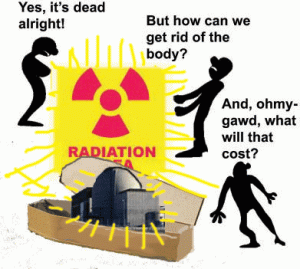
Ontario’s Unfunded Nuclear Decommissioning Liability is in the $18-$27 Billion CAD Range
https://tinyurl.com/5a9du4mz Editorial Team, August 6 2021 Late last year I worked up the likely amount of public money that would have to be thrown at the nuclear industry in order to successfully and safely decommission the 100 operational reactors and the now shut down ones. Unsurprisingly, the nuclear industry had been very optimistic in its estimates of decommissioning costs and timeframes, when the global empirical averages were trending to a billion USD and 100 years per reactor.
Recently I was asked by an Ontario journalist what I thought the likely situation in Ontario would be, and whether the decommissioning trusts were equally underfunded. I was unsurprised to find that Canada is in the same boat as the US, with highly optimistic schedule and cost projections which belie Canadian empirical experience with the CANDU reactor, and that the fund had nowhere near the money necessary for the job. Let’s run the numbers. [diagram on original]
Ontario Power Generation (OPG) is the chunk of the provincial utility that was carved apart in the late 1990s by the Mike Harris Conservatives to handle generation alone. It operates 18 aging CANDU reactors across three sites: Bruce, Pickering, and Darlington.
Table of operational nuclear generation reactors in Ontario
OPG has a nuclear decommissioning fund of about $5 billion CAD or US$4 billion right now. If the experience of other countries on the actual cost of a billion USD per reactor and an actual timeline of decommissioning of a century holds true, and I see no reason why it doesn’t, that means that there is currently a $17.5 billion CAD gap in Ontario, in addition to the existing $19.3 billion CAD in debt still being serviced from their construction. When the government of the era split up the utility, it moved all of the debt off of the components and into general debt. One of the many appropriate and sensible things that the McGuinty Administration did in the 2000s, in addition to shutting down coal generation entirely, was to move the debt back into the utility and set about servicing it from utility bills.
Most of the reactors at Bruce Nuclear are aging out, with several over 40 years old and the remainder approaching 40. Darlington’s are around 30, so they have a bit of runway. Pickering’s reactors are going to be shut down in 2024 and 2025 and start decommissioning in 2028. While refurbishment could bridge Ontario’s for another 20 years in many cases, that’s expensive and typically won’t pass any economic viability assessment compared to alternatives.
The likelihood is that all reactors in Ontario will reach end of life by 2035, and be replaced by some combination of renewable energy and HVDC transmission from neighboring jurisdictions, with both Manitoba and Quebec having excellent, low-carbon hydroelectric to spare.
Does the empirical experience of shutting down CANDU reactors track to the roughly billion USD that’s seen for other reactors? According to the World Nuclear Association, no.
The fourth unit is Gentilly 2, a more modern Candu 6 type, which was shut down at the end of 2012 after 30 years operation. It is being defuelled and the heavy water was to be treated over 18 months to mid-2014. A decommissioning licence was issued for 2016 to 2026 and the main part of the reactor will be closed up and left for 40 years to allow radioactivity to decay before demolition. All 27,000 fuel bundles are expected to be in dry storage (Macstor) by 2020. The decommissioning cost is put at C$ 1.8 billion over 50 years.”
That translates to US$1.44 billion, so it would appear as if CANDUs are on the expensive side to decommission. If that holds true, Ontario’s gap is actually in the range of $27 billion CAD.
Nuclear decommissioning funding comes from reactors operating revenue. In the US, it’s 0.01 to 0.02 cents per kWh as a set aside. I wasn’t able to find the required set aside for Ontario’s fleet, but obviously they aren’t setting aside sufficient funds now, or have absurdly optimistic fund growth expectations. They only have a decade to set aside more money from operating reactors, and have only set aside $5 billion CAD after 50 years, so the most generous assumption is that they will set aside perhaps $7 billion CAD in the OPG fund by end of life of the reactors, and have a liability for decommissioning of $15.5 to $27 billion CAD. For the next step, let’s assume $20 billion CAD for the sake of round numbers.
Given the likelihood of all of Ontario’s reactors being off of the grid by 2035, with major decommissioning occurring every few years until then, the kWh generated by Ontario’s nuclear fleet from now through 2060 will be in the range of about 1000 TWh assuming there are no lengthy outages at any of the plants, which to be clear is an awful lot of low carbon electricity.
However, $20 billion is a big number too. It turns into about 19 cents per kWh if you only count electricity generated from today through end of life for the reactors. It’s obviously a lot lower if you calculated from beginning of the lifetime of the reactors. However you count it though, that’s only the unfunded Ontario liability, and it’s on top of subsidized security costs Canada and Ontario and municipalities bear, and it’s on top of the outstanding $19.3 billion in debt that has only been receiving servicing on the interest since the McGuinty government brought it back into the utility. It’s likely that the majority of that debt will be outstanding in 2035 still, as it has gone from $20 billion to $19.3 billion in the last 11 years, so expecting it to be gone by 2035 is not realistic.
So yes, Ontario’s nuclear program will be a fiscal burden on Ontarians to the tune of around $40 billion CAD which will be spent through roughly 2135, finally being paid off by the great-grandchildren of babies born in 2021.
Nuclear, the gift that keeps on giving.
This article was originally published by Cleantechnica.com.
Read the original article here.
1 This Month

Read the Public Inquiry Report, the Commissioners’ report, Surrendering Australia: The AUKUS Deception is available to download for free at aukuspublicinquiry.com. Or just watch the replay of the National Press Club Luncheon.


19 November – Webinar – The Reality of Reprocessing
Time: 11:00 AM Pacific Time (US & Canada) / 2:00 PM Eastern / 7:00 PM UK / 8:00 PM CET
Register for the Zoom Event Here



Shut down the radiation-damaged Heysham nuclear reactors now
To see nuclear-related stories in greater depth and intensity – go to https://nuclearinformation.wordpress.com

Say No to NASA’s Reckless Nuclear Reactor on the Moon
Say No to NASA’s Reckless Nuclear Reactor on the Moon
-
Archives
- November 2026 (94)
- October 2026 (302)
- September 2026 (339)
- August 2026 (330)
- July 2026 (355)
- June 2026 (287)
- May 2026 (306)
- April 2026 (356)
- March 2026 (251)
- February 2026 (267)
- January 2026 (308)
- December 2025 (358)
-
Categories
- 1
- 1 NUCLEAR ISSUES
- business and costs
- climate change
- culture and arts
- ENERGY
- environment
- health
- history
- indigenous issues
- Legal
- marketing of nuclear
- media
- opposition to nuclear
- PERSONAL STORIES
- politics
- politics international
- Religion and ethics
- safety
- secrets,lies and civil liberties
- spinbuster
- technology
- Uranium
- wastes
- weapons and war
- Women
- 2 WORLD
- ACTION
- AFRICA
- Atrocities
- AUSTRALIA
- Christina's notes
- Christina's themes
- culture and arts
- Events
- Fuk 2022
- Fuk 2023
- Fukushima 2017
- Fukushima 2018
- fukushima 2019
- Fukushima 2020
- Fukushima 2021
- general
- global warming
- Humour (God we need it)
- Nuclear
- RARE EARTHS
- Reference
- resources – print
- Resources -audiovicual
- Weekly Newsletter
- World
- World Nuclear
- YouTube
-
RSS
Entries RSS
Comments RSS

