European Union passes sustainable taxonomy law, but postpones decision about nuclear power.

“The commission must deliver a science-based taxonomy regulation that excludes fossil gas, nuclear, and factory farming. Otherwise, the credibility of the taxonomy is ruined.”
EU green taxonomy becomes law, gas and nuclear postponed, Institutional investors have signalled they want a taxonomy that is based on science – not political compromise. euobserver, By WESTER VAN GAAL 11 Dec 21,
BRUSSELS, The first two chapters of the sustainable taxonomy, the EU’s ambitious labelling system for green investment, were passed on Thursday (9 December).
Until midnight on Wednesday, EU member states had time to reject this first set of rules – the so-called ‘first delegated act’.
But despite opposition from a group of countries, the proposal passed and will come into force on 1 January 2022. It will describe the sustainable criteria for renewable energy, car manufacturing, shipping, forestry and bioenergy and more, and include a “technology-neutral” benchmark at 100 grams of CO2 per kilowatt-hour for any investments in energy production.
The criteria for the list has mainly been compiled by the Sustainable Finance Platform, a group of 57 NGOs, scientific and financial experts, making the first part of taxonomy “science-based”…..
The European Commission will now likely unveil the second delegated act on 22 December.
This will describe how nuclear and gas will be labelled under the taxonomy. But the process has become highly-politicised over the last months.
Second act
In a meeting of member states on 29 November the project nearly faltered.
An EU diplomat, speaking anonymously, explained to EUobserver that a French-led group of 13 member states tried to block the first list “out of principle” – because the commission had not agreed to include nuclear and gas in the green taxonomy.
France and Finland pushed for nuclear to be “fully part of the taxonomy.” Ten other mainly eastern European countries want gas included. Sweden joined the group because the new rules endanger its forestry sector.
The group tried to gain a supermajority of 15 to force the commission’s hand but fell short. Germany and Italy abstained, but did not respond to requests for explanation made by EUobserver.
The commission will now decide how to label nuclear and gas before the end of the year, and it is not yet clear how the issue will pan out…………..
Whatever the commission will decide, only a supermajority in the council – 15 member states – or a parliamentary majority can block the second delegated act. Both are unlikely.
What next?
Institutional investors have already signalled they want a taxonomy based on science, not political compromise.
This will “harm the objective-scientific, transparent character of the taxonomy and increases the risk of ‘greenwashing’. Europe promised the world climate leadership, it is time to show it,” a group of banks wrote this week.
Sebastien Godinot, a senior economist at WWF and member of the EU’s Sustainable Finance Platform, said the commission must not give in to blackmail and bullying.
“The commission must deliver a science-based taxonomy regulation that excludes fossil gas, nuclear, and factory farming. Otherwise, the credibility of the taxonomy is ruined.”
But the commission may have no choice but to compromise between the gas and nuclear-supporting member states on one side, and countries opposing these on the other – while also being mindful that investors and experts from its Sustainable Finance Platform will reject a system containing contradictory political concessions. https://euobserver.com/climate/153776
Inside information from China could sink the French nuclear flagship EPR.
 | |||

Image – by Eva Stegen
Maxron says –
''we are building nuclear power plants 6 new epr klima blablabla''
Inside information from China could sink the French nuclear flagship EPR https://www.ausgestrahlt.de/blog/2021/12/09/insider-infos-aus-china-k%C3%B6nnen-franz%C3%B6sisches-atomflaggschiff-epr-versenken/ 09.12.2021 | Eva Stegen In 1989, in response to Chernobyl, development of a third generation reactor began. The European pressurized water reactor EPR has not yet generated a kilowatt hour in Europe. Despite multiple disasters, no one pulled the rip cord. Now a whistleblower reveals a system error that should be the end of the EPR.
Some people either have nerves of wire, no self-esteem or the deep certainty that any nonsense they utter will be whipped into all media via the international press agencies, just as if one did not have to check a completely absurd announcement at least once. But it is so, the French emperor is naked. He just yelled out to the press that he wanted to have six more reactor construction sites for the fiasco flagship EPR (European pressurized water reactor) when a whistleblower tore the last scrap of material off his body. It was a French nuclear engineer who had an in-depth look at the EPR reactors in Taishan, China. They are the only two – out of 200 announced – that ever went online.
There it was just ………
However, one of the two is offline again after just 2.5 years of operation. With an unknown outcome. Evidence is growing that a design flaw affecting the entire EPR series has led to Taishan 1 being switched off. The whistleblower gave the radiation research institute ‘CRIIRAD’ important detailed technical information from Taishan. CRIIRAD, in turn, put a series of questions to the French nuclear regulator, ‘Autorité de Sûreté Nucléaire’, ASN.
The silence of those who knew it
A copy was sent to the news agency ‘AFP’, but miraculously the horror news did not spread as rapidly as Macron’s ludicrous announcement to sink further billions in further ‘EPR’ flop construction sites. With every additional day on which neither the operator nor the nuclear regulatory authority deny ‘ASN’, this hypothesis of the design flaw, which affects all ‘EPR’, becomes more important.
In June 2021, a CNN report from Taishan, China caused a stir. There was talk of an “imminent radiological threat” in a letter from the French consortium partner “Framatome” to the US Department of Energy, which “CNN” has received. The Chinese security authorities were accused of having raised the radiation limit values for the outside area around the nuclear power plant in order to circumvent the shutdown of the defective reactor block.
Where do the radioactive gases come from?
As early as October 2020, defects were found on the cladding tubes of some fuel elements, which led to the escape of radioactive gases in the reactor pressure vessel. Despite the radiological risks for workers and residents, the nuclear power plant continued to operate. First of all, according to Bruno Chareyron from ‘CRIIRAD’. This duct damage is quite normal, something like that happens. In fact, however, the degree of damage to the cladding tubes and the gas leaks in the reactor have steadily worsened since it was loaded with fuel in autumn 2020.
The operators have asked the authorities to increase the limit value, above which the reactor must be shut down. The authorities would have doubled the value , but as the contamination continued to rise, the new warning threshold was exceeded at the end of May 2021. This continued until the shutdown on July 30, 2021. In August, the fuel rods began unloading. Nobody knows when or whether the reactor can ever start again.
Thanks to the whistleblower’s insider knowledge, ‘CRIIRAD’ is now able to track down the causes of the defective ducts, which the investigative satirical magazine ‘le Canard enchaîné’ described as “knots in the pipelines”. The cameras that the Chinese had brought into the heart of the EPR, in the reactor pressure vessel, were supposed to check the thesis that the zirconium cladding tubes that protect the uranium fuel rods are unusually corroded.
In addition to the risk of pipe rupture in the primary circuit, there is also the risk that the grids, which are intended to hold the fuel elements in position in the reactor pressure vessel, are damaged by the vibrations. If this structure is weakened , Chareyron explained , it is conceivable that in the event of an earthquake the clusters of fuel and control rods would swing against the inner walls of the container. A deformation induced in this way could mean that the control rods, which are actually supposed to brake the nuclear chain reaction, cannot retract.
Bad Vibrations from Olkiluoto and the scandal forge Le Creusot
As early as 2018, the Finnish electricity supplier ‘TVO’ and the Finnish safety authority ‘STUK’ reported that during tests on the Olkiluoto EPR permanent construction site, vibrations had occurred in the primary circuit on the reactor pressure vessel .
But as early as 2007/08 hydraulic model tests at the scandal-shrouded nuclear component manufacturer in Le Creusot brought the vibration problem to light. That is why ‘CRIIRAD’ asks the nuclear supervisory authority about the failed attempt to reduce the flow of water with the help of a baffle that was attached under the reactor core in order to influence the hydraulics and thus the vibrations. The vibration problem is obviously inherent in the system and affects not only the Taishan blocks but also Olkiluoto, Flamanville and Hinkley Point C. In short, all Generation 3 reactors that were once touted as “inherently safe”.
Corecatcher not catchy
In addition to carbon-brittle forging errors, messed up welds and inferior concrete, there are also vibrations of the artfully knotted pipeline design. The once-praised core catcher, which was supposed to catch a melted reactor core, apparently also gives the engineers a headache. If a large fragment of the container were to block the slide to the catcher, the corium would not flow into the catcher, according to the confidential account. But the naked Emperor Macron never tires of loudly proclaiming his atomic illusions. If the idea of the third generation of EPR reactors, which incidentally dates back to 1989, doesn’t work, you can tell the same nonsense again. Simply use the same “climate saver” texts again, just replace generation 3 and EPR with generation 4 and SMR. Apparently, the president is sure that the news agencies and the associated copy-paste editorial offices are already creating the appropriate mental cinema for EU citizens. Because he wants taxonomy money from them, for even more atomic illusions.
‘The Catalog of Nuclear Death’: The U.S.’s Hair Raising Plan to Obliterate Russia

‘The Catalog of Nuclear Death’: The U.S.’s Hair Raising Plan to Obliterate Russia, The U.S. Air Force’s titled 1956 Atomic Weapons Requirement Study outlined all the targets it planned to hit if World War III broke out and how many bombers and nuclear weapons it would need to get the job done. In short, the report is a catalog of nuclear death. The National Interest, by WarIsBoring 10 Dec 21, Here’s What You Need to Know: The Air Force’s 1956 Atomic Weapons Requirement Study detailed the U.S.’s nuclear plan to attack Russia if the need should ever arrive.
In one scene from Stanley Kubrick’s iconic Cold War film Dr. Strangelove, an irate president Merkin Muffley refuses to get on board with a massive nuclear attack already in progress. Played by Peter Sellers, Muffley is trying to decide what to do after a rogue U.S. Air Force general sends his planes to bomb the Soviet Union.
“You’re talking about mass murder, general, not war!” Muffley angrily tells George C. Scott’s Gen. Turgidson, after the officer suggests the impending strikes could actually work. “Mr. President, I’m not saying we wouldn’t get our hair mussed,” Turgidson quips.
“But I do say no more than 10 to 20 million killed … tops,” the general stammers. “Uh, depending on the breaks.”
Released to a public faced with the ever present threat of nuclear annihilation in 1964, Kubrick probably had no idea just how close he was to the truth. Eight years earlier, the Air Force put together a report detailing how to obliterate the Soviet Union, China and their allies.
The National Security Archive at George Washington University obtained the document through a Mandatory Declassification Review and released it online on Dec. 22, 2015.
The flying branch’s blandly titled 1956 Atomic Weapons Requirement Study outlined all the targets it planned to hit if World War III broke out and how many bombers and nuclear weapons it would need to get the job done. Over the course of more than 800 pages, intelligence analysts identified more than 2,000 potential “designated ground zeroes” in the Soviet Union and elsewhere, including both military bases and cities.
“The SAC study includes chilling details,” William Burr, a nuclear researcher and analyst at the National Security Archive, wrote along with the release. “According to its authors, their target priorities and nuclear bombing tactics would expose nearby civilians and ‘friendly forces and people’ to high levels of deadly radioactive fallout.”
In short, the report is a catalog of nuclear death.
In 1956, Washington no longer had a monopoly on atomic bombs, but appeared to be winning the nuclear arms race. While Moscow had set off its first atomic weapon seven years before, the Pentagon had already started fielding even more powerful thermonuclear hydrogen bombs.
With long-range ballistic missiles still in development, the Air Force relied on a fleet of lumbering bombers and faster fighters to lob the nuclear arsenal in any actual war. The attack would come from warplanes armed with free-fall bombs or from early cruise missiles like the much maligned Snark………………
Those targets or target complexes that do not have a direct bearing on the destruction of SovBloc air power objective are part of the systematic destruction objective,” the authors explained. “The importance of the latter is not minimized.”
H-bombs would be reserved for important military targets, like air bases. American planes would drop atomic bombs on the rest……
The report includes a five-page key to every single category that might appear in the voluminous lists of bombing targets. It includes country codes for various facilities in all eight members of the Warsaw Pact. Depending on the type of target, three digit identifiers for Communist China, North Korea, North Vietnam and pre-Shah Iran might also be present.
Every single entry has a special eight-number code corresponding to an entry in a master “bombing encyclopedia.” The first four digits indicate a general zone, while the last four digits indicate the particular site or collection of sites within that particular area. This recording method theoretically allows for up to 9,999 individual targets within a given space.
The analysts clearly tried to pick out anything and everything that might have any effect on the war effort, from facilities producing cutting tools to rubber tires to the antibiotic streptomycin. Most notably, the Air Force defined “275” as the code for “population.”
“The authors developed a plan for the ‘systematic destruction’ of Soviet bloc urban-industrial targets that specifically and explicitly targeted ‘population’ in all cities, including Beijing, Moscow, Leningrad, East Berlin and Warsaw,” Burr pointed out. “Purposefully targeting civilian populations as such directly conflicted with the international norms of the day, which prohibited attacks on people per se (as opposed to military installations with civilians nearby).”
But other contemporary sources make it abundantly clear the Pentagon saw any person tied to a war effort as a viable military target. A now declassified 1952 U.S. Navy film on chemical and biological warfare specifically states a goal “to incapacitate the enemy’s armed forces and that portion of his human population that directly supports them.” With similar thoughts in mind, the U.S. Army had looked into radiological warfare and built deadly dirty bombs………
“The anonymous authors may not have been scientists,” Burr said. “But in light of the 1954 Castle Bravo test, which spread radioactive debris globally, they should have known better.”……. This first appeared in WarIsBoring here. https://nationalinterest.org/blog/reboot/catalog-nuclear-death-uss-hair-raising-plan-obliterate-russia-197705
.
Nuclear Command and Control Satellites Should Be Off Limits – here’s why
|

Nuclear Command-and-Control Satellites Should Be Off Limits https://www.defenseone.com/ideas/2021/12/nuclear-command-and-control-satellites-should-be-limits/187472/ Blowing up some satellites causes problems. Blowing up these could cause nuclear war. By JAMES ACTON and THOMAS MACDONALD, DECEMBER 10, 2021
When Russia blew up an old satellite with a new missile on November 15, it created an expanding cloud of debris that will menace the outer space environment for years to come.
Hypersonic fragments from the collision with Moscow’s ground-launched, anti-satellite weapon risk destroying other satellites used for communications, meteorology, and agriculture. They even pose a danger to China’s Tiangong Space Station and the International Space Station, where personnel—including Russia’s own cosmonauts—were forced to don spacesuits and flee into their escape capsules ahead of approaching debris.
But the greatest danger that this careless stunt highlighted is to a different potential target: high-altitude satellites used for nuclear command and control. Those critical satellites face the threat of being attacked by co-orbital anti-satellite weapons, that is, other spacecraft with offensive capabilities. Destroying a nuclear command-and-control satellite, even unintentionally, could lead a conventional conflict to escalate into a nuclear war. As such, the United States, China, and Russia have a shared interest in ensuring the security of each other’s high-altitude satellites.
Satellites are integral to the United States’ nuclear command-and-control system. They would be the preferred means to transmit a presidential order to use nuclear weapons and would provide the first warning of an incoming nuclear attack. Russia uses satellites for similar purposes, even if it appears not to rely on them quite as much as the United States. While little is publicly known about China’s nuclear command-and-control system, the U.S. Department of Defense has assessed that China is in the process of developing a space-based early-warning system.
The most important nuclear command-and-control satellites—those for communications and early warning—are located in high-altitude orbits. Fortunately, most are strung out about 22,500 miles above the equator—far above the debris from Russia’s ground-launched anti-satellite weapon test. These satellites, however, are growing more vulnerable, particularly to co-orbital anti-satellite weapons.
Nuclear command-and-control satellites might be attacked deliberately, as the prelude to a nuclear war. In a conventional conflict, if China, Russia, or the United States decided to use nuclear weapons first—or believed that its opponent was about to do so—it might try to degrade the adversary’s nuclear command-and-control system preemptively. China, for example, might attack U.S. early-warning satellites to weaken the United States’ homeland missile defenses. Conversely, the United States might target Chinese communication satellites to interfere with Beijing’s ability to wield its nuclear forces.
In a conventional war, however, nuclear command-and-control satellites might be attacked and threatened for altogether different reasons—creating the risk that nuclear war might be triggered inadvertently. The United States, in particular, is deeply reliant on satellites to enable conventional operations. Moreover, most, if not all, nuclear command-and-control satellites also support nonnuclear missions—making them tempting targets even in a purely conventional conflict. For example, some U.S. satellites transmit orders to both U.S. conventional and nuclear forces. Russia might attack these satellites to try to undermine the United States’ ability to prosecute a conventional war, but with the added and unintended effect of degrading the U.S. nuclear command-and-control system.
Washington would be hard pressed to determine the intent behind such attacks. It could easily misinterpret them as preparations for a nuclear war and respond accordingly. It might threaten to use nuclear weapons unless its adversary backed off. In fact, the Trump administration’s nuclear policy explicitly threatened the use of nuclear weapons in precisely this circumstance. The Biden administration can and should remove this threat as part of its ongoing Nuclear Posture Review.
To make matters worse, it might not take actual attacks against nuclear command-and-control satellites to spark this kind of escalation. Satellites in high-altitude orbits are periodically moved to different positions to optimize their performance. Especially in a conventional conflict, a repositioning operation that led one spacecraft to approach a nuclear command-and-control satellite might appear to the latter’s owner as the beginning of an attack against its nuclearcommand-and-control system. Once again, the potential consequences could be catastrophic.
“Keep-out zones” around high-altitude satellites would be a straightforward way to mitigate these risks. Specifically, the United States, China, and Russia should agree not to maneuver their spacecraft within a certain distance—we propose 430 miles—of one another’s high-altitude satellites. (Exceptions could be made to accommodate occasional repositioning under tightly controlled conditions. Most importantly, the state conducting the maneuver should warn the others at least 24 hours in advance.)
In a conflict, if the belligerents had no intention of attacking each other’s high-altitude satellites, they would have strong reasons of self-interest to respect keep-out zones. If a state did seek to launch such attacks, keep-out zones couldn’t stop it from doing so—but they would buy time that the targeted state could use to try to evade the attack.
Negotiating keep-out zones during a conflict, when they would be most useful, would be next-to impossible. So, Washington, Beijing, and Moscow shouldn’t wait—they should start negotiating right away.
James M. Acton is co-director of the Nuclear Policy Program and holds the Jessica T. Mathews Chair at the Carnegie Endowment for International Peace. Thomas D. MacDonald is a fellow in the Nuclear Policy Program.
The shutdown of Germany’s last nuclear power plant could enable Germany’s North to cover 160% of its electricity needs with renewables.

The shutdown of the last nuclear power plant in Schleswig-Holstein will boost wind power in the northern German state, its environment minister Jan Philipp Albrecht (Greens) expects. “Nuclear power is clogging our grids, especially in the direction of the south,” Albrecht told press agency dpa in an article carried by Focus Online.
Due to grid bottlenecks, offshore wind turbines would have to be switched off in some cases. “The importance of nuclear power as a whole is therefore overestimated,” he added.
After the shutdown of the nuclear plant at the end of this year, the north of Germany could cover 160 percent of its electricity needs with renewable energy and there will be more wind power exports to the south, Albrecht said.
Fears of power blackouts due to the nuclear phaseout are unfounded, he said. “After all, we will continue to massively expand renewable energies in Germany now. In the future, we will not be dependent on nuclear power being generated in France.”
Clean Energy Wire 9th Dec 2021
Turkey’s nuclear plans threaten Eastern Mediterranean ecosystems
Turkey’s nuclear plans threaten East Med ecosystems, ekathimerini.com, Elias G. Hadjikoumis, 10 Dec 21, Turkey has had plans to establish nuclear power plants since the 1970s, and these plans have become a key aspect of the country’s goal of economic development and growth. The Akkuyu Nuclear Power Plant (ANPP) is the first. Turkey and Russia ratified the agreement to construct the plant in May 2010. The agreement indicated that Akkuyu NGS Elektrik Uretim Corp, a subsidiary of Rosatom, would construct, own and operate the plant. The nuclear power plant is to comprise four reactors. While the major construction activities began in March 2018, the first reactor unit is expected to be operational in 2023 and the remaining units in 2026. Once complete, the plant is seen covering 10% of the country’s total electricity supply. Turkey also intends to build two nuclear power plants on the Black Sea coast to meet energy demands. Although the plants would give the country clean [?] energy and make it energy-independent, there are numerous negative environmental effects associated with the generation of nuclear energy, and these pose a threat to Turkey’s neighboring countries as well as Turkey itself.
Nuclear is considered a clean source of energy because no carbon dioxide is emitted during operation, however, all activities related to building and running a plant lead to the production of high amounts of CO2, including the current construction and plant development processes at Akkuyu. Additionally, the plant will use uranium as its main source of fuel, whose extraction processes release great amounts of CO2 into the atmosphere.
The power plant is located close to the Eastern Mediterranean, a region which comprises a vast set of coastal and marine ecosystems that deliver valuable benefits to all its coastal inhabitants. The region is set to experience negative environmental changes because of the huge amounts of water that will be required to cool the plant’s reactors. Pumping the seawater used to cool the four reactors back into the sea could lead to an 80% increase in water temperatures (2 to 5 degrees Celsius). The temperature rise would affect the area’s marine diversity. Environmentalists expect a decline in the number of fish because the high temperatures would probably kill most of them and reduce the egg-laying capacity of the rest. The high temperatures will also make the marine environment uninhabitable for a colony of Mediterranean monk seals and a very rare species of sea daffodil (Pancratium maritimum).
ANPP will affect countries around Turkey, especially Cyprus and Greece. Greece has already raised the alarm due to the lack of significant evaluation of the project and any protective measures for the environment and its neighbors. In fact, there were claims that the evaluation process for the plant was never concluded in Turkey. It is said that the government was influenced to hasten and conclude the evaluation process to favor its establishment in the specified site, which many consider unsafe because of the seismic activity in the area.
The European Parliament has called on the Turkish government to halt construction of the plant, citing the location of the construction site in a region prone to severe earthquakes. According to the European Parliament, the location of the site in a region prone to earthquakes poses a threat to Turkey and the entire Mediterranean region. The facility is situated 16 miles from the Ecemis fault line at the meeting point of the Eurasian and African tectonic plates. The fault was initially believed to be inactive when the nuclear plant’s site license was issued in 1976. However, scientific studies published in recent decades have shown that the fault is active. A nuclear engineering professor from an Istanbul university, one of the original nuclear engineers who signed the site license in 1976, indicates that the current construction is based on ignorant planning
and may pose a considerable threat to the Mediterranean region……………..
So far, no consultations have been held with neighboring countries. Commenting on the issue, a representative of the European Commission indicated that Turkey was not a party to international conventions, requiring countries to consult their neighbors over the environmental effects of major projects. The EU representative emphasized that Turkey is expected to align its legislation with EU requirements on such projects………
the greatest concern in the development of ANPP is radioactive waste in the East Medn region. Turkey has not yet signed the Joint Convention on the Safety of Spent Fuel Management and on the Safety of Radioactive Waste Management which came into effect in June 2001. Burying radioactive waste in the region would make it uninhabitable and in the event of an accident, the radioactive leak would be catastrophic to the environment. Local observers have already raised these issues. The observers argue that there has not been any clear explanation as to how Rosatom will dispose of the radioactive byproduct material generated by the nuclear plant. They fear that the site may even become a Russian nuclear dumpsite.
In conclusion, the nuclear project is a threat to Turkey and its neighbors. Its location in earthquake-prone areas and its anticipated negative environmental impact mean that the international community should put it on hold until a further assessment is carried out to determine its environmental viability. The project should be placed on hold because Turkey is not a signatory of international conventions and hence not obliged to consult with neighboring nations. The lack of consultations means that Turkey does not adequately account for the negative externalities arising from the plant on neighboring countries such as Greece and Cyprus.
Further assessment is needed to determine the effect of the plant on marine life and the potential negative effects owing to the vulnerability of Turkey and the Mediterranean region to earthquakes. The project was initiated and started even before a full commission and evaluation had been done and Turkey’s energy policies and prospects have a short overview, increasing the likelihood of an accident or lack of appropriate measures to contain any accidents in the region. The international community should take a strict position vis-a-vis the project, asking for close and consistent monitoring of all the nuclear development activities and future operations of the plant. https://www.ekathimerini.com/opinion/1173463/turkey-s-nuclear-plans-threaten-east-med-ecosystems/
Taishan Problems An investigation is still under way into leaks at nuclear power plant.

nuClear News No 136 Dec 21, Taishan Problems An investigation is still under way into the cause of problems at the Chinese EPR plant in Taishan. It was shut down in August after reports of damage to fuel rods. The plant is operated by CGN and owned in partnership with EDF, the two companies involved in building Hinkley Point C (HPC).
The Times (1) has reported that key safety components at HPC may need to be redesigned and the project delayed after defects were detected at a similar reactor in China. The newspaper says the scheduled start date for electricity generation, of June 2026, may have to be postponed.
The Commission for Independent Research and Information on Radioactivity (CRIIRAD), a French association created in the aftermath of the Chernobyl disaster, said that a whistleblower had reported to them that a design flaw in the reactor pressure vessel could be the cause of the problem at Taishan which means that design changes may be needed.
In a letter to the French nuclear regulator (2), ASN, CRIIRAD says: “In June 2021, the national and international press widely covered the case of the problems of ruptured nuclear fuel cladding at the Taishan 1 EPR reactor in China.”
It goes on to say there are several possible causes of the rupture some of which may involve design flaws in the reactor. A whistleblower has now told CRIIRAD that the ruptures are caused by a design flaw in the reactors pressure vessel. This will also cause problems in other EPR reactors like Hinkley Point C.
The letter continues: “If they are true, these revelations raise serious questions in terms of nuclear safety and radiation protection, both for plant workers and for residents. The existence of a generic design defect on the EPR reactor vessel could jeopardize the start-up of [other EPR reactors].”
Stop Hinkley spokesperson, Roy Pumfrey says:
“What’s been cobbled together to get Taishan started clearly isn’t working. It’s just another example of the folly of complex designs for big new nuclear reactors. Trying to identify and correct the design flaw can only lead to further delays and cost overruns for the absurdly expensive HPC project.”
“Stop Hinkley will be pressing the UK’s Office of Nuclear Regulation for a full disclosure of its investigations into this matter. And if there are expensive delays and modifications to HPC required, given the already huge cost to consumers, we will be asking government officials to investigate whether, in fact, it would be cheaper to cancel the whole thing.”
Eva Stegen, German blogger and energy consultant says the whistleblower gave the radiation research institute ‘CRIIRAD’ important detailed technical information from Taishan. With every additional day on which neither the operator nor the French nuclear regulatory authority – ASN – deny, the hypothesis that the design error affects all EPRs, Taishan’s problems become more important. She reminds us that in June 2021, a ‘CNN’ report from Taishan, China caused a stir. There was talk of an “immediate radiological threat” in a letter from the French consortium partner “Framatome” to the US Department of Energy. The Chinese security authorities were accused of having raised the radiation limit values for the outside area around the nuclear power plant in order to circumvent the shutdown of the defective reactor block.
In this context, a little-noticed communication of the Institute for Radiation Protection and Nuclear Safety – IRSN – of March 31 assumes new significance: the Institute expressed concern about “abnormally high vibrations” already observed in the primary circuit of several EPR reactors. It said the overall architecture of the primary circuit piping leads to the severe vibrations in the reactor pressure vessel due to an unfavourable distribution of the cooling water. These vibrations could lead to a pipe rupture in the primary circuit and cause significant radioactive releases. This raises the question whether the entire piping architecture should not be revised
As early as 2018, the Finnish power utility ‘TVO’ and the Finnish safety authority ‘STUK’ reported that during tests at Olkiluoto, vibrations had occurred in the primary circuit at the reactor pressure vessel.
So along with carbon-brittle misfits, botched welds and inferior concrete comes the vibration problem. The once-vaunted core catcher, which was supposed to be used to contain a melted reactor core, is apparently also giving engineers a headache. If a major fragment of the vessel were to block the chute to the catcher, the corium would not flow into the catcher. (3) https://www.no2nuclearpower.org.uk/wp/wp-content/uploads/2021/12/nuClearNewsNo136.pdf
Nuclear fusion – not as clean as they say: it produces considerable amounts of radioactive trash
NuClear News No 136 Dec 21, Fusion Waste The Committee on Radioactive Waste Management (CoRWM) has published a preliminary position on the implications for decommissioning, radioactive waste management, and radioactive waste disposal associated with fusion energy. (1) CoRWM member Claire Corkhill says: “Although nuclear fusion does not produce long lived fission products and actinides, neutron capture by the fusion reactor structural materials and components forms short, moderate and some long-lived activation products. In addition to tritium emissions and contaminated materials, it is clear that there will be a need to manage radioactive materials and wastes produced by neutron activation, within regulatory controls, over the whole life cycle of a fusion reactor.” (2)
The paper itself says: “The activation of components in a fusion reactor is low enough for the materials to be recycled or reused within 100 years.”
It continues:
“Minimising the generation of long lived activation products, and tritium inventory at source, is therefore of fundamental importance in achieving the primary objective in the waste hierarchy of waste prevention. However, it is to be recognised that future generations will be committed to managing wastes arising from decommissioning and waste management plans that are predicated on extended decay storage, such as those discussed herein.”
However, the paper goes on to says that “The primary components of the fusion reactor system are likely to require disposal, including the activated front wall, blanket, divertor and vacuum vessel materials … From a radiological perspective, it is reasonable to consider that, conceptually, wastes from a nuclear fusion power programme should be compatible with geological disposal, however, they may prove challenging for disposal in a near surface facility, given the long half-life and potential mobility of 14C and 94Nb.”
“…some key activation products of concern, such as 14C and 94Nb, which are long lived, should be limited in near surface disposal facilities, given the reliance on engineered barriers to assure containment.14C poses a particular challenge given its potential mobility in the near subsurface.
“Nuclear fusion technology is advocated as not being compromised by the burden of generating long lived nuclear wastes. It is evident that this claim is challenged by the expected generation of some significant volumes of LLW and likely ILW arisings. It may be noted that the recent call for expressions of interest to accommodate siting the STEP facility makes no mention of management of the arising radioactive waste. Future dialogue with local communities needs to ensure it is as open and transparent as possible on such matters.”
The Government is consulting on proposals for a regulatory framework for fusion. The consultation closes on 24th h December. See: https://assets.publishing.service.gov.uk/government/uploads/system/uploads/attachment_da ta/file/1032848/towards-fusion-energy-uk-government-proposals-regulatory-frameworkhttps://www.no2nuclearpower.org.uk/wp/wp-content/uploads/2021/12/nuClearNewsNo136.pdf
Even when he is silenced, immobilized, locked up and hidden from public view, Julian Assange continues to shine a light on the abusive mechanisms of power.
Assange: The Masks are Crumbling https://consortiumnews.com/2021/12/10/assange-the-masks-are-crumbling/
December 10, 2021 The U.S. and its allies don’t care about press freedom beyond the extent it can be used to conduct propaganda, writes Caitlin Johnstone after the High Court’s ruling against Julian Assange. By Caitlin Johnstone
CaitlinJohnstone.com The U.S. government has won its appeal against a lower British court’s rejection of its extradition request to prosecute Julian Assange for journalistic activity under the Espionage Act. Rather than going free, the WikiLeaks founder will continue to languish in Belmarsh Prison where he has already spent over two and a half years despite having been convicted of no crime.
“As a result, that extradition request will now be sent to British Home Secretary Prita Patel, who technically must approve all extradition requests but, given the U.K. Government’s long-time subservience to the U.S. security state, is all but certain to rubber-stamp it,” writes Glenn Greenwald. “Assange’s representatives, including his fiancee Stella Morris, have vowed to appeal the ruling, but today’s victory for the U.S. means that Assange’s freedom, if it ever comes, is further away than ever: not months but years even under the best of circumstances.”
“Mark this day as fascism casts off its disguises,” tweeted journalist John Pilger of the ruling.
This ruling, which allows the U.S. to continue working to extradite a journalist for exposing U.S. war crimes, comes on the final day of Washington’s so-called “Summit for Democracy“, where the U.S. secretary of state made a grandiose show about of press freedom playing “an indispensable role in informing the public, holding governments accountable, and telling stories that otherwise would not be told.” And then adding: “The U.S. will continue to stand up for the brave and necessary work of journalists around the world.”
This ruling also comes on UN Human Rights Day.
This ruling comes on the same day two journalists formally received the Nobel Peace Prizes they’d been awarded and demanded protections for journalists in their acceptance speeches.
This ruling comes as the U.S. government pledges hundreds of millions of dollars in support for “independent media” around the world in coordination with British state media.
This ruling comes after it was revealed that the C.I.A. drew up plans to kidnap and assassinate Assange in the Ecuadorian embassy after the 2017 Vault 7 releases embarrassed the agency.
This ruling comes after it was revealed that C.I.A. proxies spied on Assange and his lawyers at the Ecuadorian embassy, thereby making a fair trial in the United States impossible.
This ruling comes after it was revealed that the U.S. prosecution relied on false testimony from a diagnosed sociopath and convicted child molester.
This ruling comes after recent investigative reports on civilian-slaughtering U.S. airstrikes reminded us why it’s so important for the press to be able to conduct critical coverage of the most powerful military force ever assembled.
The facts are in and the case is closed: the U.S. and its allies do not care about press freedoms beyond the extent that they can be used to conduct propaganda. The way journalists who offend the powerful are dealt with by the U.S. government and the way they are dealt with by the Saudi monarchy differ only in terms of speed and messiness.
The masks are crumbling. Even when he is silenced, immobilized, locked up and hidden from public view, Julian Assange continues to shine a light on the abusive mechanisms of power. He is arguably exposing them more now than ever before.
As fascism casts off its disguises, it becomes more and more important to highlight the hypocrisy, fraudulence and depravity of the people who rule our world.
Who’s Telling the ‘Big Lie’ on Ukraine?
A former U.S. intelligence official who has examined the evidence said the intelligence to support the claims of a significant Russian invasion amounted to “virtually nothing.”
But these doubts and concerns are not reflected in the Post’s editorial or other MSM accounts of the dangerous Ukraine crisis. Indeed, Americans who rely on these powerful news outlets for their information are as sheltered from reality as anyone living in a totalitarian society
ROBERT PARRY: Who’s Telling the ‘Big Lie’ on Ukraine? Consortium News, December 8, 2021 The U.S. group think still driving the Ukraine crisis began at least eight years ago, as detailed in this article by Robert Parry on Sept. 2, 2014.
Exclusive: Official Washington draws the Ukraine crisis in black-and-white colors with Putin the bad guy and the U.S.-backed leaders in Kiev the good guys. But the reality is much more nuanced, with Americans consistently misled on key facts, wrote Robert Parry. By Robert Parry Sept. 2, 2014
Special to Consortium News If you wonder how the world could stumble into World War III much as it did into World War I a century ago all you need to do is look at the madness that has enveloped virtually the entire U.S. political/media structure over Ukraine where a false narrative of white hats vs. black hats took hold early and has proved impervious to facts or reason.
The original lie behind Official Washington’s latest “group think” was that Russian President Vladimir Putin instigated the crisis in Ukraine as part of some diabolical scheme to reclaim the territory of the defunct Soviet Union, including Estonia and other Baltic states. Though not a shred of U.S. intelligence supported this scenario, all the “smart people” of Washington just “knew” it to be true.
Yet, the once-acknowledged though soon forgotten reality was that the crisis was provoked last year by the European Union proposing an association agreement with Ukraine while U.S. neocons and other hawkish politicos and pundits envisioned using the Ukraine gambit as a way to undermine Putin inside Russia.
The plan was even announced by U.S. neocons such as National Endowment for Democracy President Carl Gershman who took to the op-ed page of The Washington Post nearly a year ago to call Ukraine “the biggest prize” and an important interim step toward eventually toppling Putin in Russia.
Gershman, whose NED is funded by the U.S. Congress, wrote:
“Ukraine’s choice to join Europe will accelerate the demise of the ideology of Russian imperialism that Putin represents. Russians, too, face a choice, and Putin may find himself on the losing end not just in the near abroad but within Russia itself.”
In other words, from the start, Putin was the target of the Ukraine initiative, not the instigator. But even if you choose to ignore Gershman’s clear intent, you would have to concoct a bizarre conspiracy theory to support the conventional wisdom about Putin’s grand plan.
To believe that Putin was indeed the mastermind of the crisis, you would have to think that he somehow arranged to have the EU offer the association agreement last year, then got the International Monetary Fund to attach such draconian “reforms” that Ukrainian President Viktor Yanukovych backed away from the deal.
Then, Putin had to organize mass demonstrations at Kiev’s Maidan square against Yanukovych while readying neo-Nazi militias to act as the muscle to finally overthrow the elected president and replace him with a regime dominated by far-right Ukrainian nationalists and U.S.-favored technocrats. Next, Putin had to get the new government to take provocative actions against ethnic Russians in the east, including threatening to outlaw Russian as an official language.
And throw into this storyline that Putin all the while was acting like he was trying to help Yanukovych defuse the crisis and even acquiesced to Yanukovych agreeing on Feb. 21 to accept an agreement brokered by three European countries calling for early Ukrainian elections that could vote him out of office. Instead, Putin was supposedly ordering neo-Nazi militias to oust Yanukovych in a Feb. 22 putsch, all the better to create the current crisis.
While such a fanciful scenario would make the most extreme conspiracy theorist blush, this narrative was embraced by prominent U.S. politicians, including ex-Secretary of State Hillary Clinton, and “journalists” from The New York Times to CNN. They all agreed that Putin was a madman on a mission of unchecked aggression against his neighbors with the goal of reconstituting the Russian Empire. Clinton even compared him to Adolf Hitler.
This founding false narrative was then embroidered by a consistent pattern of distorted U.S. reporting as the crisis unfolded. Indeed, for the past eight months, we have seen arguably the most one-sided coverage of a major international crisis in memory, although there were other crazed MSM stampedes, such as Iraq’s non-existent WMD in 2002-03, Iran’s supposed nuclear bomb project for most of the past decade, Libya’s “humanitarian crisis” of 2011, and Syria’s sarin gas attack in 2013.
But the hysteria over Ukraine with U.S. officials and editorialists now trying to rally a NATO military response to Russia’s alleged “invasion” of Ukraine raises the prospect of a nuclear confrontation that could end all life on the planet.
The ‘Big Lie’ of the ‘Big Lie’
This madness reached new heights with a Sept. 1 (2014) editorial in the neoconservative Washington Post, which led many of the earlier misguided stampedes and was famously wrong in asserting that Iraq’s concealment of WMD was a “flat fact.” In its new editorial, the Post reprised many of the key elements of the false Ukraine narrative in the Orwellian context of accusing Russia of deceiving its own people.
The “through-the-looking-glass” quality of the Post’s editorial was to tell the “Big Lie” while accusing Putin of telling the “Big Lie.” The editorial began with the original myth about the aggression waged by Putin whose
“bitter resentment at the Soviet empire’s collapse metastasized into seething Russian nationalism………………..
But the truth is that the U.S. mainstream news media’s distortion of the Ukraine crisis is something that a real totalitarian could only dream about. Virtually absent from major U.S. news outlets across the political spectrum has been any significant effort to tell the other side of the story or to point out the many times when the West’s “fair and factual version of events” has been false or deceptive, starting with the issue of who started this crisis.
Blinded to Neo-Nazis
In another example, the Post and other mainstream U.S. outlets have ridiculed the idea that neo-Nazis played any significant role in the putsch that ousted Yanukovych on Feb. 22 or in the Kiev regime’s brutal offensive against the ethnic Russians of eastern Ukraine.
However, occasionally, the inconvenient truth has slipped through. For instance, shortly after the February coup, the BBC described how the neo-Nazis spearheaded the violent seizure of government buildings to drive Yanukovych from power and were then rewarded with four ministries in the regime that was cobbled together in the coup’s aftermath.
When ethnic Russians in the south and east resisted the edicts from the new powers in Kiev, some neo-Nazi militias were incorporated into the National Guard and dispatched to the front lines as storm troopers eager to fight and kill people whom some considered “Untermenschen” or sub-human.
Even The New York Times, which has been among the most egregious violators of journalistic ethics in covering the Ukraine crisis, took note of Kiev’s neo-Nazi militias carrying Nazi banners while leading attacks on eastern cities albeit with this embarrassing reality consigned to the last three paragraphs of a long Times story on a different topic. [See Consortium News’s “NYT Discovers Ukraine’s Neo-Nazis at War.”]
Later, the conservative London Daily Telegraph wrote a much more detailed story about how the Kiev regime had consciously recruited these dedicated storm troopers, who carried the Wolfsangel symbol favored by Hitler’s SS, to lead street fighting in eastern cities that were first softened up by army artillery. [See Consortium News‘s “Ignoring Ukraine’s Neo-Nazi Storm Troopers.”]
You might think that unleashing Nazi storm troopers on a European population for the first time since World War II would be a big story given how much coverage is given to far less significant eruptions of neo-Nazi sentiment in Europe but this ugly reality in Ukraine disappeared quickly into the U.S. media’s memory hole. It didn’t fit the preferred good guy/bad guy narrative, with the Kiev regime the good guys and Putin the bad guy.
Now, The Washington Post has gone a step further dismissing Putin’s reference to the nasty violence inflicted by Kiev’s neo-Nazi battalions as part of Putin’s “Big Lie.” The Post is telling its readers that any reference to these neo-Nazis is just a “fantasy.”
Even more disturbing, the mainstream U.S. news media and Washington’s entire political class continue to ignore the Kiev government’s killing of thousands of ethnic Russians, including children and other non-combatants. The “responsibility to protect” crowd has suddenly lost its voice. Or, all the deaths are somehow blamed on Putin for supposedly having provoked the Ukraine crisis in the first place.
A Mysterious ‘Invasion’
And now there’s the curious case of Russia’s alleged “invasion” of Ukraine, another alarmist claim trumpeted by the Kiev regime and echoed by NATO hardliners and the MSM.
While I’m told that Russia did provide some light weapons to the rebels early in the struggle so they could defend themselves and their territory and a number of Russian nationalists have crossed the border to join the fight, the claims of an overt “invasion” with tanks, artillery and truck convoys have been backed up by scant intelligence.
One former U.S. intelligence official who has examined the evidence said the intelligence to support the claims of a significant Russian invasion amounted to “virtually nothing.” Instead, it appears that the ethnic Russian rebels may have evolved into a more effective fighting force than many in the West thought. They are, after all, fighting on their home turf for their futures.
Concerned about the latest rush to judgment about the “invasion,” the Veteran Intelligence Professionals for Sanity, a group of former U.S. intelligence officials and analysts, took the unusual step of sending a memo to German Chancellor Angela Merkel warning her of a possible replay of the false claims that led to the Iraq War.
You need to know,” the group wrote, “that accusations of a major Russian ‘invasion’ of Ukraine appear not to be supported by reliable intelligence. Rather, the ‘intelligence’ seems to be of the same dubious, politically ‘fixed’ kind used 12 years ago to ‘justify’ the U.S.-led attack on Iraq.”
But these doubts and concerns are not reflected in the Post’s editorial or other MSM accounts of the dangerous Ukraine crisis. Indeed, Americans who rely on these powerful news outlets for their information are as sheltered from reality as anyone living in a totalitarian society.The late investigative reporter Robert Parry broke many of the Iran-Contra stories for The Associated Press and Newsweek in the 1980s. He founded Consortium News in 1995 as the first online, independent news site in the United States. https://org.salsalabs.com/o/1868/p/salsa/donation/common/public/?donate_page_KEY=14124&okay=True
Nuclear reactors in the Middle East are vulnerable to missile strikes
Report: Missile strike risks to Middle East nuclear reactors, A new study explores potential radiological fallout and evacuations from a missile strike on commercial nuclear power plants. [Excellent maps] Aljazeera, By Patricia Sabga, 8 Dec 21,
Deliberate attacks on nuclear reactors may seem almost unthinkable – unless the reactor is located in the Middle East, a region that has the dubious distinction of being the only place on the planet where aerial assaults on nuclear facilities are known to have happened.
As debate intensifies in the wake of the United Nations Climate Change Conference (COP26) over what role nuclear energy should play in global decarbonisation efforts, a new report published on Wednesday brings to light the radiological fallout and subsequent evacuations that could result if a state-of-the-art missile or drone successfully attacks an existing or planned commercial nuclear power plant in the Middle East.
Produced by the Nonproliferation Policy Education Center (NPEC), a Washington, DC-based research institute, the study offers a rare publically available analysis of conflict risks to nuclear facilities in the Middle East, warning that a successful strike on a commercial nuclear power plant there “could result in the evacuation of millions of people, many of whom would not be able to return to their homes for several decades”.
“Building large, vulnerable power reactors in the Middle East is a pretty weird way to hug Mother Earth,” NPEC Director Henry Sokolski told Al Jazeera. “It was time to spell out what the implications [of a successful missile attack] would be in a place like the Middle East, which is clearly entertaining building and operating more nuclear plants.”
Other nuclear safety experts agree.
“I think it is absolutely critical that people and communities are made aware of the very great risk involved in building nuclear [power plants] in an area of high potential conflict risk,” Paul Dorfman, an associate fellow at the Sussex Energy Group at the University of Sussex, told Al Jazeera.
The map below, [on original] for example, illustrates four current and planned commercial nuclear power plants and the evacuation footprints – including in surrounding countries – that could follow a successful aerial assault on a densely packed spent fuel pool, where discarded radioactive fuel rods are cooled before being moved to more permanent storage.
“This alarming image should prompt nations to carefully evaluate and mitigate the risks and plausible consequences of constructing and operating nuclear power reactors,” said the report…………..
Given the increased interest in nuclear energy in the Middle East, its unique history of air strikes on nuclear facilities, and the emergence of non-state actors wielding advanced military firepower, NPEC believes that any cost-benefit analysis of commercial nuclear power plants in the region needs to include a public disclosure of the potential radiological fallout and population displacements that could result from a successful aerial strike on a facility.
“There have been no fewer than 13 air strikes since the very early 80s against a variety of [nuclear] reactors [in the Middle East], mostly by air forces and attempts with very inaccurate missiles like Scuds,” said Sokolski…………….
aerial strike technology has come a long way since the early 1980s, when Israel and Iran bombed Iraq’s Osirak reactor, or even 2007, when Israel destroyed a suspected reactor under construction in Syria.
“Missiles and drones with high accuracies of 1-10 meters, one thousand times more accurate than during the 1990s,” are available to both state and non-state actors, the report warns…….. https://www.aljazeera.com/economy/2021/12/8/report-missile-strike-risks-to-middle-east-nuclear-reactors
Nuclear weapons proliferation: the great danger in the USA exporting advanced fast nuclear reactors
Letter to the Secretary of Energy Regarding Advanced Reactors, Fast Reactors, Nuclear Proliferation https://npolicy.org/letter-to-the-secretary-of-energy-regarding-advanced-reactors-fast-reactors-nuclear-proliferation/ November 29, 2021
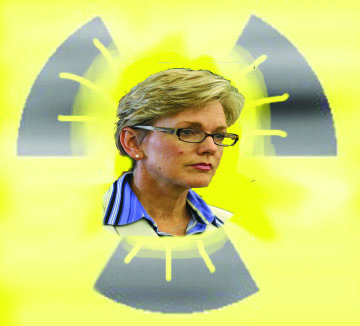
Earlier last month, Secretary of Energy Jennifer Granholm touted the Department’s commercialization of advanced fast reactors at the COPO26 Glasgow Climate Conference as a demonstration of America’s commitment to decarbonizing the planet. The State Department announced it’s organizing itself to support the export of such reactors. Yet, a day after Secretary Granholm’s COPO talk, the Pentagon determined that Beijing would acquire at least 1,000 nuclear weapons by 2030, in part, because of the super weapons-grade plutonium China could produce in its advanced fast reactors.
If the United States is serious about preventing the further spread of nuclear weapons, something has got to give. In June, I, Victor Gilinsky (NPEC’s Program Advisor), and 11 other of the nation’s leading nuclear nonproliferation experts wrote the Biden Administration and Secretary Granholm noting the nuclear weapons proliferation dangers posed by the Energy Department’s fast reactor commercialization efforts. The administration has yet to reply to that note, which called for a policy review.
Last week, I sent yet another note (below) to Secretary Granholm recalling the June 20th letter, the Pentagon’s latest China warhead findings, and fast reactor concerns.
It would be best if the United States dropped its plans to export fast reactors as these machines can be used to produce copious amounts of weapons plutonium. At a minimum, such reactors should not be exported unless and until our government can certify that it can technically assure timely warning of possible nuclear military diversions from such plants. This was the requirement that Presidents Ford and Carter demanded be met before the United States ever commercialized plutonium-based fuels. If we are still serious about preventing nuclear proliferation, our government should demand no less today.
It would be useful for the Secretary and the letter’s other addresses to clarify their position as the Department of State has already announced a $25 million-program to promote the export of U.S. advanced reactors and is presently in this business.
Letter to the Secretary of Energy Regarding Advanced Reactors, Fast Reactors, Nuclear Proliferation
November 29, 2021
The Honorable Jennifer M. Granholm
Secretary of Energy
US Department of Energy
1000 Independence Avenue, S.W.
Washington, DC 20585-1000
Re: Advanced reactors, fast reactors, nuclear proliferation
Madam Secretary:
Among the Energy Department’s “advanced reactors” that are being supported for commercialization and export are some — sodium-cooled fast reactors — that shouldn’t be for international security reasons. The natural fuel of such reactors is plutonium. In this mode they are called “breeder” reactors. If they are successful in becoming an export product—which the Department of Energy and the companies designing them advertise as a desirable goal—they will provide easy access around the world to nuclear weapons-grade plutonium. As far back as 1976, President Gerald Ford said we should not rely on plutonium fuel until the world can cope with the proliferation consequences. This determination was subsequently backed by President Jimmy Carter. Does anyone think we are anywhere near meeting this test and that we should now reverse that policy? The short answer is no.
Certainly, the Energy Department’s current enthusiasm to develop and export fast reactors is in direct conflict with the Pentagon’s trepidation about these reactors’ utility as nuclear weapons material production plants. In specific, Pentagon’s latest China military power report, released earlier this month, spotlighted two Chinese fast reactors and their associated reprocessing plants under construction and their role in helping to supply China with the weapons plutonium Beijing needs to acquire more than 1,000 nuclear weapons by 2030.
The head of the Strategic Command, Admiral Charles Richard, amplified this point earlier this year before the Senate Armed Services Committee. “With a fast breeder reactor,” he noted, “you now have a very large source of weapons grade plutonium available to you, that will change the upper bounds of what China could choose to do if they wanted to, in terms of further expansion of their nuclear capabilities.” In speaking of “a large source of weapons-grade plutonium,” Admiral Richard is referring not only to copious plutonium production, but to the “super weapons-grade” quality of about half of plutonium produced in fast reactors, a circumstance that simplifies weapon design and production. Imagine if such facilities spread globally, including to dangerous regions in Asia and the Middle East. We certainly cannot exclude the possibility that some future owners of such reactors may be interested in using these plants to make bombs.
With light water reactors, there is no need to extract plutonium. Also, as noted previously in letter to you with multiple signatures sent June 20th, there’s a major economic penalty for recycling plutonium in light water reactors versus using fresh uranium. As a result, international inspections to afford timely warning of military diversions are feasible. In contrast, with the copious quantities of “super-grade” plutonium that fast reactors produce, no such warning is yet practicable. Nor is there some technical modification of reprocessing technology that promises to make it substantially harder to access the plutonium to make bombs. Exporting “smaller” advanced nuclear plants also won’t help: Nuclear facilities, which are small in commercial terms, can, nonetheless pose very large military threats. A “small” 300 megawatt (electrical) fast reactor, for example, can produce upwards of 300 kilograms of plutonium annually, about half of which is “super-grade.” Contrast that with the requirement for a warhead, which can be as little three kilograms.
Unfortunately, nuclear enthusiasts intrigued with the breeding potential of fast reactors, especially the sodium-cooled category, have largely ignored these international security issues. Instead, they’ve lobbied for “advanced” fast reactors and reprocessing for decades. Yet, their “advanced” design dates back to the mid 1940s and so predates the light water reactor. In the 1970s, a fast reactor demonstration plant, the Clinch River Breeder Reactor, then the largest US energy project ever, was the Atomic Energy Commission’s main focus. Congress canceled it in the early 1980s because it made no economic sense. The Department of Energy, then, tried to revive the fast reactor concept during the George W. Bush administration on grounds that it would help in nuclear waste management, but that got nowhere.
The current Department of Energy flagship fast reactor commercialization demonstration project, TerraPower’s Natrium reactor, is based on an earlier General Electric-Hitachi design for a Prism reactor which is classified as a plutonium-fueled fast breeder reactor. TerraPower executives say they intend to fuel Natrium not with plutonium, but with uranium enriched to below 20 percent and that it would not require reprocessing of spent fuel. They also plan on exporting the reactor.
But fast reactors are very flexible regarding fuel use, and its customers, especially its foreign customers, will view the reactor as a potential “breeder” reactor, indeed it is the main attraction of such machines, and we expect the exporters will accommodate the customers. Consider that while TerraPower is taking advantage of the “small modular reactor” label’s cachet, TerraPower’s CEO expects customers to want the larger 1000 megawatt (electrical) size and expects to accommodate them. It is apparently still true—despite the enthusiasm over small modular reactors—that the larger sizes are more economic. I believe that once the design is established the fuel choice will revert the same way.
The Biden administration and Congress have decided to support nuclear energy as part of the effort to combat climate change. You have said that you are “very bullish on advanced nuclear reactors.” But our government’s support for advanced reactors should not be extended to fast reactors, much less their export, which would make it much easier for those so inclined to manufacture nuclear weapons. At a minimum, our government should not push their export unless and until it can certify that it can technically assure timely warning of possible nuclear military diversions. This was the requirement that Presidents Ford and Carter demanded be met before the United States ever commercialized plutonium-based fuels. If we are still serious about preventing nuclear proliferation, our government should demand no less today.
Sincerely, Henry Sokolski
Executive Director
The Nonproliferation Policy Education Center
CC: Secretary of State Antony Blinken
Administrator of the National Nuclear Security Administration Jill Hruby
Chairman, Nuclear Regulatory Commission Christopher Hansen
Nuns against nuclear weapons
Nuns against nuclear weapons – Plowshares protesters have fought for disarmament for over 40 years, going to prison for peace, https://theconversation.com/nuns-against-nuclear-weapons-plowshares-protesters-have-fought-for-disarmament-for-over-40-years-going-to-prison-for-peace-169918December 9, 2021 Carole Sargent Carole Sargent is a Friend of The Conversation. Literary Historian, Georgetown University In July 2012 Sister Megan Rice, an 82-year-old Catholic nun, and two men walked past multiple broken security cameras and into the heart of a high-security nuclear complex. Y-12 in Oak Ridge, Tennessee, was the birthplace of the atomic bomb and now stores enriched uranium for nuclear warheads. Although thanked by Congress for exposing astoundingly lax contractor security, the three were also convicted and served two years in prison.

Rice, who died in October 2021, was part of a protest tradition called Plowshares. Since 1980, there have been over 100 Plowshares actions in the U.S., the U.K. and Europe. The name comes from the books of Isaiah and Micah in the Bible: “They shall beat their swords into plowshares, and their spears into pruning hooks: nation shall not lift up sword against nation, neither shall they learn war any more.” Isaiah and Micah are accepted as Scripture by Christians, Jews and Muslims.
Civil resistance, not disobedience
Rice’s journey with Plowshares began when she retired after four decades teaching science and math in schools founded in Nigeria by her religious order, the Society of the Holy Child Jesus. At Baltimore’s Jonah House, a faith-based activist peace community, she met Sister Anne Montgomery, a Society of the Sacred Heart nun and the daughter of a prominent World War II naval commander. Montgomery became Rice’s Plowshares mentor.
Montgomery helped develop Plowshares’ legal strategies, such as attempting to put nuclear weapons on trial. This means explaining to juries that nukes have been internationally illegal since the Treaty on the Prohibition of Nuclear Weapons and even its 1968 predecessor – and also how their use violates the Geneva Conventions and other binding treaties.
When testifying, these nuns do not describe their actions as “civil disobedience,” because that would mean they did something illegal. Instead, they prefer “civil resistance,” which Montgomery called “divine obedience” to higher principles of peace.
One of Plowshares’ most effective strategies is to represent themselves in court, known as pro se, which in Latin means “for oneself.” It allows protesters, including these nuns, to discuss humanitarian law, the necessity defense – meaning you broke a small law to stop a large crime – and the U.S. 1996 War Crimes Act. Lawyers cannot discuss these issues because judges limit cases to mere trespassing or property damage. Using pro se, activists speak freely in ways that might get a real lawyer professionally reprimanded. Lawyers often do, however, stand by as advisers.
Sabotage charges
Rice wasn’t the first nun to be convicted of sabotage. Ten years earlier, Dominican Sister Ardeth Platte, who inspired the nun character on the popular Netflix prison series “Orange is the New Black,” went to prison in Danbury, Connecticut, on the same charge. Platte (pronounced Platty) spent her retirement years engaging in Plowshares and other protests at weapons sites.
In 2002, along with fellow Dominican nuns, Sister Carol Gilbert and Sister Jackie Hudson, Platte breached an intercontinental ballistic missile facility in Colorado. The three poured blood in the shape of a cross to remember victims of war. Then they rapped on the blast lid with a household hammer. The small hammers do not damage such massive weapons in any significant way. The three were accused of preventing the United States from attacking its enemies or defending itself, which is the definition of sabotage.
Just like Rice’s group and many other Plowshares activists, the three nuns carried rosaries, Bibles and other objects in small black bags. Explosives experts, however, thought they might have bombs. Attack helicopters swooped in as they sang and prayed. Police pointed semiautomatic rifles at them and shut down a nearby highway. This was an unusual reaction, since Plowshares protesters are usually stopped and arrested with far less fanfare, and it may be why the prosecutors won a sabotage conviction.
Rice’s prosecutors brought up Platte’s case during her trial, in which she and her companions were also convicted of sabotage. However, two years later an appeals court overturned it, admonishing that “no rational jury could find” they actually injured the national defense.
USA considers deploying nuclear weapons in Ukraine.

US weighing nuclear in Ukraine to deter Russia Mirage News, 9 Dec 21, ”…………… Last week U.S. President Joe Biden pledged to make it “very, very difficult” for Russia’s Vladimir Putin to take military action amid spiralling tensions with Ukraine……
“Deploying U.S. nuclear weapons in Ukraine as [deployed] on Turkish soil in 1959 to deter Soviet aggression is among the last-resort options being considered. This would make [invasion] “very, very difficult” for Russia as President Biden put it. However, this would not be a decision to take lightly.”……… https://www.miragenews.com/us-mulling-nuclear-deployment-in-ukraine-to-688776/
Scenarios of the release of radioactive ions if high precision missiles were to strike Middle East nuclear reactors.
Report: Missile strike risks to Middle East nuclear reactors, A new study explores potential radiological fallout and evacuations from a missile strike on commercial nuclear power plants. Aljazeera, By Patricia Sabga, 8 Dec 21 ” ………………Scenarios and reactors
To illustrate the potential vulnerability of a nuclear power facility to a high precision missile strike, NPEC analysed four current and planned nuclear power plants in the region for three scenarios involving the radiological release of caesium-137 (Cs-137) into the atmosphere.
“Caesium-137 is one isotope that is particularly concerning for several reasons and it’s one of the most common isotopes looked at when evaluating the danger of a nuclear accident or some kind of radioactive release,” the report’s lead researcher Eva Lisowski told Al Jazeera. “It’s dangerous enough and lasts long enough that it can cause a significant increase in the chances of developing cancer.”
Significant contamination with Cs-137 can result in hundreds of thousands of people being evacuated from their homes, the report warns, and they may not be able to return for decades, given it has a 30-year half-life.
The first scenario Lisowski modelled examined what would happen if a nuclear reactor containment building is breached by an air strike, resulting in the core being released. The second scenario mapped what would happen if a spent fuel pond were hit and a fire broke out. The third scenario assessed what would happen if a spent fuel pond that is densely packed with radioactive rods were targeted and caught fire.
The four facilities chosen for the scenarios include the UAE’s Barakah power plant, Iran’s Bushehr, the plant under construction at Akkuyu in Turkey, and the site of Egypt’s planned commercial nuclear power station at El Dabaa.
The study focused only on select commercial nuclear power reactors. Research reactors, such as the one Israel maintains at the Shimon Peres Negev Nuclear Research Center near the city of Dimona, Iran’s Tehran Research Reactor, Egypt’s research reactor at Inshas, or Algeria’s research reactor at Es-Salam were not included in the study.
Sokolski also notes that containment buildings and spent fuel ponds are not the only targets for potential sabotage.
“You can go after the electricity lines that go into the plant that are necessary to keep the cooling system operating. You can go after the emergency generators, you can calibrate any number of effects with precision against that kind of sympathetic target,” he said.
The findings
The amounts of Cs-137 released in each scenario, as well as the estimated number of evacuees in each contamination zone, were simulated for four different months of the year based on 2020 weather patterns: March, June, September and December.
The simulations all include neighbouring countries that could be affected by mandatory evacuations.
The report examined scenarios for both a large release of Cs-137 (75 percent) and a smaller release (10 percent or 5 percent) to illustrate the potential differences between a densely-packed spent fuel pool catching fire, versus one that is not full.
The three scenarios involving a missile or drone attack on the Barakah nuclear power plant predicted average population displacements ranging from 800 mandatory and 40,000 voluntary evacuations in a low-radiological release simulation involving a core breach, to 4 million mandatory and 8 million voluntary evacuations if a densely packed spent fuel pond is hit resulting in a high release of Cs-137.
The three scenarios involving a missile or drone attack on the Bushehr nuclear power plant predicted average population displacements ranging from 53,000 mandatory and 120,000 voluntary evacuations in low-radiological release simulation involving a core breach, to 6.7 million mandatory and 4.8 million voluntary evacuations if a densely packed spent fuel pond is hit resulting in a high release of Cs-137.
The three scenarios involving a missile or drone attack on the Akkuyu nuclear power plant predicted average population displacements ranging from 1,000 mandatory and 28,000 voluntary evacuations in low-radiological release simulation involving a reactor core breach, to 4.6 million mandatory and 10 million voluntary evacuations if a densely packed spent fuel pond is hit resulting in a high release of Cs-137. https://www.aljazeera.com/economy/2021/12/8/report-missile-strike-risks-to-middle-east-nuclear-reactors
1 This Month



19 November – Webinar – The Reality of Reprocessing
Time: 11:00 AM Pacific Time (US & Canada) / 2:00 PM Eastern / 7:00 PM UK / 8:00 PM CET
Register for the Zoom Event Here



Shut down the radiation-damaged Heysham nuclear reactors now
To see nuclear-related stories in greater depth and intensity – go to https://nuclearinformation.wordpress.com

Say No to NASA’s Reckless Nuclear Reactor on the Moon
Say No to NASA’s Reckless Nuclear Reactor on the Moon
-
Archives
- November 2026 (74)
- October 2026 (302)
- September 2026 (339)
- August 2026 (330)
- July 2026 (355)
- June 2026 (287)
- May 2026 (306)
- April 2026 (356)
- March 2026 (251)
- February 2026 (267)
- January 2026 (308)
- December 2025 (358)
-
Categories
- 1
- 1 NUCLEAR ISSUES
- business and costs
- climate change
- culture and arts
- ENERGY
- environment
- health
- history
- indigenous issues
- Legal
- marketing of nuclear
- media
- opposition to nuclear
- PERSONAL STORIES
- politics
- politics international
- Religion and ethics
- safety
- secrets,lies and civil liberties
- spinbuster
- technology
- Uranium
- wastes
- weapons and war
- Women
- 2 WORLD
- ACTION
- AFRICA
- Atrocities
- AUSTRALIA
- Christina's notes
- Christina's themes
- culture and arts
- Events
- Fuk 2022
- Fuk 2023
- Fukushima 2017
- Fukushima 2018
- fukushima 2019
- Fukushima 2020
- Fukushima 2021
- general
- global warming
- Humour (God we need it)
- Nuclear
- RARE EARTHS
- Reference
- resources – print
- Resources -audiovicual
- Weekly Newsletter
- World
- World Nuclear
- YouTube
-
RSS
Entries RSS
Comments RSS

