In 2022, nuclear power’s future looks grimmer than ever.

As new renewable energy capacity continues to boom, nuclear power generation declined in 2021 and the industry’s future is grimmer than it has ever been. The post In 2022, nuclear power’s future looks grimmer than ever appeared first on RenewEconomy.
In 2022, nuclear power’s future looks grimmer than ever — RenewEconomy Renew Economy, Jim Green 11 Jan 22,
The decline was marginal (<1 per cent): a net loss of two power reactors (six start-ups and eight 8 permanent closures) and a net loss of 2.5 gigawatts (GW) of nuclear capacity.
The marginal decline makes for a striking contrast with renewables. The International Energy Agency calculates that new renewable capacity added in 2021 amounted to nearly 290 GW – that’s more than four times Australia’s total electricity generating capacity.
Nuclear power’s contribution to global electricity supply has fallen from a peak of 17.5 percent in 1996 to 10.1 percent in 2020. Renewables reached an estimated 29 per cent share of global electricity generation in 2020, a record share.
The ageing of the world’s reactor fleet is a huge problem for the nuclear industry, as is the ageing of its workforce — the silver tsunami. The average age of the world’s reactor fleet continues to rise and by mid-2021 reached 30.9 years. The mean age of the 23 reactors shut down between 2016 and 2020 was 42.6 years.
Primarily because of the ageing of the reactor fleet, the International Atomic Energy Agency estimates up to 139 GW of lost nuclear capacity from 2018-2030 due to permanent reactor shutdowns, and a further loss of up to 186 GW from 2030-2050.
So the industry needs about 10 new power reactors (or 10 GW) each year just to maintain its 30-year pattern of stagnation. And there were indeed 10 reactor construction starts in 2021, six of them in China.
But the average annual number of construction starts since 2014 has been just 5.1. Thus, slow decline of nuclear power is the most likely outcome. An extension of the 30-year pattern of stagnation is possible, if and only if China does the heavy lifting. China has averaged just 2.5 reactor construction starts per year since 2011.
Phasing out nuclear power
The number of countries phasing out nuclear power steadily grows and now includes:
Nuclear power generation declined in 2021 and the industry’s future is grimmer than it has ever been.
The decline was marginal (<1 per cent): a net loss of two power reactors (six start-ups and eight 8 permanent closures) and a net loss of 2.5 gigawatts (GW) of nuclear capacity.
The marginal decline makes for a striking contrast with renewables. The International Energy Agency calculates that new renewable capacity added in 2021 amounted to nearly 290 GW – that’s more than four times Australia’s total electricity generating capacity.
Nuclear power’s contribution to global electricity supply has fallen from a peak of 17.5 percent in 1996 to 10.1 percent in 2020. Renewables reached an estimated 29 per cent share of global electricity generation in 2020, a record share.
The ageing of the world’s reactor fleet is a huge problem for the nuclear industry, as is the ageing of its workforce — the silver tsunami. The average age of the world’s reactor fleet continues to rise and by mid-2021 reached 30.9 years. The mean age of the 23 reactors shut down between 2016 and 2020 was 42.6 years.
Primarily because of the ageing of the reactor fleet, the International Atomic Energy Agency estimates up to 139 GW of lost nuclear capacity from 2018-2030 due to permanent reactor shutdowns, and a further loss of up to 186 GW from 2030-2050
So the industry needs about 10 new power reactors (or 10 GW) each year just to maintain its 30-year pattern of stagnation. And there were indeed 10 reactor construction starts in 2021, six of them in China.
But the average annual number of construction starts since 2014 has been just 5.1. Thus, slow decline of nuclear power is the most likely outcome. An extension of the 30-year pattern of stagnation is possible, if and only if China does the heavy lifting. China has averaged just 2.5 reactor construction starts per year since 2011.
Phasing out nuclear power
The number of countries phasing out nuclear power steadily grows and now includes:
Germany: Fourteen reactors have shut down since the 2011 Fukushima disaster and the final three reactors will close this year.
Belgium: The country’s seven ageing reactors will all be closed by the end of 2025.
Taiwan: Final reactor closure scheduled for 2025. Four reactors were shut down from 2018 to 2021 and only two remain operational.
Spain: Nuclear power capacity is expected to decline from 7.1 GW in 2020 to 3 GW in 2030 with the final reactor closure in 2035.
Switzerland: The government accepted the results of a 2017 referendum which supported a ban on new reactors and thus a gradual phase-out is underway. The Mühleberg reactor was shut down in 2019 and most or all of the remaining four ageing reactors are likely to be shut down over the next decade.
South Korea: Long-term (2060) phase-out policy with concrete actions already taken including the shut-down of the Kori-1 and Wolsong-1 reactors in 2017 and 2019 respectively, and suspension or cancellation of plans for six further reactors. The current plan is to reduce the number of reactors from a peak of 26 in 2024 to 17 in 2034.
Too cheap to meter or too expensive to matter?
Despite the abundance of evidence that nuclear power is hopelessly uncompetitive compared to renewables, the nuclear industry and some of its supporters continue to claim otherwise.
Those economic claims are typically based on implausible cost projections for non-existent ‘Generation IV’ reactor concepts. Moreover, the nuclear lobby’s claims about the cost of renewables are just as ridiculous.
Claims about ‘cheap’ nuclear power certainly don’t consider real-world nuclear construction projects. Every power reactor construction project in Western Europe and the US over the past decade has been a disaster.
The V.C. Summer project in South Carolina (two AP1000 reactors) was abandoned after the expenditure of at least A$12.5 billion leading Westinghouse to file for bankruptcy in 2017. Criminal investigations and prosecutions related to the project are ongoing, and bailout programs to prolong operation of ageing reactors are also mired in corruption.
The only remaining reactor construction project in the US is the Vogtle project in Georgia (two AP1000 reactors). The current cost estimate of A$37.6-41.8 billion is twice the estimate when construction began. Costs continue to increase and the project only survives because of multi-billion-dollar taxpayer bailouts. The project is six years behind schedule.
In 2006, Westinghouse said it could build an AP1000 reactor for as little as A$2.0 billion, 10 times lower than the current estimate for Vogtle.
The Watts Bar 2 reactor in Tennessee began operation in 2016, 43 years after construction began. That is the only power reactor start-up in the US over the past quarter-century. The previous start-up was Watts Bar 1, completed in 1996 after a 23-year construction period.
In 2021, TVA abandoned the unfinished Bellefonte nuclear plant in Alabama, 47 years after construction began and following the expenditure of an estimated A$8.1 billion.
There have been no other power reactor construction projects in the US over the past 25 years other than those listed above. Numerous other reactor projects were abandoned before construction began, some following the expenditure of hundreds of millions of dollars.
Western Europe
The only current reactor construction project in France is one EPR reactor under construction at Flamanville. The current cost estimate of A$30.1 billion — yes, over A$30 billion — is 5.8 times greater than the original estimate. The Flamanville reactor is 10 years behind schedule.
The only reactor construction project in the UK comprises two EPR reactors under construction at Hinkley Point. In the late 2000s, the estimated construction cost for one EPR reactor in the UK was A$3.8 billion. The current cost estimate for two EPR reactors at Hinkley Point is A$41.6-43.5 billion, over five times greater than the initial estimate of A$3.8 billion per reactor.
In 2007, EDF boasted that Britons would be using electricity from an EPR reactor at Hinkley Point to cook their Christmas turkeys in 2017, but construction didn’t even begin until 2018.
One EPR reactor (Olkiluoto-3) is under construction in Finland. The current cost estimate of about A$17.4 billion is 3.7 times greater than the original estimate. Olkiluoto-3 is 13 years behind schedule.
Nuclear power is growing in a few countries, but only barely. China is said to be the industry’s shining light but nuclear growth has been modest over the past decade and it is paltry compared to renewables (2 GW of nuclear power capacity added in 2020 compared to 135 GW of renewables).
There were only three power reactor construction starts in Russia in the decade from 2011 to 2020, and only four in India……………………………… https://reneweconomy.com.au/in-2022-nuclear-powers-future-is-grimmer-than-ever/
The European Union will need to invest 500 billion euros ($568 billion) in new generation nuclear power stations!
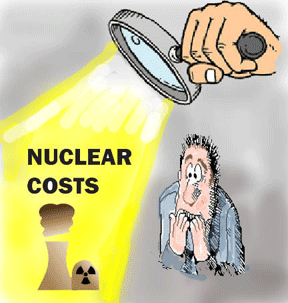
France24 9th Jan 2022
The European Union will need to invest 500 billion euros ($568 billion) in new generation nuclear power stations from now until 2050, the bloc’s internal market commissioner said in an interview published at the weekend.
“Existing nuclear plants alone will need 50 billion euros of investment from now until 2030. And new generation ones will need 500 billion!” Thierry Breton told the Journal du Dimanche newspaper. Breton also argued that an EU plan to label energy from nuclear power and natural gas as “green” sources for investment was a vital step towards attracting that capital. The EU is consulting its member states on that proposal, with internal disagreement on whether the power sources truly qualify as sustainable options.
France24 9th Jan 2022
Factoring in the full cost of the radioactive wastes, the price to pay for nuclear power is astronomic.
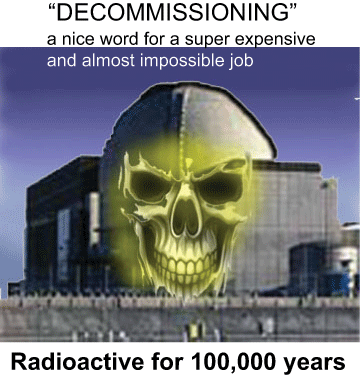
The price to pay for nuclear power is too high, https://www.scotsman.com/news/opinion/letters/the-price-to-pay-for-nuclear-power-is-too-high-readers-letters-3520498 Tim Flinn, Garvald, East Lothian, 10 Jan 22,
It doesn’t seem 30-odd years since I went with a group of sixth form A Level physics students on a tour of Dunbar’s Torness nuclear power station, now scheduled for decommissioning.
Most of them now have their PhDs and families of their own, but hopefully they all share my view that nuclear electricity remains the most toxic and expensive domestic fuel in regular use – and will remain so unless and until the problems associated with its deadly wastes are finally solved.
As things stand now the next 500 human generations will be stuck with the human and financial costs consequent upon coping with the radioactive detritus of the very first nuclear electricity generated some 80 years ago. Factoring in inflation the final price of just a single nuclear kWh will total more £s than there are particles in the universe. If anyone doubts that, let them do their own sums, or get a copy of mine (I hope they can cope with logarithms and discounting cash flows).
If the investment into nuclear energy (originally so we could keep up with the Jonses and have our own A and H bombs) had instead been ploughed into research and development of clean, safe, renewables we would long ago have had endless energy to spare and green devices to export. But we didn’t and so we haven’t. To replace one nuclear power station with yet another is to refuse to learn. Are we that stupid still?
Small nuclear reactors make no economic sense, despite the boost by Alberta Premier Jason Kenney and lobbyists.
Guess Who’s Leading the Charge for Nuclear Power in Canada?
Small reactors make no economic sense, despite the boost by Alberta Premier Jason Kenney and lobbyists. David Climenhaga The Tyee, Today | Alberta Politics 10 Jan 22,
David J. Climenhaga is an award-winning journalist, author, post-secondary teacher, poet and trade union communicator. He blogs at AlbertaPolitics.ca. Follow him on Twitter at @djclimenhaga.
Small nuclear reactors don’t make any more economic sense now than they did back in the summer of 2020 when Alberta Premier Jason Kenney took to the internet to tout the supposed benefits of the largely undeveloped technology being promoted by Canada’s nuclear industry.
Now that Kenney has taken to Twitter again to claim atomic energy is a “real solution that helps reduce emissions” and that so-called small modular reactors can “strengthen and diversify our energy sector,” it’s worth taking another look at why the economics of small nuclear reactors don’t add up.
As I pointed out in 2020, “as long as natural gas is cheap and plentiful, small nuclear reactors will never make economic sense.”
Natural gas is somewhat more expensive now than it was then, but not enough to make a difference to that calculation when the massive cost of any new nuclear-energy project is considered.
Even “small modular reactors,” so named to reassure a public skittish about the term nuclear and wary of the costs and risks of atomic reactors, are extremely expensive. It would be more accurate to call them “medium-sized nuclear reactors.”
For example, two such reactors built by Russia starting in 2006 were supposed to cost US$140 million. They ended up costing US$740 million by the time the project was completed in 2019.
Getting approvals for smaller reactors is time consuming, too. As environmentalist and author Chris Turner pointed out yesterday, the first small nuclear reactor approved in the United States “submitted its application in 2017, got approval late last year, could begin producing 700MW by 2029 if all goes perfectly. Solar will add double that to Alberta’s grid by 2023.” Indeed, the estimated completion date of the NuScale Power project may be even later.
The small reactors touted by many companies, often entirely speculative ventures, are nothing more than pretty drawings in fancy brochures. According to the International Atomic Energy Agency, there are about 50 concepts, but only a couple in the United States and Russia with massive amounts of government money behind them are anything more than pipedreams or stock touts’ pitches to investors.
And small nuclear reactors are less economical than big reactors, so power companies aren’t interested in building them; all but one proposed design requires enriched uranium, which Canada doesn’t produce, so they won’t do much for uranium mining in Alberta; and all the safety and waste-removal problems of big nukes continue to exist with small ones.
These points are documented in more detail my 2020 post, which also discussed why smaller reactors will never create very many jobs in Alberta, ……………………- https://thetyee.ca/Analysis/2022/01/10/Nuclear-Power-Canada-Who-Leading-Charge/
Nuclear war is a genuine threat, so why have non-proliferation efforts stalled?
Nuclear war is a genuine threat, so why have non-proliferation efforts stalled? Arab News, 10 Jan 22,
- The Treaty on the Non-Proliferation of Nuclear Weapons committed states to reduce their arsenals with the goal of eliminating them
- The P5 group of nations released a joint statement on Jan. 3 affirming “a nuclear war cannot be won and must never be fought”
NEW YORK CITY: Although the world is understandably preoccupied with the coronavirus pandemic, climate change, and regional conflicts, it would be wrong to assume that the threat of nuclear war had vanished. In fact, the probability of nuclear annihilation remains perilously high.
At the beginning of the year, the pandemic claimed yet another casualty — the 10th Review Conference of the parties to the Treaty on the Non-Proliferation of Nuclear Weapons, which had been scheduled to take place on Jan. 4.
The postponement of the meeting until August went largely unreported at the time because, it would appear, the perceived threat posed by nuclear weapons had lost its urgency in recent decades.
However, the development came as tensions escalated between Western countries and Russia over Ukraine as well as between the US and China over Taiwan.
The non-proliferation treaty, or NPT, which forms the foundation of the non-proliferation regime, was signed in 1968 and came into force in 1970. It is the single most important instrument that the 191 states-parties have to prevent further proliferation and lead the world toward total disarmament.
The bargain that underpins the NPT is very simple: The nuclear states under the treaty commit to reduce their nuclear arsenals with the ultimate goal of eliminating them, and the non-nuclear states adhere to their commitments enshrined in the treaty to not acquire nuclear weapons.
Not everyone has adhered to this. India, Pakistan, Israel, and North Korea are not signatories, while Iran, although an NPT signatory, is nevertheless enriching uranium and is locked in a battle with the West over its nuclear program.
It is the second time the 10th RevCon has been rescheduled due to the pandemic. The 2020 conference, which would have coincided with the NPT’s 50th anniversary, was also delayed, scuttling hopes of getting the non-proliferation regime back on track and breathing new life into the arms control and disarmament process.
The three pillars of the NPT — non-proliferation, disarmament, and the peaceful use of nuclear technologies — have seen varying degrees of success.
While the non-nuclear states kept their end of the bargain and adhered to the treaty, bar a couple of exceptions, the nuclear states have been less faithful. They have not fulfilled their obligations, as stipulated by article six of the NPT, to rid the world of nuclear weapons. This has led to tensions and placed a strain on the whole non-proliferation regime.
Looking for an alternative, the non-nuclear states pushed for a process in the UN General Assembly, which culminated in the adoption of a Treaty on the Prohibition of Nuclear Weapons on July 7, 2017, coming into force on Jan. 22, 2021.
However, the conference’s postponement could not have come at a worse time, as anxiety over the fraying of the architecture of arms control is mounting.
Experts believe the risk of nuclear war is greater than ever. The Bulletin of the Atomic Scientists has set its Doomsday Clock at 100 seconds to midnight — the closest the timepiece has been to symbolic doom in its more than 70 years of its existence.
A speech by former US Senator Sam Nunn, an authority on nuclear weapons, on the 50th anniversary of the NPT in 2020 described the danger in stark terms…………….
The Stockholm International Peace Institute has estimated that the world’s nuclear states collectively possessed approximately 13,080 nuclear weapons as of January 2021. That figure represented a small decrease on the 13,400 estimate of 2020.
However, this has been offset by the increase in the number of nuclear weapons deployed with operational forces, from 3,720 in 2020 to 3,825 in 2021. Of these, around 2,000 were “kept in a state of high operational alert,” the institute said in its 2021 report.
All of this has occurred in the absence of a credible arms control process because of growing tensions between the US and Russia over Ukraine, and America and China over Taiwan, Hong Kong, and the Indo-Pacific.
Although they were disappointed by the conference postponement, the non-nuclear states were heartened on Jan. 3 when the US, Russia, China, France, and the UK, a group of powers known as the P5, put out a joint statement claiming they “consider the avoidance of war between nuclear-weapon states and the reduction of strategic risks as our foremost responsibilities.
However, this has been offset by the increase in the number of nuclear weapons deployed with operational forces, from 3,720 in 2020 to 3,825 in 2021. Of these, around 2,000 were “kept in a state of high operational alert,” the institute said in its 2021 report.
All of this has occurred in the absence of a credible arms control process because of growing tensions between the US and Russia over Ukraine, and America and China over Taiwan, Hong Kong, and the Indo-Pacific.
Although they were disappointed by the conference postponement, the non-nuclear states were heartened on Jan. 3 when the US, Russia, China, France, and the UK, a group of powers known as the P5, put out a joint statement claiming they “consider the avoidance of war between nuclear-weapon states and the reduction of strategic risks as our foremost responsibilities……………….
From the standpoint of Arab countries, there was also an important element missing from the joint statement, which failed to mention the 1995 NPT resolution introduced by the US, the UK, and Russia agreeing in support of the principle of a Middle East region free from all weapons of mass destruction.
It had been hoped that the 10th RevCon would provide an opportunity to acknowledge the progress made in this regard. The first Conference on the Establishment of a Middle East Zone Free of Nuclear Weapons and Other Weapons of Mass Destruction took place at the UN headquarters in New York in 2019, chaired by Jordan, and again in 2021, chaired by Kuwait.
Israel, the only state in the Middle East thought to possess nuclear weapons, did not attend any of the sessions, nor did the US, despite being one of the main sponsors of the 1995 resolution.
Supporters of arms control therefore have little choice but to wait until August to see whether the P5 will back up their words with action and deliver a “meaningful outcome” that will preserve the integrity of the NPT. https://www.arabnews.com/node/2001751/world
Legal case over compensation for workers in ”uniquely dangerous” nuclear sites
High Court Takes Up Nuclear Site Workers’ Compensation Case (1) https://news.bloomberglaw.com/daily-labor-report/high-court-takes-up-washington-workers-compensation-challenge
Jan. 11, 202
- 9th Cir. upheld change to state workers’ compensation law
- U.S. government warns of costly consequences for contracts
The U.S. Supreme Court will consider the federal government’s challenge to a Washington state workers’ compensation law in a case that could have costly consequences for U.S. government contracts involving hazardous work on federal property.
The justices agreed Monday to review a U.S. Court of Appeals for the Ninth Circuit decision upholding a Washington law that presumes certain worker health conditions linked to cleanup work at the Hanford Site, a decommissioned federal nuclear production complex, are occupational diseases that can trigger workers’ compensation benefits.
The Department of Energy since 1989 has overseen cleanup at the Hanford Site, which produced weapons-grade plutonium for use in the U.S. nuclear program during World War II and the Cold War. The cleanup of the Hanford site is expected to continue over the next six decades and involve roughly 400 department employees and 10,000 contractors and subcontractors.
In 2018, Washington lawmakers passed legislation, HB 1723, that amended the state’s workers’ compensation law exclusive to the Hanford site, covering at least 100,000 current and former federal contract workers who performed services there over the past 80 years. The law states that presumed occupational diseases stemming from work at Hanford should trigger benefits eligibility, including cancers and other respiratory diseases.
The federal government argued the law exposes government contractors, and by extension the United States, to “massive new costs” that similarly situated state and private employers don’t incur
‘Uniquely Dangerous Workplace’
The Justice Department had asked the Supreme Court to take up the case, arguing the 2018 law discriminated against the United States and that state law shouldn’t apply to federal contract workers at Hanford. The government warned that the logic applied by a panel of Ninth Circuit judges opened the door to other states passing legislation targeting work at federal facilities.
“Congress did not permit States to adopt laws that impose unique burdens on the United States and the firms that it engages to carry out federal functions,” Justice Department attorneys argued. “The practical consequences of the panel’s mistake are far-reaching. Even if the Hanford site is considered in isolation, the decision is likely to cost the United States tens of millions of dollars annually for the remainder of the 21st century.”
Attorneys for Washington state, however, responded that courts have allowed states to regulate workers’ compensation for injuries or illnesses suffered during work on federal land. They argued Washington state has “long tailored its workers’ compensation laws to the dangers faced by particular employees,” noting statutes that protect firefighters and other workers facing special hazards.
“Hanford is a uniquely dangerous workplace, filled with radioactive and toxic chemicals, and private contractors operating there have routinely failed to provide employees with protective equipment and to monitor their exposures to toxic substances,” they argued.
Justice Department attorneys also argued the Ninth Circuit ruling clashed with Supreme Court precedent in a 1988 decision, Goodyear Atomic Corp. v. Miller, which described a similar situation of a state workers’ compensation award for an employee injured at a federally owned facility.
The full Ninth Circuit previously declined to take up the case, and said the Washington law fell properly within a part of federal law that authorizes states to apply their workers’ compensation laws to federal projects.
In a dissent to the Ninth Circuit’s denial of a rehearing, Judge Daniel P. Collins wrote that the panel’s decision clashed with high court precedent, calling it an “egregious error” that would have sweeping consequences.
The U.S. Solicitor General’s office represents the federal government. The Washington Attorney General’s office is defending the state law.
The case is U.S. v. Washington, U.S., No. 21-404, cert granted 1/10/22.
To contact the reporter on this story: Erin Mulvaney in Washington at emulvaney@bloomberglaw.com
To contact the editors responsible for this story: Jay-Anne B. Casuga at jcasuga@bloomberglaw.com; John Lauinger at jlauinger@bloomberglaw.com; Andrew Harris at aharris@bloomberglaw.com
Just the bare 144 years of above-ground storage for UK’s Chapelcross Intermediate Level Nuclear Waste
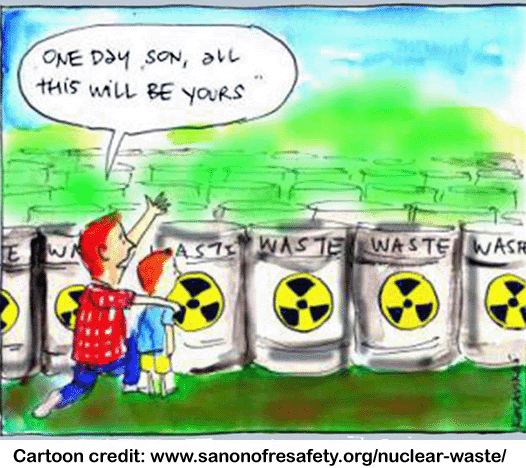
The question for policy makers is do we really want to contemplate building new nuclear power stations when the legacy will be with future generations for 102 years, nearly two and a half times beyond any new nuclear plant’s operational life. The cost of nuclear electricity generation is high and future costs of dealing with the legacy are also passed on to at least four future generations.
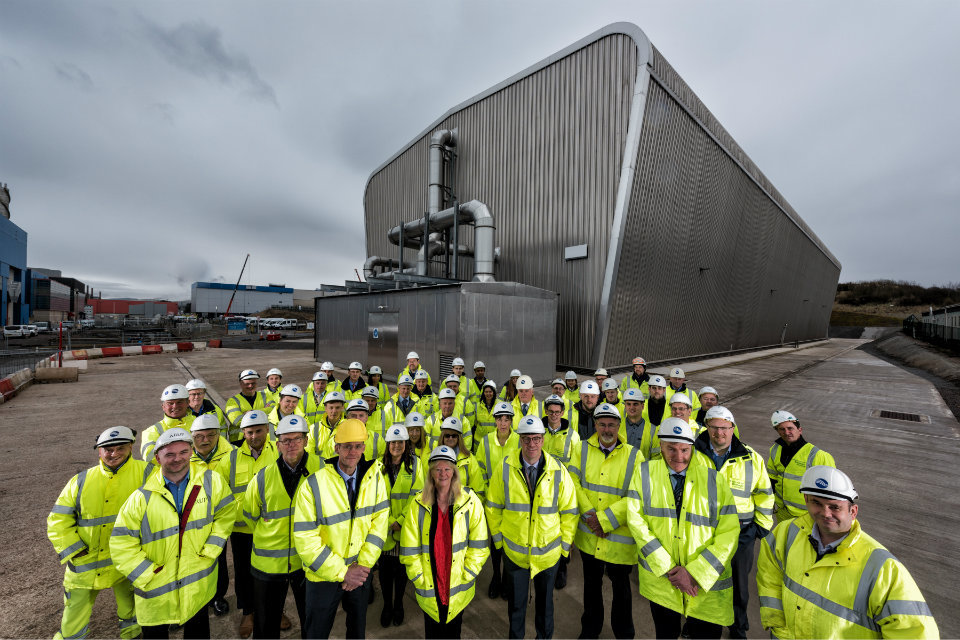
| Following on from a previous article on Hunterston B which was shut down last Friday I decided to have a look at one of the smaller nuclear power stations in Scotland to see how work was progressing on decommissioning. Chapelcross nuclear power station occupies a 92 hectares site on the location of a former World War II training airfield in Annan. Chapelcross had 4 Magnox reactors, each with a 48MW output. Chapelcross was linked to sister plant Calder Hall in Cumbria which is now the site of the NDA’s Sellafield operation. Calder Hall closed in 2003 and Chapelcross in 2004. Both plants were originally operated by the UK Atomic Energy Authority. Their main purpose was to produce weapons-grade plutonium although they also generated electricity for the National Grid. By 1st April 2019, Chapelcross had been defuelled and all High Level Waste moved to Sellafield. At that point, almost three years ago, the Intermediate Level Waste as well as LLW had still to be dealt with. The VLLW would appear to be close to the end of the decommissioning process. The LLW is destined for containers in Cumbria and the estimated 4,900 cublic metres of Intermediate Level Waste will be left onsite in specially constructed containers for a period of 120 years, pending a Scottish Government decision around 2145 on disposal of the containers and contents. The interim storage facility for storing Intermediate Level Waste at Chapelcross began 2014 and was completed by May 2021 when the first ‘package’ was placed in the facility. In announcing this progress Magnox Ltd and the NDA said in a news release; “The Interim Storage Facility (ISF) can hold over 700 waste packages of four different approved package types, and will be filled over the next five years as part of decommissioning work. Standing at 57m long and 23m wide, it has been constructed to safely and securely store packages for 120 years.” Work on the Intermediate Level Waste which is due to complete in 2026. The storage facility is then sealed for 120 years when a decision will be made by the Scottish Government on final disposal of ILW storage and contents. Whilst it can be argued that the core decommissioning work will take around 22 years, the end game is still 120 years away making 144 years in total for final clearance at the site. Chapelcross operated for 44 years. The ILW will remain on the site until 2146 although the buildings will be long gone by then. It is essential we deal with the legacies of the past and do so to the highest possible standard because we owe that to our own and future generations. The question for policy makers is do we really want to contemplate building new nuclear power stations when the legacy will be with future generations for 102 years, nearly two and a half times beyond any new nuclear plant’s operational life. The cost of nuclear electricity generation is high and future costs of dealing with the legacy are also passed on to at least four future generations. Newsnet 10th Jan 2022 https://newsnet.scot/news-analysis/nuclear-decommissioning-chapelcross-a-timeline/ |
The European Association for Renewable Energie Eurosolar rejects inclusion of nuclear and natural in the EU taxonomy
The European Association for Renewable Energie Eurosolar rejects »any
elements of nuclear and natural gas supply in the EU taxonomy for
environmentally sustainable activities«. The taxonomy is a classification
system for sustainable economic activities which are due to receive
advantageous financing conditions under EU regulations.
The European
Commision has proposed to include nuclear and natural gas into the
taxonomy. Member states like Germany strongly protested or, like Luxembourg
and Austria, even announced to bring action against the Commission, while
others are decisively supporting the proposal.
Photon 10th Jan 2022
EU delays deadline on green investment rules for nuclear and gas
EU delays deadline on green investment rules for nuclear and gas, By Kate Abnett BRUSSELS, Jan 10 (Reuters) – The European Commission said on Monday it has delayed to later this month the deadline for experts to give feedback on divisive plans to allow some natural gas and nuclear energy projects to be labelled as sustainable investments……… (subscribers only) https://www.reuters.com/markets/commodities/eu-delays-deadline-green-investment-rules-nuclear-gas-2022-01-10/
Former Israeli premier says notion of destroying Iran’s nuclear capabilities mere ‘nonsense’
Former Israeli premier says notion of destroying Iran’s nuclear capabilities mere ‘nonsense’Press Tv, 11 January 2022 The former Israeli prime minister has dismissed any possibility of a preemptive attack on Iran’s nuclear facilities by the regime, saying that such a notion is “nonsense.”
Ehud Olmert made the remarks in a Monday interview with Israel’s Channel 12 news, during which he derided the idea that the Tel Aviv regime would be able to destroy Iran’s nuclear facilities through a military strike.
Olmert emphasized that such a notion would be pure “nonsense,” adding, “It is unnecessary arrogance that indicates weakness, not strength.”
Olmert’s latest remarks echoed his previous assertions in an opinion piece published in Haaretz Hebrew site in which he noted that Israel did not have conventional military capabilities that enable it to strike and permanently eliminate Iran’s nuclear facilities as it did in Iraq in 1981 and Syria in 2007.
The Israeli regime has never stopped advertising the threat of “military action” against Iran and falsely accusing the Islamic Republic of seeking to acquire nonconventional military capability.
Iran, for its part, has repeatedly downplayed Israel’s threats against its nuclear facilities, promising crushing response to any act of aggression against the country.
On January 3, Iran’s foreign minister slammed anti-Iranian remarks by Israel’s foreign minister Yair Lapid, saying that the Islamic Republic will defend its interests with power.
Hossein Amir-Abdollahian’s remarks came in a tweet in response to earlier claims by Lapid that the Zionist regime “could attack Iran if necessary without informing the Biden administration,” adding that “Israel has capabilities, some of which the world, and even some experts in the field, cannot even imagine.”…………………………… https://www.presstv.ir/Detail/2022/01/11/674486/Ex-Israeli-PM-destroy-Iran-s-nuclear-capabilities-nonsense
Cracked’ nuclear power station retired.
Cracked’ nuclear power station retired. The Ecologist, Katrine Bussey | 10th January 2022 ‘As the expensive and hazardous job of cleaning up the radioactive legacy Hunterston leaves in its wake now begins, Scotland must press on with plans to harness more clean, renewable energy.’
One of Scotland’s two nuclear power plants has been shutdown, bringing an end to almost 46 years of it generating electricity.
Environmental campaigners said the final shutdown of Hunterston B, near West Kilbride – which started producing electricity 45 years and 11 months ago – was “inevitable”.
Lang Banks, the director of WWF Scotland, said the plant had become increasingly unreliable, and argued that growth in renewable energy means nuclear power is no longer required.
Technologies
Mr Banks said the “repeated failure to solve the problem of hundreds of cracks in the graphite bricks surrounding the reactor core means the closure of Hunterston B was inevitable”.
He added: “Thankfully Scotland has massively grown its renewable power-generating capacity, which means we’ll no longer need the electricity from this increasingly unreliable nuclear power plant.
“As the expensive and hazardous job of cleaning up the radioactive legacy Hunterston leaves in its wake now begins, Scotland must press on with plans to harness more clean, renewable energy.”
A Scottish Government spokesperson said: “Hunterston B, its operators and in particular the workforces who have staffed the plant for more than 40 years, have played an important role in supporting Scotland’s energy requirements.
“We do however remain clear in our opposition to the building of new nuclear power plants in Scotland under current technologies.
Transition
“Significant growth in renewables, storage, hydrogen and carbon capture provide the best pathway to net zero by 2045, and will deliver the decarbonisation we need to see across industry, heat and transport.
They added: “We recognise that planning will be crucial to ensure that economic and social opportunities from the transition are not missed.
“Our National Just Transition Planning framework sets out the consistent, ambitious approach we will take to developing transition plans.
We have committed to delivering our first Just Transition Plan as part of the forthcoming refreshed Scottish Energy Strategy, and will work in partnership with businesses, workers and communities to ensure this provides the certainty needed for investment in our net zero journey.
“As part of the jointly Scottish and UK Government funded Ayrshire Growth Deal, regional partners are developing a business case for the Hunterston Strategic Development Area to support a long-term strategic plan for the Ayrshire region, its people and businesses.”………………. https://theecologist.org/2022/jan/10/cracked-nuclear-power-station-retired
US-Russia Talks May Be the Last Chance
It’s crunch time in Russia-U.S. relations. High-level talks starting Monday will determine the shape of world security for decades to come, observes Tony Kevin. Consortium News, By Tony Kevin, Pearls and Irritations 10 Jan 22,
On Monday, vital Russia-U.S. talks will start in Geneva. Russia’s delegation will be headed by Deputy Foreign Minister Sergei Ryabkov and the U.S. by National Security Adviser Jake Sullivan.
These are ‘precursor’ negotiations – ‘talks about talks’, in the old strategic arms limitation treaties (SALT) terminology. Russia is driving the pace. The U.S. is in reactive mode, trying unsuccessfully to slow things down, to trim Russia’s sails. So far they are not succeeding.
Russia’s best-case scenario for Monday is this: Successful precursor talks will be followed soon after by substantive, detailed foreign minister level negotiations, led by Russian Foreign Minister Sergei Lavrov and U.S. Secretary of State Antony Blinken, with participation of top military brass from both sides.
Russia is seeking detailed U.S.-Russia agreements on mutual security guarantees in Europe.
Unusually, Russian drafts of these agreements were handed over by Russia to the U.S. and at the same time made public on Dec. 17. Russia will want to achieve these solemn written mutual commitments, as well-summarized by Patrick Lawrence in Consortium News on Dec. 28:
- NATO will cease all efforts to expand eastward, notably into Ukraine and Georgia.
- NATO guarantees that it will not deploy missile batteries in nations bordering Russia.
- An end to NATO military and naval exercises in nations and seas bordering Russia.
- The effective restoration of the treaty covering intermediate-range nuclear weapons. The U.S. abandoned the INF pact in August 2019.
- An ongoing East-West security dialogue
These desired agreements would be backed up by early NATO-Russia negotiations in Brussels to achieve corresponding agreements at that level. Finally, the two presidents would formally seal the deal.
Russia’s worst-case scenario: that if the U.S. fails to negotiate towards this complete package – if the U.S. tries in its usual way to equivocate, delay, or cherry-pick Russia’s proposed deal – Russia will terminate the talks.
Coldest War
Russia-U.S. and Russia-NATO relations would then enter the deepest of deep freezes since the worst years of Cold War One. Russia would focus its economic and diplomatic resources entirely on relations with the East and South – backstopped by the Belt and Road Initiative of its reliable friend China. Russia would effectively stop trying to dialogue with U.S. and NATO Europe and call the U.S. bluff on enhanced sanctions.
On the now highly militarized Russia-NATO frontier, armies, navies and tactical intermediate range missile forces (sufficient to destroy most of Europe and European Russia) would confront each other. Risks of East-West war by provocation or accident would be far greater than in the years 1989-2014, before the sharp deterioration in East-West relations brought about by the U.S.-backed, 2014 Ukraine coup.
Time Running Out
These present talks instigated by Russia are thus really the Last Chance Saloon: the last opportunity maybe for decades to pursue relaxation of East-West tensions – ‘détente’, in the old, nearly forgotten word of late Cold War One. Russia has had enough of years of creeping security deterioration and has drawn its red lines………
Russia has seen how under successive U.S. presidents Clinton, George W. Bush, Obama, Trump, and now Biden, a strategically destructive pattern of U.S. and NATO behavior had emerged since 1999, when President Bill Clinton welshed on the 1989-91 agreements between Reagan and George H.W. Bush with Gorbachev, that NATO would not expand into Eastern Europe following the reunification of Germany. ‘Though there was no formal written treaty as such, subsequent Soviet and Russian complaints about being misled about NATO expansion were well founded in numerous written contemporaneous memcons and telcons (formal written records of conversations) at the highest levels.
As the West offered soothing words and prevarications, NATO expanded, first with Poland, Czechoslovakia and Hungary in 1999. There were further large expansions in 2004 and 2009, bringing NATO right up against Russia’s Western frontiers. Provocatively, NATO then listed Ukraine and Georgia as candidates for NATO membership……………………………….
Putin is now holding the strongest negotiating cards. My betting — indeed my hope — is that Russia will achieve its demanded mutual security guarantees in Europe in the coming weeks.
International security – Australia’s security — will be greatly strengthened if he succeeds.
Much could still go wrong. There are troublemakers in the Western bloc whose careers depend on maintaining East-West tensions at just below the level of war. They will try hard to subvert and derail Russia’s goals.
In Australia, as in the U.S., there is almost complete public ignorance of this subject matter. Be prepared for massive disinformation in the coming weeks from the partly Pentagon and State Department funded think tank the Australian Strategic Policy Institute (ASPI) and from mainstream media, hysterically whipping-up alleged threats of an imminent Russian invasion of Ukraine. This propaganda offensive, turning Russia’s defensive posture into aggression, is already under way, especially in the U.S.
Australia sadly no longer has the intellectual resources for an informed and balanced public discussion of these momentous developments. Ignorance and groundless fears of Russia prevail. Dissenting voices such as mine have been marginalized and almost silenced.
One might hope there is more reality-based knowledge in the national security community. But if there is, they are not telling the public. I fear that there too, ignorance and prejudice have taken hold. We are perilously leaving the strategic thinking on Russia to our Big Brother in Washington.
.Tony Kevin is a former Australian senior diplomat, having served as ambassador to Cambodia and Poland, as well as being posted to Australia’s embassy in Moscow. He is the author of six published books on public policy and international relations. https://consortiumnews.com/2022/01/09/us-russia-talks-may-be-last-chance/
To bankroll the failing nuclear industry, the UK government will push thousands into fuel poverty, with its Nuclear Energy (Financing) Bill

Bad for fuel poverty, bad for climate action: why MPs should vote against the Nuclear Energy Bill on Monday.
Controversial legislation is being rushed through parliament which will transfer billions of pounds onto
individual consumers, whilst affording them no protection from the spiralling construction costs of nuclear power. Introduced at the end of October when attention was rightly focused on COP26, the Bill has received little attention.
Yet it will have a profound impact on millions of families forced to foot the bill and will push thousands more into fuel poverty. So why is the government forcing more families into fuel poverty?
To bankroll a failing industry. With all 15 British nuclear power plants set to be closed by 2030, funding for eight new ones is in a state of collapse. Only one plant – Hinkley Point C – is under construction and
this is running ten years late and £4.5 billion over budget. The Bill enables energy companies to use a regulated asset base (RAB) model to transfer the construction costs – and financial risks – onto consumers
and start making a profit even before the plants generate any electricity.
Labour Outlook 9th Jan 2022
What War With Russia Would Look Like
Consortium News, January 10, 2022 Wendy Sherman thinks her aim in talks with Russian officials starting Monday is to lecture them on the cost of hubris. Instead she’s set to lead the U.S., NATO, and Europe down a path of ruin, warns Scott Ritter.By Scott Ritter
Special to Consortium News If ever a critical diplomatic negotiation was doomed to fail from the start, the discussions between the U.S. and Russia over Ukraine and Russian security guarantees is it.
The two sides can’t even agree on an agenda.
From the Russian perspective, the situation is clear: “The Russian side came here [to Geneva] with a clear position that contains a number of elements that, to my mind, are understandable and have been so clearly formulated—including at a high level—that deviating from our approaches simply is not possible,” Russian Deputy Foreign Minister Sergei Ryabkov told the press after a pre-meeting dinner on Sunday hosted by U.S. Deputy Secretary of State Wendy Sherman, who is leading the U.S. delegation.
Ryabkov was referring Russian President Vladimir Putin’s demands to U.S. President Joe Biden in early December regarding Russian security guarantees, which were then laid out by Moscow in detail in the form of two draft treaties, one a Russian-U.S. security treaty, the other a security agreement between Russia and NATO.
The latter would bar Ukraine from joining NATO and rule out any eastward expansion by the trans-Atlantic military alliance. At the time, Ryabkov tersely noted that the U.S. should immediately begin to address the proposed drafts with an eye to finalizing something when the two sides meet. Now, with the meeting beginning on Monday, it doesn’t appear as if the U.S. has done any such thing……….
All the U.S. has been willing to do, it seems, is to remind Russia of so-called “serious consequences” should Russia invade Ukraine, something the U.S. and NATO fear is imminent, given the scope and scale of recent Russian military exercises in the region involving tens of thousands of troops. This threat was made by Biden to Putin on several occasions, including a phone call initiated by Putin last week to help frame the upcoming talks.
Yet on the eve of the Ryabkov-Sherman meeting, U.S. Secretary of State Tony Blinken simply reiterated these threats, declaring that Russia would face “massive consequences” if it invaded Ukraine………..
Lessons of history
It is as if both Biden and Blinken are deaf, dumb, and blind when it comes to reading Russia.
Ryabkov has alluded to a fact already made clear by the Russians—there will be no compromise when it comes to Russia’s legitimate national security interests. And if the U.S. cannot understand how the accumulation of military power encompassed in a military alliance which views Russia as a singular, existential threat to its members’ security is seen by Russia as threatening, then there is no comprehension of how the events of June 22, 1941 have shaped the present -day Russian psyche, why Russia will never again allow such a situation to occur, and why the talks are doomed before they even begin.
As for the American threats, Russia has given its response—any effort to sanction Russia would result, as Putin told Biden last month, in a “complete rupture of relations” between Russia and those countries attempting sanctions. One need not be a student of history to comprehend that the next logical step following a “complete rupture of relations” between two parties that are at loggerheads over matters pertaining to existential threats to the national security of one or both is not the peaceful resumption of relations, but war.
There is no mealy-mouthed posturing by Foggy Bottom peacocks taking place in Moscow, but rather a cold, hard, statement of fact—ignore Russia’s demands at you own peril. The U.S., it seems, believes that the worst-case scenario is one where Russia invades Ukraine, only to wilt under the sustained pressure of economic sanctions and military threats.
Russia’s worse-case scenario is one where it engages in armed conflict with NATO……………
The Shape of War What would a conflict between Russia and NATO look like? In short, not like anything NATO has prepared for. ………………….
Given the overwhelming supremacy Russia has both in terms of the ability to project air power backed by precision missile attacks, a strategic air campaign against Ukraine would accomplish in days what the U.S. took more than a month to do against Iraq in 1991……….
While the U.S., NATO, the EU, and the G7 have all promised “unprecedented sanctions,” sanctions only matter if the other side cares. Russia, by rupturing relations with the West, no longer would care about sanctions. Moreover, it is a simple acknowledgement of reality that Russia can survive being blocked from SWIFT transactions longer than Europe can survive without Russian energy. Any rupturing of relations between Russia and the West will result in the complete embargoing of Russian gas and oil to European customers.
There is no European Plan B. Europe will suffer, and because Europe is composed of erstwhile democracies, politicians will pay the price. All those politicians who followed the U.S. blindly into a confrontation with Russia will now have to answer to their respective constituents why they committed economic suicide on behalf of a Nazi-worshipping, thoroughly corrupt nation (Ukraine) which has nothing in common with the rest of Europe. It will be a short conversation.
NATO’s Fix…………
Russia won’t wait until the U.S. has had time to accumulate sufficient military power, either. Russia will simply destroy the offending party through the combination of an air campaign designed to degrade the economic function of the targeted nation, and a ground campaign designed to annihilate the ability to wage war. Russia does not need to occupy the territory of NATO for any lengthy period—just enough to destroy whatever military power has been accumulated by NATO near its borders.
And—here’s the kicker—short of employing nuclear weapons, there’s nothing NATO can do to prevent this outcome. Militarily, NATO is but a shadow of its former self.,,,,,,,,,,,,,,
Sherman will face off against Ryabkov in Geneva, with the fate of Europe in her hands. The sad thing is, she doesn’t see it that way. Thanks to Biden, Blinken and the host of Russophobes who populate the U.S. national security state today, Sherman thinks she is there to simply communicate the consequences of diplomatic failure to Russia. To threaten. With mere words……..
One wonders if Sherman, Biden, Blinken, and the others have thought this through. Odds are, they have not, and the consequences for Europe will be dire.
Scott Ritter is a former Marine Corps intelligence officer who served in the former Soviet Union implementing arms control treaties, in the Persian Gulf during Operation Desert Storm, and in Iraq overseeing the disarmament of WMD. https://consortiumnews.com/2022/01/10/what-war-with-russia-would-look-like/
As nuclear power’s failures become more apparent, government and media enthusiastically promote it.

Why is support for nuclear power noisiest just as its failures become most clear? The UK government and mainstream media agree we need nuclear to avoid the worst climate change. They’re wrong – so why aren’t we hearing that? Open Democracy, Andrew Stirling, Phil Johnstone, 9 January 2022,

”…………………….This Green Party case is particularly noteworthy, since it is (strangely given underlying patterns of public concern on nuclear issues), the only organised political force in England collectively offering a consistently sceptical position about nuclear power in Parliament. With the longstanding Green grounding on this issue so strong over a half-century, it is especially strange that this development should come at a time when – at least for the Greens – the argument is more over than it has ever been.
What remains particularly striking about all the instances we cite is that none engage substantively with the real-world performance of nuclear power as it is. Despite vivid rhetorics around needs for ‘science-based’ policy – and occasionally colourful fear-mongering about intermittency ‘putting the lights out’ – none of these prolific voices address (let alone refute) the worldwide substantive picture that shows nuclear power overwhelmingly to be slower, less effective and more expensive at tackling climate disruption than are renewable and storage alternatives.
UK government policy
Despite the surface commitment, we see this trend in UK government energy policy too. Dig into more specialist civil service policy papers and you find spiralling prices and little in the way of an energy-related case for nuclear power. But – in a remarkable departure from the normally diligent attention to costs – the most recent energy white paper ignored all that boring economic detail. Official UK nuclear attachments are treated as an unquestionable given.
So, it might be understood why deep-rooted nuclear interests are seeking to hide these inconvenient facts behind pretty pictures of the West Highlands. But why is the media so keen to help, squirrelling realities away from view behind tales of repentant environmentalists? Why is so much new noise building up behind nuclear power in formerly critical political parties, just when the case has grown weaker than ever?
Profound issues are raised here, not only concerning the cost and speed of climate action, but about the independence and professionalism of the UK media and the health of British democracy as a whole. Whichever opinion we each take on nuclear issues – and whatever the undoubted uncertainties and ambiguities – we should all care very deeply about this. https://www.opendemocracy.net/en/opendemocracyuk/why-is-support-for-nuclear-power-noisiest-just-as-its-failures-become-most-clear/
1 This Month



19 November – Webinar – The Reality of Reprocessing
Time: 11:00 AM Pacific Time (US & Canada) / 2:00 PM Eastern / 7:00 PM UK / 8:00 PM CET
Register for the Zoom Event Here



Shut down the radiation-damaged Heysham nuclear reactors now
To see nuclear-related stories in greater depth and intensity – go to https://nuclearinformation.wordpress.com

Say No to NASA’s Reckless Nuclear Reactor on the Moon
Say No to NASA’s Reckless Nuclear Reactor on the Moon
-
Archives
- November 2026 (74)
- October 2026 (302)
- September 2026 (339)
- August 2026 (330)
- July 2026 (355)
- June 2026 (287)
- May 2026 (306)
- April 2026 (356)
- March 2026 (251)
- February 2026 (267)
- January 2026 (308)
- December 2025 (358)
-
Categories
- 1
- 1 NUCLEAR ISSUES
- business and costs
- climate change
- culture and arts
- ENERGY
- environment
- health
- history
- indigenous issues
- Legal
- marketing of nuclear
- media
- opposition to nuclear
- PERSONAL STORIES
- politics
- politics international
- Religion and ethics
- safety
- secrets,lies and civil liberties
- spinbuster
- technology
- Uranium
- wastes
- weapons and war
- Women
- 2 WORLD
- ACTION
- AFRICA
- Atrocities
- AUSTRALIA
- Christina's notes
- Christina's themes
- culture and arts
- Events
- Fuk 2022
- Fuk 2023
- Fukushima 2017
- Fukushima 2018
- fukushima 2019
- Fukushima 2020
- Fukushima 2021
- general
- global warming
- Humour (God we need it)
- Nuclear
- RARE EARTHS
- Reference
- resources – print
- Resources -audiovicual
- Weekly Newsletter
- World
- World Nuclear
- YouTube
-
RSS
Entries RSS
Comments RSS

