France’s new-generation Flamanville nuclear plant delayed again.
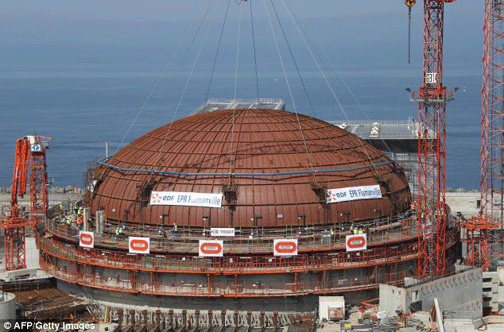
France’s new-generation nuclear plant delayed again, France 24 Paris (AFP) – Electricity giant EDF on Wednesday announced a further delay and cost overruns for France’s flagship new-generation nuclear plant, in a blow to President Emmanuel Macron’s strategy of making atomic power a cornerstone of energy policy.
EDF said that the Flamanville plant on the Channel coast would not be loaded with fuel until the “second quarter of 2023”, instead of late 2022.
The statement came after Macron announced plans for new reactors to provide low-carbon energy and as France backs classing nuclear as a “green” technology under future EU rules.
Projected costs had increased by another 300 million euros ($340 million) to 12.7 billion euros, EDF said — around four times more than the initial forecast of 3.3 billion euros.
Construction on the new-generation EPR plant began in 2007, and was supposed to be finished in 2012.
In November, Macron had announced that “for the first time in decades, we will restart construction of nuclear reactors in our country” — as well as “developing renewable energy”.
The plans would “guarantee France’s energy independence” and help reach its goal of being carbon neutral by 2050, he added.
But the president, who has yet to officially confirm that he plans to stand for re-election in April, was short on details like where or when the new plants would be built.
The Flamanville overruns were “a fiasco at the French public’s expense”, said Greens presidential candidate Yannick Jadot.
Left-wing candidate Jean-Luc Melenchon called the news a “shipwreck for the nuclear sector” — long one of the crown jewels of French industry.
Brussels battle
With 56 reactors providing over 70 percent of France’s electricity, according to EDF, Paris has led the charge for nuclear power to be recognised by the European Union as a green technology eligible for carbon-neutral investment.
Allying with eastern EU member states like Poland and the Czech Republic, the push to include atomic energy in the so-called green “taxonomy” has set it at odds with traditional partner Germany.
Berlin is in the process of shutting all its nuclear plants by the end of this year and Germany’s governing coalition now includes the Green party, rooted in part in opposition to the technology going back to the 1970s.
Environment Minister Steffi Lemke has said it would be “absolutely wrong” to include nuclear energy on the list, as it “can lead to devastating environmental catastrophes”.
“We agree to disagree on the issue” with the French, German Europe Minister Anna Luehrmann told AFP last week……….. https://www.france24.com/en/live-news/20220112-france-s-new-generation-nuclear-plant-delayed-again
UK’s Nuclear Financing Bill – very strange logic – with £40 billion to £60 billion for a new nuclear power station seen as a good thing.
Last week Tim Farron MP sent the following reply to Radiation Free Lakeland when we urged him to vote NO to the public paying for new nuclear build in the Nuclear Financing Bill yesterday. Our MP’s opposition to new nuclear is heartening. But this opposition was not reflected in the vote of
458 for to 53 against (how many others opposed did not vote?) the Bill at third reading.
The Bill will now be considered in the House of Lords. This vote is truly shocking. Alan Brown MP said during the debate Government “has been very good at telling us about the mythical savings that will
accrue via the regulated asset base funding model introduced by this Bill—they are estimated at between £30 billion and £70 billion. What the Government are not so good at is telling us what money they want to commit for the likes of Sizewell C. In effect, they are telling us, ”Let’s save money for bill payers by signing up to a less bad deal for a new nuclear project.”
According to the impact assessment, the capital and financing cost is going to be in the region of £40 billion to £60 billion for a new nuclear power station.
It is a strange logic to tell us that £50 billion being added to our energy bills at the time of a cost of living energy crisis is somehow a good thing. By default, the Government are also confirming just how much of a stinking, rotten deal Hinkley Point C was for bill payers if we are saying that we can save that much money compared with the contracts for difference model for Hinkley C.”
Radiation Free Lakeland 11th Jan 2022
UK’s Nuclear Energy (Financing) Bill passes in House of Commons

New funding plan for Sizewell C station clears final hurdle in Commons https://www.eadt.co.uk/news/business/funding-plan-sizewell-c-suffolk-clears-commons-8612482
Matthew Earth January 10, 2022
Plans for a new way of funding nuclear power plants – including Sizewell C on the Suffolk coast – have cleared their final hurdle in the House of Commons.
Business Secretary Kwasi Kwarteng described the passing of the Nuclear Energy (Financing) Bill on Monday evening as the “path to leadership and innovation”.
The Bill creates a new framework for funding nuclear power plants, after worries from investors have led to current projects stalling.
It would allow pension funds and other institutional investors to provide cash for power stations through a regulated asset base funding model.
Energy bill payers would contribute towards the cost of new power stations during construction through their bills, with the aim of giving investors greater certainty after projects such as Sizewell C faced delays due to concerns over the financial risks of construction.
However, Labour has said bill payers could be exploited as a “milk cow” under the new scheme if power stations face delays during building work.
MPs voted 458 to 53 in favour of the Bill at third reading, and it will now be considered in the House of Lords.
The government has recently agreed a six-week delay to the final decision A final decision on whether the station will be built is expected later this year.
To Avert ‘Global Nuclear Holocaust,’ US Groups Demand Abolition of ICBMs
To Avert ‘Global Nuclear Holocaust,’ US Groups Demand Abolition of ICBMs https://www.commondreams.org/news/2022/01/12/avert-global-nuclear-holocaust-us-groups-demand-abolition-icbmsWhistleblower Daniel Ellsberg says no other immediate action would go further “to reduce the real risk of a false alarm in a crisis causing the near-extinction of humanity.”
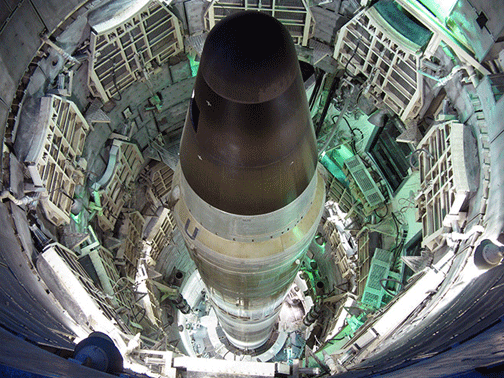
JAKE JOHNSON More than 60 U.S. organizations issued a joint statement Wednesday calling for the total elimination of the country’s land-based nuclear missiles, warning that the weapons are both an enormous waste of money and—most crucially—an existential threat to humankind.
Organized by the advocacy groups RootsAction and Just Foreign Policy, the statement argues that intercontinental ballistic missiles (ICBMs) are “uniquely dangerous, greatly increasing the chances that a false alarm or miscalculation will result in nuclear war.”
“There is no more important step the United States could take to reduce the chances of a global nuclear holocaust than to eliminate its ICBMs,” continues the statement, which was signed by Beyond the Bomb, Global Zero, Justice Democrats, CodePink, and dozens of other anti-war groups.
“Everything is at stake,” the groups warn. “Nuclear weapons could destroy civilization and inflict catastrophic damage on the world’s ecosystems with ‘nuclear winter,’ inducing mass starvation while virtually ending agriculture. That is the overarching context for the need to shut down the 400 ICBMs now in underground silos that are scattered across five states—Colorado, Montana, Nebraska, North Dakota, and Wyoming.”
The statement comes just two weeks after President Joe Biden signed into law a sprawling military policy bill that allocates billions of dollars to research, development, and missile procurement for the Ground-Based Strategic Deterrent (GBSD) program, an initiative that is expected to replace the current Minuteman III ICBMs in the coming years.
Ahead of the $778 billion legislation’s passage, some progressive lawmakers—most prominently Rep. Ro Khanna (D-Calif.) and Sen. Ed Markey (D-Mass.)—called for a pause in GBSD development, a demand that went unheeded.
Daniel Ellsberg, the legendary whistleblower and longtime proponent of nuclear disarmament, told Common Dreams in an email that “most of the so-called ‘defense’ budget is legislative pork.”
“But some of it—in particular, the maintenance and proposed replacement to the current ICBM program—is toxic pork,” he added. “It’s not just unnecessary, it’s positively dangerous, to our own security and that of the rest of the world.”
Before leaking the Pentagon Papers to the press in 1971, Ellsberg specialized in nuclear weapons and operational planning for a possible nuclear war during his time as a consultant to the Defense Department, an experience he recounts in his 2017 book The Doomsday Machine: Confessions of a Nuclear War Planner.
“We should have gotten rid of our silo-based ICBMs no less than half a century ago, when they had become totally vulnerable to attack,” Ellsberg told Common Dreams. “Ever since then, deterrence of a nuclear attack should have been based solely on our invulnerable submarine-launched missile force, which is itself far larger than that function requires or should permit.”
Echoing the anti-war coalition’s fear that a potential “false alarm” could spark nuclear catastrophe, Ellsberg noted that “the survival in wartime of hundreds of land-based missiles depends on their being launched, irrevocably (unlike bombers), on electronic and infrared warning before attacking missiles might arrive.”
“Such a warning, however convincing, may be false; and that has actually happened, more times than our public has ever become aware,” he said. “No other strategic weapons besides ground-based ICBMs challenge a national leader to decide, absurdly within minutes, whether ‘to use them or lose them.’ They should not exist.”
“No other specific, concrete American action would go so far immediately to reduce the real risk of a false alarm in a crisis causing the near-extinction of humanity,” Ellsberg concluded.
In a statement, RootsAction national director Norman Solomon lamented that recent public discussion surrounding U.S. nuclear weapons policy “has been almost entirely limited to the narrow question of whether to build a new ICBM system or stick with the existing Minuteman III missiles for decades longer.”
“That’s like arguing over whether to refurbish the deck chairs on the nuclear Titanic,” said Solomon. “Both options retain the same unique dangers of nuclear war that ICBMs involve. It’s time to really widen the ICBM debate, and this joint statement from U.S. organizations is a vital step in that direction.”
Fieldwork in the High Arctic found cataclysmic impact of climate change happening 70 years ahead of what the scientific models expected.

During the month of December 2021 two warnings of impending sea level rise were issued by highly respected groups of climate scientists. These are professional scientists who do not deal in hyperbole. Rather, they are archetypical conservative serious-minded scientists who follow the facts. The most recent warning on December 30th is of deteriorating conditions at the Arctic and Greenland. The second warning is the threatening collapse in Antarctica of one of the largest glaciers in the world. As these event unfortunately coincide so close together, one at the top of the world, the other at the bottom, should coastal cities plan to build sea walls? An article by M. Farquharson, et al in Geophysical Research Letters d/d June10, 2019 stated: “Observed maximum thaw depths at our sites are already exceeding those projected to occur by 2090.” In other words, fieldwork in the High Arctic found cataclysmic impact of climate change happening 70 years ahead of what the scientific models expected. Counterpunch 7th Jan 2022 https://www.counterpunch.org/2022/01/07/when-to-build-sea-walls/ |
Climate change destroying homes across the Arctic
Cracked homes, buckled roads and ruptured pipelines are likely to become common in and near the Arctic as warming temperatures cause frozen ground to thaw, new findings say. Five million people live on Arctic permafrost including in Russia, North America and Scandinavia.
Climate change is causing the Arctic to warm two-to-four times faster than the rest of the planet.
BBC 11th Jan 2022
Climate change crisis ranked as the biggest threat facing the global economy, ahead of wars and pandemics.

Extreme weather, biodiversity loss, and a global failure to tackle climate change are the biggest threats facing the global economy. Together they rank ahead of international conflicts, the collapse of financial markets, and pandemics as the major risks to economic stability, according to the latest edition of the annual World Economic Forum (WEF) Global Risks Report released today.
In the next 24 months extreme weather is the largest risk to economic stability, posing a bigger threat than the rising cost of living, poor mental health, and cybersecurity failure, the WEF said.
iNews 11th Jan 2022
Times 12th Jan 2022
Russia concerned that NATO wants to lower the threshold for nuclear weapons use.
 |
Russia finds worrisome NATO’s wish to lower nuclear threshold — diplomat https://tass.com/defense/1387211Alexander Grushko also pointed to the complete degradation of the arms control system
BRUSSELS, January 12. /TASS/. Russia is seriously worried by NATO’s wish to lower the threshold for nuclear weapons use, Deputy Foreign Minister Alexander Grushko told a news conference following a meeting of the Russia-NATO Council on Wednesday.
“In conducting their military policies, the United States and its allies have been trying to gain superiority in all media: on land, in the air and at sea. Now there are also outer space and cyberspace. As well as all possible theaters of combat operations. Conceptually, operationally and technically the threshold of nuclear weapons use is being lowered. We see that the scenarios of various exercises incorporate the nuclear component, which causes our most serious concern,” Grushko said.
He pointed to the complete degradation of the arms control system.
It all began when the United States pulled out of the anti-ballistic missile treaty. Then it prevented NATO countries from ratifying the agreement on the adaptation of the conventional forces in Europe (CFE) treaty, which might serve as a corner stone of European security. Then the US administration dropped the INF treaty (on the elimination of intermediate and shorter-range missiles). And last year the Open Skies Treaty was seriously undermined,” Grushko concluded.
The Russia-NATO Council’s meeting was a second round of consultations by Russia and the West on Russia’s proposals for European security. The first stage – talks between Russia and the United States – took place in Geneva on January 10. A third will follow on the OSCE platform in Vienna on January 13.
Severely damaged fuel at Fukushima No 1 reactor – survey to find this has been halted.

Survey at Fukushima No. 1 reactor container halted, https://www.japantimes.co.jp/news/2022/01/12/national/tepco-fukushima-survey-halted/ Tokyo Electric Power Company Holdings Inc. halted its investigation of the inside of the containment vessel of the No. 1 reactor at its stricken Fukushima No. 1 nuclear power plant on Wednesday.
The move came after an issue was found during preparation work for the display of data such as radiation levels from dosimeters inside underwater robots to be used in the survey. The preparations began at noon the same day and were halted around two hours later.
Tepco said that it will resume the survey once measures to resolve the issue are taken.
In the survey, which will continue until around August, Tepco aims to take pictures of melted nuclear fuel debris and other deposits using six types of underwater robots to record their locations and thickness in water that has accumulated at the bottom of the containment vessel.
It will also try to collect deposit samples and take pictures of the inside of the base that supports the reactor pressure vessel. The information obtained in the survey will be used for studies on ways to remove the debris.
The nuclear fuel at the No. 1 reactor’s core is believed to have melted and mostly fallen inside the containment vessel during the triple meltdown disaster at the plant, which was hit by a huge earthquake and tsunami on March 11, 2011.
In its survey of March 2017, Tepco failed to find nuclear fuel debris at the No. 1 reactor, leaving the reactor’s detailed situation unknown, in contrast to the No. 2 and No. 3 reactors, where melted fuel debris was successfully photographed.
Ho hum – Flamanville nuclear power project delayed again.
Electricite de France SA on Wednesday said that it has revised the
schedule for its Flamanville 3 nuclear reactor project in northern France,
citing the current stage of progress, and difficulties caused by the
coronavirus pandemic.
The French energy company said the fuel-loading date
has been rescheduled to the second trimester of 2023 from the end of 2022.
Costs are now estimated at 12.7 billion euros ($14.41 billion) compared
with an earlier estimate of EUR12.4 billion. Several operations still need
to be carried out before loading the fuel into the reactor vessel and
carrying out start-up tests, EDF said.
Market Watch 12th Jan 2022
Germany to stick to its guns on phasing out nuclear and coal energy
| |||
https://www.reuters.com/business/energy/germany-stick-guns-phasing-out-nuclear-coal-energy-scholz-2022-01-12/Reuters BERLIN, Jan 12 (Reuters) – Germany will push ahead with phasing out nuclear and coal energy despite rising energy prices, Chancellor Olaf Scholz said on Wednesday, adding that nuclear power made no economic sense given the high cost of storing waste…….
Scholz told parliament that his government would instead expedite the process of gaining permission to expand solar and wind farms to push prices down and meet power demand expected to rise to about 800 terawatts (TW) in 2030 from around 600 TW today.
The desperate nuclear industry now looks to get its claws into electric cars.

US Nuclear January 2022 Shareholder Letter, US Nuclear Corp.Thu, January 13, 2022”……………………..Looking forward to electric cars and trucks: As a group Solar System Resources, Grapheton, and Four Point, with the encouragement of US Nuclear, were one of 20 EV innovators, judged and selected by ‘Charge On Innovation Challenge’ out of 350 of the best engineering companies in this global competition under the patronage of BHP, RioTinto, and Vale mining companies. Competing to electrify huge fleets of ultra-class mining trucks, our group proposed to develop a novel super-capacitor technology that would be used for powering and rapidly charging electric cars and trucks………’https://finance.yahoo.com/news/us-nuclear-january-2022-shareholder-133000864.html
Texas ‘downwinders’ should be eligible for nuclear radiation compensation, advocates say
Texas ‘downwinders’ should be eligible for nuclear radiation compensation, advocates say, TEXAS STANDARD, By Michael Marks. January 12, 2022
Congress is considering a bill to pay more people who were harmed by nuclear development, but the legislation still excludes some Texans who saw fallout firsthand.
A bill to compensate more people who were harmed by U.S. nuclear development is moving through Congress. But advocates say that it still leaves out people who were affected by nuclear radiation.
Under proposed amendments to the Radiation Exposure Compensation Act, eligible people would get $150,000 from the federal government. That includes uranium miners from Texas, but not “downwinders”: people who lived down wind from nuclear test sites.
Istra Fuhrmann is a nuclear policy advocate for the Friends Committee on National Legislation. She spoke to the Texas Standard about the bill and its provisions……………………. https://www.texasstandard.org/stories/texas-downwinders-should-be-eligible-for-nuclear-radiation-compensation-advocates-say/
What future for Small Nuclear Reactors (SMRs) ?

Small nuclear reactor? It’s a lemon!
Large taxpayer subsidies might get some projects, such as the NuScale project in the US or the Rolls-Royce mid-sized reactor project in the UK, to the construction stage. Or they may join the growing list of abandoned SMR projects
In 2022, nuclear power’s future looks grimmer than ever, Jim Green, 11 Jan 2022, RenewEconomy
”……………………………………….. Small modular reactors
Small modular reactors (SMRs) are heavily promoted but construction projects are few and far between and have exhibited disastrous cost overruns and multi-year delays.
It should be noted that none of the projects discussed below meet the ‘modular’ definition of serial factory production of reactor components, which could potentially drive down costs. Using that definition, no SMRs have ever been built and no country, company or utility is building the infrastructure for SMR construction.
In 2004, when the CAREM SMR in Argentina was in the planning stage, Argentina’s Bariloche Atomic Center estimated an overnight cost of A$1.4 billion / GW for an integrated 300 megawatt (MW) plant, while acknowledging that to achieve such a cost would be a “very difficult task”. Now, the cost estimate is more than 20 times greater at A$32.6 billion / GW. A little over A$1 billion for a reactor with a capacity of just 32 MW. The project is seven years behind schedule and costs will likely increase further.
Russia’s 70 MW floating nuclear power plant is said to be the only operating SMR anywhere in the world (although it doesn’t fit the ‘modular’ definition of serial factory production). The construction cost increased six-fold from 6 billion rubles to 37 billion rubles (A$688 million), equivalent to A$9.8 billion / GW. The construction project was nine years behind schedule.

According to the OECD’s Nuclear Energy Agency, electricity produced by the Russian floating plant costs an estimated A$279 / MWh, with the high cost due to large staffing requirements, high fuel costs, and resources required to maintain the barge and coastal infrastructure. The cost of electricity produced by the Russian plant exceeds costs from large reactors (A$182-284) even though SMRs are being promoted as the solution to the exorbitant costs of large nuclear plants.
SMRs are being promoted as important potential contributors to climate change abatement but the primary purpose of the Russian plant is to power fossil fuel mining operations in the Arctic.
A 2016 report said that the estimated construction cost of China’s demonstration 210 MW high-temperature gas-cooled reactor (HTGR) is about A$7.0 billion / GW and that cost increases have arisen from higher material and component costs, increases in labour costs, and project delays. The World Nuclear Association states that the cost is A$8.4 billion / GW. Those figures are 2-3 times higher than the A$2.8 billion / GW estimate in a 2009 paper by Tsinghua University researchers.
China’s HTGR was partially grid-connected in late-2021 and full connection will take place in early 2022.
China reportedly plans to upscale the HTGR design to 655 MW (three reactor modules feeding one turbine). China’s Institute of Nuclear and New Energy Technology at Tsinghua University expects the cost of a 655 MW HTGR will be 15-20 percent higher than the cost of a conventional 600 MW pressurised water reactor.
NucNet reported in 2020 that China’s State Nuclear Power Technology Corp dropped plans to manufacture 20 additional HTGR units after levelised cost of electricity estimates rose to levels higher than a conventional pressurised water reactor such as China’s indigenous Hualong One. Likewise, the World Nuclear Association states that plans for 18 additional HTGRs at the same site as the demonstration plant have been “dropped”.

The World Nuclear Association lists just two other SMR construction projects other than those listed above. In July 2021, China National Nuclear Corporation (CNNC) New Energy Corporation began construction of the 125 MW pressurised water reactor ACP100. According to CNNC, construction costs per kilowatt will be twice the cost of large reactors, and the levelised cost of electricity will be 50 percent higher than large reactors.

In June 2021, construction of the 300 MW demonstration lead-cooled BREST fast reactor began in Russia. In 2012, the estimated cost for the reactor and associated facilities was A$780 million, but the cost estimate has more than doubled and now stands at A$1.9 billion.
SMR hype
Much more could be said about the proliferation of SMRs in the ‘planning’ stage, and the accompanying hype. For example a recent review asserts that more than 30 demonstrations of ‘advanced’ reactor designs are in progress across the globe. In fact, few have progressed beyond the planning stage, and few will. Private-sector funding has been scant and taxpayer funding has generally been well short of that required for SMR construction projects to proceed.
Large taxpayer subsidies might get some projects, such as the NuScale project in the US or the Rolls-Royce mid-sized reactor project in the UK, to the construction stage. Or they may join the growing list of abandoned SMR projects.
A failed history of small reactor projects. A handful of recent construction projects, most subject to major cost overruns and multi-year delays. And the possibility of a small number of SMR construction projects over the next decade. Clearly the hype surrounding SMRs lacks justification.
Everything that is promising about SMRs belongs in the never-never; everything in the real-world is expensive and over-budget, slow and behind schedule. Moreover, there are disturbing, multifaceted connections between SMR projects and nuclear weapons proliferation, and between SMRs and fossil fuel mining.
SMRs for Australia
There is ongoing promotion of SMRs in Australia but a study by WSP / Parsons Brinckerhoff, commissioned by the South Australian Nuclear Fuel Cycle Royal Commission, estimated costs of A$225 / MWh for SMRs. The Minerals Council of Australia states that SMRs won’t find a market unless they can produce power at about one-third of that cost.
In its 2021 GenCost report, CSIRO provides these 2030 cost estimates:
* Nuclear (SMR): A$128-322 / MWh
* 90 percent wind and solar PV with integration costs (transmission, storage and synchronous condensers): A$55-80 / MWh
Enthusiasts hope that nuclear power’s cost competitiveness will improve, but in all likelihood it will continue to worsen. Alone among energy sources, nuclear power becomes more expensive over time, or in other words it has a negative learning curve.
Dr Jim Green is the national nuclear campaigner with Friends of the Earth Australia and the author of a recent report on nuclear power’s economic crisis. , https://reneweconomy.com.au/in-2022-nuclear-powers-future-is-grimmer-than-ever/
Downright absurd to classify a technology with the potential danger of nuclear power plants as green and sustainable.
I am very sure that not a single private company will ever build a nuclear power plant on its own account and at its own risk. The taxonomy does not change that. At best, it reduces the enormous government subsidies needed to push this technology into the market
“Nuclear is the opposite of what wind & solar need to partner with” – ex energy state sec Nuclear phase-outEnergiewende Clean Energy Wire, 11 Jan 22 Without the anti-nuclear movement, the energy transition in Germany would likely look different. But despite a strong focus on fighting nuclear power, the civil society movement that marked the rise of the Green Party has always had the climate in mind and wanted to ensure that reactors weren’t substituted with coal plants.

Clean Energy Wire spoke to Rainer Baake, director of the Climate Neutrality Foundation, former energy state secretary, and one of the architects of the original German nuclear phase-out in 2000. He says that with all democratic parties pledged to the exit timetable, it is “absolutely out of the question” that Germany returns to using this high-risk technology. With a decision to include nuclear as a sustainable investment, the EU Commission would discredit the taxonomy, he said. “However, this will not stop the energy transition in Germany.”
……………………………………. The whole energy transition consists of replacing conventional power plants, nuclear as well as fossil power plants with renewables. And that’s what we started with simultaneously. When the nuclear phase-out was decided, the Renewable Energies Act was created. As a consequence of the Kyoto protocol, we decided on an emissions trading system in Europe. Nuclear energy will be history on 31 December 2022 and we will also completely phase out coal in this decade and replace both with renewables. The next step will be to exchange fossil natural gas against hydrogen.
…………………… Can nuclear power, as supplied by today’s nuclear power plants, make a meaningful contribution to an electricity system dominated by renewables? As base load or for other system services?
Is it a problem for the German energy transition if other (European) countries, also with the help of the new European taxonomy, invest in nuclear power instead of renewables?
The opposite is true. A climate-friendly electricity system dominated by weather-dependent production from wind and solar plants requires a great deal of flexibility to balance fluctuating supply with fluctuating demand. Nuclear power plants are technically and operationally designed to produce as consistently as possible. They are the exact opposite of what wind and solar need to partner with.
Is it a problem for the German energy transition if other (European) countries, also with the help of the new European taxonomy, invest in nuclear power instead of renewables?
I find it downright absurd to classify a technology with the potential danger of nuclear power plants as green and sustainable. And even more so because it produces radioactive waste that remains dangerous for the unimaginable period of a million years, and for which we have not yet found a safe solution. With this decision, the EU Commission discredits the taxonomy. However, this will not stop the energy transition in Germany.
I am very sure that not a single private company will ever build a nuclear power plant on its own account and at its own risk. The taxonomy does not change that. At best, it reduces the enormous government subsidies needed to push this technology into the market.
While innovations and learning curves over the past 20 years have ensured that renewable energies have become increasingly cheaper, the costs of nuclear energy have risen more and more. In this respect, it is no wonder that, according to IEA figures, 70 percent of global investment in the power sector now goes to renewable energies.
A recent survey showed that a slight majority of Germans would agree to give nuclear power a role for climate protection reasons. Do you see the possibility that attitudes towards nuclear power could change again in Germany?
What survey? Since Chernobyl, all the polls I know of have shown clear majorities in favour of phasing out nuclear power. Take a look at the last federal election, all democratic parties are sticking to the timetable for the nuclear phase-out and support the expansion of renewable energies. The last three reactors will go offline at the end of this year. This will mark the end of the use of nuclear energy in Germany.
Is there any scenario next year in which Germany will let the existing nuclear power plants run longer after all, as some are calling for?
I consider such a scenario to be absolutely out of the question.
Do you see the new small-scale nuclear reactors as a chance for a renewed use of nuclear power in the fight against the climate crisis?
These reactors, which allegedly are completely safe and produce no nuclear waste, have one major disadvantage: they don’t exist.
The 400 nuclear power plants in existence worldwide today cover only about ten percent of the demand for electricity. If we wanted to replace global fossil power generation with small nuclear reactors, we would need many thousands of these power plants. Precisely because they are so small, they would have to operate with highly enriched uranium. The danger that nuclear fuel would be illegally diverted and used to build bombs is real. No one can want that, and hopefully the free world will not allow it. https://www.cleanenergywire.org/news/nuclear-opposite-what-wind-solar-need-partner-ex-energy-state-sec
1 This Month



19 November – Webinar – The Reality of Reprocessing
Time: 11:00 AM Pacific Time (US & Canada) / 2:00 PM Eastern / 7:00 PM UK / 8:00 PM CET
Register for the Zoom Event Here



Shut down the radiation-damaged Heysham nuclear reactors now
To see nuclear-related stories in greater depth and intensity – go to https://nuclearinformation.wordpress.com

Say No to NASA’s Reckless Nuclear Reactor on the Moon
Say No to NASA’s Reckless Nuclear Reactor on the Moon
-
Archives
- November 2026 (74)
- October 2026 (302)
- September 2026 (339)
- August 2026 (330)
- July 2026 (355)
- June 2026 (287)
- May 2026 (306)
- April 2026 (356)
- March 2026 (251)
- February 2026 (267)
- January 2026 (308)
- December 2025 (358)
-
Categories
- 1
- 1 NUCLEAR ISSUES
- business and costs
- climate change
- culture and arts
- ENERGY
- environment
- health
- history
- indigenous issues
- Legal
- marketing of nuclear
- media
- opposition to nuclear
- PERSONAL STORIES
- politics
- politics international
- Religion and ethics
- safety
- secrets,lies and civil liberties
- spinbuster
- technology
- Uranium
- wastes
- weapons and war
- Women
- 2 WORLD
- ACTION
- AFRICA
- Atrocities
- AUSTRALIA
- Christina's notes
- Christina's themes
- culture and arts
- Events
- Fuk 2022
- Fuk 2023
- Fukushima 2017
- Fukushima 2018
- fukushima 2019
- Fukushima 2020
- Fukushima 2021
- general
- global warming
- Humour (God we need it)
- Nuclear
- RARE EARTHS
- Reference
- resources – print
- Resources -audiovicual
- Weekly Newsletter
- World
- World Nuclear
- YouTube
-
RSS
Entries RSS
Comments RSS

