Able Archer: The NATO exercise that almost went nuclear
Able Archer: The NATO exercise that almost went nuclear.
Able Archer was a 1983 NATO military exercise that nearly triggered war with the Soviet Union
Able Archer was an annual NATO military exercise that involved thousands of military personnel and equipment. The goal of the exercise was to simulate an escalation in a conflict between NATO countries and the USSR, culminating in a co-ordinated nuclear attack.
Live Science, By Callum McKelvie , 13 Apr 22,
In 1983, the annual exercise almost triggered the outbreak of war between NATO and the Soviet Union, when miscommunication led the Soviet government to believe the West was in fact mounting an invasion.
Able Archer, was an annual NATO exercise and the culmination the culmination of the Autumn Forger maneuvers that involved 100,000 personnel, some 16,000 of which were flown in from the United States according to The Atomic Heritage Foundation. The exercise was designed to end with a simulated nuclear strike following a theoretical Warsaw Pact invasion of Western Europe.
Although the Soviet Union was aware that the annual event was due to take place, in 1983 Able Archer differed in many ways from previous exercises.
First, there were large periods of radio silence, as well as encrypted messages among the NATO forces.
Second, the imaginary forces were moved to high alert and there were even reports of fake missiles being taxied out of hangers with dummy warheads.
Finally, senior officials were involved with even President Ronald Reagan himself scheduled to participate, although in reality he dropped out, according to the BBC. In the buildup to the 1983 Able Archer exercise the Warsaw Pact countries had become increasingly paranoid about the potential of a U.S. nuclear attack.
In 1981 Ronald Reagan became the 40th President of the United States and quickly proved himself aggressive in his approach towards the USSR. In March 1983, just a few short months before Able Archer, Reagan referred to the Soviet Union as an “evil empire”, according to Voices of Democracy and announced his intent to build the “Star Wars” space-based anti-missile program, according to the Atomic Heritage Foundation.
That same year, the U.S. deployed Pershing II Nuclear Missiles at their bases in West Germany, able to reach a Soviet target in less than 10 minutes, according to Missile Threat.
As a result of the this threat and the fear of a nuclear strike, the KGB created Project RYaN, which stood for “Raketno-Yadernoe Napadenie” — translated meaning “Nuclear Missile Attack” — according to the Wilson Center.
“The Soviet Intelligence community was still traumatized by its failure to anticipate the German attack in 1941 and was determined not to be taken by surprise again,” Colonel Robert E Hamilton wrote in his article “Able Archer At 35: Lessons from the 1983 War Scare“.
As well as using traditional intelligence methods, including human agents, RYaN also utilized computers in a bid to monitor indicators from both NATO and the United States that a nuclear attack was imminent.
On Sept. 26, the Soviet Early Warning Satellite System registered a warning that five American minuteman missiles were on their way to Russian soil, according to Stanford University. The warning was revealed to be a false alarm.
“1983 was a supremely dangerous year in which a series of events seriously raised the temperature between East and West,” historian Taylor Downing told All About History Magazine “Most obvious here was the shooting down of a Korean civilian airliner, flight KAL 007, by a Soviet fighter plane after it had strayed off course by about 350 miles and ended up crossing Soviet airspace above a sensitive military area.
“Reagan could not believe this was a case of mistaken identity, a tragic accident that caused the death of 269 innocent people, ” Downing continued. “He called the Soviet Union “a terrorist state” that showed no regard for human life. I argue that at this point the Cold War nearly went hot as some in Washington demanded a military retaliation against the Soviet Union.”
As tensions between the two sides began to rise, so did the danger of a possible nuclear conflict. According to the strategy of Mutually Assured Destruction, if this occurred then both sides would annihilate each other.
“When situations are this tense it is always possible that one side will misinterpret what the other side is doing,” Downing said. “In the end, the safety of all nuclear systems is reliant upon the human factor — it is a politician or military leader who finally has to respond to threats perceived or real and press the nuclear button. So, no matter how sophisticated the failsafe systems are, it is down to a person to make the final decision — and all humans are fallible.”
When the Able Archer exercise began on Nov. 7, 1983, the Soviet response was unprecedented………………………………………….
In 1990 the President’s Foreign Advisory Board crafted a top secret report entitled “The Soviet War Scare” which makes clear the threat posed by Able Archer, stating that the US “may have inadvertently placed our relations with the Soviet Union on a hair trigger.”……………. https://www.livescience.com/able-archer
Former U.S. Secretary of Defense Gates says it’s most unlikely that Russia would use chemical weapons in Ukraine
Gates says chances of Russia using chemical or nuclear weapons ‘pretty low’, The Hill, 13 Apr 22
………………………………….. Gates said there are also no military reasons for Putin to use targeted nuclear weapons in Ukraine.
“Again, what’s the military value of it? It’s really more of a terror weapon, at this point and the consequences of crossing that threshold are, I think, pretty consequential,” he said, also noting the geographical risk of such weapons.
“The winds there blow from the west. So radiation from the use of a tactical nuclear weapons in eastern Ukraine is going to end up in Russia,” Gates said……… https://thehill.com/policy/international/3266833-gates-says-chances-of-russia-using-chemical-or-nuclear-weapons-pretty-low/
U.S. foreign policy, corporate news on Ukraine and elsewhere is steeped in racism
Nonstop Corporate News on Ukraine Is Fueling Support for Unchecked US Militarism,
Henry A. Giroux, Truthout, 13 Apr 22 ”…………………………………….
U.S. foreign policy is soaked in blood; torture; the violations of civil rights; abductions; kidnappings; targeted assassinations; illegal black holes; the scorched bodies of members of a wedding party in Yemen killed by a drone attack; and hundreds of women, children and old men brutally murdered by U.S. soldiers in the Vietnam village of My Lai.
In a war culture, memory fades, violence is elevated to its most visible and mediating force, and logic is refigured to feed a totalitarian sensibility. Under such circumstances, as London School of Economics Professor Mary Kaldor has argued, we live at a time in which the relationship between politics and violence is changing. She states: “Rather than politics being pursued through violent means, violence becomes politics. It is not conflict that leads to war but war itself that creates conflict.”
Behind this disproportionate response by the international community and its media platforms lies the ghosts of colonialism and the merging of culture and the undercurrents of white supremacy. For example, the general indifference to comparable acts of war and unspeakable violence can be in part explained by the fact that the Ukrainian victims appearing on the mass media are white Europeans. What is not shown are “Black people being refused at border crossings in favor of white Ukrainians, leaving them stuck at borders for days in brutal conditions [or] Black people being pushed off trains.” The mainstream media celebrate Poland’s welcoming of Ukrainian refugees but are silent about the Polish government boasting about building walls and “creating a ‘fortress’ to keep out refugees from Syria and Afghanistan.”
The war in Ukraine makes clear that racism is not deterred by global boundaries. Empathy in this war only runs skin deep. It is easy for white people in the media to sympathize with people who look just like them. This was made clear when CBS News Senior Correspondent Charlie D’Agata, reporting on the war, stated that it was hard to watch the violence waged against Ukrainians because Ukraine “isn’t a place, with all due respect, like Iraq or Afghanistan, that has seen conflict raging for decades. This is a relatively civilized, relatively European [country] … one where you wouldn’t expect that, or hope that it’s going to happen.” In this case, “civilized,” is code for white. D’Agata simply echoed the obvious normalization of racism as is clear in a number of comments that appeared in the mainstream press. The Guardian offered a summary of just a few, which include the following:
The BBC interviewed a former deputy prosecutor general of Ukraine, who told the network: ‘It’s very emotional for me because I see European people with blue eyes and blond hair … being killed every day.’ Rather than question or challenge the comment, the BBC host flatly replied, ‘I understand and respect the emotion.’ On France’s BFM TV, journalist Phillipe Corbé stated this about Ukraine: ‘We’re not talking here about Syrians fleeing the bombing of the Syrian regime backed by Putin. We’re talking about Europeans leaving in cars that look like ours to save their lives…. And writing in the Telegraph, Daniel Hannan explained: ‘They seem so like us. That is what makes it so shocking. Ukraine is a European country. Its people watch Netflix and have Instagram accounts, vote in free elections and read uncensored newspapers. War is no longer something visited upon impoverished and remote populations.’
There is more here than a slip of the tongue; there is also the repressed history of white supremacy. As City University of New York Professor Moustafa Bayoumi writing in The Guardian observes, all of these comments point to a deeply ingrained and “pernicious racism that permeates today’s war coverage and seeps into its fabric like a stain that won’t go away. The implication is clear: war is a natural state for people of color, while white people naturally gravitate toward peace.”
Clearly, in the age of Western colonialism, a larger public is taught to take for granted that justice should weigh largely in favor of people whose skin color is the same as those who have the power to define whose lives count and whose do not. These comments are also emblematic of the propaganda machines that have resurfaced with the scourge of racism on their hands, indifferent to the legacy of racism with which they are complicit……………… https://truthout.org/articles/nonstop-corporate-news-on-ukraine-is-fueling-support-for-unchecked-us-militarism/?eType=EmailBlastContent&eId=77fff940-46b2-4233-a46f-c6b8512452b6
Rolls Royce shares dive as JP Morgan warns that small nuclear reactors will not be profitable

The new markets business of Rolls-Royce, focusing on electrical power for
small aircraft and taxpayer-backed small modular nuclear reactors, could be
lossmaking into the 2030s, a broker has warned, pushing the engineering
group’s share price lower.
Rolls-Royce announced changes to its reporting
structure at its full-year results in February, including the creation of
its new markets unit, which is pursuing opportunities from the transition
to net zero.
In an equity research note to clients yesterday, JP Morgan
Cazenove said the venture “offers good long-term sales potential but
there is no guarantee of good profits”. Rolls-Royce secured £490 million
of funding last year, including about £50 million provided by the company
and £210 million from the government, to help to support investment in the
design of the small modular reactors (SMRs). JP Morgan said demand could
“grow strongly as countries seek to cut emissions and increase ‘energy
security’.
But SMRs need to compete with other energy sources and we see
a high risk of the first SMRs being well over budget.”
Times 13th April 2022
Rolls-Royce dives as JP Morgan casts doubt on its plans for mini nuclear
power stations and electric planes.
This is Money 12th April 2022
Japanese groups voice growing opposition, organize rallies over govt’s nuclear-contaminated water dumping plan decided one year before
Japanese groups voice growing opposition, organize rallies over govt’s nuclear-contaminated water dumping plan decided one year before
By Zhang Hui, Xing Xiaojing and Zhang Changyue, Global Times, Apr 13, 2022 Several Japanese groups voiced growing opposition and organized rallies on Wednesday against Japan’s plan to release contaminated wastewater from the Fukushima nuclear plant into the sea, marking one year after Japan’s decision.
The Japanese government turned a deaf ear to waves of opposition from Japan and surrounding countries including China and South Korea, as it aims to move ahead with the plan, Chinese experts said, noting that international society should request the International Court of Justice (ICJ) to issue an advisory opinion on the illegality of the planned release and collect scientific evidence such as nuclear-related data.
For the Middle East, the introduction of nuclear reactors poses dangers at every turn
Should Middle East climate change be tackled with nuclear energy?……. for Middle East nations there are dangers at every turn. Aljzaeera, By Sanam Mahoozi, 12 Apr 2022, If history is any indication, nuclear accidents can happen and when they do, they have deadly outcomes for humans as well as for the environment. Chernobyl and Fukushima are still paying the price for the nuclear mishaps that exposed them to radioactive material.
……………… For most countries in the Middle East, fossil fuels play a dominant role and replacing them with cleaner sources is crucial.
But some experts say transitioning to nuclear energy represents an even higher risk.
‘Risks must be considered’
As Ghena Alhanaee, a researcher in the field of civil and environmental engineering, told Al Jazeera, “there are many layers of implications if an incident were to occur in the Gulf, given the uniqueness of the region”.
Most of the countries in the region fund their economies almost exclusively through oil and gas revenues, and any disruption to these trading activities by a nuclear accident would lead to calamitous financial losses.
About half of the world’s desalination capacity is found in the region. Studies show that Gulf countries such as the United Arab Emirates (UAE), Qatar and Kuwait get more than 90 percent of their drinking water from desalination, a process that removes salt from the seawater.
“So if you get any nuclear accident in that environment you can start to say goodbye to Gulf desalination plants,” Paul Dorfman, associate fellow at the University of Sussex and chair of the Nuclear Consulting Group, told Al Jazeera.
Simply put, a nuclear incident could endanger the security of energy, water and food sectors in the region.
“All such risks must be considered by the nations sharing this very unique natural treasure,” said Kaveh Madani of United Nations University, the former deputy head of Iran’s environment department.
When it comes to nuclear power generation, “the appealing side of it is clear, as is the side that could be harmful to the health and environment of its surroundings”, Madani said.
The nuclear industry in the Gulf region is expanding, with the International Atomic Energy Agency (IAEA) currently helping some countries develop their nuclear programmes. The kingdom of Saudi Arabia is one of them.
As it stands, there are only two active nuclear power facilities in the region: the Bushehr nuclear power plant in Iran, and the Barakah nuclear power plant in the UAE. Bushehr has one operational reactor and another one under construction, and Barakah has two operational reactors with two more on the way.
Nuclear energy development in the Middle East is still in its early stages, but the number of plants is expected to increase given Saudi Arabia’s plans to take forward its own capabilities.
………….. the risks may indeed outweigh the benefits if something were to go wrong with any of the facilities.
“There is this paradox about nuclear; one never knows whether it would help you or damage you,” Dorfman pointed out.
………….. Extreme weather can also damage nuclear facilities and result in radiation footprints that last thousands of years. The European heatwaves that either shut down or slowed down the nuclear reactors in France and Germany in 2003 and 2019 are evidence of this possibility.
The region is rife with rivalries between countries, also making nuclear power dangerous.
“They can use one nuclear power programme to build up the infrastructure to at least send a signal that they could eventually develop the capability for nuclear weapons, so there are strategic reasons to want to move in that direction,” Gregory Jaczko, former chairman of the US Nuclear Regulatory Commission, told Al Jazeera.
When faced with the prospect of going nuclear for whatever reason, countries around the Gulf “need to always think about the unthinkable and should have a chronic unease because this technology, by its nature, is a safety-critical technology and its accident is characterised as low-probability, high consequence,” said Najmedin Meshkati, civil environmental engineering professor specialising in nuclear safety at the University of Southern California.
“If something goes wrong,” said Meshkati, “these consequences will have a punishing impact for the workers, for the company, for the country, and for the entire region.” https://www.aljazeera.com/news/2022/4/12/should-middle-east-climate-change-be-tackled-with-nuclear-energy
Oregon regulators have doubts about Natrium nuclear schedule for Kemmerer

Oregon regulators question nuclear schedule for Kemmerer
Public utility officials in Oregon say they support PacifiCorp’s plan to add the Natrium plant to its power fleet, but declined to formally recognize it as a viable project this early.
by Dustin BleizefferApril 13, 2022 TerraPower’s Natrium nuclear power plant in Kemmerer might help Oregon accomplish its climate action plan by helping to replace coal power, but state regulators, concerned by the project’s unprecedented timeline, aren’t yet willing to bet on it. TerraPower’s Natrium nuclear power plant in Kemmerer might help Oregon accomplish its climate action plan by helping to replace coal power, but state regulators, concerned by the project’s unprecedented timeline, aren’t yet willing to bet on it.
The Oregon Public Utility Commission in March declined to formally acknowledge PacifiCorp’s plans for Natrium to be a part of its future electrical generation portfolio.
“This project is just so early that we don’t really feel like we can give it that kind of weight,” Oregon PUC Commissioner Mark Thompson said. “That’s not because PacifiCorp has done something wrong. I just think it’s just not knowable. It’s so early on.”
The commission approved the balance of PacifiCorp’s “integrated resource plan” for how it will meet future power needs for its Oregon customers. Commissioners said they remain open to including Natrium in future filings from PacifiCorp.
Why it matters
Natrium skeptics have noted that crucial federal funding for the project is tied to meeting aggressive deadlines. The commission’s decision appears to be the first instance of a regulatory body acting on similar concerns.
PacifiCorp, which operates as Rocky Mountain Power in Wyoming, is a regulated utility providing electrical power to customers in six western states, including Oregon. State public utility authorities must approve plans for new electrical generation facilities before a utility is allowed to tap ratepayers to cover the cost………….
“PacifiCorp and TerraPower understand that PacifiCorp will only move forward if the Natrium demonstration project brings value to our customers,” PacifiCorp spokeswoman Tiffany Erickson said. https://wyofile.com/oregon-regulators-question-nuclear-schedule-for-kemmerer/
Anti- Bradwell B campaigners slam Government’s boost for nuclear – ”never likely to see the light of day!”
Bradwell B campaigners slam Government’s boost for nuclear, Maldon Standard BY JESSICA DAY-PARKERTRAINEE REPORTER, CAMPAIGNERS against a new nuclear power station in the Dengie say the Government’s big boost for new nuclear is “unachievable, delusionary and irrelevant”.
The Government launched its British Energy Security Strategy which signifies a significant acceleration of nuclear energy, as well as renewables.
It sets out plans to boost nuclear power to three times its present capacity to produce 25 per cent of the UK’s electricity by the middle of the century.
Prime Minister Boris Johnson said the strategy will reduce dependence on power sources “exposed to volatile international prices” and increase energy self-sufficiency with cheaper bills.
However, Prof Andy Blowers, Blackwater Against New Nuclear Group’s (BANNG) chair, said: “This policy of nuclear expansion should be dismissed as unachievable, delusionary and irrelevant.
“And there is little prospect of Bradwell being among the sites where new nuclear power stations are likely to be built.”
BANNG argues nuclear power does not provide the answer to energy security for a number of reasons…………………
Prof Blowers added: “Despite the hype, the new nuclear boost is unlikely to get off the ground.
“And, Bradwell B or any other nuclear project is never likely to see the light of day on a wholly unsuitable site. The local communities have made their voices heard and helped to see off the Chinese developer. They are hardly likely to welcome a successor.” https://www.maldonandburnhamstandard.co.uk/news/20064213.bradwell-b-campaigners-slam-governments-boost-nuclear/
France working out how to save debt-laden nuclear company EDF
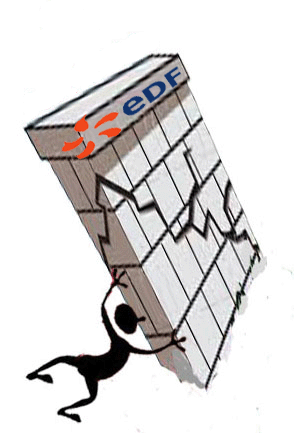
France is considering restructuring plans for debt-laden power firm EDF
(EDF.PA) that include full nationalisation followed by the sale of its
renewables business to focus on nuclear energy, BFM Business reported,
citing unidentified sources.
The website said the government was working
with investment bank Goldman Sachs on several restructuring scenarios. The
sale of the renewables business could fetch 15 billion euros ($16 billion),
it cited unidentified bankers as saying, adding that could help finance the
building of six next-generation EPR nuclear reactors.
Reuters 13th April 2022
Nuclear Free Local Authorities deplore UK govt’s super-costly new nuclear energy strategy, and its rejection of energy conservation measures
THE NUCLEAR FREE LOCAL AUTHORITIES organisation (NFLA) says it is
“incredulous” that Prime Minister Boris Johnson and the UK Government
remains wedded to a new Energy Security Strategy that will rely in large
part upon the development of 24 GW of new nuclear generation capacity to
power Britain.
A plan involving mass investment in renewables and a
reduction in electricity demand through retrofitting the nation’s homes
with insulation would have been far cheaper and quicker to deliver, it
says.
In response to the government’s commitment to build the equivalent
of eight new large nuclear power stations by 2050, NFLA National Chair,
Councillor David Blackburn, said: “It defies common sense that the
current government is turning to a technology that is too slow to install,
too costly to build, remains risky to operate and vulnerable to military
and terrorist attack, and leaves a toxic legacy of radioactive waste that
has to be safely stored for 100,000 years.”
Ekklesia 13th April 2022
Caitlin Johnstone sheds a critical gaze on media reporting on Ukraine, and asks why Julian Assange is criminalised for revealing military atrocities.

If it seems a bit hypocritical to you that the empire is blasting us in the face all day with narratives alleging Russian war crimes while that same empire is imprisoning a journalist for exposing its war crimes, that’s because it absolutely is hypocritical.
If something looks wrong about the fact that we’re about to watch a judge sign off on Julian Assange’s extradition to the United States for practicing journalism while that same United States keeps pushing out narratives about the need to protect Ukraine’s freedom and democracy, that’s because it should.
If It Feels Like You’re Being Manipulated, It’s Because You Are,
more https://caitlinjohnstone.substack.com/p/if-it-feels-like-youre-being-manipulated?s=w Caitlin Johnstone, 11 Apr 22, If you’ve got a gut feeling that your rulers are working to control your perception of the war in Ukraine, it is safe to trust that feeling.
If you feel like there’s been a concerted effort from the most powerful government and media institutions in the western world to manipulate your understanding of what’s going on with this war, it’s because that’s exactly what has been happening.
If you can’t recall ever seeing such intense mass media spin about a war before, it’s because you haven’t.
If you get the distinct impression that this may be the most aggressively perception-managed and psyop-intensive war in human history, it’s because it is.
If it looks like Silicon Valley platforms are controlling the content that people see to give them a perspective on this war that is wildly biased in favor of the US narrative, it’s because that is indeed the case.
If it seems like a suspicious coincidence that Russiagate manufactured mainstream consent for all the same shady agendas we’re seeing ramped up now like cold war brinkmanship against Moscow, internet censorship, and being constantly lied to by the mass media for the greater good, it’s because it is a mighty suspicious coincidence.
If it seems weird to you that so many self-styled leftists are responding to this war by fanatically supporting the extremely dangerous unipolarist geostrategic agendas of the most powerful empire that has ever existed, that’s because it is weird. Really, really, really weird.
If it seems a bit hypocritical to you that the empire is blasting us in the face all day with narratives alleging Russian war crimes while that same empire is imprisoning a journalist for exposing its war crimes, that’s because it absolutely is hypocritical.
If something looks wrong about the fact that we’re about to watch a judge sign off on Julian Assange’s extradition to the United States for practicing journalism while that same United States keeps pushing out narratives about the need to protect Ukraine’s freedom and democracy, that’s because it should.
If you’re beginning to get the nagging sense that the mainstream consensus worldview is a construct manufactured by the powerful, for the powerful and everything you were taught about your nation, your government and your world is a lie, that’s definitely a possibility worth considering.
If it’s starting to seem like we’re all being manipulated at mass scale to think, act and vote in a way which benefits a vast power structure that rules over us while hiding its true nature, I’d say that’s a thread worth pulling.
If you’ve a sneaking suspicion that the lies might go even deeper than that, right down to deceptions about who you fundamentally are and what this life is actually about, that suspicion is probably worth exploring.
If you’re feeling a bit like Keanu Reeves in the beginning of The Matrix right before the veil gets ripped away, I’d recommend following the white bunny and seeing how deep that rabbit hole goes.
If it has occurred to you that humanity needs to wake up from the matrix of illusion before our sociopathic rulers drive us to extinction via environmental catastrophe or nuclear armageddon, then your notes match my own.
If you believe it’s possible that these existential crises we’re fast approaching may be the catalyst we need to collectively rip the blindfold from our eyes and begin moving in a truth-based way upon this earth and creating a healthy world, then we are on the same page.
If there’s something in you that whispers there’s a good chance we make it despite the long odds we appear to be facing, I will tell you a secret: I hear it too.
Russian soldiers received ‘shocking amount’ of nuclear exposure at Chernobyl site – some may have less than a year to live.
Ukraine says Russian soldiers stole potentially deadly radioactive substances from Chernobyl,
more – https://www.abc.net.au/news/2022-04-11/russians-stole-radioactive-substance-chernobyl/100981372
Russian forces who occupied the Chernobyl nuclear plant stole potentially deadly radioactive substances from research laboratories, Ukraine’s State Agency for Managing the Exclusion Zone says.
Key points:
- Ukraine recently took back control of the Chernobyl site
- Ukraine’s energy minister says some Russia soldiers have less than a year to live
- Chernobyl plant staff have just been rotated for the second time since Russian forces seized the facilities
Moscow’s troops seized the defunct power plant on the first day of their invasion of Ukraine on February 24. They occupied the highly radioactive zone for over a month, before retreating on March 31.
The agency said on Facebook that Russian soldiers pillaged two laboratories in the area.
It said the Russians entered a storage area of the Ecocentre research base and stole 133 highly radioactive substances.
Even a small part of this activity is deadly if handled unprofessionally,” the agency said.
‘Shocking’ amount of nuclear exposure
Earlier this week, Ukraine’s energy minister German Gulashchenko said Russian soldiers exposed themselves to a “shocking” amount of nuclear radiation, saying some of them may have less than a year to live.
“They dug bare soil contaminated with radiation, collected radioactive sand in bags for fortification, breathed this dust,” Mr Gulashchenko said on Facebook on Friday after visiting the exclusion zone.
“After a month of such exposure, they have a maximum of one year of life. More precisely, not life but a slow death from diseases. “Every Russian soldier will bring a piece of Chernobyl home. Dead or alive.”
He said Russian military equipment was also contaminated.
“The ignorance of Russian soldiers is shocking.”
The Chernobyl power station was the site of the world’s worst nuclear disaster in 1986.
Situation ‘far from normal’
The International Atomic Energy Agency said Ukraine had been able to rotate staff at the decommissioned Chernobyl nuclear plant for only the second time since Russian forces seized the facility early in the war.
They had to be transported to and from the site by water, with the Pripyat River being the only way for people living in the city of Slavutych to currently reach the plant.
The nuclear agency said the situation around Chernobyl, site of a 1986 nuclear disaster, “remained far from normal” after Russians departed at the end of March.
Ukrainian officials told the agency on Sunday that laboratories for radiation monitoring at the site were destroyed and instruments damaged or stolen.
The automated transmission of radiation monitoring data has been disabled.
The US-Australia-UK pact seems determined to pursue great power competition at the risk of real conflict.
APRIL 11, 2022
Written by
Sarang Shidore
The leaders of the United States, United Kingdom and Australia — the three nations that form the AUKUS security grouping— have issued a joint statement recently on deepening their cooperation to include new technologies. The statement spoke of “new trilateral cooperation on hypersonics and counter-hypersonics, and electronic warfare capabilities, as well as to expand information sharing and to deepen cooperation on defense innovation.”
AUKUS is an explicitly military pact announced in September 2021 aimed to counter China in the Asia-Pacific. It has been generally portrayed as an agreement to transfer highly sensitive nuclear submarine technology to Australia and equip Canberra with such craft. Since then, the submarine plans have made some progress, with the Exchange of Naval Nuclear Propulsion Information Agreement signed by the three countries, which allows sharing of sensitive data. Australian Prime Minister Scott Morrison has also announced the earmarking of an additional base for nuclear submarines on the country’s east coast.
But AUKUS is as much, or even more, about other defense technologies such as cyber, artificial intelligence, quantum physics, and others to which hypersonics is just the latest addition. The likely reason for adding the latter is China’s own progress in this technology, with a recent test that was seen in the United States as a breakthrough. The United States is widely considered to be behind China and Russia in hypersonic technology. However, Washington is very much implicated in Chinese advances. The United States probably sparked China’s drive for hypersonics when it withdrew from the bedrock Anti-Ballistic Missile (ABM) treaty in 2001.
Last year, I wrote about the dangers and risks AUKUS presents to the stability and security of Asia. These include setting a poor precedent for curbing nuclear proliferation, problematic weaponization of norms and values claims, the perception of an Anglo-Saxon club in Asia, and risks of sparking a new arms race. Deterrence has a place in any U.S. approach toward China, but the U.S. Indo-Pacific strategy is heavy on deterrence and light on reassurance. The inclusion of hypersonics in AUKUS is simply another sign that we have entered a world of decreasing safeguards against chances of great power conflict with all its potential to go nuclear. Nuclear war, more than the rise of China, is a core and existential threat to the United States.
Last year, I wrote about the dangers and risks AUKUS presents to the stability and security of Asia. These include setting a poor precedent for curbing nuclear proliferation, problematic weaponization of norms and values claims, the perception of an Anglo-Saxon club in Asia, and risks of sparking a new arms race. Deterrence has a place in any U.S. approach toward China, but the U.S. Indo-Pacific strategy is heavy on deterrence and light on reassurance. The inclusion of hypersonics in AUKUS is simply another sign that we have entered a world of decreasing safeguards against chances of great power conflict with all its potential to go nuclear. Nuclear war, more than the rise of China, is a core and existential threat to the United States.
What should America do with its nuclear waste?
What Should America Do With Its Nuclear Waste?
Currently there are about 80 locations in 35 states where spent fuel is being stored, with no long-term plans for disposal., WP, By Rebecca Tuhus-Dubrow 1 Apr 22, ”……………………………………….. (closure of SanOnofre nuclear power station) Magda and other activists realized that all of the high-level radioactive waste that had accumulated at the plant over the course of its lifetime — 1,600 tons of spent fuel rods — would remain at the site for the foreseeable future. Although the federal government is legally responsible for disposing of commercial spent nuclear fuel in a permanent underground repository, there has been no plan for fulfilling that obligation since the Obama administration halted the project at Nevada’s Yucca Mountain in 2010. There are currently about 80 locations in 35 states — mostly at operational and decommissioned nuclear plants — where spent fuel is being stored indefinitely.
Since the San Onofre plant shut down, Magda has been trying to get the spent fuel moved to a more suitable site and to ensure that, until then, it is stored as safely as possible. As of 2017, she has represented her local chapter of the Sierra Club on the Community Engagement Panel, an entity established by SCE that holds quarterly meetings with the public. In her garage, she showed me a gray filing cabinet with four vertically stacked drawers, her granddaughter’s teal bike propped up against the side. The drawers contain hundreds of manila files with hand-scrawled labels: ………. In addition to earthquakes and tsunamis, Magda and other activists are worried about coastal erosion and sea level rise caused by climate change. “We can’t leave it here,” Magda says.
The question of what to do with the nation’s spent nuclear fuel has recently garnered renewed attention. This is thanks in part to U.S. Rep. Mike Levin (D-Calif.), who represents the district encompassing San Onofre and has taken up the cause as one of his signature issues. An environmental lawyer by training, he told me he ran for Congress partially to make progress on reviving the nation’s stalled efforts. In January 2019, he established a task force of local stakeholders to study the situation at San Onofre. He has also co-founded the bipartisan Spent Nuclear Fuel Solutions Caucus, with Rep. Rodney Davis (R-Ill.), and introduced the Spent Fuel Prioritization Act, which would ensure that the material is moved first from the most sensitive locations, including San Onofre.
Among scientific experts and government officials, there is broad consensus that the optimal solution is to eventually bury nuclear waste in a deep geological repository. But that is a long-term goal, and in the near future, Levin and many others are pushing for “consolidated interim storage.” This would mean that the spent fuel scattered at sites across the country would be moved to one or more facilities, in appropriate settings, that would be devoted entirely to safely storing the fuel until a geological disposal facility is ready.
There is also agreement, of a limited sort, between many nuclear opponents and supporters on the importance of addressing the waste issue. But for many opponents, such as Magda, the waste is a reason to abandon this form of energy altogether. ……………..
Despite recent momentum to break the spent fuel impasse, the obstacles are considerable. “Frankly we have a real problem in the U.S., not just at San Onofre,” Levin told me. “San Onofre is just the symptom, with 9 million people within 50 miles and two earthquake faults and rising sea level. The actual problem is that we’ve got nowhere to move it to.”
…………. The 1982 Nuclear Waste Policy Act was the first major law to address spent nuclear fuel, and assigned the federal government the task of constructing and operating such facilities. By that time, there were dozens of commercial nuclear plants that had been accumulating spent fuel and storing it on-site with no plans for disposal. According to the law, the Department of Energy was required to move promptly to site two geological repositories for permanent disposal.
In 1987, however, amendments to this law identified only a single location: Yucca Mountain, about 90 miles northwest of Las Vegas. The selection was based on the Energy Department’s assessment of the site’s geological features and was also thought to reflect political dynamics at the time. In the state, the legislation became known as the “Screw Nevada Bill.” Nevada’s powerful long-serving senator, Harry M. Reid, made it his mission to see that this repository would never come to pass. In 2010, the Obama administration announced that it would withdraw the license application to the Nuclear Regulatory Commission for the project. “We’re done with Yucca,” Carol Browner, President Barack Obama’s energy adviser, said. (The United States does have a deep geological repository for defense waste, in New Mexico, but not for commercial spent fuel.)
Meanwhile, Obama’s secretary of energy convened the bipartisan Blue Ribbon Commission on America’s Nuclear Future to devise a new strategy. The commission issued a report in January 2012. “The overall record of the U.S. nuclear waste program has been one of broken promises and unmet commitments,” the report stated.
The report’s first recommendation, highlighting its importance, was a “consent-based approach to siting future nuclear waste management facilities” for both permanent underground disposal and temporary aboveground storage. That is, instead of selecting sites based strictly on physical characteristics, the new approach would solicit volunteers, and engage communities, states, tribes and other stakeholders to obtain their approval before proceeding with plans…………
The spent fuel at San Onofre is stored in 123 canisters, in what’s called an independent spent fuel storage installation (ISFSI, pronounced “ISSfuhsee”). Contrary to the popular impression of nuclear waste as green goo, the fuel rods consist of solid pellets, each slightly larger than a pencil eraser. The fuel rods, bundled into fuel assemblies, were retrieved from the reactors over the course of decades. After cooling for at least five years in pools of water, they were transferred into stainless-steel canisters, with walls five-eighths of an inch thick. Workers then transferred the loaded canisters, each of which weighs 50 tons, to a concrete pad overlooking the ocean and lowered them into stainless-steel cavities beneath the pad’s surface………….
the ongoing demolition of the plant — major decommissioning work is expected to continue through 2028 — as well as the construction of a rail yard. It was a reminder that radioactive spent fuel is not the only kind of waste produced by nuclear plants: Millions of pounds of metal and steel, and tens of thousands of titanium tubes, will eventually be loaded onto rail cars and shipped away, some to be recycled, some to a landfill. One day, according to the plan, the spent fuel will be shipped away on this rail line as well, though no one knows to where……………………………….
The 1957 National Academy of Sciences report stated, “Unlike the disposal of any other type of waste, the hazard related to radioactive waste is so great that no element of doubt should be allowed to exist regarding safety.” Being in the same room with unshielded nuclear waste, fresh out of the reactor, could very quickly give you a fatal dose of radiation……………………………………
Magda points out that for real progress to occur, the law needs to change so that Yucca Mountain is not the only permissible site for a permanent repository. Levin has not yet introduced legislation to change that, but he told me he plans to. One arguable reason for optimism is that an improved waste management strategy, unlike so many other causes, has bipartisan support. “Nuclear waste doesn’t care if you’re a Democrat or a Republican,” Levin says……………………….. https://www.washingtonpost.com/magazine/2022/04/11/america-nuclear-waste-san-onofre/
UK’s energy strategy ”cowardly and incoherent” – solar and onshore wind are the practical options
Michael Grubb: The writer is professor of energy and climate change at
University College London and was former senior adviser to energy regulator
Ofgem.
The UK energy strategy is both cowardly and incoherent. The defining
feature of the UK energy strategy is its incoherence. It does not know what
problem it is trying to solve – and thus it does not solve any. By
failing to boost energy efficiency and kicking the only possible short-term
supply option – that of cheap onshore wind – into the long grass, it
most certainly will not help those struggling with energy bills in the
coming winters.
Offshore wind is the great success story of the past decade
and capacity has grown sharply in recent years. The strategy increases the
offshore target for 2030 from 40GW to 50GW. That’s very ambitious but
possible. But offshore wind involves big and complex kit from only a few
suppliers, it usually takes three to five years from bid to completion, and
the pace of expansion could stress supply chains and drive up costs. If it
were all concentrated in the North Sea, there would be immense challenges
for the grid – both in transmission and in managing the peaks and
troughs. Wind is best when distributed more widely.
The most cowardly failure concerns onshore wind. It is not only our cheapest energy resource
– it typically costs about a third to a quarter of what people will soon
be paying for their electricity – but it is, with solar, the only one
that could make a dent in the short term. The strategy outlines a plan for
nuclear to 2050, kicked off with one new plant to be funded before the next
general election. If it takes an energy crisis to actually make a decision,
so be it, but it will not help solve the crisis.
Nuclear is not only slow
and expensive, it would need to be flexible to ramp up and down with the
swings of demand, wind and solar. This further undermines the economics.
Launching a 30-year plan for nuclear also raises the question – why
can’t the government set out even a coherent 30-month plan for energy
efficiency?
FT 10th April 2022
https://www.ft.com/content/3fe73617-5f8f-4b70-8856-ca53e2ec92b3
1 This Month



19 November – Webinar – The Reality of Reprocessing
Time: 11:00 AM Pacific Time (US & Canada) / 2:00 PM Eastern / 7:00 PM UK / 8:00 PM CET
Register for the Zoom Event Here



Shut down the radiation-damaged Heysham nuclear reactors now
To see nuclear-related stories in greater depth and intensity – go to https://nuclearinformation.wordpress.com

Say No to NASA’s Reckless Nuclear Reactor on the Moon
Say No to NASA’s Reckless Nuclear Reactor on the Moon
-
Archives
- November 2026 (74)
- October 2026 (302)
- September 2026 (339)
- August 2026 (330)
- July 2026 (355)
- June 2026 (287)
- May 2026 (306)
- April 2026 (356)
- March 2026 (251)
- February 2026 (267)
- January 2026 (308)
- December 2025 (358)
-
Categories
- 1
- 1 NUCLEAR ISSUES
- business and costs
- climate change
- culture and arts
- ENERGY
- environment
- health
- history
- indigenous issues
- Legal
- marketing of nuclear
- media
- opposition to nuclear
- PERSONAL STORIES
- politics
- politics international
- Religion and ethics
- safety
- secrets,lies and civil liberties
- spinbuster
- technology
- Uranium
- wastes
- weapons and war
- Women
- 2 WORLD
- ACTION
- AFRICA
- Atrocities
- AUSTRALIA
- Christina's notes
- Christina's themes
- culture and arts
- Events
- Fuk 2022
- Fuk 2023
- Fukushima 2017
- Fukushima 2018
- fukushima 2019
- Fukushima 2020
- Fukushima 2021
- general
- global warming
- Humour (God we need it)
- Nuclear
- RARE EARTHS
- Reference
- resources – print
- Resources -audiovicual
- Weekly Newsletter
- World
- World Nuclear
- YouTube
-
RSS
Entries RSS
Comments RSS

