Ukrainian blogger gets 15 years gaol for saying that Zelensky govt takes orders from other governments
https://www.lindipendente.online/2022/04/05/ucraina-blogger-arrestato-perche-critica-zelensky-rischia-15-anni-di-carcere/?fbclid=IwAR0XFoa_HVePLpr3DYMhXT2PH-d0juJG-3gBHSrVqovgqqc_rCyYB0kA_70 Mike Mapes 15 Apr 22,
Ukrainian blogger Gleb Lyashenko has been sentenced for “betrayal” to 15 years in prison after writing on a post:
“Zelensky was wrong. It has been years that the Russia has been asking us for a reasonable agreement, that is to stay out of the Nato. But there was no change of course. This is why our government takes orders from others, who use us Ukrainians for their purposes. The result was this absurd war. “
Since yesterday Ukraine also has its Assange and Snowden.
“All wars start with lies. But all wars can be stopped by the truth!”
No room at the dump: NFLA fears Johnson’s nuclear ambitions will lead to need for second unwanted underground facility
Like the standing joke about buses turning up late and in pairs, the
Nuclear Free Local Authorities fear that Boris Johnson’s commitment to
treble Britain’s nuclear generating capacity by 2050 will create so much
new toxic nuclear waste that the government will want to build a second
underground nuclear dump in the next two decades.
A large, and much maligned, element in last week’s UK Energy Security Strategy was the
pledge to build up to eight new large nuclear power stations over the next
three decades, generating 24 gigawatts of electricity, and the UK could run
out of room to store the resultant radioactive waste if the Prime
Minister’s plan becomes reality.
Professor Claire Corkhill is Chair in
Nuclear Material Degradation and EPSRC Early Career Research Fellow and
Reader at the University of Sheffield, and a member of the Committee on
Radioactive waste Management (CORWM) which advises the government.
Professor Corkhill has publicly commented that existing plans for the dump
will only provide sufficient capacity to take the legacy waste from 70
years of operations and waste from up to 16 gigawatts of nuclear new build,
and has expressed concern about ‘rushing to expand nuclear power until
the implementation of radioactive waste policy [i.e. the GDF] has
progressed further’.
NFLA 13th April 2022
Carelessness of Russian soldiers around Chernobyl – shows danger of nuclear sites in wartime
As we learn more about the negligence of Russian generals who ignored
warnings that the radioactive forest surrounding Chornobyl was a hazardous
staging ground for their assault on Kyiv, environmental historian Kate
Brown flags an ill-recognized reality: humanity is ill prepared for what
happens when nuclear facilities are held hostage during war.
Known as the
“Red Forest”—its pine trees turned red from radiation exposure after
a reactor at Chornobyl melted down in April 1986—the area where Russian
soldiers bulldozed and dug trenches and bunkers is the most contaminated
region of the Chornobyl Exclusion Zone, which is itself “one of the most
toxic places on Earth,” writes the New York Times.
But Russian generals did not seem troubled by the fact that their troops were digging and
bunking down in earthworks that may have had radiation levels 1,000 times
above ambient.
Energy Mix 12th April 2022
Ukraine MoD Asserts No Evidence That Russia Will Deploy Nuclear Weapons Amid War
The spokesperson of the Ukrainian Defence Ministry, Oleksandr Motuzianyk stated that Ukraine perceives no indicators that Russia will deploy nuclear weapons.
Written By Rohit Ranjan Republic World, 15th April, 2022
Scientist fired after raising questions about safety at nuclear waste plant
 |
4 Investigates: Scientist fired after raising questions about safety at nuclear waste plant https://www.kob.com/albuquerque-news/4-investigates-scientist-fired-after-raising-questions-about-safety-at-nuclear-waste-plant/6445723/
Brittany Costello, April 14, 2022 CARLSBAD, N.M— There are some things we just leave up to the experts – that includes the science and research that goes into the Waste Isolation Pilot Plant in Carlsbad, New Mexico, the only-of-its-kind facility that stores transuranic radioactive waste from around the country.
What if we told you there are questions about the science of its long-term safety? KOB 4 spoke with a former scientist who said he lost his job after raising the red flag.
There’s an expectation, a reputation that follows the name Sandia National Labs. Its advanced scientific work is something many of us take for granted. Not Dr. Charles Oakes, who is a geochemist who used to work for Sandia National Labs in Carlsbad at the Waste Isolation Pilot Plant, also known as WIPP.
Part of his job was to make sure WIPP, and all of the transuranic radioactive waste stored inside, is safe for years to come.
This is a case where they weren’t, not only were they not doing their job, they were claiming they were doing their job but falsifying all the evidence that went into the claims that they were doing the job,” Dr. Charles Oakes said.
From the outside, there’s not much to see at WIPP. That’s because all the waste is stored more than 2,000 feet below ground.
“WIPP is the only facility of its kind in the world, deep geologic repository for nuclear waste,” said Don Hancock, Director of the Nuclear Waste Program a Southwest Research and Information Center.
Hancock has served as a WIPP watchdog even before the first disposal at the Department of Energy site in 1999.
“Essentially what’s in WIPP are elements that are contaminated from the manufacturing of components in nuclear weapons, particularly the plutonium core, the heart of it,” said Hancock. “That includes machinery that includes gloves, and booties, that includes sludges.”
It might sound complex, but the key to safe storage of radioactive material is simple: accurate, reliable science and research. Regulators at the Environmental Protection Agency demand it.
Sandia National Labs is contracted to do it, at a cost of $18-million a year.
It’s so important that, in order for WIIPP to continue accepting waste, every five years, it has to recertify that its projections show the facility will be safe after it’s filled up and closed down.
Safe from that point and 10,000 years beyond it.
“The most common feared way that the radiation will get to the surface is through the flow of water,” said Dr. Oakes. “There are some aquifers in the rock of the repository. One of the fears is that a well will be drilled through the repository or near to this repository and water may flow through the repository and intersect with a well bore.”
Dr. Oakes said his job was to look at how much of that radioactive material would make it to the surface.
“If you do have radioactive material dissolved in the water, will it react with rocks, minerals along the way, and be removed from the water, in which you removed the threat, or will it carry on its merry way dissolved and get to the surface where it can potentially hurt people and the environment,” he said.
During his time at Sandia National Labs, Dr. Oakes said he discovered inaccuracies that called into question WIPP’s long-term safety, what he believed to data errors.
Oakes said he brought it up to his bosses, the Department of Energy and even the EPA.
After he spoke up, Oakes said Sandia labeled him a problem employee and showed him the door.
Oakes is being represented by attorney Timothy White – and Nick Davis of Davis Law. Their goal is to address much more than what they believe to be retaliatory discharge.
“We’re trying to achieve a certain safety standard here and the information that is being used to allegedly show that we’ve achieved that standard, that we should be recertified to manage the WIPP project, is built on bad science leading to fraud,” said White.
KOB 4 wanted to hear from Sandia National Labs. A spokesperson told us they cannot comment on these accusations because of the pending lawsuit.
There are a number of defendants named in the suit: Honeywell International, National Technology and engineering Solutions of Sandia, LLC, Carol Adkins, and Paul Shoemaker.
Attorneys representing the defendants have responded in court. Documents allege Oakes was fired after multiple “inappropriate interactions with colleagues” but they did not go into detail.
Attorneys are also asking a federal judge to dismiss the case.
As far as all of that expansive data is concerned, officials at the Department of Energy, with the WIPP project, said there are quality assurance procedures in place including several independent reviews.
They said a recertification decision is expected later in April or early May.
Spain outraged as massive US nuclear-powered submarine arrives in Gibraltar
SPAIN has launched an official complaint against the arrival of a US nuclear-powered submarine in Gibraltar.
By ALESSANDRA SCOTTO DI SANTOLO, Apr 14, 2022 The arrival of a USS Georgia submarine in the port of Gibraltar has sparked a diplomatic row between Spain and the US. The Spanish Foreign Ministry has confirmed that it has lodged an official protest with the US.
The Spanish authorities wanted the submarine to anchor at the Rota naval base instead, where the US Georgia had already been based in August 2020.
The reasons and the duration for the stopover of the submarine remain unknown.
Since the port of Gibraltar was ceded by Spain to the United Kingdom in 1713, the Spanish government actually lacks the authority to prevent such moves. The British Overseas Territory has been at the centre of a bitter row between the UK and EU after Brexit, as access to Gibraltar was not included in the trade agreement. Under an EU proposal, Spain would gain control over the country’s external border……………………https://www.express.co.uk/news/uk/1596057/spain-news-Gibraltar-uss-Georgia-submarine-nuclear-uk-latest
A call for World-class Cleanup at Chalk River Laboratories
https://concernedcitizens.net/2022/04/14/a-call-for-world-class-cleanup-at-chalk-river-laboratories/ Canada’s $16 billion nuclear waste legacy is in danger of being abandoned in substandard facilities and allowed to leak into our rivers and drinking water. Instead, let’s use our expertise to turn Canada into a world leader in the cleanup and safe storage of radioactive waste.
WORLD-CLASS NUCLEAR WASTE CLEANUP would protect health, drinking water, property values and peace of mind.
What do experts say is needed?
The International Atomic Energy Agency says that radioactive waste facilities must be carefully sited and waste placed below ground to keep radioactive materials out of air and water and protect current and future generations. The IAEA says that siting a facility for long-lived waste in a “stable geological formation” is “fundamentally important.” It says that nuclear reactor entombment should only be used in the case of an emergency, such as a meltdown.
Retired AECL scientists say that IAEA guidance must be followed, that Canada has an obligation to follow the guidelines as a signatory to the Joint Convention on the Safety of Radioactive Waste Management.
First Nations, in a Joint Declaration, endorsed by resolution at the Assembly of First Nations, say that nuclear waste should be managed according to five principles: 1) no abandonment, 2) monitored and retrievable storage 3) better containment, more packaging, 2) away from drinking water and major water bodies and 5) no unnecessary transport (exports and imports)
The Canadian Coalition for Nuclear Responsibility says radioactive waste should be carefully managed in monitored and retrievable condition so that repairs to packaging can be made as needed, to keep the contents out of the biosphere, our air, soil and drinking water. The CCNR suggests that a “rolling stewardship” strategy whereby each generation teaches each subsequent generation how to look after the wastes and keep them out of the biosphere.
Some countries such as Finland have made good progress building facilities to keep radioactive waste out of the biosphere. Finland puts radioactive wastes produced by its four nuclear reactors in bedrock geological facilities 100 meters deep. It has over 25 years of experience with these facilities. They will also house the radioactive remains of the reactors when they are shut down and dismantled.
WORLD-CLASS NUCLEAR WASTE CLEANUP would bring money into the Ottawa Valley economy and support good careers for generations of valley residents.
WORLD-CLASS NUCLEAR WASTE CLEANUP would involve:


WORLD-CLASS NUCLEAR WASTE STORAGE FACILITIES would protect the Ottawa River and future generations.
Rep. Ilhan Omar: Accountability for Russia Means Abandoning US ‘Hypocrisy’
Akbar Shahid Ahmed/HuffPost,
The congresswoman revealed a proposal to make America a member of the International Criminal Court and revoke a Bush-era measure that undermines it.
Mounting evidence of widespread Russian atrocities in Ukraine is spurring the Biden administration and lawmakers from both parties to demand justice at a global level — specifically, at the International Criminal Court in The Hague. Now Rep. Ilhan Omar (D-Minn.) is challenging them to boost that prospect by making the U.S. a member of the court and repealing a George W. Bush-era law that requires the U.S. to block the court from investigating Americans.
“We’ve engaged in a process for a long time of delegitimizing these international institutions that essentially call for accountability, and I think it is really disturbing that we now think they are powerful enough … to hold Russia accountable. It’s easy for people to see the hypocrisy in those two statements when we’ve said previously that we don’t believe in the ability of the court to [be] unbiased,” Omar said on Wednesday………….
“It’s really important for us not to have a law on the books that says in many ways it is OK for everyone to be prosecuted” but not Americans, Omar told HuffPost. “Think about just how much more powerful of a statement it would be if we didn’t just call for accountability for war crimes in Ukraine in holding Russians accountable for the possible war crimes they have committed but if we actually had skin in the game.”
| Progressives like Omar see developing a loud, nuanced position on Ukraine as critical to expanding their influence over national security policy and reforming the U.S.’s approach to global affairs.Conservatives and the Pentagon have argued for years that if the U.S. joined the court, American officials would face unfair and politically motivated investigations. But every Republican in the Senate recently voted for legislation recommending the court as a venue for probing Russia’s abuses, and House Republicans are supporting a bill urging the court to prosecute Putin if any harm befalls Ukrainian President Volodymyr Zelenskyy………………. https://www.rsn.org/001/rep-ilhan-omar-accountability-for-russia-means-abandoning-us-hypocrisy.html |
Dr Richard Dixon: Scottish and UK governments are on a collision course over nuclear energy and oil.
The UK Government’s new energy strategy
makes no sense at all and puts Westminster on collision course with
Holyrood. In early March, Boris Johnson said he would produce, as a matter
of urgency, a plan to respond to the twin challenges of war in Ukraine and
the cost-of-living crisis.
Four weeks later, we finally have the British
Energy Security Strategy and it does pretty much the opposite of what’s
needed. Supposedly this is because the PM and Chancellor could not agree on
key measures. The result is a strategy that convinces no-one. Even the
right-wing press have roundly lambasted it.
The first thing you are taught
in any class about energy is that using less is much better than producing
it differently. Yet, there is nothing at all in the strategy on the
quickest, cheapest and most obvious way to save energy and reduce bills –
improving the energy efficiency of people’s homes.
The last thing youwould do if you want to change our energy system quickly and at an
affordable cost is invest in new nuclear reactors, yet that is exactly what
the government plans to do, egged on by Labour’s new enthusiasm.
The cover of the strategy shows the construction site at Hinkley Point C,
originally proposed in the mid-1980s, subject of a two-and-a-half year
public inquiry and with construction now running ten years late and many
times over budget. The world’s most expensive power plant is perhaps not
the cleverest example to use.
The plan suggests eight new nuclear reactors.
In 2010, the Conservative-Lib Dem coalition government planned to build
eight new reactors in the next decade … 12 years later the two reactors
at Hinkley are the only ones actually under construction and they might
possibly producing electricity in 2027 with a price tag of £23 billion.
There will be a new round of applications for oil and gas production in the
autumn, given a green gloss by the complete con that is the Climate
Compatibility Checklist. The Cambo oilfield might be back on the table. The
government says it is reviewing the science on fracking, and Ineos has
already kindly offered to start drilling.
The Scottish Government is due to
publish a set of energy scenarios before the summer and a draft Energy
Strategy in the autumn. There will be plenty of energy efficiency and
renewables but no new nuclear and no fracking. Apart from offshore wind,
the UK and Scottish plans on energy are pretty much the opposite of each
other. Sparks will fly.
Scotsman 14th April 2022
Touring exhibition celebrates 40 years on Wales county councils Nuclear Free Zones
A TOURING exhibition is to visit Llandudno next week to celebrate 40 years
since all eight of the (then) county councils of Wales declared themselves
“Nuclear Free Zones”. This was marked on February 23, 1982 by the Clwyd
“Nuclear Free Wales” Declaration. CND Cymru (supported by North Wales
Quakers) are marking the campaigns which led to that signing with a touring
exhibition at 12 centres around Wales, including Llandudno (known as
“Nuclear Free Wales @40”).
North Wales Pioneer 14th April 2022
Nuclear and gas in EU taxonomy slammed as ‘greenwashing’.
Nuclear and gas in EU taxonomy slammed as ‘greenwashing’,
- The controversial decision to include gas and nuclear in the EU’s taxonomy was the outcome of a lengthy and highly-politicised process EU Observer By ELENA SÁNCHEZ NICOLÁS BRUSSELS, 14 Apr 22, Russia’s invasion of Ukraine, and EU plans to reduce its reliance on Russian fossil-fuel imports, have raised more questions over the fate of the European Commission’s controversial taxonomy proposal.
EU member states were already split over the role of gas and nuclear in the energy transition and, thus, in green finance — even before the war in Ukraine……….
Critics say the proposal undermines the credibility of the EU taxonomy as a science-based investment tool, gives credence to claims of greenwashing, creates confusion in financial markets, and will cause major delays in the much-needed transition away from fossil fuels.
The taxonomy does not ban outright investment in activities not included in the guidelines — but it is designed to steer investments away from companies and investors which falsely claim to be environmentally sustainable.
‘Gold standard’ gone
Experts have warned that including natural gas (with a higher threshold than the one recommended by experts) and nuclear power in the EU’s sustainable finance rules may lead to further greenwashing in financial markets.
University College Dublin professor Andreas Hoepner, who has been one of those leading academic opposition on the taxonomy, describes it as probably “the biggest greenwash ever.”
The proposal, he said, ignores rigorous scientific analysis and weakens the credibility of the whole EU sustainable finance agenda. And it may even lead to an increase in emissions incompatible with the Fit-for-55 package and the EU’s climate targets.
The rules were meant to create common standards for classifying taxonomy-aligned economic activities as environmentally sustainable.
But Laurence Tubiana, one of the key architects of the 2015 Paris Agreement, has warned that investors may go elsewhere to seek more “more reliable science-based criteria” to classify their investments.
“The whole idea of creating a ‘gold standard’ is gone” with gas and nuclear power included in the EU taxonomy, Dutch MEP Bas Eickhout told EUobserver in an interview.
With the credibility of the whole taxonomy hanging by a thread, Eickhout warned of the impact on green bonds, given that funds raised from these bonds could be used for gas and nuclear projects. The transition towards net-zero emissions will require massive investment, but not enough money is currently going into projects delivering climate neutrality, he said.
“If we now lower the standard in order to mobilise the money, then we are still fooling ourselves,” he said, because the taxonomy must be “a credible standard” to fulfil its goal…………………..
“The EU should rapidly transition away from fossil fuels, fossil-fuel investments and subsidies to deliver climate stability,” added Ursula Woodburn from the UK’s cross-sector group of business leaders, CLG Europe,
The decision to include gas and nuclear in the taxonomy was slammed as the outcome of a both lengthy and highly-politicised process.
But the European Commission has also come under fire for looking at this tool purely through a domestic prism — despite its impact beyond EU borders. https://euobserver.com/war-peace-green-economy/154585
Glenn Greenwald: The Censorship Campaign Against Western Criticism of NATO’s Ukraine Policy Is Extreme

This war has been very good indeed for the permanent Washington political and media class. And although it was taboo for weeks to say so, it is now beyond clear that the only goal that the U.S. and its allies have when it comes to the war in Ukraine is to keep it dragging on for as long as possible.
One can spread as many lies and as much disinformation as one wants provided that it is designed to advance the NATO agenda in Ukraine

It is not a mystery who is benefiting from this orgy of military spending. On Tuesday, Reuters reported that “the Pentagon will host leaders from the top eight U.S. weapons manufacturers on Wednesday to discuss the industry’s capacity to meet Ukraine’s weapons needs if the war with Russia lasts years.” Among those participating in this meeting about the need to increase weapons manufacturing to feed the proxy war in Ukraine is Raytheon, which is fortunate to have retired General Lloyd Austin as Defense Secretary, a position to which he ascended from the Raytheon Board of Directors. It is virtually impossible to imagine an event more favorable to the weapons manufacturer industry than this war in Ukraine:
https://scheerpost.com/2022/04/13/glenn-greenwald-the-censorship-campaign-against-western-criticism-of-natos-ukraine-policy-is-extreme/ April 13, 2022 Preventing populations from asking who benefits from a protracted proxy war, and who pays the price, is paramount. A closed propaganda system achieves that. By Glenn Greenwald
If one wishes to be exposed to news, information or perspective that contravenes the prevailing US/NATO view on the war in Ukraine, a rigorous search is required. And there is no guarantee that search will succeed. That is because the state/corporate censorship regime that has been imposed in the West with regard to this war is stunningly aggressive, rapid and comprehensive.
On a virtually daily basis, any off-key news agency, independent platform or individual citizen is liable to be banished from the internet. In early March, barely a week after Russia’s invasion of Ukraine, the twenty-seven nation European Union — citing “disinformation” and “public order and security” — officially banned the Russian state-news outlets RT and Sputnik from being heard anywhere in Europe. In what Reuters called “an unprecedented move,” all television and online platforms were barred by force of law from airing content from those two outlets. Even prior to that censorship order from the state, Facebook and Google were already banning those outlets, and Twitter immediately announced they would as well, in compliance with the new EU law.
But what was “unprecedented” just six weeks ago has now become commonplace, even normalized. Any platform devoted to offering inconvenient-to-NATO news or alternative perspectives is guaranteed a very short lifespan. Less than two weeks after the EU’s decree, Google announced that it was voluntarily banning all Russian-affiliated media worldwide, meaning Americans and all other non-Europeans were now blocked from viewing those channels on YouTube if they wished to. As so often happens with Big Tech censorship, much of the pressure on Google to more aggressively censor content about the war in Ukraine came from its own workforce: “Workers across Google had been urging YouTube to take additional punitive measures against Russian channels.”
So prolific and fast-moving is this censorship regime that it is virtually impossible to count how many platforms, agencies and individuals have been banished for the crime of expressing views deemed “pro-Russian.” On Tuesday, Twitter, with no explanation as usual, suddenly banned one of the most informative, reliable and careful dissident accounts, named “Russians With Attitude.” Created in late 2020 by two English-speaking Russians, the account exploded in popularity since the start of the war, from roughly 20,000 followers before the invasion to more than 125,000 followers at the time Twitter banned it. An accompanying podcast with the same name also exploded in popularity and, at least as of now, can still be heard on Patreon.
What makes this outburst of Western censorship so notable — and what is at least partially driving it — is that there is a clear, demonstrable hunger in the West for news and information that is banished by Western news sources, ones which loyally and unquestioningly mimic claims from the U.S. government, NATO, and Ukrainian officials. As The Washington Post acknowledged when reporting Big Tech’s “unprecedented” banning of RT, Sputnik and other Russian sources of news: “In the first four days of Russia’s invasion of Ukraine, viewership of more than a dozen Russian state-backed propaganda channels on YouTube spiked to unusually high levels.”
Note that this censorship regime is completely one-sided and, as usual, entirely aligned with U.S. foreign policy. Western news outlets and social media platforms have been flooded with pro-Ukrainian propaganda and outright lies from the start of the war. A New York Times article from early March put it very delicately in its headline: “Fact and Mythmaking Blend in Ukraine’s Information War.” Axios was similarly understated in recognizing this fact:
Ukraine misinformation is spreading — and not just from Russia.” Members of the U.S. Congress have gleefully spread fabrications that went viral to millions of people, with no action from censorship-happy Silicon Valley corporations. That is not a surprise: all participants in war use disinformation and propaganda to manipulate public opinion in their favor, and that certainly includes all direct and proxy-war belligerents in the war in Ukraine.
Yet there is little to no censorship — either by Western states or by Silicon Valley monopolies — of pro-Ukrainian disinformation, propaganda and lies. The censorship goes only in one direction: to silence any voices deemed “pro-Russian,” regardless of whether they spread disinformation. The “Russians With Attitude” Twitter account became popular in part because they sometimes criticized Russia, in part because they were more careful with facts and viral claims that most U.S. corporate media outlets, and in part because there is such a paucity of outlets that are willing to offer any information that undercuts what the U.S. Government and NATO want you to believe about the war.
Their crime, like the crime of so many other banished accounts, was not disinformation but skepticism about the US/NATO propaganda campaign. Put another way, it is not “disinformation” but rather viewpoint-error that is targeted for silencing. One can spread as many lies and as much disinformation as one wants provided that it is designed to advance the NATO agenda in Ukraine (just as one is free to spread disinformation provided that its purpose is to strengthen the Democratic Party, which wields its majoritarian power in Washington to demand greater censorship and commands the support of most of Silicon Valley). But what one cannot do is question the NATO/Ukrainian propaganda framework without running a very substantial risk of banishment.
It is unsurprising that Silicon Valley monopolies exercise their censorship power in full alignment with the foreign policy interests of the U.S. Government. Many of the key tech monopolies — such as Google and Amazon — routinely seek and obtain highly lucrative contracts with the U.S. security state, including both the CIA and NSA. Their top executives enjoy very close relationships with top Democratic Party officials. And Congressional Democrats have repeatedly hauled tech executives before their various Committees to explicitly threaten them with legal and regulatory reprisals if they do not censor more in accordance with the policy goals and political interests of that party.
But one question lingers: why is there so much urgency about silencing the small pockets of dissenting voices about the war in Ukraine? This war has united the establishment wings of both parties and virtually the entire corporate media with a lockstep consensus not seen since the days and weeks after the 9/11 attack. One can count on both hands the number of prominent political and media figures who have been willing to dissent even minimally from that bipartisan Washington consensus — dissent that instantly provokes vilification in the form of attacks on one’s patriotism and loyalties. Why is there such fear of allowing these isolated and demonized voices to be heard at all?
The answer seems clear. The benefits from this war for multiple key Washington power centers cannot be overstated. The billions of dollars in aid and weapons being sent by the U.S. to Ukraine are flying so fast and with such seeming randomness that it is difficult to track. “Biden approves $350 million in military aid for Ukraine,” Reuters said on February 26; “Biden announces $800 million in military aid for Ukraine,” announced The New York Times on March 16; on March 30, NBC’s headline read: “Ukraine to receive additional $500 million in aid from U.S., Biden announces”; on Tuesday, Reuters announced: “U.S. to announce $750 million more in weapons for Ukraine, officials say.” By design, these gigantic numbers have long ago lost any meaning and provoke barely a peep of questioning let alone objection.
It is not a mystery who is benefiting from this orgy of military spending. On Tuesday, Reuters reported that “the Pentagon will host leaders from the top eight U.S. weapons manufacturers on Wednesday to discuss the industry’s capacity to meet Ukraine’s weapons needs if the war with Russia lasts years.” Among those participating in this meeting about the need to increase weapons manufacturing to feed the proxy war in Ukraine is Raytheon, which is fortunate to have retired General Lloyd Austin as Defense Secretary, a position to which he ascended from the Raytheon Board of Directors. It is virtually impossible to imagine an event more favorable to the weapons manufacturer industry than this war in Ukraine:
Demand for weapons has shot up after Russia’s invasion on Feb. 24 spurred U.S. and allied weapons transfers to Ukraine. Resupplying as well as planning for a longer war is expected to be discussed at the meeting, the sources told Reuters on condition of anonymity. . .
Resupplying as well as planning for a longer war is expected to be discussed at the meeting. . . . The White House said last week that it has provided more than $1.7 billion in security assistance to Ukraine since the invasion, including over 5,000 Javelins and more than 1,400 Stingers.
This permanent power faction is far from the only one to be reaping benefits from the war in Ukraine and to have its fortunes depend upon prolonging the war as long as possible. The union of the U.S. security state, Democratic Party neocons, and their media allies has not been riding this high since the glory days of 2002. One of MSNBC’s most vocal DNC boosters, Chris Hayes, gushed that the war in Ukraine has revitalized faith and trust in the CIA and intelligence community more than any event in recent memory — deservedly so, he said: “The last few weeks have been like the Iraq War in reverse for US intelligence.” One can barely read a mainstream newspaper or watch a corporate news outlet without seeing the nation’s most bloodthirsty warmongering band of neocons — David Frum, Bill Kristol, Liz Cheney, Wesley Clark, Anne Applebaum, Adam Kinzinger — being celebrated as wise experts and heroic warriors for freedom.
This war has been very good indeed for the permanent Washington political and media class. And although it was taboo for weeks to say so, it is now beyond clear that the only goal that the U.S. and its allies have when it comes to the war in Ukraine is to keep it dragging on for as long as possible. Not only are there no serious American diplomatic efforts to end the war, but the goal is to ensure that does not happen. They are now saying that explicitly, and it is not hard to understand why.
The benefits from endless quagmire in Ukraine are as immense as they are obvious. The military budget skyrockets. Punishment is imposed on the arch-nemesis of the Democratic Party — Russia and Putin — while they are bogged down in a war from which Ukrainians suffer most. The citizenry unites behind their leaders and is distracted
from their collective deprivations. The emotions provoked by the horrors of this war — unprecedentedly shown to the public by the Western media which typically ignores carnage and victims of wars waged by Western countries and their allies — is a very potent tool to maintain unity and demonize domestic adversaries. The pundit class finds strength, purpose and resolve, able to feign a Churchillian posture without any of the risks. Prior sins and crimes of American elites are absolved and forgotten at the altar of maximalist claims about Putin’s unprecedented evils — just as they were absolved and forgotten through the script which maintained that the U.S. had never encountered a threat as grave or malignant as Trump. After all, if Putin and Trump are Hitler or even worse, then anyone who opposes them is heroic and noble regardless of all their prior malignant acts.
And that is why even small pockets of dissent cannot be tolerated. It is vital that Americans and Europeans remain entrapped inside a completely closed system of propaganda about the war, just as Russians are kept entrapped inside their own. Keeping these populations united in support of fighting a proxy war against Russia is far too valuable on too many levels to permit any questioning or alternative perspectives. Preventing people from asking who this war benefits, and who is paying the price for it, is paramount.
Big Tech has long proven to be a reliable instrument of censorship and dissent-quashing for the U.S. Government (much to the chagrin of corporate media employees, Russian outlets still remain available on free speech alternatives such as Rumble and Telegram, which is why so much ire is now directed at them). A rapid series of ostensible “crises” — Russiagate, 1/6, the COVID pandemic — were all exploited to condition Westerners to believe that censorship was not only justified but necessary for their own good. In the West, censorship now provokes not anger but gratitude. All of that laid the perfect foundation for this new escalation of a censorship regime in which dissent, on a virtually daily basis, is increasingly more difficult to locate.
No matter one’s views on Russia, Ukraine, the U.S. and the war, it should be deeply alarming to watch such a concerted, united campaign on the part of the most powerful public and private entities to stomp out any and all dissent, while so aggressively demonizing what little manages to slip by. No matter how smart or critically minded or sophisticated we fancy ourselves to be, none of us is immune to official propaganda campaigns, studied and perfected over decades. Nor is any of us immune to the pressures of group-think and herd behavior and hive minds: these are embedded in our psyches and thus easily exploitable.
That is precisely the objective of restricting and closing the information system available to us. It makes it extremely difficult to remain skeptical or critical of the bombardment of approved messaging we receive every day from every direction in every form. And that is precisely the reason to oppose such censorship regimes. An opinion or belief adopted due to propaganda and reflex rather than autonomy and critical evaluation has no value.
Nonstop Corporate News on Ukraine Is Fueling Support for Unchecked US Militarism
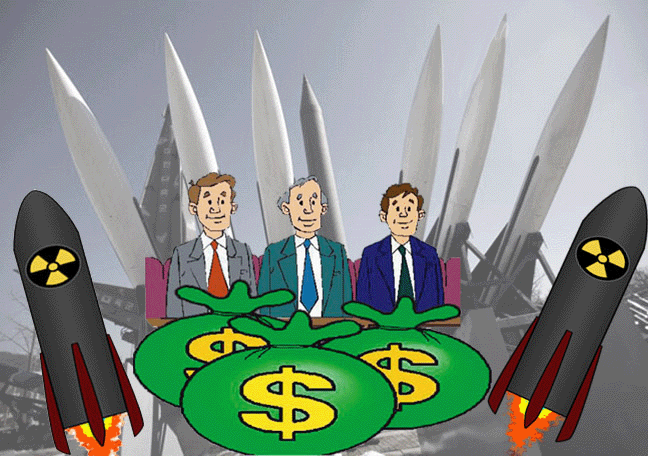
The U.S. public is being fed continuous nonstop images of technologically sophisticated weapons being used in Ukraine — in effect this appears to function as a sort of advertisement for the weapons industry, coupled with the sensational presentation of gratuitous violence
Talking heads in the dominant media landscape churn out cheap binarisms about good and evil, democracy versus authoritarianism. In doing so, they reinforce the mythic narrative that the U.S., a model of liberal innocence, is furthering the global fight for democracy, untainted in its false assertion that fascism is always elsewhere — in this case exclusively in Russia.
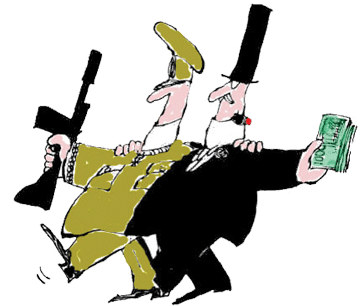
There is almost no talk about the role of the military-industrial complex, both in its push for war, and how it usually emerges as the only winner. Nor is there any talk about who profits from an embrace of war talk, the spectacularization of war and war itself.
Henry A. Giroux, Truthout, 13 Apr 22, The drums of fascism are beating louder. The catastrophe of war and outpouring of support for the millions of Ukrainians suffering under the brutal attacks by Russia has morphed into increased warmongering from the West. The shock of war has been transformed into a cinematic spectacle used to fan the flames of militarism. The sheer boldness, violence and ruthlessness of Russia’s attack on Ukraine has created a global political crisis accentuated by both a crisis of ideas and a crisis of historical reckoning, at least in the Western mainstream media.
The wider public’s inability to reflect on the underlying causes of the war is due at least in the United States to its long-standing dominant belief in its own exceptionalism, reinforced by a moral righteousness endlessly reproduced in the mainstream media.
Tragic pictures of the agonizing hardships faced by the Ukrainian people too often appear with little or no critical commentary in the corporate-controlled cultural apparatuses. Endless images of unfathomable agony by the Ukrainian people dominate the conventional news outlets and other monopolies of information governed by the spectacle of 24/7 coverage, matched almost entirely by a lack of historical analysis. While widespread moral repulsion to the tragedies of the war are understandable, what is not acceptable is the refusal of the mainstream media to reflect on the historical, political and economic conditions leading up to the war.
The U.S. public is being fed continuous nonstop images of technologically sophisticated weapons being used in Ukraine — in effect this appears to function as a sort of advertisement for the weapons industry, coupled with the sensational presentation of gratuitous violence.
Within this militarized aesthetic, operating in the service of permanent war, as cultural critic Rustom Bharucha writes, “there is an echo of the pornographic in maximizing the pleasure of violence.” The corporate media are thus rendering war as riveting, emotional and free from demanding intellectual complexities since it emerges out of an either/or view of good and evil.
Images of violence are replayed in the mainstream media over and over again, making violence not only more visible but also rootless. The sheer monopoly of such images gives them a fascist edge, all the while dissolving politics into a cinematic pathology. Writer and philosopher Susan Sontag’s observation about war coverage, made in a different historical context, is even more relevant today. According to Sontag, the endless images of war and suffering, removed from the context of rigorous historical analysis, represent a contempt for “all that is reflective, critical and pluralistic [and are] linked to forms of rabid masculinity [that] glamorizes death.”
Talking heads in the dominant media landscape churn out cheap binarisms about good and evil, democracy versus authoritarianism. In doing so, they reinforce the mythic narrative that the U.S., a model of liberal innocence, is furthering the global fight for democracy, untainted in its false assertion that fascism is always elsewhere — in this case exclusively in Russia. There is almost no talk about the role of the military-industrial complex, both in its push for war, and how it usually emerges as the only winner. Nor is there any talk about who profits from an embrace of war talk, the spectacularization of war and war itself.
When more critical explanations of the war appear, especially from those criticizing the eastward expansion of the North Atlantic Treaty Organization (NATO), which created one set of conditions for the conflict, they are often mocked, ignored, or at worst, accused of being treasonous. In this instance, a rampant militarism collapses the difference between a critical analysis and a justification for Russia’s actions………….
We have seen a similar shutting down of dissent before in the face of catastrophic events, especially in the aftermath of the 9/11 attacks and the ensuing “war on terror.” Yet, the frenetic opposition to dissent today seems more dangerous, especially given the multiple cultural platforms calling for “virtual war, for participating in it, and being manipulated by it, [including] crowd funding urban militias on Twitter, posting videos of captured tanks or ‘army cats’ to Instagram and TikTok.”
The need for community is too often now organized around a bristling war fever feeding on militaristic language in mainstream outlets such as The Atlantic, The New Republic, New Yorker, The Financial Times and The Wall Street Journal. In all cases, rightful moral outrage over the brutality of Russia’s unlawful invasion morphed quickly into a fog-of-war hysteria demanding more military aid, more punitive sanctions and bolstered by the discourse of unchecked jingoism. The call for peace or a diplomatic solution is barely mentioned.
With the war in Ukraine raging, more nuanced analyses along with dissent disappear in the suffocating discourses of hyper-nationalism and the growing bonfire of militarism fueled by what Indian essayist and novelist Pankaj Mishra, writing in the London Review of Books, calls “an infotainment media [that] works up citizens into a state of paranoid patriotism.” The military-industrial-intellectual-academic complex has reasserted itself in the face of Russia’s violation of international law, accelerating the prospect, if not welcoming, the potential of another looming Cold War, aided greatly by media apparatuses that bask in the comfort of moral certainty and patriotic inanity. In this atmosphere of hyper-war culture, military victories become synonymous with moral victories as language becomes weaponized and matters of ethics no longer inform the urgent call for peace.
In the face of the brutal Russian invasion, the concept of militarization is being amplified and put into service as a call for more upgraded weapons. Talk of war, not peace, dominates the mainstream media landscapes both at home and abroad. Such talk also fuels a global arms industry, oil and gas monopolies, and the weaponization of language itself. Militarism as a tool of unchecked nationalism and patriotism drives the mainstream and right-wing disimagination machines. Both fuel a global war fever through different degrees of misrepresentation and create what intellectual historian Jackson Lears writing in the London Review of Books calls “an atmosphere “poisoned by militarist rants.” He goes further in regarding his critique of the U.S. response to the war in Ukraine, writing in the New York Review of Books:
Yet the US has failed to put a cease-fire and a neutral Ukraine at the forefront of its policy agenda there. Quite the contrary: it has dramatically increased the flow of weapons to Ukraine, which had already been deployed for eight years to suppress the separatist uprising in the Donbas. US policy prolongs the war and creates the likelihood of a protracted insurgency after a Russian victory, which seems probable at this writing. Meanwhile, the Biden administration has refused to address Russia’s fear of NATO encirclement. Sometimes we must conduct diplomacy with nations whose actions we deplore. How does one negotiate with any potential diplomatic partner while ignoring its security concerns? The answer, of course, is that one does not. Without serious American diplomacy, the Ukraine war, too, may well become endless.
The horrific events in Ukraine have mobilized a global response against the brutal acts of violence inflicted on the Ukrainian people, but such massive acts of violence have also taken place in Syria, Afghanistan, Iraq and Yemen without eliciting comparable condemnations or humanitarian aid from the U.S. and Europe. Moreover, while public outrage in the U.S. is warranted in light of the “horrendous crimes by Russian troops against Ukrainian civilians—massacre, murder, and rape, among them,” memory fades, and the line between fantasy and historical consciousness disappears, “erasing the brutalizing crimes committed during America’s Global War on Terror.”……………………………………..
Historical amnesia and a prolonged military conflict combine making it easier to sell war rather than peace, which would demand not only condemnation of Russia but also an exercise in self-scrutiny with a particular focus on the military optic that has been driving U.S. foreign policy since President Dwight D. Eisenhower warned in the 1950s of the danger of the military-industrial complex.
The Ukrainian war is truly insidious and rouses the deepest sympathies and robust moral outrage, but the calls to punish Russia overlook the equally crucial need to call for peace. In doing so, such actions ignore a crucial history and mode of analysis that make clear that behind this war are long-standing anti-democratic ideologies that have given us massive inequality, disastrous climate change, poverty, racial apartheid and the increasing threat of nuclear war.
War never escapes the tragedies it produces and is almost always an outgrowth of the dreams of the powerful — which always guarantees a world draped in suffering and death. Peace is difficult in an age when culture is organized around the interrelated discourse of militarism and state violence. War has become the only mirror in which alleged democratic capitalist and authoritarian societies recognize themselves. Rather than defined as a crisis, war for authoritarian rulers and the soulless arms industries becomes an opportunity for power and profits, however ill-conceived.
Peace demands a different assertion of collective identity, a different ethical posture and value system that takes seriously Dr. Martin Luther King Jr.’s admonition that human beings must do everything not to “spiral down a militaristic stairway into the hell of thermonuclear annihilation.” This is not merely a matter of conscience or resistance but of survival itself.
French presidential election – Macron and LePen have differing pro-nuclear policies – but in both cases, very costly.
| |||
French presidential election: Future of nuclear power and EDF down to voters, Euractiv By Nelly Moussu | EURACTIV.fr | translated by Anne-Sophie Gayet, 13 Apr 2022
Both Emmanuel Macron and Marine Le Pen, the candidates that qualified for the second round of the French presidential election, support the revival of nuclear energy. However, they differ in their ambitions, strategies and modus operandi. EURACTIV France reports.
EDF, the French multinational electric utility company, is looking to diversify its energy sources – in particular, focusing its core business on nuclear power. This progress has so far been hampered, however, by a number of difficulties that have challenged the energy giant’s finances: the shutdown of reactors for maintenance and the obligation to lower its prices, as mandated by the state.
With Macron and Le Pen’s pro-nuclear energy programmes, the company is likely to face increased financial pressure, presented with high investment costs for maintenance and the building of reactors.
Two pro-nuclear politicians
Presenting his electoral programme in Belfort on February 10, Macron outlined his plan to build six new nuclear reactors of the EPR 2 type, examine eight other projects, and extend existing plants. “I am asking EDF to study the conditions of extension beyond 50 years, in conjunction with the nuclear safety authority”, Macron said.
An “inter-ministerial programme directorate dedicated to new nuclear power” would be set up to “ensure the management, coordinate administrative procedures, and ensure that the costs and deadlines of the projects are respected”, he continued.
Macron also announced a new regulation for nuclear electricity, replacing the Regulated Access to Historic Nuclear Electricity (Accès Régulé à l’Electricité Nucléaire Historique, ARENH). This system, which allows all energy suppliers to purchase electricity from EDF under conditions set by the State, will expire in 2025.
………. Le Pen has broad nuclear ambitions too. In her plan, named ‘Marie Curie’, the candidate announced that she wanted to extend the life of existing power plants to 60 years, reopen the Fessenheim plant (which was closed in 2020), build five pairs of EPRs by 2031 and five pairs of EPR 2s by 2036.
However, these forecasts are not necessarily credible, said Nicolas Goldberg, an energy expert at Terra Nova. In a note published by the Terra Nova think tank on Monday (April 11), he emphasised that Le Pen’s announcements “are contradictory to what the nuclear industry advocates: according to independent audits carried out on behalf of the State, deciding today on a nuclear revival would mean that at best a first pair of EPRs could be available between 2035 and 2037 […]. It should also be remembered that the industry itself has expressed some doubts about its ability to build more than 14 EPRs by 2050.”
Towards a nationalisation of EDF?
To implement their nuclear projects, Macron and Le Pen would rely on EDF, 84% of which is currently owned by the state.
………………..“The state will take its responsibilities to secure EDF’s financial situation and its financing capacity in the short and medium-term, as much as to allow it to pursue its strategy of profitable development within the framework of the energy transition”, Macron announced in February during his speech in Belfort.
Some have interpreted this statement as an open door to nationalisation. “Emmanuel Macron knows very well that in order to have a cheap nuclear power, public funding is required”, Goldberg said. By nationalising, EDF’s borrowing rates would not be the same; nor would the sharing of risks……………..
“For Emmanuel Macron, I feel that it is complicated,” Goldberg said. “There is, at the same time, the will to keep an integrated group, to give public financing for nuclear power, and to remain in the European markets”. Nationalisation is uncertain on Macron’s side, and it could be only partial.
Nationalisation is less of an uncertainty for Le Pen, Goldberg said. “It’s a nationalisation no matter what it costs,” the expert says. However, the candidate has not given any details on this issue in her programme. Contacted by EURACTIV on this for more details, her campaign team did not respond…….. https://www.euractiv.com/section/energy/news/french-presidential-election-future-of-nuclear-power-and-edf-down-to-voters/
UK to get ”special weapons”storage sites for USA nuclear weapons, – making a pre-emptive strike easier.

Daryl Kimball, the executive director of the Arms Control Association, said the upgrade of the UK storage facilities is “an early sign that the US and Nato are preparing to engage in a protracted and maybe heightened standoff with Putin’s Russia”.
UK military vaults upgraded to store new US nuclear weapons https://www.theguardian.com/world/2022/apr/12/uk-military-vaults-upgraded-to-store-new-us-nuclear-weapons
A US 2023 budget request shows the UK is one of several European countries where investment is under way at ‘special weapons’ storage sites Julian Borger in Washington and Dan Sabbagh, Wed 13 Apr 2022
Military bunkers in the UK are being upgraded so they can be used to store US nuclear weapons again after 14 years of standing empty, according to US defence budget documents.
In the Biden administration’s 2023 defence budget request, the UK was added to the list of countries where infrastructure investment is under way at “special weapons” storage sites, alongside Belgium, Germany, Italy, the Netherlands and Turkey – all countries where the US stores an estimated 100 B61 nuclear bombs.
Hans Kristensen, the director of the nuclear information project at the Federation of American Scientists (FAS), who first reported on the budget item, said he believed the British site being upgraded is the US airbase at RAF Lakenheath, 100 km north-east of London.
The US withdrew its B61 munitions from Lakenheath in 2008, marking the end of more than half a century of maintaining a US nuclear stockpile in the UK. At the time of the withdrawal, the gravity bombs were widely seen as militarily obsolete and hopes were higher for further disarmament by the nuclear weapons powers.
That optimism has since been dashed, against the backdrop of Vladimir Putin’s invasion of Ukraine, his regime’s nuclear threats against Nato, and extensive nuclear weapon modernisation programmes pursued by both the US and Russia. As part of the US plan, the B61 has been given a new lease of life with a guidance system, the B61-12 variant, due to go into full production in May.
The 2023 budget request says that Nato “is wrapping up a 13-year, $384m infrastructure investment program at storage sites in Belgium, Germany, Italy, the Netherlands, the UK, and Turkey to upgrade security measures, communication systems, and facilities”.
In the 1990s, RAF Lakenheath had 33 underground storage vaults, where 110 B61 bombs were stored, according to the FAS. Since their withdrawal the vaults have been mothballed. Kristensen said he believes the vaults are now being upgraded so the new B61-12 bombs can be stored there, if needed.
The Biden administration has been careful not to make any moves that might be seen as escalatory in the nuclear arena in response to Putin’s announcement he would put Russia’s nuclear forces on higher alert a few days after his invasion of Ukraine. The US has cancelled scheduled tests of its intercontinental ballistic missiles, for example.
For the same reason, Kristensen said he doubted the Biden administration is planning to increase the US nuclear stockpile in Europe. When the new B61-12 bombs are delivered, expected next year, they will replace older models already there. Instead, he thought the Lakenheath upgrade is intended to provided more flexibility to move the nuclear weapons around Europe.
“One of the things they have talked about is protecting the deterrent against Russia’s improved cruise missiles capabilities,” Kristensen said. “So they could be trying to beef up the readiness of more sites without them necessarily receiving nukes, so that they have the options to move things around in a contingency if they need to.”
Britain has become keen to take a more assertive role when it comes to its own nuclear deterrent, and last year announced it would increase its own stockpile of Trident nuclear warheads by 40% to 260, the first such increase since the end of the cold war. Whitehall sources say the UK has “a clearer appreciation” of its role as a nuclear weapons state in a renewed era of state competition with Russia and China.
The UK Ministry of Defence did not comment on the upgrade mentioned in the US budget. One British official said: “We won’t provide anything on this as it relates to the storage of nuclear weapons.” But the news comes just four months after the arrival in Lakenheath of the first of a new generation of nuclear-capable US combat aircraft, the F-35A Lightning II, the first such deployment in Europe.
Daryl Kimball, the executive director of the Arms Control Association, said the upgrade of the UK storage facilities is “an early sign that the US and Nato are preparing to engage in a protracted and maybe heightened standoff with Putin’s Russia”.
“The administration should provide some clarity about the military necessity and goals of possibly bringing nuclear weapons back to the UK,” Kimball added.
The developments in Europe are part of a broader retreat from arms control. The Biden administration’s nuclear posture review, which has been sent to Congress but not yet declassified, is reported not to contain the changes the president pledged during his campaign.
In 2020, he said he would formally declare the sole purpose of nuclear weapons to be deterrence of a nuclear attack against the United States or its allies. But the review leaves open the option of using nuclear arms to respond to non-nuclear threats as well.
The nuclear disarmament group CND said the “quiet announcement” by the US amounted to more militarisation at a time of growing risk and would add to the risks faced by the British public. Kate Hudson, the general secretary of CND, said she feared it could lead to US warheads being redeployed in the UK. “Nuclear weapons don’t make us safe – they make us a target,” she added.
1 This Month



19 November – Webinar – The Reality of Reprocessing
Time: 11:00 AM Pacific Time (US & Canada) / 2:00 PM Eastern / 7:00 PM UK / 8:00 PM CET
Register for the Zoom Event Here



Shut down the radiation-damaged Heysham nuclear reactors now
To see nuclear-related stories in greater depth and intensity – go to https://nuclearinformation.wordpress.com

Say No to NASA’s Reckless Nuclear Reactor on the Moon
Say No to NASA’s Reckless Nuclear Reactor on the Moon
-
Archives
- November 2026 (74)
- October 2026 (302)
- September 2026 (339)
- August 2026 (330)
- July 2026 (355)
- June 2026 (287)
- May 2026 (306)
- April 2026 (356)
- March 2026 (251)
- February 2026 (267)
- January 2026 (308)
- December 2025 (358)
-
Categories
- 1
- 1 NUCLEAR ISSUES
- business and costs
- climate change
- culture and arts
- ENERGY
- environment
- health
- history
- indigenous issues
- Legal
- marketing of nuclear
- media
- opposition to nuclear
- PERSONAL STORIES
- politics
- politics international
- Religion and ethics
- safety
- secrets,lies and civil liberties
- spinbuster
- technology
- Uranium
- wastes
- weapons and war
- Women
- 2 WORLD
- ACTION
- AFRICA
- Atrocities
- AUSTRALIA
- Christina's notes
- Christina's themes
- culture and arts
- Events
- Fuk 2022
- Fuk 2023
- Fukushima 2017
- Fukushima 2018
- fukushima 2019
- Fukushima 2020
- Fukushima 2021
- general
- global warming
- Humour (God we need it)
- Nuclear
- RARE EARTHS
- Reference
- resources – print
- Resources -audiovicual
- Weekly Newsletter
- World
- World Nuclear
- YouTube
-
RSS
Entries RSS
Comments RSS

