After Undermining International Criminal Court, US Now Wants It to Charge Russians,
Marjorie Cohn, Truthout, 17 Apr 22
Athough the United States has tried mightily to undermine the International Criminal Court (ICC) since it became operational in 2002, the U.S. government is now pushing for the ICC to prosecute Russian leaders for war crimes in Ukraine. Apparently, Washington thinks the ICC is reliable enough to try Russians but not to bring U.S. or Israeli officials to justice.
On March 15, the Senate unanimously passed S. Res 546, which “encourages member states to petition the ICC or other appropriate international tribunal to take any appropriate steps to investigate war crimes and crimes against humanity committed by the Russian Armed Forces.”
When he introduced the resolution, Sen. Lindsey Graham (R-South Carolina) said, “This is a proper exercise of jurisdiction. This is what the court was created for.” The United States has refused to join the ICC and consistently tries to undercut the court. Yet a unanimous U.S. Senate voted to utilize the ICC in the Ukraine conflict.
Since February 24, when the Russian Federation launched an armed attack against Ukraine, horrific images of destruction have been ubiquitous. The Office of the UN High Commissioner for Human Rights has documented 3,455 civilian casualties, including 1,417 killed and 2,038 injured as of April 3. Most of those casualties have been caused by explosive weapons with a wide impact area, which includes heavy artillery and multiple launch systems as well as air and missile strikes.
On February 28, Karim Khan, chief prosecutor of the International Criminal Court, opened an investigation into the situation in Ukraine. He said that his preliminary examination found a reasonable basis to believe that alleged war crimes and crimes against humanity had been committed in Ukraine. Khan’s formal investigation will “also encompass any new alleged crimes . . . that are committed by any party to the conflict on any part of the territory of Ukraine.”
As I explained in prior Truthout columns, in spite of U.S.-led NATO’s provocation of Russia over the past several years, the Russian invasion of Ukraine constitutes illegal aggression.
Nevertheless, the ICC does not have jurisdiction to prosecute Russian leaders for the crime of aggression.
The ICC’s Rome Statute Prohibits Aggression
In 1946, the International Military Tribunal at Nuremberg called the waging of aggressive war “essentially an evil thing,” adding that, “to initiate a war of aggression . . . is not only an international crime; it is the supreme international crime differing only from other war crimes in that it contains within itself the accumulated evil of the whole.”
U.S. Supreme Court Justice Robert Jackson, chief prosecutor at the Nuremberg Tribunal, called aggressive war “the greatest menace of our times.” Jackson said, “If certain acts in violation of treaties are crimes, they are crimes whether the United States does them or whether Germany does them, and we are not prepared to lay down a rule of criminal conduct against others which we would not be willing to have invoked against us.”
Aggression is prohibited by the ICC’s Rome Statute. Article 8bis defines the crime of aggression as “the planning, preparation, initiation or execution, by a person in a position effectively to exercise control over or to direct the political or military action of a State, of an act of aggression which, by its character, gravity and scale, constitutes a manifest violation of the Charter of the United Nations.”
Adopting the central prohibition of the UN Charter against the use of aggressive force, Article 8bis defines an act of aggression as “the use of armed force by a State against the sovereignty, territorial integrity or political independence of another State, or in any other manner inconsistent with the Charter of the United Nations.” The charter only allows the use of military force in self-defense or with the consent of the Security Council, neither of which happened before Russia invaded Ukraine.
In order to secure a conviction for aggression, the prosecutor of the ICC must prove that a leader who exercised control over the military or political apparatus of a country ordered an armed attack against another country. An armed attack can include bombing or attacking the armed forces of other country. The attack must be a “manifest” violation of the UN Charter in its character, scale and gravity, which includes only the most serious forms of the illegal use of force. For example, a single gunshot would not qualify but George W. Bush’s illegal invasion of Iraq would………………………………………….
When he introduced the resolution, Sen. Lindsey Graham (R-South Carolina) said, “This is a proper exercise of jurisdiction. This is what the court was created for.” The United States has refused to join the ICC and consistently tries to undercut the court. Yet a unanimous U.S. Senate voted to utilize the ICC in the Ukraine conflict.
Since February 24, when the Russian Federation launched an armed attack against Ukraine, horrific images of destruction have been ubiquitous. The Office of the UN High Commissioner for Human Rights has documented 3,455 civilian casualties, including 1,417 killed and 2,038 injured as of April 3. Most of those casualties have been caused by explosive weapons with a wide impact area, which includes heavy artillery and multiple launch systems as well as air and missile strikes.
On February 28, Karim Khan, chief prosecutor of the International Criminal Court, opened an investigation into the situation in Ukraine. He said that his preliminary examination found a reasonable basis to believe that alleged war crimes and crimes against humanity had been committed in Ukraine. Khan’s formal investigation will “also encompass any new alleged crimes . . . that are committed by any party to the conflict on any part of the territory of Ukraine.”
As I explained in prior Truthout columns, in spite of U.S.-led NATO’s provocation of Russia over the past several years, the Russian invasion of Ukraine constitutes illegal aggression.
Nevertheless, the ICC does not have jurisdiction to prosecute Russian leaders for the crime of aggression……………….
“So, the U.S. wants to help the International Criminal Court prosecute Russian war crimes while barring any possibility the ICC could probe U.S. (or Israeli) war crimes,” observed Reed Brody, a commissioner for the International Commission of Jurists, an international human rights nongovernmental organization.
U.S. hypocrisy is no more apparent than in the first “Whereas” clause of the Senate’s unanimous resolution condemning Russia. It says, “Whereas the United States of America is a beacon for the values of freedom, democracy, and human rights across the globe . . .”
One hundred members of the U.S. Senate affirmed that sentiment in spite of the U.S. wars of aggression in Kosovo, Iraq and Afghanistan, and the commission of U.S war crimes. If the senators truly believe that the ICC is dependable enough to prosecute Russian leaders, they should push Biden to send the Rome Statute to them for advice and consent to ratification. What’s good for the Russian goose should also be good for the U.S. gander. https://truthout.org/articles/after-undermining-international-criminal-court-us-wants-it-to-charge-russians/?eType=EmailBlastContent&eId=1f951de0-ce82-4df9-b85e-0a76f6faf974
Zelensky gives his vision of peace deal with Russia
Had ‘the collective West’ not interfered, this ‘war’ might have ended weeks ago, lives saved, deals signed. But that is not how the utilization of a patsy works.
https://www.sott.net/article/466833-Zelensky-gives-his-vision-of-peace-deal-with-Russia 17 Apr 22,
RT A peace agreement with Russia might consist of two separate documents that would cover the two key issues – security guarantees for Kiev and its future relations with Moscow, Ukrainian President Volodymyr Zelensky said on Saturday.
Speaking to Ukrainian media, Zelensky explained that Moscow would like to have one comprehensive document that would address all the issues. However, because the security guarantees involve other countries, two documents could be a solution. According to the Ukrainian leader:
“A peace treaty with Russia can consist of two different documents. One of them should concern security guarantees for Ukraine, the other to directly address its relations with the Russian Federation.”
He explained that a document covering security guarantees could be signed by those countries “who are ready for these security guarantees,” while another document could cover future relations between Ukraine and Russia.
Zelensky claimed that the UK, US, Italy and Turkey have shown a willingness to provide security guarantees for Ukraine, but there has been no final answer from any of them. A previous list of potential guarantors also included Germany, France, Poland and Israel. Zelensky continued:
“Moscow would like to have one agreement that addresses all the issues. However, not all see themselves at the same table with Russia. For them, security guarantees for Ukraine are one issue, and agreements with Russia are another.”
Despite the apparent progress achieved in the negotiations between Moscow and Kiev in Istanbul in late March, earlier this week Russian President Vladimir Putin said that the peace talks had “returned to a deadlock.” He explained that Ukraine has refused to fulfill one of Russia’s key requests: to recognize Crimea as Russian and the Donbass republics as independent.
Putin’s remarks followed an announcement by Foreign Minister Sergey Lavrov that Kiev had submitted new written proposals that deviated from what was offered during the in-person talks. The new proposal, according to Lavrov, fails to mention that the security guarantees Kiev wants to obtain do not cover Crimea.
Obtaining security guarantees from world powers has been named by Kiev as a key condition for agreeing to a neutral status and abandoning its ambition to join NATO.
Russia attacked the neighboring state in late February, following Ukraine’s failure to implement the terms of the Minsk agreements, first signed in 2014, and Moscow’s eventual recognition of the Donbass republics of Donetsk and Lugansk. The German and French brokered protocols were designed to give the breakaway regions special status within the Ukrainian state.
The Kremlin has since demanded that Ukraine officially declare itself a neutral country that will never join the US-led NATO military bloc. Kiev insists the Russian offensive was completely unprovoked and has denied claims it was planning to retake the two republics by force.
Moscow has warned Western countries against “pumping up” Ukraine with weapons, saying that these actions were exacerbating the conflict.
Comment: The potential ‘two-part’ agreements indicate Ukraine is incidental in this power play, otherwise the forces d’jour would accept a deal between Russia and Ukraine and step aside.
Meanwhile, conflict threatens to break off talks:
Ukrainian President Volodymyr Zelenskiy has threatened to break off talks with Moscow should Russian forces wipe out the remaining Ukrainian soldiers trapped in Mariupol as Moscow claimed it had taken control of the besieged and battered port city after a weeks-long battle.
The Russian Defense Ministry on April 16 said it had cleared the Mariupol urban area of Ukrainian troops and had trapped a few remaining fighters in the Azovstal steel plant.
A Russian Defense Ministry spokesman was quoted by Russia’s RIA Novosti news agency as saying that Ukrainian forces have lost a total of 4,000 troops during the long fight for the city. Casualty figures from both sides have proved impossible to independently confirm.
Ukraine has not commented on the latest Russian claims but in recent days has indicated the situation in Mariupol was desperate, with deaths mounting among the trapped civilian population and many experts predicting the city would soon fall to the Russians.
In an interview published earlier on April 16 with Ukrayinska Pravda, Zelenskiy warned Russia against committing atrocities against Ukrainian soldiers in the city.
“The elimination of our troops, of our men [in Mariupol] will put an end to any negotiations. That will bring an impasse as we don’t negotiate on either our territories or our people. The situation is very difficult [in Mariupol]. Our soldiers are blocked, the wounded are blocked. There is a humanitarian crisis…. Nevertheless, the guys are defending themselves.”
Kyiv Mayor Vitaliy Klitschko said at least one person was killed and several others wounded in early morning attacks.
“For those Kyivites who left and are already thinking of heading back to return to the capital, I ask you to refrain from this and stay in safer places.”
In his nightly address to the nation, Zelenskiy said:
“The success of our military on the battlefield has been really significant. Historically significant. But it’s still not enough to clear our land from the invading forces. The sanctions against Russia are very serious, economically painful. But it is not enough to starve Russia’s military machine. We need to promote stronger, more destructive sanctions. This will determine how long this war will last.”
Meanwhile, the United States and its Western allies continued to pile pressure on Moscow over its campaign. The German government said on April 15 that it plans to release more than 1 billion euros in military aid for Ukraine. The move comes amid criticism from Ukraine and some EU partners such as Poland and the Baltic states that Germany has not done enough to send armaments to Kyiv.
The UN refugee agency said as of April 16 that 4,836,445 million Ukrainians had left the country since the Russian invasion — up by 40,200 from the previous day’s total.
Had ‘the collective West’ not interfered, this ‘war’ might have ended weeks ago, lives saved, deals signed. But that is not how the utilization of a patsy works.
North Korea tests new weapon bolstering nuclear capability
North Korea says it has successfully test-launched a newly developed tactical guided weapon
- By HYUNG-JIN KIM – Associated Press
- Apr 17, 2022
SEOUL, South Korea (AP) — North Korea has test-fired a new type of tactical guided weapon designed to boost its nuclear fighting capability, state media reported Sunday, a day before its chief rivals the United States and South Korea begin annual drills that the North views as an invasion rehearsal.
The 13th weapons test this year came amid concerns that North Korea may soon conduct an even larger provocation. That may include a nuclear test in an effort to expand the country’s arsenal and increase pressure on Washington and Seoul while denuclearization talks remain stalled………………………….. https://www.news-gazette.com/coronavirus/north-korea-tests-new-weapon-bolstering-nuclear-capability/article_0413e1d9-3fb7-5c42-a63c-e1ea66b3e084.htm
Biden’s genocide comment raised concern
SOTT, Carol E. Lee, Josh Lederman, NBC News, Fri, 15 Apr 2022
President Joe Biden’s declaration this week that Russia is committing “genocide” in Ukraine raised concerns among some officials in his own government and has so far not been corroborated by information collected by U.S. intelligence agencies, according to senior administration officials.
At the State Department, which is tasked with making formal determinations of genocide and war crimes through an independent legal process, two officials said that Biden’s seemingly offhand declaration during a domestic policy speech in Iowa on Tuesday made it harder for the agency to credibly do its job.
U.S. intelligence agencies collect information when allegations are made of actions that could amount to genocide, but policymakers are the ones who actually decide whether to declare it. Intelligence reports on Ukraine currently do not support a genocide designation, officials said.
“Genocide includes a goal of destroying an ethnic group or nation and, so far, that is not what we are seeing.”…………..
The question of when to label Russia’s actions in Ukraine “genocide,” particularly the legal threshold for doing so had been discussed inside the White House ever since images of mass graves and civilian torture and assassinations emerged in Bucha, people familiar with the discussions said. Biden had recently begun to make his views clear in private, so White House officials weren’t surprised that he called what’s happening in Ukraine “genocide,” but they were taken aback that he did so offhandedly in a speech in Iowa about inflation, the people said.
The president’s declaration of genocide in Ukraine was the third time in recent weeks that the president has tried to separate what he says are his personal views from official U.S. policy to take a position that he believes is right even though it’s not aligned with the position of his own government.
Biden said Russia was committing war crimes in Ukraine — another symbolically and legally significant moment in which he got ahead of his own administration — a week before the U.S. government completed its legal process and formally made that declaration.
Biden also said Russian President Vladimir Putin should no longer be in power, prompting a scramble by his aides to say that’s not what he meant and stress that U.S. policy is not regime change in Moscow. Biden later said he did mean what he said — that it was his “personal” view — but not U.S. policy.
…………… “These aren’t gaffes,” said one person close to the White House. “He’s doing this very purposefully.”
Responding to questions about Biden’s genocide declaration, White House press secretary Jen Psaki told reporters this week, “The president was calling it like he sees it, and that’s what he does.”
The apparent disconnect between the president and the bureaucracy he oversees is striking given Biden’s extensive experience in foreign policy and government. Biden also has stressed since the 2020 campaign that “the words of a president matter.” And he’s gone out of his way to say he would not try to influence independent Justice Department decisions, but some administration officials see a willingness for him to do just that with other independent legal processes.
Once the president says he believes genocide and war crimes have been committed, administration officials said that puts immense pressure on career government officials to reach the same conclusion. The concern is that if and when the State Department’s Office of Global Criminal Justice reaches those conclusions on its own, the office risks appearing late to the game or like it’s trying to justify Biden’s public comments, the officials said. One of the administration officials said Biden’s comments had put particular pressure on Beth Van Schaack, the U.S. ambassador for global criminal justice, who was confirmed by the Senate last month. On Friday, Schaack met with Ukraine’s prosecutor general, Iryna Venediktova, to compare notes as Venediktvoa’s office investigates alleged Russian war crimes by Russia. Venediktova, like Ukrainian President Volodymyr Zelenskyy, has already accused Russia of genocide in Ukraine.
U.S. intelligence shows that the Russians have been told that Ukrainians in the eastern Donbas region, where fighting is expected to intensify, are Nazis and that the Ukrainian civilians are Nazi sympathizers, raising concerns about genocide, officials said. The Russians also have been told the same about Ukrainians in Mariupol, officials said, with one noting how brutal Moscow’s military campaign has been there.
Genocide is a specific crime defined under international law, and proving it requires showing an intent at high levels to commit genocide.
Biden’s early accusation against Russia, which was welcomed by Zelenskyy, came even ahead of human rights organizations that have often pushed U.S. administrations to declare that a regime has committed genocide.
Human Rights Watch, for instance, so far has not found evidence of a genocidal campaign waged by Russia, according to Tara Sepehri Far, acting deputy director of Human Rights Watch’s Washington office.
“Our research is not matching the definition yet,” said Sepehri Far. “It doesn’t mean it’s not happening.”
Biden has throughout his decades long career at times been quicker than others in the U.S. government to speak out about genocide………………………….. https://www.sott.net/article/466834-Biden-genocide-comment-raised-concern-among-some-U-S-officials
Dissent is dying in America – the backlash is vitriolic
 | |||
AMERICAN DISSENT ON UKRAINE IS DYING IN DARKNESS https://popularresistance.org/american-dissent-on-ukraine-is-dying-in-darkness/ AUDIO
- By Robert Scheer, Scheer Post., April 16, 2022
When It Came To The Ukraine Conflict, Professor Michael J. Brenner Did What He’s Done His Whole Life: Question American Foreign Policy.
This time the backlash was vitriolic.
As the death toll in Russia’s illegal invasion of Ukraine continues to rise, there have only been a handful of Westerners publicly questioning NATO and the West’s role in the conflict. These voices are becoming fewer and further between as a wave of feverish backlash engulfs any dissent on the subject. One of these voices belongs to Professor Michael J. Brenner, a lifelong academic, Professor Emeritus of International Affairs at the University of Pittsburgh and a Fellow of the Center for Transatlantic Relations at SAIS/Johns Hopkins, as well as former Director of the International Relations & Global Studies Program at the University of Texas.
Brenner’s credentials also include having worked at the Foreign Service Institute, the U.S. Department of Defense and Westinghouse, and written several books on American foreign policy. From the vantage point of decades of experience and studies, the intellectual regularly shared his thoughts on topics of interest through a mailing list sent to thousands of readers—that is until the response to his Ukraine analysis made him question why he bothered in the first place.
In an email with the subject line “Quittin’ Time,” Brenner recently declared that, aside from having already said his piece on Ukraine, one of the main reasons he sees for giving up on expressing his opinions on the subject is that “it is manifestly obvious that our society is not capable of conducting an honest, logical, reasonably informed discourse on matters of consequence. Instead, we experience fantasy, fabrication, fatuousness and fulmination.” He goes on to decry President Joe Biden’s alarming comments in Poland when he all but revealed that the U.S. is—and perhaps has always been—interested in a Russian regime change.
On this week’s “Scheer Intelligence,” Brenner tells host Robert Scheer how the recent attacks he received—many of a personal, ad hominem nature—were some of the most vitriolic he’s ever experienced. The two discuss how many media narratives completely leave out that the eastward expansion of NATO, among other Western aggressions against Russia, played an important part in fueling the current humanitarian crisis. Corporate media’s “cartoonish” depiction of Russian president Vladimir Putin, adds Brenner, is not only misleading, but dangerous given the nuclear brinkmanship that has ensued. Listen to the full discussion between Brenner and Scheer as they continue to dissent despite living in an America that is seemingly increasingly hostile to any opinion that strays from the official line.
U.S. Jews Favor Return to Iran Deal
Jews support a return to the Iran deal by 68-32, according to a new survey. And when Jews are asked to name their top two political issues, Israel shows up near the bottom of the list, well behind climate change.
Portside, April 16, 2022, Philip Weiss MONDOWEISS
merican Jews overwhelmingly support the renewal of the Iran deal, and very few American Jews consider Israel a political priority, according to a new survey of American Jewish voters.
Jews support a return to the Iran deal by 68-32, the Jewish Electoral Institute found in a poll of 800 Jews this spring. The proportion is nearly 4-to-1 among Reform Jews (79-21) and women (77-23). And Jews over 65 are for the deal by a larger percentage (72-28) than Jews under 40. Only the orthodox are against the Iran deal, by 85-15! But orthodox make up just 9 percent of the Jewish population.
Now here’s the indifference to Israel question.
Voters were asked to say which two issues they wanted the president to focus on. Israel got clobbered. Only 4 percent listed it as one of their two issues.
When you break it out by denomination, it’s even starker. 1 percent of non-denominational Jews and 2 percent of Reform Jews think Israel should be a priority. And those two groups make up more than two-thirds of American Jews — 31 percent non-denominational, 37 percent Reform. Though 5 percent of Conservative and 18 percent of Orthodox Jews see Israel as a priority.
Other issues are just way more important. 42 percent of nondenominational Jews say climate change should be a top priority; 32 percent say voting rights; 12 percent say crime…………………
The new poll also shows that 93 percent of American Jews are concerned about antisemitism. The Reform number there is 95 percent concerned, the orthodox 96 percent, the non-denominational 89 percent concerned……. https://portside.org/2022-04-16/us-jews-favor-return-iran-deal
Tons of Japanese nuclear waste may be destined for overseas disposal

April 17, 2022
TOKYO (Kyodo) — Japan’s nuclear power plants have over 57,000 tons of large equipment that have, or will in time, become radioactive industrial waste and may be destined to be disposed of overseas, a tally of electric power company data showed Saturday.
The scale of the would-be hazardous waste underscores the ongoing move within the government to reexamine a rule banning the exports of radioactive waste at a time when few municipalities are willing to accept such waste.
Creating an exception to the rule under the foreign exchange law would allow power companies to commission contractors overseas to dispose of certain types of large equipment on the condition they are recycled in the destination countries.
But critics say radioactive waste created in Japan should not be forced on other countries and that such waste should be recycled domestically by improving related disposal technology.
The tally showed nuclear power plants in the country had 57,230 tons of the large equipment, including those still in use, at the end of March.
The equipment in question comes in three types. Steam generators create steam used to generate electricity, while feedwater heaters heat the water that goes back into a reactor and casings are used to store or transport spent nuclear fuel.

For example, there are 37 used steam generators, weighing a total of 12,000 tons, according to the tally. Twenty-two generators, or 7,500 tons, remain at reactors to be decommissioned, while another 51 units, or 15,300 tons, are still in use.
The crippled Fukushima Daiichi nuclear power plant has 3,360 tons of spent nuclear fuel casings. But the industry ministry says it sees no scenario in which waste emerging from the plant’s decommissioning process would be disposed of overseas.
The tally did not include data on the Tokyo Electric Power Company Holdings Inc. plant. Tohoku Electric Power Co. declined to provide data.
Decommissioning of nuclear reactors is expected to speed up from the mid-2020s in Japan, with an attendant increase in radioactive waste. Already, 24 commercial reactors are due to be decommissioned.

Radioactive waste is expected to be buried underground, depending on its pollution levels. But few disposal sites have been picked, leaving the handling of large reactor equipment, in particular, in limbo.
A steam generator is a large cylindrical metal object that is 20 meters long and weighs 300 tons. Because of its size, it cannot be easily cut up, encased in drums and buried.
Kansai Electric Power Co. has 21 generators stored away on its premises. “We are concerned about having little room left on our premises (at power plants) going forward as it would impact decommissioning work,” a company source said.
“It is virtually impossible to dispose of the waste domestically. The regulatory reconsideration is a gleam of hope for the waste issue that is at a dead-end,” the source added, expressing hope for overseas disposal.
One company the Japanese side is talking with about possible waste export is EnergySolutions Inc., a U.S. nuclear service company and a major player in the reactor decommissioning business.
The Utah-based company has processed over 60,000 tons of waste produced in reactor decommissioning in and outside of the United States.
A company official expressed confidence that it can process not just the three types of large reactor equipment under consideration for export, but other waste, such as metals from the Fukushima Daiichi plant.
Tatsujiro Suzuki, a Nagasaki University professor, who served as an acting head of the government’s Atomic Energy Commission, is critical of the envisioned disposal of radioactive waste overseas.
“This is what you get when the state has failed to seriously discuss what to do with waste,” Suzuki said, warning that it is a slippery slope and could lead to an export of waste from the Fukushima nuclear disaster.
“It is sheer irresponsibility when looked at from the principle that disposal must be done in one’s own country.”
Extremely rare brain cancer appearing in people who attended a New Jersey school, close to former nuclear weapons fuel plant

94 former staff and students from Colonia High School in the Woodbridge Township School District have been stricken by the devastating diagnoses in recent years.
While the exact number of former faculty and staff diagnosed with glioblastoma is not precisely known, the cancer is exceedingly rare. According to the American Association of Neurological Surgeons, glioblastoma has an incidence of 3.21 per 100,000
Nearly 100 people at this NJ school got brain tumors — a survivor demands answers, https://nypost.com/2022/04/14/why-nearly-100-people-at-nj-school-got-brain-tumors/?fbclid=IwAR1IItuf3UXbHuJAJr-gByHSGIgbgX1lZYsljrokhDTk6z1Dx77P5UMwrg4
By Andrew Court
A cancer survivor is vowing to untangle the twisted mystery of why almost 100 people associated with a New Jersey high school have developed “extremely” rare malignant brain tumors.
Al Lupiano is among the 94 former staff and students from Colonia High School in the Woodbridge Township School District who have been stricken by the devastating diagnoses in recent years.
“I will not rest until I have answers,” Lupiano, 50, declared in an interview with NJ.com and the Star-Ledger on Thursday. “I will uncover the truth.”
Among the others diagnosed with brain cancer was Lupiano’s younger sister, who passed away from the disease in February at the age of 44.
The devoted brother promised his sister on her deathbed that he would get to the bottom of what was causing the apparent cancer cluster at Colonia High. On Tuesday — after a public push by Lupiano — local officials approved an emergency probe of the school.
“There could be a real problem here, and our residents deserve to know if there are any dangers,” Woodbridge Mayor John McCormac said in a statement. “We’re all concerned, and we all want to get to the bottom of this. This is definitely not normal.”
Starting this weekend, various radiological assessments will be conducted across the school’s 28-acre campus, including the testing of indoor air samples for radon.
Lupiano was diagnosed with a brain tumor back in the late 1990s, at the age of 27. He went on to recover from the disease.
Last year, his wife — who also attended Colonia — was diagnosed with a rare brain tumor. On the exact same day, Lupiano’s younger sister, Angela DeCillis, another alumna of Colonia, learned that she too had brain cancer.
After his sister’s death in February, Lupiano became convinced of a link between the Colonia campus and the brain cancers that he, his wife and his sister had developed. Last month, he started a Facebook group asking locals whether they knew of any other people associated with the school who had been stricken by similar diagnoses.
In less than six weeks, Lupiano says, he has gathered the names of 94 people connected with the school who have developed brain tumors.
The disturbing development became headline news this week after CBS News took it national. A subsequent TikTok video discussing the medical mystery has also racked up more than 2.2 million viral views in just 24 hours.
The vast majority of those who have developed brain tumors “graduated between 1975 and 2000, although outliers have come as recently as a 2014 graduate,” according to the Star-Ledger.
The diagnoses include “several types of primary brain tumors, including cancerous forms like glioblastoma and noncancerous yet debilitating masses such as acoustic neuromas, haemangioblastomas and meningiomas.”
“To find something like this … is a significant discovery,” Dr. Sumul Raval, one of New Jersey’s top neuro-oncologists, told the outlet. “Normally speaking, you don’t get radiation in a high school … unless something is going on in that area that we don’t know,” Raval added, calling for an immediate investigation.
The viral TikTok video discussing the purported cancer cluster was posted Wednesday by popular personality Dr. Joe Whittington.
Whittington — a board-certified MD in California — claimed several of the brain tumors developed by ex-Colonia High staff and students are glioblastoma multiforme — an aggressive cancer which spreads to brain tissue.
While the exact number of former faculty and staff diagnosed with glioblastoma is not precisely known, the cancer is exceedingly rare. According to the American Association of Neurological Surgeons, glioblastoma has an incidence of 3.21 per 100,000.
Meanwhile, the TikTok video sparked panic and a range of conspiracy-theory style comments, with people claiming mold, toxic waste, asbestos and nearby cellphone towers could all be causing the cluster.
Lupiano also spoke with CBS News on Thursday, saying he now believes ionizing radiation must be responsible for the health issues.
“What I find alarming is there’s truly only one environmental link to primary brain tumors, and that’s ionizing radiation,” he declared. “It’s not contaminated water. It’s not air. It’s not something in soil. It’s not something done to us due to bad habits.”
The school was built back in 1967 on acres of empty land, with McCormac telling the news network he is stumped as to what could be causing the cancers.
Lupiano alleges that some contaminated soil was removed from the site when it closed down in 1967 — the same year Colonia High School was built. He now wonders whether some of that soil ended up on the school grounds.CBS2
He has reached out to the state Department of Health, Department of Environmental Protection and the federal Agency for Toxic Substances and Disease Registry for help — which is reportedly still in the “early stages,” according to the CBS News report.
Lupiano told NJ Spotlight News that the school is located less than 12 miles from the Middlesex Sampling Plant — a site that was used, under the direction of the Manhattan Project, to crush, dry, store, package and ship uranium ore for the development of the atomic bomb.
He alleges that some contaminated soil was removed from the site when it closed down in 1967 — the same year Colonia High School was built. Lupiano is wondering whether some of that soil ended up on the school grounds.
Today, Colonia enrolls approximately 1,300 students, with many said to be “anxious” about the possible cancer cluster.
“We are looking at possible things that we can do between the town and school, and they said they will look at anything we come up with,” McCormac said. at top https://nypost.com/2022/04/14/why-nearly-100-people-at-nj-school-got-brain-tumors/?fbclid=IwAR1IItuf3UXbHuJAJr-gByHSGIgbgX1lZYsljrokhDTk6z1Dx77P5UMwrg4
Recent history sheds light on the Ukraine situation . Part Three- Denazification
Retired Swiss Military-Intelligence Officer. Is it possible to actually know what has been and is going on in Ukraine?
Jacques Baud, The Unz Review 02 Apr 2022
”………………………………………………………………….. Denazification

In cities like Kharkov, Mariupol and Odessa, the Ukrainian defense is provided by the paramilitary militias. They know that the objective of “denazification” is aimed primarily at them. For an attacker in an urbanized area, civilians are a problem. This is why Russia is seeking to create humanitarian corridors to empty cities of civilians and leave only the militias, to fight them more easily.
Conversely, these militias seek to keep civilians in the cities from evacuating in order to dissuade the Russian army from fighting there. This is why they are reluctant to implement these corridors and do everything to ensure that Russian efforts are unsuccessful — they use the civilian population as “human shields.” Videos showing civilians trying to leave Mariupol and beaten up by fighters of the Azov regiment are of course carefully censored by the Western media.
On Facebook, the Azov group was considered in the same category as the Islamic State [ISIS] and subject to the platform’s “policy on dangerous individuals and organizations.” It was therefore forbidden to glorify its activities, and “posts” that were favorable to it were systematically banned. But on February 24, Facebook changed its policy and allowed posts favorable to the militia. In the same spirit, in March, the platform authorized, in the former Eastern countries, calls for the murder of Russian soldiers and leaders. So much for the values that inspire our leaders.
Our media propagate a romantic image of popular resistance by the Ukrainian people. It is this image that led the European Union to finance the distribution of arms to the civilian population. In my capacity as head of peacekeeping at the UN, I worked on the issue of civilian protection. We found that violence against civilians occurred in very specific contexts. In particular, when weapons are abundant and there are no command structures.
These command structures are the essence of armies: their function is to channel the use of force towards an objective. By arming citizens in a haphazard manner, as is currently the case, the EU is turning them into combatants, with the consequential effect of making them potential targets. Moreover, without command, without operational goals, the distribution of arms leads inevitably to settling of scores, banditry and actions that are more deadly than effective. War becomes a matter of emotions. Force becomes violence. This is what happened in Tawarga (Libya) from 11 to 13 August 2011, where 30,000 black Africans were massacred with weapons parachuted (illegally) by France. By the way, the British Royal Institute for Strategic Studies (RUSI) does not see any added value in these arms deliveries.
Moreover, by delivering arms to a country at war, one exposes oneself to being considered a belligerent. The Russian strikes of March 13, 2022, against the Mykolayev air base follow Russian warnings that arms shipments would be treated as hostile targets.
The EU is repeating the disastrous experience of the Third Reich in the final hours of the Battle of Berlin.War must be left to the military and when one side has lost, it must be admitted. And if there is to be resistance, it must be led and structured. But we are doing exactly the opposite — we are pushing citizens to go and fight, and at the same time, Facebook authorizes calls for the murder of Russian soldiers and leaders. So much for the values that inspire us.
Some intelligence services see this irresponsible decision as a way to use the Ukrainian population as cannon fodder to fight Vladimir Putin’s Russia. It would have been better to engage in negotiations and thus obtain guarantees for the civilian population than to add fuel to the fire. It is easy to be combative with the blood of others.
4. The Maternity Hospital At Mariupol
It is important to understand beforehand that it is not the Ukrainian army that is defending Mariupol, but the Azov militia, composed of foreign mercenaries.
In its March 7, 2022 summary of the situation, the Russian UN mission in New York stated that “Residents report that Ukrainian armed forces expelled staff from the Mariupol city birth hospital No. 1 and set up a firing post inside the facility.” On March 8, the independent Russian media Lenta.ru, publishedthe testimony of civilians from Mariupol who told that the maternity hospital was taken over by the militia of the Azov regiment, and who drove out the civilian occupants by threatening them with their weapons. They confirmed the statements of the Russian ambassador a few hours earlier.
The hospital in Mariupol occupies a dominant position, perfectly suited for the installation of anti-tank weapons and for observation. On 9 March, Russian forces struck the building. According to CNN, 17 people were wounded, but the images do not show any casualties in the building and there is no evidence that the victims mentioned are related to this strike. There is talk of children, but in reality, there is nothing. This does not prevent the leaders of the EU from seeing this as a war crime. And this allows Zelensky to call for a no-fly zone over Ukraine.
In reality, we do not know exactly what happened. But the sequence of events tends to confirm that Russian forces struck a position of the Azov regiment and that the maternity ward was then free of civilians.
The problem is that the paramilitary militias that defend the cities are encouraged by the international community not to respect the rules of war. It seems that the Ukrainians have replayed the scenario of the Kuwait City maternity hospital in 1990, which was totally staged by the firm Hill & Knowlton for $10.7 million in order to convince the United Nations Security Council to intervene in Iraq for Operation Desert Shield/Storm.
Western politicians have accepted civilian strikes in the Donbass for eight years without adopting any sanctions against the Ukrainian government. We have long since entered a dynamic where Western politicians have agreed to sacrifice international law towards their goal of weakening Russia………………. more https://www.sott.net/article/466340-Retired-Swiss-Military-Intelligence-Officer-Is-it-Possible-to-Actually-Know-What-Has-Been-And-is-Going-on-in-Ukraine
Recent history sheds light on the Ukraine situation . Part Two Outbreak of war.
Retired Swiss Military-Intelligence Officer. Is it possible to actually know what has been and is going on in Ukraine?
Jacques Baud, The Unz Review, 04 Apr 2022
Part Two: The War
As a former head of analysis of Warsaw Pact forces in the Swiss strategic intelligence service, I observe with sadness — but not astonishment — that our services are no longer able to understand the military situation in Ukraine. The self-proclaimed “experts” who parade on our TV screens tirelessly relay the same information modulated by the claim that Russia — and Vladimir Putin — is irrational. Let’s take a step back.
1. The Outbreak Of War
Since November 2021, the Americans have been constantly threatening a Russian invasion of Ukraine. However, the Ukrainians at first did not seem to agree. Why not?
We have to go back to March 24, 2021. On that day, Volodymyr Zelensky issued a decree for the recapture of the Crimea, and began to deploy his forces to the south of the country. At the same time, several NATO exercises were conducted between the Black Sea and the Baltic Sea, accompanied by a significant increase in reconnaissance flights along the Russian border. Russia then conducted several exercises to test the operational readiness of its troops and to show that it was following the evolution of the situation.
Things calmed down until October-November with the end of the ZAPAD 21 exercises, whose troop movements were interpreted as a reinforcement for an offensive against Ukraine. However, even the Ukrainian authorities refuted the idea of Russian preparations for a war, and Oleksiy Reznikov, Ukrainian Minister of Defense, states that there had been no change on its border since the spring.
In violation of the Minsk Agreements, Ukraine was conducting air operations in Donbass using drones, including at least one strike against a fuel depot in Donetsk in October 2021. The American press noted this, but not the Europeans; and no one condemned these violations.
In February 2022, events came to a head. On February 7, during his visit to Moscow, Emmanuel Macron reaffirmed to Vladimir Putin his commitment to the Minsk Agreements, a commitment he would repeat after his meeting with Volodymyr Zelensky the next day. But on February 11, in Berlin, after nine hours of work, the meeting of political advisors to the leaders of the “Normandy format” ended without any concrete result: the Ukrainians still refused to apply the Minsk Agreements, apparently under pressure from the United States. Vladimir Putin noted that Macron had made empty promises and that the West was not ready to enforce the agreements, the same opposition to a settlement it had exhibited for eight years.
Ukrainian preparations in the contact zone continued. The Russian Parliament became alarmed; and on February 15 it asked Vladimir Putin to recognize the independence of the Republics, which he initially refused to do.
On 17 February, President Joe Biden announced that Russia would attack Ukraine in the next few days. How did he know this? It is a mystery. But since the 16th, the artillery shelling of the population of Donbass had increased dramatically, as the daily reports of the OSCE observers show. Naturally, neither the media, nor the European Union, nor NATO, nor any Western government reacted or intervened. It would be said later that this was Russian disinformation. In fact, it seems that the European Union and some countries have deliberately kept silent about the massacre of the Donbass population, knowing that this would provoke a Russian intervention.
At the same time, there were reports of sabotage in the Donbass. On 18 January, Donbass fighters intercepted saboteurs, who spoke Polish and were equipped with Western equipment and who were seeking to create chemical incidents in Gorlivka. They could have been CIA mercenaries, led or “advised” by Americans and composed of Ukrainian or European fighters, to carry out sabotage actions in the Donbass Republics.
In fact, as early as February 16, Joe Biden knew that the Ukrainians had begun intense shelling the civilian population of Donbass, forcing Vladimir Putin to make a difficult choice: to help Donbass militarily and create an international problem, or to stand by and watch the Russian-speaking people of Donbass being crushed.
If he decided to intervene, Putin could invoke the international obligation of “Responsibility To Protect” (R2P). But he knew that whatever its nature or scale, the intervention would trigger a storm of sanctions. Therefore, whether Russian intervention were limited to the Donbass or went further to put pressure on the West over the status of the Ukraine, the price to pay would be the same. This is what he explained in his speech on February 21. On that day, he agreed to the request of the Duma and recognized the independence of the two Donbass Republics and, at the same time, he signed friendship and assistance treaties with them.
The Ukrainian artillery bombardment of the Donbass population continued, and, on 23 February, the two Republics asked for military assistance from Russia. On 24 February, Vladimir Putin invoked Article 51 of the United Nations Charter, which provides for mutual military assistance in the framework of a defensive alliance.
In order to make the Russian intervention seem totally illegal in the eyes of the public, Western powers deliberately hid the fact that the war actually started on February 16. The Ukrainian army was preparing to attack the Donbass as early as 2021, as some Russian and European intelligence services were well aware.
In his speech of February 24, Vladimir Putin stated the two objectives of his operation: “demilitarize” and “denazify” the Ukraine. So, it was not a question of taking over Ukraine, nor even, presumably, of occupying it; and certainly not of destroying it.
From then on, our knowledge of the course of the operation is limited: the Russians have excellent security for their operations (OPSEC) and the details of their planning are not known. But fairly quickly, the course of the operation allows us to understand how the strategic objectives were translated on the operational level.
Demilitarization:
- ground destruction of Ukrainian aviation, air defense systems and reconnaissance assets;
- neutralization of command and intelligence structures (C3I), as well as the main logistical routes in the depth of the territory;
- encirclement of the bulk of the Ukrainian army massed in the southeast of the country.
- destruction or neutralization of volunteer battalions operating in the cities of Odessa, Kharkov, and Mariupol, as well as in various facilities in the territory.
Denazification:
2. Demilitarization
The Russian offensive was carried out in a very “classic” manner. Initially — as the Israelis had done in 1967 — with the destruction on the ground of the air force in the very first hours. Then, we witnessed a simultaneous progression along several axes according to the principle of “flowing water”: advance everywhere where resistance was weak and leave the cities (very demanding in terms of troops) for later. In the north, the Chernobyl power plant was occupied immediately to prevent acts of sabotage. The images of Ukrainian and Russian soldiers guarding the plant togetherare of course not shown.
The idea that Russia is trying to take over Kiev, the capital, to eliminate Zelensky, comes typically from the West. But Vladimir Putin never intended to shoot or topple Zelensky. Instead, Russia seeks to keep him in power by pushing him to negotiate, by surrounding Kiev. The Russians want to obtain the neutrality of Ukraine.
Many Western commentators were surprised that the Russians continued to seek a negotiated solution while conducting military operations. The explanation lies in the Russian strategic outlook since the Soviet era. For the West, war begins when politics ends. However, the Russian approach follows a Clausewitzian inspiration: war is the continuity of politics and one can move fluidly from one to the other, even during combat. This allows one to create pressure on the adversary and push him to negotiate.
From an operational point of view, the Russian offensive was an example of previous military action and planning: in six days, the Russians seized a territory as large as the United Kingdom, with a speed of advance greater than what the Wehrmacht had achieved in 1940.
The bulk of the Ukrainian army was deployed in the south of the country in preparation for a major operation against the Donbass. This is why Russian forces were able to encircle it from the beginning of March in the “cauldron” between Slavyansk, Kramatorsk and Severodonetsk, with a thrust from the East through Kharkov and another from the South from Crimea. Troops from the Donetsk (DPR) and Lugansk (LPR) Republics are complementing the Russian forces with a push from the East.
At this stage, Russian forces are slowly tightening the noose, but are no longer under any time pressure or schedule. Their demilitarization goal is all but achieved and the remaining Ukrainian forces no longer have an operational and strategic command structure.
The “slowdown” that our “experts” attribute to poor logistics is only the consequence of having achieved their objectives. Russia does not want to engage in an occupation of the entire Ukrainian territory. In fact, it appears that Russia is trying to limit its advance to the linguistic border of the country…………………………… more https://www.sott.net/article/466340-Retired-Swiss-Military-Intelligence-Officer-Is-it-Possible-to-Actually-Know-What-Has-Been-And-is-Going-on-in-Ukraine
Recent history sheds light on the Ukraine situation . Part One
Retired Swiss Military-Intelligence Officer. Is it possible to actually know what has been and is going on in Ukraine?
The integration of these paramilitary forces into the Ukrainian National Guard was not at all accompanied by a “denazification,” as some claim.
Among the many examples, that of the Azov Regiment’s insignia is instructive.
Jacques Baud
The Unz Review 02 Apr 2022 I Just recently I came across perhaps the clearest and most reasonable account of what has been going on in Ukraine. Its importance comes due to the fact that its author, Jacques Baud, a retired colonel in the Swiss intelligence service, was variously a highly placed, major participant in NATO training operations in Ukraine. Over the years, he also had extensive dealings with his Russian counterparts. His long essay first appeared (in French) at the respected Centre Français de Recherche sur le Renseignement. A literal translation appeared at The Postil (April 1, 2022). I have gone back to the original French and edited the article down some and rendered it, I hope, in more idiomatic English. I do not think in editing it I have damaged Baud’s fascinating account. For in a real sense, what he has done is “to let the cat out of the bag.” — Boyd D. Cathay
Part One: The Road To War
For years, from Mali to Afghanistan, I have worked for peace and risked my life for it. It is therefore not a question of justifying war, but of understanding what led us to it.
Let’s try to examine the roots of the Ukrainian conflict. It starts with those who for the last eight years have been talking about “separatists” or “independentists” from Donbass. This is a misnomer. The referendums conducted by the two self-proclaimed Republics of Donetsk and Lugansk in May 2014, were not referendums of “independence” (независимость), as some unscrupulous journalists have claimed, but referendums of “self-determination” or “autonomy” (самостоятельность). The qualifier “pro-Russian” suggests that Russia was a party to the conflict, which was not the case, and the term “Russian speakers” would have been more honest. Moreover, these referendums were conducted against the advice of Vladimir Putin.
In fact, these Republics were not seeking to separate from Ukraine, but to have a status of autonomy, guaranteeing them the use of the Russian language as an official language — because the first legislative act of the new government resulting from the American-sponsored overthrow of [the democratically-elected] President Yanukovych, was the abolition, on February 23, 2014, of the Kivalov-Kolesnichenko law of 2012 that made Russian an official language in Ukraine. A bit like if German putschists decided that French and Italian would no longer be official languages in Switzerland.
This decision caused a storm in the Russian-speaking population. The result was fierce repression against the Russian-speaking regions (Odessa, Dnepropetrovsk, Kharkov, Lugansk and Donetsk) which was carried out beginning in February 2014 and led to a militarization of the situation and some horrific massacres of the Russian population (in Odessa and Mariupol, the most notable).
At this stage, too rigid and engrossed in a doctrinaire approach to operations, the Ukrainian general staff subdued the enemy but without managing to actually prevail. The war waged by the autonomists consisted in highly mobile operations conducted with light means. With a more flexible and less doctrinaire approach, the rebels were able to exploit the inertia of Ukrainian forces to repeatedly “trap” them.
In 2014, when I was at NATO, I was responsible for the fight against the proliferation of small arms, and we were trying to detect Russian arms deliveries to the rebels, to see if Moscow was involved. The information we received then came almost entirely from Polish intelligence services and did not “fit” with the information coming from the OSCE [Organization for Security and Co-operation in Europe] — and despite rather crude allegations, there were no deliveries of weapons and military equipment from Russia.
The rebels were armed thanks to the defection of Russian-speaking Ukrainian units that went over to the rebel side. As Ukrainian failures continued, tank, artillery and anti-aircraft battalions swelled the ranks of the autonomists. This is what pushed the Ukrainians to commit to the Minsk Agreements.
But just after signing the Minsk 1 Agreements, the Ukrainian President Petro Poroshenko launched a massive “anti-terrorist operation” (ATO/Антитерористична операція) against the Donbass. Poorly advised by NATO officers, the Ukrainians suffered a crushing defeat in Debaltsevo, which forced them to engage in the Minsk 2 Agreements.
It is essential to recall here that Minsk 1 (September 2014) and Minsk 2 (February 2015) Agreements did not provide for the separation or independence of the Republics, but their autonomy within the framework of Ukraine. Those who have read the Agreements (there are very few who actually have) will note that it is written that the status of the Republics was to be negotiated between Kiev and the representatives of the Republics, for an internal solution within Ukraine.
That is why, since 2014, Russia has systematically demanded the implementation of the Minsk Agreements while refusing to be a party to the negotiations, because it was an internal matter of Ukraine. On the other side, the West — led by France — systematically tried to replace Minsk Agreements with the “Normandy format,” which put Russians and Ukrainians face-to-face. However, let us remember that there were never any Russian troops in the Donbass before 23-24 February 2022. Moreover, OSCE observers have never observed the slightest trace of Russian units operating in the Donbass before then. For example, the U.S. intelligence map published by the Washington Post on December 3, 2021 does not show Russian troops in the Donbass.
n October 2015, Vasyl Hrytsak, director of the Ukrainian Security Service (SBU), confessed that only 56 Russian fighters had been observed in the Donbass. This was exactly comparable to the Swiss who went to fight in Bosnia on weekends, in the 1990s, or the French who go to fight in Ukraine today.
The Ukrainian army was then in a deplorable state. In October 2018, after four years of war, the chief Ukrainian military prosecutor, Anatoly Matios, stated that Ukraine had lost 2,700 men in the Donbass: 891 from illnesses, 318 from road accidents, 177 from other accidents, 175 from poisonings (alcohol, drugs), 172 from careless handling of weapons, 101 from breaches of security regulations, 228 from murders and 615 from suicides.
In fact, the Ukrainian army was undermined by the corruption of its cadres and no longer enjoyed the support of the population. According to a British Home Office report, in the March/April 2014 recall of reservists, 70 percent did not show up for the first session, 80 percent for the second, 90 percent for the third, and 95 percent for the fourth. In October/November 2017, 70% of conscripts did not show up for the “Fall 2017” recall campaign. This is not counting suicides and desertions (often over to the autonomists), which reached up to 30 percent of the workforce in the ATO area. Young Ukrainians refused to go and fight in the Donbass and preferred emigration, which also explains, at least partially, the demographic deficit of the country.
The Ukrainian Ministry of Defense then turned to NATO to help make its armed forces more “attractive.” Having already worked on similar projects within the framework of the United Nations, I was asked by NATO to participate in a program to restore the image of the Ukrainian armed forces. But this is a long-term process and the Ukrainians wanted to move quickly.
So, to compensate for the lack of soldiers, the Ukrainian government resorted to paramilitary militias. In 2020, they constituted about 40 percent of the Ukrainian forces and numbered about 102,000 men, according to Reuters. They were armed, financed and trained by the United States, Great Britain, Canada and France. There were more than 19 nationalities.
These militias had been operating in the Donbass since 2014, with Western support. Even if one can argue about the term “Nazi,” the fact remains that these militias are violent, convey a nauseating ideology and are virulently anti-Semitic…[and] are composed of fanatical and brutal individuals. The best known of these is the Azov Regiment, whose emblem is reminiscent of the 2nd SS Das Reich Panzer Division, which is revered in the Ukraine for liberating Kharkov from the Soviets in 1943, before carrying out the 1944 Oradour-sur-Glane massacre in France.
The characterization of the Ukrainian paramilitaries as “Nazis” or “neo-Nazis” is considered Russian propaganda. But that’s not the view of the Times of Israel, or the West Point Academy’s Center for Counterterrorism. In 2014, Newsweek magazine seemed to associate them more with… the Islamic State. Take your pick!
So, the West supported and continued to arm militias that have been guilty of numerous crimes against civilian populations since 2014: rape, torture and massacres…
The integration of these paramilitary forces into the Ukrainian National Guard was not at all accompanied by a “denazification,” as some claim.
Among the many examples, that of the Azov Regiment’s insignia is instructive: see above
In 2022, very schematically, the Ukrainian armed forces fighting the Russian offensive were organized as:
- The Army, subordinated to the Ministry of Defense. It is organized into 3 army corps and composed of maneuver formations (tanks, heavy artillery, missiles, etc.).
- The National Guard, which depends on the Ministry of the Interior and is organized into 5 territorial commands.
The National Guard is therefore a territorial defense force that is not part of the Ukrainian army. It includes paramilitary militias, called “volunteer battalions” (добровольчі батальйоні), also known by the evocative name of “reprisal battalions,” and composed of infantry. Primarily trained for urban combat, they now defend cities such as Kharkov, Mariupol, Odessa, Kiev, etc……. more https://www.sott.net/article/466340-Retired-Swiss-Military-Intelligence-Officer-Is-it-Possible-to-Actually-Know-What-Has-Been-And-is-Going-on-in-Ukraine
Nuclear power stations UK: the new and existing sites at threat of flooding from 2030 amid rising sea levels

NationalWorld investigates how safe the locations of both the current and proposed nuclear power stations are amid rising sea levels https://www.nationalworld.com/news/environment/nuclear-power-stations-uk-new-existing-sites-threat-flooding-2030-sea-levels-3655640
By Isabella Boneham,, 15th April 2022 All of the current and proposed locations of nuclear power stations in the UK will be at “significant risk” of being flooded from 2030 due to extreme weather events becoming more frequent, a Greenpeace chief scientist told NationalWorld.
UK seas have risen by over 16.5cm since 1901, bringing into question the safety, security and viability of nuclear power stations on Britain’s coastlines. However, in the Government’s latest energy strategy, Boris Johnson ramped up the drive for nuclear energy, proposing plans to build eight new stations with one being approved each year until 2030.
Where are the current and proposed locations of nuclear power stations in the UK?
There are eight nuclear power stations currently generating in the UK
- Hunterston, a coastal area in Ayrshire, Scotland
- Torness, east coast of Scotland
- Hartlepool, located in County Durham
- Heysham, located in Lancashire
- Sizewell, located on the Suffolk coast
- Dungeness, on the coast of Kent
- Hinkley Point, located in Somerset
- Wylfa, on the island of Anglesey in Wales
- In June 2011, eight sites across Britain were chosen as locations for new nuclear stations.
- In the Government’s new energy strategy, announced on 7 April 2022, Boris Johnson confirmed plans for these eight sites:
- Bradwell B is a proposed new nuclear power station at Bradwell-on-Sea in Essex and is currently in the public consultation stages.
- Hartlepool in County Durham was confirmed as a ‘designated nuclear site’ in the Government’s 7 April energy strategy. The town’s existing EDF nuclear power station is due to cease production in 2024.
- Heysham in Lancashire was named in the UK government’s new major energy strategy.
The Government has backed the construction of Hinkley C in Somerset, which will be the largest nuclear station in Britain – it is set to open by the end of 2026.- Oldbury in south Gloucestershire was mentioned as a candidate for a new nuclear reactor site.
- Moorside nuclear power station is proposed for a site near Sellafield in Cumbria – it has received full business case approval from the government.
- There are proposals for a nuclear plant on the coastline of Suffolk called Sizewell C, with ministers throwing in £100m investment to EDF Energy’s £20bn nuclear power station.
- Small Modular Reactors will form a key part of the nuclear project pipeline, with both Trawsfynydd and Wylfa tipped as sites.
- How will rising sea levels affect UK nuclear power stations?
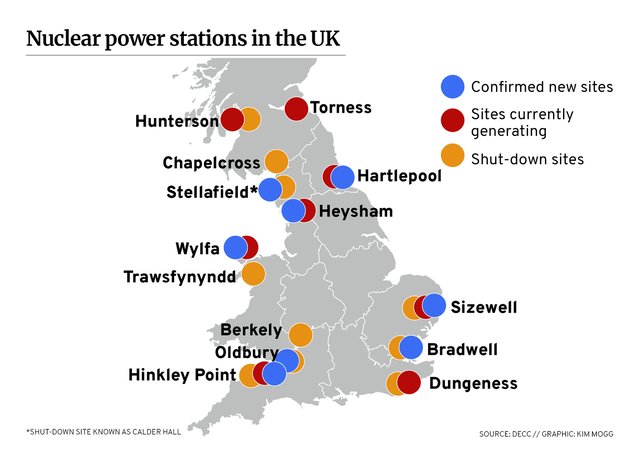
- All of the locations of current and proposed nuclear power stations are deemed to be unsafe.A new interactive tool that looks at flooding risk to coastal regions has revealed the severity of the rising sea level threat to the location of nuclear power stations.
The searchable map from Climate Central, a non-profit organisation focused on climate science, shows the expected rise of sea levels and what areas of the UK are most at risk from flooding.By 2030, based on the current pollution trajectory, it is clear that the locations of current and proposed stations are at threat from rising sea levels.
- The coastlines of these areas, where nuclear stations are located, are at threat of floods from 2030 onwards.These maps identify places that require deeper investigation of risk and are based on global-scale datasets for tides in addition to sea level rise projections.
- Dr Paul Dorfman, Chair of the Nuclear Consulting Group, an independent institute providing expert research and analysis of nuclear issues, told NationalWorld that current and proposed nuclear power stations will be vulnerable to flooding due to rising sea levels and more frequent and severe storms.
How big is the climate threat?
The UK’s sea level has risen by over 16.5cm since 1901, according to the state of the UK Climate Report 2020 published last year by the Met Office.
It also found that 2020 was the third warmest year, fifth wettest and eight sunniest on record.
No other year has fallen in the top 10 for all three variables for the UK
- It also marked the eighth warmest year for UK near-coastal sea-surface temperature in a series from 1870.Parts of the UK will be at risk of being flooded in 2030 due to rising sea levels and warming temperatures.
- Areas at risk of being flooded in 2030 are Portsmouth, East Riding of Yorkshire, Arun (West Sussex), London boroughs on either side of the Thames including Canary Wharf and Fulham, Chichester (West Sussex), Weston-Super-Mare, Cardiff, Great Yarmouth (Norfolk), and West Berkshire (Berkshire) and Worthing (West Sussex), according to Climate Central’s interactive tool.
- Dr Scott Kulp, a senior scientist at Climate Central and lead author of the study, said that these maps show the “potential of climate change to reshape cities, economies, coastlines, and entire global regions within our lifetimes.”
- He added: “As the tideline rises higher than the ground people call home, nations will increasingly confront questions about whether, how much, and how long coastal defences can protect them.”Over 1.3 million residential and commercial addresses in Britain will be at risk of flooding by 2050, intelligence provider Gamma has said.
- What has the government said?
- A spokesperson from the Government’s Department for Business, Energy, and Industrial Strategy, said: “Site licence holders in the civil nuclear industry are required to meet robust standards, overseen by independent regulators, including ensuring that sites have the necessary defences in place to protect them against the effects of climate change, such as flooding, rises in sea levels, coastal erosion and drought.”
The spokesperson added: “The Office for Nuclear Regulation and environmental regulators would not allow a nuclear power station to be developed on a site, or to operate, if they judged that it was not safe to do so.”
Reclaim the Word “Clean” from the Nuclear Industry
PETITION https://you.38degrees.org.uk/petitions/clean-energy-technology-park-is-a-nuclear-nightmare
King Midas turned everthing he touched into gold. This is what the most toxic industry would have us believe nuclear power is …”clean” and “green” and puppy dogs tails. The dark heart of this industry resides in another heartland. That of Nannashire near Preston where the UK’s Nuclear Fuel Manufacturing site hunkers down like a well camouflaged toxic toad between the well known, vigorously and sucessfully opposed fracking sites of Preston New Road and Roseacre. Unlike fracking, Nuclear has co-opted so many ordinary folk with its unprecedented PR machine and largesse to good causes (using public money). And now it has even co-opted the English language with the naming of the “Clean Energy Technology Park” even while it gears up to rip up uranium from far flung countries and manufacture ever more nuclear fuel. There is no “away” for nuclear wastes apart from the Midas curse of turning all life on this fragile biosphere to a nuclear wasteland. How can we fight the “Clean Energy Technology Park” when even language has been twisted so out of shape for the nuclear cause…
What absolute idiot does not want “Clean Energy”?
Its CLEAN ENERGY Why are you Opposing it??
The first step to resistance is to reclaim the world “CLEAN” from the nuclear industry. Join us and sign the petition which will be handed in on the anniversary of the ongoing Chernobyl disaster – 26th April. https://you.38degrees.org.uk/petitions/clean-energy-technology-park-is-a-nuclear-nightmare
To: Trading Standards, Lancashire County Council. “CLEAN” ENERGY TECHNOLOGY PARK IS A NUCLEAR NIGHTMARE We the undersigned call for the the word “clean” to be removed from the UK’s Nuclear Fuel Manufacturing plant which the industry has re-named the Clean Energy Technology Park. We call for Removal of the word “CLEAN” from the CLEAN ENERGY TECHNOLOGY PARK to be replaced with the accurate description of “NUCLEAR”.
To describe Nuclear energy as “clean” is fraudulent and the claim amounts to a mass marketing scam perpetrated on the British public.
Why is this important?
“Clean” Energy Security? The raw material for nuclear is uranium which can be found in in the UK in the Orkneys but which our government buys from, for example Kazakhstan where it is largely mined by leaching out the uranium from the rock using massive amounts of fresh water and chemicals
. “Clean” Carbon footprint? Nuclear is at least the third highest carbon emitter after coal-fired plants and natural gas. As uranium becomes more scarce more energy and chemicals are needed to get the uranium out of the ground. The Nuclear Decommissioning Authority have calculated their carbon footprint for 2019/20 as 1,046,950 tonnes of carbon dioxide equivalent (CO2e). This does not include operation of nuclear reactors or include the building of Hinkley Point C with the biggest pour of concrete in the UK ever. The nuclear and fossil fuel industry are mutually intertwined. The biggest gas plant being constructed in the UK right now is at Sellafield, home to 80 percent of the UK’s existing nuclear waste which needs to be kept cool. The heating effect of discharges to the atmosphere and sea and also the use of water as a coolant for reactors and nuclear wastes are all contributing to ocean temperature rise and climate change. An honest description of Nuclear would be : Radioactive Fossil Fuel by proxy
“Clean” Radioactive Emissions Radioactive emissions occur at every stage of the nuclear fuel cycle from the mining of uranium to enrichment, to fuel manufacture, to operation of the reactors, to the “disposal” of nuclear wastes. These emissions occur both routinely and accidentally and have already resulted in large swathes of the world’s land and oceans becoming irreversibly polluted with man-made radioactive isotopes.
“Clean” and Healthy? Radiation can damage the DNA in our cells. High doses of radiation can cause Acute Radiation Syndrome or Cutaneous Radiation Injuries. There is no such thing as a “safe dose” of radiation
The “Clean Energy Technology Park” just 3.9 miles from the centre of Preston is planning an incinerator to burn intermediate level radioactive wastes from across Europe. This would result in daily plumes of chemical and radio-toxic airborne fine particle emissions blowing accross Preston City Centre. We call for the word “Clean” to be replaced by – Nuclear – at the
“Clean Energy Technology Park”.
.
Fears sunken Russian warship Moskva was carrying nuclear weapons
There are fears that sunken Russian warship The Moskva was carrying nuclear weapons that could now cause a “broken arrow” incident. news.com.au
Megan Palin, April 16, 2022 There are fears that sunken Russian warship The Moskva that is now believed to be resting at the bottom of the Black Sea was carrying nuclear weapons.
Maksym Marchenko, the governor of the Odesa region, said Ukraine struck the ship with two Neptune missiles and caused “serious damage” on Thursday.
The Russian Defence Ministry denied there had been an attack by Ukraine on the ship, which would normally have about 500 sailors aboard, and said the heavily damaged Moskva sank in a storm under tow after being gutted by fire.
Speaking at the Pentagon on Friday, a senior US defense official said the Moskva warship was hit by two Ukrainian Neptune missiles, prompting its sinking.
In a chilling revelation, sources say it’s likely that several nuclear missiles are on the sunken vessel, and there is now real concern that could lead to a nuclear accident – otherwise known as a “broken arrow” incident in American military slang.
Mykhailo Samus, director of a Lviv-based military think-tank; Andriy Klymenko, editor of Black Sea News; and Ukrainian newspaper Defence Express all warned today that the Moskva was designed to carry warheads which could fit in the nose of its supersonic P-1000 “Vulkan” missiles – designed to take out American aircraft carriers.
“On board the Moskva could be nuclear warheads – two units,’ Samus said, while Klymenko called on other Black Sea nations – Turkey, Romania, Georgia, and Bulgaria – to insist on an explanation. Where are these warheads? Where were they when the ammunition exploded,” he asked.
This is HUGE. Russia’s defense ministry admits Moskva, their flagship in Black Sea fleet, slava class cruiser, has SUNK! It was key to intelligence & air defenses for the Russian ships. IMO this is on the level big as stopping Russians from taking Kyiv. https://t.co/3SifeskeHzpic.twitter.com/EmNR4L0Vgy— John Spencer (@SpencerGuard) April 14, 2022
BlackSeaNews editor-in-chief Andriy Klymenko called for an urgent international probe into whether the Moskva was carrying nuclear weapons.
“Friends and experts say that there are two nuclear warheads for cruise missiles on board the Moskva,” he said………….. https://www.news.com.au/world/europe/fears-sunken-russian-warship-moskva-was-carrying-nuclear-weapons/news-story/959170261e82bd43b5eb3c37fabf8dcd
| |||
Once Rocked by Nuclear Disaster, Fukushima Is Now a Renewables Hub
https://e360.yale.edu/digest/once-rocked-by-nuclear-disaster-fukushima-is-now-a-renewables-hub, 15 Apr 22,
More than a decade after a major nuclear power plant disaster, Fukushima, Japan is seeing extensive renewable energy development on abandoned lands, as satellite imagery from NASA shows.
When an earthquake and resulting tsunami hit the Fukushima Daiichi Nuclear Power Plant in 2011, damaged reactors released radioactive material into the surrounding area, rendering large swaths of farmland unusable. Today, some of those fields are home to sprawling solar arrays.
The Fukushima prefecture has set a goal of 100 percent renewable power by 2040. Around 40 precent of its power currently comes from renewables, with plans underway to spend $2.75 billion on the development of 11 solar farms and 10 wind farms on contaminated or abandoned lands.
“A strong desire to never see a repeat of such an accident was the most important starting point” for Fukushima’s renewable push, Noriaki Saito, energy director at the prefecture’s planning department, told AFP.
1 This Month



19 November – Webinar – The Reality of Reprocessing
Time: 11:00 AM Pacific Time (US & Canada) / 2:00 PM Eastern / 7:00 PM UK / 8:00 PM CET
Register for the Zoom Event Here



Shut down the radiation-damaged Heysham nuclear reactors now
To see nuclear-related stories in greater depth and intensity – go to https://nuclearinformation.wordpress.com

Say No to NASA’s Reckless Nuclear Reactor on the Moon
Say No to NASA’s Reckless Nuclear Reactor on the Moon
-
Archives
- November 2026 (74)
- October 2026 (302)
- September 2026 (339)
- August 2026 (330)
- July 2026 (355)
- June 2026 (287)
- May 2026 (306)
- April 2026 (356)
- March 2026 (251)
- February 2026 (267)
- January 2026 (308)
- December 2025 (358)
-
Categories
- 1
- 1 NUCLEAR ISSUES
- business and costs
- climate change
- culture and arts
- ENERGY
- environment
- health
- history
- indigenous issues
- Legal
- marketing of nuclear
- media
- opposition to nuclear
- PERSONAL STORIES
- politics
- politics international
- Religion and ethics
- safety
- secrets,lies and civil liberties
- spinbuster
- technology
- Uranium
- wastes
- weapons and war
- Women
- 2 WORLD
- ACTION
- AFRICA
- Atrocities
- AUSTRALIA
- Christina's notes
- Christina's themes
- culture and arts
- Events
- Fuk 2022
- Fuk 2023
- Fukushima 2017
- Fukushima 2018
- fukushima 2019
- Fukushima 2020
- Fukushima 2021
- general
- global warming
- Humour (God we need it)
- Nuclear
- RARE EARTHS
- Reference
- resources – print
- Resources -audiovicual
- Weekly Newsletter
- World
- World Nuclear
- YouTube
-
RSS
Entries RSS
Comments RSS

