War fears at another Ukraine nuclear site
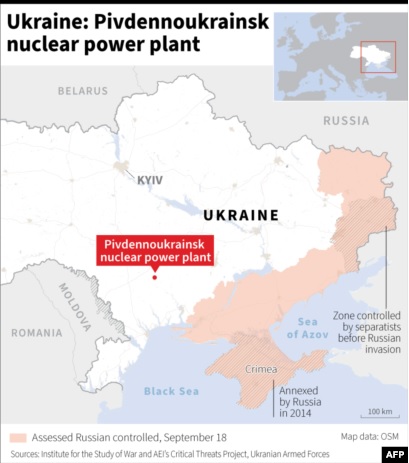
The Australian 22 Sept 22, A vast crater several metres deep in empty land strewn with wild grass bears witness to the shelling this week at the Pivdennoukrainskpower plant site in southern Ukraine, the latest sign of nuclear risk in the war-scarred nation.
Small shards of grey metal, similar to rocket and missile fragments that litter innumerable fighting-damaged Ukrainian places, dot the loamy earth gouged out by the impact.
“That’s where the blast of the explosion went towards,” said Ivan Zhebet, security chief at the Pivdennoukrainsk plant in the southern Mykolaiv region.
A compass reading by an AFP journalist indicated that it was fired from the southeast, territory under Russian control.
The shell struck shortly after midnight on Monday, just minutes after an air raid warning sounded in nearby Yuzhnourainsk, a town that had until then been relatively calm.
Others said they saw a flash of light in the sky.
All the residents questioned by AFP worried that the nuclear site — which directly provides jobs for 6,000 of the town’s 42,000-strong population and indirectly for many more — would be hit.
Pivdennoukrainskis the third nuclear site to be caught up in a conflict that began with Russia’s invasion in February………………………………………..
Nataliya Stoikova, a department head at Pivdennoukrainsk, said:
“The danger is really frightening. If something were to happen (at Pivdennoukrainsk) or Zaporizhzhia, the accident at Chernobyl would be almost small” by comparison. https://www.theaustralian.com.au/news/latest-news/war-fears-at-another-ukraine-nuclear-site/news-story/d81fe91e6bd375729e35eb4caaea2c95
Is Zaporizhzhia safer now?

What is “cold shutdown”? And what about the fuel pools?
Cold shutdown reduces risk of disaster at Zaporizhzhia nuclear plant – but combat around spent fuel still poses a threat
By Najmedin Meshkati, University of Southern California
Is Zaporizhzhia safer now? — Beyond Nuclear International Energoatom, operator of the Zaporizhzhia Nuclear Power Plant in the Ukrainian city of Enerhodar, announced on Sept. 11, 2022, that it was shutting down the last operating reactor of the plant’s six reactors, reactor No. 6. The operators have put the reactor in cold shutdown to minimize the risk of a radiation leak from combat in the area around the nuclear power plant.
The Conversation asked Najmedin Meshkati, a professor and nuclear safety expert at the University of Southern California, to explain cold shutdown, what it means for the safety of the nuclear power plant, and the ongoing risks to the plant’s spent fuel, which is uranium that has been largely but not completely depleted by the fission reaction that drives nuclear power plants.
What does it mean to have a nuclear reactor in cold shutdown?
The fission reaction that generates heat in a nuclear power plant is produced by positioning a number of uranium fuel rods in close proximity. Shutting down a nuclear reactor involves inserting control rods between the fuel rods to stop the fission reaction.
The reactor is then in cooldown mode as the temperature decreases. According to the U.S. Nuclear Regulatory Commission, once the temperature is below 200 degrees Fahrenheit (93 Celsius) and the reactor coolant system is at atmospheric pressure, the reactor is in cold shutdown.
When the reactor is operating, it requires cooling to absorb the heat and keep the fuel rods from melting together, which would set off a catastrophic chain reaction. When a reactor is in cold shutdown, it no longer needs the same level of circulation. The Zaporizhzhia Nuclear Power Plant uses pressurized water reactors.
How does being in cold shutdown improve the plant’s safety?
The shutdown has removed a huge element of risk. The Zaporizhzhia Nuclear Power Plant is a pressurized water reactor. These reactors need constant cooling, and the cooling pumps are gigantic, powerful, electricity-guzzling machines.
Cold shutdown is the state in which you do not need to constantly run the primary cooling pumps at the same level to circulate the cooling water in the primary cooling loop. The International Atomic Energy Agency (IAEA) has reported that reactor No. 6 is now in a cold shutdown state like the facility’s five other reactors, and will require less power for cooling. Now, at least if the plant loses offsite power, the operators won’t have to worry about cooling an operating reactor with cranky diesel generators.
And by shutting down reactor No. 6, the plant operators can be relieved of a considerable amount of their workload monitoring the reactors amid the ongoing uncertainties around the site. This substantially reduced the potential for human error.
The operators’ jobs are likely to be much less demanding and stressful now than before. However, they still need to constantly monitor the status of the shutdown reactors and the spent fuel pools.
What are the risks from the spent fuel at the plant?
The plant still needs a reliable source of electricity to cool the six huge spent fuel pools that are inside the containment structures and to remove residual heat from the shutdown reactors. The cooling pumps for the spent fuel pools need much less electricity than the cooling pumps on the reactor’s primary and secondary loops, and the spent fuel cooling system could tolerate a brief electricity outage.
One more important factor is that the spent fuel storage racks in the spent fuel pools at the Zaporizhzhia Nuclear Power Plant were compacted to increase capacity, according to a 2017 Ukrainian government report to the IAEA. The greater number and more compacted the stored spent fuel rods, the more heat they generate and so more power is needed to cool them.
There is also a dry spent fuel storage facility at the plant. Dry spent fuel storage involves packing spent fuel rods into massive cylinders, or casks, which require no water or other coolants. The casks are designed to keep the fuel rods contained for at least 50 years. However, the casks are not under the containment structures at the plant, and, though they were designed to withstand being crashed into by an airliner, it’s not clear whether artillery shelling and aerial bombardment, particularly repeated attacks, could crack open the casks and release radiation into the grounds of the plant.
The closest analogy to this scenario could be a terrorist attack that, according to a seminal study by the National Research Council, could breach a dry cask and potentially result in the release of radioactive material from the spent fuel. This could happen through the dispersion of fuel particles or fragments or the dispersion of radioactive aerosols. This would be similar to the detonation of a “dirty bomb,” which, depending on wind direction and dispersion radius, could result in radioactive contamination. This in turn could cause serious problems for access to and work in the plant.
Next steps from the IAEA and UN
The IAEA has called on Russia and Ukraine to set up a “safety and security protection zone” around the plant. However, the IAEA is a science and engineering inspectorate and technical assistance agency. Negotiating and establishing a protection zone at a nuclear power plant in a war zone is entirely unprecedented and totally different from all past IAEA efforts.
Establishing a protection zone requires negotiations and approvals at the highest political and military levels in Kyiv and Moscow. It could be accomplished through backchannel, Track II-type diplomacy, specifically nuclear safety-focused engineering diplomacy. In the meantime, the IAEA needs strong support from the United Nations Security Council in the form of a resolution, mandate or the creation of a special commission.
Najmedin Meshkati, Professor of Engineering and International Relations, University of Southern California
Hundreds Of Children Included In Ukrainian Public Kill-List

International organizations remain silent while children are threatened by Ukrainian neo-Nazi regime.
thefreeonline by Lucas Leiroz, researcher in Social Sciences at the Rural Federal University of Rio de Janeiro; geopolitical consultant.
Despite many complaints, appeals and critiques, the infamous Ukrainian website “Myrotvorets” remains active on the internet.
The site exposes the personal data of thousands of people considered enemies by the Ukrainian neo-Nazi regime, making it the largest public kill-list ever witnessed.
Journalist Olesya Buzina shot dead in Kiev Western media’s invented ‘Narrative’ ignores Ukraine’s public Kill List: ’12 journalists killed already’- must be deleted!
The most terrible point of this situation is that hundreds of ethnic Russian children are included in this list. Russian diplomats demand a position on the part of UNICEF on the matter, but international organizations remain silent.
“Publishing personal data, addresses and phone numbers, on minors is a crime. It’s like a menu for pedophiles or people doing human trafficking.”
Although Myrotvorets is officially an NGO, in practice it operates in a fully integrated manner with the Ukrainian government. The very purpose of the site is to provide a database of alleged “enemies” of the Ukrainian state, thus being much more of a Kiev intelligence department than an NGO.
The website project started precisely in 2014, as well as the beginning of the ethnic and political persecution against Russian citizens and Maidan’s opponents.
The word LIQUIDATED was placed on the entry of Russian photojournalist Andrei Stenin after his murder and many others listed and subsequently killed, including the Italian Andrea Rocchelli.
Also, it must be noted that many of the people included in the list were actually murdered, such as Russian journalist Daria Dugina, which shows that Ukrainian intelligence forces really use the data provided by Myrotvorets and try to “fulfill” the kill-list proposed by the website.
However, what is most shocking in this issue is the presence of children on this list. The Ukrainian government and its allied neo-Nazi organizations do not seem to distinguish who actually poses a threat to the Maidan’s political regime and who does not.
For them, everyone who opposes the government and publicly expresses their critical opinions must be exterminated, even innocent civilians and children.
According to a recent data survey by journalist Mira Terada, at least 327 children would have had their personal data exposed by Myrotvorets. Considering that Ukrainian forces really try to kill those on this list, the lives of these children are in danger.
Investigations into this topic increased after Faina Savekova, a 12-year-old girl from Lugansk, was added to the list for posting letters on the internet expressing pride for the Russian identity of her people and criticism against the current Ukrainian policies in her region.
After her data was exposed, Faina asked the UN for help, even writing letters to the Secretary General, which were never answered.
Russian journalist Veronika Naydenova, originally from Crimea but living in Germany, was added to the list in January, also after raising the inclusion of children, including 13-year-old Faina Savenkova, from the Lugansk People’s Republic.
“The same day my article was published, I was added to the list. But this hasn’t stopped me, I’ve written many articles since.”
UNICEF, which would be the UN office responsible for caring for children, also remained silent, showing the omission of international organizations in the face of the serious Ukrainian problem.
Currently, we know that Faina is just one of hundreds of children in the kill-list, but that has not changed the international silence.
On September 14, Russian diplomat at the UN Dmitry Polyanskiy made some comments on this matter on his social media. He criticized the omission on the part of the UN and called on UNICEF to comment on the case.
Polyanskiy was realistic and said that he does not expect legal or coercive action against Ukraine, but only a simple formal condemnation for these acts…………………….
Considering recent Ukraine’s history, in which murders, massacres of civilians and terrorist attacks have become commonplace, it is possible to say that these 327 children, as well as the thousands of other innocent people exposed by the site, are indeed in danger………………….. https://thefreeonline.com/2022/09/17/waiting-to-die-hundreds-of-children-included-in-ukrainian-public-kill-list/
New research on how nuclear war would affect Earth today – it won’t matter who is bombing whom

Kelly Kizer Whitt, 18 Sept 22,
A nuclear war would devastate our oceans and our world, with some effects lasting thousands of years. That’s the conclusion of a new study led by Cheryl Harrison at Louisiana State University in Baton Rouge. She said in a statement:
It doesn’t matter who is bombing whom. It can be India and Pakistan or NATO and Russia. Once the smoke is released into the upper atmosphere, it spreads globally and affects everyone.
These scientists’ simulations showed that it doesn’t matter whether the detonation of a nuclear arsenal came through a deliberate act of war, or through accident or hacking Their statement explained:
In all of the researchers’ simulated scenarios, nuclear firestorms would release soot and smoke into the upper atmosphere that would block out the sun, resulting in crop failure around the world. In the first month following nuclear detonation, average global temperatures would plunge by about 13 degrees Fahrenheit (7 degrees C), a larger temperature change than in the last Ice Age.
Ocean temperatures would drop quickly and would not return to their pre-war state even after the smoke clears. As the planet gets colder, sea ice expands by more than 6 million square miles and 6 feet deep in some basins blocking major ports including Beijing’s Port of Tianjin, Copenhagen and St. Petersburg. The sea ice would spread into normally ice-free coastal regions blocking shipping across the Northern Hemisphere making it difficult to get food and supplies into some cities such as Shanghai, where ships are not prepared to face sea ice.
The sudden drop in light and ocean temperatures, especially from the Arctic to the North Atlantic and North Pacific oceans, would kill the marine algae, which is the foundation of the marine food web, essentially creating a famine in the ocean. This would halt most fishing and aquaculture.
The scientists published their study in the peer-reviewed journal AGU Advances on July 7, 2022.
Where are the nuclear weapons?
Nine nations control more than 13,000 nuclear weapons on Earth, these scientists said. According to worldpopulationreview.com, the top three countries with nuclear weapons include Russia with 6,257, the United States with 5,550 and China with 350. The Treaty on the Non-Proliferation of Nuclear Weapons (NPT) aims to control the spread of nuclear weapons and reaches for disarmament.
In their study, the researchers simulated what would happen if the U.S. and Russia used 4,400 100-kiloton nuclear weapons. This would result in fires that would put more than 330 billion pounds of smoke and sunlight-absorbing black carbon into the upper atmosphere.
In another simulation, they imagined India and Pakistan detonating about 500 100-kiloton nuclear weapons. This would inject 11 to 103 billion pounds of smoke and soot into the upper atmosphere.
In all the simulations, the result was essentially the same.
The effect on marine life
With a blackened sky from the nuclear firestorm, oceans would receive less light and heat. This is especially true from the Arctic to the North Atlantic and North Pacific. Marine algae (seaweed), the base of the ocean’s food web, would die. Thus, a chain reaction would follow, creating a famine in the ocean. Fishing and aquaculture would mostly come to an end. So marine life suffers from both the initial blast and the resulting new ocean conditions.
Ocean waters would take longer to recover than on land. The changes to Arctic sea ice alone would probably last thousands of years, ushering in what the scientists called a Nuclear Little Ice Age.
Events other than nuclear war with similar results
Nuclear war isn’t the only event that could lead to these results of devastation in the ocean and on land. Massive wildfires and volcanic eruptions could eject enough soot into the atmosphere for similar results. Massive volcanic eruptions in the past have even caused multiple mass extinction events on Earth. Harrison said:
We can avoid nuclear war, but volcanic eruptions are definitely going to happen again. There’s nothing we can do about it, so it’s important when we’re talking about resilience and how to design our society, that we consider what we need to do to prepare for unavoidable climate shocks. We can and must, however, do everything we can to avoid nuclear war. The effects are too likely to be globally catastrophic.
How we got to an $850 billion Pentagon budget – “independent” think tanks are funded by weapons corporations.

Speaking Security Newsletter | Note n°173 | 16 September 2022, Stephen Semler
Situation
The Senate might vote on the fiscal year 2023 military budget this month. Or it might not; nobody’s sure. What’s for certain is that the bill the Senate considers will have at least as much as $850 billion for the Pentagon. In other words, we’re staring down a $72 billion year-to-year increase in military spending with this legislation: The FY2022 version of the same bill (National Defense Authorization Act, or NDAA) licensed $778 billion for the Pentagon.
How we got to an $850 billion Pentagon budget
In March, Joe Biden proposed increasing annual military spending by $35 billion—to $813 billion—as part of his FY2023 budget request. In June, the House Armed Services Committee (HASC) added another $37 billion on top of that before advancing the $850 billion bill to the House floor for approval.
This decision was reportedly a matter of course for the committee. According to one HASC member, there was “almost no debate” on dumping another $37 billion on top of Biden’s own proposed increase. An overlooked reason why the committee’s move was so automatic was the ‘expertise’ that made a $72 billion year-to-year increase seem appropriate or even natural.
Think tanks are said to be free from the ugly forces that bias in-house policy planning—namely, all the lobbying and campaign cash that encourage members of Congress to make decisions based on parochial interests and not the public’s. The problem is that establishment think tanks are corrupted by the same monied interests members of Congress are. In this case, we’re talking about the arms industry.
Every think tank represented in a House Armed Services Committee hearing to provide expert testimony from January 1, 2020 through September 16, 2022 that disclosed its donors received funding from military contractors (the one that didn’t disclose its donors was the hawkish American Enterprise Institute).
The result? Military contractors were able to launder their profit-driven interests through ostensibly non-political institutions, while powerful lawmakers on the HASC got their parochially-driven policy positions validated by ostensibly unbiased ‘expertise’.
In effect if not juridically, Ukraine was becoming a member of the NATO alliance. THE WORLD SPLIT APART

THE WORLD SPLIT APART 2.0: Introduction Russian & Eurasian Politics, GORDON M. HAHN 21 Sept 22,
Nearly a decade ago I began warning that NATO expansion and the West’s failure to understand that Russian national security interests not a Russian desire to ‘recreate the USSR’ or ‘former Russian empire’ would lead to a world split apart between the West and ‘the rest’ (Sino-Russian ‘strategic partnership and those states oriented towards it).…………………………………………………………………………..
NATO expansion to Ukraine continued with Ukrainian membership replaced by deep Western and NATO involvement in Ukraine’s politics and military and gradually deepening after the 2014 Maidan revolt. In effect if not juridically, Ukraine was becoming a member of the NATO alliance.
In this regard, it is important to point out that the famous Article 5 of the NATO Charter is not a blanket, mandatory obligation to engage directly in military action in defense of an alliance member under attack by an alliance non-member state. It merely requires consultations and assistance, which can but does not necessarily have to be the commitment of member-states’ forces directly to the battlefield.
Assistance can include the provision of weapons, training, intelligence, and other forms of indirect assistance. This was already happening in Ukraine as a result of NATO policies. Russian President responded with his invasion rapidly to both escalating that level of NATO military and intelligence assistance to Ukraine and accelerating the bifurcation of the world between the West and the rest.
For all intents and purposes NATO and the entire West are at war with Russia and escalation to a more direct confrontation is just over the horizon. This course of events has deepened and consolidated the Sino-Russian alliance by any other name and that alliance’s efforts to rally to its side the rest of the rest. The world is becoming split apart as never before – an outcome globalization was not supposed to being about. The ‘new cold war’ is driving towards a greater bifurcation of the world into two camps than the confrontation between communism and capitalism ever engendered. Continuation to follow. https://wordpress.com/read/feeds/33462456/posts/4272028238
THE WORLD SPLIT APART 2.0: Introduction — Russian & Eurasian Politics
Nevada files motion regarding Yucca Mountain Nuclear Waste Project, launches dedicated website with educational resources.

Nevada’s staunch bi-partisan opposition to the project
Nevada Governor Steve Sisolak, CARSON CITY, NV – September 20, 2022
Today, Nevada Governor Steve Sisolak and the Nevada Agency for Nuclear Projects announced the filing of a new legal motion to bring an end to failed federal plans to construct a repository for the nation’s highly radioactive waste at Yucca Mountain, 65 miles northwest of Clark County’s populated areas.
The motion is being filed before the United States Nuclear Regulatory Commission. It asks the Nuclear Regulatory Commission to resume the adjudicatory portion of the licensing procedures so that Nevada may take specific additional steps aimed at stopping the project.
As a companion to the legal motion, today, the State launched a new webpage with resources recapping the failed policies that led to the designation of the Yucca Mountain Project and the geographic flaws in the site.
“It is time to take the lessons learned from the Yucca Mountain experiment and chalk them up to experience,” Governor Sisolak said. “This is a fight that Nevada has battled since 1987. The past three Presidential Administrations have agreed that Yucca Mountain is unworkable. It is time for this Administration and the Department of Energy to follow through and support the case made by Nevada’s leaders, legislators, experts and legal team.”
“I’ve opposed every attempt to revive the failed Yucca Mountain project, and it’s time we take this unsuitable site off the table once and for all,” said Senator Catherine Cortez Masto. “I support Nevada’s efforts to end the licensing process for Yucca Mountain, and I will continue to work with all stakeholders at the federal, state, local, and Tribal levels to find a safe, workable, and consent-based alternative.”
“For years, I have been fighting alongside our delegation to prevent Nevada from ever becoming the nation’s dumping ground for nuclear waste because it threatens our state’s security, economy, and public health,” said Senator Jacky Rosen. “That’s why I’m strongly supporting Nevada’s actions to finally put an end to Yucca Mountain, taking steps that would block future misguided efforts to try to revive this ill-conceived project against our state’s consent.”……………………………………………………………..
“Year after year, we’ve had to fight to ensure that Nevada does not become our nation’s dumping ground for nuclear waste,” said Rep. Susie Lee (NV-03). “I’m proud to sit on the Appropriations Committee’s Subcommittee on Energy and Water, where I’ve successfully blocked any funding going toward reviving Yucca Mountain, and I have worked with the Department of Energy to secure a commitment to finding consent-based alternatives to the proposed nuclear repository at Yucca Mountain. Now, it’s time to put an end to this failed project once and for all. That’s why I support the state of Nevada’s efforts to end the licensing for Yucca Mountain and to open the door to a productive consent-based solutions for nuclear waste storage.”
Videos and podcasts on the new webpage feature Nevada technical experts and document the project’s flaws, ill-conceived efforts to address site weaknesses with engineered barriers, and the need for nuclear waste and spent fuel solutions that are grounded in a robust consent-based siting process.
Nevada’s staunch bi-partisan opposition to the project and the history behind it is also featured on the webpage in an interview with former Nevada Rep. Jim Bilbray before his death last year about the so-called “Screw Nevada Bill,” that singled out Yucca Mountain as the nation’s sole repository site.
After more than three decades, continuing to pursue a license for the Yucca Mountain Project would expend additional time, millions more taxpayer dollars on a project that Nevada has demonstrated time and again will fail to securely and safely house the nation’s nuclear waste. The motion filed by the State today is the first step towards putting an end to thirty years of failed policy and acting on the need for a more fair, consent-based process to address the nuclear waste disposal needs of the United States. https://gov.nv.gov/News/Press/2022/2022-09-20_Yucca_Mountain_Nuclear_Waste/
Putin flirts again with grim prospect of nuclear war – this time he might mean it
Guardian, Pjotr Sauer, 21 Sept 22, Russian leader’s speech marks biggest escalation of Ukraine war, and raises fears of unprecedented disaster
“This is not a bluff.”
The message from Vladimir Putin’s ominous morning speech, which marked the biggest escalation of the Ukraine war since the invasion on 24 February, was clear: Russia is willing to use nuclear weapons if Ukraine continues its offensive operations.
While the longtime Russian leader has previously flirted with the grim prospect of using nuclear weapons, experts say his latest statements went further, raising fears around the world of an unprecedented nuclear disaster.
Addressing the nation on Wednesday, Putin confirmed he was planning to annex four partly occupied regions of southern and eastern Ukraine after this weekend’s Kremlin-orchestrated “referendums”.
He added that he was prepared to use “all means” to defend the “territorial integrity” of the Russian-occupied lands and their people.
“Putin’s statements go beyond the Russian nuclear doctrine, which only suggests Russian first use in a conventional war when the very existence of the state is threatened,” said Andrey Baklitskiy, a senior researcher in the Weapons of Mass Destruction and other Strategic Weapons Programme at the United Nations Institute for Disarmament Research.
Ukraine, which has been making rapid military gains over the past few weeks, has stressed that it will continue its efforts to liberate occupied lands, with Ukraine’s president, Volodymyr Zelenskiy, stating on Wednesday that referendums will “act step by step to liberate our country”.
This means Putin’s resolve will probably be tested in the coming weeks……………….
Mark Galeotti, an expert on Russian politics, also said Putin’s nuclear threats were unprecedented but questioned whether the Russian leader was willing to go through with his threats, which would de facto mean nuclear war.
“It’s glib to assume anyone claiming they are not bluffing is bluffing, but the credibility of a threat to risk thermonuclear Armageddon if Ukrainian forces continue to move in territories still Ukrainian by law is questionable.”
Instead, Galeotti argued, the apocalyptic threats could have been intended to force the west and Ukraine into accepting Russia’s territorial gains in the war.
Zelenskiy, in an interview with the German newspaper Bild on Wednesday, likewise said he did not believe Putin would use nuclear weapons. “I don’t think the world will allow him to use those weapons,” he said.
The Ukrainian leader, however, did not rule out the possibility of a Russian nuclear strike, saying “we can’t look into Putin’s head”………………………………………………………..
Pentagon opens sweeping review of clandestine psychological operations

Ellen Nakashima, The Washington Post, Mon, 19 Sep 2022
The Pentagon has ordered a sweeping audit of how it conducts clandestine information warfare after major social media companies identified and took offline fake accounts suspected of being run by the U.S. military in violation of the platforms’ rules.
Colin Kahl, the undersecretary of defense for policy, last week instructed the military commands that engage in psychological operations online to provide a full accounting of their activities by next month after the White House and some federal agencies expressed mounting concerns over the Defense Department’s attempted manipulation of audiences overseas, according to several defense and administration officials familiar with the matter.
The takedowns in recent years by Twitter and Facebook of more than 150 bogus personas and media sites created in the United States was disclosed last month by internet researchers Graphika and the Stanford Internet Observatory. While the researchers did not attribute the sham accounts to the U.S. military, two officials familiar with the matter said that U.S. Central Command is among those whose activities are facing scrutiny. Like others interviewed for this report, they spoke on the condition of anonymity to discuss sensitive military operations.
The researchers did not specify when the takedowns occurred, but those familiar with the matter said they were within the past two or three years. Some were recent, they said, and involved posts from the summer that advanced anti-Russia narratives citing the Kremlin’s “imperialist” war in Ukraine and warning of the conflict’s direct impact on Central Asian countries. Significantly, they found that the pretend personas — employing tactics used by countries such as Russia and China — did not gain much traction, and that overt accounts actually attracted more followers.
…………………………. The U.S. government’s use of ersatz social media accounts, though authorized by law and policy, has stirred controversy inside the Biden administration, with the White House pressing the Pentagon to clarify and justify its policies. The White House, agencies such as the State Department and even some officials within the Defense Department have been concerned that the policies are too broad, allowing leeway for tactics that even if used to spread truthful information, risk eroding U.S. credibility, several U.S. officials said.
…………. ..A spokeswoman for the National Security Council, which is part of the White House, declined to comment.
Kahl disclosed his review at a virtual meeting convened by the National Security Council on Tuesday, saying he wants to know what types of operations have been carried out, who they’re targeting, what tools are being used and why military commanders have chosen those tactics, and how effective they have been, several officials said.
…………………… Congress in late 2019 passed a law affirming that the military could conduct operations in the “information environment”
……The measure, known as Section 1631, allows the military to carry out clandestine psychological operations without crossing what the CIA has claimed as its covert authority, alleviating some of the friction that had hindered such operations previously.
The first defense official recalled:
“Combatant commanders got really excited. They were very eager to utilize these new authorities. The defense contractors were equally eager to land lucrative classified contracts to enable clandestine influence operations.”
………………………………… https://www.washingtonpost.com/national-security/2022/09/19/pentagon-psychological-operations-facebook-twitter/
Nukes Are Our Corporate Death Wish…the Sun is the People’s Cure

replacing nuke power and fossil fuels with solar, wind, batteries and LED/efficiency means a parallel apocalypse in the world of corporate power—-an end to the centralized multi-national control our global energy supply.
The Diablo deal clearly puts the global fossil-nuclear utility industry on the path to extinction. If these two immense reactors can be smoothly overtaken by cheaper, cleaner, safer renewable energy…what about the rest of the dying fossil/nuke fleet? What does that say about the future of centralized corporate power?
| Christina Macpherson <christinamacpherson@gmail.com> | 7:56 AM (0 minutes ago) |  | |
| to me |
https://www.counterpunch.org/2022/09/21/nukes-are-our-corporate-death-wishthe-sun-is-the-peoples-cure/ BY HARVEY WASSERMAN, 21 Sept22,
Humankind’s ultimate extinction is now flowing through an atomic death spiral.
A single errant shell at Ukraine’s Zaporizhzhia…a single seismic shock at California’s Diablo Canyon…can bury us all in apocalyptic radiation.
The eruptions already stretch from Kyshtym, Iron Mike, Castle Bravo, Windscale, SL-1, Chalk River, Santa Susanna, Fermi I, Perry, Davis-Besse, North Anna, Tokaimura, Three Mile Island, Church Rock, Surry, Chernobyl, Vandellòs, Sosnovy Bor, WIPP, Fukushima, Fort Calhoun to South Texas and too many more.
It’s been clear since 1945 that A-Bombs can extinct the human race. Commercial reactors supply them with fissionable material and a work force.
Burning alongside thousands of nuclear warheads there are 400+ commercial reactors worldwide…decrepit, decayed, expensive, under-maintained, unstable and uninsured (except by token taxpayer funds). Six in Ukraine currently tremble in a war zone.
The average age of the 92 nukes in the US is nearly 40. The 1000+-square-mile dead zone around Chernobyl could be easily duplicated by any nuke. Just superimpose a similar lethal wound anywhere on a US map and calculate the damage.
But it’s a double-sided apocalypse.
Bombs & reactors can obliterate the human species with both explosive bangs and the agonized whimpers of radioactive murder.
But replacing nuke power and fossil fuels with solar, wind, batteries and LED/efficiency means a parallel apocalypse in the world of corporate power—-an end to the centralized multi-national control our global energy supply.
Cheaper, cleaner, safer, more reliable, more job-producing democratized green energy stands to obliterate the monetary and political death grip King CONG (Coal, Oil, Nukes, Gas) has on our species’ throat.
The decentralized, community-controlled green vision is as terrifying to global energy barons as is biological extinction to the rest of us. And thus the atomic hucksters somehow try to convince us their apocalyptic reactors are “clean, green, carbon-free,” you name it.
The scam’s cutting edge is now in California, where would-be president Gavin Newson is pushing nuclear power while conspiring to kill renewables.
At the End Time vortex is Diablo Canyon.
For more than a half-century, plus grassroots citizens have fought two atomic power reactors on the central California coast, eight miles west of San Luis Obispo.
Unit One’s first components arrived on site in pre-digital 1967. By 1984-5, when the hardware was already obsolete, more than 10,000 citizens (including me) were arrested there.
As Jerry Brown’s greening Golden State has welcomed more than 17,000 wind turbines, 1.4+ million rooftop solar installations and massive advances in battery and LED/efficiency technologies now dwarf the output from the state’s one remaining nuke plant.
Some 1500 Californians now work at Diablo; over 70,000 work in renewables, batteries and efficiency. Shutting Diablo and replacing it with real green power would add thousands of jobs to the state’s energy mix.
Early on Pacific Gas & Electric vehemently denied that there were any active earthquake faults threatening Diablo. They refused to allow experts who said otherwise to testify in official hearings. They also refused to build in the safeguards required to withstand certain levels of seismic shaking.
But then in 1973 the company admitted that they knew about an active earthquake fault—-the Hosgri—-sitting just three miles from the reactor cores. Just 45 miles from the San Andreas, a dozen more fault lines intertwine near the core. Dr. Michael Peck, the Nuclear Regulatory Commission’s site inspector for five years, warned in 2014 a likely quake could shake Diablo to rubble.
But the NRC has refused to force PG&E to physically upgrade the facility. Instead a series of “waivers” let Diablo run where any number of fault lines could rattle it—-and millions of us downwind—-to outright oblivion.
The NRC has long since admitted that Unit One is seriously embrittled. It’s well-known throughout the industry that the steel cylinder containing its super-hot core reaction will shatter in a melt-down. Explosive radioactive death clouds will then pour into Los Angeles, the Central Valley and/or Bay Area….and into the jet-stream and around the globe, doing terminal damage to the human species.
Diablo has not recently—-if ever—-been independently inspected. It has no private insurance. There are no public evacuation plans for California’s major population centers.
In 2016-8, then-Governor Brown and now-Governor Newsom helped plan Diablo’s closure. Local citizens, elected officials, unions, regulators, environmental groups and more mapped out an orderly shut-down.
As a result, workers are being compensated, with some retiring, some staying for decommissioning, the younger ones being retrained to work in the booming renewable industry.
As a reward for not meeting legal safety and ecological requirements, PG&E has ducked a wide range of upgrades and maintenance The plant has been set to operate through the expiration of Unit One’s NRC license in 2024, then Unit Two’s in 2025. Its owner has been allowed to ignore routine upkeep, becoming more dangerous by the day.
Hot radioactive water still pours into ocean, killing billions of marine creatures. There remains just barely enough on-site space to accommodate the ensuing spent fuel through 2024-5. Managing more is an epic unknown, requiring at very least exceedingly dangerous manipulations of what’s already in the fuel pools, along with untenable expansions of the dry casks and concrete pads on the site.
The venerable Mothers for Peace—and thousands more—-want Diablo to immediately shut.
The nukes’ 2400 megawatts are already fading below a well-planned, cleanly executed symphony of solar panels, wind farms, batteries and LED/efficiency. Massive off-shore wind turbines will soon send mega-juice pouring into Diablo’s switching stations.
By public consensus the 2016 phase-out plan embodies as rational and well-calculated a transition as the human species could concoct…a model for winding down the other 90+ American reactors, and maybe even the 400+ worldwide. It offers a sustainable green escape from the obscene financial and ecological failures of atomic power to the proven reliability of a Solartopian future.
Which has pitched King CONG (Coal, Oil, Nukes, Gas) into a Luddite state of terminal atomic panic.
The Diablo deal clearly puts the global fossil-nuclear utility industry on the path to extinction. If these two immense reactors can be smoothly overtaken by cheaper, cleaner, safer renewable energy…what about the rest of the dying fossil/nuke fleet? What does that say about the future of centralized corporate power?
With this giant hole poked into the obsolete energy Luddites’ Maginot line, what will happen to the trillions of dollars still sunk in the old ways of scorching the Earth? What will trillions of kilowatts of Solartopian electricity pouring into the grid do to the future of fossil/nuclear fuels?
The industry does not want to know—-and it does not want YOU to know.
Wind, solar, batteries and efficiency already sustain much of California’s and the nation’s grid, now commonly providing the flexible, reliable, low-cost, zero-aaron essential power needed to avoid blackouts, unsustainable rate hikes and lethal climate chaos.
First and foremost, King CONG’s anti-green blitzkrieg disrupts supply chains and assaults rooftop solar with taxes and regulations designed to kill it. Endless genuflections to the dead bird each big turbine kills per year accompany the assault. So do rightful worries over mining of lithium and cobalt, major polluters in regions with bad labor practices.
But these are solvable, non-plutonium-based problems in comparison with mining, milling and enriching uranium while failing to manage its wastes.
No windmill ever killed a fish, but nukes kill billions of marine creatures every day.
Every reactor burns at roughly 570 degrees Fahrenheit, spewing radiation, carbon 14 and lethal pollutants into the eco-sphere. Massive quantities of carbon pour from mining, milling, enrichment and disposal. All reactors and fuel pools can explode at any time.
The Trumpian Big Lie is that these ancient, uninsured instruments of mass extinction are somehow “emission and carbon free.”
So Newsom has strong-armed California’s legislature to trash Diablo’s shut-down deal and hand PG&E $1.4 billion to operate til the next quake blows the place apart.
With utility and fossil/nuke money in his presidential war chest, Newsom is poised to pursue the White House against a hard-right Ron DeSantis who actually vetoed solar taxes like the ones Newsom is pushing.
Polls in both Florida and California show 80% support for renewables. Fierce campaigns now rage against Diablo’s extension and Newsom’s attempt to kill rooftop solar.
The Governor now has the radioactive winds to his back.
But as fossil/nukes scorch the planet, and as their apocalyptic clouds pour over our biggest cities, and as their over-the-top inefficiencies bankrupt our economy, what will be left for his corrupt, cynical ilk to govern?
Harvey Wasserman wrote SOLARTOPIA! Our Green-Powered Earth. His Green Power & Wellness Show is at www.prn.fm.
Small modular reactors: What is taking so long?
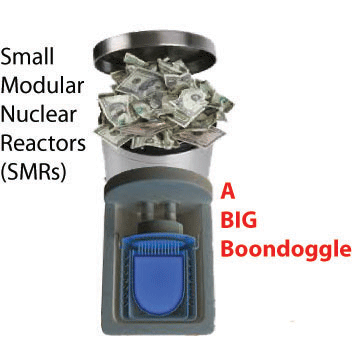
Next-generation nuclear has long been just around the corner, but debate still rages over the silver-bullet credentials of small modular reactors.
By Oliver Gordon The growing urgency of the climate crisis and, more recently, the energy crisis has reawakened global interest in nuclear energy. Even the likes of Bill Gates and Elon Musk have waded into the debate to petition for a more prominent role for nuclear power in the transition to net-zero greenhouse gas emissions. To that end, there is much expectation surrounding the development of small modular reactors (SMRs), a new generation of nuclear reactors that are being marketed as the solution to all of nuclear power’s previous shortcomings.
To that end, there is much expectation surrounding the development of small
modular reactors (SMRs), a new generation of nuclear reactors that are
being marketed as the solution to all of nuclear power’s previous
shortcomings.
In fact, SMRs are not forecast to hit the commercial market
before 2030, and although SMRs are expected to have lower up-front capital
costs per reactor, their economic competitiveness is still to be proven in
practice once they are deployed at scale.
Nuclear reactors are extremely
complex systems that must comply with stringent safety requirements, taking
into account a wide variety of accident scenarios. The licensing process is
extensive and country-dependent, implying some standardisation will be
required for SMRs to properly take off.
However – beyond the perennial
oscillation of public acceptance of nuclear energy – there are still a
variety of challenges SMR technology needs to overcome before it can reach
commercial deployment. “The hardest is economics,” says M V Ramana, the
Simons Chair in Disarmament, Global and Human Security at the School of
Public Policy and Global Affairs at the University of British Columbia,
Canada, and author of The Power of Promise: Examining Nuclear Energy in
India. “Nuclear energy is an expensive way to generate electricity.”
Energy Monitor (accessed) 21st Sept 2022
https://www.energymonitor.ai/sectors/power/small-modular-reactors-smrs-what-is-taking-so-long
Nuclear industry Beating Retreat at Bradwell?
https://www.nuclearpolicy.info/news/beating-retreat-at-bradwell/ 21 Sept 22, Recent news received by the Nuclear Free Local Authorities from an Essex resident appears to indicate that the development of a new Chinese-backed nuclear power plant at Bradwell-on-Sea is at a halt.
Like Operation Sealion before it, this unwanted foreign invasion of Southern England seems also to have been indefinitely postponed.
The Bradwell B power station project has been led by majority shareholder, the China General Nuclear Power Group (CGN), a Chinese-state owned energy corporation, with junior partners, French-state owned EDF Energy. CGN owned 66.5% of the equity and EDF Energy the rest. CGN had proposed to install two of its own UK HPR1000 reactors designed specifically for the plant, and the design received approval from the Office of Nuclear Regulation only in February 2022.
However, even before then, things were turning sour for the project. UK – China relations have been on a downward track for many months and Conservative MP Iain Duncan Smith described Chinese investors as ‘not trusted vendors’ in Parliament. Giving substance to this sentiment, the Conservative Government passed the National Security and Investment Act, which entered into force in January 2022. This allows Whitehall ‘to intervene in certain acquisitions that could harm the UK’s national security’ such as civil nuclear power plants, and Ministers have frequently talked openly about their determination to terminate Chinese involvement in the Bradwell project.
Householders have now received letters that appear to indicate that the Bradwell B project team is indeed making a withdrawal from the site. Workers will soon be returning to fill in the exploratory boreholes they dug from 2018 to 2020 to conduct ‘early investigative surveys’ into ground conditions. Restorative work will take place from mid-September to make land available once more to enable local farmers to grow crops. And there is news that the project team will be ‘closing the current site compound’ and ‘removing the temporary site offices’ ‘by the end of the year’. Furthermore, there are no plans to ‘conduct further temporary ground investigation and load testing works’, for which planning approval has been granted, in 2023.
Commenting Councillor David Blackburn, Chair of the NFLA Steering Committee, said: “We do not know for certain if the Bradwell B project is finally dead and buried, but the fact that the project team is beating retreat from the site is a clear indication that no work will progress for the foreseeable future.
“Clearly Chinese involvement, which includes the bulk of the equity investment and the employment of a reactor specifically designed for this project, is as dead as the Dodo! It is unlikely that EDF Energy, which is already tens of billions of Euros in debt, will want to take on any further financial liability given its existing heavy involvement in both the Hinkley Point C and Sizewell C nuclear power projects, and frankly the appetite of most private investors to back new nuclear projects is almost nil”.
For more information, please contact NFLA Secretary Richard Outram by email on richard.outram@manchester.gov.uk or telephone 07583 097793
China, AUKUS clash over nuclear subs

By Francois Murphy, South Coast Register, September 17 2022 China has clashed with the countries in the AUKUS alliance at a meeting of the UN nuclear watchdog over their plan to supply Australia with nuclear-powered submarines, capping a week in which Beijing has repeatedly railed against the project.
Under the alliance between Washington, London and Canberra announced last year, Australia plans to acquire at least eight nuclear submarines that International Atomic Energy Agency (IAEA) chief Rafael Grossi has said will be fuelled by “very highly enriched uranium”, suggesting it could be weapons-grade or close to it.

To date no party to the nuclear Non-Proliferation Treaty (NPT) other than the five countries the treaty recognises as weapons states – the United States, Russia, China, Britain and France – has nuclear submarines.
The vessels can stay underwater for longer than conventional subs and are harder to detect.
“The AUKUS partnership involves the illegal transfer of nuclear weapon materials, making it essentially an act of nuclear proliferation,” China said in a position paper sent to IAEA member states during this week’s quarterly meeting of the IAEA’s 35-nation Board of Governors……………………
The AUKUS countries and the IAEA say the NPT allows so-called marine nuclear propulsion provided necessary arrangements are made with the IAEA.
China disagrees in this case because nuclear material will be transferred to Australia rather than being produced by it.
It argues the IAEA is overstepping its mandate and wants an unspecified “inter-governmental” process to examine the issue at the IAEA instead of leaving it to the agency.
In its seven-page position paper, China said AUKUS countries were seeking to take the IAEA “hostage” so it could “whitewash” nuclear proliferation.
Nuclear submarines are a particular challenge because when they are at sea their fuel is beyond the reach of the agency’s inspectors who are supposed to keep track of all nuclear material.
IAEA chief Grossi has said he is satisfied with the AUKUS countries’ transparency so far……………………
https://www.southcoastregister.com.au/story/7906718/china-aukus-clash-over-nuclear-subs/?cs=202—
Offsite power supply to Zaporizhzhia nuclear plant destroyed

Offsite power supply to Zaporizhzhia nuclear plant destroyed
Guardian Isobel Koshiw in Kyiv, 10 Sept 22,
A vital offsite electricity supply to the Zaporizhzhia nuclear plant has been destroyed by shelling and there is little likelihood a reliable supply will be re-established, the United Nations’ nuclear watchdog chief has said.
Rafael Grossi, the director general of the International Atomic Energy Agency (IAEA), said shelling had destroyed the switchyard of a nearby thermal power plant.
The plant has supplied power to the nuclear facility each time its normal supply lines had been cut over the past three weeks. The thermal plant was also supplying the surrounding area, which was plunged into darkness.
Local Ukrainian officials said work was under way to restore the connection, which has been cut multiple times this week.
Grossi, who said he had been informed of the situation by IAEA representatives at the plant, called for an “immediate cessation of all shelling in the entire area”. “This is an unsustainable situation and is becoming increasingly precarious,” he said, without apportioning blame for the shelling.
Ukraine and Russia have blamed each other for shelling near Zaporizhzhia in southern Ukraine and within the perimeter of Europe’s biggest nuclear power plant, which has six reactors.
The thermal supply has been cut and restored multiple times this week and Enerhodar, the nearby town, has suffered several complete blackouts.
When the thermal supply has been cut the plant has relied on its only remaining operating reactor for the power needed for cooling and other safety functions. This method is designed to provide power only for a few hours at a time. Diesel generators are used as a last resort. The constant destruction of thermal power supply has led Ukraine to consider shutting down the remaining operating reactor, said Grossi. Ukraine “no longer [has] confidence in the restoration of offsite power”, he said.
Grossi said that if Ukraine decided not to restore the offsite supply the entire power plant would be reliant on emergency diesel generators to ensure supplies for the nuclear safety and security functions.
“As a consequence, the operator would not be able to restart the reactors unless offsite power was reliably re-established,” he said…………….. https://www.theguardian.com/world/2022/sep/09/offsite-power-supply-to-zaporizhzhia-nuclear-plant-destroyed
Gullible governments – US Energy Department returns to costly and risky plutonium separation technologies

Bulletin of the Atomic Scientists, By Jungmin Kang, Masafumi Takubo, Frank von Hippel | September 14, 2022, On July 17, the United Kingdom ended 58 years of plutonium separation for nuclear fuel by closing its Magnox nuclear fuel reprocessing plant at Sellafield. This leaves the UK with the world’s largest stock of separated power-reactor plutonium, 140 metric tons as of the end of 2020, including 22 tons separated for Japan. The UK is also second in the world only to Russia in the size of its overall inventory of separated plutonium with 119 tons, including 3.2 tons for weapons. Russia’s stock, 191 tons, is mostly “weapon-grade” separated for use in nuclear weapons during the Cold War, but the UK’s power-reactor plutonium is also weapon usable, and therefore also poses a security risk. The UK has no plan for how it will dispose of its separated plutonium. Its “prudent estimate” placeholder for the disposal cost is £10 billion ($12.6 billion).
One obvious way to get rid of separated plutonium would be to mix it with depleted uranium to make “mixed-oxide” (MOX) fuel energetically equivalent to low-enriched uranium fuel, the standard fuel of conventional reactors. Despite the bad economics, since 1976 France has routinely separated out the approximately one percent plutonium in the low-enriched uranium spent fuel discharged by its water-cooled reactors and recycled the plutonium in MOX fuel.
But both the UK and the US have had negative experiences with building their own MOX production plants.
In 2001, the UK completed a MOX plant, only to abandon it in 2011 after 10 years of failed attempts to make it operate. For its part, the US Energy Department, which owns almost 50 tons of excess Cold War plutonium, contracted with the French government-owned nuclear-fuel cycle company, Areva (now Orano), in 2008 to build a MOX fuel fabrication plant. But the United States switched to a “dilute and dispose” policy for its excess plutonium in 2017 after the estimated cost of the MOX plant grew from $2.7 billion to $17 billion.
Despite decades of failed attempts around the world to make separated plutonium an economic fuel for nuclear power plants, the United States Energy Department is once again promoting the recycling of separated plutonium in the fuel of “advanced” reactor designs that were found to be economically uncompetitive 50 years ago. At the same time, other countries—including Canada and South Korea, working in collaboration with the Energy Department’s nuclear laboratories—are also promoting plutonium separation as a “solution” to their own spent fuel disposal problems. These efforts not only gloss over the long history of failure of these nuclear technologies; they also fail to take into account the proliferation risk associated with plutonium separation—a risk that history has shown to be quite real.
Renewed advocacy for plutonium separation. As the UK finally turns its back on plutonium separation, the United States Energy Department is looking in the other direction. Within the Energy Department, one part, the Office of Defense Nuclear Nonproliferation, is struggling to dispose of excess Cold War weapons plutonium, as two others—the Office of Nuclear Energy and ARPA-E (Advanced Research Project Agency – Energy)—are promoting plutonium separation……………………………………..
In fact, the Energy Department’s Office of Nuclear Energy is promoting sodium-cooled reactor designs based on the Idaho National Laboratory’s Experimental Breeder Reactor II, which was shut down in 1994 due to a lack of mission after the end of the US breeder program a decade earlier. The Energy Department’s office is now supporting research, development, and demonstration of sodium-cooled reactors by several nuclear energy startups.

Among them is Bill Gates’ Terrapower, to which the department has committed as much as $2 billion in matching funds to build a 345-megawatt-electric sodium-cooled prototype reactor—called Natrium (sodium in Latin)—in the state of Wyoming. One of Wyoming’s current senators, John Barrasso, is a leading advocate of nuclear power and could become chair of the Senate Committee on Energy and Natural Resources if the Republicans take control of the upper chamber in the elections this fall.
Terrapower insists Natrium is not a plutonium breeder reactor and will be fueled “once through” with uranium enriched to just below 20 percent and its spent fuel disposed of directly in a deep geologic repository, without reprocessing. Natrium, however, is set to use, initially at least, the same type of fuel used in Idaho’s Experimental Breeder Reactor II. The Energy Department maintains that this spent fuel cannot be disposed of directly because the sodium in the fuel could burn if it contacts underground water or air. On that basis, the Idaho National Laboratory has been struggling for 25 years to treat a mere three tons of spent fuel from the Experimental Breeder Reactor II using a special reprocessing technology called “pyroprocessing.”
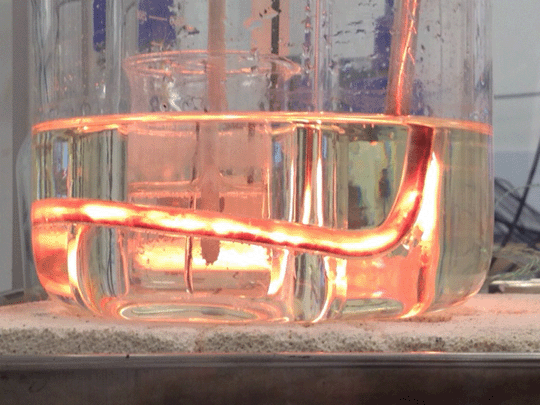
In pyroprocessing, the fuel is dissolved in molten salt instead of acid, and the plutonium and uranium are recovered by passing a current through the salt and plating them out on electrodes. In 2021, Terrapower stated that it plans to switch later to a fuel for Natrium that does not contain sodium but then received in March 2022 the largest of eleven Energy Department grants for research and development on new reprocessing technologies.
Liquid-sodium-cooled reactor designs date back to the 1960s and 1970s, when the global nuclear power community believed conventional power reactor capacity would quickly outgrow the available supply of high-grade uranium ore. Conventional reactors are fueled primarily by chain-reacting uranium 235, which comprises only 0.7 percent by weight of natural uranium. Because of this low percentage, nuclear power advocates focused on developing plutonium “breeder” reactors that would be fueled by chain-reacting plutonium produced from the abundant but non-chain-reacting uranium 238 isotope, which constitutes 99.3 percent of natural uranium. (Liquid-sodium-cooled reactors are sometimes called “fast-neutron reactors” because they utilize fast neutrons to operate. Sodium was chosen as a coolant because it slows neutrons less than water. Fast neutrons are essential to a plutonium breeder reactor because the fission of plutonium by fast neutrons releases more excess secondary neutrons whose capture in uranium 238 makes possible the production of more plutonium than the reactor consumes.)
Large programs were launched to provide startup fuel for the breeder reactors by reprocessing spent conventional power-reactor fuel to recover its contained plutonium.
………………………………….. Only a few prototypes were built and then mostly abandoned. In 2020, the Organisation for Economic Co-operation and Development’s Nuclear Energy Agency estimated that sufficient low-cost uranium would be available to fuel existing conventional reactor capacity for more than a century.
Zombie plutonium-separation programs. Even though separated plutonium has morphed from the nuclear fuel of the future into a disposal problem, civilian plutonium separation continues in several countries, notably France, Japan, and Russia. It is also being advocated again by the offices within the US Energy Department that fund research and development on nuclear energy.
Russia still has an active breeder reactor development program, with two operating liquid sodium-cooled prototypes—only one of them plutonium fueled—plus a small, liquid, lead-cooled prototype under construction. But Russia has already separated 60 tons of power-reactor plutonium and has declared as excess above its weapons needs approximately 40 tons of weapon-grade plutonium. These 100 tons of separated plutonium would be enough to provide startup fuel for five years for six full-size breeder reactors.
China and India have breeder reactor prototypes under construction, but their breeders are suspected of being dual-purpose. In addition to their production of electric power, the weapon-grade plutonium produced in uranium “blankets” around the breeder cores is likely to be used for making additional warheads for their still-growing nuclear arsenals.
France and Japan require their nuclear utilities to pay for reprocessing their spent fuel and for recycling the recovered plutonium in MOX fuel, even though both countries have known for decades that the cost of plutonium recycling is several times more than using low-enriched uranium fuel “once through,” with the spent fuel being disposed of directly in a deep geological repository.
Claimed benefits of reprocessing. Advocates of plutonium recycling in France and Japan justify their programs with claims that it reduces uranium requirements, the volume of radioactive waste requiring disposal, and the duration of the decay heat and radiotoxicity of the spent fuel in a geologic repository. These benefits are, however, either minor or non-existent. First, France’s plutonium recycling program reduces its uranium requirements by only about 10 percent, which could be achieved at much less cost in other ways, such as by adjusting enrichment plants to extract a higher percentage of the uranium 235 isotopes in natural uranium. Second, with proper accounting, it is not at all clear that recycling produces a net reduction in the volume of radioactive waste requiring deep geological disposal. Third, the claimed heat reduction, if realized, could reduce the size of the repository by packing radioactive waste canisters more closely. But this is not significant because, with the currently used reprocessing technology, americium 241, which has a 430-year half-life and dominates the decay heat from the spent fuel during the first thousand years, remains in the reprocessed waste.
Claims of the reduced toxicity of reprocessed waste turn out to be false as well. For decades, France’s nuclear establishment has promoted continued reprocessing in part out of hope that, after its foreign reprocessing customers did not renew their contracts, it could sell its plutonium recycling technology to other countries, starting with China and the United States. But, with the notable exception of the canceled US MOX plant, these efforts so far have not materialized, and the willingness of the French government to continue funding its expensive nuclear fuel cycle strategy may be reaching its limits………………………..
Proliferation danger. Aside from the waste of taxpayer money, there is one major public-policy objection to plutonium separation: Plutonium can be used to make a nuclear weapon. The chain-reacting material in the Nagasaki bomb was six kilograms of plutonium, and the fission triggers of virtually all nuclear warheads today are powered with plutonium. Reactor-grade plutonium is weapon-usable, as well.
In the 1960s, however, blinded by enthusiasm for plutonium breeder reactors, the US Atomic Energy Commission—the Energy Department’s predecessor agency—promoted plutonium worldwide as the fuel of the future. During that period, India sent 1,000 scientists and engineers to Argonne and other US national laboratories to be educated in nuclear science and engineering. In 1964, India began to separate plutonium from the spent fuel of a heavy-water research reactor provided jointly by Canada and the United States. Ten years later, in 1974, India used some of that separated plutonium for a design test of a “peaceful nuclear explosive,” which is now a landmark in the history of nuclear weapon proliferation……………………….
False environmental claims for reprocessing. Since the 1980s, advocates of reprocessing and plutonium recycling and fast neutron reactors in the Energy Department’s Argonne and Idaho National Laboratories have promoted them primarily as a strategy to facilitate spent fuel disposal.
The George W. Bush administration, which came to power in 2001, embraced this argument because it saw the impasse over siting a spent fuel repository as an obstacle to the expansion of nuclear power in the United States. To address the proliferation issue, the Bush Administration proposed in 2006 a “Global Nuclear Energy Partnership” in which only countries that already reprocessed their spent fuel (China, France, Japan, and Russia) plus the United States would be allowed to reprocess the world’s spent fuel and extract plutonium. The recovered plutonium then would be used in the reprocessing countries to fuel advanced burner reactors (breeder reactors tweaked so that they would produce less plutonium than they consumed). These burner reactors would be sodium-cooled fast-neutron reactors because the slow neutrons that sustain the chain reaction in water-cooled reactors are not effective in fissioning some of the plutonium isotopes. After Congress understood the huge costs involved, however, it refused to fund the partnership…………………………….
Plutonium and the geological disposal of spent fuel. Despite the unfavorable economics, the idea of separating and fissioning the plutonium in spent fuel has been kept alive in the United States and some other countries in part by continuing political and technical obstacles to siting spent fuel repositories. Proponents of reprocessing have managed to keep their governments’ attention on plutonium because it is a long-lived radioelement, a ferocious carcinogen—if inhaled—and has fuel value if recycled.
But detailed studies have concluded that plutonium makes a relatively small contribution to the long-term risk from a spent fuel geologic repository for spent fuel from commercial power reactors.
……………………………………………….. risk assessments are theoretical, but they are based on real-world experience with the movement of radioisotopes through the environment.
The main source of that experience is from the large quantities of fission products and plutonium lofted into the stratosphere by the fireballs of megaton-scale atmospheric nuclear tests between 1952 and 1980. During that period, the Soviet Union, the United States, China, the United Kingdom, and France injected into the stratosphere a total of about eight tons of fission products and 3.4 tons of plutonium—comparable to the quantities in a few hundred tons of spent light water reactor fuel. These radioisotopes returned to earth as global radioactive “fallout.”
…………………………………… In addition to the proliferation danger dramatized by the case of India, plutonium separation also brings with it a danger of a massive accidental radioactive release during reprocessing. The world’s worst nuclear accident before Chernobyl involved the Soviet Union’s first reprocessing plant for plutonium production, in 1957……………………………………………..
Gullible governments. Nearly half a century after India conducted its first nuclear test in 1974 with assistance provided inadvertently by Canada and the United States, both countries’ governments seem to have forgotten about the proliferation risk associated with spent fuel reprocessing. Today, advocates of fast-neutron breeder or burner reactors are pitching again the same arguments—used before the test—to gullible governments that seem unaware of the history of this issue. This ignorance has created problems for Canada’s nonproliferation policy as well as that of the United States.
In Canada, a UK startup, Moltex, has obtained financial support from federal and provincial governments by promising to “solve” Canada’s spent fuel problem. Its proposed solution is to extract the plutonium in the spent fuel of Canada’s aging CANDU (CANada Deuterium Uranium) reactors to fuel a new generation of molten-salt-cooled reactors. The Moltex company also proposes to make Canada an export hub for its reactors and small reprocessing plants.
In South Korea, the Korea Atomic Energy Research Institute, with support from Energy Department’s Argonne and Idaho National Laboratories, has similarly been campaigning to persuade its government that pyroprocessing spent fuel and fissioning plutonium in sodium-cooled reactors would help solve that country’s spent fuel management problem.
It is time for governments to learn again about the risks involved with plutonium separation and to fence off “no-go zones” for their nuclear energy advocates, lest they unintentionally precipitate a new round of nuclear-weapon proliferation.
Notes:
[1] Carbon 14 and iodine 129 are difficult to capture during reprocessing and therefore are routinely released into the atmosphere and ocean by France’s reprocessing plant at La Hague. Also, had the uranium 238 in the spent fuel not been mined, its decay product, radium 226, would have been released within the original uranium deposit. So, even though some reprocessing advocates join with nuclear power critics in amplifying the hazards of plutonium and other transuranic elements in underground radioactive waste repositories, they generally omit comparisons with reprocessing hazards (in the case of reprocessing advocates) or with natural uranium deposits (in the case of repository opponents). https://thebulletin.org/2022/09/some-fuels-never-learn-us-energy-department-returns-to-costly-and-risky-plutonium-separation-technologies/
1 This Month


Tell Congress: Prevent Nuclear Catastrophe in Iran

Tell Congress: Prevent Nuclear Catastrophe in Iran

Read the Public Inquiry Report, the Commissioners’ report, Surrendering Australia: The AUKUS Deception is available to download for free at aukuspublicinquiry.com. Or just watch the replay of the National Press Club Luncheon.
To see nuclear-related stories in greater depth and intensity – go to https://nuclearinformation.wordpress.com
Say No to NASA’s Reckless Nuclear Reactor on the Moon
-
Archives
- November 2026 (284)
- October 2026 (302)
- September 2026 (339)
- August 2026 (330)
- July 2026 (355)
- June 2026 (287)
- May 2026 (306)
- April 2026 (356)
- March 2026 (251)
- February 2026 (267)
- January 2026 (308)
- December 2025 (358)
-
Categories
- 1
- 1 NUCLEAR ISSUES
- business and costs
- climate change
- culture and arts
- ENERGY
- environment
- health
- history
- indigenous issues
- Legal
- marketing of nuclear
- media
- opposition to nuclear
- PERSONAL STORIES
- politics
- politics international
- Religion and ethics
- safety
- secrets,lies and civil liberties
- spinbuster
- technology
- Uranium
- wastes
- weapons and war
- Women
- 2 WORLD
- ACTION
- AFRICA
- Atrocities
- AUSTRALIA
- Christina's notes
- Christina's themes
- culture and arts
- Events
- Fuk 2022
- Fuk 2023
- Fukushima 2017
- Fukushima 2018
- fukushima 2019
- Fukushima 2020
- Fukushima 2021
- general
- global warming
- Humour (God we need it)
- Nuclear
- RARE EARTHS
- Reference
- resources – print
- Resources -audiovicual
- Weekly Newsletter
- World
- World Nuclear
- YouTube
-
RSS
Entries RSS
Comments RSS

