Pandora’s box of nuclear progress
Why uranium mining, nuclear energy, and atomic bombs are all steps in the path to destruction
By Cymry Gomery, Coordinator of Montréal for a World BEYOND War
This op-ed was inspired by a presentation by Dr. Gordon Edwards of the Canadian Coalition for Nuclear Responsibility on November 16, 2022.
The Russia-Ukraine conflict has many worried that we are on the brink of nuclear war. Putin has put Russia’s nukes on high alert and President Biden grimly warned last month of the risk of nuclear “armageddon”. New York City shocked the world with its PSA on how to survive a nuclear attack, while the Doomsday Clock is just 100 seconds to midnight.
However, nuclear bombs are just the last in a series of related products and activities—uranium mining, nuclear energy, and nuclear bombs—whose production is rooted in the fact that human moral understanding of the world lags far behind our technical skills. They are all progress traps.
What is a progress trap?
The notion of progress is generally perceived in a positive light in Western society. If we can find an innovative way to do something more quickly, with less effort, we feel pleased. However, this perception was called into question by Ronald Wright in his 2004 book A Short History of Progress. Wright defines a progress trap as ”a chain of successes which, upon reaching a certain scale, leads to disaster. The dangers are seldom seen before it’s too late. The jaws of a trap open slowly and invitingly, then snap closed fast.”
Wright mentions hunting as an early example, because as humans developed tools that were more efficient at killing ever more animals, they eventually exhausted their food supply and starved. With industrialization, hunting gave way to factory farms, which seems very different, but in fact was just another version of a progress trap. Not only do factory farms cause immense suffering to animals, they are hurt humans too: People in developed countries consume too many calories, of food of questionable suitability to humans, and often die of cancers and obesity-related diseases.
Now let’s look at uranium mining, nuclear energy and nuclear bombs in this light.
The Uranium mining progress trap
Uranium, a heavy metal that was discovered in 1789, was initially used as a colorant for glass and pottery. However, eventually humans discovered that uranium can be used to effect nuclear fission, and since 1939 that miraculous property has been harnessed to produce nuclear energy for civilian purposes, and to make bombs for the military. That is the “successful” aspect of Wright’s definition (if you are okay with considering both keeping people warm and killing them as desirable outcomes).
Canada is the world’s single largest supplier of uranium, and most of the mines are in the North where Inuit communities—typically the most disadvantaged and least politically influential demographic in Canada—are exposed to uranium dust, tailings, and other hazards.
Uranium mining creates radioactive dust that workers can inhale or accidentally ingest, leading to lung cancer and bone cancer. Over time, workers or people living near a uranium mine can be exposed to high concentrations, which can damage their internal organs, notably the kidneys. Animal studies suggest that uranium affects reproduction, the developing fetus, and increases the risk of leukemia and soft tissue cancers.
This is alarming enough; however the progress trap comes into play when one considers the half-life of uranium, the period during which it decays and emits gamma radiation (electromagnetic radiation which we also know as X-rays). Uranium-238, the most common form, has a half-life of 4.46 billion years.
In other words, once uranium is brought to the surface through mining, a Pandora’s box of radiation is unleashed on the world, radiation that can cause lethal cancers and other illnesses, for billions of years. That’s a progress trap right there. But that’s not the whole story. This uranium is not finished its destructive mission. It can now be used to make nuclear energy and nuclear bombs.
The Nuclear energy progress trap
Nuclear energy has been touted as a clean energy because it does not produce greenhouse gasses (GHG). However, it is far from clean. In 2003, a study produced by nuclear advocates at the Massachusetts Institute of Technology identified costs, safety, proliferation, and waste as the four “unresolved problems” with nuclear power……………………………………………………………
So nuclear energy is also a progress trap. Anyway, there are other means of producing energy—wind, sun, hydro, geothermal–which are less costly. However, even if nuclear energy were the cheapest energy, it would still be off the table to any project manager worth her salt, because it is highly polluting, entails the risk of nuclear disasters such as have already happened at Fukushima and Chernobyl, and because persistent nuclear waste poisons and kills humans and animals.
Also, nuclear waste produces plutonium, which is used to make nuclear bombs—the next step in the “progress” continuum.
The nuclear bomb progress trap
Yes, it has come to this. Humans are capable of wiping out all life on Earth with the push of a button. Western civilization’s obsession with winning and hegemony has led to a situation where we have mastered death but failed at life. This is the penultimate example of human technological intelligence outpacing human emotional and spiritual evolution.
An accidental missile launch could lead to the greatest global public health disaster in recorded history. A war using fewer than half the nuclear weapons of India and Pakistan alone would lift enough black soot and soil into the air to cause a nuclear winter. In his book Command and Control, author Eric Schlosser documents how nuclear weapons provide what he calls an “illusion of safety,” while, in fact, posing real danger due to the threat of accidental detonation. Schlosser documents how hundreds of incidents involving nuclear weapons have nearly destroyed our world through accident, confusion, or misunderstanding.
One way out of the mutually assured destruction (so tellingly rendered as MAD) trap we have created is the Treaty for the Prohibition of Nuclear Weapons (TPNW), which entered into force in 2021, and has been signed by 91 nations and ratified by 68. However, the nuclear armed nations have not signed, nor have NATO member countries like Canada.
USA’s Inflation Reduction Act of 2022 (IRA) cleverly worded so it could be a bonanza for small nuclear plant developers
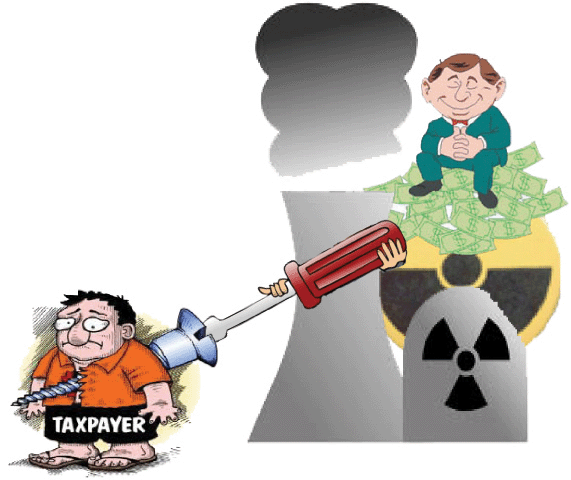
Advanced Nuclear Plants Poised to Benefit from Inflation Reduction Act, Retiring Coal Plants
American Power Association, November 27, 2022 Peter Maloney “………………………………… The Inflation Reduction Act of 2022 (IRA) provides production tax credits (PTC) for existing nuclear power plants but, more importantly, for new nuclear power plants and specifically for advanced reactors and small modular reactors – the type NuScale Power is working on. The IRA amends the definition of a qualified facility eligible for a “clean PTC” to mean any plant placed into service after Dec. 31, 2024, that produces zero greenhouse gas emissions.
The IRA also amends the Internal Revenue Service (IRS) rules on qualifying for a clean energy investment tax credit (ITC) by changing the language in the code to allow investments for advanced reactors to qualify for the credit. The change provides a tax credit of 30 percent of the cost of building a zero-emission advanced nuclear power plant that is placed in service after 2025.
“If you design and plan to put in a small modular reactor at the site of a retired coal plant, there is a further 10 percent ITC available, and if you use domestic content there is another 10 percent ITC added on,” Colbert said. “That can add up to a 50 percent reduction in costs.”
In September, the Department of Energy (DOE) released a study that found that hundreds of coal power plant sites across the country could be converted to nuclear power plant sites……………………..
Each NuScale small modular reactor (SMR) is designed to generate 77 megawatts (MW) of electricity. Up to 12 SMRs can be combined to make a 924-MW VOYGR™-12 power plant. In addition to their compact design, which makes them scalable and cost competitive, …………………………..
NuScale is now looking forward to reaching another milestone in the regulatory process.
In July, the NRC directed its staff to issue a final rule certifying NuScale’s SMR design.
The rulemaking would amend NRC regulations to incorporate NuScale’s SMR standard plant design, which would allow applicants intending to build and operate an SMR plant to reference the design certification rule.
“If approved, the certification would be published in the Federal Register and have the effect of law,” Colbert said.
The rulemaking is on the docket for the NRC to make a decision in November.
Kamala Harris, nuclear saleswoman extraordinaire, touting small nuclear reactors to Thailand

US to help Thailand harness nuclear energy, Manila Times. By Agence France-Presse, November 28, 2022
IN SEARCH OF CLEAN FUEL A staff member works at the production line of Dunan Metals Co. Ltd in the Thai-Chinese Rayong industrial zone in Rayong province, Thailand, Nov. 8, 2022. The United States will help Thailand develop nuclear power through a new class of small reactors, part of a program aimed at fighting climate change, Vice President Kamala Harris announced on a visit Saturday, November 26. XINHUA PHOTO
BANGKOK: The United States will help Thailand develop nuclear power through a new class of small reactors, part of a program aimed at fighting climate change, Vice President Kamala Harris announced on a visit Saturday.
The White House said the assistance was part of its Net Zero World Initiative, a project launched at last year’s Glasgow climate summit in which the United States partners with the private sector and philanthropists to promote clean energy.
Thailand does not have nuclear power, with the public mood on the issue souring after the 2011 Fukushima disaster in Japan.
The White House said it would offer technical assistance to the Southeast Asian country to deploy the developing technology of small modular reactors, which are factory-built and portable………………
The White House did not give a timeline but said it would support Thailand, which is highly vulnerable to climate change, in its goal of going carbon neutral by 2065.
Harris is visiting the US ally for an Asia-Pacific Economic Cooperation summit and discussed climate efforts in a meeting with Thai Prime Minister Prayut Chan-O-Cha………… https://www.manilatimes.net/2022/11/28/news/world/us-to-help-thailand-harness-nuclear-energy/1868041
Washington’s Iron Curtain in Ukraine
Peace and Planet Newsby Diana Johnstone | Fall 2022 Edition
This article is from June 2014; the editors found it profoundly accurate and quite prescient about the shape of things we are witnessing today.
ATO leaders are currently acting out a deliberate charade in Europe, designed to reconstruct an Iron Curtain between Russia and the West.
With astonishing unanimity, NATO leaders feign surprise at events they planned months in advance. Events that they deliberately triggered are being misrepresented as sudden, astonishing, unjustified “Russian aggression.” The United States and the European Union undertook an aggressive provocation in Ukraine that they knew would force Russia to react defensively, one way or another.
They could not be sure exactly how Russian president Vladimir Putin would react when he saw that the United States was manipulating political conflict in Ukraine to install a pro-Western government intent on joining NATO. This was not a mere matter of a “sphere of influence” in Russia’s “near abroad,” but a matter of life and death to the Russian Navy, as well as a grave national security threat on Russia’s border.
A trap was thereby set for Putin. He was damned if he did, and damned if he didn’t. He could underreact, and betray Russia’s basic national interests, allowing NATO to advance its hostile forces to an ideal attack position.
Or he could overreact, by sending Russian forces to invade Ukraine. The West was ready for this, prepared to scream that Putin was “the new Hitler,” poised to overrun poor, helpless Europe, which could only be saved (again) by the generous Americans.
In reality, the Russian defensive move was a very reasonable middle course. Thanks to the fact that the overwhelming majority of Crimeans felt Russian, having been Russian citizens until Khrushchev frivolously bestowed the territory on Ukraine in 1954, a peaceful democratic solution was found. Crimeans voted for their return to Russia in a referendum which was perfectly legal according to international law, although in violation of the Ukrainian constitution, which was by then in tatters having just been violated by the overthrow of the country’s duly elected president, Victor Yanukovych, facilitated by violent militias. The change of status of Crimea was achieved without bloodshed, by the ballot box.
Nevertheless, the cries of indignation from the West were every bit as hysterically hostile as if Putin had overreacted and subjected Ukraine to a U.S.-style bombing campaign, or invaded the country outright – which they may have expected him to do.
U.S. Secretary of State John Kerry led the chorus of self-righteous indignation, accusing Russia of the sort of thing his own government is in the habit of doing. “You just don’t invade another country on phony pretext in order to assert your interests. This is an act of aggression that is completely trumped up in terms of its pretext,” Kerry pontificated. “It’s really 19th-century behavior in the 21st century.” Instead of laughing at this hypocrisy, U.S. media, politicians and punditry zealously took up the theme of Putin’s unacceptable expansionist aggression. The Europeans followed with a weak, obedient echo.
It Was All Planned at Yalta
In September 2013, one of Ukraine’s richest oligarchs, Viktor Pinchuk, paid for an elite strategic conference on Ukraine’s future that was held in the same Palace in Yalta, Crimea, where Roosevelt, Stalin and Churchill met to decide the future of Europe in 1945.
The Economist, one of the elite media reporting on what it called a “display of fierce diplomacy,” stated that: “The future of Ukraine, a country of 48m people, and of Europe was being decided in real time.” The participants included Bill and Hillary Clinton, former CIA head General David Petraeus, former U.S. Treasury Secretary Lawrence Summers, former World Bank head Robert Zoellick, Swedish Foreign Minister Carl Bildt, Shimon Peres, Tony Blair, Gerhard Schröder, Dominique Strauss-Kahn, Mario Monti, Lithuanian President Dalia Grybauskaite, and Poland’s influential Foreign Minister Radek Sikorski. Both President Viktor Yanukovych, deposed five months later, and his recently elected successor Petro Poroshenko were present. Former U.S. energy secretary Bill Richardson was there to talk about the shale-gas revolution which the United States hopes to use to weaken Russia by substituting fracking for Russia’s natural gas reserves. The center of discussion was the “Deep and Comprehensive Free Trade Agreement” (DCFTA) between Ukraine and the European Union, and the prospect of Ukraine’s integration with the West. The general tone was euphoria over the prospect of breaking Ukraine’s ties with Russia in favor of the West.
Conspiracy against Russia? Not at all. Unlike Bilderberg, the proceedings were not secret. Facing a dozen or so American VIPs and a large sampling of the European political elite was a Putin adviser named Sergei Glazyev, who made Russia’s position perfectly clear.
Glazyev injected a note of political and economic realism into the conference. Forbes reported at the time on the “stark difference” between the Russian and Western views “not over the advisability of Ukraine’s integration with the EU but over its likely impact.” In contrast to Western euphoria, the Russian view was based on “very specific and pointed economic criticisms” about the Trade Agreement’s impact on Ukraine’s economy, noting that Ukraine was running an enormous foreign accounts deficit, funded with foreign borrowing, and that the resulting substantial increase in Western imports could only swell the deficit. Ukraine “will either default on its debts or require a sizable bailout.”
The Forbes reporter concluded that “the Russian position is far closer to the truth than the happy talk coming from Brussels and Kiev.”
As for the political impact, Glazyev pointed out that the Russian-speaking minority in Eastern Ukraine might move to split the country in protest against cutting ties with Russia, and that Russia would be legally entitled to support them, according to The Times of London.
In short, while planning to incorporate Ukraine into the Western sphere, Western leaders were perfectly aware that this move would entail serious problems with Russian-speaking Ukrainians, and with Russia itself. Rather than seeking to work out a compromise, Western leaders decided to forge ahead and to blame Russia for whatever would go wrong. ……………………….
Plan A and Plan B
U.S. policy, already evident at the September 2013 Yalta meeting, was carried out on the ground by Victoria Nuland, former advisor to Dick Cheney, deputy ambassador to NATO, spokeswoman for Hillary Clinton, wife of neocon theorist Robert Kagan. Her leading role in the Ukraine events proves that the neo-con influence in the State Department, established under Bush II, was retained by Obama……………..
As Victoria Nuland boasted in Washington, since the dissolution of the Soviet Union in 1991, the United States has spent $5 billion to gain political influence in Ukraine (this is called “promoting democracy”)…….
What called public attention to Victoria Nuland’s role in the Ukrainian crisis was her use of a naughty word, when she told the U.S. ambassador, “Fuck the EU.” But the fuss over her bad language veiled her bad intentions.
……………………………… What called public attention to Victoria Nuland’s role in the Ukrainian crisis was her use of a naughty word, when she told the U.S. ambassador, “Fuck the EU.” But the fuss over her bad language veiled her bad intentions.
………………….
The Protection Racket Returns
But first of all, the United States needs Russia as an enemy in order to “save Europe,” which is another way to say, in order to continue to dominate Europe.
…………………………………………………………….. Perhaps the most extraordinary aspect of the current charade is the servility of the “old” Europeans. Apparently abandoning all Europe’s accumulated wisdom, drawn from its wars and tragedies, and even oblivious to their own best interests, today’s European leaders seem ready to follow their American protectors to another D-Day … D for Doom. https://peaceandplanetnews.org/ukraine-iron-curtain/
Ukrainian city names street after Nazi collaborator

Vinnitsa is replacing world-famous Russian author Leo Tolstoy with Stepan Bandera https://www.rt.com/russia/567200-vinnitsa-tolstoy-bandera-street/ 27 Nov 22
The city council of Vinnitsa in Ukraine announced on Friday it was renaming one of its streets after WWII Nazi collaborator Stepan Bandera. The local authorities described their drive to rid the city of all toponyms linked to Russia as a “process of decolonization.”
The street previously bore the name of Leo Tolstoy, the 19th-century Russian author of world renown. Vinnitsa authorities said they paid “special attention” to memorializing those they described as “heroes of the national liberation struggle.” Bandera, who led a nationalist movement responsible for many atrocities against Russians, Jews and Poles in WWII, is regarded as a national hero by the current Ukrainian authorities.
Another street was named after Ivan Treiko, one of the “generals” and the “military intelligence chief” of the Ukrainian Insurgent Army (UPA), a paramilitary group that also collaborated with the Nazis. Warsaw in particular has blamed the UPA for the genocide of Poles in Volhynia and Eastern Galicia. The ethnic cleansing operations against Poles were ordered by Nazi Germany and carried out by paramilitary units that consisted primarily of ethnic Ukrainians.
A total of 232 toponyms have been changed as part of the “decolonization” campaign in Vinnitsa and neighboring towns, the city council said, praising itself as one of the “most active participants” of this nationwide drive.
Ukraine’s capital, Kiev, has renamed one of its streets after the notorious Azov regiment, which has had open neo-Nazis in its ranks. That street previously bore the name of the Soviet Marshal Rodion Malinovsky. Ukrainian by origin, Malinovsky liberated much of southern Ukraine, including his home city of Odessa, from the Nazis in 1943-1944.
In June, the mayor of Odessa expressed his concern over the growing enmity for “all things Russian” amid the prolonged conflict between Moscow and Kiev.
The removal of references to Russia from street names and other institutions has been a trend in Ukraine since the 2014 Maidan coup, but intensified after the launch of Moscow’s military operation.
Merkel explains why she wasn’t surprised by Russia’s offensive in Ukraine

https://www.rt.com/news/567189-merkel-ukraine-russia-conflict-surprise/ 26 Nov 22
The Minsk Agreements became “eroded” and the EU was reluctant to talk to Moscow, the former German chancellor told Der Spiegel
Former German Chancellor Angela Merkel says she was not surprised when the conflict between Russia and Ukraine broke out in late February. The retired leader was speaking to Der Spiegel in a lengthy interview published on Thursday.
“It did not come as a surprise,” Merkel told the outlet. By then, “the Minsk Agreements were eroded,” the former chancellor stated, referring to the 2014 ceasefire deal brokered by Germany and France, which were designed to give the eastern regions special status within Ukraine.
She also said her efforts to establish another dialogue platform for Russia and the EU in 2021 had come to nothing.
I wanted, together with [French President] Emmanuel Macron, to create an independent European discussion format with Putin through the European Council,” Merkel said, explaining that she faced opposition from other members of the EU’s top body.
“I no longer had the strength to assert myself,” she noted, as everyone knew she was about to step down. She faced the same problem on her farewell visit to Moscow, sensing she no longer had the ability to influence Putin, for whom she said “only power counts.”
The former German leader said she “wished for a more peaceful time” after her departure and would have “pushed for [her initiative] further” had she decided to lead her party into the 2021 parliamentary elections and won.
The former chancellor also acknowledged that she had not moved forward “even a millimeter” in resolving not only the Ukraine crisis, but the tensions between “Transnistria and Moldova, Georgia and Abkhazia,” as well as the crises in Syria and Libya. “It was time for a new approach,” she said.
Merkel, however, defended her opposition to admitting Georgia and Ukraine into NATO, arguing that she “bought time” for Kiev to better prepare for the Russian offensive.
However, Merkel still believes that Berlin should not be “the first nation to send state-of-the-art tanks” to Kiev, warning that it would only damage Berlin’s relations with Moscow. “Russia would then be only further set against Germany,” she said.
Merkel faced criticism at home over the conflict for supposedly making the German economy too reliant on Russian gas. The ex-chancellor defended her decisions, saying that buying gas from Moscow was the best way towards a green future and the move away from coal.
JNFL’s application for examination of a nuclear fuel reprocessing plant was criticized by the Regulatory Commission for “lacking a sense of urgency”

JNFL Senior Managing Executive Officer Rei Sudo (left) and others explain at the Nuclear Regulation Authority’s review meeting in Minato-ku, Tokyo.
November 22, 2022
JNFL found multiple errors in the seismic calculation results of the application it submitted to the Nuclear Regulation Authority during the examination required for the operation of its reprocessing plant for spent nuclear fuel from nuclear power plants in Rokkasho Village, Aomori Prefecture. The errors were discovered when the Nuclear Regulation Commission pointed them out to JNFL. Even two years after the application was submitted, NNFL continues to reveal its inadequacies, and there is no prospect that the review will be completed.
The errors were in the results of seismic calculations for the cooling tower fire detectors, which NNFL submitted on November 8 in the form of an amendment to its application. According to NNFL, when the results of the seismic calculations were transcribed into the application, incorrect values were entered in several places. Although the documents were checked before submission, the mistake was not noticed. The cause of the error has not been disclosed, saying that it is under investigation. The correction will be corrected and resubmitted in the future.
According to the secretariat of the regulatory commission, the error in the calculation results was so simple that a person with expert knowledge would be able to recognize it at a glance.
At the review meeting held on March 15, the person in charge at the secretariat of the regulatory commission commented, “In the review of facility design, making a mistake in numerical values is a definite and serious problem,” and “It is the most rudimentary of rudiments. Why don’t they notice it? Why don’t they realize this? They have no sense of crisis at all. Rei Sudo, executive vice president of Nenryo, who is in charge of handling the review, simply stated, “This is something that really shouldn’t happen. We take this very seriously.
The reprocessing plant, a core facility under the government’s nuclear fuel cycle policy, met the new regulatory standards for basic accident countermeasures in July 2020, and in December of the same year, JNFL applied for a review of detailed facility designs and construction plans. However, there has been no significant progress since the application stage due to inadequate explanations from NNFL.
In September of this year, NNFL announced for the 26th time that it was postponing the completion of the plant due to the difficulties encountered in the review process. The company plans to announce the next target date for completion by the end of this year, but the examination process will inevitably become even more difficult due to the discovery of numerical errors. (Kenta Onozawa)
https://www.tokyo-np.co.jp/article/215291?fbclid=IwAR3axQXraZ9FR1wgBWFW97VsXYaz7LEtnmRwhAa8f6fSsxczwS8WNBpIdY4
Small Modular Nuclear Reactor cost overruns: the same old problems haunt new nuclear in Utah
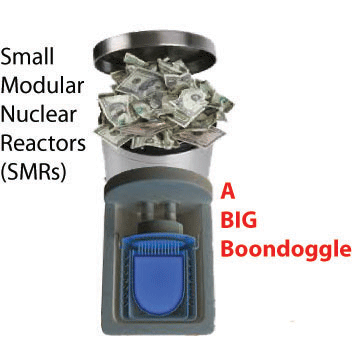
Much hope is being placed on Small Modular Reactors (SMR) making new
nuclear plants competitive. But David Schlissel at IEEFA summarises their
research into the publications, updates and statements coming from the
stakeholders involved with the SMR by UAMPS (Utah Associated Municipal
Power Systems) and NuScale Power Corporation that shows that costs are
going out of control, a persistent problem in the nuclear industry.
The original target power price of $55/MWh has risen to $100 (with subsidies)
and is likely to rise further by the time it’s switched on in 2030, says
Schlissel. Construction costs and delays are the main causes (as usual). So
concerned are potential customers that, since February 2022, only 101MW of
the plant’s total 462MW have been subscribed to.
It will be difficult to
secure financing for the plant without a fully subscribed project.
Meanwhile, IEEFA figures say renewable resources and battery storage will
provide reliable electricity at lower cost than the UAMPS plant, even if
the price for the power from the project is just $58 per MWh. And
renewables and battery costs are still declining.
Energy Post 25th Nov 2022 more https://energypost.eu/small-modular-reactor-cost-overruns-the-same-old-problems-haunt-new-nuclear-in-utah/
Could the Minsk II agreement Have Prevented the War in Ukraine?
a significant minority of Ukrainians want to remain close to Russia, and for them fully integrating with the West represents a loss.
The fundamental problem for Ukraine was that a majority of citizens sought closer ties with the West, but a significant minority sought closer ties with Russia, and these two aspirations were mutually incompatible.
Daily Sceptic, BY NOAH CARL., 23 NOVEMBER 2022,
Since Russia’s invasion of Ukraine began, Western commentators have spent a huge amount of time expressing moral outrage at Russia’s actions, but comparatively little time thinking about how the war could have been prevented.
This is puzzling. Even if Ukraine manages to win, this victory will have come at an enormous price – tens of thousands of lives, millions of refugees (many of whom may never return), and untold damage to the country’s infrastructure. No matter what the outcome, the war will have been disastrous for ordinary Ukrainians.
It therefore seems essential to ask whether it could have been prevented.
One possible way it could have been prevented is through deterrence. NATO members could have announced in advance, ‘We commit to defending Ukraine if it is ever attacked by Russia’. Alternatively, the U.S. and its allies could have armed Ukraine to the teeth by transferring huge quantities of offensive weapons.
The disadvantages of this approach are obvious. It might have caused Russia to invade even sooner to forestall the arrival of NATO troops or weapons. And if Russia did call the West’s bluff, it might have sparked World War III, as NATO would have pre-committed to entering the war on Ukraine’s side.
As late as February 2014, the percentage of Ukrainians who wanted to join the EU was only 5 points higher than the percentage who wanted to join the Eurasian Customs Union. The balance of opinion then shifted after the ‘Revolution of Dignity’.
There’s another possible way the war could have been prevented: through the implementation of Minsk II. This was an agreement signed in 2015 by representatives from Russia, Ukraine and the two separatist republics, which aimed to bring an end to the fighting in Donbas. It was based on a plan drawn-up by the leaders of France and Germany.
Although Minsk II ultimately failed, since neither side honoured the terms, it was unanimously endorsed
by the UN Security Council.
Critics of Minsk II say it was too favourable to the Russian/separatist side. This is because the agreement would have granted significant autonomy to the two Donbas regions, allowing them to veto Ukraine’s future membership of NATO and possibly its membership of the EU as well. (Minsk II is roughly equivalent to the plan John Mearsheimer put forward in 2014, which emphasised Ukrainian neutrality.)
For Ukrainians who aspire to fully integrate with the West, not being able to join NATO or the EU represents a major loss. Yet a significant minority of Ukrainians want to remain close to Russia, and for them fully integrating with the West represents a loss.
Likewise, almost half of Ukrainians opposed the Maidan protest movement, including a plurality who “[did] not support it all”. For this reason alone, calling the subsequent change of government a ‘Revolution of Dignity’ is highly dubious.
The fundamental problem for Ukraine was that a majority of citizens sought closer ties with the West, but a significant minority sought closer ties with Russia, and these two aspirations were mutually incompatible.
You might say that in a democracy, the majority gets to decide the future path of the country, so Minsk II was fundamentally unfair. Yet it’s widely understood that in ethnically divided countries, the majority often has to make concessions to the minority for the sake of overall stability. Half the parliamentary seats in Lebanon are reserved for Christians and half for Muslims, regardless of the ethnic make-up of the country (which no one quite knows), to prevent one group from dominating the other.
In any case, the European interest – as judged by the leaders of France and Germany – was preserving stability in Ukraine, rather than ensuring the country’s pro-Western majority got its way.
According to the New York Times, the plan for Minsk II emerged “in response to reports that lethal assistance was now on the table in Washington”. In other words, the U.S. wanted to start supplying Ukraine with offensive weapons, so France and Germany stepped in to broker a peace deal before that happened.
Why did Minsk II fail? As I’ve already stated, neither side upheld its end of the bargain. Yet historian Anatol Lieven argues it could have worked but for “the refusal of Ukrainian governments to implement the solution and the refusal of the United States to put pressure on them to do so”…………………………
why, as the country’s main backer, did the U.S. not pressure Ukraine to implement the agreement? After all, the U.S. endorsed the agreement in its capacity as a member of the UN Security Council, and the U.S. pressures its allies to do things all the time.
The obvious reason is that U.S. interests were not served by the implementation of Minsk II.
From a Western perspective, preventing the war in Ukraine would have required the French and Germans to act more decisively, or the Americans to look beyond their own interests. Unfortunately, neither of these eventualities came to pass…………………………… https://dailysceptic.org/2022/11/23/could-minsk-ii-have-prevented-the-war-in-ukraine/
It’s high time to defuse the military carbon bomb
We cannot tackle climate change, and save our collective future, while increasing military spending.
the richest countries spent $9.45 trillion on their militaries between 2013 and 2021 compared with an estimated $234bn on climate finance – in other words, they have spent 30 times as much on the military as climate finance.
- https://www.aljazeera.com/opinions/2022/11/25/military-carbon-bomb Nick Buxton, Researcher at the Transnational Institute, 25 Nov 202225 Nov 2022,
The annual United Nations climate talks, known as the Conference of Parties (COP), have traditionally promised much but delivered little. This year’s COP27 was no different, with most observers noting that it even backtracked on commitments made at COP26 in Glasgow.
What was less observed was that the summit faced a major additional obstacle in 2022. This year, the climate crisis was overshadowed by the war in Ukraine which has been the foreign policy priority of the United States and the European Union since the beginning of Russia’s invasion in February.
The difference between the way the world’s richest countries responded to the Ukraine war and the carbon war on our whole planet is undoubtedly stark.
Since the beginning of Russia’s invasion, the US and its NATO allies provided Ukraine with military assistance worth more than $25bn, welcomed nearly seven million refugees, and willingly absorbed severe economic shocks caused by energy price increases triggered by the war.
Despite a global recession looming on the horizon, these countries did not hesitate to increase their military expenditure. Germany allocated 100 billion euros ($104bn) of its 2022 budget for the armed forces, for example, and the US House of Representatives approved a record $840bn military spending.
Yet at COP27, these same wealthiest nations were not even able to deliver the $100bn in climate finance that had been promised as far back as 2009 to the world’s most climate-vulnerable countries. A recent report co-published by the organisation I work for, the Transnational Institute, found that the richest countries spent $9.45 trillion on their militaries between 2013 and 2021 compared with an estimated $234bn on climate finance – in other words, they have spent 30 times as much on the military as climate finance.
After many years of pressure, at COP27, nations finally agreed to create a loss and damage mechanism to provide funds to impoverished countries suffering severe climate impacts, but it is so far just an empty pot. The accelerated arms race that has emerged since the Russian invasion and rising US-China tensions signal that filling that pot will not be a priority for most wealthy nations in the near future.
These spending choices matter not just because they are diverting resources from urgently needed climate action, but also because every dollar spent on the military is worsening the climate crisis. Most militaries consume significant amounts of fossil fuels. One estimate calculates that military emissions may make up 5.5 percent of global emissions. If the global military were a country, it would be the fourth biggest emitter in the world, ahead of Russia.
Furthermore, most of the world’s military spending goes towards the purchase of equipment and vehicles that are among the worst offenders when it comes to carbon emissions. In 2022 alone, for example, 475 new F-35 fighter jets, which use a whopping 5,600 litres (1,480 gallons) of oil per hour of flight, have been ordered. These fuel-guzzling planes could be flying for the next 30 years.
The emissions increase even further when war breaks out. The Ukrainian government at COP27 presented research showing that the first eight months of war had already led to 33 million tonnes of greenhouse gas emissions, equivalent to adding 16 million cars to the United Kingdom’s roads for two years.
US and UK military chiefs argue that they are committed to reducing military emissions, but their plans so far remain undetailed, opaque and unconvincing. Adding solar panels to a military base is easy to do, but does nothing to tackle the main challenge, which is fossil fuel consumption by military jets, ships and tanks. For now, there is no alternative, green fuel that can be produced at the scale needed and without triggering unacceptable social and environmental consequences, such as increased deforestation and the dispossession of Indigenous peoples.
The uncomfortable truth is that there is no way of ensuring that our planet remains habitable in the long term while continuing to increase military spending. In the midst of an intense and brutal war in Ukraine, this fact is too easily lost as governments are able to justify any increases in military spending to deal with the new immediate “threats”.
Moreover, the military spending of many rich countries is already way out of proportion to any real or perceived threat. NATO member states, for example, already spend 17 times as much on the military as Russia. The US spends more on its military than the next nine countries combined.
Meanwhile, the world has an ever smaller window to tackle climate change – the most pressing threat to our collective future. The Intergovernmental Panel on Climate Change says the world must cut emissions by 45 percent by 2030 to have any chance at keeping global average temperature increases below 1.5 degrees Celsius (2.7 degrees Fahrenheit). When every month counts, embarking on an accelerated arms race is the worst path the world’s most powerful nations can take. It diverts money and attention from urgent climate action, it increases emissions and it fuels conflicts at a time of increased climate instability.
Climate change can teach us a critical lesson about security. Carbon emissions do not recognise borders. It is not possible for any nation to shield itself from the effects of climate change using tanks or fighter jets. The only way to tackle the climate emergency is through global cooperation. Demilitarisation and peace are the best and perhaps the only ways to ensure that humanity has the capacity and resilience to respond to this crisis.
Only if the world’s leaders recognise that uniting to confront the threat of global heating is more important than any imperialist strategy or narrow economic interest, may we have a chance to avoid climate catastrophe. A secure nation in the end depends on a secure planet.
US Arms Dealing Is Out of Control
What will it take to rein in Washington’s arms-sales addiction?
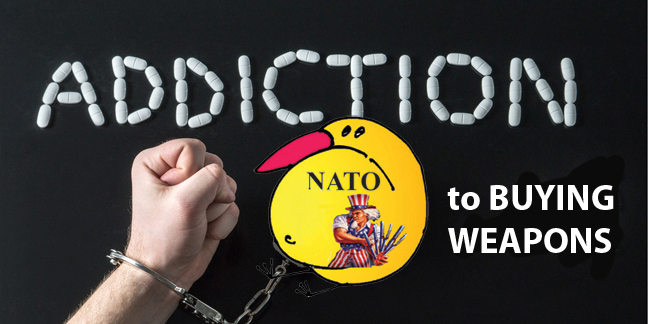
The Nation, By William D. Hartung. NOVEMBER 23, 2022,
There’s a seldom commented upon reality of this century and this moment: The United States remains the number-one arms-exporting nation on the planet. Between 2017 and 2021, it grabbed 39 percent of the total global weapons market, and there’s nothing new about that. It has, in fact, been the top arms dealer in every year but one for the past three decades. And it’s a remarkably lucrative business, earning American weapons makers tens of billions of dollars annually.
It would be one thing if it were simply a matter of money raked in by the industrial half of the military-industrial complex. Unfortunately, in these years, US-supplied weaponry has also fueled conflicts, enabled human-rights violations, helped destabilize not just individual countries but whole regions, and made it significantly easier for repressive regimes to commit war crimes.
At first glance, it appeared that Joe Biden, on entering the White House, might take a different approach to arms sales. On the campaign trail in 2020, he had, for instance, labeled Saudi Arabia a “pariah” state and implied that the unbridled flow of US weaponry to that kingdom would be reduced, if not terminated. He also bluntly assured voters that this country wouldn’t “check its values at the door to sell arms.”
Initially, Biden paused arms deals to that country and even suspended one bomb sale. Unfortunately, within eight months of his taking office, sales to the Saudi regime had resumed. In addition, the Biden team has offered arms to a number of other repressive regimes from Egypt and Nigeria to the Philippines. Such sales contrast strikingly with the president’s mantra of supporting “democracies over autocracies,” as well as his reasonable impulse to supply weapons to Ukraine to defend itself against Russia’s brutal invasion.
The last president who attempted to bring runaway US weapons trafficking under some sort of control was Jimmy Carter. In 1976, he campaigned for the presidency on a platform based, in part, on promoting human rights globally and curbing the arms trade. And for a period as president, he did indeed suspend sales to repressive regimes, while, in that Cold War era, engaging in direct talks with the Soviet Union on reducing global arms sales. He also spoke out eloquently about the need to rein in the trade in death and destruction.
However, Zbigniew Brzezinski, his hard-line national security advisor, waged a campaign inside his administration against the president’s efforts, arguing that arms sales were too valuable as a tool of Cold War influence to be sacrificed at the altar of human rights. And once that longtime ally, the shah of Iran, was overthrown in 1978 and the Soviet Union invaded Afghanistan in 1979, all talk of controlling the arms trade went out the window.
THE BIDEN RECORD: WHY NOT RESTRAINT?
What accounts for Joe Biden’s transformation from a president intent on controlling arms sales to a business-as-usual promoter of such weaponry globally? The root cause can be found in his administration’s adherence to a series of misguided notions about the value of arms sales. In a recent report I wrote for the Quincy Institute for Responsible Statecraft on the US approach to such exports, I lay out those notions fully, including lending a hand in stabilizing key regions, deterring Washington’s adversaries from engaging in aggression, building meaningful military-to-military relationships with current or potential partner nations, increasing this country’s political and diplomatic influence globally, and creating jobs here in the United States. In the Saudi case, Biden’s shift was tied to the dangerous notion that we needed to bolster the Kingdom’s supposedly crucial role in “containing Iran”—a policy that only increases the risk of war in the region—and the false promise that, in return, the Saudis would expand their oil output to help curb soaring gas prices here at home.
Such explanations are part of an all-encompassing belief in Washington that giving away or selling weaponry of every sort to foreign clients is a risk-free way of garnering yet more economic, political, and strategic influence globally. The positive spin advocates of the arms trade give to the government’s role as the world’s largest arms broker ignores the fact that, in too many cases, the risks—from fueling conflict and increasing domestic repression elsewhere to drawing the United States into unnecessary wars—far outweigh any possible benefits.
AN ARMS CLIENTS HALL OF SHAME
There are numerous examples, both historically and in the present moment, of how this country’s arms sales have done more harm than good, but for now let’s just highlight four of them—Saudi Arabia, Egypt, Nigeria, and the Philippines.
SAUDI ARABIA……………
EGYPT…………………….
NIGERIA………………….
THE PHILIPPINES……….
COMPANIES CASH IN
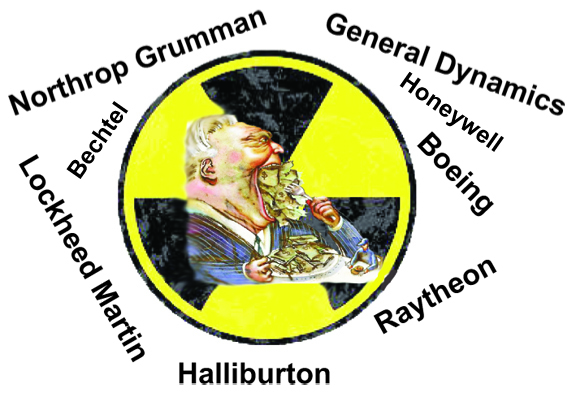
While the humanitarian consequences of US arms sales may be devastating, if you happen to be a major weapons maker like Lockheed Martin, Boeing, Raytheon, or General Dynamics, the economic benefits are enormous. Weapons systems built by those four companies alone have figured in more than half of the $100 billion-plus in major arms offers made since President Biden took office.
While those firms prefer to pose as passive beneficiaries of carefully considered government policies, they continue to work overtime to loosen restrictions on weapons exports and expand the number of countries eligible for such equipment and training. To that end, those four giant firms alone routinely donate millions of dollars to key members of Congress, while employing 300 lobbyists, many of them drawn from the ranks of the Pentagon, Congress, and the National Security Council. Once on board, those retired generals, admirals, and other officials use their government contacts and inside knowledge of the arm-sales process to influence government policies and practices.
A particularly egregious and visible example of this was Raytheon’s effort to pressure Congress and the Trump administration to approve a sale of precision-guided munitions to the Saudis. A former Raytheon lobbyist, Charles Faulkner, worked inside the State Department to keep the Saudi arms pipeline open despite that country’s bombing of civilian targets in Yemen, and then Raytheon’s former CEO, Thomas Kennedy, even went so far as to directly lobby Senate Foreign Relations chairman Senator Robert Menendez over Saudi arms sales. (He was rebuffed.) But the most spectacular lobbyist for the Saudis was, of course, President Trump, who justified continuing arms sales to Riyadh after the regime’s 2018 murder of US resident, Saudi journalist, and Washington Post columnist Jamal Khashoggi this way:
$110 billion will be spent on the purchase of military equipment from Boeing, Lockheed Martin, Raytheon, and many other great U.S. defense contractors. If we foolishly cancel these contracts, Russia and China would be the enormous beneficiaries—and very happy to acquire all this newfound business. It would be a wonderful gift to them directly from the United States!
In fact, neither Russia nor China would be able to replace the US as Saudi Arabia’s primary arms supplier any time soon. The kingdom is so reliant on American equipment that it might take a decade or more for it to rebuild its military around weapons supplied by another nation.
In reality, expansive as American arms sales to the Saudis are, that $110 billion figure was a typical case of Trumpian exaggeration. Actual sales during his term were less than one-third of that, and jobs tied to those sales in the US were similarly far less than President Trump claimed. The figure he liked to throw around— 500,000—was at least 12 times the actual one. Still, the damage done by the weaponry his administration rammed through Congress for the Saudis has been incalculable and can’t be measured by the dollar value of any particular sale.
The Raytheon lobbying campaign was extraordinary primarily because its details became public knowledge. But count on one thing: Similar efforts by other military-industrial corporations surely take place behind closed doors on a regular basis. One precondition for reducing dangerous arms deals would have to be reducing the political power of the major weapons-producing companies.
PUSHING BACK AGAINST AMERICA’S ARMS SALES ADDICTION
In 2019, spurred by Saudi actions ranging from the war in Yemen to the Khashoggi murder, both houses of Congress voted down a specific deal for the first time—$1.5 billion in precision-guided bombs for Saudi Arabia and other Middle Eastern clients—only to have their actions vetoed by President Trump. Successful votes to end military support or Saudi Arabia under the War Powers Resolution met a similar fate……………………………
Success in reining in Washington’s arms-sales addiction will, at the very least, require a major campaign of public education. Too few Americans even know about their nation’s role as the world’s largest weapons trader, much less the devastating impact of the arms it transfers. But when asked, a majority of Americans are against arming repressive regimes like Saudi Arabia and consider arms sales to be “a hazard to US security.”
Still, until there is greater public understanding of the humanitarian and security consequences of what the government is doing in our name, coupled with concerted pressure on the Biden administration, the national security state, and the weapons makers, the arms trade is likely to continue full speed ahead. If so, those companies will remain in weapons heaven, while so many people on this planet will find themselves in a hell on Earth https://www.thenation.com/article/world/arms-dealing-us-weapons-market/?utm_source=Sailthru&utm_medium=email&utm_campaign=Daily%2011.23.2022&utm_term=daily
The projected cost of new nuclear power has risen by fourfold since 2008 – and it is still rising
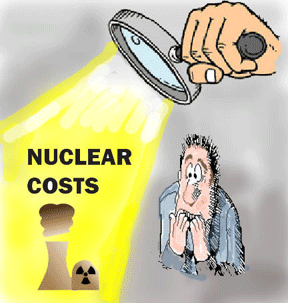
The projected cost of new nuclear power has risen by almost fourfold since
the UK Government made estimates in 2008, and the cost is still rising.
Nuclear analysts warn that the cost to consumers of funding Sizewell C
through the so-called ‘Regulatory Asset Base’ (RAB) model will be much
higher than has been projected by the Government.
In 2008 as the Government argued for more nuclear power stations to be built, the Government, in a
White Paper on nuclear costs, said that each 1.6 GWe EPR reactor would cost
around 2.8 billion. But the most recently released (by EDF) cost of the
Hinkley C EPR double reactor is £25.5 billion (in 2015 prices) and assumes
the plant will be completed by 2027.
This equates to £12.75 billion per
each 1.6 GWe reactor, as reported by World Nuclear News. This is nearly
four times the estimate made by the UK Government in 2008 after inflation
is taken into account.
100% Renewables 25th Nov 2022
Estonian public concerned about radioactive waste from planned nuclear power plant.
The handling of radioactive nuclear waste is one of the public’s biggest
concerns in discussions about potentially building a nuclear power plant in
Estonia, pollsters have found. In 2024, the government will make a decision
on whether or not to build a nuclear power plant in Estonia.
This will be based on a report currently being put together by the Ministry of
Environment. Surveys show nuclear energy is seen as an alternative to using
shale oil to create energy. But the public’s attitudes can be broadly split
into three groups: supporters, opponents and skeptics.
ERR 24th Nov 2022
World’s Biggest Nuclear-Fusion Project Faces Delays as Component Cracks.
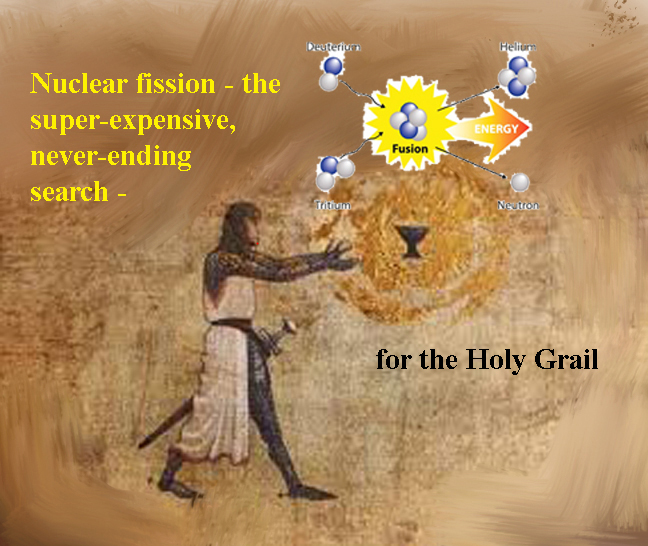
Cracks in a key silver-lined component are creating new delays and cost
overruns in the $23 billion project to prove whether nuclear fusion can
generate limitless clean energy.
The International Thermonuclear
Experimental Reactor, or ITER, under construction in southern France is
being funded by the European Union and countries including China, India,
Japan, Russia and South Korea. The world’s biggest experiment aims to show
that mimicking the power that makes stars shine can produce clean energy
that could help slow global warming on Earth.
But new ITER Director-General
Pietro Barabaschi warned members this week the project faces problems that
are potentially “extensive,” along with new requirements for time and
money that “will not be insignificant.”
Bloomberg 25th Nov 2022
UK government underestimated the cost to the public of Regulated Asset Base financing of nuclear power
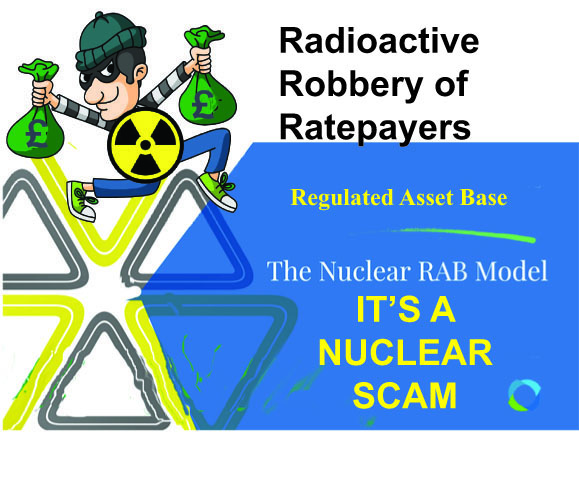
The government has been accused of under-estimating the cost to customers
of its new financing support mechanism for nuclear power, which could add
£100 onto annual bills if ex-prime minister Boris Johnson’s pledge to
roll out a new fleet of the plants is honoured.
At a meeting of the
All-Party Parliamentary Group on Energy Costs, held at the House of Commons
on Wednesday (23 November), University of Greenwich emeritus professor of
energy Steve Thomas criticised the use of the Regulated Asset Base (RAB)
for nuclear projects.
Utility Week 24th Nov 2022
1 This Month




Shut down the radiation-damaged Heysham nuclear reactors now
To see nuclear-related stories in greater depth and intensity – go to https://nuclearinformation.wordpress.com

Say No to NASA’s Reckless Nuclear Reactor on the Moon
Say No to NASA’s Reckless Nuclear Reactor on the Moon
-
Archives
- November 2026 (12)
- October 2026 (302)
- September 2026 (339)
- August 2026 (330)
- July 2026 (355)
- June 2026 (287)
- May 2026 (306)
- April 2026 (356)
- March 2026 (251)
- February 2026 (267)
- January 2026 (308)
- December 2025 (358)
-
Categories
- 1
- 1 NUCLEAR ISSUES
- business and costs
- climate change
- culture and arts
- ENERGY
- environment
- health
- history
- indigenous issues
- Legal
- marketing of nuclear
- media
- opposition to nuclear
- PERSONAL STORIES
- politics
- politics international
- Religion and ethics
- safety
- secrets,lies and civil liberties
- spinbuster
- technology
- Uranium
- wastes
- weapons and war
- Women
- 2 WORLD
- ACTION
- AFRICA
- Atrocities
- AUSTRALIA
- Christina's notes
- Christina's themes
- culture and arts
- Events
- Fuk 2022
- Fuk 2023
- Fukushima 2017
- Fukushima 2018
- fukushima 2019
- Fukushima 2020
- Fukushima 2021
- general
- global warming
- Humour (God we need it)
- Nuclear
- RARE EARTHS
- Reference
- resources – print
- Resources -audiovicual
- Weekly Newsletter
- World
- World Nuclear
- YouTube
-
RSS
Entries RSS
Comments RSS

