Pentagon can’t account for $220 billion in govt property, fails fifth audit
Pentagon can’t account for $220 billion in gov’t property, fails fifth audit | 18 Jan 2023 | A Tuesday report by the Government Accountability Office revealed that the Department of Defense failed its fifth audit in a row after it could not account for at least 220 billion in government-furnished property, the Daily Caller News Foundation reported.
The DOD has been mandated by federal law to complete audits since 1994; however, the mandate was ignored for decades due to the agency’s massive size, according to Military dot com. Since launching its first independent audit, in 2017 the Pentagon has never passed.
The Pentagon failed its fifth audit in November after the agency could not prove expenditures for 61% of its 3.5 trillion in assets. To perform this year’s overall audit of the DOD, which was expected to cost 218 million, the agency aggregated 27 separate audits conducted by approximately 1,600 auditors. According to Military.com, the auditors performed 220 in-person site visits and 750 virtual site visits.
MICAELA BURROW, January 17, 2023
he Department of Defense (DOD) has neglected to address its inability to keep track of at least 220 billion in equipment provided to government contractors, according to a Tuesday report by the Government Accountability Office (GAO).
Auditors first reported the Pentagon’s failure to account for government-owned equipment or material offered up for use to contracting agencies, also called government furnished property, in 2001, according to the report. DOD has made little improvement since then, increasing the risk that the Pentagon could accidentally overlook errors in the books.
“This long-standing issue affects the accounting and reporting of GFP and is one of the reasons DOD is unable to produce auditable financial statements,” GAO said. Of all the major federal agencies GAO is obligated to review, DOD is the only one unable to receive an opinion on its financial statements. https://dailycaller.com/2023/01/17/watchdog-pentagon-billions-equipment-contractors/
Germany Says US Must Lead Way On Tanks For Ukraine, As Republican Party Also Piles On Pressure
https://www.zerohedge.com/geopolitical/germany-says-us-must-lead-way-tanks-ukraine-gop-also-piles-pressureBY TYLER DURDEN, THURSDAY, JAN 19, 2023 –
Germany just upped the pressure on the Biden administration regarding growing calls to send Ukraine M1 Abrams tanks, which the White House has thus far resisted, fearing further escalation with Russia.
It comes as Germany just appointed a new defense minister, Boris Pistorius, after scandal-plagued Christine Lambrecht resigned the day prior, after also long being accused of representing weakness on arming Ukraine. The Scholz government said it will be up for the new defense minister to mull the question of tanks for Ukraine, as Kiev’s pleas grow louder.
“Germany won’t allow allies to ship German-made tanks to Ukraine to help its defense against Russia nor send its own systems unless the U.S. agrees to send American-made battle tanks, senior German officials said on Wednesday,” according to fresh Wall Street Journal reporting.
The timing of the WSJ’s German tank story is interesting, also given the same day top Republican committee chairs in Congress are ramping up the pressure on Biden, demanding that the US approve what are widely seen as ‘weapons needed to win’ against Russia.
Leopard 2 tanks, ATACMS, and other long-range precision munitions should be approved without delay,” House Foreign Affairs Committee Chairman Michael McCaul and House Armed Services Committee Chairman Mike Rogers said in a statement reported by Bloomberg. The pair of lawmakers at the same time criticized the “current indecision and self-deterrence” which they say will only prolong the conflict.
But Germany’s Scholz has consistently expressed a desire to avoid potential direct military escalation with Russia at all costs. Approving tanks would likely plunge Germany deeper in right alongside the US as things continue sliding toward direct confrontation.
Meanwhile, sabotage from Scholz?…
Suffolk: Sizewell C ‘should not get licence’ due to erosion
Campaigners opposed to the new Sizewell C nuclear power station have
written to a nuclear industry regulator calling for it to reject the new
plant due to coastal erosion.
Together Against Sizewell C (TASC) has sent a
letter to the Office for Nuclear Regulation calling for Sizewell C’s
nuclear operating licence to be ruled out after photos emerged showing the
extent of coastal erosion near to where the new facility will be sited,
raising safety concerns.
Pete Wilkinson, from TASC, said: “This
generation’s inactivity on climate change has already compromised future
generations. To proceed with Sizewell C while being fully aware that it is
highly vulnerable to sea level rise, storm surges and flooding, only adds
to the inter-generational burden we pass on.” However, a spokesperson for
Sizewell C said: “The design of the power station, including its sea
defence and the raised platform it will be built on, will protect Sizewell
C from flooding. “Our plans take account of the effect of climate change
and the predicted rise in sea levels over the coming decades.”
East Anglian Daily Times 18th Jan 2023
https://www.eadt.co.uk/news/23257671.suffolk-sizewell-c-should-not-get-licence-due-erosion/
“Great British Nuclear “- it’s high time that they came clean on what this will cost.

Bowen is right to think Britain’s nuclear plans will require “substantial” taxpayer support.
It’s high time the government spelt out how much financial fuel it’s willing to burn.
Maybe Great British Nuclear will prove as successful as Great British
Railways: another government invention still stuck in the sidings while the
strike-bound network grinds to a halt.

But at least Simon Bowen is after an
improvement on that. Who he? The industry adviser picked by ministers to
make their nuclear nirvana a reality. He’s setting up GBN, the “flagship
body” to corral the construction of up to 24 gigawatts of new capacity by
2050: a shopping list, he says, that will involve at least three more
mega-nukes on top of Hinkley Point C, plus a litter of small modular
reactors.
As he told MPs on the science committee, the new body will be the
“glue within the industry to drive the nuclear programme”. Always
assuming it gets set up, of course — because you can already sense
Bowen’s frustration with the government.
In a post-Ukraine war push for
energy security, it was Boris Johnson who declared that Britain should
“go nuclear and go large”, not that he spelt out the eye-popping costs
to the taxpayer. But Bowen’s report into how the new body should work,
complete with 25 recommendations, has since been passed from Liz Truss to
Rishi Sunak and deemed top secret.
To boot, from the latest PM he sees no
“overarching strategy” on what’s needed for energy security: the
“quantum of nuclear” or other technologies. That’s crucial because
“the investment required in nuclear is substantial”, he says, with the
same stuff underpinning successful international projects: “A substantial
amount of government leadership and fiscal support, not just in terms of
financing but who bears the risk.”
No private financier can see how
Sizewell gets built without the government injecting £5 billion-plus equity
and insulating investors from most construction risk. Build three big nukes
and you treble that problem before taking on small modular reactors — an
untried technology to which Rolls-Royce’s new boss, Tufan Erginbilgic,
seems disinclined to bring blue-sky finance. Add it up and Bowen is right
to think Britain’s nuclear plans will require “substantial” taxpayer
support. It’s high time the government spelt out how much financial fuel
it’s willing to burn.
Times 19th Jan 2023
https://www.thetimes.co.uk/article/great-british-nuclear-puts-treasury-on-alert-jjt987rlr
U.S. approves design for NuScale small modular nuclear reactor, but significant problems remain.

By Timothy Gardner WASHINGTON, Jan 20 (Reuters) – The U.S. nuclear power regulator has certified the design for the NuScale Power Corp’s (SMR.N) small modular reactor, the first such approval in the country for the next generation technology.
The Nuclear Regulatory Commission’s approval, published in the Federal Register late on Thursday, clears a hurdle for NuScale. The company plans to build a demonstration small modular reactor (SMR) power plant at the Idaho National Laboratory. NuScale says the six-reactor, 462 megawatt Carbon Free Power Project will be fully running in 2030.
There are significant questions about rising costs of the demonstration plant, expected to provide electricity to the Utah Associated Municipal Power Systems (UAMPS). NuScale said this month the target price for power from the plant is $89 per megawatt hour, up 53% from the previous estimate of $58 per MWh.
Backers of next generation reactors including President Joe Biden’s administration and many Republican lawmakers, say they are crucial in curbing climate change. NuScale says they will be safer than today’s far larger conventional reactors, but the reactors, like conventional nuclear plants, are expected to produce highly toxic waste, for which no permanent fix has been developed.
The U.S. Department of Energy has provided more than $600 million since 2014 to support the design, licensing and siting of NuScale’s power plant and other small modular reactors. NuScale and other companies that succeed in building next generation reactors could receive for the first time lucrative production tax credits contained in last year’s Inflation Reduction Act signed by Biden……………..
NuScale also hopes to build SMRs in Romania, Kazakhstan and Poland, despite concerns from nuclear safety experts who say Russia’s invasion of Ukraine and occupation of the Zaporizhzhia plant should make the industry think seriously about developing plants in the region. https://www.reuters.com/business/energy/us-approves-design-nuscale-small-modular-nuclear-reactor-2023-01-20/
Call to end practice of transporting nuclear warheads through Cumbria
A CAMPAIGN group have called for an immediate end to the practice of
transporting nuclear warheads by lorry along motorways and roads in Cumbria
and elsewhere. Their renewed call comes in response to news that the
Ministry of Defence has admitted that 40 safety incidents involving convoys
transporting nuclear warheads were logged during 2019, 2020 and 2021,
following a freedom of information request.
Carlisle News & Star 18th Jan 2023
https://www.newsandstar.co.uk/news/23256357.call-end-practice-transporting-nuclear-warheads-cumbria/
Many years for removal and disposal of radioactive waste from historic subterranean vaults at Berkeley nuclear power station.
Work is underway to remove intermediate level radioactive waste (ILW) from
historic subterranean vaults at Berkeley nuclear power station. The removal
and transfer of this ILW into newly designed concrete boxes before moving
it into an interim on-site storage facility is a milestone step in the
decommissioning of the site.
This is part of Magnox’s strategy for dealing
with legacy waste in a consistent and cost-effective manner across its
different sites. The first concrete box of radioactive waste has now been
filled and safely stored at the Gloucestershire site, pending long-term
disposal in a future Geological Disposal Facility (GDF).
It is expected to take between four and five years to remove the full inventory of waste from
the vaults at Berkeley. ONR has maintained regulatory oversight throughout
the planning phase and will continue to do as the retrieval phases
progress.
ONR 17th January 2023
Righting shoddy nuclear waste storage site to cost Japan 36 bil. yen (280 million US$)

File photo taken in October 2021 shows the Japan Atomic Energy Agency’s Tokai Reprocessing Plant in Tokai, Ibaraki Prefecture, eastern Japan
Jan 15, 2023
The Japan Atomic Energy Agency estimates that it will cost taxpayers 36.1 billion yen ($280 million) to rectify the shoddy storage of radioactive waste in a storage pool at the Tokai Reprocessing Plant, the nation’s first facility for reprocessing spent nuclear fuel, an official said Sunday.
Around 800 containers of transuranic radioactive waste, or “TRU waste,” were dropped into the pool from 1977 to 1991 using a wire in the now-disused plant in Tokai, a village in Ibaraki Prefecture northeast of Tokyo. They emit high levels of radiation.
The waste includes pieces of metal cladding tubes that contained spent nuclear fuel, generated during the reprocessing process. The containers are ultimately supposed to be buried more than 300 meters below surface.
The agency has estimated that 19.1 billion yen will be needed to build a new storage facility for the containers, and 17 billion yen for a building that will cover the storage pool and the crane equipment to grab containers.
The 794 containers each are about 80 centimeters in diameter, 90 cm tall and weigh about 1 ton, with many lying on their sides or overturned in the pool. Some have had their shape altered by the impact of being dropped.
The containers were found stored in the improper manner in the 1990s. While the agency said the storage is secure from earthquakes and tsunamis, it has nonetheless decided to improve the situation.
The extractions have been delayed by about 10 years from the original plan and are expected to begin in the mid-2030s.
The Tokai Reprocessing Plant was the nation’s first plant that reprocessed spent fuel from nuclear reactors to recover uranium and plutonium. Between 1977 and 2007, about 1,140 tons of fuel were reprocessed. The plant’s dismantlement was decided in 2014 and is expected to take about 70 years at a cost of 1 trillion yen.
Japan, US to team up on next-generation nuclear reactors

Jan. 10, 2023
Japan and the United States have agreed to start work on developing next-generation nuclear reactors as part of joint efforts to strengthen energy security and promote decarbonization.
Japan’s Industry Minister Nishimura Yasutoshi met US Energy Secretary Jennifer Granholm in Washington on Monday.
Nishimura said, “With this agreement, the two countries will explore opportunities for cooperation in the development and construction of next-generation reactors, making the most of existing reactors, and building strong supply chains.”
The two sides said in a joint statement their efforts will include building advanced light water reactors.
They also agreed to try to maximize the use of existing reactors, and establish robust supply chains for uranium fuel and nuclear components.
Japan approved a new policy on nuclear power in December. It includes the development of next-generation reactors to replace decommissioned ones.
Credible nuclear regulation needs independence, transparency
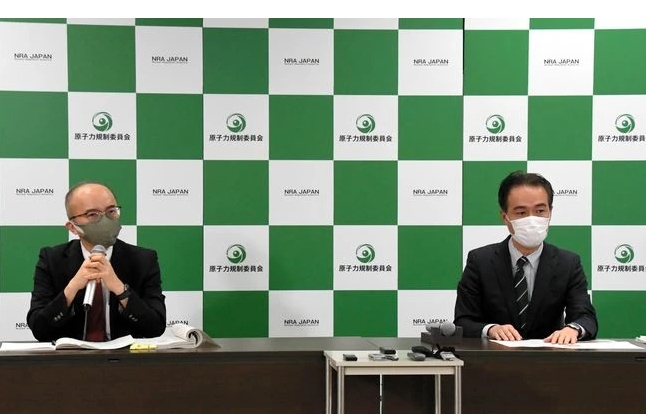
Officials of the Secretariat of the Nuclear Regulation Authority meet reporters in Tokyo on Dec. 27 to explain about closed-door meetings of the secretariat and the Agency for Natural Resources and Energy regarding extending the life span of aging nuclear reactors.
January 6, 2023
Nuclear regulation should place importance on “independent decision-making” and “ensure total disclosure of information,” including facts concerning the decision-making process.
This principle was established in line with the bitter lessons learned from the dreadful calamity that occurred at the Fukushima No. 1 nuclear power plant in 2011. The pledge must not be taken lightly.
Recent revelations have raised serious questions about the nuclear regulator’s commitment to the principle.
The Secretariat of the Nuclear Regulation Authority (NRA) held seven closed-door meetings with the Agency for Natural Resources and Energy, an agency under the Ministry of Economy, Trade and Industry (METI), over Prime Minister Fumio Kishida’s initiative to extend the life span of aging nuclear reactors.
The two organizations also held dozens of telephone conversations over the matter.
After the Fukushima disaster, the jurisdiction of regulating nuclear power generation was transferred from the pro-industry METI to the newly created Nuclear Regulation Authority. The NRA is an external organ of the Environment Ministry.
In early October, the NRA instructed its secretariat to review regulations related to the proposal to extend the legal life of reactors. But the secretariat and the agency had begun holding talks over the matter at the end of July. The secretariat did not report these early meetings to the NRA or keep records of the sessions.
When these facts came to light in December, the secretariat categorically denied discussing, coordinating or adjusting nuclear safety regulations during these talks. It contended there was no problem with the “independence and transparency” of the NRA.
During these meetings, however, the energy agency told the NRA secretariat that revisions to laws including those under the NRA jurisdiction were being considered. The secretariat called for the deletion of certain provisions concerning nuclear safety regulations from the envisioned bill while beginning to consider its own bill.
It is difficult to believe that these meetings were not for advance policy coordination or discussions.
Generally speaking, exchanges of information between government organizations are necessary for smooth administrative functioning. But the NRA was separated from the METI, the leading champion of nuclear power generation, to ensure its independence.
It should not be viewed or treated similarly to other ministries and agencies.
NRA Chairman Shinsuke Yamanaka has argued that there is nothing wrong with staff members of the secretariat discussing related issues since the final decisions are made by the NRA.
But the NRA’s code of conduct, which stresses the importance of independence and transparency, states that the NRA performs its duties “together with” the NRA secretariat. The principle should also be applied to the secretariat.
The NRA’s failure to keep track of what was going on within the secretariat raises questions about its governance.
Especially serious is the secretariat’s disregard for the importance of information disclosure, which is vital for assessing and securing the independence of nuclear regulation.
The secretariat has said meetings and discussions with other ministries and agencies are not subject to the rules concerning record-keeping. But the NRA has told the secretariat to keep records of future meetings with other government departments related to nuclear power generation and make public the records.
But telephone conversations will not be covered by this rule. Is this sufficiently effective?
The top three positions at the NRA secretariat have been held by former METI officials since last summer. The NRA’s responses to the proposal to extend the life span of reactors since October have been criticized as “premature” actions even by some NRA members.
If the NRA fails to forthrightly address the suspicions raised by the latest revelations, the credibility of nuclear regulation will be undermined. The NRA should undertake a serious probe into what transpired and publish the findings.
Slovenia’s nuclear power plant gets permit for a 20 year operating extension
nsion
Krško nuclear power plant has obtained an environmental permit for its
lifetime extension from 40 to 60 years. The only NPP in Slovenia will be so
able to operate until 2043.
European Nuclear Society 17th Jan 2023
France’s nuclear waste agency applies to create a long-term underground storage in Eastern France.
France’s national agency for managing nuclear waste has applied to the
ministry of ecological transition for the creation of a project for the
long-term storage of high-level radioactive waste, the agency said on
Tuesday. The application, which was filed on Monday, represents a new phase
in which French authorities will examine the plan for safety to ensure it
guards against radioactive leaks.
The project, called Cigéo, calls for the
waste to be stored 500 metres below ground in the Callovo-Oxfordian clay
formation in eastern France. Currently the waste is temporarily stored on
the surface, the agency said. Construction could begin as soon as 2027 if
the French nuclear safety authority approves the application. Authorisation
for an industrial pilot phase to store some waste could come from 2035 to
2040, with full operational approval between 2040 and 2050, the agency
said. Finland, Sweden, Switzerland, Belgium and the Netherlands are also
examining the construction of long-term high-level radioactive waste
storage sites.
Reuters 17th Jan 2023
France’s new law on nuclear energy will be a gift to the nuclear lobby.
The new nuclear law, under debate in the Senate, is a gift offered to the atom lobby. And the majority on the right could further strengthen it. The public debate on the creation of new EPR2 nuclear reactors is not yet over and the government already wants to speed up their construction.
OnTuesday, January 17, his bill for an “ambitious and sustainable” nuclear revival will be presented to the Senate. The text proposes various technical measures to simplify the development of EPR2s . But above all, it sends a political signal: the government is in working order to advance its cause. Even if it means radically changing the deadlines for administrative authorizations, the legal procedures and the frameworks of environmental democracy.
When presenting her bill to the Economic Affairs Committee , Agnès Pannier-Runacher first began by apologizing. “I’m sorry, it’s a horribly technical text… But the modalities for reviving nuclear power
will go through unattractive considerations , ” she continued. For her, the current difficulties of nuclear power – its slowness and its high cost – would be, above all, linked to bureaucratic and normative heavinesses that it would be a question of doing away with.
“It’s important that the cost of this new program be competitive, which is much easier said than done ,” she
said. Renewable energies have an exit cost of 60 to 80 euros (MWh) and this is the price level that should be had for nuclear power.
Reporterre 17th Jan 2023 https://reporterre.net/Tapis-rouge-pour-le-nucleaire-au-Senat
The British government’s Regulated Asset Base – the test case for reviving its nuclear power dream
After years of false dawns, can Britain realise its nuclear ambitions? FT, 19 Jan 23 “…………………………………………………………………………………. Nuclear test case
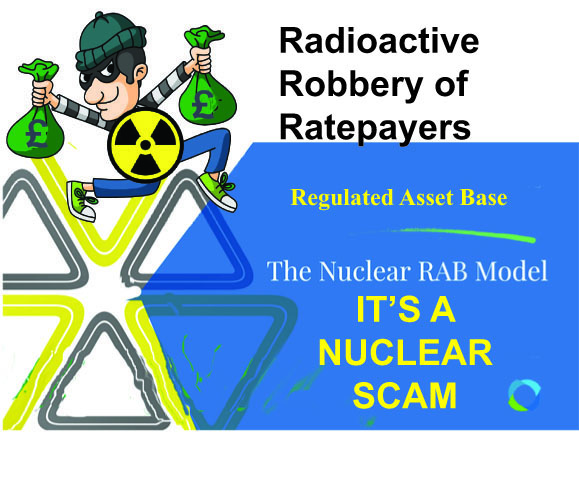
Fresh hopes of encouraging the development of a new fleet of nuclear reactors — both large and small — now rest on a complex hybrid public-private partnership financing model known as the Regulated Asset Base. Already used for other infrastructure projects such as energy networks and airport terminals, RAB promises potential investors an “allowed revenue” — overseen by a regulator — from the start of construction, funded via a surcharge on consumer energy bills.
Supporters of the model, such as EDF, argue it significantly cuts the cost of financing because it lowers the interest that builds up during the construction phase and reduces the amount of compounded debt that needs to be serviced and paid off during the station’s lifespan. Financing costs account for roughly two-thirds of the overall cost of a nuclear plant. The allowed revenue payments continue after the plant is operational. Rather than paying a price for every unit of electricity produced, the model essentially pays for new nuclear power stations to be available.
But the RAB model is also divisive. Critics argue it would saddle bill payers with high additional costs if projects run over time and over budget.
The UK government intends for that risk to be shared between the project’s owners and consumers, according to people familiar with the discussions, although it is yet to reveal how that would work in the case of Sizewell C, which is unlikely to be connected to the electricity grid before the 2030s.
“If the cost of overruns and delays cannot just be lumped on to consumers, I think it would be implausible any investor would look at the deal,” says Steve Thomas, emeritus professor of energy policy at the University of Greenwich. “How would you feel if your pension fund was taking the risk of a nuclear project not being built to time and cost?”
For long-running nuclear sceptics, the latest attempt at ushering in a new civil nuclear golden age in Britain risks diverting attention and investment away from other technologies, such as wind, solar and storage, which could be delivered sooner to achieve the country’s near-term emissions targets.
The UK government is working towards a fivefold increase in offshore wind to 50GW by 2030 — which it claims would be enough to “power every home” — and to raise solar deployment to 70GW from 14GW by 2035. Renewables supporters claim these could still meet a lot of demand even on calmer, less bright days.
“If you want to hit your 2035 target and Sizewell C is not going to get you there [in time] then you have got to do something else . . . so why do Sizewell C as well if you are going to get there without it?” says Alison Downes, a former head of direct actions at Greenpeace UK who is now spearheading a campaign to stop Sizewell C being built.
Among longstanding nuclear proponents, there are still nerves about whether Britain’s latest attempt to revive an industry will come to fruition, even if they feel the politics are now on their side.
If a final investment decision is taken by the end of 2024 as hoped, Sizewell C will be the first test of the financing model for nuclear projects and only the second nuclear power station to enter construction since 1995, when the last of the current fleet opened. The other, Hinkley Point C, began construction in 2016 but is running over-time and over-budget. It is not currently envisaged to generate any electricity before mid-2027.
Nuclear industry executives have also been pushing ministers to confirm a new nuclear reactor construction programme beyond Sizewell C as part of GBN’s launch.
This should, in the short-term, include a commitment to take final investment decisions on two further nuclear projects in the next parliament.
But to get to that stage and avoid adding to the roster of failed nuclear projects, the impasse within government must first be resolved.
Graham Stuart, energy and climate minister at the BEIS, alluded on Wednesday to the tussle between departments, saying a date for the launch of GBN would be set once it had “a resolved and finalised agreement with His Majesty’s Treasury”.
A government insider confirmed the rollout was being held up by chancellor Jeremy Hunt who “wants to do due diligence on GBN before approving it”.
“Is there haggling over money?” the person says. “There always is.” https://www.ft.com/content/c4c481d3-99e0-4c2f-8d4e-96b4c9a3bd59
IAEA sends staff to all Ukraine nuclear plants to reduce risk of accidents
PBS NewsHour, Jan 18, 2023
KYIV, Ukraine (AP) — The International Atomic Energy Agency is placing teams of experts at all four of Ukraine’s nuclear power plants to reduce the risk of severe accidents as Russia’s war against the country rages on, agency head Rafael Grossi said Wednesday.
The IAEA, which is affiliated with the United Nations, already has a permanent presence at Ukraine’s — and Europe’s — largest nuclear plant in Zaporizhzhia that is held by Russian forces.
The IAEA’s permanent presence at all of Ukraine’s nuclear facilities, with at least 11 staff in total, marks an unprecedented expansion for the agency. IAEA technicians will also be at Chernobyl, the now-closed nuclear plant that was the site of a deadly nuclear accident in 1986 that spread fallout over much of Europe…………………………………. more https://www.pbs.org/newshour/world/iaea-sends-staff-to-all-ukraine-nuclear-plants-to-reduce-risk-of-accidents
1 This Month
Tell Congress: Prevent Nuclear Catastrophe in Iran

Tell Congress: Prevent Nuclear Catastrophe in Iran

Read the Public Inquiry Report, the Commissioners’ report, Surrendering Australia: The AUKUS Deception is available to download for free at aukuspublicinquiry.com. Or just watch the replay of the National Press Club Luncheon.


Shut down the radiation-damaged Heysham nuclear reactors now
To see nuclear-related stories in greater depth and intensity – go to https://nuclearinformation.wordpress.com

Say No to NASA’s Reckless Nuclear Reactor on the Moon
Say No to NASA’s Reckless Nuclear Reactor on the Moon
-
Archives
- November 2026 (238)
- October 2026 (302)
- September 2026 (339)
- August 2026 (330)
- July 2026 (355)
- June 2026 (287)
- May 2026 (306)
- April 2026 (356)
- March 2026 (251)
- February 2026 (267)
- January 2026 (308)
- December 2025 (358)
-
Categories
- 1
- 1 NUCLEAR ISSUES
- business and costs
- climate change
- culture and arts
- ENERGY
- environment
- health
- history
- indigenous issues
- Legal
- marketing of nuclear
- media
- opposition to nuclear
- PERSONAL STORIES
- politics
- politics international
- Religion and ethics
- safety
- secrets,lies and civil liberties
- spinbuster
- technology
- Uranium
- wastes
- weapons and war
- Women
- 2 WORLD
- ACTION
- AFRICA
- Atrocities
- AUSTRALIA
- Christina's notes
- Christina's themes
- culture and arts
- Events
- Fuk 2022
- Fuk 2023
- Fukushima 2017
- Fukushima 2018
- fukushima 2019
- Fukushima 2020
- Fukushima 2021
- general
- global warming
- Humour (God we need it)
- Nuclear
- RARE EARTHS
- Reference
- resources – print
- Resources -audiovicual
- Weekly Newsletter
- World
- World Nuclear
- YouTube
-
RSS
Entries RSS
Comments RSS

