Rolls Royce marketing its mini nuclear reactors to Sweden, Finland, Czech Republic, but deals could collapse

Rolls-Royce could build mini-nuclear reactors in Sweden and Finland under
plans being explored by Helsinki’s national energy company. Finnish
government-owned utility Fortnum has signed an early stage deal with
Rolls-Royce’s nuclear power business to explore uses of its small modular
reactors (SMRs) in the two Nordic countries. Shares in Rolls-Royce jumped
over 6pc in London on the news, amid a broader market rally.
The early stage deal comes as Rolls-Royce awaits a UK government decision on whether
to buy the reactors, which are smaller and cheaper than full scale plants.
Rolls-Royce’s 470MW units cost £1.8bn each. As well as the Finns, the
Czech government is also considering purchasing the technology as part of
efforts to decarbonise energy systems. Despite international interest,
Rolls-Royce has warned that deals may collapse unless Britain signals it
backs the technology by placing its own orders.
Telegraph 21st March 2023
Mini nuclear reactors all the rage, but are they the answer?

Mini nuclear reactors have appeared on the scene as an exciting prospect since the
spring budget, but how do they weigh up to traditional plants?
London-based start-up Newcleo laid out plans over the weekend to raise £900mln to build
small reactors in the UK on the back of the news. US-based developer Last
Energy then announced it had signed a deal to sell 24 of its mini nuclear
plants to UK customers on Monday, with these set to cost just £100mln
each.
Rolls-Royce Holdings PLC, a key player in the industry and the only
firm with SMR tech currently going through the UK’s regulatory process,
said it welcomed the government’s new stance, meanwhile.
What it may not
welcome is heated-up competition, though, with Newcleo among six rival
firms which have already applied to enter the UK’s stringent SMR design
assessment process, and the announcement likely to prompt more –
including Last Energy. Cavendish Nuclear/X-Energy, GE-Hitachi Nuclear
Energy, GMET Nuclear, Holtec Britain, UK Atomics, mark the others which
have submitted applications for their tech, though none are set to match
the size and output of Rolls-Royce’s.
Proactive Investors 21st March 2023
World on ‘thin ice’ as UN climate report gives stark warning
By Associated Press, CNN Mar 21, 2023, https://www.9news.com.au/world/climate-change-ipcc-report-antonio-guterres-says-world-on-thin-ice-as-un-climate-report-gives-stark-warning/fd6c84d9-6139-40a9-a971-866da5233ca1—
Humanity still has a chance, close to the last one, to prevent the worst of climate change‘s future harms, a top United Nations panel of scientists says.
But doing so requires quickly slashing carbon pollution and fossil fuel use by nearly two-thirds by 2035, the Intergovernmental Panel on Climate Change said.
The United Nations chief said it more bluntly, calling for an end to new fossil fuel exploration and rich countries quitting coal, oil and gas by 2040.
“Humanity is on thin ice — and that ice is melting fast,” United Nations Secretary-General Antonio Guterres said.
“Our world needs climate action on all fronts — everything, everywhere, all at once.”
Stepping up his pleas for action on fossil fuels, Guterres not only called for “no new coal” but also for eliminating its use in rich countries by 2030 and poor countries by 2040.
He urged carbon-free electricity generation in the developed world by 2035, meaning no gas-fired power plants too.
That date is key because nations soon have to come up with goals for pollution reduction by 2035, according to the Paris climate agreement.
“The climate time-bomb is ticking,” Guterres said, describing the IPCC report as a “a how-to guide to defuse” it.
The report draws on the findings of hundreds of scientists to provide a comprehensive assessment of how the climate crisis is unfolding.
After contentious debate, the UN science panel calculated and reported that to stay under the warming limit set in Paris the world needs to cut 60 per cent of its greenhouse gas emissions by 2035, compared with 2019, adding a new target not previously mentioned in the six reports issued since 2018.
“The choices and actions implemented in this decade will have impacts for thousands of years,” the report, said calling climate change “a threat to human well-being and planetary health”.
“We are not on the right track but it’s not too late,” said report co-author and water scientist Aditi Mukherji.
“Our intention is really a message of hope, and not that of doomsday.”
With the world only a few tenths of a degree away from the globally accepted goal of limiting warming to 1.5 degrees since pre-industrial times, scientists stressed a sense of urgency. The goal was adopted as part of the 2015 Paris climate agreement and the world has already warmed 1.1 degrees.
This is likely the last warning the Nobel Peace Prize-winning collection of scientists will be able to make about the 1.5 mark because their next set of reports will likely come after Earth has either breached the mark or locked into exceeding it soon, several scientists, including report authors, told The Associated Press.
‘We are pretty much locked into 1.5’
After 1.5 degrees “the risks are starting to pile on,” said report co-author Francis X Johnson, a climate, land and policy scientist at the Stockholm Environment Institute.
The report mentions “tipping points” around that temperature of species extinction, including coral reefs, irreversible melting of ice sheets and sea level rise on the order of several metres.
“The window is closing if emissions are not reduced as quickly as possible,” Johnson said in an interview.
“Scientists are rather alarmed.”
“1.5 is a critical critical limit, particularly for small islands and mountain (communities) which depend on glaciers,” said Mukherji, who’s also the climate change impact platform director at the research institute CGIAR.
Many scientists, including at least three co-authors, said hitting 1.5 degrees is inevitable.
“We are pretty much locked into 1.5,” said report co-author Malte Meinshausen, a climate scientist at the University of Melbourne in Australia.
“There’s very little way we will be able to avoid crossing 1.5 C sometime in the 2030s” but the big issue is whether the temperature keeps rising from there or stabilises.
Guterres insisted “the 1.5-degree limit is achievable”. Science panel chief Hoesung Lee said so far the world is far off course
“This report confirms that if the current trends, current patterns of consumption and production continues, then … the global average 1.5 degrees temperature increase will be seen sometime in this decade,” Lee said.
Scientists emphasise that the world, civilisation or humanity won’t end if and when Earth hits and passes the 1.5 degree mark. Mukherji said “it’s not as if it’s a cliff that we all fall off”. But an earlier IPCC report detailed how the harms – from coral reef extinction to Arctic sea ice absent summers to even nastier extreme weather – are much worse beyond 1.5 degrees of warming.
“It is certainly prudent to be planning for a future that’s warmer than 1.5 degrees,” said IPCC report review editor Steven Rose, an economist at the Electric Power Research Institute in the United States.
Threats from fossil fuels
If the world continues to use all the fossil fuel-powered infrastructure either existing now or proposed Earth will warm at least 2 degrees Celsius since pre-industrial times, blowing past the 1.5 mark, the report said.
Because the report is based on data from a few years ago, the calculations about fossil fuel projects already in the pipeline do not include the increase in coal and natural gas use after Russia’s invasion of Ukraine, said report co-author Dipak Dasgupta, a climate economist at The Energy and Resources Institute in India.
The report comes a week after the Biden Administration in the United States approved the huge Willow oil-drilling project in Alaska, which could produce up to 180,000 barrels of oil a day.
The rich vs poor divide
The report and the underlying discussions also touch on the disparity between rich nations, which caused much of the problem because carbon dioxide emissions from industrialisation stay in the air for more than a century, and poorer countries that get hit harder by extreme weather.
If the world is to achieve its climate goals, poorer countries need a “many-fold” increase in financial help to adapt to a warmer world and switch to non-polluting energy. Countries have made financial pledges and promises of a damage compensation fund.
If rich countries don’t cut emissions quicker and better help victim nations adapt to future harms, “the world is relegating the least developed countries to poverty”, said Madeline Diouf Sarr, chair of a coalition of the poorest nations.
Despite the risk, ‘a message of hope’
The report offers hope if action is taken, using the word “opportunity” nine times in a 27-page summary. Though opportunity is overshadowed by 94 uses of the word “risk.”
The head of the IPCC said the report contains “a message of hope in addition to those various scientific findings about the tremendous damages and also the losses that climate change has imposed on us and on the planet”.
“There is a pathway that we can resolve these problems, and this report provides a comprehensive overview of what actions we can take to lead us into a much better, liveable future,” Lee told The Associated Press.
Lee was at pains to stress that it’s not the panel’s job to tell countries what they should or shouldn’t do to cap global temperature rise at 1.5 Celsius.
“It’s up to each government to find the best solution,” he said, adding that scientists hope those solutions will stabilise the globe’s temperature around 1.5 degrees.
Asked whether this would be the last report to describe ways in which 1.5 degrees can be achieved, Lee said it was impossible to predict what advances might be made that could keep that target alive.
“The possibility is still there,” he said.
“It depends upon, again I want to emphasise that, the political will to achieve that goal.”
Activists also found grains of hope in the reports.
“The findings of these reports can make us feel disheartened about the slow pace of emissions reductions, the limited transition to renewable energy and the growing, daily impact of the climate crisis on children,” said youth climate activist Vanessa Nakate, a goodwill ambassador for UNICEF.
“But those children need us to read this report and take action, not lose hope.”
Climate News. What is the IPCC AR6 synthesis report and why does it matter?

The fourth and final instalment of the sixth assessment report (AR6) by the
Intergovernmental Panel on Climate Change, the body of the world’s leading
climate scientists, is the synthesis report, so called because it draws
together the key findings of the preceding three main sections.
Together, they make a comprehensive review of global knowledge of the climate. The
first three sections covered the physical science of the climate crisis,
including observations and projections of global heating, the impacts of
the climate crisis and how to adapt to them, and ways of reducing
greenhouse gas emissions. They were published in August 2021, February and
April 2022 respectively.
The synthesis report also includes three other
shorter IPCC reports published since 2018, on the impacts of global heating
of more than 1.5C above pre-industrial levels, climate change and land, and
climate change and the oceans and cryosphere (the ice caps and glaciers).
Guardian 19th March 2023
Samoa’s desperate plea for world climate action

Samoa PM urges world to save Pacific people from climate crisis
obliteration. The world must step back from the brink of climate disaster
to save the people of the Pacific from obliteration, the prime minister of
Samoa has urged.
On the eve of a landmark report by the Intergovernmental
Panel on Climate Change, which is expected to deliver a scientific “final
warning” on the climate emergency, Fiame Naomi Mata’afa, Samoa’s prime
minister, issued a desperate plea for action. “We’re all impacted, but
the degree of the impact is in the particular circumstance of countries. So
our low-lying atoll countries, it’s right there, we’re living with it,”
said Mata’afa. “There are already examples in the Pacific of communities,
whole communities, that have relocated to different countries,” she said.
“They’re really having to address issues of sovereignty through loss of
land.”
Guardian 19th March 2023
Thorium fake charity group cons El Salvador into joining the “Nuclear Power Club”.

Power, 20 Mar 23,
“…… the government of El Salvador and the Thorium Energy Alliance, a Harvard, Illinois–based non-profit advocacy group that endorses thorium-fueled reactors, signed a memorandum of understanding (MOU) to promote the “El Salvador Energy Bridge” plan. The MOU was signed by Daniel Alvarez, El Salvador’s director general of Energy, Hydrocarbons, and Mines (DGEHM), and John Kutsch, executive director of the Thorium Energy Alliance, at the Embassy of El Salvador in Washington, D.C. (Figure 1), with Ambassador Milena Mayorga present to witness the event.
El Salvador has historically gotten much of its power from hydro and geothermal resources, according to International Energy Agency (IEA) data. In 2020, the most recent numbers available on the IEA’s website, hydropower accounted for about 32.8% of the electricity generation in El Salvador. Geothermal was second, supplying 24.6% of the mix, while oil (15.5%), solar PV (14.3%), and biofuels (12.9%) rounded out the list. El Salvador’s total generation in 2020 was about 6.321 TWh………………..”
South Korea coming for a slice of Africa’s emerging nuclear power market
As African countries firm up their nuclear power ambitions, South Korea’s Korea Hydro & Nuclear Power (KHNP), a subsidiary of state-owned Korea Electric Power Corporation is coming for a share of the continent’s emerging market.…… (Subscribers only) https://www.theafricareport.com/293984/south-korea-coming-for-a-slice-of-africas-emerging-nuclear-power-market/
Just another U.S. nuclear front group, marketing to Indonesia (never mind about the volcanoes)

USA, Indonesia announce partnership on SMRs
WNN, 20 March 2023
The USA and Indonesia have announced a strategic partnership to help Indonesia develop its nuclear energy programme, supporting Indonesia’s interest in deploying small modular reactor (SMR) technology to meet its energy security and climate goals.
A Memorandum of Agreement, as well as affiliated grants and contracts, was signed during the Indo-Pacific Business Dialogue in Bali, Indonesia. The agreement advances the goals of the Just Energy Transition Partnership (JETP) and will strengthen Indonesia’s leadership in the ASEAN region on the deployment of advanced, safe and secure nuclear energy technologies, working toward the goal of net-zero emissions in Indonesia by 2060.
Under the agreement, the US Trade and Development Agency (USTDA) has awarded a grant to PLN Indonesia Power to provide assistance to assess the technical and economic viability of a proposed nuclear power plant, to be located in West Kalimantan. It will include a site selection plan, power plant and interconnection system design, preliminary environmental and social impact assessment, risk assessment, cost estimate and regulatory review.
Indonesia Power selected NuScale Power to carry out the assistance in partnership with a subsidiary of Fluor Corporation and Japan’s JGC Corporation. The proposed 462 MWe facility would utilise NuScale’s SMR technology…………………………………..
In August 2019, Indonesia’s National Atomic Energy Agency (Batan) signed a Memorandum of Understanding with utility Indonesia Power to cooperate in the use of nuclear technology in the energy sector. One area of cooperation will be a feasibility study on the use of nuclear power plants. https://world-nuclear-news.org/Articles/USA,-Indonesia-announce-partnership-on-SMRs
France in national denial- rejecting renewable energy, clinging to out-dated nuclear

our country seems to be in a form of denial of the difficulties of the
nuclear sector and has been rehashing the same arguments against renewable energies for twenty years: supposed overconsumption of materials, lack of aesthetics, presumed destruction of biodiversity… and a allegedly
astronomical cost.
The debate in the energy sector has intensified in recent years as
important deadlines have come and gone in terms of choices regarding
France’s climate and energy future. But this confrontation of proposals,
necessary and commendable, is struggling to find its place, as illustrated
by the failure of the debate organized by the National Commission for
Public Debate on the construction of the EPR2 reactors, which ended on
February 27.
It usually boils down to invective, at the expense of the
quality of the information brought to the attention of the greatest number.
This desperate state of affairs must change so as not to mislead us
collectively about the choices that determine the country’s energy future.
The debate on energy in France is skewed by the place of nuclear power
which, for a long time, relegated renewable energies to the bare minimum.
At a time when the question arises of renewing our electricity generation
system, it is appropriate to question the relevance of maintaining the same
technological choices as fifty years ago in an eminently different context.
But our country seems to be in a form of denial of the difficulties of the
nuclear sector and has been rehashing the same arguments against renewable
energies for twenty years: supposed overconsumption of materials, lack of
aesthetics, presumed destruction of biodiversity… and a allegedly
astronomical cost.
Le Monde 16th March 2023
Jerome in Paris 18th March 2023
Rebooting memories of life before the nuclear devastation of Hiroshima
20 March 2023Peace and Security https://news.un.org/en/story/2023/03/1134662
A Japanese initiative to colourize photos of Hiroshima survivors, taken before the war, has been hailed by the UN as a way to breathe new life into conversations about peace, and a world without nuclear weapons.
Only a few survivors of the World War Two Hiroshima and Nagasaki nuclear bombings are still alive to share their memories. Acutely aware that she is part of the last generation to be able to talk directly to the hibakusha – those who survived the Hiroshima nuclear bomb – Anju Niwata, a young Japanese peace activist born and raised in Hiroshima, launched a project called “Rebooting Memories”, which involves colourizing photos taken in the city before the war, featuring survivors, and the families and places lost in the bombing.
Ms. Niwata uses a combination of software and interviews with survivors to accurately bring colour to the black and white photos she borrows from the survivors. “The black and white photos may appear lifeless, static, and frozen to us”, she says.
“By colourizing the photos, however, the frozen time and memories of the peaceful lives before the bombing gradually advance and start breathing. It takes a long time, but I am always encouraged by the hibakusha’s joy at seeing the colour photos.
Her efforts have been warmly welcomed by the hibakusha, who played a big part in helping people around the world to understand the devastating impact of nuclear weapons, in the years following the Second World War.
Tokuso Hamai was evacuated from Hiroshima when he was two-years-old, before the bombing. All of his family members were killed. As part of Ms. Niwata’s project, he went with her to the site of the barber shop that his father used to run, in Hiroshima’s Nakajima district.
Today, any remains of the shop, and the buildings around it, have disappeared, buried under the Peace Park built to commemorate the tragic event, and remember the victims.
Standing at the site, and looking at the colour photographs, sparked Mr. Hamai’s memories of pre-War Hiroshima. “I recalled what I had forgotten”, he says. “If the photos were black and white, this would not have happened. What I recalled first was a green avenue of cedars. I remember picking cedar buds as bullets for a toy gun.”
Ms. Niwata’s aim of reviving awareness of the consequences of nuclear war is wholeheartedly supported by Izumi Nakamitsu, the UN Under-Secretary-General of Disarmament Affairs, who is herself Japanese.
“Disarmament is part of the DNA of the United Nations. The first General Assembly session took place in London, just a few months after Hiroshima and Nagasaki. The shock of the nuclear bombings made a huge impact on everyone in the world at the time.
“Since then, it’s been part of a priority agenda of the United Nations and it is even more important today because we are again in a dangerous world where conflicts and tensions are on the rise. There are some 13,000 nuclear weapons in the world’s arsenals, relations between nuclear weapons states are tense. This poses existential threats, and I think it’s important that people start to imagine the impact if they are ever used.
I think Ms. Niwata’s project will have an enormous impact. if you can visualize how things were, it enters your imagination more vividly, and will do something to your mind and then your heart.”
When she took part in the SDG Global Festival of Action, a UN event filled with dozens of inspiring speakers from around the world, Ms. Niwata was encouraged to see that she was far from the only young activist working towards peace, each using different methods to achieve the same goal. “It is my mission to continue spreading the thoughts and memories of the atomic bomb survivors into the future and realize a world free from nuclear weapons”.
- In 2019, a General Assembly resolution, “Youth, Disarmament, and Non-proliferation”, reaffirmed the important and positive contribution that young people can make in sustaining peace and security.
- That same year, the UN Office for Disarmament Affairs (UNODA) launched the #Youth4Disarmament outreach initiative, recognizing that young people like Ms. Niwata play a critical role in raising awareness and developing new ways to reduce threats from weapons of mass destruction and conventional arms.
- The initiative connects geographically diverse young people with experts to learn about current international security challenges, the work of the United Nations, and how to actively participate.
Seven countries reject nuclear-derived hydrogen from EU renewables law
By Frédéric Simon | EURACTIV.com, Mar 20, 2023
A group of seven EU countries led by Germany have rejected calls to incorporate nuclear-made hydrogen into the bloc’s green transport targets, reigniting a dispute with France that has held back an agreement on the bloc’s renewable energy directive.
In a letter to the European Commission, the seven countries reiterate their opposition to including nuclear power in calculating green transport fuel targets.
“We share the view that the production and use of low-carbon hydrogen and low-carbon fuels should not be incentivised through a directive on the promotion of renewable energy,” says the letter, dated 16 March and signed by Austria, Denmark, Germany, Ireland, Luxembourg, Portugal, and Spain.
France and eight other EU countries have called for exempting nuclear-derived fuels from green transport targets in the renewables directive. In practice, this would be done by withdrawing those from the denominator used to calculate binding targets for green transport fuels….
This pro-nuclear coalition [led by France] includes Bulgaria, Croatia, Czechia, France, Hungary, Poland, Romania, Slovakia, and Slovenia.
But the seven EU countries disagree, saying low-carbon fuels should be left out of the renewable energy directive, “especially by accounting them towards the overall 2030 or any sectoral renewable energy targets or deducting them from the denominator”.
They also express their “clear opposition to the link between low-carbon fuels and [renewable energy] targets under Article 8a of the Gas Directive,” supported by France and the other pro-nuclear countries.
Counting low-carbon energy towards renewable targets would rather reduce our climate efforts and slow down investment in the much needed additional renewable capacity,” they argue, adding that the renewable energy directive “does not prevent or prohibit Member States from using other low-carbon hydrogen and low-carbon fuels.”
The seven countries acknowledge that nuclear-derived hydrogen “may play a role in some member states” and that “a clear regulatory framework for them is needed”. But according to them, this should be addressed in the ongoing revision of EU gas legislation.
France has pushed for the European Union to recognise nuclear power as a low-carbon energy source alongside renewables.
Earlier this month, Paris launched a “nuclear alliance” with 10 other EU member states, aiming to cooperate more closely along the entire nuclear supply chain and promote “common industrial projects” in new generation capacity…….. https://www.euractiv.com/section/energy-environment/news/seven-countries-reject-nuclear-derived-hydrogen-from-eu-renewables-law/
U.S. government marketing nuclear power to Indonesia
Indonesia plans to develop a nuclear power plant with a potential capacity
of 462MW in West Kalimantan with funding and technological support from the
United States government.
Infrastructure Journal 20th March 2023
https://www.ijglobal.com/articles/171053/indonesia-plans-nuclear-plant-with-us-support
The (Vancouver) Columbian Editorial Board: Congress must recognize urgency at Hanford.
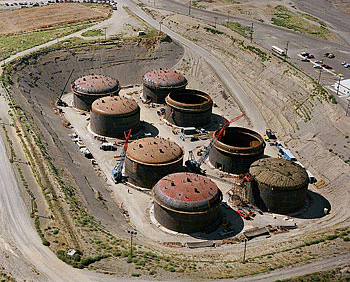
Hanford represents “the costliest environmental remediation project the world has ever seen and, arguably, the most contaminated place on the entire planet.”
as Washington residents learned long ago, it is difficult to draw federal attention to a remote site in our state.
The (Vancouver) Columbian Editorial Board, Mar 17, 2023 https://www.wenatcheeworld.com/opinion/opinion-the-vancouver-columbian-editorial-board-congress-must-recognize-urgency-at-hanford/article_b86f63c1-8193-5510-b3b0-b5357aa2c4d5.html
For too long, the federal government has kept cleanup at the Hanford nuclear reservation toward the bottom of its to-do list. “It’s a nice idea,” a long string of presidential administrations have seemed to say. “We’ll get to it eventually.”
With such nonchalance being the prevailing attitude for decades, the fact that President Joe Biden’s proposed 2024 federal budget includes record funding for Hanford is encouraging. But it is far from cause for celebration.
Congress must join the administration in recognizing the importance of the site and approving the president’s request for some $3 billion for Hanford. The issue is not only a matter of cleaning up hazardous, radioactive waste in Washington; it is about the federal government fulfilling its moral and court-ordered duty.
“There’s more work to do, but this is a big step in the right direction to getting this cleanup done efficiently, effectively and safely,” Gov. Jay Inslee wrote on Twitter this week.
Beggars, as they say, can’t be choosers, which puts Washington leaders in a difficult spot. While the proposal for increased funding is a step in the right direction, it does not mitigate years of inattention by the federal government. Nor does it fully fund cleanup at what is considered the nation’s most contaminated radioactive site.
Hanford, once the hub of plutonium production for the United States’ arsenal of nuclear weapons, now is home to underground tanks holding 56 million gallons of radioactive waste. Many of those tanks are known to be leaking, and with the site’s proximity to the Columbia River — 200 miles upstream from Vancouver — federal officials should have brought urgency to the project long ago.
“The citizens living along banks of the Columbia River deserve to know the full story of what is happening with the Hanford tanks,” U.S. Sen. Ron Wyden, D-Ore., once wrote to Department of Energy officials, who oversee Hanford cleanup.
That was in 2014. Citizens still are waiting for significant progress.
According to the Tri-City Herald, Biden’s proposed budget would increase spending on a vitrification plant at Hanford from its current $875 million to $1 billion; that plant is being prepared to treat radioactive waste for disposal. The budget also would add an extra $34 million for work at the tank farms.
Rep. Dan Newhouse, R-Sunnyside, whose district includes the Hanford site, long has worked to draw attention to the cleanup. So have Washington Sens. Patty Murray and Maria Cantwell. As Congress considers the details of Biden’s budget proposal, Washington lawmakers — including Rep. Marie Gluesenkamp Perez, D-Skamania — should impress upon their colleagues the importance of Hanford.
Every state and every congressional district has its own needs, but a site largely unknown to the rest of the country warrants special attention. As journalist Joshua Frank wrote last year in the book “Atomic Days: The Untold Story of the Most Toxic Place in America,” Hanford represents “the costliest environmental remediation project the world has ever seen and, arguably, the most contaminated place on the entire planet.”
With Murray serving as chair of the Senate Appropriations Committee — and with Newhouse sitting on the House Appropriations Committee — there is hope that Hanford funding will remain unscathed when Congress takes a scalpel to Biden’s proposed budget. But as Washington residents learned long ago, it is difficult to draw federal attention to a remote site in our state.
UK’s costly struggle to deal with dead nuclear submarines

The MoD has also been slated for the cost of maintaining the subs, £30 million a year.
Rosyth to be ‘de-nuclearised’ with removal of old submarines
https://www.dunfermlinepress.com/news/23150469.rosyth-de-nuclearised-removal-old-submarines/ By Ally McRoberts 27th November, 22
ALL of the laid-up nuclear submarines will be gone as part of a UK Government pledge to “de-nuclearise Rosyth” by 2035.
Councillors were given an update on the programme to remove radioactive waste and turn the seven boats that have been parked at the dockyard for decades into “tin cans and razor blades”.
The Ministry of Defence have faced heavy criticism for the delays in dealing with the nuclear legacy, with 27 Royal Navy subs to be scrapped in total.
Christine Bruce, from the Rosyth Submarine Dismantling Project, said most of the Low-Level Radioactive Waste (LLW) should be gone by the end of 2024.
She added: “The subs will take a bit longer but we’ve got a forward programme which definitely does remove them all by about 2035.
“It absolutely is our aim to do what we said all those years ago, to de-nuclearise Rosyth.”
One of the decommissioned subs, Dreadnought, has been in the Rosyth basin since 1980 and she admitted that it had been out of service for so long that a lot of the low-level radiation had “disappeared naturally”.
The MoD has also been slated for the cost of maintaining the subs, £30 million a year.
At the South and West Fife area committee yesterday (Wednesday), Ms Bruce acknowledged: “It’s taken a long time to get to where we are.
We started in 1998, I was part of it from the beginning, it’s taken quite a long time to come up with the policy and for good reasons.
“There were no easy answers. If it had been easy we would have done it a long time before now.
“The aim is to get rid of 27 submarines, of which seven are at Rosyth and the rest are, or will be, at Devonport.”
A facility to deal with the boats at Rosyth had to be brought up to date, to make sure it was safe to remove the radioactive material, with funding from the MoD.
Work started on Swiftsure in 2015-16 and around 52 tonnes of LLW was removed, with most of the metals recycled.
With lessons learned from the first sub, they progressed and removed 77 tonnes from Resolution and then 120 tonnes from Revenge.
The next step was a world first, the removal of the reactor from Revenge, the most radioactive part left in the sub, as well as the steam generators.
Next will be removing the rest of the LLW from Swiftsure so all that’s left is the reactor, which should be taken out around 2025.
The sub was to be recycled elsewhere but it’s cheaper, safer and more secure “to do the first one at Rosyth” and then sell it off to scrap merchants.
Gordon McAughey, head of internal assurance at Babcock Rosyth, added: “Hopefully, by 2026, the skyline change at Rosyth will occur where the first boat will be gone, it will be tin cans and razor blades.
“It’s a very challenging programme to build a facility to do all this work and to get all the permissions from regulators, but what I will say is we never compromise on safety for the sake of progress. We can’t compromise on safety.”
LLW is to be taken to a facility in Dorset, which should be completed next year, by 2024.
The reactors are to be taken to Capenhurst in Cheshire and it hasn’t yet been decided if they’ll be transported by road or sea.
Ms Bruce said safety and security would be paramount.
What to do with dead nuclear submarines?

Legacy. It is unacceptable to leave waste for future generations to deal with……
End game
To some extent, the Ministry of Defence is stuck in a vicious circle whereby the cost of storing submarines eats into the budget for their disposal. ………but the glacial pace of work …. is more concerning. There are always more pressing priorities for defence expenditure and the dismantling project has been continually delayed. In the meantime the nuclear and health and safety regulatory requirements that must be met are getting stricter, adding further costs. There is almost complete reliance on Babcock for UK submarine support activity and there is a very finite number of SQEP with nuclear expertise available to recruit in the UK.
Project to dismantle ex-Royal Navy nuclear submarines inches forward, Navy Lookout, 7 Feb 22.
There are currently 21 former Royal Navy nuclear submarines awaiting disposal, 7 in Rosyth and 14 in Devonport. Here we look at the process and the modest progress in efforts to dismantle them.
Kicking the can down the road ………. Unfortunately, successive governments failed to make arrangements for the timely disposal of these boats. In a less environmentally conscious era, filling the boats with concrete and sinking them in the deep ocean was the original plan but the disposal of nuclear waste at sea was banned by the London Dumping Convention in 1983. Planning for the dismantling of these submarines should have been started at that time, but only in the last 10 years has there been a serious effort to grip the issue.
Over time the nuclear regulatory frameworks have become ever-more demanding than when the submarines were conceived. Stricter rules have added more complexity and cost to the dismantling process, ironically adding delays and increasing the amount of nuclear waste awaiting appropriate disposal. HMS Dreadnought decommissioned in 1980, has now been tied up in Rosyth far longer than she was in active service. In the civil nuclear industry, operators are required by law to put aside funds and make plans during the life of the plant to pay for decommissioning. It would be prudent if a similar principle was applied by the MoD to all new nuclear submarine construction.
Besides the attraction of deferring costs in the short-term, a major cause of delays has been the selection of a land storage site for radioactive waste. Low-Level Waste (LLW) is stored at Sellafield in concrete-lined vaults and in 2017 URENCO Nuclear Stewardship Ltd at Capenhurst in Cheshire was selected as the interim site for storing the more dangerous Intermediate Level Waste (ILW). The Reactor Pressure Vessels (RPV) removed from the submarines are classed as ILW and will temporarily be stored in purpose-built buildings above ground. They will eventually be moved to a permanent underground Geological Disposal Facility (GDF)
Afloat storage
While awaiting dismantling, decommissioned submarines are stored afloat in a non-tidal basin in the dockyard. The 7 submarines in Rosyth have all had their nuclear fuel rods removed but of the 14 in Devonport, 10 are still fuelled. This is because in 2003 the facilities for de-fuelling were deemed no longer safe enough to meet modern regulation standards and the process was halted. Submarines that have not had fuel removed have the reactor primary circuit chemically treated to guarantee it remains inert and additional radiation monitoring equipment is fitted.
Apart from regular monitoring, once every 15 years each boat has to be dry-docked for a Survey and Docking Period (SADP) which involves hull inspection and preservation work.
Reasons to accelerate disposal
Cost. The expense of afloat storage and maintenance of decommissioned boats is rising – currently costing approximately £30M per year. Every further delay adds to this and will have to be funded from a defence budget that is much smaller in real terms than when the boats were ordered and built during the Cold War. The total disposal cost will be at least £3bn over 25 years and continue into the 2040s. (This is for the 27 boats listed above – Astute-class dismantling is not yet being considered.) All this effort and expense is a drain on precious MoD resources for zero operational gain with each delay adding to the cost.
Legacy. It is unacceptable to leave waste for future generations to deal with and it is simply common sense to dispose of old equipment at around the same time their replacements come online. Responsible care of the hulks afloat means they pose minimal risk to the environment or local population, but a tiny risk does remain. This makes some people living nearby uneasy and provides another grievance for those ideologically opposed to nuclear submarines and Trident. The minimal environmental hazard they pose is sometimes exaggerated by media, politicians and campaigners to suit their own agenda. The old boats are also a rather uncomfortable reminder of the time when the RN had an SSN force approximately double the strength it is today.
Space. When HMS Trenchant is moved to 3 Basin at Devonport for storage, the basin will be at its licensed capacity. Currently, the MoD only has permission from the nuclear regulator to store 14 boats. Approval to hold 16 will be needed in order to accommodate HMS Talent and Triumph when they decommission. Storing more boats in Rosyth is not an option because of limited space in the basin which is also used for civilian vessels as well as by the aircraft carriers to access the dry dock. Once the purpose-built disposal facility at Devonport is up and running in the early 2030s, it will be more efficient (and likely deemed politically less sensitive than anything in Scotland).
Progress at Rosyth
The Submarine Dismantling Project (SDP) finally started at Rosyth in December 2016, around 15 years behind schedule. A team of around 150 people are working on the site pioneering the two-stage process to remove radioactive waste. Swiftsure was the ‘pilot’ submarine for the project and stage 1 – the removal of LLW. This work was completed and the boat was sealed up and returned to afloat storage in the basin during August 2018. So far, 129 tonnes of mainly metallic LLW have been removed from Swiftsure and Resolution. Many of the older boats have asbestos lagging around pipes, which also has to be removed with exceptional care and disposed of in sealed containers. Stage 1 work on Resolution was completed on time in March 2020 and on budget.
Stage 1 work on Revenge started in March 2020 but was suspended on the 24th due to COVID lockdown and (almost) normal working was not resumed until June 2020……………..
Disposal at Devonport
Progress at Devonport is considerably behind that of Rosyth. The unplanned refuelling of HMS Vanguard added a six-month delay as Babcock engineers were diverted from the SDP to work on the more urgent SSBN refit. ………………..
End game
To some extent, the MoD is stuck in a vicious circle whereby the cost of storing submarines eats into the budget for their disposal. The modest progress at Rosyth in the last 5 years is encouraging but the glacial pace of work in Devonport is more concerning. There are always more pressing priorities for defence expenditure and the dismantling project has been continually delayed. In the meantime the nuclear and health and safety regulatory requirements that must be met are getting stricter, adding further costs. There is almost complete reliance on Babcock for UK submarine support activity and there is a very finite number of SQEP with nuclear expertise available to recruit in the UK.
Like so many problems in defence, the failure to dispose of the boats cannot be blamed on one person, government or company, rather a series of decisions made by many individuals that seemed justifiable at the time. There must be some sympathy for those working to deal with this legacy today, although the thrust of 2019 HoC Public Accounts Committee report on submarine disposal efforts can be summarised as saying “this is simply not good enough”. https://www.navylookout.com/project-to-dismantle-ex-royal-navy-nuclear-submarines-inches-forward/
1 This Month
Tell Congress: Prevent Nuclear Catastrophe in Iran

Tell Congress: Prevent Nuclear Catastrophe in Iran

Read the Public Inquiry Report, the Commissioners’ report, Surrendering Australia: The AUKUS Deception is available to download for free at aukuspublicinquiry.com. Or just watch the replay of the National Press Club Luncheon.


Shut down the radiation-damaged Heysham nuclear reactors now
To see nuclear-related stories in greater depth and intensity – go to https://nuclearinformation.wordpress.com

Say No to NASA’s Reckless Nuclear Reactor on the Moon
Say No to NASA’s Reckless Nuclear Reactor on the Moon
-
Archives
- November 2026 (238)
- October 2026 (302)
- September 2026 (339)
- August 2026 (330)
- July 2026 (355)
- June 2026 (287)
- May 2026 (306)
- April 2026 (356)
- March 2026 (251)
- February 2026 (267)
- January 2026 (308)
- December 2025 (358)
-
Categories
- 1
- 1 NUCLEAR ISSUES
- business and costs
- climate change
- culture and arts
- ENERGY
- environment
- health
- history
- indigenous issues
- Legal
- marketing of nuclear
- media
- opposition to nuclear
- PERSONAL STORIES
- politics
- politics international
- Religion and ethics
- safety
- secrets,lies and civil liberties
- spinbuster
- technology
- Uranium
- wastes
- weapons and war
- Women
- 2 WORLD
- ACTION
- AFRICA
- Atrocities
- AUSTRALIA
- Christina's notes
- Christina's themes
- culture and arts
- Events
- Fuk 2022
- Fuk 2023
- Fukushima 2017
- Fukushima 2018
- fukushima 2019
- Fukushima 2020
- Fukushima 2021
- general
- global warming
- Humour (God we need it)
- Nuclear
- RARE EARTHS
- Reference
- resources – print
- Resources -audiovicual
- Weekly Newsletter
- World
- World Nuclear
- YouTube
-
RSS
Entries RSS
Comments RSS

