Japan watchdog OKs new safety rules to extend reactor life

The Fukushima Daiichi nuclear power plant sits in coastal towns of both Okuma and Futaba, as seen from the Ukedo fishing port in Namie town, northeastern Japan, on March 2, 2022
February 14, 2023
TOKYO (AP) — Japanese nuclear regulators on Monday approved contentious safety evaluation changes and draft legislation to allow aging reactors to operate longer, in a rare split decision in which one of the five commissioners dissented.
The Nuclear Regulation Authority, responding to a new government policy to scrap the current 60-year operating limit for reactors, adopted a new system in which additional operating extensions can granted every 10 years after 30 years of service. No maximum limit is specified. The authority also adopted a draft revision of the reactor regulation law for approval by parliament.
It’s a major change from the current 40-year operating limit with a possible one-time extension of up to 20 years, a rule that was introduced as part of stricter safety standards adopted after the 2011 Fukushima nuclear plant disaster.
Prime Minister Fumio Kishida’s Cabinet adopted a plan last Friday to maximize the use of nuclear energy, including accelerating restarts of halted reactors, prolonging the operational life of aging plants and development of next-generation reactors to replace those designated for decommissioning, as Japan struggles to secure a stable energy supply and meet its pledge to reach carbon neutrality by 2050.
One of the authority’s five commissioners, Akira Ishiwatari, a Tohoku University geologist, opposed the changes.
“We are open to revisions (to rules) if changes are clearly to contribute to greater safety for scientific or technical reasons. To me, these changes do not serve either purpose,” Ishiwatari said at Monday’s commission meeting.
Another commissioner, Tomoyuki Sugiyama, deputy chief of the Japan Atomic Energy Agency’s nuclear safety research center, said he felt the discussion was “rushed” as a result of government pressure and that the regulatory body should have acted more independently.
Authority Chairman Shinsuke Yamanaka denied that the watchdog yielded to government pressure and said he believes the new safety system is adequate.
The authority’s task is “to inspect the safety of (aging) reactors no matter how long their operational lifespan is,” he said. “We simply do not issue safety permits for reactors with progressing deterioration.”
Anti-nuclear sentiment and safety concerns rose sharply in Japan after the Fukushima disaster, in which a massive earthquake and tsunami damaged the plant’s cooling system, resulting in the meltdown of three reactors and the release of large amounts of radiation.
The government has been pushing for a return to nuclear power amid worries of energy shortages following Russia’s invasion of Ukraine and a global push to reduce greenhouse gases.
While maintaining a 20%-22% target for nuclear energy’s share of the energy mix for 2030, the government previously denied it was considering building new nuclear plants or replacing aged reactors in an apparent attempt to avoid triggering criticism from a wary public.
https://mainichi.jp/english/articles/20230214/p2g/00m/0bu/009000c
Post-war Ukraine – a triumphal land owned by Western business corporations.

tough neoliberal policies to be imposed on post-war Ukraine, with calls for cutting labour laws , “opening markets”, lowering tariffs, deregulating industries and “selling state-owned enterprises to private investors”.
Zelensky invited foreign companies to come and exploit its abundant resources and cheap labour and offered Wall Street “a chance to invest … in projects worth hundreds of billions of dollars”.
Along with the nature of the arms being supplied, so have the objectives changed, at least the stated ones. We started, so it seems, to help Ukraine defend itself against Russian invasion, then we began talking about a “Ukrainian victory” to inflict a “strategic defeat” on Russia that would leave it “weakened”, with the fall of the Putin government. We have now reached the point that a former Polish foreign minister, currently a MEP, organised a meeting in the European Parliament on January 31, 2023 to “discuss the prospects for decolonisation and de-imperialisation of the Russian Federation” (i.e., the dissolution of the Russian Federation).
Great Expectations: The Ukraine to come, By Stefania Fusero, New Cold War, Feb 13, 2023:
Originally published in Italian on La Citta Futurà, Feb 11, 2023:
The collective West, increasingly becoming more directly involved in the conflict in Ukraine, has been vague about the objectives of its participation in the war and has repeatedly contradicted itself on the nature and number of weapons to be sent to Ukraine. From another standpoint, however, it has maintained clarity and constancy over time: the total dedication to a neoliberal project for a Ukraine open to Western corporations in which workers have no guardianship or protection.
The Western powers – the USA, NATO and the EU – have maintained a linear, unequivocal and steady standpoint on the management of the conflict in Ukraine, if not a vocal partisan support for one of the parties involved (the post-Maidan Ukrainian government), the demonisation of the Russian Federation and a disdainful rejection of the ancient art of diplomacy.
While French president Macron, a week after the entry of Russian troops into Ukraine stated, “we are not at war against Russia”, after less than a year the German foreign minister Annalena Baerbock declared in front of the EU parliamentarians “we are fighting a war against Russia.” On the other hand, if at the beginning of the Russian military operations Biden pledged to avoid a direct conflict between the US and Russia, US intelligence officials have recently revealed that not only have the CIA and US special forces been conducting clandestine military operations in Ukraine, but that the CIA, together with a spy agency of another NATO country, is engaged in sabotage operations within the Russian Federation itself.
Not to mention the escalation in arms shipments to Ukraine by Western countries – the most striking example is certainly Germany, which at the beginning of the conflict reluctantly announced that it would just send helmets and a field hospital, then, amid the indignation expressed by various allied countries and subjected to ever stronger pressure, after less than a year announced it would send tanks, no less. Thus, in a few months, Germany reneged on the principles of foreign policy pursued after the defeat of Nazism, one of which required Germany not to send weapons to any conflict zones, a policy which can be summed up in the German pledge ‘never again’. Which amounts to a complete reversal of the policy of peaceful coexistence with Russia and Eastern Europe pursued by such statesmen as Willy Brandt, having major implications for the entire European continent, not just Germany.
Just a few years have passed – but it feels like centuries – since, on 7 May 2015, Foreign Minister Frank-Walter Steinmeier solemnly celebrated in Volgograd the 70th anniversary of the end of WW2. “Here in Stalingrad, these people brought about the first decisive turnaround in the war. Here in Stalingrad, these people began Europe’s liberation from Nazi dictatorship. In doing so, they made immeasurable sacrifices. As a German, I bow before these victims in sorrow. And I ask for forgiveness for the infinite suffering that Germans inflicted on others in the name of Germany, here in this city, all over Russia, in the parts of the then Soviet Union that are now Ukraine and Belarus, and all over Europe…”.
No one has described such escalation better than former Ukrainian Defence Minister Oleksii Reznikov as of October last year. “When I was in D.C. in November, before the invasion, and asked for Stingers, they told me it was impossible. Now it’s possible. When I asked for 155mm guns, the answer was no. HIMARS, no. HARM, no. Now all of that is a yes. Therefore, I’m certain that tomorrow there will be tanks and ATACMS and F-16s.”
Along with the nature of the arms being supplied, so have the objectives changed, at least the stated ones. We started, so it seems, to help Ukraine defend itself against Russian invasion, then we began talking about a “Ukrainian victory” to inflict a “strategic defeat” on Russia that would leave it “weakened”, with the fall of the Putin government. We have now reached the point that a former Polish foreign minister, currently a MEP, organised a meeting in the European Parliament on January 31, 2023 to “discuss the prospects for decolonisation and de-imperialisation of the Russian Federation” (i.e., the dissolution of the Russian Federation).
On the other hand, it is not the first time that a plan to dismantle the Russian Federation has been openly talked of, under the guise of an improbable anti-imperialist struggle – see for example a conference organised on June 23, 2022 in Washington by the CSCE, a US government agency otherwise known as the Helsinki Commission. If anything, such initiatives can now be officially held at the institutional seat of the EU parliament.
Whereas the trajectory of Western military involvement in the Ukraine conflict has apparently been confused and cobbled together, the stance on the economic, social and political future of Ukraine has instead remained clear and constant over time.
The table is laid
4-5 July 2022, Lugano: Ukraine Recovery Conference.
Representatives of Western governments and corporations (US, EU, UK, Japan and South Korea) met in Switzerland to plan a series of tough neoliberal policies to be imposed on post-war Ukraine, with calls for cutting labour laws , “opening markets”, lowering tariffs, deregulating industries and “selling state-owned enterprises to private investors”. The URC (Conference on the Recovery of Ukraine) was not a novel initiative, but a continuation of the “Conference on the Reform of Ukraine”(URC) started in 2017. Same acronym, same spirit, i.e., to urge “strengthening market economy”, “decentralisation, privatisation, state enterprise reform, land reform, state administration reform” and “Euro-Atlantic integration”.
September 6, 2022: Volodymyr Zelensky virtually opens the New York Stock Exchange by symbolically ringing the bell via video streaming.
On the same day he had an editorial in the Wall Street Journal in which he launched the neoliberal ‘Advantage Ukraine’ program. Zelensky invited foreign companies to come and exploit its abundant resources and cheap labour and offered Wall Street “a chance to invest … in projects worth hundreds of billions of dollars”.
January 23, 2023: Zelensky delivers a video speech to the US National Association of State Chambers of Commerce meeting at Boca Raton, Florida, entitled After the War, American Business Can Become a Locomotive of Global Economic Growth.
A transcript of the speech is published on the institutional website of the Ukrainian presidency: “And – when we’ll be able to end this war by throwing out the occupiers – in the same manner together we’ll be able to start the difficult work of rebuilding Ukraine – our cities, our economy, our infrastructure. It is already clear that this will be the largest economic project of our time in Europe. It is obvious that American business can become the locomotive that will once again push forward global economic growth.
We have already managed to attract attention and have cooperation with such giants of the international financial and investment world such as Black Rock, J.P. Morgan and Goldman Sachs. Such American brands as Starlink or Westinghouse have already become part of our, Ukrainian, way… And everyone can become a great business by working with Ukraine. In all sectors -from weapons and defence to construction, from communications to agriculture, from transport to IT, from banks to medicine.”
Disaster capitalism
As to now, no one is able to predict what will remain of Ukraine at the end of the war, but the project of the Western actors involved is very clear and has already begun to be put into practice.
Ukraine was already the poorest country in Europe and if, like all the others in the former Soviet Union, it suffered from the brutal shock therapy* that had turned them into market economies, the neoliberal shock therapy imposed was not as devastating to Ukraine as it was to Russia. And there are still some state-owned assets in Ukraine to appeal to Western corporations. Last August Zelensky effectively eliminated the right to collective bargaining and union representation for the majority of Ukrainian workers, thus making them even poorer.
As economist Michael Hudson argues, Ukraine may well be the poorest country in Europe, but it is so for 99% of citizens; for the remaining 1% – the corrupt kleptocrats of the most corrupt country in Europe – it will instead become the richest country. And of course, the invitation to exploit the country’s riches is being extended to investors on the New York Stock Exchange. “Come on in and join the party! Someone’s loss is turned into somebody else’s gain. And that’s what happens in a class war. It’s a zero-sum game. There is no attempt at all to raise living standards.”
Class war has long been declared on the lower classes in the entire collective West, not just in Ukraine, suffice it to recall what French President Macron said last August: “What we are currently living through is a kind of major tipping point or a great upheaval…we are living the end of what could have seemed an era of abundance…”
Professor Michael Hudson comments: “When he said the ‘end of abundance’, what he really meant was the beginning of an IMF austerity program applied to Europe. And the end of the abundance for the 90% is a bonanza of abundance for the 1%, for the financial sector. They’re making huge, huge gains in all of this… Austerity for the population means we’re now going to put the class war in business here…It’s lower wages, enabling higher profit opportunities for the companies. It’s going to be the end of abundance for wage earners, but it’ll be a bonanza for the monopoly owners and for the banks.”
It is class warfare in Europe and the USA, but in Ukraine it is simultaneously a vicious, cynical proxy war that has been mercilessly shredding hapless Ukrainians into cannon fodder.
* the so-called shock therapy was inaugurated in Pinochet’s Chile, then it was implemented in Russia and in the other USSR countries after the end of the Soviet Union to turn them into market economies. Prices were liberalised while eliminating any social guarantees for citizens, causing an increase in excess mortality and a decrease in life expectancy, together with growing economic inequality, corruption and poverty. Assets and companies were sold out at bargain prices to local and foreign speculators who became enormously rich, while the social fabric unravelled causing an exponential increase in disease, suicide and crime.
Sources:
Mission Creep? How the US role in Ukraine has slowly escalated,
Branko Marcetic in Responsible Statecraft, 23 Jan 2023
The dissolution of the Russian Federation is far less dangerous than leaving it ruled by criminals, Anna Fotyga, 27 Jan 2023
German tanks in the Ukraine. Again (Maria Zakharova, Russian foreign ministry spokeswoman)
German tanks in the Ukraine. Again (Maria Zakharova, Russian foreign ministry spokeswoman)
Speech by Foreign Minister Frank-Walter Steinmeier in Volgograd to commemorate the end of the Second World War 70 years ago, Federal Foreign Office 7 May 2015
Decolonizing Russia – a moral and strategic imperative, CSCE 23 June 2022
President of Ukraine’s address to the participants of the meeting of the National Association of State Chambers, President of Ukraine 23 Jan 2023
West prepares to plunder post-war Ukraine with neoliberal shock therapy: privatization, deregulation, slashing worker protections, Ben Norton in Geopolitical Economy, 28 July 2022
Zelensky is literally selling Ukraine to US corporations on Wall Street, Ben Norton in Geopolitical Economy, 9 Sept 2022
Ukraine’s Zelensky sends love letter to US corporations, promising ‘big business’ for Wall Street, Ben Norton in Geopolitical Economy, 25 Jan 2023
Economist Michael Hudson on debt relief, inflation, Ukraine disaster capitalism, petrodollar crisis, Ben Norton in Geopolitical Economy, 8 Sept 2022
EU Commission abandons plans to sanction Russia’s nuclear industry.
EU Commission scratches Russia nuclear sanctions plans
Ukrainian President Volodymyr Zelenskyy had urged the EU to sanction Rosatom, the Russian state nuclear energy company.
The European Commission has abandoned plans to sanction Russia’s nuclear sector or its representatives in its next sanctions package, three diplomats told POLITICO on Thursday.
The EU executive initially told EU countries that it would try to draw up sanctions targeting Russia’s civil nuclear sector. And, ahead of a meeting of EU leaders last week, Ukrainian President Volodymyr Zelenskyy urged the bloc at least to issue sanctions against Russian nuclear energy company Rosatom.
But that plan has failed, the three diplomats said, pointing to the latest sanctions drafts.
The EU’s sanctions packages are divided into multiple parts: New rules that target specific sectors, such as aviation or military, and lists that impose visa restrictions and asset freezes on individuals and companies — but none include the nuclear sector, according to drafts seen by POLITICO and EU diplomats who spoke on condition of anonymity……………
France has also expressed prudence, with a French economy ministry official telling reporters earlier this week that “many nuclear power plants use fuel of Russian energy.”…………………
What We Know About The US Air Force’s Balloon Party So Far

https://caityjohnstone.medium.com/what-we-know-about-the-us-air-forces-balloon-party-so-far-6c59b80e7a3d Caitlin Johnstone, 18 Feb 23
You know, everyone’s always talking about how the US military is only ever used to kill foreigners for resource control and generate profits for the military-industrial complex, but that’s not entirely true. Turns out the US military is also used for shooting down party balloons.
In an article titled “Object downed by US missile may have been amateur hobbyists’ $12 balloon,” The Guardian’s Richard Luscombe reports the following:
The Northern Illinois Bottlecap Balloon Brigade says one of its hobby craft went “missing in action” over Alaska on 11 February, the same day a US F-22 jet downed an unidentified airborne entity not far away above Canada’s Yukon territory.
In a blogpost, the group did not link the two events. But the trajectory of the pico balloon before its last recorded electronic check-in at 12.48am that day suggests a connection — as well as a fiery demise at the hands of a sidewinder missile on the 124th day of its journey, three days before it was set to complete its seventh circumnavigation.
If that is what happened, it would mean the US military expended a missile costing $439,000 (£365,000) to fell an innocuous hobby balloon worth about $12 (£10).
“The descriptions of all three unidentified objects shot down Feb. 10–12 match the shapes, altitudes and payloads of the small pico balloons, which can usually be purchased for $12–180 each, depending on the type,” writes Steve Trimble for Aviation Week, who first broke the Bottlecap Balloon Brigade story.
This information would put a bit of a wobble on Senate Majority Leader Chuck Schumer’s comments to ABC’s This Week on Sunday that all three of the balloons shot down through the weekend were Chinese surveillance devices, saying “the Chinese were humiliated” by the US catching them in their sinister espionage plot. If the US air force did in fact just spent millions of dollars shooting down American party balloons, it wouldn’t be the Chinese who are humiliated.
And it looks like that is indeed what happened. On Tuesday the National Security Council’s John Kirby said the “leading explanation” for the three unidentified flying objects that were shot down is that they were “balloons tied to some commercial or benign purpose.” On Thursday President Biden told the press that “The intelligence community’s current assessment is that these three objects were most likely balloons tied to private companies, recreation, or research institutions studying weather or conducting other scientific research.”
And this all comes out after US officials told The Washington Post that the “Chinese spy balloon” which started this historically unprecedented multi-day frenzy of aerial kinetic warfare over North America was probably never intended for surveillance of the United States at all. Experts assess that the balloon was blown over the continent entirely by accident, trying to reconcile that narrative with the contradictory US government claims of intentional Chinese espionage by suggesting that perhaps the Chinese had intended for the balloon to be used for spying on US military forces in the Pacific or something.
So to recap, the US air force shot down a Chinese balloon which US officials have subsequently admitted was only blown over the US by accident, then went on a spree of shooting things out of the sky which it turns out were probably civilian party balloons. The entire American political/media class has been spending the month of February furiously demanding more militarism and more cold war escalations over what is in all probability four harmless balloons.
And what’s really crazy is that they’re probably going to get those increases in militarism and cold war escalations they’ve been calling for, despite the entire ordeal originating primarily in the overactive imaginations of the drivers of the US empire. The shrieking hysterical panic about “Chinese spy balloons” has dwarfed the coverage of the revelations contradicting that narrative, and China hawks have been using the occasion to argue for increases in military spending. The Atlantic’s Richard Fontaine got all excited and wrote a whole article about how the threat of Chinese spy balloons can be used “to rally public concern and build international solidarity” against China.
These are the people who rule our world. They are not wise. They are not insightful. They are not even particularly intelligent. The US empire is a Yosemite Sam cartoon character who at any time can just flip out and start firing Sidewinder missiles at random pieces of junk in the sky, screaming “I’ll blast yer head off ya varmint!” If the US war machine was a civilian human, their family would be quietly talking amongst themselves about the possibility of conservatorship.
These are the last people in the world who should be running things, and they are the last people in the world who should be armed with nuclear weapons. But that’s exactly where we find ourselves in this bizarre slice of spacetime. God help us all.
____________________
Japan PM Kishida tells ministers to assuage public concerns over nuclear policy
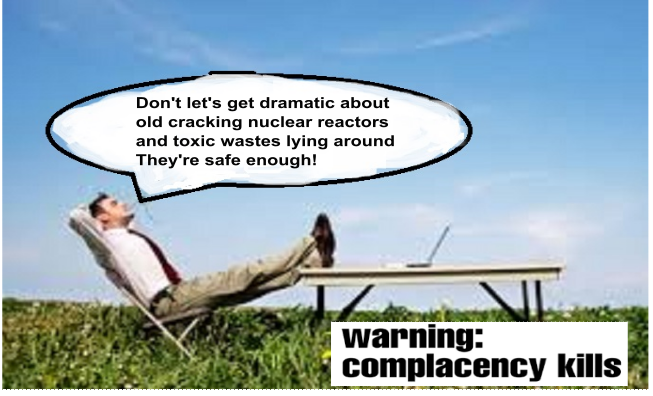
Mainichi, 17 Feb 23, TOKYO (Kyodo) — Japanese Prime Minister Fumio Kishida urged his ministers Friday to assuage public concerns over the government’s planned policy shift that will allow the operation of nuclear power plants beyond the current limit of 60 years.
The instruction came after the country’s nuclear watchdog decided this week to review regulatory standards on the lifespan of nuclear reactors despite one of the five commissioners remaining opposed to the policy in a rare move.
The government plans to submit related bills to parliament during the current session. The revision will enable the operation of reactors for an extended period by excluding the time spent on inspections and other offline periods from their designed service life.
“I was instructed that the Cabinet should decide on the bills after we are ready to provide thorough explanations at the Diet to clear the public’s anxiety,” industry minister Yasutoshi Nishimura told a press conference………………
On Monday, the Nuclear Regulation Authority formally approved the revision by a majority vote after Akira Ishiwatari, a commissioner in charge of earthquake and tsunami countermeasures, opposed it.
The revision “is not based on new scientific or technical findings. It cannot be said to be a shift to the safe side,” Ishiwatari said. Another member also expressed a cautious stance in making decisions too swiftly. https://mainichi.jp/english/articles/20230217/p2g/00m/0na/060000c
EDF’s historic $13.5 billion loss in 2022 – as France became an importer of electricity
Electricite de France SA reported a historic loss for 2022 after repairs
choked its nuclear output, but the utility predicted a significant rebound
in earnings this year as production recovers. The state-controlled
generator swung to a net loss, excluding non-recurring items, of €12.7
billion ($13.5 billion) last year after a profit of €4.7 billion in 2021,
according to a statement on Friday.
The company’s woes exacerbated the
region’s energy crisis by turning France — traditionally a powerhouse
producer — into a net importer of electricity. President Emmanuel
Macron’s government, which is trying to regain full ownership of the
nuclear giant to reassure creditors, wants new Chief Executive Officer Luc
Remont to restore production and prepare the company to start building new
reactors in France and the UK.
Bloomberg 17th Feb 2023
https://www.bnnbloomberg.ca/edf-reports-record-loss-after-nuclear-output-choked-by-repairs-1.1885186
Concerns over the construction of a nuclear power plant in Akkuyu, Turkey, due to its proximity to the 7.8 magnitude earthquake’s epicentre.
Deadly Turkey earthquake stirs debate over nuclear plant construction.
Activists have raised concerns over the construction of a nuclear power
plant in the southern city of Akkuyu, Mersin Province due to its proximity
to the 7.8 magnitude earthquake’s epicentre.
The New Arab 16th Feb 2023
https://www.newarab.com/news/turkey-quake-stirs-debate-over-nuclear-plant-construction
‘Extreme situation’: Antarctic sea ice hits record low

Damian Carrington 16 Feb 23
https://www.theguardian.com/world/2023/feb/15/antarctic-sea-ice-hits-record-low-climate-crisis
The area of sea ice around Antarctica has hit a record low, with scientists reporting “never having seen such an extreme situation before”. The ice extent is expected to shrink even further before this year’s summer melting season ends.
The impact of the climate crisis in melting sea ice in the Arctic is clear in the records that stretch back to 1979. Antarctic sea ice varies much more from year to year, which has made it harder to see an effect from global heating.
However, “remarkable” losses of Antarctic sea ice in the last six years indicate that the record levels of heat now in the ocean and related changes in weather patterns may mean that the climate crisis is finally manifesting in the observations.
Scientists were already very concerned about Antarctic ice. Climate models suggested as far back as 2014 that the giant West Antarctic Ice Sheet (WAIS), which sits on the continent, was doomed to collapse due to the levels of global heating already seen then.
The increasing loss of sea ice exposes ice sheets and their glaciers to waves that accelerate their disintegration and melting, researchers warned. A recent study estimated that the WAIS would be tipped into gradual collapse – and four metres of sea level rise – with a global temperature rise as low as 1C, a point already passed.
“I have never seen such an extreme, ice-free situation here before,” said Prof Karsten Gohl, from the Helmholtz Centre for Polar and Marine Research in the Alfred Wegener Institute, Germany, and who first visited the region in 1994.
Gohl, on board the research vessel Polarstern in Antarctica, said: “The continental shelf, an area the size of Germany, is now completely ice-free. It is troubling to consider how quickly this change has taken place.”
Prof Christian Haas, also at the Helmholtz Centre, said: “The rapid decline in sea ice over the past six years is quite remarkable, since the ice cover hardly changed at all in the 35 years before.”
Scientists at the National Snow and Ice Data Center in the US have also said a new record low has been set. They said Antarctic sea ice extent fell to 1.91m square kilometres on 13 February, below the previous record set on 25 February 2022.
Sea ice melts away in the Antarctic summer before starting to grow again as autumn arrives. “In past years, the annual minimum has occurred between 18 February and 3 March, so further decline is expected,” the NSIDC researchers said. “Much of the Antarctic coast is ice free. Earlier studies have linked low sea ice cover with wave-induced stresses on the floating ice shelves that hem the continent, leading to break up of weaker areas.”
The German scientists said the “intense melting” could be due to unusually high air temperatures to the west and east of the Antarctic peninsula, which were about 1.5C above the long-term average. Furthermore, there have been strong westerly winds, which increase sea ice retreat. The result is “intensified melting of ice shelves, an essential aspect of future global sea-level rise”, the researchers said.
Historical records also show dramatic changes in Antarctica, they said. The Belgian research vessel Belgica was trapped in massive pack ice for more than a year in the Antarctic summer 125 years ago, in exactly the same region where the Polarstern vessel is now sailing in completely ice-free waters.
Prof Carlos Moffat, at the University of Delaware, US, and recently returned from a research cruise in the Southern Ocean, told Inside Climate News: “The extraordinary change we’ve seen this year is dramatic. Even as somebody who’s been looking at these changing systems for a few decades, I was taken aback by what I saw.”
Zelensky is literally selling Ukraine to US corporations on Wall Street.
Ukraine’s Western-backed leader Volodymyr Zelensky opened the New York Stock Exchange telling Wall Street his country is “open” for foreign corporations to exploit it with $400 billion in state selloffs.
ByBen Norton, 2022-09-09
Ukraine’s Western-backed leader Volodymyr Zelensky virtually opened the New York Stock Exchange on the morning of September 6, symbolically ringing the bell via video stream.
Zelensky announced that his country is “open for business” – that is to say, that foreign corporations are free to come and exploit its plentiful resources and low-paid labor.
In a speech launching the neoliberal selloff program Advantage Ukraine, Zelensky offered Wall Street “a chance for you to invest now in projects worth of hundreds of billions of dollars.”
The financial news service Business Wire published a press release from the Ukrainian government in which Zelensky boasted:
The $400+ [billion] in investment options featured on AdvantageUkraine.com span public private partnerships, privatization and private ventures. A USAID-supported project team of investment bankers and researchers appointed by Ukraine’s Ministry of Economy will work with businesses interested in investing.
………………………….. The press release cited executives of US corporate giants Google, Alphabet, and Microsoft, who salivated over the economic possibilities offered by Ukraine.
Reuters noted that the Ukrainian government hired British public relations firm WPP to run the marketing operation for Advantage Ukraine.
Zelensky coordinated his New York Stock Exchange publicity stunt with an editorial in the Wall Street Journal imploring US capitalists to “Invest in the Future of Ukraine.”
“I committed my administration to creating a favorable environment for investment that would make Ukraine the greatest growth opportunity in Europe since the end of World War II,” Zelensky wrote.
Multipolarista previously reported on a meeting by Western governments and corporations in Switzerland in July in which they planned harsh neoliberal economic policies to impose on Ukraine.
The Western participants published documents calling to cut labor laws, “open markets,” drop tariffs, deregulate industries, and “sell state-owned enterprises to private investors.”
In an interview with Multipolarista, economist Michael Hudson compared the new emergency anti-labor laws imposed by the Ukrainian government to the brutal neoliberal policies implemented by Chile’s far-right Pinochet dictatorship after a CIA-backed coup in 1973.
“It’s jaw dropping,” Hudson said of Zelensky’s Wall Street Journal op-ed. “It’s like a parody of what a socialist would have written about how the class war would be put in into action by a fascist government.”
“So of course he was welcomed on the stock exchange for abolishing labor’s rights,” Hudson added. “You could not have a more black-and-white example” of class war………………………………… https://geopoliticaleconomy.com/2022/09/09/zelensky-selling-ukraine-wall-street/
Pro nuclear film
CAN nuclear energy be the answer to the climate crisis? That is the belief
of the subjects at the centre of Irish filmmaker Frankie Fenton’s
provocative new film who assert that it is one of the cleanest and safest
technologies in the world. Thirteen years in the making, Fenton’s
observational documentary which he was director of photography as well as
writing, directing and producing, follows a small group of pro-nuclear
activists as they try to persuade law makers and the public of the virtues
of atomic energy using scientific evidence.
Although on the whole they seem to make a compelling argument (bananas notwithstanding) their assertions are not challenged during the film. Nuclear energy isn’t recognised for its own massive carbon footprint in terms of the huge costs of building new reactors and the toxic waste they produce, as well as the mining of the uranium and thorium needed to fuel them.
Morning Star 16th Feb 2023
Antarctic sea ice level now lowest on record.

There is now less sea-ice surrounding the Antarctic continent than at any
time since we began using satellites to measure it in the late 1970s. It is
the southern hemisphere summer, when you’d expect less sea-ice, but this
year is exceptional, according to the National Snow and Ice Data Center.
Winds and warmer air and water reduced coverage to just 1.91 million square
km (737,000 sq miles) on 13 February. What is more, the melt still has some
way to go this summer.
BBC 17th Feb 2023
NATO reveals new space fleet
The US-led military bloc will use commercial satellites to improve intelligence gathering.
NATO has announced a new space project that aims to create a fleet of spy satellites. The initiative, which includes NATO applicants Sweden and Finland, involves not only national but commercial assets.
The project, which is called ‘Alliance Persistent Surveillance from Space’ (APSS), was unveiled on Wednesday, with a total of 16 current member states expected to chip in. According to a statement published on NATO’s website, the project will “help streamline data collection, sharing and analysis among NATO Allies and with the NATO command structure.”
Sweden and Finland applied for NATO membership in May of 2022, though their bids have yet to be approved by Hungary and Türkiye. However, despite not being formally admitted into the military bloc, both Stockholm and Helsinki are already participating in joint projects.
APSS will entail the creation of a “constellation,” named ‘Aquila’, of national as well as commercial satellites. It is expected to “provide essential support to NATO’s military missions and operations.”
The military bloc explained that APSS comes as part of NATO’s Overarching Space Policy adopted back in 2019………………………………… https://www.rt.com/news/571561-nato-space-surveillance-project/
Sizewell B nuclear station switched off fo 66 days for maintenance work
Sizewell B nuclear power station has been switched off for 66 days for
refuelling and maintenance work. Last year, EDF unveiled plans to extend
the operational life of the Sizewell B power station by at least 20 years.
The energy company has made an £80 million investment in the power plant,
part of which is the station’s 18th refuelling and maintenance outage. It
is expected that engineers will complete more than 10,000 routine
maintenance and inspection tasks and replace a third of the fuel during the
66-day outage.
Energy Live News 16th Feb 2023
Dumping 1M gallons of radioactive water in Hudson is ‘best option,’ per Indian Point nuclear plant owner

Gothamist, Rosemary Misdary, Feb 18, 2023
The owner of the defunct Indian Point nuclear facility says it’s planning to dump about 1 million gallons of radioactive water into the Hudson River. The move, which the company describes as the “best option” for the waste, could happen as early as August.
A Feb. 2 meeting of the Indian Point Decommissioning Oversight Board heated up when the plant’s owner Holtec International disclosed the plan as part of its lengthy closure process. The contaminated water could just naturally — and safely — decay in storage onsite.
Environmental groups and residents are also concerned this could harm their community, as the Hudson River is already a federally designated toxic Superfund site. Rich Burroni, Holtec’s site vice president for Indian Point, agreed to give the community at least a month’s notice before any radioactive discharge into the Hudson River begins.
But Holtec is well within its legal rights and permits to discharge waste at the same rate as it did when operating, and it does not need federal, state or local approval to dump the contaminated water. This practice is standard for nuclear plants.
Nearly two years have passed since Indian Point shut down its third and final reactor in the village of Buchanan, located on the Hudson’s east bank about 30 miles north of Midtown. Toward the end of its 59-year lifespan, the plant had more than a 2,000 megawatt capacity — providing electricity to more than 2 million homes, or 13% of the state’s power demand.
Holtec received about $2.4 billion in funds, shouldered by ratepayers, to decommission the plant. And it wants to do so in 12 years, which is in accordance with town’s wishes to repurpose the site. But Holtec and the surrounding community are still debating what to do with Indian Point’s radioactive remnants.
“Yes, you can do it [discharge radioactive water]. It’s normal practice. But should you when you have other options that might avoid this additional release of radioactivity to the environment?” said Edwin Lyman, director of nuclear power safety at the Union of Concerned Scientists, a nonprofit science advocacy organization. “It may only cause a low risk to the environment as far as we know, but there are other options here, and why not try to minimize the harm?”……………………………………………
Options are limited when it comes to disposing of radioactive waste, and only three methods are typically used for tainted water. ……………………………………………………..
Lyman said a fourth option would be leaving the radioactive water onsite to decay over time into non-harmful helium. “Keep storing indefinitely and eventually the problem will solve itself,” he said.
For tritium, this process would take just over 24 years. Lyman considers this the best option because it minimizes the effects on the environment. It’s also viable because other radioactive material — spent fuel generated from operating the plant — remains onsite and will take hundreds of thousands of years to decay. This material includes plutonium and uranium.
Lyman said this waste has no place to go and will be there for a long time, so there’s no rush to deal with the radioactive water while spent fuel continues to sit on the property. Most radioactive waste is stored where it is generated. And federal regulations allow 60 years for decommissioning. That spent fuel could remain at the site even after the decommissioning is completed, according to the Nuclear Regulatory Commission.
“In the long term, it’s going to degrade, and the only way to protect the environment from that degradation is to bury it in a deep geological repository,” Lyman said…………………………………..
The next meeting for the Indian Point Decommissioning Oversight Board will take place on April 27 at 6 p.m. at Cortlandt Town Hall. Participants have the option to attend virtually. https://gothamist.com/news/dumping-radioactive-water-hudson-river-best-option-indian-point-nuclear-plant-owner-holtec
Small modular nuclear reactors: a good deal for Southwest Virginia?

FEBRUARY 16, 2023 By Rees Shearer, https://www.virginiamercury.com/2023/02/16/small-modular-nuclear-reactors-a-good-deal-for-southwest-virginia/
In announcing his 2022 Virginia Energy Plan, Gov. Glenn Youngkin said, “A growing Virginia must have reliable, affordable and clean energy for Virginia’s families and businesses.” The governor’s plan to promote and subsidize small modular nuclear reactors (SMRs) in Southwest Virginia fails all three of the governor’s own criteria:
- SMRs can’t be reliable, when they cannot reliably be built and brought on line in a predictable and timely fashion.
- SMRs can’t be affordable, because nuclear power is close to the costliest of all forms of electric power generation.
- SMRs can’t be clean, since they produce extremely toxic high- and low-level nuclear waste, which has no safe storage or disposal solution.
Appalachia has long served as a sacrifice zone for rapacious energy ambitions of other regions. Southwest Virginians have had reason to hope that would change as opportunities for low-cost solar development emerged in recent years. Instead, politicians like Youngkin are making too-good-to-be-true promises about SMRs, sidelining opportunities to promote solar, which can produce power in a matter of weeks, not decades.
Imposing SMRs on Southwest Virginia is disturbing. My father worked for the Atomic Energy Commission in the 1950s. The promise the nuclear industry and the government touted then, “electricity, too cheap to meter,” has never been realized. Tennessee Valley Authority and other utilities abandoned nuclear plants under construction, leaving costly monuments to that folly and sticking electricity customers with the bill.
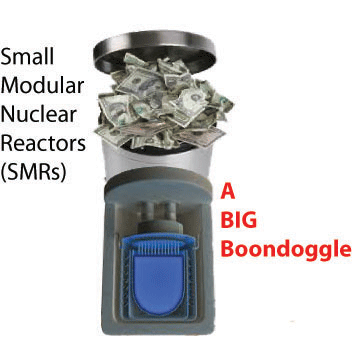
It’s not at all clear that SMR technology will succeed, or when. Levelized cost charts of electric power generation rate nuclear as among the very most expensive means to generate electric power at utility scale. If nuclear waste management, insurance and decommissioning costs are included, actual costs are far higher. (Some of these costs are already socialized for nuclear power, such as insurance in the Price-Anderson Act.)
The first commercial SMR is not expected to be completed until 2029, but already its developers have raised the target price of its power by 53%. This is not a surprise; nuclear power construction history documents an extremely strong correlation between new designs and cost increases and project delays. Indeed, the Lazard analysis shows that nuclear is the ONLY grid-wide generation source to increase in price between 2009 and 2021. The increase was 36%!

Nuclear waste and reprocessing are also serious concerns. Make no mistake, un-reprocessed nuclear waste, for all practicable purposes, is forever. The fact that we have become accustomed to risk does not, by any means, reduce risk. Nor will SMRs generate less waste than their larger forbears. Indeed, a recent Stanford University study concluded that “small modular reactors may produce a disproportionately larger amount of nuclear waste than bigger nuclear plants.”
Safeguarding this waste is already costing taxpayers and utility customers tens of billions of dollars. Since the United States has failed to designate a central storage facility, nuclear power plants are forced to continue to store the waste in pools on site.

Yet nuclear waste recycling, known as reprocessing, is no panacea. In November, the governor spoke in Bristol in support of recycling nuclear waste from SMRs: “I think the big steps out of the box are the technical capability to deploy in the next 10 years and on top of that to press forward to recycling opportunities for fuel.” He may have had in mind BWX Technologies of Lynchburg, which is beginning reprocessing of uranium at its Nuclear Fuel Services plant in Erwin, Tennessee, for nuclear weapons.

Transportation of SMR nuclear wastes along Virginia mountain roads or railroads across the border to Erwin presents further risk of accident and contamination. Longstanding concerns about transportation and security of nuclear wastes have never been adequately addressed.
Given these questions about cost, practicality and safety, the governor’s choice of SMRs as the cornerstone for future energy development in the coalfields of Southwest Virginia risks leaving residents here with nothing. This is especially worrisome as it pulls state support from proven, cheaper and more readily deployable solar and energy storage applications.
It also redirects government resources away from homegrown economic projects, like the New Economy Program, based on cleaning up and repurposing unrestored mine lands for a burgeoning utility solar energy industry, employing local residents and adding productive purpose to restored land and benefiting the tax base.
Counties across eastern and Piedmont Virginia are benefiting from a property tax bonanza flowing from utility-scale solar development. Coalfield counties are being told to ignore a sure solar bet and place their few economic development chips on a risky, unproven, costly, pie-in-the-sky energy prospect.
Why should SWVA be forced to endure the burden of risky and more costly electric energy, subsidized by the state to benefit powerful corporations, which seek to exploit our region and its people? Why indeed, while the rest of Virginia benefits economically from low-cost, safe solar energy?
This same shell game occurred when state mining regulation allowed mountaintops to be blown away and thousands of acres of forestland despoiled. Once again, government officials are choosing to make decisions that benefit the interests of corporations outside the region instead of the people who actually live here.
1 This Month




Shut down the radiation-damaged Heysham nuclear reactors now
To see nuclear-related stories in greater depth and intensity – go to https://nuclearinformation.wordpress.com

Say No to NASA’s Reckless Nuclear Reactor on the Moon
Say No to NASA’s Reckless Nuclear Reactor on the Moon
-
Archives
- October 2026 (279)
- September 2026 (339)
- August 2026 (330)
- July 2026 (355)
- June 2026 (287)
- May 2026 (306)
- April 2026 (356)
- March 2026 (251)
- February 2026 (267)
- January 2026 (308)
- December 2025 (358)
- November 2025 (359)
-
Categories
- 1
- 1 NUCLEAR ISSUES
- business and costs
- climate change
- culture and arts
- ENERGY
- environment
- health
- history
- indigenous issues
- Legal
- marketing of nuclear
- media
- opposition to nuclear
- PERSONAL STORIES
- politics
- politics international
- Religion and ethics
- safety
- secrets,lies and civil liberties
- spinbuster
- technology
- Uranium
- wastes
- weapons and war
- Women
- 2 WORLD
- ACTION
- AFRICA
- Atrocities
- AUSTRALIA
- Christina's notes
- Christina's themes
- culture and arts
- Events
- Fuk 2022
- Fuk 2023
- Fukushima 2017
- Fukushima 2018
- fukushima 2019
- Fukushima 2020
- Fukushima 2021
- general
- global warming
- Humour (God we need it)
- Nuclear
- RARE EARTHS
- Reference
- resources – print
- Resources -audiovicual
- Weekly Newsletter
- World
- World Nuclear
- YouTube
-
RSS
Entries RSS
Comments RSS

