Spreading the Bomb – Will Ottawa revisit Canada’s support for plutonium reprocessing?

Canadian Coalition for Nuclear Responsibility
February 21, 2023
Today, the Canadian Coalition for Nuclear Responsibility and researchers from five universities are urging Ottawa to reconsider its financial and political support for reprocessing in Canada – extracting plutonium from used nuclear fuel.
Plutonium is one of the key materials needed to make nuclear weapons—the other alternative is highly enriched uranium. Plutonium is created as a byproduct in nuclear reactors. Once extracted, plutonium can be used either as a nuclear fuel or as a nuclear explosive. The chemical process used to separate plutonium from other radioactive substances produced in nuclear reactors is called reprocessing
In 1974 India used plutonium from a Canadian reactor to explode an atomic bomb in an underground test. The entire world was shocked to realize that access to plutonium and the making of an atomic bomb may be separated only by an act of political will.
Last week, a House of Commons committee released a report recommending that the government “work with international and scientific partners to examine nuclear waste reprocessing and its implications for waste management and [nuclear weapons] proliferation vulnerability.
The recommendation by the House of Commons committee echoes numerous calls by civil society groups and by U.S. and domestic researchers after Canada announced a $50.5 million grant to the Moltex corporation in March 2021 for a New Brunswick project to develop a plutonium reprocessing facility at the Point Lepreau nuclear site on the Bay of Fundy.
Allowing plutonium reprocessing in Canada sends a dangerous signal to other countries that it is OK to for them to extract plutonium for commercial use. Such a practice increases the risk of spreading nuclear weapons capabilities to countries that currently do not possess the means to make nuclear weapons. The risk is that much greater if Canada sells the technology, as is currently envisaged.
“By supporting the implementation of reprocessing technology intended for export, in connection with a plutonium-fuelled nuclear reactor, without regard for the weapons implications, Canada may be once again spreading the bomb abroad,” says Dr. Gordon Edwards, President of the Canadian Coalition on Nuclear Responsibility.
Reprocessing is often justified as a solution to the problem of dealing with nuclear waste, but in reality, it only makes the challenge even harder. Instead of having all the radioactive materials produced in solid spent fuel, these get dispersed into multiple solid, liquid and gaseous waste streams.
Researchers from the University of British Columbia, Princeton University and three New Brunswick universities are supporting the call for an international review. “We’re heartened that the House of Commons Committee listened to the concerns about plutonium reprocessing raised by numerous experts and concerned citizens,” says Dr. Susan O’Donnell, Adjunct Professor at the University of New Brunswick.
Dr. Edwards cited three letters written to Prime Minister Justin Trudeau by nine prominent nonproliferation experts, including plutonium expert Dr. Frank von Hippel. “The Prime Minister’s failure to respond indicates an appalling lack of good governance on the proliferation of nuclear weapons,” said Dr. Edwards.
To date the government has not responded to the letters or even acknowledged the monumental significance of the nuclear weapons connection with reprocessing. The House of Commons Science and Research Committee cited the letters by Dr. von Hippel and others as rationale for their recommendation to conduct the review.
Commercial reprocessing has never been carried out in Canada but in the past, Canada has been complicit in the production of nuclear weapons. During the Cold War some reprocessing was done at the federal government’s Chalk River Nuclear Laboratory, at a time when Canada sold both uranium and plutonium to the US army for use in nuclear weapons. These operations resulted in a permanent legacy of nuclear waste and radioactive contamination in Canada.
The first reactors were built to produce plutonium for bombs. The first reprocessing plants were built to extract plutonium to be used as a nuclear explosive. Following India’s use of plutonium from a nuclear reactor supplied by Canada in its 1974 weapon test, the United States banned commercial plutonium reprocessing in 1977 to reduce the danger of weapons proliferation.
Canada has had an informal ban on reprocessing since the 1970s. A 2016 Canadian Nuclear Laboratories report stated that reprocessing used CANDU fuel would “increase proliferation risk.” That CNL admission was fully confirmed in a major report (330 pages) released three months ago by a U.S. National Academy of Sciences. The expert panel reached a consensus that the reprocessing technology proposed for New Brunswick by the Moltex corporation “does not provide significant proliferation resistance.”
The need for an independent international review is urgent, as Moltex announced just last week that the company is seeking an additional $250 million in government funding.
The researchers supporting the call for an international review of plutonium reprocessing in relation to the spread of nuclear weapons are:
Dr. Gordon Edwards, President, Canadian Coalition for Nuclear Responsibility
Dr. Susan O’Donnell, Adjunct Professor and Principal Investigator of the Rural Action and Voices for the Environment [RAVEN] project, University of New Brunswick
Dr. Janice Harvey, Assistant Professor, Environment & Society Program, St. Thomas University
Dr. Jean-Philippe Sapinski, Assistant Professor of Environmental Studies, Université de Moncton
Dr. M.V. Ramana, Professor and Simons Chair in Disarmament, Global and Human Security, School of Public Policy and Global Affairs, University of British Columbia
Dr. Frank von Hippel, Senior Research Physicist and Professor of Public and International Affairs Emeritus, Program on Science & Global Security, Princeton University
France mounts ‘aggressive’ nuclear push with eye on EU industrial plan

“They’re trying to get nuclear everywhere where it doesn’t fit … to have policy lock-in,” said one EU diplomat who spoke on condition of anonymity, adding: “Everybody is a little annoyed at the French — it’s very aggressive.”
Paris looks out for its atomic industry as the sector faces a crossroads.
BY VICTOR JACK, 17 Feb 23, https://www.politico.eu/article/france-aggressive-nuclear-energy-push-eu-industrial-plan-renewables/
With its atomic industry at a crossroads, France is mounting a lobbying blitz to put nuclear energy on par with renewables in EU climate legislation — and unlock benefits from the bloc’s upcoming plans to boost green industries.
Paris argues that if the ultimate goal of the EU’s climate targets is to decarbonize the bloc, that should mean nuclear plants, with their negligible CO2 emissions, have a key role to play alongside renewables.
But that push — and attempt to reposition nuclear as a green technology — is also a strategy to strengthen Paris’ hand down the line in accessing cash from the bloc’s upcoming mammoth industrial strategy, six diplomats told POLITICO.
“They’re trying to get nuclear everywhere where it doesn’t fit … to have policy lock-in,” said one EU diplomat who spoke on condition of anonymity, adding: “Everybody is a little annoyed at the French — it’s very aggressive.”
The move is designed to “build leverage for other arguments” down the line, a second EU diplomat said.
Asked whether France expects nuclear to be counted as a “clean technology” in the upcoming industrial plan and therefore benefit from it, a senior French energy ministry official told POLITICO that “the [EU sustainable investment rules] recognize the fact that nuclear … is a technology that contributes to the transition.”
“So in absolute terms, it seems to us that this question already has an answer.”
Small victory, bigger problem
Paris notched a first victory last week on the EU’s long-awaited rules governing what counts as “renewable hydrogen.”
Unlike most other countries, hydrogen producers in France will be able to count the electricity taken from the grid as renewable as long as they also sign a long-term power contract with an existing renewables provider. The exception was made because 70 percent of France’s electricity comes from low-emissions nuclear.
But this promotion of nuclear-powered hydrogen — also known as “pink” or “low-carbon” hydrogen — is only one part of France’s broader push to inject atomic energy into EU green policy files, in which it has so far been less successful.
In late January, Paris attempted to insert low-carbon hydrogen into a renewables cooperation partnership with Ukraine, but was ultimately overruled.
It also led a push alongside eight other EU countries this month for pink hydrogen to be included in the EU’s Renewable Energy Directive, arguing that it should contribute toward 2030 targets for greening transport and industry.
When it didn’t get its way, France accused Spain and Germany of reneging on promises to recognize the role of low-carbon hydrogen.
“It would not be understandable for Spain and Germany to take different positions in Brussels and not keep their commitments,” French Energy Minister Agnès Pannier-Runacher told reporters last week.
Atomic needs
The push comes as experts predict France’s electricity demand will rise sharply as the country electrifies to meet its climate goals, and its ageing nuclear fleet declines.
Historically an exporter of electricity to its EU neighbors, France last year was forced to import power to meet its consumption needs as half its nuclear fleet was forced into maintenance due to corrosion and other technical problems.
And with the country’s largest utility EDF announcing a nine-month halt to another nuclear reactor earlier this month, that leaves two-fifths of its reactors still out of action.
“A lot of these nuclear reactors are ageing,” said Carlos Torres Diaz, senior vice president and head of power at Rystad Energy, a consultancy, who predicts some will be decommissioned already “in the next decade.”
Add to that French electricity demand is set to rise from 417 to 715 terawatt-hours by 2030, Torres Diaz said, meaning “there will need to be some investments.”
Paris is clearly aware of the challenge. In a sharp U-turn from his previous policy, President Emmanuel Macron announced plans to build six new reactors last February, with an eye on building eight more.
But that won’t come cheap, with new nuclear plants typically costing “billions,” Torres Diaz said. “If they need to renew all this ageing capacity then they will need to get the funding … If it’s not a green source of energy they will struggle to get some financing.”
That’s where the EU’s Green Industrial Plan comes in.

Announced last month, the upcoming plan is Brussels’ attempt to help the bloc go toe-to-toe with the United States’ $369 billion Inflation Reduction Act with a range of tax relaxations and new industrial benchmarks for 2030.
From the proposed European Sovereignty Fund, to more state aid allowances and potentially a competitive auction for a 10-year fixed-rate renewable hydrogen contract, there’s ample opportunity for France to cash in.
With the discussion still in its early days and specific language on policy not yet nailed down, that gives France an opening to stake out its position.
In the planned Net-Zero Industrial Act, for example, which aims to slash red tape on “net-zero” technologies, the “precise product scope [of the technologies] remains to be defined,” according to the European Commission.
Marion Labatut, EDF’s deputy director of EU affairs, agreed “it would be good” if nuclear were included in the upcoming strategy. She added that the utility would be interested in accessing the Commission’s hydrogen auction, for example.
And while France is likely to face resistance from nuclear-skeptic countries including Germany and Luxembourg, recent diplomatic efforts indicate Paris is not likely to give up easily.
In fact, pink hydrogen was on the agenda during the first official meeting between Commission President Ursula von der Leyen and French Prime Minister Élisabeth Borne on Thursday.
Overall, this push “is very unsurprising,” a third EU diplomat said. “The French are very skilled at using crises to push their own strategic policies ahead.”
Alexandre Léchenet and Giorgio Leali contributed reporting.
Groundwater carries radiation risk for North Korean cities near nuke test site – rights group
By Hyonhee Shin https://www.reuters.com/world/asia-pacific/groundwater-carries-radiation-risk-north-korean-cities-near-nuke-test-site-2023-02-21/
SEOUL, Feb 21 (Reuters) – Tens of thousands of North Koreans and people in South Korea, Japan and China could be exposed to radioactive materials spread through groundwater from an underground nuclear test site, a Seoul-based human rights group said in a report on Tuesday.
North Korea secretly conducted six tests of nuclear weapons at the Punggye-ri site in the mountainous North Hamgyong Province between 2006 and 2017, according to the U.S. and South Korean governments.
The study by the Transitional Justice Working Group said radioactive materials could have spread across eight cities and counties near the site, where more than 1 million North Koreans live, and where groundwater is used in everyday lives including drinking.
The group, formed in 2014, worked with nuclear and medical experts and defectors and used open source intelligence and publicly available government and U.N. reports for the study, which was backed by the National Endowment for Democracy, a non-profit corporation funded by the U.S. Congress.
“This report is significant in showing that North Korea’s nuclear tests could threaten the right to life and health of not only the North Korean people, but also of those in South Korea and other neighbouring countries,” said Hubert Young-hwan Lee, the group’s chief and a co-author.
Telephone calls by Reuters to North Korea’s diplomatic mission to the United Nations in New York went unanswered.
In 2015, South Korea’s food safety agency detected nine times the standard level of radioactive caesium isotopes in imported hedgehog mushrooms that had been sold as Chinese produce though their actual origin was North Korea.
China and Japan have ramped up radiation monitoring and expressed concerns over potential exposure following the North’s previous nuclear tests but did not openly provide information on contaminated food.
Many outside experts have raised concerns over potential health risks from contaminated water, but North Korea rejected such concerns, saying there were no leaks of harmful materials following past nuclear tests, without providing evidence.
When North Korea invited foreign journalists to witness the destruction of some tunnels at the nuclear test site in 2018, it confiscated their radiation detectors.
Seoul’s Unification Ministry, which handles inter-Korean affairs, stopped testing defectors for radiation exposure since 2018 amid a thaw in cross-border ties.
But, out of 40 defectors from the regions near Punggye-ri who were tested for radiation in 2017 and 2018, at least nine showed abnormalities. The ministry said, however, that it could not establish a direct link with the nuclear site.
More than 880 North Koreans have escaped from those regions since 2006, the report said.
The rights group urged a resumption of testing and an international enquiry into the radiation risks for communities around Punggye-ri.
The Unification Ministry said it will consider restarting testing if any defectors report health problems and request support regarding radiation exposure.
Seoul and Washington have said Pyongyang could be preparing for a seventh nuclear test.
Our Global Surveillance System on NUKE TESTING is inadequate
For the ones whom are not aware, there is a global monitoring and surveillance system that detects radioactive particles and gases on a global scale from 80 stations to detect the “smoking gun” in regards to nuclear testing globally in which Canada and the US are collaborators for surveillance purposes.
Suffice to say, pending global atmospheric transport, there are not enough monitoring stations in Canada or the US.
This is because of the complexity of the jet stream (northern hemisphere) and the long-range transport of these radioactive particles emitted by nuclear testing because of atmospheric dilution or long-range transport, especially xenon (gas), either because of atmospheric dilution or weather patterns in the northern atmosphere. Climate change will in time make this even more problematic.
This is because of the complexity of the jet stream (northern hemisphere) and the long-range transport of these radioactive particles emitted by nuclear testing because of atmospheric dilution or long-range transport, especially xenon (gas), either because of atmospheric dilution or weather patterns in the northern atmosphere. Climate change will in time make this even more problematic.
Coriolis forces:
Link: https://education.nationalgeographic.org/resource/coriolis-effect/
Check out the link below for more details on the global surveillance system on radioactive fallouts from nuke testing: Link: https://www.ctbto.org/our-work/monitoring-technologies/radionuclide-monitoring
“How the radionuclide monitoring network works
The 80-station radionuclide monitoring network enables a continuous worldwide observation of aerosol samples of radionuclides. The network is supported by 16 radionuclide laboratories with expertise in environmental monitoring, providing independent additional analysis of IMS samples.”
“Radionuclide technology is complementary to the three waveform technologies used in the CTBT verification regime, and the only one that can confirm whether an explosion detected and located by the others is indicative of a nuclear test.”
“Radionuclide stations measure radioactive particles and noble gases, i.e. radionuclides, in the air. A radionuclide is an isotope with an unstable nucleus that loses its excess energy by emitting radiation in the form of particles or electromagnetic waves in a process called radioactive decay.”
Yet another £6 billion cost hike for UK’s Hinkley Point C nuclear project

Hinkley C’s £6bn cost hike tests UK’s nuclear resolve. A further £6 billion
cost increase at Hinkley Point C will test the government’s commitment to
funding future large-scale nuclear projects, according to energy industry
experts.
The figure was revealed alongside EDF’s accounts last week, with
construction of the 3.2GW power plant now estimated to cost as much as
£32.7 billion. That is a £6 billion increase on the revised construction
price set last year and is almost double the £18 billion figure set in 2016
when EDF first started work on the project.
The latest cost hike has been
attributed to rising inflation, however engineering problems and complex
ground conditions have previously pushed the cost up, as well as a £500
million cost increase due to Covid-19 and pandemic-related working
restrictions.
Utility Week 21st Feb 2023
https://utilityweek.co.uk/hinkley-cs-6bn-cost-hike-tests-uks-nuclear-resolve/
Temperature rise can be stopped. It is a dangerous myth to say that it’s too late to act.

Wildfires raging across Australia. Floodwater submerging an entire third of
Pakistan. Crop-killing droughts striking all corners of the world. For
anyone casting even a passing glance at the news the only conclusion, it
may often seem, is that we’re all doomed.
But beware — that conclusion,
many scientists say, is a fallacy. In fact, the belief that it is too late
for humanity to save itself from climate destruction is a new form of
misinformation that some researchers describe as more dangerous even than
outright denial of global warming. It is a widespread belief, particularly
among the young.
A December 2021 report in the Lancet found that more than
half of 10,000 people aged 16 to 25 surveyed globally agreed that
“humanity is doomed”. Yet Kristina Dahl, a principal climate scientist
at the Union of Concerned Scientists (UCS), says it is a “myth” that we
can do nothing to stop the worst effects of climate change.
“Recent
modelling shows that within about a decade of reaching net-zero current
emissions, we would stop temperature rise,” she says. “It’s things
[like] temperature that are especially responsive to changes in emissions.
There is still a lot that is within our power and there are even parts of
the climate system that respond really quickly to the changes that we make.
So that sense that it’s too late … is really false.”
Times 22nd Feb 2023
Do not bring nuclear energy plants to Scotland, SNP tells new UK energy minister
The SNP has warned new energy minister Andrew Bowie to keep new nuclear power out of Scotland.
Energy policy has long been one of the most contentious issues between the UK and Scottish governments, with disagreements around the future of oil and gas and potential new nuclear stations raging in recent years.
Now, the SNP has urged the UK Government to focus on renewables as opposed to the creation of new nuclear power, which they say would not immediately solve the country’s current energy security issues.
According to a report from Politico, Mr Bowie is set to become the UK’s first ever nuclear energy minister, putting the West Aberdeenshire and Kincardine MP at odds with the Government in Edinburgh.
The SNP’s Westminster energy spokesman Alan Brown said: “Andrew Bowie must be taking up one of the most pointless ministerial positions in the UK government.
“If the Tories think they will bring down energy bills by building nuclear power stations that won’t be ready for years to come then they are more delusional than we thought.
“Scotland is awash with renewable energy potential and Andrew Bowie should be focusing his efforts there, as it will create jobs for his constituents for decades to come and will ensure we are using Scotland’s energy potential to the fullest.”
He added: “Households across Scotland are desperate for solutions to sky-high energy bills now and nuclear power will not provide that answer – indeed, the Government has confirmed it will increase our energy bills.
“Scotland is rich with renewable energy potential and we cannot have our resources squandered once again by successive Westminster governments, that is why the only way we can harness the potential of Scotland’s energy is by becoming an independent country.”
The SNP’s energy spokesman added that nuclear projects were “one of the most expensive forms of energy”, with costs for building Hinkley Point C in Somerset rising to £33 billion according to reports this week, and the cost for the Sizewell C site potentially rising above £30 billion……………… https://www.energyvoice.com/oilandgas/north-sea/decom/484720/uk-trade-boss-touts-massive-potential-for-decom-export-growth-following-release-of-blueprintuk-trade-boss-touts-massive-potential-for-decom-export-growth
Explainer: The New START nuclear treaty, and why Vladimir Putin is walking away from it
ABC News, 22 Feb 23, Russia’s President Vladimir Putin’s announcement on Tuesday (local time) that Moscow is suspending its participation in the last remaining US-Russia arms control treaty will have an immediate impact on America’s ability to monitor Russian nuclear activities.
Key points:
- Vladimir Putin says Russia will suspend its participation in the New START nuclear arms treaty
- The treaty required both the US and Russia to communicate about their nuclear arsenals, allow on-site inspections and adhere to limits on nuclear warheads
- The US had previously signalled it would withdraw from the treaty under the Trump administration, but signed an extension in 2021
However, the pact was already on life support.
Mr Putin’s decision to suspend Russian cooperation with the treaty’s nuclear warhead and missile inspections follows Moscow’s cancellation late last year of talks that had been intended to salvage an agreement that both sides have accused the other of violating.
In his state of the nation address to the Russian people, Mr Putin said Russia was suspending its participation in the treaty because of US support for Ukraine, and accused the US and its NATO allies of openly working for Russia’s destruction.
The US had previously walked away from the treaty. During the Trump administration, the US declined to engage in negotiations to extend it, accusing Moscow of flagrant violations.
But when President Joe Biden took office in 2021, his administration signed a five-year extension.
Here’s a look at New START, and what Russia’s announcement means for keeping US and Russian nuclear weapons in check………………………………………………………………… more https://www.abc.net.au/news/2023-02-22/new-start-us-russia-arms-control-treaty-explainers/102008364
USA’s Inflation Reduction Act is a game-changer for the nuclear industry -says Public Service Enterprise Group
PSEG to consider nuclear plant investments, capitalizing on the IRA’s production tax credits, CEO says
Utility Dive, Feb. 22, 2023, Stephen Singer
Dive Brief:
- Public Service Enterprise Group will consider “small but important value-added investments” at its nuclear plants, capitalizing on production tax credits in the Inflation Reduction Act, President and CEO Ralph LaRossa said Tuesday…………………
Dive Insight:
The passage of the IRA last August will “help to preserve the financial viability of our carbon-free nuclear fleet into the next decade,” the Newark, New Jersey-based parent company of Public Service Electric and Gas said in a statement.
“While the industry waits for clarifications, we believe the Inflation Reduction Act is a game-changer that should provide the stability required for long-term viability of the U.S. nuclear fleet,” LaRossa said.
Guggenheim analyst Shahriar Pourreza said in a client note Tuesday that “longer term upsides for nuclear” could come from U.S. Treasury Department guidance on production tax credits. Guidance will take time and “further drive strategic decision-making,” he said……….
Daniel Cregg, executive vice president and chief financial officer, said PSEG is engaged in a “waiting game” as the Treasury Department provides details on the nuclear production tax credits. “I don’t even have a date to tell you when Treasury is going to come out with it,” he told analysts.
The IRA, with $369 billion in climate provisions, provides tax credits for existing nuclear power plants and new facilities, advanced reactors and small modular reactors. The law provides a choice between a technology-neutral production tax credit of $25/MWh for the first 10 years of plant operation or a 30% investment tax credit on new zero-carbon power plants that begin operating in 2025 or later.
Tax credits have drawn interest from other energy companies. Constellation announced Tuesday it will spend $800 million for new equipment to increase the output of two nuclear generating stations in Illinois by about 135 MW.
“Support for nuclear in the IRA has made extending the lives of U.S. nuclear assets to 80 years more likely assuming continued support,” Constellation said. “It has caused Constellation to examine nuclear uprate opportunities that were canceled a decade ago due to market forces.”
LaRossa reiterated PSEG’s decision to exit offshore wind generation………… -more https://www.utilitydive.com/news/pseg-ira-nuclear-production-tax-credits/643221/—
Fury as Japan plans to dump a million tonnes of contaminated water in the Pacific
Japan has a serious problem it can no longer control – and the “solution” has horrified our nearest neighbours, who say a catastrophe is coming.
Alexis Carey@carey_alexis, news.com.au February 23, 2023
Outrage is growing over an “unjust” plan to dump more than a million tonnes of contaminated wastewater on Australia’s doorstep – within months.
In 2011, Japan was rocked by the Fukushima nuclear disaster – the worst of its kind since Chernobyl in 1986.
Responders scrambled to stop damaged reactors at Fukushima’s Daiichi nuclear plant from overheating by pumping massive amounts of water through them, with the contaminated water then being stored in massive tanks at the site.
But now, Japan has run out of space, and in 2021, announced plans to dump 1.3 million tonnes of the contaminated wastewater into the Pacific Ocean.
The water would be treated before being released over a period of several decades, with Prime Minister Yoshihide Suga saying at the time it was “a realistic solution”.
“We will do our utmost to keep the water far above safety standards,” he vowed.
In the almost two years since, Japan has been working out the finer details of the release, which is now due to begin as soon as the northern hemisphere’s spring or summer – Australia’s autumn or winter.
And countries across the Pacific are furious.
Kenichi Takahara, risk communicator of the Fukushima Daiichi decontamination and decommissioning engineering company, visits the Fukushima Daiichi nuclear power plant. Picture: Philip Fong/AFP
‘Catastrophic harm’
Writing for The Guardian soon after the plan was first announced, youth advocates from the region Joey Tau and Talei Luscia Mangioni described it as an “unjust act”.
“To Pacific peoples, who have carried the disproportionate human cost of nuclearism in our region, this is yet another act of catastrophic and irreversible trans-boundary harm that our region has not consented to,” they wrote.
They were referring to the long history of the Pacific being used as the world’s nuclear waste dumping ground, with hundreds of nuclear tests being carried out across the region in the decades since the Second World War.
High-profile individuals and groups from across the Pacific – including from Vanuatu, Fiji, the Marshall Islands and French Polynesia – have also spoken out against Japan’s plan for months on end.
“If it is safe, dump it in Tokyo, test it in Paris, and store it in Washington, but keep our Pacific nuclear-free,” Vanuatu stateswoman and veteran activist of the Nuclear Free and Independent Pacific (NFIP) movement Motarilavoa Hilda Lini said soon after Japan’s plan was unveiled.
“We are people of the ocean, we must stand up and protect it.”
In another moving statement released last year, environmental advocacy group Youngsolwara Pacific likened the release to “nuclear war”.
“How can the Japanese government, who has experienced the same brutal experiences of nuclear weapons in both Hiroshima and Nagasaki, wish to further pollute our Pacific with nuclear waste? To us, this irresponsible act of trans-boundary harm is just the same as waging nuclear war on us as Pacific peoples and our islands.”
But their pleas have fallen on deaf ears – and a string of experts have even voiced support for Japan’s controversial move.
………………………………….But for many critics of the plan, plenty of concerns remain.
“We must prevent actions that will lead or mislead us towards another major nuclear contamination disaster at the hands of others,” the former prime minister of the Cook Islands Henry Puna said just last month, as the deadline for the release looms. https://www.news.com.au/technology/environment/fury-as-japan-plans-to-dump-a-million-tonnes-of-contaminated-water-in-the-pacific/news-story/fbf0c9c3ab7a4414c7e41713a4b0c628
The Horrifying Endgame in Ukraine

This entire scenario is a long slow march toward nuclear war or the complete disintegration of Ukraine.
The U.S. won’t end the weapons deliveries because Joe Biden is afraid of losing face and his closest advisors such as Victoria Nuland have an irrational hatred for Russia and are total warmongers.
BY JAMES RICKARDS, 14 Feb 23, https://dailyreckoning.com/the-horrifying-endgame-in-ukraine/—
In yesterday’s issue, I addressed the biggest and most complex topic on the geopolitical landscape today — China.
But today I’m discussing what is by far the most alarming topic on the geopolitical landscape today. That’s the war in Ukraine and the dangers of escalation.
I’ve written extensively about two facets of the war in Ukraine that you don’t hear from legacy media in the United States or U.K. The first is that Russia is actually winning the war.
U.S. outlets such as The New York Times (a channel for the State Department) and The Washington Post (a channel for the CIA) report endlessly about how Russian plans have failed, about how incompetent they are about how the Armed Forces of Ukraine (AFU) have pushed back Russians in the Donbass, and how NATO weapons such as U.S. Abrams tanks, U.K. Challenger tanks and German Leopard tanks will turn the tide against Russia soon.
This is all nonsense. None of it is true.
Reality Check
First off, the Ukrainian advances that took place in late summer were against lightly defended positions that the Russians quickly conceded to conserve forces. The Russians were willing to give up the land so that they wouldn’t lose valuable men and materiel.
The Russians withdrew to more defensible positions and have been badly mauling Ukrainian attacking forces ever since. Ukraine has wasted incredibly large amounts of men and equipment in these futile and ill-advised attacks.
In all, credible reports indicate that AFU casualties are nearing 500,000 and are increasing at an unsustainable rate. On the other hand, reports of 100,000 Russian dead are almost certainly wild exaggerations put out by Ukraine. The BBC attempted to verify these numbers and could only find about 20,000 confirmed Russian dead based on extensive searches on funeral notices, public records, etc.
Send in the Tanks — Eventually!
What about the tanks NATO is supposedly sending? Well, the tanks have not been delivered yet and most won’t be for months or longer. Our own M1 Abrams tanks might not even arrive for a year or more.
We actually have to custom build these tanks so that they don’t have the special armor and other advanced systems that our own M1s have. The Pentagon doesn’t want them falling into Russian hands if they’re destroyed or captured. Besides, we’re only sending 31 tanks anyway.
When the NATO tanks do arrive, they’ll likely quickly be destroyed by Russian artillery, anti-tank weapons and precision missiles. They’re good tanks, but far from invincible. For decades, the Russians have been developing powerful weapons specifically designed to destroy these NATO tank models. The Russians aren’t particularly worried about them.
Aside from that, tanks rely on effective air cover for protection, which Ukraine lacks. They’ll be sitting ducks on the battlefield. It doesn’t really make sense to send tanks to Ukraine unless you send combat aircraft to give them cover (more on that below).
Russia’s Winning on the Battlefield
Meanwhile, Russian forces have nearly encircled the city of Bakhmut, which is a major transportation and logistics hub, with several key roads and rail lines passing through it. It’ll probably fall to the Russians within weeks.
Losing Bakhmut will be a major blow to Ukraine, despite claims in the western media that it really isn’t very important. Ukraine’s entire 800-mile defensive line would probably begin to crumble, and they don’t have heavily fortified positions to fall back on. Ukrainian troops, while brave and competent soldiers, are exhausted and running out of supplies as it is.
On top of that, it appears likely that Russia is preparing a devastating offensive with massive amounts of men, tanks, armored personnel carriers, artillery, helicopters, drones and fixed-wing aircraft.
This Russian army is not the same army that invaded Ukraine a year ago. It’s much better trained, led and equipped. It’s learned from the mistakes it made during its initial invasion last February. Ukraine shouldn’t expect them to repeat those mistakes.
Does all this mean I’m cheering on a Russian victory in Ukraine? No, I’m just observing the facts on the ground and consolidating them to perform an objective analysis.
That analysis leads me to believe that Russia will win the war militarily. Western military assistance may prolong the fighting but won’t affect the ultimate outcome. It’ll just delay the inevitable and get a lot more people needlessly killed.
The Much Greater Risk
The second facet of this war not reported in the media, or at least downplayed, is the growing risk of nuclear war.
This risk increases with every escalatory step by both sides. The U.S. is the leader in reckless escalation by supplying long-range artillery, Patriot anti-missile batteries, intelligence, surveillance, and now the tanks. Russia responds at each step.
There’s a number of steps before the two sides arrive at the nuclear level, but neither shows a willingness to step back.
By the way, Russia has every legal right to attack those NATO countries supplying arms to Ukraine. By supplying arms to a party to the conflict, they’ve given up their neutrality and have become, in effect, combatants. Russia hasn’t done this because it doesn’t want to bring NATO directly into the fight. But legally, it can.
Gimme, Gimme, Gimme
Ukraine’s demands on the U.S., UK and the rest of NATO for advanced weapons to fight Russians know no limits. The West began by supplying Ukraine with cash, intelligence and anti-tank weapons such as the Javelin missile. Soon we were supplying long-range artillery, drones, and more cash.
As Russian advances continued, Zelensky demanded and got Patriot anti-missile batteries that can destroy incoming Russian missiles. The U.S. artillery was aimed at Russian Crimea. Several drones struck inside Russia at sensitive air bases with nuclear weapons nearby.
Once these advanced systems show they can’t help, what’s the Ukrainian’s next demand? Russia can escalate just as quickly and lethally as the U.S.
This entire scenario is a long slow march toward nuclear war or the complete disintegration of Ukraine.
Is Anyone Really Prepared for This?
The U.S. won’t end the weapons deliveries because Joe Biden is afraid of losing face and his closest advisors such as Victoria Nuland have an irrational hatred for Russia and are total warmongers.
Now, we can add a new danger, resulting from desperation. This is the fact that the U.S. itself may be the biggest loser in the war.
As Ukraine disappears under a massive Russian onslaught, the U.S. will grow increasingly desperate. Its credibility is on the line after committing so much money, materiel and moral weight to Ukraine’s defense.
The Biden administration has essentially turned the war in Ukraine into an existential crisis for the U.S. and NATO, when it never should have been. Ukraine has never been a vital U.S. interest. But the war is existential for Russia, and Russia won’t give up.
Is the U.S. just going to throw up its hands and concede Russian victory? NATO may actually disintegrate in the face of such spectacular failure. So, we’ll probably double down.
Maybe a desperate Biden orders troops into western Ukraine as a buffer against a complete Russian takeover of the country. You can imagine what could go wrong. That situation may quickly devolve into a direct war between the U.S. and Russia rather than the proxy war that it is now.
The American people and investors in particular are not prepared for any of this. They should be. It’s becoming increasingly likely.
France’s government may switch funds from social housing to the cause of propping up the nuclear industry.
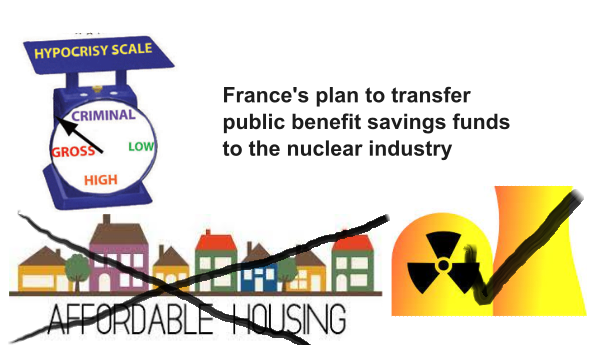
Will we be forced to choose between heating and housing one day? This
question may appear absurd at an individual level but much less so at the
level of the French state which constantly has to make trade-offs on
subjects as uncomfortable as this one.
According to French business daily
Les Echos, the government is contemplating the possibility of setting aside
a portion of the Livret A [savings account proposed by French banks] –
whose €375 billion is mainly devoted to social housing funding – and
investing a portion of the money in nuclear power.
Le Monde 12th Feb 2023
Financial disaster looms for France’s nuclear corporation EDF

EDF reported one of the biggest losses in French corporate history on
Friday, February 17, as fallout from the Ukraine war and idling nuclear
reactors spelled financial disaster for the state-controlled utility.
EDF struggled with a drop in electricity output last year as it had to close
several of France’s 56 nuclear reactors to fix corrosion problems while a
heatwave led to a diminution of hydro-power production.
While 2022 revenue rose 70% to €143.5 billion, EDF reported a record loss of €17.9 billion
which compared with a net profit of €5.1 billion in 2021. After Russia’s
invasion of Ukraine sent energy prices skyrocketing, the government
required EDF to sell energy under cost to consumers to help them afford
their bills.
Le Monde 17th Feb 2023
Pentagon-Funded Plymouth University Cancels Anti-War Academic: the militarization of higher education.

Pentagon-Funded Plymouth University Cancels Anti-War Academic: Reflections on How the US Empire Conquered Higher Education, CouterPunch BY T.J. COLES 17 Feb 23,
The US Empire is in the final and most dangerous stages of its quest for what the Pentagon calls “full spectrum dominance.” Having invaded and fought proxy wars in the oil-rich Middle East, it is now trying to break nuclear-armed Russia in another proxy war before attempting “regime change” in nuclear-armed China. We need not tarry on the potential consequences. Professor Noam Chomsky called it 20 years ago: this is hegemony or survival. Which one do you choose?
As the Empire races towards its biggest bet, using humanity and all other species on the planet as gambling chips, anti-war comment is tolerated less and less. For those who want to know what happened to me, see the Annex of this article for the leaked emails and background. Meanwhile, consider what is taking shape.
DELETING THE ENEMY
Critics of Western imperialism are silenced by the Empire’s witting and unwitting minions in increasingly knee-jerk ways. Google, which was developed with CIA money, has de-ranked anti-war websites, driving traffic to state-corporate outlets that promote imperialism. After buying YouTube, it then went on a de-platforming spree, banning and de-monetizing “conspiracy theorists,” left and right, who dare deviate from the increasingly narrow orthodoxy of acceptable thought.
Under the new McCarthyism of RussiaGate, the US Federal Bureau of Investigation has used the pretext of countering foreign disinformation to suspend and terminate political accounts. In 2020, following an evidence-free CNN report alleging that it was a front for the sanctioned nation of Iran, the FBI and Department of Justice seized the US domain for the website of the American Herald Tribune, founded by Dr. Anthony James Hall, who retired from his Canadian university, Lethbridge, following pressure from the Zionist Lobby and from individuals who accused him of being a “conspiracy theorist”—a cheap smear tactic employed against me by a cabal of staff at Plymouth University.
Meanwhile, the Twitter Files have exploded the myth that “social media” are independent corporate actors. Likewise, journalist Dr. Alan Macleod has documented the dozens of former spies now employed to police content at Facebook.
SHAME IS THE GAME
The opinions of self-described fact-checkers—like the Poynter Institute—are amplified by state-corporate media which engage in public humiliation rituals in the hope that retailers will pull magazines, academic institutions will fire staff, digital providers will demonetize accounts, and web hosts will drop entire sites and/or content……….
As governments contract out censorship to “fact-checkers,” critics of Empire are demonetized. Consortium News and Mint Press have seen their PayPal accounts frozen. PayPal’s pro-Trump co-founder, Peter Thiel, has made many millions of dollars from Pentagon contracts. Between 2007 and ’19, US taxpayers gave his Palantir Technologies $1.5 billion via the Department of Defense, particularly to spy on Afghans and Iraqis.
ACADEMIC OBLIVION
The above examples show how the US military and intelligence continue to influence the infrastructure through which much of today’s information travels. Another target is academia. But how serious is the problem?……………………………………………………..
THE MILITARIZATION OF HIGHER EDUCATION
Universities serve a variety of purposes, one of which is the development of new weapons for the US military. In the past, white voices critical of Empire would be tolerated as long as their non-university work did not grind the gears of Empire. That’s how Professor Chomsky, for instance, was able to get arrested protesting mass murder in Vietnam while receiving Pentagon money to undertake his linguistics research.
The technological origins of “full spectrum dominance” can perhaps be traced back to the outgoing Reagan and incoming George H.W. Bush administrations, under whom the Pentagon founded the Multidisciplinary University Research Initiative to further integrate with education and develop tools for things like the so-called Star Wars program (Strategic Defense Initiative). One consequence is that higher education became significantly influenced—maybe not full-spectrum dominated—by the eternal war machine.
By 2015, the Department of Defense (DoD), which in more honest times was called the Department of War, was investing $250 million of taxpayer money in universities. In that year, the DoD decided to look for international partners, of which the Britain was a natural first-choice. The Pentagon’s Basic Research Office Director, Robin Staffin, said: “we decided it was time to formalize cooperation between the U.S. and the U.K.”
DARPA is the Pentagon’s taxpayer-funded innovation arm. It used to stand for the Advanced Projects Research Agency, but PR experts realized that they’d better prefix it with the word “Defense.” In 2016, venture capitalist-turned-DARPA Director, Arati Prabhakar, said: “DARPA is reliant on research universities as one part of this huge ecosystem … [We] draw from the deep foundational research, almost always at places like great universities.”
For instance, the DoD recently said that the universities of Alabama-Huntsville, Florida International, Texas A&M Engineering Experiment Station, and others, have received funding to develop solutions for—are you ready?—“monitoring the health and status of hypersonic aeroshells” (heat shields for space systems, which are core elements of “full spectrum dominance.” The “health and status” of ordinary Americans, who still don’t have free coverage, is less important). Other projects include thermodynamic ducts for hypersonic vehicles sponsored by the usual suspects, like Boeing and Lockheed Martin.
FUNDING PLYMOUTH UNIVERSITY: DARPA’S DRIVE…………………………………………………
CONCLUSION
As universities continue designing weapons of mass murder, thought criminals in Western countries continue to face deplatforming and public shaming. Are their personal fates as severe as those of dissident academics in US-UK-supported regimes, like Saudi Arabia? Of course not. But that is not the point. An obvious chilling effect is created in which scholars striving for social justice and indeed the survival of the planet are silenced. The witting an unwitting minions of Empire are too obtuse to realize that by issuing penalties for expressing opinions, those penalties may one day be imposed upon them.
ANNEX (HISTORY, EMAIL EVIDENCE, REBUTTAL):
MY STORY……………………………………………………………………………….as I have lost my University position as a result of my political views, it is worth considering exactly what I write for Nexus (article by article) and that my articles give a left-wing voice to the so-called conspiracy research community, which is often dominated by right-wingers and apolitical people.
As one can see below, the bulk of my work for Nexus consists of critiques and exposés of US military and intelligence agencies. …………………………………………………………
T. J. Coles is director of the Plymouth Institute for Peace Research and the author of several books, including Voices for Peace (with Noam Chomsky and others) and Fire and Fury: How the US Isolates North Korea, Encircles China and Risks Nuclear War in Asia (both Clairview Books). https://www.counterpunch.org/2023/02/17/pentagon-funded-plymouth-university-cancels-anti-war-academic-reflections-on-how-the-us-empire-conquered-higher-education/
Betting on Ukraine victory was ‘suicidal’ – Seymour Hersh
https://www.rt.com/russia/571690-hersh-ukraine-nato-corruption/ 18 Feb 23
The West didn’t even want Kiev in NATO because of corruption concerns, the Pulitzer Prize-winning journalist says.
The US and its allies should have attempted to reach an agreement with Moscow as their belief that Ukraine can win a conflict against Russia is “suicidal,” iconic American investigative journalist Seymour Hersh has argued.
Speaking in a YouTube interview with the Consortium News outlet on Friday, Hersh accused the Biden administration of making “so many bad mistakes,” adding that “it’s impossible to believe just how dumb this leadership was.”
“It was suicidal to think you can win that war, that Ukraine can win the war [against Russia]. There’s just too much corruption. That was a very, very bad decision. We should have been pushing for peace, we should have made an agreement,” the former Pulitzer Prize winner insisted.
US President Joe Biden basically “blew off NATO in Europe” by telling allies that he is backing Ukraine with its “totally corrupt government,” Hersh added. The journalist also pointed out how Kiev glorifies Stepan Bandera, “the great pro-Nazi who killed Jews like crazy during World War II.”
It’s just silly not to right away assure the Russian government that we weren’t interested in making Ukraine a member of NATO,” Hersh stated, referring to long-standing concerns in Moscow. “NATO didn’t want Ukraine anyway because of the corruption.”
Hersh recently published a bombshell report which accused the US of sabotaging the Nord Stream pipelines last year. He cited an informed source as explaining that explosives were planted on the bottom of the Baltic Sea by US Navy divers under the guise of a NATO exercise back in June 2022. They were detonated in late September, rendering the pipelines, which were built to deliver Russian gas to Europe through Germany, inoperable.
US Secretary of State Antony Blinken, as well as Under Secretary for Political Affairs Victoria Nuland and National Security Advisor Jake Sullivan, are all “very hawkish,” according to the journalist. The trio “pushed Biden very hard” to go ahead with the sabotage because “they have long-standing incredible hatred for [Russian President Vladimir] Putin. It’s almost personal, I would guess,” Hersh claimed.
READ MORE: More Nord Stream ‘bombshells’ to come – Seymour Hersh
US National Security Council spokeswoman Adrienne Watson branded Hersh’s bombshell report “utterly false and complete fiction.” The journalist has promised even more revelations on how the pipelines were blown up.
1 This Month




Shut down the radiation-damaged Heysham nuclear reactors now
To see nuclear-related stories in greater depth and intensity – go to https://nuclearinformation.wordpress.com

Say No to NASA’s Reckless Nuclear Reactor on the Moon
Say No to NASA’s Reckless Nuclear Reactor on the Moon
-
Archives
- October 2026 (279)
- September 2026 (339)
- August 2026 (330)
- July 2026 (355)
- June 2026 (287)
- May 2026 (306)
- April 2026 (356)
- March 2026 (251)
- February 2026 (267)
- January 2026 (308)
- December 2025 (358)
- November 2025 (359)
-
Categories
- 1
- 1 NUCLEAR ISSUES
- business and costs
- climate change
- culture and arts
- ENERGY
- environment
- health
- history
- indigenous issues
- Legal
- marketing of nuclear
- media
- opposition to nuclear
- PERSONAL STORIES
- politics
- politics international
- Religion and ethics
- safety
- secrets,lies and civil liberties
- spinbuster
- technology
- Uranium
- wastes
- weapons and war
- Women
- 2 WORLD
- ACTION
- AFRICA
- Atrocities
- AUSTRALIA
- Christina's notes
- Christina's themes
- culture and arts
- Events
- Fuk 2022
- Fuk 2023
- Fukushima 2017
- Fukushima 2018
- fukushima 2019
- Fukushima 2020
- Fukushima 2021
- general
- global warming
- Humour (God we need it)
- Nuclear
- RARE EARTHS
- Reference
- resources – print
- Resources -audiovicual
- Weekly Newsletter
- World
- World Nuclear
- YouTube
-
RSS
Entries RSS
Comments RSS

