‘We need to wake up’: Algonquin leaders sound alarm over planned nuclear waste facility near Ottawa River
By Matteo Cimellaro | News, Urban Indigenous Communities in Ottawa | June 20th 2023
Four Algonquin chiefs spoke out on Tuesday, calling out the government and its private-sector contractor over what they say are inadequate consultations over a planned nuclear waste storage facility.
Last year, the Canadian Nuclear Safety Commission (CNSC) paused its decision to move ahead with the planned waste facility, located at the Canadian Nuclear Laboratories in Chalk River, Ont. The site is 180 kilometres north of Ottawa and sits within a kilometre of the Ottawa River, otherwise known as the Kichi Sibi in Algonquin.
The pause was intended to give more time for consultations with Kebaowek First Nation and Kitigan Zibi Anishinabeg, whose traditional territories circle the Ottawa River on both sides of Quebec and Ontario.
“It’s a huge victory for us,” Coun. Justin Roy of Kebaowek First Nation told Canada’s National Observer at the time.
But now, Algonquin leaders are slamming the CNSC for failing to give adequate time for meaningful consultation. The process only lasted six months, which the leaders argued is a short time frame given the challenges of negotiating funding agreements for Indigenous-led environmental assessments.
Still, the Algonquin-led assessment found the proximity to the Ottawa River, which supplies water to millions, including Algonquins, a major red flag. The river was given status of a Canadian Heritage River by Ontario and Quebec and it holds the utmost spiritual and historical importance for the Algonquin nation.
The assessment also pointed to potential risks to Indigenous harvesting rights and the environment, including contamination concerns to local moose, migratory birds and fish.
There are also concerns about tritium, a radioactive form of hydrogen, leaching from the nuclear waste into the Ottawa River, Chief Lance Haymond of Kebaowek First Nation said.
“We need to wake up and recognize what a danger Chalk River poses not only to the Algonquin people but to all Canadians, especially those living in the Ottawa-Gatineau area,” he added.
At the press conference, Haymond was flanked by Dylan Whiteduck, chief of Kitigan Zibi, and grand chiefs Savanna McGregor and Lisa Robinson, who are leaders of the Algonquin Anishinabeg Nation Tribal Council and Algonquin Nation Secretariat, respectively.
Elizabeth May, co-leader of the federal Green Party, sponsored the press conference. In brief comments, she pointed to the primary shareholder of the company that manages Canadian Nuclear Laboratories, criticizing the decision to build the facility so close to the Ottawa River.
Canadian Nuclear Laboratories is a subsidiary of the Crown corporation Atomic Energy Limited Corporation, but it is operated under contract by the Canadian National Energy Alliance, a private-sector consortium led primarily by SNC-Lavalin. The Canadian National Energy Alliance is responsible for the daily operations of the nuclear laboratories, as well as the decommissioning and management of nuclear waste from the facilities, according to the SNC-Lavalin website.
“I don’t think we had in mind that SNC-Lavalin would once again get its way,” she said, alluding to the company’s role in a scandal that rocked the federal government four years ago.
The Algonquin leaders are also calling foul on the consultation process for a divide-and-conquer strategy of picking which Algonquin nations to consult with, which Haymond calls a “continuation of colonialism.” Pikwakanagan First Nation signed a long-term relationship agreement with Canadian Nuclear Laboratories on June 9.
“It’s a First Nation who seemed to have forgotten their responsibilities and priorities as protectors of the land, protectors of the water,” he said.
Haymond notes Pikwakanagan was given years of consultation through the controversial organization Algonquins of Ontario, which local Algonquins have accused of dividing the nation and giving free passes to false Indigenous identity claims. The organization even named a building in Algonquin at the Canadian Nuclear Laboratories site.
An official hearing for the near-surface nuclear waste facility is scheduled for Aug. 10.
“We’ve been here for millennia, the Algonquin nation and our people,” Chief Whiteduck said.
“We’re still here, and we’re gonna be here for another 1,000 years. We’re hoping to deal with these contaminants that will be poured into our river.”
— With files from Natasha Bulowski
Plan to discharge water into Hudson River from closed nuclear plant sparks uproar

Michael Hill, Independent 21 June 23
The Indian Point nuclear plant along the Hudson River is at the
center of a controversy two years after it was shut down. The latest
flashpoint revolves around plans to release 1.3 million gallons of water
with traces of radioactive tritium into the river as part of the plant’s
decommissioning…………..
opponents along the river question the health and safety claims. They say the releases of radioactive water could be a step back for a once notoriously polluted river that is now a popular summer attraction for sailors, kayakers and swimmers.
Communities along the river have already passed resolutions opposing the discharges, and an online petition has gathered more than 440,000 signatures. Now a bill being considered in state Legislature on Tuesday sponsored by two Hudson Valley Democrats would ban those radiological discharges into the river.
“It leaves a bad taste in your mouth … the idea that we would be polluting our beautiful Hudson River with waste when we’ve spent so many years trying to clean it up. This shouldn’t be a dumping ground,” Assembly member Dana Levenberg said at a state Capitol rally for her bill.
The bill, approved by the state Senate earlier this month, was opposed by some union officials, who say it could interrupt the decommissioning and cause layoffs…………….. https://www.independent.co.uk/news/world/americas/hudson-river-ap-new-york-city-kathy-hochul-communities-b2361202.html
The Silent Slaughter of the Flower of Ukraine’s Youth
Now that the Ukrainian counteroffensive is underway, it is clear that the government and its Western allies are maintaining silence to conceal the brutal cost Ukraine’s brave young people are paying.
By Medea Benjamin | Nicolas J.S. Davies / Common Dreams. June 21, 2023
https://scheerpost.com/2023/06/21/the-silent-slaughter-of-the-flower-of-ukraines-youth/
As Ukraine prepared to launch its much heralded but long delayed counteroffensive, the media published a photograph of a Ukrainian soldier with his finger on his lips, symbolizing the need for secrecy to retain some element of surprise for this widely telegraphed operation.
Now that the offensive has been under way for two weeks, it is clear that the Ukrainian government and its Western allies are maintaining silence for quite a different reason: to conceal the brutal cost Ukraine’s brave young people are paying to recover small scraps of territory from Russian occupation forces, in what some are already calling a suicide mission.
Western pundits at first described these first two weeks of fighting as “probing operations” to find weak spots in Russia’s defenses, which Russia has been fortifying since 2022 with multiple layers of minefields, “dragon’s teeth,” tank-traps, pre-positioned artillery, and attack helicopters, unopposed in the air, that can fire 12 anti-tank missiles apiece.
On the advice of British military advisers in Kyiv, Ukraine flung Western tanks and armored vehicles manned by NATO-trained troops into these killing fields without air support or demining operations. The results have been predictably disastrous, and it is now clear that these are not just “probing” operations as the propaganda at first claimed, but the long-awaited main offensive.
A Western official with intelligence access told The Associated Press on June 14, “Intense fighting is now ongoing in nearly all sectors of the front… This is much more than probing. These are full-scale movements of armor and heavy equipment into the Russian security zone.”
Other glimpses are emerging of the reality behind the propaganda. At a press conference after a summit at NATO Headquarters, U.S. General Mark Milley warned that the offensive will be long, violent, and costly in Ukrainian lives.
“This is a very difficult fight. It’s a very violent fight, and it will likely take a considerable amount of time and at high cost,” Milley said.
Russian videos show dozens of Ukrainian tanks and armored vehicles lying smashed in minefields, and NATO military advisers in Ukraine have confirmed that it lost 38 tanks in one night on June 8, including newly delivered German-built Leopard IIs.
Rob Lee of the Foreign Policy Research Institute explained to TheNew York Times that the Russians are trying to inflict as many casualties and destroy as many vehicles as possible in the areas in front of their main defensive lines, turning those areas into lethal kill zones. If this strategy works, any Ukrainian forces that reach the main Russian defense lines will be too weakened and depleted to break through and achieve their goal of severing Russia’s land bridge between Donbas and Crimea.
Russia’s Ministry of Defense reported that Ukraine’s forces suffered 7,500 casualties in the first 10 days of the offensive. If Ukraine’s real losses are a fraction of that, the long, violent bloodbath that General Milley anticipates will destroy the new armored brigades that NATO has armed and trained, and serve only to escalate the gory war of attrition that has destroyed Mariupol, Sievierodonetsk, and Bakhmut, killing and wounding hundreds of thousands of young Ukrainians and Russians.
A senior European military officer in Ukraine provided more details of the carnage to Asia Times, calling Ukraine’s operations on June 8 and 9 a “suicide mission” that violated the basic rules of military tactics.
“We tried to tell them to stop these piecemeal tactics, define a main thrust with infantry support and do what they can,” he said. “They were trained by the British, and they’re playing Light Brigade,” he added, comparing the offensive to a suicidal charge into massive Russian cannon fire that wiped out Britain’s Light Cavalry Brigade in Crimea in 1854.
If Ukraine’s “Spring Offensive” plunges on to the bitter end, it could be more like the British and French Somme Offensive, fought near the French River Somme in 1916. After 19,240 British troops were killed on the first day (including Nicolas’s 20-year-old great-uncle, Robert Masterman), the battle raged on for more than four months of pointless, wanton slaughter, with over a million British, French, and German casualties. It was finally called off after advancing only six miles and failing to capture either of the two small French towns that were its initial objectives.
The current offensive was delayed for months as Ukraine and its allies grappled with the likelihood of the outcome we are now witnessing. The fact that it went ahead regardless reflects the moral bankruptcy of U.S. and NATO political leaders, who are sacrificing the flower of Ukraine’s youth in a proxy war they will not send their own children or grandchildren to fight.
As Ukraine launches its offensive, NATO is conducting Air Defender, the largest military exercise in its history, from June 12 to 23, with 250 warplanes, including nuclear-capable F-35s, flying from German bases to simulate combat operations in and over Germany, Lithuania, Romania, the North Sea, and the Baltic Sea. The exercise has led to at least 15 incidents between NATO and Russian aircraft in the skies near Lithuania.
It seems that nobody in NATO’s foreboding fortress in Brussels has stumbled on the concept of a “security dilemma,” in which supposedly defensive actions by one party are perceived as offensive threats by another and lead to a spiral of mutual escalation, as has been the case between NATO and Russia since the 1990s. Professor of Russian history Richard Sakwa has written, “NATO exists to manage the risks created by its existence.”
These risks will be evident in the upcoming NATO Summit in Vilnius on July 11-12, where Ukraine and its eastern allies will be pushing for Ukraine membership, while the U.S. and western Europe insist that membership cannot be offered while the war rages on and will instead offer “upgraded” status and a shorter route to membership once the war ends.
The continued insistence that Ukraine will one day be a NATO member only means a prolongation of the conflict, as this is a red line that Russia insists cannot be crossed. That’s why negotiations that lead to a neutral Ukraine are key to ending the war.
But the United States will not agree to that as long as President Joe Biden keeps U.S. Ukraine policy firmly under the thumbs of hawkish neoconservative desk warriors like Antony Blinken and Victoria Nuland at the State Department and National Security Adviser Jake Sullivan at the White House. Pressure to keep escalating U.S. involvement in the war is also coming from Congress, where Republicans accuse Biden of “hemming and hawing” instead of “going all in” to help Ukraine.
Paradoxically, the Pentagon and intelligence agencies are more realistic than their civilian colleagues about the lack of any military solution. The Chairman of the Joint Chiefs of Staff, General Milley, has called for diplomacy to bring peace to Ukraine, and U.S. intelligence sources have challenged dominant false narratives of the war in leaks to Newsweek and Seymour Hersh, telling Hersh that the neocons are ignoring genuine intelligence and inventing their own, just as they did to justify the invasion of Iraq in 2003.
With the retirement of Deputy Secretary of State Wendy Sherman, the State Department is losing the voice of a professional diplomat who was President Barack Obama’s chief negotiator for the JCPOA with Iran and urged Biden to rejoin the agreement, and who has taken steps to moderate U.S. brinkmanship toward China. While publicly silent on Ukraine, Sherman was a quiet voice for diplomacy in a war-mad administration.
Many fear that Sherman’s job will now go to Nuland, the leading architect of the ever-mounting catastrophe in Ukraine for the past decade, who already holds the #3 or #4 job at State as Under Secretary of State for Political Affairs.
Other departures from the senior ranks at State and the Pentagon are likely to cede more ground to the neocons. Colin Kahl, the Under Secretary of Defense for Policy, who worked with Sherman on the JCPOA, opposed sending F-16s to Ukraine, and has maintained that China will not invade Taiwan in the near future. Kahl is leaving the Pentagon to return to his position as a professor at Stanford, just as China hawk General C.Q. Brown will replace General Milley as Chairman of the Joint Chiefs when Milley retires in September.
Meanwhile, other world leaders continue to push for peace talks. A delegation of African heads of state led by President Cyril Ramaphosa of South Africa met with President Volodymyr Zelenskyy in Kyiv, and President Vladimir Putin in Moscow on June 17, to discuss the African peace plan for Ukraine.
President Putin showed the African leaders the 18-point Istanbul Agreement that a Ukrainian representative had signed back in March 2022, and told them that Ukraine had thrown it in the “dustbin of history,” after the now disgraced Boris Johnson told Zelenskyy the “collective West” would only support Ukraine to fight, not to negotiate with Russia.
The catastrophic results of the first two weeks of Ukraine’s offensive should focus the world’s attention on the urgent need for a ceasefire to halt the daily slaughter and dismemberment of hundreds of brave young Ukrainians, who are being forced to drive through minefields and kill zones in Western gifts that are proving to be no more than U.S.- and NATO-built death-traps
‘Truly shocking’: UK has enough plutonium to make almost 20,000 nukes

A study published by a university in Nagasaki has revealed that the UK has enough stockpiled plutonium to make almost 20,000 atomic warheads with the same power as the bomb which totally-destroyed that Japanese city in August 1945.
The 2023 Fissile Material Directory[i] is published in June each year by the Research Center for Nuclear Weapons Abolition (RECNA)[ii], based at Nagasaki University. RECNA has been established for over twenty years as an educational and research institute at a university that has a medical faculty with a first-hand experience of the horror of nuclear weapons. Its primary goal is achieving a world free from nuclear weapons.
In January, the institute was visited by UK/Ireland Nuclear Free Local Authorities Secretary Richard Outram, where he met Vice-Director Professor Tatsujiro Suzuki.
The study lists the UK as holding 119.7 tons of plutonium, the second highest stockpile in the world after Russia with 191.5 tons, and 22.6 tons of Highly Enriched Uranium. The plutonium stockpile is said to be sufficient to arm 19,947 atom bombs, like the ‘Fat Man’ bomb dropped on Nagasaki on 9 August 1945, whilst the uranium stockpile has the potential to be turned into a further 355 devices comparable to the ‘Little Boy’ bomb dropped on Hiroshima three days earlier.
The Nagasaki bomb is estimated to have killed 35,000 – 40,000 people on the day and the Hiroshima bomb about twice that many.
The UK Government and nuclear industry has conceded in the 2022 UK Radioactive Material Inventory that 113 tons of UK-owned plutonium are currently managed by the Nuclear Decommissioning Authority, whilst a further 4 tons are in semi-assembled MOX or other fuel components. An additional 24 tons of foreign-owned plutonium are also held, a further legacy of the costly failure of the UK’s experiment with reprocessing[iii].
Across the world, RECNA estimates that 552 tons of plutonium and 1,260 tons of HEU are held, much of the latter in military hands. These are all deemed to be fissile materials and together could arm 92,000 plutonium bombs like the one used at Nagasaki and almost 20,000 uranium devices like that deployed at Hiroshima.
The Nuclear Free Local Authorities are gravely concerned about the future use of Britain’s plutonium stockpile. In recent weeks, the UK Government and the Nuclear Decommissioning Authority have published plans suggesting that some of this material should be used as fuel for a new generation of nuclear reactors.
The NFLA fears that burning plutonium as fuel will simply lead to the creation of more nuclear waste, that such material could be a target for terrorists or hostile state actors, especially in transit, and that these actions could lead to nuclear weapon proliferation. In its response to the government and industry plan the NFLA called for fissile material to be put ‘beyond use’ for all time[iv].
Responding to the RECNA report, Councillor Lawrence O’Neill, Chair of the NFLA Steering Committee, said:
“The data published by RECNA is both astonishing and truly shocking. If only a tiny fraction of Britain’s stockpile of fissile materials ended up in the wrong hands for use by terrorists or in military action then the consequences could be too awful to contemplate. In the UK, and elsewhere in the world, anti-nuclear campaigners need to continue to work together to lobby our respective governments to make these stockpiles safe and beyond use, and the time to do that is now.”
Judge Who Ruled Against Assange Built Career as Barrister Defending UK Government
“absurd that a single judge can issue a three-page decision that could land Julian Assange in prison for the rest of his life and permanently impact the climate for journalism around the world.”
Jonathan Swift, the High Court judge who has just rejected Julian Assange’s attempt to halt his extradition to the US, is the government’s former top lawyer and previously defended the Defence and Home Secretaries.
SCHEERPOST, By Mark Curtis / Declassified UK, 19 June 23
- Swift was entrusted to act for the Defence and Home Secretaries in at least nine legal cases
- His “favourite clients were the security and intelligence agencies” while representing the government
onathan Swift, the High Court judge who has rejected Julian Assange’s appeal against extradition to the US, has a long history of working for the government departments that are now persecuting the WikiLeaks founder.
Swift, who ruled against Assange on 6 June, was formerly the government’s favourite barrister.
He worked as ‘First Treasury Counsel’ – the government’s top lawyer – from 2006 to 2014, a position in which he advised and represented the government in major litigation.
Swift acted for the Defence and Home Secretaries in at least nine cases, Declassified has found.
…………………….. It was reported in 2013 that Swift had been paid nearly a million pounds – £975,075 – over the previous three years for representing the government.
Swift now presides over Assange’s extradition case being fought by the Home Office for whom he previously worked.
As with previous judges who have ruled against Assange, the case raises serious concerns about institutional conflicts of interests at the heart of the UK legal system…………………………………………
Ruling
In his rejection of the appeal by Assange’s lawyers, Swift curtly dismissed all eight grounds to their arguments as “no more than an attempt to re-run the extensive arguments made to and rejected by the District Judge”, who previously ruled on the case.
Media freedom group Reporters Sans Frontieres said Swift’s ruling brought Assange “dangerously close to extradition”.
It added it was “absurd that a single judge can issue a three-page decision that could land Julian Assange in prison for the rest of his life and permanently impact the climate for journalism around the world.”
The US government seeks to extradite Assange in order to try him in connection with WikiLeaks’ publication of leaked classified documents that informed public interest reporting around the world.
Assange faces a possible 175 years in prison and would be the first publisher prosecuted under the US Espionage Act. https://scheerpost.com/2023/06/19/judge-who-ruled-against-assange-built-career-as-barrister-defending-uk-government/
The Reverse Cuban Missile Crisis
America now plans to install tactical nuclear weapons in Romania and Poland.
BY TYLER DURDEN. WEDNESDAY, JUN 21, 2023 – Authored by Gilbert Doctorow, https://www.zerohedge.com/geopolitical/reverse-cuban-missile-crisis
What I am about to say is surely known and under analysis in the American intelligence agencies. It is being used by the Pentagon to quietly change its nuclear force posture in Europe. However, we hear not a word about it in the media, not in mainstream, and not yet in alternative news.
I maintain that it is very important for it to be heard and reflected upon by the general public in the United States and in Europe, disagreeable though it may be at the start of a new week. So here goes…
Last Friday when I published my selective account of the Q&A session with President Vladimir Putin at the culmination point of the St Petersburg International Economic Forum I omitted one important issue:
how Russia will respond to the dispatch of “Ukrainian” F-16s from some air base in a NATO country into the war zone in Ukraine. I was considering remedying that oversight on Saturday morning when a comment from one reader forced my hand. She wrote in that Italy’s daily newspaper La Repubblica quoted Putin as saying on Friday Russia will destroy such a base in response. I responded on Saturday in the Comments section that the Russian President had in fact been evasive in his comment, saying only that Russia could destroy such a base and was now taking the issue under advisement.
However, yesterday evening’s edition of the Vladimir Solovyov talk show indicates that the Republicca reporter was closer to the truth than I. A patient and knowledgeable Russian colonel in retirement who is a frequent guest on the talk show explained that the Kremlin is now considering exactly with what means to destroy such a NATO air base, not whether to do it. And the likely means will be use of tactical nuclear weapons on a Ramstein or whatever NATO base is involved. We may say that Germany is placing itself in the bulls-eye of any escalation in the Ukraine war if it proceeds with the F-16s to Ukraine program.
Why all the fuss over the F-16s, you may ask. After all, Putin has said loud and clear that Russia will destroy the F-16s in the air just as it has been destroying the Leopard tanks and America’s Bradley armored personnel carriers while pushing back the ongoing Ukrainian counter-offensive. To understand better, we have to thank the good colonel once again. He alerted us to an important detail that you will not find mentioned in The New York Times:
the first F-16s scheduled to be supplied to the Ukrainian Air Force are from Belgium and Denmark, and are all nuclear-capable, which is not a necessary feature of these planes.
Since the Russians are unable to determine what kind of munitions the “Ukrainian” F-16s will actually be delivering to the war zone, they must assume that they are carrying tactical nuclear bombs intended to be dropped on the Russian Army troop concentrations. The effect of such an attack could be devastating, hence the Russian threat to the air bases from which such planes are launched.
The next important revelation made during the Solovyov show came with respect to the first delivery of tactical nuclear weapons to Minsk which was marked by a visit to Belarus and interview with Lukashenko by the co-host of the Sixty Minutes news and discussion show Olga Skabeyeva. In answer to her question about where the nuclear warheads are being stored, Lukashenko said ‘everywhere.’ The meaning of this was kindly deciphered for us laymen by the colonel in retirement on the Solovyov program: this signifies a cardinal shift in the Russian handling of tactical nuclear arms away from their traditional separation of the warheads kept in a central storage far from the delivery carriers to the method used by the U.S. military with respect to its tactical nuclear weapons in Europe. The Americans, he said stored the nukes just under the jets that would be used to deliver them. Now in Belarus, the warheads will also be just next to the planes and Iskander missiles that will carry them. This means that the time to launch will depend only on the time for approval from the Boss. And with respect to that, Lukashenko told Skabeyeva that he had just to make a phone call to Vladimir Vladimirovich and approval would be instantaneous.
Why such a hair-trigger mechanism for unleashing nuclear weapons to defend Belarus? For an answer to that, go to Monday’s article in The Financial Times on how Poland is now preparing hundreds of Belarus fighters to go across the border and overthrow Lukashenko. To which I can only say: Warsaw, watch out! Lukashenko is one bold and decisive defender of his country, as his standing on the streets with a Kalashnikov in his hands when there were Western financed and promoted street demonstrations in Minsk aiming to overthrow him.
Still another item from the Solovyov show demanding our attention concerns what the good colonel calls the American response to the shipment of nuclear arms to Belarus: America now plans to install tactical nuclear weapons in Romania and Poland. Why, one might ask, in those two countries? For that you need only consider what the Kremlin has been saying for more than a decade about the U.S. bases set up in both countries supposedly to house anti-ballistic missile systems intended to bring down Iranian missiles fired on Europe. The Russians always objected that these installations would be dual-purpose and were a cover for placing nuclear-armed cruise missiles directed against themselves. Now if the USA indeed puts such missiles into the two countries, the Russian claims will have been vindicated and Washington is shown, yet again, to be a blatant liar on the world stage.
Finally, the colonel gave us an invaluable insight to changes in Russian thinking on tactical nuclear weapons which we otherwise missed. I have in mind Putin’s answer at the Forum to the question of whether Russia would use tactical nuclear weapons in the Ukraine theater. Putin’s loud and clear ‘no’ was, of course, an answer to the proposals of Sergei Karaganov for preemptive and instructive nuclear strikes in his just published essay in the magazine Russia in Global Affairs. As I reported, Putin went on to say that Russia has no need to show force by some preemptive strike because everyone knows it has many more tactical weapons than the West. And while the United States has called for talks on reduction of stockpiles of such weapons, Russia will not enter into such talks, and says to the West, “fuck you,” if I may translate his rude remark in Russian into corresponding four-letter English.
That last remark brought smiles to the faces of many Russians in the audience. But it was not just theatrics, says the good colonel: in fact Russia had been talking with Americans about the possibility of reducing stockpiles, but now, in the context of the NATO proxy war it has no intention of resuming such talks.
With that I end today’s survey of our dismal progression on the way to Armageddon.
Prodding the Pentagon
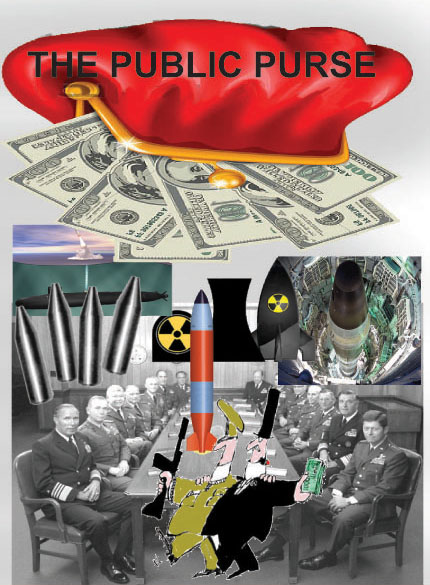
Politico 6/21/23
FIRST IN NATSEC DAILY — PRODDING THE PENTAGON: A bipartisan group of senators introduced legislation today that would require the Defense Department to pass an independent audit by the end of fiscal year 2024.
If enacted, the Audit the Pentagon Act of 2023 would require any DOD component that fails to pass an audit to return 1 percent of its budget to the Treasury for deficit reduction.
“If we are serious about spending taxpayer dollars wisely and effectively, we have got to end the absurdity of the Pentagon being the only agency in the federal government that has never passed an independent audit,” wrote Sen. BERNIE SANDERS (I-Vt.), who co-led the bill alongside CHUCK GRASSLEY (R-Iowa).
Co-sponsors include Sens. RON WYDEN (D-Ore.), MIKE LEE (R-Utah), ELIZABETH WARREN (D-Mass.), MIKE BRAUN (R-Ind.), JEFF MERKLEY (D-Ore.), RAND PAUL (R-Ky.), ED MARKEY (D-Mass.), and TAMMY BALDWIN (D-Wis.).
The Pentagon, which has a budget totaling $886 billion for fiscal year 2024, has long come under fire for excessive spending. Calls for oversight have ramped up in recent months after reports of massive price gouging by defense contractors, who will receive almost half of the budget this year.
Russian MP believes Ukrainian counteroffensive will end in July – Zelensky says operation is not going well
https://www.rt.com/russia/578360-ukrainian-counteroffensive-end-weeks-mp/ 21 June 23
Moscow’s troops are likely to repel Kiev’s offensive in July and launch an attack of their own, Andrey Kartapolov has claimed.
Kiev’s forces will exhaust their offensive capabilities in July if the current Ukrainian casualty rate persists, the head of Russia’s State Duma Defense Committee, Andrey Kartapolov, said on Tuesday.
Ukrainian troops have lost some 900 soldiers to deaths and injuries over the past 24 hours alone, the colonel general explained. According to Kartapolov, they have also lost nine tanks and dozens of armored vehicles over the same period. “If it continues at this pace, I believe we will finish repelling [this offensive] in three weeks and move on to dynamic actions ourselves,” the MP predicted in an appearance on the ‘Solovyov Live’ show.
The lawmaker claimed that Ukraine had already lost around 20,000 soldiers out of the 40,000 to 50,000 it had reportedly trained for the offensive. While he did not name his sources, he claimed the much-awaited Ukrainian operation had largely failed.
“Every tactic they have used has not worked as of now,” he said. Kiev’s troops did not advance further than the Russian forward defense area security zone and did not even reach the first defense line, the MP added.
According to the Russian Defense Ministry, over 600 Ukrainian servicemen have been killed over the past 24 hours, as Kiev’s troops continued their attacks on Russian positions. The Ukrainian forces also lost dozens of armored vehicles, as well as a dozen artillery pieces, including at least three US-made M777 howitzers, the ministry revealed in its daily briefing on Tuesday.
Kiev’s large-scale offensive began on June 4. Ukrainian troops have suffered heavy losses in the attacks, which have been repelled by Russian forces, according to the Russian Defense Ministry.
Last week, it said that 7,500 of Kiev’s frontline troops had either been killed or wounded. Russian President Vladimir Putin also said last week that Kiev had lost up to 30% of the heavy equipment supplied to it by the West.
Scientists monitoring ‘doomsday’ glacier in Antarctic warn climate change happening faster than ever before.

Collapse of the Thwaites glacier and its accompanying ice sheet could lead to more than three metres of sea level rise. The British Antarctic Survey is hoping to find out how fast it might collapse
i news, By Daniel Capurro, Environment Correspondent, June 20, 2023
Antarctica is changing at “a pace that we’ve never seen before” with the potential collapse of key ice sheets threatening three metres of sea level rise in a century, the British Antarctic Survey (BAS) has warned.
Scientists at the BAS, which is launching a new 10-year strategy, are part of a multinational effort to monitor the Thwaites glacier, which has been dubbed the “doomsday glacier”.
The river of ice has retreated more than eight miles since the 90s and is already responsible for 4 per cent of global sea level rises. Were it to melt entirely, this would cause a rise in the sea level of 65 centimetres.
More worryingly, it is thought to be both the keystone and the “weak underbelly” of the West Antarctic Ice Sheet.
If Thwaites were to pass a tipping point and be lost completely, said the BAS, it could potentially lead other glaciers around it to rapidly disintegrate and eventually to the collapse of the entire ice sheet.
Were that to happen, global sea levels would rise by more than three metres, with Cambridge, the headquarters of the BAS, suddenly finding itself on the edge of saltwater marshes.
“There’s this common perception of sea level changes a few millimetres a year, and therefore we all relaxed thinking what are a few millimetres?” said Dr Dominic Hodgson, head of the Ice Sheets and Climate Change team at the British Antarctic Survey. “But when we look back at the historical record, we can see that in the past when ice sheets melted, they do in very non-linear jumps.”
There are periods of meltwater pulses, where essentially an ice sheet collapses and the sea level rises by several metres in the 100 years or so. It’s really rapid.”
BAS scientists are now racing to understand the composition of the bedrock beneath the glacier. Depending on how hard or soft it is could affect whether the glacier takes just five years to disappear or 500, although Dr Alex Brisbourne, who is part of the bedrock team, said the worst-case scenarios already appeared unlikely.
Even without such a collapse, the picture from the Polar regions is a troubling one. “We’ve seen extreme temperatures in Antarctica in the last couple of years, over 20°C, which is completely unsustainable for keeping ice,” said Dr Hodgson.
“We’ve got serious problems happening, starting in the polar regions and spreading out to the rest of the planet that we have to address now,” he said………….
more https://inews.co.uk/news/environment/scientists-racing-doomsday-glacier-change-faster-ever-2422082
Chinese astronauts install radiation-exposure experiment outside Tiangong space station
By Andrew Jones, 21 June 23, https://www.space.com/astronauts-install-radiation-experiment-china-tiangong-space-station
China plans to conduct radiation experiments on plant seeds, microorganisms and small animals.
China is running a biological radiation exposure experiment outside its space station.
The country’s Shenzhou 16 astronauts — Jing Haipeng, Zhu Yangzhu and Gui Haichao — installed the experiment outside the Tiangong space station‘s Mengtian science module on June 10, China’s National Space Science Center (NSSC) announced in a statement.
The experiment was deployed using Mentian’s dedicated payload airlock and attached to an external payload adapter using the space station’s small robotic arm.
The experiment payload contains 13 sample box units loaded with biomaterials. These are designed to study the impact of cosmic radiation and microgravity on organisms, the origin and evolution of life and the development of space radiation mutagenic resources.
The equipment can be used for in-orbit experiments on biological samples, including plant seeds, microorganisms and small animals, according to NSSC. The temperature inside each sample container unit can be adjusted to suit the organisms it is hosting.
On-orbit medical research involving space radiation biological exposure is of great significance to supporting China’s human spaceflight program. That program is ambitious, with plans to launch long-term crewed missions in Earth orbit and send people to the surface of the moon, the Chinese-language outlet Science and Technology Daily reported.
The experiment payload was developed jointly by the NSSC and Dalian Maritime University. It is intended to operate for five years and is planned to be used for several scientific projects.
The Shenzhou 16 crew arrived at Tiangong on May 30 and will remain aboard the space station until November.
Kiev planning strike on Russia with Western-made missiles – Moscow
https://www.rt.com/russia/578329-himars-strike-russia-shoigu/ 21 June 23,
Attacks with Storm Shadow and HIMARS missiles outside zone of active hostilities will trigger retaliation, minister has warned
The Ukrainian military leadership has plans to use Western weapons to strike parts of Russia that are not part of the active zone of hostilities, including Crimea, Russian Defense Minister Sergey Shoigu has warned.
In particular, officials in Kiev want to use HIMARS multiple rocket launchers and Storm Shadow air-launched cruise missiles, he said. The weapon systems have been delivered to Kiev by the US and the UK respectively and, if such attacks are launched, it would escalate the NATO nations’ involvement in the conflict, according to Shoigu.
Such an operation will “result in immediate strikes against the decision-making centers in the territory of Ukraine,” he stated. The defense minister was speaking on Tuesday during a high-profile meeting in his department.
The minister also offered a brief update on the special military operation in Ukraine, stating that since June 4 Kiev’s forces launched 263 attacks against Russian positions. “All of them were repelled, the enemy failed to reach its goals,” he added.
The Ukrainian government this month launched its long-anticipated counteroffensive. So far, it has failed to achieve significant advances on the ground, according to Russian reports and to accounts in Western media.
The US and its allies have supplied Western-made military hardware worth billions of dollars in preparation for the Ukrainian operation, including main battle tanks that they’d previously hesitated to offer.
The Russian military claimed to have destroyed a significant portion of the arsenal in the past two weeks, as Ukrainian forces failed to breach minefields or to deal with Russian advantage in artillery firepower and air superiority.
The delivery in May of Storm Shadow missiles was another move to give Ukraine additional military capabilities ahead of the counteroffensive. These have a range of up to 300 kilometers (200 miles), which is superior to other weapons that Kiev has access to.
The Russian Ministry of Defense regularly reports intercepting the British-made weapons in its regular updates on the Ukraine campaign.
The Imminent Extradition of Julian Assange and the Death of Journalism

Julian Assange’s legal options have nearly run out. He could be extradited to the U.S. this week. Should he be convicted in the U.S., any reporting on the inner workings of power will become a crime.
By Chris Hedges / Original to ScheerPost more https://scheerpost.com/2023/06/18/chris-hedges-the-imminent-extradition-of-julian-assange-and-the-death-of-journalism/?utm_source=rss&utm_medium=rss&utm_campaign=chris-hedges-the-imminent-extradition-of-julian-assange-and-the-death-of-journalism
High Court Judge Jonathan Swift — who previously worked for a variety of British government agencies as a barrister and said his favorite clients are “security and intelligence agencies” — rejected two applications by Julian Assange’s lawyers to appeal his extradition last week. The extradition order was signed last June by Home Secretary Priti Patel. Julian’s legal team have filed a final application for appeal, the last option available in the British courts. If accepted, the case could proceed to a public hearing in front of two new High Court judges. If rejected, Julian could be immediately extradited to the United States where he will stand trial for 18 counts of violating the Espionage Act, charges that could see him receive a 175-year sentence, as early as this week.
The only chance to block an extradition, if the final appeal is rejected, as I expect it will be, would come from the European Court of Human Rights (ECtHR). The parliamentary arm of the Council of Europe, which created the ECtHR, along with their Commissioner for Human Rights, oppose Julian’s “detention, extradition and prosecution” because it represents “a dangerous precedent for journalists.” It is unclear if the British government would abide by the court’s decision — even though it is obligated to do so — if it ruled against extradition, or if the U.K. would extradite Julian before an appeal to the European court can be heard. Julian, once shipped to the U.S., would be put on trial in the U.S. District Court for the Eastern District of Virginia where most espionage cases have been won by the U.S. government.
Judge Vanessa Baraitser at Westminster Magistrates’ Court refused to authorize the U.S. government’s extradition request in Jan. 2021 because of the severity of the conditions Julian would endure in the U.S. prison system.
“Faced with the conditions of near total isolation without the protective factors which limited his risk at [Her Majesty’s Prison] Belmarsh, I am satisfied the procedures described by the U.S. will not prevent Mr. Assange from finding a way to commit suicide,” said Baraitser when handing down her 132-page ruling, “and for this reason I have decided extradition would be oppressive by reason of mental harm and I order his discharge.”
Baraitser’s decision was overturned after an appeal by U.S. authorities. The High Court accepted the conclusions of the lower court about increased risk of suicide and inhumane prison conditions. But it also accepted four assurances in U.S. Diplomatic Note no. 74, given to the court in Feb. 2021, which promised Julian would be well treated. The U.S. government claimed that its assurances “entirely answer the concerns which caused the judge [in the lower court] to discharge Mr. Assange.” The “assurances” state that Julian will not be subject to Special Administrative Measures (SAMs).
They promise that Julian, an Australian citizen, can serve his sentence in Australia if the Australian government requests his extradition. They promise he will receive adequate clinical and psychological care. They promise that, pre-trial and post-trial, Julian will not be held in the Administrative Maximum Facility (ADX) in Florence, Colorado. No one is held pre-trial in ADX Florence. But it sounds reassuring. ADX Florence is not the only supermax prison in the U.S. Julian can be placed in one of our other Guantanamo-like facilities in a Communications Management Unit (CMU). CMUs are highly restrictive units that replicate the near total isolation imposed by SAMs.
None of these “assurances” are worth the paper they are written on. All come with escape clauses. None are legally binding. Should Julian do “something subsequent to the offering of these assurances that meets the tests for the imposition of SAMs or designation to ADX” he will, the court conceded, be subject to these harsher forms of control.
If Australia does not request a transfer it “cannot be a cause for criticism of the USA, or a reason for regarding the assurances as inadequate to meet the judge’s concerns,” the ruling read. And even if that were not the case, it would take Julian 10 to 15 years to appeal his sentence up to the U.S. Supreme Court, which would be more than enough time to destroy him psychologically and physically.
No doubt the plane waiting to take Julian to the U.S. will be well stocked with blindfolds, sedatives, shackles, enemas, diapers and jumpsuits used to facilitate “extraordinary renditions” conducted by the CIA.
The extradition of Julian will be the next step in the slow-motion execution of the publisher and founder of WikiLeaks and one of the most important journalists of our generation. It will ensure that Julian spends the rest of his life in a U.S. prison. It will create legal precedents that will criminalize any investigation into the inner workings of power, even by citizens from another country. It will be a body blow to our anemic democracy, which is rapidly metamorphosing into corporate totalitarianism.
I am as stunned by this full frontal assault on journalism as I am by the lack of public outrage, especially by the media. The very belated call from The New York Times, The Guardian, Le Monde, Der Spiegel and El País — all of whom published material provided by WikiLeaks — to drop the extradition charges is too little too late. All of the public protests I have attended in defense of Julian in the U.S. are sparsely attended. Our passivity makes us complicit in our own enslavement.
Julian’s case, from the start, has been a judicial farce.
Former Ecuadorian President Lenin Moreno terminated Julian’s rights of asylum as a political refugee, in violation of international law. He then authorized London Metropolitan Police to enter the Ecuadorian Embassy — diplomatically sanctioned sovereign territory — to arrest a naturalized citizen of Ecuador. Moreno’s government, which revoked Julian’s citizenship, was granted a large loan by the International Monetary Fund for its assistance. Donald Trump, by demanding Julian’s extradition under the Espionage Act, criminalized journalism, in much the same way Woodrow Wilson did when he shut down socialist publications such as The Masses.
The hearings, some of which I attended in London and others of which I sat through online, mocked basic legal protocols. They included the decision to ignore the CIA’s surveillance and recording of meetings between Julian and his attorneys during his time as a political refugee in the embassy, eviscerating attorney-client-privilege. This alone should have seen the case thrown out of court. They included validating the decision to charge Julian, although he is not a U.S. citizen, under the Espionage Act. They included Kafkaesque contortions to convince the courts that Julian is not a journalist. They ignored Article 4 of the U.K.-U.S. extradition treaty that prohibits extradition for political offenses. I watched as the prosecutor James Lewis, representing the U.S., gave legal directives to Judge Baraitser, who promptly adopted them as her legal decision.
The judicial lynching of Julian has far more in common with the dark days of Lubyanka than the ideals of British jurisprudence.
The debate over arcane legal nuances distracts us from the fact that Julian has not committed a crime in Britain, other than an old charge of breaching bail conditions when he sought asylum in the Ecuadorian Embassy. Normally this would entail a fine. He was instead sentenced to a year in Belmarsh prison and has been held there since April 2019.
The decision to seek Julian’s extradition, contemplated by Barack Obama’s administration, was pursued by the Trump administration following WikiLeaks’ publication of the documents known as Vault 7, which exposed the CIA’s cyberwarfare programs designed to monitor and take control of cars, smart TVs, web browsers and the operating systems of most smart phones, as well as Microsoft Windows, MacOS and Linux.
Julian, as I noted in a column filed from London last year, is targeted because of the Iraq War Logs, released in Oct. 2010, which document numerous U.S. war crimes, including images seen in the Collateral Murder video, of the gunning down of two Reuters journalists and 10 other civilians and severely injuring two children.
He is targeted because he made public the killing of nearly 700 civilians who had approached too closely to U.S. convoys and checkpoints, including pregnant women, the blind and deaf, and at least 30 children
He is targeted because he exposed more than 15,000 unreported deaths of Iraqi civilians and the torture and abuse of some 800 men and boys, aged between 14 to 89, at Guantánamo Bay detention camp.
He is targeted because he showed us that Hillary Clinton in 2009 ordered U.S. diplomats to spy on U.N. Secretary General Ban Ki-moon and other U.N. representatives from China, France, Russia, and the U.K., spying that included obtaining DNA, iris scans, fingerprints, and personal passwords, all part of the long pattern of illegal surveillance that included eavesdropping on U.N. Secretary General Kofi Annan in the weeks before the U.S.-led invasion of Iraq in 2003.
He is targeted because he exposed that Obama, Hillary Clinton and the CIA backed the June 2009 military coup in Honduras that overthrew the democratically-elected president Manuel Zelaya, replacing him with a murderous and corrupt military regime.
He is targeted because he released documents that revealed the United States secretly launched missile, bomb and drone attacks on Yemen, killing scores of civilians.
He is targeted because he made public the off-the-record talks Hillary Clinton gave to Goldman Sachs, talks for which she was paid $657,000, a sum so large it can only be considered a bribe, as well as her private assurances to Wall Street that she would do their bidding while promising the public financial regulation and reform.
For revealing these truths alone he is guilty.
The U.S. court system is even more draconian than the British court system. It can use SAMs, anti-terrorism laws and the Espionage Act to block Julian from speaking to the public, being released on bail, or seeing the “secret” evidence used to convict him.
The CIA was created to carry out assassinations, coups, torture, kidnapping, blackmail, character assassination and illegal spying. It has targeted U.S. citizens, in violation of its charter. These activities were exposed in 1975 by the Church Committee hearings in the Senate and the Pike Committee hearings in the House.
Working with UC Global, the Spanish security firm in the embassy, the CIA put Julian under 24-hour video and digital surveillance. It discussed kidnapping and assassinating him while he was in the embassy, which included plans of a shoot-out on the streets with involvement by London Metropolitan Police. The U.S. allocates a secret black budget of $52 billion a year to hide multiple types of clandestine projects carried out by the National Security Agency, the CIA, and other intelligence agencies, usually beyond the scrutiny of Congress. All these clandestine activities, especially after the attacks of 9/11, have massively expanded.
Senator Frank Church, after examining the heavily redacted CIA documents released to his committee, defined the CIA’s covert activity as “a semantic disguise for murder, coercion, blackmail, bribery, the spreading of lies.”
The CIA and intelligence agencies, along with the military, all of which operate without effective Congressional oversight, are the engines behind Julian’s extradition. Julian inflicted, by exposing their crimes and lies, a grievous wound. They demand vengeance. The control these forces seek abroad is the control they seek at home.
Julian may soon be imprisoned for life in the U.S. for journalism, but he won’t be the only one.
Will upcoming NATO summit launch forever war in Europe?

Zelensky said two weeks ago that Ukraine would not even attend the Vilnius Summit unless given a firm signal on its eventual membership.
Pressure is mounting to make some sort of formal declaration over Ukraine’s membership at meetings in Vilnius next month.
JUNE 16, 2023, David Sacks, https://responsiblestatecraft.org/2023/06/16/will-upcoming-nato-summit-launch-forever-war-in-europe/
An article in the New York Times on Wednesday claimed that pressure is building on Biden to announce a timetable for Ukrainian membership in NATO at its Vilnius Summit next month.
Supposedly Biden is “isolated” among NATO allies in his reluctance to do so, even though that claim is contradicted by the story’s own last paragraph (the one that Noam Chomsky once quipped should be read first), which acknowledges that “others argue more quietly” that NATO membership “could give Mr. Putin more incentive to continue the war, or to escalate it.”
Indeed, since Moscow has already declared NATO membership for Ukraine to be completely unacceptable and an existential threat — the prevention of which is one of its chief war aims — a Vilnius Declaration that Ukraine will join NATO when the war ends will effectively ensure that the war goes on forever. It will also take off the table the West’s central bargaining chip to achieve peace, which is a neutral Ukraine.
It’s clear that the “pressure” on Biden is coming from Zelensky and some of the eastern NATO countries, specifically Poland and the Baltic States. Zelensky said two weeks ago that Ukraine would not even attend the Vilnius Summit unless given a firm signal on its eventual membership. Former NATO secretary general Anders Rasmussen, now a consultant to Zelensky, even threatened that “if NATO cannot agree on a clear path forward for Ukraine, there is a clear possibility that some countries individually might take action.” In particular, “the Poles would seriously consider going in,” triggering direct war between NATO and Russia.
The NYT article implies that the current secretary general Jens Stoltenberg agrees with the hardliners on the need for a concrete timetable for Ukraine’s admission into NATO, but he made no such promises during his joint address with President Biden on Tuesday. By Wednesday, Stoltenberg and NATO were making it clear that no specific timeline for Ukraine’s NATO membership would be on the agenda in Vilnius. He reiterated comments from April that “Ukraine’s future is in NATO,” and said there would be agreement from member states on a “multi-year program” to help Ukraine “become fully interoperable with NATO,” but wouldn’t commit to anything more specific than that.
Apparently, it’s Zelensky and his allies along the Russian border who are “isolated,” not President Biden.
Whatever Stoltenberg’s personal views may be, he knows NATO is divided on the question of admitting Ukraine in the near future. Even the NYT name-checks three countries – Germany, Hungary, and Turkey – whose leaders would definitely oppose membership at a specific future date. Many more leaders have privately expressed concern, and Biden, to his credit, appears to be one of them.
While his overall conduct and rhetoric has been hawkish (and I continue to maintain he could have avoided this war altogether with better diplomacy in the months leading up to it), Biden has been admirably consistent in his desire not to plunge America into direct war with Russia.
The threats from Rasmussen underscore how easily a proxy war can turn into a real one in an alliance where all members are pledged to come to the military defense of any one member. The American people may begin to question the wisdom of making new Article 5 guarantees if foreigners like Rassmussen can use existing ones to blackmail the United States into reckless action.
Polish or Ukrainian tails should not wag American dogs into World War III.
Short of giving Ukraine the security guarantees that NATO membership provides, some in Biden’s foreign policy circle, such as Secretary of State Antony Blinken, have been pushing a different idea, which is to give “Israel status” to Ukraine. This consists of long-term security guarantees (which run for ten-year intervals in Israel’s case) including weapons, ammunition, and money “not subject to the fate of the current counteroffensive or the electoral calendar.” In other words, America won’t reassess support even if the counteroffensive fails. Indeed, support won’t cease even if those pesky voters change their minds. Biden’s War for Democracy is too important to be subject to elections.
However, some observers may see here a classic bait and switch. Last year, after Ukraine retook land around Kharkiv and Kherson, the American people were assured that the Ukrainians would complete the job in the spring and summer of 2023. This new Ukrainian counteroffensive would roll back Russian territorial gains, perhaps even threaten the Russian hold on Crimea, and thereby drive Moscow to the negotiating table and end the war. Many Americans supported the $100+ billion in appropriations for Ukraine on this basis. The implicit promise was that this was a one-time expense, not the baseline for an annual appropriation in a new Forever War.
Now a difficult start to the counteroffensive coupled with a proposed multi-year deal at Vilnius makes clear that this was a lie or a pipe dream. But isn’t this what always happens? Administrations ease us into war with promises of quick and easy victory, and then once involved, tell us we can’t back out no matter the cost because American credibility is at stake. It’s Vietnam, Afghanistan or Iraq all over again, except this time with a nuclear-armed adversary creating the heightened risk that the war could escalate into WWIII at any point.
Perhaps the most pointless aspect of the current debate among NATO members is that with or without a timetable, a Vilnius Declaration that Ukraine will join NATO is a promise that cannot be implemented, absent a major reversal in Ukrainian fortunes on the battlefield. Such a declaration cannot guarantee Ukraine’s NATO admission any more than its forerunner at the Bucharest Summit in 2008 did. It can only guarantee that the Russians remain implacably resolved to stopping it by perpetuating the war as long as they have to.
So our insistence that Ukraine be allowed to join NATO “someday,” combined with our (sensible) desire not to be drawn into World War III, means that “someday” will never arrive. This begs the question: why continue to make a promise when there is no realistic path to achieving it? Why fight over a principle (NATO’s “open door”) that’s largely theoretical anyway because Ukraine can’t actually join the alliance without triggering the continent-wide conflagration NATO was established to avoid in the first place?
The leaders meeting at Vilnius may not be asking that question, but future historians judging them surely will.
World’s Largest Fusion Project Is in Big Trouble, New Documents Reveal

The ITER project formally began in 2006, when its international partners agreed to fund an estimated €5 billion (then $6.3 billion), 10-year plan that would have seen ITER come online in 2016. The most recent official cost estimate stands at more than €20 billion ($22 billion), with ITER nominally turning on scarcely two years from now. Documents recently obtained via a lawsuit, however, imply that these figures are woefully outdated: ITER is not just facing several years’ worth of additional delays but also a growing internal recognition that the project’s remaining technical challenges are poised to send budgets spiraling even further out of control and successful operation ever further into the future.
With each passing decade, this record-breaking monument to big international science looks less and less like a cathedral—and more like a mausoleum.
The International Thermonuclear Experimental Reactor (ITER) is already billions of dollars over budget and decades behind schedule. Not even its leaders can say how much more money and time it will take to complete
By Charles Seife on June 15, 2023. https://www.scientificamerican.com/article/worlds-largest-fusion-project-is-in-big-trouble-new-documents-reveal/?fbclid=IwAR3siLk4iSD43-SE6sBStfYeTIl9YNeZ5QcLz27JgQwMd85DcYV7kUmciw8
It could be a new world record, although no one involved wants to talk about it. In the south of France, a collaboration among 35 countries has been birthing one of the largest and most ambitious scientific experiments ever conceived: the giant fusion power machine known as the International Thermonuclear Experimental Reactor (ITER).
But the only record ITER seems certain to set doesn’t involve “burning” plasma at temperatures 10 times higher than that of the sun’s core, keeping this “artificial star” ablaze and generating net energy for seconds at a time or any of fusion energy’s other spectacular and myriad prerequisites. Instead ITER is on the verge of a record-setting disaster as accumulated schedule slips and budget overruns threaten to make it the most delayed—and most cost-inflated—science project in history.
ITER is supposed to help humanity achieve the dream of a world powered not by fossil fuels but by fusion energy, the same process that makes the stars shine. Conceived in the mid-1980s, the machine, when completed, will essentially be a giant, high-tech, doughnut-shaped vessel—known as a tokamak—that will contain hydrogen raised to such high temperatures that it will become ionized, forming a plasma rather than a gas. Powerful magnetic and electric fields flowing from and through the tokamak will girdle and heat the plasma cloud so that the atoms inside will collide and fuse together, releasing immense amounts of energy. But this feat is easier said than done.
Since the 1950s fusion machines have grown bigger and more powerful, but none has ever gotten anywhere near what would be needed to put this panacea energy source on the electric grid. ITER is the biggest, most powerful fusion device ever devised, and its designers have intended it to be the machine that will finally show that fusion power plants can really be built.
The ITER project formally began in 2006, when its international partners agreed to fund an estimated €5 billion (then $6.3 billion), 10-year plan that would have seen ITER come online in 2016. The most recent official cost estimate stands at more than €20 billion ($22 billion), with ITER nominally turning on scarcely two years from now. Documents recently obtained via a lawsuit, however, imply that these figures are woefully outdated: ITER is not just facing several years’ worth of additional delays but also a growing internal recognition that the project’s remaining technical challenges are poised to send budgets spiraling even further out of control and successful operation ever further into the future.
The documents, drafted a year ago for a private meeting of the ITER Council, ITER’s governing body, show that at the time, the project was bracing for a three-year delay—a doubling of internal estimates prepared just six months earlier. And in the year since those documents were written, the already grim news out of ITER has unfortunately only gotten worse. Yet no one within the ITER Organization has been able to provide estimates of the additional delays, much less the extra expenses expected to result from them. Nor has anyone at the U.S. Department of Energy, which is in charge of the nation’s contributions to ITER, been able to do so. When contacted for this story, DOE officials did not respond to any questions by the time of publication.
The problems leading to these latest projected delays were several years in the making. The ITER Organization was extremely slow to let on that anything was wrong, however. As late as early July 2022, ITER’s website announced that the machine was expected to turn on as scheduled in December 2025. Afterward that date bore an asterisk clarifying that it would be revised. Now the date has disappeared from the website altogether. ITER leaders seldom let slip that anything was awry either. In February 2017 ITER’s then director general, the late Bernard Bigot, discussed its progress with DOE representatives. “ITER is really moving forward,” he said. “We are working day and night…. The progress is on schedule.” The timeline he presented implied that everything was on track. Construction of the ITER complex’s foundation, which incorporates an earthquake protection system with hundreds of tremor-dampening rubber- and metal-laminated plates, should have been almost complete. From there, assembly of the reactor itself was planned to begin in 2018. At the time of Bigot’s remarks, two of its major pieces—a massive magnetic coil to wrap around the doughnutlike tokamak and a large section of the vacuum vessel that makes up the tokamak’s walls—were supposed to be ready to ship within the month and by the end of the year, respectively. Instead the coil would take almost three more years to complete, as would the vessel sector. The pieces were completed in January and April 2020, respectively. In fact, a large proportion of the big components of the machine were behind schedule by a year or two years or even more. Soon ITER’s official start of assembly was bumped from 2018 to 2020.
Then, in early 2020, the COVID pandemic struck, slowing manufacturing and shipping of machine components.
Continue readingSaudi Arabia demands own nuclear program in exchange for ties with Israel

According to NYT, Riyadh may sideline long-held demand to establish Palestinian state for normalization with Israel; Netanyahu could face strong opposition from defense establishment, fearing move would initiate a nuclear arms race across Middle East
In discreet U.S.-mediated talks between Saudi Arabia and Israel, Riyadh has conditioned normalizing ties with Jerusalem on the establishment of a civilian nuclear program, as well as a robust defense pact with Washington and removing restrictions on American arms sales, the New York Times reported on Saturday.
The demand reportedly came during U.S. Secretary of State Antony Blinken’s visit to the Gulf kingdom earlier this month where he held a lengthy meeting with Saudi Crown Prince Muhammed bin Salman.
Blinken then held a 40-minute phone call with Netanyahu, briefing him about the details of bin Salman’s demands.
The Times cited two American officials who described the phone call as “a turn in the Biden administration’s long-shot bid to broker a landmark diplomatic deal” between Jerusalem and Riyadh
For such a deal to fructify, each side would have to have to reverse course on at least one long-held position: Israel would have to allow the Saudi kingdom to enrich uranium; Saudi Arabia will have to abandon its policy to avoid normalization with Israel as long as the Palestinians are not allowed to establish their own state; and Biden would have to explain his volte-face on bin Salman, whom he promised to make a “pariah” during his 2020 presidential election campaign for his alleged involvement in the murder of Saudi-American journalist Jamal Khashoggi.
According to the report, Prime Minister Benjamin Netanyahu could face strong opposition from the national security establishment to consenting to a Saudi nuclear enrichment program, fearing such a move would initiate a nuclear arms race across the Middle East.
1 This Month
23-25 October – on Zoom – World BEYOND War’s annual global conferenc


Shut down the radiation-damaged Heysham nuclear reactors now
To see nuclear-related stories in greater depth and intensity – go to https://nuclearinformation.wordpress.com

Say No to NASA’s Reckless Nuclear Reactor on the Moon
Say No to NASA’s Reckless Nuclear Reactor on the Moon

-
Archives
- October 2026 (219)
- September 2026 (339)
- August 2026 (330)
- July 2026 (355)
- June 2026 (287)
- May 2026 (306)
- April 2026 (356)
- March 2026 (251)
- February 2026 (267)
- January 2026 (308)
- December 2025 (358)
- November 2025 (359)
-
Categories
- 1
- 1 NUCLEAR ISSUES
- business and costs
- climate change
- culture and arts
- ENERGY
- environment
- health
- history
- indigenous issues
- Legal
- marketing of nuclear
- media
- opposition to nuclear
- PERSONAL STORIES
- politics
- politics international
- Religion and ethics
- safety
- secrets,lies and civil liberties
- spinbuster
- technology
- Uranium
- wastes
- weapons and war
- Women
- 2 WORLD
- ACTION
- AFRICA
- Atrocities
- AUSTRALIA
- Christina's notes
- Christina's themes
- culture and arts
- Events
- Fuk 2022
- Fuk 2023
- Fukushima 2017
- Fukushima 2018
- fukushima 2019
- Fukushima 2020
- Fukushima 2021
- general
- global warming
- Humour (God we need it)
- Nuclear
- RARE EARTHS
- Reference
- resources – print
- Resources -audiovicual
- Weekly Newsletter
- World
- World Nuclear
- YouTube
-
RSS
Entries RSS
Comments RSS

